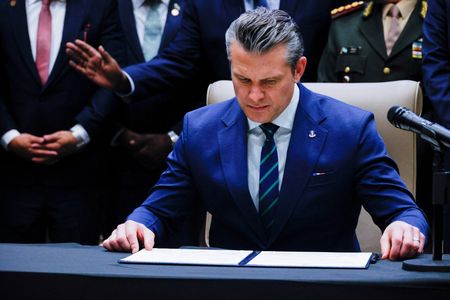
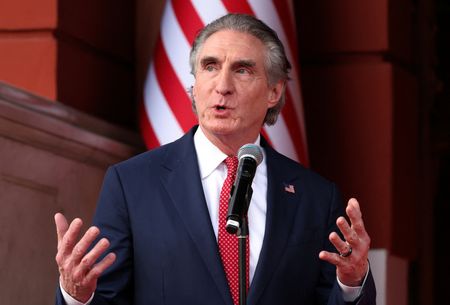
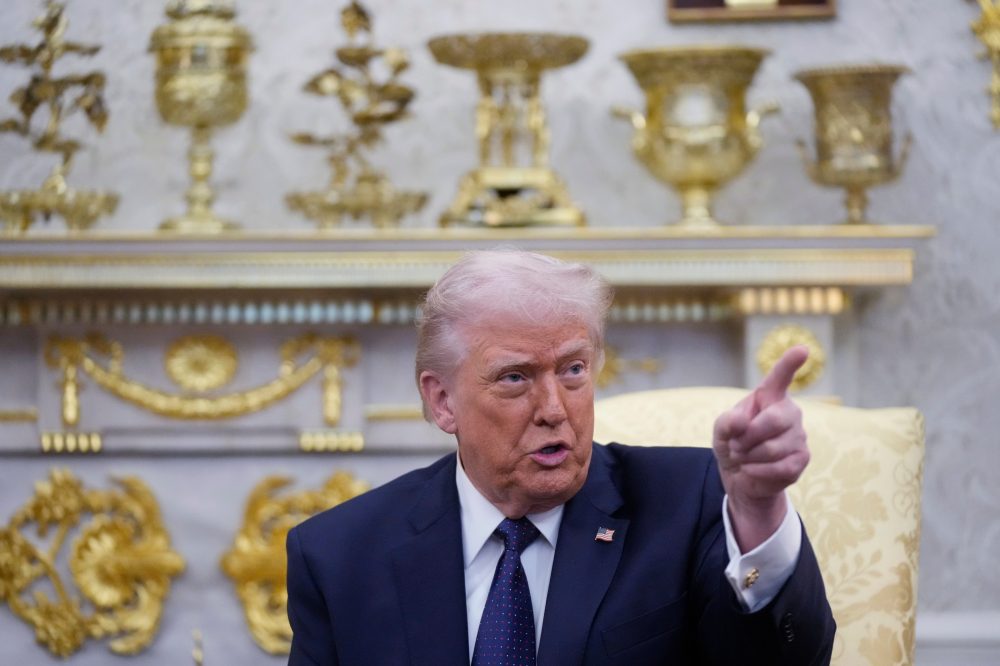
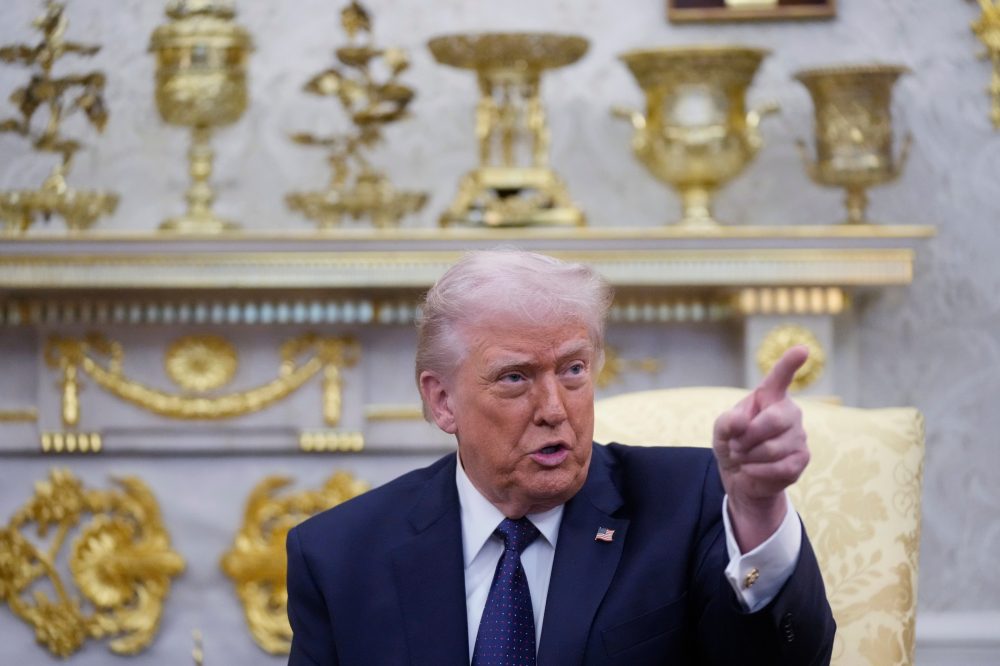
TAMPA, Florida – Defense Secretary Pete Hegseth declared Thursday that America’s military goals regarding Iran remain unchanged, following President Donald Trump’s statement to Reuters that the U.S. should play a role in selecting Iran’s future leadership.
The Pentagon described earlier this week that the military operation, called Operation Epic Fury, aims to eliminate Iran’s offensive missile capabilities, missile manufacturing facilities, and naval forces, while preventing Tehran from obtaining nuclear weapons.
“There’s no expansion in our objectives. We know exactly what we’re trying to achieve,” Hegseth stated.
The Defense Secretary noted that Trump was “having a heck of a say in who runs Iran given the ongoing operation.”
During a phone conversation with Reuters Thursday, Trump indicated that America would need to assist in selecting Iran’s next leader.
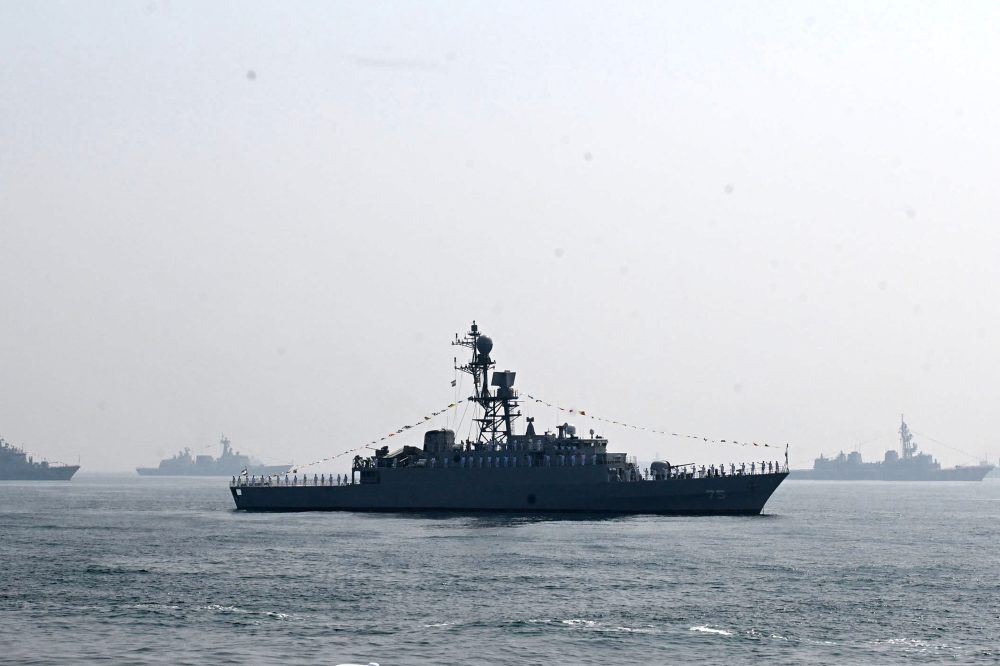
American forces have struck more than 2,000 Iranian targets during the last six days, including naval vessels belonging to Iran’s fleet.
WASHINGTON – America and Venezuela’s temporary leadership have decided to rebuild their diplomatic and consular connections, according to a Thursday announcement from the U.S. State Department. Officials say the focus remains on establishing conditions that would allow for a peaceful shift toward a democratically chosen government.
State Department representatives explained the decision’s purpose, stating: “This step will facilitate our joint efforts to promote stability, support economic recovery, and advance political reconciliation in Venezuela.”
Department officials further elaborated on their approach: “Our engagement is focused on helping the Venezuelan people move forward through a phased process that creates the conditions for a peaceful transition to a democratically elected government.”
Following several months of increased political strain, American forces apprehended Venezuelan President Nicolas Maduro this past January, triggering a series of governmental shifts within the South American nation. These changes included the installation of interim President Delcy Rodriguez.
Since those events unfolded, both nations have slowly begun rebuilding their bilateral connections.
PRISTINA – A midnight deadline came and went Thursday without Kosovo’s parliament selecting a new president, throwing the Balkan nation into another round of political turmoil that threatens to spark yet another emergency election.
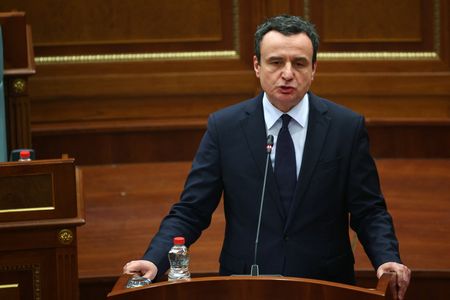
The parliamentary assembly, which contains 120 seats, had until the end of Thursday to choose a head of state. However, Prime Minister Albin Kurti’s governing Vetevendosje party failed to secure sufficient support from opposition members for their presidential nominee.
While opposition groups have called for selecting a candidate with broader consensus, Kurti put forward Foreign Minister Glauk Konjufca for the position.
Parliamentary Speaker Albulena Haxhiu announced the session could not move forward due to insufficient attendance. “There is no quorum to continue this session… we cannot proceed with the vote,” Haxhiu stated, explaining that just 66 legislators showed up – falling short of the minimum 80 needed.
Should emergency elections be triggered, it would mark the third time Kosovo voters head to the polls in slightly more than 12 months. The country previously conducted a snap election on December 28 following the inability to establish a government after February 2025’s voting.
Both major opposition groups – the Democratic Party of Kosovo and the Democratic League of Kosovo – are pushing for the president to authorize new elections.
Current President Vjosa Osmani, whose term continues for another month, is anticipated to announce next steps on Friday.
Israeli Defense Forces have severely crippled Iran’s military capabilities, eliminating approximately 80% of the country’s air defense infrastructure and over 60% of ballistic missile launch systems during the initial stages of Operation Roaring Lion, according to Lt. Gen. Eyal Zamir, Israel’s chief military officer.
The extensive bombardment has granted Israeli warplanes nearly complete dominance over Iranian airspace, Zamir announced in his official statement.
“Within 24 hours, our pilots paved the way to Tehran. We destroyed about 80% of the air defense systems and achieved almost complete air superiority over the skies of Iran,” Zamir stated.
The military campaign has involved extensive aerial operations against Iranian defense installations, with Israeli pilots conducting massive numbers of combat missions.
“So far, Israeli Air Force pilots have carried out 2,500 strikes and dropped more than 6,000 munitions,” the IDF chief reported.
Military sources indicate that numerous attacks have concentrated on missile installations that Israeli leadership considers the primary danger to civilian areas within Israel’s borders.
“Thanks to this and to the high-quality intelligence, we are striking the ballistic missiles that pose a direct threat to the citizens of the State of Israel.”
Zamir added, “We have neutralized and destroyed more than 60% of the ballistic missile launchers, a very significant achievement that reduces the damage to the home front and saves many lives.”
However, the military leader cautioned that Iran continues to pose a security risk to Israel even after the substantial damage to its weapons systems.
“Every missile is lethal, I emphasize that the threat has not yet been removed and still poses a danger,” he warned.
Israeli military leadership indicated plans to escalate operations as the mission enters its next stage.
“We are now transitioning to the next phase of the campaign, in which we will intensify strikes against the regime’s foundations and military capabilities,” Zamir announced.
“We have additional surprise moves at our disposal that I do not intend to reveal,” he concluded.
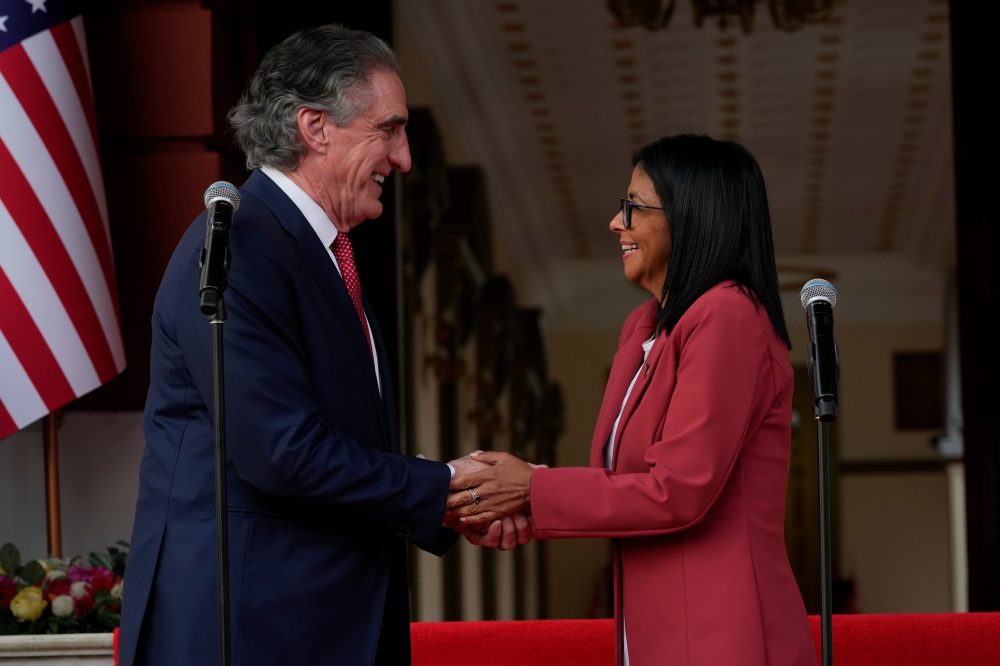
MAIQUETIA, Venezuela — Interior Secretary Doug Burgum announced Thursday that Venezuelan leadership has committed to providing safety guarantees for international mining firms considering investments in the nation, where valuable mineral deposits have traditionally been dominated by criminal organizations, armed groups, and unauthorized miners operating with government and military backing.
Following a two-day visit to Venezuela, Burgum informed the media that acting President Delcy Rodríguez’s administration recognized the security challenges facing potential investors. Legitimate mining development in these dangerous, remote locations represents a key component of the U.S. strategy to help restore stability to the crisis-stricken nation.
“We heard assurances in the meeting today and yesterday that if companies wanted to get to these areas, do due diligence, think about reopening mines, maybe even getting back to mines that they themselves were running 15 or 20 years ago, that this government would ensure their security,” Burgum said.
The Interior Secretary, who chairs President Donald Trump’s National Energy Dominance Council, argued that while illegal operations “created an economic opportunity where there was none,” legitimate investments would deliver a “superior economic opportunity.”
Burgum joins other U.S. officials who have recently visited Caracas to engage with Rodríguez, who assumed power after former President Nicolás Maduro was captured by American forces two months earlier. This diplomatic outreach supports the Trump administration’s efforts to counter China’s dominance in critical mineral supplies — many of which exist abundantly in Venezuela — while advancing plans to stabilize the South American nation that endured severe crisis throughout Maduro’s nearly 13-year presidency.
The Republican government is taking aggressive steps to secure essential mineral supplies required for electric vehicle production, defense systems, and advanced technology after China restricted exports in retaliation for Trump’s comprehensive tariff policies last year. Despite a recent agreement between the superpowers to ease trade tensions and mineral export limitations, China’s restrictions remain more stringent than pre-Trump levels.
Beyond petroleum reserves, Venezuela possesses significant deposits of gold, copper, coltan, bauxite, diamonds, and other valuable minerals, though the poorly regulated mining sector is notorious for dangerous working conditions. Coltan contains niobium and tantalum, both classified as critical minerals essential for smartphone manufacturing and electric vehicle batteries, while bauxite is refined into aluminum, another U.S.-designated critical mineral.
“I believe the steps we are taking demonstrate the goodwill to build this cooperation agenda in the energy and mining sectors, which will strengthen relations between our two countries for the benefit of the people of Venezuela and the people of the United States,” Rodríguez said on state television.
One day prior, Rodríguez revealed plans to request legislative action on comprehensive mining law reforms designed to encourage foreign investment. These modifications will follow the framework of recently enacted oil sector changes that enabled privatization, abandoning a core principle of the socialist government that has controlled the country for over twenty years.
Numerous international corporations with Venezuelan investments, particularly in mining and petroleum, lost their assets to government seizure approximately two decades ago. In 2016, Maduro’s administration created an extensive mining development zone across the country’s central region to compensate for declining oil revenues caused by poor management, corruption, and subsequent U.S. economic sanctions.
Mining activities for gold, diamonds, copper, and other materials have expanded dramatically since then. Most operations are unauthorized mines functioning under harsh conditions with criminal gang involvement, yet desperate Venezuelans continue seeking opportunities to escape poverty through potential quick wealth. Government officials and military personnel receive portions of illegal mining profits in exchange for permitting mine operations, providing fuel and equipment access, and facilitating mineral transportation.
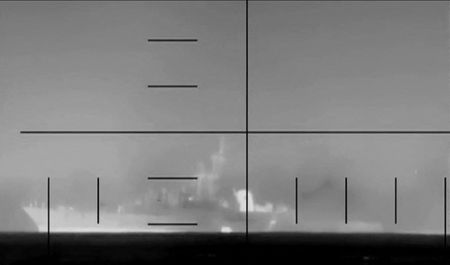
WASHINGTON, March 5 – Pentagon officials announced Thursday that American forces have destroyed more than 30 Iranian naval vessels during the ongoing military conflict involving the United States and Israel against Iran. Among the destroyed craft was an Iranian drone vessel that caught fire during the engagement.
Admiral Brad Cooper, who oversees American military operations in the Middle East as commander of Central Command, briefed reporters on the conflict’s progress. Cooper reported that Iranian ballistic missile strikes have plummeted by 90% compared to the war’s initial day.
The admiral’s briefing provided one of the most detailed accounts to date of the military action’s impact on Iranian naval capabilities in the region.
A drone assault launched by Iran targeted Azerbaijan’s Nakhchivan International Airport on Thursday, March 5, leaving two people wounded and raising fears that ongoing Middle Eastern conflicts are spreading to new regions.
Azerbaijan’s Foreign Ministry reported that two unmanned aircraft originating from Iranian soil attacked the exclave territory. The first drone hit the airport’s terminal building, while the second struck near a local school facility.
Emergency responders rushed to both locations as officials worked to evaluate damage to the airport facilities and nearby structures. Authorities have not disclosed whether flight operations at the airport have been halted.
The Nakhchivan exclave represents an isolated piece of Azerbaijani territory, cut off from the main country by Armenia and positioned along borders shared with both Iran and Turkey. Its proximity to Iran—just 10 kilometers or 6 miles away—leaves it exposed to close-range drone and rocket attacks.
Azerbaijan’s government issued harsh criticism of the assault, with foreign ministry officials calling it a breach of national sovereignty and international legal standards.
“Azerbaijan reserves the right to take appropriate measures,” ministry representatives declared in an official statement released after the bombing.
Diplomatic tensions escalated when Azerbaijan’s Foreign Ministry called in Iran’s ambassador for discussions, according to local media coverage.
Social media footage appeared to capture explosions and flames around the airport area immediately following the attack, though officials have not yet released comprehensive damage assessments.
The bombing occurs amid widening regional warfare that began with joint US-Israeli military operations against Iran on February 28. Recent weeks have seen Iranian missile and drone campaigns hitting multiple locations throughout the area, sparking worries that more nations may become involved in the fighting.
Long-standing defense and intelligence partnerships between Azerbaijan and Israel have created ongoing friction with Tehran. Iranian officials have consistently claimed that Baku permits Israeli spy operations along Iran’s northern frontier—charges that Azerbaijani leaders reject.
Thursday’s assault on Nakhchivan creates the possibility that warfare could extend into the South Caucasus, potentially establishing another battleground in a strategically important area that borders Iran, Turkey, and Russia.
Military officials in Israel project that hostilities with Iran may persist for an additional one to two weeks as forces work to diminish Tehran’s military strength and potentially trigger governmental collapse, according to reporting by the Times of Israel.
Simultaneously, polling data reveals overwhelming support among Israel’s Jewish population for the joint US-Israeli military campaign against Iran.
During the initial five days of combat operations, American and Israeli forces launched 5,000 bombing strikes against Iranian targets.
A high-ranking Israeli Air Force official stated that air operations will continue to expand dominance throughout the region, with special emphasis on the Tehran area.
Speaking to public broadcaster KAN News on Monday, a senior Israeli official suggested the confrontation might stretch even further, potentially continuing through Passover next month. The timeline could shift based on internal Iranian developments, the official noted. Sources indicate that while no directive has been given for Iranian citizens to demonstrate publicly, such a signal may come soon.
KAN News also reported that Israeli security cabinet meetings determined that Iran’s missile attack frequency will likely diminish following days of coordinated strikes by Israeli and US forces. Intelligence assessments suggest Iran currently maintains approximately 200 operational missile launchers.
Domestic polling within Israel reveals sharp divisions along ethnic lines regarding the military operation. Jewish citizens demonstrate overwhelming approval while Arab citizens show significantly less enthusiasm.
Research findings indicate 82% of all respondents endorse Operation Roaring Lion. However, support jumps to 93% among Jewish respondents while dropping to just 26% among Arab citizens.
Jewish support crosses political boundaries, though with varying intensity levels. Right-wing respondents show 97% approval, centrist voters demonstrate 93% backing, and left-leaning citizens register 76% support.
A majority of Jewish survey participants prefer extending operations beyond current military goals. Fifty-seven percent believe the campaign should persist until Iran’s nuclear and missile programs are destroyed and the Ayatollah government is removed, while 36% favor concluding once stated objectives are met.
The polling also found 74% of Jewish respondents express confidence in Prime Minister Benjamin Netanyahu’s handling of the operation, compared to only 16% of Arab participants. Additionally, 74% of Jewish citizens report feeling secure from Iranian attacks, while merely 15% of Arab respondents share that sentiment.
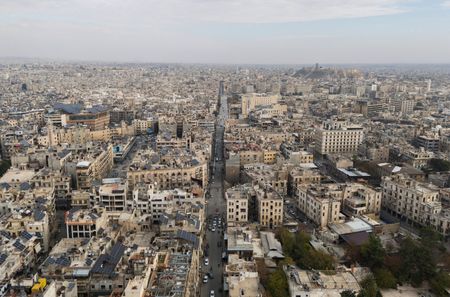
Syrian aviation authorities announced Thursday the reopening of flight corridors linking the northern city of Aleppo to Mediterranean destinations, making these routes available to international carriers amid widespread regional air traffic disruptions.
Omar Hosari, who leads Syria’s Civil Aviation Authority, explained to Reuters that the newly activated pathway will provide secure flight operations for aircraft using Aleppo International Airport. Any carrier meeting established international safety requirements can utilize these routes.
“The corridors are not dedicated exclusively to Syrian Air,” Hosari stated. “Other airlines can use them to transit or operate through Syrian airspace according to the usual regulatory procedures.”
Aviation officials also confirmed Thursday that northern Syrian airspace routes toward Turkey have been restored following comprehensive operational and technical evaluations, taking into account recent regional developments impacting air travel.
The first Syrian Air departure from Aleppo to Istanbul completed its journey successfully on Thursday, signaling the gradual restoration of airport operations. Officials have scheduled an Aleppo-to-Jeddah flight for Friday and are considering additional routes to destinations like Riyadh.
Royal Jordanian is anticipated to utilize the Mediterranean corridor Friday for service between Amman and Aleppo as part of the staged return of commercial aviation to the region.
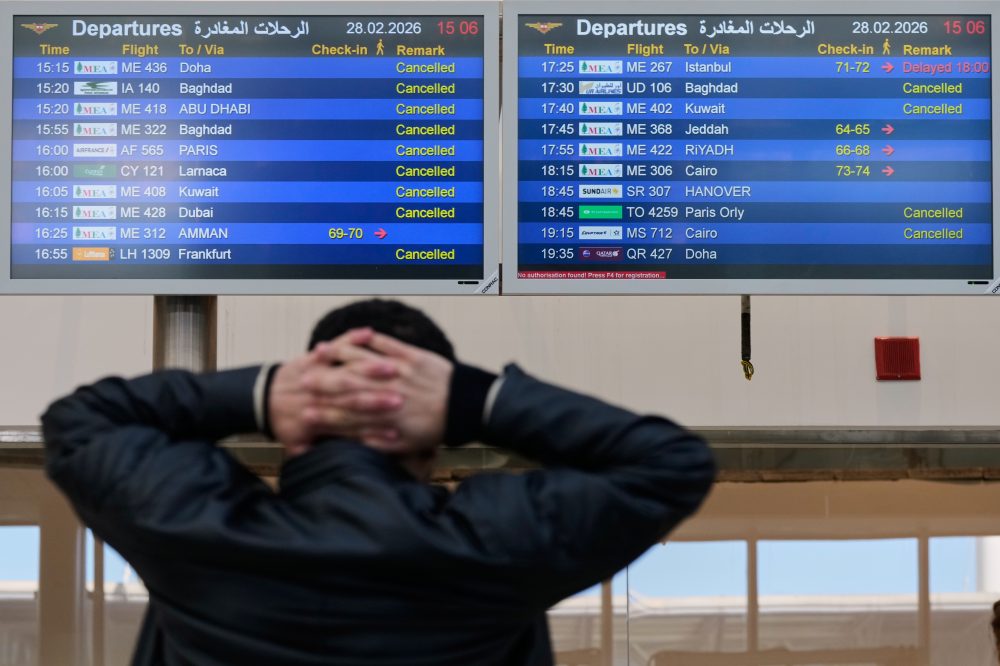
Across much of the Middle East, commercial aviation has remained severely limited, with major Gulf aviation centers including Doha and Dubai – the world’s leading international passenger hub – continuing closures for six consecutive days following U.S.-Israeli military action against Iran and subsequent Iranian retaliation involving missiles and drones throughout the region.
As regional tensions enter their second week, Syria finds itself in a relatively peripheral position, with Iranian military presence eliminated following President Bashar al-Assad’s removal in late 2024, and U.S. military installations in the country evacuated this past February.
News reporters documenting the escalating Middle East conflict are experiencing firsthand the same perils faced by the civilians they’re covering, as rocket attacks continue to target Israel during the sixth day of widening regional warfare.
Media professionals working in the conflict zone find their daily schedules controlled by warning sirens and urgent dashes to nearby protective shelters. Gabriel Coladro, who works as a reporter for The Media Line, described how covering the story from Israel during the ongoing attacks has required constantly stopping his work to find safety alongside his family members.
The dangerous conditions highlight the challenges faced by journalists attempting to document the unfolding crisis while managing their own safety in an active war zone.
Iran’s Islamic Revolutionary Guard Corps has intensified military operations against Kurdish opposition forces, launching a series of drone and missile strikes on their bases in northern Iraq this week.
The attacks come as five Kurdish political organizations have united to form an armed coalition challenging Iran’s government. On Tuesday afternoon, the Revolutionary Guard carried out fresh assaults on Kurdish opposition strongholds in response to this growing resistance movement.
The Kurdistan Democratic Party reported Monday that Iranian forces used three unmanned aircraft to attack the Kurdistan Democratic Party of Iran’s facility in Koy Sanjaq, located in the Erbil region of Iraq. Kurdish news organization Rudaw confirmed that missiles also struck the same location, which serves as home to families of party members.
Iran’s Tasnim News Agency announced Tuesday evening that Revolutionary Guard forces had once again attacked Kurdish opposition sites in the Kurdistan Region, alleging these organizations were “planning infiltration and action against the country.”
“Following a targeted intelligence operation,” Tasnim stated that the locations were “powerfully destroyed” through the deployment of 30 unmanned aircraft. The news agency later claimed that Revolutionary Guard ground units joined the offensive, launching numerous drones at what they characterized as a “US base in Erbil” and conducting “several rounds” of attacks that “destroyed the deployment locations” of Kurdish resistance groups in “northern Iraq.”
No other news organizations have verified the alleged strike on an American military installation in Erbil. This development occurs as numerous Revolutionary Guard command facilities, including ground force headquarters, have faced targeting by US and Israeli forces over the past four days.
Reports indicate that US President Donald Trump conducted telephone conversations Sunday with Iraq’s primary Kurdish faction leaders, Masoud Barzani of the Kurdistan Democratic Party and Bafel Talabani of the Patriotic Union of Kurdistan, discussing the ongoing US-Israeli conflict with Iran’s government.
Axios reported that these communications followed extensive lobbying efforts by Israeli Prime Minister Benjamin Netanyahu to promote increased American involvement and coordination with Kurdistan Region leadership. The Wall Street Journal has also indicated that the US president is evaluating potential support for Kurdish resistance forces opposing Iran’s regime.
Numerous Iranian Kurdish organizations have maintained relatively strong connections with Israel over many years, and the Kurdistan Free Life Party (PJAK)—among the five Kurdish groups that recently established a unified opposition front against Iran’s government—has openly declared that if Iranian liberation requires Israeli cooperation, such partnership would be welcomed.
Peyman Viyan, serving as one of PJAK’s dual leaders and recognized as the sole female commander among Iran’s Kurdish political movements, stated in one discussion that PJAK presently maintains no connections with America or Israel. However, in remarks cited by Israel’s Channel 12, she indicated that Iranian freedom might be achieved through collaborative efforts between Iranians and Israel.
Additionally, Abdullah Mohtadi, who leads the Komala Party of Iranian Kurdistan as secretary-general, recently conducted meetings with US Congressional representatives during a Washington visit. Kurdish organizations—which maintain substantial armed peshmerga military units—seem to have gained increased significance in American and Israeli policy considerations during this period when both nations are engaged in conflict with Iran’s leadership.
Nearly all Iranian Kurdish political groups advocate for Kurdistan autonomy within Iran alongside broader Iranian freedom. Recently, however, exiled Crown Prince and overseas opposition leader Reza Pahlavi responded harshly to the five-party Kurdish alliance, referencing “suppression by the army,” comments that generated widespread condemnation.
On Tuesday, he released a video statement revising his previous position, expressing support for eliminating discrimination against Iran’s ethnic minorities, including Kurdish populations.
During recent weeks, Kurdish resistance organizations have engaged in repeated confrontations with the Revolutionary Guard, prompting Iran’s government to respond with missile attacks on their facilities. Since Sunday, however, Tehran has significantly escalated missile and drone operations against Iranian Kurdish party bases and settlements in Iraq.
On Monday, Kurdistan Region Prime Minister Masrour Barzani, without specifically identifying the Revolutionary Guard, issued warnings against continued missile and drone attacks, characterizing them as “terrorist attacks,” and urged Iraq’s federal government to take action.
President Donald Trump launched a scathing attack on Israeli President Isaac Herzog Thursday, demanding he immediately pardon Prime Minister Benjamin Netanyahu and accusing him of breaking multiple promises to do so.
According to journalist Barak Ravid’s reporting, Trump claimed Herzog had made several pledges to pardon Netanyahu but never delivered on them. The President reportedly labeled Herzog “a disgrace” and insisted he should issue the pardon right away.
“He promised me five times that he would grant Bibi a pardon,” Trump stated, using Netanyahu’s well-known nickname. “I don’t want anything on Bibi’s mind other than fighting against Iran.”
Trump’s harsh words inject fresh controversy into the ongoing discussion about Netanyahu’s corruption case, which launched in 2020 with allegations of bribery, fraud, and breach of trust. Netanyahu has maintained his innocence throughout and claims the charges are politically driven.
The U.S. President has consistently backed Netanyahu and drawn parallels between the Israeli leader’s legal challenges and what Trump characterizes as politically motivated cases against him in America. In his recent statements, Trump indicated that the court proceedings might interfere with Israel’s focus during heightened tensions with Iran.
Israeli law gives the president power to issue pardons. These decisions usually follow recommendations from legal experts and thorough examination of case details. While the idea of pardoning Netanyahu has emerged in Israeli political discussions before, it continues to spark debate.
Herzog’s representatives have previously stated that any pardon consideration would go through appropriate legal channels and have rejected assertions that the president made definitive commitments on this matter.
This confrontation unfolds during a critical time for Israel as the nation continues dealing with expanding regional tensions involving Iran following recent military actions and counter-strikes throughout the Middle East.
Trump’s statements represent an unusually bold intervention by a U.S. leader in Israel’s domestic legal and political matters while highlighting his belief that Netanyahu should concentrate solely on dealing with Tehran.
Interior Secretary Doug Burgum wrapped up a two-day diplomatic mission to Venezuela on Thursday, expressing strong confidence about future investment prospects in the South American nation’s mining sector.
Speaking to reporters before his departure from Caracas, Burgum highlighted upcoming legislation that will open doors for international companies, with operating permits expected soon. Venezuela’s interim administration under Delcy Rodriguez has pledged to protect foreign businesses, according to the Interior Secretary.
Burgum, who leads the U.S. National Energy Dominance Council, praised interim President Rodriguez’s efforts to welcome foreign capital into Venezuela’s oil and mineral sectors, reflecting similar endorsements from President Donald Trump.
This marks the second high-level U.S. cabinet visit to Venezuela following January’s military operation that resulted in Nicolas Maduro’s capture. Energy Secretary Chris Wright made a similar trip last month.
Venezuela possesses vast mineral wealth including gold, iron ore, bauxite and coltan, but current production levels remain far below potential. Mining facilities require substantial repairs and modernization investments, while major state enterprises CVG and Minerven continue facing financial constraints and U.S. sanctions.
Foreign investment dried up over the past decade after nationalizations implemented under former President Hugo Chavez. Industry analysts believe rapid export growth is possible, especially for gold, though they warn that enormous capital investments and renewed exploration efforts will be necessary.
The Interior Secretary’s delegation included more than 24 mining and mineral companies. Thursday morning meetings in Caracas brought together major international oil and gas firms with leading Venezuelan corporate and banking executives.
When questioned about corruption concerns and security challenges, including armed groups involved in illegal mining operations, Burgum emphasized that interested companies have demonstrated strong ethical standards and that new regulations will generate employment opportunities.
“I think you’re going to see this government very concerned about providing the right kind of security. We heard assurances in the meeting today and yesterday that if companies wanted to get to these areas, do due diligence, think about reopening mines, maybe even getting back to mines that they themselves were running 15 or 20 years ago, that this government would ensure their security,” Burgum said.
“I’m feeling very optimistic about an environment where investment is going to flow, not just to offshore oil and gas, not just to Caracas but actually to the interior where these enormous resources exist,” he added.
Burgum indicated that general mining licenses, similar to those already granted to oil companies, will be available shortly.
CAIRO (AP) — American and Israeli forces have launched an unprecedented military campaign against Iran, targeting a far broader range of objectives than previous conflicts. Military analysts say the current strategy appears focused on dismantling Iran’s defense capabilities and undermining its religious government structure.
According to U.S. Central Command, more than 2,000 targets have been attacked in under seven days, representing the most intensive American bombing operation in the Middle East region in over ten years, based on data from Airwars, a conflict monitoring organization. Israeli officials report striking hundreds of additional locations.
The coordinated assault has reached from Tehran, the nation’s capital, to numerous cities throughout Iran, with airstrikes hitting government leadership, defense installations, weapons manufacturing plants, security forces, and state broadcasting facilities.
While the complete extent of destruction remains unclear, Armed Conflict Location and Event Data (ACLED), an independent monitoring organization, described it as “a more significant blow than anyone expected might happen in such a short time.” The group noted that despite the death of Supreme Leader Ayatollah Ali Khamenei, Iran’s emergency leadership still maintains “the ability for domestic coercion.”
Casualty figures are challenging to verify due to communication disruptions. Iranian government sources report at least 1,230 fatalities. State media indicates that 165 people, primarily children, died when airstrikes hit a school in southeastern Iran.
The bombing campaign eliminated Khamenei at his residential compound in central Tehran during initial attacks on February 28. Additional strikes killed Iran’s defense minister, Republican Guard commander, Khamenei’s chief security advisor, and other high-ranking officials.
Attacks also damaged a religious site associated with Khamenei’s predecessor and created a large hole in the dome of an Assembly of Experts building, which houses senior Shiite clerics responsible for selecting the next supreme leader.
The Revolutionary Guard, Iran’s primary military force, and the Basij paramilitary organization have been major targets. ACLED documented over 280 strikes by Wednesday, with more than 20% aimed at Revolutionary Guard or Basij positions, particularly in Tehran and Iran’s western and southern regions. Military bases, underground facilities, weapons storage sites, manufacturing plants, and command centers have all sustained damage.
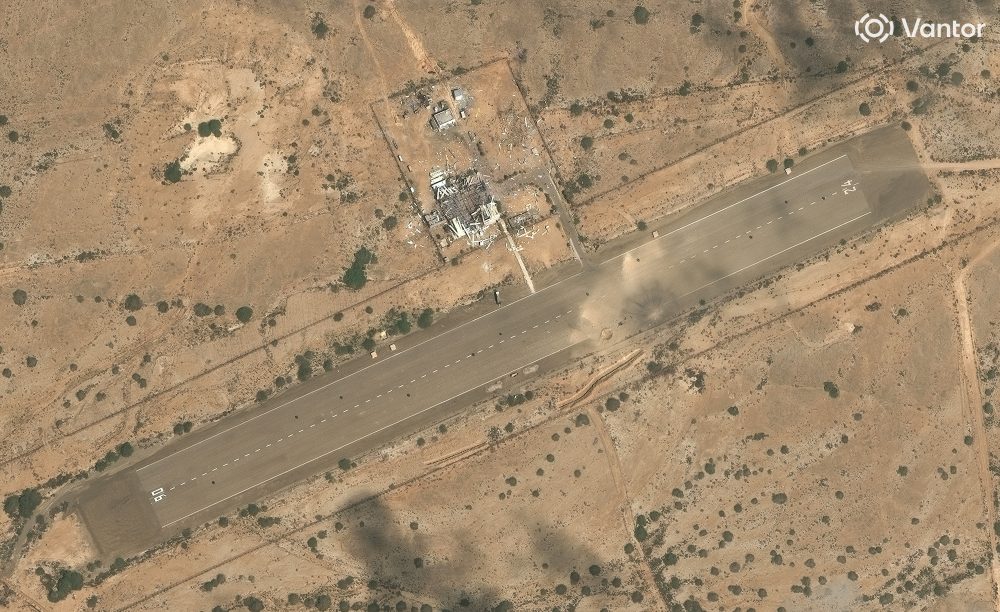
Satellite imagery from Vantor, a U.S. imaging company, shows multiple demolished buildings at the Revolutionary Guard’s northern Tehran headquarters. Local Basij offices have also been struck throughout the country.
Thursday’s attacks included two Tehran sports venues, notably the expansive Azadi Sports Complex, once considered as an Olympic host site. Verified video footage shows a massive hole in the roof of a 12,000-seat arena. Military analysts note that the Guard and Basij frequently use athletic facilities as assembly points.
However, ACLED observed that “a lot of empty buildings” have also been targeted, suggesting not every strike delivers strategic value.
American and Israeli officials identify Iran’s missile capabilities as a primary target. Strikes hit suspected missile installations in the mountains near Isfahan and outside Kermanshah, where satellite photos from Planet Labs PBC reveal crater-damaged roads leading to underground mountain tunnels. The Garmdareh missile facility near Tehran also suffered extensive building damage.
Iran previously possessed thousands of short and medium-range missiles. Despite ongoing attacks, the country continues launching missiles and drones at Israeli targets, American Persian Gulf bases, and regional energy infrastructure. A senior Western intelligence official, speaking anonymously, estimated Iran has several days of ballistic missile reserves at current firing rates, though it may conserve some for extended operations.
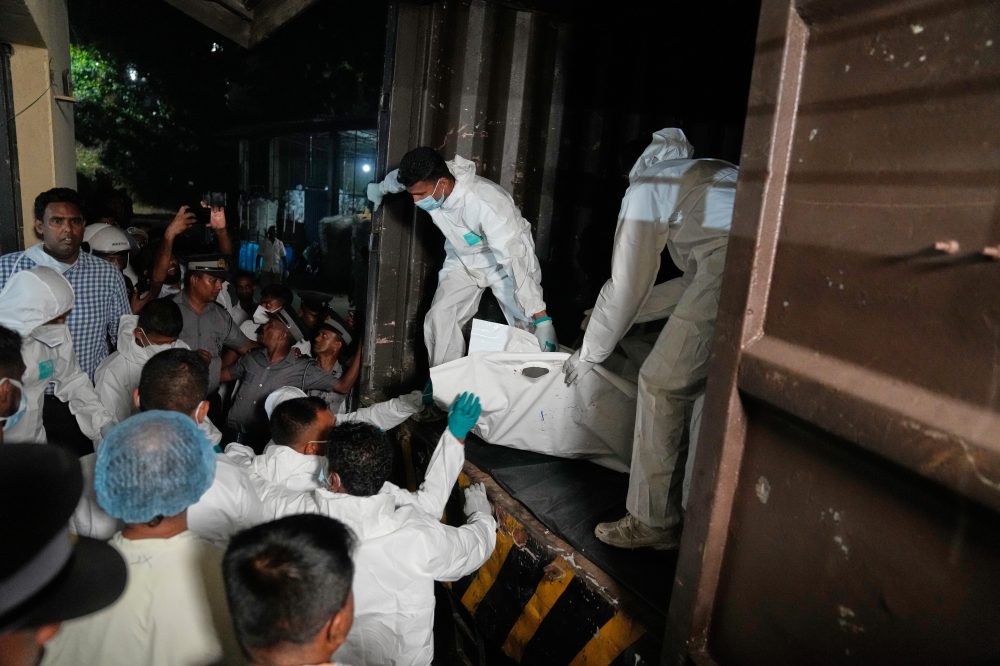
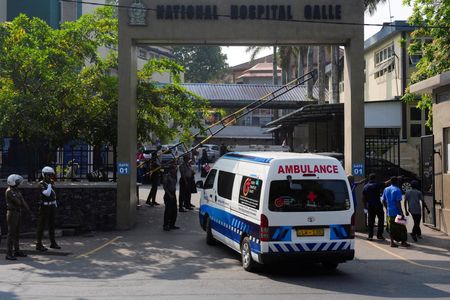
Naval assets have also been targeted. Vantor satellite photos show a capsized vessel at the Konarak Naval Base on Iran’s southern coast following strikes there. A U.S. submarine sank an Iranian warship near Sri Lanka, where authorities recovered 87 bodies and rescued 32 Iranian sailors on Wednesday.
Military-connected manufacturers have faced attacks as well. In Isfahan, ACLED documented strikes on Isfahan Optics Industries, which faces international sanctions due to suspected nuclear program connections.
Tehran’s main police headquarters sustained multiple building collapses, according to Planet Labs satellite imagery. The national police force, led by a Revolutionary Guard general, plays a crucial role in Iran’s internal security and has violently suppressed anti-government demonstrations.
Local police stations have also been targeted, including one near Tehran’s Grand Bazaar, where late December protests grew into massive nationwide demonstrations before being violently suppressed in early January.
The state television and radio network IRIB has endured repeated attacks while maintaining broadcasts. Its main headquarters in northern Tehran shows visible damage. Sunday strikes on another IRIB facility brought down transmission equipment and severely damaged the nearby Gandhi Hospital, shattering its exterior and scattering debris throughout patient areas.
Nuclear facilities have received limited attention so far, though Israel has indicated future targeting. Monday satellite images reveal new damage at the Natanz nuclear facility, Iran’s primary enrichment site. The International Atomic Energy Agency stated there was “no radiological consequence expected.”
Israeli military officials reported striking mountains north of Tehran where they claim Iran secretly relocated nuclear activities to underground bunkers following last summer’s 12-day conflict.
Iran continues asserting its nuclear program serves peaceful purposes, though officials previously threatened weapons development while enriching uranium to near-weapons-grade concentrations.
ATHENS, Greece (AP) — A Greek man has experienced profound emotions after discovering a photograph that captured his grandfather’s final moments before being executed by Nazi forces during World War II.
Thrasivoulos Marakis spent his life listening to family stories about his namesake grandfather, whom he never had the chance to meet. The tales described a towering man who lost his life during Nazi retaliation operations in Greece throughout the war.
Throughout the years, Marakis possessed only a single faded family photograph of his grandfather.
However, a new image surfaced last month through an online auction. The photograph depicted his grandfather walking with composure toward his execution alongside fellow prisoners.
This discovery has deeply affected the Marakis family and generated intense emotions throughout Greece, where the killing of 200 prisoners by Nazi occupying forces on May 1, 1944 stands as one of the nation’s most moving representations of wartime defiance.
The photographs hold profound personal significance for Marakis.
“They went to their deaths with their heads held high so that we could be free today,” he said.
On Thursday, the Culture Ministry unveiled these disturbing photographs of the execution — the first authenticated images ever released publicly — following their acquisition of the collection from a private collector in Belgium.
Marakis, a Crete resident, identified the tall, broad-shouldered figure leading one group — with rolled-up sleeves, walking forward with dignity — as his grandfather, 40-year-old dairy farmer Thrasivoulos Kalafatakis.
He presented the image to aging family members and their acquaintances, including a local 97-year-old woman.
“That’s when I got the final confirmation,” he told The Associated Press. “It was very moving for the family — deeply, deeply moving.”
The photograph captures prisoners marching under guard toward Athens’ Kaisariani firing range, where they faced execution in groups of 20 as retaliation for a resistance attack that killed a German commander in southern Greece.
The Greek government acquired the archive from a Belgian collector for 100,000 euros ($115,700). The collection contains 262 photographs captured by German Wehrmacht lieutenant Hermann Heuer, who served in Greece during 1943–44, plus wartime currency and news clippings from that era.
While unveiling the materials in Athens, Culture Minister Lina Mendoni explained that the images offer compelling evidence of Nazi occupation strategies and restore personal identities to victims previously known primarily through written records.
“The value of this collection is immense,” Mendoni said. “The photographs…are priceless, because they give a face and a visual dimension to historical testimonies.”
“What matters is how the Greeks faced the Nazi system with courage,” she added.
Multiple photographs document the prisoners’ last moments.
One sequence shows trucks carrying detainees along unpaved roads from Athens’ outskirts Haidari prison camp to the execution site east of the city center. Another image captures the men entering the shooting area, where stacks of jackets sit piled beside the entrance.
Valentin Schneider, a researcher at the University of Athens’ Department of History and Archaeology who assisted in authenticating the images, explained the detail’s importance.
“Most likely it was on the orders of the German army,” Schneider said. “To make the bullets penetrate more easily, they asked them to remove their coats and heavy clothing.”
Additional photographs document seldom-recorded moments: one captures the precise instant gunfire erupts, while another shows the executed prisoners on the ground, all having fallen backward.
Historians note that such visual documentation is exceptionally uncommon.
Throughout Nazi occupation of Greece from 1941 to 1944, German commanders regularly ordered executions of hostages or civilians following resistance operations.
Many prisoners killed at Kaisariani had been detained years before by Greece’s pre-war authoritarian government for communist political activities and remained incarcerated when German forces took control of the country.
The 200 prisoners faced execution in response to the ambush and assassination of a German military commander in southern Greece by resistance fighters.
The archive also exposes another aspect of the German officer who captured the photographs. Among the images are glimpses of Heuer’s personal life — including swimming near Athens, touring the Acropolis and spending time with his family after returning to Germany.
Stavroula Fotopoulou, director of the Culture Ministry’s antiquities and cultural heritage department, explained that the photographs represented a wider system promoted by the Nazi regime.
They “created a powerful propaganda machine, not only with professional photographers in the propaganda units, but by encouraging everyone — soldiers and their families — to take photographs,” she said. “Why? So these images could be sent back home and build the impression of the Wehrmacht’s successes.”
Mendoni announced that official identification of individuals shown in the photographs will commence immediately. Digital versions will be distributed to victims’ families as well as institutions and museums requesting them.
“In that moment, the Greeks — and these people in particular — showed true greatness,” Mendoni said. “They reacted with bravery and dignity. That’s what we must hold on to.”
Marakis stated the images demonstrate his grandfather “stood by his beliefs and his ideology. He never renounced them”
He added: “If he had renounced them, he would have lived longer.”
These represent just some of the evolving justifications the Trump administration has offered for its military campaign against Iran and the assassination of Iranian leadership, all without first obtaining congressional approval or allied support. Key details remain murky about this expanding conflict initiated by the president, including how it will end, when operations might conclude, and which groups Trump envisions replacing what he terms the “sick people” currently governing Iran.
What sets this U.S.-Iran confrontation apart from previous tensions is the apparent lack of coordination among Trump administration officials regarding fundamental questions: What are the objectives and why act at this moment?
“Typically, you establish a unified rationale from the outset and maintain consistent communication,” explained David Schenker, formerly of the Trump administration and currently with the Washington Institute for Near East Policy. “However, this presents difficulties for the current administration.”
By midweek, White House officials characterized the Republican president’s launch of Operation Epic Fury as responding to historical Iranian threats against America “and the president’s assessment, grounded in evidence, that Iran presents an immediate and direct danger to the United States of America.” Experts question this characterization.
Below are selected explanations from Trump administration representatives during the past week as the U.S.-Israel confrontation with Iran escalated into warfare.
STATEMENTS FOLLOWING U.S.-ISRAEL ATTACKS ON IRAN LAST SUMMER:
“THE NUCLEAR SITES IN IRAN ARE COMPLETELY DESTROYED!” Trump declared in a June 24, 2025, Truth Social posting.
RESPONSES TO INTELLIGENCE REPORTS SUGGESTING IRAN’S NUCLEAR PROGRAM SUFFERED ONLY TEMPORARY SETBACKS:
“That is a false story, and it’s one that really shouldn’t be re-reported,” Secretary of State Marco Rubio stated during a June 25, 2025, Politico interview.
COMMENTS SINCE THE ASSASSINATION OF IRANIAN SUPREME LEADER AYATOLLAH ALI KHAMENEI:
“If we didn’t do what we’re doing right now, you would have had a nuclear war and they would have taken out many countries because, you know what? They’re sick people,” Trump said Tuesday at the White House.
CONTEXT:
Tehran has consistently maintained its nuclear program serves peaceful purposes, though the UN’s nuclear monitoring agency and Western governments assert Iran operated an organized weapons program until 2003.
The program’s current status remains unknown since officials have blocked International Atomic Energy Agency inspectors from accessing bombed nuclear sites since June. This information comes from a confidential watchdog report distributed to member nations and obtained February 27 by The Associated Press.
Iran claims it has halted enrichment activities since June. AP analysis of satellite imagery reveals renewed activity at two targeted locations, indicating Iran may be evaluating damage and potentially salvaging materials.
Under the Treaty on the Non-Proliferation of Nuclear Weapons, Iran must cooperate with the IAEA, but suspended all collaboration following the conflict with Israel.
ADMINISTRATION STATEMENTS:
“Iran possesses a very large number of ballistic missiles, particularly short-range ballistic missiles, that threaten the United States and our bases in the region, and our partners in the region, and all of our bases in the UAE, Qatar and Bahrain,” Rubio told reporters February 25.
“The regime already had missiles capable of hitting Europe and our bases — both local and overseas — and would soon have had missiles capable of reaching our beautiful America,” Trump stated during a Monday White House Medal of Honor ceremony.
Iran “was building powerful missiles and drones to create a conventional shield for their nuclear blackmail ambitions,” Defense Secretary Pete Hegseth said during Monday’s Pentagon briefing.
CONTEXT:
Iran has not confirmed intentions to develop intercontinental ballistic missiles. The nation maintains self-imposed restrictions on its missile program, capping range at 2,000 kilometers (1,240 miles). This reaches throughout the Middle East and portions of Eastern Europe.
Trump administration representatives informed congressional staff during private Sunday briefings that U.S. intelligence indicated no Iranian preparations for preemptive strikes against America. Officials instead acknowledged broader threats from Iran and affiliated groups.
“There’s been a lot of reporting that the assessments from the intelligence and military didn’t suggest that there was going to be an Iranian first strike,” noted Naysan Rafati, senior Iran analyst at the Washington-based International Crisis Group. “My sense has been that opportunity is at least as much of a significant factor as threats, certainly.”
ADMINISTRATION STATEMENTS:
“We knew that there was going to be an Israeli action. And we knew that if we didn’t preemptively go after (Iran) before they launched those attacks, we would suffer higher casualties,” Rubio told reporters Monday.
“Israel was determined to act in its own defense here, with or without American support,” House Speaker Mike Johnson, R-La., informed reporters. Should that have occurred, he continued, “exquisite intelligence” indicated Iran would target American assets. “If we had waited, the consequences of inaction on our part could have been devastating,” he stated.
“No,” Trump responded to White House reporters Tuesday when questioned whether Israel pressured his decision to attack Iran. “If anything, I might have forced Israel’s hand.”
CONTEXT:
No evidence suggests Israel was compelled to cooperate with the U.S. in these strikes.
An Israeli military official, speaking anonymously per protocol, described coordinated planning between America and Israel Wednesday. Three weeks prior to the attacks, Israel recognized the operation was heading toward renewed Iranian confrontation and dispatched a team to the Pentagon, the official revealed. On Friday, Israeli forces deliberately indicated military stand-down for the weekend, releasing images showing personnel and senior commanders departing for Shabbat dinner.
This shared intelligence enabled strikes to proceed hours later in a surprise daytime assault, sources familiar with the operation informed the AP over the weekend. The eventual U.S.-Israeli attack barrage occurred so rapidly they were nearly simultaneous — three strikes across three sites within one minute — eliminating Khamenei and approximately 40 senior officials, another Israeli military official reported Sunday.
During operations, American and Israeli command centers maintained real-time synchronization for rapid tactical adjustments, the first Israeli military official said Wednesday.
In a televised statement, Prime Minister Benjamin Netanyahu announced Israel conducted the strikes “in full cooperation” with the United States.
ADMINISTRATION STATEMENTS:
“If Iran shoots and violently kills peaceful protesters, which is their custom, the United States of America will come to their rescue. We are locked and loaded and ready to go,” Trump posted on Truth Social January 2.
“When we are finished, take over your government. It will be yours to take,” Trump addressed Iranians on Truth Social immediately following initial strikes.
“This is not a so-called regime change war. But the regime sure did change, and the world is better off for it,” Hegseth stated at Monday’s Pentagon briefing.
CONTEXT:
America maintains an extensive, complex regime change history. Consider Vietnam, Panama, Nicaragua, Iraq and Afghanistan following September 11, 2001, and Venezuela recently.
Regarding Iran specifically, the CIA assisted in engineering a 1953 coup that removed Iran’s democratically elected leader and granted near-absolute authority to Shah Mohammad Reza Pahlavi. However, like the shah, who was overthrown during Iran’s 1979 Islamic Revolution, regime change rarely proceeds as intended.
This occurs partly because such outcomes remain beyond Trump’s complete authority, as he acknowledged Tuesday.
“Most of the people we had in mind are dead,” he informed reporters. “Now we have another group. They may be dead also based on reports. So, I guess you have a third wave coming, and pretty soon we’re not going to know anybody.”
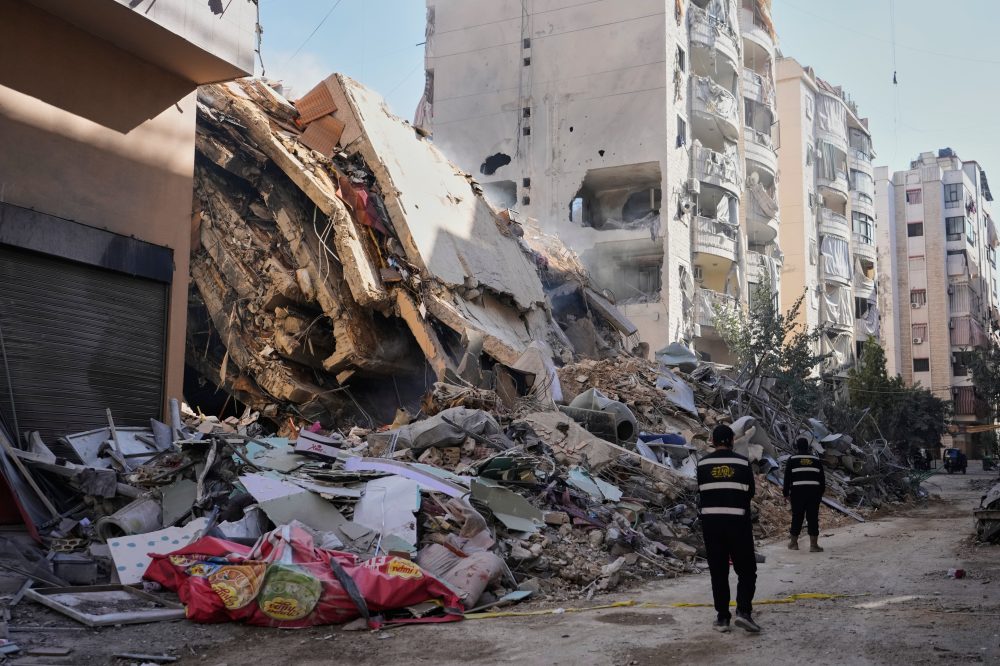
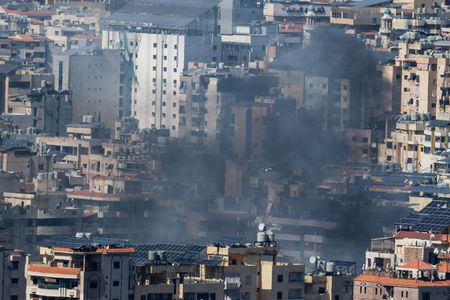
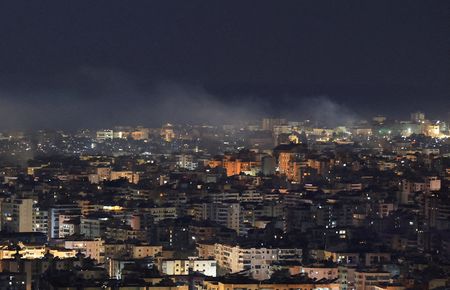
BEIRUT (AP) — Massive traffic jams clogged Lebanon’s capital Thursday as thousands of frightened civilians attempted to escape following an Israeli military directive demanding the complete evacuation of Beirut’s southern neighborhoods, suggesting preparations for extensive bombing operations in the region.
The directive targeting the district called Dahiyeh urged civilians to “save your lives and evacuate your homes immediately,” while providing specific escape routes for residents in different neighborhoods.
Throughout the renewed fighting between Israeli forces and Hezbollah militants, Israel has targeted locations in Beirut’s outskirts and previously warned all residents south of the Litani River to abandon their communities, though this marks the first comprehensive evacuation directive for areas within the Lebanese capital itself.
Following recent U.S. and Israeli operations against Iran that sparked renewed Middle Eastern warfare, Hezbollah fired rockets and unmanned aircraft toward Israel Monday for the first time in more than twelve months, prompting Israeli counter-strikes against southern Lebanon and Beirut’s southern districts.
The fighting has resulted in 102 deaths and displaced over 83,000 Lebanese citizens prior to Thursday’s evacuation directive.
Hadi Kaakour, a resident fleeing Beirut’s southern neighborhoods, expressed uncertainty about finding safety even after leaving his home.
“We don’t put anything past them (Israel), they will strike us no matter where we go,” he said.
Other evacuees voiced anger about Lebanon becoming entangled in the broader regional conflict.
“We got sucked into a mess that we have nothing to do with,” said Yousef Nabulsi, another fleeing resident. “People have been displaced and are now staying on the streets, and this is wrong.”
United Nations peacekeeping forces stationed in southern Lebanon witnessed and monitored fighting in the region as additional Israeli military units crossed the border, according to a representative from the United Nations Interim Force in Lebanon, known as UNIFIL, who spoke Thursday. This marked the initial official confirmation of active combat operations.
“Ground combat was observed west of Kfar Kila,” a village near the border with Israel, overnight, which included “firing of shots,” UNIFIL spokesperson Tilak Pokharel said. In Khiyam, a town about 5 km (3 mi) from the border, he said peacekeepers saw “air attacks and flares and heard explosions.”
Israeli officials announced Tuesday they deployed reinforcements to southern Lebanon. Israeli military units had maintained control of multiple border positions in Lebanon following a November 2024 ceasefire that ended the earlier Israel-Hezbollah conflict.
Lebanese military forces withdrew from border areas as Israeli troops advanced, while Hezbollah released multiple statements claiming successful attacks against advancing Israeli forces and distributed footage showing a tank being hit by a guided missile. Israeli military officials reported Wednesday that two soldiers sustained injuries from anti-tank weapons fire in Lebanon.
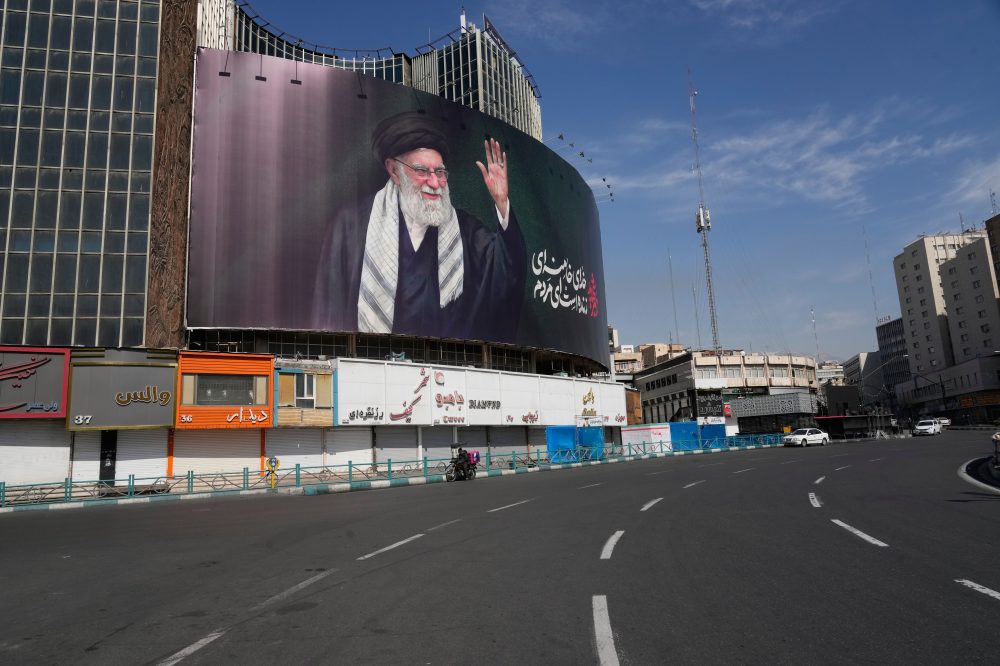
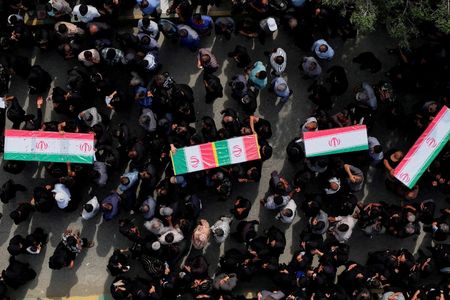
TEHRAN — Joint military strikes conducted by the United States and Israel have devastated Iran’s capital city, creating widespread destruction and claiming the life of Iran’s supreme leader in the attacks.
Photographs from Tehran reveal extensive damage throughout the city, with columns of smoke billowing over the urban landscape and numerous structures reduced to debris. Citizens in the Iranian capital are grieving the loss of their nation’s highest-ranking leader, who perished during the bombardment.
The images, compiled by Associated Press photographers, document the aftermath of the coordinated assault on the Middle Eastern nation’s seat of power.
Ukrainian President Volodymyr Zelenskyy delivered sharp criticism Thursday toward Hungarian Prime Minister Viktor Orban, who has prevented approval of a vital $104 billion European Union assistance package that Ukraine desperately needs in its ongoing conflict with Russia.
The financial support from international partners has become essential for Ukraine’s budget operations, as the country redirects most government resources toward military defense. Hungary, an EU nation that has kept friendly relations with Moscow, rejected the aid package earlier this month during disagreements over petroleum supply issues.
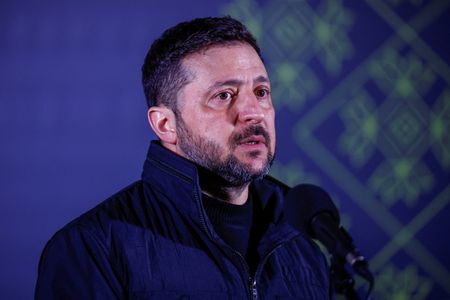
“We hope a certain person in the EU will not keep blocking the 90 billion… and Ukrainian soldiers will have weapons,” Zelenskyy stated during a press conference in Kyiv.
“Otherwise, we will give the address of this person to our armed forces, our guys. Let them call him, speak with him in their own language.”
These comments are expected to increase friction between the two leaders as Russia’s four-year military campaign against Ukraine continues, while Orban – who will face voters on April 12 – has avoided directly criticizing Moscow’s actions.
Hungary’s rejection of both the financial aid and additional EU penalties against Russia stems from what Budapest claims was Ukraine’s intentional disruption of oil flowing through the Druzhba pipeline that transports Russian petroleum to European markets.
Ukrainian officials maintain that petroleum shipments ceased following Russian strikes on pipeline facilities in January, and repair crews are working to restore operations as quickly as possible. Zelenskyy announced Thursday that the Soviet-built pipeline system could resume functioning within six weeks.
“They (the Russians) are killing us, and we’re supposed to give poor little Orban oil, because without it he won’t win elections?” he said.
Orban has positioned the Ukrainian conflict as a central issue in his upcoming reelection campaign.
Ukrainian forces continue defending against persistent Russian offensives across multiple sections of the 750-mile battle line, while Kyiv navigates American pressure for peace negotiations and resists Russian demands for territorial concessions.
Although facing disadvantages in weaponry and personnel, Ukraine’s military has reclaimed ground in recent weeks, with February marking the first month since 2023 where territorial gains exceeded losses, according to analysis from the Finland-based Black Bird Group.
European foreign ministers attempted unsuccessfully this month to convince Budapest against penalizing Ukraine for delays in pipeline restoration, which also affects Slovakia, another EU neighbor of Ukraine.
Slovakia, led by Prime Minister Robert Fico who also maintains sympathetic views toward the Kremlin, announced it would deny Ukrainian requests for emergency electrical power until oil deliveries restart through the Druzhba system.
MOSCOW – Russian investigators announced Thursday that corruption charges have been filed against a high-ranking former defense ministry official, marking another development in an extensive investigation targeting military leadership.
According to the state Investigative Committee, Ruslan Tsalikov faces accusations of embezzlement, money laundering, and accepting bribes during his time in government service.
Tsalikov held the position of first deputy defense minister for nearly a decade, serving from 2015 until 2024. His tenure coincided with a period that saw widespread corruption investigations result in the detention of numerous high-ranking military officers, deputy ministers, and civilian defense personnel.
The prosecution follows a pattern of similar cases, including that of former deputy minister Timur Ivanov, who received a 13-year prison sentence in July 2025.
Both Tsalikov and Ivanov worked under the leadership of Sergei Shoigu, who maintained a close relationship with Russian President Vladimir Putin for many years. Shoigu’s role as defense minister ended in 2024 when he was reassigned to lead Russia’s Security Council.
HAVANA (AP) — Large areas of western Cuba continue to experience power outages on Thursday, almost 24 hours after a widespread electrical failure struck the region in another incident attributed to the island’s deteriorating power infrastructure and fuel shortages.
Repair teams have been working through the night to fix a damaged boiler at a major thermoelectric facility, though authorities caution that complete power restoration may require three to four days.
According to state media, approximately 297,000 Havana residents, representing 34% of customers, currently have electricity, along with 37 medical facilities and five water treatment facilities.
Cuba’s Electric Union posted on X that the power system is functioning “in a limited capacity, prioritizing basic services, primarily health and water supply.”
State media indicated that two generating facilities are currently shut down due to petroleum shortages.
The island nation has faced ongoing challenges with its deteriorating electrical infrastructure and unreliable fuel deliveries, with the situation worsening significantly in recent months.
Critical petroleum deliveries from Venezuela stopped after the United States targeted the South American nation in early January. Following that, U.S. President Donald Trump threatened to impose tariffs on any nation providing oil to Cuba.
In recent weeks, Cuban authorities enacted strict fuel conservation policies and announced that aviation fuel would be unavailable at nine airports through mid-March.
This power failure marks the second major outage to affect western Cuba in a three-month period.
The December blackout persisted for almost 12 hours. Authorities attributed that incident to a malfunction in transmission infrastructure connecting two generating facilities, which created system overload and triggered the collapse of the western power network.
Many of Cuba’s power generation facilities have been in service for more than three decades and receive minimal upkeep due to financial constraints. Government officials state that U.S. economic sanctions have blocked access to replacement equipment and specialized components.
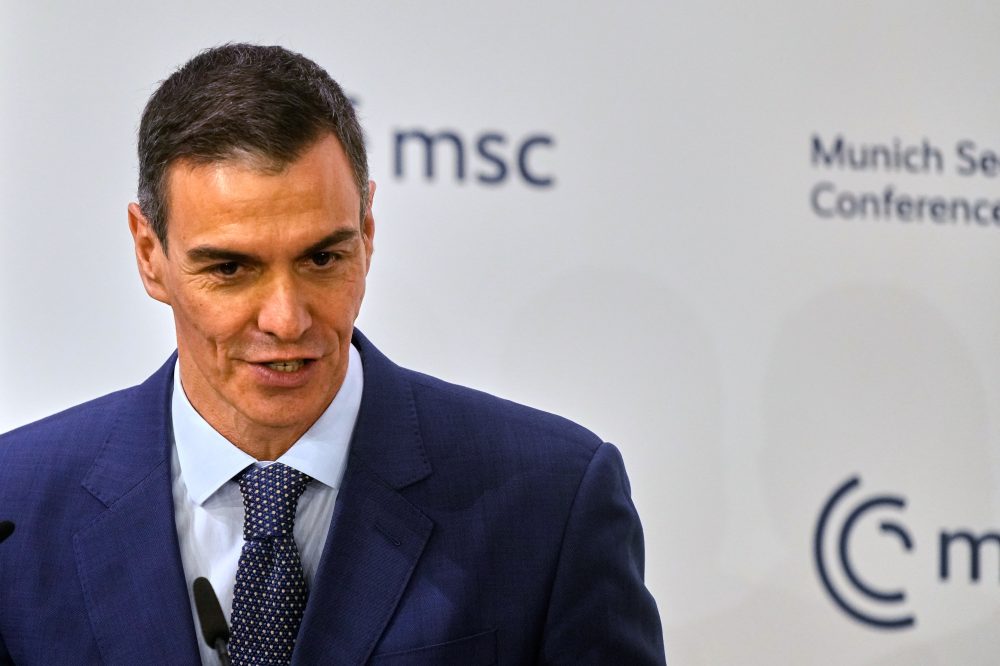
BARCELONA, Spain (AP) — Spanish Prime Minister Pedro Sánchez has positioned himself as the leading European voice opposing President Donald Trump’s policies, particularly after denying the U.S. military access to Spanish bases for operations against Iran.
The confrontation escalated Tuesday when Trump threatened to “cut off all trade with Spain” following the Spanish leader’s refusal to cooperate. Tensions grew further when Spain’s foreign minister disputed White House claims that Madrid had received Trump’s message “loud and clear” and was now working with American forces.
Although condemning Tehran’s authoritarian government, Sánchez declared he would not support what he characterized as an unjustified military campaign.
“We are not going to be complicit in something that is bad for the world and is also contrary to our values and interests, just out of fear of reprisals from someone,” Sánchez declared, adopting the rallying cry “No to the war” during a recent address.
The disagreement over Spanish military facilities appears more diplomatic than strategically significant, given America’s extensive network of bases throughout Europe and the Middle East, with other European nations providing support.
Spain and the United States have maintained steady, cordial relations spanning decades, beginning in the 20th century when America established shared military installations during Francisco Franco’s dictatorship.
The 54-year-old Sánchez assumed office in 2018 and ranks among Europe’s most visible progressive leaders.
He has championed core liberal principles including women’s rights, legal immigration pathways, human rights protections, international law adherence, and climate action — issues that have become frequent targets of Trump’s MAGA agenda and European far-right movements.
Prior to the Iran conflict, Sánchez had already established himself as Trump’s ideological opponent across numerous policy areas.
The Spanish leader has emerged as one of Israel’s harshest critics regarding its Gaza military operations, repeatedly condemning the extensive civilian casualties following Hamas’s 2023 surprise assault on Israeli soil.
“This is not self-defense, it’s not even an attack — it’s the extermination of a defenseless people,” he stated while traveling across Europe and the Middle East seeking peace negotiations.
Within NATO, Spain stood alone in rejecting commitments to raise defense spending to 5% of national economic output. Sánchez negotiated a special exemption during last year’s alliance summit, limiting Spain’s commitment to 2.1%, which he termed “sufficient and realistic.”
Trump suggested Spain’s NATO membership should be reconsidered, though this remains an unexecuted threat.
While numerous European nations tightened border controls and the Trump administration expanded immigration enforcement, Spain is currently processing work and residence documentation for 500,000 foreign nationals already within its borders.
Sánchez has directly referenced Trump while promoting immigration’s economic advantages for his nation.
“MAGA-style leaders may say that our country can’t handle taking in so many migrants — that this is a suicidal move, the desperate act of a collapsing country,” he stated in a recent New York Times editorial. “But don’t let them fool you. Spain is booming.”
Under Sánchez’s leadership, Spain has joined nations including Australia and France in restricting social media access for young teenagers, contrasting sharply with the Trump administration’s support for technology companies and their interpretation of free speech rights online.
X platform owner Elon Musk attacked the Spanish prime minister last month, labeling Sánchez “the true fascist totalitarian” following his announcement of plans to ban social media access for those under 16.
Diplomatic relations between Spain and the United States are becoming increasingly strained as Madrid refuses to allow American military forces access to two jointly operated bases within Spanish territory.
The Spanish administration has confirmed its position to block U.S. access to these facilities as military operations involving the United States and Israel against Iran continue to expand. This stance has created a widening divide between Spain and the current Trump administration.
Protesters gathered in Barcelona on Wednesday, displaying images of Iran’s deceased supreme leader alongside Spanish Prime Minister Pedro Sánchez while demonstrating against American and Israeli military actions targeting Iran.
The refusal to grant base access represents a significant diplomatic challenge for U.S. military operations in the region, as these Spanish facilities have traditionally served as important strategic locations for American forces.
LONDON, March 5 – British Prime Minister Keir Starmer plans to hold a news briefing Thursday afternoon to provide an update on the worsening situation in the Middle East, according to a spokesperson from his office.
The Prime Minister is scheduled to meet with reporters at 2 p.m. local time in London, the spokesperson confirmed.
The United Kingdom, which did not participate in the weekend offensive against Iran, has announced plans to relocate military assets to the Middle East following an assault on its military installation in Cyprus.
Earlier this week, Starmer’s administration revealed it would send a naval vessel along with helicopter units equipped with anti-drone technology to help counter Iran’s revenge attacks.
With the U.S.-Iran conflict now in its sixth day, the hostilities have expanded beyond Persian Gulf nations and reached into Asia, leading thousands of tourists and residents stranded in the region to attempt evacuation from the Middle East.
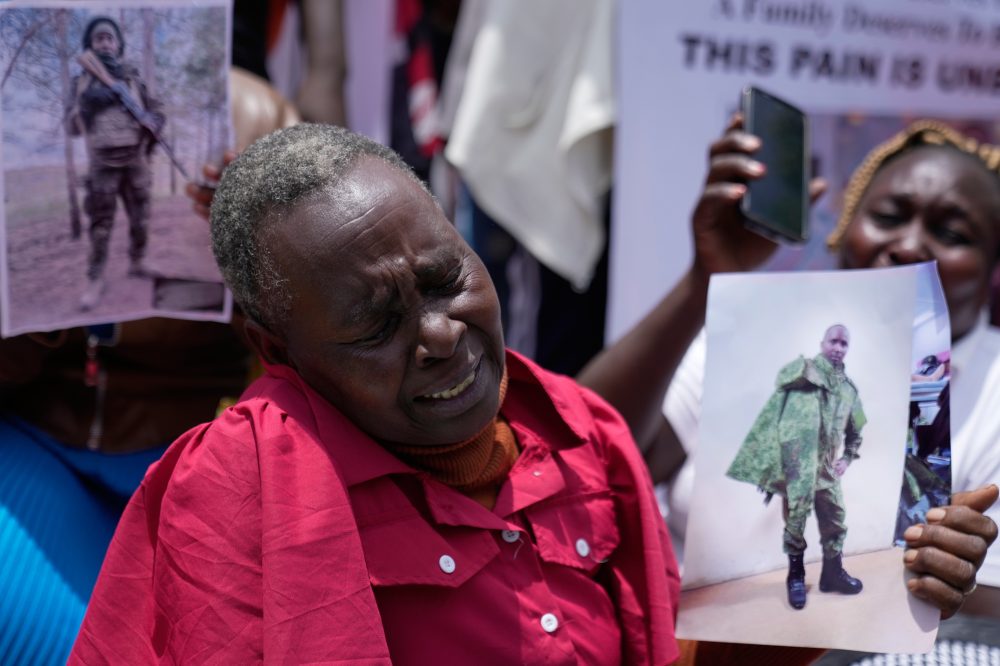
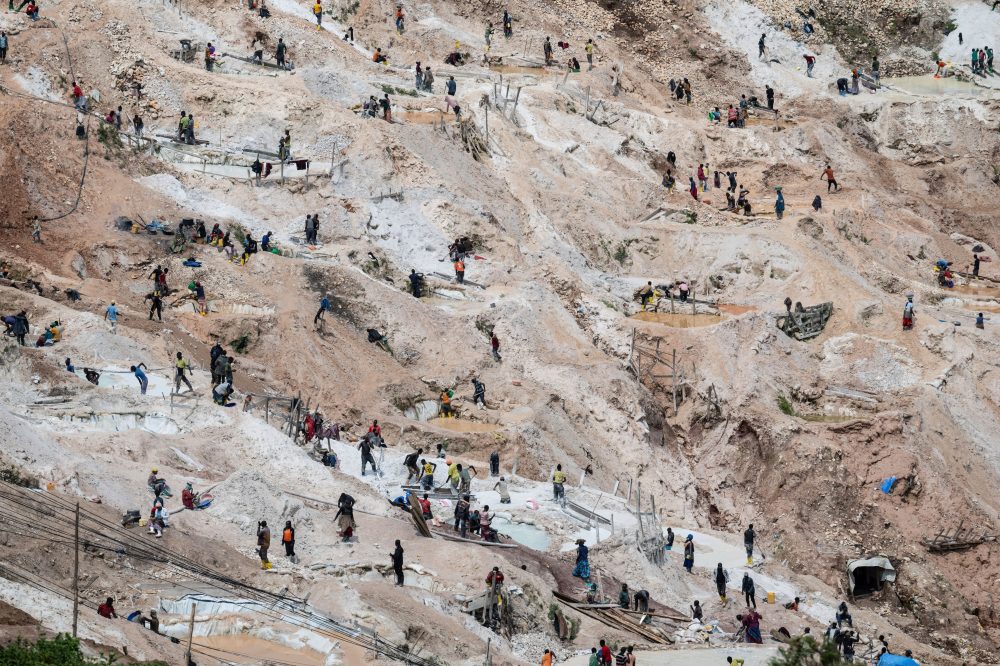
DAKAR, Senegal (AP) — A catastrophic tunnel collapse at a coltan mining operation in eastern Congo has claimed the lives of at least 200 workers, according to reports from the rebel-controlled facility.
Government officials and rebel leaders are pointing fingers at each other over who bears responsibility for the tragedy, while also disagreeing about the actual number of casualties. However, experts confirm this represents one of the most devastating mining accidents in recent memory.
This disaster comes on the heels of a similar incident that occurred in January, which also resulted in more than 200 fatalities in a region already struggling with humanitarian challenges and active warfare.
The Rwandan-supported M23 rebel organization captured the town of Rubaya and gained control of its mining operations in May 2024.
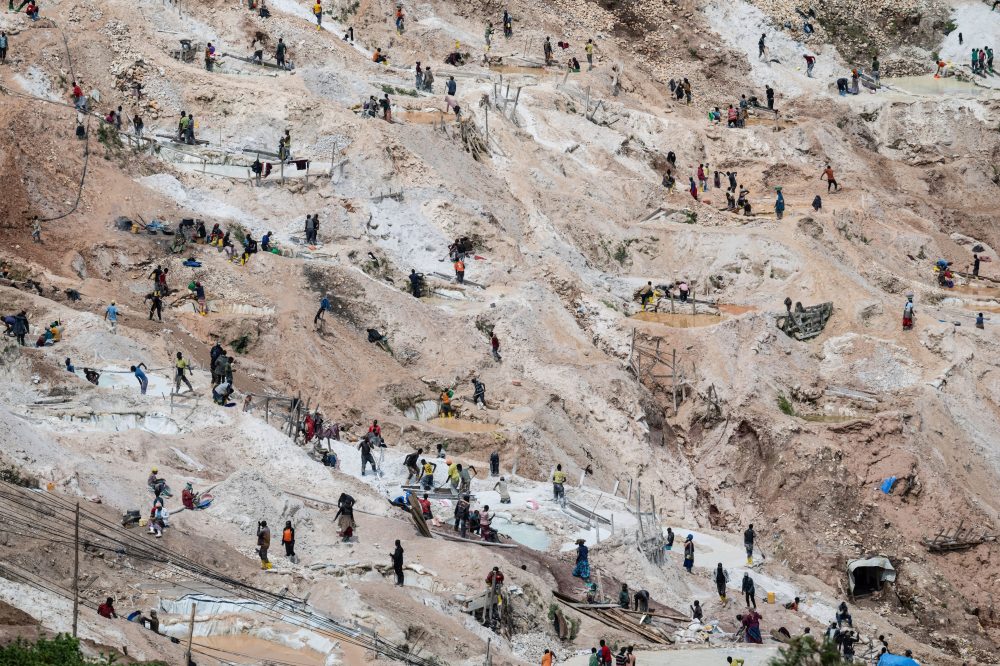
The tunnel collapse occurred on Tuesday when multiple hand-excavated shafts gave way, trapping workers inside, according to Congo’s Ministry of Mines.
Located approximately 25 miles west of Goma, the regional hub, the mining site employs thousands of workers who primarily use manual labor techniques. Workers create extensive tunnel systems, frequently running alongside each other, with minimal structural reinforcement and no emergency escape routes should disasters occur.
Information about the incident remains limited due to the site’s isolated location and pressure from both rebel forces and mine operators to suppress details following the accident.
Ibrahim Taluseke, who works as a miner at Rubaya, explained to The Associated Press that mine operators face financial obligations of $300 per victim’s family, creating motivation to downplay casualty figures.
“Imagine if you give a high number, these owners could even eliminate you. Because often they even hide the victims’ bodies to avoid compensation,” Taluseke stated.
Additional miners provided conflicting casualty counts from the disaster.
Given the challenges of reaching Rubaya, researchers hold different views about what caused these consecutive collapses.
Christian-Géraud Neema, who serves as a nonresident scholar with the Carnegie Africa Program, attributed the disaster to severe rainfall and stressed the importance of questioning official accounts.
“It’s normal for Kinshasa to exaggerate the numbers,” he explained, noting that such accidents occur regularly and cautioning against linking the recent collapses directly to rebel management of the facilities. “We should not be shocked; we should expect another collapse in three weeks’ time or in a month,” Neema added.
Guillaume de Brier, who conducts research for the International Peace Information Service (IPIS), acknowledged that while the recent disasters rank among the most lethal in years, M23’s takeover of the mining operations has contributed to the problems.
“Because of M23, there are no more civil society protections or state services,” de Brier explained. The absence of oversight during active conflict has led to increased worker numbers, as many people have become unemployed and cannot secure jobs outside the small-scale mining industry, he added.
The facilities extract coltan, which stands for columbite-tantalite, a mineral ore containing the valuable metals tantalum and niobium.
These materials are classified as essential raw materials by major powers including the United States, European Union, China, and Japan. Tantalum finds its way into smartphones, laptops, and car electronics, plus aircraft engines, missile systems, and GPS equipment. Niobium serves critical roles in pipeline construction, rocket manufacturing, and jet engine production.
A United Nations investigation revealed that since capturing Rubaya, M23 has collected taxes on monthly trading and transportation of 120 metric tonnes of coltan, earning no less than $800,000 monthly. U.N. specialists report the coltan then moves to Rwanda for export. However, researchers note that even prior to M23’s control, the mineral flowed to Rwanda, with the primary change being the elimination of Congolese middlemen from the process.
The United Kingdom has implemented new visa requirements for citizens of St. Lucia beginning Thursday, according to an official statement from the Caribbean nation’s government.
British officials justified the policy change by pointing to a significant rise in asylum applications from residents of the former British colony, which has approximately 180,000 inhabitants.
The timing of this immigration policy shift comes as Prime Minister Keir Starmer’s administration faces mounting pressure to demonstrate stricter border controls, particularly with the populist Reform UK party climbing in public opinion surveys. Immigration remains a highly contentious political topic throughout Britain.
St. Lucia’s leadership indicated they received notification of the change through correspondence dated Wednesday and are now working directly with British officials to maintain favorable travel arrangements between the two nations. Government representatives said they will continue discussions to “explore pathways for maintaining strong mobility arrangements.”
Previously, St. Lucian nationals could visit the United Kingdom by obtaining a 16-pound Electronic Travel Authorization. The Caribbean government announced that current ETA holders will have a six-week grace period to adjust to the new requirements.
Despite the World Bank’s 2023 estimate showing minimal net emigration from St. Lucia—just 23 people—British authorities determined the visa requirement was necessary due to increased asylum requests.
As a Commonwealth member, St. Lucia maintains historical ties to Britain dating back to its colonial period. Before the 1970s, citizens from many Commonwealth nations held rights to live and work in the United Kingdom.
The visa policy for St. Lucia coincides with Britain’s announcement earlier this week that it would suspend study visas for applicants from Afghanistan, Cameroon, Myanmar and Sudan, while also halting work visa approvals for Afghan nationals.
The Iran-backed militant organization Hezbollah has sent its most skilled fighters back to Lebanon’s southern border area to engage Israeli military units, according to three Lebanese sources with knowledge of the military movements.
The elite Radwan unit members have been ordered to enter combat and prevent Israeli armored vehicles from advancing further, with the sources pointing to Khiyam as one location where Israeli forces reportedly moved forward on Wednesday.
The Lebanese Shi’ite Muslim organization, which Iran’s Revolutionary Guards founded in 1982, joined the conflict on Monday by launching attacks in retaliation for Iran’s supreme leader’s death in a joint U.S.-Israeli strike on Tehran.
Since that time, Israel has conducted intensive bombardments across southern Lebanon and beyond, deploying additional ground forces across the border while directing Lebanese civilians to evacuate large portions of the frontier zone where Israeli military personnel have maintained positions since the 2024 conflict.
In a Wednesday television address, Hezbollah leader Naim Qassem declared the organization would resist what he characterized as Israel’s “occupation and expansion” strategy.
“For us, this is an existential defence,” he stated.
The specialized fighters moved south after Hezbollah initiated rocket and drone attacks on Monday, the sources revealed while requesting anonymity due to the matter’s sensitive nature.
These forces had previously departed the region between the Litani River and Israel’s border following a U.S.-mediated ceasefire that ended the 2024 war, relocating north of the river, according to the sources.
The exact number of elite troops deployed was not disclosed by the sources.
Lebanese President Joseph Aoun confirmed that Hezbollah’s initial Monday barrage originated from positions north of the Litani River.
Israeli military representatives said they were reviewing the information but did not immediately offer commentary on the sources’ claims. Lebanon’s army refused to provide statements, and Prime Minister Nawaf Salam’s office did not respond to requests for comment.
The Israeli military reported Wednesday that two soldiers sustained injuries from anti-tank weapons fire in southern Lebanon, marking the first documented casualties among Israeli forces since the regional conflict began.
Hezbollah has claimed responsibility for multiple tank attacks this week, alongside numerous rocket and drone strikes against Israeli targets.
An Israeli military spokesman said Wednesday that forces were “positioning troops a little farther” into Lebanese territory than previously “to prevent any attacks against the northern communities” within Israel.
Before the October 7, 2023 Hamas assault on Israel sparked widespread regional fighting, Hezbollah had showcased Radwan fighters practicing simulated Israeli invasion scenarios for journalists in May 2023.
Approximately 5,000 Hezbollah militants died during the 2024 Israeli war, with many casualties coming from Radwan unit ranks. The conflict significantly diminished Hezbollah’s capabilities.
Israel has maintained almost daily attacks against Hezbollah positions since that war ended, including a December strike on what Israeli officials described as a Radwan training facility in the south.
Under the 2024 ceasefire terms, which required Lebanon’s army to confiscate unauthorized weapons starting in areas south of the Litani, Lebanese military forces captured numerous Hezbollah arms stockpiles. While Hezbollah stated it honored the ceasefire south of the Litani, the group maintained the agreement did not cover other Lebanese territories.
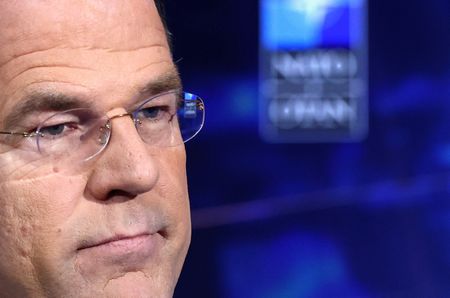
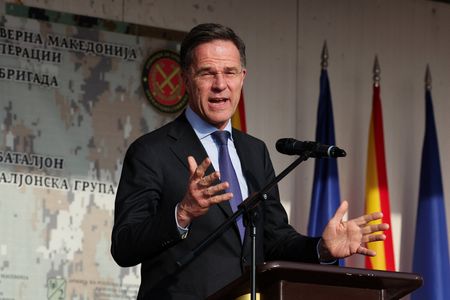
BRUSSELS – NATO’s top leader emphasized the alliance’s preparedness and vigilance following the successful interception of an Iranian ballistic missile targeting Turkey, a NATO member nation, during a Thursday interview with Reuters.
Secretary General Mark Rutte spoke about various alliance matters, including France’s nuclear policy changes and defended his supportive comments about President Donald Trump’s leadership.
MISSILE DEFENSE SUCCESS
“NATO air missile defence was able to take it out. So that was very important. It also shows you, I think, clear evidence that we, with a 360-degree approach, will defend every inch of NATO territory. Our military are constantly on it. But of course, this was serious and absolutely condemnable,” Rutte stated regarding the intercepted missile.
MIDDLE EAST INVOLVEMENT CONCERNS
When asked about potential NATO involvement in Middle Eastern conflicts, Rutte clarified the alliance’s position. “Article 5, I think, is not in order here. Nobody’s talking about Article 5. And the most important thing is that our adversaries have seen yesterday that NATO is so strong and so vigilant, and even more vigilant, if possible, since Saturday because of the situation, of course, in the Middle East,” he explained.
TRUMP’S IRAN STRATEGY
Discussing the president’s military decisions regarding Iran, Rutte noted the threat Iran posed. “We know that Iran was close to getting its hands on a nuclear capability, a missile capability, which would be a threat, not only to the Middle East, and of course, to Israel, and potentially it would be life-threatening to Israel, but also a threat to Europe,” he said.
The NATO chief highlighted European support for U.S. operations: “Clearly, NATO is not itself involved here. NATO allies are providing key enabling support. What we see here is that NATO, in that sense, is also this power protection projection platform for the United States. Because without European allies, the U.S. would have found it very difficult to launch this campaign against Iran.”
FUTURE IRAN POLICY
Regarding long-term objectives, Rutte expressed broad agreement among allies. “I think there is widespread acknowledgement and agreement that at least we have to be sure that going forward, Iran, this republic, is not able again, to pose (a) death threat to its neighbours, to Israel, the Middle East, to Europe,” he said.
“From my conversations with senior American military and political leaders, it’s my absolute sense that they know where they are going,” Rutte added.
UKRAINE CONFLICT UPDATE
The secretary general connected Iran’s role in supporting Russia’s war efforts, calling it “one of the key supporters of the Russian war effort against Ukraine — totally unprovoked, this crazy war which started in 2014 and then the full-scale invasion in February 2022.”
He provided positive updates on Ukrainian progress: “What we also see now is that Ukraine is already, for some weeks, being able to recapture terrain, territory which the Russians got their hands on before, so that is really good news. We know that the Ukrainians are posing extreme losses on the Russians, months in, months out, many times more than the Russians lost in Afghanistan in the 1980s.”
DEFENDING TRUMP PRAISE
Addressing criticism about his complimentary remarks toward the U.S. president, Rutte justified his approach. “Obviously I do believe that the United States is the most powerful and most quintessential ally within the Alliance. If the president of that country is able to get the whole of NATO at 2% last year, and then in The Hague, collectively agreeing to the 5% — I would doubt it, without President Trump, we would have really reached it. And then him now taking this decisive action to take out this capability of Iran … if a president of a country is providing that type of leadership, some praise is warranted,” he explained.
ALLIANCE UNITY
Discussing internal NATO dynamics, particularly regarding Spain, Rutte praised their contributions: “Spain is deployed all over NATO territory. Their troops are part of many forward land forces, many initiatives, many NATO missions. I really want to commend them for that — there is a Spanish Patriot system in Turkey, defending key American interests. Yes, there are also discussions on spending. But this is an alliance of democracies. When there are debates between allies, I always try to stay a bit muted.”
FRENCH NUCLEAR POLICY
Commenting on French President Macron’s recent nuclear deterrence statements, Rutte expressed support while emphasizing American leadership. “I really welcome this. It is leveraging more of what France is doing. However, and we all agree on this, the ultimate, supreme guarantor of our way of life … is, in the end, the United States nuclear umbrella, and that is key,” he said.
“I’m absolutely convinced the U.S. is completely committed to NATO,” Rutte concluded.
NATO’s top leader expressed support Thursday for France’s decision to strengthen its nuclear capabilities, though he emphasized that American defense protection continues to serve as Europe’s primary security guarantee.
Secretary General Mark Rutte praised French President Emmanuel Macron’s recent announcement to expand France’s nuclear deterrent and possibly permit European allies to host French military aircraft during deterrence operations. This development follows growing anxiety among European nations regarding America’s reliability as a defense partner.
Speaking from Brussels on Thursday, Rutte indicated that France’s updated nuclear strategy would complicate Russia’s ability to evaluate European defense capabilities. He voiced approval for ongoing nuclear cooperation discussions between Paris and multiple European capitals.
However, the NATO chief stressed that Europe cannot function without American security assurance and worked to address doubts about Washington’s dedication to European defense.
“The ultimate, supreme guarantor of our way of life … is, in the end, the United States’ nuclear umbrella, and that is key,” Rutte stated during his Reuters interview.
During his address at a submarine facility, Macron explained that France’s nuclear doctrine revision occurred with full transparency regarding Washington and serves as a complement to NATO’s nuclear operations.
France and Germany have created a nuclear coordination committee to address deterrence matters and plan to begin practical collaboration this year. Macron indicated that Greece, Poland, the Netherlands, Belgium, Denmark and Sweden may also participate in French nuclear exercises.
Over the past 14 months, the Trump administration has frequently criticized Europe’s capacity and willingness for self-defense.
In accidentally disclosed communications between senior Trump officials before strikes against Yemen’s Iran-supported Houthis last year, someone identified as Vice President JD Vance expressed frustration, writing “I just hate bailing out Europe.” This prompted another official, identified as Defense Secretary Pete Hegseth, to criticize European “free-loading.”
Responding to Washington’s pressure, NATO’s European nations have increased their military spending obligations.
A dispute over Greenland earlier this year intensified European concerns about American dedication to ally protection. Nevertheless, Rutte expressed confidence in America’s NATO commitment and European security protection.
“I’m absolutely convinced the U.S. is completely committed to NATO,” he declared.
“The United States knows that to stay safe itself (on) the U.S. mainland, you need a secure Atlantic, a secure Europe, a secure Arctic.”
The conflict between the United States and Iran intensified Thursday with fresh attacks on oil tankers in Gulf waters and Iranian drone incursions into Azerbaijan, raising concerns the crisis could engulf additional oil-producing nations in the region.
An explosives-laden remote-controlled Iranian vessel targeted a crude oil tanker flying under the Bahamas flag while it was anchored near Iraq’s Khor al Zubair port, preliminary reports indicate. Meanwhile, a second tanker positioned off Kuwait’s coast began taking on water and leaking oil following a massive blast on its port side.
Since hostilities erupted Saturday between the United States, Israel and Iran, nine ships have been targeted in attacks. Iran fired a barrage of missiles toward Israel early Thursday and deployed drones into Azerbaijan, wounding four individuals.
The growing violence follows Washington’s rejection of a proposal to cease American strikes and coincides with the emergence of Iran’s deceased supreme leader’s son as a leading candidate for succession, indicating Tehran shows no signs of yielding to international pressure.
Ship-tracking data from MarineTraffic reveals approximately 200 vessels, including oil and liquefied natural gas carriers plus cargo ships, remain anchored in open Gulf waters near major producing nations. Hundreds more ships sit stranded outside the Strait of Hormuz, unable to reach their destination ports. This critical waterway handles roughly one-fifth of global oil and LNG shipments.
BP removed international personnel from Iraq’s Rumaila oil facility after two unidentified drones touched down within the field boundaries, Iraqi oil industry sources reported. Baghdad has slashed daily oil output by nearly 1.5 million barrels as storage capacity reached its limit and tanker loading became impossible, officials confirmed to Reuters.
Energy markets responded sharply Thursday, with oil prices climbing approximately 3% and extending their surge to more than 14% since Saturday’s conflict onset. US-Israeli military operations against Iran have severely disrupted Middle Eastern supply chains.
European natural gas benchmark prices jumped over 5% Thursday, reaching 51.30 euros per megawatt-hour and climbing roughly 50% for the week. Russian President Vladimir Putin declared his nation could immediately cut off gas deliveries to Europe amid the energy price volatility stemming from the Iranian crisis.
Qatar, responsible for 20% of worldwide LNG production, suspended gas operations earlier this week due to the ongoing conflict. Major alternative suppliers including the United States and Australia possess minimal excess capacity to compensate for the supply shortage, according to industry analysis and Reuters data.
The European Union faces increased risks and costs in replenishing gas reserves during upcoming months due to the Iranian conflict and LNG supply disruptions. The bloc continues importing some Russian gas while planning to terminate pipeline deliveries by late 2027 and prohibit new short-term LNG agreements starting late April 2026.
Asian energy importers experienced additional strain from Middle Eastern supply interruptions. China instructed refineries to avoid signing new fuel export agreements and attempt canceling existing shipment commitments, multiple informed sources revealed Thursday.
Embassy workers and diplomatic personnel in Saudi Arabia’s capital received orders to remain indoors on March 5 due to concerns about a possible security threat, according to three sources familiar with the situation.
The shelter-in-place directive affected staff members working within Riyadh’s diplomatic district, where multiple foreign missions are located.
The sources, who had direct knowledge of the security alert, did not provide additional information about the nature of the potential threat.
NAIROBI, Kenya — Grieving families whose sons were tricked into joining Russia’s military forces in Ukraine took their pleas to Kenya’s parliament Thursday, demanding an end to the deceptive recruitment practices that sent their loved ones to war.
The demonstrators walked through Nairobi’s streets carrying pictures of their sons — some fighting on the battlefield, others wounded, killed, or missing in action. Their chants echoed through the capital as they called on officials to bring their family members home safely.
Among the crowd, protesters displayed a large white sign with red lettering that declared: “KENYANS AND FAMILIES DEMAND JUSTICE FOR THEIR SONS RECRUITED INTO RUSSIA MILITARY.”
Government officials revealed last month that over 1,000 Kenyans had been enlisted to serve in Russia’s forces fighting Ukraine. Current figures show 89 Kenyans remain active in combat zones, with one fatality confirmed, 39 receiving medical treatment in hospitals, and 28 listed as missing in action. Some recruits have managed to return to Kenya.
Foreign Minister Musalia Mudavadi informed The Associated Press last month of his plans to visit Russia, describing it as a “diplomatic approach to rein in” those who are “taking advantage of anyone in this misadventure.”
Mudavadi also indicated that diplomatic efforts are ongoing to free Kenyans being held as prisoners of war in Ukraine and to bring home those remaining in Russia.
Ukraine’s ambassador to Kenya, Yurii Tokar, confirmed to the AP Wednesday that one Kenyan is currently detained as a prisoner of war in Ukraine. He explained that under Geneva Convention rules, POWs are generally freed when conflicts end, though both Ukraine and Russia have conducted multiple prisoner exchanges throughout the four-year conflict.
Lamech Mboga, whose brother departed for Russia in August 2025, told the AP he suspects his sibling is now imprisoned in Ukraine and pleaded for his freedom.
A parliamentary intelligence briefing delivered last month by majority leader Kimani Ichung’wah revealed that both Kenyan and Russian officials worked together with recruiting companies to deceive Kenyans into military service.
Thursday’s parliamentary petitioners insisted that those responsible for the recruitment scheme must face charges for “human trafficking, forced recruitment, and possible violations of international humanitarian and labor laws.”
Authorities have already filed human trafficking charges against two Kenyans in connection with the case.
Alexander Lukashenko, the president of Belarus, has granted clemency to 18 individuals currently serving prison sentences, according to an announcement from his administration on Thursday.
Among those receiving pardons, 15 had been convicted on extremism-related charges. This particular criminal designation has become a common tool used by Lukashenko’s government to prosecute political opposition members and critics of his rule.
The clemency announcement was made through a Telegram channel associated with the presidential administration.
GALLE, Sri Lanka — A deadly submarine attack by US forces has claimed the lives of 87 Iranian naval personnel after their warship participated in military exercises with India’s navy, according to officials from New Delhi.
The attack highlights how the ongoing US-Israeli military campaign against Iran is expanding far beyond Middle Eastern boundaries. The incident has also sparked intense discussions in India regarding maritime safety throughout the Indian Ocean, where New Delhi maintains substantial naval operations.
Sri Lankan naval forces pulled 87 bodies from the water and saved 32 crew members from the IRIS Dena on Wednesday, after the vessel was destroyed in international waters near the island nation. Such submarine warfare represents an uncommon occurrence not seen since the Second World War.
According to Sri Lanka’s maritime forces, they responded to an emergency call from the IRIS Dena, but arrived to find only oil slicks and survivors in the water where the ship had been. Medical facilities in Galle, located on Sri Lanka’s southern shoreline, received the rescued sailors for treatment.
Defense Secretary Pete Hegseth characterized the attack as evidence that US-Israeli military actions against Iran are expanding internationally, calling the IRIS Dena a “prize ship.” President Donald Trump has stated that eliminating Iran’s naval capabilities remains a primary war objective.
The Defense Department shared footage on social media platform X capturing the torpedo strike. The video shows the Iranian vessel being torn apart by an underwater blast, sending massive water columns skyward.
Iran’s Foreign Minister Abbas Araghchi condemned the US Navy for what he called “an atrocity at sea” in destroying the frigate, posting on social media Thursday that America “will come to bitterly regret” the assault.
Araghchi reported the IRIS Dena was carrying “almost 130” personnel.
Indian naval and defense officials confirmed the Iranian warship had taken part in the International Fleet Review and the multinational MILAN 2026 naval training operation, hosted by India’s navy at Visakhapatnam port between February 15-25. Defense ministry sources said 74 nations participated in these events.
Indian naval social media posts from February 17 showed the Iranian vessel during the exercises, including photographs of crew members displaying their national flag on deck.
Araghchi emphasized that the frigate had served as “a guest” of India’s naval forces. Indian government officials have yet to issue public statements regarding the incident.
In Sri Lanka, Media Minister and government spokesperson Nalinda Jayatissa informed parliament Thursday that a second Iranian vessel has entered their territorial waters.
Jayatissa offered no additional information about this ship or its crew size. He stated the government aims to “minimize the loss of lives and safeguard regional peace” without providing specifics.
India considers the Indian Ocean vital to national security, regularly deploying naval patrols and hosting international training exercises to protect crucial shipping routes for worldwide commerce and energy transport. The nation has historically attempted to balance diplomatic relations between the US and Iran while promoting peaceful dialogue.
Indian opposition politicians Thursday criticized the government’s silence on the matter, arguing that a warship’s destruction so near India’s maritime territory demanded an official response.
The opposition Indian National Congress party criticized what it termed “silence” from Prime Minister Narendra Modi’s administration.
“The conflict has reached our backyard, with an Iranian warship sunk in the Indian Ocean. Yet the Prime Minister has said nothing,” opposition leader Rahul Gandhi posted on X.
Former diplomat Kanwal Sibal, who held the foreign secretary position from 2002-2003, wrote on X that while India bears no “political or military responsibility for the U.S. attack,” its “responsibility is at a moral and human plane.”
“The U.S. has ignored India’s sensitivities,” Sibal stated. “The ship was in these waters because of India’s invitation.”
A United States submarine launched a torpedo attack against an Iranian naval vessel in the Indian Ocean this week, representing the first instance of America sinking an enemy ship with such weaponry since the Second World War.
The incident occurred on March 4 when the Iranian warship IRIS Dena came under attack from American forces, according to officials from Sri Lanka, the United States, and Iran. The strike was part of coordinated U.S. and Israeli military actions targeting Iranian assets.
Search and Recovery Efforts Continue
Sri Lankan naval forces initiated emergency rescue operations after receiving an urgent distress signal from the IRIS Dena during the early morning hours of Wednesday.
When rescue teams arrived at the location, they found the warship had already gone down, with only a petroleum spill marking where the vessel once floated. Approximately 130 personnel were aboard the ship when it sank.
Recovery teams have pulled 87 bodies from the water and saved 32 survivors, who received medical attention for relatively minor wounds and were anticipated to leave the hospital on Thursday. Maritime search teams continue looking for roughly 10 missing crew members.
Naval Exercise Participation
The vessel went down in Sri Lankan territorial waters, approximately 19 nautical miles from the southern coastal city of Galle, following the submarine assault.
The Dena had been making its way back to Iran after completing participation in naval training exercises conducted in India between February 16 and February 26, staged near the southern Indian port of Visakhapatnam.
The Iranian ship joined 17 other foreign naval vessels in the MILAN exercise, which occurs every two years and included participants from Sri Lanka, Australia, Japan, and Russia. Military representatives from more than 70 nations observed the drills, including delegates from the United States and Britain.
Indian military officials characterized the training operation as among the most extensive multinational naval exercises in the Indo-Pacific region, designed to improve coordination between forces, enhance maritime surveillance capabilities, and strengthen joint response systems.
International Response
India’s naval command had previously celebrated the Dena’s participation as evidence of the “enduring cultural connections between the two countries.” Following the sinking, footage has emerged showing Iranian naval personnel parading through Visakhapatnam streets during exercise ceremonies.
Iranian Foreign Minister Seyed Abbas Araghchi posted on social media platform X that the Dena served as “a guest of India’s Navy” and suffered the attack without advance notice while in international waters. He warned that the United States “will bitterly regret the precedent it has set.”
New Delhi has remained silent regarding the attack, although many Indians have commended neighboring Sri Lanka for its rescue response. India’s primary opposition Congress party condemned the government’s lack of response, stating the conflict had “reached our backyard” and challenging New Delhi’s position as a “net security provider” in the Indian Ocean area.
BRUSSELS – NATO’s top official affirmed Thursday that alliance members will maintain their commitment to Ukraine’s defense despite ongoing tensions involving Iran.
Speaking to Reuters, NATO Secretary General Mark Rutte emphasized that member nations view their international obligations as interconnected rather than conflicting.
“Many leaders in Europe and the United States, Canada say it has to be ‘and, and’: make sure that as allies we enable what the Americans are doing in the Middle East … and at the same time make sure that Ukraine has what it needs to stay strong in the fight,” Rutte explained during the Brussels interview.
The NATO chief’s remarks underscore the alliance’s position that supporting multiple international efforts simultaneously remains a priority for member countries.
MOSCOW – A court in Russia’s Krasnodar region handed down a 15-year prison sentence Thursday to a Romanian national found guilty of conducting espionage operations on behalf of Ukraine.
According to a Telegram announcement from the court’s media office, the defendant identified as Adrian-David Chercio was convicted of collecting and transmitting sensitive intelligence about air defense installations located in Sochi, the Black Sea resort destination.
Court officials stated that Chercio entered into an agreement to conduct intelligence work for Ukrainian authorities in November 2024, though they did not disclose the timing of his detention.
Romanian foreign ministry representatives have not yet responded to requests for comment regarding the case.
BERLIN — A German court handed down a 13-year prison sentence Thursday to a young Syrian man who attacked and severely injured a Spanish visitor at Berlin’s Holocaust Memorial more than a year ago.
The 20-year-old perpetrator, identified by authorities only as Wassim Al M. following German privacy regulations, faced conviction on multiple charges including attempted murder and seeking membership in an international terrorist group, according to reports from German news agency dpa.
Court officials determined that he made the journey from Leipzig to Berlin on February 21, 2025, with the intention of conducting an assault on behalf of the Islamic State organization.
Presiding judge Doris Husch explained that the defendant selected the Holocaust Memorial as his target location because “he believed he would find people of Jewish faith there.” The attack involved stabbing the Spanish visitor in the neck area, followed by the perpetrator yelling “Allahu akbar,” meaning “God is great.”
The 31-year-old Spanish victim lived through the assault but continues to receive mental health care and remains unable to return to work.
Throughout the legal proceedings, the defendant claimed he immediately felt remorse for his actions and maintained that he had come to Berlin because of coercion from someone he met online while viewing Islamic State propaganda materials.
According to investigators, the defendant reached Germany in 2023 without adult supervision and received approved asylum status before settling in Leipzig. Police took him into custody approximately three hours following the attack when he approached law enforcement officers while covered in blood.
The Memorial to the Murdered Jews of Europe consists of 2,700 gray concrete blocks situated close to the Brandenburg Gate in central Berlin, serving as a tribute to the 6 million Jewish victims of the Holocaust.
This violent incident took place just two days prior to a nationwide German election where immigration policies had emerged as a major campaign topic, intensified by several fatal attacks involving immigrants in the preceding months.
Chinese officials unveiled their most conservative economic growth projection in more than 30 years during Thursday’s opening of the nation’s annual legislative session in Beijing, signaling what experts view as a realistic approach to ongoing domestic financial challenges.
The government also published its complete five-year strategic plan extending through 2030, highlighting priorities for economic and political direction with emphasis on developing independence in sectors including artificial intelligence, robotics, and cutting-edge technologies amid intensifying competition with America.
The week-long legislative gathering is anticipated to formally endorse the five-year blueprint in the coming days.
Premier Li Qiang announced an economic expansion goal of 4.5% to 5% for 2026 during his annual government work presentation — marking the most modest target since 1991 and representing the first reduction from the official “around 5%” objective established for 2023 through 2025.
This decreased projection follows an extended real estate sector downturn that caused housing values to plummet, undermined consumer spending and investment confidence, and resulted in widespread unemployment.
To tackle the nation’s internal economic difficulties, government representatives committed to steadying the real estate market through managing new construction and decreasing existing inventory.
Li also emphasized the significance of stimulating domestic spending, though the country’s allocation of 250 billion yuan ($36 billion) designated for consumer product trade-in incentives fell short of the previous year’s 300 billion yuan commitment.
Even amid the ongoing U.S.-China trade dispute, Beijing reported achieving its official 5% economic growth objective for the previous year. This success stemmed primarily from its unprecedented trade surplus approaching $1.2 trillion, driven by increased exports to areas including Europe and Latin America.
“What we achieved in 2025 was indeed hard won,” Li stated during his address. “Rarely in many years have we encountered such a grave and complex landscape.”
Regarding Taiwan, the independently governed territory that Beijing has claimed for generations, Li emphasized that the government will “resolutely fight against” independence movements.
The selection of “fight against” terminology seemed to represent a more aggressive stance compared to the previous year’s language of “resolutely oppose.”
Within the comprehensive draft of its five-year strategy through 2030, Chinese leadership outlined ambitions for achieving technological independence to compete with the United States. The proposed plan detailed objectives for progress in artificial intelligence, robotics, semiconductors, biomedicine, quantum technology, and aerospace sectors.
To guarantee innovation advances, Chinese authorities estimated at least 7% annual average increases in national research and development expenditure.
Government leaders also announced a 7% military budget increase for 2026, reaching approximately 1.9 trillion yuan ($270 billion). This represented a slight decrease from the roughly 7.2% yearly growth over the past three years.
During his presentation, Li declared that the nation must accomplish “solid gains in military training and combat readiness.” This statement coincided with President Xi’s expanding military leadership purge — including dismissing nine military officials from the congress the previous week — as the country accelerates its armed forces modernization timeline.
Like numerous global regions, China confronts a population challenge as its citizenry ages and fertility rates decline. The 1.4 billion population decreased for the fourth consecutive year in 2025, dropping by approximately 3 million from the prior year.
Chinese officials pledged Thursday to establish a “fertility-friendly society” through policies addressing education, employment, childcare, and healthcare assistance aimed at encouraging increased births.
Concerning environmental objectives, China, the planet’s largest polluter, indicated it would maintain its renewable energy initiatives and carbon emission reductions.
For the five-year period ending in 2030, Beijing established a target of decreasing carbon emissions per gross domestic product unit by 17%, compared to the 18% reduction goal from the preceding five-year span.
DUBAI, United Arab Emirates (AP) — The Iranian government has long threatened to unleash widespread missile and drone attacks throughout the Middle East if it perceived an existential threat to its survival.
The Islamic Republic is now making good on those warnings.
Following Saturday’s U.S.-Israeli military operation that resulted in the death of Iranian Supreme Leader Ayatollah Ali Khamenei, Tehran has deployed thousands of drones and ballistic missiles against Israeli targets, U.S. military installations and diplomatic facilities in the region, plus energy infrastructure throughout the Persian Gulf. Iranian forces have also launched missile strikes against Turkey and sent drones into Azerbaijani territory.
Tehran’s fundamental approach centers on creating fear about an expanding conflict, hoping that Washington’s allies will exert sufficient pressure to stop the military campaign. An extended war with American and Israeli casualties could also benefit Iran’s position.
However, this strategy of attacking neighboring countries could prove counterproductive.
Preserving Iran’s governmental structure through the conflict represents Tehran’s top objective, according to Ellie Geranmayeh, deputy director of the Middle East and North Africa program at the European Council on Foreign Relations.
“Iran is upping the costs for this U.S. military campaign and regionalizing it from the get-go, as they promised they would if America restarts the war again with Iran,” she said. Last June, the United States joined Israel in a 12-day military campaign against nuclear enrichment facilities. While Iran claims its nuclear program serves peaceful purposes, Iranian officials had previously threatened to develop nuclear weapons while enriching uranium to near-weapons-grade concentrations.
Iranian leadership believes that causing casualties and disrupting energy supplies to increase oil and gas costs will prompt America’s partners or domestic opposition to pressure U.S. President Donald Trump into scaling back operations.
“The Iranians are banking on basically out-stomaching him, and exhausting him and his allies to the point where they would basically have a diplomatic off-ramp,” Geranmayeh said. While Trump remains unpredictable, she noted, he currently appears focused on “unconditional surrender to his demands, rather than a negotiated settlement.”
American and Israeli forces have conducted hundreds of air attacks, causing significant damage to Iranian governmental, military and nuclear facilities. Though severely outmatched militarily, Iran continues launching ballistic missiles at Israel, resulting in 11 deaths and disrupting daily life for millions of Israelis. Additional fatalities have occurred in Gulf Arab nations, while the U.S.-Israeli offensive has claimed 1,045 Iranian lives.
Following over two years of conflict in Gaza, Israeli citizens show limited enthusiasm for another extended military engagement. Public opinion surveys indicate Americans are similarly reluctant about prolonged warfare.
The American-Israeli assault followed unsuccessful diplomatic negotiations between the U.S. and Iran regarding Tehran’s nuclear program and Western economic sanctions.
Trump announced Monday that his four goals include eliminating Iran’s missile capacity, destroying its naval forces, preventing nuclear weapons acquisition, and stopping support for allied militant organizations.
Iran’s military response has affected every regional nation, including Oman, which facilitated recent nuclear negotiations and maintained decades of close Iranian relations after helping the late Sultan Qaboos bin Said suppress a 1970s insurgency.
Last week, with U.S. naval forces gathering in the region, Oman’s foreign minister traveled urgently to Washington attempting to preserve nuclear discussions.
Subsequently, Oman became involved in the conflict. Iranian missiles have struck an Omani port and vessels near its coastline. Oman’s Duqm port provided logistical support for the USS Abraham Lincoln aircraft carrier’s deployment preparations.
Saudi Arabia, which established diplomatic détente with Tehran in 2023, also faced attacks this week. Its Ras Tanura oil refinery suffered repeated strikes and drones hit the U.S. Embassy in Riyadh — creating an awkward situation for Crown Prince Mohammed bin Salman, who has cultivated close ties with Trump.
Qatar and the United Arab Emirates, both maintaining strong Trump relationships, have also experienced repeated targeting.
A stark mathematical reality emerges as fighting continues. Iran possesses limited missile and drone inventories, while Gulf Arab states, the U.S. and Israel maintain finite supplies of interceptor missiles capable of stopping incoming attacks.
U.S. Defense Secretary Pete Hegseth reported Wednesday that thousands of Iranian missiles and drones have been “intercepted and vaporized” during the conflict. Israeli military officials claim to have eliminated dozens of missile launch systems.
For American and Israeli forces, destroying missiles and launch platforms remains crucial. Both nations had to intercept Iranian missiles during June’s war and repeatedly throughout the Israel-Hamas conflict.
“In simple terms, we are focused on shooting all the things that can shoot at us,” said U.S. Navy Adm. Brad Cooper, commander of American Central Command.
A senior Western official, speaking anonymously about intelligence information, estimated Iran has several days of ballistic missile supplies at current firing rates, though Tehran may reserve some for extended operations.
Israeli military sources report significantly reduced Iranian launches recently due to airstrikes — despite warning sirens continuously sounding across Israel from Wednesday into Thursday.
Iran’s approach of threatening energy security, creating divisions between Gulf and Western nations, and increasing operational costs is “backfiring,” said Hasan Alhasan, a Middle East specialist with London’s International Institute for Strategic Studies.
“It’s driving and pushing the Gulf states into closer alignment with the United States,” he said.
“The Gulf states can’t simply sit idle and continue absorbing indefinite attacks to their critical infrastructure and to civilians in Gulf cities,” Alhasan said. They likely seek both additional defensive weapons and diplomatic solutions to end the conflict.
Iran’s foreign minister suggested his country’s military units now operate independently without central government oversight, potentially explaining Iran’s increasingly unpredictable attacks.
“They are acting based on instructions — you know, general instructions — given to them in advance,” Abbas Araghchi told Al Jazeera on Sunday.
However, following a Wednesday conversation with Araghchi, Qatar’s prime minister, Sheikh Mohammed bin Abdulrahman Al Thani, “categorically rejected” his claim that Iranian missiles only targeted American interests rather than Qatari territory.
GOMA, Congo — Congolese officials report that more than 200 people perished when a coltan mining operation collapsed Tuesday in the country’s eastern region, though the armed group controlling the facility strongly contests that death toll.
The deadly incident occurred at the Rubaya mining complex, which falls under the control of M23 rebels, according to a Wednesday statement from Congo’s Ministry of Mines. This marks another tragic mining accident in the nation’s mineral-wealthy territories dominated by armed groups.
M23 senior official Fanny Kaj challenged the government’s casualty figures, claiming the destruction resulted from bombing attacks rather than a structural failure and asserting only five fatalities occurred.
“I can confirm that what people are publishing is not true. There was no landslide; there were bombings, and the death toll isn’t what people are saying. It’s simply about five people who died,” Kaj stated.
However, Ibrahim Taluseke, who works at the mining site, contradicted the rebel account, saying he personally assisted in retrieving more than 200 bodies from the disaster zone.
“We are afraid, but these are lives that are in danger,” Taluseke explained. “The owners of the pits do not accept that the exact number of deaths be revealed.”
The Rubaya facility sits in eastern Congo’s core region, an area abundant in valuable minerals but devastated by decades of warfare involving government troops and various militant organizations, including the Rwanda-supported M23 group. The rebels’ recent comeback has intensified the ongoing conflict and deepened the humanitarian emergency.
Congo stands as a leading global source of coltan, a dark metallic mineral containing tantalum, an essential element for manufacturing smartphones, computers and aircraft engines.
According to U.S. Geological Survey data, the Central African nation supplied approximately 40% of worldwide coltan production in 2023, with Australia, Canada and Brazil serving as other major producers. The Rubaya operations alone account for more than 15% of global tantalum supply.
M23 forces captured the town and seized control of its mining operations in May 2024. A United Nations investigation revealed that since taking Rubaya, the rebels have levied taxes on coltan trade and transportation, earning no less than $800,000 monthly.
Eastern Congo has experienced recurring crises spanning multiple decades. Ongoing conflicts have generated one of the planet’s most severe humanitarian disasters, displacing over 7 million residents, with more than 300,000 forced from their homes since December alone.
The Congolese and Rwandan governments signed a U.S.-mediated peace agreement in June, with ongoing negotiations between rebel forces and Congo continuing. Nevertheless, combat persists across multiple battlegrounds in eastern Congo, resulting in continued civilian and military casualties.
The diplomatic accord between Congo and Rwanda also provides the U.S. government and American corporations with access to essential minerals.
A comparable mining collapse occurred last month, resulting in over 200 deaths.
MENTON, France — The son of a former French president is attempting to kickstart his political career in a picturesque Mediterranean town, bringing with him a conservative philosophy shaped by years spent in America during Donald Trump’s rise to power.
Twenty-eight-year-old Louis Sarkozy, whose father Nicolas Sarkozy once led France, is competing in this month’s mayoral contest in Menton, a small community positioned between mountain ranges and the Italian frontier along the French Riviera.
The younger Sarkozy lived in America throughout his teenage years and into his twenties, an experience he credits with forming his political worldview during Trump’s presidential tenure. He’s now testing whether his famous surname combined with American-influenced right-wing ideology can defeat a formidable far-right opponent grounded in France’s nationalist traditions.
His campaign focuses on local concerns including a housing shortage caused by vacation rental properties flooding the market and addressing criminal activity. Though running as an independent candidate, Louis Sarkozy has gained backing from moderate and center-right politicians who want to block a victory by the far-right National Rally party.
The aspiring politician hopes to mirror his father’s trajectory, who leveraged his role as mayor of Neuilly, an affluent Parisian suburb, into France’s highest office.
However, the Sarkozy family name carries baggage. Nicolas Sarkozy faced brief imprisonment last year over corruption allegations he contests, and his post-presidential years have been marked by multiple legal controversies that have damaged the family’s reputation.
Vandals spray-painted “Son of a prisoner” on Louis Sarkozy’s campaign headquarters last month, reflecting the mixed reception his candidacy has received from residents. Polling data shows National Rally candidate Alexandra Masson leading significantly over Sarkozy, though he appears positioned to advance to a runoff election where coalition-building could provide a route to victory.
“People do not vote for you because your name is Sarkozy, they vote for your project,” he explained to Reuters, noting that his father is providing campaign guidance.
The motorcycle-riding candidate, who displays arm tattoos and has appeared frequently in French celebrity publications, describes his ideology as traditional French liberalism merged with American conservative positions on border security and law enforcement. Despite his tough-on-crime stance, he advocates for drug decriminalization.
While not openly endorsing Trump, who remains unpopular among French voters, Sarkozy evaluates the former president’s policies individually. He has criticized Trump’s immigration approach and previously proposed requiring legal immigrants to complete military service as a method to reduce immigration numbers.
Having attended a military academy in rural Pennsylvania for four years, Sarkozy believes this experience provided valuable insight into authentic American culture. He condemned Trump’s recent threats regarding Greenland but praised him for “doing exactly what he said,” adding “he is much more popular than we think.”
Sarkozy enthusiastically endorses America’s business-friendly economic framework, arguing that France suffers from overly restrictive employment regulations and an outdated retirement system.
“We must unblock our companies, let the French work. Work longer in life, work longer in the week even if it is not popular,” he stated. “Either we do it now, or it is an IMF rescue plan that makes us do it in 25 years.”
This candidate represents part of a generational transformation, joining a small but expanding group of political figures attempting to introduce Trump-influenced concepts to France’s conservative movement. Sarah Knafo, a relatively unknown European Parliament member seeking Paris City Hall, represents another example of this trend.
“This discourse from the United States resonates with a significant segment of the population favourable to Trump’s ‘I say it, I do it’ brand of politics,” explained Stewart Chau, Research Director at Verian.
Louis Sarkozy’s reinvention of French conservative ideology highlights the changing dynamics on the political right, as the center-right Les Republicains party searches for strategies to counter Marine Le Pen’s increasingly powerful National Rally.
Though calling Masson “a good candidate,” Sarkozy has rejected any potential partnership with the National Rally.
“It is an opposition party, a party made to shout,” he commented, expressing doubt about the far right’s ability to govern effectively if they achieved national power.
Masson dismissed Sarkozy’s entry into Menton politics, labeling him a “Franco-American boy” who “lacks territorial anchoring.”
“People know that I am very invested in local issues,” Masson responded.
During his campaign activities in Menton, Sarkozy received support from his mother Cécilia Attias, who traveled from New York to assist his efforts.
“Louis needs to know France and there is nothing better than a municipal mandate for that,” she observed.
Pakistan finds itself walking a diplomatic tightrope as violent demonstrations following the death of Iran’s Supreme Leader Ayatollah Ali Khamenei threaten the country’s delicate relationships with both Washington and Tehran.
The crisis intensified last week when angry protesters breached the U.S. consulate compound in Karachi and demonstrations spread to other cities across Pakistan. The unrest has created a significant challenge for Islamabad as it attempts to maintain strong connections with President Donald Trump’s administration while managing outrage within its substantial Shi’ite Muslim population.
The situation is further complicated by Pakistan’s ongoing conflicts with Afghanistan and its strategic partnerships with both the United States and Saudi Arabia. Pakistan recently joined Trump’s Board of Peace initiative and signed a mutual defense agreement with the Saudis.
“Pakistan is trying to maintain domestic peace by expressing solidarity with Iran, while it also risks being pulled into the orbit of the war by the U.S. and Saudis,” explained Arsalan Khan, an assistant professor at the University of Tennessee, Knoxville.
“If the war progresses, then it may find itself making trade-offs between domestic peace and its geopolitical commitments,” Khan added.
A senior Pakistani security official acknowledged the gravity of the situation, telling Reuters: “Balancing relationships and blowback is the most pressing issue for Pakistan.”
The violence claimed at least 26 lives as demonstrators clashed with law enforcement after news broke of Khamenei’s death on Sunday. During the consulate breach in Karachi, U.S. Marines opened fire on protesters who had scaled the facility’s walls, according to two American officials. Video evidence revealed that some demonstrators were armed and shot into the diplomatic compound.
Leading Shi’ite religious authorities throughout Pakistan have declared periods of mourning and issued warnings that additional demonstrations are planned, raising concerns about continued instability in major urban centers.
“Death has not weakened the Shi’ites but united them with a new spirit of revolution and independence from the slavery of the U.S. and its allies,” declared Shi’ite cleric Sajid Ali Naqvi.
Pakistan’s Shi’ite community represents approximately one-fifth of the nation’s 240 million citizens, making it the world’s second-largest Shi’ite population after Iran. The majority of Pakistanis follow Sunni Islam.
This minority group has frequently faced sectarian violence from organizations including Islamic State and the Sunni militant organization Tehreek-e-Taliban Pakistan.
The religious divide between Sunni and Shi’ite Muslims originated after Prophet Muhammad’s death in 632, when his followers disagreed over succession. These theological differences continue to fuel tensions in modern times and have brought some nations to the edge of civil conflict.
Pakistan’s political development and Khamenei’s respected position among Shi’ites have influenced the community’s reaction to the Iranian leader’s killing, according to Madiha Tahir, an assistant professor at Yale University.
During the 1980s, General Zia ul Haq promoted a form of Sunni Islamic governance in Pakistan, while the 1979 Iranian revolution provided new support and religious connections for Pakistani Shi’ites.
“Pakistani Shias found themselves marginalized in an increasingly sectarian state and vulnerable to violence,” Tahir noted.
“At the same time, the Iranian Revolution meant that they could draw on Iran for aid. It had a profound effect on Shia communities and politics in Pakistan,” she continued.
For Pakistan’s Shi’ite population, Iran’s Ayatollah became a protector of their religious identity, said Kamran Bokhari, senior director at the New Lines Institute in Washington.
“Add in anti-Americanism and anti-Israeli sentiment and you can see how this becomes a powerful potion,” Bokhari observed.
Shi’ite organizations connected to the Millat-e-Jafaria network and other groups have organized protests and called for investigations into the deaths of demonstrators. They have also demanded criminal charges against the U.S. consul general.
“He was our representative. He was like our pope,” said Syed Hussain Ali, who operates the digital platform Hussaini Khayal and organized a memorial service for Khamenei.
Pakistan’s Prime Minister Shehbaz Sharif officially denounced Khamenei’s killing, describing it as a “violation of international law.” However, he avoided specifically naming the United States and also stated that “Pakistan stands in full solidarity with Saudi Arabia and our brotherly Gulf countries in this perilous time.”
Experts suggest that while the Shi’ite protests may eventually subside, the deaths of demonstrators could maintain ongoing tensions, particularly as funeral services for the victims continue to draw large crowds.
“Each one of those deaths is a reminder of the embattled place of Shias within Pakistan,” Tahir explained. “There is definite potential for this to continue.”
GALLE, Sri Lanka – Sri Lankan government officials announced Thursday that they are working to protect individuals aboard an Iranian vessel located in waters near the South Asian island nation.
The ship is currently positioned within Sri Lanka’s economic zone but remains outside the country’s territorial waters, according to cabinet spokesperson Nalinda Jayatissa.
“We are doing our utmost to safeguard lives,” Jayatissa stated during Thursday’s announcement.
Officials have not released additional details about the nature of the emergency or the number of people aboard the Iranian vessel.
Clouds of smoke and debris filled the skies over southern Beirut neighborhoods early Wednesday morning as Israeli military operations expanded into Lebanon, creating what officials describe as a significant second battleground in the ongoing conflict with Iran-backed forces.
Israeli commanders characterized their recent military moves over the last day as measured and protective responses, which included sending more soldiers into Lebanon’s southern region and launching air operations further into Lebanese territory. Military leaders cautioned they would expand their campaign if hostile activities from Lebanese soil persist.
According to Israeli defense statements, the bombing runs focused on Hezbollah leadership facilities and ammunition depots throughout Beirut and additional Lebanese locations. The intensity of military exchanges has increased as evacuation notices and safety warnings circulated across portions of the capital city and southern regions.
Lebanese Health Ministry officials confirmed that no fewer than 40 individuals have died with hundreds more injured during this recent surge of attacks. Tens of thousands of residents have abandoned their homes as fears mount that the confrontation could develop into a more extensive, long-term military campaign.
Lebanese government officials have taken steps to publicly separate the state from Hezbollah’s military actions. Prime Minister Nawaf Salam declared Hezbollah’s armed activities as “illegal” while indicating efforts to stop attacks originating from Lebanese soil.
“We will not accept anyone dragging the country into adventures that threaten its security and unity,” Salam posted on his X account Saturday, warning Hezbollah against joining Iranian retaliation against Israel.
Israeli leadership portrayed Hezbollah’s choice to engage in combat as following Iran’s regional strategy, with Defense Minister Israel Katz delivering a stern message directed at Hezbollah’s command structure.
“Hezbollah will pay a heavy price for the shooting towards Israel, and Naim Qassem, the secretary-general of Hezbollah, who decided on the shooting under pressure from Iran—is now a target for elimination,” read a social media post by Israeli Defense Minister Israel Katz. “Whoever follows in the path of Khamenei will soon find himself with him in the depths of hell along with all the thwarted elements of the axis of evil.”
Israeli officials view the expanding Lebanese conflict as directly connected to their broader confrontation with Tehran, maintaining that Hezbollah continues operating as an Iranian proxy despite significant losses in previous fighting.
“Ideologically, Hezbollah still has very close ties to Iran,” Avraham Levine, a speaker and digital content manager at the Alma Research and Education Center, a security think tank in northern Israel, told The Media Line. “Nothing has changed; Hezbollah is still a main tool for Iran when it comes to Israel.”
This escalation threatens to destroy a delicate ceasefire that mostly remained intact following the 2023–2024 Israel-Hezbollah conflict, which forced tens of thousands from their homes on both sides before an internationally mediated agreement reduced hostilities.
“Hezbollah has now challenged this ceasefire by joining the war, no less,” Levine said. “The likely scenario is a continuation of Hezbollah fire, keeping Israel busy on another front and applying pressure by showing support for Iran.”
Levine predicted that Hezbollah would probably conduct focused, selective strikes against Israeli military positions near the border instead of launching a major ground invasion into Israeli territory.
“We have launched an offensive campaign against Hezbollah. We are not only operating defensively; we are now going on the offensive as well,” Israel Defense Forces (IDF) Chief of the General Staff Lt. Gen. Eyal Zamir said Monday at a briefing with senior commanders. “We must prepare for many prolonged days of combat ahead. This requires strong defensive readiness and sustained offensive readiness, operating in continuous waves while constantly utilizing opportunities.”
Israeli authorities have also identified a wider range of targets connected to Hezbollah’s operational network in Lebanon, including financial systems, while advising civilians to stay away from Hezbollah-associated locations as strikes expanded beyond border areas.
Meanwhile, the Lebanese escalation has developed during the fifth day of joint US-Israel operations against Iran, with Israeli Prime Minister Benjamin Netanyahu indicating the campaign might require “some time” despite both allies emphasizing early military successes while Iranian counterattacks continue reaching Israel.
During the initial stages, Israeli and US officials reported that both militaries gained control of Iranian airspace by weakening crucial air-defense systems, allowing continued strikes on missile facilities, command centers, and other strategic objectives.
Iran’s Supreme Leader Ayatollah Ali Khamenei died during the campaign’s opening phase, along with other high-ranking Iranian military leaders, according to Israeli and US announcements and various reports.
US military forces have also reported attacking Iranian naval targets, describing the maritime operations as part of broader efforts to reduce Iran’s regional influence and military capabilities.
“Targeting the navy is of utmost importance and can remove one of Iran’s main tools which it has used to threaten countries in the region and threaten the continuity of international trade,” Meir Ben-Shabbat, head of the Misgav Institute for National Security and former national security adviser, told The Media Line.
Ben-Shabbat contended that the campaign’s early phase demonstrated remarkably close operational partnership between Washington and Jerusalem, including successful defense against incoming attacks.
“First and foremost, the close cooperation between Israel and the US must be noted. The amount and quality of the strikes is testament to high-quality intelligence and high operational abilities of the Israeli air force, in addition to a high success rate of air defense systems in Israel,” Ben-Shabbat said.
Iran has maintained its ballistic missile and drone attacks against Israel, with Israeli media reporting that at least 12 people have died and more than 60 have been wounded since the conflict began, along with additional strikes causing damage and casualties in central Israel.
“To all of these achievements, we must add the significant performance of the US military that, in addition to managing and coordinating the effort, conducted over 1,000 strikes against major power centers in Iran,” Ben-Shabbat said.
Currently, the most pressing concern is whether the Israel-Lebanon conflict remains a limited escalation or develops into an extended campaign that pulls Lebanon further into the regional war, particularly as Beirut’s administration faces demands to back up its public statements with concrete action.
BANGKOK — International energy markets are experiencing severe disruption as military conflict near the Persian Gulf blocks critical oil and natural gas deliveries, sending fuel costs skyrocketing across the globe.
Asian nations face the greatest vulnerability because they depend extensively on imported energy supplies, with much of their fuel traveling through the Strait of Hormuz — a critical waterway that handles one-fifth of worldwide crude oil and liquefied natural gas commerce.
Energy consulting firm Kpler reports that approximately 13 million barrels of oil traveled through this strategic corridor daily in 2025, representing roughly one-third of all ocean-transported crude petroleum that gets refined into gasoline and diesel fuel.
The strait also serves as a pathway for about 20% of global LNG — natural gas that’s been cooled into liquid for simpler storage and shipping. The U.S. Energy Information Administration notes that over 80% of LNG moving through this waterway in 2024 was destined for Asian markets.
Following the start of the Iranian conflict, Brent crude prices — the global benchmark — have surged 15% to approximately $84 per barrel, marking the highest levels seen since July 2024.
President Donald Trump announced Tuesday that America would provide risk insurance for shipping companies and potentially deploy naval forces to safeguard vessels if necessary. However, the supply disruptions are creating ripple effects far beyond the immediate region. When energy supplies become limited, wealthier nations typically outbid developing countries for available fuel shipments, leaving economically vulnerable areas facing shortages. Similar patterns emerged during previous energy crises triggered by Russia’s 2022 invasion of Ukraine.
“The crisis, with the closure of the Hormuz Strait as the latest development, would not only raise oil and gas prices but also grind global economic activity to a halt,” stated Zulfikar Yurnaidi from the Association of Southeast Asian Nations’ Centre for Energy.
The massive scale of Asia’s two largest populations amplifies these energy security concerns.
China leads the world in crude oil imports while India ranks third globally. Extended periods of elevated oil prices would create widespread economic impacts, affecting transportation systems, manufacturing sectors, and household budgets.
While China purchases more Iranian oil than any other nation, Beijing has made energy security a priority and maintains alternative supply sources, including significant renewable energy capacity. Last year, China imported roughly 1.4 million barrels daily from Iran, accounting for about 13% of its total seaborne crude purchases, according to Kpler data.
Most Iranian oil shipments are currently in transit and should meet Chinese demand for an additional four to five months, Kpler estimates. China also maintains considerable strategic petroleum stockpiles, though exact quantities remain classified government information.
The country can increase purchases from Russia through its independent refineries — industry term “teapots” — which have become primary buyers of Iranian, Russian and Venezuelan oil, often at significant discounts due to Western sanctions risks. Despite war-related supply interruptions, global oil availability remains adequate overall.
“It is therefore unlikely that China would struggle to source enough crude to power its economy or meet domestic demand,” explained Muyu Xu, a senior crude oil analyst at Kpler. “The real question is at what price.”
India may restart Russian crude oil purchases despite pressure from Trump to avoid such transactions.
The country maintains crude reserves lasting less than one month. Energy analyst Vibhuti Garg from the Institute for Energy Economics and Financial Analysis in Delhi warns that the next two weeks are crucial, and conditions could rapidly worsen, driving up fuel expenses and general inflation if fighting continues.
“It is a very, very volatile situation,” Garg noted.
The primary concern involves higher costs for perishable food products susceptible to supply disruptions. Additionally, a weakening rupee and increased borrowing expenses could slow economic growth, she explained.
East Asia remains among the most vulnerable regions to Middle Eastern energy supply interruptions.
Japan imported 2.34 million barrels of crude daily in January, representing about 95% of that month’s total imports, according to its Ministry of Economy, Trade and Industry. Japan typically ranks as the world’s second-largest LNG importer.
South Korea depends almost entirely on energy imports. The Korea International Trade Association reports the country obtains approximately 70% of its crude oil and 20% of its LNG from Middle Eastern sources.
Taiwan imports nearly all its LNG requirements. While attempting to reduce Middle Eastern dependence, it still sources about one-third from Qatar, which suspended LNG production following attacks on its facilities.
Japan and South Korea maintain substantial energy stockpiles. Taiwan has announced sufficient supplies for March and established contingency plans for future needs.
However, analysts emphasize that reserves provide only temporary protection, and energy-dependent industries like Taiwan’s semiconductor sector remain at risk.
Governments are operating in “hope for the best, prepare for the worst” mode, according to Grant Hauber from IEEFA, who warns some may regret not diversifying earlier into renewable energy — a “natural hedge” against supply disruptions.
Fossil fuels continue dominating energy systems across all three East Asian economies. Renewable sources provide less than 10% of electricity in South Korea and Taiwan, and approximately 22% in Japan, based on International Energy Agency data.
Developing Southeast Asian nations with growing energy needs face risks of being outbid by wealthier countries as supplies tighten.
Singapore officials have advised businesses and residents to prepare for increased energy costs.
Manila authorities prohibited non-essential government vehicle travel and personal use of official cars to reduce fuel consumption.
Thai officials have encouraged public energy conservation as motorists queue at gas stations amid climbing prices.
Full-time delivery workers and drivers — crucial for moving goods and people through Thailand’s crowded cities — rely on fuel for their livelihoods. In the northern city of Chiang Rai, 64-year-old taxi driver Sommit Sutar expressed uncertainty about conserving fuel while maintaining his work.
“Gasoline was already expensive. This war will make the problem even worse,” Sutar said.
Thailand’s government has halted petroleum exports to strengthen domestic reserves, which officials say can last up to 61 days while increasing natural gas production from the Gulf of Thailand and Myanmar.
Thailand’s heavy reliance on spot-market LNG leaves it “highly exposed to price and geopolitical volatility,” noted Amy Kong from Brussels-based research organization Zero Carbon Analytics. This vulnerability makes the country susceptible to bidding competitions with wealthier nations.
DUBAI – A prominent Iranian religious leader has taken on a crucial wartime role following the death of the country’s Supreme Leader in recent military strikes.
Ayatollah Alireza Arafi has been thrust into Iran’s highest levels of power during an extraordinarily turbulent time, moving from his position among senior religious figures to active leadership after Supreme Leader Ayatollah Ali Khamenei was killed.
The scholar-turned-administrator, known for his hardline positions, now serves as one of three top officials tasked with guiding the nation through its most unstable period since the Islamic Revolution of 1979.
Iranian authorities named Arafi to a temporary three-person leadership council responsible for running government operations, working alongside President Masoud Pezeshkian and Chief Justice Gholam-Hossein Mohseni-Ejei. This appointment came after Khamenei’s death during U.S.-Israeli military operations that began February 28.
The emergency leadership faces dual challenges: coordinating Iran’s response to ongoing U.S.-Israeli military action while simultaneously handling the critical process of choosing a new supreme leader. The religious establishment faces intense pressure to quickly select Khamenei’s replacement, as delays could project weakness and undermine confidence in governmental stability.
While Arafi, now in his late 60s, may not have the international recognition of other prominent clerics, his career advancement under the strongly anti-Western Khamenei positioned him for moments of prominence. Some religious leaders have even considered Arafi as a possible candidate to succeed Khamenei.
PROCEDURAL CHALLENGES AHEAD
Should Arafi pursue the supreme leadership position, he faces significant institutional obstacles. The 88-member Assembly of Experts, responsible for choosing the next leader, must first have a committee nominate him during a meeting with at least two-thirds attendance.
Following nomination, Arafi would still need support from two-thirds of attending members – approximately 40 senior religious leaders. Success remains uncertain at every step of this process.
Born in 1959, Arafi brings limited direct political experience but maintains strong ideological alignment with Khamenei’s vision. He has consistently advocated for governance based on complete implementation of Shi’ite religious law.
His influence stems primarily from significant institutional positions: leadership of Al-Mustafa International University and oversight of religious education in Iran’s holy city of Qom. He also holds membership in both the Guardian Council, which vets election candidates, and the Assembly of Experts – appointments he received through Khamenei’s support and confidence.
Arafi’s standing within Iran’s religious hierarchy began early when, at age 11, he relocated to Qom, the center of Shi’ite religious scholarship and learning.
As the son of an Ayatollah, Arafi pursued extensive education in religious law and philosophical studies throughout his formative years.
His professional trajectory accelerated after Khamenei assumed supreme leadership in 1989. At just 33 years old, Arafi began leading Friday prayers in his birthplace of Meybod, an early indication of Khamenei’s trust in him as the Supreme Leader strategically elevated loyal supporters.
INTERNATIONAL RELIGIOUS INFLUENCE
Arafi later assumed the same prayer leadership role in Qom, Iran’s sacred Shi’ite center, building both religious credibility and political influence within the clerical hierarchy.
His leadership of Al-Mustafa International University expanded his reach significantly. The institution operates connected religious schools and Islamic educational centers across more than 50 nations, working to spread the Islamic Republic’s ideological influence internationally.
According to the university’s Persian-language website, over 50,000 international students participate in its programs, with those studying in Iran receiving complimentary housing, home financing assistance, and healthcare coverage for themselves and family members.
Arafi left this university position in 2018. Two years afterward, the U.S. State Department officially designated the Quds Force as a terrorist organization, noting its recruitment activities.
The designation highlighted how the force had recruited Pakistani and Afghan students from Al-Mustafa International University into the Zaynabiyoun Brigade and Fatemiyoun Division – armed groups operating in Syria under Revolutionary Guards’ Quds Force direction and previously sanctioned for terrorism and human rights violations.
While leading the university, Arafi asserted that roughly 50 million individuals converted to Shi’ite Islam over eight years through the institution’s missionary work. This claim faced skepticism from critics.
In 2016, Iranian leadership appointed him to head the country’s nationwide religious education system.
Arafi enhanced his political position three years later when Khamenei personally selected him for the Guardian Council, an influential oversight body that examines proposed laws and determines candidate eligibility for elections.
Two major oil-producing nations could be forced to drastically reduce their crude output in the coming days if a critical Middle Eastern shipping passage stays blocked, according to financial analysts at J.P. Morgan.
Banking experts warned Tuesday that Iraq may need to halt production within approximately three days, while Kuwait could face similar constraints within two weeks. The disruption stems from the ongoing closure of the Strait of Hormuz, a narrow but crucial waterway connecting the Persian Gulf to the Gulf of Oman.
The financial institution projects that blocked access to this strategic passage could eliminate 3.3 million barrels of daily oil production by the eighth day of the current Middle Eastern crisis. Should the blockade continue, analysts estimate losses could grow to 3.8 million barrels daily around day 15, eventually reaching 4.7 million barrels per day by day 18.
This waterway serves as one of the planet’s most important energy transit points, handling approximately 20 percent of worldwide oil and liquefied natural gas shipments.
Two senior Iraqi petroleum officials confirmed to Reuters that their nation would need to slash oil production by more than 3 million barrels daily if tanker vessels cannot safely navigate through the strait to reach loading facilities.
President Donald Trump announced Tuesday that American naval forces stand ready to provide escort services for oil tankers traveling through the waterway if needed.
Meanwhile, Iranian media outlets reported that a high-ranking Revolutionary Guards official declared the strait closed to all traffic, warning that Iran would target any vessel attempting passage.
The European Union’s top diplomat warned Wednesday that Iran’s leadership is essentially sealing its own fate through unprovoked missile strikes against neighboring nations.
Speaking to reporters in Warsaw, EU foreign policy chief Kaja Kallas criticized Iran’s regional military actions, stating: “Iran’s strategy is to sow chaos and set the region on fire.”
Her comments came after Turkey announced that NATO defense systems had intercepted an Iranian ballistic missile that was targeting Turkish territory earlier Wednesday.
When asked about the missile incident, Polish Foreign Minister Radosław Sikorski condemned Iran’s expanding military aggression, saying: “Iran is broadening the war to countries that did not attack it … there is a well known saying it’s worse than a crime, it’s a mistake.”
Kallas acknowledged that the escalating Middle Eastern conflict is drawing focus away from the ongoing war in Ukraine, emphasizing the importance of keeping Ukraine’s situation in the spotlight. She noted that while Iran’s involvement in regional conflicts has weakened Russia’s alliance network, Moscow could still gain economically from rising oil prices caused by Middle Eastern instability.
Turkish authorities have developed comprehensive emergency strategies to address a potential surge of refugees from Iran amid ongoing regional tensions, Interior Minister Mustafa Ciftci announced Wednesday from the capital city of Ankara.
The minister outlined three distinct approaches Turkish officials have formulated: controlling any refugee movement while people remain on Iran’s side of the border, establishing buffer areas along the shared frontier if the flow cannot be contained, and permitting entry into Turkey through organized, supervised processes.
Ciftci revealed that Turkey has established preliminary infrastructure capable of accommodating as many as 90,000 individuals should a rapid influx occur, with resources including temporary tent facilities and emergency housing locations.
Currently, border activity remains normal across the three official crossing points between the two nations, the minister noted.
However, recent observations suggest growing movement in the region. On Monday, a Reuters correspondent witnessed several hundred Iranian citizens making the crossing into Turkish territory, with additional groups reportedly waiting to make the journey.
The minister explained that Turkish officials have received information indicating Iran is currently preventing its own citizens from departing the country, while permitting Turkish nationals and citizens from other countries to leave.
Border crossing statistics from the minister’s office show that 5,010 individuals entered Turkey from March 1 through March 3, while 5,495 people traveled in the opposite direction during the same timeframe.
LONDON — Metropolitan Police detained three individuals Wednesday on allegations of conducting intelligence operations for China, with one suspect identified as the spouse of a British Labour Party member of parliament.
Authorities say the trio violated Britain’s National Security Act of 2023 by allegedly providing assistance to foreign intelligence operations.
The suspects remain unnamed as formal charges have not been filed. Police report arresting a 39-year-old man in London, a 68-year-old individual in Powys, Wales, and a 43-year-old man in Pontyclun, Wales.
As pressure mounted to identify one of the suspects amid reports linking him to a parliamentarian, Joani Reid, who represents the Scottish district of East Kilbride and Strathaven, released a public statement confirming her husband’s arrest while emphasizing her own innocence in the matter.
Reid chose not to identify her 39-year-old husband David Taylor by name in her statement.
“I have never seen anything to make me suspect my husband has broken any law,” she said. “I am not part of my husband’s business activities and neither I nor my children are part of this investigation, and we should not be treated by media organisations as though we are.”
These detentions represent the most recent in a series of arrests throughout Britain involving individuals accused of conducting espionage or political interference operations for China. In November, the domestic intelligence service MI5 issued warnings to parliamentarians about Chinese operatives conducting “targeted and widespread” recruitment efforts through LinkedIn and front organizations.
Chinese officials have categorically rejected these accusations, describing them as fabricated and malicious attacks.
Security Minister Dan Jarvis confirmed that British officials lodged formal complaints with Chinese authorities regarding these arrests.
“The Government has been consistent and unambiguous in our assessment that China presents a series of threats to the United Kingdom,” Jarvis said. “We remain deeply concerned by an increasing pattern of covert activity from Chinese state-linked actors targeting U.K. democracy.”
Commander Helen Flanagan, who leads London’s counter-terrorism operations, stated that authorities do not believe these arrests indicate any immediate danger to public safety.
“We have seen a significant increase in our casework relating to national security in recent years, and we continue to work extremely closely with our partners to help keep the country safe and take action to disrupt malign activity where we suspect it,” Flanagan said.
FRANKFURT, Germany — Military conflict in the Middle East involving Iran has created major disruptions to regional oil and natural gas distribution, with the resulting price spikes providing Russia with enhanced revenue from energy sales that serve as a cornerstone of the Kremlin’s budget and crucial funding source for its military campaign in Ukraine.
Russian crude export prices have climbed from below $40 per barrel in December to approximately $62 per barrel — initially driven by conflict concerns and subsequently by the near-complete shutdown of tanker operations through the Strait of Hormuz, which handles roughly 20% of global oil consumption.
While Russian petroleum continues selling at a significant markdown compared to international Brent crude benchmark — which has jumped above $82 from Friday’s closing of $72.87 before the U.S. and Israeli strike on Iran — Russian crude now exceeds the $59 per barrel threshold the Russian Finance Ministry projected in its 2026 budget calculations. Energy tax collections comprise as much as 30% of Russia’s federal budget.
The suspension of ship-transported liquefied natural gas production by Qatar, a major global supplier, will dramatically intensify worldwide competition for available shipments — benefiting Russian exports as well.
Moscow had experienced state energy revenues drop to a four-year minimum of 393 billion rubles ($5 billion) in January, with that month’s budget deficit of 1.7 trillion rubles ($21.8 billion) marking a record high, Finance Ministry data shows.
The reduced income resulted from weakened international prices and steep discounts caused by U.S. and European Union interference with Russia’s “shadow fleet” of vessels with unclear ownership used to transport oil to major customers China and India, circumventing Western price limits and sanctions targeting Russia’s largest oil corporations, Lukoil and Rosneft.
Economic expansion has stalled as enormous defense expenditures have plateaued. President Vladimir Putin has turned to tax hikes and increased borrowing from cooperative domestic financial institutions to maintain government fiscal stability in the conflict’s fifth year.
“Russia is a big winner from the war-related energy turmoil,” said Simone Tagliapietra, energy expert at the Bruegel think tank in Brussels. “Higher oil prices mean higher revenues for the government and therefore stronger capability to finance the war in Ukraine.”
Amena Bakr, head of Middle East and OPEC+ insights at data and analytics firm Kpler, writes: “With Middle East barrels facing logistical disruption, both India and China face strong incentives to deepen reliance on Russian supply.”
Furthermore, European natural gas futures prices have soared dramatically, creating doubts about EU objectives to eliminate Russian LNG imports by 2027 — bringing back unpleasant memories of 2022’s energy crisis when Moscow severed most pipeline gas deliveries due to the conflict.
The duration of Strait of Hormuz shipping restrictions will be critical, according to Alexandra Prokopenko, a Russian economy specialist at the Carnegie Russia Eurasia Center in Berlin.
Rapid conflict resolution would bring Brent prices back to roughly $65 per barrel, and “a short-lived spike would not fundamentally change” Russia’s budget situation, she explained. A moderate scenario with partial shipping resumption and oil stabilizing around $80 per barrel would provide Russia “some fiscal relief,” depending on price duration.
Extended closure with Iranian attacks damaging refineries and pipelines could push oil to $108 per barrel, accelerating inflation and bringing Europe near recession. “This scenario would bring the largest windfall to Russia,” she noted.
Even weeks of Gulf LNG disruption could prompt European calls to postpone plans banning new Russian supply agreements after April 25, said Chris Weafer, CEO of Macro-Advisory Ltd consultancy.
“The EU is under even more pressure to work with the U.S. to find a solution to the Ukraine conflict and, very likely, to consider easing the plan for a total block for Russian oil and gas imports,” he said. “Countries such as Hungary and Slovakia and those who have been big buyers of Russian LNG, will press for that review.”
Regardless, “the Russian federal budget will have a much better result in March,” Weafer said, citing reduced Russian oil discounts and “because there are eager buyers of Russian oil and oil products.”
Deputy Prime Minister Alexander Novak stated Wednesday that Russian petroleum was “in demand” and that Russia stood prepared to expand deliveries to China and India, Tass news agency reported.
Kirill Dmitriev, head of Russia’s sovereign wealth fund, mocked European Commission President Ursula von der Leyen and EU foreign policy chief Kaja Kallas, posting on X that “surely the wise Ursula and Kaja have a backup LNG plan. Or maybe not.”
Belgium, France, the Netherlands and Spain have maintained imports of approximately 2 billion cubic meters of Russian LNG monthly, while Hungary additionally imports 2 billion cubic meters monthly via the Turkstream pipeline crossing the Black Sea, Tagliapietra noted. This would total 45 billion cubic meters in 2026, representing 15% of this year’s total gas demand.
It’s “not easy to replace this in case the LNG market gets tighter with continued shutdowns in Qatar,” he said.
New Zealand’s government announced Wednesday it is positioning two military C-130J Hercules transport aircraft in the Middle East as a precautionary step to potentially rescue New Zealand citizens from the volatile region.
Thousands of travelers from around the world, including New Zealanders, have found themselves trapped throughout the Middle East as growing tensions between the United States, Israel, and Iran have caused widespread flight cancellations and forced major airports to shut down, including Dubai’s international airport, which handles more passenger traffic than any other worldwide.
According to government records, approximately 3,000 New Zealand citizens are currently registered as residents in Middle Eastern countries.
“The events in the Middle East are fast-moving, dangerous and complex — and our primary focus is on assisting New Zealanders in the region to the extent possible in this very challenging security environment,” Foreign Minister Winston Peters said in a statement.
Peters explained that deploying the aircraft along with diplomatic personnel ensures “they can be ready when conditions allow to assist with any civilian evacuation operations.”
With restricted airspace and the suspension of most commercial airline service, Peters noted that officials continue advising New Zealand citizens to remain in secure locations or to pursue any available safe routes out of the region when possible.
The government has not yet finalized where exactly the diplomatic team and the two Hercules aircraft will be stationed, according to the official announcement.
Argentine President Javier Milei announced Wednesday his selection of Juan Bautista Mahiques, Buenos Aires’ top prosecutor, to lead the country’s justice department.
Mahiques has served as attorney general for Argentina’s capital city since October 2019 and will take over from Mariano Cuneo Libarona, who held the justice minister position starting in December 2023. Milei made the announcement through a post on the social media platform X.
According to reporting by La Nacion, a local publication, Libarona stepped down from his role citing personal circumstances.
The newly appointed justice minister expressed his commitment to the position in his own social media statement: “I assume this role with the conviction that without legal certainty there is no investment, without stable rules there is no development, and without independent judges there is no republic.”
During his address to Congress this past Sunday, Milei revealed plans to pursue additional criminal code modifications this year aimed at implementing stricter punishments for lawbreakers.
The administration recently secured important legislative wins when lawmakers approved contentious workplace reforms and criminal code amendments that reduced the minimum age for criminal accountability from 16 to 14 years old.
A marble sculpture that has resided in a Roman basilica for hundreds of years has been newly identified as a work by Michelangelo, ending nearly two centuries of uncertainty about its creator.
The artwork, showing Christ the Saviour, sits within the Basilica of Sant’Agnese fuori le mura along Rome’s historic Via Nomentana, where it has been maintained by a Catholic religious order.
While the piece was initially credited to Michelangelo through the early 1800s, it subsequently lost any connection to the famous Renaissance artist and remained without attribution until now.
Independent researcher Valentina Salerno, who serves on the Vatican committee commemorating 500 years since Michelangelo’s birth, has reconnected the sculpture to the celebrated Tuscan master.
“We have lived here since 1412, and the monumental complex of Sant’Agnese always holds surprises — this is one of them,” Franco Bergamin, of the Order of Lateran Canons Regular, told a press conference.
Salerno’s investigation relied heavily on extensive archival research rather than purely aesthetic evaluation, utilizing notary documents, estate inventories, and indirect letters from Michelangelo’s later Roman period.
“I am not an art historian — in fact, I don’t even have a university degree — but the strength of my research lies in its reliance on public archival documents,” she explained, characterizing herself as something of an investigator.
The documentary evidence contradicts the widely accepted belief that Michelangelo, who reached age 88, routinely destroyed his works during his final years. The records instead indicate that sketches, studies, and certain marble pieces were systematically distributed among his trusted associates following his death.
“At Michelangelo’s death, every powerful ruler would have wanted to claim something of the master. But the artist carefully devised the transfer of the material in his possession so that his art could be passed on to his pupils and thus to future generations,” Salerno said.
One record mentions a secured chamber that required multiple keys for entry, designed to protect precious materials. Though the chamber was eventually cleared, its former contents can be tracked through later transfers.
The investigation reveals a careful network that moved unidentified pieces to religious establishments and secondary locations, where they became integrated into practical environments instead of entering commercial art markets.
The Sant’Agnese sculpture appears connected to this distribution system. Having been incorporated into the basilica’s worship space for generations, the piece survived within a structure modified by centuries of renovations and expansions.
The emerging evidence will support a wider attribution effort designed to gradually restore additional forgotten pieces to Michelangelo’s recognized body of work and share these discoveries with international art scholars.
The brilliant white sculpture currently rests on an altar within a side chapel of the basilica, where it is monitored by security systems.
Military experts and intelligence officials warn that Iran possesses the capability to maintain drone strikes against the vital Strait of Hormuz for extended periods, though questions remain about the sustainability of their missile operations.
Following weekend strikes by the United States and Israel against Iranian targets, Tehran has responded by firing hundreds of missiles and deploying over 1,000 drones against Gulf nations aligned with Washington. While most projectiles were stopped by defensive systems, several residential areas, commercial structures, infrastructure sites, and American military installations have been damaged.
Intelligence assessments reveal Iran’s substantial drone manufacturing capabilities. The Centre for Information Resilience, a British Foreign Office-funded research organization, estimates Tehran can manufacture approximately 10,000 drones monthly through its industrial facilities.
Iran’s missile inventory remains uncertain, with Israeli military estimates placing the stockpile at 2,500 weapons, while other defense analysts suggest numbers closer to 6,000. The remaining ammunition levels could significantly influence the conflict’s trajectory.
The strategic waterway between Iran and Oman has become a primary target, with Iranian forces successfully striking six commercial vessels. This vital shipping lane handles twenty percent of global crude oil and liquefied natural gas transport, and maritime traffic has nearly ceased following the attacks.
Market reactions have been swift, with Brent crude prices jumping twelve percent and European natural gas benchmarks climbing roughly fifty percent this week.
Bob McNally, who leads Rapidan Energy Group, emphasized Iran’s determination and capabilities. “Iran is not going to fold easily or quickly, they have the means to make it unsafe for commercial traffic to flow through Hormuz,” McNally explained.
He added that American forces are focusing their efforts on Iranian ammunition depots, launch sites, and facilities threatening the strait. “But all Iran has to do is show they can hit a few tankers and concern will take care of the rest, folks just won’t go through,” McNally noted.
A former British MI6 intelligence director identified missile resupply as Iran’s weak point. Russia lacks the capacity to provide replacements, while China will likely exercise caution in supporting Tehran militarily, the official explained.
“If it became known that China was actually providing some sort of serious military hardware to Iran, that would play very badly with the GCC states,” the intelligence veteran said, referencing Gulf Cooperation Council members including Bahrain, Kuwait, Saudi Arabia, Qatar, Oman and the United Arab Emirates.
Another Western intelligence source suggested Iran’s missile reserves may be depleted from previous support to Hezbollah forces in Lebanon and Houthi rebels in Yemen. Israeli military intelligence indicates stocks were further reduced during June’s twelve-day conflict with Israel, though some supplies have been replenished.
Missile launcher availability presents another significant limitation. British CIR research shows launcher supplies have decreased by at least half over the past year due to Israeli and American strikes, with further reductions in recent days.
Despite these constraints, Iran appears well-positioned to continue drone operations. Washington Institute senior fellow Farzin Nadimi notes that Iran’s newest Shahed-136 drones can travel 700 to 1,000 kilometers, providing sufficient range to target any location along the southern Gulf coastline when launched from Iranian territory or naval vessels.
Production flexibility enhances Iran’s drone capabilities, with many units manufactured at dual-purpose facilities that can be modified to increase output, according to CIR analysts.
These unmanned aircraft have successfully breached Gulf state air defenses, with 65 drones penetrating United Arab Emirates airspace since hostilities began. Targets have included Amazon data facilities, Dubai International Airport, and a Fairmont hotel. Bahrain has experienced infrastructure damage, including strikes on a U.S. naval installation and a mixed-use tower housing hotel and residential units.
Oil market participants are preparing for additional price increases as the duration of Strait of Hormuz disruptions becomes clearer in coming days.
A senior Vitol executive expressed significant concern about market underestimation of current risks. “I am very concerned, this risk is currently underpriced in oil markets,” the commodity trading house official stated. “The prevalent theory is that Iran is using old missiles and drones first to deplete air defences. If so, their response is yet to start properly.”
Should missile and drone supplies become exhausted, Iran could resort to naval mining operations. Maritime risk intelligence firm Dryad Global estimates Tehran maintains between 5,000 and 6,000 sea mines in its arsenal.
These explosive devices can be anchored to the ocean floor, rocket-launched, or allowed to drift freely, detonating upon vessel contact. Current analysis shows no evidence of mine deployment in the Strait of Hormuz.
Cormac McCarry, who directs maritime intelligence and security operations at Control Risks, warned of prolonged consequences from mining operations. “If sea mines are laid, it will take a long time to deal with them,” McCarry explained. “That’s where we will be looking at months of destruction.”
COLOMBO, Sri Lanka — Thirty-two survivors were pulled from the waters of the Indian Ocean after an Iranian military vessel went down in international waters near Sri Lanka, according to government officials who spoke Wednesday.
Sri Lankan Foreign Minister Vijitha Herath addressed Parliament, explaining that naval forces received a distress call about the vessel IRIS Dena, which was carrying 180 personnel and experiencing critical problems before going under. The island nation deployed both naval vessels and aircraft for the emergency response operation, Herath reported.
Navy spokesman Commander Buddhika Sampath described the scene when rescue teams arrived at the coordinates. “There was no sign of the ship and there were only some oil patches and life rafts. We found people floating on the water,” Sampath stated.
While Sampath confirmed that multiple fatalities were discovered in the water, he would not specify the exact death toll. The 32 rescued individuals have been transported to medical facilities for treatment, he added.
U.S. Defense Secretary Pete Hegseth revealed Wednesday that an American submarine fired the torpedo that destroyed the Iranian ship while it operated in international waters.
Medical official Dr. Anil Jasinghe from Sri Lanka’s health ministry provided an update on the survivors’ conditions, noting that one person remains in critical care, seven others require emergency medical attention, and the remaining rescued personnel are being treated for less severe injuries.
Commander Sampath indicated that search and recovery efforts remain active in the area. He provided no additional information regarding what caused the casualties or the extent of damage the vessel sustained.
The sunken IRIS Dena represented one of Iran’s most modern naval assets — a Moudge-class frigate designed for deep-water operations. The warship carried an arsenal including large-caliber guns, air defense missiles, anti-vessel missiles, torpedoes, and one helicopter.
This frigate served as the flagship during a 2023 international deployment that included stops at ports in South Africa and Brazil. The vessel traveled alongside the support ship IRIS Makran, which was converted from an oil tanker.
Both ships were targeted by U.S. Treasury Department sanctions in February 2023, along with eight leaders of an Iranian drone company that provided weapons to Russia for attacks on Ukrainian civilian areas.
U.S. Admiral Brad Cooper, commander of American forces in the Central Command region, reported that no fewer than 17 Iranian naval ships have been destroyed during the current conflict.
“We are also sinking the Iranian navy — the entire navy,” Cooper declared in a video statement.
Conflict between the United States and Iran escalated significantly Wednesday following an American submarine attack on an Iranian naval vessel near Sri Lankan waters, intensifying a crisis that has brought maritime traffic through the Strait of Hormuz to a virtual standstill for five consecutive days and severely disrupted crucial Middle Eastern energy exports.
The submarine assault occurred as President Donald Trump announced plans to offer insurance coverage and naval protection for vessels transporting oil and natural gas from Middle Eastern regions in an effort to control rapidly rising energy costs.
Ship-tracking information from MarineTraffic indicates that approximately 200 vessels, encompassing oil tankers, liquefied natural gas carriers, and cargo ships, continue waiting at anchor in international waters near major Gulf nations such as Iraq, Saudi Arabia, and Qatar, based on Reuters analysis.
Maritime data reveals hundreds of additional ships remain positioned outside the Hormuz passage, unable to access their destination ports. This critical shipping channel handles roughly one-fifth of global oil and LNG transportation.
The container vessel Safeen Prestige, operating under a Maltese flag, sustained damage from projectile fire while navigating toward the northern section of the Strait of Hormuz, forcing the crew to evacuate the ship, according to shipping industry sources.
Qatar has halted natural gas production while Iraq reduced oil output as both nations exhausted storage capacity, unable to transfer their products to waiting tankers. Saudi Arabia, the United Arab Emirates, and Kuwait face similar loading difficulties, though production cuts from these countries remain unconfirmed.
Despite the widespread shipping paralysis, one notable journey occurred Tuesday when the Suezmax vessel Pola successfully navigated through the Strait of Hormuz to reach UAE waters for crude oil loading, industry sources and LSEG tracking systems confirmed.
The Pola had deactivated its AIS tracking system late March 2 while approaching the Strait and reappeared the following day near Abu Dhabi waters.
On Tuesday, Trump announced he had directed the U.S. International Development Finance Corporation to extend political-risk insurance and financial backing for Gulf maritime commerce.
“No matter what, the United States will ensure the free flow of energy to the world,” he stated in a social media message.
Wednesday saw oil prices decline despite four consecutive days of increases, gaining 12% since hostilities began Saturday when U.S.-Israeli operations against Iran disrupted Middle Eastern supply chains. The rate of price increases has moderated compared to previous trading sessions.
Goldman Sachs announced Wednesday it increased its Brent crude oil projection for the second quarter by $10 to reach $76 per barrel. The financial institution also elevated its WTI forecast by $9 to $71 per barrel.
The bank cited extended disruption to oil and gas exports through the Strait of Hormuz and potential damage to production infrastructure as primary concerns. Goldman Sachs anticipates reduced oil movement through Hormuz will result in significant decreases in OECD stockpiles and Middle Eastern production during March.
“Providing protection for all tankers operating in areas currently threatened by Iran is unrealistic as this would require a very high number of warships and other military assets,” stated Jakob Larsen, chief safety and security officer with shipping association BIMCO.
Asian refineries confront potential production reductions due to inability to secure immediate replacement shipments from Gulf suppliers amid the shipping shutdown, according to four traders and three industry analysts.
Asia depends on the Middle East for 60% of its oil imports, making the region particularly susceptible to current disruptions. Indonesian and Japanese refineries are increasing purchases from American sources to compensate for shortfalls. Sources at two companies indicate India is considering expanded purchases from Russia.
Four sources reported that Saudi Aramco’s primary domestic refinery and crucial crude export facility at Ras Tanura was attacked Wednesday.
Federal officials announced they are now coordinating evacuation efforts to bring home U.S. citizens who remain stuck in Middle Eastern countries following the outbreak of hostilities with Iran.
According to the Trump administration, both military aircraft and chartered commercial planes are being organized to assist Americans who have been unable to leave the region since the conflict began.
The evacuation operations represent the government’s effort to ensure the safety of American nationals who found themselves stranded when the situation deteriorated.
NAIROBI, Kenya (AP) — Africa’s premier clean energy financing initiative aims to expand its funding to $2.5 billion within the coming two years, reflecting growing support for the continent’s shift toward renewable energy sources.
The African Development Bank’s Sustainable Energy Fund for Africa (SEFA) saw increased donor support in 2025, demonstrating strengthened confidence among investors in Africa’s renewable energy sector. Throughout its existence, the program has generated approximately $1 billion in private sector investment alongside its direct funding commitments.
“Based on our projects pipeline, we projected capital mobilization to climb to $2.5 billion,” said Joao Duarte Cunha, manager of the bank’s Renewable Energy Funds Division and the Sustainable Energy Fund for Africa.
“By 2030, we expect our portfolio to yield over $10 billion in commercial capital mobilized,” he said.
SEFA’s funding increased to $88 million in 2025, with most contributions coming from nations within the European Union. This represented a significant jump from the previous year’s $54.3 million, according to announcements made during the regional development bank’s recent governing council session.
“SEFA is proving its catalytic value on the ground, with accelerated approvals and disbursements and growing impact,” said Kevin Kariuki, vice president for Power, Energy, Climate and Green Growth at the African Development Bank Group.
The development bank gave approval to 13 renewable energy initiatives in 2025 totaling $97 million in value, a slight decrease from 14 projects worth $108 million approved during the previous year.
“The last two years have been among our strongest, with 27 projects approved — also broadly comparable in funding volumes and significantly higher than earlier years,” said Cunha.
“Demand for catalytic financing and upstream support continues to grow, and we remain deeply committed to driving the energy transition and achieving universal energy access by 2030,” he said.
At the recent COP 30 international climate conference held in Brazil, Germany pledged $40.1 million to advance SEFA’s objectives of widespread energy access and green hydrogen development programs. Italy also announced its commitment of $5.9 million to the initiative.
The fund operates with the primary purpose of drawing private sector investment into clean energy development throughout Africa. With Denmark serving as a leading contributor, SEFA has accumulated total donations of $577 million since inception. The program offers reduced-rate financing and technical expertise to broaden energy availability and promote sustainable growth.
During 2024, SEFA gave the green light to 14 renewable energy ventures across Kenya, Nigeria, Burkina Faso, Ethiopia and Chad, contributing roughly 840 megawatts of power generation capability and establishing 1.5 million new electrical connections. Among these initiatives, eight focused on green baseload power generation — the essential minimum energy output needed to satisfy national demand. Two projects involved green mini-grid systems, while four concentrated on energy efficiency improvements.
Throughout 2025, the majority of approved ventures also emphasized green baseload generation, with reduced focus on mini-grid and efficiency programs. In December, SEFA authorized a $10 million loan to Hyphen Hydrogen Energy, a renewable energy company developing hydrogen and ammonia production facilities in Namibia. The fund also supplied an $8.14 million guarantee for an Ivory Coast social currency bond intended to finance 400,000 new electrical connections before year’s end.
In addition to large-scale utility projects, SEFA is directing investment toward distributed energy systems, including mini-grid developers and private equity and debt funds specializing in localized energy generation from smaller-scale sources.
“We are actively testing new product lines for clean cooking and for financing through commercial banks. There is real and meaningful innovation happening in this space,” Cunha said.
MELBOURNE, Australia — During a policy speech in Australia on Wednesday, Canadian Prime Minister Mark Carney expressed disappointment that the ongoing Middle East conflict represents an alarming breakdown of global diplomatic cooperation.
Speaking to the Lowy Institute, a prominent international policy research organization based in Sydney, Carney made his remarks during the Australian portion of a three-country trade mission that started in India. The prime minister is scheduled to address Australia’s Parliament on Thursday before continuing to Japan on Friday.
“Geo-strategically, hegemons are increasingly acting without constraint or respect for international norms or laws while others bear the consequences. Now the extremes of this disruption are being played out in real time in the Middle East,” Carney stated.
The Canadian leader expanded on concepts he first presented during his widely-discussed January address at the World Economic Forum in Davos, Switzerland, where he warned that established international diplomatic frameworks were deteriorating.
Carney emphasized Canada’s commitment to preventing Iran from developing nuclear capabilities and threatening global stability.
“We are actively taking on the world as it is, not passively waiting for a world we wish to be. But we also take this position with some regret because the current conflict is another example of the failure of the international order,” he stated.
Despite years of United Nations diplomatic initiatives, “Iran’s nuclear threat remains and now the United States and Israel have acted without engaging the U.N. or consulting with allies including Canada,” he continued.
When asked about potential international law violations regarding U.S. and Israeli military strikes against Iran, Carney responded that such determinations were “a judgment for others to make.”
The visit also focused on strengthening partnerships between Canada and Australia in strategic sectors including critical minerals, artificial intelligence, and defense technology development.
Six American soldiers lost their lives Sunday when an Iranian drone targeted a military operations facility situated within a civilian port in Kuwait, positioned miles from the primary Army installation, satellite imagery and military officials reveal.
The spouse of one fallen soldier, who served with a supply and logistics unit stationed in Iowa, revealed to The Associated Press Tuesday that the facility resembled a shipping container structure and lacked protective defenses.
These details, initially disclosed by CNN and CBS News, spark concerns regarding security measures implemented by U.S. forces during military operations alongside Israel against Iran, which has launched counter-attacks across multiple regional nations, including Kuwait. President Donald Trump and senior military officials warn additional American casualties may occur.
Defense Secretary Pete Hegseth stated Monday that the six service members perished at a “tactical operations center” when a projectile penetrated air defense systems. The Pentagon later verified it was a drone attack at Port Shuaiba while releasing the identities of four deceased soldiers.
Satellite photography from Monday examined by the AP revealed the primary structure completely demolished, with dark smoke billowing upward. The facility sits within Port Shuaiba, an active commercial harbor and industrial zone located south of Kuwait City. A U.S. official, speaking anonymously due to the ongoing investigation, verified the image showed Sunday’s attack site.
Camp Arifjan, the Army installation, lies over 10 miles southward. The operations facility was positioned just over one mile from commercial shipping docks where cargo vessels unload containers, surrounded by petroleum storage facilities, refineries, and electrical generation plants.
Joey Amor, whose wife Sgt. 1st Class Nicole Amor was among the casualties, explained his 39-year-old spouse from White Bear Lake, Minnesota, had been relocated from the base to the container-like structure one week prior to the Iranian assault.
“They were dispersing because they were in fear that the base they were on was going to get attacked, and they felt it was safer in smaller groups in separated places,” he said.
Following media coverage of the operations facility, chief Pentagon spokesman Sean Parnell posted on social media that the “secure facility was fortified with 6-foot walls.” He stated the military maintains “the most extensive Air Defense umbrella in the world over the Middle East right now and control of the skies is increasing with every wave of airpower.”
Parnell’s office declined to address inquiries about the walls’ effectiveness against drone attacks or available air defense systems protecting the port command center.
Capt. Tim Hawkins, representing U.S. Central Command, stated “it would be inappropriate to comment given the incident is under investigation.”
Aviation markets began showing signs of recovery Wednesday as several governments initiated rescue operations to evacuate tens of thousands of citizens stranded in the Middle East, even as military operations between the U.S., Israel, and Iran continue to intensify.
Major transportation hubs throughout the Gulf region, including Dubai International Airport – the world’s busiest for international travel – entered their fifth consecutive day of closure, creating the most severe travel disruption since the coronavirus pandemic began.
Wednesday marked the departure of initial evacuation flights bound for Britain and France, while the United Arab Emirates established designated travel corridors to facilitate the return of some nationals.
The current situation stands in stark contrast to typical operations, when thousands of aircraft would normally traverse the region daily. Stranded vacationers and expatriate residents have been attempting to secure alternative routes out of the area.
Stock values for major carriers began stabilizing after experiencing significant double-digit declines over recent days, which eliminated tens of billions in market capitalization from the aviation sector.
German carrier Lufthansa saw shares decline 0.8% while Australian airline Qantas dropped 2.7% – both companies have shed more than 10% of their value this week, marking their poorest performance in nearly twelve months. International Airlines Group, which operates British Airways, fell 1.5% after losing over 11% in the previous three trading sessions.
The Gulf region serves as a critical junction for international cargo operations, creating additional strain on global supply chains.
Aviation industry leaders report that flight crews and pilots are now dispersed worldwide, creating logistical challenges for resuming normal operations once airspace restrictions are lifted. Rising petroleum costs will further burden carrier expenses.
“If the airspace closure becomes the norm, it will also make Asia-Europe flights more expensive as flights will need to reroute,” Natixis said in a research report on Wednesday.
“The limited option to travel will also reduce affluent Middle Eastern tourist spending in Asia.”
Asian aviation stocks showed improvement compared to earlier weekly losses. Korean Air Lines dropped 7.9% following Tuesday’s 10.3% decline.
“It is just a different market reaction time as many European airlines have already reacted more since the war started,” said Gary Ng, a senior economist at Natixis.
“As the market prices in a longer-duration war with higher energy prices and weaker currencies, it affects the whole sector broadly including APAC airlines.”
South Korean markets were shuttered Monday when aviation and tourism securities experienced the heaviest impact from the regional conflict.
Japan Airlines shares fell 2.9% Wednesday, following Tuesday’s 6.4% loss.
Chinese aviation giants Air China and China Southern Airlines concluded trading with decreases ranging from 1% to 3%.
JAKARTA – Indonesia’s top diplomat announced Tuesday that negotiations surrounding President Donald Trump’s Gaza “Board of Peace” initiative have been suspended as warfare escalates across the Middle East region.
Foreign Minister Sugiono told reporters that the ongoing conflict involving Iran has forced all parties to redirect their focus away from the peacekeeping discussions. Indonesia had been positioned as a major contributor to the proposed force.
The current military operations between U.S. and Israeli forces against Iran have resulted in numerous civilian casualties while disrupting global aviation and driving up petroleum costs following the effective blockade of the Strait of Hormuz.
“All BoP discussions are on hold as all attention has shifted to the situation in Iran,” Sugiono stated during a Tuesday evening press conference, responding to questions about growing calls for Indonesia to withdraw from the peace initiative amid the expanding Middle Eastern conflict.
The minister added, “We will also consult with our friends and colleagues in the Gulf because they are also under attack,” speaking after participating in an official function with President Prabowo Subianto.
Indonesia’s involvement in Trump’s peace board has faced significant domestic opposition from religious leaders and policy analysts who argue it undermines the nation’s historical solidarity with Palestinian interests. As the world’s most populous Muslim-majority country, Indonesia has long advocated for a two-state resolution to the Israeli-Palestinian conflict.
The Indonesian Ulema Council, a prominent religious authority, declared on March 1st that the country should abandon the peace board entirely, arguing that Trump’s military action against Iran has rendered the whole project meaningless.
Similarly, Nahdlatul Ulama, the country’s most influential Muslim organization, has urged Jakarta to leverage its board position to demand that Israel and the United States cease hostilities.
Trump initially unveiled the peace board concept in September as part of his broader strategy to resolve the Gaza conflict, though he later expanded its scope to address various international disputes typically managed by United Nations frameworks.
Sugiono revealed that President Prabowo has expressed readiness to serve as a mediator in the Iran conflict, seeking “to cool down and de-escalate the situation in the region.”
Indonesia’s military had been preparing approximately 1,000 soldiers for possible Gaza deployment by early April as part of the UN-authorized International Stabilization Force, with Indonesian officials slated to hold deputy command positions within the multinational operation.
COLOMBO – Naval and defense officials in Sri Lanka confirmed Wednesday that over 100 individuals remain unaccounted for following a submarine assault on an Iranian vessel in waters near the island nation.
According to sources within Sri Lanka’s naval command and defense ministry who spoke with Reuters, the maritime incident resulted in at least 101 people reported as missing, while another 78 individuals sustained injuries in the attack that occurred off the Sri Lankan coastline.
The submarine strike represents a significant maritime security incident in the region, though additional details about the circumstances surrounding the attack have not yet been disclosed by officials.
The son of Iran’s Supreme Leader has reportedly escaped the deadly military strikes that killed his father over the weekend, according to Iranian sources speaking to international media.
Mojtaba Khamenei was not present in Tehran during the joint American and Israeli operations that resulted in the death of his father, Ayatollah Ali Khamenei, two sources from Iran confirmed on Wednesday.
The younger Khamenei holds significant influence within Iran’s religious hierarchy and has long been viewed as a potential heir to his father’s position of ultimate authority in the Islamic Republic.
A mid-level religious leader with strong connections to Iran’s powerful Revolutionary Guards, Mojtaba has established himself as a hardline figure among the country’s most powerful clerics. Political observers have consistently identified him as a leading candidate for succession.
“He (Mojtaba) is alive … he was not in Tehran when the Supreme Leader was killed,” according to one Iranian source.
The elder Khamenei died on Saturday following coordinated strikes by American and Israeli forces against multiple Iranian locations. The operation eliminated several high-ranking military officials and other key figures in the Iranian government.
Iran’s official media outlets confirmed the Supreme Leader’s death early Sunday morning. A high-ranking Israeli official verified that Khamenei’s remains had been recovered, while U.S. President Donald Trump announced that America had collaborated closely with Israel in targeting the leader who had controlled Iran since 1989.
Spanish Prime Minister Pedro Sánchez maintained his strong opposition to U.S. and Israeli military operations in Iran on Wednesday, refusing to yield to new trade threats from President Trump and cautioning that the conflict amounts to “playing Russian roulette” with countless lives at stake.
Trump issued a warning Tuesday that he would halt American trade with Spain following the country’s decision to block U.S. access to shared military installations for Iranian operations.
“We are not going to be complicit in something that is bad for the world and is also contrary to our values and interests, just out of fear of reprisals from someone,” Sánchez declared during a broadcast statement.
The mechanics of Trump’s proposed trade cutoff remain unclear, given that Spain belongs to the European Union, which handles trade negotiations for all 27 member nations collectively.
Even with Spain’s rejection, Trump claimed Tuesday that “we could use their base if we want,” referring to two shared military facilities in southern Spain that operate under Spanish authority. “We could just fly in and use it,” Trump stated. “Nobody’s going to tell us not to use it, but we don’t have to.”
Trump’s Tuesday warnings represent another example of the president using economic penalties as diplomatic leverage. Last month, the U.S. Supreme Court rejected Trump’s comprehensive global tariff program, ruling that emergency authorities don’t grant the president power to impose broad tariffs unilaterally.
Trump continues to assert, however, that the court’s decision permits him to implement comprehensive trade embargoes against selected countries.
This Iranian conflict disagreement represents another strain in Spanish-American relations under the Trump presidency. Spain previously voiced strong opposition to Israel’s Gaza military campaign.
Sánchez has characterized the American and Israeli Iranian operations as an “unjustifiable” and “dangerous” military action.
During Wednesday’s remarks, the Spanish leader also drew parallels to the Iraq conflict and its role in fueling extremist movements.
“In short, the position of the government of Spain can be summarized in four words,” Sánchez concluded. “No to the war.”
MOSCOW – Russian transportation officials on Wednesday pointed the finger at Ukraine following a fire aboard a Russian natural gas tanker in the Mediterranean Sea the previous day.
Moscow claims Ukrainian naval drones targeted the Arctic Metagaz, a vessel carrying liquefied natural gas, in what would represent the first such assault on a Russian LNG ship if the allegations prove accurate.
Ukrainian security services have not yet responded to requests for comment regarding the accusations.
This incident follows a pattern of Ukrainian forces striking Russian petroleum facilities and energy-related targets as part of efforts to cut off revenue streams supporting Moscow’s military operations.
According to Russia’s transportation ministry, all 30 crew members aboard the vessel – all Russian citizens – remained unharmed during the incident.
“We qualify what happened as an act of international terrorism and maritime piracy, a gross violation of the fundamental norms of international maritime law,” the ministry said in a statement.
Officials said the ship, which had departed from Murmansk in Russia’s Arctic region with its cargo, came under attack in waters near Malta’s jurisdiction. Russian authorities expressed gratitude to Maltese emergency response teams for their assistance.
The transportation ministry claims the Ukrainian drones originated from Libya’s coastline when they launched the assault.
Neither the vessel’s Russian management company LLC SMP Techmanagement nor Novatek, Russia’s leading LNG producer, have issued statements about the maritime incident.
A second attack in three days has targeted Saudi Arabia’s most important oil processing facility, according to multiple industry sources.
The Ras Tanura complex, operated by Saudi Aramco and home to the kingdom’s biggest domestic refinery, was hit Wednesday by what sources described as an unidentified projectile. Four separate sources confirmed the latest incident to Reuters.
Details about what specific part of the massive facility sustained damage remained unclear as of Wednesday evening. The same complex had been forced to cease operations on Monday after suffering a drone attack, according to a source familiar with the situation.
The repeated targeting of Ras Tanura represents a significant escalation in attacks on Saudi Arabia’s critical energy infrastructure.
WASHINGTON — During Tuesday remarks at the White House, President Donald Trump indicated that an Iranian official already within the current government structure could be the most suitable candidate to assume leadership after U.S.-Israel military operations conclude, though he acknowledged that “most of the people we had in mind are dead.”
The president’s statements represent a shift from his previous position just four days earlier, when he strongly urged Iranian citizens to “take over your government” following the U.S.-Israel bombing campaign. His latest comments suggest movement away from the notion that ongoing military action could provide an opening to dismantle Iran’s religious leadership system established during the 1979 Islamic revolution.
According to Trump, numerous Iranian government figures his administration had considered as possible future leaders have been eliminated during the U.S.-Israeli operations that resulted in the death of Iranian Supreme Leader Ali Khamenei along with other senior officials.
The president has not revealed publicly any individuals he considers viable future Iranian leaders. Additionally, it remains unknown whether the White House has engaged in any communication with Iranian officials since military action began.
“Most of the people we had in mind are dead,” Trump told reporters during an Oval Office session. “Now we have another group, they may be dead also, based on reports. So you have a third wave coming. Pretty soon we’re not going to know anybody.”
When asked about Reza Pahlavi, the former shah’s exiled son who seeks to position himself for potential return should Iran’s Shiite religious government collapse, Trump said his administration has not seriously evaluated him for Iranian leadership.
“It would seem to me that somebody from within maybe would be more appropriate,” Trump stated, suggesting it might be logical for “somebody that’s there, that’s currently popular, if there is such a person” to fill the leadership void.
These remarks occurred while Trump welcomed German Chancellor Friedrich Merz for his initial face-to-face meeting with a foreign leader since the U.S. and Israel began their Iranian military campaign.
Trump expressed concern about a “worst case” outcome where “somebody takes over who’s as bad as the previous person.”
“That could happen. We don’t want that to happen,” Trump continued. “You go through this, and then in five years you realize you put somebody in who was no better.”
The White House has intensified efforts to address criticism regarding what some view as an unnecessarily rapid decision to initiate military action against Iran.
Trump’s strike authorization last week followed extended negotiations conducted by presidential envoy Steve Witkoff and son-in-law Jared Kushner with Iranian representatives — discussions the U.S. came to view as delaying tactics.
Following the latest negotiation round in Geneva, Switzerland last week, Witkoff and Kushner informed Trump that achieving a nuclear agreement resembling the 2015 deal negotiated under former President Barack Obama remained possible, according to a senior administration official.
The official, speaking anonymously to reporters, characterized it as a potential “Obama-plus deal” that Witkoff and Kushner believed would require months but was achievable.
However, while the negotiators expressed readiness to pursue diplomatic solutions and “fight for every point that we can” if Trump preferred that approach, they emphasized to the president that Iran remained unwilling to accept terms satisfactory to the United States.
Trump also delivered sharp criticism toward Britain and Spain regarding their hesitation to support U.S.-Israeli strikes against Iran.
“This is not Winston Churchill that we’re dealing with,” Trump said regarding British Prime Minister Keir Starmer.
Starmer initially prevented American aircraft from utilizing British military installations for Saturday’s Iranian attacks. He subsequently permitted U.S. use of English bases and Diego Garcia facilities in the Indian Ocean for strikes against Iran’s ballistic missiles and storage locations, but not for other targets.
Trump additionally announced plans to “cut off all trade with Spain” following Foreign Minister José Manuel Albares’ statement that Spain would not permit U.S. use of jointly operated southern Spanish bases for strikes not authorized under United Nations charter provisions.
The president also responded to criticism from close allies regarding the war decision — concerns that intensified after Secretary of State Marco Rubio said Monday that the U.S. chose to strike because “we knew that there was going to be an Israeli action.”
“And we knew that if we didn’t preemptively go after them before they launched those attacks, we would suffer higher casualties,” Rubio explained.
Trump disputed suggestions that Israel had pulled the White House into the conflict. “We were having negotiations with these lunatics, and it was my opinion that they were going to attack,” Trump said. “If anything, I might have forced Israel’s hand.”
During his Oval Office visit, Merz stated that Germany is “looking forward to the day after” the Iran conflict ends.
He indicated Berlin’s desire to collaborate with the U.S. on post-conflict strategy for when Iran’s current government no longer exists.
“We are having a high interest in common approach and common work and what we can do,” Merz said. “And this is important not just for the Americans. This is extremely important for Europe and extremely important for Israel and their security.”
Merz also highlighted rising oil costs as economic damage, presenting an argument for rapid conflict resolution.
Trump recognized that oil and gas prices would increase during continued U.S. strike involvement but argued the impact would be temporary.
“We have a little high oil prices for a little while, but as soon as this ends, those prices are going to drop, I believe, lower than even before,” Trump said.
According to AAA data, average U.S. gasoline prices jumped 11 cents overnight Tuesday to approximately $3.11 per gallon.
Ukrainian Deputy Prime Minister Oleksiy Kuleba reported that a railway employee sustained injuries when a Russian drone struck an unoccupied passenger train in the southern Mykolaiv region during the early morning hours of Wednesday.
Kuleba also disclosed that Russian forces attempted another drone assault on a train traveling between Dnipro in the east-central region and Kovel in the northwest late Tuesday evening. However, railway personnel successfully thwarted this attack, causing the drone to crash several meters from the locomotive.
Ukraine’s national railway company, Ukrzaliznytsia, stated that Russian forces have escalated their drone assaults on rail infrastructure, with train cars and locomotives serving as primary objectives.
The railway operator documented 18 separate attacks since the beginning of March, resulting in damage to 41 different facilities.
According to the company, Russian forces have also targeted locomotives, cargo cars, and specialized repair equipment, while railway maintenance yards and bridges have faced bombardment throughout the month.
Earlier this week, a Russian drone strike on a passenger train in the Dnipropetrovsk region resulted in one fatality and left seven others wounded on Monday.
MADRID – Spain’s Prime Minister Pedro Sanchez reinforced his strong stance against U.S. and Israeli military strikes on Iran during a national television broadcast Wednesday, despite facing trade punishment threats from President Trump.
The Spanish leader used stark language to describe the potential consequences of the military action, stating: “This is how humanity’s great disasters start … You cannot play Russian roulette with destiny of millions.”
The diplomatic rift between the NATO partners deepened after Sanchez publicly condemned the American and Israeli bombardment of Iran as both dangerous and unlawful. Spain subsequently prohibited U.S. military planes from accessing Spanish naval and air installations in the country’s southern region for operations targeting Tehran.
During his address, Sanchez emphasized that military force cannot resolve global challenges. “The position of the Spanish government can be summarised in four words: ‘No to the war,’” he declared, describing his country’s position as principled rather than deceptive.
The Prime Minister appeared to directly address Trump’s economic threats, saying: “We’re not going to be complicit in something that’s bad for the world nor contrary to our values and interests simply to avoid reprisals from someone.”
Sanchez drew parallels to the Iraq conflict’s aftermath, citing increased terrorist activity and rising energy costs as examples of unintended consequences. He argued that the Iranian military operation would produce similarly unpredictable results without creating a more equitable global system.
A prominent figure in South Africa’s struggle against apartheid has passed away. Mosiuoa “Terror” Lekota, who served as the nation’s defense minister and spent years fighting white minority rule, died Wednesday at 77 following an extended battle with illness, according to his political party.
Lekota spent eight years behind bars on the notorious Robben Island prison from 1974 to 1982, sharing his confinement with Nelson Mandela and other leading figures in the anti-apartheid movement. Even after his release, authorities imprisoned him again for continuing his activism against the regime.
Known for his passionate involvement in youth political movements during apartheid, Lekota later held the position of defense minister from 1999 through 2008. He also chaired the African National Congress, the party that took control of the government following South Africa’s historic 1994 democratic elections.
Lekota’s ties with the ANC deteriorated when Thabo Mbeki was ousted as president in 2008, after losing the party leadership to Jacob Zuma the previous year. This prompted Lekota to establish the Congress of the People (COPE) as a rival organization.
His new party made a strong showing in the 2009 elections, capturing more than 7% of votes nationwide and securing 30 seats in the 400-member parliament, making it the third-largest opposition force. The split significantly weakened ANC support as numerous members and leaders defected to join Lekota’s movement.
The ANC’s influence continued to wane, ultimately losing its parliamentary majority for the first time in 2024 and now operates as the leading party in a coalition arrangement.
Beyond his activism credentials, Lekota earned respect as a dedicated legislator and political figure who amplified opposition voices in government. Internal conflicts within COPE, however, led to its steady deterioration and complete failure to secure any parliamentary representation in the 2024 elections, effectively ending Lekota’s legislative career.
Health concerns forced him to withdraw from political life in 2025, with his party naming an interim leader following his departure.
Political figures across South Africa have offered condolences following news of his death.
Bantu Holomisa, who serves as deputy defense minister and heads the opposition United Democratic Movement, praised Lekota’s impact. “He decided to leave the ANC and formed COPE with other South Africans, by doing so he literally strengthened the opposition parties,” Holomisa stated.
“His role was not doubted, because he and others from the ANC did understand the passage of the struggle. And they knew very well what was the original agenda, which seemed to have been hijacked,” Holomisa added.
DUBAI, United Arab Emirates — Following the death of Iran’s Supreme Leader Ayatollah Ali Khamenei in an Israeli airstrike last week, attention has turned to his son Mojtaba as a potential successor to lead the Islamic Republic during wartime.
The younger Khamenei has remained out of public view since Saturday’s deadly strike on his father’s Tehran offices, which claimed the life of the 86-year-old leader. The attack also killed Mojtaba’s spouse, Zahra Haddad Adel, whose family has deep ties to Iran’s religious government.
While Iranian state media hasn’t disclosed his location, officials believe Mojtaba Khamenei remains alive and has likely sought shelter as U.S. and Israeli military operations continue targeting Iran.
Despite never holding an elected or appointed government role, the secretive figure has long been viewed as a potential heir to Iran’s top position. His father’s death in combat, along with his wife’s martyrdom, may strengthen his appeal among the elderly religious scholars who comprise the 88-member Assembly of Experts responsible for choosing Iran’s next supreme leader.
The eventual successor will inherit command of Iran’s military forces during active conflict and oversight of the nation’s highly enriched uranium reserves, which could potentially be weaponized if ordered.
According to United Against Nuclear Iran, a U.S. advocacy organization, Mojtaba served his father in multiple capacities as “a combination of aide-de-camp, confidant, gatekeeper and power broker,” similar to how Ahmad Khomeini supported Iran’s first Supreme Leader Ruhollah Khomeini.
Born in Mashhad in 1969, roughly a decade before Iran’s 1979 Islamic Revolution, Mojtaba witnessed his father’s opposition activities against Shah Mohammad Reza Pahlavi during his childhood.
An official account of Ali Khamenei’s life describes how the shah’s secret police force, SAVAK, once raided their family home and assaulted the future leader. When young Mojtaba and his siblings were told their father was taking a trip, the elder Khamenei recalled saying: “But I told them, ‘There is no need to lie.’ I told them the truth.”
Following the monarchy’s collapse, the family relocated to Tehran. Mojtaba later served in the Iran-Iraq conflict as part of the Habib ibn Mazahir Battalion, a Revolutionary Guard unit whose veterans went on to occupy senior intelligence roles, likely with Khamenei family support.
When his father assumed the supreme leadership in 1989, Mojtaba gained access to vast financial resources through Iran’s bonyads — state-funded foundations controlling assets previously owned by the shah.
His influence expanded as he worked from his father’s downtown Tehran headquarters. Classified U.S. diplomatic communications released by WikiLeaks in the late 2000s dubbed him “the power behind the robes.” One document alleged he monitored his father’s communications, controlled access to the leader, and was building his own network of supporters.
A 2008 diplomatic cable noted that Mojtaba “is widely viewed within the regime as a capable and forceful leader and manager who may someday succeed to at least a share of national leadership; his father may also see him in that light,” while acknowledging his limited religious credentials and relatively young age.
The document further stated: “Mojtaba is, however, due to his skills, wealth, and unmatched alliances, reportedly seen by a number of regime insiders as a plausible candidate for shared leadership of Iran upon his father’s demise, whether that demise is soon or years in the future.”
According to the U.S. Treasury Department, Mojtaba maintained close relationships with Revolutionary Guard leadership, including commanders from the elite Quds Force and the volunteer Basij militia that brutally crushed nationwide demonstrations in January.
The Trump administration imposed sanctions on him in 2019 for helping to “advance his father’s destabilizing regional ambitions and oppressive domestic objectives.”
Intelligence reports suggest Mojtaba secretly backed hardline President Mahmoud Ahmadinejad’s 2005 victory and his controversial 2009 reelection, which triggered the Green Movement uprising.
Former presidential contender Mahdi Karroubi, who ran in both elections, criticized Mojtaba as “a master’s son” and accused him of election interference. His father reportedly responded that Mojtaba was “a master himself, not a master’s son.”
Iran has experienced only one previous leadership transition since the 1979 revolution. Ayatollah Ruhollah Khomeini passed away at 86 after spearheading the revolution and guiding Iran through its devastating eight-year conflict with Iraq.
The incoming leader will assume power following a 12-day war with Israel, as U.S.-Israeli forces work to neutralize Iran’s nuclear capabilities and military strength while hoping to inspire domestic uprising against the theocratic system.
Iran’s supreme leader sits at the center of the nation’s intricate Shiite religious government structure, holding ultimate authority over all state decisions. The position includes serving as military commander-in-chief and head of the Revolutionary Guard, the paramilitary organization designated as terrorist by the United States in 2019 and empowered under his father’s rule.
The Guard leads Iran’s self-proclaimed “Axis of Resistance,” a network of militant organizations and regional partners designed to challenge U.S. and Israeli interests throughout the Middle East. The force also controls significant business interests within Iran and manages the country’s ballistic missile program.
Canadian Prime Minister Mark Carney delivered sharp criticism Wednesday regarding the escalating Middle East crisis, describing the situation as evidence that the global diplomatic system has broken down.
Speaking at the Lowy Institute think tank during a visit to Sydney, Australia, Carney expressed frustration that Washington failed to coordinate with allied nations before launching military action against Iran over the weekend alongside Israeli forces. The strikes came after diplomatic talks concerning Tehran’s nuclear program reached an impasse.
The military action has triggered widespread regional violence, with Iranian forces retaliating against multiple Gulf nations including Bahrain, the United Arab Emirates, and Qatar. Iranian attacks have also targeted American diplomatic facilities in Saudi Arabia and Kuwait, forcing the U.S. to shut down embassy operations throughout the region.
“The current conflict is another example of the failure of the international order, despite decades of UN Security Council resolutions, the work of the International Atomic Energy Agency in a succession of sanctions and diplomatic frameworks,” Carney stated during his Australian speech.
“Iran’s nuclear threat remains, and now the United States and Israel have acted without engaging the UN or consulting with allies, including Canada,” he added.
The Canadian leader emphasized the need for immediate peace efforts, telling reporters that “Canada calls for a rapid de-escalation of hostilities and is prepared to assist in achieving this goal.”
Carney indicated that all nations involved in the fighting, including America and Israel, must adhere to established international combat protocols.
When questioned about whether the military strikes violated international law, Carney suggested they appeared problematic but deferred to legal experts for a definitive assessment. “It appears that these actions are inconsistent with international law,” he said, adding “it’s for others more expert than me … to make that determination.”
The Prime Minister confirmed that Canada received no advance warning about the planned attacks and was not invited to participate. He suggested his country would have declined involvement anyway, stating “We would not have been in a position … to take a judgement that met our standards if we had been asked to participate.”
Despite his criticism of the military approach, Carney acknowledged after the strikes began that Canada backed American efforts “acting to prevent Iran from obtaining a nuclear weapon and to prevent its regime from further threatening international peace and security.”
Carney’s Australian visit is part of a broader Asia-Pacific tour that includes stops in Japan and India, designed to strengthen partnerships between what he termed “middle powers.”
“Canada is focused on building a dense web of connections, ad hoc coalitions that work issue by issue, with partners that share enough common ground on those issues to act together,” Carney explained Wednesday.
“In contrast, great powers can afford to go it alone. They have the market size, the military capacity to leverage, to dictate terms. Middle powers like Canada do not,” he noted.
Officials indicated that Canada and Australia plan to expand collaboration in defense, maritime security, critical mineral resources, trade relationships, and artificial intelligence development.
A dispute has erupted between a United States mining corporation with backing from billionaires Jeff Bezos and Bill Gates and Belgium’s AfricaMuseum regarding who should have the right to digitize historical maps from the colonial period of what is today the Democratic Republic of Congo.
The mining startup KoBold Metals stated it had proposed assisting the DRC with digitizing the colonial-period collection, which sits on museum shelves extending approximately 500 meters and holds millions of records documenting how Congo’s mineral resources were charted and extracted.
“We scan, we digitise the documents, and make them accessible to the public immediately,” Benjamin Katabuka, Director General for KoBold Metals in DRC, told Reuters.
“This country needs more investment in exploration, and we need the data to be available to the public to make that happen,” he added.
The Belgian institution, with support from Belgian officials, has declined the offer, stating it already maintains a separate initiative with the DRC to digitize the information, funded by the European Union.
“We cannot delegate the management of collections to private companies; it would go against all scientific and institutional ethics,” museum director Bart Ouvry told Reuters.
KoBold obtained authorization last year to explore for lithium and additional minerals in DRC and established agreements with Kinshasa to digitize information, including materials housed in Belgium, according to the company.
Katabuka explained that the DRC government made the request for archive access. “KoBold is coming to support the project, technically and financially,” he stated.
KoBold referenced a 2022 Belgian statute that established a system for returning colonial-period collections to African nations. Archives, however, are not included in this framework.
Ouvry explained the museum is collaborating with Congo’s National Geological Service to digitize and distribute the geological archives through a project anticipated to require up to five years. Information would be accessible in both nations “in accordance with Belgian and European law,” he noted.
Congo’s ministry of mines did not respond to requests for comment.
The museum’s comprehensive archive, situated just outside Brussels in Tervuren, contains materials that are handwritten, delicate and still not completely cataloged, according to the head of the museum’s earth sciences department.
Belgium’s King Leopold II claimed Congo in 1885 for his personal profit – the territory was ransacked and the population endured severe violence. The King controlled it as his personal domain until 1908, when it transitioned to a Belgian colony.
Ouvry stated the archives remain accessible, duplicates can be furnished upon request, and private corporations must provide a support letter from the DRC government to examine geological maps.
A Belgian government representative for foreign affairs described the geological archives as a public resource. “Belgium cannot, under any circumstances, grant exclusive access to a foreign company or private entity with which it does not have a contractual relationship,” spokesperson Florinda Baleci stated.
International rivalry for essential minerals is intensifying and DRC contains abundant deposits of lithium, copper, cobalt and coltan. The nation’s ministry of mines calculates that 90% of potential resources remain undeveloped.
KoBold represents one of multiple U.S. corporations expanding operations in Congo as Washington strengthens a strategic alliance with Kinshasa to secure supplies and decrease dependence on China for materials required for batteries, electronics and defense systems.
Nearly 900 people have lost their lives across the Middle East following the outbreak of hostilities between the United States, Israel, and Iran that began on February 28. The conflict has rapidly expanded beyond the initial combatants, pulling in Gulf nations that house American military installations and drawing Lebanon into the violence.
The following casualty figures represent reports from participating nations as of March 3, marking the fourth day of warfare. These death counts have not been independently confirmed by Reuters.
Iran has suffered the heaviest losses, with the Iranian Red Crescent Society documenting 787 fatalities. Among the most tragic incidents was a missile attack that struck a primary school in the southern city of Minab on the conflict’s opening day, killing 165 schoolgirls and staff members. Officials have not clarified whether military personnel from the Islamic Revolutionary Guard Corps are included in the overall death count.
Israeli casualties stand at 10 civilians, with nine of those deaths occurring when an Iranian missile hit Beit Shemesh near Jerusalem on March 1, as reported by Magen David Adom, Israel’s ambulance service. The Israel Defense Forces has not reported any military fatalities.
Lebanon’s health ministry confirms 50 people have died in Israeli airstrikes on Lebanese territory.
Several Gulf states have also reported casualties. Bahrain’s interior ministry confirmed one death after a fire erupted in Salman Industrial City following the interception of a missile. Kuwait has lost three people, including two soldiers, in Iranian attacks according to the country’s health and foreign ministries. The United Arab Emirates defense ministry reports three fatalities.
Maritime casualties include one person killed when a projectile struck the Marshall Islands-flagged product tanker MKD VYOM off Oman’s coast near Muscat.
American military losses total six service members who died in an attack on a facility in Kuwait, according to U.S. Central Command.
Sri Lanka’s naval forces successfully rescued no fewer than 30 individuals from a failing Iranian vessel in waters close to the island nation on Wednesday, according to the country’s foreign minister who addressed parliament about the incident.
The rescue operation was launched by Sri Lanka’s navy following an emergency distress signal received from the Iranian vessel, a defense ministry representative confirmed earlier Wednesday.
While Foreign Minister Vijitha Herath provided no additional specifics about the incident, he indicated that Sri Lanka would pursue proper measures in response to the situation.
Reports from regional news outlets indicated the vessel experienced difficulties off Galle’s coastline in the nation’s southern region, with those who sustained injuries being transported to a medical facility in Galle for treatment.
BEIJING – A pair of high-ranking Chinese Communist Party leaders were notably missing from Wednesday’s launch of China’s most significant annual political gatherings, as ongoing investigations continue to shake the party’s upper echelons.
General Zhang Youxia, who holds China’s top military position, was nowhere to be seen among the 23 members of the party’s politburo during the opening ceremony of the Chinese People’s Political Consultative Conference, according to eyewitness accounts. Also absent was Ma Xingrui, who previously served as the party’s leading official overseeing China’s western Xinjiang region.
Zhang, who also serves as vice chairman of the Central Military Commission, has been under official investigation since January. Meanwhile, Ma has remained out of public view since the end of October.
The absences highlight the continuing shake-up within China’s Communist Party leadership as officials face scrutiny in what observers describe as a significant purge of senior party members.
Iranian authorities have announced plans for a three-day farewell ceremony honoring Supreme Leader Ayatollah Ali Khamenei, who died Saturday following joint airstrikes by the United States and Israel, according to state media reports.
Hojjatoleslam Mahmoudi, who leads Iran’s Islamic Propagation Council, revealed that the memorial service will commence Wednesday evening and extend through three days. Details regarding the funeral procession will be released at a later time.
Beginning at 10 p.m. local time (6:30 p.m. EST), members of the public will have the opportunity to view Khamenei’s remains at the Imam Khomeini Prayer Hall in Tehran, the official announced.
“The Mosalla (prayer hall) will be receiving visitors and the dear people can attend and take part in the farewell ceremony and mark a strong presence once again,” Mahmoudi stated to Iranian media outlets.
Khamenei, who was 86 years old at the time of his death, had maintained strict control over Iran for decades through policies centered on opposition to both the United States and Israel. Iranian state media confirmed his death resulted from the coordinated military strikes conducted over the weekend.
Legislators in the Philippines have directed Vice President Sara Duterte to address impeachment charges filed against her, after a committee determined there was merit to serious accusations on Wednesday.
The House of Representatives’ justice committee found sufficient grounds for allegations that include unexplained wealth accumulation, improper use of government funds, and making death threats against President Ferdinand Marcos Jr.
Sara Duterte, whose father Rodrigo Duterte previously served as the nation’s president, is widely considered a leading candidate for the 2028 presidential race and has publicly stated her intention to seek the presidency. Last year, she successfully weathered a previous impeachment attempt that the Supreme Court ultimately dismissed for constitutional violations.
Should the Senate find her guilty during a trial, Duterte would lose her current position and be permanently barred from any future government roles.
Her legal representatives have not yet provided a statement regarding the impeachment proceedings.
The committee’s decision on Wednesday highlights the dramatic deterioration of relations between two political powerhouses from influential families who initially won office together in 2022 before their alliance crumbled into rivalry.
Prior to any formal vote on proceeding with an impeachment trial, House members will review Duterte’s response to the accusations, should she choose to provide one, along with any additional statements from those who filed the complaints.
The accusations against the vice president encompass the inappropriate use of classified government funds, accepting bribes, possessing wealth without clear sources, and making public statements threatening the assassination of Marcos, his spouse, and a relative who served as House speaker.
Representative Leila de Lima, who supported one of the complaints against Duterte, told Reuters: “This is a very good development that the process of accountability is now moving.”
Originally, four separate impeachment complaints were submitted against Duterte, though the number was reduced after one was rejected due to regulations preventing such filings within one year of a previous submission. Another complaint was voluntarily withdrawn to expedite the process since it contained similar allegations to another filing.
Last month, Marcos himself successfully avoided a separate impeachment effort when his congressional supporters voted to reject it.
JERUSALEM – Israeli Prime Minister Benjamin Netanyahu has accomplished a longtime goal of striking Iran’s leadership, but cracks are showing in his partnership with U.S. President Donald Trump as their combined military operation continues with potentially evolving objectives.
When the bombing operation began Saturday, both leaders initially stated that changing Iran’s government was their aim. However, during White House comments Monday – just two days after Israeli airstrikes eliminated Iran’s Supreme Leader Ayatollah Ali Khamenei and key leadership figures – Trump avoided mentioning government overthrow as his primary objective.
Instead, Trump outlined U.S. priorities as eliminating Iran’s missile arsenal and naval forces while preventing nuclear weapon development. Pentagon chief Pete Hegseth reinforced this position during a press briefing, stating the mission was not a “so-called regime-change war.”
Netanyahu maintains a different stance, continuing to urge Iranian citizens to rise up against their government as recently as Monday evening. “We’re going to create the conditions, first, for the Iranian people to get control of their destiny,” he stated during a Fox News interview.
When asked about the differing approaches, a White House official speaking anonymously to Reuters confirmed the two nations have separate military objectives. “Regime change is one of theirs,” the official explained.
Leading up to the conflict, Netanyahu successfully persuaded Trump this represented a critical moment to stop Tehran’s nuclear ambitions and eliminate ballistic missile threats. Trump indicated the operation might last “four or five weeks” or “whatever it takes.”
“I don’t get bored, I never get bored,” Trump responded Monday when questioned about maintaining sustained attention on the operation.
Israeli officials privately recognize that Trump will ultimately determine when hostilities end. Dan Shapiro, who served as U.S. ambassador to Israel during the Obama years, suggested Trump might seek an “early off-ramp” from the conflict.
“If President Trump decides that he’s reached the end of this operation before Netanyahu wants it to end, he’s still going to end it,” stated Shapiro, now with the Atlantic Council think-tank in Washington.
Domestic pressures could influence Trump’s decision-making as the war extends and expands. American public opinion opposes the operation, with Reuters/Ipsos polling showing only 25% support for U.S. strikes against Iran. Primary elections began Tuesday in crucial swing states Texas and North Carolina that may determine congressional control following fall midterm contests.
The crisis has disrupted shipping and energy sectors, with gasoline prices climbing 11 cents per gallon this week in the U.S., while global market spikes suggest further increases ahead. These rising costs could serve as daily reminders of affordability challenges facing many Americans.
Domestically, Israel support has become increasingly partisan, with 59% of Americans now viewing Israel’s government unfavorably – up from 51% one year ago, according to October Pew Research Center data.
Neither the White House nor Netanyahu’s office provided responses to comment requests.
Throughout most of the past thirty years in power, Netanyahu has frequently disagreed with American presidents, particularly when he publicly criticized former Democratic President Barack Obama’s Iran nuclear negotiations. The Biden administration also clashed with Netanyahu and restricted certain weapons deliveries during Israel’s Gaza military operations.
Following Trump’s 2025 return to office, Netanyahu held seven presidential meetings and used numerous phone conversations to redirect attention from Gaza toward Iran’s missile and nuclear programs, presenting Tehran’s religious leadership as a mutual threat, according to a U.S. official with direct knowledge of their discussions.
While Trump sent representatives to nuclear negotiations with Iran in Geneva and Oman, both countries had spent months preparing their military strategy, with attack timing determined weeks earlier, an Israeli official revealed.
Netanyahu’s final Trump meeting occurred during a hastily scheduled February 11, 2026 visit featuring a three-hour White House session unusually closed to media coverage. The following day, the USS Gerald Ford aircraft carrier – the world’s largest warship – left the Caribbean, where it supported Venezuelan military operations, heading for the Mediterranean.
“I have tried to persuade successive American administrations to take firm action, and President Trump did,” Netanyahu told Fox News Monday.
Trump dismissed suggestions that Israel forced America into war, telling White House reporters Tuesday: “Based on the way the negotiation was going, I think they were going to attack first, and I didn’t want that to happen. So if anything I might have forced Israel’s hand.”
For 76-year-old Netanyahu, leading a war that most Israelis support offers an opportunity to cement his political legacy before October elections, where he confronts significant challenges. His far-right coalition shows internal divisions, he faces corruption charges he denies, and Israelis continue processing a multi-front conflict that started in 2023, which Netanyahu promised would reshape Middle Eastern dynamics.
Israel’s longest-serving prime minister has demonstrated exceptional political survival skills previously. Although consecutive polls predict his October defeat, Netanyahu retains realistic victory chances if Israeli casualties and economic war costs stay minimal, according to Tel Aviv University political scientist Udi Sommer.
“If it succeeds, relatively quickly (like) in June 2025, it will work very much in his favour as Israel’s protector and the one who had woven a particularly successful relationship with the administration in Washington,” Sommer explained.
Netanyahu’s security reputation suffered devastating damage on October 7, 2023, when Iran-supported Hamas militants executed a surprise assault on Israel, killing over 1,200 people and capturing 251 hostages.
This triggered a two-year Gaza military campaign against Hamas – Israel’s longest war – which has resulted in at least 72,000 Palestinian deaths according to health officials, destroyed much of the territory, and caused Israel’s highest military casualties in decades.
Netanyahu has refused responsibility for October 7 security failures while highlighting Israel’s subsequent success in weakening Iranian proxies Hamas and Lebanon’s Hezbollah. Their Syrian ally Bashar al-Assad has also been removed from power.
Even achieving military success in Iran won’t eliminate anger among many Israeli voters, including within Netanyahu’s right-wing base, said political analyst Amotz Asa-el from Jerusalem’s Shalom Hartman research institute.
“The past three years’ events have been so traumatic and so dramatic and so revolting to that swing vote that I don’t think any kind of salvation in Iran will offset this,” he concluded.
Myanmar’s military government declared Wednesday it will implement strict fuel rationing measures for private cars, citing Middle East conflicts that have disrupted global oil supply chains.
The National Defence and Security Council announced the new restrictions will take effect March 7, 2026, as a direct result of what they termed “global political situations” and armed conflicts in the Middle East that have blocked oil transport routes.
The rationing system will operate on an “even-odd” basis, where vehicles with even-numbered license plates can only operate on even calendar dates, while odd-numbered plates are restricted to odd dates. Electric cars and motorcycles will not be subject to these limitations.
Officials warned against fuel hoarding and price gouging, stating that anyone caught stockpiling gasoline for resale at higher prices will face criminal charges.
International shipping expenses have skyrocketed due to the continuing U.S. and Israeli conflict with Iran and the practical shutdown of the Strait of Hormuz, which has severely impacted oil tankers heading to Asian destinations.
The Southeast Asian nation depends heavily on processed fuel imports from Singapore and Malaysia, both major refining centers for Middle Eastern oil.
While these supply chain problems have already created shortages, alternative fuel sources remain accessible through Russia and neighboring Thailand.
Citizens in Yangon, the nation’s economic center, worry the rationing measures will increase living expenses and add more complications to daily routines in a city already struggling with electrical blackouts.
“Operating vehicles on alternating even and odd days based on license plate numbers is an incredibly frustrating system for people in a city like Yangon, where we depend so heavily on cars,” said one Yangon resident.
Rising fuel costs have already made meeting demand challenging, which raises concerns about the nation’s emergency fuel stockpiles, the resident noted.
In the border community of Myawaddy, gas stations completely ran out of fuel by March 3 evening, forcing temporary closures and prompting locals to travel to gas stations across the border in Thailand’s Mae Sot.
“Since yesterday, many people have been crossing over to the Mae Sot side to fill up their tanks. I went to stand in line myself and saw a massive number of vehicles queuing up at Thai gas stations,” the resident said.
The country has remained unstable since 2021, when military forces removed the democratically elected administration of Nobel Prize winner Aung San Suu Kyi, triggering widespread resistance movements that have developed into a countrywide armed conflict.
NEW YORK (AP) — Military operations involving the United States and Israel in Iran have created major disruptions for air travel throughout the Middle East, leaving thousands of passengers stranded with an uncertain outlook ahead.
Aviation specialists warn that scheduled flights in upcoming days and weeks may face continued interruptions, creating worldwide ripple effects particularly as the conflict expands with counter-attacks in Gulf nations. Airlines serving Gulf airports rely on these facilities as essential connection points for passengers traveling between Europe, Africa and Asia.
With airspace restrictions implemented across the region, numerous airlines have been compelled to either scrub flights entirely or reroute through lengthier paths. This situation is putting pressure on operational expenses and fare costs, both potentially rising if carriers must spend more on fuel as the conflict persists. Aviation experts are advising travelers to delay non-essential trips when possible, review refund policies or insurance coverage, and above all, stay informed about safety warnings.
“This situation goes beyond typical delay issues. We’re dealing with restricted airspace in an active conflict area,” explained Hassan Shahidi, president and CEO of the Flight Safety Foundation, emphasizing that suspended operations and guidance from airlines, airports and government agencies could change daily or even hourly. “Passengers need to prepare for unpredictability.”
Following weekend attacks launched by the U.S. and Israel, retaliatory actions and other developments have progressed quickly. Iranian officials report that hundreds of casualties have occurred within their borders. Travel experts emphasize that passengers throughout the region must stay current with safety recommendations and official updates.
Several nations have released travel warnings and emergency departure instructions. On Monday, the U.S. State Department advised all American citizens to exit Iran and Israel immediately, along with Qatar, Bahrain, Egypt, Iraq, Jordan, Kuwait, Lebanon, Oman, Palestinian territories, Saudi Arabia, Syria, the United Arab Emirates and Yemen through whatever commercial transport remains available. Secretary of State Marco Rubio urged media outlets to promote evacuation assistance for Americans. Simultaneously, nations including China, Italy, France and Germany began coordinating departure plans for their nationals.
Aviation experts like Shahidi recommend that travelers stay updated on these governmental and embassy advisories to ensure access to current information. Given the large number of people still stuck due to extensive cancellations and airspace restrictions, he suggests reconsidering or rebooking planned trips when feasible.
“When travel isn’t mandatory, think about delaying it,” Shahidi advised. “However, if the trip is essential, ensure you purchase refundable or flexible tickets.”
Passengers should also track announcements from airports and carriers. International airlines Etihad Airways and Emirates, operating from Abu Dhabi and Dubai respectively, plus Qatar Airways based in Doha have all paused specific routes, referencing airspace restrictions and safety protocols.
Numerous carriers are processing refund requests or providing complimentary rebooking options, though these alternatives often apply only to particular dates or destinations. Travelers need to examine individual airline websites for detailed information. For upcoming journeys, purchasing refundable fares now could offer greater flexibility.
Apart from airline-provided options, some passengers may consider travel insurance. However, careful review of policy details is crucial, especially exclusions listed in specific plans.
“Military actions and civil disorder are usually not covered since they cannot be predicted,” stated Suzanne Morrow, CEO of travel insurance company InsureMyTrip. Customers might still obtain coverage for delays, she noted, but travel insurance aims to “restore your situation,” and when airlines provide rebooking or refunds, additional claims may not apply.
Christina Tunnah from World Nomads Travel Insurance confirms that most of her company’s policies exclude coverage for war-related losses, though compensation might be available in specific situations, such as purchasing a “cancel for any reason” option. The traveler would still need to cancel within designated timeframes.
Tunnah notes that once an incident becomes public knowledge, coverage becomes unlikely. Therefore, consumers who haven’t already bought travel insurance may find that many insurers have implemented new restrictions for affected destinations.
In addition to cancellations, many airlines are now using extended routes to bypass restricted airspace. Shahidi observed this includes not only current conflict-related closures but also restrictions from other ongoing global conflicts.
Managing these various conflict areas has grown more challenging for airlines since longer routes increase costs. Industry practice requires carriers to pay “overflight fees” when crossing other nations’ airspace, which may now be more frequent. Extended flights also consume additional fuel.
“Passengers will bear these additional costs,” explained Bryan Terry, managing director at Alton Aviation Consultancy. Should the conflict persist, he predicted, travelers should “expect some airlines to implement fuel surcharges” or raise current fees.
Travelers have already noticed dramatically increased ticket prices. Experts believe these immediate spikes reflect supply and demand dynamics following thousands of recent flight cancellations. However, expenses from extended routing combined with oil prices that have already risen since U.S. and Israeli attacks began could affect consumers in the longer term.
Crude oil pricing directly impacts jet fuel costs, which represented approximately 30% of airline operating expenses in 2024, based on International Air Transport Association research.
Numerous routes scheduled within the coming week are either completely booked or feature extremely high prices for remaining seats. Current market conditions show these costs, though still elevated, are reduced for trips booked further ahead, Terry observes. But again, if the conflict extends or intensifies, “circumstances could shift instantly.”
BEIJING – A Chinese parliamentary spokesperson announced Wednesday that Beijing remains open to strengthening dialogue with Washington across multiple levels, though the nation will continue defending what it calls its fundamental principles and boundaries.
Lou Qinjian made these remarks during a press briefing ahead of Thursday’s opening of the National People’s Congress annual gathering, where Chinese leaders will announce their economic goals and policy direction for the coming year.
The timing of these comments is particularly significant as both nations work to improve relations before an anticipated meeting between Presidents Donald Trump and Xi Jinping scheduled for late March in Beijing.
According to Lou, mutual respect and peaceful coexistence should guide the relationship between the two superpowers.
“China has its own principles and red lines, and as always, will resolutely defend its sovereignty, security and development interests,” he stated during the news conference.
The spokesperson emphasized that direct communication between national leaders plays a crucial and “irreplaceable strategic role” in managing bilateral relations. He encouraged both countries to “expand the list of cooperation (areas) while reducing the list of problems.”
Lou also appealed to American lawmakers to approach China with an “objective” perspective and take actions that would strengthen ties between the nations.
While a White House representative has verified that Trump plans to visit China from March 31 through April 2, Chinese officials have yet to make their own formal confirmation of the trip.
According to Bloomberg News reports from Tuesday, senior trade officials from both countries are planning to convene in Paris next week to explore possible commercial agreements related to the upcoming presidential meeting.
Malaysian corruption investigators announced Wednesday they are examining potential fraud and misconduct related to a massive $279 million government contract with British semiconductor company Arm Holdings.
The Malaysian Anti-Corruption Commission is scrutinizing the 1.1 billion ringgit agreement between the Southeast Asian nation and the chip design firm, according to commission chief Azam Baki during a Wednesday news conference in Kuala Lumpur.
Investigators have already called in a dozen individuals for questioning regarding the Arm Holdings contract, Baki revealed. Those summoned include a former government minister along with officials from Malaysia’s economy ministry and the country’s investment agency.
The corruption commission is examining potential violations including abuse of power, fraudulent activity, and governance failures connected to the semiconductor deal, Baki explained.
“We will investigate this matter in a fair and professional manner,” Baki stated, noting that additional witnesses will be brought in to assist with the ongoing investigation.
The controversial agreement, announced in March 2025, commits Malaysia’s government to paying Arm $250 million over a decade to obtain the company’s semiconductor design blueprints for domestic manufacturers.
Beyond the Arm Holdings probe, authorities are also examining a separate proposed acquisition of IJM Corp by Malaysian business conglomerate Sunway, Baki confirmed.
A commercial oil vessel completed a rare passage through the Strait of Hormuz this week, arriving at a United Arab Emirates facility to collect crude oil despite ongoing Middle Eastern conflicts that have severely impacted regional shipping, according to maritime industry sources and vessel tracking information.
The Suezmax-class tanker Pola disabled its automatic identification system on March 2nd while approaching the strategic waterway, then reactivated the tracking equipment on March 3rd when it appeared near Abu Dhabi, according to LSEG tracking records.
Two industry sources, requesting anonymity due to the delicate nature of the situation, confirmed the ship is bound for Jebel Dhanna port to collect Abu Dhabi Murban crude oil destined for Thailand.
TV Delmarva was unable to reach Dynacom Tankers, the company operating the vessel, for immediate response during after-hours periods.
The ongoing U.S.-Israeli military conflict with Iran has brought Middle Eastern energy shipments to a standstill, as Tehran has launched attacks against maritime vessels and energy infrastructure, effectively shutting down Gulf navigation and forcing oil production halts across nations including Qatar and Iraq.
Maritime data from Vortexa shows that crude oil tanker movements through the strait dropped dramatically to just four ships on March 1st – the day following the outbreak of hostilities – compared to the typical daily average of 24 vessels recorded since January.
The leading U.S. military official overseeing Middle East operations announced that the current conflict with Iran is moving faster than anticipated, as both American and Israeli forces continue striking targets throughout the country while Iran launches counterattacks across the Gulf region.
The ongoing five-day conflict has sent shockwaves through international markets, forcing airlines and travel companies to handle over 20,000 canceled flights while nations work urgently to evacuate citizens stranded across the Middle East.
Israeli defense forces reported Wednesday morning that they had launched a new round of attacks aimed at Iranian missile launch facilities, air defense networks, and critical infrastructure.
Throughout Israel, emergency sirens blared early Wednesday as Iranian rockets approached, with witnesses describing thunderous explosions from intercepted missiles that rattled buildings across the region.
Admiral Brad Cooper, who oversees U.S. Central Command forces in the Middle East, described the initial day of ‘Operation Epic Fury’ attacks against Iran as “nearly double the scale” compared to the opening day of the ‘Shock and Awe’ campaign that launched the 2003 Iraq War.
“We are seeing that Iran’s ability to hit us, and our partners, is declining, while our combat power, on the other hand, is building,” Cooper stated during a video briefing released Tuesday evening. “My overall operational assessment is that we are ahead of our game plan.”
According to Cooper, Iranian air defense capabilities have suffered severe damage, their naval forces have no functioning ships in critical waterways following the destruction of 17 vessels, and coalition forces have successfully targeted more than 2,000 Iranian locations.
Cooper confirmed that approximately 50,000 American service members are participating in the operations, with additional “more capabilities” being deployed to the region.
Military officials on Tuesday released the names of four American soldiers who became the first U.S. casualties in the conflict, as the Trump administration cautioned that the escalating situation would likely result in additional American losses. President Trump has not dismissed the possibility of deploying ground troops.
An individual with knowledge of Israel’s military strategy informed Reuters that the campaign was originally designed to span two weeks but is progressing through planned targets more rapidly than expected, particularly following early victories in eliminating Iranian leadership, including Supreme Leader Ayatollah Ali Khamenei during Saturday’s initial strikes.
President Trump indicated Monday that initial American estimates projected the operation would continue for four to five weeks.
Iranian officials reported Tuesday that fatalities from the attacks have climbed to 787 people. This figure includes 165 schoolgirls who died on the conflict’s first day when their educational facility was bombed, representing the largest single loss of life among multiple civilian locations reportedly struck.
As Iranian citizens evacuate urban areas, the capital city of Tehran has transformed into what observers describe as a deserted metropolis.
“How long will this continue? Where are the shelters? Where is the government?” asked Bijan, a 32-year-old banking professional, speaking to Reuters by phone from Tehran. “Every night my wife and I hide in the basement. The whole city is empty. There is smoke and blood everywhere.”
Israeli forces maintained their campaign against the Iran-backed Hezbollah organization in nearby Lebanon Wednesday, following militant retaliation for the killing of Khamenei, the 86-year-old leader who had governed Iran for 37 years.
Israeli military commanders issued evacuation orders Wednesday for 16 southern Lebanese communities, instructing residents to abandon their homes and warning that anyone remaining near Hezbollah operatives, installations, or weapons would face mortal danger.
Multiple casualties resulted from an Israeli airstrike targeting a four-story apartment building in Baalbek, an eastern Lebanese city, according to the state news agency NNA’s early Wednesday report.
President Trump has defended the Iranian assault, stating he authorized the military campaign because he had “a feeling” Iran would launch an attack following the breakdown of nuclear program negotiations.
Iranian leadership has condemned the conflict as an unprovoked assault.
“We have told the enemy that if you try to harm our main centres, we will hit all economic centres in the region,” declared Revolutionary Guards adviser Ebrahim Jabari through Iranian media outlets.
Iran has launched missile and drone attacks against neighboring Arab nations hosting American military installations and has disrupted maritime traffic through the Strait of Hormuz, a critical passage for one-fifth of global oil and liquefied natural gas shipments.
WASHINGTON – Kurdish militia groups from Iran have been holding discussions with United States officials regarding possible military strikes against Iranian security forces operating in the country’s western regions, according to three knowledgeable sources.
The coalition of Iranian Kurdish organizations, operating from bases along the Iran-Iraq border within Iraq’s semiautonomous Kurdish region, has been preparing for such military action with the aim of diminishing Iran’s armed forces capabilities. This preparation coincides with ongoing US and Israeli bombardment of Iranian positions.
According to two sources, the objective behind such an operation would be to provide space for Iranian citizens opposing the Islamic government to stage an uprising, particularly following the deaths of Supreme Leader Ali Khamenei and other senior officials since the US-Israeli offensive commenced Saturday.
Sources speaking anonymously about classified military discussions indicated that no final determination has been reached regarding the operation or when it might occur.
The Kurdish organizations have made requests for American military assistance, while leaders in both Erbil and Baghdad have maintained communication with the Trump administration recently, the sources revealed.
Two sources confirmed that the groups are negotiating with the United States for CIA assistance in obtaining weaponry.
CNN initially reported the CIA’s participation with these groups and the possible ground operation. Axios reported this week that President Trump conducted a phone conversation with two leading figures from Iraqi Kurdistan.
Reuters was unable to independently verify the scope of CIA participation in operational planning, whether weapons had been provided, or if any American personnel would accompany Kurdish forces into Iran.
The CIA refused to provide comment. Neither the White House nor the Pentagon responded immediately to requests for comment.
The Kurdish Regional Government also did not respond immediately to comment requests.
Any military operation launched from Iraq would likely need substantial American military and intelligence backing.
The Pentagon reports that two US installations in Erbil have provided support for the international coalition combating Islamic State fighters.
Kurdish organizations in Iraqi Kurdistan maintain extensive historical cooperation with the US, though their changing loyalties and political philosophies have occasionally created tension with Washington.
America collaborated with certain Kurdish groups in Iraq during both the Iraq War and the campaign against ISIS.
However, the potential effectiveness of Iranian Kurdish groups in combat within Iran remains uncertain. The organizations’ fighters possess different levels of battlefield experience.
A source referenced by CNN explained that the strategy would involve Kurdish armed forces engaging Iranian security personnel to facilitate civilian uprisings in Iranian urban areas.
Regional reactions to such a Kurdish operation in Iran remain unclear.
Armed resistance by Iranian Kurds could significantly impact Iran’s internal stability.
Such action might intensify an existing armed separatist movement among Iran’s ethnic Baluch population, which maintains connections with separatists in Pakistan’s unstable Baluchistan province.
Islamabad would be unlikely to accept any movement toward Baluch independence.
Turkey, which strongly supports Syrian President Ahmed al-Sharaa, views the integration agreement between Damascus and Kurdish forces as essential for reestablishing government control throughout Syria.
Turkey had previously threatened its own military intervention against the Syrian Kurdish Democratic Forces in northern Syria if the group refused to accept central government authority.
Ankara has been advancing its ongoing peace efforts with the banned Kurdistan Workers Party and would likely oppose arming Kurdish groups near its borders.
BEIJING (AP) — China’s ceremonial parliament will convene Thursday in Beijing to reveal the nation’s policy roadmap and economic objectives for the upcoming years.
The annual gathering brings together the National People’s Congress along with its advisory counterpart in the Chinese capital. The National People’s Congress will approve new legislation previously determined by China’s Communist Party leaders. Though the body consists of nearly 3,000 members who cast votes, approval is virtually guaranteed to be unanimous.
Simultaneously convening is the Chinese People’s Political Consultative Conference, an advisory group made up of prominent figures from Chinese society, including business leaders and sports figures. The body also features delegates from China’s ethnic minorities, though it wields minimal influence over policy matters.
This dual assembly is known as the Two Sessions. These political gatherings have transformed during President Xi Jinping’s leadership, becoming more tightly controlled with reduced opportunities for discussion.
“A long, long time ago, it was a venue for policy deliberation,” and even controversial things, said Alfred Wu, a professor of public policy at the National University of Singapore. “Now it’s very much become a showcase, propaganda.”
During the National People’s Congress, China’s premier traditionally reveals the nation’s GDP objectives and additional economic benchmarks for the year ahead.
This year, analysts are anticipating specifics regarding the 15th five-year plan, which the government previewed in draft form last October. The plan is anticipated to emphasize technological advancement and economic independence.
China releases five-year economic plans as guidance for its economy, a practice stemming from its historical centrally-planned economic system.
The Chinese economy continues to struggle, facing elevated youth joblessness, declining property values and reduced consumer spending. The nation also confronts trade disputes with the United States, which has imposed tariffs on Chinese imports.
Analysts suggest China must navigate a challenging balance between advancing its technology manufacturing sectors, including robotics, clean energy and artificial intelligence, while stimulating domestic consumer spending as citizens face economic pressure. Technology supply chains remain limited and benefits don’t reach consumers as effectively.
China will likely reduce its headline growth projection to an unprecedented low, according to predictions from Neil Thomas and Lobsang Tsering, policy analysts at the Asia Society. This would represent a meaningful step in a “shift from high-speed to high-quality growth,” they noted.
China’s parliament expelled 19 members recently, following the widely reported dismissal of two top military leaders in January.
Currently, just one member remains on the influential Central Military Commission, which oversees the armed forces, though policy analysts don’t anticipate personnel announcements during the upcoming Two Sessions. Observers typically monitor attendance carefully for potential signs of political purges.
Xi Jinping has reportedly dismissed as many as 100 senior military officials from the People’s Liberation Army over the past four years, according to recent research from the Center for Strategic Studies, with General Zhang Youxia’s January removal being the most notable.
However, leadership appears in no hurry to name replacements.
“I don’t think they’re particularly worried about this,” said Wu of National University Singapore. He noted that Wang Yi resumed his role as foreign minister after initially stepping down, following the high-profile dismissal of his successor Qin Gang.
The Pentagon released Tuesday the names of four Army Reserve members who lost their lives during the ongoing conflict with Iran, describing them as logistics specialists from various states who ensured troops received essential supplies and equipment.
The service members perished Sunday after a drone struck their command facility at Port Shuaiba, Kuwait, occurring just one day following the joint U.S.-Israeli military offensive against Iran. Iran retaliated by firing missiles and drones at Israel and multiple Gulf nations where American forces are stationed.
The fallen soldiers have been identified as Capt. Cody Khork, 35, from Winter Haven, Florida; Sgt. 1st Class Noah Tietjens, 42, from Bellevue, Nebraska; Sgt. 1st Class Nicole Amor, 39, from White Bear Lake, Minnesota; and Sgt. Declan Coady, 20, from West Des Moines, Iowa, who received a posthumous promotion from specialist. The Pentagon has not disclosed the identities of the remaining two casualties.
“These men and women all bravely volunteered to defend our country, and their sacrifice will never be forgotten,” Army Secretary Daniel Driscoll said.
Each soldier served with the 103rd Sustainment Command, a unit responsible for delivering food, fuel, water, ammunition, transportation equipment and other critical supplies to military personnel.
“Sadly, there will likely be more, before it ends. That’s the way it is,” President Donald Trump said of deaths.
Amor was scheduled to return home within days to reunite with her spouse and two children when the fatal attack occurred.
“You don’t go to Kuwait thinking something’s going to happen, and for her to be one of the first – it hurts,” Joey Amor, her husband, said Tuesday.
Known for her passion for gardening, Amor regularly prepared salsa using peppers and tomatoes from her backyard garden alongside her high school senior son. She also loved rollerblading and cycling with her fourth-grade daughter.
“If you needed anything she would just take care of it for you,” Joey Amor said. “She’s helped a lot of people through a lot of dark times, and brought a lot of light to this world.”
According to Coady’s LinkedIn profile, he attended Drake University while serving as an information technology specialist in the Army Reserve.
He noted that his military experience taught him how to “interact with countless different kinds of people from all different backgrounds” through his service.
Records show Coady earned his Eagle Scout designation in 2020, as announced by his West Des Moines troop on Facebook. A local Iowa charity focused on helping homeless youth reported that he constructed 12 Adirondack chairs for their organization.
Nebraska U.S. Sen. Pete Ricketts expressed that he and his spouse are grieving Tietjens’ loss while keeping his family in their prayers.
“May we always remember and honor the sacrifices made by Noah Tietjens and the Tietjens family,” Ricketts said.
Social media profiles indicate Tietjens was married with one child. An online photograph depicts the family together with their son dressed in martial arts attire.
Multiple family photographs appear on Facebook accounts linked to Amor and her husband Joey, including several images featuring their teenage son.
In November, Joey shared a heartfelt message declaring his affection for Nicole.
“Even while you are on the other side of the world you found a way to make my birthday special,” he said. “I love you!”
Moscow has issued a stark warning about Afghanistan’s security situation, claiming the country serves as a base for up to 23,000 international terrorist operatives who pose significant threats to regional stability.
According to Russia’s Foreign Ministry assessment, reported by the South Asia Terrorism Portal and Russian news agency Interfax, Afghanistan’s military and political landscape remains volatile and unpredictable, with terrorist networks serving as the primary source of instability.
The ministry’s analysis indicates that foreign nationals comprise more than half of the estimated 20,000 to 23,000 militants operating within Afghan borders, highlighting ongoing dangers to neighboring nations’ security.
Moscow’s breakdown identifies several major militant organizations: Islamic State-Khorasan Province commands approximately 3,000 fighters, while Tehrik-e-Taliban Pakistan maintains between 5,000 and 7,000 members. Al-Qaida’s presence ranges from 400 to 1,500 operatives, and the East Turkestan Islamic Movement operates with 300 to 1,200 fighters. The Islamic Movement of Uzbekistan fields 150 to 500 militants, with Jamaat Ansarullah maintaining 150 to 250 members.
Russian officials note that the Tehrik-e-Taliban Pakistan primarily operates from Afghanistan’s southeastern and eastern territories, using these areas as launching points for cross-border attacks into Pakistan, further deteriorating relations between the two nations.
The assessment highlights Islamic State-Khorasan Province’s extensive infrastructure, including training compounds and dormant cells throughout various regions. Although not considered an immediate threat to Taliban authority, the group’s activities reportedly undermine perceptions of the Taliban’s capacity to maintain national security.
Despite Taliban efforts to reduce poppy farming, Afghanistan continues as a major narcotics producer. While opium cultivation allegedly decreased by roughly 20% in 2025, methamphetamine manufacturing has increased dramatically.
Notably, Russia stands as the only nation to formally recognize Taliban governance.
Prior to the Foreign Ministry’s concerning assessment, Andrey Serdyukov, Joint Staff chief of the Collective Security Treaty Organization (CSTO), stated on February 13, 2026, that multiple international extremist and terrorist organizations continue operating within Afghanistan.
Serdyukov cautioned that these groups’ activities threaten broader regional stability, especially for Central Asian nations sharing borders with Afghanistan.
His statements reflected increasing anxiety within the Russia-led security alliance that Afghanistan-based armed networks could destabilize surrounding countries and increase cross-border insecurity.
During a Moscow press briefing, Serdyukov emphasized that extremist and terrorist groups’ continued presence and operations in Afghanistan directly threaten regional security and risk spreading instability to adjacent nations.
Meanwhile, Sergei Shoigu, secretary of Russia’s Security Council, pinpointed the Tajikistan-Afghanistan border as a critical security concern for CSTO member nations, reflecting worries that cross-border militant activity could destabilize the broader region.
The Moscow-based CSTO represents a Russia-led military partnership including Russia, Belarus, Armenia, Kazakhstan, Kyrgyzstan, and Tajikistan, dedicated to addressing regional security challenges in Central Asia, including potential spillover from Afghanistan.
Taliban leadership has rejected Russia’s Foreign Ministry assertions regarding 20,000 to 23,000 international armed group members operating in Afghanistan.
Taliban spokesperson Zabihullah Mujahid characterized the figures and their sources as inaccurate, maintaining that no such organizations exist within the country.
Mujahid, reinforcing the regime’s established stance, declared that Afghanistan operates under complete unified control and foreign groups cannot function within the nation.
Since the Taliban’s 2021 return to power, Islamabad has argued that terrorist incidents within Pakistan have increased substantially, primarily due to banned TTP leadership’s presence on Afghan territory.
Pakistan claims it has repeatedly presented Afghan Taliban leadership with solid evidence that Afghan soil is being utilized to conduct attacks inside Pakistan.
However, according to Islamabad, Kabul has not addressed these concerns seriously. Pakistani officials contend that this position has contributed to escalating tensions that have brought the two countries to near-confrontational status.
Recent assessments by credible Russian institutions appear to validate Islamabad’s position.
Some analysts suggest that Moscow may now reconsider its policy toward the Afghan regime.
Previously, UN entities such as the Security Council and its monitoring systems, along with US institutions including the State Department, US Central Command, and United States Institute of Peace, had repeatedly cautioned about this emerging threat, but Russia did not prioritize those evaluations. This time, however, following assessments issued by its own institutions, Moscow may seriously reconsider its approach.
Dr. Andrew Korybko, a Moscow-based scholar and geopolitical analyst, explained to The Media Line that “Russia became the first country to officially recognize the Taliban’s restored rule over Afghanistan in order to develop more meaningful mineral, connectivity, and security cooperation.”
He clarified that “minerals” references Afghanistan’s rare earth resources, while “connectivity” indicates Russian plans to establish Afghanistan as a transit state connecting Russia with South Asia through Central Asia and Afghanistan.
“Understandably, none of these ambitious plans could come to fruition unless the security situation improves, namely through the elimination of foreign terrorists and the de-radicalization and reintegration of domestic ones—if they’re not eliminated in battle first,” Korybko stated.
He contended that the “Russian Foreign Ministry’s latest report was not meant to discredit the Taliban. Its purpose was to highlight the challenges the Taliban faces in controlling such groups.”
Simultaneously, Korybko observed that reports indicated the Taliban might support the TTP and could maintain connections to the Balochistan Liberation Army, noting that both are terrorist organizations that have executed attacks against neighboring Pakistan.
He stressed that “this report does indeed lend credence to Pakistan’s claims even if that wasn’t the intent, and the recent Pakistan-Taliban clashes come just before Prime Minister Sharif’s visit to Russia, meaning his talks with Putin will likely touch on these security issues.”
Syed Khalid Muhammad, executive director of CommandEleven, a Pakistan-based intelligence, consulting, and research organization providing geopolitical and threat analysis and risk assessments, informed The Media Line that “There is a clear shift in relations between Russia and the Afghan Taliban, of which the first indications began to emerge soon after the Taliban was recognized by Moscow. It started with soft public statements, coupled with harsher behind-the-scenes conversations with the Taliban leadership.”
He maintained that “not only Russia but also China, another key ally of Kabul, is reconsidering its approach amid the worsening security situation,” and mentioned that ISIS was connected to the Moscow concert hall attack and the assault on a Chinese restaurant in Kabul, while Beijing also cautioned Kabul following attacks on Chinese workers at mining locations.
According to Muhammad, these incidents, combined with a UN Security Council monitoring report indicating that the Taliban were harboring more than 21 terrorist groups, proved decisive and prompted both countries to reconsider their overall strategies.
He additionally argued that Islamic State group branches maintain connections and training facilities throughout Afghanistan, from the north to the southeast.
Muhammad added that despite previous endorsements of the Taliban’s counter-terrorism efforts, Russia now questions their effectiveness against IS-KP.
Mohsin Durrani, an Islamabad-based expert on regional security affairs, informed The Media Line that “The recent assessment by the Russian Foreign Ministry highlights persistent threats despite Russia’s recognition of the Taliban regime in July 2025.”
He stated that Moscow’s findings corresponded with Pakistan’s longstanding assertions that Afghan territory served as a sanctuary for armed groups, adding that recognizing this shared threat could encourage regional actors to prioritize coordinated security efforts.
Durrani observed that the assessment emphasizes continuing regional security challenges and reflects a more pragmatic, less idealistic relationship between Moscow and Kabul, one characterized by engagement but moderated by concerns over security deficiencies.
He further maintained that for Pakistan, the report provides external validation of its appeals for concrete action against cross-border terrorism, which could help build multilateral pressure to eliminate safe havens and influence broader regional stability strategies.
According to Durrani, a genuine recalibration of Russia’s policy toward conditional support may encourage stronger regional cooperation.
He argued that prioritizing counterterrorism over unconditional accommodation would help establish trust, reduce spillover risks, and support Pakistan’s efforts to achieve lasting peace through verified enforcement measures.
Secretary of State Marco Rubio announced Tuesday that an unmanned aircraft attacked the United States consulate in Dubai, though he emphasized that all American staff members are safe and no one was harmed in the incident.
The Secretary of State’s announcement came after Dubai officials released their own statement about the drone-related event that ignited a fire close to the American diplomatic facility. The Dubai Media Office posted on X: “Dubai authorities have confirmed that a fire resulting from a drone-related incident near the US Consulate has been successfully contained.”
First responders arrived at the location and put out the fire, according to local officials.
People living in the surrounding neighborhood reported to AFP that they heard a powerful blast. One eyewitness described seeing fire near the consulate building moments later. Undercover police officers moved civilians away from nearby roads, which authorities blocked off while security personnel established a protective barrier around the area.
This attack occurs during a period when Dubai and other cities throughout the Gulf region have experienced multiple aerial assaults since Saturday, following intensified American-Israeli military operations against Iran that prompted Iran to launch retaliatory missiles and drones throughout the area.
Authorities have not yet provided additional information regarding who operated the drone or how much damage may have occurred to surrounding structures.
During earlier phases of the conflict, Iranian unmanned aircraft were spotted flying over multiple sites within the United Arab Emirates. Government announcements and news reports documented fires and building damage in sections of Dubai and Abu Dhabi during late Saturday and early Sunday.
Social media footage appeared to capture flames close to the Fairmont hotel on Palm Jumeirah, fire burning along the outside of the Burj Al Arab, and smoke billowing near the Burj Khalifa area.
The Dubai Media Office stated that falling wreckage at Jebel Ali Port started a fire. Officials also confirmed damage occurred at Dubai International Airport, where four workers sustained injuries. Reports indicate that a drone hit Terminal 3, leading to an evacuation, while another strike early Sunday created heavy smoke that rose above the city.
In Abu Dhabi, authorities reported that Zayed International Airport was struck. The attacks in that city resulted in one death and left four others with severe injuries.
Prosecutors in Taiwan announced Wednesday they have filed criminal charges against 62 individuals connected to an international fraud operation known as the Prince Group, which authorities say operated massive scam centers across multiple countries.
The organization’s founder, Chen Zhi, was taken into custody and sent back to China from Cambodia in January. U.S. officials claim his business empire served as a cover for online fraud and money laundering activities worth billions of dollars. Chinese media showed images of Chen being escorted from an aircraft at Beijing’s airport while wearing handcuffs and a hood.
According to Taiwan’s prosecution office, the island nation became one of several locations where Chen moved illegal money through fake companies, purchasing high-end merchandise, expensive automobiles, and property investments.
“This was done to conceal and disguise the source and flow of the criminal proceeds,” prosecutors stated in their announcement.
The prosecution office revealed that Prince Group members transferred approximately T$10.8 billion (equivalent to $339.12 million) into Taiwan from foreign accounts for suspected money laundering activities. With these funds, they acquired 24 real estate properties, 35 automobiles, and accumulated T$55.53 million worth of additional assets including cash, luxury handbags, and footwear.
Taiwan authorities have confiscated more than T$5.5 billion worth of assets during their investigation.
Chen’s current location remains unknown, and attempts to reach him for a response have been unsuccessful.
Last November, the Prince Group issued a denial of any criminal activity through a United States legal firm.
Earlier this week, Taiwan held an auction for 33 high-end vehicles, including Ferrari models, that were confiscated during the probe.
“To conceal and disguise criminal proceeds, they exploited Taiwanese nationals to carry out money-laundering activities in Taiwan through online gambling and underground remittances,” the prosecution office explained.
“This not only seriously disrupted Taiwan’s financial order and social stability, but also damaged Taiwan’s international image.”
Law enforcement agencies throughout Asia, including those in Singapore and Hong Kong, have similarly confiscated assets and arrested people with ties to the Prince Group.
This international scam network developed across Southeast Asia while the pandemic was occurring. Experts believe these operations generate billions annually for criminal organizations by using trafficked workers to target victims worldwide.
President Donald Trump announced Tuesday that American naval forces will safeguard commercial vessels traveling through Middle Eastern waters when needed, while his administration will provide government insurance coverage to protect ocean trade amid rising tensions with Iran that are shaking worldwide energy markets.
Trump took to social media to declare that Washington would supply “at a very reasonable price, political risk insurance and guarantees for ALL Maritime Trade, especially Energy, traveling through the Gulf.” The president emphasized that this initiative “will ensure the FREE FLOW of ENERGY to the WORLD.”
The president’s declaration follows a spike in petroleum and natural gas costs as worries mount over vessel traffic through the Strait of Hormuz, a critical waterway separating Oman from Iran that serves as a lifeline for global supplies. Energy intelligence company Kpler reports that approximately 13 million oil barrels pass through this route daily in 2025, accounting for roughly 31% of worldwide seaborne petroleum deliveries.
Brent crude, the international standard, jumped 2.6% to approximately $80 per barrel and has climbed nearly 10% since hostilities started. Market experts caution that extended disruptions could push costs beyond $100 per barrel.
Iranian officials have announced the waterway’s closure, calling it payback for combined American-Israeli military actions after nuclear talks fell apart. Ebrahim Jabbari, a top advisor to the Islamic Revolutionary Guard Corps commander-in-chief, stated Monday: “The Strait [of Hormuz] is closed. If anyone tries to pass, the heroes of the Revolutionary Guards and the regular navy will set those ships ablaze.”
The Islamic Revolutionary Guard Corps announced Saturday that they had blocked the passage. “The ATHE NOVA tanker, one of the American allies in the Strait of Hormuz, is still on fire after being hit by two drones,” the Guards declared in their statement.
The growing hostile language and military strikes have heightened worries about supply shortfalls and additional instability in international energy markets.
Fighter jets targeted the Assembly of Experts facility in Qom, Iran on Tuesday afternoon, just as the religious council was reportedly meeting to select a replacement for Supreme Leader Ali Khamenei following his recent death. Social media posts showed the building suffered extensive damage, with reports of casualties among those present.
Despite the attack, Iranian officials announced later that evening that the selection process for new leadership had been finalized. Fars News Agency, which maintains ties to Iran’s Islamic Revolutionary Guard Corps, stated that officials had evacuated the building beforehand due to security concerns and moved the selection process to virtual meetings.
According to Fars, the results of the leadership vote would be revealed “soon.” The IRGC-linked Tasnim News Agency confirmed that missiles hit the Qom facility. Israeli aircraft also targeted the Assembly’s regular meeting location the same night, suggesting the gathering may have been relocated to Qom as a precaution.
An Iranian journalist speaking to The Media Line explained that if Assembly members were indeed killed or injured in the strike, selecting new leadership would become nearly impossible. The source noted that organizing another meeting would prove extremely challenging given Israel’s intelligence capabilities, and the Assembly might lack the required number of members to make decisions and conduct votes.
The journalist further suggested that Israel’s intelligence penetration might be so comprehensive that the initial strike on the Assembly’s usual building was designed to force members to relocate, allowing for a precisely timed follow-up attack.
Telegram channels connected to Iran’s government indicated that the Assembly was reviewing a pre-compiled candidate list and moving toward a voting decision, though Fars firmly denied any in-person meetings took place.
Sources close to the regime have mentioned several potential candidates, including Mojtaba Khamenei (son of the former leader), Hassan Khomeini (grandson of Ruhollah Khomeini), and Alireza Arafi. None of these individuals possess extensive high-level executive experience, and their influence within the IRGC remains limited, with the exception of Khamenei’s son.
Mojtaba Khamenei, previously considered highly influential in Iran’s financial networks and security apparatus, has reportedly reduced his direct involvement in executive matters over the past year after suspending his religious instruction. His current status remains unclear following the strike on the Khamenei family compound during the joint Israeli-US operation, though reports confirm his wife, Zahra Haddad Adel, was killed in that attack.
The Assembly’s governing rules require at least 59 members present for leadership selection sessions. The new leader must secure two-thirds of votes cast by secret ballot. If conducted remotely, this would mark the first time in the Islamic Republic’s history that a supreme leader was chosen through virtual voting.
Additional candidates mentioned in recent years include Sadeq Larijani and Mohammad Mahdi-Mirbagheri, though both face significant opposition. Ali Larijani’s position has reportedly improved since Khamenei’s death.
Sadeq Larijani, who serves as Supreme National Security Council secretary and brother to Expediency Discernment Council head Sadeq Larijani, could emerge as a pragmatic choice if he can build better relationships with the IRGC and address critics who accuse the Larijani family of seeking power and financial impropriety. During wartime, he might be presented as a candidate focused on the Islamic Republic’s survival.
Fars also reported that Khamenei had not designated a preferred successor before his death. The agency indicated an official announcement could come “in the coming hours, or perhaps in the coming days.”
Three American F-15 fighter jets were accidentally brought down by a Kuwaiti F/A-18 aircraft this past Sunday, according to a Tuesday report from the Wall Street Journal.
The newspaper’s account relies on information from three sources who have knowledge of preliminary findings regarding the incident that occurred March 3rd.
The details surrounding the accidental downing have not been independently confirmed by other news organizations at this time.
Security officials in Qatar announced Wednesday they have successfully broken up two espionage networks tied to Iran’s Islamic Revolutionary Guard Corps, taking 10 suspected operatives into custody on charges of spying and planning sabotage operations.
According to a statement released through Qatar News Agency, the State Security Service declared: “As part of the ongoing efforts to protect the security of the State and safeguard its stability, the competent authorities have succeeded in arresting two cells operating on behalf of the Iranian Revolutionary Guard within the State of Qatar.”
Authorities revealed that seven of the captured individuals were tasked with collecting intelligence on vital infrastructure and military installations throughout Qatar. The other three suspects were allegedly planning destructive activities and had received training in drone operations. During the investigation, security forces confiscated communication devices along with sensitive data and location coordinates of strategic facilities.
“During investigations, the suspects admitted to their affiliation with the Iranian Revolutionary Guard and to being assigned espionage and sabotage missions,” according to Qatar News Agency. The State Security Service has urged both citizens and residents to stay vigilant and report any suspicious activities to authorities.
In a related incident, Qatar’s Defense Ministry reported that Iran launched two ballistic missiles targeting the country. Air defense systems successfully intercepted one missile, while the second struck Al Udeid Air Base. No injuries were reported from the attack.
These developments occur as Qatar and neighboring Gulf nations have endured multiple days of Iranian missile and drone strikes during the ongoing conflict involving Iran, the United States, and Israel. Qatari leadership stated that security forces are working continuously to address threats and maintain public safety.
This marks the first instance where Doha has openly blamed Iran’s Revolutionary Guard for conducting espionage activities on Qatari soil, signaling a significant change in diplomatic relations as regional tensions continue to rise.
CHITWAN, Nepal (AP) — The gathering started small, with people arriving in small groups, but soon transformed into massive waves of supporters. Students in school uniforms weaved through the packed crowd. Senior citizens leaning on walking aids joined others who carried pictures of Balendra Shah high above their heads, waiting for hours to see him in person.
When the former rapper turned political candidate finally appeared at the public venue in Nepal’s Chitwan district, the crowd’s response was thunderous. Shah’s music blared from speakers while thousands of supporters shouted his name in unison. His appearance lasted just thirty minutes, with only about five minutes of speaking, before he departed.
These dramatic gatherings have become standard events during Shah’s campaign stops, as Nepal’s approximately 19 million eligible voters get ready for Thursday’s election — the nation’s first since a youth-driven movement ousted the former government one year ago. Those backing Shah, age 35, claim he should be considered the leading candidate.
“I have seen him on television and on my mobile phone, but I wanted to see him in real life,” said Tulasi Devi Shrestha, 75, who was present at Shah’s rally.
Shah’s political ascent in Nepal has been remarkably quick.
He disrupted the nation’s traditional political structure in 2022 when he secured victory in Kathmandu’s mayoral election, beating opponents from more conventional parties. He became a leading voice of opposition in 2025 during a youth-driven movement that brought down the government in this Himalayan country of roughly 30 million people.
With Nepal approaching these critical elections, numerous supporters think he has the potential to serve as the country’s next prime minister.
Shah’s National Independent Party is directly confronting the deeply established Nepali Congress and the Communist Party of Nepal (Unified Marxist–Leninist), parties that have traded control for many years. While these traditional parties work to overcome widespread public dissatisfaction, Shah has gained traction with younger demographics seeking political transformation.
Shah has developed a reputation as an outsider candidate, competing against former prime minister Khadga Prasad Oli, who lost power during the recent uprising.
Opponents label him a populist figure and doubt his ability to effectively govern if elected. However, many of his followers see him as a necessary departure from Nepal’s established political leadership.
“In my whole life I have seen so many politicians come and go, but I love his energy and I am hopeful that he will bring some change,” said Shrestha.
Multiple fatalities occurred when Israeli forces launched an air attack on a residential apartment complex in Baalbek, located in eastern Lebanon, according to Lebanon’s national news service NNA in a Wednesday morning report.
The targeted structure was a four-story building housing multiple families. Emergency rescue operations are currently underway as crews attempt to extract survivors trapped under the collapsed debris, NNA reported.