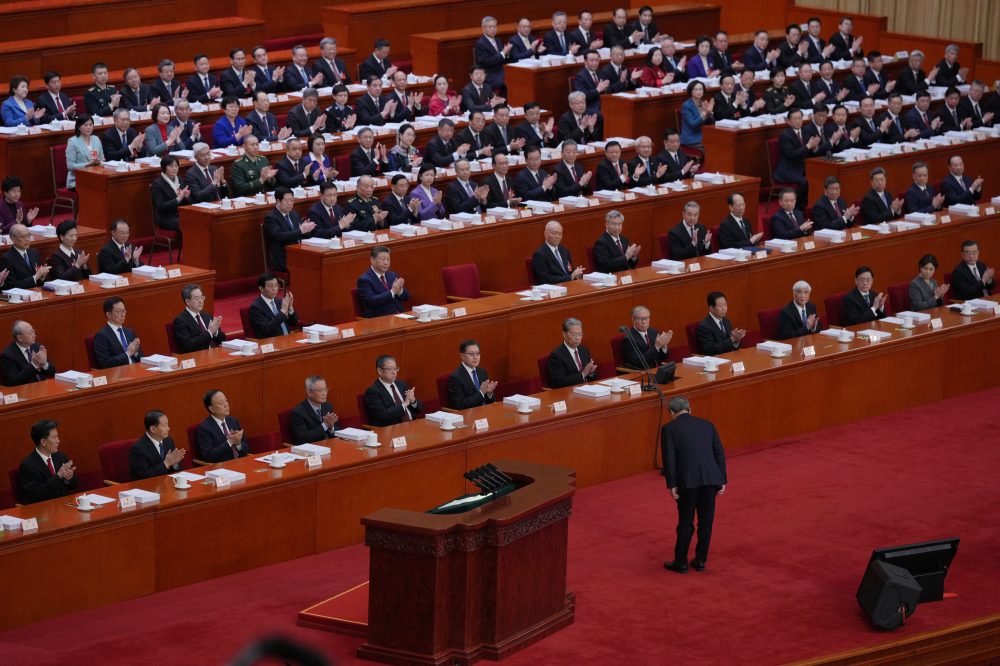

Chinese officials unveiled their most conservative economic growth projection in more than 30 years during Thursday’s opening of the nation’s annual legislative session in Beijing, signaling what experts view as a realistic approach to ongoing domestic financial challenges.
The government also published its complete five-year strategic plan extending through 2030, highlighting priorities for economic and political direction with emphasis on developing independence in sectors including artificial intelligence, robotics, and cutting-edge technologies amid intensifying competition with America.
The week-long legislative gathering is anticipated to formally endorse the five-year blueprint in the coming days.
Premier Li Qiang announced an economic expansion goal of 4.5% to 5% for 2026 during his annual government work presentation — marking the most modest target since 1991 and representing the first reduction from the official “around 5%” objective established for 2023 through 2025.
This decreased projection follows an extended real estate sector downturn that caused housing values to plummet, undermined consumer spending and investment confidence, and resulted in widespread unemployment.
To tackle the nation’s internal economic difficulties, government representatives committed to steadying the real estate market through managing new construction and decreasing existing inventory.
Li also emphasized the significance of stimulating domestic spending, though the country’s allocation of 250 billion yuan ($36 billion) designated for consumer product trade-in incentives fell short of the previous year’s 300 billion yuan commitment.
Even amid the ongoing U.S.-China trade dispute, Beijing reported achieving its official 5% economic growth objective for the previous year. This success stemmed primarily from its unprecedented trade surplus approaching $1.2 trillion, driven by increased exports to areas including Europe and Latin America.
“What we achieved in 2025 was indeed hard won,” Li stated during his address. “Rarely in many years have we encountered such a grave and complex landscape.”
Regarding Taiwan, the independently governed territory that Beijing has claimed for generations, Li emphasized that the government will “resolutely fight against” independence movements.
The selection of “fight against” terminology seemed to represent a more aggressive stance compared to the previous year’s language of “resolutely oppose.”
Within the comprehensive draft of its five-year strategy through 2030, Chinese leadership outlined ambitions for achieving technological independence to compete with the United States. The proposed plan detailed objectives for progress in artificial intelligence, robotics, semiconductors, biomedicine, quantum technology, and aerospace sectors.
To guarantee innovation advances, Chinese authorities estimated at least 7% annual average increases in national research and development expenditure.
Government leaders also announced a 7% military budget increase for 2026, reaching approximately 1.9 trillion yuan ($270 billion). This represented a slight decrease from the roughly 7.2% yearly growth over the past three years.
During his presentation, Li declared that the nation must accomplish “solid gains in military training and combat readiness.” This statement coincided with President Xi’s expanding military leadership purge — including dismissing nine military officials from the congress the previous week — as the country accelerates its armed forces modernization timeline.
Like numerous global regions, China confronts a population challenge as its citizenry ages and fertility rates decline. The 1.4 billion population decreased for the fourth consecutive year in 2025, dropping by approximately 3 million from the prior year.
Chinese officials pledged Thursday to establish a “fertility-friendly society” through policies addressing education, employment, childcare, and healthcare assistance aimed at encouraging increased births.
Concerning environmental objectives, China, the planet’s largest polluter, indicated it would maintain its renewable energy initiatives and carbon emission reductions.
For the five-year period ending in 2030, Beijing established a target of decreasing carbon emissions per gross domestic product unit by 17%, compared to the 18% reduction goal from the preceding five-year span.