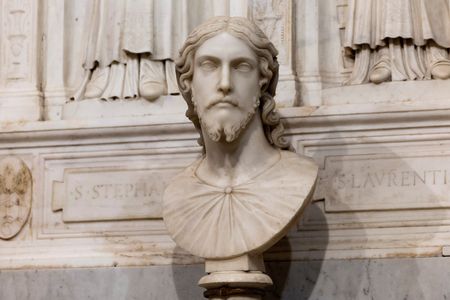

A marble sculpture that has resided in a Roman basilica for hundreds of years has been newly identified as a work by Michelangelo, ending nearly two centuries of uncertainty about its creator.
The artwork, showing Christ the Saviour, sits within the Basilica of Sant’Agnese fuori le mura along Rome’s historic Via Nomentana, where it has been maintained by a Catholic religious order.
While the piece was initially credited to Michelangelo through the early 1800s, it subsequently lost any connection to the famous Renaissance artist and remained without attribution until now.
Independent researcher Valentina Salerno, who serves on the Vatican committee commemorating 500 years since Michelangelo’s birth, has reconnected the sculpture to the celebrated Tuscan master.
“We have lived here since 1412, and the monumental complex of Sant’Agnese always holds surprises — this is one of them,” Franco Bergamin, of the Order of Lateran Canons Regular, told a press conference.
Salerno’s investigation relied heavily on extensive archival research rather than purely aesthetic evaluation, utilizing notary documents, estate inventories, and indirect letters from Michelangelo’s later Roman period.
“I am not an art historian — in fact, I don’t even have a university degree — but the strength of my research lies in its reliance on public archival documents,” she explained, characterizing herself as something of an investigator.
The documentary evidence contradicts the widely accepted belief that Michelangelo, who reached age 88, routinely destroyed his works during his final years. The records instead indicate that sketches, studies, and certain marble pieces were systematically distributed among his trusted associates following his death.
“At Michelangelo’s death, every powerful ruler would have wanted to claim something of the master. But the artist carefully devised the transfer of the material in his possession so that his art could be passed on to his pupils and thus to future generations,” Salerno said.
One record mentions a secured chamber that required multiple keys for entry, designed to protect precious materials. Though the chamber was eventually cleared, its former contents can be tracked through later transfers.
The investigation reveals a careful network that moved unidentified pieces to religious establishments and secondary locations, where they became integrated into practical environments instead of entering commercial art markets.
The Sant’Agnese sculpture appears connected to this distribution system. Having been incorporated into the basilica’s worship space for generations, the piece survived within a structure modified by centuries of renovations and expansions.
The emerging evidence will support a wider attribution effort designed to gradually restore additional forgotten pieces to Michelangelo’s recognized body of work and share these discoveries with international art scholars.
The brilliant white sculpture currently rests on an altar within a side chapel of the basilica, where it is monitored by security systems.