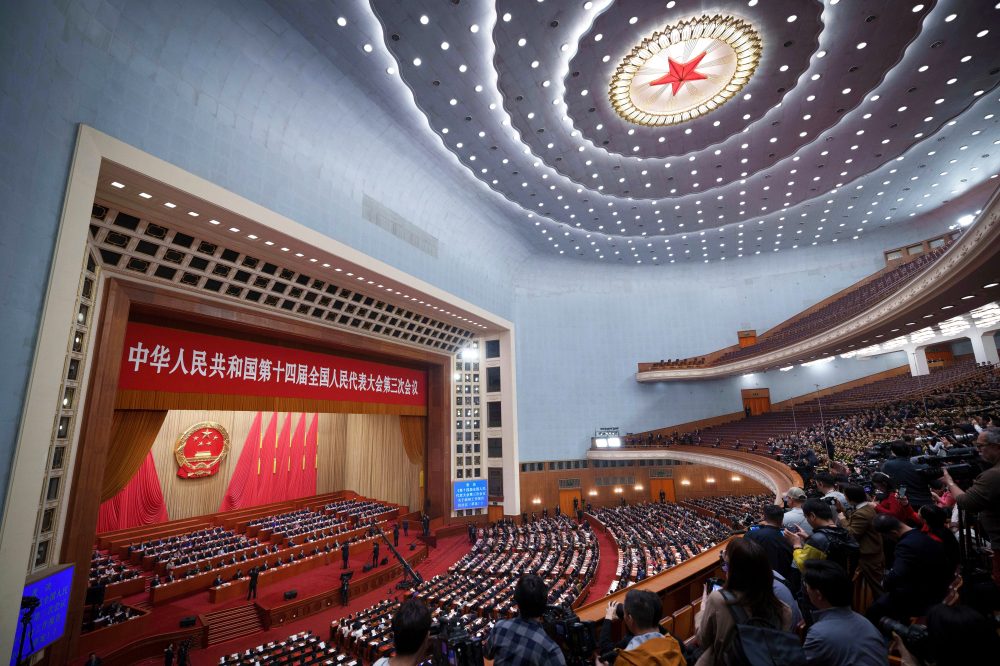

BEIJING (AP) — China’s ceremonial parliament will convene Thursday in Beijing to reveal the nation’s policy roadmap and economic objectives for the upcoming years.
The annual gathering brings together the National People’s Congress along with its advisory counterpart in the Chinese capital. The National People’s Congress will approve new legislation previously determined by China’s Communist Party leaders. Though the body consists of nearly 3,000 members who cast votes, approval is virtually guaranteed to be unanimous.
Simultaneously convening is the Chinese People’s Political Consultative Conference, an advisory group made up of prominent figures from Chinese society, including business leaders and sports figures. The body also features delegates from China’s ethnic minorities, though it wields minimal influence over policy matters.
This dual assembly is known as the Two Sessions. These political gatherings have transformed during President Xi Jinping’s leadership, becoming more tightly controlled with reduced opportunities for discussion.
“A long, long time ago, it was a venue for policy deliberation,” and even controversial things, said Alfred Wu, a professor of public policy at the National University of Singapore. “Now it’s very much become a showcase, propaganda.”
During the National People’s Congress, China’s premier traditionally reveals the nation’s GDP objectives and additional economic benchmarks for the year ahead.
This year, analysts are anticipating specifics regarding the 15th five-year plan, which the government previewed in draft form last October. The plan is anticipated to emphasize technological advancement and economic independence.
China releases five-year economic plans as guidance for its economy, a practice stemming from its historical centrally-planned economic system.
The Chinese economy continues to struggle, facing elevated youth joblessness, declining property values and reduced consumer spending. The nation also confronts trade disputes with the United States, which has imposed tariffs on Chinese imports.
Analysts suggest China must navigate a challenging balance between advancing its technology manufacturing sectors, including robotics, clean energy and artificial intelligence, while stimulating domestic consumer spending as citizens face economic pressure. Technology supply chains remain limited and benefits don’t reach consumers as effectively.
China will likely reduce its headline growth projection to an unprecedented low, according to predictions from Neil Thomas and Lobsang Tsering, policy analysts at the Asia Society. This would represent a meaningful step in a “shift from high-speed to high-quality growth,” they noted.
China’s parliament expelled 19 members recently, following the widely reported dismissal of two top military leaders in January.
Currently, just one member remains on the influential Central Military Commission, which oversees the armed forces, though policy analysts don’t anticipate personnel announcements during the upcoming Two Sessions. Observers typically monitor attendance carefully for potential signs of political purges.
Xi Jinping has reportedly dismissed as many as 100 senior military officials from the People’s Liberation Army over the past four years, according to recent research from the Center for Strategic Studies, with General Zhang Youxia’s January removal being the most notable.
However, leadership appears in no hurry to name replacements.
“I don’t think they’re particularly worried about this,” said Wu of National University Singapore. He noted that Wang Yi resumed his role as foreign minister after initially stepping down, following the high-profile dismissal of his successor Qin Gang.