
ATHENS, Greece (AP) — A Greek man has experienced profound emotions after discovering a photograph that captured his grandfather’s final moments before being executed by Nazi forces during World War II.
Thrasivoulos Marakis spent his life listening to family stories about his namesake grandfather, whom he never had the chance to meet. The tales described a towering man who lost his life during Nazi retaliation operations in Greece throughout the war.
Throughout the years, Marakis possessed only a single faded family photograph of his grandfather.
However, a new image surfaced last month through an online auction. The photograph depicted his grandfather walking with composure toward his execution alongside fellow prisoners.
This discovery has deeply affected the Marakis family and generated intense emotions throughout Greece, where the killing of 200 prisoners by Nazi occupying forces on May 1, 1944 stands as one of the nation’s most moving representations of wartime defiance.
The photographs hold profound personal significance for Marakis.
“They went to their deaths with their heads held high so that we could be free today,” he said.
On Thursday, the Culture Ministry unveiled these disturbing photographs of the execution — the first authenticated images ever released publicly — following their acquisition of the collection from a private collector in Belgium.
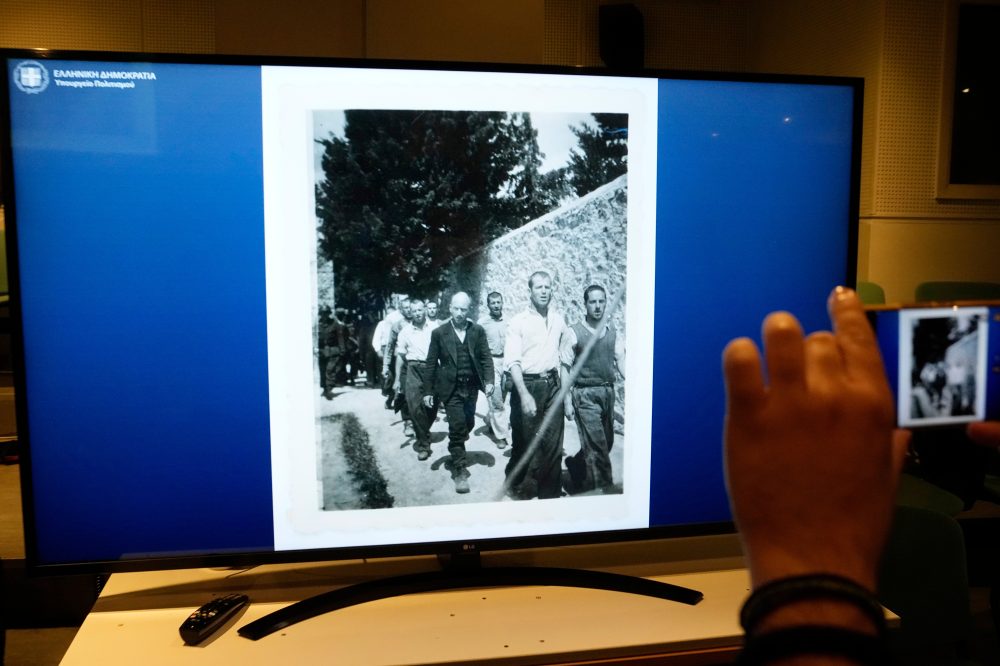
Marakis, a Crete resident, identified the tall, broad-shouldered figure leading one group — with rolled-up sleeves, walking forward with dignity — as his grandfather, 40-year-old dairy farmer Thrasivoulos Kalafatakis.
He presented the image to aging family members and their acquaintances, including a local 97-year-old woman.
“That’s when I got the final confirmation,” he told The Associated Press. “It was very moving for the family — deeply, deeply moving.”
The photograph captures prisoners marching under guard toward Athens’ Kaisariani firing range, where they faced execution in groups of 20 as retaliation for a resistance attack that killed a German commander in southern Greece.
The Greek government acquired the archive from a Belgian collector for 100,000 euros ($115,700). The collection contains 262 photographs captured by German Wehrmacht lieutenant Hermann Heuer, who served in Greece during 1943–44, plus wartime currency and news clippings from that era.
While unveiling the materials in Athens, Culture Minister Lina Mendoni explained that the images offer compelling evidence of Nazi occupation strategies and restore personal identities to victims previously known primarily through written records.
“The value of this collection is immense,” Mendoni said. “The photographs…are priceless, because they give a face and a visual dimension to historical testimonies.”
“What matters is how the Greeks faced the Nazi system with courage,” she added.
Multiple photographs document the prisoners’ last moments.
One sequence shows trucks carrying detainees along unpaved roads from Athens’ outskirts Haidari prison camp to the execution site east of the city center. Another image captures the men entering the shooting area, where stacks of jackets sit piled beside the entrance.
Valentin Schneider, a researcher at the University of Athens’ Department of History and Archaeology who assisted in authenticating the images, explained the detail’s importance.
“Most likely it was on the orders of the German army,” Schneider said. “To make the bullets penetrate more easily, they asked them to remove their coats and heavy clothing.”
Additional photographs document seldom-recorded moments: one captures the precise instant gunfire erupts, while another shows the executed prisoners on the ground, all having fallen backward.
Historians note that such visual documentation is exceptionally uncommon.
Throughout Nazi occupation of Greece from 1941 to 1944, German commanders regularly ordered executions of hostages or civilians following resistance operations.
Many prisoners killed at Kaisariani had been detained years before by Greece’s pre-war authoritarian government for communist political activities and remained incarcerated when German forces took control of the country.
The 200 prisoners faced execution in response to the ambush and assassination of a German military commander in southern Greece by resistance fighters.
The archive also exposes another aspect of the German officer who captured the photographs. Among the images are glimpses of Heuer’s personal life — including swimming near Athens, touring the Acropolis and spending time with his family after returning to Germany.
Stavroula Fotopoulou, director of the Culture Ministry’s antiquities and cultural heritage department, explained that the photographs represented a wider system promoted by the Nazi regime.
They “created a powerful propaganda machine, not only with professional photographers in the propaganda units, but by encouraging everyone — soldiers and their families — to take photographs,” she said. “Why? So these images could be sent back home and build the impression of the Wehrmacht’s successes.”
Mendoni announced that official identification of individuals shown in the photographs will commence immediately. Digital versions will be distributed to victims’ families as well as institutions and museums requesting them.
“In that moment, the Greeks — and these people in particular — showed true greatness,” Mendoni said. “They reacted with bravery and dignity. That’s what we must hold on to.”
Marakis stated the images demonstrate his grandfather “stood by his beliefs and his ideology. He never renounced them”
He added: “If he had renounced them, he would have lived longer.”