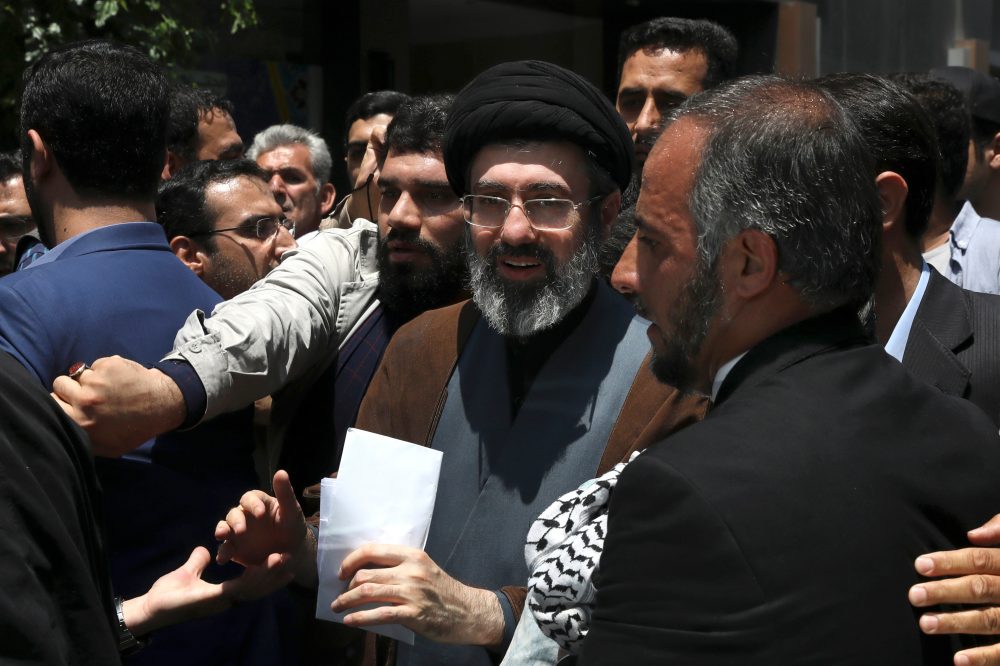

DUBAI, United Arab Emirates — Following the death of Iran’s Supreme Leader Ayatollah Ali Khamenei in an Israeli airstrike last week, attention has turned to his son Mojtaba as a potential successor to lead the Islamic Republic during wartime.
The younger Khamenei has remained out of public view since Saturday’s deadly strike on his father’s Tehran offices, which claimed the life of the 86-year-old leader. The attack also killed Mojtaba’s spouse, Zahra Haddad Adel, whose family has deep ties to Iran’s religious government.
While Iranian state media hasn’t disclosed his location, officials believe Mojtaba Khamenei remains alive and has likely sought shelter as U.S. and Israeli military operations continue targeting Iran.
Despite never holding an elected or appointed government role, the secretive figure has long been viewed as a potential heir to Iran’s top position. His father’s death in combat, along with his wife’s martyrdom, may strengthen his appeal among the elderly religious scholars who comprise the 88-member Assembly of Experts responsible for choosing Iran’s next supreme leader.
The eventual successor will inherit command of Iran’s military forces during active conflict and oversight of the nation’s highly enriched uranium reserves, which could potentially be weaponized if ordered.
According to United Against Nuclear Iran, a U.S. advocacy organization, Mojtaba served his father in multiple capacities as “a combination of aide-de-camp, confidant, gatekeeper and power broker,” similar to how Ahmad Khomeini supported Iran’s first Supreme Leader Ruhollah Khomeini.
Born in Mashhad in 1969, roughly a decade before Iran’s 1979 Islamic Revolution, Mojtaba witnessed his father’s opposition activities against Shah Mohammad Reza Pahlavi during his childhood.
An official account of Ali Khamenei’s life describes how the shah’s secret police force, SAVAK, once raided their family home and assaulted the future leader. When young Mojtaba and his siblings were told their father was taking a trip, the elder Khamenei recalled saying: “But I told them, ‘There is no need to lie.’ I told them the truth.”
Following the monarchy’s collapse, the family relocated to Tehran. Mojtaba later served in the Iran-Iraq conflict as part of the Habib ibn Mazahir Battalion, a Revolutionary Guard unit whose veterans went on to occupy senior intelligence roles, likely with Khamenei family support.
When his father assumed the supreme leadership in 1989, Mojtaba gained access to vast financial resources through Iran’s bonyads — state-funded foundations controlling assets previously owned by the shah.
His influence expanded as he worked from his father’s downtown Tehran headquarters. Classified U.S. diplomatic communications released by WikiLeaks in the late 2000s dubbed him “the power behind the robes.” One document alleged he monitored his father’s communications, controlled access to the leader, and was building his own network of supporters.
A 2008 diplomatic cable noted that Mojtaba “is widely viewed within the regime as a capable and forceful leader and manager who may someday succeed to at least a share of national leadership; his father may also see him in that light,” while acknowledging his limited religious credentials and relatively young age.
The document further stated: “Mojtaba is, however, due to his skills, wealth, and unmatched alliances, reportedly seen by a number of regime insiders as a plausible candidate for shared leadership of Iran upon his father’s demise, whether that demise is soon or years in the future.”
According to the U.S. Treasury Department, Mojtaba maintained close relationships with Revolutionary Guard leadership, including commanders from the elite Quds Force and the volunteer Basij militia that brutally crushed nationwide demonstrations in January.
The Trump administration imposed sanctions on him in 2019 for helping to “advance his father’s destabilizing regional ambitions and oppressive domestic objectives.”
Intelligence reports suggest Mojtaba secretly backed hardline President Mahmoud Ahmadinejad’s 2005 victory and his controversial 2009 reelection, which triggered the Green Movement uprising.
Former presidential contender Mahdi Karroubi, who ran in both elections, criticized Mojtaba as “a master’s son” and accused him of election interference. His father reportedly responded that Mojtaba was “a master himself, not a master’s son.”
Iran has experienced only one previous leadership transition since the 1979 revolution. Ayatollah Ruhollah Khomeini passed away at 86 after spearheading the revolution and guiding Iran through its devastating eight-year conflict with Iraq.
The incoming leader will assume power following a 12-day war with Israel, as U.S.-Israeli forces work to neutralize Iran’s nuclear capabilities and military strength while hoping to inspire domestic uprising against the theocratic system.
Iran’s supreme leader sits at the center of the nation’s intricate Shiite religious government structure, holding ultimate authority over all state decisions. The position includes serving as military commander-in-chief and head of the Revolutionary Guard, the paramilitary organization designated as terrorist by the United States in 2019 and empowered under his father’s rule.
The Guard leads Iran’s self-proclaimed “Axis of Resistance,” a network of militant organizations and regional partners designed to challenge U.S. and Israeli interests throughout the Middle East. The force also controls significant business interests within Iran and manages the country’s ballistic missile program.