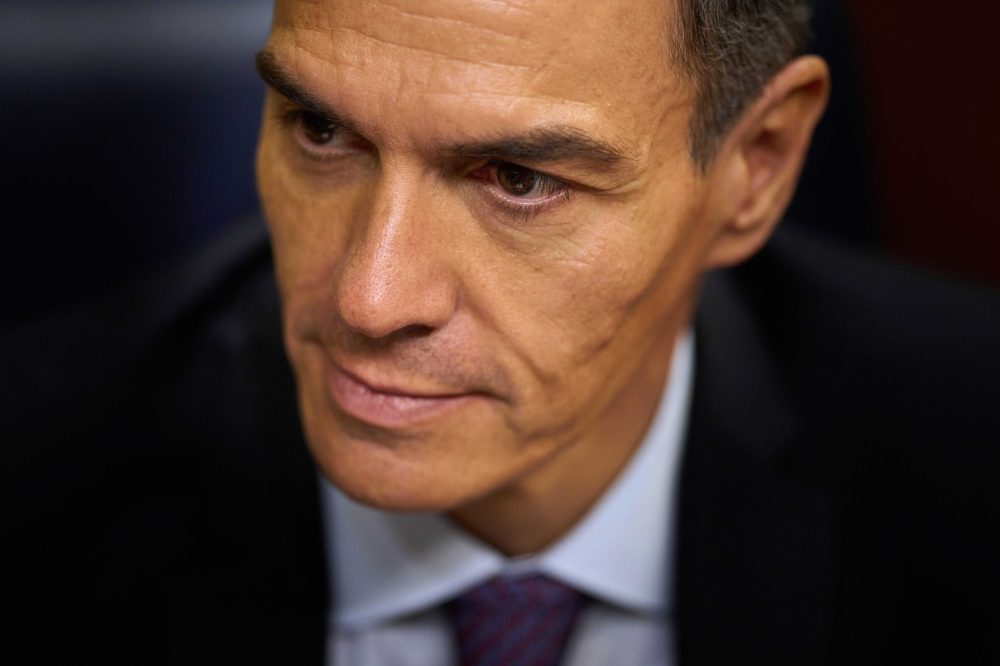

BARCELONA, Spain (AP) — Spanish Prime Minister Pedro Sánchez has positioned himself as the leading European voice opposing President Donald Trump’s policies, particularly after denying the U.S. military access to Spanish bases for operations against Iran.
The confrontation escalated Tuesday when Trump threatened to “cut off all trade with Spain” following the Spanish leader’s refusal to cooperate. Tensions grew further when Spain’s foreign minister disputed White House claims that Madrid had received Trump’s message “loud and clear” and was now working with American forces.
Although condemning Tehran’s authoritarian government, Sánchez declared he would not support what he characterized as an unjustified military campaign.
“We are not going to be complicit in something that is bad for the world and is also contrary to our values and interests, just out of fear of reprisals from someone,” Sánchez declared, adopting the rallying cry “No to the war” during a recent address.
The disagreement over Spanish military facilities appears more diplomatic than strategically significant, given America’s extensive network of bases throughout Europe and the Middle East, with other European nations providing support.
Spain and the United States have maintained steady, cordial relations spanning decades, beginning in the 20th century when America established shared military installations during Francisco Franco’s dictatorship.
The 54-year-old Sánchez assumed office in 2018 and ranks among Europe’s most visible progressive leaders.
He has championed core liberal principles including women’s rights, legal immigration pathways, human rights protections, international law adherence, and climate action — issues that have become frequent targets of Trump’s MAGA agenda and European far-right movements.
Prior to the Iran conflict, Sánchez had already established himself as Trump’s ideological opponent across numerous policy areas.
The Spanish leader has emerged as one of Israel’s harshest critics regarding its Gaza military operations, repeatedly condemning the extensive civilian casualties following Hamas’s 2023 surprise assault on Israeli soil.
“This is not self-defense, it’s not even an attack — it’s the extermination of a defenseless people,” he stated while traveling across Europe and the Middle East seeking peace negotiations.
Within NATO, Spain stood alone in rejecting commitments to raise defense spending to 5% of national economic output. Sánchez negotiated a special exemption during last year’s alliance summit, limiting Spain’s commitment to 2.1%, which he termed “sufficient and realistic.”
Trump suggested Spain’s NATO membership should be reconsidered, though this remains an unexecuted threat.
While numerous European nations tightened border controls and the Trump administration expanded immigration enforcement, Spain is currently processing work and residence documentation for 500,000 foreign nationals already within its borders.
Sánchez has directly referenced Trump while promoting immigration’s economic advantages for his nation.
“MAGA-style leaders may say that our country can’t handle taking in so many migrants — that this is a suicidal move, the desperate act of a collapsing country,” he stated in a recent New York Times editorial. “But don’t let them fool you. Spain is booming.”
Under Sánchez’s leadership, Spain has joined nations including Australia and France in restricting social media access for young teenagers, contrasting sharply with the Trump administration’s support for technology companies and their interpretation of free speech rights online.
X platform owner Elon Musk attacked the Spanish prime minister last month, labeling Sánchez “the true fascist totalitarian” following his announcement of plans to ban social media access for those under 16.