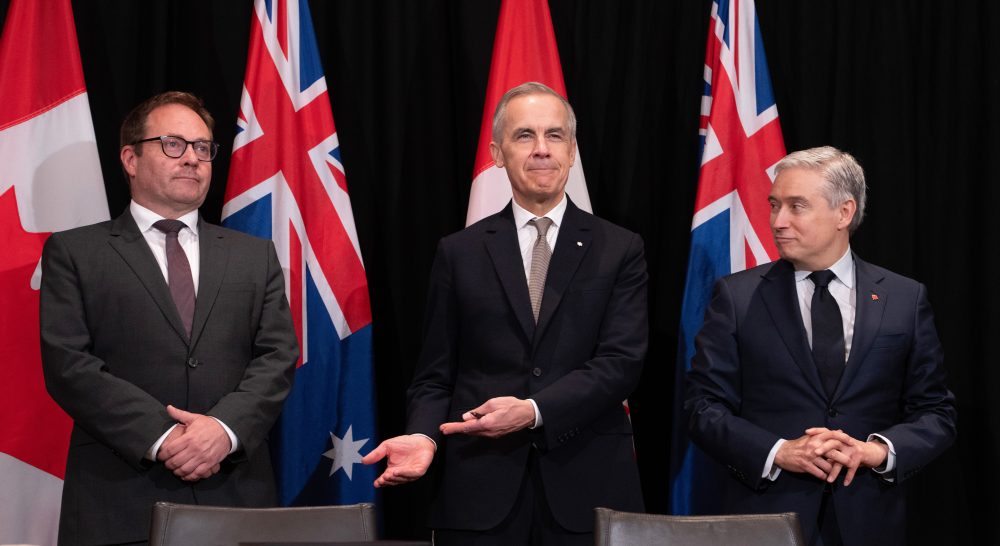

MELBOURNE, Australia — During a policy speech in Australia on Wednesday, Canadian Prime Minister Mark Carney expressed disappointment that the ongoing Middle East conflict represents an alarming breakdown of global diplomatic cooperation.
Speaking to the Lowy Institute, a prominent international policy research organization based in Sydney, Carney made his remarks during the Australian portion of a three-country trade mission that started in India. The prime minister is scheduled to address Australia’s Parliament on Thursday before continuing to Japan on Friday.
“Geo-strategically, hegemons are increasingly acting without constraint or respect for international norms or laws while others bear the consequences. Now the extremes of this disruption are being played out in real time in the Middle East,” Carney stated.
The Canadian leader expanded on concepts he first presented during his widely-discussed January address at the World Economic Forum in Davos, Switzerland, where he warned that established international diplomatic frameworks were deteriorating.
Carney emphasized Canada’s commitment to preventing Iran from developing nuclear capabilities and threatening global stability.
“We are actively taking on the world as it is, not passively waiting for a world we wish to be. But we also take this position with some regret because the current conflict is another example of the failure of the international order,” he stated.
Despite years of United Nations diplomatic initiatives, “Iran’s nuclear threat remains and now the United States and Israel have acted without engaging the U.N. or consulting with allies including Canada,” he continued.
When asked about potential international law violations regarding U.S. and Israeli military strikes against Iran, Carney responded that such determinations were “a judgment for others to make.”
The visit also focused on strengthening partnerships between Canada and Australia in strategic sectors including critical minerals, artificial intelligence, and defense technology development.