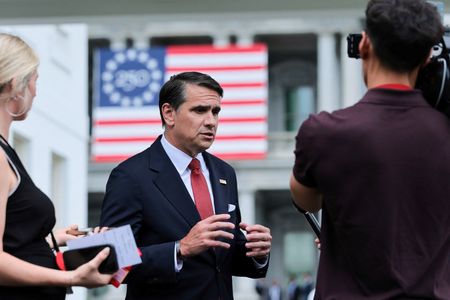
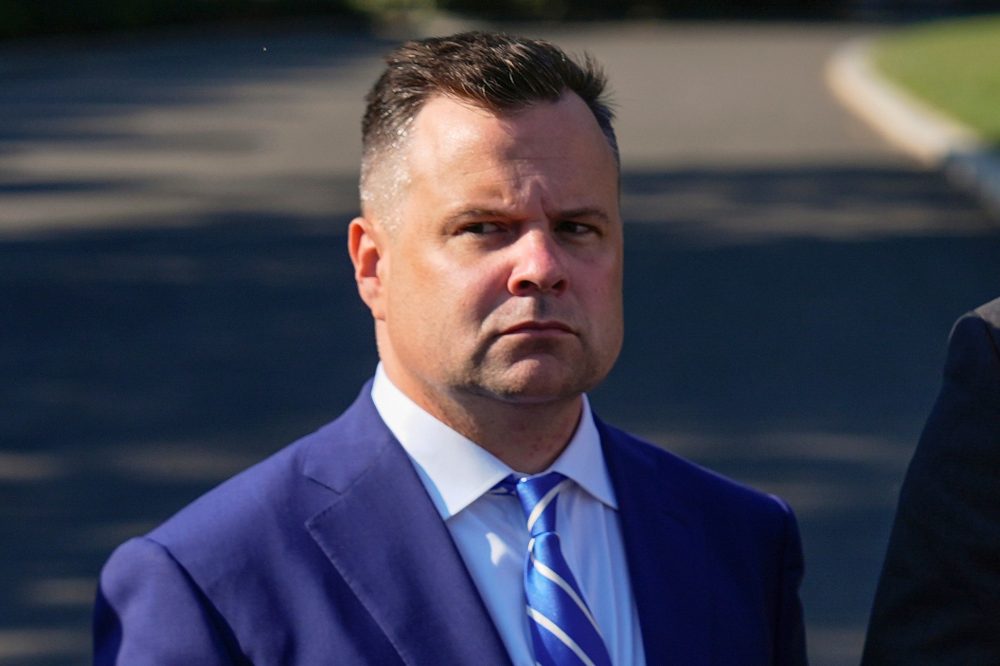
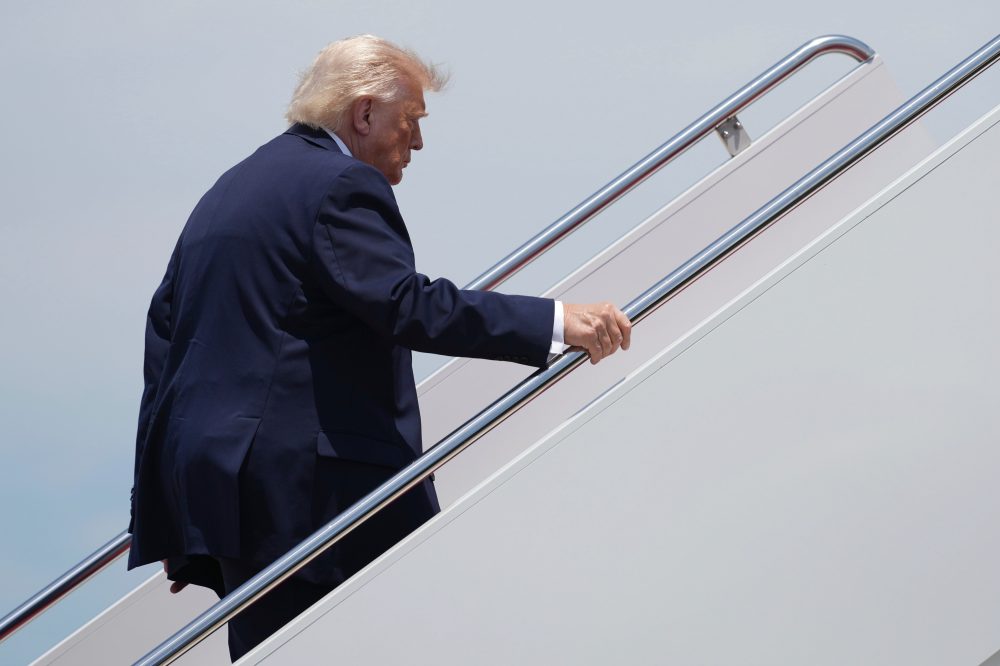
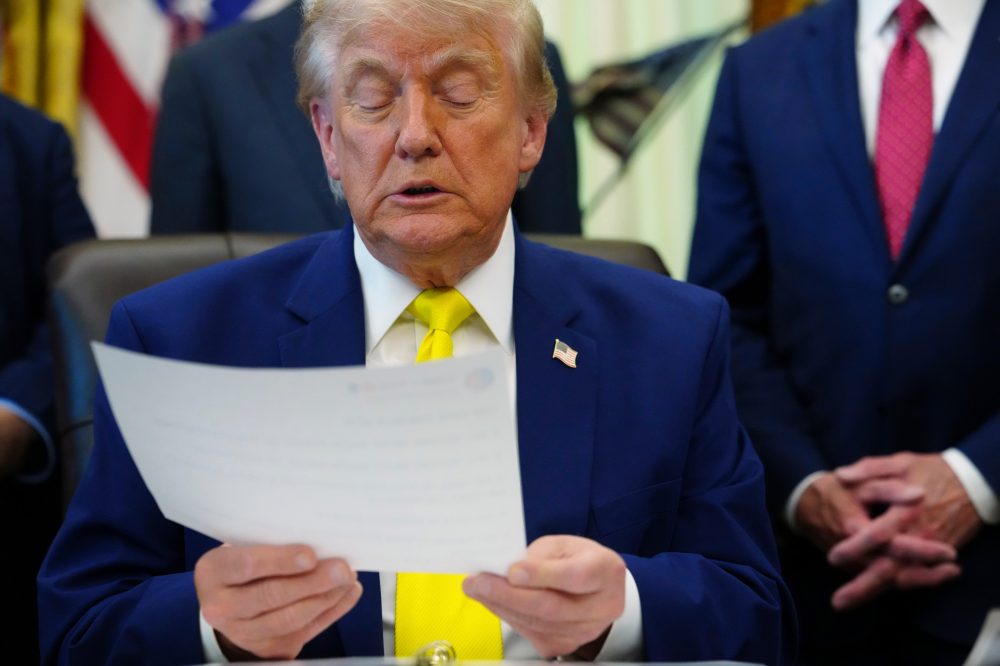
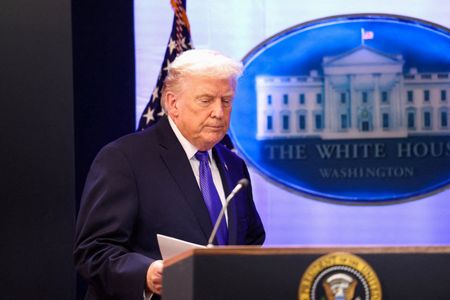
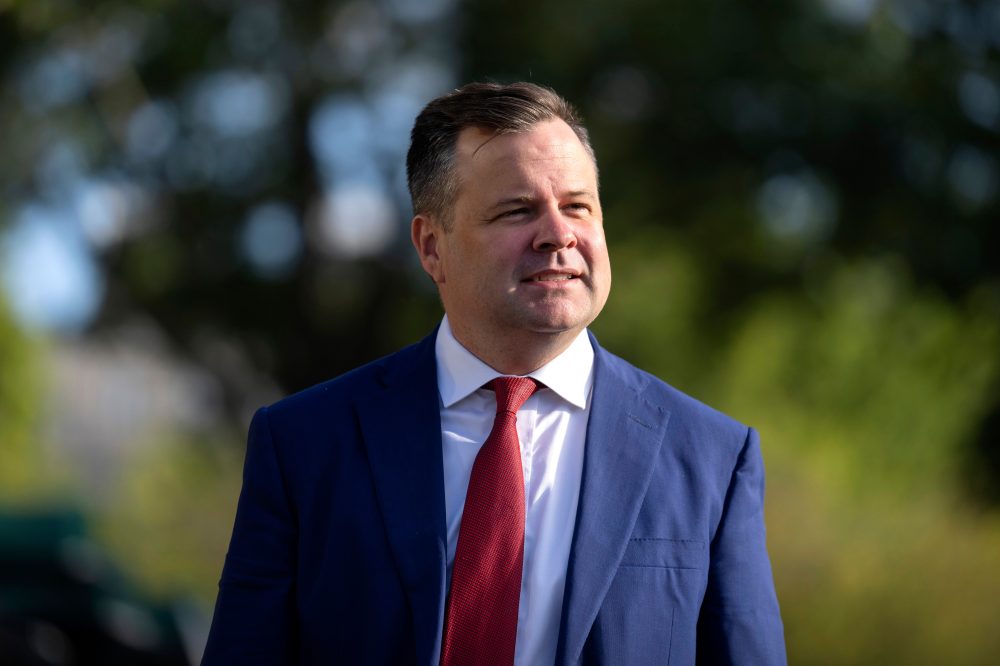
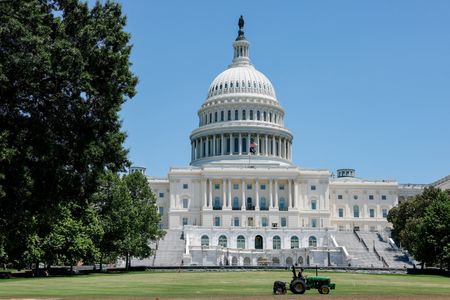
The White House announced Monday that U.S. President Donald Trump has formally transmitted Todd Blanche’s nomination to the U.S. Senate for consideration as attorney general.
The June 8 announcement moves Blanche’s nomination into the Senate confirmation process, where lawmakers will review his qualifications for the nation’s top law enforcement position.
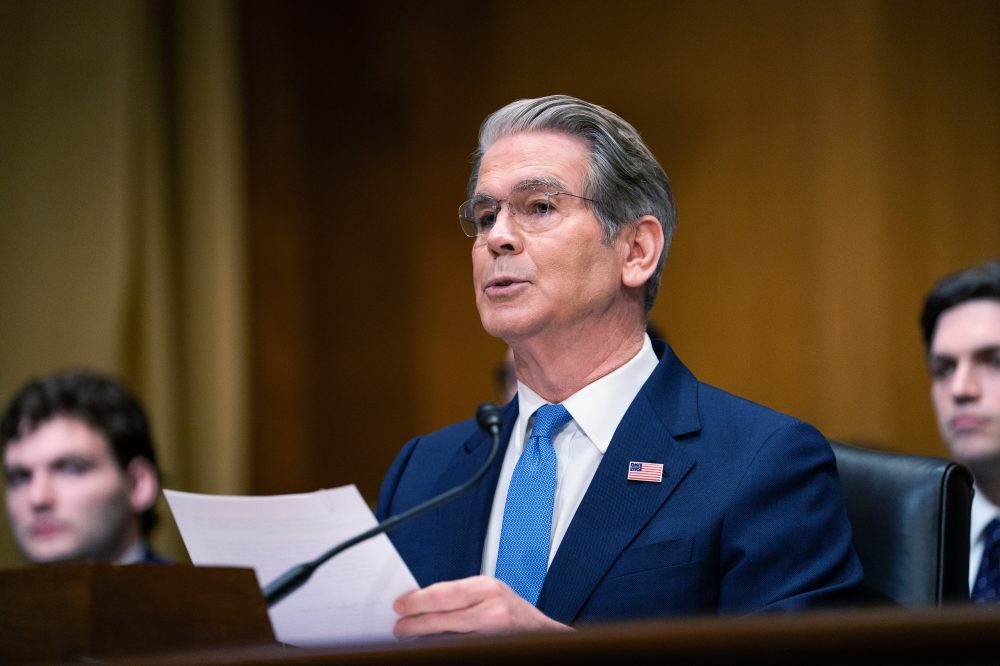
WASHINGTON – Six Democratic senators called Monday for a federal investigation into Transportation Secretary Sean Duffy over a family vacation road trip that was recorded for an online video series and funded by corporate donors whose businesses fall under his department’s regulatory oversight.
The lawmakers – Senators Patty Murray, Elizabeth Warren, Tammy Duckworth, Ben Ray Lujan, Mazie Hirono and Richard Blumenthal – have requested the DOT Office of Inspector General examine the video project. In their request, they stated that Duffy’s involvement creates “serious questions about use of funds and potential misconduct.”
The controversy centers around the transportation chief’s participation in the filmed vacation trip that was financed by companies his agency oversees, raising potential conflict of interest concerns.
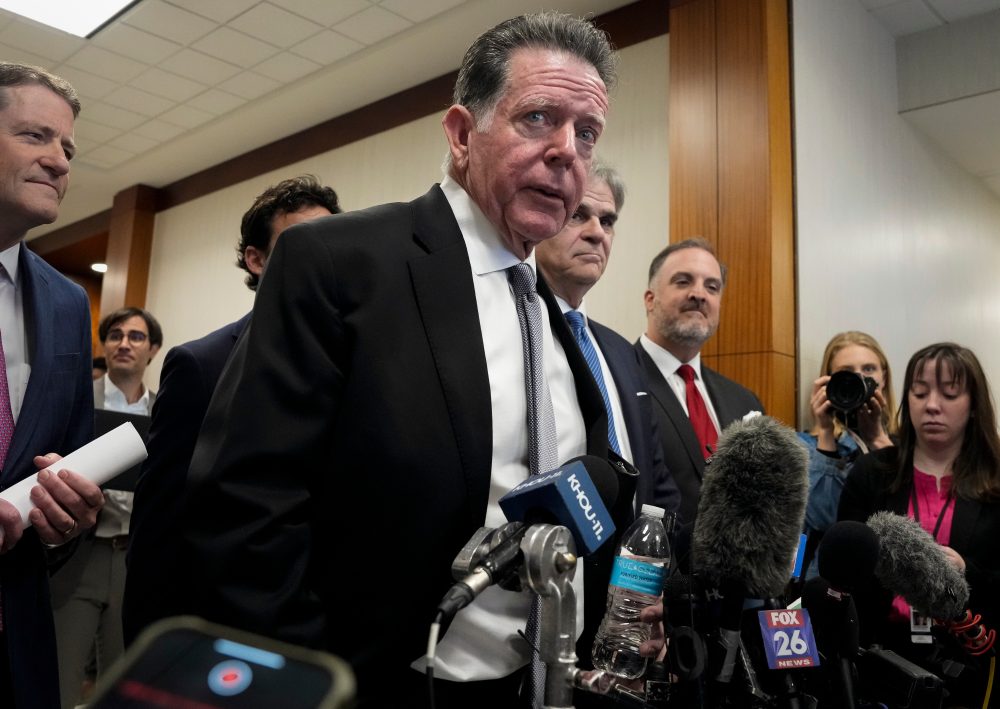
AUSTIN, Texas (AP) — A Houston defense attorney who spent nearly ten years representing Texas Attorney General Ken Paxton against corruption and securities fraud charges has announced his backing for Democrat James Talarico in a major U.S. Senate contest.
On Monday, Talarico’s campaign highlighted receiving support from Dan Cogdell, a Houston lawyer who served on Paxton’s legal team during the Republican’s landmark 2023 impeachment proceedings that resulted in his acquittal.
While Paxton’s history of legal issues forms a key component of Talarico’s campaign strategy, Cogdell’s endorsement did not reference worries about his former client’s legal past.
According to Cogdell, he holds no personal animosity toward Paxton and believes Texas legislators made the correct decision in clearing the attorney general. However, from a political standpoint, Cogdell expressed concern that Paxton prioritizes satisfying President Donald Trump over other considerations.
“I worked my ass off for the man for nine years,” Cogdell told The Associated Press during an interview. “But that’s a different inquiry, my obligation to Ken ended at the courthouse steps and my obligation as a citizen is to do what I think is the right thing.”
Cogdell emphasized that Texas faces significant challenges in areas like education and healthcare, “and to simply bootlick or rubber stamp Trump, that’s not what we need in D.C. right now.” He also recently conducted an extended interview with Talarico on Cogdell’s podcast.
When contacted for a response, a campaign representative for Paxton noted that Cogdell is a Democrat and characterized the endorsement as predictable.
Tony Buzbee, who served as lead counsel during Paxton’s impeachment trial, echoed this sentiment on X while announcing his own support for Paxton in the race.
Cogdell acknowledged his Democratic registration, though Texas does not require voters to register by party affiliation. He clarified that he views himself as a moderate who has historically donated more campaign funds to Republican rather than Democratic candidates.
Talarico has energized Democratic hopes for turning the statewide Texas seat blue as the party works to regain U.S. Senate control this November.
Paxton’s outsider campaign defeated Sen. John Cornyn in last month’s Republican Senate primary runoff, boosted by a Trump endorsement in the race’s final stretch.
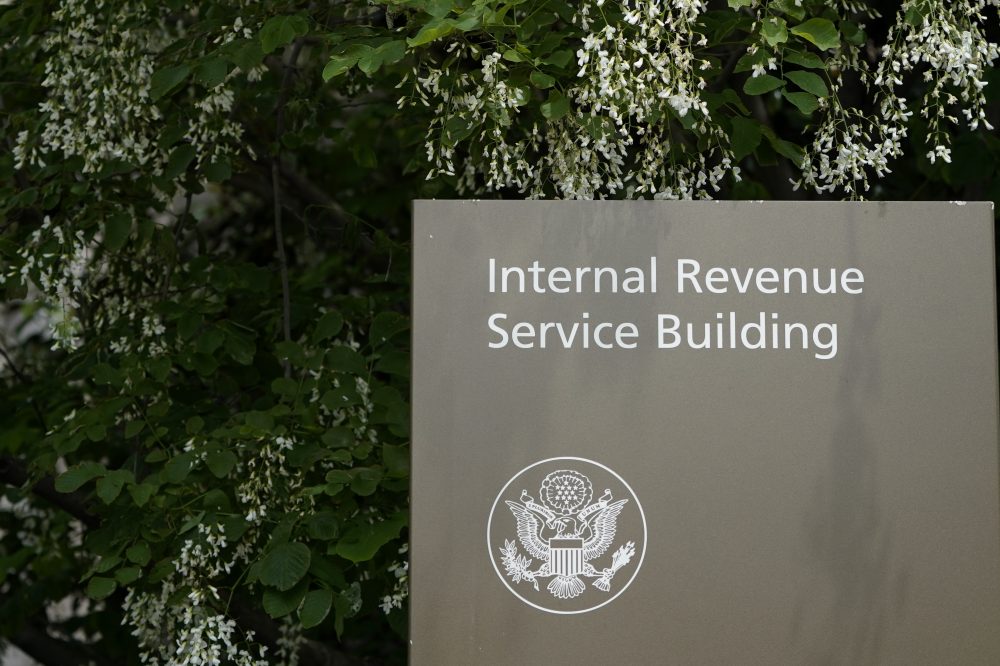
WASHINGTON — Federal investigators have uncovered serious security vulnerabilities in a controversial program that permits Immigration and Customs Enforcement to obtain taxpayer records from the Internal Revenue Service, according to a newly released Treasury watchdog report.
The Treasury inspector general’s findings represent the first comprehensive review of the scope and problems associated with the taxpayer information exchange program, which sparked multiple court challenges and internal disputes when it was implemented in 2025.
Treasury’s inspector general, known as TIGTA, determined that the disputed 2025 arrangement between ICE and Treasury — which enables ICE to submit immigrant names and addresses for verification against tax databases — suffered from data formatting inconsistencies and flawed matching standards that produced inaccurate results.
The controversial program prompted the then-acting commissioner of the IRS to step down from the position.
According to the report’s findings, ICE submitted requests for address details on over 1.2 million individuals following the agreement’s implementation, with the IRS eventually supplying last-known address information for approximately 47,000 people.
TIGTA’s investigation revealed that the IRS’s computerized matching system contained significant defects. Data formatting problems from ICE’s submissions created unreliable matches, including instances where partial or incorrect addresses received validation as accurate information, the report indicates.
Treasury and IRS officials did not provide responses to Associated Press inquiries seeking comment.
The taxpayer and immigration data cross-checking initiative represents a component of President Donald Trump’s border security priorities and his comprehensive national immigration enforcement campaign, which has included deportation operations, workplace enforcement actions and implementation of an 18th century wartime statute for removing Venezuelan migrants.
This disclosure marks the second time that extensive taxpayer information sharing with ICE has come to light.
A federal judge ruled in February that the IRS violated federal law through its unauthorized disclosure of confidential taxpayer records to Immigration and Customs Enforcement, specifically referencing the same 47,000 information releases highlighted in TIGTA’s findings.
U.S. District Judge Colleen Kollar-Kotelly determined that the IRS improperly provided taxpayer records for thousands of individuals to the Department of Homeland Security under the agencies’ disputed information-sharing arrangement designed to identify and remove people residing illegally in the United States.
The latest TIGTA report contains no formal recommendations, according to correspondence from Nancy A. LaManna, deputy inspector general for inspections and evaluations.
“However, we plan to share some concerns we identified during our review with the DHS Office of Inspector General,” her letter states.
Two residents from the Washington area are seeking court intervention to prevent President Donald Trump from holding an Ultimate Fighting Championship event at the White House next week, according to legal documents filed in federal court.
The residents submitted their request on Sunday to U.S. District Judge Amit Mehta, asking for an emergency order to stop the mixed martial arts competition and prevent the construction of a massive metal structure known as “the Claw” on the South Lawn of the executive mansion.
Judge Mehta responded on Monday by requesting attorneys to establish a timeline for addressing the urgent petition.
The planned event, titled “UFC Freedom 250,” is scheduled to align with President Trump’s 80th birthday celebration on June 14. The competition would take place within a towering octagon-shaped cage measuring 92 feet in height, with fighter weigh-ins planned for the Lincoln Memorial.
The legal challenge, submitted to the court on Saturday, claims that approvals granted by the National Park Service and Interior Department were improper and should be overturned.
“This nation’s public monuments should not be loaned out for private exploitation,” the plaintiffs said.
White House officials responded by characterizing the legal action as an “obstructionist, baseless, and dilatory lawsuit” and defended the planned event by stating it “is no different than the various other White House-hosted events on the South Lawn and properly permitted events on the Ellipse and National Mall throughout the year.”
The legal filing argues the event breaks regulations that prohibit sporting competitions on the South Lawn and at the Lincoln Memorial, and claims the construction of such a large arena facility needs approval from Congress.
This legal challenge adds to other ongoing court cases involving Trump’s construction initiatives at the White House and throughout the capital, including his plan to build a 90,000-square-foot ballroom on the site of the demolished East Wing, and his proposal to renovate and close The John F. Kennedy Center for the Performing Arts.
WASHINGTON — Maine’s state primary election Tuesday presents numerous competitive contests featuring candidates from well-known political dynasties.
The primary elections for U.S. Senate and House seats will determine the nominees for a midterm general election where Maine is anticipated to be crucial in determining which party controls both congressional chambers. Maine voters will also get the chance in November to showcase the state’s notably independent political character when selecting a new governor.
The candidate field includes a U.S. senator’s son, a congresswoman’s daughter, a former governor’s brother, and relatives of two presidents.
Republican Sen. Susan Collins faces no opposition in seeking renomination for a sixth term, positioning her to potentially become Maine’s longest-serving Senate member.
Collins stands as the sole Senate Republican representing a state that Democratic presidential nominee Kamala Harris won in 2024, making her a key figure in the battle for chamber control this November. Her 51% vote share in 2020 marked her weakest performance since receiving 49% in her initial successful campaign in 1996. Democrats consistently target her as a top incumbent to defeat, though her Democratic challengers have never exceeded 44% in her five prior races.
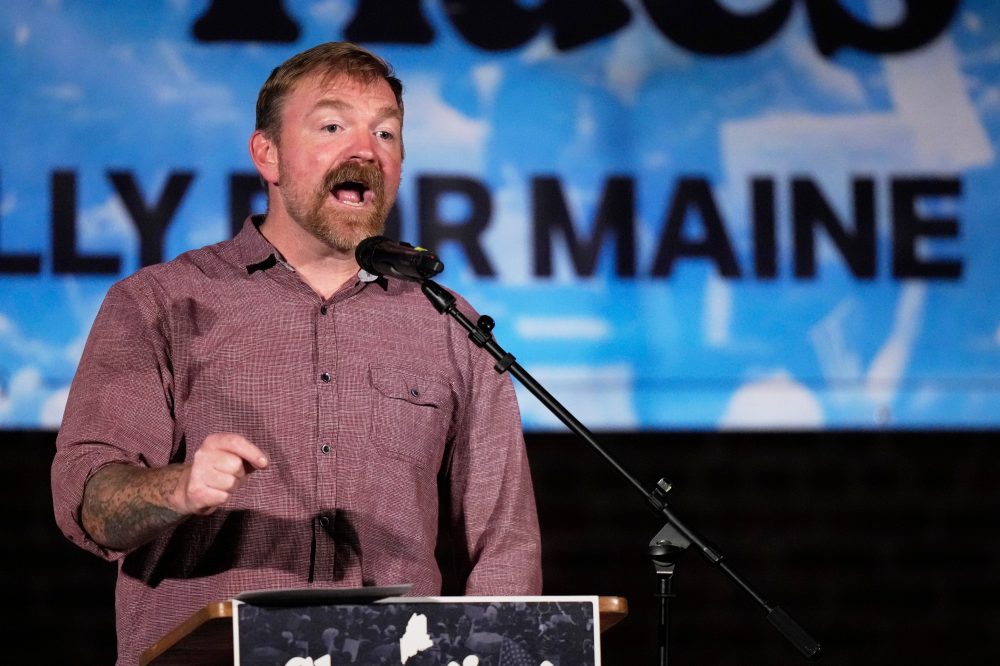
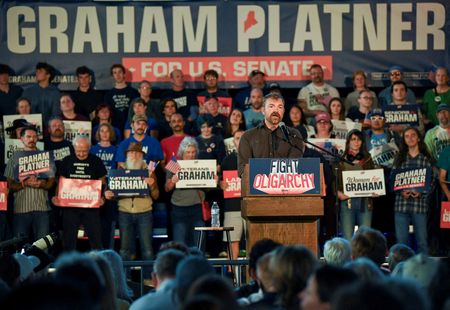
Graham Platner emerges as the frontrunner for the Democratic nomination to face Collins. The Marine and U.S. Army veteran turned to oyster farming after serving combat tours in Iraq and Afghanistan. Platner initially confronted a challenging primary against Gov. Janet Mills, whom some national Democratic leaders favored, but the second-term governor withdrew from the race in April due to fundraising difficulties.
Two other primary opponents remain for Platner, including one write-in candidate. Mills remains on the ballot despite ending her campaign.
Through May 20, Platner had raised more money than all candidates, including Collins, though Collins maintained a larger cash reserve.
Vermont U.S. Sen. Bernie Sanders provided crucial early endorsement for Platner and maintained his support despite recent accusations that Platner sent sexually explicit text messages to multiple women while married. Earlier in the campaign, Platner faced separate controversy over a tattoo he previously had that was identified as a Nazi symbol.
In the 2nd Congressional District, Democratic U.S. Rep. Jared Golden announced in November he would not pursue a fifth term in a district Trump carried in 2024, along with its single electoral vote. Maine ranks among two states that distribute some presidential electoral votes by congressional district.
The Democratic candidates seeking to replace Golden include former congressional aide Jordan Wood, state Auditor Matt Dunlap and state Sen. Joe Baldacci, brother of Democratic former Gov. John Baldacci.
The Democratic winner will challenge former two-term Republican Gov. Paul LePage, who runs uncontested for the nomination.
Wood has significantly outpaced the entire field, including LePage, in campaign fundraising, though LePage held the largest cash balance as of May 20.
For the gubernatorial primaries, state Secretary of State Shenna Bellows, former state Senate President Troy Jackson, renewable energy company co-founder Angus King III, former state House Speaker Hannah Pingree and former Centers for Disease Control and Prevention Deputy Director Nirav Shah all pursue the Democratic nomination.
Republican candidates include former healthcare CEO Jonathan Bush, former U.S. State Department official Bobby Charles, former state Senate Majority Leader Garrett Mason and businessman Ben Midgley.
King is the son of independent U.S. Sen. Angus King. Pingree is the daughter of Democratic U.S. Rep. Chellie Pingree. Bush is related to Republican former Presidents George H.W. Bush and George W. Bush.
Maine’s governor’s office regularly switches between parties. The state hasn’t chosen consecutive governors from the same party in 74 years.
While Maine contains 16 counties, elections are administered by the state’s hundreds of cities and towns, a typical New England practice. Portland stands as Maine’s largest city by far and serves as the core of the state’s Democratic support. The two congressional districts generally align with the state’s political makeup. The 1st Congressional District along Southern Maine’s coast leans heavily Democratic, while the expansive 2nd District northward encompasses most smaller, rural communities where Trump performed strongest.
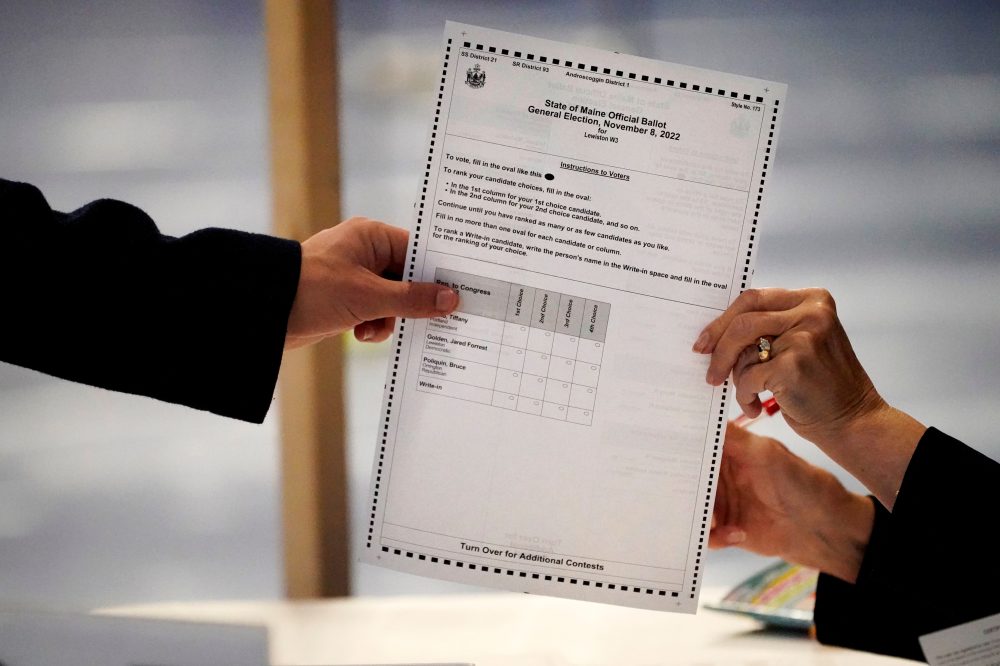
The state employs a ranked-choice voting system where voters rank candidates by preference. When no candidate achieves a majority of first-place votes, the last-place candidate gets eliminated, and their votes get redistributed among remaining candidates based on those voters’ preferences. This continues until one candidate obtains a majority.
Key election details and data points the AP Decision Team will track during vote counting:
Polls close at 8 p.m. ET.
The Associated Press will deliver vote results and announce winners in contested primaries for U.S. Senate, U.S. House, governor, state Senate and state House.
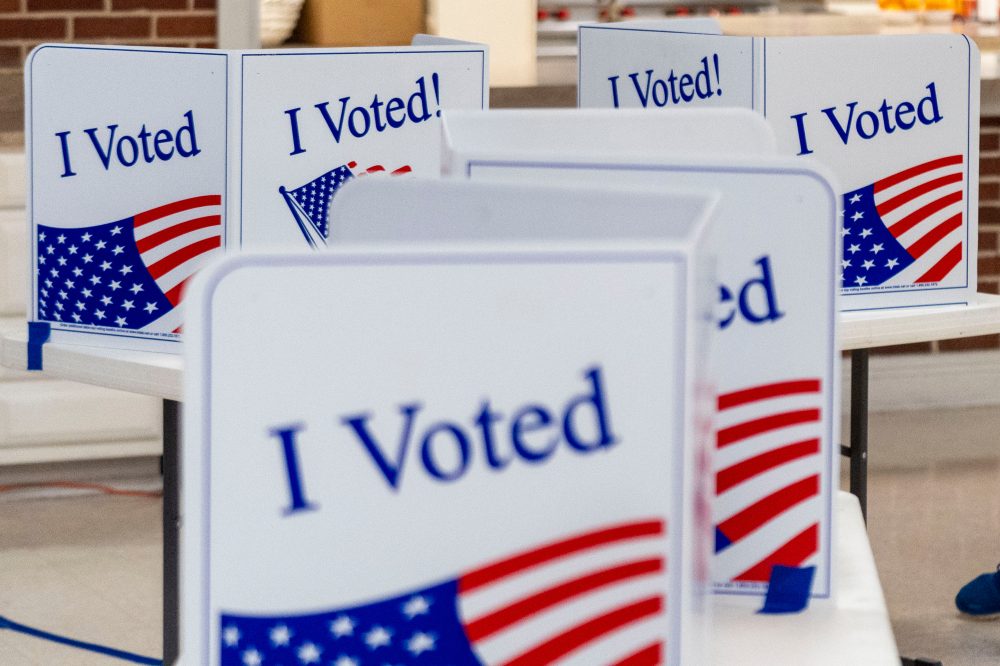
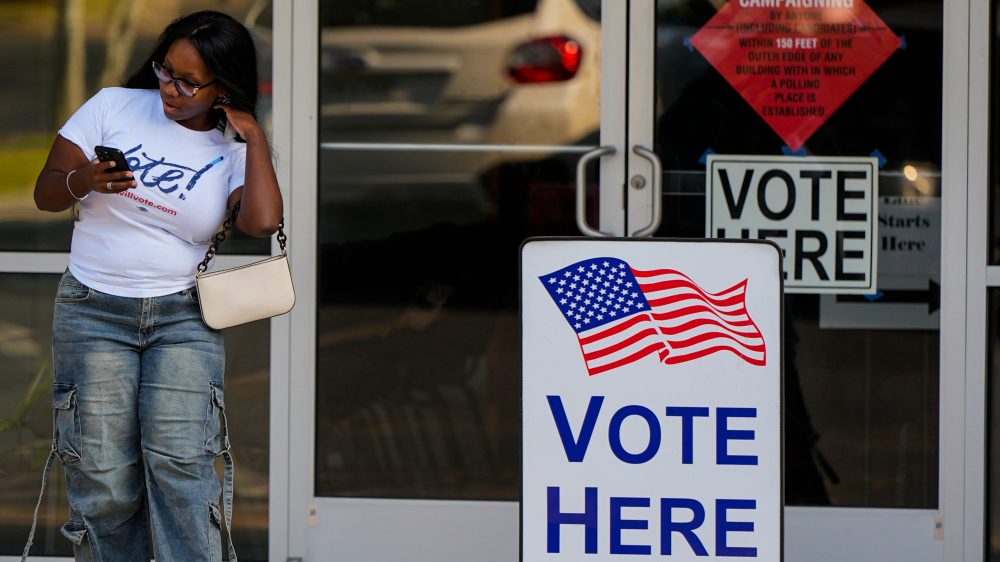
Registered party members can vote only in their party’s primary. Democrats cannot participate in Republican primaries and vice versa. Independent or unaffiliated voters may join either primary.
January registration showed approximately 354,000 registered Democrats, about 309,000 registered Republicans and roughly 334,000 unaffiliated voters.
Around 69,000 Democratic primary votes and approximately 60,000 Republican primary votes were cast in 2022’s gubernatorial primaries, when both nominees ran without opposition.
Roughly 26% of Democratic primary votes and about 12% of Republican primary votes in 2022’s gubernatorial primaries were cast before primary day.
Through Thursday, approximately 56,000 ballots had been submitted for Tuesday’s election, including about 33,000 from Democrats, roughly 13,000 from Republicans and around 10,000 from unaffiliated voters.
During the 2024 general election, the state’s largest cities and towns typically released results from all voting methods simultaneously at night’s beginning.
In 2024’s general election, the AP initially reported results at 8:44 p.m. ET, 44 minutes after poll closing. Approximately 50% of total votes were counted by 12:54 a.m. ET, with counting halting at 4:11 a.m. ET. By 3:13 p.m. ET the following day, roughly 90% of votes were tallied.
The AP doesn’t make projections and declares winners only when determining no scenario exists for a trailing candidate to overcome the gap. For uncalled races, the AP will continue covering newsworthy developments, including candidate concessions or victory claims, while clarifying it hasn’t declared a winner and explaining why.
Under 2025 law, Maine recounts occur automatically for tied votes. Candidates for statewide or multicounty office may request and fund recounts, though charges are waived if the margin doesn’t exceed 1% of total votes cast or 1,000 votes, whichever is smaller. The AP may declare winners in recount-eligible races if determining the lead is too substantial for recounts or legal challenges to alter outcomes.
As of Tuesday, 147 days remain until the 2026 midterm elections.
President Donald Trump has rejected suggestions that initiating military action against Iran contradicts his campaign promise to avoid new conflicts during his presidency.
The statement comes as tensions escalate in the Middle East, with Israel and Iran engaging in recent retaliatory attacks that risk pulling the broader region into widespread conflict.
In other developments, Trump, who has long supported the New York Knicks, announced Friday his plans to attend the first NBA Finals game held in New York since 1999. The NYPD has responded by canceling watch parties near Madison Square Garden and advising game attendees to arrive at least two hours early due to heightened security protocols.
A recent survey from The Associated Press-NORC Center for Public Affairs Research reveals declining American confidence in their nation’s global standing as the country prepares to mark its 250th anniversary. The polling data shows growing uncertainty about the future of democratic governance, especially among younger Americans, creating a stark backdrop for the upcoming commemorative celebrations.
The research indicates only about 25% of Americans believe the United States surpasses all other nations globally, while 44% consider it among the world’s top countries alongside others. Approximately 30% now view other nations as superior to the U.S., representing a significant increase from the 19% who held this view in a June 2016 AP-NORC survey.
Legal action has been filed to stop a planned UFC event scheduled for the White House South Lawn, coinciding with President Trump’s 80th birthday and the nation’s anniversary celebration. The Public Integrity Project, representing two Virginia residents, filed the Saturday lawsuit claiming the Trump administration’s June 14 event approval violates federal regulations.
The legal challenge argues the authorization breaches National Park Service rules against sporting events on federal lands, lacks congressional approval for construction elements, and proceeded without required environmental assessments. White House officials dismissed the lawsuit as “an obstructionist, baseless, and dilatory” effort to block the event, comparing it to other standard South Lawn gatherings and permitted National Mall activities.
Trump has granted clemency to Stephen Buyer, a former Republican congressman from Indiana who completed nearly two years in federal prison for illegal stock trading using insider information after leaving office. Buyer received a 22-month sentence in 2023 for trades conducted while working as a consultant and lobbyist, along with orders to surrender over $350,000 in illegal profits and pay a $10,000 penalty before his 2025 release.
The Supreme Court declined to hear Buyer’s appeal in May without commentary or dissenting opinions. Trump’s “full, complete, and unconditional pardon,” dated Thursday and announced Friday evening, praised Buyer’s military service as a judge advocate general and his congressional career as “distinguished and highly productive.”
Security measures for Monday’s NBA Finals game have prompted police to cancel a watch party near Madison Square Garden, with the New York Knicks urging fans to arrive two hours early. Trump confirmed Friday his attendance at the first NBA Finals game in New York since 1999, adding to his list of major sporting events attended during his second term, including the 2025 Super Bowl, Daytona 500, and Ryder Cup.
The NYPD announced Sunday that the Game 3 watch party cancellation was coordinated with the Secret Service due to the presidential visit. “There will be no watch parties outside of Madison Square Garden for Game 3 only,” the department stated. “This was done fully in coordination with the Secret Service because of the presidential visit. We expect watch parties at Madison Square Garden to resume for Game 4.”
Addressing criticism about his campaign messaging, Trump told NBC’s “Meet the Press” in a Sunday interview that he “didn’t guarantee” there would be no wars if he returned to office. “First of all, I didn’t guarantee no war. Why would I have built the strongest military in the world?” Trump stated.
The interview aired just hours before Israel and Iran conducted retaliatory strikes threatening to escalate Middle Eastern conflicts into full regional warfare, marking the first hostile exchange since an April 8 ceasefire agreement. Trump also defended plans for a canceled $1.8 billion compensation fund for Republican allies and reiterated unfounded claims about California’s recent primary vote counting process before ending the interview early due to frustration with NBC’s Kristen Welker’s questioning.
Nevada voters will decide several key primary contests on Tuesday, with the state’s gubernatorial race drawing the most attention and campaign dollars.
Current Governor Joe Lombardo, who took office after his 2022 victory, will defend against six fellow Republicans seeking their party’s nomination. Meanwhile, six Democrats are vying for the chance to challenge for the governor’s office in November’s general election.
The governor’s race holds particular significance as Nevada remains a crucial swing state, and the eventual winner could influence the 2028 presidential race if the state keeps its position as the first western nominating contest for both major parties.
Lombardo made history in 2022 by becoming the sole challenger nationwide to unseat a sitting governor, narrowly defeating Democratic incumbent Steve Sisolak by just 1.5 percentage points.
The Democratic gubernatorial primary features state Attorney General Aaron Ford and Washoe County Commissioner Alexis Hill among the candidates.
Since there are no presidential or U.S. Senate contests on Nevada’s ballot this election cycle, the governor’s race has become the primary focus for campaign advertising expenditures, including spending by dark-money organizations that can collect and spend unlimited funds without revealing their contributors.
Several U.S. House seats are also up for grabs. The state’s only Republican representative, Mark Amodei from the 2nd District, has decided not to pursue an eighth full term. This seat is anticipated to remain safely Republican in the fall election, as Amodei secured reelection in 2024 with 55% support while Donald Trump captured approximately 56% in the same district during the presidential contest.
The Republican primary for Amodei’s seat includes former state Senator James Settelmeyer, financial adviser and small business owner David Flippo, and 11 additional candidates. Trump has given his endorsement to Flippo. The primary winner will likely claim the seat in November.
More competitive general election battles are expected for the districts currently represented by Democratic U.S. Representatives Dina Titus, Susie Lee, and Steven Horsford. All three Democrats are running for reelection, though only Horsford in the 4th District faces no primary challenger.
State legislative races include roughly half of Nevada’s 21 state Senate positions and all 42 state House seats. Democrats currently control both legislative chambers.
In Henderson, the state’s second-largest city, Mayor Michelle Romero is seeking another term in the nonpartisan race against four opponents, including former Henderson police Chief Hollie Chadwick. A runoff election in November will occur if no candidate wins a majority.
Clark County, which encompasses Las Vegas and Henderson, represents the state’s largest population center and typically accounts for about 69% of statewide election totals. Washoe County, home to Reno, ranks second in population and usually provides around 18% of statewide votes. These two counties serve as critical indicators for both Republican and Democratic primary outcomes.
Polling locations close at 7 p.m. Pacific Time (10 p.m. Eastern Time), but state regulations mandate that polls remain open until every voter in line by closing time has cast their ballot.
The Associated Press will report vote tallies and announce winners in contested primaries for U.S. House, governor, lieutenant governor, secretary of state, state treasurer, state controller, state attorney general, state Senate, state Assembly, and Henderson’s mayoral contest. Statewide constitutional office ballots include a “None of these candidates” option, though this choice doesn’t appear for congressional or legislative races.
Primary participation is restricted to voters registered with each respective political party – Democrats cannot vote in Republican primaries and vice versa. However, eligible voters may register or switch party affiliation at polling sites on Election Day or during early voting periods.
Registration figures as of June 1 showed approximately 670,000 registered Democrats and about 659,000 registered Republicans. Around 162,000 voters registered with other parties, while 965,000 remained unaffiliated with any party.
Nevada’s 2024 primaries for U.S. Senate drew roughly 157,000 Democratic primary votes and about 171,350 Republican primary votes.
Mail-in ballots represented about 65% of votes in the 2024 state primary and approximately 57% in the 2022 state primary. Early in-person voting accounted for roughly 17% in 2024’s primary and about 22% in 2022’s primary.
By Friday, approximately 246,000 ballots had been submitted for Tuesday’s election – about 42% from Democrats, roughly 42% from Republicans, and the rest from other registered voters.
Nevada’s 17 counties follow different procedures for releasing early in-person and mail voting results. Most counties typically report all or nearly all early in-person voting totals in their initial update, while fewer than half include mail voting results in the first release.
Both Clark and Washoe counties traditionally include all early in-person voting results and partial mail voting totals in their first update before releasing any Election Day in-person results.
During the 2024 state primaries, the AP initially reported results at 11:04 p.m. Eastern Time – more than an hour past scheduled closing time, as the state waits until voting concludes in all counties before releasing any totals. The final vote update occurred at 11:55 p.m. Eastern Time for the Republican primary with about 94% of votes tallied, and at 2:28 a.m. Eastern Time for the Democratic primary with approximately 85% counted.
The AP does not make projections and only declares winners when determining no possible scenario exists for trailing candidates to overcome their deficit. For uncalled races, the AP continues covering significant developments like candidate concessions or victory claims while clarifying that no winner has been declared and explaining the reasoning.
Nevada does not conduct automatic recounts, but candidates may request and fund recounts regardless of vote margins. The AP may declare winners in races subject to potential recounts if the lead appears too substantial for recounts or legal challenges to alter the outcome.
As of Tuesday, 147 days remain until the 2026 midterm elections.
Voters in South Carolina will head to the polls Tuesday to select candidates for governor and additional state positions, marking another measure of President Donald Trump’s influence among Republican voters.
Ten candidates total—seven Republicans and three Democrats—are vying to replace Republican Gov. Henry McMaster, who cannot seek reelection due to term limits following his decade in the governor’s mansion. The winner, regardless of political party, will hold significant influence during the early phases of the 2028 presidential contest, as South Carolina is anticipated to maintain its position hosting crucial first-in-the-South presidential primaries.
Trump’s recent backing of Lt. Gov. Pamela Evette to take McMaster’s place may prove crucial in a state where he won three presidential elections with no less than 55% support. However, a recent Iowa Republican gubernatorial primary demonstrated that Trump’s support, though influential, doesn’t guarantee victory. In that contest, Trump’s chosen candidate, U.S. Rep. Randy Feenstra, was narrowly defeated by businessman Zach Lahn.
Despite this, Trump’s backing remains highly sought after. U.S. Rep. Nancy Mace, who previously strongly supported Trump but later disagreed with him by advocating for the Jeffrey Epstein files’ release, continues to highlight a previous Trump endorsement on her gubernatorial campaign website.
Additional Republican gubernatorial contenders include U.S. Rep. Ralph Norman and state Attorney General Alan Wilson, whose father is Republican U.S. Rep. Joe Wilson.
McMaster has also given his support to Evette.
Seeking the Democratic nomination are state Rep. Jermaine Johnson, attorney Mullins McLeod, and businessman Billy Webster, who previously served as chief of staff in the U.S. Department of Education during the Bill Clinton administration.
In the Senate race, U.S. Sen. Lindsey Graham confronts five Republican primary opponents as he seeks a fifth term. Graham also carries Trump’s endorsement.
Democratic candidates include Annie Andrews, a physician who ran unsuccessfully against Mace for her House seat in 2022.
Financial reports show Graham had spent over $29 million on his reelection campaign through May 20, significantly outspending all Republican and Democratic rivals. He concluded the primary campaign’s final phase with approximately $4.2 million in remaining funds, more than twice what the entire remaining Republican field possessed combined.
Mace’s gubernatorial campaign creates an opening in her 1st Congressional District seat. Primary ballots will feature seven Democrats and 11 Republicans, though one Republican, former Gov. Mark Sanford, has withdrawn from the race.
While none of South Carolina’s seven congressional districts is anticipated to be highly competitive in November, these seats became the focus of a mid-decade redistricting push supported by Trump to eliminate the state’s only Democratic-held district. The Republican-controlled state Senate blocked this initiative, leaving candidates to compete under current district boundaries.
Candidates must secure a majority to win outright, or face a June 23 runoff between the top two finishers.
The state’s most populated counties—Greenville, Horry, Charleston, Richland and Spartanburg—hold considerable sway in both parties’ primaries, though large counties with substantial Black populations, including Richland, Florence and Sumter, typically carry greater weight in Democratic races.
Key election details and data points the AP Decision Team will track include:
Voting concludes at 7 p.m. ET.
The Associated Press will report vote totals and announce winners in competitive primaries for U.S. Senate, U.S. House, governor, secretary of state, treasurer, attorney general, comptroller, state school superintendent, agriculture commissioner and state House.
All registered voters may vote in any party’s primary.
Registration reached approximately 3.4 million voters as of Friday. South Carolina doesn’t require party registration.
Previous Republican gubernatorial primaries in 2018 and 2022 each recorded roughly 368,000 votes. Democratic gubernatorial primaries saw approximately 240,000 votes in 2018 and about 182,000 in 2022.
Early voting comprised about 29% of Democratic primary votes and roughly 17% of Republican primary votes in 2022’s gubernatorial primaries.
By Friday, approximately 279,000 ballots had been submitted for Tuesday’s election, primarily through early in-person voting.
Most of South Carolina’s 46 counties typically report their complete or near-complete early in-person and mail voting tallies in the evening’s first update, usually before releasing Election Day in-person voting results.
During the 2022 primary, the AP issued its first results at 7:21 p.m. ET, 21 minutes after polls closed. The final vote update occurred at 1:14 a.m. ET, with 99.9% of votes tallied.
The AP doesn’t make projections and only declares winners when no possible scenario exists for a trailing candidate to overcome the deficit. For uncalled races, the AP will report significant developments like candidate concessions or victory claims while clarifying that no winner has been declared and explaining the reasoning.
South Carolina mandates automatic recounts when the margin between winning and losing candidates equals 1% or less of total votes. The AP may call a winner in recount-eligible races if the lead appears too substantial for a recount or legal challenge to alter the outcome.
Following Tuesday’s primary, 14 days remain until June 23 primary runoffs and 147 days until the Nov. 3 general election.
WASHINGTON — Tuesday’s state primary in North Dakota will feature a partial repeat of last year’s congressional nomination battle, as the state’s single U.S. House representative seeks renomination. The ballot also includes a constitutional amendment proposal and a mayoral race in the state’s largest city.
Republican U.S. Rep. Julie Fedorchak is pursuing her second term and confronts another primary contest from Alex Balazs, a former foreign service officer who finished fourth in last year’s race with 4% of votes trailing Fedorchak and other candidates. Fedorchak subsequently captured the general election with 69% of votes over Democrat Trygve Hammer, who is running once more and will face this year’s Republican primary victor.
Voters will select candidates for various top statewide positions, though most of these races feature unopposed candidates for offices including secretary of state, state attorney general and state agriculture commissioner.
Several of the state’s highest elected positions, including governor, lieutenant governor, treasurer and both U.S. Senate seats, will not appear on ballots until 2028 or beyond.
In a separate statewide decision, voters will consider a ballot measure that would prevent future proposed constitutional amendments from covering multiple subjects simultaneously. The measure would restrict amendments to addressing only a single topic.
Fargo, the state’s most populous city, will choose a new mayor to replace term-limited incumbent Tim Mahoney. Five candidates are competing for the nonpartisan position. This election brings two major changes from past mayoral contests. The City Commission decided in 2025 to convert the mayor’s role from part-time to full-time. Additionally, this marks the first mayoral election since the state prohibited the distinctive voting method Fargo residents had implemented in 2018. The city’s former “approval voting” system allowed voters to select unlimited candidates, with victory going to whoever received the most votes. This approach was intended to elect winners with widespread voter support.
State Legislature primaries also appear on ballots. Slightly more than half of North Dakota’s 47 state Senate positions and 94 state House seats face election in 2026. Republicans maintain commanding supermajorities in both legislative chambers.
North Dakota ranks among the nation’s most dependably Republican states. Republican presidential nominees have carried the state in the past 15 elections. The state was Donald Trump’s fourth-strongest in 2016 and 2020 elections, and his third-best in 2024 when he earned 67% of votes.
Polling locations close at 7 p.m. local time, translating to 8 p.m. and 9 p.m. ET. Most polling sites operate in Central time and close at 8 p.m. ET, while some Mountain time locations close at 9 p.m. ET.
The Associated Press will deliver vote tallies and announce winners in competitive primaries for U.S. House, state Senate, state House, Public Service Commission and state school superintendent, plus the general election for Fargo mayor and the statewide ballot question.
All eligible voters may participate in any party’s primary election.
North Dakota stands as the sole state without voter registration requirements. Any U.S. citizen who reaches 18 by the general election and has resided in North Dakota for 30 days before Election Day qualifies to vote. Approximately 594,000 eligible voters existed in North Dakota as of the 2024 general election.
Around 372,000 North Dakota voters participated in the 2024 presidential general election. Primary turnout runs significantly lower. During 2024 state primaries, roughly 20,000 voters joined Democratic primaries for U.S. Senate and governor when nominees faced no opposition. Republican participation that year reached about 83,000 voters in an uncontested U.S. Senate primary and approximately 93,000 in a contested gubernatorial primary.
Early in-person and mail voting accounted for roughly 41% of total votes across both parties’ 2024 primaries. This figure was about 48% during 2022 state primaries.
By Friday, approximately 37,000 ballots had been submitted for Tuesday’s election.
North Dakota’s 53 counties handle result reporting differently for early in-person and mail votes, but over two-thirds typically release complete or nearly complete results in their initial report. This encompasses all voting methods: early in-person, mail ballots, and Election Day in-person voting. The four largest counties – Cass, Burleigh, Grand Forks and Ward – generally release mixed vote types throughout the evening.
During the 2024 state primary, the AP initially published results at 9 p.m. ET, coinciding with final poll closures. The evening’s final vote update occurred at 11:56 p.m. ET, with approximately 99% of total votes tallied.
The AP avoids making projections and declares winners only when determining no possible scenario exists for trailing candidates to overcome deficits. When races remain uncalled, the AP continues covering significant developments like candidate concessions or victory claims while clarifying it has not declared winners and explaining reasons.
Automatic recounts occur in North Dakota primaries when vote margins equal 1% or less of votes received by the leading candidate. Primary candidates may request and fund recounts when margins exceed 1% but remain under 2% of the top vote-getter’s total. Ballot measures decided by 0.25% margins or less receive automatic recounts. The AP may declare winners in races subject to recounts if determining leads are too substantial for recounts or legal challenges to alter outcomes.
As of Tuesday, 147 days remain until the 2026 midterm elections.
Oversight agencies may find it difficult to monitor wagering on upcoming midterm elections, as thousands of contests create numerous opportunities for those with inside knowledge to profit illegally on expanding betting platforms, according to specialists and recent information.
A spike in questionable trading activity on the nation’s two biggest prediction market platforms has raised concerns that these rapidly expanding markets are opening fresh channels for insider trading violations.
One major platform suspended three congressional hopefuls in April after they placed wagers on their own electoral contests, while authorities are examining whether former congressman George Santos potentially engaged in insider trading on the same platform.
Specialists in insider trading violations believe this could represent just the beginning of a larger problem. With no fewer than 6,590 state and federal legislative positions being contested this year, an anticipated wagering surge will challenge protective measures in an emerging market where insider trading laws remain unclear and regulatory oversight is limited, according to industry observers.
“We may see a slow response or we may see no response if and when insider trading happens in the midterms,” said Ilya Beylin, a professor at Seton Hall Law School who has studied prediction market oversight. He noted that questionable trades could damage Americans’ confidence in democratic processes when polling already indicates many citizens believe the system faces threats.
Both major platforms and the Commodity Futures Trading Commission, which seeks oversight authority over prediction markets, maintain they possess adequate monitoring capabilities and resources to address these challenges.
The companies are strengthening their safeguards, with one platform prohibiting political figures and campaign staff from election wagering while another increases enforcement against trading based on private information. The Senate implemented a ban on prediction market betting by members and staff in April.
Monthly worldwide trading activity on the two leading platforms jumped nearly five times from September to approximately $24 billion in April, exceeding the roughly $14 billion wagered monthly through legal sports betting operations in the United States last year, based on research center data.
“As innovation expands the reach and complexity of our markets, we are continuing to grow alongside it, both operationally and technologically,” a CFTC spokesperson said, adding the agency will “enforce the law aggressively.”
Legal representation for Santos chose not to provide comment.
These markets enable participants to purchase and sell contracts based on whether specific events will occur, offering “yes” or “no” positions on various outcomes.
Participants can wager on congressional control by political parties, state legislature composition, individual contests, and related campaign events and candidate activities.
Beyond approximately 470 congressional races, 6,122 state and territorial legislative positions face election this year, according to the National Conference of State Legislatures, plus local contests for prosecutor, mayor, judicial, and other positions. Every candidate creates potential insiders including campaign workers, polling specialists, fundraising staff, financial contributors, personal contacts and relatives.
Although insider trading faces prohibition in commodity derivatives markets, legal specialists note relatively few enforcement cases have occurred. Election-related insider information spans a wide range, from unreleased polling results to developing controversies, much of which regulators may not fully understand, according to Beylin.
“They will need to learn, and that learning process often involves trial and error,” he noted.
The scope of potential inside information continues expanding as election wagering becomes increasingly specialized. During the major election year of 2024, one platform featured 1,293 election-related markets with $7.26 billion in trading activity, according to the Anti-Corruption Data Collective, a nonprofit research organization.
With fewer significant contests last year, election markets on the platform decreased, but the ratio of markets to races increased seven-fold to 17.4, showing election wagering is becoming more detailed, according to Michelle Kendler-Kretsch, a researcher with the organization.
These markets increasingly emphasize race variables rather than simple winners and losers, including voter participation, victory margins, and candidate withdrawal timing, based on the group’s analysis, which has not been previously published.
For instance, one platform last year offered multiple markets on “inactive” ballot percentages, meaning votes for eliminated candidates, in the Democratic primary for New York City mayor.
This development “creates a more significant information asymmetry, while the number of potential insiders grows and the risk of insider trading increases,” Kendler-Kretsch explained.
Beyond the two major platforms, at least four other authorized U.S. platforms offer election contracts, several brokers provide access to these products, and additional companies plan to launch services. Like traditional markets, these companies provide initial oversight.
One platform recently established U.S. operations, though its primary exchange lacks U.S. regulation and typically hasn’t required identity verification checks. While it prohibits U.S. residents, authorities have noted concerns that these restrictions can be easily circumvented.
“We maintain a comprehensive market integrity framework” and focus on transparency, a company spokesperson stated.
Through internal monitoring, the platform has reported nearly 100 user accounts to law enforcement, including one allegedly used by a U.S. soldier for insider wagering on Venezuelan leader Nicolas Maduro’s potential removal, the spokesperson said.
One platform defines insiders as individuals positioned to directly affect a contract’s outcome, said Robert DeNault, the company’s enforcement director. Besides identity checks, the company uses public records to identify federal politicians and campaign staff before trading and plans similar verification for local elections where information is available. It also monitors trading for unusual patterns.
The company can then focus on suspicious activity subsets, DeNault explained. “You can leverage the tools … to gather a lot of information,” he said, adding that while workloads can be substantial, they remain manageable.
Despite these tools’ capabilities, each lead requires human investigation, said Aitan Goelman, who served as CFTC enforcement director from 2014 to 2017. The cases one platform identified in April demonstrated the need for human verification of user identities.
With CFTC enforcement staffing at 105 positions, representing its lowest level in at least two decades according to budget information, and many experienced investigators having departed, the agency may lack sufficient personnel to examine numerous referrals, Goelman suggested.
The agency spokesperson said it relies on experienced staff and has maintained continuous hiring since December.
However, Goelman argued the agency’s resources were “not even close” to meeting its requirements.
New research indicates that the phenomenon of “ideological sorting” involves more complex factors than people simply relocating to areas that align with their political beliefs.
According to recent studies, political preferences represent just one of several considerations that influence where Americans choose to live. Other significant factors include tax policies and community safety concerns.
The findings suggest that while the political divide between states is genuine, the underlying causes are more nuanced than previously understood, with residents weighing multiple practical considerations when making relocation decisions.
WASHINGTON — With the United States gearing up for elaborate festivities marking its 250th birthday, a recent national survey reveals Americans are growing less convinced their nation stands apart from others worldwide.
Research from The Associated Press-NORC Center for Public Affairs Research shows widespread concern about the future of American democratic institutions, especially among younger generations. This sentiment creates a stark backdrop as cities and towns across the nation plan commemorative events for the milestone anniversary.
The polling data shows just one in four Americans believes the United States surpasses all other nations globally, while 44% view it as among the world’s top countries alongside others. Roughly 30% now say other nations outperform the U.S., marking a significant jump from the 19% who held this view in a June 2016 AP-NORC survey.
The research reveals Americans continue to disagree on whether diversity defines the nation’s character, while consensus on other foundational elements appears to be weakening. Fewer citizens now consider democratically elected leadership as “extremely” or “very” crucial to America’s national identity compared to recent years. Currently, about two-thirds of adults view democratic governance as highly significant to the country’s identity, dropping from 80% recorded in 2021.
“It’s not that the democracy part is not working,” said Derricka Wall, 24, of Chickasaw, Alabama. “It’s the people that are actually being put in office that is the problem.”
Wall contends that elected officials have undermined America’s governmental framework, originally created to guarantee representation and prevent governmental overreach.
She described America as “not what it used to be. I feel like our founding fathers would be kind of disappointed with how it is now.”
The survey found younger Americans express significantly less belief in U.S. superiority compared to older citizens.
Among adults under 30, approximately 44% believe other countries surpass the United States, contrasting with 22% of those aged 60 and above who share this view.
Additionally, fewer young people consider democracy central to American identity. Only half of Americans under 30 hold this belief, compared with 81% of those 60 and older.
Wall explained that the founders who created the system of balanced governmental branches believed they were establishing protections against concentrated power. However, she thinks they couldn’t anticipate how quickly these safeguards would fail when officials stopped upholding them.
“I feel like they would actually roll out of their graves,” she said. “I feel they would be very disappointed in us.”
Dissatisfaction with political effectiveness spans beyond younger demographics. Kent Stage, 62 and a retired senior enlisted man in the Army, is a registered Republican in Indiana. He doubts the existing political framework can solve national challenges. He advocates for congressional term limits and increased working-class representation in government.
“I’ll trust the ambulance-chasing lawyer and a shady used car salesman before I trust the politician,” he said.
Stage, who is also a former Marine, thinks elected officials prioritize personal and family interests “while mine and yours still got to hit the old grindstone.”
The polling also reveals extensive doubt about America’s promise of opportunity. Approximately half of adults, 51%, believe the American Dream — the concept that hard work leads to advancement — was once valid but no longer applies. About one-third maintain it “still holds true” while 15% say it was never accurate.
Jack Hermanson, a 27-year-old software developer in Denver, said his faith in the American Dream shifted after watching his engineer husband’s job search difficulties. “That really shattered my impression that if you work hard, you get what you deserve,” Hermanson said.
Just 22% of Americans under 30 believe the American Dream remains valid, compared with 46% of Americans ages 60 and older.
Angela Toombs, 31, works at a senior living facility in Atlanta where her clients describe how easily they purchased homes while working entry-level positions in their twenties and express disbelief about the challenges facing Toombs’ generation. Toombs recently abandoned her apartment to rent a room for financial savings.
Doubt about the American Dream is more common among Democrats and independents than Republicans. Most Republicans, 57%, maintain the American Dream remains achievable, compared with about one-quarter of independents and 17% of Democrats.
Republicans also show much higher rates of viewing the U.S. as exceptional. About half of Republicans consider the U.S. superior to all other nations, compared with only 7% of Democrats.
Quintin Sharpe, 28, lives in a resort town on Lake Geneva in Wisconsin. A financial planner who is Republican, he said the American Dream stays within reach and he takes pride in the country. “It’s been a great experiment.”
“The opportunity is there for those who want to work for it,” he said. Sharpe considers the country “a meritocracy, and the best ideas, the best work ethic, those with the best succeed regardless of race, skin color, any of those factors.”
He and his wife plan to mark the country’s 250th anniversary by watching fireworks over the lake.
Slightly more than half of adults — 56% — consider shared American culture and values as “extremely” or “very” significant to national identity, declining from 65% in 2017. Younger Americans show less likelihood than older ones to view unified values as important to U.S. identity.
However, Americans stay deeply split on the importance of embracing diverse viewpoints: About half of adults, 51%, consider the capacity for people to arrive from other nations to flee violence or seek economic opportunities as “extremely” or “very” important to American identity, while 55% say this about blending cultures and values from worldwide.
Only about 40% of Republicans view the mixing of global cultures and values as fundamental to national identity, compared with 76% of Democrats.
Rose Nunez, 70, of San Antonio, was a small business owner but now is a caregiver for family members. Nunez, who tends to vote for Democrats, said there is an unease and tension that are just beneath the surface, especially focused on Hispanics. She said some people have started carrying their papers showing their immigration status in case they are challenged.
“It is hard to celebrate when the feelings towards immigrants and communities of color are so strong,” she said of the upcoming America 250 celebrations.
She said even citizens are questioned now. If it gets to a point where being naturalized is challenged, “guess what, my mom would be leaving. She’s been living in this country since she was maybe four years old. She’s 93.”
The AP-NORC poll of 2,596 adults was conducted April 16-20 using a sample drawn from NORC’s probability-based AmeriSpeak Panel, which is designed to be representative of the U.S. population. The margin of sampling error for adults overall is plus or minus 2.6 percentage points.
More than 2,000 women participated in Turning Point USA’s yearly women’s leadership conference this past weekend.
The gathering has raised questions about whether there may be divisions emerging within the conservative movement that helped secure President Trump’s victory in the 2024 election.
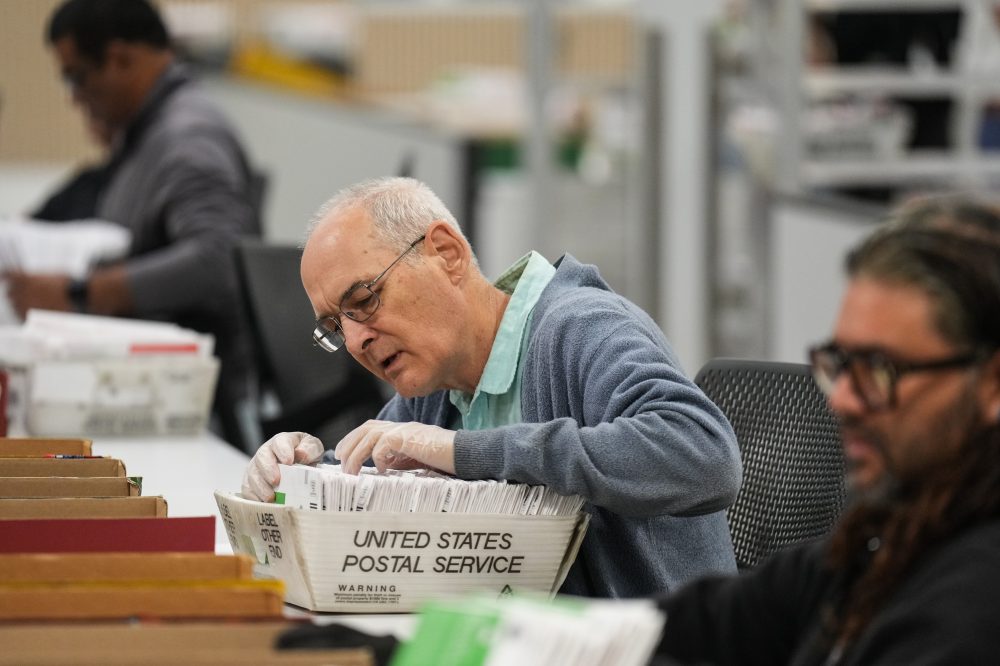
LOS ANGELES (AP) — Several days following California’s primary election, Nithya Raman and Spencer Pratt continue awaiting results to determine which candidate will advance to November’s Los Angeles mayoral runoff against current mayor Karen Bass.
Election officials had not yet declared a winner by Sunday, with vote tallies showing Raman climbing to second position behind Bass for the first time since Tuesday’s conclusion of voting and start of counting. This development places Raman, who serves as a progressive member of the city council, in front of Pratt, who previously appeared on the reality show “The Hills.”
Previously holding third position, Raman has consistently increased her vote total compared to Pratt with each update released by Los Angeles election officials since Tuesday.
California’s ballot counting process moves at a notably slow pace due to state regulations that effectively require an extended tallying period. Every qualified voter receives a mailed ballot, and these are tallied if postmarked by Election Day and delivered to election offices within one week.
Los Angeles and other California counties handle and tally mail-in ballots approximately in the sequence they arrive, meaning the final submissions received are processed last.
Following Tuesday’s poll closure, Los Angeles announced results from early-returned and pre-processed mail ballots along with same-day voting totals. Subsequently, the county has been handling and announcing results from mail ballots that came in later.
Voting data indicates substantial numbers of Democratic voters retained their mail ballots before submitting them during the campaign’s closing days, which accounts for Bass and Raman performing better than Pratt in ballots tallied since primary day.
The mayoral contest operates on a nonpartisan basis, meaning no party labels appeared beside candidate names on ballots. Both Raman and Bass are Democrats, whereas Pratt is a Republican.
During election night, Bass maintained a 4.4 percentage point advantage over Pratt, who held an 8.1-point margin over Raman. Since that time, Bass’s margin over Pratt has expanded to nearly 8 points while Raman currently leads Pratt by approximately 0.4 points, representing 3,100 votes. The Associated Press calculates that slightly under 150,000 ballots remain to be processed.
The extended counting period has generated unsubstantiated fraud allegations from certain Republicans, including President Donald Trump, who announced his Department of Justice would conduct an investigation.
The president claimed that California Democrats were manipulating results to eliminate two candidates he supports — Pratt and Republican Steve Hilton in the gubernatorial race — from the top two positions, thereby preventing their participation in November’s general election. Democrat Xavier Becerra has secured advancement to the general election in the governor’s race, but The AP has not determined the second position. Hilton maintains a 4.3-point lead over Democrat Tom Steyer for the second advancement spot, though his margin has decreased by nearly half since election night.
Los Angeles’s general election will likely serve as an evaluation of Bass’s leadership whether she competes against Raman or Pratt. However, the two potential opponents would approach the campaign from distinctly different angles.
Pratt, representing conservative viewpoints, would present a more forceful opposition to liberal policies in the Democrat-controlled city. He has emphasized homeless reduction as a central campaign issue and has strongly criticized Bass’s handling of the January 2025 Pacific Palisades wildfire that destroyed his residence and thousands of other homes. His celebrity status has generated significant attention for his candidacy, though it remains uncertain whether this publicity will produce sufficient votes for runoff qualification.
Raman, conversely, is challenging Bass from a more progressive stance. She has committed to accelerating housing development, restoring entertainment industry employment, and enhancing services in a city recognized for unclean streets and damaged roadways. She won her council seat with support from the Democratic Socialists of America, although the organization has not formally endorsed any mayoral candidate. Her late entry into the race surprised many after she had previously endorsed Bass for reelection.
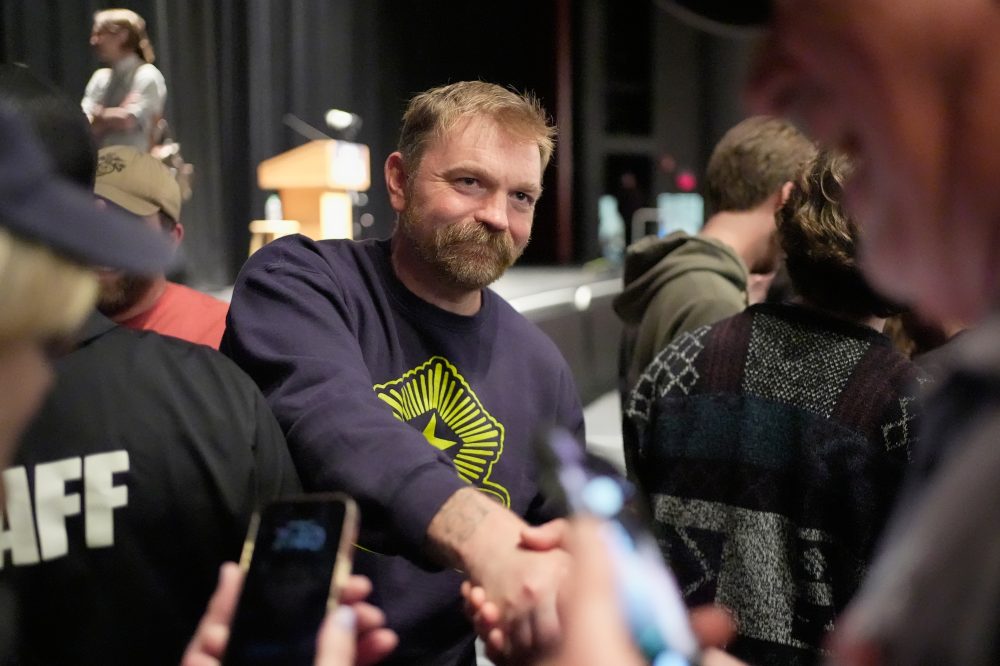
Democratic Senate candidate Graham Platner will face voters directly at a town hall meeting Sunday evening in Portland, Maine, as his campaign works to address recent allegations concerning his past behavior toward women.
The gathering occurs just two days ahead of the Democratic primary election, where Platner continues to hold frontrunner status despite questions about whether the recent controversies have dampened voter support for his unconventional campaign.
Recent reporting by The New York Times on Thursday detailed accusations from a former girlfriend claiming Platner repeatedly seized her by the shoulders during disputes and on one occasion twisted her arm behind her back before confining her to a room. Platner has consistently denied these violence allegations as false.
Additional former romantic partners spoke with the Times, with some describing favorable interactions while others characterized him as unpredictable and demeaning. These revelations followed earlier reports disclosing that Platner had sent sexually explicit communications to multiple women during his marriage.
No prominent Democratic leaders who previously backed Platner have withdrawn their endorsements following these allegations. Platner seeks to defeat Republican Sen. Susan Collins in the November general election.
At a Friday rally in Bar Harbor featuring California Rep. Ro Khanna, Platner received enthusiastic applause and stated that Maine residents “have my back.”
The military veteran has acknowledged ongoing battles with alcohol dependency and post traumatic stress disorder following his service, while maintaining he has transformed as a person.
These recent developments have intensified concerns among some Democratic supporters regarding Platner, who previously drew criticism for social media content that minimized sexual assault and for displaying a skull tattoo associated with Nazi imagery. Platner has issued apologies for the posts and concealed the tattoo, claiming he was unaware of its meaning when he received it.
Rahm Emanuel, considered a possible 2028 Democratic presidential contender who was campaigning in nearby New Hampshire over the weekend, expressed uncertainty about Platner’s chances against Collins.
“Everybody is holding their breath whether this is the start of something or the end of something,” he said. “If it’s the end, that’s one thing. If it’s the beginning of something and we’re not done, that’s another thing.”
Democratic Senate candidate Graham Platner continues to lead in Maine primary polling despite growing discomfort within his own party regarding recent revelations about his personal conduct, just days before Tuesday’s primary election.
Several Democratic members of Congress appeared on Sunday morning television programs to voice their concerns about the party’s frontrunner for November’s Senate race, though no lawmakers urged him to abandon his campaign following news reports about inappropriate text exchanges with women during his marriage and allegations from former romantic partners who characterized his conduct as “toxic.”
New York Representative Tom Suozzi told CNN’s “State of the Union” that recent media coverage has highlighted his existing concerns about the candidate. “I’ve been unsettled about Graham Platner for a long time about the issues and the positions he takes on issues, not just the allegations about his personal conduct,” Suozzi stated.
Virginia Senator Mark Warner described the allegations as “disturbing” if proven accurate during his appearance on ABC’s “This Week.” However, Warner noted that President Donald Trump’s electoral success demonstrates politicians can overcome accusations of inappropriate behavior toward women.
“I think President Trump set a new standard,” Warner explained. “Whether that low standard is what we ought to proceed with, I think it’s going to be again in the hands of the voters.”
Platner’s campaign has not yet responded to requests for comment. The candidate has previously issued apologies for the text messages while dismissing the reports as politically motivated attacks.
California Representative Ro Khanna, who recently campaigned for Platner in Maine, suggested on CBS’s “Face the Nation” that Democrats should acknowledge the inappropriate behavior before moving forward with their focus on national priorities.
“We should focus on acknowledging it was misogynistic, acknowledging it was wrong, moving on with redemption,” Khanna said during the Sunday program.
Should Platner secure victory in Tuesday’s primary, he would likely face incumbent Republican Senator Susan Collins in what observers expect to be one of the nation’s most competitive Senate races.
Republican officials also criticized Platner during their television appearances. The candidate is set to conduct a town hall meeting in Maine on Sunday evening.
Pennsylvania Representative Brian Fitzpatrick called Platner’s history “very, very troubling” during his CNN interview. “We have to set a higher bar,” Fitzpatrick declared.
Pennsylvania Republican Senator Dave McCormick labeled Platner among the Democrats’ “extreme” nominees during Fox News’s “Sunday Briefing.”
“Who would have thought you could be a misogynist, have allegations of violence against women … and have the mainstream of your party endorsing you?” McCormick questioned.
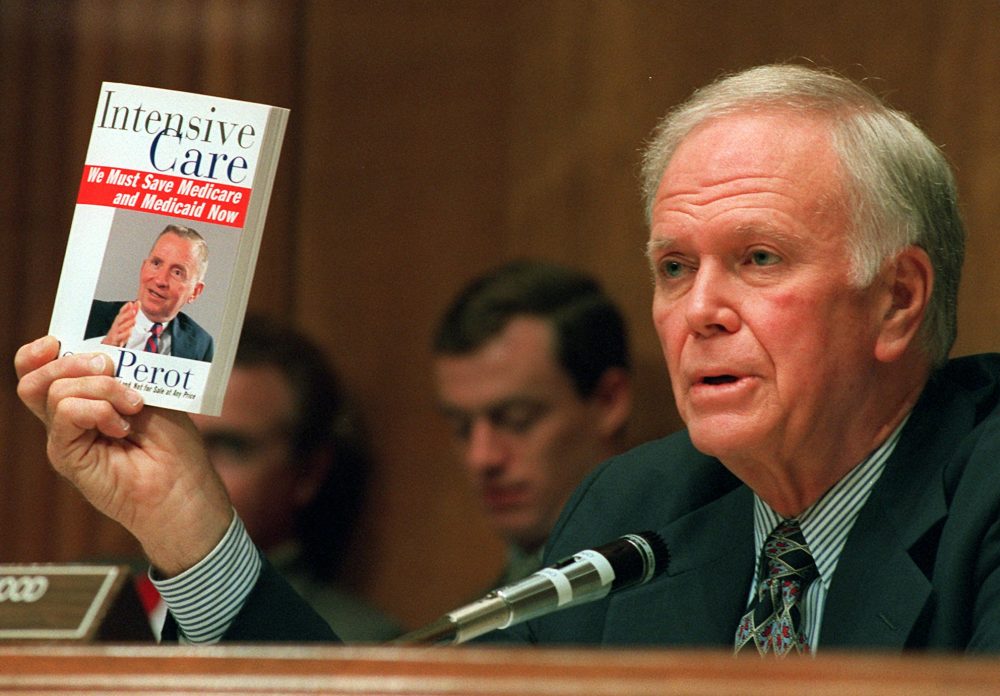
A former Oregon Republican senator whose political legacy was tarnished by sexual harassment allegations has passed away at age 93.
Bob Packwood’s family announced his death on Saturday through an obituary distributed to news organizations, though no additional details about his passing were provided.
The longtime legislator initially fought to remain in the Senate where he had served nearly three decades, stating he didn’t want the controversy to define his legacy.
Years before the MeToo movement brought such issues to the forefront, Packwood became a prominent case study of how personal conduct could destroy a public figure’s reputation. Organizations like Planned Parenthood had previously honored him for his work.
Coming from a politically connected Oregon family – his great-grandfather participated in the state’s 1857 Constitutional Convention – Packwood carved out a reputation as someone willing to cross party lines, combining moderate social views with conservative fiscal positions. He even contemplated a presidential bid in 1980.
After winning his Senate seat in 1968, Packwood became known primarily for his strong support of abortion rights as a Republican, earning widespread respect from women’s advocacy organizations nationwide. That changed when the Senate Ethics Committee began investigating misconduct allegations in 1993.
Over two dozen women, including former staff members and other associates, came forward with claims that he had made unwelcome sexual overtures.
The ethics investigation expanded beyond the harassment claims to examine other potential misconduct. Packwood ultimately stepped down in September 1995 and subsequently launched a successful lobbying firm in Washington.
Democratic Senator Ron Wyden, who took over Packwood’s seat in 1996, acknowledged his predecessor’s work on abortion rights and tax policy but said the treatment of women defined his legacy.
“His horrible history as documented in his own diaries will forever overshadow that public record. Simply put, historians’ first line about Bob Packwood must include those women who he abused and assaulted for years and years,” Wyden said in a statement.
During his tenure leading and serving on the Senate Finance Committee, Packwood developed expertise in crafting legislative compromises, particularly on tax matters. He took special pride in helping shepherd the comprehensive 1986 tax reform that reduced top rates while eliminating numerous deductions.
Throughout his political career, observers characterized him using terms like blunt, independent, maverick, and political survivor.
“I think they probably all ring true,” Packwood told The Associated Press in December 1992.
“I would like to think that I am nobody’s lackey. I try to reach conclusions independently and then I’m willing to fight for those conclusions; if necessary, having to fight against my party or my party’s president,” he said.
At 36, Packwood won his initial Senate race by narrowly defeating Democratic incumbent Wayne L. Morse, an Oregon political icon who had represented the state for over two decades. His victory quickly established him as a rising Republican figure, leading to his election as head of the National Republican Senatorial Committee by 1980.
However, he lost that leadership position after the White House supported a challenger following Packwood’s public criticism of President Ronald Reagan for alienating women, African Americans and Jewish voters.
The harassment allegations surfaced in The Washington Post just two weeks following Packwood’s 1992 reelection victory, featuring accounts from former female employees and acquaintances.
The Senate Ethics Committee also examined claims that Packwood had sought employment opportunities from lobbyists for his former wife, used staff to intimidate accusers into silence, and interfered with the investigation by modifying his personal journals.
In 1993, the Senate conducted two days of unusual floor debate about whether Packwood should be compelled to surrender his diaries, which reportedly contained entries related to the investigation. Senators voted 94-6 to enforce the committee’s subpoena.
Packwood challenged the decision in federal court and lost at every level, including when Chief Justice William Rehnquist declined to have the Supreme Court intervene.
After leaving the Senate, Packwood established Sunrise Research Corp. as his lobbying venture in 1997. The firm generated $1.5 million annually by 1999. Though business declined in later years, he told a Portland audience in 2010 that he still devoted roughly half his time to Washington lobbying activities.
While he found the work engaging, Packwood told the audience, according to The Oregonian, “it is not as much fun as being in the Senate.”
As Congress grew increasingly polarized after his departure, Packwood continued promoting centrist approaches and suggested Oregon adopt nonpartisan elections during his 2010 speech.
Packwood was married to Elaine Franklin, his former chief of staff who later became a Portland political consultant. The pair maintained residences in both the Portland region and Washington.
In a November 2002 conversation with the Salem Statesman Journal, Packwood indicated he had moved beyond the scandal that ended his Senate career.
“People have told me it must have been tough on me, or it seems unfair,” he said. “But you cannot go through the rest of life and say look what happened. Pretty soon you become a bore to your friends.
“I told myself I was not old enough to retire,” Packwood said, “so I have got to get at life and not complain about it.”
NEW YORK (AP) — A federal legal challenge has been filed attempting to prevent a planned UFC mixed martial arts event scheduled for the White House South Lawn, coinciding with President Donald Trump’s 80th birthday celebration and the country’s 250th anniversary commemoration.
The Public Integrity Project filed the lawsuit Saturday on behalf of two Virginia residents, arguing that the Trump administration’s approval of the June 14 event breaks federal law. The legal filing claims the authorization violates National Park Service rules that ban sporting competitions on federal park property, alleges Congress did not approve the large arch structure being built to overlook the venue, and states no environmental assessment was completed before construction began.
“This is fundamentally a private, commercial, corrupt use of our most sacred national monuments for private gain,” said Brendan Ballou, a lawyer for the plaintiffs. “And that is what is motivating this lawsuit.”
The White House responded with a statement calling the legal action an “obstructionist, baseless, and dilatory” effort to stop Trump from hosting the competition, adding that the event was “no different than the various other White House-hosted events on the South Lawn and properly permitted events on the Ellipse and National Mall throughout the year.”
UFC did not immediately respond to a request for comment Sunday.
Construction teams are currently building an octagon-shaped fighting cage on the South Lawn. Trump has announced the completed UFC venue will include “a 5,000-seat arena right outside the front door of the White House.” Large viewing screens showing the matches will also be installed at a nearby park on the Ellipse, with the UFC planning to distribute up to 85,000 complimentary tickets for spectators at both sites.
The octagon structure and accompanying facilities represent the newest addition to the White House construction projects Trump is overseeing.
Former President Donald Trump rejected criticism that his military action against Iran this year contradicted his campaign promise of avoiding new conflicts during his presidency.
During a Sunday broadcast of NBC’s “Meet the Press,” Trump clarified that he never made absolute guarantees about preventing warfare if returned to office.
“First of all, I didn’t guarantee no war. Why would I have built the strongest military in the world?” Trump stated.
The former president also stood by a cancelled $1.8 billion compensation program for his political allies and continued making unproven allegations about election irregularities in California’s recent primary voting process. The interview concluded abruptly when Trump grew irritated with NBC’s Kristen Welker’s challenging questions.
Throughout his 2024 presidential campaign, Trump frequently portrayed his Democratic rivals as advocates for military intervention while positioning himself as a peace-oriented leader who had avoided initiating “no new wars” during his previous term.
However, in the NBC discussion, recorded Friday in Wisconsin, Trump maintained that as a candidate, “I didn’t promise anything.”
“I don’t like these endless wars. This is not an endless war. We’ve been doing this for three months,” he explained regarding the Iranian conflict that commenced February 28.
Trump justified his actions by saying he was “doing the world a service” and “doing our country a service” to prevent Iran from obtaining nuclear capabilities. Yet during the same conversation, he made conflicting statements claiming that previous U.S. military strikes had “obliterated” Iranian nuclear facilities.
He also justified his earlier decision to exit former Democratic President Barack Obama’s Iranian nuclear agreement, which he has consistently criticized, despite not securing the improved deal he had promised to negotiate.
“It takes years to do these things,” Trump explained.
California’s extended ballot counting process has attracted numerous election conspiracy theories, with Trump alleging since Tuesday’s voting that Democrats are manipulating results without providing proof. The Trump-appointed chief federal prosecutor in Los Angeles announced Friday that his office had initiated “multiple election fraud investigations.”
Late-arriving Democratic-favoring mail-in ballots have reduced vote counts for Trump’s endorsed candidates seeking the governor’s office and Los Angeles mayoral position. Although Trump frequently characterizes changing vote tallies as evidence of fraud, these shifts simply reflect California’s lengthy counting procedures.
During the interview, Trump maintained these changes indicated “cheating” and “a rigged election,” becoming increasingly agitated as Welker demanded supporting evidence.
“All I have to do is look. All I have to do is look,” Trump responded.
“But that’s not evidence,” Welker countered.
“And I listen. And I listen to people. And let’s see what happens,” Trump replied.
Trump supported plans that his Department of Justice announced it was abandoning to establish a $1.776 billion “Anti-Weaponization Fund” through a settlement resolving Trump’s legal action against the IRS regarding leaked tax documents.
Acting Attorney General Todd Blanche announced Wednesday the department was eliminating the proposal. This decision followed a judicial pause and concerns from both Democrats and some Republicans about inadequate oversight and potential payments to January 6, 2021, Capitol riot participants.
Trump told NBC he considered the fund “a great idea” and would be “disappointed” if not implemented.
When questioned whether January 6 police attackers deserved compensation, Trump said, “I wouldn’t be inclined to say so, but I have to see it.” He then made baseless and incorrect statements about the riot and Capitol attackers. Trump issued comprehensive pardons on his first day returning to office in January 2025 for over 1,500 individuals prosecuted for January 6 involvement.
The NBC interview occurred in Chippewa Falls, Wisconsin, before Trump’s scheduled appearance at a farmers’ roundtable discussion. Heavy rainfall repeatedly disrupted the recording as it struck the barn’s metal roof where filming took place, creating audio difficulties.
At the conclusion, Welker questioned Trump about the settlement fund and his California election claims. Trump raised his voice and began labeling Welker and media outlets as “crooked,” attacking her reliability and criticizing what he termed “the fake, dirty press.”
As Welker attempted changing topics, Trump continued speaking and both talked simultaneously. Trump terminated the interview, stating, “Let’s call it quits.” He removed his microphone, telling Welker, “Thank you, darling. Have a good time.” He mentioned providing sufficient interview time, stood up and departed.
Welker reported during the broadcast that she contacted Trump Saturday, and he acknowledged the rain created complications while agreeing to conduct another interview later.
Congressional members with national security backgrounds issued warnings Sunday that President Donald Trump’s selection of Bill Pulte as his temporary intelligence chief could block efforts to extend a crucial foreign surveillance program.
Both chambers of Congress are working against a Friday cutoff date to reauthorize Section 702 of the Foreign Intelligence Surveillance Act, which permits American intelligence organizations to track emails and other communications from foreign nationals abroad without requiring individual court orders.
Trump designated Pulte, who lacks any background in security matters, as acting director of national intelligence, taking over from Tulsi Gabbard who stepped down effective June 30.
Pulte will continue serving as head of the U.S. Federal Housing Finance Agency while taking on the intelligence role. His interim selection has sparked anger from both Democratic and Republican congressional members due to his absence of relevant experience.
Democratic officials also contend Pulte has shown readiness to leverage his housing finance role to target Trump’s political opponents.
Senator Mark Warner of Virginia, the leading Democrat on the Senate Intelligence Committee, described the selection as dropping a “live hand grenade” into congressional discussions just days before FISA’s expiration during ABC’s “This Week” broadcast.
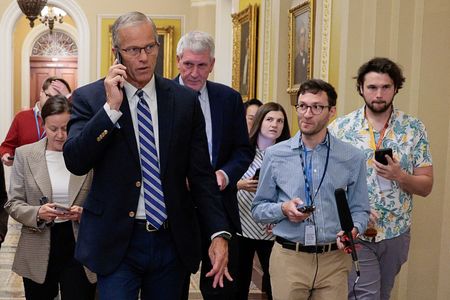
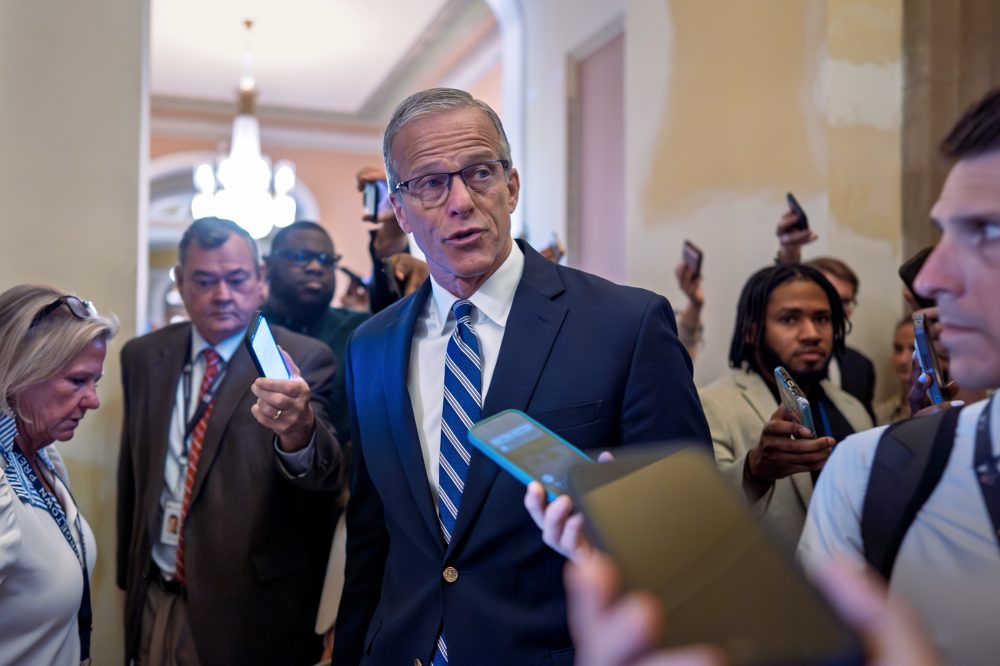
Last Friday, the Senate prevented an effort to start FISA renewal discussions, though Majority Leader John Thune, a South Dakota Republican, informed reporters that another attempt would occur this week.
Democratic backing would be crucial for the legislation to advance through the Senate. Party members have indicated they will refuse support unless Trump withdraws Pulte’s temporary assignment.
Trump stated Thursday that he probably would not put forward Pulte for a “permanent” intelligence director role. However, Pulte can function as acting director for 210 days without requiring Senate approval.
Representative Jim Himes, the leading Democrat on the House Intelligence Committee, told CBS’s “Face the Nation” that the timing of Pulte’s selection creates uncertainty about FISA’s extension.
“You just could not have come up with worse timing,” he stated. “If we had to pass another bill in the context of Bill Pulte, I don’t think we could.”
Representative Michael McCaul, a Texas Republican who also joined the ABC broadcast, commented, “I don’t believe he’s statutorily qualified” considering his lack of experience.
However, McCaul, a former House Homeland Security Committee chairman and former chair of the House Foreign Affairs Committee, warned it “would be the most grossly irresponsible thing I’ve seen Congress do in my 22 years in office” if legislators fail to extend FISA just before FIFA World Cup games begin in North America, and as weeks of celebrations start for the 250th anniversary of the United States.
While Pulte lacks qualifications for the permanent director position, Republican Senator Dave McCormick noted that the president has other officials available for intelligence guidance, including CIA Director John Ratcliffe and Secretary of State Marco Rubio, who also serves as Trump’s national security adviser.
“Bill Pulte is going to be a temporary fix until we get the right qualified person in there permanently,” McCormick stated on Fox News’s “Sunday Briefing” program.
Prior to Trump’s Pulte selection, both chambers were positioned to approve a compromise measure following lengthy negotiations. Now even Republicans anticipate the renewal might face delays.
“We write with regret to ask that you plan for a potential significant gap in foreign intelligence collection,” stated a letter that Republican Senators Tom Cotton and Chuck Grassley sent Friday to Rubio.
In their correspondence, first reported by Punchbowl, Cotton and Grassley attributed the situation to Senate Minority Leader Chuck Schumer, the chamber’s top Democrat. But Himes characterized it as an acknowledgment that Pulte creates the problem.
“I think at one level they’re acknowledging reality, which is that the Pulte appointment has taken 702 reauthorization off the table,” Himes told CBS.
Britain’s second-highest government official confronted U.S. Vice President JD Vance on Sunday, saying he corrected Vance’s claims linking immigration to a university student’s fatal stabbing.
Deputy Prime Minister David Lammy, who also serves as justice minister, described a direct phone conversation with Vance on Saturday as “robust” following controversial social media posts by the vice president.
“We had an agreeable conversation because we have got a relationship, but I wanted to make him clear that I disagree with some of the facts that he was asserting and to present the facts to him,” Lammy stated during an interview with Sky News.
The confrontation followed Vance’s Friday social media post calling for “righteous anger” over the killing of Henry Nowak, 18, who died in December after being stabbed by Vickrum Digwa in Southampton, England.
Digwa, who is Sikh, gave false information to authorities, claiming Nowak, who was white, had racially attacked him. When officers responded, they initially considered the dying victim a suspect before discovering his wounds and attempting life-saving measures.
The vice president’s post suggested the killing resulted partly from “the mass invasion of migrants, many of whom despise the West and the people who love it.”
Lammy said he stressed several key points to Vance, particularly that the perpetrator was British and is now imprisoned.
“This has got nothing to do with mass migration,” Lammy declared.
A court convicted Digwa, 23, of murder for using an 8-inch Sikh dagger in the attack and sentenced him this week to life imprisonment with a 21-year minimum term.
Anti-immigration groups and politicians have exploited the incident for their causes. On Tuesday, law enforcement in Southampton faced projectiles including chairs, cans, rocks and flares during protests about Nowak’s death that drew far-right participants and others.
Prime Minister Keir Starmer’s office released a Friday statement criticizing those “trying to interfere in our democracy and seeking to stir up division on our streets” in response to Vance’s remarks.
The Independent Office for Police Conduct is examining the responding officers’ actions as part of an investigation into potential police misconduct.
Mark Nowak, the victim’s father, has emphasized the case involves neither racism nor religion, expressing hope his son’s death will contribute to public safety rather than “further division, hatred or tension.”
Lammy also told Vance “it’s not helpful to tweet in this way, partly because of what the Nowak family have asked for, and reminded him about their desire not to make this an issue of division and hatred, but to make this an issue of common sense.”
The nation’s highest court is approaching the conclusion of its nine-month session with several high-profile decisions still pending, including cases that touch on deeply divisive cultural issues affecting Americans nationwide.
As the Supreme Court prepares to finish its current term by the end of June, justices are set to announce their decisions on two significant firearms-related cases. One involves a federal statute that prevents illegal drug users from possessing weapons, while another centers on restrictions in the state that limit carrying handguns on private commercial properties without explicit owner consent.
The court will also determine whether state legislation in two western states that prohibits transgender students from participating on female athletic teams at public educational institutions violates federal law. These cases come as various states have enacted similar restrictions on transgender participation.
With its current composition featuring six conservative justices and three liberal members, the court has consistently shifted legal precedents in a more conservative direction over recent years.
FIREARMS LEGISLATION
As the country grapples with ongoing gun violence and recurring mass casualty events, the Supreme Court has interpreted the Second Amendment’s protections broadly, expanding individual gun ownership rights.
Based on oral arguments heard in January regarding the state restrictions case, conservative justices seemed inclined to further broaden gun rights, expressing doubt about the constitutionality of requiring property owners to give “express authorization” before allowing handguns on their commercial premises. Similar regulations exist in four additional states.
Legal experts anticipate the court will strike down these restrictions. Hayley Lawrence, who leads the Duke Center for Firearms Law and advocates for gun control measures, predicted the outcome.
“It seems to me the state is going to lose 6-3,” Lawrence said.
Lawrence noted the court may also clarify the analytical approach it established in its 2022 New York State Rifle & Pistol Association v. Bruen ruling, which requires any government firearm regulation to align with historical American gun control traditions.
CONTROLLED SUBSTANCE USERS
In March, justices heard arguments about a federal criminal law that prohibits anyone classified as an “unlawful user” of controlled substances from owning firearms or ammunition. This restriction appears in the Gun Control Act of 1968, which identifies various groups, including convicted felons and fugitives, who cannot legally possess weapons.
The legal challenge originated from a case involving a man from the state who admitted to using marijuana multiple times weekly and faced charges under this statute. The same provision was used in charges against the former president’s son in 2023, though he later received a presidential pardon. The current administration supports maintaining the law.
University of Chicago law professor Darrell Miller observed that while the court seems doubtful about the drug user prohibition, justices also worry about creating precedent that could weaken other portions of the legislation, particularly restrictions on felon gun possession.
“The court is deciding a drug case but they have one eye on the felony possession statute,” Miller said.
TRANSGENDER STUDENT ATHLETES
The current administration has implemented various policies restricting transgender rights, including military service limitations that the Supreme Court previously allowed to proceed during ongoing litigation. The government now supports state laws in two western states that ban transgender athletes from competing on women’s and girls’ teams at public schools and universities.
During January oral arguments, conservative justices appeared likely to uphold these prohibitions.
Public opinion surveys suggest most Americans oppose allowing transgender athletes to compete on teams matching their gender identity, especially in college sports.
“There is vast consensus on this issue,” said William Bock, a sports law attorney at Kroger Gardis Regas who supports the state restrictions. “Seventy to 80 percent of the public doesn’t understand why people are fighting about this.”
Sasha Buchert, an attorney with LGBT legal rights organization Lambda Legal representing one of the challengers, remained optimistic about potentially overturning the state laws, noting the case arguments “went much better” than those in 2024 involving gender-affirming medical care for transgender minors. In that previous case, conservative justices voted 6-3 to uphold a state ban on such medical treatment.
While the Supreme Court ruled in 2020 that federal workplace discrimination protections extend to gay and transgender employees, the justices have since permitted various transgender restrictions to take effect.
In March, the court blocked a series of state laws that would have limited sharing information with parents about transgender public school students’ gender identity without the child’s consent, supporting Christian parents who challenged these privacy protections.
Beyond military restrictions, the current administration has also implemented policies preventing transgender individuals from using their gender identities on passports and barring transgender federal employees from using bathrooms that correspond to their gender identity.
The court has already decided one major LGBT rights case from this term, issuing an 8-1 ruling in March that overturned a state law prohibiting therapists from using “conversion” therapy aimed at changing LGBT minors’ sexual orientation or gender identity. The justices supported a Christian licensed counselor’s argument that the ban violated First Amendment free speech protections.
IMMIGRATION POLICIES
Immigration issues also feature prominently in current cultural debates. The court will soon rule on two major cases involving current administration policies: efforts to limit birthright citizenship and attempts to remove humanitarian protections called Temporary Protected Status from hundreds of thousands of immigrants from two Caribbean and Middle Eastern nations.
Based on case arguments, the administration may face defeat on birthright citizenship restrictions, similar to a February loss on tariff policies, but could prevail on Temporary Protected Status changes.
The court also has a pending decision involving religious rights, where a man practicing the Rastafarian faith sued state prison officials after guards forcibly shaved his head, violating his religious beliefs under federal law protecting incarcerated individuals from religious discrimination.
In a death penalty case, a man convicted of murder in 1997 in a southern state avoided execution after the Supreme Court in May upheld a judicial determination that he was intellectually disabled and therefore ineligible for capital punishment under established precedent.
Following a wave of congressional redistricting before the midterm elections, a nationwide fight for partisan advantage is shifting into a new phase that may impact representation on issues ranging from taxation and social programs to education funding, housing policies, and infrastructure maintenance.
The Republican-controlled Legislature in a southern state will meet June 17 for a special session dedicated to redistricting for the 2028 elections. The session’s agenda covers new voting districts for Congress as well as state House and Senate seats — and possibly even the state’s utility regulatory commission.
This will be the first instance since a recent U.S. Supreme Court decision reduced minority voting protections that a state legislature will try to redraw its own districts. Republican lawmakers in one state and Democratic legislators in another may also pursue legislative redistricting before their 2027 and 2028 elections, respectively.
However, it’s unclear how many legislatures will take similar action, and whether this mid-decade redistricting trend will reach down to county commissions, city councils, and school boards that make numerous decisions affecting residents’ daily lives. The potential impact could be far-reaching.
“The stakes here are not political, they are deeply human,” said Joe Kennedy III, founder of Groundwork Project, a nonprofit that supports local civil rights and democracy organizations.
Voting district lines are usually redrawn once every ten years following each U.S. census to reflect population shifts. However, last summer, President Donald Trump encouraged Republican lawmakers in one state to redraw congressional districts to attempt gaining additional seats in the midterm elections. Other states subsequently conducted their own partisan gerrymandering efforts.
A 6-3 Supreme Court decision in late April then sparked additional redistricting activity. The court overturned a majority-Black congressional district in one state as an illegal racial gerrymander, giving Republicans in other states justification to reshape districts with significant minority populations that have elected Democrats.
A federal judge determined in 2023 that some congressional, state Senate, and state House districts in one state were drawn in a racially discriminatory way. The Legislature promptly passed revised maps with new majority-Black districts, though they produced minimal changes to Republican majorities in the 2024 elections.
The Republican governor has summoned lawmakers into special session to redraw districts again following the Supreme Court’s decision in the case from another state. This could enable Republicans to reverse the court-mandated changes they implemented in 2023 and potentially redraw other Democratic-held minority districts to benefit the GOP.
Republicans have not yet revealed specifics of their strategy. However, a Democratic state representative who is seeking the attorney general position criticized the planned redistricting as a way of “rigging maps to maintain power.”
Several months prior to the Supreme Court ruling, a study by Fair Fight Action and Black Voters Matter predicted that Republicans in 10 Southern states could eliminate 191 Democratic-held legislative seats — including 140 districts with Black or Hispanic majorities — if the Supreme Court weakened federal Voting Rights Act protections for minorities.
“If anything, our report was an understatement,” Cliff Albright, co-founder and executive director of Black Voters Matter, recently told The Associated Press. “What’s at stake is the future of this democracy.”
Other experts don’t anticipate that many seats being redistricted. But they do expect the Supreme Court’s ruling to have effects across states.
“We’re going to potentially see a lot of frenzied efforts at every level, including at the local level, to try out undoing district maps and configurations that have performed quite well in providing improved representation for communities of color,” said Kareem Crayton, vice president of the Washington office of the Brennan Center for Justice.
The precedent from the recent Supreme Court ruling is already being used in multiple states. Following the decision, a federal appeals court is permitting one state to use a state Senate map approved by Republican lawmakers in this year’s election rather than one imposed by a federal judge who determined the state had weakened the voting power of Black residents. The modification affects two state Senate districts in one metropolitan area.
The Supreme Court has returned legislative redistricting cases filed on behalf of Black voters in one state and Native Americans in another state to lower courts for additional review in light of its decision. An attorney general in another state has requested the Supreme Court do the same for legislative redistricting cases involving Hispanic voters in that state.
Approximately half the states have constitutional provisions that ban mid-decade redistricting of state legislative seats, said Justin Levitt, a law professor at Loyola Marymount University in Los Angeles who operates the “All About Redistricting” website.
But even in states where it’s permitted, lawmakers may have less motivation to redraw their own districts than those for Congress, Levitt explained. Politicians who advocated congressional redistricting for the 2026 midterms often defended it as a method to counter gerrymandering in other states and secure as many seats as possible for their party. They had additional motivation because a shift of just a few seats nationally in the November elections could determine control of the closely divided U.S. House.
In contrast, most state legislative chambers are already controlled by one party.
“There’s a lot less incentive, if you already control the state legislature by 10 or 12 seats, to eke out an incremental one or two at the expense of really ticking off your own party membership, or at the expense of maybe risking losing seats in a broader way,” Levitt said.
The Supreme Court ruling making it harder to prove Voting Rights Act violations has already impacted some local governments.
Plaintiffs have voluntarily dropped a challenge to commission districts in one county. A federal court has accepted new legal briefs in a challenge to Board of Supervisors districts in another county. And one state’s attorney general has asked a federal appeals court to consider the case when deciding a challenge to how judges are selected in one county.
Over approximately the past four decades, data from the University of Michigan indicates that cities, counties, and school boards have been involved in more than three-fifths of the 466 lawsuits alleging violations of Section 2 of the Voting Rights Act, which prohibits providing minorities less opportunity than other voters to elect the representatives of their choice.
But that doesn’t necessarily mean local governments will rush to redistrict due to a weakened Voting Rights Act. The Supreme Court decision opened the door for officials to justify redistricting based on partisan goals. However, many local offices are officially nonpartisan.
DES MOINES, Iowa — Rob Sand officially launched his gubernatorial campaign Sunday, marking his first rally as the Democratic nominee for Iowa governor with support from Kentucky Gov. Andy Beshear.
The gubernatorial contest between Sand and Republican Zach Lahn is expected to be among the nation’s most competitive races as Iowa grapples with a state budget deficit, struggling agricultural economy and cancer crisis.
While Sand minimizes partisan politics, Democrats are counting on him to reverse their recent electoral setbacks in the state.
“We are all in on flipping Iowa,” said Beshear, chair of the Democratic Governors Association and a potential presidential candidate in 2028. “It’s certainly time for a change, and I think the people of Iowa know that Rob Sand will always put them first and lead in a way that lifts families up and doesn’t leave them out.”
Sand faced no primary opposition, while his general election opponent emerged after Tuesday’s unpredictable five-way Republican primary.
Previously unknown in statewide politics, Lahn gained attention as a business owner condemning farm consolidation and corporate tax breaks, a regenerative farmer aligned with Robert F. Kennedy’s “Make America Healthy Again” movement and a former political operative who energized Iowa’s conservative base.
For the first time since 1968, Iowa has open contests for both governor and U.S. senator, along with three competitive congressional races. National political figures including President Donald Trump and Vice President JD Vance have recently visited the state.
Democrats face significant challenges with a 200,000-person voter registration disadvantage statewide and minority status in every House district. Sand and Senate candidate Josh Turek believe they can attract independents and Republicans frustrated with partisan politics and Republican control in both Washington and Des Moines, which they blame for state problems.
Turek will challenge U.S. Rep. Ashley Hinson, who has already characterized Turek as a liberal ally of party leader Sen. Chuck Schumer.
Lahn has dismissed Sand’s nonpartisan messaging.
“Rob Sand is not a moderate,” Lahn said in his victory speech Tuesday. “He’s a liberal career politician pretending to be someone he’s not.”
Sand frequently criticizes partisanship, expresses skepticism of both major parties and advocates for divided government in Iowa. He believes most Iowans share these views.
If elected in November, Sand would likely work with Republican majorities in both legislative chambers, which recently approved measures limiting executive authority that outgoing Republican Gov. Kim Reynolds signed.
“I’m not here to tell you that the answer to 10 years of one-party control is to give the other party 10 years of one-party control. I don’t think that’s right,” Sand said Tuesday after voting in the primary. “But I do think that it’s time to say enough to the people who have had 10 years of one-party control. It’s time for balanced government in Iowa.”
Both Sand and Lahn avoid traditional party colors of blue and red in their campaign materials, choosing green instead. Both claim independence from party establishments and argue Iowans want new leadership, though Lahn’s Republican Party has controlled the statehouse for nearly a decade.
Sand’s campaign has contributed approximately $750,000 to the Iowa Democratic Party this cycle, funding Republicans criticize as inconsistent for a candidate claiming nonpartisan status. The Sand campaign explains this investment supports a state party-coordinated effort essential for his gubernatorial victory, while also helping other candidates.
As Democrats analyze their 2024 losses and debate party direction, Beshear offers his red-state leadership as a model for moving forward.
Beshear said he aims to be a “voice of reason in the chaos” of Trump’s administration and accepts being mentioned among potential 2028 Democratic presidential candidates, while maintaining focus on the upcoming midterms.
Beyond rallying with Sand, Beshear will attend a “Beers with Beshear” fundraiser for congressional candidate Sarah Trone Garriott, who seeks to defeat Republican Rep. Zach Nunn in the competitive House district covering Des Moines. Beshear said he will also meet with Turek.
The Democratic Governors Association, led by Beshear, has provided the Iowa Democratic Party about $140,000 this cycle, according to filing reports.
Confrontations between protesters and police at a New Jersey immigration facility have emerged as a major focal point in demonstrations opposing President Donald Trump’s immigration policies since late May.
Over 80 individuals have been taken into custody during multiple demonstrations outside Delaney Hall in Newark, where protesters say they are standing with detainees who report substandard living conditions inside the facility.
The Trump administration has stood by the care provided to individuals held at the 1,000-bed center.
Here are the key details:
Geo Group, a private correctional company operating detention facilities nationwide, owns the center.
According to Cosecha, an immigrant advocacy organization, detainees began a hunger strike last month. They sent out handwritten letters outlining their requests, which include better living standards and improved healthcare access, claiming some individuals are being refused necessary medications.
Similar allegations of medical neglect for serious and ongoing health issues have been made by detainees at other locations across the nation, with hunger strikes announced at additional facilities.
Those held at Delaney Hall report receiving spoiled and moldy food, including items containing maggots, while being kept in overcrowded quarters without air conditioning. Democratic congressional representatives from New York City toured the facility during early protests and stated the detainees’ claims appear legitimate.
President Donald Trump and his administration have defended the facility’s management and rejected claims of any hunger strike, mistreatment, or substandard conditions.
“The fact is, we’re giving them the calories they want,” Homeland Security Secretary Markwayne Mullin said recently. “This isn’t Holiday Inn.”
Tom Homan, Trump’s border czar, complimented the meals following a recent inspection. “The spaghetti was good,” he told CBS News.
GEO Group has rejected the complaints as “a politically motivated campaign by outside groups to dismantle ICE and federal immigration detention by targeting the government’s facility contractors.”
Demonstrators, some equipped with gas masks and protective helmets, have utilized traffic cones, garbage bins and other materials as improvised barriers, attempting to prevent vehicles from accessing the facility.
Acting U.S. Attorney General Todd Blanche posted photographs online showing bloody injuries and bruises suffered by officers with U.S. Immigration and Customs Enforcement.
Social media footage shows officers in riot equipment using tear gas and striking demonstrators with batons. Some recordings captured mounted police advancing into the crowds.
On Friday evening, ICE officers detained four individuals on charges including assault on law enforcement, obstruction and making threats, Homeland Security Secretary Markwayne Mullin announced on X. Newark police separately reported charging a Seattle resident with criminal mischief for breaking car windows.
“No one has the right to come into our city, destroy personal property, or incite violence,” Newark Public Safety Director Emanuel Miranda posted on social media. “Think twice before coming to Newark with any other agenda than to protest peacefully.”
A law enforcement officer faced charges for taking $10,000 in camera equipment from an Associated Press photographer who was hurt while reporting on the confrontation. The journalist, Angelina Katsanis, was hit in the knee by a wooden beam during fighting between police and demonstrators. After receiving medical care, she used a tracking device to locate her stolen equipment at his residence, the state’s attorney general announced Thursday.
Democratic Gov. Mikie Sherrill initially hesitated to get involved in the escalating demonstrations. However, as violence worsened, she announced the situation had become “grown unsafe” and “unacceptable” and deployed state police to maintain order.
State troopers established designated areas for protests and vehicle inspection points while ICE officers previously positioned outside the detention facility agreed to withdraw.
Newark Mayor Ras Baraka implemented a 9 p.m. curfew and deployed city police to enforce it.
However, just one week afterward, the Democrat announced the city would reduce its police deployment, citing decreased arrests and reluctance to continue using taxpayer funds to protect a privately operated facility.
The state’s attorney general filed a lawsuit against Geo Group this week, claiming the facility prevented state health inspectors from having “full access” to investigate the allegations.
Officials from both the White House and Israeli Embassy in Washington are firmly denying claims published in a New York Times article that suggests the Pentagon has raised counterintelligence warnings regarding Israel.
A representative from the Israeli Embassy called the accusations that Israel conducts surveillance on the United States “completely false.”
“Israel does not gather intelligence on American entities, let alone US government officials,” the spokesperson said. “Israel intelligence collection efforts are aimed at its enemies, not its allies. Any claims to the contrary are either misinformed or politically motivated.”
A White House representative also challenged the newspaper’s account, declaring: “This entire story is false and sourced to someone who doesn’t have any knowledge of what’s going on.”
These denials came after the New York Times published an article referencing an earlier NBC news story claiming the Pentagon’s Defense Intelligence Agency had recently upgraded its counterintelligence evaluation of Israel to the most serious level, designated as “critical.”
The news report indicated this evaluation was shared within government circles in recent weeks and showed worries that Israeli intelligence operations might be attempting to gain access to private US discussions concerning Middle Eastern conflicts.
The individuals who were reportedly under surveillance included Steve Witkoff, President Trump’s top negotiator, Elbridge A. Colby, the Pentagon’s top policy official, and one of his main deputies, Michael P. DiMino IV, and others.
The article stated that Pentagon leadership was worried that classified information not meant for distribution could be accessed by Israeli intelligence, even given the strong partnership between both nations.
One government source quoted by The New York Times indicated the internal evaluation classified Israel’s abilities in both traditional espionage and technical intelligence gathering at a “critical level.”
The article also mentioned that the document referenced multiple incidents that led to the increased threat assessment, although specific details about these events were not revealed.
The Pentagon chose not to provide comment regarding the report.
Legal representatives for jazz artist Chuck Redd announced that a Washington D.C. Superior Court judge has thrown out a contract violation lawsuit brought by the Kennedy Center after Redd pulled out of a Christmas Eve show to protest President Donald Trump’s control over the cultural institution.
The case was dismissed on Friday under the District’s Anti-SLAPP statutes, which protect against frivolous legal actions aimed at suppressing public criticism on issues of community concern.
Redd, who plays drums and vibraphone and has performed alongside notable musicians including Dizzy Gillespie and Ray Brown, had been hosting annual holiday “Jazz Jams” at the Kennedy Center beginning in 2006. He withdrew from last year’s show after Trump’s appointed board members at the Kennedy Center decided to incorporate the president’s name into the facility.
“The Center sued Mr. Redd because he publicly and rightly objected to adding Donald Trump’s name to the Kennedy Center, a living memorial to former President John F. Kennedy,” Lisa J. Banks, one of Redd’s lawyers, said in a statement. “The lawsuit against Mr. Redd was political retribution, pure and simple, by the Trump Kennedy Center, and the Court correctly saw it as such in dismissing the case with prejudice.”
In an email to The Associated Press on Saturday morning, Redd expressed that he is “very pleased with the judge’s ruling.”
The dismissal request, submitted in March, contended that Redd had no contractual duty to perform. The filing referenced an agreement from the Kennedy Center that the performer had never actually executed with his signature.
Kennedy Center officials have not yet provided a response to inquiries about the lawsuit’s dismissal.
A senior artificial intelligence policy advisor at the White House is preparing to step down from his role by the end of this month, according to a published report.
Sriram Krishnan, who serves as an AI policy advisor, intends to depart his White House position by June’s conclusion, The Information reported Saturday. The publication cited sources with knowledge of the situation.
Following his departure from the administration, Krishnan has been in talks about launching a policy organization, according to the same report. This new institution would employ engineers and focus on advancing the Trump administration’s artificial intelligence initiatives.
Reuters was unable to immediately confirm the details of this report.
Election administrators nationwide are forging stronger partnerships with local police departments as concerns about election security continue to grow.
The collaboration between election officials and law enforcement agencies has expanded significantly following the 2020 presidential election, with police taking on a more prominent role in protecting the electoral process.
This trend reflects the heightened tensions surrounding American elections and the need for additional security measures to ensure safe and secure voting environments for both voters and election workers.
Female Navy officers are expressing concern about their career prospects after Defense Secretary Pete Hegseth removed all women from a recent promotion list to admiral rank.
The Navy had originally selected 31 sailors to advance from captain to one-star admiral, but Hegseth stepped in to remove nine individuals from that list, including three women and two Black men, according to a defense official who requested anonymity due to restrictions on publicly discussing the information.
This intervention means no women will receive promotion to one-star admiral this year, despite women representing approximately 25% of all Navy officers and nearly one-third of mid-level positions, based on 2024 military statistics.
The Associated Press interviewed eight female Navy officers across different ranks and experience levels following Hegseth’s decision, which The New York Times first reported. All requested anonymity due to concerns about potential retaliation from leadership.
Junior officers described viewing this development as evidence their careers could become politically influenced if they advance too high, with some expressing they now perceive limits on their promotion potential. Several said the action made them feel undervalued within the military structure and questioned whether this was intentional.
Defense officials have provided no explanation for removing the women or the other six individuals from the promotion roster.
Pentagon spokesperson Sean Parnell stated on social media this week that “military promotions are given to those who have earned them” and emphasized the Pentagon “will never consider the color of a service member’s skin or their gender as a factor in promotions.” The Pentagon did not respond immediately to requests for additional comment.
The Navy’s selection process for one-star promotions has maintained consistency and transparency historically. The service assembles a promotion board of officers who review eligible candidates’ records and select the most qualified individuals.
The board that chose the original 31 officers operated under direction from then-Navy Secretary John Phelan, a President Donald Trump appointee, to “recommend for promotion the best qualified officers within their respective competitive category.”
Phelan’s directive, issued before his sudden departure in April, instructed the board to evaluate officers based on performance, competence, character, and other qualifications.
The order also specified that given China’s significance in the Trump administration’s National Defense Strategy, “special consideration shall be given to officers who have excelled in their knowledge of the political military affairs and U.S. strategic interests in the Indo-Pacific region, and operational contingency planning for Indo-Pacific war plans.”
Hegseth has consistently argued, without providing supporting evidence, that women in military service receive preferential treatment and lack suitability for combat positions.
“For too long, we’ve promoted too many uniformed leaders for the wrong reasons based on their race, based on gender quotas, based on historic so-called firsts,” Hegseth addressed hundreds of military leaders in September.
He claimed this approach rendered the Pentagon “less capable and less lethal.”
Phelan’s guidance explicitly stated the Navy cannot discriminate based on factors like race and gender, specifically noting “this guidance shall not be interpreted as requiring or permitting preferential treatment of any officer or group of officers on the grounds of race, religion, color, sex.”
The complete roster of 31 promotion candidates received approval from Phelan, other Navy leadership, and Joint Chiefs of Staff chairman Gen. Dan Caine before reaching Hegseth, who decided to modify the list, the defense official explained.
Although Hegseth possesses authority to alter such lists, “it’s just not the norm,” according to Katherine Kuzminski, a researcher focused on military recruiting and retention at the Center for New American Security think tank.
Kuzminski observed that “this is a decision that’s not being made by the U.S. Navy — it’s being made by the secretary of defense” and noted Hegseth’s increasing involvement in operational military matters like promotions creates “tension” regarding future expectations of “normal” procedures.
Senior Navy officers who spoke with the AP voiced worries about the message this sends to younger sailors entering the service.
Beyond blocking the recent promotions of three women to admiral, Hegseth dismissed Adm. Lisa Franchetti shortly after assuming office. Franchetti served as the service’s top officer and was the first woman in that role. He offered no explanation for her removal.
Subsequently, he has also terminated two other female three-star admirals without providing reasons.
Officers interviewed by the AP said that while they continue encouraging female sailors to remain with the Navy, they recognize this message comes during challenging circumstances.
Kuzminski explained that rhetoric and actions concerning women in military service “affects individual service member decision-making and it also affects family unit decision-making,” including whether people pursue military careers.
Following the extended hold on military promotions by Sen. Tommy Tuberville, R-Ala., during the Biden administration, surveys indicated that partisan politics entering troops’ daily lives influenced their decision-making, Kuzminski noted.
One officer indicated this impact extends beyond women alone.
In discussions with fellow sailors in her unit, she reported that male service members expressed reluctance to navigate what appears to be increasing politicization of simply executing orders from previous administrations.
WASHINGTON, June 6 – Donald Trump is encountering growing pushback from within his own political party as Republican members of Congress, who have historically been hesitant to oppose him, are demonstrating increased readiness to challenge the U.S. president.
In recent days, various groups of Republicans across both chambers of Congress have emerged to criticize his Iran policies, deny $1 billion in funding connected to his White House ballroom, compel a reversal on his $1.8 billion “anti-weaponization” fund, and prevent his domestic surveillance legislation from advancing.
Congressional representatives also went against Trump’s wishes Thursday by approving legislation to deliver assistance to Ukraine while implementing additional sanctions on Russia, though the president appears likely to veto this measure.
While both Republicans and Democrats remain doubtful that Trump confronts a genuine uprising, an expanding group of Republicans is demonstrating readiness to oppose him, including individuals Trump has personally worked to remove from office, potentially threatening his most significant policy goals leading up to Election Day.
Republican Senator Thom Tillis, who declared his retirement from the Senate last year following his opposition to the president’s so-called One Big Beautiful Bill, explained the shift: “I think what you’re seeing as you get closer to the election is that people are going to vote the way they think their constituents want them to.”
Democrats mostly rejected this notion, arguing there has been no proof that the party broadly will stand against him on significant matters.
Senator John Fetterman, a Democrat who occasionally backs Trump-supported initiatives, stated: “The people that are breaking with him are ones that were put out by Trump. That actually demonstrates his absolute control over the party.”
A White House official, speaking anonymously, attributed Republican opposition to “election-year politics.” The official noted: “Not every single member will absorb the political cost on every single issue.”
White House spokeswoman Abigail Jackson responded: “While the media and Democrats attempt to sow nonexistent divisions, we look forward to continuing this close relationship to continue fulfilling President Trump’s agenda.”
For years, Republican legislators have demonstrated public loyalty to Trump through supporting controversial cabinet nominees, offering minimal resistance to his executive actions, and backing his key legislation despite concerns about increasing deficits and reductions to the Medicaid healthcare program for low-income Americans.
Legislative members and staff indicate that frustration and bitterness have intensified since Trump challenged the reelection campaigns of Republican Senators Bill Cassidy and John Cornyn and jeopardized the Republican legislative agenda through poorly timed public statements.
The turning point occurred around the U.S. Memorial Day holiday, when Trump’s opposition to Cornyn’s reelection and his announcement of the “anti-weaponization” fund compelled Senate Republicans to drop a $70 billion immigration enforcement funding measure and depart Washington feeling angry and frustrated.
“That was kind of like a perfect storm of events,” commented a Senate Republican aide.
The Senate eventually approved the immigration enforcement funding measure on Friday, with Republicans rejecting a Democratic proposal to eliminate the fund, despite concerns it might finance January 6 Capitol rioters and other Trump political supporters.
Trump appears committed to nominating loyalist Bill Pulte to succeed Tulsi Gabbard as temporary Director of National Intelligence, despite reservations from important Republicans.
Senator Mitch McConnell clearly stated he would not support Pulte for permanent DNI, explaining that the law demands nominees with substantial experience. In a statement, he declared: “No nominee who falls short of this requirement will earn my vote.”
Republican resistance in both chambers has remained largely symbolic thus far.
Three electorally at-risk Senate Republicans – Susan Collins, Jon Husted and Dan Sullivan – participated in a Democratic effort Thursday to eliminate Trump’s “anti-weaponization” fund through a measure that failed, alongside two additional Republican attempts to terminate the fund.
Republican Senator Jim Banks, a Trump supporter, said during the voting: “This whole exercise is to pass President Trump’s top agenda item to secure the border, fund ICE. What’s happening on the floor right now shows the solidarity that we have with the president.”
Trump’s upcoming major test will likely involve his anticipated nomination of former attorney Todd Blance as permanent U.S. attorney general, a decision that may encounter significant Senate opposition. The initial review would occur in the Senate Judiciary Committee, which includes Trump retribution target Cornyn, who indicated his support would depend on Blanche’s responses to specific questions.
Cornyn told reporters: “The attorney general is not the president’s private lawyer. I want to make sure he understands the difference and is committed to making sure that the law is enforced.”
President Donald Trump has granted a complete pardon to Stephen Buyer, a former Indiana Republican congressman who completed nearly two years in federal prison for conducting illegal stock transactions using confidential information after leaving Congress.
Buyer received a 22-month prison sentence in 2023 for trades he executed while working in consulting and lobbying roles. The court also required him to surrender more than $350,000 in unlawful profits and pay a $10,000 penalty. He was released from custody in 2025.
When issuing the “full, complete, and unconditional pardon,” Trump highlighted Buyer’s military service as a judge advocate general in the Army and his congressional career as “distinguished and highly productive.” The White House released the pardon, which bears Thursday’s date, on Friday evening.
Buyer stated the pardon “corrects a politically motivated prosecution” and described his experience as “horrific to be imprisoned for a crime that I did not commit.” He continues to assert his innocence.
On May 31, Trump used his Truth Social platform to post two letters advocating for Buyer’s presidential pardon. Buyer, an attorney and Gulf War veteran, concluded his congressional service in 2011. He participated as a House prosecutor during Democratic President Bill Clinton’s 1998 impeachment proceedings and joined Trump’s 2016 transition team working on veterans’ affairs.
More than 40 former Republican Congress members signed a letter claiming Buyer was “targeted by the deep state” due to his role in Clinton’s impeachment trial.
“Like you, Mr. President, Steve has been the victim of lawfare conducted by the Biden Administration,” they stated in their April 2025 correspondence.
Five sitting House Republicans authored a separate letter arguing that pardoning Buyer would deliver justice in his case. The June 2025 letter bore signatures from Tom Cole of Oklahoma, Ken Calvert of California, Marlin Stutzman of Indiana, Jack Bergman of Michigan and Pete Sessions of Texas.
The 67-year-old Buyer faced conviction for insider trading connected to the $26.5 billion T-Mobile and Sprint merger announced in April 2018, plus illegal transactions involving management consulting firm Navigant when his client Guidehouse planned to acquire it in a deal revealed publicly weeks afterward.
The Constitution provides presidents with extensive authority to issue pardons for federal offenses. While pardons don’t eliminate a person’s criminal history, they can represent acts of compassion or justice.
President Trump made a trip to Wisconsin with the goal of convincing agricultural producers that his policies are benefiting their industry, even as they face challenges from elevated fuel costs and additional obstacles resulting from conflict in Iran.
While the former president won’t appear on ballots this November, three key figures from his administration are seeking gubernatorial seats in what could serve as a measure of his political influence two years after departing office amid declining approval ratings.
Two former Cabinet officials — ex-Interior Secretary Deb Haaland from New Mexico and former Health and Human Services Secretary Xavier Becerra from California — won their primary elections this week. They’re joined by Keisha Lance Bottoms, a former senior adviser, who claimed the Democratic gubernatorial nomination in Georgia last month.
These campaigns unfold as tensions flare among the former president’s supporters, including former White House staff, regarding the Biden family’s return to public attention just months before crucial midterm elections. The former president’s son has been active on social media engaging with both supporters and detractors, while the former first lady discusses the previous presidential campaign in her new book. The former president also plans to release his own memoir later this year.
Whether these White House connections will benefit or damage the Democratic candidates remains uncertain as they transition to general election campaigns.
“I will put my experience to work for the people of our state,” Haaland declared to enthusiastic supporters while accepting her party’s nomination.
However, she omitted any reference to the former president while outlining her background as a single mother, congressional service, and Interior Department leadership.
Former White House staffer Rodericka Applewhaite indicated that some Democrats running this fall are deliberately avoiding requests for campaign assistance from the former president.
Applewhaite has joined other Democratic strategists in publicly criticizing the Biden family’s recent public appearances, particularly the former first lady’s book promotional tour.
“The Bidens are burning a lot of good will that they built up over a very long time in what seems to be days,” she stated, directing a sharp recommendation to the former president and his family. “Step aside and let us have the battles that we need to have today.”
Across California, Georgia and New Mexico, former Biden administration members are handling their White House associations differently.
While Haaland and Becerra emphasize President Donald Trump in their campaign messaging, neither mentioned the former president in their primary victory addresses. Their official campaign websites also exclude his name from their biographical sections.
The former president didn’t publicly endorse candidates in New Mexico or California before Tuesday’s primaries. Democrats have concentrated on attacking Republicans regarding Trump’s presidential tenure.
“It’s laughable that Republicans have become so desperate to avoid talking about Donald Trump that they are now trying to go after our candidates for advocating for their states and getting results when they served in the executive branch,” stated Kevin Donohue, a spokesperson for the Democratic Governors Association. He said Democrats “are focused on affordability” while “Republicans are all in on Trump’s cost-raising agenda.”
Republicans aren’t deterred from emphasizing both candidates’ former supervisor.
Republican strategists plan to highlight Democrats’ Biden administration connections as vulnerabilities in coming weeks, according to Kollin Crompton of the Republican Governors Association.
“Deb Haaland turned her back on New Mexico to push Biden’s failed policies and the Green New Scam. New Mexico deserves a leader, not a career politician who forgot where she came from,” Montana Gov. Greg Gianforte, who leads the campaign organization, declared.
Georgia presents a different scenario.
Lance Bottoms features her Biden administration service on her campaign website. She sought and obtained his formal endorsement before Georgia’s primary, sharing it extensively across her campaign’s social media channels. She also expressed willingness to have the former president campaign alongside her this fall. “As I am moving around this state, people are missing Joe Biden more and more each day,” she told CNN.
Bottoms became the first of two candidates the former president has endorsed since leaving office, and he contacted her with congratulations following her May 19 primary victory.
Yet even Bottoms hasn’t emphasized her administration tenure during campaign events. Her standard speech references her mayoral service in Atlanta and prosecutorial background before shifting to topics like affordability and Trump administration policies.
“I spoke with him this morning, so he called to congratulate me,” Bottoms said regarding the former president after her primary win. She then quickly changed subjects. “At the end of the day, we all want the same things. We want to live in great neighborhoods, we want great schools, we want access to health care.”
Public opinion polling showed Americans held less favorable views of the former president’s tenure when he left office compared to the conclusions of Trump’s first term or Barack Obama’s second presidency, according to The Associated Press-NORC Center for Public Affairs Research.
Approximately one-quarter of American adults described him as a “good” or “great” president at that time, with fewer than one in ten considering him “great.”
This data highlighted how damaged his legacy had become, with many from his own party viewing his Democratic presidency as simply adequate.
Americans showed similar likelihood to characterize both him and Trump as “poor” or “terrible” — roughly half applied these descriptions to each president’s service — but about three in ten called the former president “average,” while fewer than two in ten said this about Trump.
The Biden family has encountered renewed examination recently, sometimes from former staff members.
The former president’s son faced criticism for recently appearing on a podcast hosted by far-right conspiracy theorist Candace Owens. He has drawn attention through online posts about his addiction struggles and media critiques.
Former first lady Jill Biden has surprised some Democrats with remarks made during promotional events for her memoir, “View from the East Wing,” released Tuesday. She told CBS News she felt “frightened” by her husband’s performance during the notable debate against Trump. The aftermath ultimately led to his withdrawal from the race.
In her book, she reveals that his senior staff “insisted he needed to run” for reelection. The memoir recounts her husband’s decision to end his candidacy and the family’s response to the former president’s cancer diagnosis last year.
During her book tour, she has fielded difficult questions about the former president’s health and mental capabilities while in office, plus her influence in encouraging his reelection bid despite widespread public doubts.
She called it “heartbreaking” that the Democratic Party turned away from her husband during an appearance on ABC’s “The View.”
“That’s why Joe had to decide to get out, because he had lost the support of the Democratic Party,” she explained.
These statements have triggered disputes among supporters, particularly after former Biden spokesperson Andrew Bates questioned to the New York Post “why that painful conversation for the party needed to be publicly re-opened now.”
The former first lady responded sharply, “I want to say to Andrew, call me up and say it to my face.”
WASHINGTON (AP) — In an unexpected private meeting, OpenAI’s chief executive reached out to Sen. Bernie Sanders this week for discussions about artificial intelligence ownership.
The conversation occurred shortly after the Vermont lawmaker unveiled his proposal requiring the American public to hold a 50% ownership share in AI corporations like OpenAI, with those stocks funding a public wealth program to distribute profits from major AI companies.
During their discussion, the OpenAI leader expressed his own support for public equity in artificial intelligence firms. While the executive indicated he couldn’t back Sanders’ proposed 50% ownership level, he showed interest in collaborating on the broader concept, sources familiar with the talks revealed.
The almost hour-long discussion in Sanders’ Senate office this week, initiated by the OpenAI chief, underscored growing friction between artificial intelligence giants and lawmakers as citizens face mounting costs from AI development while questioning its direct advantages. The situation has also formed unusual political partnerships driven by populist sentiment, with figures ranging from Sanders to President Donald Trump supporting public participation in AI profits.
During remarks to media aboard Air Force One on Friday, Trump outlined a possible collaboration “where the American people can benefit from the success of AI” and announced that top AI company leaders would meet at the White House “probably next week” to explore this concept.
“There’s something very interesting about it, where it almost becomes a partnership with the American public,” Trump, a Republican, stated Friday.
When journalists mentioned to Trump that Sanders, a self-described democratic socialist, had suggested public ownership of AI firms, he highlighted similarities between their supporter bases. The economic perspectives of Trump supporters and those who backed Sanders for president, Trump noted, “aren’t that far apart.”
Trump has supported government investment in private enterprises during his second term, reshaping his party’s political stance. His administration previously obtained a 10% ownership in the struggling Silicon Valley firm Intel, and explored a government acquisition of Spirit Airlines earlier this year, though the airline couldn’t finalize an agreement and eventually shut down.
The stances taken by prominent leaders like Trump and Sanders emerge as AI concerns spread well beyond Washington.
In Michigan, Democrats recently disagreed over Gov. Gretchen Whitmer’s public appearance with the OpenAI executive at a major data center construction site. Political candidates such as New York Democratic House candidate Alex Bores have also campaigned on AI oversight by addressing voter concerns about the technology.
“This is a real change to society,” the OpenAI leader told media this week. “I think it’s possible both that people can use AI a lot and like using it and also have anxiety about what it’s going to do for the future.”
Data center developments nationwide have faced resistance from communities worried about power usage, water needs and environmental effects. Some states previously eager to welcome these facilities, including Ohio and Virginia, have begun reconsidering tax benefits.
“We need to pass legislation right now that says there’s not going to be any further data center development until they agree to pay for their own electricity, build their own grids and pay for their own water supply,” Missouri Sen. Josh Hawley, a prominent Republican critic of Big Tech, told The Associated Press.
Prior to his Washington visit, the OpenAI executive traveled to Michigan on Monday to join Whitmer, a Democrat, at the construction location of a 1.65 million-square-foot data center. Whitmer’s administration stated the development would generate over 2,500 union construction positions.
However, the project also faced criticism from local advocates and some Democrats, including Michigan Rep. Rashida Tlaib, who described the project as “disgusting.” She expressed being “so disappointed” in Whitmer.
“It’s a very controversial topic right now and it’s coming from the ground up,” Michigan Sen. Elissa Slotkin, a Democrat, said regarding the grassroots opposition. “People feel very strongly about it.”
Whitmer, however, told reporters following the event that “one thing’s very clear, everyone has a cellphone in our pocket.”
“We are all, more and more, consuming technology and data and these data centers are going to get built. So, my thought is if we can hold them to a high standard and do it in Michigan, that’s the best way to do it,” she said.
The disputes go beyond data centers. At university campuses, graduation speakers have faced interruptions and criticism when addressing artificial intelligence topics. Approximately 70% of college students view AI as threatening their employment opportunities, based on a 2025 survey by the Institute of Politics at the Harvard Kennedy School.
The OpenAI executive recognized these worries. He noted that while “the impact on jobs has been less than many people in our field expected,” he comprehends “that college students have a lot of anxiety about the future.”
The belief that AI’s growth cannot be stopped is increasingly accepted by officials across political divisions, despite sharp disagreements about oversight approaches.
This understanding was central to the OpenAI leader’s Washington meetings. Beyond Sanders, he met with Trump administration figures such as Michael Kratsios, the White House’s chief science and technology adviser, and legislative leaders from both parties.
Sanders’ staff stressed that the two did not reach consensus on the senator’s key points presented to the OpenAI executive, including the 50% ownership requirement to ensure public decision-making authority. Sanders also voiced opposition to increasing election expenditures by the AI sector.
“Unfortunately, Sam Altman did not commit to any of those,” said Sanders’ spokesperson Jeremy Slevin.
The OpenAI leader, following their discussion, characterized it as “great,” noting that the two “obviously don’t agree on everything.”
Congress this week unveiled a bipartisan plan that would create the first comprehensive federal AI regulation approach while temporarily overriding numerous state laws.
Anthropic, one of OpenAI’s main rivals, has suggested methods for coordinating development halts on advanced AI if systems become too powerful.
The Trump administration has also started building its own monitoring framework, issuing an executive order to create a review process for national security threats from advanced AI systems before public launch.
Sanders noted the administration’s action was significant after years of warnings that regulation might hinder American innovation.
“Even these guys are beginning to catch on that there are legitimate concerns that have to be dealt with,” Sanders said.
President Donald Trump issued a presidential pardon Thursday for former U.S. Representative Stephen Buyer, who had received a 22-month prison sentence for insider trading violations.
Buyer’s conviction stemmed from illegal stock transactions he conducted in 2018 while serving as a consultant to T-Mobile US Inc during the company’s $23 billion acquisition of Sprint.
The White House made the pardon announcement on Friday.
BOSTON (AP) — A federal court judge ruled Friday in favor of 20 Democratic states, temporarily blocking the Trump administration’s attempt to require states to meet various new conditions in order to receive billions in Supplemental Nutrition Assistance Program dollars.
U.S. District Judge Myong Joun issued a preliminary injunction in the case that contested the funding requirements. The contested conditions include limitations concerning “gender ideology,” “immigration,” and “fair athletic opportunities” for women and girls.
The judge indicated he would release a written explanation of his ruling at a later time.
The states contended in their legal challenge that the Agriculture Department has “thrown unconstitutional and unlawful roadblocks between the programs created by Congress and the States that rely on them, threatening critical nutrition support, vital agricultural research, and the safety of our national food chain and communities.”
Government attorneys fought against the preliminary injunction, stating in their legal documents that “these new requirements would help promote the sound stewardship of taxpayer dollars, strengthen USDA’s control and oversight of obligated funds, and ensure that grant recipients comply with federal laws, regulations, and policies.”
SNAP serves as a crucial component of America’s social safety net, providing grocery assistance to approximately 39 million Americans, roughly 1 in 9 people. Recipient numbers dropped by almost 4.3 million between January 2025 and January 2026, based on preliminary government statistics from the Agriculture Department. Analysts attribute the decline primarily to new requirements established by a comprehensive tax and spending reduction measure that Republicans advanced through Congress last summer.
A federal court has stopped the Department of Agriculture from cutting off billions in federal funding to states that won’t follow Trump administration policies on immigration enforcement and transgender issues.
U.S. District Judge Myong Joun issued a preliminary injunction on Friday after attorneys general from 20 states and Washington D.C. challenged the funding requirements. The judge, who was appointed to the Boston federal court by President Joe Biden, said he will release a detailed explanation of his decision later.
“These grants are a lifeline — I’ll always fight to protect food assistance for families,” Massachusetts Attorney General Andrea Joy Campbell wrote on her Bluesky social media account following the court victory.
Neither the Justice Department nor the Department of Agriculture provided immediate responses when asked for comment.
This court decision represents another legal setback for the Trump administration’s efforts to tie federal grant money to the Republican president’s policy agenda.
The coalition of states and the capital district argued that the new Trump requirements threatened Congressional funding designed to provide meals for low-income families and support agricultural producers. States receive over $74 billion each year from the Department of Agriculture.
Late last year, the Department of Agriculture announced that states would need to verify compliance with federal “policies” to continue receiving funding. The attorneys general claimed this requirement was unclear and would force states to follow unrelated directives from Trump executive orders addressing “gender ideology,” immigration matters, transgender athletes, and diversity, equity and inclusion initiatives.
According to the plaintiffs, the Department of Agriculture’s new conditions could impact nutrition assistance including the Supplemental Nutrition Assistance Program, the food stamp program, school meal programs, and the Special Supplemental Nutrition Program for Women, Infants, and Children. They argued the Department of Agriculture exceeded its authority by imposing these new requirements, which they claim violate the Constitution’s Spending Clause and were implemented without following proper legal procedures.
The Trump administration maintains that since states must follow federal antidiscrimination laws and regulations to receive funding, the same principle should extend to other “policies.”
The lawsuit is titled Commonwealth of Massachusetts, et al., vs. U.S. Department of Agriculture, filed in the U.S. District Court for the District of Massachusetts under case number 1:26-cv-11396.
Legal representation for the states includes Nita Klunder from the Massachusetts Attorney General’s Office, Vikas Didwania from the Illinois Attorney General’s Office, and Brian Bilford from the California Department of Justice. The U.S. Department of Agriculture is represented by Michael Fitzgerald from the U.S. Attorney’s Office for the District of Massachusetts.
The former Health and Human Services Secretary Xavier Becerra has secured his position on California’s gubernatorial ballot for the November general election. Despite millions of votes remaining to be tallied, his identity as the top finisher has been confirmed.
The November opponent for Becerra remains undetermined as ballot counting continues across the state.
SACRAMENTO, Calif. — Xavier Becerra has secured his position in California’s general election for governor on Friday, following a campaign where he promoted his extensive background as the best choice to govern the country’s largest state by population and take over from the current Democratic governor.
Drawing upon his extensive career spanning more than three decades in government roles — including positions as the state’s top legal officer and federal health secretary — Becerra made the case that his qualifications surpassed those of other candidates in the competitive race.
“I am ready to lead the fight to uphold California’s promise to make sure we have the governance worthy of our gifts,” he stated during his election night remarks.
The identity of Becerra’s opponent in the upcoming general election remains uncertain. His primary competition included Republican Steve Hilton, a former Fox News commentator who received backing from President Donald Trump, and Democrat Tom Steyer, a wealthy environmental advocate who invested $215 million of his personal funds into his bid.
Initially, Becerra’s political effort struggled to build momentum in its early stages. However, circumstances shifted when a leading Democratic candidate, Rep. Eric Swalwell, faced allegations of sexual misconduct and withdrew from the contest, creating space for Becerra to unite Democratic voters behind his candidacy.
Becerra has pledged to continue California’s role as a primary opponent to President Donald Trump’s policies. In his previous role as attorney general, he initiated over 120 lawsuits against Trump’s first presidency, challenging policies ranging from immigration enforcement to environmental regulations.
Throughout the campaign, opponents questioned his performance as health secretary during the coronavirus outbreak and the crisis involving unaccompanied migrant children in 2021, when his department oversaw facilities housing these minors. Critics pointed to substandard conditions at some locations and inadequate screening of potential guardians for these children.
Should he win the election, Becerra has announced plans to issue emergency declarations targeting expensive energy costs and housing availability while implementing a moratorium on home insurance rate increases.
Despite California’s reputation as one of America’s most ethnically diverse states, nearly every previous governor has been a white male. Becerra’s election would mark the first time a Latino has held this position since the 1800s.
Current Governor Newsom cannot run again due to constitutional term restrictions preventing a third consecutive term.
California Democratic Rep. Doris Matsui has secured her position on the November general election ballot following a primary contest against a younger member of her own party.
The 81-year-old representative successfully defended her congressional seat after being challenged by Mai Vang, a Sacramento City Council member. Matsui has served in Congress since 2005, when she took over the Sacramento-area district following the death of her husband, former Rep. Bob Matsui.
Her primary battle represents part of a broader pattern this election cycle, with several veteran Democratic lawmakers facing challenges from younger candidates seeking to unseat them. The identity of her November opponent remains undetermined as vote counting continues.
The California primaries are playing a crucial role in shaping the upcoming fight for control of the House of Representatives, while also measuring whether Democrats can capitalize on five potential seat gains following successful redistricting efforts last year.
Democratic leaders promoted the redistricting initiative as a response to Republican map-drawing strategies in GOP-controlled states like Texas, where boundaries were redrawn to favor conservative candidates.
Prior to Tuesday’s voting, Democrats expressed concern that California’s unique primary system could backfire on them. The state’s format advances the two highest vote-getters to the general election regardless of party affiliation, raising fears that Democrats might be excluded from districts they specifically designed to favor their candidates.
Those worries proved unfounded in one key race, as San Diego City Councilwoman Marni von Wilpert successfully advanced to face Republican Jim Desmond, a San Diego County supervisor, in a suburban San Diego district. However, Democrats still face the possibility of being shut out in another district located in Sacramento’s surrounding areas.
In a separate redrawn district spanning Orange and Riverside counties in Southern California, Republicans maintain an advantage. GOP Rep. Ken Calvert has earned his spot in the November election for the 40th District, though his opponent has yet to be determined. Calvert endured a challenging primary battle against fellow Republican Rep. Young Kim, who was placed in a new district containing areas Calvert previously represented due to Democratic redistricting efforts.
San Francisco saw a different outcome, where a well-funded progressive candidate failed to secure one of the top two positions for retiring Rep. Nancy Pelosi’s seat. State Sen. Scott Wiener and San Francisco Supervisor Connie Chan will compete to succeed the former House speaker.
In the Central Valley region, Republican Rep. David Valadao, considered among the most at-risk House Republicans, awaits word on whether he will face centrist Democrat and Assemblywoman Jasmeet Bains or progressive political science professor and school board member Randy Villegas this fall.
Multiple contests remain undecided due to California’s characteristically lengthy vote-counting process, where mail-in ballots from traditionally Democratic areas are tallied later, often reducing early leads held by conservative candidates on election night.
Trump previously used the extended counting period to make unfounded fraud allegations and repeated those claims Thursday, stating his Justice Department would launch an investigation into the state’s procedures. A federal prosecutor visited Los Angeles’ primary vote-counting facility on Friday.
A former cabinet secretary from the Democratic party, Xavier Becerra, is expected to qualify for California’s November gubernatorial election following this week’s primary voting, according to projections from U.S. news organizations announced Friday.
The projection comes after Tuesday’s primary election results in California, with media outlets analyzing the vote totals to determine which candidates will advance to the general election in the fall.
LOS ANGELES (AP) — Federal prosecutors in Los Angeles announced Friday they have launched “multiple election fraud investigations” concerning California’s ongoing election process and dispatched a prosecutor to observe the county’s ballot counting facility.
These actions followed President Donald Trump’s unfounded allegations of widespread fraud in California’s extended vote tallying from Tuesday’s primary election. Mail-in ballots that typically favor Democratic candidates were still being processed, reducing vote margins for the president’s endorsed candidates seeking the governor’s office and Los Angeles mayor positions.
The statement from U.S. Attorney Bill Essayli, who was appointed by Trump as the chief federal prosecutor for Los Angeles, along with the visit to the county’s ballot processing facility, represents an intensification of the president’s efforts against the Democratic-controlled state. California’s traditionally lengthy counting process has frequently attracted election conspiracy theories. Trump reiterated his concerns Friday during a roundtable event in Chippewa Falls, Wisconsin, making unsubstantiated claims that Democrats were manipulating the election.
“You look at what’s happening — it’s getting tighter and tighter and tighter,” he said. “And the people who were supposed to win, bad things are happening. It’s a crooked state.”
Trump has frequently characterized shifts in vote counts as late ballots arrive as evidence of fraud, though these changes simply reflect the ongoing counting of additional ballots.
Trump announced Thursday that his Department of Justice was examining the California counting process. By Friday morning, Essayli posted on X regarding active investigations without offering specifics, stating only that California’s elections contain “serious structural vulnerabilities.”
A federal prosecutor arrived at the primary ballot processing facility Friday morning, according to Mike Sanchez, a spokesman for Los Angeles County’s Registrar-Recorder. The attorney “was provided an overview of the public observation program, and participated in a walkthrough of the ballot processing operations,” Sanchez said.
He noted that “election officials routinely host observers representing a wide range of interests.”
This marks the second time Trump’s Justice Department has focused on California’s electoral process. Last fall, federal observers monitored polling locations in five counties, including Los Angeles, during the special election regarding changes to California’s congressional districts.
Republican Steve Hilton, Trump’s preferred gubernatorial candidate, also called Friday for major reforms to California’s election procedures, including restricting mail ballots to only voters who specifically request them instead of automatically sending them to all registered voters. He also proposed requiring Election Day delivery rather than the current seven-day acceptance period for ballots postmarked by the voting deadline.
Hilton acknowledged in an interview that federal prosecutors might possess information his campaign lacks, though his team has monitored the count without observing anything appearing unlawful.
“We certainly haven’t seen anything of that nature that would warrant legal action,” Hilton said.
Nevertheless, Hilton characterized the slow counting process as making California “a national and international laughingstock.” He suggested the state deploy emergency teams of government workers to California’s 58 counties to accelerate vote tallying.
Jesse Salinas, president of the California Association of Clerks and Election Officers, said he appreciated Hilton’s willingness to assist but deemed the proposal ineffective.
“It’d be more disruptive than helpful at this point,” said Salinas, who also serves as clerk and registrar for Yolo County.
Any individual handling ballots or counting equipment would require training from the same personnel working intensively to process mail ballots received Tuesday. Additionally, Salinas explained, his vote-counting facility has reached capacity with no space for extra personnel.
Hilton, endorsed by Trump, is competing against two Democrats for one of two positions on the November ballot. Reality television star Spencer Pratt, another Trump-backed candidate, is similarly vying with City Councilwoman Nithya Raman for the opportunity to face Mayor Karen Bass in the November election.
Since Democrats typically vote by mail and retained their ballots unusually late in this crowded primary, their votes are frequently counted after those of Republican-leaning voters who may have voted earlier. This pattern means Republican candidates often reach their peak performance in initial election night results, only to watch their advantages diminish over subsequent days or weeks as election workers finish processing late-arriving mail ballots.
Five FBI intelligence analysts were terminated Friday for their involvement in developing a controversial 2023 report that warned about potential violent threats from certain Catholic groups, according to three sources with knowledge of the dismissals.
The terminated employees included four intelligence analysts and one supervisory analyst, sources said. All sources requested anonymity since they were not permitted to publicly discuss personnel decisions. The FBI refused to provide comment on the matter.
The intelligence report was produced by staff at the FBI’s Richmond, Virginia office in January 2023 and quickly became a source of political controversy. Congressional Republicans frequently referenced the document as evidence supporting their claims that the FBI under the previous administration was unfairly targeting conservative Americans.
Former director Chris Wray consistently rejected those accusations, and the bureau stated the report was rapidly withdrawn while an internal investigation was initiated. The attorney general under President Joe Biden, Merrick Garland, stated he was “appalled” by the document.
These dismissals represent part of extensive staff changes implemented by Director Kash Patel, a Trump administration ally who has removed dozens of personnel over the past year. Those dismissed either participated in investigations involving the president or were viewed as incompatible with current administration priorities. The Justice Department has conducted similar widespread terminations of prosecutors since Trump assumed office last year.
In February, the FBI dismissed several counterintelligence agents who had worked on the investigation examining President Donald Trump’s possession of classified materials at his Mar-a-Lago property in Palm Beach, Florida.
The Richmond document, which originated from a domestic terrorism inquiry, attempted to analyze potential connections between “Radical Traditionalist Catholic” beliefs and extremists motivated by racial and ethnic hatred. The report warned about possible violence and identified what authors characterized as “new avenues for tripwire and source development.” FBI leadership swiftly criticized these conclusions after the document became publicly known.
An internal FBI examination detailed in a 2023 congressional letter, based on interviews with 26 individuals, “found that all individuals involved in the creation, review and approval of the product failed to adhere to analytic tradecraft standards and failed to recognize that the product, as drafted, equated the subjects’ interest in their self-described form of religion with racially or ethnically motivated violent extremist (RMVE) ideology without sufficient evidence or articulable support.”
The failure to follow proper standards, including correct domestic terrorism terminology, “created the appearance that the FBI conducts investigative activity based on religious affiliation,” the letter stated. “One of the FBI’s most fundamental principles is that investigative activity may not be based solely on the exercise of rights guaranteed by the First Amendment.”
A Justice Department inspector general report from 2024 summarized the previous FBI examination by noting that while there were violations of proper analytical procedures, “no evidence of a malicious intent or an improper purpose” were discovered.
WASHINGTON — President Donald Trump released a directive Friday instructing the nation’s military and security agencies to rapidly expand their artificial intelligence capabilities while emphasizing the importance of safeguarding constitutional rights and ensuring human oversight of autonomous weapons.
The directive emerges during a period of heightened concern about AI’s role in American life, spanning from workplace displacement fears to its application in military target identification. While the Trump administration pushes to harness AI’s potential for defense purposes, military officials and Pentagon contractors have expressed caution and advocated for protective measures.
The presidential directive was distributed to key Cabinet members, including the defense secretary, homeland security secretary, attorney general, and national intelligence director.
The order mandates an updated policy on autonomous weapons to address AI’s rapidly advancing capabilities. It instructs the Department of Defense “to ensure the deliberate adoption of AI systems that respect the chain of command and operational authorities.”
The existing policy, established in 2023 during the Biden administration, requires such weapons to be designed “to allow commanders and operators to exercise appropriate levels of human judgment over the use of force,” as documented by the Congressional Research Service.
The new directive also prohibits using AI to “censor free speech, embed ideological bias, or conduct unlawful surveillance against the American people.”
“The use of AI by the national security enterprise must always be consistent with United States civil liberties and protections afforded by the Constitution and laws and regulations safeguarding the privacy of American citizens,” the directive states.
The Pentagon has already been expanding AI implementation in recent years. The technology assists in reducing target identification and engagement timeframes while supporting routine operations like equipment maintenance scheduling, supply chain management, and logistics coordination.
However, civil liberties protection and human control over autonomous weapons have generated increasing concern. These issues became central to a conflict that developed this year as the Pentagon attempts to utilize American technology companies to enhance military AI capabilities.
Anthropic requested contractual guarantees that the military would not employ its technology for fully autonomous weapons or domestic surveillance. Defense Secretary Pete Hegseth stated the company must permit any Pentagon uses deemed lawful.
Anthropic filed a lawsuit after Trump attempted to ban all federal agencies from using the company’s chatbot Claude, and Hegseth moved to classify the company as a supply chain risk, a designation designed to prevent foreign adversaries from compromising national security systems.
Military AI concerns intensified during Israel’s conflict with militants in Gaza and Lebanon, where American tech companies quietly supported Israeli target tracking efforts. The substantial civilian casualty count raised fears that these technologies contributed to innocent deaths.
Military leaders speaking at a special forces conference in Tampa, Florida, discussed AI benefits alongside the necessity for human safeguards.
Adm. Frank Bradley, commander of U.S. Special Operations Command, told conference participants that forces “have to be very careful about how we come to (AI’s) employment and its inspiration into the delivery of lethality.”
Bradley described envisioning a future where AI selects targets but emphasized that “we, as humans, have to have the confidence that … it’s going to deliver violence only where we intend it to be delivered.”
WASHINGTON — The Lincoln Memorial Reflecting Pool has begun filling with water following renovations completed under President Donald Trump’s direction, which featured coating the pool’s interior in a darker hue Trump described as ‘American flag blue.’
The refilling process marks the completion of the renovation project that transformed the appearance of the iconic memorial pool.
The Lincoln Memorial Reflecting Pool is once again filled with water after completing an expensive renovation project ordered by President Trump to paint the basin “American flag blue.”
The weeks-long undertaking, which reportedly required millions of dollars to complete, involved resurfacing and repainting the entire pool structure before workers began the refilling process on Friday.
However, many tourists visiting the iconic Washington D.C. landmark are questioning whether the final results justify the significant expense, with several noting that the changes appear quite understated.
WASHINGTON – The leading Democrat on the U.S. Senate Banking Committee has raised serious questions about alleged bias and outside meddling at a key federal financial regulator.
Senator Elizabeth Warren sent a letter Friday to Michael Selig, the chairman of the Commodity Futures Trading Commission, expressing alarm over recent New York Times coverage that detailed claims of improper interference and preferential treatment for cryptocurrency and prediction market businesses.
Warren’s correspondence to Selig, who became chairman in December and currently serves as the only active commissioner on the typically five-person panel, referenced Times reporting and other coverage suggesting agency officials stepped in to help firms connected to Trump allies while retaliating against employees who resisted such efforts.
The CFTC did not provide an immediate response to requests for comment Friday. When contacted by The Times previously, the White House stated that President Trump has no conflicts of interest in these matters.
Under Trump’s leadership of the CFTC, cryptocurrency firms and prediction market operators have seen significant benefits, including the withdrawal of enforcement cases against these sectors and the development of regulations designed to encourage industry expansion.
However, lawmakers are increasingly examining the prediction market industry over potential insider trading violations.
The agency’s workforce has declined dramatically from last year to levels not seen since the 2008 financial crisis, while enforcement actions have similarly decreased.
“Taken together, these are concerning signs of a CFTC beholden to political pressures and interests of the wealthy insiders, unbound by the rule of law and failing to protect investors and market integrity,” Warren wrote.
A U.S. Senate candidate in Maine is pushing back against allegations of physical aggression toward former romantic partners, claiming the recent negative coverage demonstrates his campaign’s growing strength.
Graham Platner is rejecting the accusations detailed in The New York Times report, stating that this controversy and others surrounding his candidacy indicate his campaign is gaining traction. The Democratic candidate is expected to challenge incumbent Sen. Susan Collins in the general election for Maine’s Senate seat.
The allegations come as Platner continues his bid for the Democratic nomination in the Maine Senate race, where he has positioned himself as the likely nominee to face the Republican incumbent in November.
WASHINGTON — Federal government attorneys told a court Friday that judicial intervention cannot halt the ongoing construction of a White House ballroom, citing both the project’s advanced status and security considerations the facility is designed to address.
During arguments before the U.S. Appeals Court, attorney Yaakov Roth told Judge Patricia Millett that only Congress possesses the authority to stop the $400 million construction project. The administration is seeking court permission to continue building the ballroom without legislative approval.
The dispute stems from an April 16 ruling by U.S. District Judge Richard Leon, who ordered the administration to cease above-ground construction on the 90,000-square-foot ballroom. Leon, appointed by Republican President George W. Bush, permitted underground work to proceed on bunker facilities and other security infrastructure at the location.
Friday’s hearing focused on questions of legal standing to challenge government actions after they’ve commenced and whether such standing supersedes national security interests.
When Millett, who was appointed by Democratic President Barack Obama, presented hypothetical scenarios, Roth acknowledged that even if the government demolished iconic structures like the Statue of Liberty and the White House, affected parties would lack legal standing to challenge such actions after completion.
Millett questioned Roth about when the ballroom construction became irreversible.
“Was it when you started doing the underground work, which is now totally completely integral and connected and inseparable from a massive ballroom on top?” she inquired. “When did it become impossible for courts to stop this project?”
Roth responded: “I think it would have been improper to enjoin it even on Day One.”
This exchange was among many during the two-hour session before the three-judge panel of the U.S. Court of Appeals for the District of Columbia Circuit. The judges concluded the hearing without issuing a ruling.
The National Trust for Historic Preservation filed their lawsuit in December, one week after the White House completed demolition of the East Wing to create space for a ballroom designed to accommodate 999 people.
Predicting the judges’ decision remains difficult. While Roth faced extensive questioning about the administration’s authority and evolving explanations for proceeding, plaintiff attorney Tad Heuer also encountered significant judicial scrutiny.
The panel pressed Heuer regarding legal standing and how aesthetic concerns might outweigh national security considerations.
“We have never opposed the underground construction of the bunker, which is where the government until recently has said the national security concerns lay,” Heuer stated. He argued that construction should pause pending congressional review.
“Congress can allow ballrooms to be built — it’s its property,” Heuer said.
Administration lawyers maintain the project incorporates vital security elements designed to counter various threats, including drones, ballistic missiles and biological hazards.
“These upgrades, alterations, and improvements are essential to protecting the President, his family, and his staff, as well as the White House itself, and the entire project flows from them,” they stated in court documents.
Two key figures in President Donald Trump’s administration made a trip to a Tennessee nuclear research facility this week as part of preparations for potential negotiations with Iran, according to a source with knowledge of the visit.
Special envoy Steve Witkoff and the president’s son-in-law Jared Kushner visited Oak Ridge National Laboratory on Thursday to meet with specialists who could contribute to future nuclear discussions with Iran, the source revealed Friday.
The source, who confirmed details from an Axios report, did not elaborate further on the specifics of the meeting.
The Trump administration has made clear that any agreement to resolve the conflict with Iran must include guarantees that Tehran will abandon nuclear weapon development efforts.
Intelligence estimates suggest Iran currently holds approximately 900 pounds of highly enriched uranium at facilities that were targeted in U.S. airstrikes last year. Iranian officials continue to insist they need uranium enrichment capabilities while rejecting claims they are pursuing weapons development.
WASHINGTON — Congress stands ready to deliver a massive financial boost to the Department of Homeland Security, providing nearly unrestricted funding to support President Donald Trump’s immigration enforcement initiatives throughout his presidency.
The approximately $70 billion funding measure passed the Republican-controlled Senate during an overnight session and is now moving to the House. Democratic leadership condemned it as a “rotten bill” while immigration advocacy groups labeled it an “ATM for ICE.”
For supporters of Trump’s pledge to conduct the nation’s largest immigration enforcement operation in history, the legislation ensures steady financial resources for the administration’s immigration activities. This comes in addition to roughly $170 billion Congress previously authorized for the department last summer as part of Trump’s comprehensive tax legislation.
“We’re going to continue to arrest people, we’re going to continue to detain people and we’re going to keep deporting people,” Trump border czar Tom Homan told CBS News on Friday.
He suggested that enforcement sweeps might target New York City during the summer months.
This congressional action occurs during a crucial period for the Republican president and his party as they prepare for midterm elections with an increasingly concerned electorate. An AP-NORC poll from April revealed that roughly one-third of American adults personally know someone affected by Trump’s immigration policies. As the nation marks its 250th anniversary, polling shows most Americans no longer view the country as welcoming to immigrants.
The funding legislation spans just twelve pages and lacks the typical oversight provisions and spending guidelines usually included in such measures. It allocates $30 billion for Immigration and Customs Enforcement activities, nearly $20 billion for Border Patrol operations, and other amounts, covering departmental expenses through 2029.
“Their options are limitless in terms of what they can do with this money,” said Vanessa Cardenas, the executive director at America’s Voice, a longtime advocacy organization for immigrants.
“That is such a hard thing to accept as a taxpaying citizen that our dollars are going to this massive, mass deportation machine, while Americans are struggling to meet health care costs, and have access to food and they’re paying so much in gas.”
The administration has attempted to reframe discussions around its immigration policies, bringing in new Homeland Security leadership following violent enforcement incidents earlier this year and the fatal shootings of Americans Renee Good and Alex Pretti in Minneapolis.
Instead of conducting highly visible street operations, the administration is pursuing behind-the-scenes measures that eliminate immigrant communities’ legal pathways to remain in the United States, including ending Temporary Protected Status and creating additional barriers to obtaining green cards.
Young immigrants known as Dreamers, who arrived in the U.S. illegally as children, have experienced processing delays for their Deferred Action for Childhood Arrivals renewals, potentially leaving them vulnerable to removal.
However, demonstrations continue across the country, including protests regarding conditions at the Delaney Hall detention center in New Jersey.
Simultaneously, Homeland Security continues expanding its ICE workforce — scheduling a recruitment event in Florida next month — constructing additional detention centers, and establishing partnerships with international governments to accept individuals being removed from the United States.
In an official statement, the department indicated that Trump and Homeland Security Secretary Markwayne Mullin are “laser focused on ensuring the hardworking men and women” of ICE and Customs and Border Patrol receive full funding. The statement characterized the congressional package as ensuring “our critical national security operations continue despite any Democrat attempts to hold our great patriotic employees hostage in the future.”
Standard congressional funding measures typically span hundreds of pages and include detailed specifications regarding expenditure methods and implementation schedules.
Congress traditionally exercises its constitutional spending authority to provide administrative oversight and limitations.
However, after Democrats blocked Homeland Security funding earlier this year following the Minnesota violence, Republicans responded by utilizing the budget reconciliation process to advance the package independently, bypassing regular appropriations procedures.
Both political parties have employed this same mechanism previously, including for Trump’s 2025 tax reduction legislation.
“All this important oversight doesn’t happen,” said Bobby Kogan, a former staff member of the Senate Budget Committee and now at the Center for American Progress, a think tank.
During the overnight Senate session, Democrats attempted to assert congressional authority by proposing amendments to maintain legislative input. Sen. Dick Durbin of Illinois, for example, sought to protect “Dreamers” from deportation while their DACA renewals face delays. These efforts were unsuccessful.
The administration faces significant pressure to fulfill its commitment to increase annual deportations to approximately 1 million, following the Republican president’s first-year figures that fell below expectations.
Mike Howell, president of the Oversight Project, leads the Mass Deportation Coalition that encourages the Trump administration to honor its commitments.
“Everyone’s talking about ICE is going to get another massive cash injection, and that’s not how I see it at all,” he said. “They’re getting like life-support money.”
“We’re not asking them to keep going,” Howell said. “We’re asking them to start.”
Howell indicated there’s minimal possibility the Trump administration will achieve the president’s deportation targets unless it abandons its focus on pursuing what it terms the “worst of the worst.”
His organization released a proposal earlier this year recommending broader enforcement operations targeting immigrants, especially in employment settings. He also advocates for the Trump administration to restrict immigrants’ access to banking services, social programs, and driver’s licenses. Congressional Republicans have introduced legislation addressing some of these areas.
The administration has intensified its messaging and recently launched a website that refers to immigrants as “aliens” — using space-themed imagery — while outlining White House efforts to prevent individuals from remaining in the United States.
President Donald Trump announced Friday his intention to have Bill Pulte, his newly appointed acting director of national intelligence, downsize the agency, which has already undergone significant reductions during his current administration.
Speaking to reporters while traveling to Wisconsin, Trump expressed his belief that the agency’s staffing levels have been “way too high for way too long” and indicated his support if Pulte decides to implement cuts.
“Bill Pulte is very good, he’s very talented,” Trump commented during his flight aboard Air Force One. In a separate conversation with The Wall Street Journal, the president revealed he has already requested that Pulte begin terminating employees.
During his discussion with the Journal, Trump confirmed he has already shared his perspective with Pulte, who previously led the Federal Housing Finance Agency but lacks experience in national security matters.
“I’d like to see it smaller. I think there are a lot of people in there that shouldn’t be there,” Trump stated, referring specifically to intelligence officials who worked during the administrations of Presidents Joe Biden and Barack Obama, according to the Journal.
Trump explained to the publication that he wants Pulte to initiate the dismissal process, with the eventual permanent intelligence director continuing the effort. The president has signaled he will not put Pulte forward for formal nomination to the permanent role.
“Frankly, it might be good for him to shake it up before people come,” Trump explained. “Because, if he (Pulte) reduced the size, in conjunction with me … and in conjunction with possibly the person coming in … he can do a lot of the hard work and we wouldn’t have to saddle somebody that goes in.”
The president selected Pulte for the role earlier this week in an unexpected decision that has faced opposition from both parties in the Senate, which must approve presidential appointments. This interim assignment has complicated efforts to renew an important national security surveillance program on Capitol Hill, with Democrats crucial to the vote expressing distrust of Pulte — whose position supervises 18 intelligence organizations — to help manage the surveillance initiative.
Before Pulte’s appointment, his predecessor Tulsi Gabbard had already begun reducing the office’s scope. Last August, the administration announced plans to decrease the office’s annual budget by over $700 million while dramatically reducing personnel numbers.
During that announcement, Gabbard characterized the office as having become “bloated and inefficient” as she revealed the approximately 40% staff reduction.
Gabbard stepped down from her position last month following her disclosure of her husband’s cancer diagnosis.
BOSTON (AP) — A federal judge on Friday invalidated a Trump administration immigration measure implemented following an incident where two National Guard members were shot, which created additional barriers for immigrants from dozens of nations seeking to remain in or enter the United States.
In a decision that severely criticized the administration, U.S. District Chief Judge John McConnell Jr. stated the measure “threw the lives of countless immigrants living in the United States into indeterminate legal limbo,” and he charged the U.S. Citizenship and Immigration Services with disregarding existing law.
“In enacting its latest immigration policies, USCIS: claims statutory and regulatory authority that it does not possess; makes decisions without the reasoned explanations that it must provide; acts without regard for the reliance interests of applicants that it must consider; and justifies its actions with pretextual concerns of ‘national security’ that mask anti-immigrant sentiments that it is forbidden from letting influence its decision-making,” he wrote. “In legal terms that means USCIS’s actions are contrary to law and arbitrary and capricious.”
A spokesperson for the Department of Homeland Security did not immediately respond to a request for comment.
The measures put in place following the National Guard shooting incident last year resulted in immigrants from 39 African, Asian, Latin American, and Middle Eastern nations being “categorically barred” from obtaining final determinations on their asylum, work authorization, green card, and citizenship petitions, among other applications.
“This ruling reaffirms a basic principle: the federal government cannot shut down lawful immigration pathways or discriminate against people based on where they come from,” said Skye Perryman, president and CEO of Democracy Forward, which represented the plaintiffs in the case. “These unlawful policies caused enormous harm to families, workers, asylum-seekers, and communities across the country who were left in limbo, unable to work, access protections, or move forward with their lives.”
The measures affect U.S. Citizenship and Immigration Services, which processes petitions for immigrants seeking work authorization and citizenship. The agency, operating under the Homeland Security Department, frequently approves asylum claims, but only for individuals already present in the United States when filing. Immigration judges handle asylum cases for those detained at the border; the court decision does not impact them, nor do the measures that led to the litigation.
This represents part of a continuing push by the administration to strengthen U.S. entry requirements for travel and immigration, which opponents argue unfairly blocks travel for individuals from numerous nations. The administration indicated it would broaden the limitations following the detention of an Afghan national suspect in the shooting incident involving two National Guard personnel during Thanksgiving weekend.
In its dismissal motion, which the court rejected, the government contended that Congress provided the executive branch extensive authority over immigration matters, including “the entry of aliens into the United States as well as discretion within the statutory scheme to confer as well as withdraw various discretionary benefits.”
“This case rests on a remarkable premise: that a federal court should prevent an agency from issuing the very policy guidance that provides government personnel with the guardrails necessary to ensure consistent, non-arbitrary, and individualized decisionmaking consistent with federal law,” the government wrote in its brief.
Immigration advocacy organizations praised the court’s decision.
“This ruling sets a powerful precedent that the administration cannot ignore the law as laid down by Congress and cannot arbitrarily bar immigration benefits on the basis of national origin by fiat,” Jamal Abdi, president at the National Iranian American Council, said. “Fortunately, this is still a nation of laws, and those who uphold America’s values have recourse to challenge and push back on such discriminatory, arbitrary policies.”
Shawn VanDiver, a Navy veteran who heads a coalition that supports Afghan resettlement efforts called #AfghanEvac, said the ruling was a “significant victory for the rule of law and for thousands of Afghan allies and other immigrants who followed every requirement asked of them.”
“Just this week in Dallas and Fort Worth, we met people who feared losing jobs because delayed work permit renewals threatened their livelihoods, families who postponed education, travel, and homeownership because they did not know when their cases would be resolved, and future Americans who had expected to become citizens only to see their applications stall without explanation,” VanDiver said.
Eight of the 15 Latin Americans who were sent to Congo in April as part of the Trump administration’s controversial immigration enforcement have now made their way back to their countries of origin, according to Congo’s government and legal representatives speaking Friday.
Federal immigration courts had previously determined these individuals would probably encounter persecution upon return to their home nations.
Congo represents one of no fewer than eight African countries that have entered into third-country deportation agreements with the United States.
Through a collection of frequently undisclosed agreements, the Trump administration has sent thousands of individuals to almost two dozen nations other than their countries of origin, according to advocacy groups. Legal experts in immigration law indicate the administration employs third-country deportations as a regulatory workaround to indirectly compel asylum seekers to return to their native countries.
Alma David, a U.S.-based attorney representing one of the 15 migrants, confirmed that eight deportees have traveled back to their home countries in recent weeks.
David’s client, a Colombian woman who had previously spoken with The Associated Press about her circumstances and uncertainty while in Congo, continues to remain in the central African nation, according to her lawyer.
Another Colombian, Adriana Maria Quiroz Zapata, also remains in Congo, despite a federal judge’s order last month directing the Trump administration to return her to the United States. She was sent to Congo even after that country had declined to accept her due to its inability to provide for her medical requirements.
Four individuals from Peru and three from Colombia traveled home earlier this week with assistance from the International Organization for Migration, a U.N.-affiliated agency, David reported.
Their return occurred through the IOM’s Assisted Voluntary Return program, where the organization covers transportation expenses and logistics for migrants who agree to return to their home countries, serving as an option instead of forced removal.
The attorney explained that these migrants had received court protections preventing their removal to their home countries by U.S. federal courts, which determined they would probably experience persecution upon return.
“The fact that they chose to return there anyway raises serious concerns that they likely felt backed into a corner because no viable alternative was presented to them,” David said.
The IOM has stated that assisted voluntary returns are “strictly voluntary and based on free, prior and informed consent.”
One Colombian man traveled back to his home country independently in recent days, David noted.
“These developments confirm the strictly transitional, temporary, and time-limited nature of this mechanism, as announced from its launch,” the Congolese government said in the statement. “Further departures will take place shortly as part of the implementation of the arrangement.”
This announcement coincides with rights attorneys filing a case against Equatorial Guinea before Africa’s leading human rights body, alleging the central African nation violated deportees’ rights by compelling them to return to their home countries from the U.S.
WASHINGTON — Military leaders continue awaiting clear direction from Pentagon leadership after President Donald Trump’s shifting decisions regarding European troop deployments have disrupted service members’ lives and potentially cost American taxpayers millions, according to two U.S. defense officials who spoke with The Associated Press.
European NATO partners were confused in May when Trump announced plans to deploy 5,000 U.S. service members to Poland, coming just weeks after he directed the same number withdrawn from Europe following tensions with Germany’s Chancellor Friedrich Merz regarding the Iran conflict. Trump administration officials maintain that European troop reductions have been long-term plans developed in coordination with partner nations.
The Republican commander-in-chief posted on social media two weeks prior that he would deploy forces to Poland — on the identical day Pentagon leadership had formally directed the cancellation of a scheduled soldier rotation to that location, according to one defense official.
Military equipment for the unit was already in transit. Transporting it required $32 million in military spending, according to U.S. Transportation Command, the defense agency primarily responsible for global troop and equipment movement.
These sudden policy shifts are requiring military leadership to “retroactively engineer” policies matching the president’s most recent statements, the official explained. Both officials received briefings on these decisions and, alongside others, agreed to speak anonymously when discussing classified military operations.
This confusion is not only concerning European partners who worry about signals being transmitted to Russia, but also threatens to damage confidence among American service members — including some whose deployments were halted just before departure — while occurring during existing Army budget pressures.
The scheduled Poland deployment of 4,000 service members from the Army’s 2nd Armored Brigade Combat Team, 1st Cavalry Division, stationed at Fort Hood, Texas, was halted through a military memo distributed at May’s beginning. European partners learned about this decision during the month’s middle period.
Several troops received notification shortly before travel not to board Poland-bound flights, while those already deployed — initially approximately 1,000 service members — remain awaiting confirmation about their return, according to a U.S. military official.
Military leadership also continues awaiting Pentagon specifics regarding how to fulfill Trump’s directive to deploy 5,000 troops to Poland, that official stated. Current planning assumes these forces will come from units already stationed in Europe, rather than additional U.S.-based deployments, the official noted.
U.S. Transportation Command had contracted shipping to transport the team’s equipment from Texas to Poland and return departing unit gear to America. The incoming team’s transportation cost totaled $32 million, including ship charter and equipment loading and unloading operations.
Since the ship was contracted to transport one unit to Europe and return another to America, determining potential savings from an earlier deployment halt decision remains difficult.
Nevertheless, the military official indicated that unplanned personnel and equipment returns from Europe likely exceed Pentagon budget allocations and represent additional expenses.
Complete rotation cancellation costs remain difficult to calculate due to multiple variables, explained Joe Costa, a former senior Pentagon official who currently directs the Atlantic Council’s Forward Defense program focusing on U.S. military challenges.
Costs likely stem from returning equipment and troops deployed ahead of the main deployment and would probably represent the lower end of the rotation’s total expense, Costa stated. The more significant impact affects troop readiness when personnel trained for specific missions may receive different deployment assignments, he explained.
U.S. military contracts with private transportation companies include cancellation provisions that frequently impose additional charges when deployments are terminated, according to John Deni, a senior nonresident fellow at the Atlantic Council who has researched such expenses.
“The question is what additional costs were incurred by deciding to send them back prematurely, changing the arrangements, changing the plan?” asked Deni, a former U.S. military adviser and planner specializing in European forces.
Whether the Pentagon can recover those costs or expenses related to the unit’s European movement remains unclear. The Defense Department declined to answer questions regarding deployment plan change costs, and the White House directed comment requests to the department.
Pentagon leadership has consistently stated plans to reduce troop numbers to encourage Europe to assume greater defense responsibilities and described the decision as part of a “comprehensive, multilayered process.”
Last month’s memo also resulted in canceling a Germany deployment for a battalion specializing in long-range rocket and missile operations.
When Trump initially threatened European troop reductions of 5,000 personnel, Pentagon officials first suggested withdrawing the 2nd Cavalry Regiment, permanently stationed in Germany, the defense official stated.
Instead, officials chose to cancel the other unit’s Poland rotation. Then Trump’s subsequent decisions created additional confusion for that plan as well.
Withdrawing Germany-stationed troops could cost in the low billions since no dedicated U.S. space and infrastructure exists to house them and their families, Costa explained.
“The other option is basically breaking up the unit,” Costa noted. “They move the equipment in different places. They move the people to different places. That carries significant readiness costs because now you’re artificially jamming pieces of units into places where they don’t necessarily belong.”
Withdrawal or deployment pauses can also damage soldier and family morale since they plan for these assignments months and years ahead, Deni observed. The uncertainty creates disruption.
“That’s often the last thing you want to do to military families,” Deni stated.
What will happen to European-stationed U.S. troops remains uncertain, both officials indicated. Options include relocating military units assigned to Germany to Poland, but that could require several years and increased costs, the military official explained.
These changes occur while the Army faces budget shortfalls, which the service’s top uniformed officer, Gen. Christopher LaNeve, recently acknowledged to Congress.
Estimates place the deficit between $2 billion and $6 billion, according to an Army official who also spoke anonymously to discuss sensitive defense matters. One consequence has included reducing nationwide soldier training courses, which ABC News previously reported.
In a statement, the Army indicated it has provided guidance to its commands to “make tough and sound resource decisions that optimize and prioritize resources toward their most critical requirements, to include major training and readiness events.”
The Army official also noted the service has received missions including National Guard deployment in Washington, increased U.S.-Mexico border presence and its Iran war participation — all straining its budget.
The Department of Homeland Security expects to reimburse the Army for border mission costs.
Army Secretary Dan Driscoll told lawmakers at a May 15 hearing that he was “optimistic” there would be progress on those payments “within a week or two.” However, the Army has not yet received reimbursement.
“We want those backfilled payments,” Driscoll stated then.
The European U.S. military is also reducing non-combat training support and strictly prioritizing essential functions, the military official noted.
Federal immigration authorities have eliminated a policy requiring them to track and report deaths of individuals who die shortly after being released from detention centers, a move that medical experts say could hide the true impact of detention conditions on human lives.
The change removes a 2021 requirement established during the previous administration that mandated Immigration and Customs Enforcement to investigate and report to Congress any deaths occurring within 30 days of a detainee’s release from custody.
The original policy was designed to prevent the agency from escaping responsibility for deaths by releasing critically ill individuals from their facilities. In previous cases, people who were brain-dead or battling serious infections have died shortly after being released from immigration detention.
Medical professionals who have studied deaths in immigration custody condemned the policy shift on Friday.
“Tracking deaths immediately after custody is a standard approach that allows health systems in jails, prisons and immigration detention to learn about gaps in care that may occur before a person leaves a facility,” said Dr. Homer Venters, former chief medical officer of the New York City jail system. “Eliminating reporting of these deaths represents a willful act of ignoring the most serious health outcome that can reflect inadequacies in care or help track outbreaks.”
Records indicate that immigration detainees frequently die at medical facilities where they are transported for care after their health deteriorates while in detention centers. These individuals, though, have typically been classified as still being under agency custody.
The Washington Post initially disclosed the policy modification on Thursday. The Department of Homeland Security, which supervises the immigration agency, subsequently acknowledged the change in a statement describing it as “common sense.”
“Under this updated policy, when an individual is no longer in ICE custody then ICE will no longer be responsible for monitoring or reviewing deaths that may occur,” the statement said.
The statement indicated the agency maintains its dedication to transparency and noted the revised policy contains procedures for “timely notification, review and reporting of deaths occurring in ICE custody.” The agency has not yet released the complete updated policy.
The decision to restrict death reporting occurs as more immigration detainees are dying. A minimum of 18 detainees have died since January 1, a rate that could exceed last year’s death count, which marked the highest in twenty years. Detainees are taking their own lives at record levels, and specialists believe many other deaths from medical causes could have been prevented with proper healthcare.
Dr. Sanjay Basu, a University of California-San Francisco epidemiologist who recently published an analysis of more than 270 ICE custody deaths, said the policy change will “make the mortality statistics appear lower without any actual improvement in care.”
“The period immediately following release is when deaths attributable to inadequate care during confinement become apparent,” he said. “Missed diagnoses, interrupted medications, untreated infections, and decompensating chronic conditions don’t always kill someone while they’re still in the building.”
As of early April, the agency was housing more than 60,000 detainees throughout its nationwide detention facility network, an increase from approximately 40,000 at the beginning of President Donald Trump’s second term. The agency disputes claims that detainees experience medical neglect, stating they receive comprehensive healthcare services.
Prior to announcing Thursday’s policy modification, Department of Homeland Security acting assistant secretary Lauren Bis informed the Associated Press on Tuesday that no detainees died in agency custody during May. This marked the first month without a detainee death since November. At that time, Bis did not respond to questions about whether any death reporting policies had been altered.
“As we have repeatedly stated, deaths in ICE custody are exceedingly rare,” she said then.
WASHINGTON — The federal government’s financial crimes enforcement division has issued new guidance directing banking institutions to monitor for suspicious financial activities connected to individuals without legal immigration status, marking another step in the current administration’s immigration enforcement efforts.
The Financial Crimes Enforcement Network — known as FinCEN — released guidance on Friday instructing financial institutions to monitor for identity theft, payroll tax fraud, and money laundering operations connected to the employment of unauthorized workers.
The advisory follows President Donald Trump’s executive order from May requiring banking institutions to conduct enhanced reviews of customer citizenship status.
The directive instructs banking regulators and federal agencies to identify indicators that individuals lacking legal status may be establishing accounts or securing loans and credit cards. The order proved less stringent than financial institutions had anticipated, as previous reports indicated the administration was considering mandatory citizenship data collection requirements.
While avoiding broad-scale exclusion of entire population groups from banking services, the order and recent advisory work to limit financial system access for those residing in the country without authorization.
Treasury Secretary Scott Bessent stated that the Trump administration “will not allow illegal aliens to abuse financial institutions to steal billions of dollars from hardworking American taxpayers.”
“Schemes to pay unlawful workers often rely upon access to the U.S. financial system, including U.S. banks,” he said.
Given that banking institutions have historically not gathered citizenship or immigration status data from customers, no dependable public statistics exist regarding the financial system risks these customers may present.
The financial services sector had conducted intensive lobbying efforts for months to prevent the administration from implementing an executive order mandating citizenship status collection, contending such requirements would prove costly and create extensive administrative burdens. With the order providing guidance rather than requirements, it appears the banking industry successfully influenced the administration’s approach.
The advisory identifies more than twelve warning signs that financial institutions should monitor to identify individuals potentially residing in the country illegally.
A federal court has overturned immigration policies implemented during President Donald Trump’s tenure that prevented individuals from dozens of nations from receiving final determinations on their asylum requests, work authorization, permanent residency, and naturalization petitions.
U.S. District Judge John McConnell, presiding in Providence, Rhode Island, determined on Friday that the U.S. Citizenship and Immigration Services had put in place a collection of illegal policies that specifically targeted individuals from 39 nations across Africa, Asia, Latin America and the Middle East.
The invalidated policies had prevented people from countries included in the travel ban from obtaining final rulings on their immigration applications and requests for legal status in the United States.
In an early morning vote Friday, the U.S. Senate approved funding for President Donald Trump’s immigration enforcement operations, concluding weeks of political standoffs and intense opposition to a controversial settlement fund that nearly blocked the measure.
Additionally, Trump announced Thursday that federal housing finance regulator Bill Pulte, whom he selected as acting director of national intelligence, will not serve as his “permanent” selection for this crucial security role after lawmakers from both parties criticized Pulte’s limited national security background in recent days.
Employment data released Friday by the Labor Department showed job creation decreased modestly last month compared to a revised figure of 179,000 positions added in April. The jobless rate remained steady at a low 4.3%.
The employment sector has shown signs of improvement this year following a challenging 2025, demonstrating resilience despite elevated energy costs and growing economic instability after the United States and Israel launched attacks against Iran in late February.
Employment gains have rebounded this year after a difficult 2025, displaying surprising resilience amid economic uncertainty and severely high energy costs resulting from the Iran conflict.
The previous occasion when Washington, D.C., voters selected both a new congressional delegate and mayor in a single election cycle, gasoline cost $1.33 per gallon and George H.W. Bush occupied the White House.
This autumn, they will repeat this process under dramatically different conditions.
With the city approaching crucial primary elections this month to select nominees for these positions, President Trump’s impact on the nation’s capital is emerging as a significant campaign topic. The new group of candidates is considering the best strategy for dealing with Trump’s Republican administration and congressional oversight of the predominantly Democratic city’s operations.
“It’s going to be a big sea change in city politics, no matter how the elections shake out,” said Amanda Huron, a professor at the University of the District of Columbia who teaches courses on D.C. history and politics. But Washington’s lack of full autonomy brings “all sorts of peculiarities around the city’s governance.”
Trump, who has long supported the New York Knicks, announced his intention to attend an NBA Finals match at Madison Square Garden next week following an invitation from the team’s owner.
Calling himself a “big fan” of both the team and owner James Dolan, Trump revealed Thursday that he will attend at least one game next week. The NBA considers this would mark the first time a sitting president has attended an NBA Finals game.
“The answer is yes — he’s invited me, I’m going,” Trump said regarding Dolan’s invitation. While speaking with reporters in the Oval Office, Trump indicated he was considering Game 3 on Monday but didn’t eliminate Game 4 on Wednesday. “Maybe I’ll do both.”
Trump, who is managing a war in Iran, congressional tensions, and approaching midterm elections, mentioned he ensured he watched portions of Game 1 on Wednesday when the Knicks defeated the San Antonio Spurs and gained a 1-0 series advantage.
Water started flowing back into the recently restored Lincoln Memorial Reflecting Pool on Thursday, Trump revealed from the Oval Office.
During an unrelated event, Trump displayed a video showing water flowing into the newly painted basin located at the base of the Lincoln Memorial.
“That’s clean, beautiful water,” the president stated.
Live footage displayed water collecting in the basin’s center, with workers and vehicles still present inside the pool area.
Trump mentioned the project to paint the shallow basin in a dark color, which he refers to as “American flag blue,” was finished Wednesday. The administration indicated in a legal document that the pool would be completely filled with water by Sunday at the latest.
Trump also revealed plans to construct a “promenade” that would enable visitors to walk from behind the Lincoln Memorial to the Potomac River.
Trump stated Thursday that federal housing finance regulator Bill Pulte, his selection for acting director of national intelligence, will not become his “permanent” choice for this vital security position.
The Republican president’s announcement that he was eliminating Pulte from permanent consideration followed bipartisan criticism on Capitol Hill recently regarding Pulte’s insufficient national security credentials. The role requires Senate approval, which legislators suggested was improbable if Pulte became the official nominee.
“He’s not going to be permanent because, you know, I don’t think he’d want to be permanent,” Trump stated while answering questions in the Oval Office following a coal-related event. He described Pulte as a “very smart guy” and mentioned he might examine previous elections that Trump alleges, without reliable proof, were “rigged” against him.
The Senate approved measures to fund Trump’s immigration enforcement operations early Friday, following weeks of postponements and intense opposition to an unrelated $1.776 billion settlement fund that nearly prevented the bill’s passage.
Lawmakers voted 52-47 to approve the $70 billion measure funding Immigration and Customs Enforcement and Border Patrol for the next three years, extending through Trump’s term, after Democrats had prevented the funding for months. The legislation will now proceed to the House, which is anticipated to consider it next week.
The final vote occurred just before 5 a.m., after Republicans narrowly rejected several attempts by members from both parties to include provisions in the bill that would permanently prohibit Trump’s settlement fund for supporters who claim they’ve faced political persecution.
Illinois state legislators have passed legislation that would permit minors to obtain birth control without requiring parental consent. The Democratic governor, J.B. Pritzker, has indicated his intention to sign the bill into law. Pritzker has been a strong advocate for abortion rights and, working alongside a supportive legislature, has pushed to establish Illinois as one of the nation’s most abortion-friendly states. The state has also positioned itself as a destination for women traveling from states with more restrictive abortion laws who seek to terminate their pregnancies.
Legislation passed by New York lawmakers would substitute gender-neutral language for traditional parental terms throughout the state’s legal code. The measure, now awaiting approval from Democratic Governor Kathy Hochul, would eliminate “mother” from all state statutes in favor of “gestating parent.” Similarly, “father” would be replaced with “non-gestating parent” under the proposed changes.
The initiative has faced pushback from conservative officials in the state. State Conservative Party Chairman Gerard Kassar criticized the proposal, describing it as “Woke culture run amok. It’s an example of how out of tune the New York legislature is. It’s an unnecessary and wasteful use of time.”
WASHINGTON (AP) — When Washington, D.C., voters last selected both a congressional delegate and mayor in a single election cycle, gasoline cost $1.33 per gallon and George H.W. Bush occupied the White House.
They’re preparing to make those choices again this autumn — in dramatically altered conditions.
With the district approaching crucial primaries this month to select nominees for these positions, President Donald Trump’s impact on the federal city has become a dominant campaign theme. Candidates are evaluating the best strategies for dealing with Trump’s Republican administration and congressional oversight of the predominantly Democratic municipality’s operations.
“It’s going to be a big sea change in city politics, no matter how the elections shake out,” said Amanda Huron, a professor at the University of the District of Columbia who teaches courses on D.C. history and politics. But Washington’s lack of full autonomy brings “all sorts of peculiarities around the city’s governance.”
Following Trump’s return to the presidency last year, the National Guard maintains an indefinite presence as part of what he describes as a crime-fighting initiative. He’s placing his personal mark on the capital’s historic monuments. Additionally, significant federal workforce reductions have intensified economic challenges for the city, which faces one of the nation’s highest jobless rates.
The district has historically maintained a complex, often tense relationship with federal authorities: Although residents elect local officials, Washington’s federal district status restricts their actual influence over municipal matters. This already constrained independence has faced additional pressure under Trump and his federal law enforcement intervention, which began last year.
This autumn, sitting council members Janeese Lewis George and Kenyan McDuffie lead the competition to succeed Mayor Muriel Bowser, who won election in 2014. The primary contenders seeking to replace longtime congressional Del. Eleanor Holmes Norton are Robert White Jr. and Brooke Pinto, both serving on the D.C. council.
Primaries scheduled for June 16 will determine these positions, which in the heavily Democratic city typically determine November’s winners.
Washington differs from other municipalities in lacking control over its destiny.
Voter options exist through a restricted home rule compact approved by Congress in 1973 that permitted residents to choose their local government officials.
However, Congress maintains authority over municipal matters, including budget approval and laws enacted by the city council. Congressional representatives elected by constituents thousands of miles distant regularly propose measures affecting city operations.
This arrangement requires local officials to navigate constituent pressures alongside congressional and administrative demands — a balancing act Bowser repeatedly faced.
Throughout Trump’s initial presidency, she directed the creation and designation of Black Lives Matter Plaza, located north of the White House, in 2020. Months following Trump’s second-term inauguration, she consented to its removal following pressure from congressional Republicans.
This action, federal workforce cuts by the Department of Government Efficiency, and increased federal law enforcement and National Guard deployment have become key election themes. Currently, approximately 3,500 troops operate in the city — a figure officials expect will reach 5,000 as the nation’s 250th anniversary celebrations near.
Trump has consistently claimed his intervention has transformed Washington into “one of the safest” and most attractive cities nationwide, experiencing a significant crime reduction.
George told The Associated Press that her primary focus involves tackling “the affordability crisis here in D.C., which the Trump administration has only made worse by unjustly firing federal employees en masse and militarizing our streets.”
McDuffie identified public safety as his main concern as crime remains problematic. He proposes adding 1,000 police officers across four years, fully staffing the 911 call center following years of persistent understaffing, and implementing a public health approach to violence prevention.
“We cannot have an affordable city,” he said, “without public safety as its foundation.”
Both candidates pledged to strengthen the city’s legal protections against federal interference and criticized Bowser for excessive cooperation with federal authorities targeting the city’s immigrant population.
Alex Dodd, co-founder of Free DC, an activist group supporting city independence, said the organization endorsed George because of her willingness to be more aggressive in opposing Trump and congressional Republicans.
“When our leaders comply with this administration before being forced, they are giving this regime an enormous advantage,” he said.
Pat Wheeler, a native Washingtonian and communications consultant who served as a department head at Morgan State University, applauded Bowser for cooperating with the Trump administration on some aspects. She noted failure to do so could have sparked retribution and a loss of what little control city officials have.
“Trump can snap his finger and the whole Republican Congress will say, ‘Let’s put a federal control board over the mayor,’” she said.
The D.C. delegate position carries no voting power, but provides the district’s nearly 700,000 residents, who lack other congressional representation, a platform through House floor speeches and legislation proposals.
However, critics argued the 88-year-old Norton became less effective during Trump’s second administration and insufficiently visible in challenging administrative and congressional interference with city autonomy. She submitted paperwork ending her reelection campaign in January.
Norton, serving 18 terms, has maintained a distinguished career. Both she and her predecessor, Walter Fauntroy Jr., achieved national prominence emerging from the civil rights movement.
“Eleanor Holmes Norton is maybe one of the last major political figures who comes out of the civil rights movement,” said Matt Dallek, a political historian at The George Washington University. “It’s a real passing of the torch.”
Campaigns for her replacement have emphasized local autonomy, Trump’s influence, and affordability concerns. Leading candidates and council members Pinto and White have also engaged in personal disputes questioning campaign funding sources and Republican connections.
Pinto told the AP her primary objective involves self-governance, which has “never been a true reality for the people of D.C.”
She identified affordability for middle-class and working families as another priority.
White’s campaign stated he’s “not willing to continue to see our tax dollars used to allow DC police to cooperate and conspire with federal agents to trample our constitutional rights and to terrorize our communities.”
Brenda Manley, a longtime resident of Ward 7, an area with a storied Black history across the Anacostia River, said the city was well managed despite the tensions with Trump. But she said she hoped all the candidates would spend more time on the campaign focusing on programs that are beneficial to all residents, like a tuition grant program championed by Norton or major strides made in education during Bowser’s tenure.
WASHINGTON – A critical foreign surveillance program is heading toward expiration next week after the U.S. Senate failed to advance renewal legislation on Friday.
The chamber voted 47-52 against proceeding with debate on reauthorizing Section 702 of the Foreign Intelligence Surveillance Act, which is set to lapse on June 12 without congressional intervention. Seven Republicans crossed party lines to join Democrats in opposing the procedural motion, with only Pennsylvania Democrat John Fetterman supporting it.
Senate Majority Leader John Thune expressed disappointment that nearly all Democrats voted against moving forward with the debate. The outcome represents a major blow for Republicans, who hold slim majorities in both congressional chambers.
Democratic opposition centers on President Donald Trump’s decision to name Federal Housing Finance Agency Director Bill Pulte as acting director of national intelligence, citing his absence of national security credentials.
Thune indicated the Trump administration may need to evaluate whether Pulte’s appointment is hindering efforts to extend the warrantless domestic surveillance authority, which lawmakers previously extended for 45 days on April 30.
“Next week, it gets real,” Thune told reporters. “A few days from now … the program goes dark. I just think that would be a dangerous mistake for the country. Hopefully, responsible folks will come to the table and at least help us figure this out.”
While acknowledging the timing of Pulte’s appointment “arguably wasn’t the best,” Thune maintained, “I still don’t think it ought to derail something that’s this important.”
This legislative defeat adds to a series of instances where some Senate Republicans have resisted various Trump proposals, including his request for $1 billion to construct a 90,000-square-foot White House ballroom and create a $1.776 billion fund for compensating political allies who claim government mistreatment.
Public polling indicates limited support for such initiatives as voters seek Washington action on rising inflation rates, partly attributed to the United States’ conflict with Iran that has disrupted global oil transportation.
A federal appeals court will decide Friday whether the Trump administration can move forward with a controversial $400 million ballroom project at the White House, in a legal battle that tests the boundaries of presidential power.
The dispute centers on the administration’s decision to demolish the East Wing of the White House complex and replace it with a massive 90,000-square-foot ballroom without obtaining Congressional authorization.
The East Wing historically served as workspace for the first lady and her staff within the White House grounds in Washington.
Last year, the National Trust for Historic Preservation filed a lawsuit challenging the project after the administration demolished the East Wing in October 2025 and started construction on the ballroom facility.
The ballroom initiative represents part of a larger effort by the Republican leader to transform the architectural landscape of government buildings and monuments throughout central Washington.
The case will be argued at 9:30 a.m. EDT before a three-judge panel of the U.S. Court of Appeals for the District of Columbia Circuit, a influential federal court positioned just below the Supreme Court.
U.S. District Judge Richard Leon, who was nominated by Republican former President George W. Bush, has issued two separate orders halting above-ground construction while permitting underground work to proceed.
Leon ruled that no federal law even “comes close to giving the President” the necessary authority to build the ballroom without Congressional approval.
The appeals panel reviewing the administration’s challenge consists of Democratic-appointed D.C. Circuit judges Patricia Millett and Bradley Garcia, along with Trump-appointed Judge Neomi Rao. Last month, the appeals court issued an order permitting construction to move forward during the ongoing litigation without deciding the case’s underlying merits.
The administration has defended the ballroom project as essential for national security, pointing to recent assassination attempts against Trump.
“The East Wing Project answers that critical security need, and ensures that the President can fulfill his constitutional duties in a safe and heavily secured facility,” the Justice Department argued to the appeals court in May.
Historic preservation advocates dispute this reasoning. The National Trust for Historic Preservation argues that the D.C. Circuit and U.S. Supreme Court have never permitted a president to “usurp powers vested in Congress by the Constitution based on nothing more than his claim of necessity.”
In court documents, the organization stated that “the public has a strong interest in pausing a project that will irreparably damage what is perhaps the most significant historic site in the country.”
Trump’s broader redevelopment plans also include constructing a 250-foot arch near the National Mall, the landscaped area stretching between the U.S. Capitol and the Lincoln Memorial, plus renovating the Kennedy Center performing arts facility.
A federal judge issued an order last week requiring Trump to remove his name from the Kennedy Center building and preventing his plans to shut down the venue for renovations.
Trump has announced that his planned ballroom is expected to be completed around September 2028.
The nation’s highest court delivered twin victories to federal regulators Thursday, reinforcing the authority of two key agencies while maintaining previously established boundaries on government oversight.
In separate decisions, the nine justices sided with both the Federal Communications Commission and Securities and Exchange Commission, turning away attempts to further restrict regulatory powers beyond limits already in place.
The court’s conservative majority issued Thursday rulings that supported the FCC’s penalty system and upheld the SEC’s extensive authority to reclaim unlawful profits through a financial tool known as disgorgement.
Georgetown University law professor David Super characterized the outcomes as “small, largely technical wins” for both agencies.
“These cases should be understood as the court telling Congress and administrative agencies that, if they adhere to the rigid limits on public regulation in its prior decisions, the court will not come back and move the goalposts,” Super said.
President Donald Trump’s administration supported both agencies throughout the legal proceedings.
WIRELESS CARRIERS DEFEATED
The FCC prevailed in an 8-1 decision that dismissed a legal challenge from telecommunications giants AT&T and Verizon. The dispute centered on whether the agency’s internal enforcement system violates constitutional jury trial rights, following a 2024 Supreme Court decision that restricted the SEC’s in-house proceedings in SEC v. Jarkesy.
The justices Thursday dismissed arguments from AT&T and Verizon that the Jarkesy decision should apply similarly to FCC operations.
However, the court emphasized that financial penalties from the agency, called forfeiture orders, don’t prevent companies from challenging the fines in court.
“The court didn’t take the opportunity to expand the reach of its prior decision in Jarkesy, but it also stressed that companies have no legal obligation to comply with the FCC’s forfeiture orders until a jury weighs in,” University of Michigan Law School professor Daniel Deacon said.
Deacon expressed no surprise at either the result or the Trump administration’s defense of agency authority.
“The Trump administration knows that it can use the administrative state for its own ends, and it hasn’t uniformly opposed agencies’ claims to authority,” Deacon said.
SEC AUTHORITY PRESERVED
A unanimous 9-0 decision strengthened the SEC’s disgorgement powers, supporting an expansive interpretation of one of the financial watchdog’s primary enforcement tools.
The central question involved whether the agency must demonstrate that victims experienced financial harm, or pecuniary loss, before seeking the return of illegal profits.
Defendant Ongkaruck Sripetch had urged the court to expand a previous ruling while challenging a court order requiring him to return over $3 million in unlawful gains and interest from a financial fraud case. The 2020 Liu v. SEC decision had restricted disgorgement to net profits from the questionable conduct.
Thursday’s ruling determined that the Liu decision didn’t support Sripetch’s challenge against the SEC.
Jose Lopez, an attorney at Dorsey & Whitney and former SEC lawyer, said the court’s decision “preserved one of the SEC’s most potent weapons in its enforcement arsenal.”
The court has previously limited federal agency authority through several significant rulings.
Recent years have seen the court establish a conservative legal theory called the major questions doctrine, granting judges broad authority to strike down executive agency actions with “vast economic and political significance” unless Congress clearly authorized them.
In another setback for federal regulatory authority, the court in 2024 eliminated a landmark 1984 precedent that had deferred to U.S. agencies when interpreting the laws they enforce. This principle, known as “Chevron deference,” had faced long-standing opposition from conservatives and business groups.
Brianne Gorod, chief counsel at the Constitutional Accountability Center, a liberal legal organization that supported the SEC and FCC in their cases, described Thursday’s decisions as victories for the regulators and “everyone who benefits from these agencies being able to do their jobs.”
“While this court has a history of favoring big business interests and making it more difficult for federal government agencies to do their jobs, today’s decisions are a reminder that it’s not always possible to predict what this court will do,” Gorod said.
The U.S. Senate voted to approve a $70 billion funding package for President Donald Trump’s immigration enforcement operations during the early hours of Friday morning, following weeks of legislative delays and strong opposition to an unrelated $1.776 billion settlement fund that nearly prevented the bill from moving forward.
The legislation provides financial support for the president’s immigration enforcement agencies, though the path to passage proved challenging due to controversy surrounding the separate settlement fund provision that generated fierce criticism from lawmakers.
Following a significant Supreme Court decision, advocates for protecting the voting power of racial minorities find themselves with fewer tools at their disposal.
The ruling has substantially narrowed the pathways available to safeguard minority voting rights, leaving activists and lawmakers to explore alternative approaches at the state level.
Among the remaining options are state-level voting rights legislation and strategic redistricting efforts, particularly in states with Democratic leadership. These approaches represent some of the few mechanisms still available to protect the electoral influence of minority communities.
The Supreme Court’s decision has effectively weakened federal protections that previously served as key safeguards against racial discrimination in voting and redistricting processes.
WASHINGTON, June 5 – The U.S. Senate voted Friday to approve legislation that would allocate $70 billion in additional funding for immigration law enforcement activities, including President Donald Trump’s deportation initiatives.
The measure now awaits consideration by the House of Representatives before it can become law.
John Bolton, who served as President Trump’s national security adviser and has since become an outspoken opponent of the former president, has reached an agreement to enter a guilty plea for improperly handling classified materials.
WASHINGTON — Senators are conducting an all-night session to advance legislation funding President Donald Trump’s immigration enforcement operations while Democrats and certain Republicans attempt to insert provisions permanently preventing Trump from establishing a $1.776 billion settlement fund.
During Thursday’s proceedings, Republicans defeated a Democratic proposal to eliminate the fund, designed to provide compensation to the president’s supporters who claim they faced political persecution. However, additional amendments were expected overnight, with Republican Sen. Bill Cassidy of Louisiana announcing plans for another attempt to stop the settlement.
These amendment votes tested party loyalty and posed risks to the immigration spending legislation, as multiple Republicans have consistently opposed the fund. The initial settlement vote remained open for approximately three hours while several GOP senators deliberated their positions.
“I feel optimistic that we’ll get there in the end,” Senate Majority Leader John Thune, R-S.D., stated Thursday evening, though he admitted uncertainty about the voting outcomes.
For weeks, Thune has urged GOP colleagues to maintain focus on funding Immigration and Customs Enforcement and Border Patrol, which Democrats have obstructed since early this year, while avoiding additional provisions that might complicate approval.
Should an amendment restricting the settlement succeed, Thune indicated it would create difficulties when transmitting the legislation to the House. Such action could also trigger a White House veto of the immigration spending measure, which has otherwise united Trump and Republicans.
When the Senate previously modified a Homeland Security funding package in March, the House rejected the changes and adjourned.
Trump’s judgment fund, established through a settlement resolving his lawsuit against the IRS regarding leaked tax returns, has frustrated numerous Republican senators.
Acting Attorney General Todd Blanche announced this week that the fund would not proceed. However, Trump, who has clashed with Senate Republicans recently, created fresh uncertainty about the settlement’s status Wednesday afternoon — immediately after the Senate voted to begin immigration bill debate — when he informed reporters the settlement is “very important” and stated “I don’t know” whether it remains dormant or canceled.
“I’d have to ask the lawyers,” he commented.
The Senate defeated a second amendment Thursday from Republican Sen. Thom Tillis of North Carolina that would have similarly prohibited the settlement fund while transferring funds to a separate anti-fraud program at the Department of Justice. Most Democrats opposed the amendment, ensuring its failure, though over 10 Republicans backed it.
Tillis argued the settlement fund, which could potentially benefit Trump supporters who assaulted police and stormed the Capitol on Jan. 6, 2021, creates political problems for the party.
“If Blanche says this is largely inoperative, why not use this moment to codify that?” Tillis questioned. “Otherwise, you’re exposing every one of our members who are in cycle to having to deal with this between today and Election Day, and that makes no sense for something that the DOJ says they’re not moving forward with.”
Republican voting patterns on future amendments remained uncertain.
Cassidy, who lost reelection last month after Trump supported his primary challenger, confirmed plans to propose an amendment banning settlement payouts. He informed reporters he might also introduce an amendment blocking a separate settlement component granting Trump and his family immunity from IRS audits.
Multiple Republican senators expressed support for the concept but required review of final language before deciding. Sen. John Cornyn, who also lost reelection last month following Trump’s endorsement of his opponent, said he supports the “thrust of it” but would await the amendment text. Republican Sen. John Curtis of Utah expressed similar sentiments.
Thune stated his belief that the final legislation should pass without settlement prohibition language.
“This is about border funding,” Thune explained. “It’s about law enforcement, it’s about ICE and CBP. So I’m trying to, you know, keep it about the main thing.”
Democrats continued proposing amendments throughout the night, addressing Trump’s tariffs, his conflict with Iran, and his immigration enforcement operations.
“Amendment after amendment, vote after vote, Republicans are going to have to answer to the American people,” Senate Democratic leader Chuck Schumer declared at the day’s start.
Approving the approximately $70 billion measure funding ICE and Border Patrol would conclude the Democratic blockade that demanded policy modifications following fatal shootings of two protesters by federal agents in January. The legislation would provide three-year funding through Trump’s term conclusion.
Senate Republicans are employing complex procedural tactics to circumvent the filibuster and approve the budget legislation without Democratic support. However, bringing the bill to the Senate floor required weeks as Republicans addressed various passage obstacles created by Trump and the White House — including a $1 billion proposal for White House security and Trump’s ballroom that they ultimately abandoned, plus intense bipartisan opposition to the settlement fund.
Democrats maintain that any Homeland Security Department funding should impose restrictions on federal immigration authorities, including improved officer identification and increased judicial warrant usage, among other demands.
Following federal agents’ shooting of Renee Good and Alex Pretti in Minneapolis, Trump accepted a Democratic request separating the Homeland Security bill from broader spending legislation that became law. Bipartisan negotiations stalled, and department funding expired in mid-February without agreement on Trump administration immigration enforcement modifications.
Congress eventually funded remaining Homeland Security Department operations in late April with Democratic backing, but ICE and Border Patrol continued operating without regular funding.
President Donald Trump’s administration has unveiled plans for new tariffs targeting 60 nations that Washington claims aren’t doing enough to eliminate forced labor from their trade goods, but specialists and advocacy organizations warn the approach may backfire in the fight against modern slavery.
The proposed import duties of 10% to 12.5% represent the administration’s newest trade action, emerging from a Section 301 investigation into unfair trade practices by the U.S. Trade Representative’s office. The initiative aims to reinstate Trump’s emergency tariffs after the U.S. Supreme Court overturned them in February.
However, trade specialists and human rights advocates question whether this strategy will meaningfully address widespread problems including child labor, forced labor, and other exploitative work conditions throughout global supply chains.
“The essence of this new measure has very little or anything to do with forced labour. It’s just a new justification for trade tariffs,” said Ram Ben Tzion, co-founder and CEO of digital shipment-vetting platform Publican.
Data from the International Labour Organization shows 27.6 million individuals currently work under forced labor conditions globally – representing a 2.7 million increase since 2016. Export-focused industries including manufacturing, construction, agriculture, fishing, and mining account for nearly half of all private sector forced labor situations.
The administration’s case against the European Union has attracted significant attention, given the trade relationship between the two partners. Washington’s report criticized the EU’s Forced Labour Regulation, scheduled to take effect in December 2027, arguing it establishes stricter evidence requirements than American standards and mandates officials demonstrate substantial concern before taking action.
European Commission officials called the tariffs unjustified while reaffirming their dedication to last year’s trade agreement with Washington that limits U.S. tariff rates on most EU products to 15%.
The international human rights organization Walk Free has determined that no G20 nation is adequately addressing forced labor relative to their economic capacity. According to Walk Free’s findings, the U.S. ranks among the top 10 countries with the highest numbers of people living under modern slavery conditions.
Andrew Wilson, Deputy Secretary-General of the International Chamber of Commerce, expressed concern about what he called the “arbitrary nature” of the proposed tariffs.
“It doesn’t make sense if the object of this is to enhance controls on modern slavery,” Wilson stated, noting that planned EU measures would eventually surpass U.S. regulations once implemented. “The EU regime may ultimately have broader market reach because it covers imports, products sold in the EU, and exports from the EU.”
Sebastian Ruenz, an ESG and supply chain specialist at law firm Taylor Wessing, disputed Washington’s characterization of EU frameworks as inadequate. The EU prohibition applies to forced labor products from any global location, regardless of their country of origin.
“It will be structurally far more comprehensive than the U.S. law,” Ruenz explained, highlighting that Germany’s Supply Chain Due Diligence Act and France’s comparable legislation have already created national forced labor standards.
Even advocates who generally support import restrictions as tools against modern slavery expressed doubts about tariffs designed around trade volumes rather than exploitation severity achieving substantial progress.
Hélène de Rengerve, senior advocate for corporate accountability at Human Rights Watch, pointed out that the most severe forced labor systems – including state-imposed programs in China’s Xinjiang region, Turkmenistan’s cotton industry, and North Korea – aren’t the main focus of these tariffs, which instead reflect trade volumes and geopolitical factors.
“It is also not clear how will this be an incentive to actually improve the situation,” de Rengerve said. “It might even create more political resistance in some countries. I fear it might be counterproductive to the objective of fighting forced labour.”
RENO, Nev. — For the first time in a decade and a half, Nevada’s sole Republican House seat is up for grabs, setting up a primary battle that will gauge whether GOP voters prefer seasoned political experience or fresh faces with President Donald Trump’s endorsement.
After Republican Rep. Mark Amodei declared his retirement this year, an opportunity emerged in the state’s 2nd District, encompassing all of northern Nevada. Former state Sen. James Settelmeyer has gained support from Amodei and Republican Gov. Joe Lombardo, while retired Lt. Col. David Flippo — who lacks elected office experience but secured Trump’s endorsement along with key MAGA movement figures — presents the alternative. Voters head to the polls Tuesday.
The district heavily favors Republicans in voter registration, and political observers are monitoring the contest for insights into Trump’s ongoing sway over party members as he navigates the latter portion of his final presidential term. Nevada Democrats acknowledge the challenging path ahead but plan to compete for the seat, believing Flippo might prove more vulnerable due to his Trump connections potentially alienating independent voters in swing county Washoe, which includes Reno.
With nearly twenty years of legislative and state government experience, Settelmeyer emerged as an early favorite upon joining the race. However, Flippo rapidly drew attention after switching from a southern Nevada congressional campaign. He established residency by renting a home to pursue the seat and brought endorsements from prominent conservative organizations like Turning Point Action, established by the late political activist Charlie Kirk.
Following both candidates’ efforts to demonstrate their Trump connections, the former president endorsed Flippo last week. Settelmeyer had previously served as a co-chair of Trump’s 2024 Nevada campaign.
“I love the State — The People are special! I will never let you down and, with David Flippo, I am just adding to that Statement,” Trump wrote on his social media platform.
Both candidates have concentrated on economic issues, water resources, and land management — particularly significant in Nevada where federal ownership encompasses most of the state’s territory — and share similar policy positions. Consequently, their backgrounds and personal qualities have become central campaign themes.
Financial adviser Flippo joined the race after prominent Nevada conservative leaders chose not to run, arguing the contest required a “strong conservative.”
His campaign strategy has targeted Settelmeyer’s legislative history, particularly his support for legislation permitting undocumented immigrants to obtain driver’s licenses.
“I’m strong on my values, I’m stronger on the conservative principles, and I don’t have the voting record,” Flippo stated in a recent interview.
However, Settelmeyer contends his legislative background demonstrates his grasp of state issues and governance capabilities. His service spans both the Senate and Assembly, plus his role as director of the Nevada Department of Conservation and Natural Resources. He has committed to maintaining regular travel between Nevada and Washington, following Amodei’s example.
“It’s just very important that at the end of the day, that northern Nevada chooses a northern Nevadan to go to DC to represent northern Nevada,” Settelmeyer told a small gathering in Washoe Valley recently.
He has reinforced this theme by highlighting Flippo’s recent relocation to the district and absence of political experience. Flippo previously competed in the Republican primary for Nevada’s 4th District in 2024 but was unsuccessful.
“Twenty years ago, we would have said this race is probably a shoe-in for the more experienced candidate,” observed Jeremy Gelman, a political science professor at the University of Nevada in Reno. “The way Republican primary politics have evolved, that’s not the case anymore.”
Amodei’s effectiveness stemmed partly from his ability to advance Trump’s priorities while occasionally challenging him, noted Fred Lokken, political science professor at the Truckee Meadows Community College in Reno.
He became the first House Republican to endorse an impeachment inquiry into Trump in 2019, though he eventually opposed impeachment. He criticized Trump’s immigration enforcement actions in Minnesota this year and resisted proposals to eliminate public broadcasting funding in 2025.
Trump’s influence proved decisive in recent Senate primaries in Louisiana and Texas, Gelman noted. The former president appears focused on identifying allies who will advance his priority agenda during his term’s final two years, likely viewing Flippo as more reliable given his campaign’s emphasis on national issues.
Flippo has secured backing from national Republicans closely tied to Trump’s “Make America Great Again” movement, including former Rep. Matt Gaetz and the Freedom Caucus Fund, the political action committee representing the hard-right conservative House Republican faction. In his endorsement, Trump highlighted that Flippo has support from “the most Highly Respected MAGA Warriors in Nevada.”
Settelmeyer’s campaign responded that northern Nevada voters “deserve a representative who knows our issues, understands our communities, and has the experience to represent them in Washington, not someone who only moved here when a political opportunity opened up.”
PORTLAND, Maine — Democratic U.S. Senate hopeful Graham Platner plans to stage his first significant campaign event Friday evening while facing ongoing scrutiny over his conduct with women.
His campaign dealt with revelations last weekend regarding sexually explicit communications Platner allegedly sent to multiple women during his marriage. Thursday brought additional reporting from The New York Times about his romantic history, with some former partners describing him in positive terms while others characterized him as unpredictable and demeaning.
One former partner accused Platner of physically restraining her arm during a dispute and confining her to a room. Platner has denied this claim.
With Maine’s primary election scheduled for Tuesday and Democrats eager to unite behind a nominee capable of unseating Republican Sen. Susan Collins this fall, there has been minimal indication that voters or political supporters are distancing themselves from Platner, who has presented himself as a flawed individual seeking redemption.
Some have dismissed the text message reports as personal business that should remain between spouses. Others contend that the Democratic Party’s need to regain Senate control from Republicans is too critical to abandon candidates with imperfections.
However, concerns persist about whether additional damaging information about Platner might surface before November’s general election.
“I think a lot of people are afraid,” said Deb Dagnan, chair of Maine’s Piscataquis County Democrats. “They’re waiting for the other shoe to drop after he gets the nomination. Then what do we do?”
Platner represents a crucial component of Democratic efforts to reclaim Senate control this cycle. However, he has faced persistent controversies including disclosure of a previously concealed tattoo featuring Nazi imagery, a record of provocative social media posts, and the recent messaging allegations.
Despite these issues, Platner’s high-profile endorsers have maintained their support, including Sens. Bernie Sanders, Elizabeth Warren and Ruben Gallego. Platner is set to appear in Bar Harbor Friday evening alongside progressive Rep. Ro Khanna of California, plus Democratic nominees for U.S. House and governor, for a voter mobilization event in the coastal community.
The gathering occurs just days before the state’s June 9 primary contest, where Platner is anticipated to claim the Democratic nomination. His leading challenger, Gov. Janet Mills, ended her campaign in late April.
He faces renewed examination following reports that he and spouse Amy Gertner have experienced marital strain and pursued counseling after he reportedly sent sexually explicit messages to other women.
The Wall Street Journal reported that Gertner informed the campaign in August about the messages, which she discovered on his device last year, to ensure they wouldn’t damage the campaign. Platner’s team reportedly concluded the texts were private matters being addressed by the couple, who wed in 2023.
Genevieve McDonald, a former campaign staffer for Platner, told The Associated Press that the candidate was “sexting multiple women while married” and that “the campaign tried to assess that as an election vulnerability.”
Following the story’s publication, Platner released a five-minute video recorded by Gertner, who avoided directly addressing her husband’s alleged texts but called the broader media attention “gossip” and noted “being married is hard.”
Gertner’s candid remarks about working through marital challenges have connected with some women, who express outrage that a former campaign worker would violate confidentiality and believe the matter should remain between the spouses.
“It’s none of my business as far as I’m concerned,” said Joanne Mason, a local Democratic leader from south-central Maine. “And I would hope that people wouldn’t judge any one person on their own private marriage.”
Valerie Tate, a Democrat from Belfast, praised Gertner’s openness about addressing their mental health and relationship challenges.
“That is not a scandal,” Tate wrote in an email. “That is integrity. Personal growth is not a disqualification from public life. For many of us, it is precisely what made us worthy of it.”
Nevertheless, Tate acknowledged lingering unease. As the public continues learning about Platner’s background, there remains possibility that something could emerge as a deal-breaker for voters.
“Of course, there is that concern as there would be in any race with somebody we don’t know all the dramas and the journeys they’ve been on,” she wrote. “Something could come out that would be disqualifying.”
This marks another chapter in Platner’s pattern of facing questions about his history. He previously had a tattoo associated with Nazi symbolism, which he covered after launching his campaign.
Platner has claimed he was unaware of the tattoo’s significance. However, a former girlfriend informed the Times he made jokes about it being a Nazi symbol and referred to it as “my Totenkopf.”
Platner’s past Reddit activity has also drawn scrutiny, including posts that minimized military sexual assaults and contained homophobic language, for which he has expressed regret.
Having never served in elected office, Platner has built a direct-speaking, progressive, populist campaign centered on issues including economic inequality, healthcare access barriers, and housing affordability. His approach has drawn thousands to rallies and events while generating millions in campaign contributions to amplify his message.
“People want somebody new,” said Paige Zeigler, a former Maine Democratic lawmaker and head of the Waldo County Democrats, explaining Platner’s continued strength. “They want somebody that they feel that they can embrace. And Platner is riding that wave.”
NEW YORK (AP) — A contentious debate erupted Thursday evening among Democratic candidates seeking a highly sought-after Manhattan congressional seat, with tensions flaring over technology industry influence and which contender could best challenge President Donald Trump.
State lawmaker Alex Bores found himself at the center of the attacks, facing criticism over his artificial intelligence regulatory proposals that have triggered significant industry expenditures both opposing and supporting his candidacy.
Early in the debate, state Assembly Member Micah Lasher accused Bores of being influenced by major technology corporations backing his campaign.
“Alex only wants to tell you half the story, about one AI company that’s spending millions to defeat him, and that’s bad,” Lasher said. “But he’s not telling you the story about Anthropic, which is spending a million dollars to elect him, or a crypto billionaire who is spending $3.5 million to send him to Congress,” Lasher continued.
Shortly afterward, Jack Schlossberg, the grandson of former President John F. Kennedy, echoed similar concerns, contending that Bores’ proposed artificial intelligence regulation “is a dream come true” for tech companies because it would give them too much control.
Bores responded: “With friends like these, who needs Republicans?”
“The Trump disinformation is coming from inside the party,” said Bores, a former data scientist at the tech firm Palantir who says he quit after it signed a deal to help the first Trump administration with immigration enforcement.
The televised forum, broadcast by local cable channel PIX11, occurred just weeks before the June 23 primary election for the District 12 congressional position that will be left open by retiring U.S. Rep. Jerry Nadler. The constituency encompasses affluent neighborhoods surrounding Central Park and Times Square in Midtown Manhattan. The seat is viewed as securely Democratic, making the Democratic primary the decisive competition.
Following Nadler’s retirement announcement, numerous Democrats launched campaigns, though the field of contenders has somewhat narrowed.
Nadler has endorsed Lasher, a former staffer who has held several behind-the-scenes posts in New York government before becoming a lawmaker in the state Assembly.
Schlossberg, whose zany social media antics and Kennedy lineage brought national eyes to the race, has cast himself as an fresh face to a party searching for stars during Trump’s second term.
George Conway, who was once married to former Trump adviser Kellyanne Conway before becoming a leading antagonist of the president, is running a campaign centered on removing Trump from office.
Bores entered the race without the fanfare of a Kennedy or a Conway but has since become a major player after an artificial intelligence-aligned group started spending to hobble his campaign. The spending has seemed to elevate his campaign, rather than damage him, helping Bores frame himself as the candidate who wants to regulate a technology that has unnerved many Americans worried about impacts such as job losses.
During the entire debate, Bores, who sponsored state legislation to require major AI developers to report dangerous incidents to the state, defended against criticism.
Following one heated exchange, he attempted to respond but was interrupted when the program broke for advertisements. Three of the five commercials focused on Bores, demonstrating the heavy spending surrounding the contest.
The opening advertisement, funded by the AI-backed Think Big PAC, alleged Bores was “bought and sold” by corporate interests. The next two advertisements supported Bores, with one featuring a robotic voice that identified itself as “the AI super PAC funded by Trump’s megadonors designed to destroy Alex Bores,” and the other casting Bores as a champion of the working class.
“You’ve seen tonight that I’m nothing like the incessant text and mailers and TV ads that are being sent out to demonize me. But I am terrifying to Trump’s megadonors and apparently to my opponents as well,” Bores said when the debate resumed.
Conway, meanwhile, lamented the combative nature of the night.
“What we saw here tonight was something that Democrats sometimes do a little too well, which was a circular, or really a triangular firing squad, and I think that’s a shame,” he said.
WASHINGTON — GOP senators rejected multiple proposed changes Thursday night while working to approve funding for President Donald Trump’s immigration enforcement operations, including turning down a Democratic proposal to permanently prevent Trump from establishing a $1.776 billion settlement fund for allies claiming government persecution.
However, Republicans continued facing numerous proposed amendments before the legislation could move forward, creating a challenge for party solidarity that extended deep into the evening. The most significant danger to the bill may come from another proposal to prohibit the settlement fund — this one from Republican Sen. Bill Cassidy of Louisiana, who was defeated for reelection last month following Trump’s endorsement of his primary challenger.
“I feel optimistic that we’ll get there in the end,” Senate Majority Leader John Thune, R-S.D., stated Thursday evening, though he admitted uncertainty about how the voting would unfold.
Thune has spent weeks urging GOP senators to maintain the bill’s focus on funding for Immigration and Customs Enforcement and Border Patrol, which Democrats have prevented since early this year, while avoiding additional provisions that might complicate approval.
Should a settlement-limiting amendment succeed, Thune explained, it would create difficulties when sending the bill to the House. It might also trigger a White House veto of the immigration spending legislation, which has otherwise brought Trump and Republicans together.
When the Senate suddenly modified a Homeland Security funding package in March, the House simply rejected it and adjourned.
The judgment fund, established through a settlement resolving Trump’s lawsuit against the IRS regarding his leaked tax returns, has frustrated numerous Republican senators.
Acting Attorney General Todd Blanche announced this week that the fund would not proceed. However, Trump, who has disagreed with Senate Republicans recently, created fresh uncertainty about the settlement’s status Wednesday afternoon — immediately after the Senate voted to begin immigration bill discussions — when he informed reporters that the settlement is “very important” and stated “I don’t know” whether it has been terminated or postponed.
“I’d have to ask the lawyers,” he said.
The Democratic proposal to eliminate the fund, the day’s initial vote, remained open for approximately three hours while Cassidy, Jon Husted of Ohio and Dan Sullivan of Alaska delayed their decisions. Ultimately, Cassidy opposed the Democratic motion while the other two GOP senators — both facing reelection this year — supported it.
Senators rejected a second proposal from Republican Sen. Thom Tillis of North Carolina that would similarly prohibit the settlement fund while transferring the money to a separate anti-fraud fund at the Department of Justice. Most Democrats opposed the amendment, ensuring its failure, though more than 10 Republicans backed it.
Tillis argued the settlement fund, which could potentially benefit Trump supporters who assaulted police and attacked the Capitol on Jan. 6, 2021, represents a political burden for the party.
“If Blanche says this is largely inoperative, why not use this moment to codify that?” Tillis questioned. “Otherwise, you’re exposing every one of our members who are in cycle to having to deal with this between today and Election Day, and that makes no sense for something that the DOJ says they’re not moving forward with.”
Republican voting intentions on additional amendments remained uncertain.
Cassidy, who spent the day consulting with the Senate parliamentarian, confirmed he still intended to propose an amendment banning settlement payouts. He informed reporters he might also suggest an amendment blocking a separate settlement provision granting Trump and his family immunity from IRS audits.
Multiple Republican senators expressed support for the concept but said they needed to review the final wording before deciding. Sen. John Cornyn, who also lost reelection last month after Trump endorsed his opponent, said he supports the “thrust of it” but would await the amendment. Republican Sen. John Curtis expressed similar sentiments.
Thune acknowledged uncertainty about whether the final bill could pass without some settlement prohibition.
“We’re going to find out soon enough,” he said Thursday evening.
Democrats scheduled additional votes throughout the night, covering Trump’s tariffs, his conflict with Iran and his immigration enforcement initiatives.
“Amendment after amendment, vote after vote, Republicans are going to have to answer to the American people,” Senate Democratic leader Chuck Schumer declared.
Approving the approximately $70 billion bill funding U.S. Immigration and Customs Enforcement and the Border Patrol would conclude the Democratic blockade, which demanded policy modifications following the fatal shootings of two protesters by federal agents in January. The legislation would provide agency funding for three years, covering Trump’s entire term.
Senate Republicans are employing a complex procedural strategy to bypass the filibuster and approve the budget legislation without Democratic support. However, bringing the bill to the Senate floor required weeks as Republicans addressed various passage obstacles created by Trump and the White House — including a $1 billion White House security proposal they ultimately abandoned and the intense bipartisan opposition to the settlement fund.
Democrats maintain that any Homeland Security Department funding bill should impose restrictions on federal immigration authorities, including improved officer identification and increased judicial warrant usage, among other demands.
Following federal agents’ shooting of Renee Good and Alex Pretti in Minneapolis, Trump agreed to a Democratic request separating the Homeland Security bill from a larger spending measure that became law. However, bipartisan negotiations stalled, and department funding expired in mid-February without agreement on Trump administration immigration enforcement changes.
Congress eventually funded the remaining Homeland Security Department at April’s end with Democratic backing. But ICE and Border Patrol continued without regular funding, prompting Republicans to launch a new effort providing three years of agency funding without Democratic votes.
A U.S. Senate hopeful from Maine is facing serious accusations from former romantic partners who claim he engaged in physically aggressive behavior during their relationships over a decade ago.
According to a recent New York Times investigation, Lyndsey Fifield has accused Graham Platner of repeatedly gripping her forcefully enough to create bruises, yanking her out of a taxi by her wrist, and in one particularly troubling episode, forcing her arm behind her back before pushing her into a bedroom and preventing her from leaving the room. Fifield, who works as a conservative activist, told the newspaper that while Platner never struck or punched her during their approximately two-year relationship beginning in 2013, these encounters left her frightened and disturbed. At the time, Platner was attending George Washington University after completing his military service.
The Times investigation examined Platner’s romantic history, interviewing multiple former partners who offered varying perspectives – some spoke favorably of him while others described patterns of insulting language, unpredictable behavior, or infidelity.
A second woman, Jenny Racicot, shared her own troubling experiences with the publication. Racicot, who identifies as a Maine Democrat, said she had an on-and-off relationship with Platner from 2019 to 2021. She recounted an incident in 2021 when Platner arrived at her residence intoxicated despite her explicit request that he not visit. She characterized his actions as “reckless” and “unsettling.”
The 41-year-old oyster farmer and military veteran, who is expected to secure victory in Tuesday’s Democratic primary, has categorically rejected claims of violent behavior in his response to the Associated Press. The Times reported that he refused their interview requests.
“Throughout this campaign, I’ve been open about what was a very dark period of my life where I struggled with undiagnosed PTSD, too often self medicated with alcohol, and was a far from perfect boyfriend. I take responsibility for all of that, and wish I had been better,” the statement said. “Any characterization beyond that is false, and I believe, politically motivated. I’m not proud of who I was then, but I am proud of the work I’ve done since, and the movement we are building in Maine.”
The Associated Press was unable to contact either Fifield or Racicot for additional comment.
Platner has gained significant attention throughout Maine with his powerful speaking style and progressive political positions. Despite having no prior experience in elected office, he has built his campaign around working-class concerns including expensive housing and healthcare costs. His expected matchup against Republican Sen. Susan Collins this November represents a crucial opportunity for Democrats seeking to regain Senate control.
Describing a specific incident, Fifield told the newspaper that during arguments involving alcohol, Platner could become physically rough. She detailed one episode where he forced her arm behind her back, pushed her into a bedroom, and held the door shut from the outside, trapping her inside.
“It hurt,” she told the paper, adding: “It didn’t cause an injury, it didn’t break my arm.”
During a Thursday evening appearance on MS NOW, Platner directly contradicted Fifield’s account of being forced into a room, telling host Chris Hayes that her version of events was untrue. He suggested the accusations stemmed from political motivations.
“There are things in this that I absolutely will take responsibility for and have been speaking about openly for months,” Platner said. “But those serious allegations are just not true.”
In her Times interview, Fifield firmly rejected any suggestion that political considerations influenced her decision to come forward.
This latest controversy follows recent public disclosure that Platner sent sexually explicit messages to multiple women during his marriage.
Additional questions have emerged regarding a skull tattoo that experts recognize as a Nazi symbol. Platner claims he was unaware of its meaning until several weeks after launching his campaign, at which point he had it modified with a different design. He maintains he was ignorant of the tattoo’s significance.
However, Fifield told the Times that he made jokes about its Nazi connections and referred to it as “my Totenkopf.”
During his MS NOW appearance, Platner once again insisted he was unaware of his tattoo’s meaning.
Notable supporters including independent Vermont Sen. Bernie Sanders have maintained their backing despite these revelations. As of Thursday, no prominent Democratic figures had publicly withdrawn their endorsements.
U.S. Rep. Ro Khanna, a California Democrat scheduled to join Platner at a Maine campaign event Friday, condemned the behavior described in the Times as “wrong and toxic,” but added, “Graham has acknowledged that and sought redemption. The people of Maine deserve a senator who is going to stand up to the billionaire class, against genocide, and for the working class.”
Platner has also faced scrutiny over previous Reddit posts that minimized military sexual assaults and contained homophobic language, issues for which he has issued apologies.
His campaign has survived these earlier controversies in what was previously viewed as a highly competitive Democratic primary before Gov. Janet Mills withdrew from the race in late April citing insufficient campaign funding.
WASHINGTON – The House of Representatives approved legislation Thursday that would deliver assistance to Ukraine and establish additional sanctions against Russia, marking another instance where some Republican lawmakers have chosen to oppose their party’s leadership and challenge President Donald Trump’s position.
Lawmakers voted 226 to 195 in favor of the Ukraine Support Act, which had been stalled for several months before reaching the floor. A small number of Republicans joined with Democrats to sign a discharge petition that forced the legislation to a vote.
During Thursday’s vote, 18 Republicans and one independent who typically sides with them voted alongside Democrats to approve the measure. The vote represents another indication of fractures within what had previously been nearly universal Republican backing for Trump’s policy positions.
The vote occurred one day after a smaller contingent of House Republicans sided with Democrats to approve a resolution requiring troop withdrawal from conflicts with Iran unless Congress formally declares war or authorizes military action.
The Ukraine Support Act faces an unclear path forward, however. The legislation must gain approval in the Senate to become law, but Republican Senate leaders have blocked votes on Russia sanctions measures that enjoy broad bipartisan backing, stating they would await Trump’s direction.
Should the Senate approve the bill, Trump would likely veto the legislation.
Although lawmakers from both parties demonstrated strong support for Ukraine during the initial period following Russia’s full-scale invasion in February 2022, some of Trump’s closest Republican supporters – including House and Senate leadership – have become less supportive of Kyiv since Trump began his second term in January 2025.
The president has also maintained control over sanctions decisions within the White House rather than Congress since beginning his second term.
American assistance to the Kyiv government has decreased significantly even as Russia and Ukraine continue exchanging attacks using missiles, drones and artillery. Diplomatic efforts remain deadlocked, with Ukraine refusing Russian President Vladimir Putin’s demands to surrender territory it has successfully protected since 2022.
The Ukraine Support Act contains provisions to assist Ukraine’s post-war reconstruction efforts, authorizes more than $1 billion in direct assistance for Kyiv, and provides up to $8 billion in support through direct loans.
The legislation also establishes strict sanctions and export restrictions targeting Russia, including measures affecting financial institutions, oil and mining sectors, and Russian government officials.
High-ranking federal officials have engaged in early-stage conversations with leading artificial intelligence companies regarding the possibility of the government acquiring ownership positions in these firms, according to a Thursday report from digital news publication NOTUS, which cited three sources with knowledge of the discussions.
The planning remains in development with shifting details, but conversations have focused on arrangements where companies would voluntarily transfer ownership shares to the federal government, according to the report.
Profits from these investments could potentially be allocated for public benefit, including distributing dividend payments to American families nationwide, the report indicated.
Reuters was unable to immediately verify the report’s claims.
This news emerges as OpenAI and Anthropic are preparing for major public stock offerings. OpenAI is getting ready to privately submit IPO paperwork, as Reuters had previously reported, while Anthropic, the company behind Claude, privately filed for a U.S. public offering on Monday.
According to the report, OpenAI CEO Sam Altman has engaged in discussions about this concept with government officials since President Donald Trump started his second term. Altman initially presented the idea directly to Trump during a 2025 conversation and has revisited the topic with senior administration officials in recent weeks as a method to more widely share AI’s economic advantages with the general public, NOTUS reported.
In 2025, Altman stated that OpenAI has engaged with the federal government regarding potential federal loan guarantees to encourage domestic chip manufacturing facility construction, though the company has not pursued government guarantees for its data center development.
The report noted that Anthropic is not engaging in discussions with the administration about offering government equity.
OpenAI, Anthropic, and the White House did not provide immediate responses to Reuters’ requests for comment regarding the NOTUS report.
On Tuesday, Trump issued an executive order requesting that major AI developers voluntarily submit their most advanced models for government cybersecurity evaluation prior to public release.
The administration announced in May that it would acquire $2 billion in ownership stakes across nine quantum computing companies.
President Donald Trump announced Thursday that he conducted meetings with automotive industry executives regarding legislation surrounding vehicle repair rights.
The discussions included GM CEO Mary Barra, Ford Motor senior executive Andrew Frick, and leadership from the National Automobile Dealers Association and the Alliance for Automotive Innovation, alongside Republican Senator Bernie Moreno, who previously worked as an auto dealer.
Ford verified its participation in the discussions, while the automotive organizations chose not to provide statements. GM did not reply to requests for comment.
“We had the auto industry in yesterday. They don’t want people to fix their car. I said ‘That’s strange!’” Trump stated. “They have a thing; nobody’s allowed to fix their car.”
The automotive sector has engaged in disputes with independent mechanics and advocacy organizations for years regarding the ability to service newer vehicles. The annual value of the U.S. automotive service industry reaches approximately $200 billion.
A U.S. House of Representatives committee approved legislation last week that would codify current industry agreements and grant the Federal Trade Commission enforcement powers over these arrangements.
The automotive alliance, representing most major car manufacturers, endorsed the measure and highlighted that 75% of vehicle repairs after warranty expiration occur at independent facilities. The organization stated that in 2014, automakers pledged to provide comprehensive repair guidance, equipment access, and diagnostic information to both dealerships and independent mechanics.
Numerous legislators and independent repair facilities believe additional measures are necessary and seek congressional approval of separate bills ensuring vehicle owners can access and distribute repair-related information, including diagnostic details.
The proposed measures would mandate that vehicle manufacturers provide owners and independent mechanics with access to diagnostic information, repair procedures, and calibration data.
Several lawmakers contend that limiting data access allows automakers to increase costs and forces independent repair shops to pay substantial fees for repair software access.
The automotive dealers organization opposes the proposed legislation, claiming it would allow aftermarket manufacturers to copy automotive components and create inferior replicas, while also providing insurance companies greater influence over repair choices.
Family members of people killed in police encounters across Minnesota voiced outrage Thursday over the state Republican Party’s decision to conduct a silent prayer for Derek Chauvin, the ex-officer imprisoned for George Floyd’s murder.
“That is the most hurtful thing you can do,” said Valerie Castile, the mother of Philando Castile, a 32-year-old school cafeteria worker who was shot and killed by a Minnesota police officer in 2016. “You give a moment of silence to a murderer? Come on.”
Castile joined other community members at a press conference hosted by Twin Cities Coalition For Justice.
The Minnesota Republican Party nominating convention conducted a moment of silence last weekend for Chauvin.
Once news of this action spread, it sparked fierce criticism.
Civil rights organizations, racial justice activists and Democratic elected officials quickly denounced party leaders, claiming they were blindly backing law enforcement while showing disrespect to Floyd and his relatives.
Chauvin has been serving time in federal prison since 2021, following his conviction for Floyd’s murder six years ago. Mobile phone footage showing Chauvin pressing his knee against Floyd’s neck for more than 9 minutes while Floyd repeatedly said “I can’t breathe” ignited widespread racial justice demonstrations throughout the second half of 2020.
On Floyd’s death anniversary one year later, people gathered at the location and knelt silently, representing the 9 minutes and 29 seconds Floyd remained pinned beneath Chauvin.
A convention attendee at the Minnesota GOP meeting in Duluth on Saturday suggested recognizing Chauvin, based on local media coverage. This happened just days following the sixth anniversary of Floyd’s death.
“The moment of silent prayer was a spontaneous motion brought forward from the convention floor. It was not part of the official convention program, it was not proposed by Convention Chairman Danny Nadeau, and it was not a statement from party leadership,” the Minnesota Republican Party said in a statement.
Castile emphasized that regardless of limited participation, the action remained painful.
“I am proud of the ones who did not do the moment of silence,” she said. “Those that did, they should be reprimanded in some fashion.”
Minnesota Attorney General Keith Ellison, who headed the state’s case against Chauvin, expressed in a statement this week that he was “heartbroken and frankly shocked” by the prayer.
“This decision dishonors the memory of George Floyd and wounds his loved ones all over again. As the lead prosecutor whose team presented this case to a jury of twelve Minnesotans and then prevailed at every step of the appeals process, I am deeply troubled by what this says about the state of our politics,” Ellison said.
Ben Crump and Antonio Romanucci, the attorneys who represented Floyd’s family in a wrongful death lawsuit, were left “sickened by this lack of respect.” They also demanded the Minnesota GOP retract their moment of silence and apologize to Floyd’s family.
“The audacity of the Minnesota Republican Party to honor an individual who has both been convicted by a jury of his peers for the murder of a fellow human being, while at the same time (violating) a professional oath to protect and serve his community, is disgusting,” they said in a statement.
Reached via text message on Thursday, Floyd’s New York-based brother, Terrence Floyd, said he was “glad to see people are still fighting with us for complete justice.”
The silent tribute for Chauvin follows a familiar pattern where conservatives have responded to police violence incidents with “back the blue” campaigns. Even before 2020, when George Floyd’s murder sparked the biggest racial justice protests since the Civil Rights Movement, certain officers became symbols of “law and order” or opposition to Black Lives Matter.
In 2014, following Darren Wilson — the former Ferguson, Missouri, police officer who is white — fatally shooting 18-year-old Michael Brown, who was Black, a GoFundMe campaign collected hundreds of thousands of dollars for the officer’s family and legal costs. This sum far exceeded what was raised for Brown’s family. Wilson was never charged criminally or with federal civil rights violations.
Police officers involved in high-profile deaths of Laquan McDonald in Chicago and Eric Garner in New York also received substantial backing from law enforcement unions that portrayed criminal charges or disciplinary actions against officers as unfair and politically driven.
While legal results differ significantly across these cases, most notable instances of support for officers facing charges in deadly encounters do not lead to overturned convictions.
___ Associated Press editor Aaron Morrison in New York City contributed to this report.
Standing in the early morning light near the Sandia Mountains, Deb Haaland spent the final hours of New Mexico’s primary election doing what she’s done for years – connecting with voters at the tribal community where she once served as an administrator.
At San Felipe Pueblo, where Haaland previously worked, she greeted passing drivers and urged them to cast their ballots. The Laguna Pueblo citizen spent time with former coworkers and friends, discussing everything from meals to family and handmade silver jewelry with Pueblo women who have followed her career with admiration and hope to witness her become America’s first Native woman governor.
By evening, Haaland had claimed the Democratic gubernatorial nomination. Her journey from Congress to serving as U.S. Interior secretary has shattered multiple glass ceilings, and she now stands positioned to reach another historic achievement if she can overcome Republican challenger Gregg Hull this November.
Political forecasters give Haaland strong chances of victory, considering New Mexico’s shift toward Democratic candidates over the past ten years. However, Hull, who previously served as mayor three separate times, argues the state requires new leadership after extended Democratic control to address persistent issues including poor education performance, elevated crime rates, and widespread poverty.
The incoming governor will face enduring challenges while dealing with policies implemented during the Trump administration. During her primary victory remarks Tuesday evening, Haaland immediately referenced President Donald Trump and has accused him of increasing costs for New Mexico residents by reducing crucial federal assistance programs.
In an upcoming memoir scheduled for publication this month, she revealed that Trump’s reelection inspired her gubernatorial campaign, viewing the governor’s office as the “first line of defense against the worst policies coming out of this administration.”
Hull avoided mentioning Trump in his victory speech, instead criticizing Haaland’s previous stance against the oil and gas sector, which funds everything from schools to free childcare in New Mexico, the nation’s second-largest oil producer after Texas.
While Haaland acknowledges that energy revenue will influence her affordability plans and recognizes the industry’s role in creating well-paying positions, she previously supported the Green New Deal advocating for an economic transition away from fossil fuels. During congressional hearings, lawmakers frequently questioned her drilling positions.
“It’s a choice between an energy policy that’s built on common sense and not one that’s built on ideologies,” Hull stated Tuesday evening. “New Mexico is an energy state.”
Haaland emphasized that America has waited too long for a female Native governor. Only Oklahoma has elected a tribal citizen as governor, doing so twice – first with Democrat Johnston Murray in the early 1950s and currently with Republican Kevin Stitt.
“I feel so strongly that representation matters,” Haaland declared. “I mean, that’s what got me into politics in the first place, is because I wanted more Native people to vote.”
Hull acknowledged Haaland’s service as one of the first two Native American women in Congress and the first Native American Cabinet secretary, but maintained that Democratic policies have disappointed New Mexico.
At Hull’s election celebration, David Bearshield, who is Cheyanne and Arapaho, ceremonially presented Hull and his wife with Pendleton blankets as a gesture of endorsement and a demonstration that Native voters don’t share uniform political views.
According to Bearshield, some Native voters and tribal governments favor more conservative politicians, particularly regarding energy development. He referenced the continuing dispute around Chaco Culture National Historical Park, where certain Navajos oppose the drilling moratorium Haaland established as Interior secretary.
“It doesn’t have to be like that,” Bearshield stated. “Those people don’t have to be in poverty.”
Advocacy organizations view Haaland’s campaign as a valuable chance to elevate tribal visibility and guarantee their participation in governance. However, Haaland understands both the enhanced attention and criticism that accompany representing frequently marginalized communities, according to Jordan James Harvill from the advocacy group Advance Native Political Leadership.
“The weight on her is the weight to solve 500 years of colonization,” he explained. “It’s just because there’s been so few of us.”
Harvill’s organization works to expand Native representation on county boards and in state legislatures by recruiting over 1,000 Native Americans interested in community service. The group also joined a coalition that urged the Biden administration to select Haaland as Interior secretary.
During primary night festivities at Albuquerque’s historic Old Town plaza, mariachi music and hoop dancers created a celebratory atmosphere where campaign workers and supporters marked a convincing primary win by “Auntie Deb,” her affectionate nickname in parts of Indian Country.
When Haaland appeared on stage wearing beaded earrings and red cowboy boots to accept the nomination, Ann Chavez Barudin of Santo Domingo Pueblo observed from the audience. She recognized herself, her mother, and her daughters in the candidate.
“It’s emotional. It’s powerful,” Chavez Barudin expressed. “I didn’t think I would ever see this day happen.”
COLUMBUS, Ohio (AP) — Two former FirstEnergy Corp. executives are facing fresh criminal charges after Ohio’s attorney general announced Thursday that a grand jury has issued new indictments in the state’s massive $60 million corruption case.
Attorney General Dave Yost, a Republican, worked alongside Summit County Prosecutor Elliot Kolkovich to outline 22 new criminal charges targeting Charles “Chuck” Jones, the former chief executive of the Akron-based utility company, and Michael Dowling, who previously served as the company’s lead lobbyist. The pair’s original prosecutions concluded in mistrial earlier this year.
“The roots of this complex case haven’t changed — FirstEnergy was hijacked by two scheming executives who sought to control the regulator that influenced the company’s stock prices,” Yost said in a statement. “I’m confident that Ohio’s ratepayers will get justice when the facts are unearthed in the courtroom.”
The charges against each defendant include engaging in corrupt activity patterns, bribery, conspiracy, evidence tampering, and two telecommunications fraud counts. Jones faces two additional obstruction of justice charges, while Dowling is hit with 14 extra counts of record tampering.
These fresh indictments arrive while defense attorneys for both executives are pursuing acquittals from Summit County Common Pleas Judge Susan Baker Ross. Their six-week trial in Akron concluded in March without jury consensus after nine days of deliberations.
At the heart of the prosecution’s case lies a $4.3 million payment FirstEnergy delivered to experienced attorney and lobbyist Sam Randazzo in 2019, just before his appointment as Ohio’s chief utility regulator. Prosecutors contend Jones and Dowling orchestrated this substantial payment to Randazzo in return for regulatory and legislative benefits he would provide as chairman of the Public Utilities Commission of Ohio. These favors allegedly included helping craft and promote House Bill 6, which contained a $1 billion rescue package for two deteriorating FirstEnergy-connected nuclear facilities.
FirstEnergy terminated both executives in October 2020 for breaking company policies and conduct standards.
Former Ohio House Speaker Larry Householder is currently serving 20 years in prison for leading a FirstEnergy-backed conspiracy to gain power, install political allies, and pass the legislation, followed by running a smear campaign against repeal efforts. The scheme resulted in five total indictments: one person received five years for blocking the repeal, another died by suicide after entering a not guilty plea, and two others await sentencing while assisting investigators.
Randazzo also took his own life while facing state and federal charges. A major trial dispute centered on whether he counted as a public official when the alleged bribe occurred. The $4.3 million transfer happened just before Ohio Gov. Mike DeWine named him PUCO chairman. Republican U.S. Sen. and former Lt. Gov. Jon Husted, who is campaigning to keep his position this fall, testified that Jones and Dowling were still advocating for a different candidate for the role.
Yost revealed Thursday that investigators have uncovered fresh evidence since the original charges.
“This new indictment includes some additional facts that were not known to us at the time of the first indictment that we became aware of because of a civil lawsuit against FirstEnergy,” he said in a video message. Both DeWine and Husted, who face no accusations of misconduct, received subpoenas in that separate legal action.
The latest indictment alleges that Jones and Dowling operated as part of a criminal organization, executing an extensive secret conspiracy from 2010 through 2021 to bribe state officials and unlawfully promote FirstEnergy’s financial interests along with their own. They’re accused of collaborating to “steal the power of government and bend it to the will of FirstEnergy” while hiding their activities through fraudulent ethics filings.
Dowling’s legal representatives stated the new indictment repeats many previous charges and incorporates additional material that the judge specifically barred during trial, including particular criminal allegations against both defendants that she dismissed.
“The timing of the new indictment comes within days of Attorney General Dave Yost leaving office on Monday,” the statement notes, and just before oral arguments on Dowling’s and Jones’ post-verdict motions for acquittal, which are set for Friday.
Yost faces term limits and was essentially pushed out of the governor’s race last year when GOP backing shifted toward biotech entrepreneur Vivek Ramaswamy. He announced in May his resignation six months early to accept an executive role at Alliance Defending Freedom, a conservative legal organization. Public Safety Director Andy Wilson has been named interim attorney general through January.
Federal officials have moved forward with President Donald Trump’s proposal for a massive commemorative arch in Washington, D.C., while requesting additional details about the ambitious project’s potential effects on aviation and local infrastructure.
The National Capital Planning Commission voted Thursday to gather more information from the Department of the Interior regarding the proposed 250-foot structure planned for construction between the Lincoln Memorial and Arlington National Cemetery.
The decision followed nearly three hours of public testimony from approximately 20 speakers, including representatives from historical and architectural organizations, with the majority expressing opposition to the arch project that represents one of several initiatives the Republican president is advancing to establish his legacy in the nation’s capital.
Site preparation work including preliminary surveys and testing commenced last month, while additional approvals continue moving through the process. The U.S. Commission of Fine Arts has already given its approval to the arch’s design, marking an important milestone in the project’s development though not directly affecting construction scheduling.
Currently, the National Capital Planning Commission wants additional justification for the monument’s proposed towering height, along with comprehensive details regarding illumination plans, stormwater management systems, and visitor traffic and parking arrangements.
Will Scharf, who has served as Trump’s White House staff secretary, heads the commission and recognized the applicant “has some homework to do,” Scharf said, recommending more information on how it would appear from other monuments in the Washington area. But, Scharf said ultimately, this year’s 250th anniversary of the Declaration of Independence “is as good an opportunity as any to add something to Washington, D.C., that will hopefully stand the test of time.
Stuart Levenbach, Trump appointee and commission vice chairman, said the proposed site represented “one of the few locations” in the area where such an “iconic civic monument could be appropriate,” although he added that “it’s reasonable to consider whether a significant architectural statement belongs in such a location.”
Numerous individuals who contacted the commission prior to Thursday’s session expressed concerns about the structure’s enormous size, interference with the city’s skyline, and public safety in the busy area. Some comments characterized it as a “waste of taxpayer money,” while others labeled it Trump’s “vanity project” or a “disgusting and disrespectful move by a man who wants to be king.”
Dozens of speakers had registered for Thursday’s session, many having previously spoken against the proposal at earlier meetings, representing groups such as the National Parks Conservation Association, National Trust for Historic Preservation and the Society of Architectural Historians.
Multiple speakers, including Gary Langston, a military veteran, criticized the arch for being oversized, requiring congressional authorization, or disrupting the visual connection between the Lincoln Memorial and Arlington House at Arlington National Cemetery that was established to represent post-Civil War reunification.
“What’s required here, if anything, is a solemn memorial rather than a monument,” Langston said.
Trump has asserted that he doesn’t need congressional approval because he’s building it on federal land.
The monument would rise 250 feet tall (76 meters) from ground level to a torch carried by a Lady Liberty-style figure atop the structure, accompanied by two golden eagles. However, four lions originally planned to guard the base have been eliminated. The inscriptions “One Nation Under God” and “Liberty and Justice for All” would appear in golden letters on each side of the monument, with the Pledge of Allegiance text displayed on both eastern and western faces.
A visitor observation platform at the top would offer panoramic views of the surrounding area. The structure would feature a granite exterior.
Opponents have contended that the monument would overwhelm the skyline and interfere with intentionally designed sight lines between the Lincoln Memorial and Arlington National Cemetery. The structure would stand more than double the height of the Lincoln Memorial at 99 feet (30 meters), and approximately half the height of the Washington Monument at roughly 555 feet (169 meters).
One Thursday speaker offered alternative suggestions. Shady Migally, an architect in California, recommended that any arch project should demonstrate more creativity than simply reinterpreting Paris’ Arc de Triomphe, presenting an alternative design matching the administration’s proposed height but featuring less dense side columns and a taller inner archway that, based on digital renderings, would preserve more visibility between the Lincoln Memorial and Arlington National Cemetery.
Trump had said last year that the arch could be paid for with private donations left over from the ballroom project. A cost estimate for the arch is still being calculated, but a mix of taxpayer and private funds is expected to pay for it, according to a White House official, who spoke on condition of anonymity because the president has not publicly discussed the project’s cost.
A group of veterans and a historian have sued the Trump administration in federal court to block the arch construction over concerns about disruptions to the sightline.
In an Oval Office event on Thursday, Trump called the arch a tribute to military victories.
“Nobody’s had more military victories, including recently, than we have,” he said.
The president has announced that some of his additional projects, including applying a blue coating to the interior of the Lincoln Memorial Reflecting Pool, will enhance the city’s appearance for July 4 celebrations marking America’s 250th anniversary. His administration announced Thursday that the renovation work had been finished and the pool was prepared for water filling.
The White House East Wing was demolished to build a large ballroom.
Until a judge determined last week that it had been unlawfully installed and ordered its removal, Trump’s name had been placed on the Kennedy Center.
Opposition voices have argued that Trump, a Republican, is dedicating excessive time and focus to his personal projects rather than addressing concerns important to voters, such as living costs, as the November elections approach.
That project is also the subject of a court challenge brought by The Cultural Landscape Foundation, which said repainting the bottom of the Reflecting Pool blue without first undergoing relevant reviews runs afoul of federal preservation laws governing historic sites.
An order in the case hasn’t come yet, and on Wednesday, the Trump administration notified the court that the work was complete, with the basin set to be filled by Sunday.
WASHINGTON — President Donald Trump announced Thursday that Bill Pulte, the federal housing finance regulator he selected as acting director of national intelligence, will not receive his nomination for the permanent position.
The Republican president’s decision follows days of bipartisan criticism from lawmakers on Capitol Hill regarding Pulte’s absence of national security background. The role requires Senate approval, which legislators suggested would be unlikely if Pulte were nominated.
“He’s not going to be permanent because, you know, I don’t think he’d want to be permanent,” Trump stated during a question session in the Oval Office following a coal-related event. He described Pulte as a “very smart guy” and mentioned he might examine previous elections that Trump alleges, without credible evidence, were “rigged” against him.
Trump indicated that other potential nominees are being evaluated for the position. “We’re interviewing people right now,” he stated.
Pulte, whose grandfather established PulteGroup, has generated controversy within the administration through his role as director of the Federal Housing Finance Agency and his supervision of mortgage entities Fannie Mae and Freddie Mac.
In his current position, Pulte has targeted Trump’s perceived political opponents over alleged mortgage fraud and has publicly criticized Jerome Powell, whose Federal Reserve chairman tenure recently concluded following months of attacks from Trump and Pulte over interest rate policies. The federal housing finance regulator also promoted a 50-year mortgage concept that failed because it would delay wealth accumulation through homeownership.
Senators from both parties voiced reservations about Pulte’s qualifications for overseeing the coordination of 18 federal agencies handling domestic and international security matters. Trump’s original director of national intelligence, Tulsi Gabbard, stepped down last month due to her husband’s cancer diagnosis.
Senate Majority Leader John Thune, a Republican from South Dakota, stated the national intelligence director position shouldn’t be “weaponized” and requires leadership by “professionals.”
Republican Sens. Thom Tillis of North Carolina, Bill Cassidy of Louisiana and John Cornyn of Texas, who are each leaving the chamber after this year’s elections, also expressed concerns about Pulte.
During Wednesday’s hearing, Treasury Secretary Scott Bessent acknowledged reports that he had threatened to oppose Pulte in September of 2025, demonstrating the tensions the federal housing finance director created within the administration.
However, Pulte maintains a strong relationship with Trump as a regular Air Force One passenger.
“He’s a person who’s got high integrity,” Trump said Thursday about Pulte.
Several days following California’s primary election, voters across the state find themselves in a routine waiting game — anticipating results for key contests including the gubernatorial and Los Angeles mayoral races.
The ongoing uncertainty in these high-stakes competitions, along with multiple tight congressional battles, comes as no shock since California consistently requires days or weeks to complete vote tallying. President Donald Trump’s complaints about the counting timeline and fraud allegations, which he voiced Thursday, also follow his established pattern of criticism.
However, Trump’s Thursday declaration that his Department of Justice was examining the count marked an unusual escalation: “Why the vote counting DELAY???,” the president wrote on his social media platform.
Trump implied that California’s Democrats were manipulating results to prevent two of his preferred candidates — Republican Steve Hilton seeking the governor’s office and Spencer Pratt running for mayor in the nonpartisan contest — from securing top-two positions needed to advance to November’s general election.
“You see what’s happening in California, they’re rigging the election,” he stated to reporters during a Thursday Oval Office event.
The president’s social media statements drew a reaction from Democratic Gov. Gavin Newsom, whose communications team shared a CNN segment detailing how the nation’s largest state emphasizes precision and voter access rather than rapid results, extending the counting period.
“For the record: we wish the votes were counted faster, too,” Newsom’s office responded.
A representative from the U.S. Attorney’s Office in Los Angeles refused to discuss whether any investigation into ballot counting was underway.
California’s legal framework essentially requires an extended counting process. Mail ballots go to all qualified voters — approximately 23 million people — and the state maintains flexible return policies. Ballots receive counting if postmarked by Election Day and delivered to election offices within a week.
Local election workers can only begin the extensive process of confirming late mail ballot authenticity and counting them after polling locations close and most Americans have retired for the night.
When voter signatures on ballot envelopes don’t align with official records, election administrators must provide those voters opportunities to verify their identity for ballot inclusion, further extending final tallies.
“We might not like how California administers its elections (and I don’t),” Stephen Richer, a former Republican election official in Maricopa County, Arizona, posted on social platform X. “But that doesn’t make it fraud.”
Newsom approved legislation last year mandating vote counting completion within 13 days instead of the previous 30-day limit. Counties seeking extensions must notify the Secretary of State’s Office with justification for delays.
This timeline fails to satisfy the president: “The Dumocrats are at it again!” he posted on his social media account. “They are trying to STEAL THE GOVERNOR OF CALIFORNIA PRIMARY, AND THE MAYOR OF LOS ANGELES, PRIMARY, AWAY FROM TWO GREAT REPUBLICAN CANDIDATES. Here we go with the very late and massive numbers of MAIL IN BALLOTS.”
State Assemblymember Marc Berman, a Democrat who authored the accelerated counting legislation, called Trump’s statements disappointing and “a lie.”
“While Trump is laser focused on lying about our elections and undermining voters’ faith in our democracy, so that Republicans can then try to pass policies like Voter ID laws that make it harder for people to vote, our priority is to make sure that every validly cast ballot is counted,” he declared in a statement.
Several analysts cautioned that Tuesday’s primary tallying might extend longer than previous election cycles.
“What compounds things this time around is that Democrats have been holding on to their ballots,” explained Rick Hasen, a UCLA law professor.
California’s millions of Democratic voters demonstrated unusual reluctance to submit ballots early this year, seemingly delaying decisions until final moments in the continuously shifting gubernatorial contest. The state uses a primary system where the leading two vote recipients, regardless of party affiliation, proceed to the general election, and Democrats had spent months worrying that numerous Democratic candidates would divide support, potentially allowing two Republicans to claim both advancing positions.
Democratic voters seemed to postpone choices until seeing which candidates gained momentum. The substantial volume of late ballots will likely extend the delay in obtaining complete results even further.
Although millions of votes have been processed, remaining uncounted ballots carry the greatest significance for tight competitions.
Despite California’s overwhelming Democratic lean, the state has hosted some of America’s closest congressional contests, occasionally determined by mere hundreds of votes, making winner determination impossible until the weeks-long counting concludes. In 2024, one House contest remained undecided until December.
Primary elections like Tuesday’s create additional complexity. The crucial information includes not just the leading vote recipient but also the runner-up. Determining true race outcomes requires sufficient vote tallies to definitively identify first and second place finishers.
The massive influx of late mail ballots counted last creates another consequence: final vote totals become increasingly Democratic. This occurs because Republicans more frequently return ballots early or vote in person on Election Day, with those ballots counted first.
The progressive shift toward Democratic candidates as counting continues has generated various conspiracy theories.
Republicans have consistently criticized California’s counting methods, despite GOP success in close House races statewide in 2024. The Republican National Committee has pursued legal challenges in other states questioning the validity of counting mail ballots arriving after Election Day, with the U.S. Supreme Court expected to address the matter this month.
However, concerns about California’s vote counting extend beyond partisan lines. Voting rights advocates have pressed state legislators to increase funding for local election offices to process the flood of late ballots more quickly.
“The Legislature needs to throw a lot more money to get the count quicker,” Hasen stated.
WASHINGTON – President Donald Trump announced Thursday that plans are underway to construct a promenade addition to the Lincoln Memorial in the nation’s capital.
The president made the announcement during remarks, revealing the upcoming construction project at the iconic Washington monument.
WASHINGTON — House lawmakers are preparing to approve legislation providing assistance to Ukraine and imposing sanctions on Russia’s economy, even as GOP leadership opposes the measure, arguing it could damage ongoing negotiations aimed at achieving stronger results.
The bill, introduced by Rep. Gregory Meeks, D-N.Y., aims to solidify American support for Ukraine by delivering more than $1 billion in security and reconstruction assistance. An additional $8 billion would be made available for Ukraine’s defense through loan programs.
This vote represents the second significant foreign policy disagreement this week between the House and President Donald Trump. The action follows the House’s first-ever approval of a war powers resolution targeting U.S. military operations against Iran.
Advocates managed to bring the Ukraine measure to a vote by collecting 218 signatures through a discharge petition, a parliamentary procedure that enables a House majority to circumvent leadership control.
While historically unsuccessful, House members have employed this petition strategy during this Congress to advance legislation releasing government documents on Jeffrey Epstein and extending healthcare subsidies for Affordable Care Act participants, although the healthcare measure stalled in the Senate.
Wednesday evening’s initial procedural vote on the Ukraine legislation succeeded 218-204, with six Republicans and one independent joining all Democrats in support.
Meeks emphasized the vote’s significance, stating the Ukrainian people need to understand “that the United States of America is not going turn its back on them, that the people of Ukraine know that we will stand with them against Russia.”
“We can’t let them down,” Meeks declared.
Supporters hope House passage will pressure the Senate to act similarly, though they recognize Senate approval is unlikely without Trump’s backing.
“It’s probably not going to get 60 votes in the Senate, but it’s going to hopefully force the Senate to address the issue,” stated Rep. Brian Fitzpatrick, R-Pa., who signed the discharge petition and supported advancing the bill. “It’s going to send a great message to the soldiers of Ukraine.”
Fitzpatrick added the vote would signal to Russian President Vladimir Putin that “we do have a pulse here, that we do care about Ukraine and that we are going to utilize our authority to help them.”
As the conflict continues, Congressional Ukraine supporters face increasing challenges in securing additional financial support for the country’s defense efforts.
According to the most recent quarterly inspector general report for Operation Atlantic Resolve, the United States has authorized approximately $195 billion for the Ukraine response, with roughly 25% allocated to replenishing American military weapon stockpiles. The most recent major Ukraine support legislation passed in April 2024, though smaller amounts have been incorporated into yearly spending bills since then.
GOP leadership has encouraged members to vote against the legislation. House Majority Leader Steve Scalise, R-La., indicated ongoing good-faith discussions between Congress and the White House regarding Ukraine support, characterizing these negotiations as complex.
“I think they are going to yield positive results, but you set that back if you pass legislation that doesn’t go as far as the negotiations are going,” Scalise explained.
The conflict stemming from Russia’s comprehensive invasion of its neighboring country has lasted more than four years with no resolution apparent. Recently, both nations have attempted to gain advantages through long-range missile attacks.
American-led peace initiatives have collapsed due to lack of progress on fundamental disagreements and as the Iran conflict diverted Washington’s focus. Ukrainian President Volodymyr Zelenskyy agreed to an unconditional ceasefire requested by Trump, but Putin declined.
Senate Ukraine-related activity has centered on legislation imposing comprehensive tariffs and secondary sanctions on nations purchasing Russian oil, gas, uranium and other exports that fund Russia’s military operations. However, this bill has stalled.
PHOENIX (AP) — Arizona’s highest court has rejected prosecutors’ attempt to appeal a ruling requiring the state’s fake elector case to return to a grand jury, dealing another blow to efforts to prosecute Mark Meadows, President Donald Trump’s former chief of staff, former New York City Mayor Rudy Giuliani, and other defendants connected to the 2020 presidential election.
The court’s decision represents yet another obstacle for Democratic Attorney General Kris Mayes, who continues facing challenges advancing this complex case through the judicial system. Officials from Mayes’ office announced they will present the entire case to a grand jury once more instead of abandoning the prosecution altogether.
This latest development follows the dismissal of comparable cases in Michigan and Georgia by courts there, along with a special prosecutor’s decision to drop federal charges in late 2024 that accused Trump of plotting to reverse the 2020 election outcome. Related prosecutions involving fake elector schemes continue moving forward in Arizona, Nevada and Wisconsin.
A Phoenix-area lower court judge determined in May that the initial grand jury reviewing this case had not been presented with the text of the Electoral Count Act, legislation from the 19th century that establishes procedures for certifying presidential elections and which defendants cited in their legal defense.
Attorneys representing the defendants contended that this law permitted multiple groups of electors to submit their votes to Congress when election results faced disputes, although lawmakers modified the statute in 2022 to clarify that states may only send one group of electors and that governors must provide approval.
No progress has occurred in Arizona’s case at the trial court level since mid-May.
Former President Joe Biden secured victory in Arizona during 2020 with a margin of 10,457 votes.
The Trump administration announced that renovations to Washington D.C.’s Lincoln Memorial Reflecting Pool have been completed, with plans to refill the iconic basin with water by this weekend.
According to the administration, the painting work was finished on Wednesday, transforming the shallow pool to what President Donald Trump describes as “American flag blue.” In a court document, officials stated the water filling process should be completed no later than Sunday.
However, as of Thursday morning, construction equipment remained visible in the empty basin with no water present.
While Trump has estimated the renovation costs between $1.5 million and $2 million, government records reveal contracts totaling at least $14.8 million have been issued for the project. The president first announced the initiative in April during an Oval Office event, explaining that a visiting friend from Germany had criticized the pool’s appearance as dark and unappealing.
This renovation represents another effort by Trump to make lasting changes to the nation’s capital, joining other projects including the demolition of the White House East Wing for a ballroom and proposed construction of an arch connecting the Lincoln Memorial to Arlington National Cemetery.
The historic reflecting pool stretches more than 2,000 feet and serves as a centerpiece between the Lincoln Memorial and Washington Monument. Originally constructed in the 1920s, the site gained historical significance as the location where Martin Luther King, Jr. delivered his famous “I Have a Dream” speech in 1963.
Before its current renovation, the basin contained approximately 6.5 million gallons of water, equivalent to about 10 Olympic-sized swimming pools, according to the National Park Service. A previous 2012 upgrade installed circulation and filtration systems that use water from the nearby Tidal Basin rather than the city’s drinking water supply. The region is currently experiencing drought conditions.
Political opponents have criticized the Republican president for focusing on personal projects instead of addressing voter concerns like living costs as the November elections approach. Some critics have also suggested the renovation makes the memorial pool resemble a recreational swimming facility.
The Cultural Landscape Foundation, a Washington-based nonprofit organization, filed a lawsuit last month seeking to halt work on what they called the “dark grey” reflecting pool. The organization argued the new paint color created a “theme park” atmosphere.
No judicial ruling has been issued in the case, but the Trump administration informed the court Wednesday that construction was complete and water filling would begin by Sunday.
The Interior Department, which supervises the Park Service, did not respond to requests for additional information.
A controversial architectural proposal from President Trump calls for constructing an arch in the nation’s capital that would be positioned between the Lincoln Memorial and the former residence of Confederate General Robert E. Lee.
Opposition voices are raising concerns that this placement would obstruct the important visual connection that currently exists between these two landmarks. They argue that this uninterrupted sight line carries deep symbolic meaning about national reconciliation and unity.
The proposed structure’s location has become a point of contention, with detractors warning that its construction would diminish the powerful message currently conveyed by the clear view linking these historically significant sites.
While June remains widely celebrated as Pride Month, several Republican governors across the nation have established competing designations for the same timeframe that advocacy groups on both sides interpret as deliberate counter-messaging.
The governors leading Indiana and Tennessee have established June as Nuclear Family Month, celebrating household structures consisting of “one husband, one wife and any biological, adopted or fostered children,” though they haven’t explicitly stated this was meant to override Pride recognition.
Alabama has designated the month as Strong Families Month, timed to align with Father’s Day. Gov. Kay Ivey’s official declaration states that fathers serve as “the head of the household” and that “homes led by a father and mother provide children with the structure and discipline necessary to succeed throughout life.”
Utah and Arkansas governors have labeled June as Fidelity Month, highlighting devotion to faith, nation and family — without specifying what family structures should look like.
A recent post from Arkansas Gov. Sarah Huckabee Sanders’ X account shared a link about her declaration with text reading, “Another Red State is Counter-Programming Pride Month.”
Neither Sanders nor the other governors have responded to Associated Press inquiries about their reasoning for selecting June for these proclamations.
Legislative efforts in at least four additional Republican-led states have proposed bills this year to establish June as Fidelity Month.
The concept originates from an organization created by Robert P. George, a Princeton University jurisprudence professor known for conservative scholarship. His organization declined interview requests.
Speaking to the National Catholic Register in 2023, he stated that “nobody gets a monopoly on a particular day or a particular month.”
June Pride festivities, featuring parades, festivals and performances, started in 1970 to commemorate the anniversary of the violent police confrontation at the Stonewall Inn, a New York City gay establishment, and have since spread globally.
“You can call it whatever you want, but one thing you’re not going to do is take away our pride or take away our joy,” stated Jordan Braxton, co-president of USA Prides.
Since Bill Clinton in 1999, every Democratic president has issued annual Pride proclamations — while no Republican president has done so.
Among GOP governors, Utah’s Spencer Cox stands out for issuing Pride proclamations in 2021, 2022 and 2023. In 2024, he called June a “Month of Bridge Building” before switching to Fidelity Month this year.
Recent polling indicates that two decades of growing acceptance for same-sex marriages and relationships has stalled — primarily due to increased Republican opposition.
Last year, U.S. Rep. Mary Miller, an Illinois Republican, proposed legislation to establish June as Family Month while eliminating Pride Month recognition, arguing “Americans are inundated with perverse Pride Month displays and events throughout the month of June that denigrate the nuclear family.” The resolution never received a vote.
Supporters see these state initiatives as chances for cultural change.
Kevin Roberts, president of the conservative Heritage Foundation, said in an interview that conservative recognitions are beneficial because Pride celebrations “were going so far as to make it difficult to celebrate traditional marriage.”
Tennessee’s legislative resolution and gubernatorial approval doesn’t specifically reference Pride Month, while declaring the “nuclear family is under attack in our beloved State and nation.”
However, Lakie Derrick, a conservative activist who co-authored the Tennessee measure, acknowledged she specifically targeted June to oppose Pride Month, which she believes “goes against” American principles.
“We’re just reclaiming the culture, and there’s no better month to do that than in a month where the culture says we’re gonna celebrate something so opposite to what we know to be right,” Derrick explained.
Marina Lowe, who oversees legal and legislative matters for LGBTQ+ advocacy organization Equality Utah, argued that Pride Month doesn’t oppose other value-based recognitions. Many LGBTQ individuals also cherish faith and family, she noted, adding “I don’t think that these positions need to be in conflict with one another.”
In Wenatchee, Washington, a school’s Turning Point USA chapter successfully arranged for Family Month banners on light poles that previously displayed rainbow flags during June. Local gay rights organization Out NCW responded by purchasing two billboards and distributing yard signs supporting Pride, according to president AJ Soto.
Josh Coleman, president of Central Alabama Pride, which has scheduled 42 events across two weeks, said the celebrations ending with a parade on June 13 and festival June 14 won’t be impacted by the proclamation.
“It’s not lost upon LGBTQ people when elected leaders don’t recognize or value the visibility of the community,” he explained. “That’s why Pride started in the first place — to make sure the community had a community.”
Alex Richardson, board chair at Indy Pride in Indianapolis, views the governor’s proclamation as a “swipe.” Yet he believes the local events celebrate some values the governor supports.
“Sure, the governor’s right, the nuclear family is worth celebrating,” Richardson said. “But I think so is the grandmother who raises her grandchildren, or the chosen family that shows up when a blended family can’t, or won’t, … or the weird blended households that are held together by love and effort.”
WASHINGTON — President Trump plans to unveil a nearly $700 million federal investment package Thursday aimed at revitalizing America’s declining coal sector through support for power plants and export facilities.
According to a White House official, the administration will invoke Cold War-era defense legislation to back 13 coal facilities nationwide and facilitate construction of new coal plants in Alaska and West Virginia — marking the first such projects built in the U.S. since 2013. The funding will also revive a shuttered coal plant in Maryland and advance a stalled coal export facility in Oakland, California.
The combined initiatives are projected to generate or preserve over 14,000 positions across coal, construction, railroad and shipping sectors, the White House official noted. The official requested anonymity as they lacked authorization to reveal specifics before Trump’s scheduled Thursday afternoon announcement.
Interior Secretary Doug Burgum, Energy Secretary Chris Wright and Environmental Protection Agency Administrator Lee Zeldin are anticipated to join Trump for the White House event.
This represents Trump’s latest effort to halt the coal industry’s prolonged downturn. Last fall, the administration announced plans to make 13 million acres of federal territory available for coal extraction and allocate $625 million for upgrading or restarting coal power facilities. Shortly after returning to office, Trump signed executive directives to revive coal — a dependable yet polluting energy source that has steadily contracted due to environmental rules and competition from less expensive natural gas.
Bloomberg News initially disclosed the new coal funding.
Following Trump’s directives, the Energy Department has mandated fossil fuel plants in Michigan, Indiana, Colorado and Washington state continue operations beyond planned closure dates to address growing electricity needs driven by data center expansion, artificial intelligence development and electric vehicle adoption. The department has issued temporary extensions for these measures and ordered oil and gas facilities in Maryland and Pennsylvania to delay scheduled shutdowns.
Wright stated that the administration’s emergency directives keeping older coal plants running helped avert significant power outages during the severe cold snap that affected much of the nation in late January and early February.
Environmental organizations criticized the latest coal support measures, which coincide with the Trump administration’s restrictions on renewable energy — including halting offshore wind permits, eliminating clean energy tax incentives and preventing wind and solar developments on federal property.
“Propping up coal billionaires with taxpayer money is one more way for the Trump administration to put polluters first and put the rest of us at risk,” said Kit Kennedy, managing director for power at the Natural Resources Defense Council. “What’s next, a taxpayer bailout to build new phone booths?”
Kennedy and other opponents argued Trump’s directive will lead to increased electricity costs and worse air quality. “The best thing for the air, the climate and our utility bills is to let these plants retire peacefully,” she stated.
While coal previously supplied over half of America’s electricity generation, its portion fell to roughly 15% in 2024, declining from approximately 45% in 2010. Natural gas currently accounts for about 43% of U.S. electricity, with nuclear power and renewable sources like wind, solar and hydroelectric providing the balance.
American coal shipments overseas decreased during Trump’s second term’s first year, primarily because fewer exports went to China following its retaliatory tariffs on U.S. goods in response to Trump’s broad tariff policies, the Energy Information Administration reported. While worldwide coal consumption reached historic highs recently, the International Energy Agency expects demand to level off or drop in upcoming years.
U.S. companies face challenges expanding into new markets due to abundant coal reserves worldwide.
Trump plans to utilize the Defense Production Act, a 1950 statute providing presidents extensive powers over industries related to national security.
Six Democratic senators have formally challenged two major tobacco corporations about their political contributions and lobbying activities following a recent shift in federal tobacco policy.
The senators sent official letters on Thursday to Reynolds American and Altria, questioning their donations and lobbying efforts directed at the Trump administration. The lawmakers accused the companies of receiving a “lucrative payday” after investing millions of dollars to gain favor with the president.
The inquiry stems from the Food and Drug Administration’s recent announcement of a new “enforcement discretion” policy. Under this approach, the agency will permit certain manufacturers to market vapes and nicotine pouches without obtaining the required legal authorization. This policy shift could potentially allow hundreds of additional vaping products to enter the marketplace and came after the White House pushed for regulatory changes.
The policy modification occurred following political contributions from both Reynolds, which operates as the American division of British American Tobacco, and Altria, with donations made as recently as April. A meeting between President Donald Trump and tobacco industry executives also took place in May.
“Money well spent,” the June 4 letters stated, claiming that the donations and lobbying activities allowed tobacco manufacturers to bypass federal regulations for selling addictive vaping products, thereby undermining the FDA’s independence.
“But for you and your shareholders, this was a lucrative payday after years of unsuccessful legislative and regulatory efforts to weaken federal tobacco oversight,” the correspondence continued, requesting specific information about donations, meetings and products that would benefit from the regulatory change.
Neither Reynolds, Altria nor the White House provided immediate responses to requests for comment.
Both companies have long argued that FDA policies have contributed to a thriving market for unauthorized devices, primarily manufactured in China. Reynolds estimates this illegal marketplace generates approximately $9.41 billion in revenue.
The tobacco companies have pursued various strategies including lobbying efforts and legal challenges, suspended sales objectives and warned they might introduce their own unauthorized products to remain competitive.
Following the “enforcement discretion” policy announcement, tobacco companies have already revealed plans to introduce new products to the market.
The letters bore the signatures of six Democratic senators: Dick Durbin of Illinois, Elizabeth Warren and Edward Markey of Massachusetts, Jeff Merkley of Oregon, Richard Blumenthal of Connecticut and Jack Reed of Rhode Island.
WASHINGTON — John Bolton, who previously served as national security adviser in the Trump administration, has reached a plea agreement with federal prosecutors that will allow him to admit guilt to one charge of keeping classified information while potentially avoiding incarceration, according to a source with knowledge of the arrangement announced Thursday.
The plea bargain would settle criminal charges brought in October that accused Bolton of 18 separate violations involving either keeping or sharing classified materials, including personal notes resembling diary entries from his government service that authorities say he gave to family members while working on a book about his White House experience.
According to the source, who requested anonymity because the agreement hasn’t been publicly announced, Bolton would pay a $2.25 million penalty under the deal. While any jail term would be limited to five years maximum, the arrangement provides a path for him to serve no time in prison, though final sentencing decisions rest with the judge.
Bolton joins several other Trump critics who have faced prosecution during the past year under the Republican administration. Federal agents brought the investigation into public attention in August when they executed search warrants at Bolton’s Maryland residence and workplace.
A veteran figure in Republican national security policy known for his aggressive stance on projecting American strength, Bolton worked in Trump’s first term for over a year before his dismissal in 2019, after which he released a book critical of the former president.
The administration attempted without success to prevent publication of “The Room Where it Happened,” arguing the book could expose classified materials. The plea agreement Bolton will accept relates to notes he provided to family members rather than content from his published work.
Court records show a rearraignment hearing, which commonly indicates a plea deal, is set for June 26 at the federal courthouse in Greenbelt, Maryland.
The Justice Department has not provided any statement regarding the matter.
WASHINGTON — The nation’s highest court delivered an 8-1 ruling Thursday supporting federal regulators’ authority to enforce data privacy regulations against major telecommunications firms.
The decision preserved a crucial enforcement mechanism for the Federal Communications Commission, while telecom companies secured a regulatory concession from the Republican administration that may alter the oversight environment.
Verizon and AT&T had contested a total of $100 million in fines levied after regulators found the corporations inadequately protected customer location information.
The telecommunications giants contended the FCC’s procedures violated constitutional standards by providing insufficient opportunities for them to present their defense before a jury.
While the administration supported the penalties as a vital regulatory mechanism, officials also indicated companies wouldn’t need to immediately remit the fines, representing a regulatory adjustment favoring the corporations.
The high court concurred with this approach.
“The orders at issue did not settle the carriers’ legal obligations because, stated simply, they did not create an obligation to pay,” Chief Justice John Roberts wrote for the majority.
Justice Clarence Thomas dissented, saying he would have gone further on limiting the agency’s power.
Similar enforcement procedures are employed by other agencies, meaning a comprehensive win for AT&T and Verizon might have created broader implications, according to advocates.
The Supreme Court’s conservative majority has previously moved to restrict federal agency authority, including reversing a long-standing precedent that favored regulators in legal proceedings and removing another agency’s significant tool for combating securities violations.
John Bolton, who previously served as national security adviser to U.S. President Donald Trump before becoming a sharp critic, plans to enter a guilty plea regarding his handling of classified materials, CNN reported Thursday based on information from three sources with knowledge of the situation.
According to CNN’s report, Bolton will plead guilty to a single charge of unlawfully keeping sensitive national security documents and has agreed to pay fines exceeding $2 million.
Federal court documents filed Thursday show Bolton is set to appear before a judge on June 26 to enter a revised plea in his case. The court filings did not specify what plea Bolton would enter.
When initially charged on October 17, 2025, Bolton entered a not guilty plea to accusations of improperly handling classified materials.
Bolton held the position of White House national security adviser under Trump’s first administration before becoming one of the president’s harshest public critics. The former U.S. ambassador to the United Nations wrote in a 2020 memoir that Trump was unsuitable for the presidency.
Federal prosecutors allege in their indictment that Bolton provided classified information to two family members for potential inclusion in a book project, including his notes from intelligence briefings and meetings with high-ranking government officials and foreign leaders.
The charges, filed in federal court in Maryland, include eight counts of transmitting national defense information and 10 counts of retaining national defense information, all violations of the Espionage Act.
Senate Republicans face a critical decision Thursday regarding President Donald Trump’s controversial $1.8 billion “anti-weaponization” fund during an extended voting session on a $70 billion immigration enforcement bill.
Amendment voting on the legislation is scheduled to start just before noon. Democratic lawmakers plan to force a vote aimed at eliminating what they describe as a “slush fund” benefiting Trump’s political allies, attempting to put Republicans in a difficult position given the president’s recent track record of ending political careers of lawmakers who oppose him.
“The first Democratic amendment of vote-a-rama will force every senator to answer a basic question: should taxpayer dollars fund Trump’s slush fund, or should it be eliminated once and for all?” Senate Democratic leader Chuck Schumer’s office said in a statement.
The controversial fund, which opponents argue would enable Trump to use public money to benefit his political associates, has already been suspended by the White House and Justice Department following strong resistance from Senate Republicans.
Democratic leadership hopes their legislative strategy will damage Republicans in November’s midterm elections, where Democrats are expected to gain House control and potentially win the Senate as well.
However, it remains uncertain whether Republicans will support the Democratic amendment, which needs only 51 votes to pass but would also torpedo the three-year funding package for U.S. Immigration and Customs Enforcement and Border Patrol.
Republican Senators Thom Tillis and Bill Cassidy, who recently lost his reelection campaign to a Trump-endorsed opponent, are also planning to introduce their own amendments targeting the fund.
“I don’t want to join with some Democratic initiative, I want this to be led by Republicans for Republicans,” Tillis told reporters. “We’ve got a sufficient number of Republicans who have been very clear that they’ve got concerns here.”
Cassidy has additionally proposed an amendment that would cancel an agreement blocking the Internal Revenue Service from examining Trump’s tax returns.
Several recent Trump actions, including his request for $1 billion in taxpayer money for White House ballroom and security improvements and his appointment of political ally Bill Pulte as U.S. intelligence chief, have drawn public criticism from some Republican lawmakers.
Democrats are preparing additional amendments that would compel Republicans to vote on various issues including IRS tax protections, the Iran war, Trump’s trade tariffs, and immigration enforcement actions, including the deadly shootings of two U.S. citizens earlier this year.