
The nation’s highest court is approaching the conclusion of its nine-month session with several high-profile decisions still pending, including cases that touch on deeply divisive cultural issues affecting Americans nationwide.
As the Supreme Court prepares to finish its current term by the end of June, justices are set to announce their decisions on two significant firearms-related cases. One involves a federal statute that prevents illegal drug users from possessing weapons, while another centers on restrictions in the state that limit carrying handguns on private commercial properties without explicit owner consent.
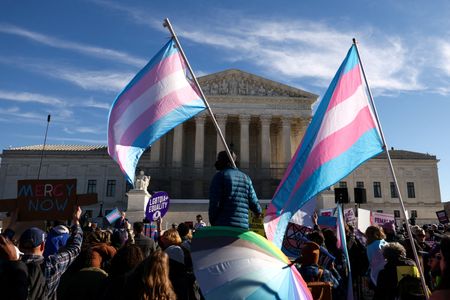
The court will also determine whether state legislation in two western states that prohibits transgender students from participating on female athletic teams at public educational institutions violates federal law. These cases come as various states have enacted similar restrictions on transgender participation.
With its current composition featuring six conservative justices and three liberal members, the court has consistently shifted legal precedents in a more conservative direction over recent years.
FIREARMS LEGISLATION
As the country grapples with ongoing gun violence and recurring mass casualty events, the Supreme Court has interpreted the Second Amendment’s protections broadly, expanding individual gun ownership rights.
Based on oral arguments heard in January regarding the state restrictions case, conservative justices seemed inclined to further broaden gun rights, expressing doubt about the constitutionality of requiring property owners to give “express authorization” before allowing handguns on their commercial premises. Similar regulations exist in four additional states.
Legal experts anticipate the court will strike down these restrictions. Hayley Lawrence, who leads the Duke Center for Firearms Law and advocates for gun control measures, predicted the outcome.
“It seems to me the state is going to lose 6-3,” Lawrence said.
Lawrence noted the court may also clarify the analytical approach it established in its 2022 New York State Rifle & Pistol Association v. Bruen ruling, which requires any government firearm regulation to align with historical American gun control traditions.
CONTROLLED SUBSTANCE USERS
In March, justices heard arguments about a federal criminal law that prohibits anyone classified as an “unlawful user” of controlled substances from owning firearms or ammunition. This restriction appears in the Gun Control Act of 1968, which identifies various groups, including convicted felons and fugitives, who cannot legally possess weapons.
The legal challenge originated from a case involving a man from the state who admitted to using marijuana multiple times weekly and faced charges under this statute. The same provision was used in charges against the former president’s son in 2023, though he later received a presidential pardon. The current administration supports maintaining the law.
University of Chicago law professor Darrell Miller observed that while the court seems doubtful about the drug user prohibition, justices also worry about creating precedent that could weaken other portions of the legislation, particularly restrictions on felon gun possession.
“The court is deciding a drug case but they have one eye on the felony possession statute,” Miller said.
TRANSGENDER STUDENT ATHLETES
The current administration has implemented various policies restricting transgender rights, including military service limitations that the Supreme Court previously allowed to proceed during ongoing litigation. The government now supports state laws in two western states that ban transgender athletes from competing on women’s and girls’ teams at public schools and universities.
During January oral arguments, conservative justices appeared likely to uphold these prohibitions.
Public opinion surveys suggest most Americans oppose allowing transgender athletes to compete on teams matching their gender identity, especially in college sports.
“There is vast consensus on this issue,” said William Bock, a sports law attorney at Kroger Gardis Regas who supports the state restrictions. “Seventy to 80 percent of the public doesn’t understand why people are fighting about this.”
Sasha Buchert, an attorney with LGBT legal rights organization Lambda Legal representing one of the challengers, remained optimistic about potentially overturning the state laws, noting the case arguments “went much better” than those in 2024 involving gender-affirming medical care for transgender minors. In that previous case, conservative justices voted 6-3 to uphold a state ban on such medical treatment.
While the Supreme Court ruled in 2020 that federal workplace discrimination protections extend to gay and transgender employees, the justices have since permitted various transgender restrictions to take effect.
In March, the court blocked a series of state laws that would have limited sharing information with parents about transgender public school students’ gender identity without the child’s consent, supporting Christian parents who challenged these privacy protections.
Beyond military restrictions, the current administration has also implemented policies preventing transgender individuals from using their gender identities on passports and barring transgender federal employees from using bathrooms that correspond to their gender identity.
The court has already decided one major LGBT rights case from this term, issuing an 8-1 ruling in March that overturned a state law prohibiting therapists from using “conversion” therapy aimed at changing LGBT minors’ sexual orientation or gender identity. The justices supported a Christian licensed counselor’s argument that the ban violated First Amendment free speech protections.
IMMIGRATION POLICIES
Immigration issues also feature prominently in current cultural debates. The court will soon rule on two major cases involving current administration policies: efforts to limit birthright citizenship and attempts to remove humanitarian protections called Temporary Protected Status from hundreds of thousands of immigrants from two Caribbean and Middle Eastern nations.
Based on case arguments, the administration may face defeat on birthright citizenship restrictions, similar to a February loss on tariff policies, but could prevail on Temporary Protected Status changes.
The court also has a pending decision involving religious rights, where a man practicing the Rastafarian faith sued state prison officials after guards forcibly shaved his head, violating his religious beliefs under federal law protecting incarcerated individuals from religious discrimination.
In a death penalty case, a man convicted of murder in 1997 in a southern state avoided execution after the Supreme Court in May upheld a judicial determination that he was intellectually disabled and therefore ineligible for capital punishment under established precedent.