
While June remains widely celebrated as Pride Month, several Republican governors across the nation have established competing designations for the same timeframe that advocacy groups on both sides interpret as deliberate counter-messaging.
The governors leading Indiana and Tennessee have established June as Nuclear Family Month, celebrating household structures consisting of “one husband, one wife and any biological, adopted or fostered children,” though they haven’t explicitly stated this was meant to override Pride recognition.
Alabama has designated the month as Strong Families Month, timed to align with Father’s Day. Gov. Kay Ivey’s official declaration states that fathers serve as “the head of the household” and that “homes led by a father and mother provide children with the structure and discipline necessary to succeed throughout life.”
Utah and Arkansas governors have labeled June as Fidelity Month, highlighting devotion to faith, nation and family — without specifying what family structures should look like.
A recent post from Arkansas Gov. Sarah Huckabee Sanders’ X account shared a link about her declaration with text reading, “Another Red State is Counter-Programming Pride Month.”
Neither Sanders nor the other governors have responded to Associated Press inquiries about their reasoning for selecting June for these proclamations.
Legislative efforts in at least four additional Republican-led states have proposed bills this year to establish June as Fidelity Month.
The concept originates from an organization created by Robert P. George, a Princeton University jurisprudence professor known for conservative scholarship. His organization declined interview requests.
Speaking to the National Catholic Register in 2023, he stated that “nobody gets a monopoly on a particular day or a particular month.”
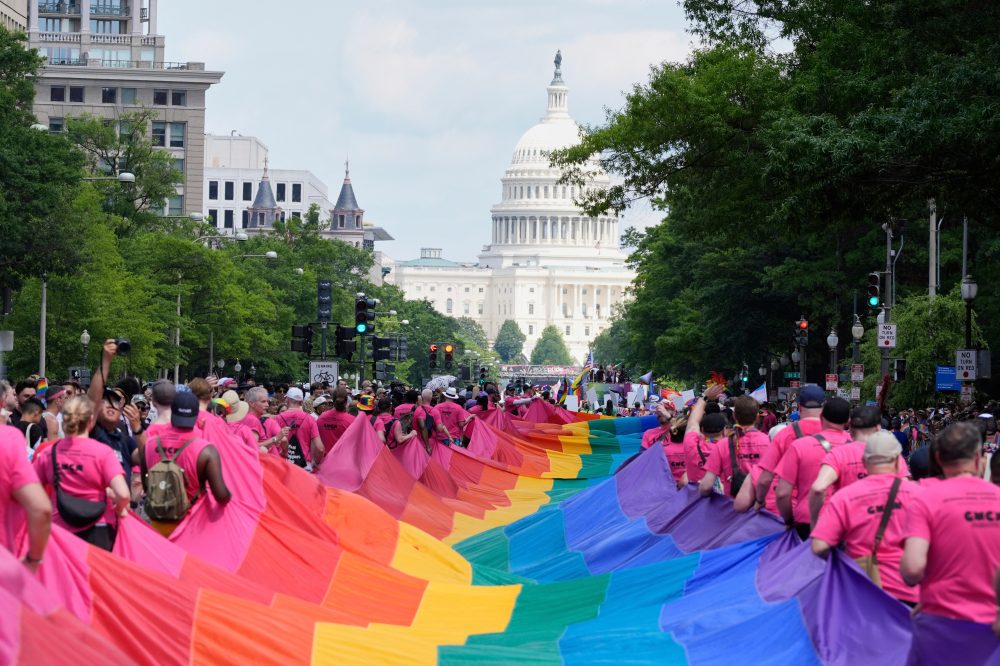
June Pride festivities, featuring parades, festivals and performances, started in 1970 to commemorate the anniversary of the violent police confrontation at the Stonewall Inn, a New York City gay establishment, and have since spread globally.
“You can call it whatever you want, but one thing you’re not going to do is take away our pride or take away our joy,” stated Jordan Braxton, co-president of USA Prides.
Since Bill Clinton in 1999, every Democratic president has issued annual Pride proclamations — while no Republican president has done so.
Among GOP governors, Utah’s Spencer Cox stands out for issuing Pride proclamations in 2021, 2022 and 2023. In 2024, he called June a “Month of Bridge Building” before switching to Fidelity Month this year.
Recent polling indicates that two decades of growing acceptance for same-sex marriages and relationships has stalled — primarily due to increased Republican opposition.
Last year, U.S. Rep. Mary Miller, an Illinois Republican, proposed legislation to establish June as Family Month while eliminating Pride Month recognition, arguing “Americans are inundated with perverse Pride Month displays and events throughout the month of June that denigrate the nuclear family.” The resolution never received a vote.
Supporters see these state initiatives as chances for cultural change.
Kevin Roberts, president of the conservative Heritage Foundation, said in an interview that conservative recognitions are beneficial because Pride celebrations “were going so far as to make it difficult to celebrate traditional marriage.”
Tennessee’s legislative resolution and gubernatorial approval doesn’t specifically reference Pride Month, while declaring the “nuclear family is under attack in our beloved State and nation.”
However, Lakie Derrick, a conservative activist who co-authored the Tennessee measure, acknowledged she specifically targeted June to oppose Pride Month, which she believes “goes against” American principles.
“We’re just reclaiming the culture, and there’s no better month to do that than in a month where the culture says we’re gonna celebrate something so opposite to what we know to be right,” Derrick explained.
Marina Lowe, who oversees legal and legislative matters for LGBTQ+ advocacy organization Equality Utah, argued that Pride Month doesn’t oppose other value-based recognitions. Many LGBTQ individuals also cherish faith and family, she noted, adding “I don’t think that these positions need to be in conflict with one another.”
In Wenatchee, Washington, a school’s Turning Point USA chapter successfully arranged for Family Month banners on light poles that previously displayed rainbow flags during June. Local gay rights organization Out NCW responded by purchasing two billboards and distributing yard signs supporting Pride, according to president AJ Soto.
Josh Coleman, president of Central Alabama Pride, which has scheduled 42 events across two weeks, said the celebrations ending with a parade on June 13 and festival June 14 won’t be impacted by the proclamation.
“It’s not lost upon LGBTQ people when elected leaders don’t recognize or value the visibility of the community,” he explained. “That’s why Pride started in the first place — to make sure the community had a community.”
Alex Richardson, board chair at Indy Pride in Indianapolis, views the governor’s proclamation as a “swipe.” Yet he believes the local events celebrate some values the governor supports.
“Sure, the governor’s right, the nuclear family is worth celebrating,” Richardson said. “But I think so is the grandmother who raises her grandchildren, or the chosen family that shows up when a blended family can’t, or won’t, … or the weird blended households that are held together by love and effort.”