
Family members of people killed in police encounters across Minnesota voiced outrage Thursday over the state Republican Party’s decision to conduct a silent prayer for Derek Chauvin, the ex-officer imprisoned for George Floyd’s murder.
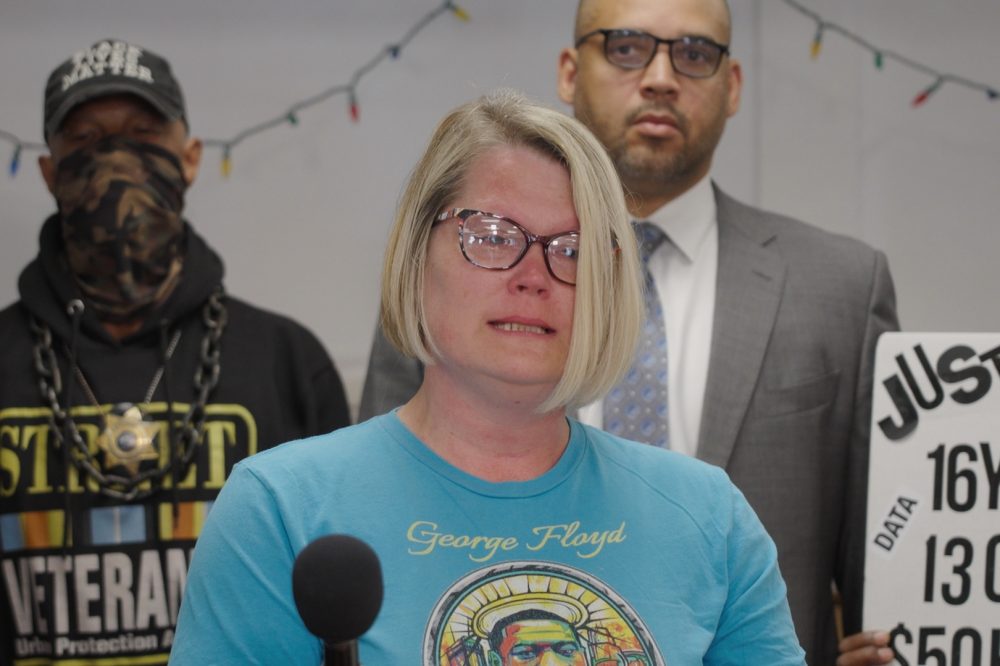
“That is the most hurtful thing you can do,” said Valerie Castile, the mother of Philando Castile, a 32-year-old school cafeteria worker who was shot and killed by a Minnesota police officer in 2016. “You give a moment of silence to a murderer? Come on.”
Castile joined other community members at a press conference hosted by Twin Cities Coalition For Justice.
The Minnesota Republican Party nominating convention conducted a moment of silence last weekend for Chauvin.
Once news of this action spread, it sparked fierce criticism.
Civil rights organizations, racial justice activists and Democratic elected officials quickly denounced party leaders, claiming they were blindly backing law enforcement while showing disrespect to Floyd and his relatives.
Chauvin has been serving time in federal prison since 2021, following his conviction for Floyd’s murder six years ago. Mobile phone footage showing Chauvin pressing his knee against Floyd’s neck for more than 9 minutes while Floyd repeatedly said “I can’t breathe” ignited widespread racial justice demonstrations throughout the second half of 2020.
On Floyd’s death anniversary one year later, people gathered at the location and knelt silently, representing the 9 minutes and 29 seconds Floyd remained pinned beneath Chauvin.
A convention attendee at the Minnesota GOP meeting in Duluth on Saturday suggested recognizing Chauvin, based on local media coverage. This happened just days following the sixth anniversary of Floyd’s death.
“The moment of silent prayer was a spontaneous motion brought forward from the convention floor. It was not part of the official convention program, it was not proposed by Convention Chairman Danny Nadeau, and it was not a statement from party leadership,” the Minnesota Republican Party said in a statement.
Castile emphasized that regardless of limited participation, the action remained painful.
“I am proud of the ones who did not do the moment of silence,” she said. “Those that did, they should be reprimanded in some fashion.”
Minnesota Attorney General Keith Ellison, who headed the state’s case against Chauvin, expressed in a statement this week that he was “heartbroken and frankly shocked” by the prayer.
“This decision dishonors the memory of George Floyd and wounds his loved ones all over again. As the lead prosecutor whose team presented this case to a jury of twelve Minnesotans and then prevailed at every step of the appeals process, I am deeply troubled by what this says about the state of our politics,” Ellison said.
Ben Crump and Antonio Romanucci, the attorneys who represented Floyd’s family in a wrongful death lawsuit, were left “sickened by this lack of respect.” They also demanded the Minnesota GOP retract their moment of silence and apologize to Floyd’s family.
“The audacity of the Minnesota Republican Party to honor an individual who has both been convicted by a jury of his peers for the murder of a fellow human being, while at the same time (violating) a professional oath to protect and serve his community, is disgusting,” they said in a statement.
Reached via text message on Thursday, Floyd’s New York-based brother, Terrence Floyd, said he was “glad to see people are still fighting with us for complete justice.”
The silent tribute for Chauvin follows a familiar pattern where conservatives have responded to police violence incidents with “back the blue” campaigns. Even before 2020, when George Floyd’s murder sparked the biggest racial justice protests since the Civil Rights Movement, certain officers became symbols of “law and order” or opposition to Black Lives Matter.
In 2014, following Darren Wilson — the former Ferguson, Missouri, police officer who is white — fatally shooting 18-year-old Michael Brown, who was Black, a GoFundMe campaign collected hundreds of thousands of dollars for the officer’s family and legal costs. This sum far exceeded what was raised for Brown’s family. Wilson was never charged criminally or with federal civil rights violations.
Police officers involved in high-profile deaths of Laquan McDonald in Chicago and Eric Garner in New York also received substantial backing from law enforcement unions that portrayed criminal charges or disciplinary actions against officers as unfair and politically driven.
While legal results differ significantly across these cases, most notable instances of support for officers facing charges in deadly encounters do not lead to overturned convictions.
___ Associated Press editor Aaron Morrison in New York City contributed to this report.