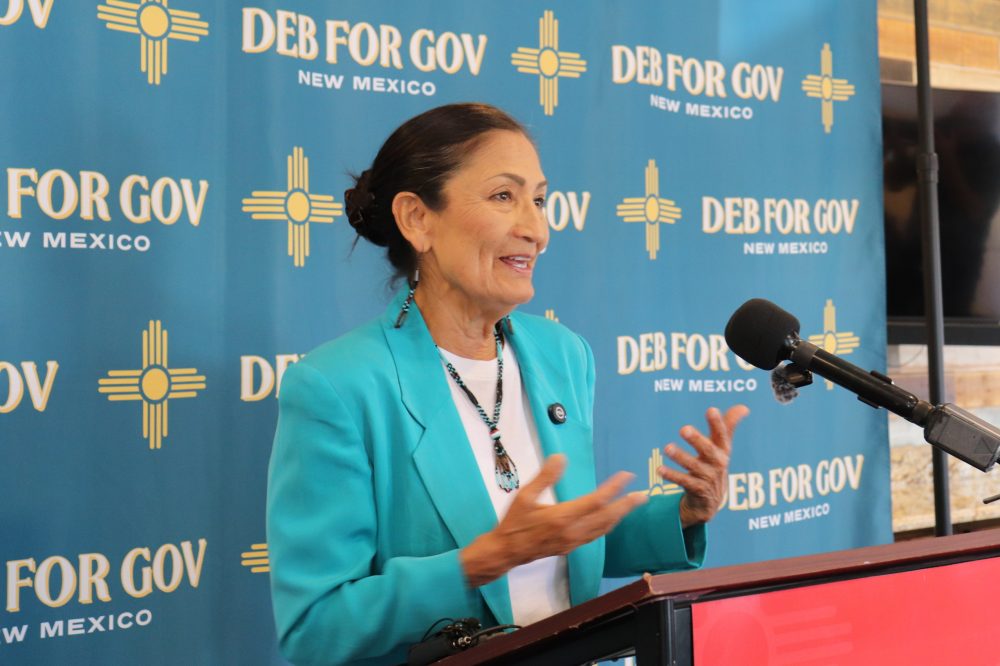

Standing in the early morning light near the Sandia Mountains, Deb Haaland spent the final hours of New Mexico’s primary election doing what she’s done for years – connecting with voters at the tribal community where she once served as an administrator.
At San Felipe Pueblo, where Haaland previously worked, she greeted passing drivers and urged them to cast their ballots. The Laguna Pueblo citizen spent time with former coworkers and friends, discussing everything from meals to family and handmade silver jewelry with Pueblo women who have followed her career with admiration and hope to witness her become America’s first Native woman governor.
By evening, Haaland had claimed the Democratic gubernatorial nomination. Her journey from Congress to serving as U.S. Interior secretary has shattered multiple glass ceilings, and she now stands positioned to reach another historic achievement if she can overcome Republican challenger Gregg Hull this November.
Political forecasters give Haaland strong chances of victory, considering New Mexico’s shift toward Democratic candidates over the past ten years. However, Hull, who previously served as mayor three separate times, argues the state requires new leadership after extended Democratic control to address persistent issues including poor education performance, elevated crime rates, and widespread poverty.
The incoming governor will face enduring challenges while dealing with policies implemented during the Trump administration. During her primary victory remarks Tuesday evening, Haaland immediately referenced President Donald Trump and has accused him of increasing costs for New Mexico residents by reducing crucial federal assistance programs.
In an upcoming memoir scheduled for publication this month, she revealed that Trump’s reelection inspired her gubernatorial campaign, viewing the governor’s office as the “first line of defense against the worst policies coming out of this administration.”
Hull avoided mentioning Trump in his victory speech, instead criticizing Haaland’s previous stance against the oil and gas sector, which funds everything from schools to free childcare in New Mexico, the nation’s second-largest oil producer after Texas.
While Haaland acknowledges that energy revenue will influence her affordability plans and recognizes the industry’s role in creating well-paying positions, she previously supported the Green New Deal advocating for an economic transition away from fossil fuels. During congressional hearings, lawmakers frequently questioned her drilling positions.
“It’s a choice between an energy policy that’s built on common sense and not one that’s built on ideologies,” Hull stated Tuesday evening. “New Mexico is an energy state.”
Haaland emphasized that America has waited too long for a female Native governor. Only Oklahoma has elected a tribal citizen as governor, doing so twice – first with Democrat Johnston Murray in the early 1950s and currently with Republican Kevin Stitt.
“I feel so strongly that representation matters,” Haaland declared. “I mean, that’s what got me into politics in the first place, is because I wanted more Native people to vote.”
Hull acknowledged Haaland’s service as one of the first two Native American women in Congress and the first Native American Cabinet secretary, but maintained that Democratic policies have disappointed New Mexico.
At Hull’s election celebration, David Bearshield, who is Cheyanne and Arapaho, ceremonially presented Hull and his wife with Pendleton blankets as a gesture of endorsement and a demonstration that Native voters don’t share uniform political views.
According to Bearshield, some Native voters and tribal governments favor more conservative politicians, particularly regarding energy development. He referenced the continuing dispute around Chaco Culture National Historical Park, where certain Navajos oppose the drilling moratorium Haaland established as Interior secretary.
“It doesn’t have to be like that,” Bearshield stated. “Those people don’t have to be in poverty.”
Advocacy organizations view Haaland’s campaign as a valuable chance to elevate tribal visibility and guarantee their participation in governance. However, Haaland understands both the enhanced attention and criticism that accompany representing frequently marginalized communities, according to Jordan James Harvill from the advocacy group Advance Native Political Leadership.
“The weight on her is the weight to solve 500 years of colonization,” he explained. “It’s just because there’s been so few of us.”
Harvill’s organization works to expand Native representation on county boards and in state legislatures by recruiting over 1,000 Native Americans interested in community service. The group also joined a coalition that urged the Biden administration to select Haaland as Interior secretary.
During primary night festivities at Albuquerque’s historic Old Town plaza, mariachi music and hoop dancers created a celebratory atmosphere where campaign workers and supporters marked a convincing primary win by “Auntie Deb,” her affectionate nickname in parts of Indian Country.
When Haaland appeared on stage wearing beaded earrings and red cowboy boots to accept the nomination, Ann Chavez Barudin of Santo Domingo Pueblo observed from the audience. She recognized herself, her mother, and her daughters in the candidate.
“It’s emotional. It’s powerful,” Chavez Barudin expressed. “I didn’t think I would ever see this day happen.”