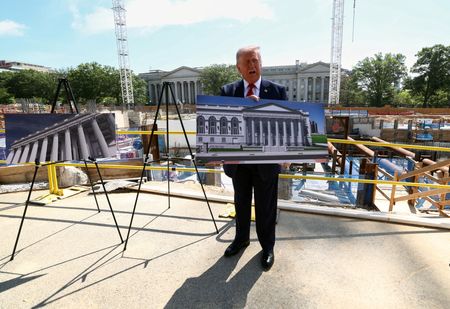

A federal appeals court will decide Friday whether the Trump administration can move forward with a controversial $400 million ballroom project at the White House, in a legal battle that tests the boundaries of presidential power.
The dispute centers on the administration’s decision to demolish the East Wing of the White House complex and replace it with a massive 90,000-square-foot ballroom without obtaining Congressional authorization.
The East Wing historically served as workspace for the first lady and her staff within the White House grounds in Washington.
Last year, the National Trust for Historic Preservation filed a lawsuit challenging the project after the administration demolished the East Wing in October 2025 and started construction on the ballroom facility.
The ballroom initiative represents part of a larger effort by the Republican leader to transform the architectural landscape of government buildings and monuments throughout central Washington.
The case will be argued at 9:30 a.m. EDT before a three-judge panel of the U.S. Court of Appeals for the District of Columbia Circuit, a influential federal court positioned just below the Supreme Court.
U.S. District Judge Richard Leon, who was nominated by Republican former President George W. Bush, has issued two separate orders halting above-ground construction while permitting underground work to proceed.
Leon ruled that no federal law even “comes close to giving the President” the necessary authority to build the ballroom without Congressional approval.
The appeals panel reviewing the administration’s challenge consists of Democratic-appointed D.C. Circuit judges Patricia Millett and Bradley Garcia, along with Trump-appointed Judge Neomi Rao. Last month, the appeals court issued an order permitting construction to move forward during the ongoing litigation without deciding the case’s underlying merits.
The administration has defended the ballroom project as essential for national security, pointing to recent assassination attempts against Trump.
“The East Wing Project answers that critical security need, and ensures that the President can fulfill his constitutional duties in a safe and heavily secured facility,” the Justice Department argued to the appeals court in May.
Historic preservation advocates dispute this reasoning. The National Trust for Historic Preservation argues that the D.C. Circuit and U.S. Supreme Court have never permitted a president to “usurp powers vested in Congress by the Constitution based on nothing more than his claim of necessity.”
In court documents, the organization stated that “the public has a strong interest in pausing a project that will irreparably damage what is perhaps the most significant historic site in the country.”
Trump’s broader redevelopment plans also include constructing a 250-foot arch near the National Mall, the landscaped area stretching between the U.S. Capitol and the Lincoln Memorial, plus renovating the Kennedy Center performing arts facility.
A federal judge issued an order last week requiring Trump to remove his name from the Kennedy Center building and preventing his plans to shut down the venue for renovations.
Trump has announced that his planned ballroom is expected to be completed around September 2028.