
WASHINGTON (AP) — In an unexpected private meeting, OpenAI’s chief executive reached out to Sen. Bernie Sanders this week for discussions about artificial intelligence ownership.
The conversation occurred shortly after the Vermont lawmaker unveiled his proposal requiring the American public to hold a 50% ownership share in AI corporations like OpenAI, with those stocks funding a public wealth program to distribute profits from major AI companies.
During their discussion, the OpenAI leader expressed his own support for public equity in artificial intelligence firms. While the executive indicated he couldn’t back Sanders’ proposed 50% ownership level, he showed interest in collaborating on the broader concept, sources familiar with the talks revealed.
The almost hour-long discussion in Sanders’ Senate office this week, initiated by the OpenAI chief, underscored growing friction between artificial intelligence giants and lawmakers as citizens face mounting costs from AI development while questioning its direct advantages. The situation has also formed unusual political partnerships driven by populist sentiment, with figures ranging from Sanders to President Donald Trump supporting public participation in AI profits.
During remarks to media aboard Air Force One on Friday, Trump outlined a possible collaboration “where the American people can benefit from the success of AI” and announced that top AI company leaders would meet at the White House “probably next week” to explore this concept.
“There’s something very interesting about it, where it almost becomes a partnership with the American public,” Trump, a Republican, stated Friday.
When journalists mentioned to Trump that Sanders, a self-described democratic socialist, had suggested public ownership of AI firms, he highlighted similarities between their supporter bases. The economic perspectives of Trump supporters and those who backed Sanders for president, Trump noted, “aren’t that far apart.”
Trump has supported government investment in private enterprises during his second term, reshaping his party’s political stance. His administration previously obtained a 10% ownership in the struggling Silicon Valley firm Intel, and explored a government acquisition of Spirit Airlines earlier this year, though the airline couldn’t finalize an agreement and eventually shut down.
The stances taken by prominent leaders like Trump and Sanders emerge as AI concerns spread well beyond Washington.
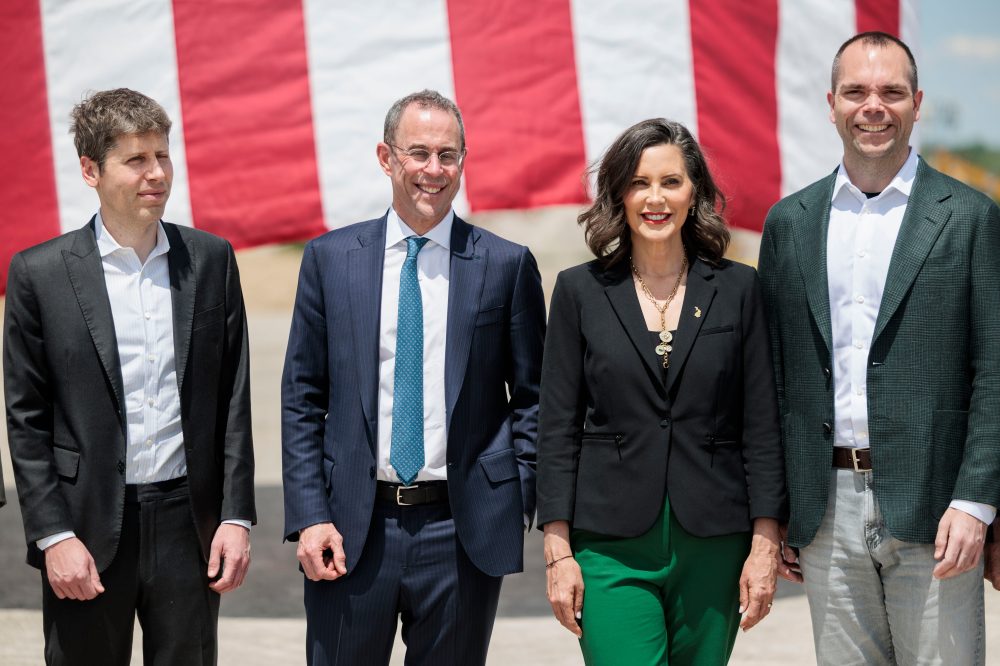
In Michigan, Democrats recently disagreed over Gov. Gretchen Whitmer’s public appearance with the OpenAI executive at a major data center construction site. Political candidates such as New York Democratic House candidate Alex Bores have also campaigned on AI oversight by addressing voter concerns about the technology.
“This is a real change to society,” the OpenAI leader told media this week. “I think it’s possible both that people can use AI a lot and like using it and also have anxiety about what it’s going to do for the future.”
Data center developments nationwide have faced resistance from communities worried about power usage, water needs and environmental effects. Some states previously eager to welcome these facilities, including Ohio and Virginia, have begun reconsidering tax benefits.
“We need to pass legislation right now that says there’s not going to be any further data center development until they agree to pay for their own electricity, build their own grids and pay for their own water supply,” Missouri Sen. Josh Hawley, a prominent Republican critic of Big Tech, told The Associated Press.
Prior to his Washington visit, the OpenAI executive traveled to Michigan on Monday to join Whitmer, a Democrat, at the construction location of a 1.65 million-square-foot data center. Whitmer’s administration stated the development would generate over 2,500 union construction positions.
However, the project also faced criticism from local advocates and some Democrats, including Michigan Rep. Rashida Tlaib, who described the project as “disgusting.” She expressed being “so disappointed” in Whitmer.
“It’s a very controversial topic right now and it’s coming from the ground up,” Michigan Sen. Elissa Slotkin, a Democrat, said regarding the grassroots opposition. “People feel very strongly about it.”
Whitmer, however, told reporters following the event that “one thing’s very clear, everyone has a cellphone in our pocket.”
“We are all, more and more, consuming technology and data and these data centers are going to get built. So, my thought is if we can hold them to a high standard and do it in Michigan, that’s the best way to do it,” she said.
The disputes go beyond data centers. At university campuses, graduation speakers have faced interruptions and criticism when addressing artificial intelligence topics. Approximately 70% of college students view AI as threatening their employment opportunities, based on a 2025 survey by the Institute of Politics at the Harvard Kennedy School.
The OpenAI executive recognized these worries. He noted that while “the impact on jobs has been less than many people in our field expected,” he comprehends “that college students have a lot of anxiety about the future.”
The belief that AI’s growth cannot be stopped is increasingly accepted by officials across political divisions, despite sharp disagreements about oversight approaches.
This understanding was central to the OpenAI leader’s Washington meetings. Beyond Sanders, he met with Trump administration figures such as Michael Kratsios, the White House’s chief science and technology adviser, and legislative leaders from both parties.
Sanders’ staff stressed that the two did not reach consensus on the senator’s key points presented to the OpenAI executive, including the 50% ownership requirement to ensure public decision-making authority. Sanders also voiced opposition to increasing election expenditures by the AI sector.
“Unfortunately, Sam Altman did not commit to any of those,” said Sanders’ spokesperson Jeremy Slevin.
The OpenAI leader, following their discussion, characterized it as “great,” noting that the two “obviously don’t agree on everything.”
Congress this week unveiled a bipartisan plan that would create the first comprehensive federal AI regulation approach while temporarily overriding numerous state laws.
Anthropic, one of OpenAI’s main rivals, has suggested methods for coordinating development halts on advanced AI if systems become too powerful.
The Trump administration has also started building its own monitoring framework, issuing an executive order to create a review process for national security threats from advanced AI systems before public launch.
Sanders noted the administration’s action was significant after years of warnings that regulation might hinder American innovation.
“Even these guys are beginning to catch on that there are legitimate concerns that have to be dealt with,” Sanders said.