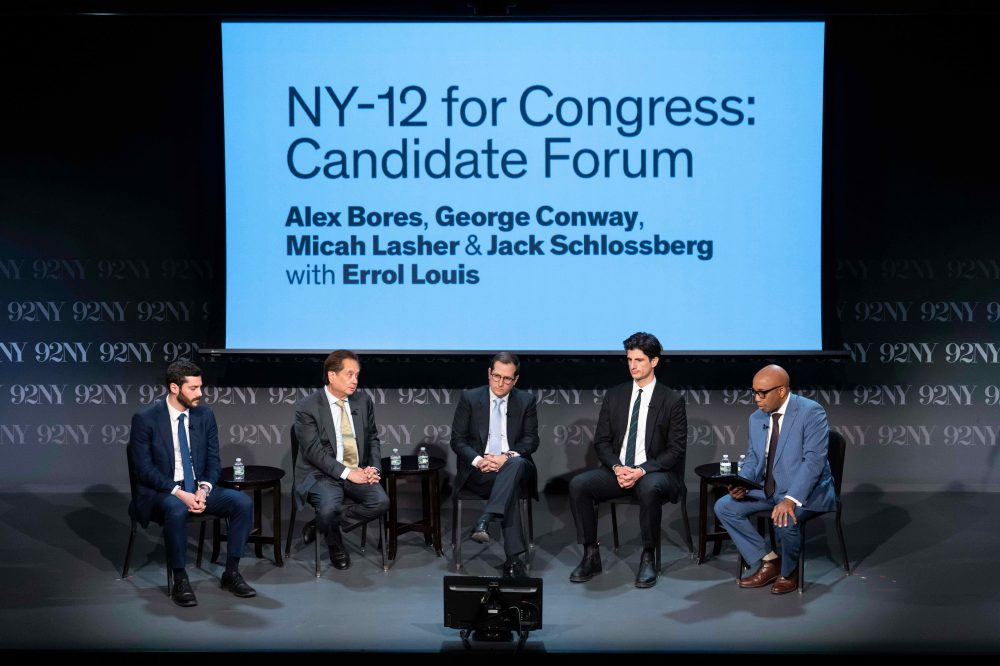

NEW YORK (AP) — A contentious debate erupted Thursday evening among Democratic candidates seeking a highly sought-after Manhattan congressional seat, with tensions flaring over technology industry influence and which contender could best challenge President Donald Trump.
State lawmaker Alex Bores found himself at the center of the attacks, facing criticism over his artificial intelligence regulatory proposals that have triggered significant industry expenditures both opposing and supporting his candidacy.
Early in the debate, state Assembly Member Micah Lasher accused Bores of being influenced by major technology corporations backing his campaign.
“Alex only wants to tell you half the story, about one AI company that’s spending millions to defeat him, and that’s bad,” Lasher said. “But he’s not telling you the story about Anthropic, which is spending a million dollars to elect him, or a crypto billionaire who is spending $3.5 million to send him to Congress,” Lasher continued.
Shortly afterward, Jack Schlossberg, the grandson of former President John F. Kennedy, echoed similar concerns, contending that Bores’ proposed artificial intelligence regulation “is a dream come true” for tech companies because it would give them too much control.
Bores responded: “With friends like these, who needs Republicans?”
“The Trump disinformation is coming from inside the party,” said Bores, a former data scientist at the tech firm Palantir who says he quit after it signed a deal to help the first Trump administration with immigration enforcement.
The televised forum, broadcast by local cable channel PIX11, occurred just weeks before the June 23 primary election for the District 12 congressional position that will be left open by retiring U.S. Rep. Jerry Nadler. The constituency encompasses affluent neighborhoods surrounding Central Park and Times Square in Midtown Manhattan. The seat is viewed as securely Democratic, making the Democratic primary the decisive competition.
Following Nadler’s retirement announcement, numerous Democrats launched campaigns, though the field of contenders has somewhat narrowed.
Nadler has endorsed Lasher, a former staffer who has held several behind-the-scenes posts in New York government before becoming a lawmaker in the state Assembly.
Schlossberg, whose zany social media antics and Kennedy lineage brought national eyes to the race, has cast himself as an fresh face to a party searching for stars during Trump’s second term.
George Conway, who was once married to former Trump adviser Kellyanne Conway before becoming a leading antagonist of the president, is running a campaign centered on removing Trump from office.
Bores entered the race without the fanfare of a Kennedy or a Conway but has since become a major player after an artificial intelligence-aligned group started spending to hobble his campaign. The spending has seemed to elevate his campaign, rather than damage him, helping Bores frame himself as the candidate who wants to regulate a technology that has unnerved many Americans worried about impacts such as job losses.
During the entire debate, Bores, who sponsored state legislation to require major AI developers to report dangerous incidents to the state, defended against criticism.
Following one heated exchange, he attempted to respond but was interrupted when the program broke for advertisements. Three of the five commercials focused on Bores, demonstrating the heavy spending surrounding the contest.
The opening advertisement, funded by the AI-backed Think Big PAC, alleged Bores was “bought and sold” by corporate interests. The next two advertisements supported Bores, with one featuring a robotic voice that identified itself as “the AI super PAC funded by Trump’s megadonors designed to destroy Alex Bores,” and the other casting Bores as a champion of the working class.
“You’ve seen tonight that I’m nothing like the incessant text and mailers and TV ads that are being sent out to demonize me. But I am terrifying to Trump’s megadonors and apparently to my opponents as well,” Bores said when the debate resumed.
Conway, meanwhile, lamented the combative nature of the night.
“What we saw here tonight was something that Democrats sometimes do a little too well, which was a circular, or really a triangular firing squad, and I think that’s a shame,” he said.