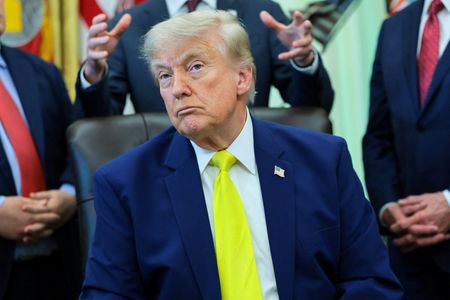

President Donald Trump announced Thursday that he conducted meetings with automotive industry executives regarding legislation surrounding vehicle repair rights.
The discussions included GM CEO Mary Barra, Ford Motor senior executive Andrew Frick, and leadership from the National Automobile Dealers Association and the Alliance for Automotive Innovation, alongside Republican Senator Bernie Moreno, who previously worked as an auto dealer.
Ford verified its participation in the discussions, while the automotive organizations chose not to provide statements. GM did not reply to requests for comment.
“We had the auto industry in yesterday. They don’t want people to fix their car. I said ‘That’s strange!’” Trump stated. “They have a thing; nobody’s allowed to fix their car.”
The automotive sector has engaged in disputes with independent mechanics and advocacy organizations for years regarding the ability to service newer vehicles. The annual value of the U.S. automotive service industry reaches approximately $200 billion.
A U.S. House of Representatives committee approved legislation last week that would codify current industry agreements and grant the Federal Trade Commission enforcement powers over these arrangements.
The automotive alliance, representing most major car manufacturers, endorsed the measure and highlighted that 75% of vehicle repairs after warranty expiration occur at independent facilities. The organization stated that in 2014, automakers pledged to provide comprehensive repair guidance, equipment access, and diagnostic information to both dealerships and independent mechanics.
Numerous legislators and independent repair facilities believe additional measures are necessary and seek congressional approval of separate bills ensuring vehicle owners can access and distribute repair-related information, including diagnostic details.
The proposed measures would mandate that vehicle manufacturers provide owners and independent mechanics with access to diagnostic information, repair procedures, and calibration data.
Several lawmakers contend that limiting data access allows automakers to increase costs and forces independent repair shops to pay substantial fees for repair software access.
The automotive dealers organization opposes the proposed legislation, claiming it would allow aftermarket manufacturers to copy automotive components and create inferior replicas, while also providing insurance companies greater influence over repair choices.