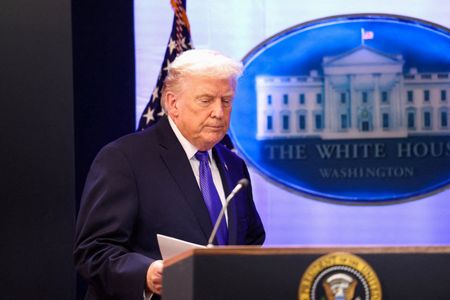

President Donald Trump’s administration has unveiled plans for new tariffs targeting 60 nations that Washington claims aren’t doing enough to eliminate forced labor from their trade goods, but specialists and advocacy organizations warn the approach may backfire in the fight against modern slavery.
The proposed import duties of 10% to 12.5% represent the administration’s newest trade action, emerging from a Section 301 investigation into unfair trade practices by the U.S. Trade Representative’s office. The initiative aims to reinstate Trump’s emergency tariffs after the U.S. Supreme Court overturned them in February.
However, trade specialists and human rights advocates question whether this strategy will meaningfully address widespread problems including child labor, forced labor, and other exploitative work conditions throughout global supply chains.
“The essence of this new measure has very little or anything to do with forced labour. It’s just a new justification for trade tariffs,” said Ram Ben Tzion, co-founder and CEO of digital shipment-vetting platform Publican.
Data from the International Labour Organization shows 27.6 million individuals currently work under forced labor conditions globally – representing a 2.7 million increase since 2016. Export-focused industries including manufacturing, construction, agriculture, fishing, and mining account for nearly half of all private sector forced labor situations.
The administration’s case against the European Union has attracted significant attention, given the trade relationship between the two partners. Washington’s report criticized the EU’s Forced Labour Regulation, scheduled to take effect in December 2027, arguing it establishes stricter evidence requirements than American standards and mandates officials demonstrate substantial concern before taking action.
European Commission officials called the tariffs unjustified while reaffirming their dedication to last year’s trade agreement with Washington that limits U.S. tariff rates on most EU products to 15%.
The international human rights organization Walk Free has determined that no G20 nation is adequately addressing forced labor relative to their economic capacity. According to Walk Free’s findings, the U.S. ranks among the top 10 countries with the highest numbers of people living under modern slavery conditions.
Andrew Wilson, Deputy Secretary-General of the International Chamber of Commerce, expressed concern about what he called the “arbitrary nature” of the proposed tariffs.
“It doesn’t make sense if the object of this is to enhance controls on modern slavery,” Wilson stated, noting that planned EU measures would eventually surpass U.S. regulations once implemented. “The EU regime may ultimately have broader market reach because it covers imports, products sold in the EU, and exports from the EU.”
Sebastian Ruenz, an ESG and supply chain specialist at law firm Taylor Wessing, disputed Washington’s characterization of EU frameworks as inadequate. The EU prohibition applies to forced labor products from any global location, regardless of their country of origin.
“It will be structurally far more comprehensive than the U.S. law,” Ruenz explained, highlighting that Germany’s Supply Chain Due Diligence Act and France’s comparable legislation have already created national forced labor standards.
Even advocates who generally support import restrictions as tools against modern slavery expressed doubts about tariffs designed around trade volumes rather than exploitation severity achieving substantial progress.
Hélène de Rengerve, senior advocate for corporate accountability at Human Rights Watch, pointed out that the most severe forced labor systems – including state-imposed programs in China’s Xinjiang region, Turkmenistan’s cotton industry, and North Korea – aren’t the main focus of these tariffs, which instead reflect trade volumes and geopolitical factors.
“It is also not clear how will this be an incentive to actually improve the situation,” de Rengerve said. “It might even create more political resistance in some countries. I fear it might be counterproductive to the objective of fighting forced labour.”