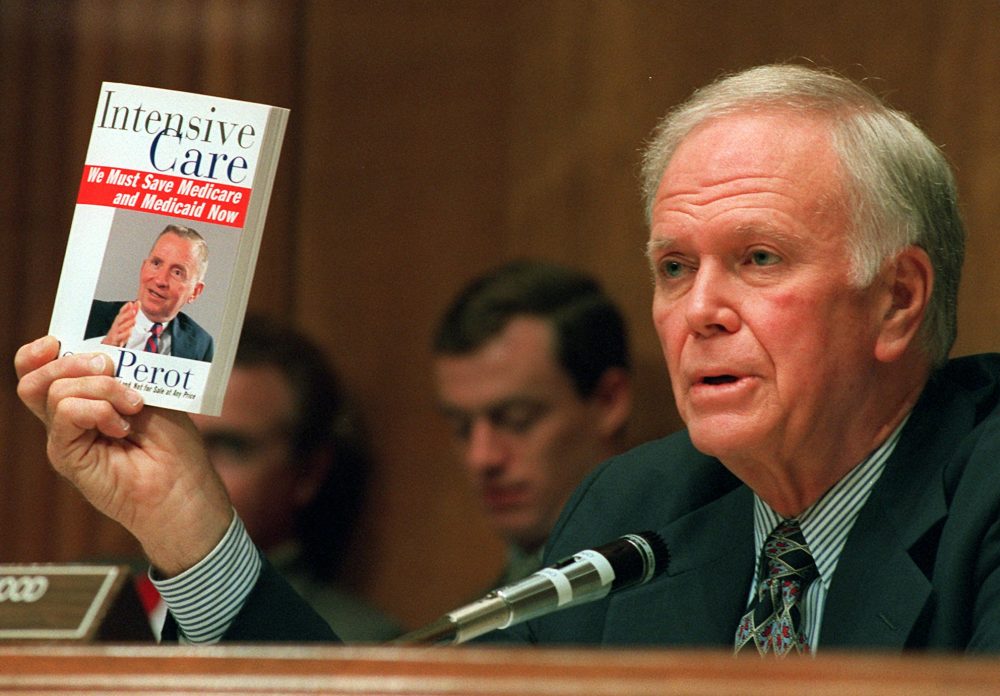

A former Oregon Republican senator whose political legacy was tarnished by sexual harassment allegations has passed away at age 93.
Bob Packwood’s family announced his death on Saturday through an obituary distributed to news organizations, though no additional details about his passing were provided.
The longtime legislator initially fought to remain in the Senate where he had served nearly three decades, stating he didn’t want the controversy to define his legacy.
Years before the MeToo movement brought such issues to the forefront, Packwood became a prominent case study of how personal conduct could destroy a public figure’s reputation. Organizations like Planned Parenthood had previously honored him for his work.
Coming from a politically connected Oregon family – his great-grandfather participated in the state’s 1857 Constitutional Convention – Packwood carved out a reputation as someone willing to cross party lines, combining moderate social views with conservative fiscal positions. He even contemplated a presidential bid in 1980.
After winning his Senate seat in 1968, Packwood became known primarily for his strong support of abortion rights as a Republican, earning widespread respect from women’s advocacy organizations nationwide. That changed when the Senate Ethics Committee began investigating misconduct allegations in 1993.
Over two dozen women, including former staff members and other associates, came forward with claims that he had made unwelcome sexual overtures.
The ethics investigation expanded beyond the harassment claims to examine other potential misconduct. Packwood ultimately stepped down in September 1995 and subsequently launched a successful lobbying firm in Washington.
Democratic Senator Ron Wyden, who took over Packwood’s seat in 1996, acknowledged his predecessor’s work on abortion rights and tax policy but said the treatment of women defined his legacy.
“His horrible history as documented in his own diaries will forever overshadow that public record. Simply put, historians’ first line about Bob Packwood must include those women who he abused and assaulted for years and years,” Wyden said in a statement.
During his tenure leading and serving on the Senate Finance Committee, Packwood developed expertise in crafting legislative compromises, particularly on tax matters. He took special pride in helping shepherd the comprehensive 1986 tax reform that reduced top rates while eliminating numerous deductions.
Throughout his political career, observers characterized him using terms like blunt, independent, maverick, and political survivor.
“I think they probably all ring true,” Packwood told The Associated Press in December 1992.
“I would like to think that I am nobody’s lackey. I try to reach conclusions independently and then I’m willing to fight for those conclusions; if necessary, having to fight against my party or my party’s president,” he said.
At 36, Packwood won his initial Senate race by narrowly defeating Democratic incumbent Wayne L. Morse, an Oregon political icon who had represented the state for over two decades. His victory quickly established him as a rising Republican figure, leading to his election as head of the National Republican Senatorial Committee by 1980.
However, he lost that leadership position after the White House supported a challenger following Packwood’s public criticism of President Ronald Reagan for alienating women, African Americans and Jewish voters.
The harassment allegations surfaced in The Washington Post just two weeks following Packwood’s 1992 reelection victory, featuring accounts from former female employees and acquaintances.
The Senate Ethics Committee also examined claims that Packwood had sought employment opportunities from lobbyists for his former wife, used staff to intimidate accusers into silence, and interfered with the investigation by modifying his personal journals.
In 1993, the Senate conducted two days of unusual floor debate about whether Packwood should be compelled to surrender his diaries, which reportedly contained entries related to the investigation. Senators voted 94-6 to enforce the committee’s subpoena.
Packwood challenged the decision in federal court and lost at every level, including when Chief Justice William Rehnquist declined to have the Supreme Court intervene.
After leaving the Senate, Packwood established Sunrise Research Corp. as his lobbying venture in 1997. The firm generated $1.5 million annually by 1999. Though business declined in later years, he told a Portland audience in 2010 that he still devoted roughly half his time to Washington lobbying activities.
While he found the work engaging, Packwood told the audience, according to The Oregonian, “it is not as much fun as being in the Senate.”
As Congress grew increasingly polarized after his departure, Packwood continued promoting centrist approaches and suggested Oregon adopt nonpartisan elections during his 2010 speech.
Packwood was married to Elaine Franklin, his former chief of staff who later became a Portland political consultant. The pair maintained residences in both the Portland region and Washington.
In a November 2002 conversation with the Salem Statesman Journal, Packwood indicated he had moved beyond the scandal that ended his Senate career.
“People have told me it must have been tough on me, or it seems unfair,” he said. “But you cannot go through the rest of life and say look what happened. Pretty soon you become a bore to your friends.
“I told myself I was not old enough to retire,” Packwood said, “so I have got to get at life and not complain about it.”