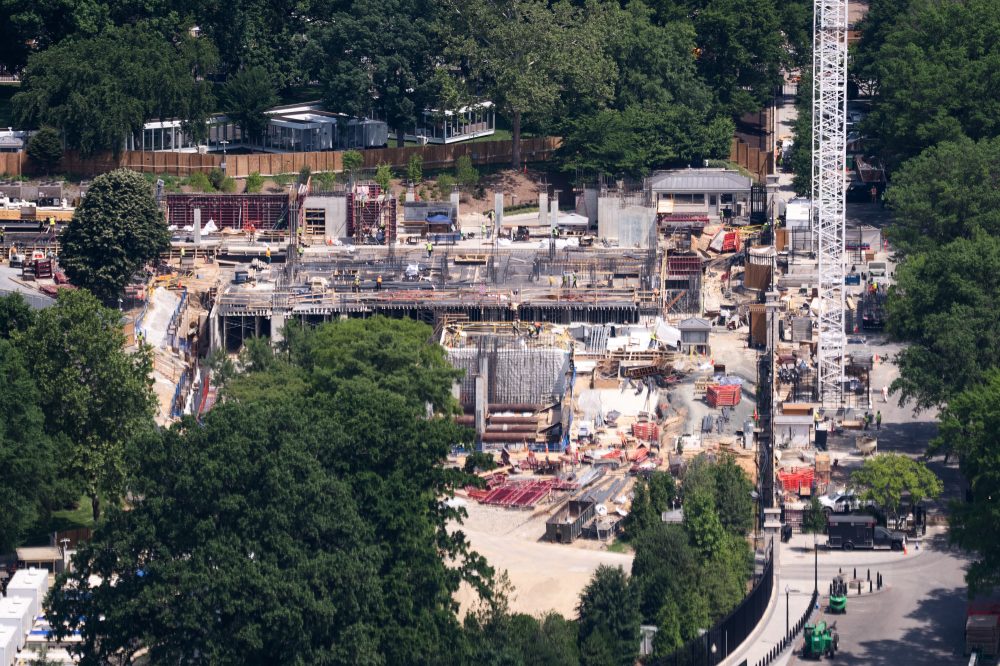

WASHINGTON — Federal government attorneys told a court Friday that judicial intervention cannot halt the ongoing construction of a White House ballroom, citing both the project’s advanced status and security considerations the facility is designed to address.
During arguments before the U.S. Appeals Court, attorney Yaakov Roth told Judge Patricia Millett that only Congress possesses the authority to stop the $400 million construction project. The administration is seeking court permission to continue building the ballroom without legislative approval.
The dispute stems from an April 16 ruling by U.S. District Judge Richard Leon, who ordered the administration to cease above-ground construction on the 90,000-square-foot ballroom. Leon, appointed by Republican President George W. Bush, permitted underground work to proceed on bunker facilities and other security infrastructure at the location.
Friday’s hearing focused on questions of legal standing to challenge government actions after they’ve commenced and whether such standing supersedes national security interests.
When Millett, who was appointed by Democratic President Barack Obama, presented hypothetical scenarios, Roth acknowledged that even if the government demolished iconic structures like the Statue of Liberty and the White House, affected parties would lack legal standing to challenge such actions after completion.
Millett questioned Roth about when the ballroom construction became irreversible.
“Was it when you started doing the underground work, which is now totally completely integral and connected and inseparable from a massive ballroom on top?” she inquired. “When did it become impossible for courts to stop this project?”
Roth responded: “I think it would have been improper to enjoin it even on Day One.”
This exchange was among many during the two-hour session before the three-judge panel of the U.S. Court of Appeals for the District of Columbia Circuit. The judges concluded the hearing without issuing a ruling.
The National Trust for Historic Preservation filed their lawsuit in December, one week after the White House completed demolition of the East Wing to create space for a ballroom designed to accommodate 999 people.
Predicting the judges’ decision remains difficult. While Roth faced extensive questioning about the administration’s authority and evolving explanations for proceeding, plaintiff attorney Tad Heuer also encountered significant judicial scrutiny.
The panel pressed Heuer regarding legal standing and how aesthetic concerns might outweigh national security considerations.
“We have never opposed the underground construction of the bunker, which is where the government until recently has said the national security concerns lay,” Heuer stated. He argued that construction should pause pending congressional review.
“Congress can allow ballrooms to be built — it’s its property,” Heuer said.
Administration lawyers maintain the project incorporates vital security elements designed to counter various threats, including drones, ballistic missiles and biological hazards.
“These upgrades, alterations, and improvements are essential to protecting the President, his family, and his staff, as well as the White House itself, and the entire project flows from them,” they stated in court documents.