The Philadelphia Union have brought back one of their most decorated players, reacquiring three-time MLS All-Star defender Kai Wagner through a transfer from Birmingham City FC on Friday.
To complete the move, Philadelphia also sent $100,000 in General Allocation Money to Sporting Kansas City in exchange for swapping positions in the waiver order — moving up from the No. 22 spot to the No. 1 position, which allowed them to claim Wagner.
Wagner had previously spent seven seasons with Philadelphia from 2019 to 2025 before his seven-month stint with Birmingham City FC, where he recorded three assists in 18 appearances across all competitions.
In a statement, Wagner expressed how much the return means to him personally. “Coming back to Philadelphia feels incredibly meaningful for me and my family. Over the years, this city has become our home, and returning was a decision that came from the heart,” he said. “My time away gave me the opportunity to experience a new challenge, but it also reinforced how much this club, this city, and our supporters mean to me.”
He added: “There’s something special about representing the Union and playing in front of our fans. I believe in what this club stands for, its culture, ambition, and commitment to competing at the highest level. I’m excited to be back, and grateful for the opportunity to help write the next chapter.”
Wagner has earned two MLS Best XI selections during his career and played a key role in Philadelphia’s two Supporters’ Shield championships for best regular-season record, won in 2020 and 2025. He was also a central figure on the 2022 team that fell to Los Angeles FC in the MLS Cup Final.
He holds the franchise record with 63 assists and has scored eight goals in 204 regular-season matches. During the 2025 season, he contributed two goals and 11 assists in 32 games while anchoring a defense that allowed just 35 goals — the fewest in MLS that year — and recorded 14 clean sheets.
Philadelphia sporting director Jon Scheer welcomed the return enthusiastically. “We’re thrilled to welcome Kai back to Philadelphia. He’s been an integral part of this club’s success and has consistently established himself as one of the top left backs in Major League Soccer,” Scheer said. “Kai understands what this club represents, what our supporters expect, and the standards we hold ourselves to every day. We’re confident he’ll make an immediate impact this season as we pursue our goals and be an important part of our club’s future.”
The Union currently sit at the bottom of the league with a record of 1-10-4 and just seven points. The team returns from a nearly two-month break due to the World Cup and will host the New York Red Bulls on Wednesday.
Tampa Bay third baseman Junior Caminero showed no signs of sitting out Friday, taking his usual third spot in the batting order as the Rays opened a day-night doubleheader against the visiting Boston Red Sox.
Caminero had taken a pitch off his left pinky finger from St. Louis Cardinals pitcher Riley O’Brien during the third inning of Tuesday’s All-Star Game. Despite the scare, X-rays taken after he exited that game came back negative. On Friday, he lined out to center field and then singled to left field in his first two trips to the plate — that single standing as Tampa Bay’s lone hit through the first five innings.
Heading into the doubleheader, Caminero was hitting .279 with 28 home runs and 59 RBIs on the season. The 23-year-old is tied for fourth in all of Major League Baseball in home runs, sharing that spot with Washington outfielder James Wood. Caminero had been on a particularly hot streak before the break, launching 13 home runs over his final 19 games leading up to the All-Star break.
The injury news was not as encouraging for two other Rays players working their way back from the disabled list. Manager Kevin Cash announced that outfielder Jake Fraley and second baseman Gavin Lux both returned to St. Petersburg, Florida, after suffering setbacks during their rehab stints with Triple-A Durham.
Fraley, 31, has been sidelined since May 15 while dealing with hernia and groin problems. Lux, who came to Tampa Bay from the Cincinnati Reds during the offseason, has been on the injured list since before Opening Day and has yet to appear in a game for the Rays. Cash said the 28-year-old Lux required a pain-killing injection in his right shoulder before he can continue his recovery.
Ukrainian President Volodymyr Zelenskiy moved on Friday to patch up a diplomatic dispute with key ally Poland, stemming from his May decision to name a Ukrainian military unit after World War Two fighters who were responsible for killing Polish civilians.
Zelenskiy convened a high-level meeting of senior government officials focused specifically on the state of relations with Poland. At the meeting, he committed to broadening investigations into killings carried out by the Ukrainian Insurgent Army, known by its Ukrainian acronym UPA, a pro-independence armed group, and pledged to open intelligence archives related to those events.
Zelenskiy emphasized that strengthening ties with Poland was essential, pointing to the significant assistance Poland has provided to Ukraine since Russia launched its full-scale invasion in 2022. Polish President Karol Nawrocki had previously stripped Zelenskiy of Poland’s highest honor in response to the military naming decision.
Following the meeting, Zelenskiy took to social media platform X to share his position. “The priorities are clear: All of us in Europe need good neighbourly, equal, and mutually beneficial relations built on respect,” he wrote. “Poland provided significant support to Ukraine after the start of Russia’s full-scale invasion, and we are grateful to Poland.”
Polish Prime Minister Donald Tusk responded warmly to Zelenskiy’s remarks. “We are ready for a serious and friendly dialogue on the issues that unite us and those that divide us today,” Tusk posted on X.
As part of the diplomatic effort, Zelenskiy announced that officials would unseal archives held by Ukraine’s Security Service and its Foreign Intelligence Service. Those files relate to the mass killings of ethnic Polish civilians in the Volhynia region, located in what is now northwestern Ukraine.
According to historians, UPA forces and allied nationalist groups killed between 70,000 and 100,000 Poles in that region between 1943 and 1945, with the aim of clearing the area of Polish inhabitants ahead of establishing future Ukrainian territory. Thousands of Ukrainians also lost their lives in retaliatory killings during the same period.
Zelenskiy additionally pledged to increase efforts to exhume victims’ remains, broaden historical dialogue, and direct more resources toward a Ukrainian history institute.
Despite these gestures, Ukrainian officials have given no sign that the decision to name the army unit after the UPA will be reversed, maintaining that Ukraine has the sovereign right to determine who it honors as national heroes.
The UPA holds a complicated place in Ukrainian historical memory. Many Ukrainians view the group as heroic for having resisted both Nazi German occupation and Soviet forces, and see it as a symbol of Ukraine’s long struggle for independence from Moscow.
Elon Musk’s SpaceX is reportedly in negotiations with the U.S. Department of Defense to provide access to data center capacity worth billions of dollars, according to a Wall Street Journal report published Friday, citing individuals with knowledge of the discussions.
If finalized, the agreement would deepen the existing partnership between the Pentagon and SpaceX, which already serves as a major contractor for rocket launches, satellite communications, and missile tracking services.
According to the Journal, SpaceX employees have been discussing plans to take on neocloud companies like CoreWeave more directly by offering computing capacity to artificial intelligence customers at more competitive prices.
The Defense Department, like many large organizations, is working to lock in additional cloud computing resources to support military AI applications and intelligence operations.
The push for computing power is not unique to SpaceX. Amazon announced late last year that it plans to invest as much as $50 billion to grow AI and supercomputing capacity for U.S. government clients through its Amazon Web Services division.
The Wall Street Journal noted that talks between SpaceX and the Pentagon are still in progress and may not result in a deal. Neither SpaceX nor the Pentagon responded to requests for comment from Reuters, which was also unable to independently confirm the report.
SpaceX has been active in striking similar agreements recently. In June, the company signed a multi-year cloud services deal with Alphabet’s Google, giving Google access to roughly 110,000 Nvidia chips and associated computing infrastructure.
In May, AI company Anthropic announced it had reached an agreement to utilize the full computing capacity of SpaceX’s Colossus 1 facility located in Memphis, adding 300 megawatts of new computing power.
The National Weather Service office located in Mount Holly, New Jersey has issued an Air Quality Alert, according to an official notice released at 3:45 PM Eastern Time on July 17.
Residents in the affected areas should be aware that air quality conditions may pose health concerns, particularly for sensitive groups such as the elderly, children, and those with respiratory conditions like asthma.
During periods of reduced air quality, health officials generally recommend limiting prolonged outdoor activity, especially strenuous exercise. Those who are sensitive to air pollution are advised to remain indoors when possible and keep windows closed.
TV Delmarva will continue to monitor this alert and provide updates as more information becomes available from the National Weather Service.
The National Weather Service office in Mount Holly, New Jersey has issued an Air Quality Alert, effective as of 3:45 PM Eastern Time on July 17.
During periods of poor air quality, health officials generally advise that sensitive groups — including children, the elderly, and individuals with respiratory or heart conditions — limit their time outdoors and reduce strenuous physical activity.
Residents are encouraged to monitor local forecasts and heed any guidance provided by health and environmental authorities until the alert has expired.
The National Weather Service office in Mount Holly, New Jersey has issued an Air Quality Alert for the region.
Details regarding the specific timing, affected areas, and pollutant levels were included in the official alert notice. Residents — especially those with respiratory conditions, the elderly, and young children — are encouraged to take precautions and limit time spent outdoors while the alert remains in effect.
For the most current information on air quality conditions and any updates to this alert, residents can visit the National Weather Service website or check with local air quality authorities.
Citizens Bank has announced plans to sever its financial ties with two private prison companies that have been operating immigration detention facilities under the Trump administration, following an intense public pressure campaign from activists and left-leaning city governments.
The bank had been providing financial services to CoreCivic and The GEO Group — two companies that own and operate private prisons across the United States. Under President Donald Trump, both companies have been contracted by U.S. Immigration and Customs Enforcement to run detention and deportation facilities as part of the administration’s broader crackdown on illegal immigration.
The pressure on Citizens Bank grew significantly, with at least two New Jersey city councils — those in Montclair and Jersey City — voting to pull their funds from the bank unless it ended its relationships with the private prison operators.
The De-ICE Citizens Bank Coalition responded to the announcement with a statement calling it a meaningful win: “Today’s announcement that Citizens Bank will exit its current lending relationships with private prison giants CoreCivic and The GEO Group is an important victory for the people who refused to let a major bank finance human suffering brought on by ICE detention activities of the current federal administration.”
Despite the public campaign, Citizens Bank maintained in its own statement that the decision was driven by business considerations, not political ones. The bank pointed to the federal government’s plans to purchase several facilities currently run by CoreCivic, and ongoing talks to do the same with GEO, arguing that these developments have reduced the companies’ need for outside financing.
“This is a business decision based on changed commercial circumstances and does not reflect any change in our view regarding these companies’ business models or operations,” the bank stated.
The broader issue of banks cutting off financial services to certain businesses — a practice known as debanking — has become increasingly controversial during Trump’s second term. Federal bank regulators have launched investigations into debanking practices, with the possibility of fines or penalties for institutions found to have engaged in it improperly.
Citizens Bank acknowledged the regulatory environment in its statement, saying: “All banks, including ourselves, must consider these regulatory and contractual frameworks in making decisions on who to bank or not bank.”
Farmers saw a slight decline in what they were paid for peanuts during the most recent reporting period, according to federal agricultural statistics.
For the week ending July 11, the average price received by farmers for all farmer stock peanuts came in at 22.7 cents per pound. That figure represents a decrease of 1.5 cents compared to the prior period.
The data was published by the U.S. Department of Agriculture’s National Agricultural Statistics Service as part of its ongoing tracking of commodity prices across the country.
NASHVILLE, Tenn. — Clara Ester, a civil rights activist who sprinted to the Rev. Martin Luther King Jr.’s side as a 20-year-old college student moments after he was shot, has passed away at the age of 78.
Ester died on July 9 and was among the very few remaining people who witnessed King’s assassination and its immediate aftermath in Memphis. With the earlier death of the Rev. Jesse Jackson Sr. in February and now Ester’s passing, King aide and former U.N. ambassador Andrew Young is believed to be the last living eyewitness to the shooting.
Growing up in Memphis, Ester attended Centenary United Methodist Church, where civil rights leader the Rev. James Lawson served as her pastor.
In a 2018 interview with The Associated Press, around the time of the 50th anniversary of King’s death, Ester reflected on what drew her into the civil rights movement. “We used to joke about colored water being Kool-Aid and the white water just being water, and so that satisfied us as children,” she said. “But until you see the racism, until you see what has been withheld from you because of your color — is what started to really truly anger me. And I knew if there was a movement that could help change any of that, I had to be in it.”
Civil rights discussions were a regular part of Sunday services at her church, Ester recalled. Because Lawson was deeply involved in the sanitation workers’ strike, her own participation in the movement felt like a natural extension of her faith community.
“I got to the point that I didn’t miss a mass meeting,” she said. “I picketed every day that the picket lines were up.”
Even decades later, Ester vividly recalled the power of King’s speech at the Mason Temple the evening before his assassination — a speech that seemed to many to foreshadow his death the following day.
“He had seen the mountaintop,” Ester said. “It was evident on the balcony — how calm.”
On April 4, 1968, Ester had gone to the Lorraine Motel for dinner when she spotted King on the balcony, chatting pleasantly with people gathered below. Then she heard a gunshot.
“He was speaking calmly and pleasantly to a crowd,” she recalled. “And so he was happy at that moment. But to lay there with his eyes open, looking toward heaven. He had seen the promised land, and he may not get there with us, but he promised that we as a people will see the promised land.”
Ester ran to King and could see he was struggling to breathe. She worked to loosen his belt and urged bystanders to bring towels to help stop the bleeding. After King was transported by ambulance, Ester was required to remain at the hotel and answer questions from police investigators.
When she was finally permitted to go home, her parents asked if she was alright. “I said, ‘No, I’m not OK. There’s something wrong with this,’” Ester said. “And it was many months later that I guess at some point, I just broke down.”
She left Memphis that summer to work elsewhere, and once she completed her schooling, she left the city for good. “It’s just too much to … it hurt me that it happened, but it hurt me that it happened in my hometown, that that’s the legacy for this city,” she said.
Ester eventually relocated to Mobile, Alabama, where she took a position as a neighborhood organizer at the Dumas Wesley Community Center, a Christian service organization that supports children, senior citizens, and people experiencing homelessness, according to her obituary. She later rose to become the center’s executive director, a role she held until her retirement in 2006.
In 1986, she was commissioned as a deaconess in the United Methodist Church, a form of lay ministry. She remained devoted to her church throughout her life and held prominent leadership positions, including serving as the national vice president of United Methodist Women.
Methodist Bishop David Graves first met Ester when he was assigned to the Alabama-West Florida Conference in 2016. In a written remembrance, he noted that she was initially cool toward him, but that a deep mutual affection developed over time.
“Thank you, Clara Ester, for a life well lived and for loving me. It changed me,” he wrote. “Clara will be missed immensely, but what a day of rejoicing is going on in heaven. For love will always find a way for those who trust in Jesus and seek to love even in our differences.”
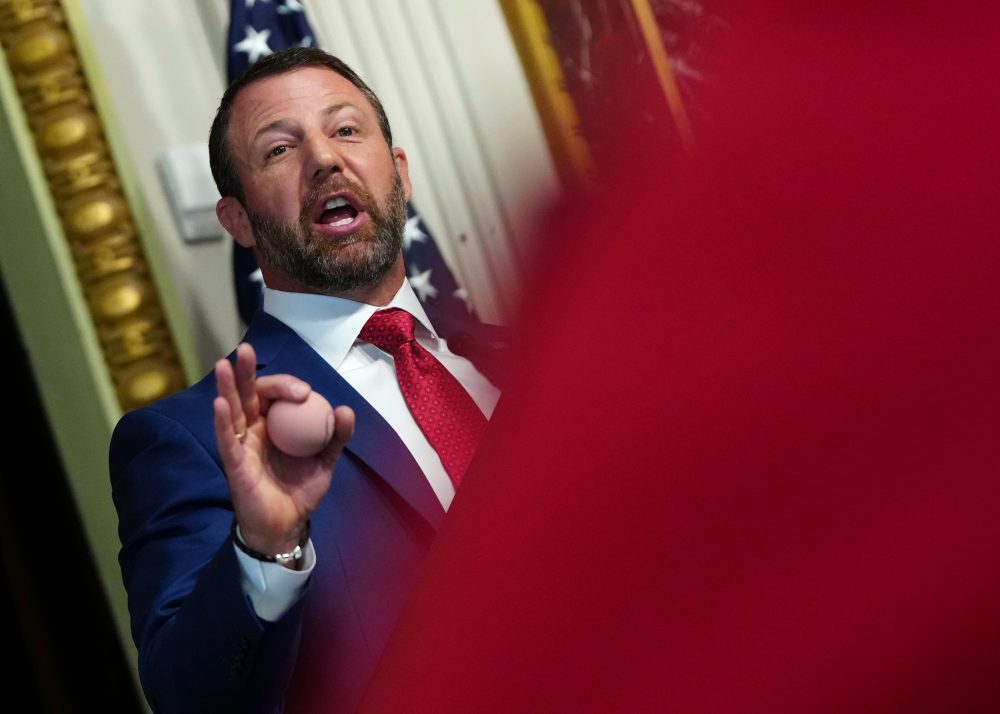
WASHINGTON (AP) — Homeland Security Secretary Markwayne Mullin stepped before cameras at the White House Friday to deliver a stark warning: state officials who refuse to cooperate with President Trump’s election security agenda could face funding cuts, penalties, or even criminal investigations.
The warning came just one day after Trump addressed the nation in primetime on the subject, and arrives only months before midterm elections that will determine which party controls Congress.
Legal and election experts, however, say the threats are largely toothless. Courts have repeatedly blocked the administration’s voting-related initiatives, and the U.S. Constitution explicitly grants states the authority to manage their own elections.
Still, Mullin’s statements — delivered from the White House complex — could further erode public confidence in election systems and create complications for states as they gear up for November.
“We absolutely can build confidence in the American people, but the states have to do their part,” Mullin said.
Trump has continued to falsely assert that Democrat Joe Biden won the 2020 presidential election through fraud, despite judges and his own attorney general during his first term determining the election was legitimate. Since returning to the White House last year, Trump has sought to use federal power to challenge that outcome.
Mullin claimed Trump was not trying to relitigate 2020, “although he definitely could at this point,” adding: “This is just about exposing what took place and making sure it never happens again.”
During Friday’s remarks, Mullin repeated an unverified claim Trump made the night before — that the federal government had identified 250,000 noncitizen voters on the rolls across California, Nevada, New Jersey, and Pennsylvania. He said the Department of Homeland Security used publicly available data to reach that conclusion. Election experts, however, say public data lacks the precision and currency needed to accurately determine whether a registered voter is a noncitizen.
Election officials in California and Pennsylvania said they would look into the administration’s findings, while pointing out that they already conduct their own voter list maintenance and that noncitizen voting is extremely uncommon — a conclusion supported by research.
California Gov. Gavin Newsom, a Democrat, fired back on social media: “California has free, fair, and secure elections and we will fight for them. Try us.”
In Nevada, Secretary of State Cisco Aguilar, also a Democrat, expressed confidence in his state’s voter records. “We are constantly looking at the information to figure out how many registered voters in Nevada don’t have a Social Security number on file,” he said. “We have done significant work to make sure our voter rolls are as clean as possible.”
Mullin also vowed to closely monitor public voter lists to pursue fraud cases both before and after the 2026 election. “If you are an illegal or you are voting illegally, we will hunt you down, we will find you and we will prosecute you,” he said.
He called on states to participate in DHS’s recently revamped SAVE program — a federal database tool at the center of the administration’s push to nationalize election oversight. At least 25 states have used the program to check their voter rolls since April 2025, following significant expansions to its capabilities under the Trump administration. The administration has demanded that states submit sensitive voter data to the program for a full audit.
Mullin warned that state officials who refuse to participate could face fines, penalties, or imprisonment.
However, a federal judge recently blocked the updated version of the SAVE program, citing concerns about voter privacy and the risk of wrongly removing eligible voters from the rolls. The case included instances where the program incorrectly flagged legitimate voter registrations.
David Becker, executive director of the nonprofit Center for Election Innovation and Research, called Mullin’s threats baseless. “Every court to consider the DOJ’s demands — 15 of them to date, six of those judges appointed by President Trump — have confirmed that the federal government cannot legally demand access to states’ sensitive voter data,” he said. “What he’s suggesting is illegal.”
Meanwhile, Trump’s push to pass the SAVE Act — federal legislation that would require proof of citizenship to register to vote — has stalled in the Senate. Republicans do not have the votes needed to bypass filibuster rules and pass the bill without Democratic support.
Mullin also amplified Trump’s concerns about potential vulnerabilities in electronic voting machines, a topic voting security experts have long acknowledged. While Trump suggested Thursday that these weaknesses make it possible to “rig” elections, officials say extensive safeguards exist, including physical security measures, pre-election machine testing, post-election reviews, and paper ballot backups used across most of the country.
To address those concerns, Mullin said the nation’s Cybersecurity and Infrastructure Security Agency — which operates under DHS — would release an updated election infrastructure plan within 30 days and offer cyber threat resources to states that participate in SAVE.
Critics noted the irony: Trump has significantly scaled back CISA’s election security work. The agency was largely sidelined during last year’s elections after the administration reviewed its election-related activities, placed more than a dozen election-focused employees on administrative leave, and cut $10 million from two cybersecurity programs — including one specifically designed to assist state and local election officials. CISA also remains without a Senate-confirmed director and has gone through multiple acting leaders.
Nevada’s Aguilar said his state has had to step up to fill the void left by the federal government. “The fact that they think they’re going to come in prior to the general election in November and provide us infrastructure, that’s nuts,” he said. “Actions speak louder than words, and in their case, it’s all been talk.”
Beginning next week, Boeing will once again be permitted to take charge of certifying that its 737 Max and 787 aircraft meet airworthiness standards, the Federal Aviation Administration announced Friday.
Following an extensive review spanning several months, the FAA concluded that Boeing’s own final safety inspections are thorough enough to confirm its planes are safe to fly. Since September, Boeing and federal inspectors had been alternating weekly in conducting the required safety checks before aircraft could be cleared for delivery. The FAA noted that both parties had been arriving at similar conclusions when issuing airworthiness certificates.
The FAA first stripped Boeing of its authority to self-certify 737 Max jets back in 2019, in the aftermath of two deadly crashes that investigators later attributed to a new software system Boeing had developed for the plane. Then in 2022, the agency also revoked Boeing’s self-certification rights for its 787 Dreamliner, pointing to persistent problems with production quality.
FAA Administrator Bryan Bedford emphasized that safety remains the top priority. “Safety drives everything we do, and this step forward is only possible because we are confident it can be done safely,” Bedford said.
While Boeing resumes its certification responsibilities, federal inspectors will not be stepping away entirely. Bedford said government oversight of Boeing’s manufacturing facilities will continue, with inspectors now able to direct more of their attention toward identifying and resolving potential defects earlier in the production process.
Boeing had not issued a response to the FAA’s announcement at the time of this report.
Separately, the FAA has also been gradually relaxing production caps it placed on Boeing’s 737 Max line after a fuselage panel detached from one of those jets — operated by Alaska Airlines — while the aircraft was in flight in January 2024. That monthly production ceiling has been raised incrementally from 38 planes to 47 planes this past summer.
The Jamaican government has confirmed that two of its citizens, recently deported by the United States to the African kingdom of Eswatini, have formally turned down offers to return to their home country.
Jamaica’s Ministry of Foreign Affairs announced late Thursday that officials were still working to make contact with a third Jamaican national who was also sent to Eswatini by U.S. authorities.
According to the Foreign Ministry, Jamaican representatives informed the two men about the consular support available to them and made clear that the government was prepared to arrange their return. “During the discussion, the men were advised of the consular assistance available to them and of the government’s readiness to facilitate their return to Jamaica,” the ministry stated.
The government also told the men that officials “could not determine their immigration status in the United States or secure their return there. Both men maintained that they did not wish to return to Jamaica.”
Communication with the two unidentified men was made possible through the Jamaican Consulate in Miami and a legal adviser who represents them.
Jamaica’s efforts came after the country reached out diplomatically to U.S. officials in Washington and also formally contacted Eswatini’s government through Jamaica’s diplomatic mission located in Pretoria, South Africa.
The U.S. practice of sending deportees to countries other than their home nations — including Eswatini — has drawn sharp criticism from attorneys and human rights advocates.
Eswatini is a small kingdom that shares a border with South Africa. The country’s king holds absolute authority and has faced accusations of suppressing pro-democracy movements within the nation.
A Jamaican man named Orville Etoria, identified as the first Jamaican national sent to Eswatini under this program, was returned to Jamaica last September. His legal team has accused U.S. authorities of unlawfully deporting him to Eswatini in July 2025 and says that he and others were repeatedly denied access to an attorney while detained there. Etoria’s return was made possible with assistance from the International Organization for Migration, known as IOM, which is a United Nations agency.
A powerful new artificial intelligence model out of China blindsided the U.S. tech sector on Friday, adding to a growing pattern of Chinese startups releasing open-source AI technology that is putting pressure on the major California-based players in the industry.
The latest model, called Kimi K3, comes from a Beijing-based startup known as Moonshot. Its chief executive earned his doctorate in Pittsburgh and is known among colleagues for his love of rock music, including Pink Floyd. The K3 model appears to be closing in on the best versions of Anthropic’s Claude and OpenAI’s ChatGPT.
Anastasios Angelopoulos, co-founder and CEO of Arena — a platform that evaluates AI systems — called it potentially “the single biggest release of the year,” saying it signals a moment when open-source Chinese models are surpassing closed U.S. models. He added on social media that “more results are rolling in that are likely to continue to show it is at the top of the pack” when it comes to front-end coding capability, one key measure of AI performance.
The timing of K3’s announcement was likely no accident. It came just before Chinese President Xi Jinping delivered an opening address Friday at China’s annual World Artificial Intelligence Conference in Shanghai. At the event, Xi declared that “the development of artificial intelligence should not be a solo performance by any single country but rather a symphony of global cooperation.”
American-led export restrictions have cut China off from some of the world’s most advanced technologies, pushing the country to develop its own capabilities and deepening the competitive tension between the two largest economies on the planet.
K3 follows another significant Chinese AI release last month from a startup called Zhipu, also known as Z.ai. Its new flagship model, GLM-5.2, has been widely adopted by software developers globally who report it performs nearly as well as the top U.S. models but at a lower cost.
The excitement surrounding K3 has drawn comparisons to the market disruption caused by the release of a model from Chinese startup DeepSeek earlier in 2025. However, not all observers are convinced the reaction is warranted. Tech analyst Patrick Moorhead called the response an “overreaction shockingly similar” to what happened with DeepSeek’s launch. He acknowledged it could benefit parts of the broader AI industry while creating a revenue challenge for Anthropic and OpenAI.
Running alongside the conference through Monday, tech giant Huawei has been showing off a new AI computing system called the Atlas 950 SuperPoD, suggesting China is increasingly building the domestic hardware it needs despite U.S. restrictions on chip imports from companies like Nvidia. Moonshot has not disclosed what hardware was used to build K3, though the startup does have a partnership with Huawei.
While K3 carries the highest price tag yet seen for a Chinese AI model, it is still half the cost of OpenAI’s high-performing GPT-5.6 Sol model, according to a Friday report from Bank of America research analysts.
U.S. lawmakers and several major American AI companies, including Anthropic and OpenAI, have accused Chinese AI developers of illegally extracting their technology through a process called “distillation.” Beijing has called those accusations “groundless.”
Anthropic specifically alleged in February that DeepSeek, Moonshot, and a third Chinese AI lab called MiniMax had run campaigns to “illicitly extract Claude’s capabilities to improve their own models.” The company described distillation as a technique that “involves training a less capable model on the outputs of a stronger one.” Anthropic said distillation can be a legitimate practice, but becomes problematic when competitors use it to gain powerful capabilities “in a fraction of the time, and at a fraction of the cost, that it would take to develop them independently.”
The technology exchange has not been entirely one-sided, however. A San Francisco-based startup called Anysphere, which makes the widely used coding tool Cursor, has acknowledged that one of its top products was built on Moonshot’s earlier K2.5 model. Elon Musk’s SpaceX is reportedly planning to finalize a $60 billion deal to acquire Cursor later this year.
Moonshot’s co-founder and CEO, Yang Zhilin, earned his Ph.D. in 2019 at Carnegie Mellon University in Pennsylvania, where he reportedly made foundational contributions to the machine-learning field. His former academic adviser, Russ Salakhutdinov — who also previously served as a director of AI research at Apple — celebrated the news. “What a huge win for the open-source community! It feels like just yesterday Zhilin was graduating from my lab at CMU,” Salakhutdinov wrote, reflecting a pride that goes beyond national rivalries.
Developers who build open-source AI make the core components of their technology available for anyone to study, change, and build on. Supporters argue this approach drives innovation, while critics caution that making powerful AI systems publicly available creates safety and security risks.
The United States is grappling with three major weather emergencies at once — choking wildfire smoke blanketing the East Coast, devastating floodwaters surging through Texas for a third straight day, and new fires erupting overnight across the Pacific Northwest.
As of Friday, July 17, firefighters were battling 68 large wildfires burning across 15 states — a jump of nearly two dozen from the previous day. Seventeen new blazes ignited in the Pacific Northwest after a series of lightning strikes, making it the most active fire region in the nation, according to the National Interagency Fire Center.
The scale of the response is enormous: more than 17,400 personnel, 140 helicopters, and four military C-130 air tanker crews have been deployed across the country. The NIFC reports that record-low snowpack in the Mountain West and widespread drought have pushed fire conditions to levels typically not seen until mid-August.
So far this year, nearly 3.72 million acres — approximately 1.51 million hectares — have burned nationwide, surpassing last year’s mid-July total by more than one million acres.
Jesse Berman, a professor at the University of Minnesota School of Public Health who studies how extreme weather impacts human health, said disasters happening at the same time amplify the danger. “These are compound events, and that can sometimes make the impacts of them far worse than what we would experience with any one of these events individually,” Berman said.
University of Pennsylvania climatologist Michael Mann linked the simultaneous crises to a wave pattern in the jet stream called “resonance” — a phenomenon where large jet stream waves become amplified and locked in place, causing extreme weather to linger over a region for extended periods. Mann said his research shows that human-driven climate change has caused these stalled jet stream events to triple in frequency since the 1950s.
Hazy Skies Across the East
Smoke drifting south from Canadian wildfires has turned skies from Minneapolis to Washington, D.C. an orange-brown haze, pushing dangerous air quality conditions onto tens of millions of people across the Midwest, Northeast, and Mid-Atlantic regions.
On Friday, Chicago ranked as having the second-worst air quality of any city in the world, according to Swiss air quality technology company IQAir. Local officials responded by closing parks and beaches along Lake Michigan indefinitely and moving parks department activities indoors.
Those closures left few options for residents without air conditioning — about 4% of city households, according to the Civic Data Atlas. Temperatures in Chicago were expected to climb above 90 degrees Fahrenheit (32 degrees Celsius), with heat index values reaching up to 97 degrees, the National Weather Service said, prompting the city to activate its community cooling centers.
Earlier in the week, Detroit, Minneapolis, and Toronto were among the most polluted cities on the planet. A heat dome sitting over the Carolinas has been pushing northwesterly winds that funnel smoke from Minnesota and Canada into the nation’s most densely populated corridor. Rain expected over the weekend may offer some relief.
Texas Flooding Continues
In Texas, there was no relief in sight as the Hill Country suffered through a third consecutive day of severe flash flooding. More than 27 inches of rain have fallen in some parts of the region since Tuesday, according to the National Weather Service.
Governor Greg Abbott confirmed two deaths tied to this week’s flooding: a 65-year-old man who was swept away in his RV near the town of Comfort, and a 74-year-old man who drove into floodwaters in Uvalde County. Rescue crews have pulled hundreds of people from rising waters throughout the week.
The National Weather Service forecast that rainfall in Texas would begin tapering off Friday, with hot and dry conditions expected in the days ahead.
This week’s flooding comes just two weeks after the one-year anniversary of last July’s deadly Guadalupe River flood, which killed at least 135 people in many of the same communities now experiencing flooding again.
The lone Democrat serving on the Federal Communications Commission is speaking out against President Donald Trump’s demand that two major broadcast networks lose their licenses after they declined to air his speech.
On Thursday evening, Trump delivered a nearly 30-minute prime-time address in which he once again raised his familiar claims that American elections cannot be trusted. During those remarks, he called for the licenses of Disney-owned ABC and Comcast-owned NBC to be taken away, saying their decision not to carry his speech amounted to fraud.
“In a rare move NBC and ABC fake news have both said they would not cover this speech,” Trump said Thursday. “Fraud like this should mean a revocation of their licenses.”
FCC Commissioner Anna Gomez, who sits alongside two Republican commissioners, fired back on Friday, calling Trump’s demand “ridiculous.” She argued the networks were simply making “the same editorial decisions they’ve made under presidents of both parties.”
“Those editorial decisions are protected by the First Amendment, and the FCC has no authority to punish a station for refusing to air a blatantly political speech,” Gomez said in a statement. “This is a naked attempt to bully broadcasters, and the FCC should have no part in it.”
Legal experts note that broadcast networks hold broad First Amendment protections when it comes to deciding what content they air. Historically, however, networks have typically carried presidential speeches, viewing them as matters of public interest. Officials also pointed out that broadcast networks have previously declined to air speeches from Democratic presidents Barack Obama and Joe Biden.
Stripping a broadcaster of its license is not a simple process — it requires multiple steps, a ruling from an administrative law judge, and could ultimately be appealed to the full FCC and through the court system.
This is not the first time Trump has pushed for action against the two networks. He has made repeated calls for the FCC to revoke the licenses of both NBC and ABC.
The Delaware Farm Bureau (DEFB) has announced the addition of Ashley Holmes to its team, naming her as the organization’s new Digital Media Assistant. In her new capacity, Holmes will work to spotlight the organization’s programs, upcoming events, and the broader world of Delaware agriculture through digital content and outreach.
Holmes comes to the position with a strong foundation in both agriculture and marketing, along with a genuine enthusiasm for telling the stories of Delaware’s farming families. She earned a bachelor’s degree in agricultural communications from Oklahoma State University and went on to gain experience in agricultural education and communications work with the Delaware Department of Agriculture. Today, Holmes also runs her family’s operation, Alley Mill Farm, located in Clayton, Delaware.
In her new role, Holmes will support DEFB’s core mission of promoting and protecting Delaware agriculture through education and advocacy — with the ultimate goal of securing a strong quality of life for farmers, their families, and the consumers they serve. Her work will include developing social media content, maintaining the organization’s website, and building digital campaigns designed to raise DEFB’s profile online.
“I am excited to work for the Delaware Farm Bureau because it provides me the opportunity to support our farmers and agricultural community,” Holmes said. “I look forward to helping advocate for agriculture, building strong relationships with producers, and contributing to an organization that works hard to ensure a successful future for Delaware’s farming families.”
For more information about the Delaware Farm Bureau, visit defb.org or follow the organization on social media.
A newly announced commemorative dollar coin bearing President Trump’s likeness is drawing criticism from legal experts who argue the move not only breaks with long-standing tradition — it may actually be against the law.
The U.S. Mint is moving forward with production of the coin, which is connected to the country’s 250th anniversary celebration. While the coin is being framed as a commemorative piece, experts say federal statutes have historically prohibited the image of any living person from appearing on American currency.
Trump would be only the second living president ever to have his face placed on a U.S. coin. The first was Calvin Coolidge, whose image appeared on a coin back in 1926.
The president’s face has shown up in a number of unusual places throughout this year, with this latest coin being among the more high-profile examples. Critics and legal scholars say the move sets a troubling precedent, regardless of the celebratory context surrounding the nation’s milestone anniversary.
SALISBURY, Maryland — The City of Salisbury has called off its upcoming 3rd Friday event, originally planned for July 17, 2026, after officials reviewed ongoing air quality conditions and determined that cancellation was the safest course of action.
City leaders say the decision was made out of concern for the health and well-being of everyone who would have taken part in the outdoor event, including city employees, vendors, performers, and members of the public.
The city expressed gratitude for the community’s patience and understanding as officials continue keeping a close eye on changing conditions.
Salisbury residents won’t have to wait too long for the next 3rd Friday celebration. The city says it looks forward to hosting a Back-to-School-themed 3rd Friday event on August 21, 2026.
For the latest updates on upcoming city events, residents are encouraged to check the City of Salisbury’s official communication channels.
State health and agriculture officials in Maryland are moving forward with an unscheduled mosquito control operation in Prince George’s County, scheduled for the evening of July 19, 2026.
The Maryland Department of Agriculture, working alongside the Prince George’s County Health Department, announced the expanded spraying effort in response to growing concerns about the potential for mosquito-borne illnesses in the area.
Officials plan to use Ultra-Low Volume, or ULV, truck-mounted spraying equipment to target adult mosquito populations across affected neighborhoods. This type of spraying involves applying very small amounts of pesticide to reduce mosquito activity in the area.
The decision to conduct the unscheduled treatment reflects the agencies’ efforts to get ahead of any potential public health threat tied to disease-carrying mosquitoes.
The Tennessee Titans will celebrate one of their most celebrated players by inducting running back Chris Johnson into their Ring of Honor at halftime of their regular-season opener on September 13.
The team made the announcement Friday, just weeks after Johnson revealed on ABC’s “Good Morning America” on June 29 that he had been diagnosed with ALS — a fatal disease affecting the nervous system — one year earlier.
“Chris Johnson holds a special place in the hearts of our organization and our fans,” said Titans controlling owner Amy Adams Strunk. “His stats speak for themselves, and he will forever remain a leader in our record books, but the man behind the yardage deserves just as much celebration.”
Johnson was selected by the Titans with the 24th overall pick in the 2008 NFL Draft and spent six of his ten professional seasons in Tennessee. During that time, he rushed for 7,965 yards and scored 58 total touchdowns — both figures ranking fourth in franchise history alongside legends like Earl Campbell, Eddie George, and Derrick Henry.
Johnson earned his famous nickname “CJ2K” during the 2009 season, when he racked up 2,006 rushing yards, making him just the sixth player in NFL history to reach the 2,000-yard mark. He joined an elite group that includes O.J. Simpson, Eric Dickerson, Barry Sanders, Terrell Davis, and Jamal Lewis. That same season, Johnson also set an NFL single-season record with 2,509 yards from scrimmage — a record that still stands today.
His remarkable 2009 performance earned him The Associated Press NFL Offensive Player of the Year Award.
The induction ceremony will take place during halftime of the Titans’ season opener against the New York Jets — the same team Johnson played for during the 2014 season. He will become the 20th member of the Titans’ Ring of Honor. Former radio analyst and assistant coach Dave McGinnis will also be inducted posthumously later in the season.
NEW YORK — Major League Baseball is putting the brakes on artificial intelligence in the dugout, restricting how teams can use iPads during games to ensure that on-field decisions remain in human hands.
The tablets, which give teams access to video footage and league-provided statistics, also featured a custom tab that allowed clubs to run outside programs. That custom tab was shut down league-wide on Wednesday evening, coinciding with the start of the season’s second half.
In a memo dated June 11 and addressed to general managers, assistant general managers, and video coordinators, MLB executive vice president of baseball operations Morgan Sword explained why the change was necessary. “In many cases, the custom tab had expanded the use of the dugout iPads beyond their originally intended purpose to include recommendations regarding substitutions, pitch calling, and other in-game decisions traditionally made by players and coaches,” Sword wrote.
The memo was first reported by The Athletic and later obtained by The Associated Press.
A review conducted by the competition committee determined that clubs had been operating within existing rules — but the league still moved to close the loophole going forward.
Sword also noted that the timing of the restriction was deliberate. “Instituting this prohibition beginning with the second half of the season is intended to provide clubs that have relied on the custom tab with appropriate lead-time to make any necessary adjustments,” he wrote.
The history of iPads in MLB dugouts stretches back to a pilot program launched late in the 2015 season, which was expanded in 2016 through a partnership with Apple. Video access was pulled during the 2020 COVID-shortened season in the aftermath of the Houston Astros sign-stealing scandal, but was restored the following year in 2021.
CAPE CANAVERAL, Fla. — No human achievement has ever topped what America accomplished when it first landed astronauts on the moon — and the very vehicle that made it possible is still up there, resting silently on the lunar surface.
Over the course of more than half a century ago, NASA successfully placed 12 men on the moon, starting with Neil Armstrong and Buzz Aldrin aboard Apollo 11. The two made history as the first human beings to set foot on another world when their lander, named Eagle, touched down on the Sea of Tranquility on July 20, 1969. Armstrong’s radio transmission became instantly iconic: “The Eagle has landed.”
Just six and a half hours after landing, Armstrong climbed down the ladder and stepped onto the moon’s gray, powdery surface, delivering what would become perhaps the most famous words ever spoken: “That’s one small step for man, one giant leap for mankind.”
The Apollo lunar module stood about 23 feet — roughly 7 meters — tall, making it slightly taller than a giraffe and about as awkward-looking. It was built in two parts: a lower descent stage equipped with four legs, and an upper section where the crew lived. The descent stage lowered the astronauts to the surface and was left behind when the upper portion blasted back up to lunar orbit.
All six of those descent stages remain on the moon permanently, clustered near the equator on the side facing Earth. Satellites — including NASA’s Lunar Reconnaissance Orbiter and spacecraft from other nations — have captured images of them from orbit, where they appear as faint white spots marking the exact landing locations of Eagle, Intrepid, Antares, Falcon, Orion, and Challenger.
Apollo 13 never made it to the surface after a critical malfunction, but its lunar module, Aquarius, was repurposed as a lifeboat that safely returned its three-man crew to Earth. The upper ascent stages from the successful missions were jettisoned after the astronauts returned to the command module and are now scattered across the moon’s surface in pieces — though some researchers believe Apollo 11’s ascent stage may still be in lunar orbit.
NASA’s new Artemis program takes a different approach from Apollo, relying on private companies to develop and operate the lunar landers. Both SpaceX, founded by Elon Musk, and Blue Origin, founded by Jeff Bezos, are racing to prepare their respective landers for a docking test in low-Earth orbit with a NASA crew capsule next year. If that rehearsal — part of Artemis III — goes smoothly, NASA could attempt its first crewed moon landing since the Apollo era as soon as 2028. SpaceX’s Starship lander is so massive that astronauts will need a ten-story elevator to reach the lunar surface — a far cry from the nine-rung ladder Apollo crews climbed down.
On that historic day in 1969, President Richard Nixon called Armstrong and Aldrin as they stood beside the American flag they had planted 240,000 miles — about 385,000 kilometers — from home. “For one priceless moment in the whole history of man, all the people on this Earth are truly one,” Nixon told them.
The federal government has unveiled a plan to put massive stretches of ocean surrounding American Samoa up for auction, opening the door to deep-sea mining operations in a move that has no precedent and is expected to face strong international pushback.
The proposed auction would cover a staggering 33 million acres — roughly 51,560 square miles — of ocean surface. The leasing proposal was officially published Friday as part of the Trump administration’s broader effort to fast-track mining permits, even as environmental concerns continue to mount.
The decision also marks a significant break from past U.S. administrations, which had previously deferred to the Jamaica-based U.N. International Seabed Authority — the international body responsible for overseeing deep international waters and crafting mining regulations. That process has been ongoing for years.
More than 43 nations have called for either a moratorium or an outright ban on deep-sea mining. Scientists have cautioned that such operations could generate harmful noise, artificial light, and smothering clouds of sediment that would devastate delicate marine ecosystems.
Despite those concerns, the U.S. and several other nations are pressing forward, eager to extract copper, iron, zinc, and other minerals from the ocean floor. These materials are in high demand for technology products, military applications, and electric vehicles.
Matt Giacona, acting director of the U.S. Marine Minerals Administration, explained the administration’s position in a statement issued Thursday. “Critical minerals have become a strategic asset in global competition, and China’s dominance in the supply of many of these materials creates unacceptable risks for America’s energy, defense and manufacturing sectors,” he said.
A representative for the secretary general of the International Seabed Authority had not responded to a request for comment at the time of publication.
Community opposition has been vocal. Seumalu Elora Raymond, a spokesperson for Fa’asao Amerika Samoa, a local community organization, blasted the federal government’s rush to move forward with the lease sale. In a statement, she said the process is “ignoring the voices of the very people whose waters, traditions, and livelihoods are on the line.”
“We will not stand by while an untested industry threatens to destroy American Samoa’s environment and cultural heritage for corporate profit,” Raymond added.
The government of American Samoa — which has already enacted its own ban on deep-sea mining in local waters — did not immediately respond to a request for comment.
The nonprofit legal organization Earthjustice accused the federal government of steamrolling the concerns of American Samoan residents. “The Trump administration continues to bow to this untested, extractive industry and seeks to make American Samoa one of the first test sites,” said Earthjustice attorney J.V. Langkilde.
According to a July environmental assessment from the U.S. Bureau of Ocean Energy Management, the proposed lease area sits at water depths ranging from 4,600 to 20,000 feet. It lies just 57 miles from the Rose Atoll National Wildlife Refuge.
The bureau is considering two possible leasing structures. Under the first option, it would issue up to two commercial leases of nearly 17 million acres each, limited at first to preliminary activities such as geophysical surveys, biological sampling, and oceanographic measurements. A second option would involve five leases of nearly 7 million acres each. Either way, any actual mining would require a separate plan to be submitted and approved after an environmental review.
The bureau’s report acknowledged lingering uncertainties, noting that “some uncertainty remains regarding the potential for indirect or accidental impacts, particularly in deepwater and pelagic zones” near Rose Atoll and several national marine sanctuaries. While the agency said it does not expect significant harm to nearshore environments, it admitted there are gaps in data — especially in deeper waters — “where biodiversity, ecological function, and baseline conditions remain poorly characterized.”
The bureau also noted that because the United States has never ratified the U.N. Convention on the Law of the Sea, it is the National Oceanic and Atmospheric Administration — not the international body — that governs U.S. mineral exploration and recovery from the seafloor.
NOAA announced in January that companies could apply for both an exploration license and a commercial operations permit simultaneously, eliminating the previous two-step requirement. In April, President Trump signed an executive order directing NOAA to accelerate the permitting process for seafloor mining operations.
Internationally, the Seabed Authority has approved exploration licenses for 22 contractors, though it has yet to authorize any commercial mining. Much of that exploration is concentrated in the Clarion-Clipperton Fracture Zone, a vast stretch of ocean floor spanning 1.7 million square miles between Hawaii and Mexico, at depths of 13,000 to 19,000 feet.
A devastating fire swept through a residential neighborhood near the city of Drammen in southern Norway on Friday, destroying more than 50 homes, according to rescue officials.
The affected area sits roughly 50 kilometers — about 30 miles — west of Oslo. Dense black smoke blanketed the region as the fire tore through a stretch of terraced housing before spreading into the surrounding forest. Despite the scale of the destruction, officials reported no casualties and no missing persons.
At least 60 firefighters were on the scene working to bring the blaze under control, with additional crews called in from neighboring regions. Helicopters were also deployed to help battle the flames from the air, dropping water on the fire below.
Strong winds made containment efforts especially difficult as authorities worked to keep the fire from spreading further. Police ordered the evacuation of hundreds of residents from the area as a precaution while the fire continued to burn.
The cause and origin of the fire had not been determined as of Friday, and an investigation is expected to follow.
A growing faction within the Federal Reserve is making the case for raising interest rates, with Cleveland Fed President Beth Hammack becoming the latest policymaker to join that call on Friday — the final day officials were allowed to speak publicly before their upcoming July 28-29 policy meeting.
Hammack said she is hearing directly from the business community and everyday Americans about the strain of high prices. “For the first time in my tenure, I’m hearing from businesses who say they think we need to take action to curb inflation, and from consumers who can’t make ends meet about a growing sense of despair,” she wrote in a LinkedIn post.
“Inflation is too high. The labor market is right around my level of maximum employment,” Hammack added, noting that underlying inflation — as tracked by the core personal consumption expenditures price index — likely climbed 3.3% in June. “Persistently high inflation is the bigger concern,” she said.
Hammack, who has been a voting member on Fed policy this year, cast a dissent in April alongside two colleagues who felt the central bank’s stance was too loose. Her comments Friday capped a week of hawkish signals from multiple Fed officials, all of whom raised alarms about higher fuel prices tied to the Middle East conflict and increasing price pressures from the rapid expansion of AI-related data centers.
On Thursday, Dallas Fed President Lorie Logan — who also dissented in April — told a gathering in Houston that conditions call for “modestly higher interest rates.” Fed Vice Chair Philip Jefferson, who rarely tips his hand on policy direction, told a Stanford University audience that if inflation “does not start to cool down soon, I believe that it could be appropriate to reconsider our current policy stance.”
Not everyone is sounding the alarm, however. New York Fed President John Williams said he believes “unquestionably high” inflation will begin to ease, pointing to roughly six factors including limited wage-growth pressure and an expected continued decline in shelter-related inflation.
Fed Chair Kevin Warsh declined to offer any hints about his thinking, telling lawmakers this week that doing so could be counterproductive. “My colleagues know I’m not big for forward guidance,” he said.
The Labor Department reported this week that consumer prices rose 3.5% in June compared to a year ago — still elevated, but slower than the 4.2% surge recorded in May.
Fed Governor Christopher Waller, who believes transparency about how data shapes policy decisions is a core responsibility, said the cooler reading offers little reassurance. He indicated on Monday that he would need to see “several months” of declining inflation readings before concluding that price levels are genuinely heading back toward the Fed’s 2% target.
For now, financial markets are pricing in no change to the Fed’s current policy rate range of 3.50% to 3.75% at the July meeting, though traders expect at least one rate increase before the close of the year.
A federal judge has refused to put the brakes on Meta Platforms’ planned layoffs, even as 26 workers claim the tech company used artificial intelligence tools to unfairly single them out for job cuts because of disabilities or medical leave.
U.S. District Judge William Orrick, based in Oakland, California, issued a written ruling Friday stating he would not prevent Meta from moving forward with the layoffs starting July 22, while the employees’ groundbreaking legal claims are resolved through private arbitration.
In his decision, Orrick determined that the workers failed to demonstrate they would suffer what the law calls “irreparable harm” — the legal standard required before a judge can issue an emergency order to stop the layoffs.
Neither Meta nor attorneys representing the employees responded to requests for comment before deadline. Meta has denied any wrongdoing and maintained that human beings — not AI systems — made the final decisions about who would be laid off.
Back in May, Meta announced that nearly 8,000 employees — roughly 10% of its worldwide workforce — would be losing their positions as the company continues to pour resources into artificial intelligence development.
The lawsuit, filed earlier this week, alleges that Meta used AI-driven tools to measure worker productivity and AI usage, which put employees at a disadvantage if they had been away from work due to medical conditions or family caregiving responsibilities. Workers also say the company factored in performance reviews that partly graded employees on how much they embraced AI technology.
Legal experts note this case appears to be the first of its kind in the United States — a direct legal challenge to a major corporation’s alleged use of AI in carrying out mass layoffs.
The employees had asked Judge Orrick for a temporary restraining order to pause the layoffs while their claims go through arbitration. A request for a longer-term preliminary injunction is still pending, and Orrick indicated during a Thursday hearing that he expects to rule on that matter next month.
During Thursday’s hearing, attorneys for the workers argued that beyond their paychecks, the employees stood to lose valuable stock options and health insurance coverage — putting at risk medical care for pregnancies and other ongoing conditions.
“There’s no do-over for bonding with a new baby or giving birth or having active medical treatment,” said attorney Barbara Cowan, addressing the judge directly.
Meta’s attorney, Erin Connell, pushed back, arguing that workers would only be losing employer-subsidized insurance — not their health coverage entirely. Connell said those types of financial losses could be recovered later if the employees prevail in arbitration.
The workers contend that while Meta’s employment agreements require disputes to go through individual arbitration, those agreements still allow employees to seek temporary court relief — an argument at the heart of this case.
Arbitration agreements are standard practice at most large companies, requiring workers to handle workplace grievances individually rather than joining class-action lawsuits. Supporters say arbitration is faster and less expensive than going to court, while opponents argue it tends to benefit employers and makes it harder for workers to pursue legitimate claims.
The plaintiffs — who filed the case anonymously — include engineers, managers, researchers, and designers. They were notified of their layoffs in May. While many are scheduled to be officially terminated on July 22, others won’t lose their jobs until later in July or August, according to court documents.
Meta noted in court filings that although the affected workers are still technically on the payroll, they lost access to company systems on May 20 and have not performed any work since then.
According to the lawsuit, Meta used several internal AI-assisted systems to evaluate and rank employees for termination. These included a large language model assistant called “Metamate,” an employee-built “second brain” that monitored workers’ communications and documents, and a productivity scoring system that analyzed keystrokes, screen activity, emails, and browsing history.
The plaintiffs claim Meta did not pause these tracking systems during vacations or legally protected leave, causing employees’ AI adoption scores — which were used as part of the layoff selection process — to drop during those absences.
The Federal Aviation Administration has informed Congress that it will restore Boeing’s ability to self-certify airworthiness for all 737 MAX and 787 aircraft, with the change set to take effect as early as next week.
The decision represents a significant step forward for the American aircraft manufacturer as it works to scale up production of both aircraft lines.
In an email reviewed by Reuters, the FAA said the move “follows months of thorough data and safety review demonstrating consistent production quality and reflects the FAA’s confidence in Boeing’s ability to issue airworthiness certificates under FAA oversight.”
The FAA had originally stripped Boeing of its authority to approve individual MAX aircraft back in 2019, following a deadly crash in Ethiopia — the second fatal MAX accident in a short span of time. Boeing’s ability to self-certify its 787 aircraft was similarly revoked in 2022, citing problems with production quality.
Boeing had not issued a public response to the announcement at the time of this report.
Five student-athletes from the Delaware State University men’s basketball team have been recognized for their hard work in the classroom, earning prestigious honors from the National Association of Basketball Coaches (NABC).
The NABC announced the recipients of its 2025-26 NABC Team Academic Excellence Awards and NABC Honors Court, which highlight academic achievement among men’s college basketball programs and individual players across the country.
The Hornets’ five honorees represent the program’s commitment to excellence both on the court and in their studies, earning recognition alongside players from programs nationwide.
Even on a struggling Arizona squad, Trey McBride stood out as one of the brightest talents in the entire NFL last season.
After establishing himself as the most productive tight end in the league, earning a near-unanimous All-Pro nod and making his second consecutive Pro Bowl, McBride has now been recognized as the best player at his position heading into 2026.
A panel of eight AP Pro Football Writers conducted a preseason survey ranking the top five tight ends based on their current standing entering the upcoming season. McBride claimed the top spot, collecting five of the eight first-place votes. Points were awarded on a sliding scale — 10 for a first-place vote, followed by 5, 3, 2, and 1 for second through fifth place, respectively.
George Kittle finished in second place with three first-place votes, while Brock Bowers landed third. Sam LaPorta and Kyle Pitts filled out the fourth and fifth spots.
McBride’s rise has been rapid. After breaking out in 2024, he took his game to historic levels in 2025. He hauled in 126 receptions last season, surpassing Zach Ertz’s previous record for catches in a single season by a tight end. He also posted 1,239 receiving yards, scored 11 receiving touchdowns — tied for the most in the league — and paced all tight ends with 566 yards after the catch. In the panel voting, he also received one second-place vote and two third-place votes.
Kittle, despite missing time due to injury, remained one of the most dominant tight ends in football. In just 11 games, he recorded 57 receptions for 628 yards and seven touchdowns, averaging 11.0 yards per catch. He had only two drops and added 259 yards after the catch. A seven-time Pro Bowl selection and two-time All-Pro, Kittle is widely regarded as one of the greatest blocking tight ends in NFL history. He tore his Achilles during San Francisco’s playoff win over the Eagles but still appeared on seven of the eight ballots, earning two second-place votes alongside his three firsts.
Bowers, who dazzled in an All-Pro rookie campaign, dealt with injuries throughout last season. He finished with 64 catches for 680 yards and seven touchdowns in 12 games, earning a second Pro Bowl berth. He added 296 yards after the catch and was charged with three drops. While he remains a dynamic pass-catcher, his blocking is still considered a developing part of his game. Bowers received three second-place votes and appeared on every ballot.
LaPorta was limited to nine games due to injuries but still contributed 40 catches for 489 yards and three touchdowns. He was not charged with a single drop and totaled 273 yards after the catch. Regarded as one of the most well-rounded tight ends in the NFL, LaPorta is considered a major asset in Detroit’s running game thanks to his elite blocking ability.
Pitts capped a long-awaited breakout with second-team All-Pro honors after posting career-best numbers — 88 receptions for 928 yards and five touchdowns. Pitts was the highest-drafted tight end in NFL history when the Falcons selected him fourth overall in 2021, and while he showed promise as a rookie — making the Pro Bowl — he struggled to live up to expectations until his breakthrough performance last season.
A Flood Watch has been issued by the National Weather Service office in Mount Holly, New Jersey, effective starting July 17 at 1:40 PM Eastern Daylight Time and running through the early morning hours of July 19 at 2:00 AM Eastern Daylight Time.
Residents in the areas covered by this watch should remain on alert for the possibility of flooding during this period. A Flood Watch means that conditions are favorable for flooding to develop, and people in the affected zones should take precautions and be ready to act quickly if flooding begins.
Officials urge the public to avoid low-lying areas, never attempt to drive through flooded roadways, and stay informed by monitoring the latest updates from the National Weather Service and local emergency management authorities.
The week of July 10-16, 2026 brought both heartbreak and celebration to communities across Latin America and the Caribbean, captured in a striking collection of photographs.
In Venezuela, families faced the devastating aftermath of two powerful earthquakes that struck the country on June 24, working desperately to recover the bodies of relatives killed in the disaster.
Meanwhile, Cuba was enduring its third nationwide blackout in just two weeks, as dwindling fuel supplies continued to plunge the island nation into darkness.
On a brighter note, tens of thousands of soccer fans poured into the streets of Argentina’s capital city in an explosion of joy after the national team secured a 2-1 victory over England, punching their ticket to the World Cup final.
The photo gallery was curated by photojournalist Fernando Vergara, based in Bogota, Colombia.
A powerful earthquake measuring 7.3 in magnitude rattled the southern Pacific coast of Mexico on Friday, striking right along the border with Guatemala and sending shockwaves felt as far away as Mexico City and El Salvador. Despite the quake’s strength, no serious damage or deaths were immediately reported in any of the affected countries.
According to the U.S. Geological Survey, the quake’s epicenter was located about 48 kilometers — roughly 30 miles — southwest of Aquiles Serdan, near the Chiapas coastline, at a depth of 15 kilometers, or about 9 miles underground. A smaller earthquake had already struck slightly farther offshore before the main event hit. At least five aftershocks followed, ranging in magnitude from 5.1 to 6.0, the USGS reported.
In Tapachula, the largest city on Mexico’s southern border, residents felt the shaking build gradually before it intensified. Alejandra Mendoza, an administrative worker at a local public hospital, described the experience to The Associated Press: “We were upstairs on the second floor when it started shaking; we thought it would pass, but then it got stronger, so we all went downstairs and evacuated in an orderly manner to the front courtyard.”
In Guatemala City, the earthquake caused widespread alarm, partly due to how long the shaking lasted. With the workday just getting underway during morning rush hour, crowds flooded into the streets and multiple buildings were evacuated. Guatemala’s National Coordinator for Disaster Reduction, known as CONRED, said there was no immediate damage to report, though videos circulating on social media showed landslides, particularly on roads heading westward.
Guatemalan education authorities suspended in-person classes in the departments of San Marcos, Quetzaltenango, Suchitepéquez, and Retalhuleu — all located near the earthquake’s epicenter.
Back in Mexico City, some buildings in certain neighborhoods swayed and creaked during the tremor. However, the city’s earthquake alert system never activated. Officials explained that “the energy radiated by the earthquake during the first few seconds did not exceed the activation thresholds.”
Mexican President Claudia Sheinbaum stated that early reports indicated no damage had occurred. The country’s navy urged people to avoid beaches for at least six hours due to the potential for tsunami activity. The Meteorological Service of Chiapas issued a warning that waves reaching up to 1 meter — about 3.3 feet — could hit the coastlines of both Mexico and Guatemala.
In Suchiate, a town situated along the river marking the border between Mexico and Guatemala, local officials were keeping a close watch on coastal areas for any signs of tsunami activity, according to Mayor Elmer Vázquez Gallardo.
The region has a long history of seismic activity, some of it deadly. Earlier this year, a major earthquake struck southern and central Mexico, claiming two lives. In 2017, a 7.1 magnitude quake killed hundreds of people in Mexico City.
HONG KONG (AP) — China indicated Friday that the door may be open for the United States to restore Hong Kong’s preferential trade privileges, after Washington confirmed it would not renew an executive order that had stripped the city of its special trading status.
According to China’s Commerce Ministry, the U.S. made commitments regarding Hong Kong and other issues during bilateral trade discussions held in Madrid last year. In a statement responding to media inquiries, the ministry said the U.S. had recently confirmed to China that the presidential executive order known as the Hong Kong Normalization order would be allowed to lapse.
“The U.S. side’s actions represent an important step in fulfilling the consensus reached during the bilateral economic and trade talks. China appreciates it,” the ministry’s statement read.
The full implications of the decision remain unclear. The White House directed reporters’ questions about the expiring order to the Treasury Department.
The U.S. Office of Foreign Assets Control issued its own statement Friday, saying the national emergency declared under the executive order had expired and that individuals who had been sanctioned under it were being removed from that list. However, the agency noted that those who remain sanctioned under a separate Hong Kong-related law have been moved to a different sanctions list.
Among those affected, Hong Kong leader John Lee and his predecessor Carrie Lam were removed from the first sanctions list but added to the second one.
The decision comes roughly two months after President Donald Trump met with his Chinese counterpart Xi Jinping in Beijing, and could help improve relations between the two countries ahead of Xi’s anticipated visit to the United States later this year. Earlier this month, a pastor from a well-known underground church who had been detained in China since October was freed after Trump raised the matter directly with Xi.
Trump originally signed the now-lapsed executive order in July 2020, during his first term in office, in response to Beijing’s imposition of a national security law in Hong Kong that same year. The order was most recently renewed for one year in July 2025.
The executive order declared that Hong Kong was no longer sufficiently self-governing to warrant different treatment from mainland China under certain U.S. laws. It removed Hong Kong’s preferential status to the degree allowed by law and in keeping with U.S. national security, foreign policy, and economic interests.
Beijing has maintained that the national security law was necessary to bring stability back to Hong Kong following widespread anti-government protests in 2019. That pro-democracy movement represented one of the most significant challenges to China’s Communist Party and the Hong Kong government since the former British territory was handed back to Chinese rule in 1997.
Six years after the law took effect, many prominent activists have been imprisoned under it, including pro-democracy former media mogul Jimmy Lai. Critics argue that the Western-style civil liberties Beijing pledged to preserve for 50 years following the handover have significantly eroded.
The Hong Kong government released a statement saying it took note of what it called a “positive shift in the U.S. policy” toward the city.
“Safeguarding Hong Kong’s prosperity and stability serves the common interests of China and the US, and also aligns with the general expectation of the international community,” the statement said.
Hong Kong officials expressed hope that the U.S. would respect China’s sovereignty and the rule of law in Hong Kong and move toward resuming normal trade and economic relations with the city.
Major U.S. restaurant chains don’t frequently find themselves at the center of foodborne illness outbreaks, but when contamination does occur, the consequences can be widespread — affecting hundreds of customers and sometimes reshaping the way food safety is regulated across the country.
Federal health officials have now linked iceberg lettuce sourced from Mexico and served at Taco Bell locations across five states to a wave of infections caused by cyclospora, a parasite known to cause diarrhea. An investigation by the U.S. Food and Drug Administration traced the contaminated lettuce back to a single supplier.
Taco Bell released a statement Thursday announcing that “the affected ingredient from our supplier is being indefinitely removed from our supply chain nationwide and will be replaced within 24 hours in select states,” calling the action a precautionary measure.
A federal official who was briefed on the investigation but not authorized to speak publicly identified the supplier as Taylor Farms, a Salinas, California-based company that grows and packages fresh vegetables for commercial buyers, meal kit services, and grocery store shelves. Federal health officials cautioned that additional “brands, restaurants, retailers, or distribution channels” may be implicated as the investigation moves forward.
Below is a look at some notable foodborne illness outbreaks that have hit restaurant chains in recent years — and in some cases, changed the way the U.S. regulates food safety.
In 2024, raw onions on McDonald’s Quarter Pounder burgers were connected to an E. coli outbreak that left at least 104 people sick across 14 states. The FDA reported that 34 of those individuals required hospitalization, and one person in Colorado died. McDonald’s identified Taylor Farms as the source of the onions and pulled the Quarter Pounder from menus in the affected states. Several other national chains also stopped using fresh onions at some of their locations during that period.
In August 2022, Wendy’s removed lettuce from sandwiches at its restaurants in Michigan, Ohio, and Pennsylvania after customers reported becoming ill. The Centers for Disease Control and Prevention said it was working to determine whether romaine lettuce was behind an E. coli outbreak that had sickened at least 37 people, and whether romaine served at Wendy’s locations was also being used elsewhere. One additional case was reported in Indiana.
Chipotle faced one of the most damaging stretches in its history beginning in 2015, when an E. coli outbreak sickened more than 50 people and forced the temporary closure of dozens of West Coast locations. Just a month later, 30 Boston College students — including at least eight players from the men’s basketball team — reported gastrointestinal symptoms after eating at a Chipotle restaurant. Federal officials declared that outbreak over in February 2016, but the chain closed all of its locations simultaneously to retrain staff. By the end of that year, Chipotle Co-CEO Montgomery Moran had stepped down as sales dropped sharply.
In 2020, Chipotle Mexican Grille agreed to pay a record $25 million fine to settle criminal charges stemming from serving contaminated food that made more than 1,100 people ill between 2015 and 2018. The company acknowledged that inadequate food safety practices — including failing to store food at temperatures that prevent bacterial growth — led to illnesses at locations in Los Angeles, nearby Simi Valley, Boston, Sterling, Virginia, and Powell, Ohio.
In December 2006, Taco Bell pulled green onions from all 5,800 of its restaurants nationwide after samples collected by investigators appeared to contain a dangerous strain of E. coli. According to the CDC, the outbreak sickened at least 71 people in New Jersey, New York, Pennsylvania, and Delaware, with most requiring hospitalization. Eight victims developed hemolytic-uremic syndrome, a serious form of kidney failure. Investigators ultimately determined that contaminated lettuce — used in many of the chain’s dishes — was the most likely culprit. Taco Bell responded quickly with a newspaper advertising campaign and had its president appear in a series of media interviews to reassure the public about food safety.
One of the most consequential outbreaks in U.S. food safety history occurred between 1992 and 1993, when undercooked hamburgers at Jack in the Box restaurants contaminated with E. coli were blamed for four deaths and more than 700 illnesses across Washington, Idaho, California, and Nevada. The federal investigation that followed identified five slaughter facilities in the U.S. and one in Canada as likely sources of the contaminated meat, and traced the animals to farms and auctions in six western states. No single plant or farm was pinpointed as the origin.
In the aftermath, the U.S. Department of Agriculture required the food industry to adopt a Hazard Analysis and Critical Control Point system — a framework designed to identify and reduce risks throughout the food production process and enable faster responses to contamination. Jack in the Box lost more than $44 million in 1993 and did not return to annual profitability for three years.
AUGUSTA, Maine — When David Brouillette told his former wife Ashley late last year that he had become an Immigration and Customs Enforcement officer, she didn’t take him seriously. But Ashley Brouillette said she had good reason to be skeptical — her ex-husband had been abusive, carried a long history of psychiatric problems, and in her view should never have been entrusted with a badge and a firearm. Other members of his family echoed those concerns to The Associated Press.
The truth of his claim didn’t hit her until this week, when footage began spreading across social media showing the moments surrounding the fatal shooting of 25-year-old Johan Sebastián Durán Guerrero by an ICE officer in the coastal Maine city of Biddeford.
Ashley Brouillette told the AP that she connected with her ex-husband through a Facebook audio call, during which he admitted he had killed Durán Guerrero. Their 18-year-old daughter, Madison Brouillette, also told the AP that her father called her on Wednesday and told her directly that he was the one who fired the fatal shot.
David Brouillette’s troubling background adds to growing scrutiny over how carefully the Department of Homeland Security has been screening new hires as it rapidly expanded its workforce to support President Donald Trump’s immigration enforcement push. At least 10 people have died in encounters with immigration agents since Trump launched the crackdown following the start of his second term.
DHS, which oversees ICE and has not publicly identified the officer who shot Durán Guerrero, said in a statement that a “vehicle attempted to flee the scene and, fearing for public safety, an officer discharged his weapon.”
When the AP reached out to ICE for comment regarding Brouillette’s background and his involvement in Monday’s shooting, a spokesperson responded: “We will never confirm or deny attempts to dox our law enforcement officers,” adding that “The ICE officer in question has nearly a decade of federal law enforcement experience with required training including use of force training.”
Brouillette, 37, did not respond to text messages or an email requesting comment. Three relatives who said they had spoken with him since the shooting — including Ashley and Madison Brouillette — said he told them he acted in self-defense. The White House directed all questions about the shooting and Brouillette to ICE.
David and Ashley Brouillette were high school sweethearts who wed in 2007 and divorced two years later. She said he turned violent after she became pregnant, and that the abuse did not stop after she left the relationship.
A check with the Maine Department of Public Safety returned no criminal record for David Brouillette. However, hundreds of family court records obtained from the Augusta District Court clerk’s office paint a picture of years of alleged physical and verbal abuse, raised by his second ex-wife on behalf of herself and his daughters.
That second ex-wife — whom the AP chose not to name due to her fear of retaliation — alleged in multiple requests for temporary protection orders that Brouillette had stalked and harassed her and physically and verbally abused his daughter.
“Dave needs counseling or something for his PTSD & depression,” she wrote in a 2021 application for a temporary protective order on behalf of his teenage daughter, which a judge granted.
In his own court filings, David Brouillette denied the allegations, accusing his second ex-wife of slander.
Madison Brouillette said she personally witnessed her father’s unstable behavior, recalling a time she came home from school to find him telling her he had been sitting on a tree stump with a gun pressed to his head.
An immediate relative of David Brouillette, who asked not to be identified, said he was diagnosed with severe bipolar disorder and attention deficit disorder as a child — a diagnosis Ashley Brouillette confirmed. The relative described him as “extremely mentally ill” and said he attempted suicide twice at age 12 and was hospitalized on multiple occasions.
That relative said they had been estranged from him for years, having cut off contact out of fear he would harm them. The relative said Brouillette did not respond to their attempts to reach him this week.
Growing up in Gardiner — a city of roughly 6,000 people located about 60 miles northeast of Biddeford, where Monday’s shooting took place — Brouillette was drawn to law enforcement and the military from an early age, relatives said.
He was initially turned away by military recruiters because of his mental health diagnoses, but was encouraged to stop taking his medications for a year before reapplying, which he did, according to his immediate relative. He was eventually allowed to enlist.
U.S. military records show Brouillette served in the Maine Army National Guard from November 2007 through January 2010, then transitioned to the regular Army as a human intelligence collector. He deployed to Afghanistan from May 2012 to February 2013 and was discharged as a sergeant in December 2015.
After leaving the Army, Brouillette cycled through a variety of jobs — some connected to law enforcement — and was injured during firefighter training, according to public records and court documents. By the end of 2021, he wrote in a text message included in court filings that he was broke, attending school full-time, and supplementing his income by delivering food for DoorDash.
In March, the Maine agency responsible for child support matters filed a lien against him, public records show, suggesting he may have been awaiting a permanent impairment or disability settlement.
Around the time he joined ICE in late 2025, Ashley Brouillette said he left her a three-minute voicemail mocking her for seeking a restraining order against him. In the message, which she shared with the AP, he repeatedly called her “disgusting” and suggested that she and the other women in her “bloodline” should die.
“And all of you should have your f——g throats cut,” the voicemail stated. “Yeah, you should. Am I threatening that I’m gonna do that? Nope. Nope. But do I think that you should have your f——g throats cut? Or should have had them cut? Yep.”
Ashley Brouillette said she had cut off all contact with him until Wednesday, when his photo started circulating online. She then reached out to his current wife on Facebook, and the two spoke by phone. During that call, her ex-husband got on the line and admitted he had fatally shot Durán Guerrero, according to cellphone screenshots she shared with the AP.
“He was asking if I could tell them that he was a good person and not to talk about the abuse and stuff that I had endured while with him,” she said. “He said that the most important thing is his character right now.”
She said he told her he is currently in protective custody. When she pressed him on why he fired, he told her it was a justified shooting, saying the victim had tried to run him over with a vehicle. His daughter said he gave her the same explanation.
“I don’t think he sees himself as a killer,” Madison Brouillette said.
Apple and the U.S. Department of Justice may be working toward a resolution in a major legal dispute, according to a Bloomberg News report published Friday.
The two sides are said to be in early-stage settlement discussions surrounding a 2024 lawsuit that accuses the iPhone manufacturer of violating federal antitrust laws.
Reuters, which first carried the Bloomberg report, noted it was unable to independently confirm the details at the time of publication.
A coalition of human rights organizations is pushing back on FIFA’s claim that this year’s World Cup was the most inclusive ever, saying that tight U.S. visa restrictions locked out thousands of fans and workers who wanted to attend the tournament.
The Sport & Rights Alliance made the criticism public on Thursday, pointing out that while the tournament grew significantly — expanding from 32 to 48 teams and giving smaller soccer nations a chance to compete on the world stage — many supporters from those very nations couldn’t get into the country to watch.
Ronan Evain, executive director of Football Supporters Europe, described the scope of the problem: “A country like Morocco, we’re still struggling to look for anyone that was able, any ticket holder that was able, to get a visa for the World Cup. The same applies to Egypt, the same applies to Jordan, the same applies to Iraq, the same applies to Uzbekistan.”
“The claim that FIFA has made welcome to the world, unite the world to the World Cup has largely failed,” Evain added.
The tournament was co-hosted by the United States, Canada, and Mexico. Neither FIFA nor the White House responded when asked for comment.
At the start of the competition, FIFA President Gianni Infantino acknowledged that visa and immigration decisions ultimately fall under the authority of national governments. Meanwhile, U.S. Homeland Security Secretary Markwayne Mullin stood by the visa denials, stating that his department had been in communication with FIFA officials throughout the process.
On the eve of the tournament’s opening, Infantino’s message to critics was simply to “chill, relax” — even as Somali World Cup referee Omar Abdulkadir Artan was turned away at the U.S. border despite holding a valid visa. The Trump administration said Artan was denied entry due to alleged ties to “suspected members of terror organisations.”
Several countries, including Senegal, had almost no representation in the stadium stands after the U.S. suspended visa issuance to most citizens of those nations.
Before the tournament even began, the Sport & Rights Alliance had already raised red flags about safety for journalists and fans, warning that FIFA had allowed a “distinctively dangerous climate of fear” to take hold amid the administration’s immigration enforcement efforts.
The organization plans to release a detailed report on human rights concerns related to the tournament this coming September.
Not all of the news was negative. Minky Worden, director of global initiatives at Human Rights Watch, acknowledged some bright spots: “This World Cup has had much to celebrate, including Haiti’s joyous World Cup participation, the first in 52 years, Cape Verde’s Cinderella run, and, of course, rainbow flags flying at Pride Match Day in Seattle.”
“But the dark side of policies by the tournament’s principal hosts has also been inescapable,” Worden said.
Donald Trump’s social media company has reportedly been in discussions about charging traders and investors up to $100,000 per month for faster access to the president’s posts on Truth Social, according to a report published Friday by the Financial Times.
Trump Media & Technology Group did not respond to a request for comment from Reuters, and Reuters was unable to independently confirm the report, which was based on sources familiar with the matter.
On Thursday, the company officially launched a paid, licensed data service called the “Truth API,” designed to give banks and trading firms what it describes as “the fastest” access to posts from high-profile Truth Social accounts.
According to a spokesperson, the product will deliver content from the platform’s 10 most influential accounts at speeds significantly faster than standard push notifications sent through the Truth Social app.
The launch represents Trump Media & Technology Group’s first entry into the data licensing market and creates a new revenue stream for the company, which has struggled to grow its media business in the face of stiff competition from larger, more established social media platforms.
A moving operation is currently underway along Little Creek Road in both the eastbound and westbound directions between US-13 and DE-1, according to Delaware Department of Transportation officials.
Motorists traveling through that stretch of roadway should be aware that the operation may affect normal traffic flow. Drivers are encouraged to allow extra time or consider alternate routes if possible.
No additional details about the nature or duration of the moving operation were provided at this time. DelDOT continues to monitor the situation, and updates may be issued as conditions change.
A University of Delaware quarterback is heading into the 2026 season with some serious recognition behind him.
The Conference USA announced Friday that Nick Minicucci has been named the league’s 2026 Preseason Offensive Player of the Year. The honor highlights Minicucci as one of the top offensive players in the conference heading into the upcoming season.
The announcement was made from Dallas, where the conference is based.
PARIS — France’s national gambling watchdog announced Friday that it has ordered the country’s internet service providers to shut off access to the Polymarket betting platform, raising alarms over potential financial harm to users and the possibility that certain wagers on the site could be rigged.
The regulator posted a statement on its website explaining the action: “On July 16, 2026, the president of France’s National Gambling Authority ordered French internet service providers to block access to the Polymarket website. The site, which attracts a particularly large audience, is promoting an illegal gambling and betting offering.”
Attempts to reach Polymarket representatives for a response to the French decision were unsuccessful.
This development is part of a broader international push by governments and regulators to bring prediction market platforms under tighter control. In May, Spain temporarily prohibited both Polymarket and Kalshi from doing business in the country. Then in June, the top U.S. derivatives regulator put forward new draft rules aimed at the fast-growing prediction markets sector.
Platforms like Polymarket and Kalshi operate by letting users purchase and trade simple yes-or-no contracts tied to the outcomes of a wide range of events — from geopolitical developments to sporting contests and elections. The format has drawn criticism from lawmakers who argue that some of these bets serve no real economic function and could be harmful to the public, prompting calls for stricter oversight and outright bans on certain types of wagers.
Michigan health officials announced Friday that the number of cyclosporiasis cases in the state has climbed to 5,002 — an increase of 690 cases in just one day — as investigators continue searching for the root cause of what has become an unusually large outbreak of the intestinal illness.
According to the Michigan Department of Health and Human Services, the outbreak had resulted in 102 hospitalizations in the state as of July 16.
Here is what we know about the outbreak:
Cyclosporiasis is a parasitic infection of the intestines. It is typically spread through contaminated food — particularly raw fruits and vegetables — or contaminated water, and causes symptoms such as diarrhea, nausea, and other stomach-related problems.
Health officials say this year’s outbreak across the United States is both larger and more widespread than outbreaks seen in previous years, raising significant concern.
Federal health agencies announced Thursday that they are looking into a multi-state outbreak of cyclospora infections connected to shredded iceberg lettuce served at Taco Bell restaurants in Indiana, Kentucky, Michigan, Ohio, and West Virginia.
The Food and Drug Administration and the Centers for Disease Control and Prevention stated that Taco Bell, which is owned by Yum Brands, will stop using lettuce from the supplier that agencies have identified as connected to the ongoing outbreak.
According to CDC data cited by the FDA, five states have reported a combined 1,644 people who became infected with the parasite and also reported eating at Taco Bell. Of those cases, 94 people have been hospitalized, and no deaths have been reported.
Bloomberg News reported Friday, citing a document, that Taylor Farms — a California-based supplier — will issue a recall of products tied to the cyclosporiasis outbreak connected to lettuce served at Taco Bell.
The FDA said it is working with the identified supplier to determine whether any potentially contaminated shredded iceberg lettuce is still available in the marketplace. The agency has also begun collecting product samples for testing and analysis.
DEIR AL-BALAH, Gaza Strip — At least seven people lost their lives and 22 more were injured Friday when an Israeli airstrike hit a funeral gathering in the Gaza Strip, according to a local medical facility.
The Israeli military had not issued any statement addressing the strike as of Friday.
Awda Hospital, located in the Nuseirat refugee camp, confirmed the death and injury toll. Officials there said those gathered had been mourning a Palestinian who died in a separate Israeli strike earlier in the day when the second attack occurred.
Israel and the Hamas militant group had reached a ceasefire agreement in October with the goal of ending a conflict that had stretched on for two years. While the most intense fighting has died down, Gaza’s Health Ministry reports that at least 1,123 people have been killed in the territory since that ceasefire went into effect.
The Health Ministry operates under the Hamas-led government and keeps detailed records of casualties. United Nations agencies and independent analysts generally consider its figures to be reliable. The ministry does not separate civilian deaths from militant deaths in its data, though it notes that women and children account for the majority of fatalities.
Militant groups have continued to carry out shooting attacks against Israeli forces, and Israel has said its airstrikes are a direct response to those incidents and other breaches of the ceasefire. Five Israeli soldiers have died since the truce began.
The conflict traces back to a Hamas-led assault on southern Israel on October 7, 2023, which claimed approximately 1,200 lives and resulted in 251 people being taken hostage. In response, Israel launched a military offensive in Gaza. Including deaths recorded since the ceasefire, Gaza’s Health Ministry says the total Palestinian death toll has surpassed 73,264.
Wisconsin Lt. Gov. Sara Rodriguez announced Friday that she is ending her bid for the Democratic gubernatorial nomination, saying that ongoing financial problems within her campaign would serve as too great a distraction to continue.
The decision follows a turbulent stretch for Rodriguez, who had been considered a prominent establishment Democrat from the Milwaukee suburbs — a key region in the battleground state. Earlier this week, she let go of her campaign manager after it was discovered that the campaign had hundreds of thousands of dollars less available than she had been led to believe.
Rodriguez addressed the situation directly in a social media post Friday. “As we have continued to dig into our financial reports, it has become clear there are issues that would be an ongoing distraction,” she wrote. “Part of being a leader is taking swift action, doing the right thing and being as honest as possible when there’s a problem.”
She went on to explain her reasoning for stepping aside entirely. “And because I believe that, I cannot, in good conscience, allow these questions to become a cloud over an election Democrats need to win,” she added.
The timing is significant — the Wisconsin Democratic primary is scheduled for August 11, less than a month away. Voters will be selecting a candidate to replace Gov. Tony Evers, a Democrat who chose not to pursue a third term in office.
Rodriguez had received the endorsement of Milwaukee County Executive David Crowley after he withdrew from the race on July 8. The remaining Democratic field includes democratic socialist Francesca Hong, former Lt. Gov. Mandela Barnes, and several other candidates.
SAN FRANCISCO — Authorities have recovered the body of one of three people who went missing after a boat sank in San Francisco Bay earlier this week, but two individuals are still unaccounted for.
The San Francisco medical examiner announced Friday that the recovered body has been identified as Tondra Madruga, 58, who also went by the name Tondra Miller. A police marine unit pulled her body from the water on Thursday, two days after the Volare — a 49-foot cabin cruiser — went down with 20 people on board. The group had gathered on the vessel to scatter the ashes of a loved one.
A family member, Quin Madruga, shared a message on Facebook following the news. “Our family is heartbroken by the loss of our beloved mother, daughter, sister, and aunt, Tondra Madruga,” he wrote. “Our hearts remain with every family impacted, and we sincerely appreciate your kindness and understanding.”
One man, Clifford Boisa, died shortly after being pulled from the cold bay waters. The U.S. Coast Guard called off its rescue operation Wednesday evening, but local police have continued searching for those still unaccounted for.
Ralph Boisa explained that the gathering on Tuesday was meant to honor the memory of his daughter, who passed away more than ten years ago. Madruga had been a friend. The two people still missing are Ralph Boisa’s sister, Carol, and Clifford Boisa’s wife, Jackie.
A 40-year-old New York man is facing hate crime charges after confronting “Today” show anchor Craig Melvin inside NBC’s studio complex in Midtown Manhattan.
Officers responded to 30 Rockefeller Center Thursday morning after receiving reports of a disorderly person inside the building. The man was taken into custody at the scene, police announced Friday.
According to a statement from NBC News, the individual had entered a restricted vestibule area near Studio 1A before approaching Melvin. Melvin alerted security personnel, who detained the man until law enforcement arrived. NBC did not disclose how the individual was able to access the restricted space.
No physical confrontation took place and no one was hurt during the incident. The network released a statement saying, “We are reviewing the incident and our security protocols and remain committed to providing a safe and secure environment for everyone who works at and visits our studios.”
The man has been charged with burglary, menacing, and criminal trespass — all classified as hate crimes — along with a harassment charge. As of Friday, it was unclear whether the man had appeared before a judge or retained legal representation. Police did not explain what factors led to the hate crime designations. Court records indicate a hearing has been set for Wednesday.
Melvin, who is Black, spoke about the ordeal during Friday morning’s broadcast. “Unfortunately, an intruder made his way into an unauthorized area here at Studio 1A,” he said. “Thankfully, he was apprehended quickly. He was placed under arrest. We are just very happy that everyone is safe.”
Melvin also turned to Instagram to reassure followers who had reached out. “Hey everyone. I’ve heard from so many of you over the last few hours,” he wrote Thursday. “I’m doing just fine. Thanks for reaching out.”
Veteran “Today” show meteorologist Al Roker also responded on social media, expressing gratitude for the outpouring of support. “We are both okay,” Roker wrote on Instagram. “It’s moments like these that serve to pull us together. You all, like Craig, said ‘You come after one of us, you come after all of us.’”
Melvin and Roker are among a relatively small number of prominent Black journalists and anchors who hold regular, high-profile positions on national broadcast network news programs.
COLUMBIA, S.C. — Newly appointed U.S. Sen. Darline Graham has quietly begun considering whether to seek a full Senate term on her own, three people with knowledge of the situation told the Associated Press. Those sources, who were not authorized to speak on the record, said she has already begun holding conversations about a possible campaign.
Darline Graham was appointed by South Carolina Gov. Henry McMaster earlier this week to serve out the remainder of her late brother Lindsey Graham’s Senate term, which expires in January. When McMaster made the announcement on Monday, he did not describe the appointment as temporary or symbolic in nature.
Darline Graham made history with the appointment, becoming the first woman ever to represent South Carolina in the U.S. Senate. At the announcement, she described the moment as “such an honor,” while many of her brother’s former staffers and campaign advisers stood behind her, visibly emotional.
“Lindsey has always been there for me. And now, I will be there for him,” she said.
Lindsey Graham passed away last Saturday at the age of 71. A preliminary finding from the medical examiner indicated he died from a tear in his aorta. He never married and had no children, though his sister was a frequent presence throughout his political career, appearing at events and even in some of his campaign advertisements.
Funeral arrangements were announced Friday. A service will be held in Washington on July 28, followed by additional services in South Carolina on July 29.
If Darline Graham decides to enter the race for a full term, her decision could significantly upend the field of candidates already positioning themselves for the contest. The filing window for a special primary opens July 21 and closes July 28, with the primary election itself set for August 11.
A number of other prominent South Carolina politicians have already been eyeing the race, including Reps. Russell Fry, Nancy Mace, and Ralph Norman, along with Lt. Gov. Pamela Evette.
Darline Graham’s interest in running was first reported by Semafor.
Popular dairy brand Fairlife has temporarily stopped producing its products in the United States after a ransomware attack compromised the company’s computer systems.
Coca-Cola, the Atlanta-based beverage giant that owns Fairlife, announced Thursday that its dairy subsidiary had discovered “unauthorized access by a third party” to part of its systems — including systems connected to production operations. The company confirmed the breach was tied to a ransomware event and said it took certain operations offline as a precaution.
“Product quality and safety have not been impacted,” Coca-Cola said in a statement. “However, as a result of the incident, production operations at fairlife in the United States are temporarily suspended.”
Fairlife’s operations in Canada were not impacted by the attack. Coca-Cola said the full extent of the damage remains unclear, but noted that law enforcement has been notified and that cybersecurity specialists are assisting with the ongoing investigation and efforts to get operations back up and running.
A company spokesperson confirmed Friday morning that no additional information was available at that time.
Ransomware attacks — where cybercriminals demand payment in exchange for restoring access to compromised systems — are becoming increasingly common. Experts point out that attackers deliberately target well-known consumer brands, knowing the disruption will have a noticeable impact on everyday shoppers.
Cyberattacks have been hitting a wide range of industries, with recent incidents knocking out school services, leaving store shelves empty, and disrupting major retailers.
Chicago-based Fairlife reports more than $3 billion in annual retail sales. The company is known for its line of lactose-free dairy products, which includes milk and protein shakes.
VENICE, Italy — When the U.S. ambassador to Italy pulled into Venice harbor aboard his enormous luxury yacht on Friday, he was welcomed not with open arms, but with organized protests from Italians who see his visit as an unwanted show of American wealth and power.
Tilman Fertitta, a billionaire hospitality mogul who serves as America’s top diplomat in Italy, is conducting what he calls the Coastal Diplomacy 250 tour — a journey along 13 Italian coastal regions aboard his super yacht intended to mark the 250th anniversary of American independence. Fertitta described the tour in a social media post as a celebration of “our shared history, our economic partnership, and the cultural bonds that make the U.S.-Italy relationship so special.”
The vessel at the center of the controversy, named Boardwalk, stretches 117 meters — roughly 384 feet — and comes equipped with two helipads, a pair of swimming pools, and a full spa and gym.
Many of the same activist groups that demonstrated against the Venice wedding of Jeff Bezos and Lauren Sanchez last year have now turned their attention to Fertitta’s arrival. On July 4th, protesters stretched a banner reading “Venezia non si USA” — a phrase that plays on both the Italian expression meaning “Venice is not to be used” and the abbreviation for the United States. Demonstrators made the banner the same length as Fertitta’s yacht to highlight what they described as “the dimensions of his arrogance.”
Protest organizer Stella Morion spoke with the Associated Press about the demonstration. “It’s arrogant to think he can do what he wants in a city that is ever more sold to the single culture of tourism,” she said. Morion added that demonstrators also oppose President Donald Trump’s international policies, particularly U.S. military strikes on Iran, which she argued have driven up energy costs.
“It is the umpteenth slap in the face of a city and all of the people in Venice who struggle to reach the end of the month due to an increase in prices caused by Trump’s war,” Morion said.
Fertitta has not agreed to an interview to address the tour or the protests directed at his visit.
The ambassador was sworn into his role in 2025. He built his fortune through the hospitality sector, with holdings in restaurants, hotels, and casinos. He also owns the NBA’s Houston Rockets. His official biography lists his net worth at $11.3 billion, and Forbes places him among the 100 wealthiest people in the United States.
The specific details of who Fertitta will meet during his Venice stay have not been made public. He is expected, however, to attend the well-known Redentore festival on Saturday — a celebration that dates back to 1576 and commemorates the end of a devastating plague, traditionally capped off with fireworks over St. Mark’s Basin.
The tour has already taken Fertitta to the Sicilian port town of Cefalu, where his family’s ancestry can be traced to 1566, as well as a meeting with the governor in Palermo. He also stopped at the Calabrian port of Le Castella and traveled along the coastlines of Puglia and up the Adriatic Sea to Venice.
Meanwhile, Fertitta’s ambassadorship comes at a complicated time in U.S.-Italy relations. Italian Premier Giorgia Meloni, once considered a close political ally of Trump with shared views on issues like immigration, has seen that relationship cool following a string of social media attacks from Trump directed at her. Meloni did not attend the 250th anniversary celebrations held at the U.S. Embassy.
An Israeli airstrike struck mourners gathered at a funeral in Nuseirat in the central Gaza Strip on Friday, killing at least eight people and injuring 20 others, according to Gaza health officials. The victims had come together to mourn someone who had already been killed by a separate Israeli strike in the same area earlier that day.
When combined with at least three additional Palestinians killed in other Israeli airstrikes across the Gaza enclave, the day’s overall death toll climbed to at least 12, according to medics on the ground.
Hamas denounced the Nuseirat strike as a “brutal massacre” targeting people in mourning, and called on international mediators and the United Nations to take action to stop Israeli military operations in Gaza.
The Israeli military told Reuters it was looking into the request for comment but did not offer an immediate response.
Meanwhile, residents living east of Deir al-Balah in central Gaza reported that Israeli forces deployed drones to broadcast audio messages directing them to evacuate their homes. The warnings forced some families to flee in search of safety.
Friday’s deaths add to a growing toll. More than 1,100 Palestinians — the majority of them civilians — have been killed in Israeli strikes since a ceasefire between Israel and Hamas took effect in October, according to Gaza health officials. Hamas does not typically report its own casualties.
Although the truce brought a halt to large-scale combat operations, Israeli strikes have continued on an almost daily basis. Israel maintains that its operations are aimed at targeting militants. During the same period, four Israeli soldiers have been killed by militants inside Gaza.
Conflict monitoring organization ACLED, a U.S.-based research group that tracks political violence around the world, reported that Israeli airstrikes against Hamas and other armed groups surpassed 40 in June — the highest single-month figure recorded since the ceasefire began. The group also noted that additional strikes near the boundary between the two sides have resulted in civilian casualties, including women and children.
The current conflict traces back to October 7, 2023, when Hamas-led fighters launched an attack on southern Israel, killing 1,200 people and taking roughly 250 individuals hostage, according to Israeli figures. The military campaign Israel launched in response has since killed more than 73,000 Palestinians, according to Gaza health officials.
Today, nearly all of Gaza’s approximately 2 million residents are crowded into a narrow coastal strip, living primarily in makeshift tents or damaged structures, in territory under Hamas control.
BELFAST — Former Northern Ireland politician Jeffrey Donaldson has filed documents with Belfast’s Court of Appeal seeking to challenge his convictions on historic child sex offenses, the BBC reported Friday.
Last month, the 63-year-old was found guilty on all 18 charges against him — including one count of rape, 13 counts of indecent assault, and four counts of gross indecency. The offenses spanned a 23-year period and involved two women who were children at the time.
A sentencing hearing has yet to be scheduled.
Donaldson’s legal team did not respond to a request for comment regarding the appeal.
Donaldson had been among Northern Ireland’s most prominent political figures when he was arrested and charged back in March 2024. He stepped down immediately as leader of the Democratic Unionist Party, the largest unionist party in Northern Ireland, following his arrest. Last month, he also requested that his knighthood from the British monarch be renounced.
A new generation of soccer-inspired baby names is emerging across Latin America as parents pay tribute to their favorite World Cup stars.
In Peru, hundreds of newborns have been given the name Haaland, after Norwegian striker Erling Haaland. Meanwhile, names tied to longtime legends like Lionel Messi, Brazil’s Neymar, and Portugal’s Cristiano Ronaldo have each accumulated roughly 30,000 registrations, according to Ivan Torres, a spokesperson for Peru’s civil registry RENIEC, who spoke to Panamericana TV last week.
“Haaland is now Peruvian too,” Torres said, also noting that one baby was simply registered as “Mundial” — the Spanish word commonly used to refer to the World Cup. Peru itself did not qualify for the tournament.
Many Latin American fans whose teams either failed to qualify or were eliminated have been reluctant to back Argentina — widely viewed as too Eurocentric — and instead rallied around Norway. The Norwegian team’s spirited “Viking row” celebration and Haaland-powered run to the quarterfinals for the first time earned the squad a massive new following throughout the region.
In Mexico, which co-hosted the World Cup alongside the U.S. and Canada, a photo of a birth certificate went viral on social media. It showed a baby girl named Quiñona Ysisidra Morita Haaland Guevara — a nod to Mexican players Julián Quiñones and Gilberto Mora, as well as the Norwegian striker. The name Ysisidra is a creative spin on “Y si sí?” — meaning “What if?” — a chant that became a rallying cry for Mexican fans before the team was eliminated by England in the round of 16. Mexico’s governance secretariat has not confirmed whether the birth certificate is authentic.
Across the border in Argentina, the names Enzo, Emiliano, and Lionel climbed to the top of the most popular baby name charts in the northeastern province of Salta during the week leading up to the final. Local officials credited what they called the “World Cup phenomenon.” Argentina’s squad heading into Sunday’s final includes midfielder Enzo Fernandez, goalkeeper Emiliano “Dibu” Martinez, and team captain Messi.
Fabiola Molina, host of the Mexico City-based parenting podcast “Sin manual para padres” (“No manual for parents”), told Reuters the naming trend has a long history in Latin America, tracing back to Diego Maradona’s famous 1986 “Hand of God” goal against England.
“A few years ago when the Backstreet Boys were popular, many women were naming their sons Kevin and Brian, and that’s why it’s very common in countries like Bolivia, Chile and Argentina to find someone called Brian Gonzalez, for example,” Molina said.
She added a note of caution: “It’s funny, but it could also be prejudicial to children when they grow up. Just because your name is Messi or Lionel, it doesn’t mean you’ll grow up to be a good soccer player — destiny won’t carve that out for you.”
Retail giant Walmart is undergoing a significant leadership shake-up, with its U.S. chief operating officer, Kieran Shanahan, set to leave the company. An internal memo, obtained by Reuters on Friday, revealed that Kyle Kinnard — currently serving as COO of Walmart’s international division — has been tapped to take over the role.
Kinnard brings more than 25 years of experience with Walmart to his new position, having held a variety of senior-level roles throughout his tenure. Among those positions was executive vice president of health and wellness for Walmart’s U.S. operations, according to the memo.
Shanahan’s departure is not the first high-profile exit in recent months. Tom Ward, who served as COO of the warehouse chain Sam’s Club, and Cedric Clark, who led U.S. store operations, both left the company in May. Around that same time, David Guggina and Chris Nicholas were appointed as CEOs of Walmart’s domestic and international operations, respectively.
Friday’s announcement also included a promotion for Juan Galarraga, who will now oversee Walmart’s international business operations in Latin America.
The leadership changes come as CEO John Furner pushes a technology-driven strategy designed to grow Walmart’s marketplace and delivery services while also drawing in higher-income customers. The company eliminated roughly 1,000 positions in May as part of that broader effort.
Walmart has also been navigating a cautious consumer spending environment. The retailer stuck to conservative annual sales and profit projections in May, and earlier this month announced plans to lower prices on a range of summer cookout staples, including meat, chips, and soda.
VENICE — U.S. Ambassador to Italy Tilman Fertitta made a striking entrance into the waters of Venice on Friday, arriving aboard his enormous superyacht and setting off a wave of protests while authorities scrambled to beef up security across the historic city.
Fertitta, a billionaire businessman tapped for the ambassadorship by President Donald Trump, is making his way along Italy’s coastline on what he’s calling a “Freedom 250 Coastal Diplomacy Tour” — a voyage meant to mark the 250th anniversary of American independence. His vessel, named Boardwalk, stretches 117 meters — roughly 384 feet — in length.
With a tugboat alongside, the gleaming white yacht slowly pulled up to Riva dei Sette Martiri, a wide waterfront walkway located about a kilometer — or half a mile — from the famous St. Mark’s Square.
The timing of Fertitta’s arrival proved particularly sensitive, landing just ahead of the Festa del Redentore, a centuries-old celebration marking the end of a historic plague outbreak. The festival draws thousands of locals and tourists to Venice each year for fireworks displays and religious observances.
Venice residents have long voiced frustration over the strain that large-scale tourism and high-profile events place on their fragile city. That discontent was reignited earlier this year when Amazon founder Jeff Bezos and journalist Lauren Sanchez held their wedding in Venice in June 2025.
Activists connected to the Morion social centre organized a demonstration under the rallying cry “Venezia non si Usa” — meaning “Venice is not to be used” — planning to march from their headquarters toward the spot where the yacht docked.
Those leading the protest described Fertitta as a symbol of Trump’s broader agenda, which they argued is stoking international conflicts, backing Israel’s military operations in Gaza, and contributing to rising prices and global economic uncertainty.
Italy’s Green and Left Alliance, known as AVS, leveled criticism at the Italian government, accusing it of pulling hundreds of police officers away from regular public safety responsibilities to essentially serve as personal security for Fertitta throughout his Italian tour. The party also called on its supporters to join demonstrations against U.S. policies.
The visit comes amid a cooling of relations between Trump and Italian Prime Minister Giorgia Meloni. A notable flashpoint came when Meloni flatly denied Trump’s claim that she had “begged” for a photo together at the recent Group of Seven summit — a public dispute that has put strain on what was once considered a tight political bond.
Fertitta has pushed back against talk of a falling out, insisting that Trump and Meloni share a genuinely strong personal connection.
The City of Rehoboth Beach has shared an early look at what residents and planners had to say during the recent Charrette Week community planning event. A full report from Joe Kohl is set to be delivered at the Mayor and Commissioners Meeting on July 17 at 2:00 p.m., and the complete presentation will be posted once it becomes available.
Here is a rundown of the nine key themes that emerged from the sessions:
Revitalizing Downtown Rehoboth Beach topped the list of priorities, with participants calling for greater focus and investment in the city center. Closely tied to that goal was a push to make mixed-use development easier to achieve, with the aim of bringing more life and activity to downtown.
Future development, participants said, should be designed with pedestrians in mind — helping to cut down on parking demand and vehicle traffic. Along those lines, there was support for reducing parking requirements in certain areas and taking a fresh look at alternative transportation strategies, including transit, bicycle access, and multimodal options.
Attendees also called for a clear plan to address vacant commercial properties, as well as incentives to encourage the creation of workforce housing.
Other priorities included expanding outdoor dining and public gathering spaces, and strengthening cultural, arts, and community-serving uses throughout the city.
Finally, participants emphasized that both Wilmington Avenue and Baltimore Avenue are in urgent need of attention and improvement.
Gray whales swimming along the West Coast are making a comeback, according to a new population estimate released July 17, 2026.
The species was once nearly wiped out entirely due to commercial whaling. However, protections put in place under the Marine Mammal Protection Act, the Endangered Species Act, and the global end of commercial whaling have allowed the population to recover over time.
The latest count indicates that the number of gray whales in the region has gone up, offering encouraging news for wildlife conservationists who have long monitored the health of this species.
Gray whales are a well-known species along the Pacific Coast, and tracking their numbers helps scientists understand the overall health of the ocean ecosystem. Officials say the upward trend in population is a sign that conservation measures are working.
Wildfire smoke billowing out of Canada and Minnesota is driving air quality readings to record-breaking levels, creating a serious health risk for millions of people across the country.
If you’re noticing smoky air creeping into your home, experts say there are practical steps you can take to reduce your exposure and protect your lungs — including building your own air purifier using nothing more than a box fan.
With air quality indexes spiking to hazardous levels in many areas, health officials are urging people to limit their time outdoors and take steps to keep indoor air as clean as possible. A DIY air purifier can be an affordable and effective way to filter harmful particles from the air inside your home.
Smoke billowing down from Canadian wildfires is blanketing large portions of the United States, and health experts are sounding the alarm about just how dangerous that hazy air can be to breathe.
According to health officials, the level of air pollution caused by wildfire smoke can be comparable to smoking roughly half a pack of cigarettes every single day — a striking comparison that underscores the serious risk posed to anyone spending time outdoors.
Residents in affected cities have been photographed wearing face masks in an effort to reduce their exposure, and local officials in some areas have urged people to stay indoors as air quality readings have reached alarming levels.
While the smoke may appear to be just a nuisance, the fine particles it carries can penetrate deep into the lungs and cause both short- and long-term health problems, particularly for children, the elderly, and those with existing respiratory conditions like asthma.
Health experts recommend several steps to limit your exposure during periods of poor air quality. Staying indoors with windows and doors closed is one of the most effective measures. Running an air purifier with a HEPA filter can also help reduce indoor particle levels. If you must go outside, wearing a properly fitted N95 or KN95 mask can offer meaningful protection compared to a standard cloth mask.
Monitoring local air quality reports before heading outside is also strongly advised, as conditions can shift quickly depending on wind patterns and fire activity.
The Delaware Department of Transportation (DelDOT) is warning drivers in New Castle County about a series of upcoming overnight closures at the I-95 and SR 896 interchange.
On Monday night, crews will close lanes on southbound I-95 as well as the southbound I-95 off-ramp leading to SR 896. Both closures are related to traffic activities in the area.
Also on Monday, a lane and shoulder closure will be in effect on southbound SR 896 overnight, again due to traffic activities.
Drivers on northbound I-95 should expect more significant disruptions. Multi-lane closures are planned for paving work running from Monday through Thursday overnight.
Motorists traveling through the area during those nights should plan for delays and consider alternate routes where possible.
COLOGNE, Germany — In a significant shift for European defense, the leaders of Germany and France revealed Friday that German military forces will take part in a nuclear exercise led by the French military before the year is out.
The announcement was made at Norvenich air base, located near Cologne in western Germany, where Chancellor Friedrich Merz spoke following meetings with French President Emmanuel Macron. “We will have German conventional forces participate in a nuclear exercise conducted by the French armed forces before the end of this year,” Merz stated.
The chancellor noted that previous German leaders had turned down similar offers of nuclear cooperation with France, but said “the world we live in today requires new answers.” He emphasized that Germany’s involvement in the exercise will be limited to conventional means for now, adding, “We are proceeding step by step, it may be that this will result in a new doctrine, but it is far too early to say that today.”
Merz also clarified that the cooperation with France “complements” the existing NATO nuclear sharing agreement, to which Germany remains committed. Under that arrangement, U.S. nuclear weapons are stationed on German soil as part of NATO’s deterrent strategy, and German fighter jets are certified to potentially carry those weapons in an emergency.
Macron stressed the importance of advanced deterrence for European collective security, saying “it creates strategic doubt among our adversaries.” He described Germany as having a “vanguard role” in deterrence efforts and warned that “diluting the presence of the nuclear deterrent” is what confuses enemies.
The French president outlined that the cooperation would involve “explaining some aspects of how we operate, sharing certain closely held practices, offering joint exercises, developing joint initiatives and partnerships, and fostering greater … trust among our teams, experts and military personnel.” He did not provide details on specific operational steps, noting that “complete and absolute transparency is not necessarily the most effective strategy when dealing with adversaries on European soil.” Macron also confirmed that Germany would not be expected to contribute financially to the enhanced nuclear deterrence effort.
A symbolic start to the partnership took place Thursday, when French Rafale jets and German Eurofighter jets conducted a joint in-flight refueling exercise. The Rafale aircraft are built to deliver nuclear weapons.
The push for deeper nuclear cooperation stems from an announcement Macron made in early March, when he said France would expand its nuclear arsenal and invited European allies to join in strengthening nuclear deterrence. That call came as doubts grew across Europe about whether the United States would remain a reliable security partner for the continent. France is currently the only nuclear power within the 27-nation European Union, a status that has held since the United Kingdom’s departure from the bloc.
A number of countries have expressed interest in the French initiative, including the United Kingdom, Germany, Poland, the Netherlands, Belgium, Greece, Sweden, Denmark, and Norway.
Germany’s involvement carries particular weight, as the country is currently carrying out a large-scale rearmament plan aimed at building Europe’s most powerful conventional military force by 2039.
The two leaders also used Friday’s meeting to try to strengthen their broader bilateral relationship, which has faced strain after a planned $100 billion joint fighter jet program fell apart in June. That project had been designed to replace both Rafales and Eurofighters operated by Germany and Spain by the year 2040.
Both leaders appear motivated to solidify progress in the months ahead, as Macron nears the end of his presidency and questions mount over whether his eventual successor will continue his push for deeper European cooperation.
LONDON (AP) — Brenda Fricker, the acclaimed Irish actress who took home an Academy Award for her role as Bridget Fagan Brown in the 1989 film “My Left Foot,” has passed away at the age of 81.
Fricker died Thursday evening in Dublin after dealing with ongoing health problems, according to a statement from her agent, Phil Belfield.
In 1990, Fricker made history by becoming the first Irish woman ever to win an Academy Award, taking home the best supporting actress honor for her portrayal of the devoted mother of Christy Brown — a man born with cerebral palsy who had use of only his left foot. Her co-star Daniel Day-Lewis, who portrayed Christy Brown in the film, also won that night, claiming the best actor award.
Belfield paid tribute to his client, saying, “We will never see her like again and the world is lesser for the lack of her. I was honored to know, love and work with her and she will always have a place in my heart and in the heart of so many film and TV fans the world over.”
Over the course of a career spanning six decades — from 1964 to 2024 — Fricker appeared in more than 90 films and television productions. Many audiences will remember her fondly as the “pigeon lady,” a kind-hearted homeless woman who formed a bond with Macaulay Culkin’s character in New York’s Central Park, in the 1992 holiday favorite “Home Alone 2: Lost in New York.”
Fricker was also part of the original cast of the long-running BBC medical drama “Casualty” and later appeared alongside Cate Blanchett in “Veronica Guerin,” a film based on the true story of an Irish investigative journalist who was killed in 1996.
Born in Dublin in 1945, Fricker was honored by her home city earlier this year when she received the Freedom of the City, Dublin’s most prestigious civic recognition.
Her autobiography, “She Died Young: A Life in Fragments,” published in September 2025, offers a candid look at both joyful childhood memories shared with her sister Grania and her deeply personal battles with sexual violence and mental health struggles that led to multiple periods of institutionalization. The book landed on the Irish Sunday Times bestseller list following its release.
Ireland’s deputy prime minister, Simon Harris, expressed the nation’s grief, calling Fricker a national treasure. “She truly was among the greatest exports this country has ever produced and an ambassador for Irish talent on the world stage,” he said. “Quite simply, we will never see the like of her ever again.”
Parts of Texas remained in the crosshairs of dangerous flash flooding Friday, even as some of the hardest-hit communities began cleaning up after days of relentless rainfall that has been blamed for two deaths.
In the early morning hours, the National Weather Service declared a flash flood emergency for Sonora, a city in Sutton County located roughly 170 miles northwest of San Antonio. Local authorities used a boat to pull one person to safety, and officials were urging — though not requiring — residents in low-lying areas near the Dry Devils River to leave their homes as heavy rain continued to fall.
Chief Deputy Jon Gann described the dire situation along the riverbanks. “The water’s up to the top of the banks,” he said. “If we get any more, we’re going to be into homes.”
Flash flood warnings were also issued for multiple counties across the Texas Hill Country — a region still recovering from devastating floods just one year ago. Flood warnings were expected to remain in effect through the weekend in many downstream areas, and some rivers were forecast to hit historic levels, even as rainfall began to ease in some spots Friday.
Since the storms kicked off Tuesday, some areas west of San Antonio have received two feet of rain or more. Gov. Gregg Abbott said rescuers using boats and helicopters have saved more than 200 people, including drivers stranded on flooded roads and families trapped inside their homes. At the peak of concern, approximately 6 million Texas residents were under a flood watch.
The storms claimed two lives. One victim was driving on a flooded road near Uvalde when the vehicle was swept away. The second fatality was 65-year-old John Mark Steward of Kerrville, whose mobile home was carried into Goat Creek on the Guadalupe River, according to his wife. The Guadalupe River gained tragic notoriety last year when flash flooding killed more than two dozen children and counselors at Camp Mystic.
Meteorologists said the slow-moving storm system was expected to drift in a northwesterly direction Friday, eventually heading toward the Big Bend region in far west Texas.
In Uvalde, one of the cities most severely impacted by the flooding, water levels were dropping and officials announced that Route 90, a major highway, had reopened after floodwaters had cut off most routes in and out of the city overnight Wednesday into Thursday.
For many residents, the crisis stirred painful memories of last summer’s catastrophic Hill Country floods, which killed more than 100 people over the July Fourth holiday weekend.
“It’s crazy happening two times in one year,” said Josiah Rodriguez, a Kerrville resident who woke up around 2 a.m. Thursday to the sound of heavy rain and drove through flooded streets to help evacuate family members.
Rodriguez noted a significant difference between this year’s flooding and last year’s disaster. “Last year there was no warning of it,” he said. “It just kind of happened overnight and it took everyone by surprise. This year, a lot more alerts have gone into place, a lot more safety measures.”
Many residents said they were blindsided in 2024 when the Guadalupe River surged without adequate warning, and some local officials faced criticism for their slow response.
So far this year, the Guadalupe has stayed below the record-breaking levels seen in 2025. Near Camp Mystic — which has not reopened since last year’s tragedy — the river near Hunt reached approximately 20.5 feet, a level high enough to cause flooding, according to data from the U.S. Geological Survey and the National Water Prediction Service.
A powerful 7.4 magnitude earthquake struck off the coast of Mexico’s southern state of Chiapas on Friday, setting off a tsunami warning and sending tremors through neighboring Central American countries.
According to the U.S. Geological Survey, the quake’s epicenter was located near the Mexican city of Puerto Madero, at a relatively shallow depth of 10 kilometers — roughly 6 miles below the surface. Shallow earthquakes tend to cause stronger shaking at ground level.
In the wake of the tremor, the U.S. Tsunami Warning System put the surrounding region on alert for a potential tsunami threat.
The effects of the quake were felt well beyond Mexico’s borders. A Reuters reporter on the ground in Guatemala City described buildings shaking during the event. Separately, another Reuters witness confirmed the tremor was also felt across the border in El Salvador.
A New York state judge has thrown out a lawsuit brought by a former JPMorgan Chase banker who alleged his former colleague coerced him into sexual activity and threatened him with racial slurs — though attorneys say the case will be refiled in federal court.
Justice Dakota Ramseur issued the ruling Thursday, ordering plaintiff Chirayu Rana to cover a portion of the legal fees incurred by JPMorgan and his former colleague Lorna Hajdini as part of the dismissal agreement. The dismissal was requested by Rana himself.
Notably, the ruling does not touch Hajdini’s defamation countersuit against Rana, which continues to move forward in Manhattan state court.
Rana, who held a vice president role in leveraged finance at JPMorgan, claimed that Hajdini used her senior position to pressure him into non-consensual sexual encounters over the course of several months. His complaint alleged she used racially derogatory language to threaten him — Rana is of Asian descent — and accused her of raping and drugging him. He also claimed she told him she “owned” him and threatened to derail his career if he refused her sexual demands.
Hajdini has pushed back firmly against those accusations. She denied ever being Rana’s supervisor, denied using racial slurs, and denied threatening him in any way. She said Rana’s allegations were deliberate lies that “wreaked havoc” on her life, subjected her to constant ridicule and harassment, and were crafted to generate media attention and win millions of dollars in damages she believes he does not deserve.
JPMorgan has also gone on record calling Rana’s claims meritless.
Rana originally filed the lawsuit on April 27, naming both JPMorgan and Hajdini as defendants. He switched legal representation last month, and his new attorneys have indicated plans to expand the case when it is refiled in federal court. The updated complaint is expected to include claims of discrimination and retaliation under several federal civil rights statutes, as well as claims under the federal Family and Medical Leave Act, alongside the existing state law allegations.
Stress is building in private investment markets, and it’s showing up in a telling way: the widening gap between what funds claim their assets are worth and what investors actually receive when they try to cash out.
This week, Cox Capital Partners launched offers to buy shares in non-traded business development companies managed by Apollo, Ares Capital, and BlackRock’s HPS Investment Partners. The offers came at discounts ranging from 15% to 30% below the funds’ net asset values as of the end of May. In practical terms, that means investors in the Apollo fund were offered just 70 cents for every dollar of stated value, HPS investors were offered 75 cents, and Ares holders were offered 85 cents.
The total dollar amount involved is relatively small — about $31 million combined — but the pricing sends a much larger message about the state of private markets.
The timing is significant. Fitch Ratings reported that redemption requests climbed at 10 of the 16 non-traded business development companies it monitors during the second quarter, with the average reaching 10.3% of shares outstanding, up from 9.7% the previous quarter.
These funds typically cap quarterly withdrawals at 5% of net asset value. When investors request more than that, payouts are spread proportionally among those seeking to exit — meaning some investors could wait multiple quarters before fully getting out. For those unwilling to wait, a secondary market exists, but it comes with a significant price penalty.
That penalty is becoming increasingly difficult to overlook. Publicly listed business development companies are trading at roughly 75 cents on the dollar on average. In some cases, public and private funds run by the same management firms hold very similar underlying investments, meaning essentially the same assets can carry very different valuations depending on which type of fund holds them.
The pressure isn’t limited to private credit. Partners Group disclosed that withdrawals from certain mature evergreen funds are expected to continue for several more quarters, after the firm capped redemptions from an $8.6 billion private-equity fund last month. Clients withdrew $3.8 billion in the first half of the year, with three mature evergreen strategies responsible for 79% of those outflows.
Partners Group cautioned that ongoing trends could reduce asset growth by 1% to 2% over the next 18 months, and that outflows from those funds could reach between $10 billion and $20 billion in a worst-case scenario. Notably, this warning came even as the firm attracted $16 billion in new client commitments — illustrating the dual reality of private markets, where new money continues to flow in while older investors struggle to get out.
Regulators are also trying to map where the risks lie. European supervisors seeking a clearer picture of banks’ exposure to the roughly $2 trillion private-credit market have reportedly run into resistance from U.S. authorities when requesting more detailed data.
On the surface, the numbers appear manageable. Euro zone banks hold an estimated €62.5 billion in private credit exposure globally, which amounts to just 0.2% of their total assets. Insurers hold approximately €211 billion, and pension funds hold about €52 billion.
However, regulators are concerned that these headline figures don’t capture the full web of financial connections beneath the surface. Private-credit assets can pass through multiple layers of the financial system, linking banks, insurers, pension funds, and asset managers through instruments such as collateralized loan obligations, leveraged lending, and reinsurance arrangements.
A stress test conducted by the European Central Bank found that direct losses from a severe private-credit shock would be manageable. The greater danger, the exercise found, would come from secondary effects — broader market selloffs and valuation losses rippling through the financial system.
Taken together, these developments point to a growing concern: as private markets expand and become more deeply connected to the broader financial system, limited liquidity and hard-to-verify valuations could make any future stress far worse when large numbers of investors try to exit at the same time.
Bank of America has made a series of high-level appointments aimed at accelerating the use of artificial intelligence across its global markets operations, according to an internal memo obtained by Reuters on Friday.
The memo, written by Ashok Krishnan — who serves as head of platforms within the global markets group — announced that Kevin Milsom has been named head of platforms AI transformation. Krishnan oversees efforts to modernize the bank’s technology infrastructure and expand automation, including the deployment of generative AI tools and other emerging technologies.
The bank’s chief technology officer indicated late last year that Bank of America intends to pour billions of dollars into technologies like artificial intelligence, with the goal of making bankers more productive and driving additional revenue.
According to the memo, Amy Avery and her Analytics, Modelling & Insights team — known as AMI — will be folded into the global platforms group, where they will be responsible for delivering data-driven insights across the organization.
The bank also announced that Sonali Theisen has taken on the additional title of head of global digital assets platform, a role she will hold alongside her existing position as head of Global FICC E-trading and markets strategic investments. FICC refers to Fixed Income, Currencies, and Commodities.
Wendy’s and Chipotle Mexican Grill announced Friday that neither chain has been affected by a cyclosporiasis outbreak that has been linked to shredded iceberg lettuce served at some Taco Bell restaurants.
Wendy’s noted that the Centers for Disease Control and Prevention’s investigation is focused on iceberg lettuce imported from Mexico — an ingredient the burger chain says it does not use. Chipotle also distanced itself from the outbreak, stating it does not serve shredded iceberg lettuce and that its romaine lettuce and Supergreens salad mix are not sourced from Mexico.
The U.S. Food and Drug Administration and the CDC are jointly investigating the outbreak, which has been connected to shredded iceberg lettuce at Taco Bell locations in Indiana, Kentucky, Michigan, Ohio, and West Virginia. Cyclosporiasis is a parasitic illness that can trigger diarrhea and other gastrointestinal problems.
On Thursday, the FDA announced that Yum Brands-owned Taco Bell would stop using lettuce from a supplier that investigators had flagged. This came shortly after Taco Bell said it had already voluntarily pulled the affected ingredient and planned to replace it within 24 hours in certain states.
According to CDC data cited by the FDA, 1,644 people who reported being infected with the parasitic illness across the five affected states said they had eaten at Taco Bell.
Neither Taco Bell nor the FDA publicly named the supplier involved. However, the Washington Post reported that California-based Taylor Farms had been identified by investigators as a possible source of the contamination. Taylor Farms did not respond when asked for comment.
Foodborne illness outbreaks can take a significant toll on restaurant companies’ stock values. McDonald’s faced similar scrutiny during a cyclospora outbreak connected to salads in 2018, and Chipotle previously dealt with a string of E. coli and norovirus outbreaks that hurt its sales, shook consumer trust, and put pressure on its share price.
A humpback whale got a second chance at life after a rescue team worked to cut it free from entangling lines in Alaskan waters.
A NOAA Fisheries response team used poles equipped with specialized knives to carefully slice through the lines that had become wrapped around the whale. The operation, which was captured in photographs, showed three crew members aboard a boat working alongside the animal to complete the rescue.
The Alaska Department of Fish and Game assisted in documenting the response effort. The disentanglement was carried out under a NOAA Fisheries permit.
NOAA Fisheries oversees marine mammal rescue and response efforts across the United States, working to protect species like humpback whales from hazards such as entanglement in fishing gear.
It’s a question that keeps coming up around Sussex County: why does Rehoboth Beach operate with a significantly larger budget than the City of Lewes? Officials have put together a detailed comparison to help answer that question.
One of the biggest factors is how each city handles utility services. Rehoboth Beach includes both Water and Wastewater operations as part of its budget — bringing in $8.2 million and $12 million respectively. Those two enterprise funds alone make up roughly 40.3% of the city’s total budget. Lewes, on the other hand, handles utility operations through a separate Board of Public Works, meaning those figures don’t appear in the city’s main budget at all.
When looking at General Fund revenues — the core operating budgets for each city — the gap is still substantial. Rehoboth Beach takes in $29.9 million in General Fund revenue, while Lewes brings in $13.8 million, making Lewes’s General Fund about 46.1% the size of Rehoboth Beach’s.
Interestingly, property taxes play a bigger role in Lewes than in Rehoboth Beach. Lewes collects $3.1 million in property tax revenue, which represents about 22.8% of its total revenues. Rehoboth Beach collects slightly less in property taxes — $2.7 million — but that figure only accounts for about 10.3% of its total revenues. The difference reflects how heavily Rehoboth Beach leans on tourism-driven income to fund city operations.
Parking revenue is one of the clearest illustrations of that tourism impact. Rehoboth Beach budgets $10.6 million from parking, compared to just $1.5 million for Lewes. A similar gap exists with lodging and accommodation taxes — Rehoboth Beach projects $4.9 million from that source, while Lewes budgets $1.2 million, or about 23.9% of what Rehoboth Beach expects to collect.
Capital spending also sets the two cities apart. Rehoboth Beach directs roughly 27.2% of its total budget toward capital improvements and infrastructure, compared to just 9.9% for Lewes. City officials say that higher figure is driven in part by the demands of maintaining utility systems and a broader range of municipal services.
Authorities in Denmark say a police officer and two other people were wounded in a shooting Friday, with the suspected perpetrator among those hit.
The incident took place in Nørresundby, a community in the North Jutland region of northern Denmark. A spokesperson for North Jutland police, Søren Pejtersen, described the injuries as serious in a statement released on Facebook.
According to Danish broadcaster DR, officers were initially dispatched to an industrial area of Nørresundby after a fire was reported at 1:39 p.m. local time (11:39 a.m. GMT). When they arrived, they were met with gunfire and shot back at the suspect.
Investigators have not yet determined whether the wounded officer was struck by the suspect or by friendly fire. The identity of the third injured person and the circumstances of their shooting also remained unclear in the immediate aftermath.
Police confirmed the active shooting situation had ended by 3 p.m. local time (1 p.m. GMT), though the investigation was expected to continue, DR reported.
Images and video from the scene showed a large column of black smoke rising from the area. Additional details were not immediately available.
NEW YORK (AP) — For news organizations around the globe, the World Cup ranks among the most complex ongoing stories to cover. The event goes far beyond match scores — it touches on politics, economics, culture, human rights, celebrity, national identity, and sheer spectacle, all happening simultaneously across multiple countries with massive, passionate audiences.
This year’s tournament spanned three nations and several time zones, and it featured 40 more matches than the previous edition. The expanded scale put the Associated Press’s broad photographer network across North America and Mexico to the test, with staff photographers assigned to cover matches in cities where they are based.
Wire services like the AP serve as the foundation of international coverage, functioning as the eyes and ears for news outlets that lack the resources to send their own teams. Their photographers pursue not just the goals on the field, but the moments surrounding them — fan traditions, geopolitical undertones, controversies, and the narratives of star athletes who carry the weight of their nations’ expectations.
For the press, the World Cup also presents a challenge of impartiality. With billions of emotionally invested viewers worldwide, every headline, photograph, and editorial decision faces intense scrutiny.
At a time when audiences are pulled in countless directions by social media platforms and algorithms, the World Cup stands out as one of the few remaining events that brings people together in a truly shared experience — a reminder that communal storytelling still matters, and that journalism continues to shape how those stories reach the public.
The AP fielded more than 60 photographers over 40 days across three countries, documenting 104 matches and delivering close to 10,000 photos to news customers. For a special gallery, 16 of those photographers selected their personal favorite image from the tournament.
Tony Hicks, the AP’s deputy director of photography for global sports, has now covered nine World Cup finals.
Democratic hopefuls in Maine are in a frantic race against the clock to win over the progressive supporters of former Senate nominee Graham Platner, all while trying to shift attention toward the November battle against Republican Sen. Susan Collins.
It’s a difficult balancing act for the candidates, who are competing to face Collins in a contest that could determine which party controls the Senate — all while Platner’s scandal continues to cast a shadow over the race. During their first debate Thursday evening, one of the opening questions put to the candidates was: What was Graham Platner’s best idea?
Moving beyond Platner is just one hurdle Democrats face. The process being used to select a new nominee has never been used before, leaving candidates with fewer than three weeks to accomplish what campaigns normally spend months or even years doing — recruiting volunteers, raising funds, and preparing for debates.
The rapid pace of events was evident Thursday night on the debate stage.
When debate moderators asked about President Donald Trump’s decision to capture Venezuelan President Nicolás Maduro and his wife earlier this year, Secretary of State Shenna Bellows provided incorrect information about Collins’s response to Trump. When a moderator corrected her, Bellows explained she had been on vacation along the Kennebec River the previous week following her unsuccessful run for governor and hadn’t anticipated entering the Senate race.
“When I need to know the facts, I will. I’ll do my homework,” said Bellows, who was defeated by Collins in 2014.
The field of 12 candidates includes former public health leader Nirav Shah and union-backed logger Troy Jackson, who had campaigned alongside Platner in an unsuccessful bid for governor.
Platner stepped away from the Senate race last week following rape accusations, which he denies. His campaign rapidly fell apart as endorsers withdrew their support and resources dried up.
Under state law, Democrats have until July 27 to name a new nominee. The Maine Democratic Party’s succession plan calls for a state party convention on July 25, where 601 delegates will cast votes to determine Platner’s replacement. The majority of those delegates will be chosen this weekend from across the state’s 16 counties.
Candidates have been actively recruiting delegates who will vote on their behalf at the convention. They must also gather 500 voter signatures to qualify for the convention ballot.
“I don’t think anyone’s happy that we’re in this situation,” said Dan Jenkins, a Maine Democrat who has applied to serve as a delegate. “We would have preferred that this had broken many, many months ago and then Graham had exited the race when there was a time for a democratic process. But it’s where we are.”
Jackson is among a small group of candidates who are pivoting to the Senate race after already running for other offices, likely giving them an advantage since they don’t have to build a campaign from the ground up.
Our Revolution, a progressive organization founded by Sen. Bernie Sanders of Vermont that had originally supported Platner, has now thrown its backing behind Jackson, the former Maine Senate president. Sanders, an independent who aligns with Democrats, has not made an endorsement in the race.
Shah, the former director of Maine’s Center for Disease Control and Prevention, also ran unsuccessfully in this year’s Maine Democratic governor’s primary. He has been making the case to Platner’s supporters that he, too, is an outsider capable of bringing together a divided Democratic Party.
“You have an important place in this campaign, and we welcome your voices,” Shah said earlier this month while speaking to Platner’s base of supporters.
Bellows also ran for governor and is counting on her previous clashes with Trump to strengthen her argument that she will fight for working-class Mainers.
Bellows previously ran against Collins in the 2014 Senate race and suffered a lopsided defeat. She later won a state senate seat before becoming Maine’s secretary of state. She has since minimized her earlier loss to Collins, pointing to what she describes as the Democratic establishment’s reluctance to seriously challenge the Republican that year.
Another candidate, Jordan Wood, had initially announced plans to run in the Maine Democratic Senate primary before withdrawing last fall to pursue a race in the state’s 2nd Congressional District — a race he also lost.
A fatal shooting involving Immigration and Customs Enforcement agents in Maine this week has become a major talking point among the candidates seeking the nomination.
Colombia’s embassy has identified the man killed Monday in Biddeford — approximately 15 miles southwest of Portland — as Johan Sebastián Durán Guerrero, a 26-year-old Colombian national. The Department of Homeland Security has stated that an ICE officer discharged his weapon after the individual being pursued attempted to flee, posing what officials described as a threat to “public safety.”
Many of the candidates have been quick to tie Collins to the controversy surrounding the federal agency.
All candidates who participated in Thursday’s debate said they supported calls to “abolish ICE,” though Wood stopped short of saying the agency should be completely eliminated.
“I believe that when I say we have to abolish it, what I mean is that we need a new law enforcement agency that has the trust of the people,” Wood said.
Jackson took a stronger stance, describing ICE as a “rogue agency that goes around doing things that they’re being told to on high.”
Platner drew more than 150,000 votes in the June 9 primary — a striking total that demonstrated the strength of a progressive base hungry for a candidate who championed the working class and could energize large crowds.
With the state convention now just over a week away, it remains to be seen which candidate can tap into that same energy and enthusiasm that Platner generated among his supporters.
When Thursday’s debate moderators pressed candidates on Platner’s best campaign idea, Jackson pointed to his support for “Medicare for All.” As a gubernatorial candidate, Jackson had also advocated for replacing employer-based and private individual health insurance with a government-run program guaranteeing coverage for all Americans, with no premiums, no deductibles, and only minimal copays for select services.
Bellows said she agreed with Platner’s view that democracy in the United States has been corrupted by those who hold power.
Shah said he would carry forward Platner’s pledge to “abolish ICE,” while Wood said he most admired Platner’s willingness to state that Israel is committing genocide in Gaza — a claim Israel denies.
“Graham got into this race saying, ‘this is genocide.’ And I learned that it is so important in these moments to draw those moral lines,” Wood said.
China is firmly denying any role in influencing American elections, responding sharply on Friday to President Donald Trump’s renewed claims that Beijing meddled in the 2020 presidential race.
During a national address on Thursday, Trump once again cast doubt on the outcome of the 2020 election and pointed the finger at China as a foreign actor who interfered in the process.
China’s Foreign Ministry spokesperson Lin Jian fired back at those allegations during a daily press briefing in Beijing. “The relevant allegations by the U.S. are entirely fabricated and aimed at vilifying China,” Lin stated. “We have no interest in interfering in US elections and have never done so.”
Lin went further, calling on Washington to stop directing what he characterized as unfounded accusations toward China.
When a reporter asked whether Trump’s comments could jeopardize an expected trip by Chinese President Xi Jinping to the United States in September, the spokesperson did not directly answer but said: “As I just said, we urge the U.S. to stop making an issue of China in its elections and do something conducive to China-U.S. relations.”
The exchange comes after Trump traveled to Beijing in mid-May and held talks with Xi. Following that meeting, both governments announced they would work within a new framework to guide their relationship going forward. Trump extended an invitation for Xi to visit the U.S. in September, and Beijing has confirmed that Xi accepted.
WASHINGTON — The nation’s top aviation regulator is calling on Congress to provide an additional $10 billion to overhaul the United States’ aging air traffic control system, as officials brace for a dramatic increase in air travel demand over the coming decades.
FAA Administrator Bryan Bedford told reporters the agency is moving quickly to put the initial $12.5 billion — already approved by Congress — to work, after years of underinvestment left the system far behind where it should be.
“We’re behind 20 years. The system is extremely safe, but it comes at the price of inefficiency and inconvenience,” Bedford said. “Americans tolerate this hugely inefficient system… And as long as it’s safe, I think that sort of saps the will to fix it.”
Policymakers are working to get ahead of projections showing air traffic could double within the next two decades, making upgrades to the current system increasingly urgent.
Property and casualty insurance powerhouse Travelers delivered a second-quarter earnings report that far exceeded Wall Street expectations, driven by a significant decline in catastrophe-related losses and strong returns from its investment portfolio. The company’s stock climbed 7% following the Friday announcement.
Despite ongoing financial pressures facing consumers and businesses alike, demand for insurance coverage has held steady. Both individuals and companies continue to seek protection from financial, legal, and disaster-related risks.
Travelers has long favored a cautious approach to its insurance business — consistently raising rates and pulling back from higher-risk clients to safeguard its bottom line, even while rival insurers chase growth through higher volumes.
One of the biggest drivers of the strong quarter was a dramatic reduction in catastrophe losses. On a pre-tax basis, those losses fell to $518 million, down sharply from $927 million in the same period last year.
The company, which focuses its investment strategy on high-quality bonds, also benefited from elevated interest rates, which allow it to earn more when reinvesting proceeds from maturing securities. Net investment income rose 13.6% to $1.07 billion, compared with $942 million a year ago. Net written premiums were essentially flat at $11.53 billion versus $11.54 billion the prior year.
CEO Alan Schnitzer highlighted the company’s financial strength and its investment in emerging technology. “The scale of our earnings and cash flow enable us to invest in differentiating technology, including AI… we remain highly confident in the outlook for Travelers,” he said in a statement.
A closely watched industry measure called the underlying combined ratio — which tracks whether a company is paying out more in claims and expenses than it collects in premiums — improved slightly to 84.1% from 84.7%. Any reading below 100 signals the company is taking in more than it pays out, which is considered healthy.
Travelers reported an adjusted profit of $10.04 per share for the quarter, well above the $5.42 per share analysts had forecast, according to data from LSEG. Shares of the company have gained more than 16% so far this year, outpacing the broader S&P 500 index.
Fifth Third Bancorp announced improved second-quarter profits on Friday, with the regional bank crediting higher net interest income along with strong fee growth in its capital markets and wealth management divisions.
Regional banks have generally been benefiting from more stable funding costs and steady customer activity, while capital markets and wealth management operations have offered an extra lift even amid ongoing economic uncertainty.
Here is a closer look at the numbers behind the bank’s quarterly performance:
Net interest income — the gap between what the bank collects in loan interest and what it pays out on deposits — climbed more than 48% to $2.22 billion compared to the same quarter a year ago.
Average portfolio loans and leases expanded to $177.57 billion, up from $123.07 billion during the prior year period.
Banks like Fifth Third have been growing their capital markets operations in recent years to take advantage of increased deal activity under the Trump administration, capturing higher fee income in the process.
According to data from Dealogic, the total value of global mergers and acquisitions announced so far this year has already crossed the $3 trillion mark.
Fifth Third’s capital markets fee revenue surged 71% to $154 million during the quarter, while wealth and asset management revenue climbed 54% to $256 million.
The bank’s adjusted tangible net income available to common shareholders reached $986 million in the second quarter, a notable jump from $608 million recorded in the same quarter a year earlier.
Looking ahead, the lender is projecting full-year net interest income to land somewhere between $8.74 billion and $8.80 billion.
A major shift away from some of the stock market’s biggest recent winners picked up speed this week, driving chip stocks toward their worst weekly performance in over a year and raising new questions about how long the AI-fueled rally can last.
The turbulence in semiconductor shares rippled across global markets, from Seoul to Europe, as investors retreated from stocks tied to artificial intelligence that had been driving strong portfolio gains for much of 2025.
The Philadelphia SE Semiconductor Index dropped 11% this week — a decline that would represent its largest single-week loss since March 2025, if those levels hold. The index has now fallen nearly 24% from its all-time high set in late June, putting it on track to officially enter bear market territory.
Toni Meadows, head of investment at BRI Wealth Management, offered this explanation: “The pullback reflects profit-taking and rising scrutiny of AI capex sustainability.”
Meadows added, “Valuations in semi-conductor stocks had priced near-perfect demand, for what has been a cyclical area in the past, so was always going to leave stocks vulnerable at some point in what has been a rapid rise.”
Despite this week’s sharp losses, the chip index has still climbed nearly 62% so far this year as of early Friday trading.
Among individual stocks, Nvidia shares fell 3%, while Qualcomm and Broadcom each dropped roughly 2%. Memory chip companies Micron and SanDisk each shed around 3%.
SpaceX shares tumbled 4% after a last-second abort of Starship’s 13th flight test added more pressure to a stock that had already slipped below its $135 per share IPO price earlier in the week.
SK Hynix’s U.S.-listed shares fell 2.7%, trading near their offering price, and have now lost more than 9% on the week.
Analysts have pointed to several factors behind this month’s sharp reversal. Chinese AI startup Moonshot unveiled a new model called Kimi K3 — a 2.8 trillion-parameter system the company describes as the world’s largest open-weight AI model — reigniting investor concerns about how quickly U.S. tech companies will see returns on their massive AI spending.
A report released Thursday indicated that Alphabet’s Google is running several months behind schedule on the launch of Gemini 3.5 Pro, its most advanced AI model.
Global markets have had a rocky start to July overall. South Korea’s KOSPI index fell into bear market territory last week, even as it remains up nearly 70% for the year. Japan’s Nikkei dropped into correction territory on Friday. Europe’s technology sector has been among the worst-performing areas this week, despite having posted its biggest quarterly gain since 2001 just last month.
The S&P 500 Momentum Index, which had been outpacing the broader S&P 500 by more than two-to-one this year, has now pulled back 10% in July, compared to just a 0.8% decline in the wider market.
Upbeat earnings forecasts from the world’s largest chipmaker, Taiwan’s TSMC, and European semiconductor equipment company ASML did little to slow the selloff.
Attention is now turning to upcoming earnings reports from two members of Wall Street’s so-called “Magnificent Seven” group. Alphabet and Tesla are both scheduled to release their quarterly results next week.
Space-related stocks also fell this week after rallying earlier in the year on excitement surrounding SpaceX’s market debut. Rocket Lab and Intuitive Machines each dropped 3% and 4% on Friday respectively, and both were on pace to finish the week down roughly 20%.
BEIJING — China’s government is putting pressure on the country’s automotive industry to raise its safety standards and rein in what officials are calling reckless business practices.
The nation’s industry ministry gathered top automakers Friday and urged them to push back against “irrational competition” while making sure their vehicles, components, and driving assistance systems — including autonomous technology — are safe for consumers.
According to a statement released by the ministry, car manufacturers are being directed to examine their production processes for problems related to consistency, reliability, and durability. Companies are also expected to thoroughly evaluate safety risks before launching new vehicle designs or products.
The ministry made clear that deceptive marketing will not be tolerated, warning that companies must avoid “exaggerated or false advertising” in how they promote their products to the public.
Officials also called on automakers to “strengthen safety assessments of combined driver-assistance and autonomous driving features” — a growing area of concern as more vehicles incorporate advanced technology on public roads.
The ministry added that government authorities plan to increase their monitoring and inspection of production quality and consistency across the industry. Those found to be in violation of the new directives will face penalties, officials warned.
A moving operation is taking place in the vicinity of the Bunker Hill Bridge on US-301, according to Delaware Department of Transportation officials.
Travelers using this stretch of roadway should be prepared for potential slowdowns or traffic disruptions in the area while the operation is in progress.
Drivers are encouraged to allow extra travel time or consider using an alternate route until the situation is resolved. No additional details regarding the duration of the operation were immediately available.
Iranian forces launched strikes on Friday that hit a combined power and water desalination facility in Kuwait, damaging one of the desert nation’s most important sources of drinking water.
The attack is the latest in a series of strikes targeting essential infrastructure across the Middle East, drawing attention to a critical weakness in one of the driest parts of the world. The region depends almost entirely on technology — not natural sources — to produce the freshwater that keeps its cities, hotels, industries, and farms running.
Kuwaiti officials confirmed that the strikes knocked out a large number of power generation units and triggered a fire at the facility. Authorities said the fire was eventually brought under control, and that emergency backup plans were put into effect.
Kuwait relies on desalination for approximately 90% of its drinking water. Neighboring countries face similar dependency levels — about 86% in Oman and roughly 70% in Saudi Arabia. Desalination works by stripping salt out of seawater, most often through a method called reverse osmosis, which forces water through extremely fine membranes.
Hundreds of these facilities line the shores of the Persian Gulf, placing the water supply for millions of people within striking distance of Iranian missiles or drones. Without these plants operating, major cities in the region could not support their current populations.
For much of the world watching the conflict involving Iran, the biggest concern has centered on energy costs. Attacks on ships passing through the Strait of Hormuz have rattled global markets and pushed oil prices to record levels.
Yet the systems that deliver drinking water to Gulf cities are just as exposed to attack.
Over the past several months, Iran has launched strikes in close proximity to multiple desalination facilities in the Gulf. Kuwait had previously reported damage at the Doha West desalination plant earlier in the conflict, caused by debris from intercepted drones or strikes targeting a nearby port.
Iran has also accused the United States of attacking Iranian desalination plants on Qeshm Island on March 8, claiming the strike cut off water access to 30 villages. Washington has not confirmed or acknowledged that strike.
Yemen’s Houthi rebels have previously targeted Saudi desalination infrastructure during periods of heightened regional tensions as well.
Many Gulf desalination plants are physically connected to power stations as co-generation facilities, meaning damage to the electrical side can also disrupt water output. These plants are made up of multiple interconnected components — intake systems, treatment stages, and energy supplies — and disrupting any single part of that chain can bring production to a halt.
Both Gulf governments and U.S. officials have long been aware of the danger these vulnerabilities pose to regional stability. If major desalination plants were taken offline, some cities could lose the bulk of their drinking water within just a few days.
A CIA analysis from 2010 warned that attacks on desalination facilities could spark national crises across multiple Gulf states, and that extended outages could stretch on for months if key equipment were destroyed.
That report noted that more than 90% of the Gulf’s desalinated water supply flows from just 56 plants, and that “each of these critical plants is extremely vulnerable to sabotage or military action.”
Beyond the threat of conflict, these facilities also face growing risks from climate change. Storm surges, extreme rainfall events, and the increasing frequency and strength of cyclones in the Arabian Sea — driven by warming ocean temperatures — all pose additional dangers to the infrastructure that millions depend on for survival.
ANGRA DOS REIS, Brazil — A fishing community living along Brazil’s southeastern Ilha Grande bay once viewed the blacktip sharks gliding through its clear, emerald waters as a potential meal. That attitude has been changing, largely because scientists discovered that a nearby cove is regularly visited by dozens of pregnant blacktip sharks — a finding that has launched a dedicated effort to protect the area.
Brazil ranks as the world’s largest consumer of shark meat, according to recent studies. Despite that demand, sharks are among the most endangered groups of vertebrates on the planet. The International Union for Conservation of Nature reports that more than one-third of all shark species face extinction risk due to overfishing, deteriorating habitats, and climate change.
Brazil’s extensive coastline is home to a wide variety of shark species and contains critical habitat for many threatened populations, making conservation there a significant piece of the global ocean protection puzzle.
Central to those conservation efforts is locating and safeguarding nursery areas like the one found in Piraquara de Fora cove, according to experts involved in the Brazilian Institute for Nature Conservation’s Sharks of Ilha Grande Bay project.
“We used to fish and eat them,” said Marlene Fernanda do Nascimento Martins, a 35-year-old community leader. Conservationists “explained that we shouldn’t do that anymore because of the animals themselves and the need to protect them.”
Sharks reproduce at a slow pace, producing far fewer young than many other fish species, which makes them especially vulnerable to population decline.
“Breeding areas are fundamental to ensuring the species survives throughout this Atlantic ecoregion,” said Leonardo Mitrano Neves, who leads the scientific side of the project.
During a recent weekday outing, Mitrano Neves and his team dropped camera-equipped monitoring devices into various sections of the cove, letting them sit underwater for an hour alongside bait to draw the sharks in. Drone footage is also being collected. All of that material is later analyzed in a lab, generating data that researchers use to make the case for stronger conservation measures.
While blacktip sharks are the most frequently seen species in the area, the project also keeps a close eye on sand tiger sharks and hammerhead sharks.
The initiative plans to bring environmental education into local schools so that younger generations begin to view sharks as part of the region’s natural heritage rather than as a food source. Public outreach materials also stress that the sharks pose no danger to people and that no shark-related incidents have been recorded in the area.
Brazilian law bans the targeted hunting of sharks, but non-protected species can still be brought ashore when caught unintentionally as bycatch. Threatened species, however, must be released if accidentally caught and cannot be sold commercially. Identification of shark meat at the market level is often unreliable, with the product frequently listed under the general term “cação.”
José Truda Palazzo, the project’s coordinator in Ilha Grande bay, said their outreach to local communities about avoiding shark meat is beginning to make a difference. At community meetings, project representatives discussed the sharks’ vital role in the ocean’s ecosystem and the health dangers tied to eating shark meat.
Research shows that sharks, as apex predators at the top of the food chain, build up high concentrations of heavy metals — including arsenic, mercury, and lead — in their blood and body tissue. A 2024 study also revealed that some Brazilian sharpnose sharks tested positive for cocaine.
“We hope that more and more people come to understand that cação is shark, and shark meat is toxic, in addition to the fact that sharks are endangered animals,” Palazzo said.
On clear days, local residents can sometimes spot the sharks from the low-lying, forested mountains overlooking the sand-colored rocks at the water’s edge. Palazzo noted that over time, watching the sharks — whether from shore, a boat, or underwater — could grow into a new income stream for the community through ecotourism.
Nascimento Martins, who fishes and sells ice on the beach to help support herself and her three children, said ecotourism would be a meaningful boost for the area. “We’re a remote community with very limited resources. So anything that comes along that can help us preserve our village is a good thing,” she said.
Fellow community member Reinaldo Dias da Rocha said his father had already taught him not to hunt sharks, but the project deepened his understanding of why protecting them matters. “We pass the information on to our nephews, to tourists who come to discover this place and enjoy our beautiful beaches, and further labor the point that what we call cação isn’t to be eaten,” he said.
As wildfires continue to burn larger portions of the Northern Hemisphere due to rising global temperatures, the smoke they produce is taking a devastating toll on human health — killing tens of thousands of people annually, according to multiple medical studies.
The damage begins almost immediately. Within hours of smoke exposure, asthma cases spike and ambulance calls increase. Within a day or so, emergency rooms become overwhelmed with patients suffering heart attacks, cardiovascular problems, lung issues, and mental health crises, doctors and scientists told the Associated Press.
Pregnant women face additional dangers, with smoke exposure raising the likelihood of premature births and underweight babies who may struggle with breathing problems throughout their lives. Researchers have also identified long-term connections between prolonged smoke and air pollution exposure and certain cancers, as well as dementia.
Following massive wildfires in 2018 and 2019, the medical and scientific communities began studying the health effects of smoke more closely. “More and more studies coming out finding that there’s all types of impacts that may not have been so obvious before,” said Dr. Mary Johnson, an environmental health scientist at Harvard School of Public Health.
Smoke triggers the body’s immune system into overdrive, causing widespread inflammation. Scientists have found it can damage the brain, the skin, and men’s sperm — leaving almost no part of the body unaffected, Johnson said. She added that people over 60 face an increased risk of stroke when exposed to wildfire smoke.
“Wildfire smoke is the toxic product of combustion of whatever burned,” which can include homes and vehicles, explained Dr. Courtney Howard, an emergency room physician, chair of the Global Climate and Health Alliance, and president-elect of the Canadian Medical Association. “So really it’s a big giant toxic soup of particles and gases.”
Researchers have identified at least 1,000 toxic substances in wildfire smoke, according to Luke Montrose, an environmental toxicologist at Colorado State University.
“If I gave you a list, you would recognize some of these as being very bad, oftentimes associated with the burning of diesel fuel or cigarette smoke, things like formaldehyde or volatile organic compounds,” Montrose said. “So just the smoke itself can be bad.”
So far this year, wildfires have burned more than 5,740 square miles — more than 14,860 square kilometers — across the United States. That figure is 31% above the 10-year average for this point in the year, according to the National Interagency Fire Center. When averaged over a decade, the amount of U.S. land burned each year in the 2020s is now more than double what it was 30 years ago.
Europe recorded a high amount of land burned in 2025, Canada has experienced several record or near-record fire years in the 2020s, and the Arctic has seen unprecedented levels of burning in recent years.
“Wildfires are becoming more frequent and intense because of climate change, and when a fire happens, you have smoke,” said Colleen Reid, a geographic health professor at the University of Colorado.
While larger smoke particles tend to settle near the source of a fire, the smallest particles — which scientists say cause the most harm — can travel great distances. In a typical wildfire, the most dangerous particles measure roughly one micron in size, Reid said.
Those tiny particles must first get past the body’s natural defenses, such as nose hairs and mucus. Once they reach the lungs, they can enter the bloodstream. Montrose explained that these particles are often coated in chemicals and have large surface areas, prompting the body’s defense system to “send signals to other cells that say, ‘We have a problem. We need to mount an immune response to this.’ And that’s where you get your acute effect or your effect within minutes, hours or even that day.” The impact is felt most strongly in the heart and lungs, he said.
The death toll is significant. A study published this year in the journal Science Advances found that an average of 24,100 people in the Lower 48 states died each year between 2006 and 2020 due to long-term exposure to tiny wildfire smoke particles. A separate Stanford study projects that wildfire smoke deaths in the U.S. will rise with climate change, potentially reaching an annual economic cost of $244 billion by the middle of this century.
Globally, wildfire smoke particles are responsible for 677,745 deaths each year, with nearly 39% of those victims being children under the age of 5, according to a 2021 study that used observations, health response data, and computer modeling to calculate the total.
Beyond the deadly effects, wildfire smoke also causes widespread breathing difficulties — particularly for people with asthma. A 2014 study conducted after roughly two and a half months of intermittent smoke exposure found a full doubling of emergency department visits for asthma and about a 50% increase in pneumonia cases, Howard said from Yellowknife, Canada. She noted that the subarctic region is warming at triple the global rate, making it “kind of canaries in the coal mine of the health impacts of climate change.”
“Even in individuals that don’t have asthma, the air can be so irritating that you could have difficulty with your respiratory system regardless,” Johnson said, “whether it’s coughing, whether it’s chest tightness, whether it’s sore throat, headache.”
Studies have also connected smoke exposure to impaired decision-making and other cognitive problems. Howard noted that patients arrive at the emergency room feeling depressed during heavy smoke events. She recommends seeking out clean-air spaces — such as designated shelters or libraries — to get relief from the smoke and possibly get some exercise.
Experts advise wearing high-quality masks when going outside, even though they don’t offer complete protection. Indoors, they recommend checking windows and doors for proper seals, investing in a good ventilation system, and regularly checking air filters.
“Staying away from the smoke is No. 1 if you can,” Johnson said.
After 246 years of anonymity, Private John Pumphrey has finally been given back his name.
Through a combination of DNA science and painstaking historical research, a Maryland teenager who lost his life in one of the final major battles of the American Revolution has been identified — and his story can now be told as the country approaches its 250th anniversary.
“There was a sense of divine timing, I guess,” said Allison Peacock, founder of FHD Forensics, a company that assisted in the effort. “I don’t know what else you want to call it.”
Pumphrey fell on August 16, 1780, at the Battle of Camden in South Carolina — one of the Continental Army’s most crushing defeats, in which British General Charles Lord Cornwallis overwhelmed patriot forces commanded by Major General Horatio Gates.
Of the roughly 900 soldiers killed that day, many were left where they died, exposed to wild animals, intense heat, and the brutal humidity of the South Carolina climate.
In 2020, archaeologists conducting a survey of the area discovered human bones emerging from the ground. Ultimately, 14 sets of remains were uncovered — 12 belonging to Continental soldiers. The remaining two were linked to the British side and were reburied at the battlefield site.
The Richland County Coroner’s Office, which had previously collaborated with Texas-based FHD Forensics on modern cases, reached out for assistance. Peacock began referring to the investigation as the case of “America’s oldest John Doe.”
“What we did is pretty much the same as what we do with any other John Doe case,” she said. “Nobody really knew for sure whether we could get genetic profiles suitable for a genealogy investigation on 240-plus year old remains. But we got lucky.”
Unlike many of his fellow soldiers, Pumphrey and four others had received a shallow burial under a thin layer of soil. He was cataloged as “Camden 9B” — the second set of remains pulled from burial site nine. His headstone bore only the words: “UNKNOWN. REV WAR. BATTLE OF CAMDEN. AUG 16 1780.”
Bone samples from two of the soldiers were sent to Astrea Forensics in California for DNA extraction and analysis.
“Typically, in a case like this, we work with teeth, because teeth are in the jaw and are protected, the roots are protected,” Peacock explained. “In this case, they were just coming up with nothing on the teeth.”
Astrea co-founder and scientific adviser Kelly Harkins Kincaid noted that remains of this age present a unique challenge, as the DNA becomes mixed with genetic material from the surrounding environment.
“It gets colonized by the microbial environment in the soil and the water in the environment,” she said.
Although Kincaid has worked with DNA samples as old as 10,000 years, this marked the oldest sample her company had ever used in an attempt to reconstruct a family tree.
Scientists extracted three types of DNA from a petrous portion of the temporal bone — a delicate structure located behind the ear at the base of the skull. Those results were uploaded to FamilyTreeDNA and GEDmatch.
“We got 20,000 matches to work with,” Peacock said. “So, it was a lot to kind of comb through.”
One match from the maternal line led researchers to Russ Hudson, a retired federal agent from Gettysburg, Pennsylvania, who volunteered to assist with archival research. A picture slowly emerged of a young orphan from Maryland’s Anne Arundel County who was searching for his place in the world.
“I learned that probably when he was 13, he went to Baltimore and he enlisted in the militia,” Hudson said. “And who knows what his story was? What did he accomplish in order to become a member of the militia at such a young age?”
No birth record has been found, so Pumphrey’s exact age at the time of his death remains uncertain. He signed his re-enlistment papers with an “X.” However, Peacock noted that bone growth plates near his knees had not yet fully closed, indicating he was still quite young when he died.
Research has since revealed that Pumphrey and his fellow soldiers from the 7th Maryland Regiment endured the brutal winter at Valley Forge in Pennsylvania alongside George Washington. His unit also participated in significant battles in the Northern Theater, including Brandywine, Germantown, and Monmouth.
Peacock estimates that Pumphrey had marched roughly 1,000 miles before meeting his end in the pine forests of South Carolina.
“We don’t really know what John Pumphrey’s cause of death was because they did not find a particular injury on his body,” she said. “It’s possible that he had a soft tissue injury, like a bayonet injury, but it’s a little hard to tell after 246 years.”
Investigators are continuing their work on a second set of remains, labeled Camden 11A. Peacock has a personal stake in that case — she discovered she is genetically related to that unknown soldier.
“One of the first things I do when I take on a case is I run my DNA against the remains to see if it’s somebody I’m related to, just on the wild chance that it might be,” she said. “It’s never happened before, but I am related to Camden 11A. So, I’m very motivated to get him identified.”
Last month, researchers felt confident enough to officially attach a name to Camden 9B. An emotional ceremony was held at the 19th-century Benson-Hammond House in Anne Arundel County, where relatives of Pumphrey were moved to tears.
“The fact that some archaeologists just happened to stumble on bones that were protruding from the earth, and knowing that it would be difficult to identify those people by DNA, I just found it really exciting,” said Becky Berman of Daytona Beach, Florida, Pumphrey’s first cousin, 10 times removed, in comments to The Associated Press.
For Hudson, the story won’t be complete until the U.S. government formally confirms the findings and replaces the “UNKNOWN” gravestone with Pumphrey’s name. He believes the country owes that much to his fifth great-uncle.
“He sacrificed himself, along with some others,” Hudson said, his eyes filling with tears, “for the sake of this new nation.”
President Donald Trump took to national television Thursday night to once again cast doubt on the integrity of U.S. elections and contest his 2020 presidential loss — this time framing those claims as a reason to push forward a tough new voter ID law.
During the primetime address, Trump leveled allegations of outside interference and undue influence in past elections, but offered no evidence that any votes were changed or that election outcomes were affected. He also left out important context surrounding his claims.
Trump announced he would be declassifying documents connected to the 2020 and 2018 elections — years when he lost the presidency and when his party suffered congressional setbacks, respectively. Despite repeated audits and reviews — many conducted by Republicans — no credible intelligence has ever confirmed that the 2020 vote count was fraudulent or manipulated by foreign governments. Notably, Trump raised no doubts about his victories in 2016 or 2024.
In a separate but related development, Democratic members of Congress are demanding answers from the Department of Homeland Security about how it screens and trains immigration enforcement officers. This comes after it was revealed Thursday that an ICE officer involved in a deadly shooting in Maine this week had a documented history of mental health problems and violent behavior.
The Associated Press reported that the officer, identified as David Brouillette, is an Army veteran whose close relatives say he has struggled with serious mental health issues since early childhood. Brouillette shot a Colombian man in Maine earlier this week.
Rep. Bennie Thompson of Mississippi, the top Democrat on the House Homeland Security Committee, said Brouillette’s background “directly call into question the supposed vetting and training ICE does of its recruits.”
Meanwhile, news organizations across the country faced a difficult decision ahead of Trump’s speech: broadcast it live or not? Trump had threatened sanctions against networks that chose not to carry it in real time. Broadcast and cable outlets spent hours debating how to handle the address, wrestling with the tension between covering the news and potentially amplifying false claims about the 2020 election.
Ultimately, most networks chose a similar approach — airing the speech while simultaneously fact-checking the president’s statements as he spoke. The situation unfolded amid ongoing friction between the press and a president who has repeatedly sought to exert influence over media coverage. Trump even used the speech itself to criticize networks that declined to air it live.
On the diplomatic front, Secretary of State Marco Rubio is set to travel to the Philippines next week for meetings with foreign ministers at an Association of Southeast Asian Nations gathering. The State Department says Rubio will meet with regional counterparts and senior officials as he promotes a free and open Indo-Pacific. He is scheduled to depart for Manila on Sunday and return to the United States on Thursday.
China pushed back Friday against Trump’s claims, with the Foreign Ministry flatly denying any involvement in U.S. elections. Spokesperson Lin Jian called the accusations fabricated. “The relevant allegations by the U.S. are entirely fabricated and aimed at vilifying China,” Lin said. “We have no interest in interfering in US elections and have never done so.” Lin urged Washington to stop what he called “groundless accusations” against China.
Sue Gordon, who served as principal deputy director of national intelligence during Trump’s first term, described the address as “a dangerous speech about an incredibly important topic.” She noted that the intelligence community had been raising alarms about foreign election interference throughout Trump’s first term, only to be dismissed. “He had an entire term to deal with it and I don’t know how you can believe how the same community that told him about it, that was excoriated about it” wouldn’t have warned him in 2020, Gordon said on CNN.
Conservative commentator John Solomon, who joined the White House staff last month and attended the speech in the East Room, said afterward that “the intelligence community has zero evidence that someone has flipped — that a foreign power flipped — a vote in 2020, ’22 or ’24.” He added, however, “We’re not through all the documents.”
In his remarks, Trump focused heavily on China while largely sidestepping Russia — a country that U.S. intelligence officials have said worked to boost Trump over Democrat Joe Biden in 2020 through widespread influence campaigns. Trump used the speech to call for passage of a strict voter ID bill that has stalled in Congress due to insufficient support even among his fellow Republicans.
“America is back and doing really well, but we still have a major challenge that must be urgently addressed, because no country can be great without fair and honest elections,” Trump said.
Vladimir and Lyubov Fedorchenko are expecting one of their better harvests in years at their farm in southern Russia’s Rostov region — but that good news comes with serious problems attached.
A fuel shortage sweeping across Russia, triggered by months of Ukrainian drone attacks on Russian oil refineries, has sent diesel prices sharply higher. That’s a major concern for the couple, who depend on diesel to run their tractors and harvesting equipment. Vladimir says his workers are spending half a day standing in line just to fill their cars with enough fuel to make it to the farm.
On top of that, the couple is caught in the fallout from a new wave of military activity in the Sea of Azov — the primary route through which grain from the Rostov region reaches international buyers. With shipping now severely restricted, Lyubov says purchase offers for their grain have nearly vanished entirely.
“Everything is at a standstill. Barley — on halt. Wheat — on halt,” she told Reuters during a visit to the farm this week. “And we desperately need money now. We need to sell (the harvest) and buy diesel fuel, fertiliser.”
The day before speaking with reporters, Lyubov said they received an offer of 14,500 roubles — roughly $185 — per ton of wheat, but with a 2,500-rouble delivery cost deducted. After factoring in wages, fuel, fertilizer, and the need to replace aging equipment, she said almost nothing is left over.
The Fedorchenkos’ situation reflects a broader crisis hitting farmers across Russia, which ranks as the world’s largest wheat exporter. Ukraine has ramped up long-range strikes inside Russia this year, with refineries a particular focus, aiming to weaken Moscow’s ability to sustain its war effort. Meanwhile, Russia and Ukraine have each struck dozens of the other’s ships over the past week — including tankers and cargo vessels — marking a significant new chapter in a conflict now in its fifth year.
Russia’s Agriculture Minister Oksana Lut acknowledged on Friday that fuel supply concerns exist across all of the country’s regions, even as she expressed optimism about the overall harvest outlook. She pledged that the government would work to make sure farmers get the fuel they need.
Andrey Sizov, an analyst with the SovEcon Black Sea research consultancy, told Reuters the stakes are high for global food supplies. “If there is no military solution to open up the Sea of Azov, and the situation drags on for most of the second half of the year, Russia could fall short of supplying the global market by 5 to 10 million tons of wheat,” he said.
For context, Russia shipped more than 61 million tons of grain last year, according to its Union of Grain Exporters and Producers — including 46 million tons of wheat alone.
Sizov estimated that rising diesel costs are already costing farmers around 1,000 roubles per metric ton of grain, and that the Sea of Azov shipping restrictions have effectively doubled that loss. He also warned that the financial strain could push more farmers to plant less grain in coming seasons, continuing a trend that began in 2022.
Back on the Rostov farm, Lyubov summed up the situation bluntly: “It’s getting worse and worse every year. Last year, the crop failure and the drought stifled everything, and this year, it’s the financial situation. There is a harvest, but there’s no way to sell it.”
“We’re constantly watching our cashflow. So, when it comes to acquiring machinery or upgrading our fleet, we just don’t have the money. Nothing is left over,” she added.
Apple is now just a hair’s breadth away from knocking Nvidia off its perch as the world’s highest-valued company — a development that would rearrange the pecking order among tech giants as investors take a fresh look at where artificial intelligence is headed.
As of Friday’s premarket trading, Apple’s market value sat at approximately $4.90 trillion following a slight uptick in its share price. Nvidia was hovering at roughly the same level after its stock slipped 2.4%.
Should Apple manage to edge past Nvidia, it would be the first time the iPhone maker has held the top position since April of last year. The neck-and-neck competition suggests that investors are no longer focused solely on the companies that have been the most obvious beneficiaries of AI spending — a group Nvidia has led for nearly a year.
“Apple was seen as a laggard in the AI race because it wasn’t spending to develop models, but now sentiment has changed,” said Toni Meadows, head of investment at BRI Wealth Management.
“Apple is less exposed to capex intensity and better positioned to monetize AI via services, ecosystem lock-in, and hardware upgrades. The re-rating reflects confidence in earnings durability rather than speculative AI upside,” Meadows added.
For a company that was long viewed as falling behind in artificial intelligence, Apple’s closing of the gap with Nvidia marks a notable shift — and could influence how CEO Tim Cook’s remaining time leading the company is remembered. Cook is set to hand the reins to hardware veteran John Ternus in September.
Last month, Apple unveiled a long-overdue revamp of its Siri voice assistant, wagering that the upgraded tool would help it catch up with both established tech rivals and newer AI-focused startups.
Some analysts believe Apple is sitting on a massive untapped AI resource: the personal data stored on hundreds of millions of iPhones. That information could make Siri far more useful and capable — but there’s a catch. The data is currently protected within Apple’s operating systems in the name of user privacy, and figuring out how to harness its value without compromising that privacy remains a significant challenge.
Meanwhile, Nvidia reached a historic milestone in October when it became the first company ever to surpass a $5 trillion market valuation, putting it in a class by itself.
Even if Apple were to overtake Nvidia, analysts caution that it wouldn’t necessarily represent a lasting power shift. Nvidia continues to be a central player in AI-related spending, with its graphics processors driving much of the generative AI surge. The chipmaker could easily reclaim the number-one spot if investor sentiment swings back in its favor.
Apple also faces its own headwinds. The company has raised prices to counter rising costs — a move that risks dampening consumer demand.
“I don’t see any meaningful distinction should Nvidia lose its crown. It’s likely to be a significant participant in whatever happens going forward,” said Benjamin Hall, vice president of alpha research at Segal Marco Advisors.
The AI investment wave has also lifted other players in the semiconductor sector. Memory chipmakers have emerged as some of the biggest winners this year. Micron crossed the $1 trillion market value threshold in May as investors recognized the critical role memory chips play in AI infrastructure. South Korea’s SK Hynix also made its debut on the Nasdaq earlier this month, adding yet another competitor for investor attention.
“The new entrants to the market could spread out the focus away from the pure Magnificent Seven names into a wider number of names,” Hall said.
The blistering rally in chip stocks hit some turbulence in July as investors began questioning whether the AI trade was sustainable. The Philadelphia SE Semiconductor index fell nearly 19% from its all-time highs during that stretch — though despite that sharp decline, the index has still outperformed Nvidia on the year.
WASHINGTON — Prices on goods brought into the United States climbed unexpectedly last month, with the annual pace of imported inflation reaching its highest point in nearly four years, according to new federal data released Friday.
The Labor Department’s Bureau of Labor Statistics reported that import prices rose 0.3% in June, following a downwardly revised 1.7% gain in May. The result caught economists off guard — those surveyed by Reuters had predicted a 0.7% decline, after a previously reported 1.9% increase the month before. It’s worth noting that these figures do not include tariff costs.
Looking at the bigger picture, import prices surged 7.1% over the 12 months ending in June — the largest year-over-year jump since August 2022, and up from the 6.6% annual increase recorded in May.
The June rise in import prices stood in contrast to declines seen in both producer and consumer prices during the same month, which had been credited to falling oil prices following a fragile ceasefire between the United States and Iran. That truce fell apart last week, sending oil prices to a one-month high.
Imported fuel costs dipped 0.4% in June after surging 12.6% in May, though they remain 44.1% higher than a year ago. Prices for imported food slipped 0.2%. When food and fuel are stripped out, import prices still rose 0.4% for the month and 4.6% over the past year.
A key driver of that core imported inflation was a 0.4% increase in the price of imported capital goods, reflecting robust demand for technology products as companies pour money into artificial intelligence. Imported consumer goods, excluding automobiles, rose 0.3%, while the cost of imported vehicles, parts, and engines edged down 0.1%.
Amazon’s self-driving car division, Zoox, announced Friday that it is recalling 105 of its autonomous vehicles due to concerns that the cars may be unable to detect heavy smoke — a flaw that could also hinder emergency personnel responding to incidents.
The announcement follows a warning issued last week by the country’s leading auto safety official, who called on self-driving vehicle companies to urgently address what was described as a “clear pattern” of driverless cars obstructing law enforcement officers and other first responders.
A consortium of investors that includes Saudi Arabia’s Public Investment Fund appears on track to receive European Union approval for its $55 billion purchase of video game developer Electronic Arts, according to sources with knowledge of the situation.
Saudi Arabia’s $1 trillion sovereign wealth fund, along with Jared Kushner’s Affinity Partners and private equity firm Silver Lake, announced the deal back in September of last year. The transaction stands as the largest leveraged buyout ever recorded.
For the Public Investment Fund, the acquisition represents a significant step in its broader strategy to position Saudi Arabia as a worldwide center for gaming and sports, while also banking on the lasting commercial value of major game franchises as the industry works its way out of an extended slump.
The move also reflects Saudi Arabia’s ongoing effort to reduce its economic dependence on oil by expanding into sectors such as infrastructure, tourism, sports, and entertainment.
The European Commission, which serves as the EU’s competition watchdog, is expected to give the deal a green light following the conclusion of its preliminary review under the Foreign Subsidies Regulation on July 30, the sources indicated. A separate review under standard merger rules is also expected to result in unconditional approval when it wraps up on July 22.
The Foreign Subsidies Regulation was created to guard against situations where companies receiving government subsidies from outside the EU gain an unfair advantage when acquiring businesses within the 27-nation bloc.
The European Commission declined to offer any comment on the matter. Neither the Public Investment Fund nor Electronic Arts responded to requests for comment.
The anticipated smooth approval stands in contrast to two earlier deals involving Middle Eastern companies. Abu Dhabi state oil firm ADNOC’s acquisition of German chemicals company Covestro and UAE telecoms group e&’s bid for portions of Czech telecoms company PPF both required extensive investigations and concessions before receiving clearance.
Andy Burnham, Britain’s incoming prime minister, is placing a massive political wager on his ability to do something that has defeated nearly every British leader before him: breaking up one of the Western world’s most centralized governments to close the gap between wealthy and struggling regions.
Burnham has put forward what he describes as the “biggest rebalancing of power our country has ever seen,” a plan to shift decision-making authority away from London and hand regional leaders greater say over budgets, transportation, housing, job training, and economic development.
The plan is the foundation of Burnham’s vision for the country, but it comes with serious political dangers. The work is extraordinarily complicated, resistance from within central government is expected, and any real-world improvements will take years to materialize.
Burnham likely has no more than three years before the next general election — and British voters have not been forgiving of leaders who made bold promises about transforming the country but fell short.
“If you talk a good game, but don’t actually pass any of the power on, or it happens very slowly, people get impatient and get frustrated by it,” said Henri Murison, chief executive of the Northern Powerhouse Group, a lobbying organization representing business and civic leaders from northern England.
Why Spreading Economic Power Matters
Britain ranks among the most centralized developed democracies when it comes to taxing and spending, and it also has some of the sharpest economic divides between regions. Many economists and legislators say these two facts are not a coincidence.
According to the Organisation for Economic Cooperation and Development, only about 6% of Britain’s tax revenue is collected below the national level — compared to 20% in France and roughly half in Germany and the United States.
That concentration of power in the center has deepened regional inequality to a degree that exceeds even the gaps between eastern and western Germany and between northern and southern Italy — two countries already known for stark internal economic divides.
Supporters of devolution argue that regions given control over their own revenue have stronger motivation to attract investment and grow their local economies.
However, experts caution that simply moving money around won’t be enough. Burnham would need to build entirely new systems of local financial oversight and accountability in areas of England where those structures barely exist.
A striking illustration of the problem: only 5% of local government bodies completed fully audited accounts for 2024/2025. That weakness is one reason the government’s own spending watchdog refused — for the third year in a row — to formally approve the UK’s overall government financial accounts.
“Getting the accountability culture right isn’t a ‘nice-to-have’ at all — it’s actually existential for devolution to endure,” said Marcus Johns, a senior researcher at the Fabian Society think tank.
Johns pointed to Britain’s history of setting up regional governing bodies only to dissolve them once political enthusiasm waned. He argues the solution is not just moving executive power outward, but also strengthening local democratic institutions — empowering oversight bodies to hold regional politicians accountable and giving financial officers a legal obligation to answer for locally raised funds.
Britain has been expanding regional self-governance in phases over the past three decades, establishing parliaments in Scotland, Wales, and Northern Ireland, and creating elected mayors in several English city regions.
Burnham’s plans are expected to center on transferring more decision-making to regional leaders across England, where 85% of the UK’s population lives, while also granting some additional authority to the devolved governments in Scotland, Wales, and Northern Ireland.
But evidence from that earlier round of devolution offers a cautionary note. Scotland, Wales, and Northern Ireland — each responsible for areas like healthcare and policing — have all ranked in the bottom half of British regions for economic growth since the late 1990s.
Politicians in those nations counter that their governments lack the meaningful powers to raise taxes and borrow money that would actually allow them to shape their economies.
Akash Paun, programme director for devolution at the Institute for Government think tank, said Burnham’s years as mayor of Greater Manchester gave him a solid grasp of what regions actually need. But Paun cautioned that rolling out new powers across all of England couldn’t happen at the same pace everywhere.
“He might find there’s less low-hanging fruit than he would hope,” Paun said. “One needs to ensure that you’ve got institutions, leaders and capacity able to exercise those functions appropriately. So you may not be able to do that all overnight.”
The Risks Ahead
Burnham has proposed establishing a new prime ministerial office in Manchester, calling it his planned “nerve centre for a rewired Britain.” But beyond that symbolic move, it remains to be seen how far he is actually willing or able to go in handing over real power and funding.
British prime ministers going back to the 1960s have pledged to decentralize power or reduce regional inequality. David Cameron promoted the “Northern Powerhouse” concept for England, creating the mayoral position that Burnham himself later held. Boris Johnson launched a “Levelling Up” initiative but stopped short of transferring actual powers.
Government departments — particularly the finance ministry — have historically resisted giving up control over spending, especially where local finances are shaky or oversight is uncertain. Some economists also question whether devolution delivers the economic benefits its supporters claim, while the costs of restructuring are certain.
Burnham will also face more pressing day-to-day demands, including international crises and the challenge of finding near-term ways to grow the economy while budgets remain tight.
Former Conservative prime minister Sunak, writing in the Sunday Times, offered a pointed warning: “Burnham may want to be the ‘devolution PM’, but the world will have other ideas.”
A disabled vehicle is causing a left lane closure on Delaware Route 1 southbound at the overpass of DuPont Parkway, also known as US Route 13, near Eagles Nest Landing Road.
Drivers traveling in that area should be prepared for potential slowdowns and are encouraged to use caution as crews work to address the situation.
No additional details about the duration of the closure have been released at this time. Motorists are urged to allow extra travel time or consider alternate routes if possible.
Motorists traveling along Meadowbrook Avenue should plan for intermittent lane closures as construction crews work in the area.
The lane restrictions are in effect along the stretch of Meadowbrook Avenue between Newport Gap Pike and Kiamensi Road. Closures are expected to remain in place until 6 p.m.
Drivers are encouraged to allow extra travel time or consider alternate routes to avoid potential delays in the area.
The FIFA World Cup has been a windfall for the American beer industry. Boston bars scrambled for emergency restocking to keep up with thirsty fans on some match days, and Philadelphia alone saw 290,000 stadium beers consumed across six games, according to FIFA organizers.
But behind all that celebratory foam lies a sobering truth: beer sales have been on a downward slide worldwide, and it remains to be seen whether this year’s tournament — co-hosted by three countries across 16 cities — can turn that around.
The Brewers Association, a trade group representing craft beer makers, reports that U.S. beer consumption has been declining steadily for ten years. Canada’s national statistics agency has recorded a similar drop, and the Brewers of Europe trade association says the European Union is experiencing the same pattern.
A growing number of consumers are stepping back from alcohol for health reasons. For the first time in Gallup’s polling history, a majority of Americans — 53% — said last year that having “one or two drinks a day” is harmful to one’s health.
Non-alcoholic beer has seen some growth, but it still accounts for only about 1% of the U.S. market, according to the Beer Institute, a trade group for brewers.
Financial pressures have also weighed on the industry. Overall U.S. alcohol consumption — covering beer, wine, and spirits — dropped 5% last year, with affordability concerns cited as a contributing factor by beverage market research firm IWSR.
Craig Purser, the president and CEO of the National Beer Wholesalers Association, points to another culprit: smartphones and streaming services. He believes they’ve pulled people away from the kind of social gatherings where beer has traditionally flowed.
“If you have this behavior where we’re cocooning and we’re not spending time with other folks, that’s going to affect beer consumption,” Purser said.
Then came the World Cup, bringing soccer fans from across the globe to cheer, commiserate, and gather together.
During the tournament’s first four weeks, beer sales at bars, restaurants, stadiums, and other venues climbed 14% in U.S. host cities compared to the same stretch last year, according to the Beer Institute. The momentum spread beyond those cities as well, with national sales rising 4%.
Jim Koch, the brewer, founder, and CEO of the Boston Beer Co. — maker of Samuel Adams and other brands — said his company had to arrange two emergency deliveries to its Sam Adams Boston Taproom on the first day Scotland’s fans arrived in town.
“At one point, we were pouring them a Sam Adams Boston Lager every 12 seconds. What a wonderful group of people,” he said.
But the brisk sales weren’t the only thing that impressed Koch.
“I didn’t see a single soul on their phone,” he said. “They had a beer in their hand and they were talking to each other. They were doing what beer is meant to do, which is helping people enjoy each other’s company.”
The open and enthusiastic drinking at this year’s venues was a sharp departure from the World Cup four years ago in Qatar, where the government prohibited the sale of alcoholic beer inside match venues.
Beer makers invested heavily in this year’s event. AB InBev, the maker of Budweiser and Michelob Ultra and the World Cup’s official beer sponsor, channeled marketing support to bars and organized 200,000 watch parties across 40 countries. Molson Coors announced it would increase its June and July marketing spending by 60% compared to the previous year and also introduced a limited-edition soccer ball designed to hold 12 cans of Miller Lite.
Maybell Romero, a law professor at Tulane University School of Law in New Orleans, typically reaches for a cocktail over a beer. But during the World Cup, she said she gravitates toward beer because of its lower alcohol content — a practical choice when watching games can stretch across an entire day.
“If I drink cocktail after cocktail, I will not be functional after a few hours,” Romero said.
Romero, who watched this year’s matches at bars in Mexico City, said she enjoyed sampling unfamiliar beers, including some made with distinctive ingredients like champagne yeast. She expects to return to cocktails once the tournament wraps up, though she might occasionally order a beer.
Beer consumption was already expected to dip in certain markets before the tournament concluded. Shares in AB InBev and Constellation Brands — which holds U.S. rights to Mexican beer labels including Corona and Modelo — fell after Mexico and Brazil were knocked out of the competition.
Romero noticed the shift in atmosphere in Mexico City following those defeats.
“The city is collectively depressed,” she said. “Everything is a lot quieter, and people aren’t going out as much.”
Purser is still optimistic that the World Cup can rekindle people’s love of gathering around live sports, particularly with the Summer Olympics set to come to Los Angeles in 2028. He noted that opportunities to enjoy a game-day beer are expanding, with college and professional football now being played on more nights of the week. He also pointed to the growing range of low- and no-alcohol beer options as a way to bring in new consumers.
In May, the NCAA lifted its long-standing prohibition on alcohol advertising during March Madness, opening the door for beer, wine, spirits, and hard seltzer brands to sponsor the college basketball tournament beginning next season.
Koch, for his part, said he isn’t losing any sleep over the industry’s recent struggles.
“People worry that the beer business has declined for a few years, and I always remind them that beer has been a part of human society, human civilization, for 10,000 years,” he said. “Beer will always be a part enhancing our enjoyment of our lives and the time we spend on this earth.”
For Catholics who attend services at churches tied to the Society of St. Pius X, going to Sunday Mass has become an act laden with a weighty question: stay or leave?
The Vatican declared on July 2 that the traditionalist breakaway group had committed one of Catholicism’s most serious offenses — ordaining new bishops without the pope’s blessing. As a result, the society’s clergy have been excommunicated, and Rome is now telling Catholics to stop attending the group’s worship services. Certain sacraments performed by the society’s priests have also been declared illicit and invalid by the Vatican’s doctrine office.
Despite the gravity of the sanctions, things inside the society’s churches have continued much as before. The traditional Latin Mass is still being celebrated, baptisms are being performed, and pilgrimages and camps are moving forward. Many of the faithful say they have no plans to walk away.
The crisis landed at a particularly challenging moment for Pope Leo XIV, who has made church unity a central theme of his pontificate. The American pope has made deliberate outreach efforts toward conservative and traditionalist Catholics — a group that felt increasingly marginalized during the papacy of Pope Francis.
Catholic bishops across the United States have been amplifying Rome’s message, encouraging the society’s members to reconnect with parishes that are in full communion with the Vatican.
San Antonio Archbishop Gustavo García-Siller addressed the situation directly in a letter to his archdiocese: “To embrace the unity called for by Christ is to remain attached to the vine and to be in communion with Pope Leo XIV and the hierarchy of the Catholic Church.”
Whether those appeals will resonate is another matter. R. Andrew Chesnut, who holds the Catholic Studies chair at Virginia Commonwealth University, said the outcome depends heavily on where individual worshippers feel their deepest sense of belonging.
“Longtime SSPX adherents often regard such statements through the lens of a decades-long conflict with Church authorities,” Chesnut said, “and are therefore less likely to be persuaded.”
The Society of St. Pius X was established in opposition to the sweeping changes brought about by the Second Vatican Council in the 1960s. That council transformed the church’s relationships with Jewish communities and other faiths, championed religious freedom, and permitted Mass to be held in local languages rather than Latin. The society views those changes as riddled with errors and heresies, and sees itself as the true protector of Catholic tradition.
Society leaders have defended the July 1 bishop consecrations as an act necessary for the salvation of souls, and they have challenged the legitimacy of the Vatican’s disciplinary response. The society has formally appealed the Vatican decree.
U.S. district spokesperson James Vogel said it is still too soon to measure the decree’s real-world impact. Masses and other activities, he noted, have not been suspended.
“I think a lot of people just continue to hold fast to what they’ve been doing,” Vogel said.
That reaction comes as no surprise to Mike Lewis, managing editor of Where Peter Is, a Catholic commentary website that has been supportive of both Pope Francis and Pope Leo.
“We’re talking about communities that have essentially been separate for 30 to 40 years. People’s families and social lives are wrapped up in this movement,” Lewis said.
For Jim De Piante, his connection to the Society of St. Pius X is deeply personal. His parents were instrumental in bringing the movement to North Carolina, and he is a member of a society-affiliated church near Charlotte — St. Anthony of Padua — which purchased land for a new campus the very week the excommunications were announced.
Rather than being shaken, De Piante said the excommunications make him want to embrace tradition even more firmly. “St. Anthony’s offers to me the traditional sacraments in the same faith that made every great saint throughout history,” he said, adding that he feels called to preserve that faith for those who come after him.
While De Piante remains confident, he acknowledges that others — particularly newer members — are troubled. He has noticed a modest dip in attendance at St. Anthony’s, which typically draws a few hundred worshippers on Sundays, and is aware of some families who are shaken and others who have decided not to return. De Piante attended the bishop consecrations in Switzerland and said he is optimistic about the society’s future.
The Vatican has made clear that the society’s faithful are not automatically excommunicated — but those who “formally adhere” to the group risk facing the church’s most severe penalties. Excommunication itself is considered a corrective rather than a permanent punishment; those excommunicated are not expelled from the church but are barred from participating in certain church activities.
Bishop Frank J. Caggiano of the Diocese of Bridgeport, Connecticut, has invited society members to come “home,” noting in a letter to his diocese that those who simply attended SSPX services to worship — without rejecting the pope’s authority — are not subject to excommunication. Even so, he cautioned that remaining loyal to the society “would be to share in a separation from the Successor of Peter.”
Ross McKnight is among those caught in the middle. He was drawn to the society during the COVID-19 pandemic, and he and his family have grown close to the traditionalist community at an SSPX church in Lacombe, Louisiana. He believes many people like him are experiencing a genuine “crisis of conscience.”
“We don’t want to abandon them in their dark hour,” McKnight said. “At the same time, that’s not our first duty. The first duty isn’t to any particular person and/or group of priests. So I think that’s the source of the conflict.”
Archbishop García-Siller in Texas has gone further than most, instructing Catholics not to attend the society’s local affiliate and announcing he will no longer permit SSPX priests to perform weddings or minister within his archdiocese.
Yet livestreamed services show that church life at society parishes continues uninterrupted. On the first Sunday following the excommunications, one society priest ran through routine parish announcements — building upkeep, a special collection, an upcoming baptism — before telling his congregation there was no reason to change course.
The Rev. Stephen Zigrang, who declined to be interviewed by the Associated Press, addressed the awkward social dynamics his parishioners might face: “The problem is, of course, family, friends. They’ll look at us crooked. But just smile, right? Say, ‘We like the old Mass. … You ought to come and try it.’”
When night descends on the West Bank town of Sinjil, Palestinian residents don’t stay indoors. Instead, they gather along a roadside overlooking a nearby valley, flashlights in hand, scanning the terrain for any sign of approaching Israeli settlers.
This has become the new normal in Sinjil, located roughly 15 kilometers — about 10 miles — northeast of Ramallah. Residents say they face settler attacks on a regular basis, and have formed a volunteer night watch to respond. When a settler group is spotted, members alert each other by phone, drawing more residents to the area to confront and drive the settlers back.
On one recent night, the volunteer watchmen spotted a group of masked settlers moving down a hillside toward the town. As more Sinjil residents arrived to defend the area, some set roadside brush on fire in an attempt to stop the settlers’ advance. The settlers responded by hurling stones and launching objects with slingshots, and Palestinian residents responded in kind. The confrontation later escalated when the sound of gunfire sent people running for cover.
Mayor Moataz Tawafsha described the situation plainly: “This is another episode in the series of settlers’ attacks against Sinjil.”
The broader context is one of rising violence across the West Bank since the Israel-Hamas war began on October 7, 2023. That conflict has brought with it a sharp increase in settler attacks on Palestinians, as well as repeated raids by the Israeli military.
For the people of Sinjil, these nightly patrols are no longer extraordinary — they have become a routine part of daily life, carried out in the absence of any government or security force willing to offer protection.
This report is based on a photo gallery curated by AP photo editors.