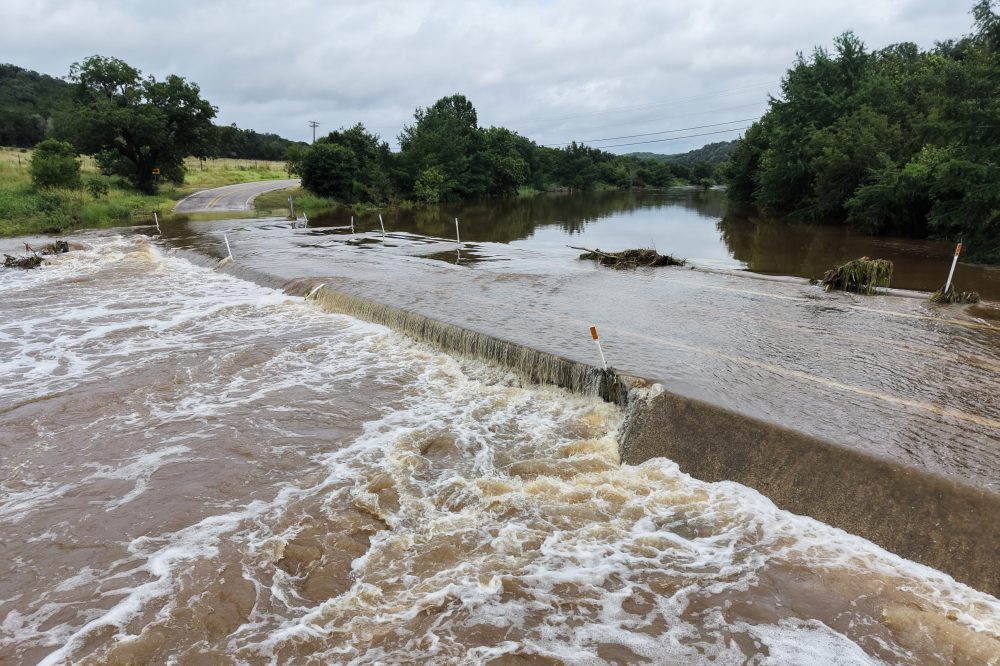

Parts of Texas remained in the crosshairs of dangerous flash flooding Friday, even as some of the hardest-hit communities began cleaning up after days of relentless rainfall that has been blamed for two deaths.
In the early morning hours, the National Weather Service declared a flash flood emergency for Sonora, a city in Sutton County located roughly 170 miles northwest of San Antonio. Local authorities used a boat to pull one person to safety, and officials were urging — though not requiring — residents in low-lying areas near the Dry Devils River to leave their homes as heavy rain continued to fall.
Chief Deputy Jon Gann described the dire situation along the riverbanks. “The water’s up to the top of the banks,” he said. “If we get any more, we’re going to be into homes.”
Flash flood warnings were also issued for multiple counties across the Texas Hill Country — a region still recovering from devastating floods just one year ago. Flood warnings were expected to remain in effect through the weekend in many downstream areas, and some rivers were forecast to hit historic levels, even as rainfall began to ease in some spots Friday.
Since the storms kicked off Tuesday, some areas west of San Antonio have received two feet of rain or more. Gov. Gregg Abbott said rescuers using boats and helicopters have saved more than 200 people, including drivers stranded on flooded roads and families trapped inside their homes. At the peak of concern, approximately 6 million Texas residents were under a flood watch.
The storms claimed two lives. One victim was driving on a flooded road near Uvalde when the vehicle was swept away. The second fatality was 65-year-old John Mark Steward of Kerrville, whose mobile home was carried into Goat Creek on the Guadalupe River, according to his wife. The Guadalupe River gained tragic notoriety last year when flash flooding killed more than two dozen children and counselors at Camp Mystic.
Meteorologists said the slow-moving storm system was expected to drift in a northwesterly direction Friday, eventually heading toward the Big Bend region in far west Texas.
In Uvalde, one of the cities most severely impacted by the flooding, water levels were dropping and officials announced that Route 90, a major highway, had reopened after floodwaters had cut off most routes in and out of the city overnight Wednesday into Thursday.
For many residents, the crisis stirred painful memories of last summer’s catastrophic Hill Country floods, which killed more than 100 people over the July Fourth holiday weekend.
“It’s crazy happening two times in one year,” said Josiah Rodriguez, a Kerrville resident who woke up around 2 a.m. Thursday to the sound of heavy rain and drove through flooded streets to help evacuate family members.
Rodriguez noted a significant difference between this year’s flooding and last year’s disaster. “Last year there was no warning of it,” he said. “It just kind of happened overnight and it took everyone by surprise. This year, a lot more alerts have gone into place, a lot more safety measures.”
Many residents said they were blindsided in 2024 when the Guadalupe River surged without adequate warning, and some local officials faced criticism for their slow response.
So far this year, the Guadalupe has stayed below the record-breaking levels seen in 2025. Near Camp Mystic — which has not reopened since last year’s tragedy — the river near Hunt reached approximately 20.5 feet, a level high enough to cause flooding, according to data from the U.S. Geological Survey and the National Water Prediction Service.