
For Catholics who attend services at churches tied to the Society of St. Pius X, going to Sunday Mass has become an act laden with a weighty question: stay or leave?
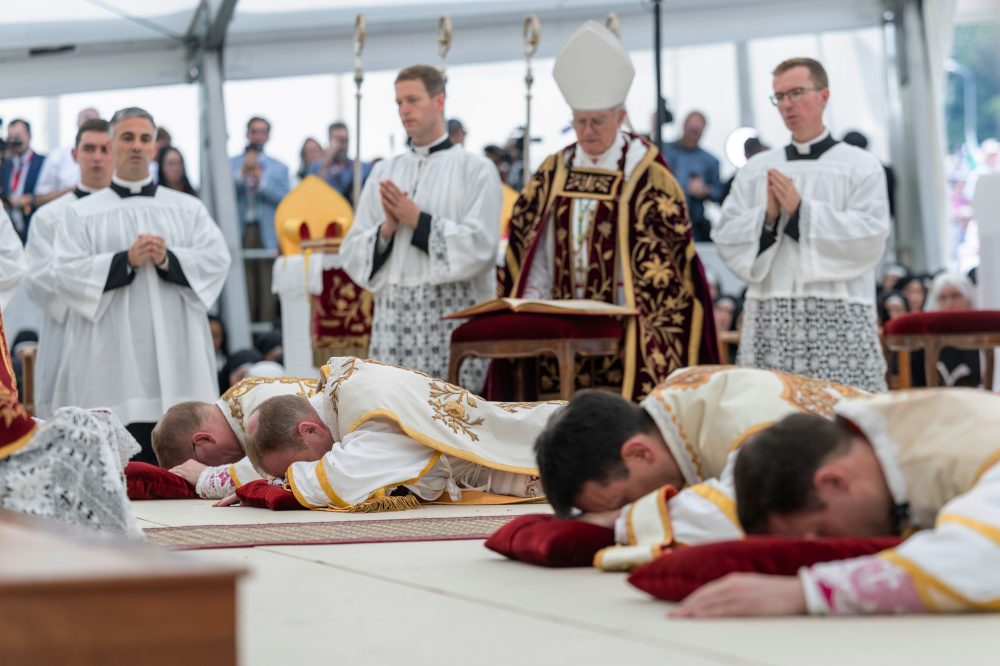
The Vatican declared on July 2 that the traditionalist breakaway group had committed one of Catholicism’s most serious offenses — ordaining new bishops without the pope’s blessing. As a result, the society’s clergy have been excommunicated, and Rome is now telling Catholics to stop attending the group’s worship services. Certain sacraments performed by the society’s priests have also been declared illicit and invalid by the Vatican’s doctrine office.
Despite the gravity of the sanctions, things inside the society’s churches have continued much as before. The traditional Latin Mass is still being celebrated, baptisms are being performed, and pilgrimages and camps are moving forward. Many of the faithful say they have no plans to walk away.
The crisis landed at a particularly challenging moment for Pope Leo XIV, who has made church unity a central theme of his pontificate. The American pope has made deliberate outreach efforts toward conservative and traditionalist Catholics — a group that felt increasingly marginalized during the papacy of Pope Francis.
Catholic bishops across the United States have been amplifying Rome’s message, encouraging the society’s members to reconnect with parishes that are in full communion with the Vatican.
San Antonio Archbishop Gustavo García-Siller addressed the situation directly in a letter to his archdiocese: “To embrace the unity called for by Christ is to remain attached to the vine and to be in communion with Pope Leo XIV and the hierarchy of the Catholic Church.”
Whether those appeals will resonate is another matter. R. Andrew Chesnut, who holds the Catholic Studies chair at Virginia Commonwealth University, said the outcome depends heavily on where individual worshippers feel their deepest sense of belonging.
“Longtime SSPX adherents often regard such statements through the lens of a decades-long conflict with Church authorities,” Chesnut said, “and are therefore less likely to be persuaded.”
The Society of St. Pius X was established in opposition to the sweeping changes brought about by the Second Vatican Council in the 1960s. That council transformed the church’s relationships with Jewish communities and other faiths, championed religious freedom, and permitted Mass to be held in local languages rather than Latin. The society views those changes as riddled with errors and heresies, and sees itself as the true protector of Catholic tradition.
Society leaders have defended the July 1 bishop consecrations as an act necessary for the salvation of souls, and they have challenged the legitimacy of the Vatican’s disciplinary response. The society has formally appealed the Vatican decree.
U.S. district spokesperson James Vogel said it is still too soon to measure the decree’s real-world impact. Masses and other activities, he noted, have not been suspended.
“I think a lot of people just continue to hold fast to what they’ve been doing,” Vogel said.
That reaction comes as no surprise to Mike Lewis, managing editor of Where Peter Is, a Catholic commentary website that has been supportive of both Pope Francis and Pope Leo.
“We’re talking about communities that have essentially been separate for 30 to 40 years. People’s families and social lives are wrapped up in this movement,” Lewis said.
For Jim De Piante, his connection to the Society of St. Pius X is deeply personal. His parents were instrumental in bringing the movement to North Carolina, and he is a member of a society-affiliated church near Charlotte — St. Anthony of Padua — which purchased land for a new campus the very week the excommunications were announced.
Rather than being shaken, De Piante said the excommunications make him want to embrace tradition even more firmly. “St. Anthony’s offers to me the traditional sacraments in the same faith that made every great saint throughout history,” he said, adding that he feels called to preserve that faith for those who come after him.
While De Piante remains confident, he acknowledges that others — particularly newer members — are troubled. He has noticed a modest dip in attendance at St. Anthony’s, which typically draws a few hundred worshippers on Sundays, and is aware of some families who are shaken and others who have decided not to return. De Piante attended the bishop consecrations in Switzerland and said he is optimistic about the society’s future.
The Vatican has made clear that the society’s faithful are not automatically excommunicated — but those who “formally adhere” to the group risk facing the church’s most severe penalties. Excommunication itself is considered a corrective rather than a permanent punishment; those excommunicated are not expelled from the church but are barred from participating in certain church activities.
Bishop Frank J. Caggiano of the Diocese of Bridgeport, Connecticut, has invited society members to come “home,” noting in a letter to his diocese that those who simply attended SSPX services to worship — without rejecting the pope’s authority — are not subject to excommunication. Even so, he cautioned that remaining loyal to the society “would be to share in a separation from the Successor of Peter.”
Ross McKnight is among those caught in the middle. He was drawn to the society during the COVID-19 pandemic, and he and his family have grown close to the traditionalist community at an SSPX church in Lacombe, Louisiana. He believes many people like him are experiencing a genuine “crisis of conscience.”
“We don’t want to abandon them in their dark hour,” McKnight said. “At the same time, that’s not our first duty. The first duty isn’t to any particular person and/or group of priests. So I think that’s the source of the conflict.”
Archbishop García-Siller in Texas has gone further than most, instructing Catholics not to attend the society’s local affiliate and announcing he will no longer permit SSPX priests to perform weddings or minister within his archdiocese.
Yet livestreamed services show that church life at society parishes continues uninterrupted. On the first Sunday following the excommunications, one society priest ran through routine parish announcements — building upkeep, a special collection, an upcoming baptism — before telling his congregation there was no reason to change course.
The Rev. Stephen Zigrang, who declined to be interviewed by the Associated Press, addressed the awkward social dynamics his parishioners might face: “The problem is, of course, family, friends. They’ll look at us crooked. But just smile, right? Say, ‘We like the old Mass. … You ought to come and try it.’”