
ANGRA DOS REIS, Brazil — A fishing community living along Brazil’s southeastern Ilha Grande bay once viewed the blacktip sharks gliding through its clear, emerald waters as a potential meal. That attitude has been changing, largely because scientists discovered that a nearby cove is regularly visited by dozens of pregnant blacktip sharks — a finding that has launched a dedicated effort to protect the area.
Brazil ranks as the world’s largest consumer of shark meat, according to recent studies. Despite that demand, sharks are among the most endangered groups of vertebrates on the planet. The International Union for Conservation of Nature reports that more than one-third of all shark species face extinction risk due to overfishing, deteriorating habitats, and climate change.
Brazil’s extensive coastline is home to a wide variety of shark species and contains critical habitat for many threatened populations, making conservation there a significant piece of the global ocean protection puzzle.
Central to those conservation efforts is locating and safeguarding nursery areas like the one found in Piraquara de Fora cove, according to experts involved in the Brazilian Institute for Nature Conservation’s Sharks of Ilha Grande Bay project.
“We used to fish and eat them,” said Marlene Fernanda do Nascimento Martins, a 35-year-old community leader. Conservationists “explained that we shouldn’t do that anymore because of the animals themselves and the need to protect them.”
Sharks reproduce at a slow pace, producing far fewer young than many other fish species, which makes them especially vulnerable to population decline.
“Breeding areas are fundamental to ensuring the species survives throughout this Atlantic ecoregion,” said Leonardo Mitrano Neves, who leads the scientific side of the project.
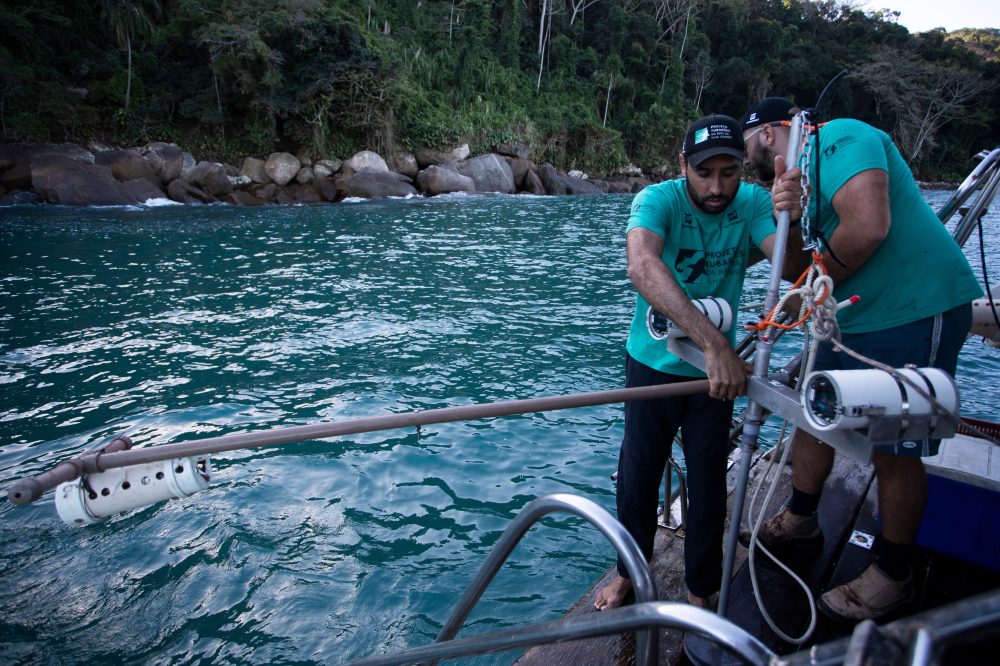
During a recent weekday outing, Mitrano Neves and his team dropped camera-equipped monitoring devices into various sections of the cove, letting them sit underwater for an hour alongside bait to draw the sharks in. Drone footage is also being collected. All of that material is later analyzed in a lab, generating data that researchers use to make the case for stronger conservation measures.
While blacktip sharks are the most frequently seen species in the area, the project also keeps a close eye on sand tiger sharks and hammerhead sharks.
The initiative plans to bring environmental education into local schools so that younger generations begin to view sharks as part of the region’s natural heritage rather than as a food source. Public outreach materials also stress that the sharks pose no danger to people and that no shark-related incidents have been recorded in the area.
Brazilian law bans the targeted hunting of sharks, but non-protected species can still be brought ashore when caught unintentionally as bycatch. Threatened species, however, must be released if accidentally caught and cannot be sold commercially. Identification of shark meat at the market level is often unreliable, with the product frequently listed under the general term “cação.”
José Truda Palazzo, the project’s coordinator in Ilha Grande bay, said their outreach to local communities about avoiding shark meat is beginning to make a difference. At community meetings, project representatives discussed the sharks’ vital role in the ocean’s ecosystem and the health dangers tied to eating shark meat.
Research shows that sharks, as apex predators at the top of the food chain, build up high concentrations of heavy metals — including arsenic, mercury, and lead — in their blood and body tissue. A 2024 study also revealed that some Brazilian sharpnose sharks tested positive for cocaine.
“We hope that more and more people come to understand that cação is shark, and shark meat is toxic, in addition to the fact that sharks are endangered animals,” Palazzo said.
On clear days, local residents can sometimes spot the sharks from the low-lying, forested mountains overlooking the sand-colored rocks at the water’s edge. Palazzo noted that over time, watching the sharks — whether from shore, a boat, or underwater — could grow into a new income stream for the community through ecotourism.
Nascimento Martins, who fishes and sells ice on the beach to help support herself and her three children, said ecotourism would be a meaningful boost for the area. “We’re a remote community with very limited resources. So anything that comes along that can help us preserve our village is a good thing,” she said.
Fellow community member Reinaldo Dias da Rocha said his father had already taught him not to hunt sharks, but the project deepened his understanding of why protecting them matters. “We pass the information on to our nephews, to tourists who come to discover this place and enjoy our beautiful beaches, and further labor the point that what we call cação isn’t to be eaten,” he said.