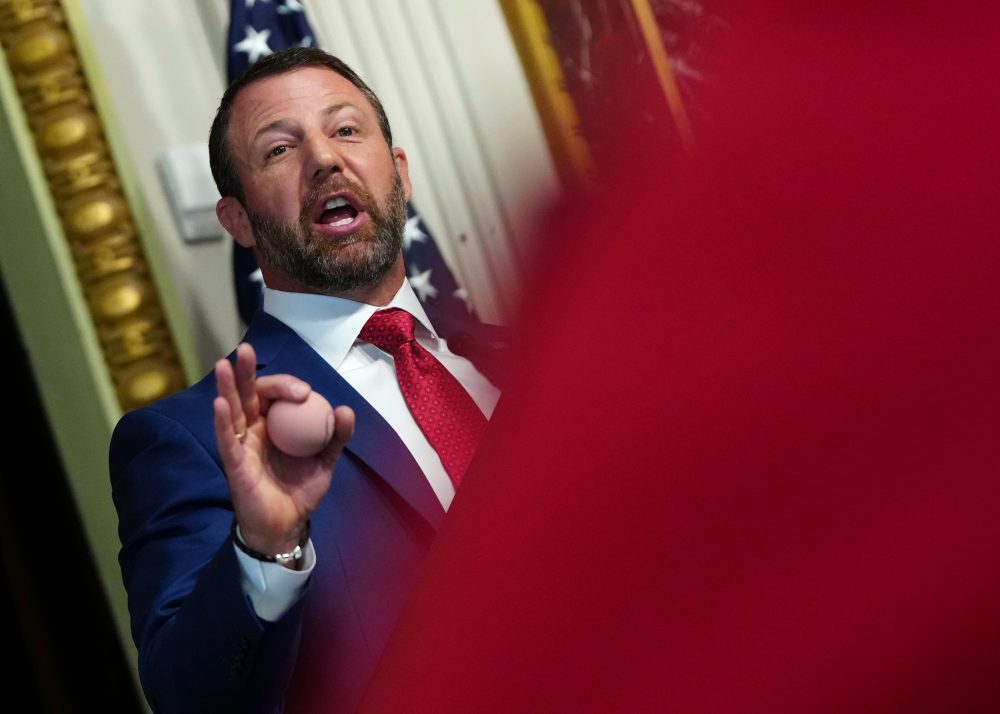

WASHINGTON (AP) — Homeland Security Secretary Markwayne Mullin stepped before cameras at the White House Friday to deliver a stark warning: state officials who refuse to cooperate with President Trump’s election security agenda could face funding cuts, penalties, or even criminal investigations.
The warning came just one day after Trump addressed the nation in primetime on the subject, and arrives only months before midterm elections that will determine which party controls Congress.
Legal and election experts, however, say the threats are largely toothless. Courts have repeatedly blocked the administration’s voting-related initiatives, and the U.S. Constitution explicitly grants states the authority to manage their own elections.
Still, Mullin’s statements — delivered from the White House complex — could further erode public confidence in election systems and create complications for states as they gear up for November.
“We absolutely can build confidence in the American people, but the states have to do their part,” Mullin said.
Trump has continued to falsely assert that Democrat Joe Biden won the 2020 presidential election through fraud, despite judges and his own attorney general during his first term determining the election was legitimate. Since returning to the White House last year, Trump has sought to use federal power to challenge that outcome.
Mullin claimed Trump was not trying to relitigate 2020, “although he definitely could at this point,” adding: “This is just about exposing what took place and making sure it never happens again.”
During Friday’s remarks, Mullin repeated an unverified claim Trump made the night before — that the federal government had identified 250,000 noncitizen voters on the rolls across California, Nevada, New Jersey, and Pennsylvania. He said the Department of Homeland Security used publicly available data to reach that conclusion. Election experts, however, say public data lacks the precision and currency needed to accurately determine whether a registered voter is a noncitizen.
Election officials in California and Pennsylvania said they would look into the administration’s findings, while pointing out that they already conduct their own voter list maintenance and that noncitizen voting is extremely uncommon — a conclusion supported by research.
California Gov. Gavin Newsom, a Democrat, fired back on social media: “California has free, fair, and secure elections and we will fight for them. Try us.”
In Nevada, Secretary of State Cisco Aguilar, also a Democrat, expressed confidence in his state’s voter records. “We are constantly looking at the information to figure out how many registered voters in Nevada don’t have a Social Security number on file,” he said. “We have done significant work to make sure our voter rolls are as clean as possible.”
Mullin also vowed to closely monitor public voter lists to pursue fraud cases both before and after the 2026 election. “If you are an illegal or you are voting illegally, we will hunt you down, we will find you and we will prosecute you,” he said.
He called on states to participate in DHS’s recently revamped SAVE program — a federal database tool at the center of the administration’s push to nationalize election oversight. At least 25 states have used the program to check their voter rolls since April 2025, following significant expansions to its capabilities under the Trump administration. The administration has demanded that states submit sensitive voter data to the program for a full audit.
Mullin warned that state officials who refuse to participate could face fines, penalties, or imprisonment.
However, a federal judge recently blocked the updated version of the SAVE program, citing concerns about voter privacy and the risk of wrongly removing eligible voters from the rolls. The case included instances where the program incorrectly flagged legitimate voter registrations.
David Becker, executive director of the nonprofit Center for Election Innovation and Research, called Mullin’s threats baseless. “Every court to consider the DOJ’s demands — 15 of them to date, six of those judges appointed by President Trump — have confirmed that the federal government cannot legally demand access to states’ sensitive voter data,” he said. “What he’s suggesting is illegal.”
Meanwhile, Trump’s push to pass the SAVE Act — federal legislation that would require proof of citizenship to register to vote — has stalled in the Senate. Republicans do not have the votes needed to bypass filibuster rules and pass the bill without Democratic support.
Mullin also amplified Trump’s concerns about potential vulnerabilities in electronic voting machines, a topic voting security experts have long acknowledged. While Trump suggested Thursday that these weaknesses make it possible to “rig” elections, officials say extensive safeguards exist, including physical security measures, pre-election machine testing, post-election reviews, and paper ballot backups used across most of the country.
To address those concerns, Mullin said the nation’s Cybersecurity and Infrastructure Security Agency — which operates under DHS — would release an updated election infrastructure plan within 30 days and offer cyber threat resources to states that participate in SAVE.
Critics noted the irony: Trump has significantly scaled back CISA’s election security work. The agency was largely sidelined during last year’s elections after the administration reviewed its election-related activities, placed more than a dozen election-focused employees on administrative leave, and cut $10 million from two cybersecurity programs — including one specifically designed to assist state and local election officials. CISA also remains without a Senate-confirmed director and has gone through multiple acting leaders.
Nevada’s Aguilar said his state has had to step up to fill the void left by the federal government. “The fact that they think they’re going to come in prior to the general election in November and provide us infrastructure, that’s nuts,” he said. “Actions speak louder than words, and in their case, it’s all been talk.”