At first glance, the women sprinting across the soccer field in the eastern Bolivian city of Santa Cruz on Friday looked like any other squad gearing up for a major tournament. Look closer, though, and you’d notice goalkeepers making saves with just one arm and field players using crutches to race down the pitch.
This was no ordinary training session. It marked the first-ever soccer training camp in South America designed specifically for female amputees with aspirations of competing at the international level. Close to three dozen women representing 10 nations — among them Argentina, Bolivia, Brazil, Ecuador, and Colombia — gathered in Santa Cruz for five days of intensive preparation, wrapping up Friday with a round of friendly matches. The majority of the participants lost their limbs due to infections or traumatic injuries.
The sport operates under a unique set of rules. In this seven-a-side format, all artificial limbs must come off before the opening whistle. Athletes use crutches to move around the field but are not permitted to make contact with the ball using them. The camp was put together by the World Amputee Football Federation — the organization that oversees global competition — along with local government officials and nonprofit groups. Top-level players, including members of the U.S. Women’s National Amputee Soccer Team, served as coaches throughout the week.
“The life of amputees can sometimes be hard, but we adapt really fast,” said Amie Donathan, 21, a member of the U.S. squad who was born with one leg. “The way I feel about this camp, honestly, can’t be described.”
The training sessions covered a wide range of skills — from balance, coordination, and movement on crutches to ball control, game strategy, and the specific rules that govern amputee soccer. All of this unfolded as global attention remained fixed on the final week of the 2026 FIFA World Cup.
Men have been competing in international amputee soccer since the 1980s and now play in a World Cup held every four years. The sport has steadily expanded its reach, especially in regions affected by conflict, such as Gaza and Rwanda. The women’s side of the game, however, is much newer — the inaugural Women’s Amputee Football World Cup was held only in 2024, with Colombia winning the first-ever title. The next edition is set for Poland in 2027, though a specific date and host city have not yet been announced, according to camp organizers.
“It’s so that women with amputations can realize their dream through sports, through soccer,” said Lidia Mayser, president of the sports council for the Santa Cruz region, which is working toward establishing a national federation and fielding a team to represent Bolivia at next year’s tournament.
For Filomena Luna, the week of training opened a door she never expected to walk through. The mother of six lost her leg at age 11 after an infection escalated when her parents first turned to a traditional healer rather than seeking medical care. Now 50 years old, she carries hopes of one day wearing Bolivia’s colors on the world stage.
“This practicing and training has helped me improve tremendously,” she said. “Soccer is an escape for me.”
A federal prosecutor in Texas stepped forward Thursday evening with fresh details about the circumstances leading up to the fatal shooting of a Mexican national by an immigration officer earlier this month — and those details appear to conflict with the government’s initial account of what happened.
Lorenzo Salgado Araujo, 52, was shot and killed by a U.S. Immigration and Customs Enforcement officer on July 7 while he was on his way to a construction job site in Houston with three coworkers, including his own brother. The shooting ignited protests across the city, with Salgado Araujo’s family demanding answers. They describe him as a dedicated father who had been living in the United States for 35 years and was close to securing legal status.
The incident occurred just days before two other men in Florida and Maine died during immigration enforcement operations under President Donald Trump’s crackdown on undocumented immigration, drawing increased attention to the tactics used by the Department of Homeland Security.
Aaron Reitz, the U.S. attorney for the Southern District of Texas, revealed Thursday for the first time that ICE officers had actually been looking for two Guatemalan men who were potentially facing deportation. Those men were reportedly driving a van similar to the one Salgado Araujo was in when he was killed. An earlier statement from DHS, released the same day as the shooting, had indicated that Salgado Araujo himself was the target of the immigration operation and was in the country without legal authorization.
Reitz stated that the officers believed Salgado Araujo and his passengers matched the description of the Guatemalan men they were attempting to locate.
According to Reitz, four officers in two separate law enforcement vehicles first tried to pull over Salgado Araujo’s van using their emergency lights. Salgado Araujo responded by making a U-turn and driving over a median to avoid being stopped.
Later that same morning, officers encountered the van a second time and moved to surround it. Two of the four agents exited their vehicles and ordered Salgado Araujo to put the van in park. Just moments before the fatal shot was fired, one of the agents was described as being “partially inside the van or immediately next to it” when Salgado Araujo attempted to reverse and then move forward again, Reitz said.
The Department of Homeland Security’s original statement accused Salgado Araujo of using his vehicle as a weapon, saying he rammed it into a law enforcement vehicle and that an officer fired in self-defense. However, the new statement from the U.S. attorney’s office made no mention of any collision between the van and a law enforcement vehicle, and did not explicitly state that the officer believed his life was in danger. No injuries among the officers have been reported.
The latest statement also did not identify the officer who fired the fatal shot, nor did it clarify whether that officer was the same person who was standing beside or partially inside the van at the time.
Reitz added that officers reported seeing “several small bags of a white, crystal-like substance inside the van” in plain view, and that the FBI later carried out a search warrant to investigate whether the substance was illegal. Salgado Araujo’s brother, who was present in the van during the shooting, has remained in ICE custody since the incident. His attorney has said the white substance was actually a salt mixture the men used as electrolytes to stay hydrated while performing strenuous outdoor labor in the intense Texas heat.
Unlike other high-profile deaths involving federal immigration officers, very few photos or videos from the scene of the Houston shooting have surfaced on social media.
SAO PAULO — A Brazilian Supreme Court justice issued a ruling Friday placing a 30-day ban on visits to former President Jair Bolsonaro, who is currently confined to house arrest, permitting only medical staff and legal counsel to see him.
Justice Alexandre de Moraes determined that a social media post made by Senator Flavio Bolsonaro — the former president’s son and a candidate in October’s presidential race — had broken the terms of his father’s house arrest conditions.
The younger Bolsonaro shared a letter over the weekend, written by his father, in which the elder Bolsonaro urged supporters to move past any internal disagreements. In the letter, Jair Bolsonaro wrote that it was time “to set aside any differences, and have everyone commit to supporting” his son’s bid for the presidency.
Jair Bolsonaro was sentenced last year to more than 27 years behind bars after being convicted of plotting to overthrow the government following his loss to Luiz Inacio Lula da Silva in the 2022 presidential election. Under the terms of his humanitarian house arrest, which was granted this year due to health concerns, he is prohibited from using social media or a telephone, either directly or through other people acting on his behalf.
A legal representative for the former president had not responded to requests for comment at the time of the ruling.
Earlier in the week, Justice Moraes had already moved to block Senator Bolsonaro from visiting his father for a period of 90 days, also stemming from the letter incident. The senator described that earlier decision as an “attempt to interfere in the elections.”
Friday’s ruling went further, additionally prohibiting the former president from receiving any visits “with a political-electoral finality” through the conclusion of the elections, and barring him from issuing “political-electoral remarks” — including statements made through third parties on his behalf.
The U.S. Justice Department has served subpoenas on 14 major law firms, demanding records and sworn depositions as part of a growing legal clash between the Trump administration and the country’s largest attorney membership organization, according to court documents filed Friday in Washington federal court.
The subpoenas, which were disclosed publicly through the court filing, require the firms to turn over communications tied to White House executive orders that either targeted those firms or prompted them to reach agreements with President Donald Trump to sidestep his directives. The records sought include any communications involving Boris Epshteyn, a longtime Trump adviser, dating back to the beginning of the president’s second term.
Investigators are also asking the firms to provide any communications they may have had with the American Bar Association specifically regarding Epshteyn. It remains unclear at this point whether any of the firms plan to legally challenge the subpoenas.
The Justice Department revealed the subpoenas in the context of a lawsuit filed by the ABA, which contends that the Trump administration has been unlawfully targeting law firms because of their past legal representation, internal diversity programs, and political associations. The ABA argues the policy harms its members.
In its court filing, the DOJ urged U.S. District Judge Amir Ali to deny the ABA’s request for similar documents directly from the White House. The department argued the ABA should instead be required to “seek this information from its own members, or the law firms at issue, rather than going directly to the White House.”
The DOJ stated in its filing that its subpoenas to the law firms are intended to “obtain the documents that Plaintiff has requested.”
Representatives for the ABA, the DOJ, and the Trump White House all declined to offer immediate comment. Spokespersons for the law firms named in the subpoenas also did not respond to requests for comment.
The ABA’s lawsuit is drawing new attention to the administration’s broader effort against high-profile law firms, and it could place firms that previously settled with the administration in a difficult spot as both sides battle over potential evidence in the case.
Four law firms that took legal action against the administration last year successfully obtained permanent court orders blocking the executive orders that had targeted them. The administration’s appeal of those rulings remains pending before the U.S. Court of Appeals for the District of Columbia Circuit, which heard oral arguments in May.
The state of Utah has pulled the operating license from the boarding school where media personality Paris Hilton says she suffered abuse as a teenager, state officials announced Friday — a significant win in her years-long push to overhaul what is widely referred to as the troubled teen industry.
The Utah Department of Health and Human Services cited numerous violations recorded in 2026 against the Provo Canyon School’s Provo campus. Among those violations were failures to shield students from potential harm or acts of violence, as well as the use of what officials described as cruel and unnecessary practices on children. More than a dozen separate citations were listed in Friday’s announcement.
“No child should be hurt in a program that is meant to protect them; particularly programs that require the authorization of the state to operate,” said Shannon Thoman-Black, director of the division of licensing and background checks at the health and human services department.
This latest action follows a separate license revocation earlier this month targeting the school’s other Utah campus, with state officials saying that facility had “failed to provide applicable health and safety services for clients.”
The Provo campus, which the school describes on its website as a psychiatric residential treatment facility serving youth between the ages of 12 and 18, has until August 15 to cease operations there. In the meantime, state officials say they will inspect the facility at least once per week.
Hilton, who spent close to a year at the school during the late 1990s, responded to the news with an emotional statement, saying she finally feels a sense of “peace.”
“This horrific chapter of abuse, neglect, and trauma has finally come to an end,” she said.
The school has 15 days from the announcement to request a formal hearing with the department.
Staci Bradley, the school’s director of business development, pushed back on the state’s move, saying the school disagrees with the decision and is “carefully reviewing all available legal and administrative avenues, including the appeals process.”
Hilton has alleged that staff members at the school beat her, watched her shower, gave her unidentified pills, and placed her in solitary confinement without clothing.
“Today means no child will ever have to endure what we did at Provo Canyon School again,” she said.
Hilton has taken her story to Congress and to state legislatures across the country, and her advocacy has contributed to the passage of laws protecting teens in Utah and 15 other states. Utah has historically been a major hub of the troubled teen industry, a network of private, for-profit residential programs for children with behavioral challenges.
In June, Hilton visited the Provo Canyon School to stand alongside two families who filed lawsuits claiming their children were mistreated at the facility.
The school is now under different ownership, and its administration has stated it is unable to address anything that occurred prior to the ownership change, including the period when Hilton attended.
The U.S. Interior Department announced Friday that it is eliminating a rule that had automatically extended protections to plants and animals classified as threatened with extinction — marking another significant rollback of the landmark Endangered Species Act under President Donald Trump’s administration, largely at the urging of industry groups.
Under the new approach, species placed on the threatened list will no longer receive blanket safeguards. Instead, each will require its own individualized protection plan — a process that could take considerable time and during which energy companies and developers could seek exemptions for oil and gas drilling, mining, and other activities in areas where those species are found.
Environmental advocates warned the change puts vulnerable wildlife at greater risk of disappearing entirely, pointing to species such as monarch butterflies and alligator snapping turtles that are currently awaiting federal protections.
Interior Secretary Doug Burgum defended the decision, saying the Endangered Species Act had been misused for too long “to stop almost any new project in America, driving up costs for families, weakening our competitiveness, and undermining our national security.”
Burgum also stated that “success should be measured by species recovery and delisting, not by adding more species to the list.”
A second rule change finalized the same day will require government officials to weigh economic consequences when determining whether a particular area qualifies as critical habitat for a species. Opponents argue this gives corporations undue influence over decisions that could allow development in sensitive wildlife areas.
Noah Greenwald of the environmental organization Center for Biological Diversity warned of the consequences: “If you’re exempting certain industries that cause habitat destruction, in many instances you’ll be exempting the main threat to those species.”
Similar policy changes were made during Trump’s first term in office but were later reversed when the Biden administration came to power.
The automatic protection rules being eliminated date back decades — wildlife received those blanket protections starting in 1975, with plants added to the coverage in 1977.
Two organizations, the Rocky Mountain Elk Foundation and the Property and Environment Research Center, filed a lawsuit against the Biden administration in 2024 after blanket protections were restored. They argued the rule unfairly burdened landowners even when a species improved from the more severe “endangered” classification to the lesser “threatened” status.
Jonathan Wood, vice president at the Montana-based research center, said the old rule removed incentives for landowners to help with species recovery. He said the Trump administration’s new framework allows officials to “better reward progress and encourage proactive conservation.”
No new species have been added to the endangered or threatened lists during Trump’s current term. In contrast, more than 20 species were added during his first term, and roughly 60 were added under the Biden administration.
Approximately 30 species are currently proposed for threatened status, including California spotted owls, monarch butterflies, alligator snapping turtles, and various snakes, fish, clams, and insects.
The pace and scope of changes to endangered species policy have moved more rapidly in Trump’s second term than in his first. In March, the administration exempted oil and gas drilling in the Gulf of Mexico from the Endangered Species Act, citing concerns raised by Defense Secretary Pete Hegseth that environmental lawsuits were threatening domestic energy production.
Last week, Interior officials significantly narrowed the legal definition of what constitutes “harm” to a species, a change that would allow development in critical wildlife habitat as long as animals are not directly killed or injured in the process.
Earlier this week, officials also dramatically reduced the amount of Rocky Mountain habitat federally designated as critical for Canada lynx, forest-dwelling wildcats facing threats from climate change and other pressures.
Also this week, Burgum announced during a visit to Montana that the U.S. Fish and Wildlife Service would transfer greater management authority over grizzly bears to the states where they reside — a longstanding goal for the Republican governors of Wyoming, Idaho, and Montana.
The Endangered Species Act is widely credited with rescuing iconic American species, including the bald eagle and the American alligator, from the edge of extinction.
Burgum noted Friday that 97% of species that have received protections under the law still retain them — a statistic that has frustrated Republican lawmakers who argue that recovered species should be removed from the protected lists more quickly.
The Delaware State Police Sex Offender Apprehension and Registration Unit, known as SOAR, has released public notifications regarding both wanted and homeless registered sex offenders in the state.
Wanted Sex Offenders
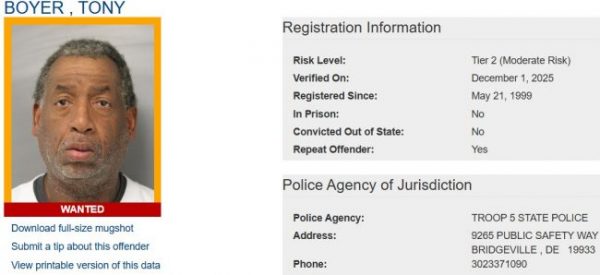
SOAR is actively searching for the following sex offenders who have failed to register or update their address as required by law: Tony Boyer, Gene Dukes, Charles Fulton, Christopher Gartner-Hunter, Daniel Kirlin, Michael Viscount, Spencer Wright, and Randy Crum.
Anyone with information about the whereabouts of these individuals is urged to call SOAR at (302) 739-5882. Tips can also be submitted anonymously through Delaware Crime Stoppers at (800) 847-3333. Please note that these individuals represent only a portion of the total wanted sex offenders in Delaware. A complete list is available on the Delaware Sex Offender Registry website.
Homeless Sex Offenders
SOAR has also issued notifications for the following sex offenders who have recently been reported as having no fixed address: James Barrineau, Lawrence Blain, Julius Brown, Willis Grayson, Shemar McAllister, and Jordan Taylor.
These individuals are not currently wanted for failing to register, but state police want the public to be aware of their homeless status. If anyone has information suggesting that any of these individuals are living at a residence, please contact SOAR at (302) 739-5882 or reach out to Delaware Crime Stoppers at (800) 847-3333. A full list of homeless sex offenders can be found on the Delaware Sex Offender Registry website.
Syria’s Interior Ministry announced Tuesday that its security forces had intercepted an alleged weapons smuggling operation aimed at moving advanced armaments through Syrian territory to Hezbollah — and in doing so, publicly branded the Lebanese group a “terrorist militia,” a characterization analysts say marks a striking change in the new government’s official stance.
According to the ministry, specialized security units stopped a suspicious vehicle near the Syrian-Iraqi border and found a cache of long-range missiles, guided anti-tank missiles, and drones hidden inside. Preliminary findings suggest the shipment was intended to pass through Syria on its way to Lebanon for Hezbollah, and officials say the investigation is continuing to identify those responsible and dismantle the network behind it.
A Syrian Interior Ministry source told The Media Line that the seizure was “an exceptional and highly significant operation,” and said Damascus would share all evidence with Iraqi authorities as part of a coordinated effort to pursue everyone connected to the alleged smuggling ring.
“The investigation treats this as a cross-border network rather than an isolated incident,” the source said, adding that coordination with Baghdad would focus on tracing the shipment’s route and identifying all parties involved.
New details obtained by The Media Line from Mazen Alloush, director of public relations at Syria’s General Authority for Land and Sea Border Crossings, revealed that the weapons were concealed inside an oil tanker that was officially registered as carrying black fuel oil. Iraqi customs officials had sealed the tanker after processing it as a routine fuel delivery and attached instructions prohibiting inspectors from opening it until it reached its final destination.
The tanker had left Iraq roughly nine days earlier after completing all required customs procedures, joining convoys moving Iraqi fuel to Syria’s Baniyas refinery through the al-Tanf border crossing under an existing oil transport agreement between the two nations.
Alloush explained that the weapons were carefully wrapped in insulating materials and submerged beneath the black fuel oil, making them nearly impossible for police dogs to detect. He said the limited availability of specialized scanning equipment for liquid tankers allowed the vehicle to pass through multiple checkpoints before being discovered on the Syrian side of the border.
“This was a sophisticated concealment operation designed to evade customs inspections,” Alloush said.
The al-Tanf crossing has long been considered one of the most sensitive points along the Syria-Iraq border, having served for years as a corridor exploited by smuggling networks during Syria’s civil war. Syrian authorities say border security has been substantially tightened since the country’s new administration came to power.
The Interior Ministry pledged that Syrian territory would not be used as a transit route for weapons trafficking or any activity threatening Syria or neighboring countries, calling border protection and national sovereignty a top priority.
Hezbollah pushed back against the allegations, dismissing them as “fabricated claims with no basis in fact” designed to damage the group’s reputation.
Iraq responded by announcing the formation of a high-level investigative committee made up of security and technical officials. In a statement, Iraq’s Security Media Cell said the committee would work with Syrian authorities to determine the full circumstances of the case and hold any negligent parties accountable “to safeguard the security and stability of the shared border and prevent any attempts to undermine national security.”
The development comes as Baghdad and Damascus work to strengthen security cooperation along their approximately 600-kilometer (370-mile) shared border — a stretch long exploited by smuggling networks during years of conflict and weakened government control.
For many observers, the most significant element of this episode goes beyond the weapons seizure itself. Daoud al-Sayed, a Syrian researcher specializing in political science and international relations, said the Interior Ministry’s decision to publicly call Hezbollah a “terrorist militia” represents a major departure from the language used under former President Bashar Assad, when the Lebanese group was considered one of Damascus’s closest military partners.
Last month, President Trump said he spoke with al-Sharaa at the G-7 conference, and that the two leaders discussed the possibility of Syria playing an active role in countering Hezbollah.
“The new Syrian administration has consistently emphasized that relations with Lebanon should be conducted through state institutions rather than armed groups,” al-Sayed told The Media Line. “The ministry’s statement reflects that policy.”
He argued that the alleged smuggling operation pushed Damascus to publicly define its position toward Hezbollah more explicitly than at any point since the new government took office. “If this rhetoric is followed by additional security and political measures,” he said, “it could signal a broader restructuring of Syria’s policy toward non-state armed groups and a new framework governing relations with Lebanon and border security.”
Hezbollah had openly entered the Syrian conflict in 2013, deploying thousands of fighters in support of Assad’s government across multiple fronts. Since the fall of that government and the rise of Syria’s new administration, officials have repeatedly stated that all weapons inside the country must fall exclusively under state authority.
Analysts say the Interior Ministry’s decision to officially label Hezbollah a “terrorist militia” signals a notable shift in Syria’s public posture, suggesting Damascus may be redefining its security and political relationship with the group. The weapons seizure is also part of a broader campaign by Syria’s new leadership to crack down on arms and narcotics trafficking networks that took root along the country’s borders during years of conflict.
Whether the joint Syrian-Iraqi investigation will ultimately expose a wider regional network remains to be seen. But the inquiry is expected to determine not only who organized the alleged shipment, but whether additional actors were involved in moving weapons across one of the region’s most sensitive borders — and for Syria’s new leadership, the outcome could serve as an early test of its commitment to reassert state authority and keep Syrian territory free from regional weapons trafficking.
US Central Command conducted a new round of military operations overnight into Friday, hitting military and transportation infrastructure in Iran’s Hormozgan province as Tehran simultaneously expanded its attacks against neighboring countries that host American military installations.
The American military used fighter jets, drones, and warships to strike a range of targets, including military logistics facilities, air defense positions, coastal surveillance sites, and infrastructure connected to access routes leading into the port of Bandar Abbas. The operation also took out six bridges and a railway station in what appeared to be a coordinated effort to cut off supply lines into the strategically important southern port city.
According to Iranian state media, the strikes resulted in at least eight deaths and left 20 others injured in Hormozgan province.
While those US operations were underway, Iran launched attacks targeting Qatar, Bahrain, Kuwait, and Jordan — four countries that all host American military facilities.
Qatar’s Defense Ministry announced Friday morning that it was responding to a second aerial attack within the same day. Earlier, Qatar’s Interior Ministry had reported that a child was injured by falling shrapnel from a previous wave of strikes. Iran had not attacked Qatar in the days leading up to Friday, and Tehran has not claimed responsibility for Friday morning’s strikes on the country.
Bahrain sounded warning sirens for a second time Friday morning, according to its Interior Ministry. Iran’s state news agency IRNA reported that Iranian forces had targeted US military assets inside Bahrain, and state broadcaster IRIB released video it claimed showed drones being launched in Bahrain’s direction. CNN reported that it had reached out to US Central Command for a response.
Kuwaiti officials issued early Friday morning warnings to residents, alerting them that missile and drone threats could produce sounds from air defense interception systems. Iranian state media reported that the Islamic Revolutionary Guard Corps, known as the IRGC, claimed to have targeted US military equipment in Kuwait.
Jordan’s military said it intercepted three Iranian missiles on Friday, with no reported casualties or property damage. The IRGC separately claimed it had struck US fighter jets and aerial refueling aircraft in Jordan — a claim that CNN said it had not been able to independently confirm.
Iranian state media later reported that the IRGC had also targeted a US radar installation in Oman.
Pennsylvania Senator John Fetterman issued a stark warning Thursday, saying he would abandon the Democratic Party if it officially adopted a position opposing US aid to Israel — describing that scenario as a personal “red line.”
His remarks came in the wake of a House vote that struck down a measure to cut off American assistance to Israel. The proposal was rejected by nearly all Republicans and a slim majority of Democrats.
Speaking to NBC News, Fetterman made his position clear: “If they put that in our platform — no aid for Israel — and officially become the anti-Israel party, then yeah, that’s a red line for me. Democrats, we’ve always should support Israel. That’s our special ally, you know? In the only democracy in the entire region, that’s Israel. So I’m always proud to stand with Israel.”
The Pennsylvania senator went further, stating he could not remain in a party that formally turned its back on Israel. “It would be a problem for me if the Democratic Party officially says, ‘Israel is the problem, Israel doesn’t deserve to exist, and I’m never going to support aid, and I’m not going to call out Hamas and Hezbollah and Iran as terrorists, and they are the problem in the region,’” Fetterman said.
Fetterman stopped short of specifying what he would do next, declining to say whether he would join the Republican Party or serve as an independent if he did leave the Democrats.
A party switch would not be unprecedented. Senators Joe Manchin and Kyrsten Sinema both previously left the Democratic Party to become independents, though they continued caucusing with Democrats before eventually retiring at the end of their Senate terms.
The controversy stems from a House vote held Wednesday, in which 103 Democrats sided with an amendment introduced by Rep. Thomas Massie, R-Ky., that would have eliminated US aid to Israel. Republicans voted overwhelmingly against the measure.
The episode highlights a deepening divide within the Democratic Party on the issue of Israel. Younger members of the party have grown increasingly supportive of Palestinians over Israelis, and a recent Pew Research Center survey found that 71% of younger Democrats hold an unfavorable view of Israel.
Armenia and Azerbaijan are moving forward on economic cooperation, including the revival of Azerbaijani oil product shipments to Armenia, even as a disagreement over Armenia’s constitution continues to block the signing of a full peace agreement between the two countries.
Despite the lack of a formal treaty, trade and diplomatic contacts between the two nations have grown, with observers describing the current situation as a kind of “real peace” in practice. Still, negotiations on a binding accord remain at a standstill.
At the heart of the dispute is language in the preamble of Armenia’s constitution. That section references a Soviet-era declaration that called for the unification of Armenia and the Nagorno-Karabakh region. Azerbaijan views this wording as an indirect claim on its sovereign territory and has insisted the language must be removed before any peace treaty can be finalized.
Armenian Prime Minister Nikol Pashinyan has said he intends to put a new constitution before voters through a national referendum, which would strip out the contested language. However, the timeline for that vote is unclear, as his political party currently lacks the parliamentary majority needed to push the referendum forward without complications.
Even with the treaty stalled, relations between the two countries have continued to improve. Direct communication has increased, and economic ties have been restored, most notably through the resumption of Azerbaijani oil deliveries to Armenia following years of conflict between the two nations.
The roots of the dispute stretch back decades to the long-standing conflict over the mountainous territory of Nagorno-Karabakh. That conflict came to a decisive end in 2023 when Azerbaijan launched a swift military offensive that dismantled the ethnic Armenian breakaway region there, causing more than 100,000 residents to flee their homes.
While the growing trade relationship and expanding diplomatic engagement point toward eventual normalization, the constitutional question remains the central obstacle standing between Armenia and Azerbaijan and a comprehensive, formal peace agreement.
Israel’s parliament voted in the early hours of Thursday morning to dissolve itself, opening the door to new national elections scheduled for October 27. The vote came after lawmakers pushed through a series of significant bills on some of the country’s most contentious domestic issues before bringing the current legislative session to a close.
With parliament now disbanded, the existing government will continue to function in a limited caretaker capacity, handling only routine matters until a new administration takes shape following the elections.
Political parties are now turning their focus to the campaign ahead, working to finalize candidate lists, forge alliances, and launch efforts across the country to secure seats in the 120-member parliament.
In the final hours before dissolving, the Knesset passed a temporary law extending mandatory military service from 30 months to 32 months. The measure is designed to help the Israel Defense Forces keep pace with operational demands and ongoing security challenges.
At the same time, parliament approved separate measures that could expand military service exemptions for ultra-Orthodox Jewish men. One of those bills elevates Torah study to the status of a Basic Law in Israel, while another halts the arrest of haredi men who have avoided the draft.
Lawmakers also approved a measure permitting gender-segregated academic programs at the graduate level.
Rounding out the final legislative push, the Knesset passed changes to the country’s communications regulatory structure and approved a bill that would divide the duties currently held by the attorney general into separate roles.
Israel’s parliament, the Knesset, passed a wide-ranging broadcast media reform law on Thursday, approving the Communications (Broadcasting) Law, 5786-2026, by a vote of 53 to 48 in its second and third readings.
The new legislation replaces the existing regulatory framework with a system that gives the government a larger role in overseeing the broadcasting industry. Under the changes, longstanding rules requiring minimum journalistic standards, investment in original Israeli productions, and limits on cross-ownership have been removed. The government will also gain more control over how television audiences are measured and how state advertising dollars are distributed.
A centerpiece of the reform is the establishment of the Broadcast Communications Authority, a new independent statutory regulator designed to consolidate and ultimately replace Israel’s current broadcast oversight bodies. The authority will operate on an annual budget of 25 million shekels, funded through deductions from the budget of Israel’s public broadcasting corporation.
The law also creates a nine-member Broadcast Communications Regulatory Council, which will be responsible for setting policy for the new authority. Council members will be chosen through a nomination process overseen by a committee chaired by the director general of the Communications Ministry.
Shortly before passage, lawmakers approved a last-minute amendment that benefits Channel 14, a pro-government broadcaster. The amendment exempts Channel 14 from a new rule that would have required television broadcasters to provide certain programming to distribution platforms at no cost. That exemption is estimated to be worth approximately 40 million shekels — roughly $13.8 million — per year.
Prime Minister Benjamin Netanyahu took part in the parliamentary debate over the legislation but stepped aside and did not vote when the final tally was taken. Netanyahu is currently on trial in cases connected to his past dealings with media outlets.
Video game retailer GameStop disclosed in a late Friday regulatory filing that it has accumulated ownership of nearly 10% of e-commerce company eBay — a development that comes about three months after GameStop made an unsolicited bid to purchase eBay for approximately $56 billion.
According to the filing, GameStop now holds 43.4 million outstanding shares of eBay, representing a 9.8% ownership stake. That figure represents a substantial jump from early May, when GameStop CEO Ryan Cohen informed eBay’s board chairman that the company had built up “a 5% economic stake” through derivatives and beneficial ownership.
The filing revealed that GameStop purchased 3.5 million eBay shares last month for approximately $381 million. On Friday, the company also settled 39 million eBay shares stemming from put/call pairs.
Boeing is standing by its long-term prediction for strong worldwide demand for commercial aircraft, releasing a market outlook on Saturday ahead of the Farnborough Airshow in England that looks nearly identical to the one it issued last year.
The American aircraft manufacturer is projecting industry-wide global deliveries of 43,625 new commercial jets and cargo planes between 2026 and 2045. That breaks down to 33,545 single-aisle aircraft, 7,715 widebody jets, 930 factory-built freighters, and 1,435 regional aircraft.
The forecast puts Boeing at odds with its European competitor Airbus, which recently cut its own projection by 1% to 42,060 new planes, pointing to the Iran war and ongoing trade tensions as reasons for the reduction.
Boeing anticipates air passenger traffic will grow about 2.3% this year — less than half the 5.3% growth rate recorded last year. However, the company expects a rebound, with growth climbing to between 6% and 7% in 2027 and 5% to 6% in 2028.
Boeing Commercial Marketing Vice President Darren Hulst told reporters, “Our outlook is that passenger traffic globally will be where it would have been by the end of 2028.” He noted that the current slowdown is fundamentally different from the prolonged demand collapse caused by the COVID-19 pandemic.
Over the full 20-year period, Boeing projects passenger traffic will grow at an average annual rate of 4%, with cargo traffic increasing 3.7%, the global jet fleet expanding 3%, and the world economy growing 2.5%.
Hulst pointed out that demand for new aircraft continues to outpace what manufacturers are able to actually deliver. While passenger traffic last year bounced back to pre-pandemic levels, the number of new jets being delivered still hasn’t returned to 2018 output levels.
Boeing estimates there will be a shortfall of nearly 2,000 aircraft heading into 2026. The gap in single-aisle jets is not expected to close until around the end of this decade, while shortages in widebody aircraft could stretch into the early 2030s.
The company’s forecast assumes demand will be split roughly evenly between replacing aging aircraft and expanding existing fleets — with 21,475 deliveries going toward replacements and 22,150 supporting fleet growth. The global fleet is expected to nearly double, rising from around 28,000 aircraft in 2025 to 50,000 by 2045, with newer-generation planes growing from 32% of the fleet to 92%.
By region, China is expected to account for 21% of all deliveries, followed by Eurasia at 20%, North America and South/Southeast Asia at 19% each, the Middle East and Africa at 10%, Latin America at 6%, and Oceania/Northeast Asia at 5%.
The forecast reflects an industry still working through the effects of repeated disruptions, with manufacturing capacity and supply chain fragility continuing to limit output. Boeing also faces delays in getting regulatory certification for several key aircraft programs, including the 737 MAX 7 and 10 and the 777-9.
Hulst said the long-term case for air travel demand remains solid, driven by trade, tourism, migration, and the continued expansion of airline networks. “The reason why we travel and the reason why goods move isn’t changing,” he said.
Motorists traveling along Kirkwood Highway should plan for delays as lane closures are currently in effect in both directions.
The eastbound and westbound left lanes are shut down between Meadowood Drive and East Green Valley Circle. Drivers are advised to use caution and allow for extra travel time in the area.
The lane restrictions are expected to be lifted by 6 a.m. Travelers may want to consider alternate routes until the closure is cleared.
Newly filed court documents have exposed that immigration officials shared sensitive Medicaid data — data they were not authorized to possess — with the private data analytics firm Palantir.
The revelation surfaced as part of an ongoing federal court case in which Democratic states are challenging ICE’s access to Medicaid records, arguing the agency has been using that information to assist in deportation operations.
According to the court filings, Medicaid officials improperly handed over data on millions of individuals to ICE, which then passed that information along to Palantir, a data analytics company.
The ex-wife of the ICE officer accused of fatally shooting a Colombian man in Maine this week has come forward to identify him — and is sharing troubling details about his character.
Ashley Brouillette identified her former husband, David Brouillette, as the agent responsible for the fatal shooting of Joan Sebastián Durán Guerrero in Biddeford, Maine, on Monday. She said she found out he was the officer involved when he reached out to her directly by phone on Wednesday.
According to people who were close to David Brouillette, the officer had a history of violent behavior and held racist beliefs, raising serious questions about his conduct as a federal law enforcement agent.
A Legionnaires’ disease outbreak sweeping through a section of New York City has turned deadly, with health officials confirming Friday that one person has lost their life to the illness.
Authorities have not disclosed the victim’s identity, age, or specifics about when or how the individual became sick.
Health investigators are continuing their search for the origin of the outbreak, which is concentrated in Manhattan’s Upper East Side neighborhood. So far, at least 67 people have been infected and numerous others have required hospitalization, according to figures from the city’s Health Department. A major focus of the investigation has been the air conditioning systems on top of large buildings, which can release water vapor that may carry the dangerous bacteria.
Legionnaires’ disease is a serious form of pneumonia that, while treatable, is fatal in roughly 10% of cases, according to the U.S. Centers for Disease Control and Prevention. Last year, a similar outbreak in New York’s Harlem neighborhood left seven people dead and sickened more than 100 others.
City health officials began monitoring the current situation on July 2, after two residents in the area were found to be infected.
Laboratory testing has detected Legionella bacteria — either living or dead — in the cooling towers of more than 75 buildings on the Upper East Side. Among the affected properties are well-known museums, private schools, and high-end apartment buildings.
It remains unclear whether any of those specific buildings played a role in spreading the disease. Regardless, all of them have been ordered to clean, drain, and disinfect their cooling towers — large devices used to regulate temperatures in big buildings.
Legionella bacteria thrive in warm water and can spread through cooling towers, hot tubs, and showerheads. People typically contract the disease by breathing in tiny droplets of water that carry the bacteria. Unlike many illnesses, Legionnaires’ disease cannot be passed from one person to another.
SIOUX FALLS, S.D. — A federal judge ruled Friday that South Dakota cannot enforce its new abortion advertising law against a reproductive health nonprofit organization.
U.S. District Judge Camela C. Theeler issued a preliminary injunction halting enforcement of the recently passed state law against New York-based Mayday Health and plaintiff Nancy Turbak Berry. In her ruling, the judge indicated the nonprofit was likely to prevail in the case.
The law, which Republican Gov. Larry Rhoden signed in March, bans the distribution and advertising of unlawful abortion services — including abortion pills — within South Dakota. Friday’s decision does not strike the law from the books entirely.
The lawsuit was filed in May, naming Gov. Rhoden and Attorney General Marty Jackley as defendants. The plaintiffs argue the advertising ban infringes on constitutionally protected free speech. The judge noted in her ruling that the state made no attempt to demonstrate the law met the legal standard of strict scrutiny — meaning the state failed to show the law served a compelling government interest and was written as narrowly as possible.
Jim Leach, the attorney representing Mayday Health, said the decision sends a clear message. “Information should not be banned,” Leach said. “And the state wants to ban information about abortion. This ruling says the state cannot ban information about abortion, no matter what you think about abortion or anything else.”
Abortion has been illegal in South Dakota since the U.S. Supreme Court overturned Roe v. Wade, with the only exception being when the pregnant person’s life is in danger. Performing, prescribing, or obtaining an abortion in the state is considered a felony.
Mayday Health, founded in 2022, runs advertisements informing the public about the legal status and availability of abortion pills, though it does not sell or provide any medication itself. In December 2025, the nonprofit placed placards at gas stations across South Dakota that read: “Pregnant? Don’t want to be? Learn More at Mayday.Health.”
Following those advertisements, Attorney General Jackley filed a complaint against Mayday Health. The two parties reached an agreement in March under which the nonprofit agreed to take down the placards.
Gov. Rhoden issued a statement Friday expressing disappointment with the ruling but emphasized that it is only a preliminary decision. “I remain confident that our law is not only constitutional — it’s vitally important,” he said.
LOS ANGELES (AP) — Paul Pelosi, the husband of former House Speaker Nancy Pelosi, is facing a misdemeanor hit-and-run charge after allegedly striking a parked car and leaving the scene in California.
The 86-year-old was behind the wheel of his brown convertible on July 3 in Yountville — a small town nestled in California wine country — when he hit a legally parked, unoccupied vehicle along the roadside, according to a statement from the Napa County Sheriff’s Office. Pelosi reportedly paused briefly before allegedly driving away. No one was hurt in the incident.
Authorities confirmed that Pelosi had no alcohol in his system at the time of the collision.
Under California law, drivers involved in crashes that cause property damage are required to stop and share their vehicle registration and license information with the other party. Prosecutors in Napa County say Pelosi failed to do that, resulting in the misdemeanor charge. He was also cited for an infraction related to making an illegal turn.
No legal representation for Paul Pelosi appeared in court records as of Friday. A call to Nancy Pelosi’s press office seeking comment was not returned.
Pelosi is due in court on August 14.
This is not Pelosi’s first brush with the law on the road. In 2022, he pleaded guilty to misdemeanor DUI charges in Napa County and was sentenced to five days behind bars along with three years of probation. He ultimately served two days in jail, received credit for two additional days for good behavior, and completed the remaining day through a courthouse work program.
His probation terms required him to pay thousands of dollars in fines and victim restitution, complete a three-month class for drinking drivers, and install an ignition interlock device — a breathalyzer system that prevents a vehicle from starting unless the driver proves sobriety.
Also in 2022, Pelosi was the victim of a violent attack at the couple’s San Francisco home, where he was seriously injured after being beaten with a hammer.
A federal judge in Boston has ruled that the Trump administration is prohibited from using an obscure contract provision to justify billions of dollars in cuts to federal grant funding, dealing a significant legal blow to the administration’s efforts to reduce spending.
The decision came after 23 states joined together last year in a lawsuit claiming the administration had been relying on the clause to slash funding across a wide range of programs, including crime prevention, food security, and scientific research. The states also feared the clause could be used to cancel both existing and future grants.
U.S. District Judge Indira Talwani issued a summary judgment blocking the administration from using the clause as a basis for cuts, and also turned down the federal government’s request to have the lawsuit dismissed.
In her written ruling, Talwani stated: “Defendants’ interpretation of the Termination Clause is not clearly supported by the text of the provision, runs counter to the regulatory scheme, receives no support in the rulemaking history, and would violate the Spending Clause’s requirement that conditions be imposed unambiguously.” Talwani was nominated to the bench by Democratic President Barack Obama.
The states’ lawsuit contended that the Office of Management and Budget had promoted the use of the clause to carry out what they characterized as a “nationwide slash-and-burn campaign” against federal grant programs.
The clause at the center of the dispute was first introduced in 2020 and later revised in 2024. It allows federal officials to end a grant if the award “no longer effectuates the program goals or agency priorities.” The states argued that while the language was put in place during the Biden administration, it was only now, for the first time, being used to actually terminate grants.
New Jersey Attorney General Jennifer Davenport issued a statement sharply criticizing the administration’s actions. “Instead of working with us to keep the public safe and lower costs for hardworking New Jerseyans, the Trump Administration has recklessly and illegally gutted federal funding for public safety, disaster preparedness, scientific research, clean water, and more,” she said.
Davenport continued: “Today’s decision is an important win for all New Jerseyans and confirms that the Trump Administration defied the law when it embarked on its campaign to gut critical federal funding to the states. The President and his allies cannot hold critical programs hostage to their personal whims and political ideologies, destabilizing the country by yanking essential federal funding that was already awarded to the states.”
Attorneys representing the federal government described the case as an “extraordinarily unusual lawsuit” and pushed for dismissal, arguing that many of the grants in question had already been terminated and that the states’ concerns about future grants were too speculative. They also accused the states of making broad, sweeping objections to the cancellation of thousands of grants without asking the court to reinstate any single specific grant.
In their dismissal motion, government lawyers wrote: “That mismatch between the allegedly unlawful agency ‘decision’ on one hand, and the amorphous relief requested in this suit, on the other, creates a set of jurisdiction and justiciability defects that doom this lawsuit at the threshold.”
A spokesperson for the Office of Management and Budget did not respond when asked for comment.
COLORADO CITY, Colo. — The families of two men who learned through at-home DNA testing that they were switched at birth nearly four decades ago are taking legal action against a North Dakota hospital, claiming the mix-up robbed them of the lives they were meant to live.
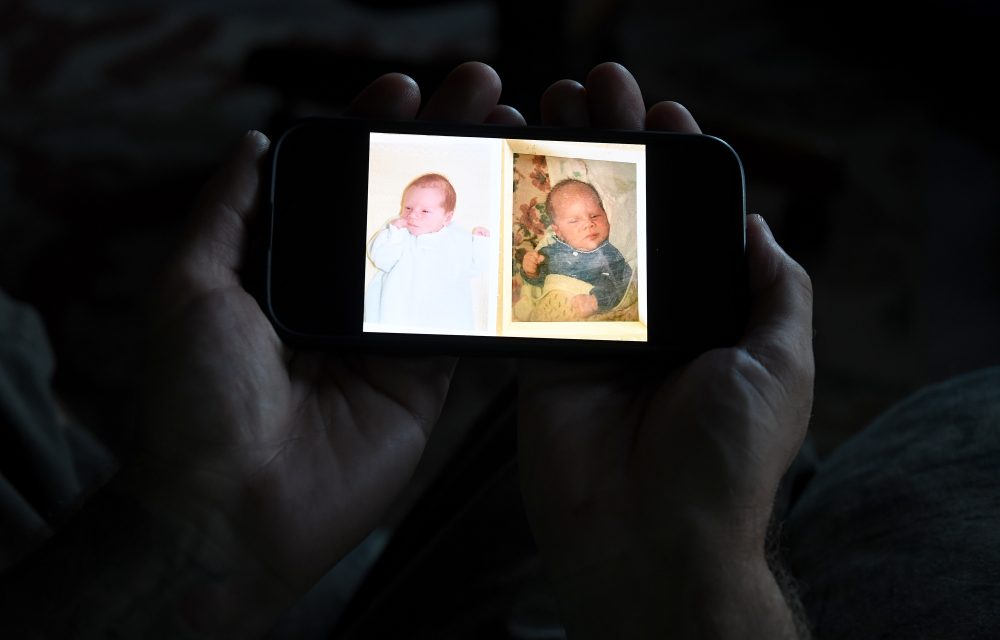
Kyle Bylin’s discovery began with a Christmas gift exchange — he randomly selected an at-home DNA test kit and took it. The results connected him to a biological aunt on a genealogy website, which then led her nephew, Jeremy Morrison, to get his own DNA tested. The outcome left no room for doubt.
“That’s when my mind was just completely blown,” Bylin recalled. “We could have never imagined that it was an actual birth switch that occurred.”
For Morrison, the truth hit home the moment he saw a photograph of Bylin’s brother — the physical resemblance was unmistakable.
According to a lawsuit filed in state court last week, Bylin and Morrison were the only two infants born on January 26, 1988, at Unity Medical Center in Grafton, North Dakota. Somehow, each baby was sent home with the other’s family.
Unity Medical Center released a statement saying there is no evidence that hospital staff caused the switch. However, Bylin — who was actually born Jeremy Morrison — says he still has the hospital bracelet that incorrectly identified him as Kyle Bylin.
It has now been two years since the DNA results upended everything the two men believed about their families. That time has been filled with disorienting revelations, emotionally charged family gatherings, and plenty of “what if” moments.
Evelyn Newton, the woman who raised Bylin as her own son, spoke with The Associated Press by phone and made clear that her bond with him remains unshaken — but so does her grief over what was taken from her.
“Kyle is still my son — that is never going to change,” Newton said. “But I feel robbed of the life I should have had with my biological son. You can’t go back and replace 35 years. First steps, driving a car, getting married — how do you make up for that?”
The hospital has not denied that the babies were switched at some point. In a statement, Unity Medical Center said it is working to understand what occurred but has found no evidence pointing to its administration or staff as responsible for the error.
“We recognize the profound impact this discovery has had on them and their families,” the hospital’s statement reads. “Unfortunately, because of the passage of nearly four decades, the medical and staffing records that might have provided additional clarity no longer exist, and no members of the delivery team from that time are still employed by the hospital.”
For Morrison, learning the truth has not changed how he feels about the family he grew up with. He still considers Elizabeth O’Toole and Terry Morrison his parents. Despite some difficult stretches — like when they divorced when he was 7 and he wished he had a sibling for support — he describes his upbringing as a good one.
“I was loved. I played sports. I did well in school,” Morrison said. “A DNA test is not going to take away 38 years of memories.”
Morrison now lives in Colorado City, Colorado, and works as a welding inspector for a wind energy company. He believes that had the switch never happened, he would likely have grown up alongside his biological brother and father on the North Dakota grain farm where Bylin was raised.
Newton said nothing during Kyle’s childhood ever made her suspect he wasn’t her biological child. His dark hair stood out in a family of light-haired relatives, but her then-husband Keith Bylin had darker-haired relatives, and Newton herself was adopted and had no frame of reference for what her own biological family looked like.
For Bylin, who pursued an academic career far from North Dakota, the discovery reframed many of his life’s experiences. He used to wonder why he felt so different from the family he grew up with — including heated political debates at Thanksgiving dinner.
“You’re just kind of shaking your fist, like, how can this be my family? How am I so different from them?” Bylin said. “It turns out that we’re just totally different people, period.”
Both men have since met their biological parents — the encounters were described as welcoming but awkward. Bylin and Morrison have not yet met each other face to face, though they have spoken by phone.
“We’ve tried to unite as a group and just recognize that no matter what, there’s different ways that this can be socially messy,” Bylin said. “Everyone’s getting to know people that they didn’t know before.”
While such cases are rare, the growing popularity of at-home DNA testing kits is making them easier to uncover. In 2024, two women sued the Norwegian government alleging a human rights violation after discovering they had been switched at birth. In 2020, two men who believe they were swapped in 1942 filed suit against a Roman Catholic diocese in West Virginia. A 2018 case in Pennsylvania revealed that two girls had been switched roughly 75 years earlier. And in 2016, the Canadian government launched an investigation after DNA evidence suggested two men from a northern Manitoba Indigenous community were switched at birth in 1975.
Dr. Jonathan Marron, a pediatric oncologist who also teaches at Harvard Medical School’s Center for Bioethics, says modern safeguards have made such errors extremely unlikely today.
“As often as all clinicians, doctors, nurses, social workers, everybody else, gripe about the electronic health records,” the digital backstop is a clear benefit, Marron said, adding that mix-ups like this should happen “pretty close to never” in the current era.
Attorney Tim O’Keefe said he spent a full year attempting to negotiate a financial settlement with the hospital before ultimately filing the lawsuit, which claims emotional distress stemming from negligence and medical malpractice. Meanwhile, both families continue adjusting to their new reality.
“I know the truth now, but we’re still working to build relationships,” Morrison said. “I mean, it’s not like I can go back in time and rebuild what’s already lost. It’s a work in progress, just like me.”
Abbott Laboratories announced Friday that it is looking into two separate cybersecurity breaches involving unauthorized access to internal systems connected to its cancer diagnostics business and an online portal called LabCentral.
The company stated that no other business units, locations, or systems were affected by the breach tied to its cancer diagnostics division. Abbott also noted that legacy Exact Sciences systems are completely separate from its own systems.
In a second incident, a hacker allegedly broke into the LabCentral portal — an externally accessible, third-party-hosted platform used by Abbott’s core laboratory diagnostics operations. Abbott said the intrusion had no impact on its business or customers, and there is no known exposure of sensitive customer or business data.
Abbott described LabCentral as a repository of publicly available technical documents, including product operating manuals, troubleshooting guides, and product specifications. The portal did not house any proprietary or sensitive information, the company said.
Cyberattacks on healthcare companies have been on the rise, with recent incidents hitting firms including Clover Health Investments, Stryker, Medtronic, Novo Nordisk, and West Pharmaceutical Services. Such attacks can disrupt operations, limit access to critical data, and raise serious concerns about protecting sensitive information.
Abbott said it has already taken steps to address both incidents, has engaged outside cybersecurity professionals and law enforcement, and is continuing to investigate what information may have been accessed.
The company does not anticipate any significant impact on its business operations or financial results as a result of either incident.
U.S. President Donald Trump is set to return to the World Cup stage at Sunday’s championship match, arriving fresh off one of the tournament’s most talked-about controversies and already eyeing a future bid for America to host the event again in 2038.
FIFA President Gianni Infantino announced that Trump will be seated alongside him during the final between Argentina and Spain at New York/New Jersey Stadium. Trump is also expected to hand the trophy to the winning team — a role he previously performed at last year’s Club World Cup.
The appearance comes just days after Trump publicly confirmed he had asked Infantino to take another look at the red card handed to U.S. striker Folarin Balogun, a move that sparked a fierce debate about fairness and the integrity of officiating at the tournament.
On Friday, Trump and Infantino exchanged warm words at a reception held inside Trump Tower in Manhattan, where FIFA established an office last year. The event drew roughly 300 guests, among them Brazilian soccer legend Ronaldo, FIFA officials, and various dignitaries.
“This World Cup would not have been such a success without you,” Infantino told Trump during the gathering.
“It turned out we were a soccer country,” Trump responded. He has frequently welcomed Infantino for meetings at the White House’s Oval Office.
The two have remained firmly in each other’s corner throughout a series of controversies surrounding the tournament, which is also co-hosted by Canada and Mexico. FIFA has maintained that Trump had no influence over the decision to suspend Balogun’s red-card ban.
In the lead-up to the tournament, U.S. host cities faced pointed questions about how they planned to make international visitors feel welcome amid Trump’s immigration enforcement actions and travel restrictions affecting several countries. Later, Trump threatened to pull matches from cities led by Democratic officials, though FIFA pushed back, stating that such decisions were not his to make.
At Friday’s reception, Trump floated the idea of the U.S. hosting the World Cup again, adding, “This time we’ll leave Mexico and Canada out.”
Trump has made a habit of appearing at high-profile sporting events over the past 18 months, a period during which his approval ratings in his second term have continued to decline. He received an enthusiastic welcome from American fans at last year’s Ryder Cup on New York’s Long Island, but his reception hasn’t always been as warm. He was loudly booed at Game 3 of the NBA Finals last month and drew the ire of tennis fans who were locked outside last year’s U.S. Open men’s final at Flushing Meadows well past the scheduled start time due to security requirements for his visit.
Trump’s presence at Sunday’s match presents a particular challenge for U.S. broadcaster Fox Sports, which relies on a shared international feed for its match coverage.
“We do take this world feed. So we’re not in control of the pictures. And so whether or not there’s a cutaway during the match to President Trump sitting next to Gianni Infantino, sitting next to whoever else, that’s not our choice one way or the other,” said play-by-play announcer John Strong. “We also don’t know when it’s coming.”
FIFA officially awarded the tournament to the U.S., Canada, and Mexico back in 2018, during Trump’s first term in office — a fact he has repeatedly cited with pride. Strong acknowledged the divided reaction Trump tends to generate among viewers.
“When it comes to President Trump, there are no neutral opinions,” Strong said. “There’s a lot of people in the audience who are super excited to see him at the game. And there’s going to be a lot of people in the audience who maybe are less thrilled to have him on their TV screen.”
Slovenian tennis player Tamara Zidansek punched her ticket to the semifinals of the UniCredit Iasi Open in Romania on Friday, defeating second-seeded Petra Marcinko of Croatia by scores of 6-3 and 7-5. Zidansek was especially effective at capitalizing on opportunities, converting six of her ten break point chances throughout the match.
Zidansek closed out the victory by taking the final two games of the second set. She will now go up against Spain’s Paula Badosa in the semifinals. Badosa earned her spot by defeating fifth-seeded Panna Udvardy of Hungary 6-4, 7-6 (2).
In other quarterfinal action at the Iasi Open, third-seeded Oleksandra Oliynykova topped France’s Clara Burel 6-4, 7-5. Egypt’s Mayar Sherif also advanced after a tough three-set battle against ninth-seeded Yulia Putintseva of Russia, winning 6-2, 3-6, 7-6 (5).
At the Athens Open, Denmark’s Clara Tauson, the tournament’s top seed, rolled through her quarterfinal matchup against fifth-seeded Czech player Sara Bejlek 6-2, 6-3. Tauson was sharp on her first serve, winning 69.7 percent of those points — going 23 for 33.
Tauson’s next opponent will be third-seeded Barbora Krejcikova of Czechia, who advanced despite committing 32 unforced errors and six double faults in a 6-4, 6-4 win over China’s Qinwen Zheng. Zheng actually held a 25-11 advantage in winners but was undone by 41 unforced errors and seven double faults of her own.
Fourth-seeded Maria Sakkari delivered a crowd-pleasing performance in her hometown, defeating Alycia Parks 6-4, 6-3. Russia’s Alina Korneeva also advanced, knocking out seventh-seeded Tereza Valentova of the Czech Republic 7-5, 6-3.
NEW YORK — The top federal prosecutor overseeing the Brooklyn district says he has no grounds to challenge the Justice Department’s move to abandon its criminal case against Indian billionaire Gautam Adani, though he stopped short of saying whether he personally agreed with the decision.
U.S. Attorney Joseph Nocella Jr. addressed the matter in a letter sent Friday to the federal judge handling the case. In it, he acknowledged that he was “not the decisionmaker” when it came to dropping the charges, and said he had no reason to believe that the justification offered by his supervisor — top Justice Department official Trent McCotter — did not reflect the “real grounds” for dismissal.
The letter came in response to a direct request from U.S. District Judge Nicholas Garaufis, who had asked Nocella to state whether he agreed or disagreed with McCotter’s reasoning for scrapping the Adani case, and whether any other factors supported the dismissal.
The case against Adani had involved allegations of fraud and bribery. Nocella’s office did not respond to a request for comment on the matter.
The New York Yankees may soon get some much-needed reinforcements back on the field.
Manager Aaron Boone could have left-handed ace Max Fried back in the starting rotation by the trade deadline, and star outfielder Aaron Judge may not be far behind — though a firm timeline for Judge remains elusive.
Fried took the mound Friday night for Triple-A Scranton/Wilkes-Barre, marking his first game action since landing on the injured list with a bone bruise following a May 13 outing. Boone said Fried was working under a pitch count “in the low 50s” for the start. He is already set for at least one additional Triple-A start next week before the team re-evaluates his status.
The situation is less clear for Judge, who is dealing with a fractured rib on his right side, and fellow slugger Giancarlo Stanton. Stanton has resumed running but has no timetable established for returning to baseball-related activities.
Judge was recently told to stop riding a stationary bike but has been cleared to walk on a treadmill at a slight incline. He is not yet permitted to take batting practice or participate in any stationary baseball drills.
Judge said Friday that the most recent imaging of his injured rib showed “some improvement,” but doctors have not cleared him for physical workouts due to the risk of re-injuring the area.
Boone remained optimistic but acknowledged the team must be patient. “We’re not there yet. We’ll just continue to wait, let it heal,” the manager said. “I feel good about the fact that he’ll be back. It’s just a matter of when.”
Boone added: “Obviously we all want Aaron Judge back in the lineup. As I’ve said we have a lot of capable players. We finished the (first) half on a high note. We have to continue to play well and hopefully win ballgames knowing that at some point he’ll join us.”
A three-time American League MVP, Judge has belted 17 home runs and driven in 38 runs across 59 games this season.
Stanton, meanwhile, has been sidelined since April 24 when he injured his calf in a game against the Houston Astros. He is not expected to return to the lineup this week. Through just 24 games this year, Stanton has three home runs and 14 RBIs. This marks his seventh stint on the injured list since he joined the Yankees prior to the 2018 season.
Two pitchers are also working their way back. Left-hander Carlos Rodon threw a 10-pitch bullpen session Friday, giving the team a live look at his recovery from inflammation in his left elbow. Right-hander Clarke Schmidt, coming back from his second Tommy John surgery, is being targeted for a potential return in August. The Yankees have scheduled Schmidt to face live hitters for the first time since undergoing the 2025 elbow procedure.
NEW YORK (AP) — Los Angeles manager Dave Roberts confirmed Friday that two-way star Shohei Ohtani underwent a procedure in which lubricant was injected into his left knee, though doctors did not drain any fluid from the joint.
Despite the knee issue, Ohtani was in Friday’s second-half opener against the New York Yankees, batting leadoff as the designated hitter. The four-time MVP is not expected to pitch this weekend, with his next scheduled start tentatively set for Wednesday in Philadelphia.
Roberts said the procedure took place following Sunday’s game against Arizona. Ohtani’s most recent pitching appearance came on July 3.
“It gives him some relief in his knee, which we were hoping to get, and then the four days off from activity, which gets it all to kind of settle in,” Roberts said. “I think we are certainly more prepared to back off on the workload if it calls for it, but Shohei wants to be out there as much as he possibly can.”
On the season, Ohtani is hitting .293 with 22 home runs and 58 RBIs at the plate, while posting an 8-2 record with a 1.79 ERA and 95 strikeouts across 85 2/3 innings in 14 starts on the mound. He sat out Tuesday’s All-Star Game.
Roberts said he plans to give Ohtani a day of rest following each of his pitching starts whenever the schedule allows.
“Safe to say that even there isn’t an off day behind it, I would like to give him that next day off,” Roberts said. “So ideally, yeah, he would have the scheduled off day behind it but that’s not always possible, kind of with the schedule and also where he’s at.”
Roberts also noted that Ohtani will likely throw off a mound within the next several days to evaluate how the knee responds.
NEW YORK (AP) — The nation’s first billionaire president may soon be generating income from a brand-new revenue stream directly tied to his time in office: charging Wall Street traders for a head start on certain posts made to his Truth Social platform.
Trump’s financially troubled media company has announced plans to offer financial trading firms and institutions the ability to view posts from the platform’s “highest-ranking” accounts — potentially including the president’s own — a matter of milliseconds before the general public sees them.
For those traders, that tiny window of time could translate into enormous profits. And for Trump, it could mean significant new income.
Trump’s posts have repeatedly demonstrated the power to shake financial markets, sending prices sharply higher or lower within moments. Until now, announcements from the White House have generally been treated as public information — something that should be freely available to everyone at the same instant.
The president holds the largest following on Truth Social, with 12.9 million followers, making it likely his account would be among those included in the early-access offering.
Truth Social’s publicly traded parent company, Trump Media & Technology, did not respond to questions submitted by email — including whether the president’s own posts would be part of the service. But the planned offering has drawn significant attention, and not only from the financial world.
“It’s odious, selling access to highest bidders on Wall Street,” said Dylan Hedler-Gaudette, a federal ethics expert at watchdog organization Project on Government Oversight. “Everything he says has market implications.”
The service, dubbed Truth PSI, was unveiled in a brief press release on Thursday. It would allow trading firms to view select posts before ordinary users, giving them the opportunity to act on market-moving information ahead of the crowd — whether that involves stocks, bonds, or interest rates.
Trump Media’s announcement did not disclose the anticipated size of this new business, but it quoted CEO Kevin McGurn saying he expects it to become a “meaningful” source of revenue as part of a broader strategy to “monetize proprietary assets.” The company said it expects to launch the service next month.
The target customers are high-frequency traders — firms that rely on reacting to news faster than anyone else to buy and sell financial instruments. In that world, fractions of a millisecond can be the difference between a gain and a loss.
When Trump unveiled sweeping tariffs on April 2 last year, the announcement was a major market event — and many people learned about it first through Truth Social.
“It’s Liberation Day in America,” Trump posted hours before a formal Rose Garden ceremony, causing stocks to drop nearly 5% over the following hours, while safe-haven assets like gold and Treasury bonds climbed sharply.
Several days later, Trump reversed course, announcing a 90-day suspension of those tariffs — again via Truth Social — writing, “THIS IS A GREAT TIME TO BUY!!!”
Markets surged 9.5% that day, adding $4 trillion to investor wealth as measured by the S&P 500 index.
“It’s yet more brazen corruption,” said Kathleen Clark of Washington University School of Law, an expert in government ethics rules. “Trump can line his pockets by selling access.”
Trump has used Truth Social to announce a wide range of major decisions, including personnel changes, immigration enforcement actions, and developments related to conflicts in Ukraine and Iran.
“THE CEASEFIRE IS NOW IN EFFECT. PLEASE DO NOT VIOLATE IT!,” he posted on June 24 last year regarding a short-lived agreement with Iran, causing oil prices to drop immediately.
No other social media platform carries comparable access to the sitting president, and banks and trading firms will presumably be required to pay a premium for that advantage.
Trump Media did not disclose a price in its announcement, but confirmed it has already secured customers for the service.
While similar early-access services exist at other social media companies, the key distinction here is that the account in question belongs to the President of the United States. Still, there appears to be no legal barrier preventing Trump from proceeding.
Federal conflict-of-interest laws would prohibit most government officials from owning a company that profits by selling access to their official decisions — but those laws specifically exempt the president and vice president, according to Clark.
Even so, every president since those laws were enacted decades ago has voluntarily acted as though the rules applied to them — divesting stocks, selling off business interests, or placing assets in a blind trust. Trump has declined to follow that tradition.
The White House directed reporters’ questions — including those about the president profiting from his office — to the company that owns Truth Social. Multiple messages to Trump Media & Technology went unanswered, and Trump’s own family business, the Trump Organization, declined to offer any comment.
Trump himself has consistently maintained that there is no conflict between his duty to act in the public interest and any financial benefit he may derive from the presidency. The White House has previously stated that Trump acts solely in the country’s best interest and is not involved in his family’s business operations.
Truth PSI is the latest attempt to breathe life into Trump Media, whose stock has tumbled more than 70% since the president returned to office earlier this year. The company has tried expanding into cryptocurrency, financial services, and nuclear fusion — none of which has reversed the decline.
The company recently replaced its longtime CEO, former Congressman Devin Nunes, with McGurn, but the stock has continued to fall regardless. Shares rose 0.6% on Thursday following the announcement, and gained slightly less than that the following day, closing at $9.66. Before Trump took office last year, the stock had closed at $40.
WASHINGTON — President Donald Trump stepped before the nation Thursday night from the White House, releasing a collection of declassified documents that his supporters had promoted as definitive proof of widespread voter fraud in the 2020 election. But after a thorough review, The Associated Press found the records fell far short of that promise.
During his address, Trump described what he called alarming revelations — including alleged Chinese interference aimed at undermining his 2020 campaign and a cover-up orchestrated by what he termed the “deep state.” He told viewers, “Americans were blatantly lied to about the security of our election infrastructure.”
The newly released materials include declassified intelligence reports, investigation files, intelligence analysis, and various correspondence. Many pages are so heavily blacked out that their conclusions are impossible to determine. Others simply repeat vulnerabilities and findings that have already been publicly known for years. Crucially, nothing in the documents demonstrates that China or any other foreign nation actually manipulated election results in 2020 or any other year.
David Becker, executive director of the Center for Election Innovation & Research, attended a White House briefing on the materials before the speech and had a blunt reaction. “The White House promised a bombshell, and they delivered a dud,” he said. Despite what he described as a clear push by administration officials to frame the documents as explosive, he said “there was absolutely nothing here that was news, nothing here that even calls into question past elections and certainly not the 2020 election.”
During his speech, Trump stated: “Starting during the 2020 election cycle, the People’s Republic of China carried out what is believed to be the largest compromise of election data in history, resulting in China’s illicit acquisition of 220 million U.S. voter files.”
What the documents do not show, however, is any evidence that China actually did anything with that information. It has been widely established for years that China gathers enormous amounts of data on Americans — not as part of any effort to change election outcomes. Additionally, public versions of voter registration files are broadly available, including online, and are routinely bought and sold by political campaigns and parties to guide their outreach efforts.
China’s attempts to influence the 2020 race were already a matter of public record, and no intelligence assessment concluded that Beijing directly interfered with the vote itself. The newly released documents do not challenge that conclusion. Instead, they shed light on an internal debate within the intelligence community over how to describe China’s intentions and actions. Emails show that one dissenting view held that China had taken steps to “denigrate” Trump — but that perspective had already been included in the post-election intelligence community assessment, meaning it was never hidden.
China responded Friday, calling Trump’s allegations “groundless” and “entirely fabricated,” and reiterating that it has never interfered in U.S. elections and has no desire to do so.
Trump also highlighted a new Department of Homeland Security investigation, based on state voter rolls and public records, which he said identified roughly 278,000 noncitizens registered to vote in federal elections. The report claimed more than a quarter of a million noncitizens were illegally registered in California, Pennsylvania, New Jersey, and Nevada. An additional 28,000 were identified in 25 states using the new Systematic Alien Verification for Entitlements system, known as SAVE.
Importantly, the report does not allege that any of those individuals actually cast a ballot — which would constitute a crime. The data itself has not been independently verified. Reports have shown that the SAVE database is riddled with errors, including outdated records that have incorrectly labeled naturalized citizens as noncitizens. A federal judge has already blocked the database from being used, citing concerns that eligible voters could be wrongly removed from voter rolls. Research has consistently shown that noncitizen voting is extremely rare, and noncitizens are permitted to vote in some local elections.
Some of the released documents also touched on Russia’s election-related activities. One declassified 2020 report described Russia as the foreign nation that had made the most aggressive attempts to penetrate American election systems — specifically working to defeat Joe Biden. The document noted that Russia amplified claims that Biden, while serving as vice president, had acted improperly in connection with Burisma, the Ukrainian energy company that employed his son Hunter — allegations that Trump and Republicans frequently repeated.
“Their aim is to defeat the former Vice President and ensure the President’s victory,” reads the document from the National Intelligence Council.
The same document noted that both China and Iran wanted Trump to lose. However, a chart within the document showed that only Russia was identified as having engaged in “targeting, accessing, or manipulating election processes or election-related systems.” Russia has continued to deny interfering in U.S. affairs.
A significant portion of the released documents relate to a Michigan case in which a canvassing operation that appeared to support Biden submitted thousands of questionable voter registration forms to a local election official in 2020. That official rejected the registrations and notified authorities. Notes from at least one FBI agent — though heavily redacted — suggest the agent pushed for further investigation and charges as recently as 2024. Michigan Republicans complained in 2023 that the state’s Democratic attorney general failed to bring charges against anyone.
Ultimately, the case was closed, according to one of the records, “because logical investigation and/or leads have been exhausted, and the investigation to date did not identify a criminal violation or a priority threat to national security.”
Trump told the nation the documents also contained intelligence “revealing shocking vulnerabilities in our election infrastructure” that leave it open “to hacking, exploitation and foreign interference.” One report listed recent security breaches — mostly attributed to Russia — and urged state and local election officials to strengthen their defenses to prevent voter information from being misused to obtain absentee ballots or alter voter rolls.
Election officials have long acknowledged that voting machines carry some risk, which is why multiple safeguards exist — including physical security measures, equipment testing, paper ballot backups, and post-election audits — to catch errors or threats.
What remains unclear is what the Trump administration itself is doing to help protect election systems. Earlier this month, Trump removed members of a bipartisan federal election commission that distributes federal grants to states, oversees voting system testing, and maintains the national voter registration form, after the panel pushed back on his effort to require proof of citizenship before registering to vote. The administration has also cut millions of dollars in funding from the U.S. Cybersecurity and Infrastructure Security Agency, which assisted state and local officials in securing elections, and disbanded an FBI task force dedicated to investigating foreign influence operations targeting U.S. elections.
The documents repeatedly flag the dangers posed by large voter databases and election websites that could be accessed or manipulated by foreign adversaries. Yet the SAVE system — which Trump has been urging states to adopt — has itself been criticized as an unlawful, centralized federal database of voter data that could present yet another target.
Bryson DeChambeau’s strong showing at the British Open hit a major snag Friday when rules officials handed him a two-stroke penalty for unintentionally improving his lie on the fifth hole during the second round at Royal Birkdale in Southport, England.
The penalty knocked DeChambeau out of sole second place and into a tie for fifth, leaving him three strokes behind the halfway leader. In the wake of the ruling, DeChambeau’s agent told Golf Channel that the golfer may choose to withdraw and not return for Saturday’s third round.
DeChambeau had wrapped up his second round on a high note, closing with back-to-back birdies for a four-under-par 66. That brought his tournament total to seven under par — just one shot behind halfway leader and fellow LIV golfer Lucas Herbert. DeChambeau had missed the cut at each of the year’s first three major championships.
The trouble began earlier in the round when DeChambeau’s tee shot on the par-four fifth strayed into heavy rough. Video showed him taking practice swings and pacing around near his ball before playing his second shot. After he completed his round, a rules official approached him and asked that they return to the fifth hole to review the situation.
DeChambeau, a fan favorite known for his powerful hitting, engaged in a heated exchange with the official as he argued his case. He appeared visibly frustrated as he eventually rode back to the scoring area in a golf cart.
More than an hour after finishing his round, the two-time major champion was officially penalized under Rule 8.1 of the rules of golf. His score on the fifth hole was changed from a bogey to a triple bogey.
R&A rules official Grant Moir explained the decision, saying: “Bryson has been penalised two strokes for inadvertently improving the area of intended backswing on fifth hole.”
Golf Channel later reported that DeChambeau’s agent and caddie pushed back on the ruling, arguing that while DeChambeau may have accidentally stepped on some tall grass near his ball, it was not along the path of his swing and therefore did not improve his lie.
DeChambeau was later spotted on the driving range at Royal Birkdale. His agent confirmed that a final decision on whether he will compete in Saturday’s third round will be made that day.
KAMPALA — Twenty schoolchildren were killed Thursday night when a bus transporting them home from a field trip crashed in eastern Uganda, according to authorities.
In response to the tragedy, the Ugandan government announced Friday that all school excursions are now on hold indefinitely, as the disaster sparked widespread grief and a wave of online calls for stronger safety measures.
According to police, early investigations indicate the driver lost control of the vehicle, which then veered off the road and flipped after striking a large rock. The information was shared in a police post on X.
The bus belonged to King David Junior School, located in the capital city of Kampala. It was making its way back from an educational trip to Sipi Falls when it crashed at Chekwatit village in the Kapchorwa district, police said.
In addition to the 20 children killed, one adult also died in the crash. Three other adults and a number of children sustained injuries, officials confirmed.
Fatal road accidents occur frequently in Uganda. Experts commonly point to poorly maintained vehicles and inadequate street lighting as contributing factors.
The country experienced another devastating crash last October, when 46 people died on one of Uganda’s main highways connecting the capital to the northern city of Gulu.
A government communications agency announced Friday that Education Minister Chrysostom Muyingo had placed “a hold on all school trips and excursions, effective immediately and until further notice.”
Spain’s former world number one Jon Rahm avoided a stroke penalty Friday after hurling his club in anger during the second round of the British Open in Southport, England.
The incident occurred on the par-three 15th hole, where Rahm pulled his tee shot and let his emotions get the better of him. Under the R&A’s code of conduct, such behavior can result in a shot being added to a player’s score, but Rahm was let off with just a warning delivered by an official later in his round.
Despite the drama, Rahm posted a round of 67, leaving him four shots behind Australian Lucas Herbert, who held the lead heading into the weekend at Royal Birkdale.
Rahm said the incident didn’t cross his mind again until he spotted the official approaching him on the 17th hole. “I didn’t think about it until I saw him on 17, and when he was walking up to me, I knew exactly what it was for, but I didn’t think about it in the moment,” Rahm said.
When asked whether he was concerned about keeping his composure during the weekend rounds, Rahm pushed back on the idea that his outbursts are a constant issue. “I shouldn’t have reacted that way, but I did — I mean, you guys are acting like it’s every single hole. I get it. I had a moment,” he said.
Rahm went on to describe his competitive nature as part of who he is, while acknowledging the club throw crossed a line. “I’m definitely more intense and passionate than a lot of the players out here, especially at work. But I wasn’t thinking about it. It’s not like I’m going to — if I try to alter who I am too much, it might cost me a little bit on the course,” he said. “But certainly shouldn’t have moments like the one on 15; I get it.”
KYIV — For the second straight day, thousands of demonstrators filled the streets outside Ukraine’s presidential office, demanding the ouster of the country’s top military commander, Oleksandr Syrskyi. The protests erupted following President Volodymyr Zelenskiy’s surprise government shake-up that pushed out widely respected defense minister Mykhailo Fedorov.
Fedorov, a 35-year-old known for his technological expertise, had been widely credited with contributing to some of Ukraine’s recent battlefield successes against Russia. His removal in the unexpected reshuffle sparked immediate public fury and calls for a more forward-thinking military strategy.
Among those who showed up to protest was Andriy, a 27-year-old combat medic who lost part of his lower limb in the war and whose brother was killed in combat. He arrived carrying a handmade cardboard sign reading: “Can not stand. Will not stay silent.”
“Syrskyi had conflicts not only with the defence minister, but also with brigade and corps commanders. If he stays, we will simply be ineffective,” Andriy said. “We could simply lose this war, we could lose.”
Zelenskiy offered minimal explanation for the shake-up, saying he was forced to act because the divide between Syrskyi and Fedorov had grown so deep that the two men refused to sit at the same table.
On Friday, Zelenskiy named Ukraine’s former top law enforcement official, Ihor Klymenko, to head the national security and defence council, replacing current chairman Rustem Umerov. Klymenko had previously been floated as a possible replacement for Fedorov himself. The president said Klymenko would be responsible for coordinating “all components of the security and defence sector,” including defence production.
It remained unclear whether Umerov — who also serves as Ukraine’s lead negotiator in U.S.-backed peace discussions with Russia — would be offered another role in the government.
Late Thursday, as public anger intensified, Zelenskiy moved to ease tensions by appointing Yevhenii Khmara, a senior security official overseeing Ukraine’s long-range strikes on Russian territory, as acting defence minister.
Crowds outside the presidential building chanted “Syrskyi away” and “Bring Fedorov back,” with many calling on leadership to heed the voices of soldiers actively fighting on the front lines.
The tension between Fedorov and Syrskyi came into full public view Thursday when the former defence minister accused the 60-year-old general of deliberately undermining his efforts. Syrskyi earned recognition for his role in defending Kyiv during the early stages of the war and has held the top military post since early 2024. However, he has drawn sustained criticism for an inflexible leadership style that some soldiers say leads to unnecessary casualties, along with resistance to modernizing battlefield tactics.
Another demonstrator, Nina, whose husband is currently serving in the military, attended the protest for a second day, bringing along her one-year-old child, Oleksandr-Carlos. Her primary demand is Syrskyi’s removal.
“The problem isn’t so much that Fedorov resigned as it is that Syrskyi remains in office,” she said, adding that the system under the commander prioritizes showing results over protecting soldiers’ lives.
“Sure, he deserves some credit, I don’t deny that but at what cost? That’s the question. Syrskyi is, after all, the old system,” Nina said.
The demonstrations drew comparisons to protests held at the same location last year, when crowds pushed back against Zelenskiy’s efforts to reduce the authority of Ukraine’s anti-corruption bodies — a move he eventually reversed.
On Friday, Zelenskiy held virtual consultations with military commanders and met in person with Brigadier General Andriy Biletsky, who leads Ukraine’s Third Army Corps, to review the battlefield situation and defense planning.
In a move intended to reassure the public that reforms championed by Fedorov would continue, Zelenskiy named Serhii Beskrestnov, a former adviser to the defence ministry, as a presidential adviser on defence technology.
The political turmoil comes as Ukrainian forces have begun regaining some momentum against Russian troops through long-range strikes targeting Russian industry and supply lines. Still, Ukraine continues to struggle with military recruitment shortfalls as Russian forces push forward, and with obtaining sufficient air defense systems to protect its cities from missile attacks.
Many Ukrainians believe the path to victory runs through technological advancement and shedding outdated Soviet-era military practices — something they argue cannot happen under Syrskyi’s leadership.
Leonid, a 63-year-old veteran who described himself as a product of the Soviet military system, put it plainly: “They are destroying our army. Maybe at some point he was necessary, but that is it.”
Northbound travelers on Red Lion Road (DE-71) are encountering a lane shift between Jester Street and Wrangle Hill Road (DE-72) as crews conduct road work in the area.
DelDOT has reported the lane configuration change, which requires drivers to adjust their path through the work zone. The shift is in place to accommodate construction activity along that stretch of roadway.
Drivers are advised to slow down, stay alert for workers and equipment, and follow all posted signage through the affected area.
ARLINGTON, Va. — One of the lawmakers behind a major piece of federal college sports legislation says he believes the bill is on track to clear the Senate.
“We probably have 60 votes,” said Sen. Eric Schmitt, R-Mo., speaking Friday at the Associated Press Sports Editors meeting.
Schmitt described the coming two weeks as a pivotal stretch for the Protect College Sports Act, warning that failure to pass the legislation could have serious long-term consequences for college athletics.
“The trajectory of this in three years will be even further unrecognizable,” Schmitt said, painting a picture of women’s sports programs collapsing under financial pressure if no action is taken.
He noted that leaders from the Southeastern Conference and the Big Ten — both of which currently oppose the bill in its current form — have held talks with the bill’s lead sponsors, Sens. Ted Cruz, R-Texas, and Maria Cantwell, D-Wash., in hopes of negotiating changes that could win their backing.
The legislation, introduced by Cruz and Cantwell, would give the NCAA and athletic conferences limited protection from lawsuits and would override the inconsistent web of state laws that currently govern name, image and likeness payments to college athletes. It also includes a provision allowing conferences to combine their media rights deals — a move supporters argue could bring in billions of additional dollars, though the SEC and Big Ten have pushed back on that idea.
College sports has been grappling with how to fairly compensate athletes for their name, image and likeness ever since a federal court approved such payments last summer.
Last month, SEC commissioner Greg Sankey sent a letter to university presidents raising concerns that the bill could create more problems than it resolves. Among his objections, Sankey argued that a section allowing athletes to file civil lawsuits in certain situations should be rewritten, saying it could actually increase legal battles rather than cut them down.
Even if the Senate passes the bill, it would still need to survive the closely divided House, where a separate measure — the SCORE Act — drew criticism from both parties and never made it to a floor vote.
A federal appeals court handed down a ruling Friday declaring that New Jersey’s prohibitions on assault-style firearms and ammunition magazines capable of holding more than 10 rounds violate the U.S. Constitution.
The decision marks a first in American legal history — no federal appeals court had previously struck down a state-level ban on such weapons. The ruling arrives at a particularly significant moment, as the U.S. Supreme Court is preparing to take up the question of whether bans on semiautomatic rifles conflict with Second Amendment protections. Adding to the legal complexity, a separate federal appeals court upheld Illinois’ ban on semiautomatic weapons just last week.
Friday’s ruling from the 3rd U.S. Circuit Court of Appeals expands upon a July 2024 decision by a federal judge, who had found only New Jersey’s specific ban on AR-15s to be unconstitutional while allowing the state’s restrictions on larger magazines to remain in place. The appeals court went further, declaring the state’s entire ban on weapons it classifies as “assault firearms” — as well as its limits on “large capacity ammunition magazines” — to be unconstitutional.
New Jersey Attorney General Jennifer Davenport, a Democrat whose office argued in defense of the law, issued a statement calling the ruling “as unfortunate as it is legally incorrect.”
“Every other federal circuit court to consider the issue has come out the other way,” Davenport said. “Assault weapons and large capacity magazines play a dangerous role in the modern epidemic of mass shootings, and New Jersey acted reasonably and lawfully in restricting them. We are considering our options.”
On the other side of the debate, John Commerford, executive director of the National Rifle Association Institute for Legislative Action, praised the decision as a “historic victory for the NRA, the Second Amendment, and law-abiding Americans.”
“The Third Circuit has struck down these unconstitutional so-called assault weapons bans and magazine bans in New Jersey, affirming what we’ve always known: the right to keep and bear arms, including commonly-owned rifles and standard-capacity magazines, is fundamental and cannot be infringed by politicians who prioritize control over constitutional freedoms,” Commerford said in a statement.
Millions of Americans across the Great Lakes, Northeast, and Mid-Atlantic regions endured another difficult day of hazardous air Friday, as out-of-control wildfires sent a thick, eerie haze drifting over Washington, D.C. and surrounding areas.
Air quality alerts were set to remain in place through Saturday across a large portion of the country, though forecasters say weekend rainfall and thunderstorms could provide some temporary relief to affected communities.
Don’t expect the smoky skies to disappear quickly, however. Bob Oravec, a lead forecaster with the National Weather Service based in Maryland, warned that fires continue to burn unchecked across remote areas of Canada, with additional blazes in a Minnesota wilderness area adding to the problem.
“The source of the smoke is going to continue on for certainly a week, probably,” Oravec said. “So in some form, there’s going to be smoke that gets transported from the fires downstream, and it’s just going to depend upon which way the wind’s blowing as to where the smoke is going to affect the most.”
On Friday, communities in Minnesota, Michigan, and Illinois near the Canadian border and the Boundary Waters Canoe Area Wilderness in Minnesota recorded some of the worst air quality readings on the planet, according to IQAir, an air quality monitoring website.
Washington, D.C. was not far behind. The Washington Monument, Lincoln Memorial, and other iconic national landmarks were swallowed up in a dense, orange-tinted haze early Friday morning.
Stewart Verdery, a former assistant secretary at the U.S. Department of Homeland Security, captured the scene in a sunrise panorama he posted on X. “Wow that Canadian smoke haze is no joke,” he wrote. “Almost nothing visible — no sun, no monuments, no Reagan Airport.”
Air quality in and around the nation’s capital was expected to deteriorate further throughout the day, potentially reaching “very unhealthy” and even “hazardous” levels on the air quality index, according to regional officials.
Health authorities urged residents — especially those with heart or lung conditions, older adults, and children — to stay indoors as much as possible until conditions improve.
There is also growing concern about how the poor air quality could affect the World Cup final match between Spain and Argentina at MetLife Stadium in New Jersey on Sunday. Oravec noted that while Saturday is expected to be rough, conditions should improve somewhat by game day.
Just one day earlier, skies over several states turned dark with an orange and yellow tinge, partially obscuring Manhattan’s skyline in a now-familiar haze.
Officials in New York, New Jersey, Pennsylvania, and other Northeastern states handed out free KN95 face masks, scrapped outdoor events, and opened libraries and public buildings as indoor refuges from the polluted air.
By Friday afternoon, air quality readings had improved from “unhealthy” to “moderate” in parts of the New York City area. Bright sunshine broke through a thin layer of smoke, and stretches of clear blue sky returned to much of the region.
Saturday is forecast to bring a strong chance of thunderstorms across the Northeast and Mid-Atlantic, which should help clear the air temporarily. How long that improvement lasts depends largely on what happens far to the north, where roughly 100 wildfires continue to burn with no end in sight, primarily in Ontario, Canada. In the U.S., authorities have closed the Boundary Waters area while battling several fires there.
Health experts warn that prolonged exposure to smoky air can worsen existing medical conditions and lead to serious long-term health issues, including respiratory illness, cardiovascular and neurological disease, and even premature death.
Canadian wildfire smoke is not expected to significantly disrupt Sunday’s World Cup championship match, according to forecaster AccuWeather. More than 80,000 fans are scheduled to pack New York New Jersey Stadium to watch Argentina face Spain for the sport’s top honor.
Smoke from hundreds of active wildfires burning across Canada has spread across a wide portion of the United States this week, leading officials to issue air quality warnings in many areas.
AccuWeather noted that air quality readings in East Rutherford, New Jersey, may fall below “good levels” on Sunday. However, conditions are expected to be noticeably better than the “poor to unhealthy” air quality anticipated on Saturday.
Meteorologist Adam Douty offered some reassurance ahead of the match. “It may still not be considered good, but it should not be as bad as Saturday. It will also be less humid compared to Saturday, which will make for more comfortable conditions,” he said.
The New York-New Jersey area has been dealing with smoky, hazy skies throughout the week, with local authorities advising residents to limit intense outdoor physical activity.
Rain in the forecast for Saturday is expected to play a key role in clearing out much of the lingering smoke before kickoff Sunday.
Clover Health Investments revealed in a regulatory filing on Friday that it discovered unusual login activity on some of its computer systems on July 4, and a subsequent investigation determined that a hacker had broken into three employee accounts using social engineering tactics.
The health insurer said the compromised accounts belonged to non-managerial employees who worked on member visit scheduling and sales support for brokers. While those accounts had access to some personal and protected health information, the company confirmed the hacker did not reach corporate financial systems or claims data.
After detecting the suspicious activity, Clover Health launched an investigation with the help of outside cybersecurity professionals, took steps to stop further unauthorized access, and alerted law enforcement.
The investigation remains ongoing, and the company is still working to determine exactly what information may have been viewed or taken. Clover Health said it believes its response successfully limited and ended the unauthorized access to its systems.
The company stated it does not believe the incident has had, or is likely to have, a significant impact on its business operations, financial condition, or financial results.
Clover Health added that it is reviewing applicable legal and regulatory obligations and will notify any affected members if that step is determined to be necessary.
Clover Health Investments is a U.S. health insurer that specializes in Medicare Advantage plans and technology solutions designed to support physicians.
A federal judge in Boston issued a ruling Friday blocking the Trump administration from using a White House budget regulation to eliminate billions of dollars in grant funding for programs that don’t align with the president’s agenda.
U.S. District Judge Indira Talwani sided with a coalition of Democratic-led states who challenged the move, agreeing that a provision quietly added to U.S. Office of Management and Budget regulations back in 2020 — during Trump’s first term in office — did not actually give his administration the legal authority to pull grant funding simply because federal agencies have shifted their priorities.
The states argued the regulation was being misused as a tool to cut off funding for causes the administration found unfavorable, and Judge Talwani agreed that the clause did not support such sweeping grant terminations.
The World Cup brought sold-out venues and millions of celebrating fans to Mexico, but the monthlong soccer spectacle did little to energize a struggling economy already burdened by sluggish investment and anxiety over the upcoming review of the North American trade agreement, known as the USMCA.
The tournament, which concludes Sunday after more than a month of competition spread across Canada, the United States, and Mexico, saw Mexico host 13 of the 104 total matches. Despite high hopes from government officials who had set ambitious tourism targets, the event fell short of those goals — and Mexico’s gross domestic product actually shrank during the first quarter of the year.
“The World Cup will not structurally change the trajectory of the Mexican economy,” said Humberto Calzada, chief economist at Rankia.
Calzada added that the competition offers only a brief, short-term jolt for an economy the government projects will grow between 1.8% and 2.8% this year — a rosier outlook than the 1.1% growth analysts are forecasting.
The financial gains from the tournament were concentrated in only a few areas. Banorte reduced its estimate of the World Cup’s contribution to Mexico’s GDP to between 0.4% and 0.5%, walking back an earlier projection of up to 0.62%. Meanwhile, Banamex put the total economic impact at $2 billion — roughly 0.1% of GDP and less than half of the $5.6 billion Mexico received in remittances during May alone.
Consulting firm Deloitte estimated the event generated around 100,000 temporary jobs, which was 10% below its earlier projection. Financial institution BBVA reported that its household consumption index dropped 0.2% from May to June, with hotel spending falling 10.5% and restaurant spending declining 4.9%, even as entertainment spending surged 16.5%.
The economic benefits were not shared equally among the three host cities — Mexico City, Guadalajara, and Monterrey. The Mexican Restaurant Association said that half of its member restaurants performed worse than during a normal week, citing low hotel occupancy and local protests in the capital as contributing factors.
Airline passenger data told a similarly uneven story. Flight traffic ticked upward in June at airports in Guadalajara and Monterrey, but dropped at Mexico City’s primary airport.
Economists say the real engine of Mexico’s economic fortunes lies beyond the soccer pitch: trade stability under the USMCA. With businesses holding off on investment while awaiting the outcome of the trade deal’s review, and the economy having contracted 0.6% in the first quarter, the International Monetary Fund recently cut its growth forecast for Mexico to 1.2%, down from a prior estimate of 1.6%.
Drivers traveling on Paper Mill Road should be aware of lane shifts currently in place between Willow Creek Lane and Limestone Road.
The lane shifts are the result of construction activity in the area and are expected to remain in effect until 5:00 PM.
Motorists are encouraged to use caution when passing through the construction zone and to allow for additional travel time if their route takes them through that stretch of road.
The NFL announced Friday that it has suspended Arizona Cardinals personnel executive Ryan Gold indefinitely after an investigation found he broke the league’s gambling policy.
According to the league, Gold shared confidential, non-public inside information about the Cardinals’ 2026 draft selections with outside parties before those picks were publicly announced. He also placed parlay bets on both NFL and college football games. The league did not identify who received the inside information from Gold.
In a statement, the NFL said: “The Gambling Policy, which is annually reviewed with all NFL personnel, strictly prohibits anyone in the NFL from participating in or facilitating any form of sports gambling, and from providing third parties non-public information. Although there is no reason to believe the integrity of any NFL game was affected, the League takes any violation of the Gambling Policy with the utmost seriousness.”
The Cardinals also responded publicly, stating: “The NFL’s policies and expectations for all employees are clear, comprehensive, and consistently communicated. We fully support the league’s decision in this matter, which involves a single employee. Our focus remains on preparing for the start of training camp next week and the 2026 season.”
Gold is currently in his 13th season with the Cardinals organization. He was elevated to director of college scouting in June 2025, following three years as assistant director of college scouting from 2022 to 2024. Before that, he served four seasons as a college scouting coordinator from 2018 to 2021.
Gold retains the right to appeal his suspension.
The NFL maintains strict gambling rules for players and all club and league personnel, and has invested heavily in gambling education efforts, reaching more than 20,000 people connected to the league.
The league confirmed that the Cardinals cooperated fully with the investigation and said there is no evidence that any other member of the organization — including coaches or players — had any knowledge of or involvement in Gold’s actions. Officials also stated there is no indication that any game or play on the field was impacted.
The NFL’s review involved interviews with key individuals as well as a thorough examination of electronic records.
NEW YORK (AP) — Yankees captain Aaron Judge is still not cleared to get back on the field, as his broken rib continues to heal. Doctors have not yet given the green light for him to resume any baseball-related activities.
Judge has been out of the lineup since May 31 due to a stress fracture in his right ribs. A scan performed during the All-Star break revealed the injury has only partially healed, and Judge said he is currently waiting on guidance from his medical team about next steps.
Yankees manager Aaron Boone spoke to reporters Friday, ahead of a weekend series against the two-time World Series champion Los Angeles Dodgers, expressing cautious optimism. “I feel good about the fact that he will be back. It’s just a matter of when,” Boone said.
Before going down with the injury, Judge was batting .248 with 17 home runs and 38 RBIs on the season, though he had managed only one homer over his final 18 games. New York held a 36-23 record when he last took the field, but the team went just 18-19 in the second half without him.
Judge isn’t the only Yankee dealing with a health setback. Designated hitter Giancarlo Stanton has been out since April 24 with a strained right calf. Left-handed pitchers Max Fried and Carlos Rodón are also on the shelf — Fried with a left elbow bone bruise and Rodón with left elbow inflammation.
Fried was scheduled to make a rehab start on Friday as part of his recovery. Meanwhile, pitcher Clarke Schmidt, who is working his way back from Tommy John surgery, is expected to throw one inning of batting practice on Saturday.
WASHINGTON — American companies have entered into roughly $60 billion worth of agreements and partnerships with the Iraqi government, including deals designed to develop new pathways for moving oil out of the Persian Gulf region without relying on the Strait of Hormuz.
The agreements were finalized at the U.S. Chamber of Commerce and span multiple sectors beyond energy, including healthcare, communications, and infrastructure development.
How quickly these oil deals can produce workable alternatives to the Strait of Hormuz remains uncertain. The strait currently carries approximately one-fifth of the world’s oil supply. Analysts at Goldman Sachs have noted that constructing pipelines in a single country alone takes at least two and a half years — and the proposed routes would pass through two or more nations.
Iran has made repeated attempts to close the Strait of Hormuz since the U.S.-Iran war began on February 28, sending oil and gas prices swinging dramatically. By Friday afternoon, West Texas crude had climbed nearly 5% to $88 per barrel — up from roughly $67 when the war started. Prices had surged past $110 in early April before pulling back following a temporary truce, only to rise again as fighting resumed.
Thomas Barrack, the U.S. Ambassador to Turkey, said the pipeline agreements would launch a program “that will make the Strait of Hormuz an afterthought.”
The deal signings came a day after Iraqi Prime Minister Ali Falah al-Zaidi met with Chevron executives in Houston, where he urged the energy company to expand and speed up its investments in Iraq.
Speaking on Friday, al-Zaidi said Iraq is looking for long-term investment and genuine partnerships — not simply companies hired to complete individual projects. He also expressed his government’s dedication to working closely with the U.S. Chamber of Commerce, calling it “the place where economic decisions are made.”
Chevron signed three separate agreements with Iraq on Friday. Jake Spiering, Chevron’s president of corporate business development, explained that two of the deals are focused on increasing oil production, while the third involves “investing in a pipeline that’s going to create another export route out of Iraq to world markets. This is very important for energy security.”
The U.S. State Department also announced its support Friday for a separate agreement between Iraq and Syria to restore and rebuild the Iraq-Syria crude oil pipeline, calling it a priority infrastructure project. “The United States welcomes the engagement of a U.S.-led international consortium to execute the technical and financial aspects of this project,” the department stated.
According to Iraqi officials, the pipeline would run from Basra in southern Iraq to Haditha in western Iraq, then continue to the port of Ceyhan in Turkey and the Syrian coastal port of Baniyas. The pipeline is expected to have the capacity to move around 2 million barrels of oil per day.
In a report released earlier this week, Goldman Sachs analysts estimated that seven pipelines currently under development across the region could collectively carry roughly 60% of the oil now flowing through the Strait of Hormuz by the end of 2028 — approximately 14 million barrels per day. Before the war with Iran began, about 23 million barrels per day were being shipped through the strait.
Since the U.S. and Israel launched military operations against Iran on February 28, Iraq — which hosts both Iran-backed militias and American military bases — has been caught in the middle of the conflict. Syria, by contrast, has largely managed to avoid direct involvement. Syrian officials have positioned their country, which is still recovering from a 14-year civil war, as a stable alternative transit corridor for energy.
With oil exports through the Strait of Hormuz severely disrupted, some shipments have already been rerouted overland through Iraq into Syria, then shipped to European markets via the Baniyas port. A key border crossing between northern Iraq and Syria that had been closed for more than a decade reopened in April, with officials highlighting it as an additional energy export option.
The overland route, however, is slower and more costly than moving oil through the strait. The pipeline project being developed would allow Iraq to export far greater volumes of oil through Syria and Turkey.
The Philadelphia Union have brought back one of their most decorated players, reacquiring three-time MLS All-Star defender Kai Wagner through a transfer from Birmingham City FC on Friday.
To complete the move, Philadelphia also sent $100,000 in General Allocation Money to Sporting Kansas City in exchange for swapping positions in the waiver order — moving up from the No. 22 spot to the No. 1 position, which allowed them to claim Wagner.
Wagner had previously spent seven seasons with Philadelphia from 2019 to 2025 before his seven-month stint with Birmingham City FC, where he recorded three assists in 18 appearances across all competitions.
In a statement, Wagner expressed how much the return means to him personally. “Coming back to Philadelphia feels incredibly meaningful for me and my family. Over the years, this city has become our home, and returning was a decision that came from the heart,” he said. “My time away gave me the opportunity to experience a new challenge, but it also reinforced how much this club, this city, and our supporters mean to me.”
He added: “There’s something special about representing the Union and playing in front of our fans. I believe in what this club stands for, its culture, ambition, and commitment to competing at the highest level. I’m excited to be back, and grateful for the opportunity to help write the next chapter.”
Wagner has earned two MLS Best XI selections during his career and played a key role in Philadelphia’s two Supporters’ Shield championships for best regular-season record, won in 2020 and 2025. He was also a central figure on the 2022 team that fell to Los Angeles FC in the MLS Cup Final.
He holds the franchise record with 63 assists and has scored eight goals in 204 regular-season matches. During the 2025 season, he contributed two goals and 11 assists in 32 games while anchoring a defense that allowed just 35 goals — the fewest in MLS that year — and recorded 14 clean sheets.
Philadelphia sporting director Jon Scheer welcomed the return enthusiastically. “We’re thrilled to welcome Kai back to Philadelphia. He’s been an integral part of this club’s success and has consistently established himself as one of the top left backs in Major League Soccer,” Scheer said. “Kai understands what this club represents, what our supporters expect, and the standards we hold ourselves to every day. We’re confident he’ll make an immediate impact this season as we pursue our goals and be an important part of our club’s future.”
The Union currently sit at the bottom of the league with a record of 1-10-4 and just seven points. The team returns from a nearly two-month break due to the World Cup and will host the New York Red Bulls on Wednesday.
Tampa Bay third baseman Junior Caminero showed no signs of sitting out Friday, taking his usual third spot in the batting order as the Rays opened a day-night doubleheader against the visiting Boston Red Sox.
Caminero had taken a pitch off his left pinky finger from St. Louis Cardinals pitcher Riley O’Brien during the third inning of Tuesday’s All-Star Game. Despite the scare, X-rays taken after he exited that game came back negative. On Friday, he lined out to center field and then singled to left field in his first two trips to the plate — that single standing as Tampa Bay’s lone hit through the first five innings.
Heading into the doubleheader, Caminero was hitting .279 with 28 home runs and 59 RBIs on the season. The 23-year-old is tied for fourth in all of Major League Baseball in home runs, sharing that spot with Washington outfielder James Wood. Caminero had been on a particularly hot streak before the break, launching 13 home runs over his final 19 games leading up to the All-Star break.
The injury news was not as encouraging for two other Rays players working their way back from the disabled list. Manager Kevin Cash announced that outfielder Jake Fraley and second baseman Gavin Lux both returned to St. Petersburg, Florida, after suffering setbacks during their rehab stints with Triple-A Durham.
Fraley, 31, has been sidelined since May 15 while dealing with hernia and groin problems. Lux, who came to Tampa Bay from the Cincinnati Reds during the offseason, has been on the injured list since before Opening Day and has yet to appear in a game for the Rays. Cash said the 28-year-old Lux required a pain-killing injection in his right shoulder before he can continue his recovery.
Ukrainian President Volodymyr Zelenskiy moved on Friday to patch up a diplomatic dispute with key ally Poland, stemming from his May decision to name a Ukrainian military unit after World War Two fighters who were responsible for killing Polish civilians.
Zelenskiy convened a high-level meeting of senior government officials focused specifically on the state of relations with Poland. At the meeting, he committed to broadening investigations into killings carried out by the Ukrainian Insurgent Army, known by its Ukrainian acronym UPA, a pro-independence armed group, and pledged to open intelligence archives related to those events.
Zelenskiy emphasized that strengthening ties with Poland was essential, pointing to the significant assistance Poland has provided to Ukraine since Russia launched its full-scale invasion in 2022. Polish President Karol Nawrocki had previously stripped Zelenskiy of Poland’s highest honor in response to the military naming decision.
Following the meeting, Zelenskiy took to social media platform X to share his position. “The priorities are clear: All of us in Europe need good neighbourly, equal, and mutually beneficial relations built on respect,” he wrote. “Poland provided significant support to Ukraine after the start of Russia’s full-scale invasion, and we are grateful to Poland.”
Polish Prime Minister Donald Tusk responded warmly to Zelenskiy’s remarks. “We are ready for a serious and friendly dialogue on the issues that unite us and those that divide us today,” Tusk posted on X.
As part of the diplomatic effort, Zelenskiy announced that officials would unseal archives held by Ukraine’s Security Service and its Foreign Intelligence Service. Those files relate to the mass killings of ethnic Polish civilians in the Volhynia region, located in what is now northwestern Ukraine.
According to historians, UPA forces and allied nationalist groups killed between 70,000 and 100,000 Poles in that region between 1943 and 1945, with the aim of clearing the area of Polish inhabitants ahead of establishing future Ukrainian territory. Thousands of Ukrainians also lost their lives in retaliatory killings during the same period.
Zelenskiy additionally pledged to increase efforts to exhume victims’ remains, broaden historical dialogue, and direct more resources toward a Ukrainian history institute.
Despite these gestures, Ukrainian officials have given no sign that the decision to name the army unit after the UPA will be reversed, maintaining that Ukraine has the sovereign right to determine who it honors as national heroes.
The UPA holds a complicated place in Ukrainian historical memory. Many Ukrainians view the group as heroic for having resisted both Nazi German occupation and Soviet forces, and see it as a symbol of Ukraine’s long struggle for independence from Moscow.
Elon Musk’s SpaceX is reportedly in negotiations with the U.S. Department of Defense to provide access to data center capacity worth billions of dollars, according to a Wall Street Journal report published Friday, citing individuals with knowledge of the discussions.
If finalized, the agreement would deepen the existing partnership between the Pentagon and SpaceX, which already serves as a major contractor for rocket launches, satellite communications, and missile tracking services.
According to the Journal, SpaceX employees have been discussing plans to take on neocloud companies like CoreWeave more directly by offering computing capacity to artificial intelligence customers at more competitive prices.
The Defense Department, like many large organizations, is working to lock in additional cloud computing resources to support military AI applications and intelligence operations.
The push for computing power is not unique to SpaceX. Amazon announced late last year that it plans to invest as much as $50 billion to grow AI and supercomputing capacity for U.S. government clients through its Amazon Web Services division.
The Wall Street Journal noted that talks between SpaceX and the Pentagon are still in progress and may not result in a deal. Neither SpaceX nor the Pentagon responded to requests for comment from Reuters, which was also unable to independently confirm the report.
SpaceX has been active in striking similar agreements recently. In June, the company signed a multi-year cloud services deal with Alphabet’s Google, giving Google access to roughly 110,000 Nvidia chips and associated computing infrastructure.
In May, AI company Anthropic announced it had reached an agreement to utilize the full computing capacity of SpaceX’s Colossus 1 facility located in Memphis, adding 300 megawatts of new computing power.
The National Weather Service office located in Mount Holly, New Jersey has issued an Air Quality Alert, according to an official notice released at 3:45 PM Eastern Time on July 17.
Residents in the affected areas should be aware that air quality conditions may pose health concerns, particularly for sensitive groups such as the elderly, children, and those with respiratory conditions like asthma.
During periods of reduced air quality, health officials generally recommend limiting prolonged outdoor activity, especially strenuous exercise. Those who are sensitive to air pollution are advised to remain indoors when possible and keep windows closed.
TV Delmarva will continue to monitor this alert and provide updates as more information becomes available from the National Weather Service.
The National Weather Service office in Mount Holly, New Jersey has issued an Air Quality Alert, effective as of 3:45 PM Eastern Time on July 17.
During periods of poor air quality, health officials generally advise that sensitive groups — including children, the elderly, and individuals with respiratory or heart conditions — limit their time outdoors and reduce strenuous physical activity.
Residents are encouraged to monitor local forecasts and heed any guidance provided by health and environmental authorities until the alert has expired.
The National Weather Service office in Mount Holly, New Jersey has issued an Air Quality Alert for the region.
Details regarding the specific timing, affected areas, and pollutant levels were included in the official alert notice. Residents — especially those with respiratory conditions, the elderly, and young children — are encouraged to take precautions and limit time spent outdoors while the alert remains in effect.
For the most current information on air quality conditions and any updates to this alert, residents can visit the National Weather Service website or check with local air quality authorities.
Citizens Bank has announced plans to sever its financial ties with two private prison companies that have been operating immigration detention facilities under the Trump administration, following an intense public pressure campaign from activists and left-leaning city governments.
The bank had been providing financial services to CoreCivic and The GEO Group — two companies that own and operate private prisons across the United States. Under President Donald Trump, both companies have been contracted by U.S. Immigration and Customs Enforcement to run detention and deportation facilities as part of the administration’s broader crackdown on illegal immigration.
The pressure on Citizens Bank grew significantly, with at least two New Jersey city councils — those in Montclair and Jersey City — voting to pull their funds from the bank unless it ended its relationships with the private prison operators.
The De-ICE Citizens Bank Coalition responded to the announcement with a statement calling it a meaningful win: “Today’s announcement that Citizens Bank will exit its current lending relationships with private prison giants CoreCivic and The GEO Group is an important victory for the people who refused to let a major bank finance human suffering brought on by ICE detention activities of the current federal administration.”
Despite the public campaign, Citizens Bank maintained in its own statement that the decision was driven by business considerations, not political ones. The bank pointed to the federal government’s plans to purchase several facilities currently run by CoreCivic, and ongoing talks to do the same with GEO, arguing that these developments have reduced the companies’ need for outside financing.
“This is a business decision based on changed commercial circumstances and does not reflect any change in our view regarding these companies’ business models or operations,” the bank stated.
The broader issue of banks cutting off financial services to certain businesses — a practice known as debanking — has become increasingly controversial during Trump’s second term. Federal bank regulators have launched investigations into debanking practices, with the possibility of fines or penalties for institutions found to have engaged in it improperly.
Citizens Bank acknowledged the regulatory environment in its statement, saying: “All banks, including ourselves, must consider these regulatory and contractual frameworks in making decisions on who to bank or not bank.”
Farmers saw a slight decline in what they were paid for peanuts during the most recent reporting period, according to federal agricultural statistics.
For the week ending July 11, the average price received by farmers for all farmer stock peanuts came in at 22.7 cents per pound. That figure represents a decrease of 1.5 cents compared to the prior period.
The data was published by the U.S. Department of Agriculture’s National Agricultural Statistics Service as part of its ongoing tracking of commodity prices across the country.
NASHVILLE, Tenn. — Clara Ester, a civil rights activist who sprinted to the Rev. Martin Luther King Jr.’s side as a 20-year-old college student moments after he was shot, has passed away at the age of 78.
Ester died on July 9 and was among the very few remaining people who witnessed King’s assassination and its immediate aftermath in Memphis. With the earlier death of the Rev. Jesse Jackson Sr. in February and now Ester’s passing, King aide and former U.N. ambassador Andrew Young is believed to be the last living eyewitness to the shooting.
Growing up in Memphis, Ester attended Centenary United Methodist Church, where civil rights leader the Rev. James Lawson served as her pastor.
In a 2018 interview with The Associated Press, around the time of the 50th anniversary of King’s death, Ester reflected on what drew her into the civil rights movement. “We used to joke about colored water being Kool-Aid and the white water just being water, and so that satisfied us as children,” she said. “But until you see the racism, until you see what has been withheld from you because of your color — is what started to really truly anger me. And I knew if there was a movement that could help change any of that, I had to be in it.”
Civil rights discussions were a regular part of Sunday services at her church, Ester recalled. Because Lawson was deeply involved in the sanitation workers’ strike, her own participation in the movement felt like a natural extension of her faith community.
“I got to the point that I didn’t miss a mass meeting,” she said. “I picketed every day that the picket lines were up.”
Even decades later, Ester vividly recalled the power of King’s speech at the Mason Temple the evening before his assassination — a speech that seemed to many to foreshadow his death the following day.
“He had seen the mountaintop,” Ester said. “It was evident on the balcony — how calm.”
On April 4, 1968, Ester had gone to the Lorraine Motel for dinner when she spotted King on the balcony, chatting pleasantly with people gathered below. Then she heard a gunshot.
“He was speaking calmly and pleasantly to a crowd,” she recalled. “And so he was happy at that moment. But to lay there with his eyes open, looking toward heaven. He had seen the promised land, and he may not get there with us, but he promised that we as a people will see the promised land.”
Ester ran to King and could see he was struggling to breathe. She worked to loosen his belt and urged bystanders to bring towels to help stop the bleeding. After King was transported by ambulance, Ester was required to remain at the hotel and answer questions from police investigators.
When she was finally permitted to go home, her parents asked if she was alright. “I said, ‘No, I’m not OK. There’s something wrong with this,’” Ester said. “And it was many months later that I guess at some point, I just broke down.”
She left Memphis that summer to work elsewhere, and once she completed her schooling, she left the city for good. “It’s just too much to … it hurt me that it happened, but it hurt me that it happened in my hometown, that that’s the legacy for this city,” she said.
Ester eventually relocated to Mobile, Alabama, where she took a position as a neighborhood organizer at the Dumas Wesley Community Center, a Christian service organization that supports children, senior citizens, and people experiencing homelessness, according to her obituary. She later rose to become the center’s executive director, a role she held until her retirement in 2006.
In 1986, she was commissioned as a deaconess in the United Methodist Church, a form of lay ministry. She remained devoted to her church throughout her life and held prominent leadership positions, including serving as the national vice president of United Methodist Women.
Methodist Bishop David Graves first met Ester when he was assigned to the Alabama-West Florida Conference in 2016. In a written remembrance, he noted that she was initially cool toward him, but that a deep mutual affection developed over time.
“Thank you, Clara Ester, for a life well lived and for loving me. It changed me,” he wrote. “Clara will be missed immensely, but what a day of rejoicing is going on in heaven. For love will always find a way for those who trust in Jesus and seek to love even in our differences.”
WASHINGTON (AP) — Homeland Security Secretary Markwayne Mullin stepped before cameras at the White House Friday to deliver a stark warning: state officials who refuse to cooperate with President Trump’s election security agenda could face funding cuts, penalties, or even criminal investigations.
The warning came just one day after Trump addressed the nation in primetime on the subject, and arrives only months before midterm elections that will determine which party controls Congress.
Legal and election experts, however, say the threats are largely toothless. Courts have repeatedly blocked the administration’s voting-related initiatives, and the U.S. Constitution explicitly grants states the authority to manage their own elections.
Still, Mullin’s statements — delivered from the White House complex — could further erode public confidence in election systems and create complications for states as they gear up for November.
“We absolutely can build confidence in the American people, but the states have to do their part,” Mullin said.
Trump has continued to falsely assert that Democrat Joe Biden won the 2020 presidential election through fraud, despite judges and his own attorney general during his first term determining the election was legitimate. Since returning to the White House last year, Trump has sought to use federal power to challenge that outcome.
Mullin claimed Trump was not trying to relitigate 2020, “although he definitely could at this point,” adding: “This is just about exposing what took place and making sure it never happens again.”
During Friday’s remarks, Mullin repeated an unverified claim Trump made the night before — that the federal government had identified 250,000 noncitizen voters on the rolls across California, Nevada, New Jersey, and Pennsylvania. He said the Department of Homeland Security used publicly available data to reach that conclusion. Election experts, however, say public data lacks the precision and currency needed to accurately determine whether a registered voter is a noncitizen.
Election officials in California and Pennsylvania said they would look into the administration’s findings, while pointing out that they already conduct their own voter list maintenance and that noncitizen voting is extremely uncommon — a conclusion supported by research.
California Gov. Gavin Newsom, a Democrat, fired back on social media: “California has free, fair, and secure elections and we will fight for them. Try us.”
In Nevada, Secretary of State Cisco Aguilar, also a Democrat, expressed confidence in his state’s voter records. “We are constantly looking at the information to figure out how many registered voters in Nevada don’t have a Social Security number on file,” he said. “We have done significant work to make sure our voter rolls are as clean as possible.”
Mullin also vowed to closely monitor public voter lists to pursue fraud cases both before and after the 2026 election. “If you are an illegal or you are voting illegally, we will hunt you down, we will find you and we will prosecute you,” he said.
He called on states to participate in DHS’s recently revamped SAVE program — a federal database tool at the center of the administration’s push to nationalize election oversight. At least 25 states have used the program to check their voter rolls since April 2025, following significant expansions to its capabilities under the Trump administration. The administration has demanded that states submit sensitive voter data to the program for a full audit.
Mullin warned that state officials who refuse to participate could face fines, penalties, or imprisonment.
However, a federal judge recently blocked the updated version of the SAVE program, citing concerns about voter privacy and the risk of wrongly removing eligible voters from the rolls. The case included instances where the program incorrectly flagged legitimate voter registrations.
David Becker, executive director of the nonprofit Center for Election Innovation and Research, called Mullin’s threats baseless. “Every court to consider the DOJ’s demands — 15 of them to date, six of those judges appointed by President Trump — have confirmed that the federal government cannot legally demand access to states’ sensitive voter data,” he said. “What he’s suggesting is illegal.”
Meanwhile, Trump’s push to pass the SAVE Act — federal legislation that would require proof of citizenship to register to vote — has stalled in the Senate. Republicans do not have the votes needed to bypass filibuster rules and pass the bill without Democratic support.
Mullin also amplified Trump’s concerns about potential vulnerabilities in electronic voting machines, a topic voting security experts have long acknowledged. While Trump suggested Thursday that these weaknesses make it possible to “rig” elections, officials say extensive safeguards exist, including physical security measures, pre-election machine testing, post-election reviews, and paper ballot backups used across most of the country.
To address those concerns, Mullin said the nation’s Cybersecurity and Infrastructure Security Agency — which operates under DHS — would release an updated election infrastructure plan within 30 days and offer cyber threat resources to states that participate in SAVE.
Critics noted the irony: Trump has significantly scaled back CISA’s election security work. The agency was largely sidelined during last year’s elections after the administration reviewed its election-related activities, placed more than a dozen election-focused employees on administrative leave, and cut $10 million from two cybersecurity programs — including one specifically designed to assist state and local election officials. CISA also remains without a Senate-confirmed director and has gone through multiple acting leaders.
Nevada’s Aguilar said his state has had to step up to fill the void left by the federal government. “The fact that they think they’re going to come in prior to the general election in November and provide us infrastructure, that’s nuts,” he said. “Actions speak louder than words, and in their case, it’s all been talk.”
Beginning next week, Boeing will once again be permitted to take charge of certifying that its 737 Max and 787 aircraft meet airworthiness standards, the Federal Aviation Administration announced Friday.
Following an extensive review spanning several months, the FAA concluded that Boeing’s own final safety inspections are thorough enough to confirm its planes are safe to fly. Since September, Boeing and federal inspectors had been alternating weekly in conducting the required safety checks before aircraft could be cleared for delivery. The FAA noted that both parties had been arriving at similar conclusions when issuing airworthiness certificates.
The FAA first stripped Boeing of its authority to self-certify 737 Max jets back in 2019, in the aftermath of two deadly crashes that investigators later attributed to a new software system Boeing had developed for the plane. Then in 2022, the agency also revoked Boeing’s self-certification rights for its 787 Dreamliner, pointing to persistent problems with production quality.
FAA Administrator Bryan Bedford emphasized that safety remains the top priority. “Safety drives everything we do, and this step forward is only possible because we are confident it can be done safely,” Bedford said.
While Boeing resumes its certification responsibilities, federal inspectors will not be stepping away entirely. Bedford said government oversight of Boeing’s manufacturing facilities will continue, with inspectors now able to direct more of their attention toward identifying and resolving potential defects earlier in the production process.
Boeing had not issued a response to the FAA’s announcement at the time of this report.
Separately, the FAA has also been gradually relaxing production caps it placed on Boeing’s 737 Max line after a fuselage panel detached from one of those jets — operated by Alaska Airlines — while the aircraft was in flight in January 2024. That monthly production ceiling has been raised incrementally from 38 planes to 47 planes this past summer.
The Jamaican government has confirmed that two of its citizens, recently deported by the United States to the African kingdom of Eswatini, have formally turned down offers to return to their home country.
Jamaica’s Ministry of Foreign Affairs announced late Thursday that officials were still working to make contact with a third Jamaican national who was also sent to Eswatini by U.S. authorities.
According to the Foreign Ministry, Jamaican representatives informed the two men about the consular support available to them and made clear that the government was prepared to arrange their return. “During the discussion, the men were advised of the consular assistance available to them and of the government’s readiness to facilitate their return to Jamaica,” the ministry stated.
The government also told the men that officials “could not determine their immigration status in the United States or secure their return there. Both men maintained that they did not wish to return to Jamaica.”
Communication with the two unidentified men was made possible through the Jamaican Consulate in Miami and a legal adviser who represents them.
Jamaica’s efforts came after the country reached out diplomatically to U.S. officials in Washington and also formally contacted Eswatini’s government through Jamaica’s diplomatic mission located in Pretoria, South Africa.
The U.S. practice of sending deportees to countries other than their home nations — including Eswatini — has drawn sharp criticism from attorneys and human rights advocates.
Eswatini is a small kingdom that shares a border with South Africa. The country’s king holds absolute authority and has faced accusations of suppressing pro-democracy movements within the nation.
A Jamaican man named Orville Etoria, identified as the first Jamaican national sent to Eswatini under this program, was returned to Jamaica last September. His legal team has accused U.S. authorities of unlawfully deporting him to Eswatini in July 2025 and says that he and others were repeatedly denied access to an attorney while detained there. Etoria’s return was made possible with assistance from the International Organization for Migration, known as IOM, which is a United Nations agency.
A powerful new artificial intelligence model out of China blindsided the U.S. tech sector on Friday, adding to a growing pattern of Chinese startups releasing open-source AI technology that is putting pressure on the major California-based players in the industry.
The latest model, called Kimi K3, comes from a Beijing-based startup known as Moonshot. Its chief executive earned his doctorate in Pittsburgh and is known among colleagues for his love of rock music, including Pink Floyd. The K3 model appears to be closing in on the best versions of Anthropic’s Claude and OpenAI’s ChatGPT.
Anastasios Angelopoulos, co-founder and CEO of Arena — a platform that evaluates AI systems — called it potentially “the single biggest release of the year,” saying it signals a moment when open-source Chinese models are surpassing closed U.S. models. He added on social media that “more results are rolling in that are likely to continue to show it is at the top of the pack” when it comes to front-end coding capability, one key measure of AI performance.
The timing of K3’s announcement was likely no accident. It came just before Chinese President Xi Jinping delivered an opening address Friday at China’s annual World Artificial Intelligence Conference in Shanghai. At the event, Xi declared that “the development of artificial intelligence should not be a solo performance by any single country but rather a symphony of global cooperation.”
American-led export restrictions have cut China off from some of the world’s most advanced technologies, pushing the country to develop its own capabilities and deepening the competitive tension between the two largest economies on the planet.
K3 follows another significant Chinese AI release last month from a startup called Zhipu, also known as Z.ai. Its new flagship model, GLM-5.2, has been widely adopted by software developers globally who report it performs nearly as well as the top U.S. models but at a lower cost.
The excitement surrounding K3 has drawn comparisons to the market disruption caused by the release of a model from Chinese startup DeepSeek earlier in 2025. However, not all observers are convinced the reaction is warranted. Tech analyst Patrick Moorhead called the response an “overreaction shockingly similar” to what happened with DeepSeek’s launch. He acknowledged it could benefit parts of the broader AI industry while creating a revenue challenge for Anthropic and OpenAI.
Running alongside the conference through Monday, tech giant Huawei has been showing off a new AI computing system called the Atlas 950 SuperPoD, suggesting China is increasingly building the domestic hardware it needs despite U.S. restrictions on chip imports from companies like Nvidia. Moonshot has not disclosed what hardware was used to build K3, though the startup does have a partnership with Huawei.
While K3 carries the highest price tag yet seen for a Chinese AI model, it is still half the cost of OpenAI’s high-performing GPT-5.6 Sol model, according to a Friday report from Bank of America research analysts.
U.S. lawmakers and several major American AI companies, including Anthropic and OpenAI, have accused Chinese AI developers of illegally extracting their technology through a process called “distillation.” Beijing has called those accusations “groundless.”
Anthropic specifically alleged in February that DeepSeek, Moonshot, and a third Chinese AI lab called MiniMax had run campaigns to “illicitly extract Claude’s capabilities to improve their own models.” The company described distillation as a technique that “involves training a less capable model on the outputs of a stronger one.” Anthropic said distillation can be a legitimate practice, but becomes problematic when competitors use it to gain powerful capabilities “in a fraction of the time, and at a fraction of the cost, that it would take to develop them independently.”
The technology exchange has not been entirely one-sided, however. A San Francisco-based startup called Anysphere, which makes the widely used coding tool Cursor, has acknowledged that one of its top products was built on Moonshot’s earlier K2.5 model. Elon Musk’s SpaceX is reportedly planning to finalize a $60 billion deal to acquire Cursor later this year.
Moonshot’s co-founder and CEO, Yang Zhilin, earned his Ph.D. in 2019 at Carnegie Mellon University in Pennsylvania, where he reportedly made foundational contributions to the machine-learning field. His former academic adviser, Russ Salakhutdinov — who also previously served as a director of AI research at Apple — celebrated the news. “What a huge win for the open-source community! It feels like just yesterday Zhilin was graduating from my lab at CMU,” Salakhutdinov wrote, reflecting a pride that goes beyond national rivalries.
Developers who build open-source AI make the core components of their technology available for anyone to study, change, and build on. Supporters argue this approach drives innovation, while critics caution that making powerful AI systems publicly available creates safety and security risks.
The United States is grappling with three major weather emergencies at once — choking wildfire smoke blanketing the East Coast, devastating floodwaters surging through Texas for a third straight day, and new fires erupting overnight across the Pacific Northwest.
As of Friday, July 17, firefighters were battling 68 large wildfires burning across 15 states — a jump of nearly two dozen from the previous day. Seventeen new blazes ignited in the Pacific Northwest after a series of lightning strikes, making it the most active fire region in the nation, according to the National Interagency Fire Center.
The scale of the response is enormous: more than 17,400 personnel, 140 helicopters, and four military C-130 air tanker crews have been deployed across the country. The NIFC reports that record-low snowpack in the Mountain West and widespread drought have pushed fire conditions to levels typically not seen until mid-August.
So far this year, nearly 3.72 million acres — approximately 1.51 million hectares — have burned nationwide, surpassing last year’s mid-July total by more than one million acres.
Jesse Berman, a professor at the University of Minnesota School of Public Health who studies how extreme weather impacts human health, said disasters happening at the same time amplify the danger. “These are compound events, and that can sometimes make the impacts of them far worse than what we would experience with any one of these events individually,” Berman said.
University of Pennsylvania climatologist Michael Mann linked the simultaneous crises to a wave pattern in the jet stream called “resonance” — a phenomenon where large jet stream waves become amplified and locked in place, causing extreme weather to linger over a region for extended periods. Mann said his research shows that human-driven climate change has caused these stalled jet stream events to triple in frequency since the 1950s.
Hazy Skies Across the East
Smoke drifting south from Canadian wildfires has turned skies from Minneapolis to Washington, D.C. an orange-brown haze, pushing dangerous air quality conditions onto tens of millions of people across the Midwest, Northeast, and Mid-Atlantic regions.
On Friday, Chicago ranked as having the second-worst air quality of any city in the world, according to Swiss air quality technology company IQAir. Local officials responded by closing parks and beaches along Lake Michigan indefinitely and moving parks department activities indoors.
Those closures left few options for residents without air conditioning — about 4% of city households, according to the Civic Data Atlas. Temperatures in Chicago were expected to climb above 90 degrees Fahrenheit (32 degrees Celsius), with heat index values reaching up to 97 degrees, the National Weather Service said, prompting the city to activate its community cooling centers.
Earlier in the week, Detroit, Minneapolis, and Toronto were among the most polluted cities on the planet. A heat dome sitting over the Carolinas has been pushing northwesterly winds that funnel smoke from Minnesota and Canada into the nation’s most densely populated corridor. Rain expected over the weekend may offer some relief.
Texas Flooding Continues
In Texas, there was no relief in sight as the Hill Country suffered through a third consecutive day of severe flash flooding. More than 27 inches of rain have fallen in some parts of the region since Tuesday, according to the National Weather Service.
Governor Greg Abbott confirmed two deaths tied to this week’s flooding: a 65-year-old man who was swept away in his RV near the town of Comfort, and a 74-year-old man who drove into floodwaters in Uvalde County. Rescue crews have pulled hundreds of people from rising waters throughout the week.
The National Weather Service forecast that rainfall in Texas would begin tapering off Friday, with hot and dry conditions expected in the days ahead.
This week’s flooding comes just two weeks after the one-year anniversary of last July’s deadly Guadalupe River flood, which killed at least 135 people in many of the same communities now experiencing flooding again.
The lone Democrat serving on the Federal Communications Commission is speaking out against President Donald Trump’s demand that two major broadcast networks lose their licenses after they declined to air his speech.
On Thursday evening, Trump delivered a nearly 30-minute prime-time address in which he once again raised his familiar claims that American elections cannot be trusted. During those remarks, he called for the licenses of Disney-owned ABC and Comcast-owned NBC to be taken away, saying their decision not to carry his speech amounted to fraud.
“In a rare move NBC and ABC fake news have both said they would not cover this speech,” Trump said Thursday. “Fraud like this should mean a revocation of their licenses.”
FCC Commissioner Anna Gomez, who sits alongside two Republican commissioners, fired back on Friday, calling Trump’s demand “ridiculous.” She argued the networks were simply making “the same editorial decisions they’ve made under presidents of both parties.”
“Those editorial decisions are protected by the First Amendment, and the FCC has no authority to punish a station for refusing to air a blatantly political speech,” Gomez said in a statement. “This is a naked attempt to bully broadcasters, and the FCC should have no part in it.”
Legal experts note that broadcast networks hold broad First Amendment protections when it comes to deciding what content they air. Historically, however, networks have typically carried presidential speeches, viewing them as matters of public interest. Officials also pointed out that broadcast networks have previously declined to air speeches from Democratic presidents Barack Obama and Joe Biden.
Stripping a broadcaster of its license is not a simple process — it requires multiple steps, a ruling from an administrative law judge, and could ultimately be appealed to the full FCC and through the court system.
This is not the first time Trump has pushed for action against the two networks. He has made repeated calls for the FCC to revoke the licenses of both NBC and ABC.
The Delaware Farm Bureau (DEFB) has announced the addition of Ashley Holmes to its team, naming her as the organization’s new Digital Media Assistant. In her new capacity, Holmes will work to spotlight the organization’s programs, upcoming events, and the broader world of Delaware agriculture through digital content and outreach.
Holmes comes to the position with a strong foundation in both agriculture and marketing, along with a genuine enthusiasm for telling the stories of Delaware’s farming families. She earned a bachelor’s degree in agricultural communications from Oklahoma State University and went on to gain experience in agricultural education and communications work with the Delaware Department of Agriculture. Today, Holmes also runs her family’s operation, Alley Mill Farm, located in Clayton, Delaware.
In her new role, Holmes will support DEFB’s core mission of promoting and protecting Delaware agriculture through education and advocacy — with the ultimate goal of securing a strong quality of life for farmers, their families, and the consumers they serve. Her work will include developing social media content, maintaining the organization’s website, and building digital campaigns designed to raise DEFB’s profile online.
“I am excited to work for the Delaware Farm Bureau because it provides me the opportunity to support our farmers and agricultural community,” Holmes said. “I look forward to helping advocate for agriculture, building strong relationships with producers, and contributing to an organization that works hard to ensure a successful future for Delaware’s farming families.”
For more information about the Delaware Farm Bureau, visit defb.org or follow the organization on social media.
A newly announced commemorative dollar coin bearing President Trump’s likeness is drawing criticism from legal experts who argue the move not only breaks with long-standing tradition — it may actually be against the law.
The U.S. Mint is moving forward with production of the coin, which is connected to the country’s 250th anniversary celebration. While the coin is being framed as a commemorative piece, experts say federal statutes have historically prohibited the image of any living person from appearing on American currency.
Trump would be only the second living president ever to have his face placed on a U.S. coin. The first was Calvin Coolidge, whose image appeared on a coin back in 1926.
The president’s face has shown up in a number of unusual places throughout this year, with this latest coin being among the more high-profile examples. Critics and legal scholars say the move sets a troubling precedent, regardless of the celebratory context surrounding the nation’s milestone anniversary.
SALISBURY, Maryland — The City of Salisbury has called off its upcoming 3rd Friday event, originally planned for July 17, 2026, after officials reviewed ongoing air quality conditions and determined that cancellation was the safest course of action.
City leaders say the decision was made out of concern for the health and well-being of everyone who would have taken part in the outdoor event, including city employees, vendors, performers, and members of the public.
The city expressed gratitude for the community’s patience and understanding as officials continue keeping a close eye on changing conditions.
Salisbury residents won’t have to wait too long for the next 3rd Friday celebration. The city says it looks forward to hosting a Back-to-School-themed 3rd Friday event on August 21, 2026.
For the latest updates on upcoming city events, residents are encouraged to check the City of Salisbury’s official communication channels.
State health and agriculture officials in Maryland are moving forward with an unscheduled mosquito control operation in Prince George’s County, scheduled for the evening of July 19, 2026.
The Maryland Department of Agriculture, working alongside the Prince George’s County Health Department, announced the expanded spraying effort in response to growing concerns about the potential for mosquito-borne illnesses in the area.
Officials plan to use Ultra-Low Volume, or ULV, truck-mounted spraying equipment to target adult mosquito populations across affected neighborhoods. This type of spraying involves applying very small amounts of pesticide to reduce mosquito activity in the area.
The decision to conduct the unscheduled treatment reflects the agencies’ efforts to get ahead of any potential public health threat tied to disease-carrying mosquitoes.
The Tennessee Titans will celebrate one of their most celebrated players by inducting running back Chris Johnson into their Ring of Honor at halftime of their regular-season opener on September 13.
The team made the announcement Friday, just weeks after Johnson revealed on ABC’s “Good Morning America” on June 29 that he had been diagnosed with ALS — a fatal disease affecting the nervous system — one year earlier.
“Chris Johnson holds a special place in the hearts of our organization and our fans,” said Titans controlling owner Amy Adams Strunk. “His stats speak for themselves, and he will forever remain a leader in our record books, but the man behind the yardage deserves just as much celebration.”
Johnson was selected by the Titans with the 24th overall pick in the 2008 NFL Draft and spent six of his ten professional seasons in Tennessee. During that time, he rushed for 7,965 yards and scored 58 total touchdowns — both figures ranking fourth in franchise history alongside legends like Earl Campbell, Eddie George, and Derrick Henry.
Johnson earned his famous nickname “CJ2K” during the 2009 season, when he racked up 2,006 rushing yards, making him just the sixth player in NFL history to reach the 2,000-yard mark. He joined an elite group that includes O.J. Simpson, Eric Dickerson, Barry Sanders, Terrell Davis, and Jamal Lewis. That same season, Johnson also set an NFL single-season record with 2,509 yards from scrimmage — a record that still stands today.
His remarkable 2009 performance earned him The Associated Press NFL Offensive Player of the Year Award.
The induction ceremony will take place during halftime of the Titans’ season opener against the New York Jets — the same team Johnson played for during the 2014 season. He will become the 20th member of the Titans’ Ring of Honor. Former radio analyst and assistant coach Dave McGinnis will also be inducted posthumously later in the season.
NEW YORK — Major League Baseball is putting the brakes on artificial intelligence in the dugout, restricting how teams can use iPads during games to ensure that on-field decisions remain in human hands.
The tablets, which give teams access to video footage and league-provided statistics, also featured a custom tab that allowed clubs to run outside programs. That custom tab was shut down league-wide on Wednesday evening, coinciding with the start of the season’s second half.
In a memo dated June 11 and addressed to general managers, assistant general managers, and video coordinators, MLB executive vice president of baseball operations Morgan Sword explained why the change was necessary. “In many cases, the custom tab had expanded the use of the dugout iPads beyond their originally intended purpose to include recommendations regarding substitutions, pitch calling, and other in-game decisions traditionally made by players and coaches,” Sword wrote.
The memo was first reported by The Athletic and later obtained by The Associated Press.
A review conducted by the competition committee determined that clubs had been operating within existing rules — but the league still moved to close the loophole going forward.
Sword also noted that the timing of the restriction was deliberate. “Instituting this prohibition beginning with the second half of the season is intended to provide clubs that have relied on the custom tab with appropriate lead-time to make any necessary adjustments,” he wrote.
The history of iPads in MLB dugouts stretches back to a pilot program launched late in the 2015 season, which was expanded in 2016 through a partnership with Apple. Video access was pulled during the 2020 COVID-shortened season in the aftermath of the Houston Astros sign-stealing scandal, but was restored the following year in 2021.
CAPE CANAVERAL, Fla. — No human achievement has ever topped what America accomplished when it first landed astronauts on the moon — and the very vehicle that made it possible is still up there, resting silently on the lunar surface.
Over the course of more than half a century ago, NASA successfully placed 12 men on the moon, starting with Neil Armstrong and Buzz Aldrin aboard Apollo 11. The two made history as the first human beings to set foot on another world when their lander, named Eagle, touched down on the Sea of Tranquility on July 20, 1969. Armstrong’s radio transmission became instantly iconic: “The Eagle has landed.”
Just six and a half hours after landing, Armstrong climbed down the ladder and stepped onto the moon’s gray, powdery surface, delivering what would become perhaps the most famous words ever spoken: “That’s one small step for man, one giant leap for mankind.”
The Apollo lunar module stood about 23 feet — roughly 7 meters — tall, making it slightly taller than a giraffe and about as awkward-looking. It was built in two parts: a lower descent stage equipped with four legs, and an upper section where the crew lived. The descent stage lowered the astronauts to the surface and was left behind when the upper portion blasted back up to lunar orbit.
All six of those descent stages remain on the moon permanently, clustered near the equator on the side facing Earth. Satellites — including NASA’s Lunar Reconnaissance Orbiter and spacecraft from other nations — have captured images of them from orbit, where they appear as faint white spots marking the exact landing locations of Eagle, Intrepid, Antares, Falcon, Orion, and Challenger.
Apollo 13 never made it to the surface after a critical malfunction, but its lunar module, Aquarius, was repurposed as a lifeboat that safely returned its three-man crew to Earth. The upper ascent stages from the successful missions were jettisoned after the astronauts returned to the command module and are now scattered across the moon’s surface in pieces — though some researchers believe Apollo 11’s ascent stage may still be in lunar orbit.
NASA’s new Artemis program takes a different approach from Apollo, relying on private companies to develop and operate the lunar landers. Both SpaceX, founded by Elon Musk, and Blue Origin, founded by Jeff Bezos, are racing to prepare their respective landers for a docking test in low-Earth orbit with a NASA crew capsule next year. If that rehearsal — part of Artemis III — goes smoothly, NASA could attempt its first crewed moon landing since the Apollo era as soon as 2028. SpaceX’s Starship lander is so massive that astronauts will need a ten-story elevator to reach the lunar surface — a far cry from the nine-rung ladder Apollo crews climbed down.
On that historic day in 1969, President Richard Nixon called Armstrong and Aldrin as they stood beside the American flag they had planted 240,000 miles — about 385,000 kilometers — from home. “For one priceless moment in the whole history of man, all the people on this Earth are truly one,” Nixon told them.
The federal government has unveiled a plan to put massive stretches of ocean surrounding American Samoa up for auction, opening the door to deep-sea mining operations in a move that has no precedent and is expected to face strong international pushback.
The proposed auction would cover a staggering 33 million acres — roughly 51,560 square miles — of ocean surface. The leasing proposal was officially published Friday as part of the Trump administration’s broader effort to fast-track mining permits, even as environmental concerns continue to mount.
The decision also marks a significant break from past U.S. administrations, which had previously deferred to the Jamaica-based U.N. International Seabed Authority — the international body responsible for overseeing deep international waters and crafting mining regulations. That process has been ongoing for years.
More than 43 nations have called for either a moratorium or an outright ban on deep-sea mining. Scientists have cautioned that such operations could generate harmful noise, artificial light, and smothering clouds of sediment that would devastate delicate marine ecosystems.
Despite those concerns, the U.S. and several other nations are pressing forward, eager to extract copper, iron, zinc, and other minerals from the ocean floor. These materials are in high demand for technology products, military applications, and electric vehicles.
Matt Giacona, acting director of the U.S. Marine Minerals Administration, explained the administration’s position in a statement issued Thursday. “Critical minerals have become a strategic asset in global competition, and China’s dominance in the supply of many of these materials creates unacceptable risks for America’s energy, defense and manufacturing sectors,” he said.
A representative for the secretary general of the International Seabed Authority had not responded to a request for comment at the time of publication.
Community opposition has been vocal. Seumalu Elora Raymond, a spokesperson for Fa’asao Amerika Samoa, a local community organization, blasted the federal government’s rush to move forward with the lease sale. In a statement, she said the process is “ignoring the voices of the very people whose waters, traditions, and livelihoods are on the line.”
“We will not stand by while an untested industry threatens to destroy American Samoa’s environment and cultural heritage for corporate profit,” Raymond added.
The government of American Samoa — which has already enacted its own ban on deep-sea mining in local waters — did not immediately respond to a request for comment.
The nonprofit legal organization Earthjustice accused the federal government of steamrolling the concerns of American Samoan residents. “The Trump administration continues to bow to this untested, extractive industry and seeks to make American Samoa one of the first test sites,” said Earthjustice attorney J.V. Langkilde.
According to a July environmental assessment from the U.S. Bureau of Ocean Energy Management, the proposed lease area sits at water depths ranging from 4,600 to 20,000 feet. It lies just 57 miles from the Rose Atoll National Wildlife Refuge.
The bureau is considering two possible leasing structures. Under the first option, it would issue up to two commercial leases of nearly 17 million acres each, limited at first to preliminary activities such as geophysical surveys, biological sampling, and oceanographic measurements. A second option would involve five leases of nearly 7 million acres each. Either way, any actual mining would require a separate plan to be submitted and approved after an environmental review.
The bureau’s report acknowledged lingering uncertainties, noting that “some uncertainty remains regarding the potential for indirect or accidental impacts, particularly in deepwater and pelagic zones” near Rose Atoll and several national marine sanctuaries. While the agency said it does not expect significant harm to nearshore environments, it admitted there are gaps in data — especially in deeper waters — “where biodiversity, ecological function, and baseline conditions remain poorly characterized.”
The bureau also noted that because the United States has never ratified the U.N. Convention on the Law of the Sea, it is the National Oceanic and Atmospheric Administration — not the international body — that governs U.S. mineral exploration and recovery from the seafloor.
NOAA announced in January that companies could apply for both an exploration license and a commercial operations permit simultaneously, eliminating the previous two-step requirement. In April, President Trump signed an executive order directing NOAA to accelerate the permitting process for seafloor mining operations.
Internationally, the Seabed Authority has approved exploration licenses for 22 contractors, though it has yet to authorize any commercial mining. Much of that exploration is concentrated in the Clarion-Clipperton Fracture Zone, a vast stretch of ocean floor spanning 1.7 million square miles between Hawaii and Mexico, at depths of 13,000 to 19,000 feet.
A devastating fire swept through a residential neighborhood near the city of Drammen in southern Norway on Friday, destroying more than 50 homes, according to rescue officials.
The affected area sits roughly 50 kilometers — about 30 miles — west of Oslo. Dense black smoke blanketed the region as the fire tore through a stretch of terraced housing before spreading into the surrounding forest. Despite the scale of the destruction, officials reported no casualties and no missing persons.
At least 60 firefighters were on the scene working to bring the blaze under control, with additional crews called in from neighboring regions. Helicopters were also deployed to help battle the flames from the air, dropping water on the fire below.
Strong winds made containment efforts especially difficult as authorities worked to keep the fire from spreading further. Police ordered the evacuation of hundreds of residents from the area as a precaution while the fire continued to burn.
The cause and origin of the fire had not been determined as of Friday, and an investigation is expected to follow.
A growing faction within the Federal Reserve is making the case for raising interest rates, with Cleveland Fed President Beth Hammack becoming the latest policymaker to join that call on Friday — the final day officials were allowed to speak publicly before their upcoming July 28-29 policy meeting.
Hammack said she is hearing directly from the business community and everyday Americans about the strain of high prices. “For the first time in my tenure, I’m hearing from businesses who say they think we need to take action to curb inflation, and from consumers who can’t make ends meet about a growing sense of despair,” she wrote in a LinkedIn post.
“Inflation is too high. The labor market is right around my level of maximum employment,” Hammack added, noting that underlying inflation — as tracked by the core personal consumption expenditures price index — likely climbed 3.3% in June. “Persistently high inflation is the bigger concern,” she said.
Hammack, who has been a voting member on Fed policy this year, cast a dissent in April alongside two colleagues who felt the central bank’s stance was too loose. Her comments Friday capped a week of hawkish signals from multiple Fed officials, all of whom raised alarms about higher fuel prices tied to the Middle East conflict and increasing price pressures from the rapid expansion of AI-related data centers.
On Thursday, Dallas Fed President Lorie Logan — who also dissented in April — told a gathering in Houston that conditions call for “modestly higher interest rates.” Fed Vice Chair Philip Jefferson, who rarely tips his hand on policy direction, told a Stanford University audience that if inflation “does not start to cool down soon, I believe that it could be appropriate to reconsider our current policy stance.”
Not everyone is sounding the alarm, however. New York Fed President John Williams said he believes “unquestionably high” inflation will begin to ease, pointing to roughly six factors including limited wage-growth pressure and an expected continued decline in shelter-related inflation.
Fed Chair Kevin Warsh declined to offer any hints about his thinking, telling lawmakers this week that doing so could be counterproductive. “My colleagues know I’m not big for forward guidance,” he said.
The Labor Department reported this week that consumer prices rose 3.5% in June compared to a year ago — still elevated, but slower than the 4.2% surge recorded in May.
Fed Governor Christopher Waller, who believes transparency about how data shapes policy decisions is a core responsibility, said the cooler reading offers little reassurance. He indicated on Monday that he would need to see “several months” of declining inflation readings before concluding that price levels are genuinely heading back toward the Fed’s 2% target.
For now, financial markets are pricing in no change to the Fed’s current policy rate range of 3.50% to 3.75% at the July meeting, though traders expect at least one rate increase before the close of the year.
A federal judge has refused to put the brakes on Meta Platforms’ planned layoffs, even as 26 workers claim the tech company used artificial intelligence tools to unfairly single them out for job cuts because of disabilities or medical leave.
U.S. District Judge William Orrick, based in Oakland, California, issued a written ruling Friday stating he would not prevent Meta from moving forward with the layoffs starting July 22, while the employees’ groundbreaking legal claims are resolved through private arbitration.
In his decision, Orrick determined that the workers failed to demonstrate they would suffer what the law calls “irreparable harm” — the legal standard required before a judge can issue an emergency order to stop the layoffs.
Neither Meta nor attorneys representing the employees responded to requests for comment before deadline. Meta has denied any wrongdoing and maintained that human beings — not AI systems — made the final decisions about who would be laid off.
Back in May, Meta announced that nearly 8,000 employees — roughly 10% of its worldwide workforce — would be losing their positions as the company continues to pour resources into artificial intelligence development.
The lawsuit, filed earlier this week, alleges that Meta used AI-driven tools to measure worker productivity and AI usage, which put employees at a disadvantage if they had been away from work due to medical conditions or family caregiving responsibilities. Workers also say the company factored in performance reviews that partly graded employees on how much they embraced AI technology.
Legal experts note this case appears to be the first of its kind in the United States — a direct legal challenge to a major corporation’s alleged use of AI in carrying out mass layoffs.
The employees had asked Judge Orrick for a temporary restraining order to pause the layoffs while their claims go through arbitration. A request for a longer-term preliminary injunction is still pending, and Orrick indicated during a Thursday hearing that he expects to rule on that matter next month.
During Thursday’s hearing, attorneys for the workers argued that beyond their paychecks, the employees stood to lose valuable stock options and health insurance coverage — putting at risk medical care for pregnancies and other ongoing conditions.
“There’s no do-over for bonding with a new baby or giving birth or having active medical treatment,” said attorney Barbara Cowan, addressing the judge directly.
Meta’s attorney, Erin Connell, pushed back, arguing that workers would only be losing employer-subsidized insurance — not their health coverage entirely. Connell said those types of financial losses could be recovered later if the employees prevail in arbitration.
The workers contend that while Meta’s employment agreements require disputes to go through individual arbitration, those agreements still allow employees to seek temporary court relief — an argument at the heart of this case.
Arbitration agreements are standard practice at most large companies, requiring workers to handle workplace grievances individually rather than joining class-action lawsuits. Supporters say arbitration is faster and less expensive than going to court, while opponents argue it tends to benefit employers and makes it harder for workers to pursue legitimate claims.
The plaintiffs — who filed the case anonymously — include engineers, managers, researchers, and designers. They were notified of their layoffs in May. While many are scheduled to be officially terminated on July 22, others won’t lose their jobs until later in July or August, according to court documents.
Meta noted in court filings that although the affected workers are still technically on the payroll, they lost access to company systems on May 20 and have not performed any work since then.
According to the lawsuit, Meta used several internal AI-assisted systems to evaluate and rank employees for termination. These included a large language model assistant called “Metamate,” an employee-built “second brain” that monitored workers’ communications and documents, and a productivity scoring system that analyzed keystrokes, screen activity, emails, and browsing history.
The plaintiffs claim Meta did not pause these tracking systems during vacations or legally protected leave, causing employees’ AI adoption scores — which were used as part of the layoff selection process — to drop during those absences.
The Federal Aviation Administration has informed Congress that it will restore Boeing’s ability to self-certify airworthiness for all 737 MAX and 787 aircraft, with the change set to take effect as early as next week.
The decision represents a significant step forward for the American aircraft manufacturer as it works to scale up production of both aircraft lines.
In an email reviewed by Reuters, the FAA said the move “follows months of thorough data and safety review demonstrating consistent production quality and reflects the FAA’s confidence in Boeing’s ability to issue airworthiness certificates under FAA oversight.”
The FAA had originally stripped Boeing of its authority to approve individual MAX aircraft back in 2019, following a deadly crash in Ethiopia — the second fatal MAX accident in a short span of time. Boeing’s ability to self-certify its 787 aircraft was similarly revoked in 2022, citing problems with production quality.
Boeing had not issued a public response to the announcement at the time of this report.
Five student-athletes from the Delaware State University men’s basketball team have been recognized for their hard work in the classroom, earning prestigious honors from the National Association of Basketball Coaches (NABC).
The NABC announced the recipients of its 2025-26 NABC Team Academic Excellence Awards and NABC Honors Court, which highlight academic achievement among men’s college basketball programs and individual players across the country.
The Hornets’ five honorees represent the program’s commitment to excellence both on the court and in their studies, earning recognition alongside players from programs nationwide.
Even on a struggling Arizona squad, Trey McBride stood out as one of the brightest talents in the entire NFL last season.
After establishing himself as the most productive tight end in the league, earning a near-unanimous All-Pro nod and making his second consecutive Pro Bowl, McBride has now been recognized as the best player at his position heading into 2026.
A panel of eight AP Pro Football Writers conducted a preseason survey ranking the top five tight ends based on their current standing entering the upcoming season. McBride claimed the top spot, collecting five of the eight first-place votes. Points were awarded on a sliding scale — 10 for a first-place vote, followed by 5, 3, 2, and 1 for second through fifth place, respectively.
George Kittle finished in second place with three first-place votes, while Brock Bowers landed third. Sam LaPorta and Kyle Pitts filled out the fourth and fifth spots.
McBride’s rise has been rapid. After breaking out in 2024, he took his game to historic levels in 2025. He hauled in 126 receptions last season, surpassing Zach Ertz’s previous record for catches in a single season by a tight end. He also posted 1,239 receiving yards, scored 11 receiving touchdowns — tied for the most in the league — and paced all tight ends with 566 yards after the catch. In the panel voting, he also received one second-place vote and two third-place votes.
Kittle, despite missing time due to injury, remained one of the most dominant tight ends in football. In just 11 games, he recorded 57 receptions for 628 yards and seven touchdowns, averaging 11.0 yards per catch. He had only two drops and added 259 yards after the catch. A seven-time Pro Bowl selection and two-time All-Pro, Kittle is widely regarded as one of the greatest blocking tight ends in NFL history. He tore his Achilles during San Francisco’s playoff win over the Eagles but still appeared on seven of the eight ballots, earning two second-place votes alongside his three firsts.
Bowers, who dazzled in an All-Pro rookie campaign, dealt with injuries throughout last season. He finished with 64 catches for 680 yards and seven touchdowns in 12 games, earning a second Pro Bowl berth. He added 296 yards after the catch and was charged with three drops. While he remains a dynamic pass-catcher, his blocking is still considered a developing part of his game. Bowers received three second-place votes and appeared on every ballot.
LaPorta was limited to nine games due to injuries but still contributed 40 catches for 489 yards and three touchdowns. He was not charged with a single drop and totaled 273 yards after the catch. Regarded as one of the most well-rounded tight ends in the NFL, LaPorta is considered a major asset in Detroit’s running game thanks to his elite blocking ability.
Pitts capped a long-awaited breakout with second-team All-Pro honors after posting career-best numbers — 88 receptions for 928 yards and five touchdowns. Pitts was the highest-drafted tight end in NFL history when the Falcons selected him fourth overall in 2021, and while he showed promise as a rookie — making the Pro Bowl — he struggled to live up to expectations until his breakthrough performance last season.
A Flood Watch has been issued by the National Weather Service office in Mount Holly, New Jersey, effective starting July 17 at 1:40 PM Eastern Daylight Time and running through the early morning hours of July 19 at 2:00 AM Eastern Daylight Time.
Residents in the areas covered by this watch should remain on alert for the possibility of flooding during this period. A Flood Watch means that conditions are favorable for flooding to develop, and people in the affected zones should take precautions and be ready to act quickly if flooding begins.
Officials urge the public to avoid low-lying areas, never attempt to drive through flooded roadways, and stay informed by monitoring the latest updates from the National Weather Service and local emergency management authorities.
The week of July 10-16, 2026 brought both heartbreak and celebration to communities across Latin America and the Caribbean, captured in a striking collection of photographs.
In Venezuela, families faced the devastating aftermath of two powerful earthquakes that struck the country on June 24, working desperately to recover the bodies of relatives killed in the disaster.
Meanwhile, Cuba was enduring its third nationwide blackout in just two weeks, as dwindling fuel supplies continued to plunge the island nation into darkness.
On a brighter note, tens of thousands of soccer fans poured into the streets of Argentina’s capital city in an explosion of joy after the national team secured a 2-1 victory over England, punching their ticket to the World Cup final.
The photo gallery was curated by photojournalist Fernando Vergara, based in Bogota, Colombia.
A powerful earthquake measuring 7.3 in magnitude rattled the southern Pacific coast of Mexico on Friday, striking right along the border with Guatemala and sending shockwaves felt as far away as Mexico City and El Salvador. Despite the quake’s strength, no serious damage or deaths were immediately reported in any of the affected countries.
According to the U.S. Geological Survey, the quake’s epicenter was located about 48 kilometers — roughly 30 miles — southwest of Aquiles Serdan, near the Chiapas coastline, at a depth of 15 kilometers, or about 9 miles underground. A smaller earthquake had already struck slightly farther offshore before the main event hit. At least five aftershocks followed, ranging in magnitude from 5.1 to 6.0, the USGS reported.
In Tapachula, the largest city on Mexico’s southern border, residents felt the shaking build gradually before it intensified. Alejandra Mendoza, an administrative worker at a local public hospital, described the experience to The Associated Press: “We were upstairs on the second floor when it started shaking; we thought it would pass, but then it got stronger, so we all went downstairs and evacuated in an orderly manner to the front courtyard.”
In Guatemala City, the earthquake caused widespread alarm, partly due to how long the shaking lasted. With the workday just getting underway during morning rush hour, crowds flooded into the streets and multiple buildings were evacuated. Guatemala’s National Coordinator for Disaster Reduction, known as CONRED, said there was no immediate damage to report, though videos circulating on social media showed landslides, particularly on roads heading westward.
Guatemalan education authorities suspended in-person classes in the departments of San Marcos, Quetzaltenango, Suchitepéquez, and Retalhuleu — all located near the earthquake’s epicenter.
Back in Mexico City, some buildings in certain neighborhoods swayed and creaked during the tremor. However, the city’s earthquake alert system never activated. Officials explained that “the energy radiated by the earthquake during the first few seconds did not exceed the activation thresholds.”
Mexican President Claudia Sheinbaum stated that early reports indicated no damage had occurred. The country’s navy urged people to avoid beaches for at least six hours due to the potential for tsunami activity. The Meteorological Service of Chiapas issued a warning that waves reaching up to 1 meter — about 3.3 feet — could hit the coastlines of both Mexico and Guatemala.
In Suchiate, a town situated along the river marking the border between Mexico and Guatemala, local officials were keeping a close watch on coastal areas for any signs of tsunami activity, according to Mayor Elmer Vázquez Gallardo.
The region has a long history of seismic activity, some of it deadly. Earlier this year, a major earthquake struck southern and central Mexico, claiming two lives. In 2017, a 7.1 magnitude quake killed hundreds of people in Mexico City.
HONG KONG (AP) — China indicated Friday that the door may be open for the United States to restore Hong Kong’s preferential trade privileges, after Washington confirmed it would not renew an executive order that had stripped the city of its special trading status.
According to China’s Commerce Ministry, the U.S. made commitments regarding Hong Kong and other issues during bilateral trade discussions held in Madrid last year. In a statement responding to media inquiries, the ministry said the U.S. had recently confirmed to China that the presidential executive order known as the Hong Kong Normalization order would be allowed to lapse.
“The U.S. side’s actions represent an important step in fulfilling the consensus reached during the bilateral economic and trade talks. China appreciates it,” the ministry’s statement read.
The full implications of the decision remain unclear. The White House directed reporters’ questions about the expiring order to the Treasury Department.
The U.S. Office of Foreign Assets Control issued its own statement Friday, saying the national emergency declared under the executive order had expired and that individuals who had been sanctioned under it were being removed from that list. However, the agency noted that those who remain sanctioned under a separate Hong Kong-related law have been moved to a different sanctions list.
Among those affected, Hong Kong leader John Lee and his predecessor Carrie Lam were removed from the first sanctions list but added to the second one.
The decision comes roughly two months after President Donald Trump met with his Chinese counterpart Xi Jinping in Beijing, and could help improve relations between the two countries ahead of Xi’s anticipated visit to the United States later this year. Earlier this month, a pastor from a well-known underground church who had been detained in China since October was freed after Trump raised the matter directly with Xi.
Trump originally signed the now-lapsed executive order in July 2020, during his first term in office, in response to Beijing’s imposition of a national security law in Hong Kong that same year. The order was most recently renewed for one year in July 2025.
The executive order declared that Hong Kong was no longer sufficiently self-governing to warrant different treatment from mainland China under certain U.S. laws. It removed Hong Kong’s preferential status to the degree allowed by law and in keeping with U.S. national security, foreign policy, and economic interests.
Beijing has maintained that the national security law was necessary to bring stability back to Hong Kong following widespread anti-government protests in 2019. That pro-democracy movement represented one of the most significant challenges to China’s Communist Party and the Hong Kong government since the former British territory was handed back to Chinese rule in 1997.
Six years after the law took effect, many prominent activists have been imprisoned under it, including pro-democracy former media mogul Jimmy Lai. Critics argue that the Western-style civil liberties Beijing pledged to preserve for 50 years following the handover have significantly eroded.
The Hong Kong government released a statement saying it took note of what it called a “positive shift in the U.S. policy” toward the city.
“Safeguarding Hong Kong’s prosperity and stability serves the common interests of China and the US, and also aligns with the general expectation of the international community,” the statement said.
Hong Kong officials expressed hope that the U.S. would respect China’s sovereignty and the rule of law in Hong Kong and move toward resuming normal trade and economic relations with the city.
Major U.S. restaurant chains don’t frequently find themselves at the center of foodborne illness outbreaks, but when contamination does occur, the consequences can be widespread — affecting hundreds of customers and sometimes reshaping the way food safety is regulated across the country.
Federal health officials have now linked iceberg lettuce sourced from Mexico and served at Taco Bell locations across five states to a wave of infections caused by cyclospora, a parasite known to cause diarrhea. An investigation by the U.S. Food and Drug Administration traced the contaminated lettuce back to a single supplier.
Taco Bell released a statement Thursday announcing that “the affected ingredient from our supplier is being indefinitely removed from our supply chain nationwide and will be replaced within 24 hours in select states,” calling the action a precautionary measure.
A federal official who was briefed on the investigation but not authorized to speak publicly identified the supplier as Taylor Farms, a Salinas, California-based company that grows and packages fresh vegetables for commercial buyers, meal kit services, and grocery store shelves. Federal health officials cautioned that additional “brands, restaurants, retailers, or distribution channels” may be implicated as the investigation moves forward.
Below is a look at some notable foodborne illness outbreaks that have hit restaurant chains in recent years — and in some cases, changed the way the U.S. regulates food safety.
In 2024, raw onions on McDonald’s Quarter Pounder burgers were connected to an E. coli outbreak that left at least 104 people sick across 14 states. The FDA reported that 34 of those individuals required hospitalization, and one person in Colorado died. McDonald’s identified Taylor Farms as the source of the onions and pulled the Quarter Pounder from menus in the affected states. Several other national chains also stopped using fresh onions at some of their locations during that period.
In August 2022, Wendy’s removed lettuce from sandwiches at its restaurants in Michigan, Ohio, and Pennsylvania after customers reported becoming ill. The Centers for Disease Control and Prevention said it was working to determine whether romaine lettuce was behind an E. coli outbreak that had sickened at least 37 people, and whether romaine served at Wendy’s locations was also being used elsewhere. One additional case was reported in Indiana.
Chipotle faced one of the most damaging stretches in its history beginning in 2015, when an E. coli outbreak sickened more than 50 people and forced the temporary closure of dozens of West Coast locations. Just a month later, 30 Boston College students — including at least eight players from the men’s basketball team — reported gastrointestinal symptoms after eating at a Chipotle restaurant. Federal officials declared that outbreak over in February 2016, but the chain closed all of its locations simultaneously to retrain staff. By the end of that year, Chipotle Co-CEO Montgomery Moran had stepped down as sales dropped sharply.
In 2020, Chipotle Mexican Grille agreed to pay a record $25 million fine to settle criminal charges stemming from serving contaminated food that made more than 1,100 people ill between 2015 and 2018. The company acknowledged that inadequate food safety practices — including failing to store food at temperatures that prevent bacterial growth — led to illnesses at locations in Los Angeles, nearby Simi Valley, Boston, Sterling, Virginia, and Powell, Ohio.
In December 2006, Taco Bell pulled green onions from all 5,800 of its restaurants nationwide after samples collected by investigators appeared to contain a dangerous strain of E. coli. According to the CDC, the outbreak sickened at least 71 people in New Jersey, New York, Pennsylvania, and Delaware, with most requiring hospitalization. Eight victims developed hemolytic-uremic syndrome, a serious form of kidney failure. Investigators ultimately determined that contaminated lettuce — used in many of the chain’s dishes — was the most likely culprit. Taco Bell responded quickly with a newspaper advertising campaign and had its president appear in a series of media interviews to reassure the public about food safety.
One of the most consequential outbreaks in U.S. food safety history occurred between 1992 and 1993, when undercooked hamburgers at Jack in the Box restaurants contaminated with E. coli were blamed for four deaths and more than 700 illnesses across Washington, Idaho, California, and Nevada. The federal investigation that followed identified five slaughter facilities in the U.S. and one in Canada as likely sources of the contaminated meat, and traced the animals to farms and auctions in six western states. No single plant or farm was pinpointed as the origin.
In the aftermath, the U.S. Department of Agriculture required the food industry to adopt a Hazard Analysis and Critical Control Point system — a framework designed to identify and reduce risks throughout the food production process and enable faster responses to contamination. Jack in the Box lost more than $44 million in 1993 and did not return to annual profitability for three years.
AUGUSTA, Maine — When David Brouillette told his former wife Ashley late last year that he had become an Immigration and Customs Enforcement officer, she didn’t take him seriously. But Ashley Brouillette said she had good reason to be skeptical — her ex-husband had been abusive, carried a long history of psychiatric problems, and in her view should never have been entrusted with a badge and a firearm. Other members of his family echoed those concerns to The Associated Press.
The truth of his claim didn’t hit her until this week, when footage began spreading across social media showing the moments surrounding the fatal shooting of 25-year-old Johan Sebastián Durán Guerrero by an ICE officer in the coastal Maine city of Biddeford.
Ashley Brouillette told the AP that she connected with her ex-husband through a Facebook audio call, during which he admitted he had killed Durán Guerrero. Their 18-year-old daughter, Madison Brouillette, also told the AP that her father called her on Wednesday and told her directly that he was the one who fired the fatal shot.
David Brouillette’s troubling background adds to growing scrutiny over how carefully the Department of Homeland Security has been screening new hires as it rapidly expanded its workforce to support President Donald Trump’s immigration enforcement push. At least 10 people have died in encounters with immigration agents since Trump launched the crackdown following the start of his second term.
DHS, which oversees ICE and has not publicly identified the officer who shot Durán Guerrero, said in a statement that a “vehicle attempted to flee the scene and, fearing for public safety, an officer discharged his weapon.”
When the AP reached out to ICE for comment regarding Brouillette’s background and his involvement in Monday’s shooting, a spokesperson responded: “We will never confirm or deny attempts to dox our law enforcement officers,” adding that “The ICE officer in question has nearly a decade of federal law enforcement experience with required training including use of force training.”
Brouillette, 37, did not respond to text messages or an email requesting comment. Three relatives who said they had spoken with him since the shooting — including Ashley and Madison Brouillette — said he told them he acted in self-defense. The White House directed all questions about the shooting and Brouillette to ICE.
David and Ashley Brouillette were high school sweethearts who wed in 2007 and divorced two years later. She said he turned violent after she became pregnant, and that the abuse did not stop after she left the relationship.
A check with the Maine Department of Public Safety returned no criminal record for David Brouillette. However, hundreds of family court records obtained from the Augusta District Court clerk’s office paint a picture of years of alleged physical and verbal abuse, raised by his second ex-wife on behalf of herself and his daughters.
That second ex-wife — whom the AP chose not to name due to her fear of retaliation — alleged in multiple requests for temporary protection orders that Brouillette had stalked and harassed her and physically and verbally abused his daughter.
“Dave needs counseling or something for his PTSD & depression,” she wrote in a 2021 application for a temporary protective order on behalf of his teenage daughter, which a judge granted.
In his own court filings, David Brouillette denied the allegations, accusing his second ex-wife of slander.
Madison Brouillette said she personally witnessed her father’s unstable behavior, recalling a time she came home from school to find him telling her he had been sitting on a tree stump with a gun pressed to his head.
An immediate relative of David Brouillette, who asked not to be identified, said he was diagnosed with severe bipolar disorder and attention deficit disorder as a child — a diagnosis Ashley Brouillette confirmed. The relative described him as “extremely mentally ill” and said he attempted suicide twice at age 12 and was hospitalized on multiple occasions.
That relative said they had been estranged from him for years, having cut off contact out of fear he would harm them. The relative said Brouillette did not respond to their attempts to reach him this week.
Growing up in Gardiner — a city of roughly 6,000 people located about 60 miles northeast of Biddeford, where Monday’s shooting took place — Brouillette was drawn to law enforcement and the military from an early age, relatives said.
He was initially turned away by military recruiters because of his mental health diagnoses, but was encouraged to stop taking his medications for a year before reapplying, which he did, according to his immediate relative. He was eventually allowed to enlist.
U.S. military records show Brouillette served in the Maine Army National Guard from November 2007 through January 2010, then transitioned to the regular Army as a human intelligence collector. He deployed to Afghanistan from May 2012 to February 2013 and was discharged as a sergeant in December 2015.
After leaving the Army, Brouillette cycled through a variety of jobs — some connected to law enforcement — and was injured during firefighter training, according to public records and court documents. By the end of 2021, he wrote in a text message included in court filings that he was broke, attending school full-time, and supplementing his income by delivering food for DoorDash.
In March, the Maine agency responsible for child support matters filed a lien against him, public records show, suggesting he may have been awaiting a permanent impairment or disability settlement.
Around the time he joined ICE in late 2025, Ashley Brouillette said he left her a three-minute voicemail mocking her for seeking a restraining order against him. In the message, which she shared with the AP, he repeatedly called her “disgusting” and suggested that she and the other women in her “bloodline” should die.
“And all of you should have your f——g throats cut,” the voicemail stated. “Yeah, you should. Am I threatening that I’m gonna do that? Nope. Nope. But do I think that you should have your f——g throats cut? Or should have had them cut? Yep.”
Ashley Brouillette said she had cut off all contact with him until Wednesday, when his photo started circulating online. She then reached out to his current wife on Facebook, and the two spoke by phone. During that call, her ex-husband got on the line and admitted he had fatally shot Durán Guerrero, according to cellphone screenshots she shared with the AP.
“He was asking if I could tell them that he was a good person and not to talk about the abuse and stuff that I had endured while with him,” she said. “He said that the most important thing is his character right now.”
She said he told her he is currently in protective custody. When she pressed him on why he fired, he told her it was a justified shooting, saying the victim had tried to run him over with a vehicle. His daughter said he gave her the same explanation.
“I don’t think he sees himself as a killer,” Madison Brouillette said.
Apple and the U.S. Department of Justice may be working toward a resolution in a major legal dispute, according to a Bloomberg News report published Friday.
The two sides are said to be in early-stage settlement discussions surrounding a 2024 lawsuit that accuses the iPhone manufacturer of violating federal antitrust laws.
Reuters, which first carried the Bloomberg report, noted it was unable to independently confirm the details at the time of publication.
A coalition of human rights organizations is pushing back on FIFA’s claim that this year’s World Cup was the most inclusive ever, saying that tight U.S. visa restrictions locked out thousands of fans and workers who wanted to attend the tournament.
The Sport & Rights Alliance made the criticism public on Thursday, pointing out that while the tournament grew significantly — expanding from 32 to 48 teams and giving smaller soccer nations a chance to compete on the world stage — many supporters from those very nations couldn’t get into the country to watch.
Ronan Evain, executive director of Football Supporters Europe, described the scope of the problem: “A country like Morocco, we’re still struggling to look for anyone that was able, any ticket holder that was able, to get a visa for the World Cup. The same applies to Egypt, the same applies to Jordan, the same applies to Iraq, the same applies to Uzbekistan.”
“The claim that FIFA has made welcome to the world, unite the world to the World Cup has largely failed,” Evain added.
The tournament was co-hosted by the United States, Canada, and Mexico. Neither FIFA nor the White House responded when asked for comment.
At the start of the competition, FIFA President Gianni Infantino acknowledged that visa and immigration decisions ultimately fall under the authority of national governments. Meanwhile, U.S. Homeland Security Secretary Markwayne Mullin stood by the visa denials, stating that his department had been in communication with FIFA officials throughout the process.
On the eve of the tournament’s opening, Infantino’s message to critics was simply to “chill, relax” — even as Somali World Cup referee Omar Abdulkadir Artan was turned away at the U.S. border despite holding a valid visa. The Trump administration said Artan was denied entry due to alleged ties to “suspected members of terror organisations.”
Several countries, including Senegal, had almost no representation in the stadium stands after the U.S. suspended visa issuance to most citizens of those nations.
Before the tournament even began, the Sport & Rights Alliance had already raised red flags about safety for journalists and fans, warning that FIFA had allowed a “distinctively dangerous climate of fear” to take hold amid the administration’s immigration enforcement efforts.
The organization plans to release a detailed report on human rights concerns related to the tournament this coming September.
Not all of the news was negative. Minky Worden, director of global initiatives at Human Rights Watch, acknowledged some bright spots: “This World Cup has had much to celebrate, including Haiti’s joyous World Cup participation, the first in 52 years, Cape Verde’s Cinderella run, and, of course, rainbow flags flying at Pride Match Day in Seattle.”
“But the dark side of policies by the tournament’s principal hosts has also been inescapable,” Worden said.
Donald Trump’s social media company has reportedly been in discussions about charging traders and investors up to $100,000 per month for faster access to the president’s posts on Truth Social, according to a report published Friday by the Financial Times.
Trump Media & Technology Group did not respond to a request for comment from Reuters, and Reuters was unable to independently confirm the report, which was based on sources familiar with the matter.
On Thursday, the company officially launched a paid, licensed data service called the “Truth API,” designed to give banks and trading firms what it describes as “the fastest” access to posts from high-profile Truth Social accounts.
According to a spokesperson, the product will deliver content from the platform’s 10 most influential accounts at speeds significantly faster than standard push notifications sent through the Truth Social app.
The launch represents Trump Media & Technology Group’s first entry into the data licensing market and creates a new revenue stream for the company, which has struggled to grow its media business in the face of stiff competition from larger, more established social media platforms.
A moving operation is currently underway along Little Creek Road in both the eastbound and westbound directions between US-13 and DE-1, according to Delaware Department of Transportation officials.
Motorists traveling through that stretch of roadway should be aware that the operation may affect normal traffic flow. Drivers are encouraged to allow extra time or consider alternate routes if possible.
No additional details about the nature or duration of the moving operation were provided at this time. DelDOT continues to monitor the situation, and updates may be issued as conditions change.
A University of Delaware quarterback is heading into the 2026 season with some serious recognition behind him.
The Conference USA announced Friday that Nick Minicucci has been named the league’s 2026 Preseason Offensive Player of the Year. The honor highlights Minicucci as one of the top offensive players in the conference heading into the upcoming season.
The announcement was made from Dallas, where the conference is based.
PARIS — France’s national gambling watchdog announced Friday that it has ordered the country’s internet service providers to shut off access to the Polymarket betting platform, raising alarms over potential financial harm to users and the possibility that certain wagers on the site could be rigged.
The regulator posted a statement on its website explaining the action: “On July 16, 2026, the president of France’s National Gambling Authority ordered French internet service providers to block access to the Polymarket website. The site, which attracts a particularly large audience, is promoting an illegal gambling and betting offering.”
Attempts to reach Polymarket representatives for a response to the French decision were unsuccessful.
This development is part of a broader international push by governments and regulators to bring prediction market platforms under tighter control. In May, Spain temporarily prohibited both Polymarket and Kalshi from doing business in the country. Then in June, the top U.S. derivatives regulator put forward new draft rules aimed at the fast-growing prediction markets sector.
Platforms like Polymarket and Kalshi operate by letting users purchase and trade simple yes-or-no contracts tied to the outcomes of a wide range of events — from geopolitical developments to sporting contests and elections. The format has drawn criticism from lawmakers who argue that some of these bets serve no real economic function and could be harmful to the public, prompting calls for stricter oversight and outright bans on certain types of wagers.
Michigan health officials announced Friday that the number of cyclosporiasis cases in the state has climbed to 5,002 — an increase of 690 cases in just one day — as investigators continue searching for the root cause of what has become an unusually large outbreak of the intestinal illness.
According to the Michigan Department of Health and Human Services, the outbreak had resulted in 102 hospitalizations in the state as of July 16.
Here is what we know about the outbreak:
Cyclosporiasis is a parasitic infection of the intestines. It is typically spread through contaminated food — particularly raw fruits and vegetables — or contaminated water, and causes symptoms such as diarrhea, nausea, and other stomach-related problems.
Health officials say this year’s outbreak across the United States is both larger and more widespread than outbreaks seen in previous years, raising significant concern.
Federal health agencies announced Thursday that they are looking into a multi-state outbreak of cyclospora infections connected to shredded iceberg lettuce served at Taco Bell restaurants in Indiana, Kentucky, Michigan, Ohio, and West Virginia.
The Food and Drug Administration and the Centers for Disease Control and Prevention stated that Taco Bell, which is owned by Yum Brands, will stop using lettuce from the supplier that agencies have identified as connected to the ongoing outbreak.
According to CDC data cited by the FDA, five states have reported a combined 1,644 people who became infected with the parasite and also reported eating at Taco Bell. Of those cases, 94 people have been hospitalized, and no deaths have been reported.
Bloomberg News reported Friday, citing a document, that Taylor Farms — a California-based supplier — will issue a recall of products tied to the cyclosporiasis outbreak connected to lettuce served at Taco Bell.
The FDA said it is working with the identified supplier to determine whether any potentially contaminated shredded iceberg lettuce is still available in the marketplace. The agency has also begun collecting product samples for testing and analysis.
DEIR AL-BALAH, Gaza Strip — At least seven people lost their lives and 22 more were injured Friday when an Israeli airstrike hit a funeral gathering in the Gaza Strip, according to a local medical facility.
The Israeli military had not issued any statement addressing the strike as of Friday.
Awda Hospital, located in the Nuseirat refugee camp, confirmed the death and injury toll. Officials there said those gathered had been mourning a Palestinian who died in a separate Israeli strike earlier in the day when the second attack occurred.
Israel and the Hamas militant group had reached a ceasefire agreement in October with the goal of ending a conflict that had stretched on for two years. While the most intense fighting has died down, Gaza’s Health Ministry reports that at least 1,123 people have been killed in the territory since that ceasefire went into effect.
The Health Ministry operates under the Hamas-led government and keeps detailed records of casualties. United Nations agencies and independent analysts generally consider its figures to be reliable. The ministry does not separate civilian deaths from militant deaths in its data, though it notes that women and children account for the majority of fatalities.
Militant groups have continued to carry out shooting attacks against Israeli forces, and Israel has said its airstrikes are a direct response to those incidents and other breaches of the ceasefire. Five Israeli soldiers have died since the truce began.
The conflict traces back to a Hamas-led assault on southern Israel on October 7, 2023, which claimed approximately 1,200 lives and resulted in 251 people being taken hostage. In response, Israel launched a military offensive in Gaza. Including deaths recorded since the ceasefire, Gaza’s Health Ministry says the total Palestinian death toll has surpassed 73,264.
Wisconsin Lt. Gov. Sara Rodriguez announced Friday that she is ending her bid for the Democratic gubernatorial nomination, saying that ongoing financial problems within her campaign would serve as too great a distraction to continue.
The decision follows a turbulent stretch for Rodriguez, who had been considered a prominent establishment Democrat from the Milwaukee suburbs — a key region in the battleground state. Earlier this week, she let go of her campaign manager after it was discovered that the campaign had hundreds of thousands of dollars less available than she had been led to believe.
Rodriguez addressed the situation directly in a social media post Friday. “As we have continued to dig into our financial reports, it has become clear there are issues that would be an ongoing distraction,” she wrote. “Part of being a leader is taking swift action, doing the right thing and being as honest as possible when there’s a problem.”
She went on to explain her reasoning for stepping aside entirely. “And because I believe that, I cannot, in good conscience, allow these questions to become a cloud over an election Democrats need to win,” she added.
The timing is significant — the Wisconsin Democratic primary is scheduled for August 11, less than a month away. Voters will be selecting a candidate to replace Gov. Tony Evers, a Democrat who chose not to pursue a third term in office.
Rodriguez had received the endorsement of Milwaukee County Executive David Crowley after he withdrew from the race on July 8. The remaining Democratic field includes democratic socialist Francesca Hong, former Lt. Gov. Mandela Barnes, and several other candidates.
SAN FRANCISCO — Authorities have recovered the body of one of three people who went missing after a boat sank in San Francisco Bay earlier this week, but two individuals are still unaccounted for.
The San Francisco medical examiner announced Friday that the recovered body has been identified as Tondra Madruga, 58, who also went by the name Tondra Miller. A police marine unit pulled her body from the water on Thursday, two days after the Volare — a 49-foot cabin cruiser — went down with 20 people on board. The group had gathered on the vessel to scatter the ashes of a loved one.
A family member, Quin Madruga, shared a message on Facebook following the news. “Our family is heartbroken by the loss of our beloved mother, daughter, sister, and aunt, Tondra Madruga,” he wrote. “Our hearts remain with every family impacted, and we sincerely appreciate your kindness and understanding.”
One man, Clifford Boisa, died shortly after being pulled from the cold bay waters. The U.S. Coast Guard called off its rescue operation Wednesday evening, but local police have continued searching for those still unaccounted for.
Ralph Boisa explained that the gathering on Tuesday was meant to honor the memory of his daughter, who passed away more than ten years ago. Madruga had been a friend. The two people still missing are Ralph Boisa’s sister, Carol, and Clifford Boisa’s wife, Jackie.
A 40-year-old New York man is facing hate crime charges after confronting “Today” show anchor Craig Melvin inside NBC’s studio complex in Midtown Manhattan.
Officers responded to 30 Rockefeller Center Thursday morning after receiving reports of a disorderly person inside the building. The man was taken into custody at the scene, police announced Friday.
According to a statement from NBC News, the individual had entered a restricted vestibule area near Studio 1A before approaching Melvin. Melvin alerted security personnel, who detained the man until law enforcement arrived. NBC did not disclose how the individual was able to access the restricted space.
No physical confrontation took place and no one was hurt during the incident. The network released a statement saying, “We are reviewing the incident and our security protocols and remain committed to providing a safe and secure environment for everyone who works at and visits our studios.”
The man has been charged with burglary, menacing, and criminal trespass — all classified as hate crimes — along with a harassment charge. As of Friday, it was unclear whether the man had appeared before a judge or retained legal representation. Police did not explain what factors led to the hate crime designations. Court records indicate a hearing has been set for Wednesday.
Melvin, who is Black, spoke about the ordeal during Friday morning’s broadcast. “Unfortunately, an intruder made his way into an unauthorized area here at Studio 1A,” he said. “Thankfully, he was apprehended quickly. He was placed under arrest. We are just very happy that everyone is safe.”
Melvin also turned to Instagram to reassure followers who had reached out. “Hey everyone. I’ve heard from so many of you over the last few hours,” he wrote Thursday. “I’m doing just fine. Thanks for reaching out.”
Veteran “Today” show meteorologist Al Roker also responded on social media, expressing gratitude for the outpouring of support. “We are both okay,” Roker wrote on Instagram. “It’s moments like these that serve to pull us together. You all, like Craig, said ‘You come after one of us, you come after all of us.’”
Melvin and Roker are among a relatively small number of prominent Black journalists and anchors who hold regular, high-profile positions on national broadcast network news programs.
COLUMBIA, S.C. — Newly appointed U.S. Sen. Darline Graham has quietly begun considering whether to seek a full Senate term on her own, three people with knowledge of the situation told the Associated Press. Those sources, who were not authorized to speak on the record, said she has already begun holding conversations about a possible campaign.
Darline Graham was appointed by South Carolina Gov. Henry McMaster earlier this week to serve out the remainder of her late brother Lindsey Graham’s Senate term, which expires in January. When McMaster made the announcement on Monday, he did not describe the appointment as temporary or symbolic in nature.
Darline Graham made history with the appointment, becoming the first woman ever to represent South Carolina in the U.S. Senate. At the announcement, she described the moment as “such an honor,” while many of her brother’s former staffers and campaign advisers stood behind her, visibly emotional.
“Lindsey has always been there for me. And now, I will be there for him,” she said.
Lindsey Graham passed away last Saturday at the age of 71. A preliminary finding from the medical examiner indicated he died from a tear in his aorta. He never married and had no children, though his sister was a frequent presence throughout his political career, appearing at events and even in some of his campaign advertisements.
Funeral arrangements were announced Friday. A service will be held in Washington on July 28, followed by additional services in South Carolina on July 29.
If Darline Graham decides to enter the race for a full term, her decision could significantly upend the field of candidates already positioning themselves for the contest. The filing window for a special primary opens July 21 and closes July 28, with the primary election itself set for August 11.
A number of other prominent South Carolina politicians have already been eyeing the race, including Reps. Russell Fry, Nancy Mace, and Ralph Norman, along with Lt. Gov. Pamela Evette.
Darline Graham’s interest in running was first reported by Semafor.
Popular dairy brand Fairlife has temporarily stopped producing its products in the United States after a ransomware attack compromised the company’s computer systems.
Coca-Cola, the Atlanta-based beverage giant that owns Fairlife, announced Thursday that its dairy subsidiary had discovered “unauthorized access by a third party” to part of its systems — including systems connected to production operations. The company confirmed the breach was tied to a ransomware event and said it took certain operations offline as a precaution.
“Product quality and safety have not been impacted,” Coca-Cola said in a statement. “However, as a result of the incident, production operations at fairlife in the United States are temporarily suspended.”
Fairlife’s operations in Canada were not impacted by the attack. Coca-Cola said the full extent of the damage remains unclear, but noted that law enforcement has been notified and that cybersecurity specialists are assisting with the ongoing investigation and efforts to get operations back up and running.
A company spokesperson confirmed Friday morning that no additional information was available at that time.
Ransomware attacks — where cybercriminals demand payment in exchange for restoring access to compromised systems — are becoming increasingly common. Experts point out that attackers deliberately target well-known consumer brands, knowing the disruption will have a noticeable impact on everyday shoppers.
Cyberattacks have been hitting a wide range of industries, with recent incidents knocking out school services, leaving store shelves empty, and disrupting major retailers.
Chicago-based Fairlife reports more than $3 billion in annual retail sales. The company is known for its line of lactose-free dairy products, which includes milk and protein shakes.
VENICE, Italy — When the U.S. ambassador to Italy pulled into Venice harbor aboard his enormous luxury yacht on Friday, he was welcomed not with open arms, but with organized protests from Italians who see his visit as an unwanted show of American wealth and power.
Tilman Fertitta, a billionaire hospitality mogul who serves as America’s top diplomat in Italy, is conducting what he calls the Coastal Diplomacy 250 tour — a journey along 13 Italian coastal regions aboard his super yacht intended to mark the 250th anniversary of American independence. Fertitta described the tour in a social media post as a celebration of “our shared history, our economic partnership, and the cultural bonds that make the U.S.-Italy relationship so special.”
The vessel at the center of the controversy, named Boardwalk, stretches 117 meters — roughly 384 feet — and comes equipped with two helipads, a pair of swimming pools, and a full spa and gym.
Many of the same activist groups that demonstrated against the Venice wedding of Jeff Bezos and Lauren Sanchez last year have now turned their attention to Fertitta’s arrival. On July 4th, protesters stretched a banner reading “Venezia non si USA” — a phrase that plays on both the Italian expression meaning “Venice is not to be used” and the abbreviation for the United States. Demonstrators made the banner the same length as Fertitta’s yacht to highlight what they described as “the dimensions of his arrogance.”
Protest organizer Stella Morion spoke with the Associated Press about the demonstration. “It’s arrogant to think he can do what he wants in a city that is ever more sold to the single culture of tourism,” she said. Morion added that demonstrators also oppose President Donald Trump’s international policies, particularly U.S. military strikes on Iran, which she argued have driven up energy costs.
“It is the umpteenth slap in the face of a city and all of the people in Venice who struggle to reach the end of the month due to an increase in prices caused by Trump’s war,” Morion said.
Fertitta has not agreed to an interview to address the tour or the protests directed at his visit.
The ambassador was sworn into his role in 2025. He built his fortune through the hospitality sector, with holdings in restaurants, hotels, and casinos. He also owns the NBA’s Houston Rockets. His official biography lists his net worth at $11.3 billion, and Forbes places him among the 100 wealthiest people in the United States.
The specific details of who Fertitta will meet during his Venice stay have not been made public. He is expected, however, to attend the well-known Redentore festival on Saturday — a celebration that dates back to 1576 and commemorates the end of a devastating plague, traditionally capped off with fireworks over St. Mark’s Basin.
The tour has already taken Fertitta to the Sicilian port town of Cefalu, where his family’s ancestry can be traced to 1566, as well as a meeting with the governor in Palermo. He also stopped at the Calabrian port of Le Castella and traveled along the coastlines of Puglia and up the Adriatic Sea to Venice.
Meanwhile, Fertitta’s ambassadorship comes at a complicated time in U.S.-Italy relations. Italian Premier Giorgia Meloni, once considered a close political ally of Trump with shared views on issues like immigration, has seen that relationship cool following a string of social media attacks from Trump directed at her. Meloni did not attend the 250th anniversary celebrations held at the U.S. Embassy.
An Israeli airstrike struck mourners gathered at a funeral in Nuseirat in the central Gaza Strip on Friday, killing at least eight people and injuring 20 others, according to Gaza health officials. The victims had come together to mourn someone who had already been killed by a separate Israeli strike in the same area earlier that day.
When combined with at least three additional Palestinians killed in other Israeli airstrikes across the Gaza enclave, the day’s overall death toll climbed to at least 12, according to medics on the ground.
Hamas denounced the Nuseirat strike as a “brutal massacre” targeting people in mourning, and called on international mediators and the United Nations to take action to stop Israeli military operations in Gaza.
The Israeli military told Reuters it was looking into the request for comment but did not offer an immediate response.
Meanwhile, residents living east of Deir al-Balah in central Gaza reported that Israeli forces deployed drones to broadcast audio messages directing them to evacuate their homes. The warnings forced some families to flee in search of safety.
Friday’s deaths add to a growing toll. More than 1,100 Palestinians — the majority of them civilians — have been killed in Israeli strikes since a ceasefire between Israel and Hamas took effect in October, according to Gaza health officials. Hamas does not typically report its own casualties.
Although the truce brought a halt to large-scale combat operations, Israeli strikes have continued on an almost daily basis. Israel maintains that its operations are aimed at targeting militants. During the same period, four Israeli soldiers have been killed by militants inside Gaza.
Conflict monitoring organization ACLED, a U.S.-based research group that tracks political violence around the world, reported that Israeli airstrikes against Hamas and other armed groups surpassed 40 in June — the highest single-month figure recorded since the ceasefire began. The group also noted that additional strikes near the boundary between the two sides have resulted in civilian casualties, including women and children.
The current conflict traces back to October 7, 2023, when Hamas-led fighters launched an attack on southern Israel, killing 1,200 people and taking roughly 250 individuals hostage, according to Israeli figures. The military campaign Israel launched in response has since killed more than 73,000 Palestinians, according to Gaza health officials.
Today, nearly all of Gaza’s approximately 2 million residents are crowded into a narrow coastal strip, living primarily in makeshift tents or damaged structures, in territory under Hamas control.