
After 246 years of anonymity, Private John Pumphrey has finally been given back his name.
Through a combination of DNA science and painstaking historical research, a Maryland teenager who lost his life in one of the final major battles of the American Revolution has been identified — and his story can now be told as the country approaches its 250th anniversary.
“There was a sense of divine timing, I guess,” said Allison Peacock, founder of FHD Forensics, a company that assisted in the effort. “I don’t know what else you want to call it.”
Pumphrey fell on August 16, 1780, at the Battle of Camden in South Carolina — one of the Continental Army’s most crushing defeats, in which British General Charles Lord Cornwallis overwhelmed patriot forces commanded by Major General Horatio Gates.
Of the roughly 900 soldiers killed that day, many were left where they died, exposed to wild animals, intense heat, and the brutal humidity of the South Carolina climate.
In 2020, archaeologists conducting a survey of the area discovered human bones emerging from the ground. Ultimately, 14 sets of remains were uncovered — 12 belonging to Continental soldiers. The remaining two were linked to the British side and were reburied at the battlefield site.
The Richland County Coroner’s Office, which had previously collaborated with Texas-based FHD Forensics on modern cases, reached out for assistance. Peacock began referring to the investigation as the case of “America’s oldest John Doe.”
“What we did is pretty much the same as what we do with any other John Doe case,” she said. “Nobody really knew for sure whether we could get genetic profiles suitable for a genealogy investigation on 240-plus year old remains. But we got lucky.”
Unlike many of his fellow soldiers, Pumphrey and four others had received a shallow burial under a thin layer of soil. He was cataloged as “Camden 9B” — the second set of remains pulled from burial site nine. His headstone bore only the words: “UNKNOWN. REV WAR. BATTLE OF CAMDEN. AUG 16 1780.”
Bone samples from two of the soldiers were sent to Astrea Forensics in California for DNA extraction and analysis.
“Typically, in a case like this, we work with teeth, because teeth are in the jaw and are protected, the roots are protected,” Peacock explained. “In this case, they were just coming up with nothing on the teeth.”
Astrea co-founder and scientific adviser Kelly Harkins Kincaid noted that remains of this age present a unique challenge, as the DNA becomes mixed with genetic material from the surrounding environment.
“It gets colonized by the microbial environment in the soil and the water in the environment,” she said.
Although Kincaid has worked with DNA samples as old as 10,000 years, this marked the oldest sample her company had ever used in an attempt to reconstruct a family tree.
Scientists extracted three types of DNA from a petrous portion of the temporal bone — a delicate structure located behind the ear at the base of the skull. Those results were uploaded to FamilyTreeDNA and GEDmatch.
“We got 20,000 matches to work with,” Peacock said. “So, it was a lot to kind of comb through.”
One match from the maternal line led researchers to Russ Hudson, a retired federal agent from Gettysburg, Pennsylvania, who volunteered to assist with archival research. A picture slowly emerged of a young orphan from Maryland’s Anne Arundel County who was searching for his place in the world.
“I learned that probably when he was 13, he went to Baltimore and he enlisted in the militia,” Hudson said. “And who knows what his story was? What did he accomplish in order to become a member of the militia at such a young age?”
No birth record has been found, so Pumphrey’s exact age at the time of his death remains uncertain. He signed his re-enlistment papers with an “X.” However, Peacock noted that bone growth plates near his knees had not yet fully closed, indicating he was still quite young when he died.
Research has since revealed that Pumphrey and his fellow soldiers from the 7th Maryland Regiment endured the brutal winter at Valley Forge in Pennsylvania alongside George Washington. His unit also participated in significant battles in the Northern Theater, including Brandywine, Germantown, and Monmouth.
Peacock estimates that Pumphrey had marched roughly 1,000 miles before meeting his end in the pine forests of South Carolina.
“We don’t really know what John Pumphrey’s cause of death was because they did not find a particular injury on his body,” she said. “It’s possible that he had a soft tissue injury, like a bayonet injury, but it’s a little hard to tell after 246 years.”
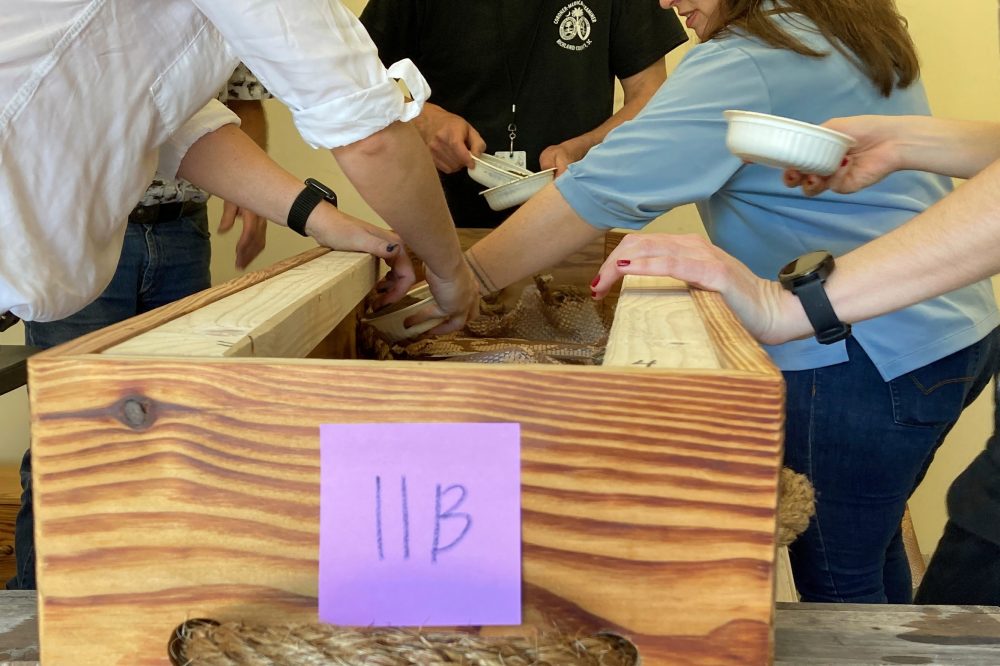
Investigators are continuing their work on a second set of remains, labeled Camden 11A. Peacock has a personal stake in that case — she discovered she is genetically related to that unknown soldier.
“One of the first things I do when I take on a case is I run my DNA against the remains to see if it’s somebody I’m related to, just on the wild chance that it might be,” she said. “It’s never happened before, but I am related to Camden 11A. So, I’m very motivated to get him identified.”
Last month, researchers felt confident enough to officially attach a name to Camden 9B. An emotional ceremony was held at the 19th-century Benson-Hammond House in Anne Arundel County, where relatives of Pumphrey were moved to tears.
“The fact that some archaeologists just happened to stumble on bones that were protruding from the earth, and knowing that it would be difficult to identify those people by DNA, I just found it really exciting,” said Becky Berman of Daytona Beach, Florida, Pumphrey’s first cousin, 10 times removed, in comments to The Associated Press.
For Hudson, the story won’t be complete until the U.S. government formally confirms the findings and replaces the “UNKNOWN” gravestone with Pumphrey’s name. He believes the country owes that much to his fifth great-uncle.
“He sacrificed himself, along with some others,” Hudson said, his eyes filling with tears, “for the sake of this new nation.”