Shares of BMW dropped sharply in early Frankfurt trading on Wednesday, falling 8% after the German luxury automaker issued a profit warning the previous evening that caught Wall Street analysts off guard.
The automaker cited two major headwinds behind the downgrade: persistent weakness in the Chinese market and the ripple effects of the Iran war on vehicle pricing and consumer confidence.
Analysts at both Deutsche Bank and Jefferies noted the size of the profit outlook reduction was far larger than anticipated. The revision brought BMW’s operating automotive margin down to a range of 1% to 3%, compared to its previous forecast of 4% to 6%.
In addition to lowering its profit outlook, BMW announced it would step up its cost-cutting efforts. The company acknowledged those measures would result in a one-time negative financial impact during the second half of 2026, though it offered few additional details.
Analysts at Jefferies suggested the restructuring comments pointed to sweeping changes ahead, saying the overhaul “will largely impact German operations and may address a global assembly footprint business model that is still largely centered on exporting ICE powertrain components from Germany.”
The warning is being viewed by some market watchers as a sign that BMW may be rethinking its broader business strategy in response to shifting global conditions.
NAIROBI, Kenya (AP) — Despite billions of dollars in pledges to support Africa’s shift to clean energy, countless renewable energy projects across the continent are failing to launch — and experts say a little-known financial rule is largely to blame.
The rule, called the “sovereign ceiling,” links the credit rating of any project or company to the credit rating of the country in which it operates. Analysts and development finance specialists say this makes perfectly sound renewable energy projects look far more dangerous to international investors than they actually are.
Of Africa’s 54 nations, only Botswana and Mauritius currently hold investment-grade sovereign ratings, meaning the vast majority of African countries — and the projects within them — are automatically viewed as high-risk borrowers under this framework.
The consequences are significant. The rule is hampering government efforts to bring electricity to more people and honor climate commitments made under the Paris Agreement. According to the International Energy Agency, close to 600 million people across Africa still have no access to electricity.
“The financing environment is the problem,” said Dr. John Asafu-Adjaye, a senior fellow at the African Center for Economic Transformation. “A project with strong fundamentals, a long-term power purchase agreement and predictable cash flow ends up being priced as if it were inherently dangerous. Not because it is, but because of where it sits on a map.”
In practical terms, analysts explain, renewable energy projects in countries with weak sovereign ratings absorb the perception of that sovereign risk — even when the projects themselves are financially solid and backed by international guarantees.
Several high-profile projects have already felt the impact. Kenya’s Menengai Geothermal project, Zambia’s IFC-led Solar Scaling programme, and Nigeria’s Solar IPP pipeline all struggled to secure adequate funding as investors raised concerns about sovereign guarantees, creditworthiness, and financing terms.
The United Nations Development Program estimates that subjective credit rating assessments cost African nations as much as $74.5 billion each year through higher borrowing costs and missed investment opportunities. Analysts add that renewable energy projects in Africa frequently face financing costs two to four times higher than comparable projects in Europe or North America.
“The sovereign ceiling functions as a binding constraint that raises costs across all projects and limits scaling of clean energy deployment regardless of fundamentals,” said Dr. Sibusisi Nkomo, program director of the University of Cambridge Institute for Sustainability Leadership’s Africa Program.
“Our recent work on private finance and investment in Africa shows that international credit rating systems often overstate risk relative to actual project fundamentals, leading to inflated risk premiums and higher costs of capital,” Nkomo added.
The outsized influence of major credit rating agencies — including Moody’s, S&P, and Fitch — along with other Western financial institutions, also shapes how investors view African markets, potentially cutting off access to bond markets as another source of financing, analysts say.
Many African nations see solar, wind, and transmission infrastructure as essential to their economies and industrial growth.
“Electricity is the backbone of all modern economies and is therefore essential for development,” said Malango Mughogho, managing director of ZeniZeni. However, she noted that much of the available project financing comes in the form of loans that countries simply cannot afford to repay.
Maria Nkhonjera, a climate and development finance specialist at the Stockholm Environment Institute, said international credit ratings and what she calls “risk mispricing” unfairly inflate borrowing costs — even though African clean energy projects have relatively low default rates.
“The sovereign ceiling rule is an outdated credit rule that penalizes commercially viable clean energy projects for sovereign risks,” Nkhonjera said.
Beyond the sovereign ceiling, clean energy projects also face hurdles from complicated approval processes, fragmented funding sources, and limited local institutional capacity.
“Africa does not lack investable opportunities,” Asafu-Adjaye said. “What it faces is a system in which risk is systematically overestimated.”
Nkhonjera suggested that expanding low-cost financing, increasing lending in local currencies, and reforming international debt systems could meaningfully reduce borrowing costs. Multilateral institutions such as Afreximbank and the Trade and Development Bank could also play a bigger role by offering guarantees and credit enhancements that help separate individual projects from sovereign risk.
“In many African countries, the cost of capital is now one of the most important determinants of the pace of economic transformation,” Asafu-Adjaye said. “Fixing that system is not peripheral to the development agenda. It is central to it.”
BUNDIBUGYO, Uganda (AP) — Each time Ebola resurfaces, communities face a difficult divide: some of the sick head to the nearest medical facility, while others make their way to a traditional healer’s shrine — a choice that often proves fatal.
Across affected regions, many people interpret the onset of hemorrhagic fever as a spiritual problem rather than a medical one, turning to herbal remedies and prayer rather than hospital treatment. That dynamic is playing out right now in Congo, where the country’s seventeenth Ebola outbreak since 1976 is underway. The virus was first identified that year in the Congo Basin ecosystem.
Fifty years after its discovery, Ebola remains deeply misunderstood by many who fall ill, while religious figures have essentially become first responders in a life-or-death emergency. The current outbreak has claimed the lives of health workers who lacked protective equipment, as well as pastors and congregation members who gathered while the virus was actively spreading, according to humanitarian workers and others who spoke with The Associated Press.
The virus moves from person to person through close contact with the bodily fluids of someone who is sick or has died from the disease. The outbreak is particularly alarming in areas where residents are suspicious of health workers and refuse medical attention.
In Bunia, a town in Ituri province at the center of the outbreak, false information about how Ebola works has severely hampered containment efforts. The outbreak has killed at least 181 people so far. One piece of misinformation circulating in the area claims the virus is deliberately spread by people who drop magical charms attached to dollar bills into pit latrines.
“Some people still describe Ebola as something mysterious, spiritual, or brought by outsiders, rather than a disease that needs medical care,” said Onesphore Bangenza of the aid organization Mercy Corps, speaking from Bunia. “When people do not trust the health system, they often go first to traditional healers, faith leaders, or people they already know. The danger is that many only reach the hospital when they are already very sick.”
This outbreak is caused by the Bundibugyo virus, a rare Ebola strain for which no approved treatments or vaccines currently exist. It is unfolding in a remote part of Congo that is already dealing with armed rebel activity and population displacement. The disease adds another layer of suffering with symptoms that many compare to a modern-day plague.
Health officials confirmed the outbreak on May 15. Some specialists believe infections may have been occurring as far back as February, but early testing was focused on a different virus that also causes Ebola disease.
The World Health Organization quickly classified the situation as a public health emergency of international concern. The United States government has temporarily barred entry to non-U.S. passport holders who have recently traveled to Congo, Uganda, or South Sudan.
With so many community members seeking spiritual explanations for the illness, humanitarian organizations are calling on religious leaders to play an active role in fighting the outbreak.
A video circulating widely among residents of Ituri features a catechist leader from the Ebola hotspot of Mongbwalu who recently recovered from the disease and spoke openly about the choice that nearly cost him his life.
“I don’t usually rush to the hospital, so I decided to go to the fields,” said Deogratias Kasereka, who went on to explain that it was his children who ultimately persuaded him to seek medical care.
His symptoms included muscle weakness, headaches, and a high fever. In its later stages, Ebola can also cause both internal and external bleeding.
The symptoms are not only frightening but sometimes humiliating, which leads some patients to prefer the relative privacy of a traditional healer over a hospital setting, according to Vincent Isimbwa, an elder among Seventh-day Adventists in a Ugandan community that experienced the very first Bundibugyo outbreak back in 2007.
“They faced it so rough,” Isimbwa said. “The challenge with Ebola is that it is so bad that some people can believe that there are supernatural powers behind it.”
That 2007 outbreak killed at least 36 people and left lasting trauma on the community. Many residents also express regret that the Bundibugyo virus bears the name of their district — a mountainous home to roughly 200,000 people, most of whom work as farmers.
In Bundibugyo, a Ugandan nurse whose blood sample confirmed the 2007 outbreak recalled that his early symptoms puzzled medical staff. Some initially thought Samuel Kuule had food poisoning. While others in the community may have sought out traditional healers, Kuule was cared for in a small hospital room by a team of caregivers that included his pregnant wife, who never contracted the disease.
Kuule said his symptoms — peeling skin, bloodshot eyes, and a severe headache — were terrifying, yet they never shook his Seventh-day Adventist faith, as they might have for others who could have interpreted their illness as witchcraft.
“For those who are weak in faith, they may (think) that they are being bewitched,” he said. “Maybe they can believe it.”
Some community members recalled that one of the first victims of the 2007 outbreak was a woman carried down the mountains on a stretcher to a traditional healer’s shrine. That healer — an older man who survived the outbreak — lost three of his sons to Ebola. Speaking through his presumptive heir, Amon Balinda, the healer said he shifted from offering blessings and prayer to prescribing herbal remedies once he learned Ebola was spreading.
“For us in African traditional societies, in most cases when you fall sick and you go to the hospitals and they give you some injections and there is no improvement, there and then you switch to your neighbor, or anybody, and say maybe he is the one bewitching you,” he said. “Then you decide to go to the witch doctor.”
Scientists believe Ebola outbreaks typically begin when the virus jumps from an infected animal — such as a fruit bat — to a human host. These cross-species transmissions often occur when people handle or consume wild meat, according to experts.
The WHO is urging early testing and the isolation of anyone who may have been exposed in the current outbreak.
Both goals are difficult to achieve in communities with strong religious traditions, whether Christian or traditional. Many insist on following established burial customs, believing that departing from them could prevent the deceased from reaching the afterlife. Pastors whose standing depends on their ability to heal are expected to lay hands on the sick. Traditional healers face the same expectations.
These concerns prompted Ugandan President Yoweri Museveni to publicly criticize religious leaders in a recent televised address, telling them there was no need to physically touch the sick during an Ebola outbreak. He noted that the WHO chief, Tedros Adhanom Ghebreyesus, had told him during a visit to Uganda that many of the victims in Congo are people of faith.
“The pastors, the pastors, the pastors,” Museveni said, visibly frustrated. “The people of God — they are the ones who touch patients. … God is not deaf. You can pray without touching.”
BOGOTA, Colombia — Just a few years ago, Latin America appeared to be shifting decisively to the left. Progressive leaders, capitalizing on widespread anger over deep-rooted inequality made worse by the COVID-19 pandemic, rose to power in several of the region’s largest nations, including Brazil, Chile, Colombia, and Peru.
But the political winds are shifting again. While overall homicide rates across Latin America have generally fallen compared to a decade ago, sharp increases in violence in certain countries — combined with a broader regional rise in crimes like extortion — have given conservative populists fertile ground to campaign on promises of iron-fisted crackdowns on crime and immigration.
Campaign rhetoric portraying migrants as criminals and embracing the aggressive security tactics championed by El Salvador’s president, Nayib Bukele, has earned conservative candidates the endorsement of U.S. President Donald Trump and energized frustrated voters — even as critics raise alarms about the potential for human rights abuses and democratic backsliding.
“You have an emergent right wing that is very much in collaboration across the region and with the U.S. through the MAGA movement, which has also used crime as a rallying cry for political mobilization,” said Enrique Roig, vice president of the nonprofit Human Rights First and a former State Department official. “It’s easier to sell locking people up than it is to deal with the reasons why mainly young men join gangs in countries like El Salvador.”
Populist politicians across the political spectrum have found success, but only those on the right have offered quick security fixes that make voters “feel safer in six months” — even if that means having to “sacrifice democracy and human rights,” according to Adam Isacson, director for defense oversight at the Washington Office on Latin America organization.
He noted that left-wing proposals — such as community violence prevention programs, improved police training, and reforms to the justice system and prisons — require much more time before results are visible.
“It’s absolutely what you’re supposed to be doing, but people’s patience runs out,” Isacson said of those longer-term strategies. “So, there come the Bukeles of the world saying, ‘You want to feel better? We got this.’”
In Colombia, where large portions of the countryside have descended into renewed conflict, pro-Trump businessman Abelardo de la Espriella has led polls ahead of a presidential runoff election while closely mirroring Bukele’s approach.
In Peru, where extortion has jumped fivefold over the past five years, Keiko Fujimori surged into a June 7 presidential runoff on a law-and-order platform. She has pledged to station military forces in prisons and along the country’s borders, leaning on the authoritarian legacy of her late, disgraced father, former President Alberto Fujimori.
Costa Rica, shaken by record levels of drug-related killings, chose conservative populist Laura Fernández in February based on her hard-line stance on crime. In Honduras, businessman Nasry Asfura swept December’s election after Trump endorsed him as a partner in the battle against what Trump called “narco-communists.”
According to InSight Crime, a think tank focused on organized crime in the Americas, the combined average homicide rate across Latin America and the Caribbean dropped by more than 5% last year compared to 2024, with the median rate reaching approximately 17.6 deaths per 100,000 people.
However, notable exceptions exist. Drug-fueled killings have climbed in Peru and Colombia — the world’s two largest cocaine producers — as well as in neighboring Ecuador, whose major seaports are prized by traffickers as a gateway to European markets.
Last year, authorities recorded 2,400 homicides in Peru and 14,780 in Colombia — the highest totals in each country since at least 2020. In Ecuador, killings surged a striking 31% year over year, reaching 9,216.
Much of Ecuador’s violence is attributed to gangs that began expanding rapidly during the COVID-19 pandemic, as criminal organizations from Mexico, Colombia, and the Balkans moved in and recruited local members, igniting deadly battles over drug-trafficking corridors. Those conflicts have extended into prisons, where hundreds of inmates have been killed since 2021. Ecuadorian authorities also logged more than 16,100 extortion cases last year, down from 23,000 in 2024 — though experts caution that extortion is widely underreported.
In Chile, voters four years ago rejected ultra-conservative lawmaker José Antonio Kast in favor of then-candidate Gabriel Boric, a young former student protest leader who promised to tackle Chile’s deep social inequities. Last year, however, growing fears about rising crime — frequently linked in media coverage to the country’s expanding Venezuelan immigrant population — helped Kast mount a political comeback.
As Venezuelan criminal networks, including the Tren de Aragua gang, exploited their country’s mass migration to infiltrate human trafficking operations following the pandemic, Chile — long among the safest nations in Latin America — experienced an unprecedented wave of carjackings, kidnappings, and shootings.
Chile’s homicide rate climbed 30%, peaking at 6.7 per 100,000 people between 2021 and 2022, according to the country’s Interior Ministry. Though it has since declined, it remains above pre-2021 levels. Other violent crimes continue to rise — kidnappings, for example, have increased nearly 180% over the past four years.
Taking cues from Bukele — whose mega-prisons in El Salvador Kast visited during his campaign — Kast decisively defeated his Communist opponent in December by pledging to construct a massive border wall, harden prison conditions for gang members, and deport hundreds of thousands of undocumented migrants. Voters largely overlooked his opposition to abortion rights and same-sex marriage, as well as his defense of the late dictator Augusto Pinochet’s brutal regime.
In Peru, despite the divisive legacy of the convicted Alberto Fujimori, his daughter has capitalized on a surge in violent crime that occurred in the four years since she narrowly lost the presidency to schoolteacher Pedro Castillo. Running under the slogan “Peru with Order,” Keiko Fujimori captured the largest share of votes in April’s first round. Results from the June 7 runoff still show her in a statistical tie with nationalist Roberto Sánchez, the political successor of the imprisoned Castillo.
Analysts say that public appetite for tough measures — historically tied to the region’s brutal right-wing dictatorships of the 20th century — has grown in step with declining trust in government institutions and increasing ambivalence about democracy itself.
“The thinking is often, ‘democracy hasn’t been able to keep me and my family safe, so maybe democracy is part of the problem,’” said Eduardo Moncada, director of the Institute of Latin American Studies at Columbia University.
That sentiment presents a serious challenge for Latin America’s left, which in many countries has overseen sluggish economic growth, become entangled in corruption scandals, and fallen short on promises of social reform.
Even progressive politicians — such as Jeannette Jara in Chile and Sánchez in Peru — have adjusted to the shifting political climate. Uruguay’s president, Yamandú Orsi, described Bukele’s model as worth studying further. The center-left government of Guatemala declared a state of emergency to combat gang violence this year and welcomed assistance from the Trump administration in targeting drug traffickers.
Yet newly elected hard-liners have found that the realities of governing complex, cash-strapped democracies like Ecuador and Chile are far removed from the simplicity of campaign promises. These nations bear little resemblance to tiny El Salvador, where Bukele’s party commands a legislative supermajority.
Ecuador’s President Daniel Noboa campaigned in 2023 on promises to imprison gang leaders on floating barges and construct mega-prisons. He dropped the barge proposal after taking office, and his government didn’t open its first mega-prison until November.
“Building mega-prisons hasn’t been that easy or that straightforward because the country is in a very bad state financially and because President Daniel Noboa still sees himself as a democrat,” said Beatriz García Nice, a policy analyst at the Washington-based Stimson Center think tank.
Nearly three months into his time in office, Chilean President Kast is facing a skeptical public that says it cannot distinguish his security policies from those of his left-wing predecessor. His government has carried out only two deportation flights despite pledging to swiftly round up and remove Chile’s more than 300,000 undocumented immigrants. His public tone has noticeably softened, and last month he drew criticism after referring to his mass deportation promise as “a metaphor.”
Even as he unveiled new security proposals in a June 1 address — including stripping those convicted of attacking police officers of social benefits — he moved to temper his supporters’ expectations.
“Governing, as many of you know, means taking responsibility for reality, especially when it’s difficult,” he said. “I’m proceeding step by step because this isn’t something that happens overnight.”
The U.S. military carried out an attack Tuesday on a vessel suspected of transporting illegal drugs in the eastern Pacific Ocean, resulting in one fatality and two survivors, as the Trump administration presses forward with its ongoing campaign against alleged drug traffickers in Latin America.
With this latest strike, the total number of people killed in U.S. military boat attacks has reached at least 208 since the Trump administration began going after those it labels “narcoterrorists” in early September.
U.S. Southern Command, consistent with how it has handled most of its announcements about strikes in the eastern Pacific and Caribbean Sea, stated that the vessel was targeted along known drug smuggling routes. However, the military offered no evidence confirming the boat was actually carrying drugs. A video shared on X captured the boat moving through the water moments before the strike hit, sending it up in flames.
Southern Command stated that it “immediately notified U.S. Coast Guard to activate the Search and Rescue system for the survivors.”
President Donald Trump has described the U.S. as being in “armed conflict” with Latin American cartels, arguing the strikes are a necessary step to cut off the drug supply flowing into the country and reduce deadly overdoses among Americans. Despite those claims, his administration has provided little supporting evidence that those killed were in fact “narcoterrorists.”
Critics have raised doubts about both the legal basis for the strikes and whether they are actually working, pointing out that fentanyl — the drug responsible for many fatal overdoses — is typically brought into the United States over land from Mexico, where it is manufactured using chemicals sourced from China and India.
The strikes have come under heavy scrutiny from some Democratic members of Congress and legal experts who study military law. The very first strike in early September raised particular alarms among certain lawmakers and military law scholars.
In that initial attack, nine people were killed, and two men who initially survived were holding onto the wreckage when the boat was struck a second time, killing them both. The White House confirmed the follow-up strike, defending it as an act of “self-defense” aimed at ensuring the vessel was fully destroyed and conducted within the laws of armed conflict.
However, some legal scholars argued that striking survivors a second time would have been unlawful regardless of whether an armed conflict was underway.
The Pentagon’s internal watchdog announced in May that it intends to examine whether the military followed a proper targeting framework when conducting the strikes. That review, however, is focused narrowly on what is known as the six-phase Joint Targeting Cycle and does not address the broader question of whether the strikes were legal, according to the inspector general’s office.
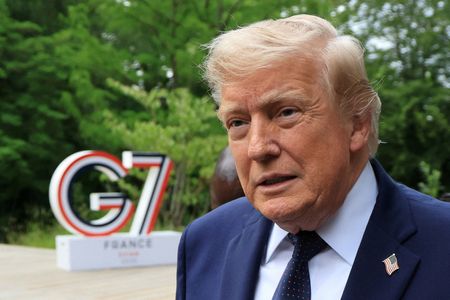
EVIAN-LES-BAINS, France — The heads of government representing the G7 nations announced Wednesday that they stand firmly together in their support for Ukraine, reaffirming their commitment to the country’s territorial integrity while agreeing to turn up the heat on Russia’s war-driven economy.
In a joint statement released by the group, the leaders declared, “In this context, we will strengthen our sanctions (against Russia), including those on the oil and gas sectors.”
The announcement came as the G7 leaders convened for a summit in the French town of Evian-les-Bains. Beyond the conflict in Ukraine, the group also addressed broader global developments, expressing their support for the recently reached agreement between the United States and Iran and signaling their willingness to help carry out its terms.
The leaders also outlined steps to improve global energy security, stating their intention to work toward diversifying energy supply routes, reducing reliance on the Strait of Hormuz, and building up energy reserves.
WASHINGTON — When the leaders of the world’s seven largest economies sit down in France on Wednesday to talk about the global economy, one major topic will be conspicuously absent from direct criticism: the role that President Donald Trump’s war with Iran has played in rattling global markets.
Oil prices have surged 30% and inflation is climbing worldwide — both largely tied to the conflict that the U.S. and Israel launched against Iran in late February. Yet G7 leaders, already strained by disputes over U.S. tariffs, NATO, and Greenland, are expected to hold back from publicly blaming Trump for the economic turbulence, according to analysts.
Over the weekend, the U.S. and Iran announced a deal to halt the fighting and reopen the Strait of Hormuz, which gave global markets a much-needed boost. But economists caution that the damage is already done — energy costs have spiked, food supply concerns are mounting in developing nations, and central banks have been forced to act. Both the European Central Bank and the Bank of Japan raised interest rates within the past week in an effort to contain worsening inflation.
British Prime Minister Keir Starmer has publicly said he is “fed up” with how the conflict has driven up energy costs for his country. Italian Prime Minister Giorgia Meloni has warned of the war’s broader economic and social consequences. Rising prices have also taken a toll politically, denting approval ratings for Starmer, German Chancellor Friedrich Merz, and French President Emmanuel Macron.
Despite all of this, world leaders appear set to avoid a direct confrontation with Trump at the summit, largely because they still need his cooperation on critical issues including Ukraine, NATO, and trade negotiations.
Analysts say this reluctance is undermining the very purpose of the G7, which was founded after the 1973 oil shock specifically to help the world’s major economies navigate exactly these kinds of crises.
“U.S. policymaking has been hurting world economic activity,” said Marcelo Estevao, chief economist at the Institute of International Finance. “You have a country with the largest economy undermining what could have been a G7 agenda of collaboration,” he added, noting that the G7 must work harder to stay relevant as emerging market economies — which are not part of the group — now make up a growing share of the global economy.
France, serving as this year’s G7 host, has already moved to reduce the chances of open conflict by scrapping plans for a broad final statement, or communique. Instead, the focus will be on narrower topics such as global economic imbalances, critical mineral supply chains, and restructuring development aid programs.
The ceasefire deal reached just before Trump departed for France has further reduced the likelihood of a dramatic showdown. Still, economists warn that even with the deal in place, restoring normal trade flows could take months, and experts in the fuel and maritime sectors say bunker fuel supplies could take up to a year to normalize.
International Monetary Fund chief Kristalina Georgieva, attending the G7 summit in France, took a somewhat more optimistic tone in a blog post Monday, walking back some of the dire warnings she issued two months ago. She said the global economy was holding up so far, with no clear signs of a worldwide slowdown, even as some regions have been hit hard.
The IMF, whose largest shareholder is the United States, is set to release an updated global economic forecast on July 8. Georgieva’s post came shortly after a more pessimistic outlook from the World Bank. One of the IMF’s scenarios, based on a short-lived conflict, projects global growth of 3.1% in 2026, down from 3.4% in 2025. Its worst-case scenario shows growth dropping to just 2%, with inflation reaching 5.8%.
U.S. officials have pointed out that oil prices have come down from their peak and that the United States, as a fuel exporter, was somewhat insulated from the worst price increases. They argue the war’s economic impact will ease quickly once the Strait of Hormuz fully reopens, and believe even fuel-importing nations in Europe are likely to avoid severe shortages.
The G7 — made up of the major European economies along with the U.S., Canada, and Japan — has been grappling with questions about its relevance for years as economies like India, Brazil, and China have grown in global influence. The group now represents just 44.1% of global GDP, a sharp drop from 60.5% when it was first established, according to the Center for Strategic and International Studies.
Supporters of the group argue it still serves a vital function during moments of crisis, pointing to its response during the 2008-2009 global financial meltdown.
“The G7 has always been able, if needed, to come up with some real decisions that still govern half the world economy,” said Martin Muehleisen, a former IMF strategy chief who has participated in past summits, including some that included Trump. He noted that while European leaders would likely stay cautious in formal settings, unexpected moments of tension could still emerge during private meetings and dinners.
Eric LeCompte, executive director of Jubilee USA Network, a development organization, said economic concerns remain front and center regardless of the ceasefire. “The economy is in deep turmoil and you don’t have to be in a developing country to see it. You can just go to a grocery store and feel it,” he said.
ASTI, Italy — In just a matter of months, Irene Roggero Ugues watched helplessly as her daughter Rossella’s personality shifted dramatically, driven by a relentless stream of self-harm content pushed to her through social media. The 12-year-old ultimately died by suicide.
It was only after Rossella’s death that her parents unlocked her devices and discovered the full extent of her online activity. She had been using social media far more than they had realized, including a secret Instagram account she had named ‘Just a dead pers0n’ — spelling the word ‘person’ with a zero in place of the letter o.
According to her parents, Rossella began seeking out depressive content in September 2023, content that reflected her inner emotional state. Social media algorithms continued feeding her more of the same material, and within five months, she was gone.
“At some point, it seemed to take on a life of its own, growing until it overwhelmed the cheerful, sociable side of her — the brighter part,” Irene told Reuters during a meeting at a café in her hometown of Asti, in northern Italy.
Rossella’s family is among several Italian families who have joined a lawsuit against Meta — the company that owns Instagram and Facebook — and its major competitor TikTok. It marks the first collective legal action in Italy to directly challenge social media companies and the algorithms that drive their platforms. The families are pushing for stricter limits on minors’ access to these platforms and greater public awareness of the dangers they pose.
Both companies have rejected the lawsuit’s claims that their services cause harm to young people. They say they actively work to protect younger users by removing dangerous content, reducing exposure to risky material, and offering tools to help parents oversee their children’s accounts.
“We know parents worry about the safety of their teens online, which is why we’re consistently making changes to help protect teens,” a Meta spokesperson said, pointing to the company’s “Teen Accounts” feature and other built-in protections. “We strongly disagree with these allegations, which ignore our longstanding commitment to supporting young people.”
TikTok, for its part, said it strictly enforces guidelines designed to protect users’ mental and behavioral health, and that it removes more than 99% of content found to violate those standards. “We also continue to invest in safety measures to diversify recommended content, block potentially harmful searches and connect vulnerable users with support resources,” a TikTok spokesperson said, also referencing local suicide prevention resources.
When asked specifically about Instagram’s possible role in Rossella’s case, Meta said it would not comment on the matter while litigation is ongoing, but noted that young people’s mental health is influenced by many different factors. The company said the impact of social media depends on how platforms are used, what safeguards exist, and how involved parents are.
Irene described the tragedy as unfolding like a sudden and devastating “illness” that left her and her husband with no power to stop it. She believes the algorithm accelerated everything. “The progression of her distress — or psychosis, or whatever it was that I still cannot define — might have unfolded more naturally” without it, she said.
This legal battle is taking place against a broader backdrop of growing scrutiny of social media platforms across Europe. Britain recently announced plans to ban social media use for children under 16. In the United States, a court ruling found Meta and Alphabet’s Google negligent in designing platforms considered harmful to young people. Meanwhile, European Union regulators are increasing enforcement of the Digital Services Act, pushing online platforms to do more to protect minors and limit harmful content.
“The goal is not to dismiss the benefits of social media, but to remove the technological and marketing mechanisms that make it harmful to the most vulnerable users,” said lawyer Stefano Commodo, who is leading the lawsuit alongside the Italian parents’ association MOIGE.
Many parents involved in the case say the safety tools offered by these platforms are inadequate, pointing out that children can easily find online tutorials explaining how to bypass filters or get around screen time limits by switching to a different device.
“Monitoring social media use is a full-time job. It would require parents to spend all their time doing it, and that is simply unrealistic,” said Valentina Muraglie, a board member of Italy’s association of large families.
Muraglie shared her own experience with her son Antonio, who as a teenager put down his Harry Potter book collection and replaced reading with scrolling through social media. Now in his twenties, he struggles to read at length — something she attributes to the way social media algorithms eroded his attention span. “Once he had a phone in his hand, at 16, little by little books started to disappear,” she said. “Within a few years he stopped reading altogether.”
The World Health Organization has warned that addiction-like social media behavior is on the rise among adolescents and is associated with reduced well-being, disrupted sleep, and other health risks. Research published in JAMA Pediatrics, a U.S. medical journal, has identified measurable differences in brain development among teenagers who are heavy social media users — a population whose brains are still in the process of developing.
The Italian lawsuit argues that social media platforms use reward systems modeled after slot machines to keep users hooked, repeatedly stimulating the release of dopamine — a brain chemical associated with pleasure and reward. “Each ‘like’ or notification triggers dopamine release, tying users to the platform in a way that resembles addiction,” said Tonino Cantelmi, an advisor to the plaintiffs and director of the School of Specialisation in Cognitive-Interpersonal Psychotherapy in Rome.
The families involved in the case say brain imaging studies of social media users show activity in regions of the brain linked to addictive behavior. Spokespeople for both Meta and TikTok declined to address the scientific evidence on addiction presented in court, reiterating their earlier statements about their companies’ commitment to mental health.
Some mental health professionals urge caution when drawing sweeping conclusions about social media’s effects on young people. Federico Tonioni, who leads the Web Psychopathology Centre at Rome’s Gemelli hospital, said, “The healthiest approach when dealing with adolescents is to accept that we are unprepared.” He added that he could not say with certainty that his patients would be better off in a world without social networks, and cautioned against putting too much emphasis on parental control. “If there is something dangerous, it is control over children. Young people need to be listened to. Control is not a healthy form of presence. The healthiest distance is trust,” he said.
Irene Roggero Ugues said she joined the lawsuit so that other parents can be warned about dangers she only learned of after it was too late for her daughter. “We underestimated certain risks and didn’t know they existed, but others can still act. There’s no point keeping this to myself, and I don’t think Rossella would mind,” she said.
A boat believed to be smuggling drugs through the eastern Pacific Ocean came under U.S. military attack on Tuesday, leaving one person dead and two others alive.
The strike brings the running total of people killed in similar military boat attacks to a minimum of 208.
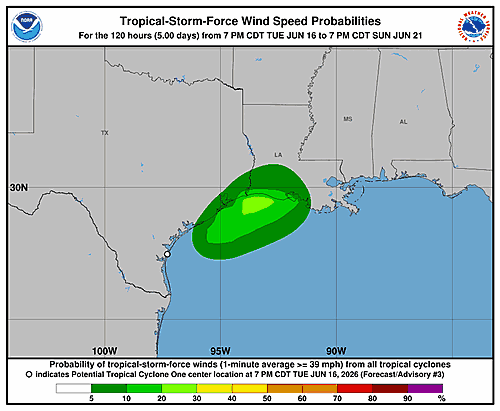
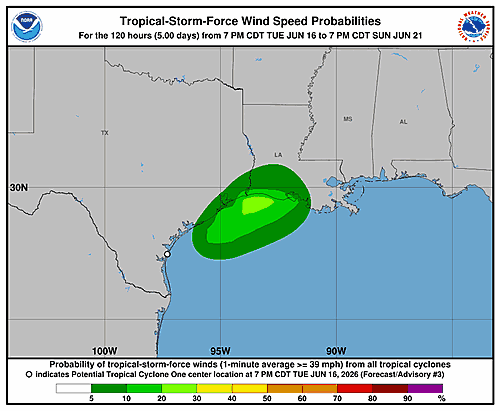
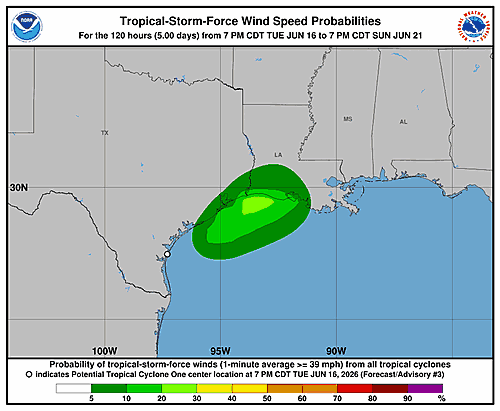
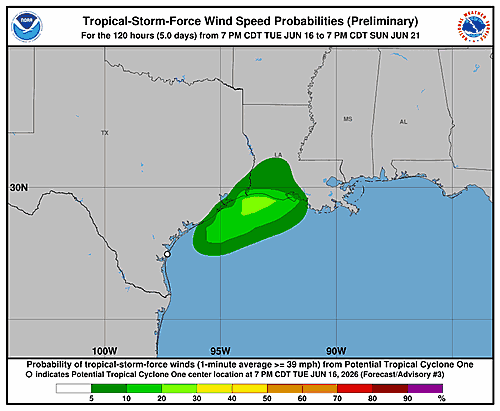
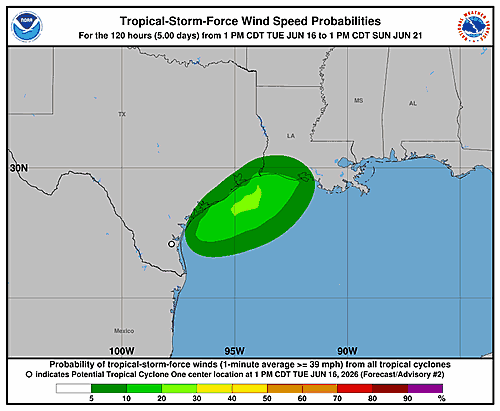
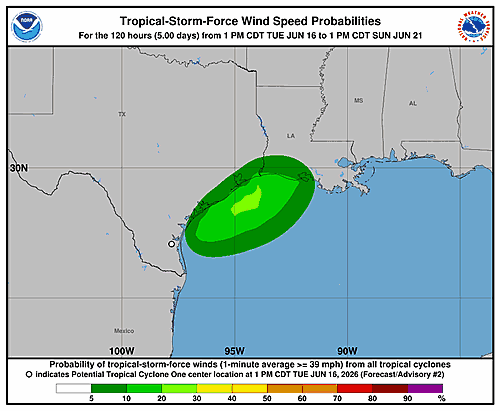
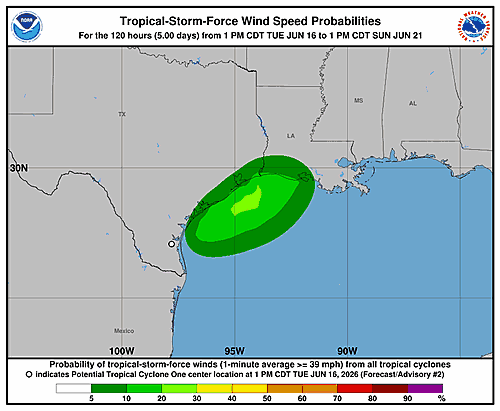
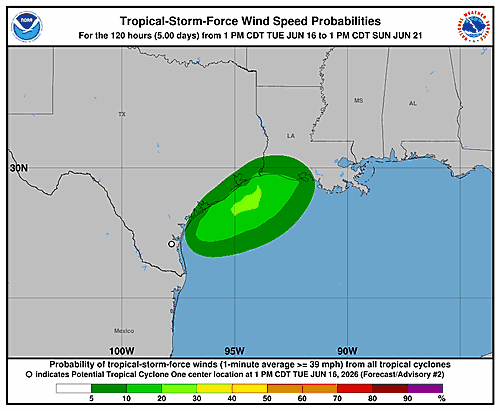
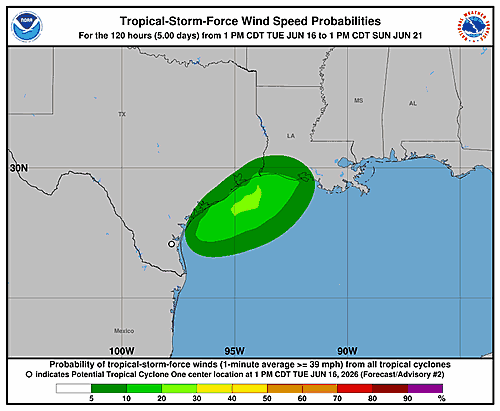
The National Hurricane Center has issued updated wind speed probability graphics for Potential Tropical Cyclone One, designated as system AL012026 in the Atlantic basin.
The graphics show the probability of 34-knot or higher wind speeds affecting various areas over a 120-hour forecast period. These probabilities help residents and emergency managers assess the likelihood of tropical-force winds reaching their locations.
The wind speed probability information was last updated Wednesday, June 17, 2026, at 3:22 a.m. GMT. Forecasters urge those in potentially affected regions to continue tracking the system as it develops and to follow guidance from local emergency management officials.
WASHINGTON — When the United States and Israel launched airstrikes against Iran on February 28, President Donald Trump outlined an ambitious set of goals: destroying Iran’s ballistic missile arsenal, dismantling its military power, and making certain Tehran could never develop a nuclear weapon.
Now, with more than three months of conflict behind them and a preliminary peace agreement on the table, the question is: how much of that agenda has actually been fulfilled?
MISSILES AND DRONES
Going into the conflict, Iran possessed the largest ballistic missile stockpile in the Middle East — somewhere between 2,500 and 6,000 missiles of varying types. Several had the range to strike Israel, reaching up to 2,000 kilometers (roughly 1,240 miles), and some were armed with cluster munition warheads that are especially difficult to intercept. Iran was also a major producer of long-range drones, including the Shahed drone used by Russia against Ukraine and by Iran itself.
About a month into the fighting, U.S. sources told Reuters that approximately one-third of that arsenal had been destroyed, with another third likely damaged, destroyed, or buried.
U.S. Admiral Brad Cooper testified before Congress on May 14 that Iran’s capacity to manufacture and stockpile missiles and long-range drones had been set back by years. He reported that more than 1,500 missiles and 6,000 drones had been intercepted by the U.S. and allied forces throughout the conflict.
Even so, Iran retains some strike capability. On June 6, it launched missile salvos at Kuwait and Bahrain, and on June 7, it fired missiles at Israel. All three countries reported no significant damage from those attacks.
CONVENTIONAL MILITARY
The U.S. military says it has significantly weakened Iran’s conventional ability to project force in the region or threaten American operations.
Admiral Cooper told Congress that U.S. forces had destroyed 161 Iranian naval vessels and eliminated 82% of Iran’s air defense systems. He added that Iran’s air force, which had been flying up to 100 missions per day before the war, is now conducting no flight operations at all.
Despite those losses, Iran managed to effectively close the Strait of Hormuz for the duration of the conflict — using speedboats, mines, drones, and missile boats to trap merchant ships in the waterway. That strait carries roughly one-fifth of the world’s oil and natural gas supply.
NUCLEAR PROGRAM
Trump has repeatedly identified preventing Iran from acquiring a nuclear weapon as his primary objective. Iran has consistently denied any intention to build one, insisting its nuclear program exists solely for peaceful purposes.
However, the war appears to have done little to change Iran’s nuclear timeline. U.S. intelligence estimated last month that Iran could produce a nuclear weapon in less than a year — the same assessment that followed the June 2025 strikes on Iranian nuclear facilities.
Iran’s nuclear program is expected to be a central sticking point as negotiators work toward formalizing the framework deal, set to be signed on Friday. Trump has demanded that Iran’s enriched uranium be removed from the country, while Iran’s Supreme Leader Ayatollah Mojtaba Khamenei has insisted it must remain inside Iran, according to sources.
IRANIAN PROXY FORCES
On March 2, Trump said from the White House that Iran must not be allowed to continue arming and financing the proxy armed groups operating in Iraq, Lebanon, Gaza, and Yemen — a network Tehran has used for decades to extend its influence and pressure its enemies.
Iran has shown no sign of cutting off support for those groups since the war began, but both U.S. military and independent assessments conclude that the proxy network is far less effective than it once was.
Much of that weakening had already occurred before the latest conflict. Israel had killed many of Hamas’s top commanders and thousands of its fighters in Gaza following the October 7, 2023 attack, and had also eliminated much of Hezbollah’s leadership in Lebanon. The fall of former President Bashar al-Assad’s government in Syria in 2024 cut off a key supply route Iran had used to arm Hezbollah. Economic troubles and international sanctions further limited Iran’s ability to fund these groups.
During the war, those groups played a limited role. Hamas did not launch attacks on Israel from Gaza, and the Houthis did not significantly disrupt Red Sea shipping from Yemen.
Hezbollah entered the conflict on March 2, firing missiles and drones into Israel. Israel responded with airstrikes and a ground invasion that has killed nearly 3,700 people and displaced 1.2 million in Lebanon. On the Israeli side, approximately 28 soldiers and four civilians have been killed.
Admiral Cooper told Congress in May that Iran can no longer reliably supply those proxy groups with advanced weapons, though he did not elaborate on what that assessment specifically means in practice.
REGIME CHANGE
Before the war, Trump had encouraged Iranian citizens to rise up against their government. After Supreme Leader Ayatollah Ali Khamenei died on February 28, Trump called it their “single greatest chance” to take control. On March 6, he declared the war would only conclude with “UNCONDITIONAL SURRENDER” from Iran and the installation of a new, “acceptable” leader.
The war did not topple Iran’s theocratic government, but Trump has argued he achieved his objective anyway — because Khamenei was succeeded by his son, Ayatollah Mojtaba Khamenei. Trump described the new leadership as “a new, and more reasonable, regime” in a March 29 statement.
In recent weeks, Trump has stopped calling for the removal of Iran’s leadership.
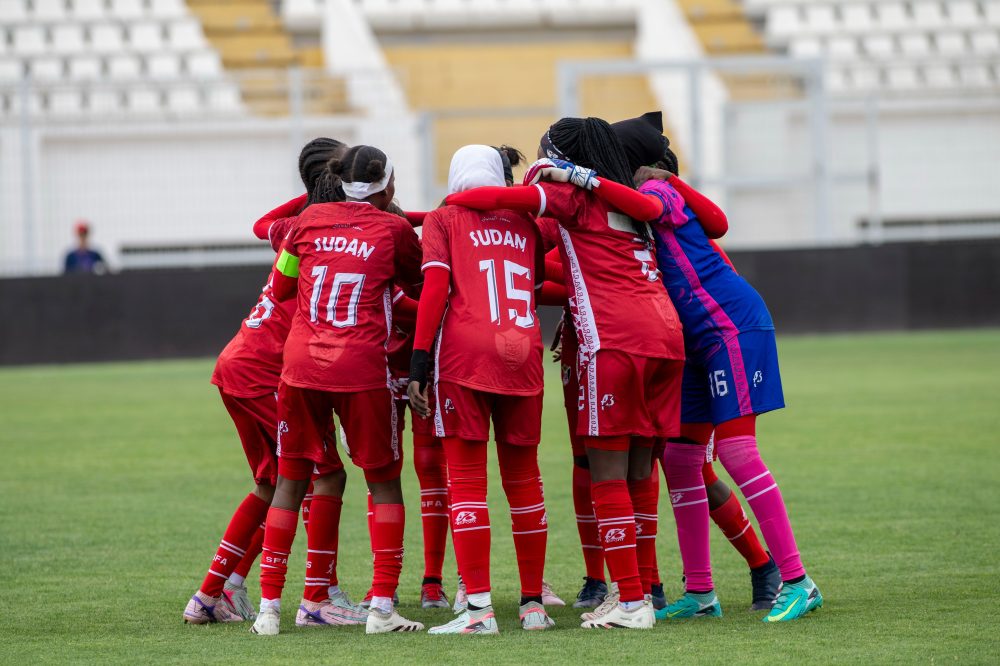
CASABLANCA, Morocco — Their bright red jerseys contrasted sharply against the green grass. Most of the players were teenage girls. Some had escaped a raging civil war. Others had never competed in an organized soccer league or stepped inside a major stadium before this moment.
But when they walked onto the pitch at Larbi Zaouli Stadium in Casablanca, Morocco, they made history — Sudan’s first appearance in international women’s soccer since civil war tore the country apart, in a nation where women playing sports has long been a deeply contested issue.
“My goal is to lift up soccer in my country,” said Nura Mohamed, the team’s 17-year-old captain, speaking to the Associated Press. “It’s a beautiful, unique feeling because, at the end of the day, I just love playing.”
Sudan’s under-17 women’s national team traveled to Morocco last week to compete in qualifying rounds for the 2028 Los Angeles Olympics. The inexperienced squad was overwhelmed by Comoros, giving up 30 goals across two matches. After the final whistle, with only a handful of fans cheering from the stands, many of the players wept.
They were up against an older, more physically developed, and far more experienced opponent. Sudan’s soccer federation, unable to field a senior women’s team in time, chose to enter the younger squad rather than forfeit their spot in the competition. The girls had only begun training a few weeks before the tournament.
“The difference between us and the others is huge. We cannot yet compete at the highest level,” said Burhan Tia, a veteran Sudanese soccer coach who oversees all of Sudan’s women’s national teams, speaking after the first match — a 17-0 loss. “Comoros has many players competing in Europe, our team is mainly made up of schoolgirls.”
Women’s soccer in Sudan effectively collapsed when the civil war broke out in 2023. For federation officials, getting this young team onto an international stage after years of conflict represents a meaningful step toward keeping the women’s game alive in the country.
“Some traveled long distances just to attend training. Many are separated from their families, yet they continue to work hard and pursue their dream,” said Manal Ali Bushra, a businesswoman who leads the women’s soccer committee, in comments to the AP.
Ali Bushra said the federation is pursuing infrastructure improvements, including a planned sports city and the renovation of key stadiums in more stable regions of the country. She declined to discuss the women’s program’s budget or financial backing.
Coach Tia understood the scale of the challenge when he agreed to take on the task of rebuilding a program that had fallen apart.
“First, I had to find girls who played soccer. Then, once I found girls who played, I had to make sure they were the right age,” he said. “Then I needed to convince their parents to let them miss classes for training.”
With the domestic league shut down, Tia’s search for players took him to schools throughout Sudan and to neighboring Egypt, where many Sudanese families had taken refuge from the fighting. He brought in 10 players from clubs and academies in Cairo, with the remainder coming from cities inside Sudan.
He had hoped to recruit from conflict-affected regions like Darfur or Kordofan — an area historically known for producing some of Sudan’s finest athletes — but many girls there had lost their identification documents, making it impossible to verify their ages under international soccer rules. The war has also devastated transportation infrastructure, turning trips that once took a few hours into dangerous journeys spanning several days.
On the field, the players’ limited experience showed. Several had difficulty with basic positioning, struggling to hold an offside line or maintain any tactical structure. Throughout the matches, they frequently looked to the sidelines for guidance from Tia and his assistant coach.
The United Nations has called the war in Sudan the world’s worst humanitarian crisis. The conflict began in 2023 when a power struggle between the military and the paramilitary Rapid Support Forces exploded into open warfare, bringing with it mass killings, rape, and ethnic violence. The U.N. reports more than 40,000 people have died, and over 14 million have been displaced, with famine and disease spreading across parts of the country.
The war brought all sports activity to a halt, including the women’s soccer league, which was formally established following the 2019 revolution that removed President Omar al-Bashir from power. His three decades of Islamist rule were defined by Public Order Laws that rights organizations said severely restricted women’s freedoms. Even after his removal, a prominent Sudanese religious figure publicly claimed the creation of a women’s football league was an attack on religion.
“The idea of women running, jumping, sweating, and even something as simple as their bodies being visible in motion, was seen by Bashir’s Islamist regime as producing fitna, which in a Sudanese context was understood as sexual or moral chaos,” said Liv Tønnessen, a political scientist who researches gender politics in Sudan, in comments to the AP.
“So when women step onto a soccer pitch, they are directly confronting that entire logic. They are not just present in a male-dominated sports arena, they are moving freely in it, on their own terms,” added Tønnessen, who previously served as a guest researcher at a women-only university in Sudan.
Beyond the institutional obstacles, players also faced a flood of sexist harassment online. Comment sections on the national team’s social media pages were filled with people mocking the squad over their lopsided losses. Others posted messages telling the players to “go back to the kitchen” — in multiple languages.
While Gen. Abdel Fattah al-Burhan’s military government has permitted international soccer travel for the teenage players, the U.N. has documented sexual and gender-based violence carried out by the Sudanese Armed Forces, which he commands.
Tønnessen views the government’s support for the team as a strategic move by the military to appear legitimate. By backing the squad, she argues, the military is trying to signal that the country is functioning normally and to associate itself with the spirit of the 2019 revolution.
Hala Al-Karib, a prominent Sudanese women’s rights activist, pushed back against critics who argue the team is simply being used to project a more progressive image on women’s rights.
“The main challenge for me is a reform of the federation,” she told the AP, pointing to what she described as a lack of real investment in and support for women’s soccer in Sudan.
But back on the pitch in Casablanca, the politics, the war, and the debate all seemed to fade into the background — leaving nothing but a group of teenagers chasing a ball.
BUCHAREST, Romania — A striking new exhibition now open in Romania’s capital city is pulling back the curtain on the terrifying methods used by the country’s communist-era secret police — and it’s doing so using the secret police’s own recordings.
On display at the National History Museum of Romania in Bucharest, the exhibition is titled “A.REST 1989: The Securitate Video Archive.” It draws on actual video footage to show how arrests and interrogations were conducted under the Securitate — the vast surveillance and enforcement network that kept Nicolae Ceausescu in power until he was toppled and executed in December 1989.
Visitors can watch original, grainy videotaped interrogations of four detainees, shown on wall-mounted monitors in the museum’s main hall. All of the recordings were made in 1989 by the Securitate’s Criminal Investigations Directorate.
At the center of the exhibition floor sits a reconstructed detention cell, outfitted with a small bed, a bare metal bowl, and a cup — a stark reminder of the isolation prisoners endured. The display also illustrates the sweeping reach of the Securitate and the methods its agents employed against those they investigated.
Many of the recordings capture coercive questioning and intimidation that sometimes veers into the absurd, as detainees are worn down or left confused. In one exchange, a woman whose husband had allegedly fled the country tells her interrogator: “I no longer have the strength to fight. I need logical arguments, not this nonsense.”
The exhibition’s organizers describe the Securitate’s version of justice as a system in which detainees “were merely prisoners, captives in the operational labyrinth of manufactured guilt.” They say the exhibition can serve as a long-overdue “memorial plaque” for victims, noting that “the victims, thus, gain a voice and a place.”
The show runs through mid-September and was organized as a joint effort between the National History Museum, Romania’s National Council for Studying the Securitate Archives — known as CNSAS — and the Ministry of Culture.
According to organizers, the 26 videotapes held by CNSAS are “a remnant, the accidental result of the disorderly and violent end” of socialist Romania, captured by the criminal investigations technical department in 1989.
Oana Demetriade, a historian at CNSAS and one of the exhibition’s curators, told the Associated Press that she originally envisioned using the tapes for a documentary aimed at students, but ultimately chose to create a museum exhibition instead.
“The project grew organically through the discussions I had with architects and designers,” she explained. “From the very beginning, the first discussions I had with my husband who works at CNSAS and everything I found in these tapes made me go ‘wow!’ … They were being watched in cells non-stop.”
She added: “That’s what this whole archive brings new. How it gets here and how people, those who are arrested, in the end, are repeatedly threatened, yelled at, threatened with beatings, threatened with the family suffering, and so on.”
Among the physical artifacts on display is a printing press that once belonged to journalist Petre Mihai Bacanu, seized by the secret police in early 1989. Bacanu and a group of associates had used the press to produce an underground newspaper critical of Ceausescu and his government.
In footage from a February 1989 interrogation, Bacanu is heard asking: “How could we, after 45 years of socialism, still be afraid of people’s opinions, even of their thoughts?”
Another item on display is a pair of specially designed glasses used to prevent detainees from “seeing where they were going or identifying” other individuals.
Mihai Demetriade, also a CNSAS historian and co-curator of the exhibition alongside his wife, explained that the detention facility featured two distinct types of holding areas. “Preventative detention” was used in political cases involving alleged crimes against the state, while “operational detention” units functioned more like kidnapping — locking up potential dissidents during sensitive occasions such as a government congress or a foreign dignitary’s visit.
“We are not talking about the testimonies of victims after the fall of communism, nor about documents, nor about books, nor about manuscripts,” he said. “We have something not open to manipulation … a live recording of events that occur in interrogation rooms or cells. It’s hard to fight against something like that as a denialist.”
He went on to say: “This space is important because it proves how rapacious, tough, aggressive the communist dictatorship remained even in the last moments of the communist system.”
The exhibition arrives at a notable moment. In recent years, a wave of nostalgia for life under communism during the Ceausescu era has grown in Romania, particularly among younger generations who have little or no personal memory of the country before 1989 — even as nationalism has simultaneously been on the rise.
Cornel Constantin Ilie, the manager of the National History Museum of Romania, says the exhibition has the potential to reveal the truth about that chapter of history and “reach the minds and, why not, the souls” of those who walk through it.
“It is an exhibition that puts you in front of facts that cannot be ignored,” he said. “It’s very important because we must not forget and we must not repeat. … What we see in this exhibition is an ugly face of history, it is a story in which human freedom, human dignity were suppressed.”
A developing low pressure system is tracking northeastward along the middle Texas coastline, and forecasters are warning it could bring life-threatening flooding to portions of Texas and Louisiana.
According to the National Hurricane Center, as of 1:00 AM Central Time on Wednesday, June 17, the center of the system — designated Potential Tropical Cyclone One — was located near the Texas coast at coordinates 27.7 degrees north, 97.2 degrees west.
The storm was moving to the northeast at approximately 5 miles per hour. It had a minimum central pressure of 1,004 millibars, with maximum sustained winds of around 30 miles per hour.
While the system has not yet reached tropical storm strength, forecasters say the flooding risk is significant and could prove deadly for residents in its path across the Gulf Coast region.
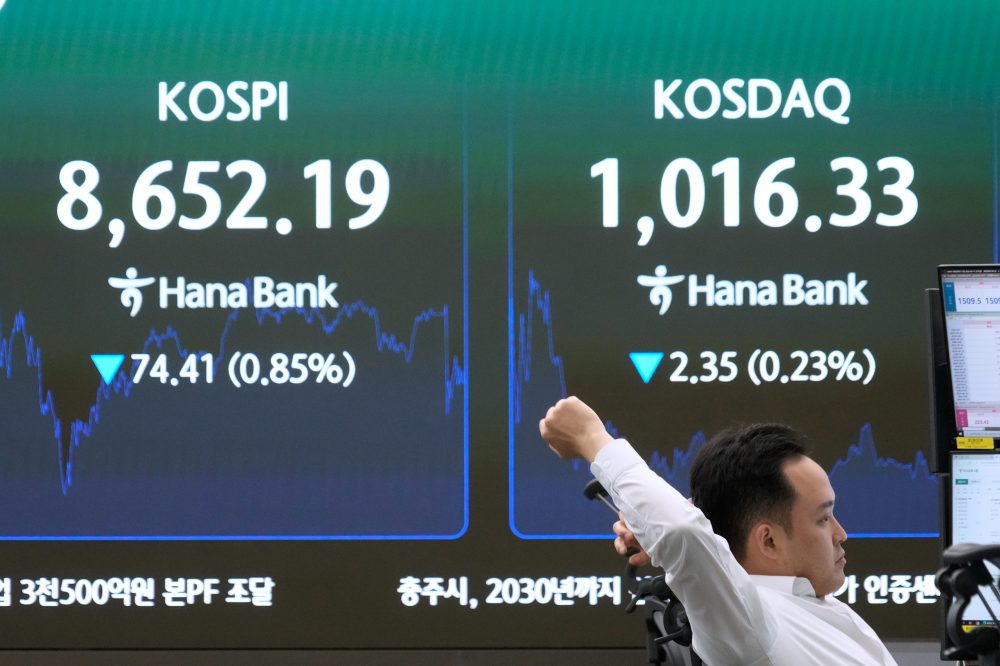
HONG KONG (AP) — Markets across Asia delivered mixed results Wednesday, with oil prices holding below $80 per barrel as investors monitored developments around an interim agreement between the United States and Iran aimed at ending the war between the two countries.
U.S. futures moved slightly upward ahead of the Federal Reserve’s scheduled interest rate announcement, following a mixed close on Wall Street that left major indexes hovering near record territory.
Japan’s Nikkei 225 index gained 0.8%, reaching 69,926.08 — close to its all-time high recorded earlier this week. The gains came after government figures revealed Japanese exports surged 17% in May compared to the same month last year, driven partly by strong overseas demand for high-tech goods.
South Korea’s Kospi dipped 0.2% to 8,706.10, weighed down by losses among major technology companies following a broader sell-off of artificial intelligence-related stocks on Wall Street. Samsung Electronics, the nation’s most valuable publicly traded company, dropped 1.9%.
Hong Kong’s Hang Seng index declined 0.8% to 24,273.95, while mainland China’s Shanghai Composite slipped 0.1% to 4,089.26. Australia’s S&P/ASX 200 rose 0.5% to 8,965.30. Taiwan’s Taiex fell 0.5%, while India’s Sensex gained 0.3%.
Crude oil prices found some footing after a steep drop earlier in the week, fueled by hopes that the war could be winding down and that the Strait of Hormuz — a critical passageway for global oil and gas shipments — might reopen. However, complications remain, including whether any peace deal will require Israel to withdraw from Lebanon.
Brent crude, the global benchmark, slipped 0.3% to $78.76 a barrel in early Wednesday trading, having already tumbled more than 5% on Tuesday. Despite the recent drop, prices remain elevated compared to the roughly $70-per-barrel level seen in late February before the conflict began.
U.S. benchmark crude fell 0.4% to $75.78 a barrel.
Economists at HSBC cautioned that a return to normal oil flows won’t happen overnight. “Normalizing (oil) flows will take time,” they wrote in a note this week. “Hurdles include mine clearance, insurance reinstatement, emptying excess Gulf oil storage, repositioning ships, and restarting idled production fields.”
Back in the United States, the Federal Reserve kicked off a two-day meeting on Tuesday — the first chaired by new Fed Chair Kevin Warsh — to deliberate on interest rates, with an announcement expected Wednesday.
President Donald Trump has been publicly pushing for rate cuts to give the U.S. economy a boost, but concerns are growing that inflation could worsen due to the energy price shock tied to the Iran war.
Most analysts expect the Fed to leave its benchmark rate unchanged for now. In the bond market, the yield on the 10-year U.S. Treasury note fell to below 4.44%, down from 4.47% late Monday.
Preston Caldwell, chief U.S. economist at Morningstar, offered a measured outlook in a recent commentary. “With weak wage growth and rent growth, underlying forces are pointing to inflation falling sharply once the energy price shock recedes. We don’t expect the Fed to hike rates in 2026,” he wrote.
On Tuesday, Wall Street’s S&P 500 slid 0.6% to 7,511.35 after reaching an all-time high earlier this month. The Dow Jones Industrial Average bucked the trend, adding 0.6% to close at 51,999.67 — another record high. The tech-heavy Nasdaq composite dropped 1.2% to 26,376.34 as several major technology stocks fell amid renewed fears of an AI market bubble.
Nvidia shares fell 2.4%, chipmaker Broadcom dropped 4.4%, and Micron Technology lost 6.2%.
On the upside, SpaceX — the rocket company founded by Elon Musk — climbed 4.8%, marking its third consecutive day of gains since making its Wall Street debut.
Yum Brands rose 1.9% after announcing plans to sell Pizza Hut for $2.7 billion, with the majority of the restaurant locations being acquired by private equity firm LongRange Capital.
In currency markets early Wednesday, the U.S. dollar slipped to 160.30 Japanese yen from 160.42 yen. The euro edged up to $1.1612 from $1.1608.
Georgia has become the next Southern state where Republicans are moving to reshape voting district boundaries in ways that critics say could weaken the political influence of Black and other minority voters — a push made possible after the U.S. Supreme Court dismantled key Voting Rights Act protections that had shaped existing district lines in racially diverse states.
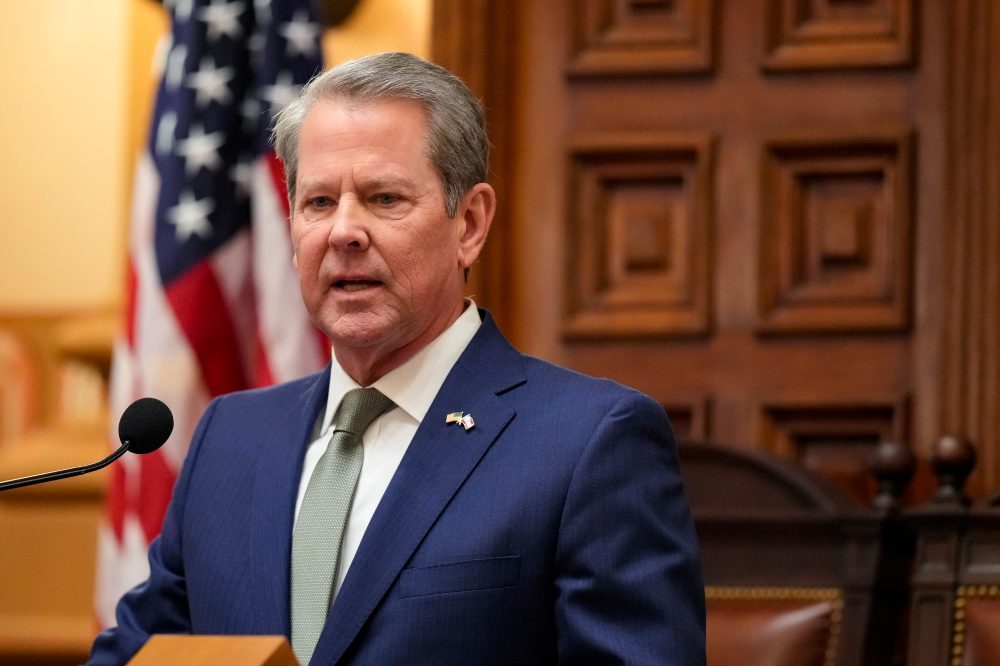
The state’s General Assembly gathered Wednesday for a special session called by outgoing Gov. Brian Kemp, responding to the high court’s ruling in Louisiana v. Callais, which struck down Louisiana’s congressional district map as an unlawful racial gerrymander.
Kemp, wrapping up the final months of his second term, took a different approach than other governors who rushed to finalize new congressional maps ahead of the November midterms — partly in response to pressure from President Donald Trump to protect the Republican Party’s slim hold on Congress. Rather than targeting the upcoming elections, Kemp wants Georgia’s lawmakers to craft new district lines for the 2028 election cycle. However, he went further than his Southern counterparts by also asking the Republican-led Assembly to redraw its own legislative boundaries.
That step would make Georgia the first state in the nation to apply the Callais decision to its own legislature, highlighting the far-reaching consequences of the Supreme Court’s ruling across Southern states, which are home to the largest share of Black voters and Black elected officials in the country.
The issue carries particular weight in Georgia, where the state Capitol complex features a statue of the Rev. Martin Luther King Jr. and sits just blocks from where the slain civil rights leader lived, preached, and led the movement that ultimately produced the Voting Rights Act in 1965.
Despite the session’s start, neither Kemp nor Republican legislative leaders had released any proposed district changes as of late Tuesday evening, drawing sharp criticism from Democrats and activists who are planning daily protests throughout the proceedings.
“They have not been transparent,” said state Rep. Tanya Miller, a Black legislator from Atlanta who is the Democratic nominee for attorney general. “Something as fundamental as voters getting to choose their leaders ought not to be done in the dark, ought not happen in back rooms.”
When approached by The Associated Press, the governor declined to share specifics. “I’ll talk about redistricting on Wednesday,” Kemp said while campaigning for fellow Republicans ahead of Georgia’s primary runoff elections held Tuesday.
House Speaker Pro Tem Jan Jones, who has experience with previous redistricting cycles, described the final outcome as “a legislative prerogative” — a characterization confirmed by Kemp’s staff. But Jones acknowledged that even in her role as a senior Republican on the committee that would review new maps, she hasn’t “been in any room creating maps.” When asked directly who is actually drawing the new districts, she replied: “I don’t know.”
Before the Callais ruling, Section 2 of the Voting Rights Act was widely interpreted to require that district maps — for Congress, state legislatures, and local governing bodies — give historically marginalized minority communities a fair chance to elect candidates of their choosing. Across the country and in Georgia, these so-called “opportunity districts” have consistently produced Black and other nonwhite representatives at higher rates.
For context, roughly one-third of Georgia’s 180 state representatives are Black. When Latino, Asian, and other minority groups are included, nonwhite lawmakers make up about 40% of the chamber — a figure that closely mirrors the state’s overall population. Among Georgia’s 14 U.S. House seats, five have electorates that are majority or plurality nonwhite, and all five elected Black Democrats in 2024.
In the Callais decision, issued earlier this spring, a conservative majority on the Supreme Court concluded that drawing districts with racial composition in mind is discriminatory and violates the Constitution’s equal protection clause. The justices declared that redistricting must be conducted on a “race neutral” basis.
The court’s reasoning did not rest on partisan considerations, and federal courts have previously ruled that partisan gerrymandering is constitutionally allowed. But in Southern states in particular, party affiliation closely tracks with race and ethnicity. This reality has allowed Republicans — a party whose membership is predominantly white — to redraw maps in ways that scatter nonwhite voters, who tend to favor Democrats, across more districts in order to boost likely Republican outcomes.
Many civil rights advocates and legal scholars argue this makes it practically impossible for Southern legislatures to draw genuinely “race neutral” maps.
Emory University professor Carol Anderson drew a comparison between the Callais ruling and the redistricting push it has triggered to historical tools like poll taxes and literacy tests — measures used by white Southern conservatives and upheld by the Supreme Court during the Jim Crow era.
“They used racially neutral language for policies that were clearly racially targeted,” said Anderson, who also serves on the board of Fair Fight Action, an organization mobilizing opposition to the Georgia redistricting effort.
There is no guarantee, however, that Georgia Republicans will achieve their desired results through new maps. Partisan redistricting typically involves either packing certain voters into fewer districts or spreading them thinly across more. In the Atlanta metro area, dispersing nonwhite, Democratic-leaning voters could make more seats appear to favor Republicans — but it also risks creating more competitive battleground districts, since white suburban voters in the region are trending less conservative. That shift could give Democratic candidates of any background more opportunities to win.
That dynamic may be less of a concern in the Georgia state Senate, which is already viewed as gerrymandered to benefit Republicans, but it could factor more heavily into decisions about state House and U.S. House boundaries.
Kemp is effectively asking Republican lawmakers — particularly those representing metro Atlanta — to redraw their own districts and take on unfamiliar electoral terrain.
On the national level, the redistricting battle began last year when Trump pushed Republican-controlled states to redraw congressional boundaries to protect the GOP’s narrow House majority heading into November. Texas was the first to act. California’s governor and Democratic legislators responded with their own gerrymander, which voters later ratified, and a series of other states followed. The results might have been near even had the Virginia Supreme Court, which has a conservative majority, not struck down newly drawn Democratic maps that state voters had approved. In total, Republicans believe they could net as many as 16 seats through their redistricting efforts, while Democrats project gains of up to six seats from new maps in California and Utah.
Even so, those gains may not be enough for Republicans to hold their congressional majority, given the president’s declining approval ratings — though the effort could help limit Democratic gains and position the GOP favorably heading into 2028 and beyond.
RIVERHEAD, N.Y. — A Long Island architect who led a secret double life as the Gilgo Beach serial killer is facing sentencing Wednesday after confessing in court to the murders of eight women.
Rex Heuermann, 62, of Massapequa Park, is expected to receive a life prison sentence when he appears before a judge in Riverhead, New York. Relatives of his victims are anticipated to deliver statements to the court.
Wednesday’s proceedings mark the conclusion of a remarkable investigation that unraveled one of New York’s most baffling cold cases — one that began with a string of seemingly unrelated disappearances of young women and later captured widespread public attention through true-crime documentaries, books, and podcasts after police began uncovering skeletal remains in the sandy brush along a coastal parkway.
Heuermann, who has largely stayed silent throughout numerous court appearances since his arrest in 2023, will have the opportunity to speak at Wednesday’s sentencing, though it remains unclear whether he will do so. His attorneys did not respond to requests for comment.
His ex-wife, Asa Ellerup, along with their two adult children, have indicated through their attorneys that they will not attend the sentencing, citing respect for the families of the victims.
In April, Heuermann pleaded guilty to charges of murdering seven women: Megan Waterman, Melissa Barthelemy, Amber Lynn Costello, Maureen Brainard-Barnes, Valerie Mack, Jessica Taylor, and Sandra Costilla. Though he was never formally charged in connection with an eighth death, he also admitted in court to killing Karen Vergata. Heuermann stated that he strangled his victims — many of whom were sex workers — and dismembered some of their bodies.
The majority of the women vanished between 2000 and 2010, with most of their remains discovered along a remote parkway near Long Island’s Gilgo Beach, roughly 50 miles (80 kilometers) from Manhattan.
Two of the killings, however, occurred earlier. Costilla’s remains were recovered in 1993, more than 60 miles (100 kilometers) away in the Hamptons, while Vergata’s remains turned up in 1996 on Fire Island, over 20 miles (32 kilometers) east of Gilgo Beach.
The case first came to public attention in 2010 when investigators discovered remains along Ocean Parkway while searching for a missing sex worker named Shannan Gilbert, whose death was ultimately ruled an accidental drowning.
The hunt for the killer of the other women stalled for years before a reinvigorated investigation in 2022 identified Heuermann as a potential suspect. Detectives connected him to a pickup truck that a witness reported seeing around the time one of the victims disappeared in 2010.
A critical break came when DNA recovered from a pizza crust Heuermann had thrown away in a Manhattan trash can was matched to genetic material extracted from badly degraded hair fragments found on the victims’ remains.
Investigators also built a case using cellphone and location tracking data that showed Heuermann had arranged meetings with some of the victims shortly before they went missing.
Following his arrest, prosecutors in 2024 uncovered what they called a “blueprint” for the murders buried in his computer files. Among the documents was a set of checklists with notes reminding him to minimize noise, clean the bodies, and eliminate evidence.
As a condition of his guilty plea, Heuermann has agreed to work with the FBI’s behavioral analysis unit to assist in identifying other serial killers.
Since his arrest in July 2023, Heuermann has been held at the county jail in Riverhead. He will eventually serve his sentence at a state prison yet to be determined.
According to Suffolk County Sheriff Errol Toulon, who oversees the Riverhead jail, Heuermann has spent the past three years in a segregated cell, reading crime novels, receiving occasional visits from attorneys or family members, and briefly exchanging correspondence with the notorious “Happy Face Killer.”
When officers set out in 2010 searching for a missing woman along a barrier island parkway near New York’s Gilgo Beach, they made a grim discovery — human remains scattered in the brush. Almost immediately, investigators feared they were dealing with the work of a serial killer.
Over the following years, DNA testing and other investigative tools helped authorities identify the victims, and in some cases, connect those remains to other discoveries made on Long Island years before. That investigation ultimately led to the arrest of Rex Heuermann, who pleaded guilty to murdering seven women and acknowledged in open court that he had killed an eighth.
Below is a chronological account of how this case unfolded:
November 20, 1993: Two hunters come across the body of Sandra Costilla, 28, in a wooded area of North Sea, a hamlet located in the Hamptons. Costilla had been living in New York City at the time of her death.
April 20, 1996: Partial remains belonging to Karen Vergata, 34, are found on Fire Island, a barrier beach along the coast. Investigators would not learn her identity until 2022, when updated DNA technology allowed them to make a positive identification. Vergata had been involved in sex work when she disappeared.
June 28, 1997: The partial remains of a woman are found inside a plastic tub at a state park in West Hempstead, New York. Because of a tattoo found on her body, investigators give her the nickname “Peaches.” Her true identity goes unknown for years, until 2025 when police identify her as Tanya Jackson, a U.S. Army veteran who had been living in Brooklyn before she vanished.
September 2000: Partial skeletal remains of Valerie Mack, 24, who had been working as an escort in Philadelphia, are found in a wooded section of Manorville, New York. Her family last saw her in the spring or summer of that year in Port Republic, New Jersey.
July 26, 2003: Partial skeletal remains of Jessica Taylor, who was 20 years old when she disappeared and had been working as an escort, are discovered in a wooded area of Manorville.
July 9, 2007: Maureen Brainard-Barnes, 25, who had traveled to New York from her home in Norwich, Connecticut, to engage in sex work, is last heard from by a friend. She tells the friend she is leaving her hotel to meet a client. Investigators would later determine through cellphone records that her phone was last active on Long Island.
July 10, 2009: Melissa Barthelemy, 24, a sex worker, is last seen at her apartment in the Bronx. She tells a friend she is going to meet a man and expects to return by morning. Location data from her phone places her last known whereabouts on Long Island. Within days, someone begins using her phone to make taunting calls to members of her family.
May 1, 2010: Shannan Gilbert, a sex worker, vanishes from the barrier island community of Oak Beach, New York, after fleeing a client’s home and knocking frantically on a neighbor’s door. In a recorded 911 call, she tells the dispatcher that people are after her, though she can be heard refusing offers of help. Her pimp, the client, and the neighbor all report to police that she seemed disoriented and ran off into the night on her own.
June 6, 2010: Megan Waterman, 22, who had come to Long Island from Maine for sex work, is last seen at a motel in Hauppauge, New York.
September 2, 2010: Amber Lynn Costello, 27, is last seen leaving her West Babylon home to meet a sex work client. A male acquaintance later tells investigators he believed the client arrived in a Chevrolet Avalanche.
December 11, 2010: A police officer and his dog stumble upon human remains during a training exercise along Ocean Parkway. Authorities initially think they may have found Gilbert, but the remains are later identified as those of Barthelemy.
December 13, 2010: Police discover the bodies of Costello, Brainard-Barnes, and Waterman along the same quarter-mile section of Ocean Parkway where Barthelemy’s remains had been located.
December 14, 2010: Suffolk County Police Commissioner Richard Dormer publicly announces the discovery of the bodies and suggests that a serial killer may be responsible. Police expand their search efforts while continuing to look for any trace of Gilbert.
March 29, 2011: Some of Taylor’s remains are found along Ocean Parkway.
April 4, 2011: More of Valerie Mack’s remains surface along Ocean Parkway. Close to those remains, investigators also discover the remains of a 2-year-old girl, later identified through DNA testing as Tatiana Dykes, the daughter of Tanya Jackson. Elsewhere along the parkway, the remains of an Asian male are found. Investigators estimate he died somewhere between five and ten years earlier and was likely in his late teens or early twenties. He has still not been identified.
April 11, 2011: Additional remains of Vergata are found along Ocean Parkway, several miles to the west of Gilgo Beach. More remains of Jackson are also discovered along the same beach parkway.
December 13, 2011: Gilbert’s skeletal remains are found in a tidal marsh near Oak Beach. Following an autopsy, Suffolk County Police conclude that she accidentally drowned.
January 2022: The Suffolk County district attorney forms a new task force specifically to investigate the Gilgo Beach killings.
July 13, 2023: Heuermann is taken into custody and charged with the murders of Costello, Waterman, and Barthelemy. Critical evidence includes cellphone location data showing Heuermann and the victims were in the same locations at overlapping times, as well as DNA traces recovered from the remains.
January 16, 2024: Heuermann faces an additional charge in the death of Brainard-Barnes. Prosecutors reveal that a hair recovered with her body is genetically consistent with a DNA sample taken from Heuermann’s wife.
May 20, 2024: Investigators conduct a new search of Heuermann’s home, a process that continues for nearly a week.
June 6, 2024: Heuermann is charged with the murders of Costilla and Taylor.
December 17, 2024: A sealed indictment is made public, charging Heuermann in connection with Mack’s death.
December 18, 2025: A Florida man named Andrew Dykes enters a not guilty plea to charges of killing Tanya Jackson and Tatiana Dykes. Investigators say Andrew Dykes was Tatiana’s father, and that DNA evidence connected him to the crime. Though this case ultimately had no connection to the other Gilgo Beach killings, authorities say the investigation benefited from the additional resources that had been directed toward the serial killer probe.
April 8, 2026: Heuermann pleads guilty to seven counts of murder for the killings of Barthelemy, Brainard-Barnes, Costello, Costilla, Mack, Taylor, and Waterman. He also admits in court that he was responsible for the death of Vergata.
June 17, 2026: A judge is scheduled to formally sentence Heuermann to prison for the murders.
A small plane came down on a highway in Laredo, Texas Tuesday night and burst into flames, triggering a frantic rescue effort as drivers abandoned their cars and trucks to help free those trapped inside the burning aircraft.
The crash happened shortly after 10 p.m., according to Jose Baeza, an investigator with the Laredo Police Department. The roadway where the plane went down, Loop 20, was shut down in both directions following the incident. Baeza said there were no immediate reports of injuries among motorists on the highway.
Footage shared online shows the aircraft tipped on its side and wedged against a highway barrier, with flames visible.
Zayra Garza, an esthetician, happened to be driving her coworkers home when she came across the crash scene. She pulled out her phone and began recording as she approached, eventually stopping her vehicle across from the burning plane.
Garza watched as someone inside the cockpit desperately tried to break through the window to get out. Within moments, other drivers had gotten out of their vehicles and were attempting to smash the window open from the outside to help.
Garza’s husband jumped out to join the effort. She then watched as the plane’s door swung open. Three people who appeared to be teenagers came rushing out, followed by what looked to be the pilot. A crew member then struggled to pull another person from the wreckage — someone who appeared to be unconscious.
“It looked like part of a movie. I was in shock,” Garza said of the chaotic scene.
“What was worrying me was the fire,” she added. “I was concerned that it could have just exploded at any time.”
PARIS/STOCKHOLM — Europe’s push for independence in artificial intelligence is taking center stage this week as world leaders and technology executives descend on France for both the G7 summit and the VivaTech conference in Paris.
The timing is significant. Just days before these gatherings, the United States moved to tighten access to Anthropic’s most advanced AI systems for people outside the country — a move that has highlighted just how exposed Europe is to decisions made across the Atlantic.
“Tech sovereignty will be top of mind this week at VivaTech,” said Ana Paula Assis, a senior vice president at IBM. “For European organisations to get this right, it is vital to understand sovereignty is about having control where it matters — not where the technology is from.”
The underlying tension is one Europe has struggled with for years: how to preserve strategic independence while still leaning heavily on American companies that lead the world in cloud computing, chip design, and cutting-edge AI development.
G7 nations have convened in Evian, France, where government officials are sitting down with top executives from major AI firms including Anthropic, OpenAI, Alphabet’s Google, and French startup Mistral. Topics on the table include AI competitiveness, regulatory frameworks, and dependence on China for critical minerals.
Meanwhile, more than 180,000 attendees — including Amazon’s Jeff Bezos — are expected at VivaTech in Paris, where conversations are expected to center as much on geopolitics as on new technology.
Mistral, the French AI startup widely regarded as Europe’s strongest homegrown contender in the AI race, is deepening its ties with European businesses, especially in sectors where the region claims a competitive edge.
Still, despite billions of euros in investment, European AI companies continue to depend heavily on U.S.-controlled cloud systems, semiconductors, and foundational AI models.
France has emerged as one of the loudest voices calling for European technological self-reliance, with its government actively working to reduce its use of American providers in public services.
“We cannot rely on tools developed by foreign powers. France must have its own tools,” French Prime Minister Sebastien Lecornu said Tuesday.
The European Commission is currently reviewing the real-world impact of U.S. export control rules, insisting that any such measures should not unfairly target allied nations.
European officials have increasingly framed AI development as both an economic and a national security priority. The Commission has recently announced plans for AI “gigafactories” and large-scale computing facilities intended to give Europe sovereign control over its own computing power. Proposed legislation also aims to grow domestic cloud, AI, and semiconductor industries while reducing dependence on major U.S. technology companies — though critics argue Europe remains years behind its American rivals.
Telecoms company Orange captured the sentiment in a statement: “It’s patently clear, if it wasn’t before, how important it is for Europe to have access to an AI service that it can control, that will never be switched off on a whim.”
But building that independence comes with a price tag. Capgemini’s chief operating officer Karine Brunet noted that companies must weigh sovereignty goals against real costs, pointing out that European cloud alternatives can carry premiums of up to 40% compared to American options.
“The alternative is not simply replacing one provider with another,” said Francois Bitouzet, managing director of VivaTech. “It is about building more resilient technology strategies, where companies can draw on European innovation for the most critical parts of their stack while still working with global partners where it makes sense.”
Global drug manufacturers are applying pressure to European governments over medicine pricing policies — and they appear to be borrowing a strategy that recently worked in the United Kingdom: threatening to withdraw investment unless policymakers back down.
Germany has become the primary focus of that pressure. The country is currently debating legislation aimed at reining in rapidly rising costs within its public health insurance system. The pharmaceutical industry scored a notable victory in Britain after the government agreed to increase medicine spending as part of a broader arrangement designed to avoid tariffs imposed by Washington.
Pfizer sent a letter last week to the German chancellor warning that its investments in the country were at risk because of the proposed drug-pricing policy. AstraZeneca cautioned that it might not introduce new medications in Germany if the legislation moves forward.
Earlier this month, Eli Lilly announced it would cut a planned 2.3 billion euro ($2.7 billion) investment in half. Germany-based Boehringer Ingelheim separately announced it was canceling expansion plans valued at 900 million euros. Both companies pointed to the proposed legislation as the reason.
Diarmaid MacDonald of Just Treatment, a patient advocacy group based in the UK, was critical of the industry’s approach. “The industry is delighted with how the UK government folded in the face of their pressure,” he said. “They would love to see others replicate that capitulation.”
Germany’s health ministry said this week that no final decisions had been made and declined to elaborate on any ongoing parliamentary discussions.
The pressure appears to be having some effect. A government source told Reuters on Monday that Germany would abandon part of the plan the industry objected to, replacing a variable discount system with a fixed one to reduce the investment uncertainty that companies had flagged.
However, industry sources indicated that change alone does not resolve their wider concerns about Germany’s pricing environment. The proposed law still faces months of parliamentary debate and could undergo further revisions.
Those same sources said the UK agreement was seen favorably by drugmakers not just because of changes to how new medicines are valued and paid for, but also because it included commitments around innovation and patient access.
Healthcare analyst Diederik Stadig of ING Bank noted that the industry’s response in Germany appeared more reactive compared to what he described as a more deliberate strategy in Britain, though he acknowledged the two situations were comparable.
“The German government made a proposal, ‘we want to reform pricing’. And the industry said, ‘OK, that’s all well and good, but that affects our return on investment,’” Stadig said. He added that factors including tariffs, U.S. pricing policy, the rise of China, and the attractiveness of the American market were all making Europe a less appealing destination for pharmaceutical investment. “The industry is making Europe acutely aware of this,” he said.
The dispute in Germany is part of a wider conflict playing out across the continent. In France, the national health authority accused drugmakers in April of using what it called “coercive pressure” to influence clinical assessments, including threats to pull medicines from the market. In the Netherlands, the country’s biotech lobby warned that companies were growing more hesitant about seeking drug reimbursement approvals and that the country risked falling lower on pharmaceutical launch priority lists.
Adding to the tension is the impact of U.S. President Donald Trump’s most-favored-nation pricing initiative, which seeks to link prescription drug prices in the U.S. market to lower prices charged in other countries, including in Europe. Several major drug companies have already reached agreements with the White House to reduce U.S. drug costs in exchange for tariff relief, which is creating additional pressure to raise prices in other markets.
Some critics viewed Germany’s partial concession as a concerning sign of how much leverage the pharmaceutical industry currently holds. At the same time, they noted that European nations retain some bargaining power, since the continent remains a significant market even if it is less profitable than the United States.
Sally Gainsbury, an analyst at the healthcare think tank Nuffield Trust, offered a measured perspective. “America is not the only market in the world,” she said, while acknowledging that the UK-U.S. pricing agreement carried a cautionary message for Europe. “The depressing reality is that the ‘UK playbook’ here means health systems will spend more, but will get less health benefit for their populations,” she added.
Shareholders of Toyota Motor gathered Tuesday for the automaker’s first annual meeting under new CEO Kenta Kon, voting to re-elect Akio Toyoda as chairman and formally seating Kon on the company’s board of directors.
Investors also approved the re-election of four additional directors at the meeting, held in Toyota City, Japan. The results reflect strong shareholder confidence in the direction of the world’s top-selling automaker, which has experienced growing demand for hybrid vehicles in markets including the United States and Japan.
Following the meeting, Kon spoke with reporters and said the company plans to keep putting money into growth areas. “Hitting the brakes suddenly” is not something the company intends to do, he said, as Toyota continues its strategy of investing in artificial intelligence, robotics, and a variety of powertrain technologies.
Kon, who previously served as a secretary to Toyoda before being elevated to the CEO position in April, officially joined the board at Tuesday’s meeting. Meanwhile, former CEO Koji Sato, who now holds the title of vice chairman, departed from the board.
KANSAS CITY, Missouri — Lionel Messi made a powerful statement Tuesday night, scoring three goals to lead Argentina to a 3-0 victory over Algeria in World Cup action, putting to rest any questions about whether the 38-year-old legend still has what it takes at the highest level.
The performance came just one day after Argentina coach Lionel Scaloni declared that Messi was “even more” vital to the defending champions than ever before — and Messi wasted no time proving him right.
The milestone-filled evening included Messi tying Miroslav Klose’s record of 16 goals, giving him a share of the all-time men’s scoring mark at the World Cup. It also marked his record sixth World Cup appearance and his 200th cap for the Argentine national team — all of it coming exactly 20 years after he scored his very first World Cup goal.
Messi’s impact was felt from nearly the opening whistle. In just the second minute, he stripped Algeria of possession deep in their own territory, a moment that foreshadowed the intensity he would bring throughout the match. Midfielder Rodrigo De Paul assisted on Messi’s first goal in the 17th minute and spoke glowingly of his teammate afterward.
“It’s an advantage to have Leo, because of how he manages the group and drives it forward,” De Paul said. “He doesn’t pay attention to individual records. He prioritises the team, and for us that’s incredible.”
The night carried added emotional weight given that this World Cup — hosted across the United States, Mexico, and Canada — is widely expected to be Messi’s last. Argentine supporters inside the Kansas City stadium expressed their reverence openly, bowing repeatedly in his direction throughout the match. When Messi was substituted out for Nico Paz in the 80th minute, the crowd’s reaction was no less enthusiastic. The day before, fans had gathered at Mill Creek Park wearing shirts that read “Messiah.”
The match was played in a venue where Kansas City Chiefs quarterback Patrick Mahomes has long been a fan favorite — but Tuesday night, Mahomes himself was in the stands watching Messi. The NFL star took to social media to share a video of the Argentine along with a goat emoji, a widely recognized symbol meaning “greatest of all time.”
Messi arrived at the tournament still recovering from a muscle strain and had only recently been eased back into game action. His three-goal night erased any lingering concerns about his physical condition.
Coach Scaloni was at a loss for words when asked to describe what he witnessed. “Speechless for Leo. What can I say? He’s incredible. He’s been doing this for 20 years. Everyone in soccer wants to watch him and enjoys it,” Scaloni said after the final whistle.
Kevin Warsh is concluding his first Federal Open Market Committee meeting Wednesday, with declining oil prices and a fragile peace deal providing a somewhat favorable environment for keeping interest rates unchanged — which is what traders are broadly anticipating.
All eyes will be on how Warsh casts his vote, what he says during his post-meeting press conference, and how he handles the challenge of explaining the economic outlook to markets.
Warsh has historically been skeptical of so-called “forward guidance” — the practice of signaling where interest rates are headed — and he may opt not to include a rate projection in the quarterly economic outlook that the U.S. central bank releases.
However, Warsh was selected by U.S. President Donald Trump with the expectation that he would lower rates. With inflation still running above target and the job market holding steady, markets are actually pricing in a rate increase. That means Warsh will face pointed questions on the topic, and the dollar has been drifting this week in anticipation of his remarks.
If Warsh fails to push back on current market pricing, investors could interpret that as a signal he leans hawkish. On the other hand, if he does push back, it could stoke concerns about inflation — making this a tricky tightrope to walk.
Adding another layer of complexity, Warsh will be operating in a boardroom where his predecessor, Jerome Powell, still holds a vote.
One possible model for navigating the situation came Tuesday from the Bank of Japan’s Deputy Governor Shinichi Uchida, who managed to keep policy options open without rattling financial markets. Uchida also had some assistance from Japan’s finance ministry, which has been signaling it could step in to support the yen if the currency weakens further.
Asian markets moved mostly flat on Wednesday, with investors largely waiting on Warsh’s announcement. Meanwhile, oil sellers also paused, holding out for confirmed details on a reported U.S.-Iran agreement.
Brent crude futures have dropped below $80 per barrel following reports that the U.S. is considering lifting sanctions on Iranian oil exports. Beyond the Fed decision Wednesday, Sweden’s Riksbank is widely expected to hold rates steady but may hint that an increase could come later this year.
In the United Kingdom, inflation is expected to edge up toward 3%, driven partly by higher energy costs. Final inflation readings across Europe are not anticipated to differ significantly from earlier estimates.
Key developments to watch Wednesday include rate decisions from both the U.S. and Sweden, British inflation data, and U.S. retail sales figures.
The National Hurricane Center is tracking a developing weather system in the Atlantic Ocean, identified as Potential Tropical Cyclone One.
Wind speed probability graphics for the system were last updated on Wednesday, June 17, 2026, at 3:22 a.m. GMT, according to information released by the National Hurricane Center.
The graphics show the probability of 34-knot wind speeds affecting various areas over a 120-hour period as forecasters continue to monitor the storm’s development and potential track.
Residents along the Atlantic coast are encouraged to monitor updates from the National Hurricane Center as the system continues to be evaluated by meteorologists.
WARSAW, Poland — Germany and Poland were scheduled to put pen to paper on a new defense agreement Wednesday, setting aside a long and complicated shared history to deepen military cooperation across Europe at a time of heightened tensions with Russia and growing questions about how committed the United States will remain to European security.
The relationship between the two neighboring nations has grown increasingly practical in recent years, shaped by Russia’s full-scale invasion of Ukraine in 2022 and the rise of a liberal government in Poland in 2023.
As the United States considers a partial pullback of its military forces from Europe, Poland is pushing for major European allies to take on a bigger role in defending the continent’s eastern edge. Meanwhile, Germany is looking for partners as it works to rebuild its military — known as the Bundeswehr — after decades of underinvestment. Berlin’s goal is to develop the most capable conventional army on NATO’s European side, positioning itself as a cornerstone of European defense going forward.
Poland’s value as a logistics hub supporting Ukraine, combined with its expanding economy and significant defense spending, has made it an attractive partner for Germany and other major European nations.
“We Germans need a strong Poland as an equal partner,” German Chancellor Friedrich Merz said in Berlin following a December meeting with liberal Polish Prime Minister Donald Tusk. “This is in our fundamental interest.”
The new defense agreement is expected to outline plans for securing the Baltic Sea region and spell out cooperation on military movement and infrastructure, cyber defense, and emerging technologies.
Justyna Gotkowska, deputy director of the Warsaw-based think tank Center for Eastern Studies, noted that the two countries are already firmly linked through NATO’s defense planning, which assigns Germany a central role in protecting the Baltic region alongside Poland and other central and eastern European nations.
“Germany is largely responsible for the defense of the Baltic states and without cooperation with Poland, that will not happen,” Gotkowska said.
The Baltic countries are frequently cited as the most probable target for a Russian attack on NATO territory if such a conflict were ever to occur.
The agreement is expected to reaffirm the mutual defense commitments already established under NATO and European Union treaties, to which both Germany and Poland belong. However, unlike bilateral treaties each country has separately signed with France and the United Kingdom in recent years, this German-Polish deal is an inter-ministerial arrangement. It focuses on the practical side of military cooperation and does not include the political mutual defense declarations found in those other bilateral agreements.
When asked in June by Polish Radio Trojka why Poland was not pursuing a similar full treaty with Germany, Polish Foreign Minister Radosław Sikorski said that President Karol Nawrocki — who came to power with the backing of the national-conservative Law and Justice party — would never agree to it.
“Hell would break loose here” if such a German-Polish treaty were signed, Sikorski said.
During the period when Law and Justice held power, that government demanded $1.3 trillion in reparations from Germany for its World War II occupation of Poland — a claim Berlin has rejected. The issue is expected to resurface ahead of next year’s general election, and Tusk will be careful not to appear as though he is taking a soft stance or acting in Berlin’s interests. Tusk himself has called on Germany to move more quickly to compensate survivors of the wartime occupation.
Despite Poland’s growing role in Europe’s security framework, Germany has tended to make major decisions on issues like Ukraine or Iran alongside key Western European partners France and the United Kingdom, often leaving Warsaw out of the conversation.
On June 7, those three Western European nations hosted Ukrainian President Volodymyr Zelenskyy in London to discuss the potential role they could play in future peace negotiations with Russia.
At a news conference in Warsaw following that London gathering, Tusk said he had raised concerns directly with Merz that Poland deserved a seat at the table in discussions about Ukraine’s future and the broader region. “Any arrangements made without our participation will not be respected or binding for us,” Tusk said.
Rolf Nikel, a former German ambassador to Poland and vice president of the German Council on Foreign Relations, acknowledged that Poland’s standing within Europe and NATO has grown considerably.
“So Poland must be taken more seriously today and, above all, must be respected more than we have seen in the past,” Nikel said.
Gotkowska echoed that sentiment, pointing out that Germany needs to come to terms with the fact that its economy has stalled while Poland’s economy and military strength have grown.
“The balance of power has changed in Europe in recent years,” Gotkowska said.
When historian Geoffrey Ward visits the Franklin D. Roosevelt Presidential Library and Museum for research, he says he gets swept up in the atmosphere of FDR himself — a sense of comfortable, cheerful clutter that shaped how Roosevelt presented himself to the world.
“It feels like you’re stepping back into his world,” Ward said of the Hyde Park, New York property that was once the Roosevelt family home. “The library and home collections reflect all his many interests — stamps, coins, birds he shot and had stuffed as a boy, model ships, children’s books, books about naval history, the pony-drawn sleigh he rode in as a child, and on and on.”
Since Roosevelt helped establish the modern presidential library system in the late 1930s, a nationwide network of museums and research centers has taken shape. These sites are overseen in part by the National Archives and Records Administration, known as NARA, but each carries its own distinct character. They range from the scenic Ronald Reagan Presidential Library and Museum in California’s Simi Valley to the small-town Herbert Hoover Library and Museum in West Branch, Iowa, to the sprawling Obama Presidential Center, which opens its doors to the public on June 19 — Juneteenth — in Chicago.
Historian Douglas Brinkley, who says he has made a point of visiting every post-FDR presidential library, describes them as essential gathering places for lectures, research, school groups, and visitors from around the country.
“Each of the libraries have their own aura,” Brinkley said. “Roosevelt came up with a perfect idea by gifting his home in Hyde Park to the people of America, instead of having his papers stored in a warehouse in Virginia or Maryland. He started a tradition of having them go where the president lived.”
Each library reflects the personality and legacy of the president it honors. Brinkley and other historians point out that while the archival side of these libraries is managed by NARA, the museum portions are funded by private donors who may prefer to highlight a president’s achievements and downplay his shortcomings.
For example, the Hoover library’s website includes a page about the Great Depression that emphasizes how some of the policies later associated with Roosevelt — who defeated Hoover in a landslide — were originally proposed by Hoover. The Richard Nixon library, meanwhile, was the center of a prolonged dispute between museum administrators and the former president and his allies over everything from control of his records to how prominently the Watergate scandal, which led to Nixon’s resignation, should be featured.
Max Boot, who authored a 2024 biography of Reagan, drew a distinction between his experience using the Reagan archives versus visiting the museum itself. He said the late president’s official records were “administered by federal employees in an entirely professional and apolitical fashion. There is no attempt to hide anything.” The museum, however, “naturally focuses on Reagan’s achievements and shortchanges his failures.”
“It’s designed to present a positive portrait. Thus, volumes critical of Reagan are not sold in the library bookstore,” Boot said.
Historian Ted Widmer, who previously served as a speechwriter for President Bill Clinton, acknowledged that presidential libraries will inevitably put the best face on a presidency, but said there has been some movement toward greater openness in recent years.
He singled out the Lyndon Johnson library in Austin, Texas, for being willing to confront LBJ’s widely criticized decisions during the Vietnam War. In 2023, the library drew renewed attention to one of Johnson’s most controversial moments — his 1948 Senate campaign, now broadly believed to have involved election fraud — by posting recordings on its website of interviews conducted by Associated Press reporter James W. Mangan with a former Texas election judge who admitted to certifying fraudulent votes that helped Johnson win.
“It is hard to know if future libraries will continue that trend, in an era in which history is increasingly politicized and polarized,” Widmer said. “But it’s healthy for our democracy to encourage the study of history as it really happened — not a sanitized version.”
The Obama Presidential Center has faced its own share of criticism, both for its scale and its appearance. Writing in The Guardian, critic Oliver Wainwright described it this way: “The building has an ominous presence, its mostly windowless heft recalling a menacing sci-fi headquarters.” The center has also drawn scrutiny for the decision not to include a NARA facility on the grounds. A large portion of the former president’s records exist in digital form, a shift that historian Brinkley expects will only grow more common with future presidential libraries.
Up to one million visitors per year are expected at the center’s 20-acre campus. Highlights include a public library branch, a basketball court built to NBA standards, a fruit and vegetable garden, and a playground. Former President Barack Obama tested out one of the site’s tall metal slides during a visit in May.
“That was fantastic,” he said after sliding down, according to a video shared on the Obama Foundation’s social media. “I was a little tall for it.”
Obama was personally involved in shaping many of the center’s details, from the textured stonework on the museum’s 225-foot tower to a pair of high-backed reading chairs inside the library. One of his favorite features, though, is a set of charcoal grills that will be available for anyone to use. He first floated the idea at a community meeting in 2017, drawing warm laughter from the crowd.
“We don’t have any folks who grill here?” Obama said at the time. “I thought this was the South Side of Chicago.”
WASHINGTON — A short-term agreement between the United States and Iran is meant to kick off a two-month stretch of negotiations aimed at tackling one of the most stubborn disputes between the two longtime rivals: Iran’s nuclear program.
President Donald Trump has cited stopping Iran from obtaining a nuclear weapon as a central reason he launched military operations alongside Israel back in February. Yet the preliminary agreement he has been promoting leaves very little time to work through an issue that has defied resolution for years. For context, the last major nuclear agreement between Iran and world powers took well over a year to put together.
Details about the initial deal have been sparse, but what is known is that it calls for reopening the Strait of Hormuz to international oil shipments, financial incentives tied to benchmarks Iran must meet, and a 60-day window for negotiations aimed at ending Iran’s nuclear activities. The agreement is scheduled to be formally signed Friday in Switzerland.
Doubts about whether the deal is realistic or effective are widespread — among Republican and Democratic lawmakers alike, as well as pro-Israel advocates and Israel itself.
Republican Sen. Lindsey Graham of South Carolina, a close ally of Trump and a longtime critic of Iran, expressed his reservations clearly on Tuesday. “My skepticism is Iran itself. What would a good deal look like? No enrichment. And we’ll see if we can get there,” he said. “But whether or not we can get phase two, I don’t know.”
David Schenker, director of the Arab Politics Program at the Washington Institute for Near East Policy and a former assistant secretary of state for Near Eastern Affairs during the first Trump administration, raised doubts about whether the administration has the staying power to see complex nuclear negotiations through.
“This administration has proven that it has a hard time keeping its attention on these issues,” Schenker said. “This is the kind of thing that requires dogged attention, attention to detail and numerous technical experts involved. Trump loses his attention, moves on, and so does the administration. It’s like they don’t understand Iran’s strategy. They didn’t get it the first time, or the second.”
The Trump administration, however, remains confident. Vice President JD Vance said the technical specifics still need to be worked out, but stressed that Iran must take concrete steps before receiving any benefits such as sanctions relief.
“Our plan under this deal is, again, the Iranians are getting a lot of benefits so long as they dismantle that nuclear weapons program,” Vance said during an appearance on Megyn Kelly’s podcast Tuesday.
Vance also addressed skepticism about trusting Iran to follow through. “People always ask me, ‘Why do you believe it this time?’ I don’t believe them,” he said. “I don’t trust anything that anybody says. I trust what people do. And the way this deal is structured is that as they do more, they receive more. As they do less, they receive less.”
Iran has consistently said its nuclear activities are for peaceful purposes.
The 2015 nuclear agreement, formally known as the Joint Comprehensive Plan of Action or JCPOA, required more than 18 months of work before it was finalized. The process began with private conversations between U.S. and Iranian officials in Oman during the final stretch of then-President Barack Obama’s first term. It ultimately required heavy involvement from Secretary of State John Kerry and Energy Secretary Ernest Moniz, along with a large team of technical specialists who traveled across Europe before the talks concluded in Vienna, Austria.
Trump pulled the United States out of the JCPOA in 2018, before many of its more contentious provisions had taken effect. There is currently no sign that Iran is prepared to offer significantly more in a new agreement.
The JCPOA included highly technical provisions covering uranium enrichment limits, advanced centrifuges, and heavy water production, with Iran receiving substantial sanctions relief worth billions of dollars in return. Even critics who opposed the deal — Trump famously called it the “worst deal ever negotiated,” and all Republicans along with several prominent Democrats voted against it — acknowledge it still took more than 18 months to reach even an imperfect result.
Republican lawmakers are insisting that any nuclear deal with Iran must go through Congress, as required by law. GOP Sen. Ted Cruz of Texas said he “would certainly anticipate that” the Senate will have the final say on any agreement.
GOP Sen. John Kennedy of Louisiana said he had little faith that Iran would actually honor any deal it signs.
However, Sen. Roger Marshall, a Republican from Kansas who has spoken directly with Vice President Vance about the agreement, suggested the tight timeline could actually work in the administration’s favor.
“Iran’s modus operandi is to negotiate for the purpose of delaying, so they can rearm themselves,” Marshall said. “I think the president has to give them some type of a finite amount of time, or there’s going to be consequences. So I think it can be done.”
Sen. Tim Kaine, a Democrat from Virginia, noted that negotiators do have a foundation to build on from the Obama-era talks. Still, he pointed out the scale of what was involved previously.
“It took years to put together. You had allies and even adversaries — China and Russia — around the table, you had the IAEA at the table, the Obama chief negotiator had a Nobel Prize in physics, Ernie Moniz,” Kaine said. “I don’t know that either Jared Kushner or Steve Witkoff have a Nobel Prize. So it’s going to be hard.”
Trump envoys Witkoff and Kushner, neither of whom had prior experience in nuclear negotiations, made multiple but ultimately unsuccessful attempts to reach a deal through Omani mediation during the early months of Trump’s second term. Those efforts wound down after U.S.-Israel strikes on Iranian nuclear sites in June 2025, following which Pakistan stepped in as the primary go-between.
Beyond the nuclear issue, there is also uncertainty about other longstanding concerns — including Iran’s ballistic missile program, its backing of militant groups in the region, and its treatment of its own citizens. It remains unclear whether any of these matters will be addressed by either the current interim deal or any potential longer-term agreement.
Brian Katulis, a senior fellow at the Middle East Institute, offered a blunt assessment of where things stand. “A deal is better than more fighting, but the war America and Israel prosecuted against Iran has fallen short of achieving its stated objectives,” he said. “This agreement is mostly about cleaning up an unnecessary mess and putting the best face on it.”
WASHINGTON (AP) — A new chapter begins at the Federal Reserve on Wednesday as Kevin Warsh, President Trump’s chosen leader for the nation’s central bank, takes charge of his first policy meeting and steps before cameras for his inaugural press conference.
Despite the change in leadership, major policy shifts are not expected right away. Economists anticipate the Fed will hold its benchmark interest rate steady at roughly 3.6%, marking the fourth consecutive meeting without a change. However, policymakers may revise their post-meeting statement to remove any language suggesting the Fed’s next move will be a rate cut — a shift that could signal rates will stay put for a prolonged stretch, or possibly even climb higher if inflation remains stubborn.
The main event Wednesday is expected to be Warsh’s afternoon press conference, which Wall Street investors, economists, and likely the White House will be watching closely to gauge his approach. Warsh brings a background as a former investment banker, a stint on the Fed’s board of governors from 2006 to 2011, and time as a visiting fellow at the conservative Hoover Institution.
Fed observers will be looking for signals on several key questions: Where might interest rates be headed? How does Warsh plan to tackle elevated inflation fueled by the Iran war and the resulting spike in gas prices? And will he reshape how the Fed communicates with the public?
One possible change under Warsh: reducing the number of press conferences from eight per year — currently held after each meeting — down to four, mirroring the approach former chair Ben Bernanke used when he introduced the practice. Warsh has expressed a desire to lower the Fed’s public profile and pull back on economic commentary, arguing that public statements can trap officials into defending specific positions longer than is prudent.
Still, pulling back on communication carries its own risks. Financial markets and the broader public have grown accustomed to clear guidance from the Fed, and less transparency could unsettle both.
Warsh also finds himself in a very different economic climate than when he appeared to be positioning himself for the Fed chair role last year. At that time, he was vocal about supporting lower interest rates — a position aligned with Trump’s repeated demands — and argued that advances in artificial intelligence could dramatically boost economic output and bring inflation down over time. Many economists were skeptical of that argument even then, noting that surging investment in semiconductors and computing equipment was itself contributing to inflationary pressure.
Since the Iran war began on February 28, inflation has climbed to a three-year high of 4.2%, driven largely by rising gas prices tied to the conflict. The Fed’s traditional response to elevated inflation is to raise its key rate to slow spending and economic growth.
Trump has announced a preliminary peace agreement that could end the three-month conflict, but whether the ceasefire will hold remains uncertain. Even if oil supplies from the Middle East resume flowing normally, it could take months before consumers see relief at the gas pump, in grocery stores, or on airline tickets. By the Fed’s preferred inflation measure, prices have already been running above its 2% target for more than five years.
Meanwhile, the job market has shown surprising strength, which reduces the urgency for rate cuts. Back in January, the Fed projected it would cut rates twice this year, partly out of concern that employers were cutting jobs and unemployment would rise. But a government report released earlier this month showed employers added 172,000 jobs in May — the third consecutive month of solid hiring gains.
Trump has consistently pushed for lower rates since returning to the White House, but as inflation has picked up in recent weeks, he has said he wants “Kevin” to act independently and make his own calls. At the same time, he stated earlier this month that the Fed should not raise rates, even in the face of higher inflation.
Trump was a persistent critic of Warsh’s predecessor, Jerome Powell, for not cutting rates aggressively enough. In January, the Department of Justice launched an unprecedented investigation into Powell over brief testimony he gave last July about a building renovation project. A federal judge ultimately threw out the DOJ’s subpoenas, and the government dropped the case.
The effort largely backfired. Powell chose to remain on the Fed’s board of governors after his term as chair concluded on May 15, with the ability to serve as a governor through January 2028. By staying on, Powell denied the Trump administration the chance to fill an additional seat on the seven-member board. Powell is expected to participate in Wednesday’s rate decision vote.
EVIAN-LES-BAINS, France — World leaders meeting at the G7 summit in France are working toward a joint statement on critical minerals that could include steps to lessen the West’s dependence on China and protect investors from retaliatory trade measures and price undercutting, according to diplomats familiar with the discussions.
The final day of the June 15-17 summit in Evian-les-Bains features discussions on securing mineral supply chains — a top priority of France’s G7 presidency — along with efforts to correct what leaders see as dangerous imbalances in the global economy.
Alarm over Western dependence on China intensified last year when Beijing placed export restrictions on rare earth permanent magnets, nearly halting operations in some industries. The episode exposed just how deeply the energy, defense, and technology sectors rely on materials largely controlled by China.
“We are negotiating texts that are significant on critical minerals and, as a consequence, on economic sovereignty,” a French presidency official said ahead of the summit.
Options that have been on the table in recent months include price supports, market standards, government subsidies, guaranteed purchase agreements, and ways to attract more private investment into mineral supply chains outside of China. Analysts expect any announcements from the summit to represent early-stage commitments rather than sweeping solutions.
China has been steadily tightening its grip on exports of niche materials and battery metals. In addition to rare earth restrictions, Beijing has also limited American companies’ access to tungsten and antimony, among other materials.
Western nations are scrambling to secure supply agreements with mines and build their own processing and recycling capacity. However, experts warn it could take years to meaningfully challenge China’s dominant position — one that was built up over several decades.
The United States proposed a critical minerals trading bloc in early 2026, but disagreements remain among participating countries over how such a group would function, particularly given the White House’s “America First” policy priorities.
Beyond minerals, G7 leaders are also taking aim at what France describes as “predatory competition” from China. France has characterized the core imbalance this way: China overproduces, the United States overconsumes, and Europe underinvests.
European officials are increasingly worried about China’s record trade surplus and its expansion into higher-value industries — a trend analysts are calling a “second China shock,” recalling China’s earlier takeover of low-value manufacturing in the 2000s.
French President Emmanuel Macron made a last-minute push to engage China before the summit in hopes of finding common ground. Beijing has pushed back against European Union claims of unfair subsidies and has repeatedly promised “strong” countermeasures against the EU’s proposed “Buy European” policy and updated technology sovereignty rules.
EU leaders are scheduled to hold separate discussions Thursday in Brussels on using trade defense tools more aggressively against a surge of Chinese imports. Last year, the EU posted its largest-ever trade deficit with China, topping €360 billion.
“This is, of course, not sustainable. As you know, in Europe, our strategy is very clear: de-risk not decouple,” European Commission President Ursula von der Leyen told reporters at the opening of the summit.
G7 leaders are also set to discuss artificial intelligence over a Wednesday lunch, covering topics such as the legal liability of AI bots and agents, and how AI systems present information as true or false. OpenAI founder Sam Altman and Anthropic CEO Dario Amodei are expected to take part in the lunch.
MEXICO CITY — A tame duck named Merlin, decked out in a pint-sized Mexico soccer jersey and specially made duck socks, has captured the imagination of football fans around the world, emerging as an unlikely unofficial symbol of Mexico’s World Cup run.
The little duck’s rise to fame began during outdoor celebrations in Mexico City after the co-host nation defeated South Africa 2-0 in the tournament’s opening match last week. As crowds flooded Reforma Avenue in the capital to celebrate the victory, Merlin was spotted waddling through the festivities alongside his owner.
Bystanders pulled out their phones to capture the unexpected sight, and the video quickly spread across the internet. Soon, fans were calling for Merlin to be named Mexico’s official World Cup mascot.
His owner, street vendor Karla Gomez, who typically sells drinks along Mexico City’s streets with her son Christian and their duck, had no idea the moment would go viral. “It was a normal day for us,” she said. “We thought we were passing by unnoticed, because obviously we never thought Merlin would have that boom.”
Gomez was careful to note that she isn’t looking to stir up any controversy over mascot status. “We are very respectful,” she said. “We respect the axolotl as much as the jaguar. We don’t like controversy, honestly.”
These days, Gomez has fully embraced her role as the mother of a feathered celebrity. Fans regularly stop the family to snap selfies with Merlin, who has also been photographed splashing around in public fountains to beat the heat.
“I’m Merlin’s mum. I already consider myself as such,” Gomez said. “For us it has been a surprise, truly. The fact that Merlin is the unofficial mascot of the World Cup … we feel very pleased about such a situation and above all that people love my duck.”
Taking a page from the legendary Paul the Octopus, Merlin has also tried his hand — or rather his beak — at predicting match outcomes. When presented with flags from both Mexico and South Korea, he chose Mexico’s flag.
Mexico is set to face South Korea on Thursday in Group A play, followed by a match against the Czech Republic on June 24.
MANILA — The Philippine Senate made a dramatic leadership change on Wednesday, voting out an ally of former president Rodrigo Duterte as Senate president and replacing him with a new leader — all just weeks before the anticipated start of Vice President Sara Duterte’s impeachment trial.
Senator Sherwin Gatchalian was chosen as the new Senate president during a special session, officially completing the removal of Alan Peter Cayetano. The process had begun during a June 3 session when a bloc led by Gatchalian declared all leadership positions vacant, but fell short of the votes needed to elect a successor at that time.
Cayetano, who had only taken the Senate presidency the previous month, was absent from Wednesday’s session along with his political allies. The special session was convened by President Ferdinand Marcos Jr. to advance urgent legislation, including a bill targeting political dynasties.
Every one of the 13 senators who attended the session cast their vote for Gatchalian, who belongs to a different political party than Marcos. The full Senate has 24 members total.
The conflict over Senate leadership traces back to last month, when Senator Ronald “Bato” dela Rosa — who faces an arrest warrant from the International Criminal Court — resurfaced after a lengthy absence from public view. His reappearance provided the deciding vote to put Cayetano, a former running mate of Rodrigo Duterte, in charge of the chamber, just as it was preparing to receive an impeachment complaint against the vice president.
Dela Rosa then quietly departed on May 14, just hours after chaos and gunfire broke out inside the Senate building. His current location remains unknown.
Rodrigo Duterte, the father of Vice President Sara Duterte, is currently held in ICC custody in The Hague, where he will stand trial on charges of crimes against humanity. Dela Rosa faces similar ICC charges stemming from his role as the chief enforcer of Duterte’s violent “war on drugs.” Both men deny the charges against them.
The Senate is set to formally convene as an impeachment court on July 6 to hear the case against Sara Duterte. A conviction could result in her being barred from holding public office, potentially ending her reported ambitions to run for president in 2028.
The impeachment complaint against her includes allegations of misappropriating public funds, accumulating unexplained wealth, and making threats against the lives of Marcos, the first lady, and a former House Speaker. Duterte has denied any wrongdoing and has characterized the impeachment proceedings as politically driven.
KANSAS CITY, Missouri — Lionel Messi delivered a breathtaking three-goal performance Tuesday evening, tying the all-time World Cup scoring record and silencing any doubters about the 38-year-old’s ability to still dominate the world’s biggest stage, as Argentina cruised past Algeria 3-0 in Group J action.
With those three goals, Messi drew even with Germany’s Miroslav Klose at 16 career World Cup goals. He also claimed the title of oldest player to ever score a hat-trick at a World Cup — and remarkably, the milestone came exactly 20 years to the day after he scored his very first goal at the tournament.
Tuesday’s match at Kansas City Stadium was also Messi’s 200th international appearance for Argentina, and it marked his participation in a sixth World Cup — a feat no other player has ever accomplished. He turns 39 later this month.
The Argentina captain nearly gave the crowd something to cheer about within the first five minutes, but an early goal was called back for offside. Algeria also had a potential goal disallowed on the same grounds shortly after.
Messi’s first legitimate goal came in the 17th minute, set up by a perfectly threaded through ball from Rodrigo De Paul that split Algeria’s defensive line. Messi charged forward and unleashed a powerful shot from roughly 25 yards out that grazed the fingertips of goalkeeper Luca Zidane — son of French soccer legend Zinedine Zidane, who was watching from the stands — and found the top-right corner of the net.
His second goal arrived in the 60th minute under more fortunate circumstances. Alexis Mac Allister launched a low shot from distance that Zidane mishandled badly, the ball bouncing off the goalkeeper’s chest and falling perfectly for Messi, who calmly slotted it home.
Messi came close to completing the hat-trick just minutes later, but Zidane recovered to push that attempt over the crossbar. He would not be denied, however, finding the net again in the 76th minute with another powerful strike after being set up by substitute Nico Gonzalez.
Algeria fans called for a red card when Messi appeared to step on defender Aissa Mandi’s calf in the first half, but no disciplinary action was taken.
Mac Allister was effusive in his praise of his captain following the victory. “There are no words to describe it,” he said. “I think if anyone thought this team was better without Leo, today it became clear that Leo is the most important player of all. And that we have to build a team around him, where he feels comfortable.”
Mandi himself acknowledged the difficulty of trying to contain Messi. “What makes the difference is they have a player who doesn’t forgive,” the Algerian defender said. “Almost every chance ends up in the back of the net. He’s a player, maybe the best player of all time, so that’s his efficiency, and it’s formidable. We knew it, we tried to limit him as much as possible, but it didn’t work.”
Argentina entered the tournament with some uncertainty hanging over the squad. Their previous two World Cup campaigns had opened with a shocking loss to Saudi Arabia in 2022 and a frustrating draw with Iceland four years before that. There were also questions about whether coach Lionel Scaloni’s side had been adequately tested, given that they had gone years without facing European competition before a 3-0 friendly win over Iceland just last week.
Tuesday’s performance appeared to put those concerns to rest. Mac Allister reflected on the importance of the strong opening result: “While we had the experience of the last World Cup, where we started, perhaps not in the best way, and ended up winning, we know how important it is to start with a win, to gain confidence.”
Argentina now aims to become the first men’s national team to successfully defend a World Cup title since Brazil accomplished the feat in 1962. Their next match is Monday against Austria in Arlington, Texas. Algeria will also play Monday, taking on Jordan in Santa Clara, California.
BEIJING — Chinese Foreign Minister Wang Yi used a rare press briefing on Wednesday to highlight what he described as a serious lack of representation for emerging markets within the United Nations, an institution whose authority he said is being increasingly tested by growing political and economic tensions around the world.
The briefing was held in connection with the release of a white paper laying out proposals for making global governance more just and equitable.
“Countries, whether large or small, strong or weak, developed or developing, are equal members of the international community,” Wang said. He called for developing nations — collectively known as the Global South — to have a stronger voice in international affairs.
Wang painted a stark picture of the current global situation, warning that rapidly emerging challenges are creating a web of overlapping crises. “The ship of civilisation has entered dangerous waters with hidden reefs and violent storms,” he said.
He also cautioned that deep-rooted conflicts are being exposed by current disputes, and that so-called “black swan and grey rhino events” — terms referring to sudden unexpected developments and slow-moving but visible threats that go unaddressed — continue to arise.
While Wang referenced the ongoing conflicts in the Middle East and Ukraine, he did not go into specific details about either situation.
The white paper, Wang explained, is intended to help build international consensus so the global community can respond more effectively to shared challenges. He emphasized that protecting the authority and standing of the United Nations is central to making that effort succeed.
SEOUL — South Korea announced Wednesday that it will reposition a line running parallel to its military border with North Korea, effectively shrinking the zone where civilians need special authorization to enter.
The boundary in question, known as the Civilian Control Line, currently sits as far as 10 kilometers — roughly 6.2 miles — south of the Military Demarcation Line, which was established at the conclusion of the 1950-53 Korean War. Anyone wishing to enter the restricted area between the two lines must first receive military approval.
Defence Minister Ahn Gyu-back said the adjustment will move the civilian access line to an average of 6 kilometers from the Military Demarcation Line. He described the change as a response to longstanding requests from people living in the area, made possible by what he called improved defense readiness.
According to media reports, as many as 20,000 people live within the restricted zone, while others regularly pass through the authorization process to farm or work in the area.
Along with the boundary shift, the defence ministry announced additional measures to loosen restrictions near the border. Among them is a relaxed reporting requirement for residents who use drones for agricultural purposes.
President Lee Jae Myung’s liberal government, which took office last year, has pursued a number of steps intended to reduce friction with North Korea. However, Pyongyang has continued to maintain a hostile posture toward its southern neighbor.
The National Hurricane Center has issued updated forecast graphics for Potential Tropical Cyclone One, tracking the system’s potential wind impacts across affected areas.
The latest wind speed probability graphic, showing the likelihood of 34-knot or higher winds over a 120-hour period, was last updated on Wednesday, June 17, 2026, at 3:22 AM GMT.
Residents and boaters in potentially affected regions are encouraged to keep a close eye on updates from the National Hurricane Center as forecasters continue to monitor this developing system.
KANSAS CITY, Mo. — When defending World Cup champions Argentina took the field Tuesday, nothing was going to stand in the way of their most devoted supporters — not distance, not cost, and not even the lack of a ticket.
Three fans pedaled nearly 11,000 miles from South America all the way to Kansas City, Missouri — arriving without tickets. Another group made a 20-hour drive, surviving on sandwiches to stretch their budget. Then there’s Daniel Otero, a 73-year-old attending his seventh World Cup, who is spending approximately $100,000 so he and his two sons can follow the team throughout the tournament.
“We are crazy for Argentina,” Otero said. “That’s why we spend so much money to see our country, our national team.”
The dedication paid off as Argentina opened its championship defense with a 3-0 shutout of Algeria. Legendary forward Lionel Messi netted all three goals. With his 39th birthday arriving next week, this could be the final World Cup appearance for the sport’s iconic star.
“Argentina now is like the Chicago Bulls with Michael Jordan,” said Juan Martin, 43, of Buenos Aires, before the match. “In his prime, he had fans around the world. Argentina has fans around the world with Messi.”
Martin plans to spend the next month following the team alongside his girlfriend, 31-year-old Agostina Gomez Uvia, a journey he estimates will run $20,000 apiece. Otero, meanwhile, spent $40,000 on tickets alone.
Otero and his 27-year-old son Franco were struck by the sight of American families also wearing Argentina jerseys bearing Messi’s name.
“I can’t remember an Argentinian team without Messi,” Franco Otero said.
“He changed the game,” added Manuel Valdes, a 29-year-old engineer from Corrientes, Argentina, who made the trip with his father and younger brother. “There’s a before and after in football.”
Outside the stadium, 11-year-old Andre Cornuz of Miami joined his father in setting up an Argentine flag on top of a van before kickoff. Nearby, members of the band Los Sin Entradas — which translates to “Those Without Tickets” — assembled their drums. Fans stopped to take photos in front of the display, which featured a large banner reading “Lio Te Quiero” — “I love you, Lio” — alongside a photo of Messi.
“I have been raised with Messi,” said Andre, whose father is originally from Argentina and who frequently visits family there. “I am very connected to the land.”
The band’s next destination is Dallas, where Argentina plays its next match, and then “wherever it takes us,” Andre said.
Pam Kramer, the chief executive of the Kansas City organizing committee, said she has been amazed by the commitment of Argentina’s supporters this past week — including the three cyclists who arrived without tickets and still found a way into the stadium.
“We had those three Argentine cyclists come here, and they came here without tickets. And the people in Johnson County (Kansas) were like, ‘You know what? We’re fans too. We’re going to make sure you get to a match,’” Kramer said. “And that’s genuine. Nobody is doing it for show. We want people to see what we see, that this place is pretty special.”
Three hours before the opening whistle, fans were already forming lines at the stadium gates, with mounted police officers keeping watch over the crowd. Jorgelina Skorput, 34, of New York City, waited alongside friends after a two-day drive fueled by sandwiches and a stay at an Airbnb an hour outside the city to cut costs.
All in, she estimates the trip set her back $2,000, including an $800 game ticket.
“I felt like this is the only time, the only opportunity I’m going to get to see the World Cup,” said Skorput, who was born in Rosario, Argentina, and came to the United States at age 9. “We’re the last champions.”
KANSAS CITY, Missouri — Lionel Messi has drawn level with the all-time men’s World Cup scoring record after delivering a stunning hat-trick in Argentina’s opening match of the tournament against Algeria on Tuesday.
The three-goal performance pushed Messi’s career World Cup goal tally to 16, tying the record set by former German striker Miroslav Klose.
BEIJING — China announced Wednesday that it intends to respond with countermeasures after Taiwan’s government launched a new website designed to collect intelligence tips from Chinese nationals, with Beijing calling the move a sign of Taipei’s “confrontational mindset.”
The two governments have long engaged in mutual espionage. Taiwan and China — which considers the democratically governed island to be part of its own territory — have maintained a long history of spying on one another. Taiwan has recently reported a growing number of espionage cases linked to China.
Taiwan’s National Security Bureau introduced the website on Sunday, stating it was creating a secure channel for what it described as a rising number of people inside China who are dissatisfied with the country’s political system and want to see change.
At a regularly scheduled news conference in Beijing, Chen Binhua, a spokesperson for China’s Taiwan Affairs Office, accused Taiwan of carrying out “intelligence theft, infiltration, and sabotage activities, escalating cross-strait confrontation and undermining cross-strait relations.”
“This fully exposes their pro–Taiwan independence stance, their stubbornness, confrontational mindset, and refusal to change course,” Chen said.
He added: “We strongly condemn this and will resolutely take countermeasures,” though he did not elaborate on what specific actions China plans to take.
Chen also stated that Chinese citizens, organizations, companies, and other entities all share a duty to protect national security. He warned that anyone who provides intelligence to Taiwan’s agencies in a manner that breaks Chinese law will face legal consequences.
“For those who provide intelligence to Taiwan’s intelligence agencies in a way that constitutes a crime, the relevant departments will pursue legal responsibility in accordance with the law,” he said.
Taiwan, for its part, said its new program follows the example set by intelligence agencies in countries including the United States, Britain, and Israel.
China has employed similar strategies in the past. In 2024, Beijing set up an email address where individuals could submit tips about alleged crimes committed by Taiwan “separatists.”
Taiwan’s government continues to reject China’s claims of sovereignty over the island, maintaining that only the people of Taiwan have the right to determine their own future.
American sprinter Noah Lyles delivered a stunning performance on Tuesday, slashing a quarter of a second from the world’s best time in the 150 meters at the Ostrava Golden Spike meeting held in the Czech Republic.
Lyles, who holds the Olympic 100m title and has claimed the 200m world championship four times, crossed the line in 14.67 seconds — surpassing the previous mark of 14.92 set by Jamaica’s Kishane Thompson earlier this year.
The 28-year-old reflected on the achievement with a sense of satisfaction. “It was about time,” he said.
Lyles also spoke about the unique challenge of competing in the unconventional event. “This feeling — it’s nothing new. It’s very hard to get used to running from a staggered 150 start. We do it in practice, but that’s without blocks. But all in all, I think that it was really good,” he added.
South Africa’s Sinesipho Dambile came in second place with a time of 14.78 seconds, while Australian teenage standout Gout Gout rounded out the top three, finishing in 14.96 seconds.
Australia’s Federal Court issued a major ruling on Wednesday, prohibiting former Star Entertainment chief executive and managing director Matthias Bekier from serving in any corporate management role for a period of six years.
In addition to the management ban, Bekier was fined A$700,000 — equivalent to approximately $494,620 in U.S. dollars — as a result of violations connected to how the company handled risks related to money laundering and criminal activity.
The court’s decision reflects the serious legal consequences that can follow when corporate leaders fail to adequately address financial crime risks within their organizations.
(Exchange rate: $1 USD = 1.4152 Australian dollars)
A federal judge has put the brakes on Idaho’s sweeping new transgender bathroom law, preventing the state from fully enforcing a measure that would have made it a criminal offense for transgender people to use restrooms that don’t match the sex listed on their birth certificate.
The Idaho law — considered the most restrictive of its kind among roughly 20 states that have placed limits on bathroom access for transgender people — was scheduled to take effect July 1. U.S. District Judge Amanda Brailsford, based in Boise, issued a preliminary injunction Tuesday halting significant portions of the law while a class-action lawsuit challenging its constitutionality works its way through the courts.
Under Brailsford’s order, transgender individuals may continue using single-occupancy restrooms that align with their gender identity. If no single-stall option is available on the same floor of a building, they may also use a multi-stall restroom matching their gender identity.
However, the state retains the authority to enforce the law as it pertains to multi-user restrooms, as well as sections dealing with public locker rooms and shower facilities — areas that were not part of the legal challenge.
The plaintiffs in the case sought a narrowly focused injunction targeting what they considered the most burdensome elements of the law, though their ultimate goal is a final ruling that would eliminate all restroom restrictions entirely.
At the heart of the lawsuit is the argument that the statute violates plaintiffs’ rights under the 14th Amendment to the U.S. Constitution, specifically their rights to due process, equal protection, and privacy.
In a 30-page written opinion, Judge Brailsford sided with the plaintiffs on the due process question, concluding they are likely to succeed in their argument that the law’s enforcement provisions are too vague to be constitutional. She determined that finding alone was enough to override the state’s public safety rationale and justify issuing the injunction — without even needing to weigh in on the privacy and equal protection claims.
Supporters of the law have argued it is designed to protect women and children from potential predators who might pose as transgender individuals to gain access to women’s restrooms. The judge acknowledged that the state does have a legitimate interest in “promoting bodily privacy and protecting women and children in public restrooms from those who may seek to do harm,” but concluded that existing criminal statutes can address those concerns “without infringing upon plaintiffs’ constitutional rights.”
The plaintiffs countered that rather than improving safety, the law would put transgender people at greater risk, exposing them to “likely violence, harassment and psychological harm.”
The lawsuit also contends that the Republican-controlled Idaho legislature “relied on inaccurate beliefs and stereotypes about transgender people” when writing the law, “conflating transgender people with sexual predators.”
Idaho is one of approximately 20 states with some form of transgender bathroom restriction in place, according to data from the Movement Advancement Project, an LGBTQ-focused think tank. Only three other states — Utah, Kansas, and Florida — also use the threat of jail time to enforce similar rules, but Idaho’s law is broader in reach and carries harsher criminal penalties than those states.
The law applies to government buildings, restaurants, stores, and other businesses open to the public, making it illegal to enter a restroom, changing room, or shower designated for the opposite biological sex. A first violation would be a misdemeanor carrying up to one year in jail, while a second offense within five years would be classified as a felony with a maximum five-year prison sentence.
Idaho has also previously enacted two other laws restricting bathroom access in public schools and on college campuses, enforced through the ability of students to file civil lawsuits. Both of those laws remain in effect and are currently being challenged in court.
A potentially dangerous tropical system has developed near the Texas coast, prompting urgent warnings from forecasters about the risk of life-threatening flooding across portions of Texas and Louisiana.
According to the National Hurricane Center, as of 10:00 PM CDT on Tuesday, June 16, the center of Potential Tropical Cyclone One was located near coordinates 27.6 degrees north latitude and 97.1 degrees west longitude. The system was moving to the northeast at approximately 6 miles per hour.
The storm’s minimum central pressure was recorded at 1004 millibars, with maximum sustained winds of around 30 miles per hour at the time of the advisory.
Forecasters are emphasizing that despite the relatively low wind speeds, the primary danger from this system is the potential for significant and life-threatening flooding in the affected regions of Texas and Louisiana. Residents in those areas are urged to monitor updates closely and follow guidance from local emergency management officials.
The National Hurricane Center in Miami issued its third advisory on Potential Tropical Cyclone One early Wednesday morning, tracking a disorganized but developing weather system in the Gulf of Mexico.
As of 3:00 a.m. UTC on Wednesday, June 17, 2026, the center of the system was located near 27.6 degrees north latitude and 97.1 degrees west longitude. Forecasters say the position is accurate within about 40 nautical miles.
The system is currently moving toward the northeast at approximately 5 knots, or roughly 6 miles per hour. It is producing maximum sustained winds of 25 knots — about 29 miles per hour — with gusts reaching up to 35 knots.
The estimated minimum central pressure stands at 1004 millibars. Forecasters note that wind and sea conditions vary significantly from one side of the storm to the other.
Looking ahead, the National Hurricane Center expects the system to reach tropical cyclone status by Wednesday afternoon, with maximum winds climbing to 30 knots. By early Thursday morning, the system is forecast to be inland, with winds increasing to 35 knots and gusts up to 45 knots.
The system is expected to weaken significantly once inland, dropping to 20-knot winds by Thursday afternoon. Forecasters project the system will fully dissipate by early Friday, June 19.
The advisory was prepared by forecasters Pasch and Adams. The next full advisory is scheduled for 9:00 a.m. UTC Wednesday, with an intermediate public advisory expected at 6:00 a.m. UTC. Ships within 300 miles of the storm’s center have been asked to submit reports every three hours.
The National Hurricane Center is tracking a disorganized weather disturbance that is beginning to push into the northwestern Gulf of Mexico, and forecasters say it could develop into a tropical storm as early as Wednesday.
As of 10:00 PM CDT Tuesday, June 16, 2026, the system — designated Potential Tropical Cyclone One — had sustained winds of around 25 knots, or about 30 miles per hour. Forecasters noted that strong westerly wind shear is disrupting the storm’s structure, pushing most of the heavy rainfall away from the center of circulation. Because of this, the system has not yet qualified as a full tropical cyclone.
Despite its relatively weak winds, the storm is expected to move northeastward, running just off the Texas coastline before likely coming back onshore late Wednesday or Wednesday night. The National Hurricane Center says the system could gain some strength while it is briefly over the warm Gulf waters, but ongoing wind shear is expected to limit how powerful it becomes before landfall.
The official forecast calls for the system to reach tropical storm strength on Wednesday, with maximum winds around 35 to 40 knots before weakening rapidly once inland. Forecasters expect the system to dissipate entirely by Friday.
Regardless of whether it officially becomes a named tropical storm, forecasters are emphasizing that heavy rainfall and flash flooding represent the most dangerous threats from this system.
The National Hurricane Center issued the following key warnings:
Life-threatening flash flooding and urban flooding is likely through Thursday across Louisiana and southern Mississippi, with the threat also extending near the Upper Texas coast. Flash flooding is additionally possible across Alabama, Georgia, and the Florida Panhandle through the end of the week, and prolonged rainfall could push the flood threat into the weekend.
A Tropical Storm Warning is in effect along the Louisiana coast from Sabine Pass to Morgan City, where tropical-storm-force winds are expected on Wednesday.
Minor to moderate coastal flooding is also anticipated along parts of the Upper Texas and Louisiana shorelines.
The forecast discussion was issued by forecasters Pasch and Adams at the National Hurricane Center in Miami, Florida.
The National Hurricane Center in Miami issued its third wind speed probability bulletin for Potential Tropical Cyclone One at 3:00 a.m. Coordinated Universal Time on Wednesday, June 17, 2026.
At the time of the bulletin, the center of the storm system was located near latitude 27.6 degrees north and longitude 97.1 degrees west, with maximum sustained winds of approximately 25 knots — equal to about 30 miles per hour or 45 kilometers per hour.
The bulletin outlines the probability of sustained wind speeds reaching at least 34 knots (39 mph), 50 knots (58 mph), and 64 knots (74 mph) at specific locations over the next five days.
Among the locations with the highest cumulative chances of experiencing tropical storm-force winds of at least 34 knots, Cameron, Louisiana tops the list at 30 percent. Galveston, Texas showed a 17 percent cumulative probability, while Lake Charles, Louisiana came in at 9 percent.
Other locations with notable probabilities include Lafayette, Louisiana at 6 percent, Port Arthur, Texas at 5 percent, and Alexandria, Louisiana and New Iberia, Louisiana each at 4 percent. Fort Polk, Louisiana, High Island, Texas, Matagorda, Texas, and Port O’Connor, Texas also appear in the bulletin with lower cumulative probabilities.
The bulletin was prepared by forecaster Pasch at the National Hurricane Center.
The National Hurricane Center has issued wind speed probability graphics for a system designated Potential Tropical Cyclone One, offering forecasters and the public a look at where tropical-storm-force winds could develop over the next several days.
The graphics, which show the probability of 34-knot or greater wind speeds over a 120-hour period, were last updated on Wednesday, June 17, 2026, at approximately 2:39 a.m. GMT.
Residents and boaters in potentially affected areas are encouraged to keep a close eye on official updates from the National Hurricane Center as the system continues to be monitored.
Motorists traveling on Interstate 95 should plan for delays near the Christina River Bridge overnight, as construction crews have closed right lanes in both the northbound and southbound directions.
The lane closures are in effect between Exit 5C and Exit 5A and are expected to remain in place until 5 a.m.
Drivers are urged to allow extra travel time or consider alternate routes until the construction work is completed and lanes reopen.
The University of Maryland Eastern Shore has announced the addition of a women’s flag football program, expanding its collegiate athletics offerings.
The Princess Anne-based institution made the announcement, signaling its commitment to growing opportunities for female student-athletes on the Eastern Shore.
No further details regarding roster size, coaching staff, or a competition start date were included in the initial announcement.
Japan’s export figures continued their upward trend in May, marking nine straight months of growth, according to government data released Wednesday. A weaker yen, rising commodity prices, and robust demand for semiconductors helped push total export values up 17% compared to the same month last year — surpassing the median market forecast of a 16.2% increase and building on April’s 14.8% gain.
Despite the strong headline number, the picture is more complicated when looking beneath the surface. Export volumes rose just 0.5% in May, a figure that tells a very different story than the value data.
Koki Akimoto, an economist at Daiwa Institute of Research, pointed to the yen’s weakness and surging energy costs as key factors inflating both export and import figures in price terms. “With the overall volume hardly increasing, exports lacked underlying strength,” he said.
The global boom in artificial intelligence has provided some cushion for the broader world economy against war-related risks, helping import-dependent countries like Japan absorb the immediate shock to growth and trade. Electronic component exports were a standout driver of overall growth, as AI and data center demand pushed up prices for memory chips and non-ferrous metals.
Exports to the United States climbed 12.5% in May from a year ago, while shipments to China rose 17.9%, according to the data.
On the import side, overall purchases from abroad grew 12.5% year-on-year in May, slightly below market forecasts calling for a 12.8% increase. The gains came even as crude oil import volumes collapsed, largely because the closure of the Strait of Hormuz sent prices for crude and related products sharply higher. Crude oil imports fell 28.5% in value terms and plummeted 57.3% in volume terms, with the per-unit cost in yen reaching an all-time high.
The combination of those factors left Japan with a trade deficit of 378.7 billion yen — equivalent to approximately $2.36 billion — for the month of May. That result was notably smaller than the forecast deficit of 564.6 billion yen.
Japan relies heavily on imported energy, and disruptions to Middle Eastern supply routes have significantly driven up costs. The government has been working to diversify where it sources crude oil, securing alternative supplies from outside the region, including from the United States. Still, those efforts have not fully made up for the shortfall. Crude oil imports from the Middle East dropped 61.9% in volume terms last month, while imports from the United States rose 24%.
U.S. and Iranian officials announced Sunday that they had agreed on a framework for a deal that would end the war, lift the U.S. blockade of Iran, and reopen the Strait of Hormuz. However, analysts cautioned that a full return to normal shipping operations will take time, citing damage to oil processing infrastructure, ongoing security concerns, and the need to restore maritime insurance coverage.
“Higher oil prices driven by supply disruptions tend to erode Japan’s net exports over time, as worsening terms of trade and softer global demand combine to weigh on the export outlook,” Daiwa’s Akimoto warned.
Separately, data also released Wednesday showed Japan’s core machinery orders jumped 8.7% in April from the prior month — well above the median market forecast of just a 0.9% increase — suggesting businesses may be starting to ramp up investment spending.
Chicago Cubs starting pitcher Edward Cabrera was taken out of Tuesday’s game against the Colorado Rockies with just one out recorded in the fifth inning, after manager Craig Counsell and a team trainer made their way to the mound to check on him.
Reliever Ryan Rolison stepped in to replace Cabrera at a point when Colorado held a 3-2 lead. Rolison surrendered two additional runs during his appearance, though both were officially credited to Cabrera’s stat line.
By the time Cabrera’s outing was over, he had given up five runs on three hits across 4 1/3 innings, while striking out three batters and issuing two walks.
No official explanation was provided for the early exit. However, it is worth noting that Cabrera was placed on the 15-day injured list on May 24 due to a blister problem.
The Cubs’ pitching staff has been hit hard by injuries. Earlier the same day, Daniel Palencia was also placed on the injured list, bringing Chicago’s total number of pitchers on various injury lists to nine.
ABC announced Tuesday that this year’s Stanley Cup Final delivered the network’s best viewership numbers for the NHL championship round in seven years, fueled by a high-scoring, dramatic series.
The Carolina Hurricanes defeated the Vegas Golden Knights in six games, drawing an average audience of 5.2 million viewers. To find higher Stanley Cup Final ratings, you’d have to go back to 2019, when an average of 5.3 million viewers watched the St. Louis Blues defeat the Boston Bruins in a seven-game series.
The championship-clinching Game 6 brought in 5.9 million viewers — the largest audience for a finals Game 6 since 2019. That number was more than double the viewership from last year’s Game 6, when the Florida Panthers claimed the title against the Edmonton Oilers.
The Sunday clincher aired on ABC and drew a 40% increase in viewers compared to the last time ABC broadcast the finals in 2024, which also featured the Panthers and Oilers. At its peak late in the game, 7.2 million people were watching as Carolina secured the second championship in the franchise’s history.
The first five games of the series were marked by high-scoring action, with each contest featuring at least six total goals. Both teams mounted comebacks during the series, and two games went to overtime. Only the final game broke the pattern, with Carolina shutting out Vegas 3-0 to claim the Cup.
ABC and ESPN also announced that viewership across the entire 2026 NHL playoffs reached an all-time high for the company, averaging 2.2 million viewers over 43 games. That figure represents a 127% jump from 2025 and a 19% increase from 2024. ESPN has broadcast NHL playoff games from 1994 to 2002 and again every year since 2021.
Crude oil prices tumbled sharply Wednesday after a senior U.S. official announced that the United States plans to waive sanctions on Iranian oil as part of a deal to end the conflict between the two nations — raising the possibility of millions of new barrels entering the global supply.
Brent crude futures dropped below $80 per barrel, hitting their lowest point since the early days of the U.S.-Iran conflict back in March.
The potential surge in oil supply offered some hope for inflation relief and pushed bond yields downward. Ten-year Japanese bond yields fell 1.5 basis points to 2.63%, while Australian rates dropped nearly 5 basis points to 4.787%.
Kim Fustier, a senior oil and gas analyst at HSBC, noted that financial markets seem to be betting heavily on a full return to normal oil flows through the Strait of Hormuz. However, the bank believes that normalization won’t fully happen until the end of September.
The U.S.-Iran agreement is expected to be formally signed on Friday, though few specifics have been made public. A three-month blockade of the Strait of Hormuz has already drained oil stockpiles significantly, with U.S. reserves sitting at their lowest level since 1983.
On Wall Street Tuesday night, investors pulled back from heavily concentrated positions in technology and semiconductor stocks, sending the Nasdaq down 1.15%. At the same time, gains in financial and industrial stocks pushed the Dow Jones Industrial Average to a new record high.
Asian markets were mixed on Wednesday. Japan’s Nikkei climbed 0.4%, while stock markets in Hong Kong and Shanghai held relatively steady. Chipmaker-heavy markets in Taiwan and South Korea edged lower, and the broader MSCI Asia-Pacific index outside Japan fell roughly 0.3%.
Beyond oil, investors were also watching closely for signals from the Federal Reserve’s first meeting under new chair Kevin Warsh. A change in the Fed funds rate is considered unlikely, so attention is focused on Warsh’s press conference and the projections from committee members — who, as of March, mostly expected rate cuts this year.
The euro gained only slightly this week, hovering near $1.16. A widely anticipated rate hike in Japan on Tuesday did little to strengthen the yen, which remained around 160.3 to the dollar.
Xiao Cui, senior economist at Pictet Wealth Management, offered this outlook: “We expect Warsh to downplay forward guidance, instead advocating patience on policy rates and inflation — leaning dovish relative to market pricing.”
Cui added a word of caution: “If Warsh embraces the possibility of rate hikes and does not push back on market pricing, this could be interpreted as hawkish.”
A 6.7-magnitude earthquake rattled Indonesia’s Sulawesi island on Tuesday, killing one person and injuring dozens more, according to the country’s disaster mitigation agency.
Indonesia’s geophysics agency, known as BMKG, reported that the quake hit Tuesday morning, with its epicenter located approximately 42 kilometers — about 26 miles — southeast of the town of Palu, at a depth of 10 kilometers.
The disaster agency confirmed late Tuesday that one fatality occurred in the Sigi region, though no additional details about the death were provided. A total of 38 people sustained injuries.
The earthquake left a trail of destruction across Central Sulawesi province, damaging a road that links three separate regions. Officials also reported damage to 67 homes, bridges, offices, and places of worship.
Authorities confirmed the earthquake did not generate a tsunami — a relief given the area’s history. In 2018, a much stronger 7.5-magnitude quake struck Palu and surrounding communities, unleashing a tsunami that reached heights of up to 6 meters, or roughly 20 feet, and claimed thousands of lives in one of the country’s most devastating recent disasters.
Indonesia sits within the so-called “Pacific Ring of Fire,” a seismically active zone of volcanoes and fault lines that stretches from South America all the way to the Russian Far East. The country’s location within this geologically complex region makes it especially vulnerable to earthquakes.
Travelers heading through the Kirkwood Highway and Capitol Trail corridor should be aware of intermittent lane closures at the Cleveland Avenue intersection.
The closures are tied to construction work in the area and are expected to remain in effect until 6:00 AM.
Drivers are encouraged to allow extra time for their commute or consider alternate routes to avoid potential delays in the area.
The National Hurricane Center has issued wind speed probability graphics for Potential Tropical Cyclone One, tracking the storm system’s potential impact across the region.
The graphics display the probability of 34-knot wind speeds occurring within a 120-hour forecast window. These probability maps help residents and emergency managers assess the likelihood of tropical storm-force winds reaching their areas.
According to the National Hurricane Center, the wind speed probability information was last updated on Tuesday, June 16, 2026, at 9:21 PM GMT. Residents in potentially affected areas are encouraged to monitor the latest updates from the National Hurricane Center as the system develops.
Attorneys for Haitian immigrants are calling on the U.S. Supreme Court to throw out a case currently before the justices, arguing that newly surfaced evidence changes the picture significantly.
At the heart of the dispute is the Trump administration’s decision to end Temporary Protected Status — a program that shields certain foreign nationals from deportation — for Haitians living in the United States.
The lawyers contend that the Supreme Court does not have access to the full record showing how the administration arrived at that decision. Without that complete record, they argue, the court should not move forward with the case.
The Supreme Court has been examining the revocation of Temporary Protected Status for both Haitian and Syrian migrants. Members of the National TPS Alliance have rallied outside the court in Washington, D.C., drawing attention to the issue.
The case raises significant questions about the legal process behind removing protections for immigrant communities who have been living and working in the United States under that status.
Serena Williams’ doubles run at the WTA 500 Berlin Tennis Open came to an early end Tuesday, as she and Czechia’s Karolina Muchova were knocked out in the opening round.
The unseeded duo lost to New Zealand’s Erin Routliffe and Mexico’s Giuliana Olmos by a score of 6-4, 6-4. For Williams, the defeat came in just her second tournament back since announcing her return to professional tennis.
Muchova had better luck on the singles court, however. Seeded seventh, she cruised past China’s Shuai Zhang 6-1, 6-3. Ukraine’s sixth-seeded Elina Svitolina was in firm control against Russia’s Anna Kalinskaya, leading 6-1, 4-1, when Kalinskaya withdrew from the match. Czech eighth seed Linda Noskova also advanced, defeating Mexico’s Renata Zarazua 6-1, 6-4.
American Madison Keys, along with France’s Diane Parry, Spain’s Paula Badosa, Czechia’s Katerina Siniakova, and Germany’s Eva Lys, each picked up first-round victories in straight sets.
Meanwhile, at the Lexus Nottingham Open in the United Kingdom, Turkey’s Zeynep Sonmez pulled off a notable upset, eliminating second-seeded Canadian Leylah Fernandez 6-4, 7-6 (1). Sonmez had to fight through two qualifying matches just to earn a spot in the main draw.
Two other seeded players also fell in the first round at Nottingham. Eighth seed McCartney Kessler lost to fellow American Katie Volynets 6-3, 6-3, while 11th seed Sara Bejlek dropped a three-set match to compatriot Karolina Pliskova 2-6, 7-6 (3), 6-2.
Fifth seed Ann Li survived a tough three-set battle against Australia’s Kimberly Birrell, winning 4-6, 7-6 (3), 6-4. Caty McNally, Great Britain’s Hannah Klugman, and Ukraine’s Dayana Yastremska all advanced in straight sets, while Switzerland’s Viktorija Golubic needed three sets to get past Sofia Kenin.
The U.S. military announced Tuesday that it attacked a vessel in the Eastern Pacific Ocean, killing one person while two others survived the strike.
The action is the most recent in a series of military strikes that human rights organizations describe as extrajudicial killings, while the Trump administration frames them as operations against what it calls “narco-terrorists.”
According to U.S. Southern Command, which posted the announcement on X, one male died in the strike and two males were pulled from the water alive. The U.S. Coast Guard was also notified to assist with search and rescue efforts.
Survivors of these strikes have been rare, making Tuesday’s incident unusual.
The Southern Command stated the targeted vessel was being operated by what it described as “Designated Terrorists Organizations” and was traveling along “known narco-trafficking routes.” However, the military did not name those organizations, identify the individuals involved, or provide supporting evidence for its claims.
Since September, U.S. military strikes on similar vessels have resulted in more than 200 deaths. President Donald Trump’s administration has defended the campaign as targeting boats suspected of carrying illegal drugs.
Legal experts and human rights advocates both inside the United States and around the world have raised serious concerns about whether these strikes are lawful. Human Rights Watch and Amnesty International have both labeled the strikes unlawful extrajudicial killings.
This year’s NBA Finals delivered television ratings not seen in nearly three decades, as the matchup between the New York Knicks and the San Antonio Spurs captivated more than 20 million viewers on average, according to Nielsen data.
The Knicks sealed the championship with a 94-90 win over the Spurs in Game 5 on Saturday night, a contest that drew an average audience of 24.5 million on ESPN and ABC. That figure represents the largest Game 5 audience for the NBA Finals since 1998, when Michael Jordan and the Chicago Bulls claimed their sixth title by defeating the Utah Jazz across six games — a series that averaged 29.04 million viewers.
At its peak, viewership for Saturday’s clinching game reached 33 million, as Finals MVP Jalen Brunson — who finished with 45 points — led the Knicks on a dramatic rally from a 10-point fourth-quarter deficit to secure the championship.
Since ESPN and ABC took over broadcast rights for the NBA Finals in 2003, this year’s series stands as the highest-rated. It is only the third time since 1999 that the Finals has averaged at least 20 million viewers per game.
By contrast, last season’s championship series between the Oklahoma City Thunder and the Indiana Pacers — which the Thunder won in seven games — averaged just 10.31 million viewers, less than half of this year’s total.
Motorists traveling southbound on Salem Church Road should be aware of an active lane closure at the Cornell Drive intersection.
The closure is in place to accommodate construction work in the area. Drivers are advised to plan accordingly and allow extra travel time or seek an alternate route if possible.
The lane is expected to reopen by 6:00 AM. Travelers are encouraged to stay alert to changing traffic conditions in the area until the work is complete.
The National Hurricane Center has issued updated forecast graphics for Potential Tropical Cyclone One, tracking the system’s potential wind impacts across affected areas.
The latest wind speed probability graphics, which show the likelihood of 34-knot or higher winds reaching various locations, were updated on Tuesday, June 16, 2026, at approximately 9:21 p.m. GMT.
Forecasters are continuing to monitor the development of this potential tropical system. Residents and communities in areas that could be affected are encouraged to stay informed and follow guidance from the National Hurricane Center as the storm’s track and intensity become clearer.
The United States has quietly held off on blacklisting China’s artificial intelligence startup DeepSeek, Chinese memory chipmaker CXMT, and more than 100 other companies that have been flagged as national security threats — and the Trump administration’s reluctance to act appears tied to efforts to keep relations with Beijing from deteriorating further, according to two people with knowledge of the situation.
All of these companies were approved by a government interagency committee last year for addition to the Commerce Department’s Entity List — a trade blacklist that restricts U.S. companies from shipping goods, software, and technology to listed firms without a special license that is almost certain to be denied. Reuters is reporting both the delay and the large number of companies waiting to be added for the first time.
DeepSeek made global headlines in January 2025 when its low-cost AI model rattled the technology industry. A senior official at the U.S. State Department told Reuters last year that the startup has provided support to China’s military and intelligence operations, and that it attempted to use shell companies in Southeast Asia to illegally obtain advanced American chips.
AI company Anthropic this year said it uncovered a coordinated effort by DeepSeek and two other Chinese AI laboratories to improperly extract capabilities from its Claude AI platform in order to boost their own systems. Meanwhile, OpenAI separately warned members of Congress that DeepSeek had also been targeting its models.
CXMT — formally known as ChangXin Memory Technologies — is China’s leading memory chip producer and was previously designated as a Chinese military company by the Defense Department during the Biden administration. The Commerce Department had reportedly been weighing placing it on the Entity List for over a year.
Despite repeated inquiries, DeepSeek and CXMT were not reachable for comment outside of normal business hours. The Commerce Department’s Bureau of Industry and Security, which manages the Entity List, did not directly address questions about why the list has gone without updates since last year, nor did it comment specifically on DeepSeek or CXMT.
In a statement, the bureau said it uses “many policy and enforcement tools, including the Entity List … on a daily basis to ensure we are combating bad actors.”
The U.S. and China are engaged in an intensifying rivalry spanning technology, trade, and national security. Washington has relied on tariffs and export controls to limit Beijing’s technological rise, while China has leveraged its control over rare earth minerals that are critical to defense, automotive, and semiconductor industries.
According to Philip Luck, a global supply chain researcher at the Washington-based Center for Strategic and International Studies, no companies have been added to the Entity List since October — the longest gap in new postings in more than ten years.
“The Entity List is like whack-a-mole and you’ve got to keep whacking the moles,” Luck said, likening the situation to an arcade game. He added that the absence of new listings is likely enabling American technology to reach adversaries who could weaponize it against the United States.
Kevin Kurland, a former Commerce Department official, put it bluntly: “The fact the U.S. hasn’t put any companies on the Entity List since October demonstrates that trade policy is overshadowing the use of a critical national security tool.”
Among the companies waiting to be listed are several Chinese firms that reportedly supplied Russian drones recovered in Poland last September. One source noted that listing those lesser-known companies is especially important because American suppliers may be unaware of what those businesses actually do.
Dozens of additional Chinese companies were identified last year as security risks after they were found to be selling restricted Nvidia chips to Chinese universities, but they too were never added to the list, according to a third source. Chinese manufacturers of military drones and robot dogs were also among the candidates for blacklisting, that same source said.
Since late 2025, the under secretary of commerce for industry and security, Jeffrey Kessler, has reportedly sought to avoid placing Chinese parties on the list out of concern it would further strain U.S.-China relations, according to the first source and others familiar with the situation.
The standstill is being viewed by many as symptomatic of a broader dysfunction at the Bureau of Industry and Security under the current administration — a difficulty taking action or issuing new rules to counter threats that export restrictions could otherwise address. The bureau announced early last year that it would replace a Biden-era regulation governing global access to American AI chips, but no replacement rule has been published, and the original rule is not being enforced, potentially creating a loophole that may have allowed those chips to reach Chinese companies operating outside China.
Decisions on who gets added to the Entity List are made by an interagency committee that includes representatives from the Commerce, Defense, Energy, and State departments, and sometimes Treasury. But two sources said that even after the committee approved companies for the list, the Commerce Department has not moved forward with publishing them.
At least 75 Chinese entities involved in advanced semiconductor production, semiconductor manufacturing equipment, and AI development have cleared the committee process and were slated for blacklisting, one source said.
Motorists traveling through the North Main Street and West Church Street intersection should be aware that the southbound lane is currently taken out of service to allow crews to perform traffic signal repair work.
The lane closure is in effect at that intersection while the necessary repairs are completed. Drivers are encouraged to use caution in the area and consider alternate routes to avoid potential delays.
No timeline for the completion of the repairs or the reopening of the lane has been provided at this time.
GAZA (AP) — Tens of thousands of Palestinian children have been left without one or both parents as a result of Israel’s military campaign in Gaza, adding to what UNICEF describes as the “unconscionable” impact the conflict has had on the region’s youth.
The loss of a parent is among the most enduring consequences of the war, stripping children — many of whom are already dealing with trauma, injuries, or desperate living conditions — of the guidance and love that mothers and fathers provide as they grow up.
UNICEF reported that as of earlier this year, close to 59,000 children had lost at least one parent, while approximately 2,700 had lost both their mother and father.
More than 73,000 people have died in Gaza since the war began on Oct. 7, 2023, when Hamas-led militants launched an attack on southern Israel, killing roughly 1,200 people and taking 251 others hostage. Those casualty figures come from Gaza’s health ministry, which operates under the Hamas-run government but is staffed by medical professionals who keep detailed records that the international community generally considers reliable.
“The tragedy is not limited to physical harm alone,” said Dr. Ola Awad, president of the Palestinian Central Bureau of Statistics. “But extends to the very fabric of the family and social structure.”
Gazan society is deeply rooted in extended family networks, with relatives often sharing homes or living nearby. In the wake of widespread destruction, family members and other caregivers have worked to give orphaned children some sense of normalcy.
Mahmoud Nofal, 64, is now the guardian of his two young grandchildren, ages 3 and 5. “It’s difficult to replace the love and affection of a father and mother. It’s difficult to compensate them for so many things,” he said. Speaking from the tent where the three of them now live in the southern area of Khan Younis, he added, “I am their provider. I bathe them and I supply them with everything they need.”
Separated from their families, homes, and daily routines, many children hold tightly to whatever remnants of their former lives they can find. Some have returned to school, help out with household tasks, or ride bikes along dirt paths with friends.
For 10-year-old Razan Shanan, letting go has proven nearly impossible. An airstrike took the lives of five members of her immediate family, leaving her as the sole survivor. The attack has left her deeply anxious, and she holds on to family photographs she was able to recover from the wreckage of the six-story building that had been her home.
Salah Al-Kafarana, who is now raising five nieces and nephews in Gaza City, put it plainly: “No matter how much affection, clothing, trips, food, and drink I provide them, it can never replace even one percent of their family.”
This report is based on a documentary photo essay curated by AP photo editors.
The player unions representing NFL and NBA athletes have joined forces in a letter to the leaders of the Senate Commerce Committee, voicing their approval of a newly introduced Senate bill intended to overhaul college sports.
The Associated Press obtained a copy of the letter from the NFL Players Association and National Basketball Players Association on Tuesday, shared by a source who requested anonymity because the letter had not been made public.
In the letter, the two unions expressed backing for the bill, specifically citing provisions that would guarantee name, image, and likeness — or NIL — rights for college athletes, along with medical and healthcare benefits.
“We encourage continued meaningful stakeholder engagement and negotiations to further strengthen the bill as it moves through Congress to ensure college athletes are protected and empowered,” the letter read. It was addressed to Sen. Ted Cruz, R-Texas, and Sen. Maria Cantwell, D-Wash.
The NFL also issued a separate statement endorsing the bipartisan measure. “Healthy, stable, and thriving collegiate athletics is essential to the future of American sports, including Olympic sports, and this legislation is an important step to achieving that for the benefit of all college athletes and institutions alike,” the league said, noting it will continue working with Congress on the effort.
Cruz and Cantwell, the top two lawmakers on the Senate Commerce Committee, are co-sponsors of the bill, but its passage is far from guaranteed. The measure would need 60 votes to advance through the Senate, and both senators have said they remain open to making changes to the 111-page bill, which was unveiled on May 27.
The legislation, known as the Protect College Sports Act, has yet to earn the backing of the SEC and Big Ten conferences, and is drawing criticism from some members of the Senate.
Former Alabama football coach Nick Saban has been among those who testified in support of the bill, which seeks to bring order to a college sports landscape where athletes can earn millions of dollars and move between schools with relative ease.
Among its key provisions, the bill would regulate how much athletes can be paid, limit players to one transfer without penalty during their college careers, and establish what is being called a “Lane Kiffin Rule” — a restriction that would prevent coaches from leaving their programs mid-season.
WASHINGTON — The U.S. Education Department is handing off two of its most significant responsibilities, transferring oversight of special education programs and civil rights enforcement to other federal agencies. The moves bring President Donald Trump considerably closer to his goal of effectively shutting down the department, even though formally dissolving it would require an act of Congress.
The administration announced Tuesday that the Justice Department will take on civil rights enforcement in schools, including student privacy protections, while the Department of Health and Human Services will assume responsibility for special education. Officials are describing the transfers as an interagency partnership designed to cut down on bureaucracy.
The Education Department’s Office for Civil Rights has long served as a critical safety net for families who believe their child is being discriminated against at school. When local officials fail to address complaints, parents, students, and advocacy groups can file allegations of civil rights violations involving schools, colleges, and universities that receive federal funding. The office has the authority to compel schools to fix problems, and institutions that refuse could lose federal money.
The office handles a broad range of complaints — from unequal treatment of male and female athletes, to mishandled sexual assault allegations, to racially unequal discipline practices. Under the Trump administration, the office has also been used to enforce the administration’s stance on diversity, equity, and inclusion, as well as its push to remove transgender athletes from sports.
On the special education side, the Education Department has played a pivotal role in distributing billions of dollars to schools and ensuring states follow the Individuals with Disabilities Education Act, which guarantees educational access for students with disabilities. The department’s special education office, which once had around 200 employees, now has about 121 staff members.
Trump made dismantling the Education Department a central campaign promise. Shortly after Education Secretary Linda McMahon was confirmed last March, the administration cut the department’s workforce by roughly half. Since then, the department has been steadily transferring its programs to other agencies through a series of interagency agreements.
Programs already moved include Title I funding for low-income schools, teacher training grants, English instruction funding, and the college-access program known as TRIO — all of which are now under the Labor Department. The federal student loan portfolio is being transferred in phases to the Treasury Department. Health and Human Services has already taken on grant programs tied to school safety, community engagement, and foreign medical school accreditation. Foreign language programs and a portal tracking foreign university donations have gone to the State Department, and the Interior Department now oversees Native American education.
What remains at the Education Department is largely a shell of its former self. Research arms such as the Institute of Education Sciences and the National Center for Education Statistics — which administers the Nation’s Report Card — are still there, though significantly reduced. The Office of the Education Secretary remains operational, and the department continues to process state waiver requests and maintain legal oversight of major grants.
The Trump administration’s fact sheet states: “This partnership will not impact students, parents or families who believe they have experienced discrimination. Anyone who believes discrimination has occurred in an education program or activity may file a complaint with ED-OCR” — referring to the Education Department’s Office for Civil Rights.
Despite those assurances, disability and civil rights advocates are worried. Under the current system, a family whose child with a disability is denied school accommodations can often go to a single federal agency for help. With responsibilities now spread across multiple agencies, parents may face a more confusing and complicated process to get answers.
There are also concerns about how special education will be treated under Health and Human Services, which tends to approach disability through a medical framework rather than an educational one.
Robyn Linscott, who directs education policy at The Arc of the United States, a prominent disability rights organization, warned of the consequences of that shift. “Disability is treated as a diagnosis to manage instead of a natural part of human life,” she said. “When that mindset drives education decisions, students are more likely to be segregated, underestimated or treated as separate from the school community.”
Legal challenges are also possible, with advocacy groups potentially filing or amending lawsuits to block the changes. It also remains unclear what will happen to staff currently working in the Office for Civil Rights and special education, or how existing cases will be handled going forward.
The Office for Civil Rights was already dealing with a significant backlog of cases before Trump took office, a problem that has grown during his presidency. A report released in April by Sen. Bernie Sanders, who caucuses with Democrats, found that the office had reached zero resolution agreements since March 2025 involving sexual harassment, sexual violence, seclusion and restraint, racial harassment, or discriminatory school discipline. The report also identified more than 2,700 pending cases in those categories.
WASHINGTON — The freshly renovated Lincoln Memorial Reflecting Pool, which features a newly painted “American flag blue” bottom, has already turned a murky green color due to an algae bloom — and that’s just days after its more than $14 million makeover was completed.
While the Washington Monument can once again be seen reflected in the refilled pool, President Donald Trump’s dream of a brilliant blue stretch of water between two of Washington’s most famous landmarks has run headlong into the stubborn realities of chemistry and biology — the same ones any homeowner with a backyard pool knows all too well. Making matters more complicated is the sheer size of the structure, which is larger than ten Olympic swimming pools combined and which Trump has referred to as a lake, as well as its water source: the frequently murky Tidal Basin.
Algae has been a persistent problem at the site since it first opened more than a century ago. But Trump made tackling the issue a priority as part of his broader effort to spruce up the nation’s capital ahead of the country’s 250th anniversary. Contracts totaling at least $14.8 million have been awarded for the project, which Trump announced in April after a friend visiting from Germany told him the pool looked dark and disgusting.
On Tuesday, teams of National Park Service employees and outside contractors deployed chemicals along with ozone nanobubbles — a water purification method that reduces the need for harsh chemical treatments — in an effort to get the algae under control. Similar methods had been used to treat the pool before the renovation even began.
Cochise Wanzer II, president of the Pool Service Company in Arlington, Virginia, didn’t mince words about the situation. “What do you expect?” he said. “You’re basically taking natural, untreated river water, pumping it in and expecting it to do something different from what it would do out in the open.”
Wanzer also pointed out that the new dark paint on the pool’s floor is actually making the algae problem worse. “Now that the bottom is nice and dark, it elevates the temperature and the algae grows better,” he explained.
In addition to the nanobubble treatment, workers used a swimming pool-style vacuum to physically remove algae from the bottom of the pool. The result was a patchwork of clean blue patches surrounded by large green-covered areas — a sight anyone who has vacuumed a carpet in sections would recognize. The National Park Service also confirmed it is applying hydrogen peroxide to the water, a gentler alternative to chlorine that is commonly used in spas and natural swimming pools. In a statement, the agency noted, “There are no harmful side effects to marine life or to the environment.”
At one point during the cleanup effort, a contractor removed his shoes and socks, rolled his pants up to his knees, and waded directly into the pool to position an ozone nanobubble tube — all while tourists and local visitors looked on during a sunny morning.
Among those at the pool was a Las Vegas couple, Rick and Ariana Pettit, who are traveling the country in their RV. The two stopped to take photos at the historic site, which has served as the backdrop for countless protests and marches over the decades. Ariana, wearing American flag-themed leggings and a Make America Great Again leotard, turned to her husband — dressed in a Veteran for Trump American flag button-up shirt — and said: “Look, it’s already looking more blue.”
Wanzer offered a straightforward prescription for getting ahead of the algae problem long-term: “They may want to drain it, hose it all down, and start from the beginning with fresh water and treat it as the water comes in.”
WILMINGTON, Del. — A gunman who opened fire inside Wilmington Hospital Tuesday afternoon, killing one person and injuring another, had not been captured hours after the attack, according to police.
Wilmington Police Chief Wilfredo Campos addressed reporters Tuesday evening, saying the shooting was first reported around 3:30 p.m. He said he would not be disclosing the identities of the victims or the condition of the survivor, citing respect for the victims’ families.
Campos said detectives were actively working to identify the shooter and figure out how that person managed to exit the building following the attack.
ChristianaCare, the health system that runs the hospital, released a written statement saying it had redirected patients away from its emergency department and was taking every necessary measure to protect patients, staff, and visitors. The statement described the situation as “an active police investigation for a possible active shooter.”
By Tuesday night, a lockdown that had been put in place at the hospital was lifted.
At the evening news conference, Wilmington Mayor John Carney spoke about the victims and the hospital employees who sheltered in place while law enforcement swept through the building room by room. “If ever there is a place that should be a sanctuary for such violence, that is the place,” Carney said.
Incidents of violence at hospitals have been a recurring issue across the United States.
Wilmington is Delaware’s largest city, home to roughly 71,000 residents, and sits approximately 25 miles south of Philadelphia.
Australian airline Qantas is preparing to reveal which city — London or New York — will be the first destination served by what would become the world’s longest nonstop commercial flights, marking a major milestone in aviation history after years of planning and delays.
Known internally as “Project Sunrise,” the initiative has been in development since 2017 and aims to offer direct service from eastern Australia using specially modified Airbus long-haul aircraft. The flights are expected to begin by the end of next year.
The goal is to shrink what was once a five-day journey along the historic “Kangaroo Route” to London down to a maximum of 22 hours, depending on the specific path and wind conditions. Currently, that same trip takes between 24 and 25 hours with a stop in Singapore.
New York, which Qantas currently reaches from Sydney by way of Auckland, is also among the early planned destinations. However, the airline has not yet publicly stated which city will launch first — until Wednesday’s announcement.
The undertaking represents a significant financial risk for the carrier, which has invested billions of dollars into new aircraft, redesigned cabin interiors, and research into how extremely long flights affect passengers’ health.
For the project to pay off, Qantas must convince travelers to spend more money in exchange for skipping connecting flights, while also making those long hours in the air as comfortable as possible.
Aviation analyst John Strickland put it plainly: “What they are selling is time, and they absolutely need to get a premium on all the cabins, particularly business and premium economy.”
The project takes its name from a series of endurance flights Qantas operated during World War Two, when planes stayed in the air long enough to witness two sunrises — earning the nickname “double sunrise” flights.
Qantas has projected that Project Sunrise could contribute more than A$400 million (approximately $282.68 million U.S.) annually to the company’s earnings. In February, Qantas CEO Vanessa Hudson said the financial model assumes nonstop tickets could command prices roughly 20% higher than comparable one-stop fares in premium cabin classes.
However, analysts have cautioned that elevated fuel costs tied to the conflict in the Gulf region have made it harder for the airline to break even on the flights.
A note from Jefferies analysts published in April — written after an initial U.S.-Iran ceasefire but before this week’s interim peace agreement — suggested that travelers would continue to favor flying directly to Europe through Perth or switching from Middle Eastern hubs to Asian ones through 2027. “Consequently, we expect a positive market for Project Sunrise flights to London,” the analysts wrote.
Gulf-based carriers such as Emirates, which have built their business models around connecting passengers through their hub airports, have signaled they intend to compete aggressively. Adding to that competitive landscape, the Australian government on Wednesday lifted a months-long “do not travel” warning for Gulf hub airports — a warning that had effectively invalidated most travel insurance policies, even for passengers simply passing through.
Qantas plans to present the financial details of the new nonstop service to investors and showcase its custom-designed cabin configurations at an event held Wednesday in Toulouse, France.
Airbus secured the Project Sunrise contract in 2019 following a fierce competition against Boeing’s 777X aircraft. Earlier this month, Airbus completed the first test flight of one of the 12 specially modified A350-1000ULR jets ordered by Qantas.
Each of the 238-seat planes includes an additional rear-center fuel tank that extends the aircraft’s range by 1,000 nautical miles — bringing the total to 10,000 nautical miles (about 11,508 miles). The flights are so lengthy that a substantial portion of the fuel load is consumed simply carrying the weight of the remaining fuel onboard.
The first of these planes is scheduled to be delivered in April 2027 — roughly five years behind the original timeline, due to disruptions caused by the COVID-19 pandemic and ongoing aerospace supply chain problems.
Reuters has also reported that Qantas is currently in discussions to purchase 20 additional wide-body aircraft from either Airbus or Boeing, with the smaller A350-900 model or more Boeing 787s being considered as options.
U.S. President Donald Trump delivered a rare public rebuke of Israel’s military campaign in Lebanon on Tuesday, saying the approach of bombing entire apartment buildings to hunt down Hezbollah fighters is unnecessary and is resulting in civilian deaths.
Speaking at the G7 summit in France, Trump said Israel has been fighting Hezbollah — the Iran-aligned Lebanese militia — for “too long.” He voiced frustration over Israeli airstrikes in Beirut, which he said had put his recent peace agreement with Iran at risk.
“Too many people have been killed. You don’t have to knock down an apartment house every time you’re looking for somebody, because there are a lot of people in those apartment houses, and they’re not all Hezbollah,” Trump said during the summit.
The remarks signal growing friction between Trump and Israeli Prime Minister Benjamin Netanyahu, who has long been considered a key political ally. Israeli officials have reportedly been quietly voicing frustration over Trump’s Iran deal, while Trump has grown increasingly impatient with Netanyahu over the Beirut strikes, which he says triggered Iranian attacks at a critical moment in negotiations.
Despite the criticism, Trump described his relationship with Netanyahu as “great,” while also insisting the Israeli leader should be “more responsible” when it comes to Lebanon. He also made a pointed statement about America’s role in Israel’s existence: “Without us, without the United States, there would be no Israel. Without me, there would be no Israel, because no other president was willing to do what I did.”
The two leaders have repeatedly clashed over Israel’s continued military pursuit of Hezbollah in Lebanon. A halt to those operations is reportedly a key demand from Iran. It is uncommon for U.S. presidents to publicly criticize Israel’s military methods.
Shortly after Trump’s remarks, an official White House social media account shared a video clip of those specific comments — though the White House did not explain why those particular remarks were highlighted.
The White House did, however, emphasize that Trump maintains a strong relationship with Netanyahu and described the Israel Defense Forces as “incredible partners.”
“There has been no greater friend to Israel and a fighter for peace than President Trump…Americans and our allies around the world are already safer for the United States and Israel’s bold actions to deny the Iranian regime the ability to develop a nuclear weapon,” a White House official stated.
Analysts note there is no clear sign that Trump’s comments will lead to any concrete policy changes that would compel Israel to alter its military tactics or better protect civilians.
Israel has faced widespread international criticism, particularly over its military campaign in Gaza, which has resulted in 73,000 deaths — the majority of them civilians — according to the Gaza health ministry. Israel maintains that it does not intentionally target non-combatants and accuses militant groups like Hamas and Hezbollah of using civilians as human shields.
A spokesperson for the Israeli embassy in Washington declined to comment on the story.
The Nashville Predators bolstered their roster Tuesday by acquiring veteran center Ross Colton from the Colorado Avalanche in a trade that sent three players and two future draft picks between the two clubs.
Nashville received Colton along with minor league goaltender Isak Posch. In return, the Predators gave up goaltender Magnus Chrona, their third-round pick in the 2026 NHL Draft, and an additional third-round selection in the 2027 draft.
Colton, who is 29 years old, brings six seasons of NHL experience to Nashville. He earned a Stanley Cup championship with the Tampa Bay Lightning during his rookie campaign in 2021 and has gone on to score 13 goals across 75 career playoff appearances.
Over the course of his regular-season career spanning 404 games, Colton has put up 89 goals, 87 assists, 183 blocked shots, and 822 hits. This past season, he contributed nine goals and 15 assists in 73 games for an Avalanche team that captured the Presidents’ Trophy by posting the NHL’s top regular-season record.
Chrona, a 25-year-old native of Sweden, made nine appearances for the San Jose Sharks during the 2023-24 season, finishing with a 1-6-1 record and a 4.71 goals-against average. He then spent the past two seasons in the AHL with the Milwaukee Admirals, going 21-22-8 with a 2.86 goals-against average.
Posch, also a 24-year-old from Sweden, played the bulk of this season with the AHL’s Colorado Eagles, posting a 15-8-5 record and a 2.78 goals-against average.
Former boxing champion Floyd Mayweather is now facing two felony charges in Nevada after allegedly writing a $200,000 check for a watch purchase that his bank account couldn’t cover, according to Clark County court records.
The 49-year-old appeared through his legal representative at a Monday hearing in Clark County court, where he faced official charges of “theft, value $100,000 or greater” and “draw or pass check with intent to defraud, value $1,200 or greater.”
According to a complaint filed by Clark County prosecutors on April 27, Mayweather wrote a check from a Wells Fargo Bank account to a jewelry business called Gold and Beyond on December 31, 2024, for $200,000 to purchase a watch. The complaint states he “had insufficient money, property, or credit” in his account to complete the purchase. A court order requiring Mayweather to appear before a judge followed three days after the complaint was filed.
The theft charge alleges Mayweather wrote the check “in exchange for obtaining property or services” while “knowing that the check would not be paid when presented,” and that he did so “knowingly, feloniously, and without lawful authority.”
Under Nevada law, a fraud conviction could land Mayweather in prison for one to four years and result in a $5,000 fine plus restitution. The felony theft charge carries an even steeper penalty — up to 20 years behind bars and fines reaching $15,000.
Gold and Beyond first brought the complaint to the Clark County District Attorney’s office back in February. Mark Cook of Cook & Kelesis, the law firm representing the business, explained that the delay was intentional — the company was hoping Mayweather would simply pay what he owed. However, Cook said neither Mayweather nor his legal team ever responded. The Clark County District Attorney’s Office and Mayweather’s attorney were both unavailable for comment.
Meanwhile, Mayweather is still scheduled to participate in an exhibition bout against kickboxer Mike Zambis on June 27 in Athens, Greece. Although the Internal Revenue Service placed a tax lien of more than $7.2 million against Mayweather for unpaid taxes in 2018 and 2023, his tax attorneys have reportedly reached an arrangement with the IRS allowing him to make the trip abroad.
OpenAI is spending money at a staggering pace, according to a new report. The artificial intelligence company went through $3.7 billion in expenses during just the first three months of 2026 — a figure that represents more than half of the $5.7 billion it brought in during that same period, according to The Information, which cited documents OpenAI shared with its shareholders.
Reuters was unable to independently confirm the details of the report.
The financial disclosure comes shortly after OpenAI announced earlier this month that it had quietly filed paperwork for an initial public stock offering in the United States. According to one source familiar with the matter, that IPO could happen as early as September and may place the company’s total value at as much as $1 trillion.
Nvidia CEO Jensen Huang is making a strong case that society must adapt to a world shaped by artificial intelligence. In an exclusive interview with the Associated Press conducted in Sherman, Texas, Huang acknowledged that while AI holds enormous promise — including faster economic growth and scientific breakthroughs — he has also felt the pressure to address concerns about job losses and broader risks to humanity. “We need to create new social norms,” Huang said Tuesday. “I would advocate that everybody use AI. Just go engage it.”
All eyes on Wall Street and in Washington are turning to Federal Reserve Chair Kevin Warsh as he prepares to oversee his first policy meeting since being nominated by President Trump in late January. The central question hanging over the meeting: will Warsh push to raise interest rates to fight inflation, or cut them as Trump has long preferred? Bond markets, which can react sharply to statements from the Fed chair, will be watching Wednesday’s session closely. Economists say Warsh will likely take a neutral stance, given the difficult economic environment he is stepping into.
The Trump administration is siding with Elon Musk’s artificial intelligence company xAI in a civil rights lawsuit over an unpermitted power plant in Mississippi. The NAACP and other organizations allege that xAI has been illegally operating dozens of natural gas turbines to power a $20 billion data center, posing health risks to communities in North Mississippi and the nearby Memphis area in violation of the federal Clean Air Act. The Justice Department has moved to intervene in the case and have the lawsuit thrown out, arguing the facility is “critical to the economy” and the U.S. military.
A new wave of Chinese exports is raising alarms in Europe and drawing attention at the G7 summit. Despite eight years of American tariffs on Chinese goods, China’s industrial output has not slowed — it has simply shifted direction. With U.S. markets largely closed off by tariffs, China is now sending more products than ever to Europe and parts of Asia. Analysts warn this could trigger a European version of the so-called “China Shock” that devastated manufacturing communities across the American heartland in the 2000s, wiping out hundreds of thousands of factory jobs and fueling the political discontent that helped elect Donald Trump — twice.
A fact-check is raising questions about President Trump’s claim that illegal immigration drove up car insurance premiums. Trump has been crediting his immigration crackdown for a recent drop in rates while blaming undocumented immigration under his predecessor for earlier price increases. But experts say the real driver of rising premiums was the COVID-19 pandemic, which led to riskier driving behavior and disrupted supply chains. Insurers are now cutting rates to stay competitive as their finances stabilize. Experts say there is no evidence linking illegal immigration to changes in car insurance costs.
Nvidia is making a bold bet that artificial intelligence will create — not eliminate — American manufacturing jobs. The Silicon Valley company has announced a $2 billion partnership with Coherent, centered on a Texas factory that produces materials for lasers used to improve chip performance. CEO Jensen Huang says the initiative is proof that AI can support domestic job growth. The factory is expected to generate 1,000 positions. Nvidia is also expanding its focus from chip development to full AI systems, with production based in the United States. The AI sector has drawn bipartisan support in Washington as a driver of economic growth and national security.
Pizza Hut is changing hands in a $2.7 billion deal. Parent company Yum Brands announced Tuesday that private equity firm LongRange Capital will acquire Pizza Hut’s operations outside of mainland China for roughly $1.5 billion, while Yum China Holdings Inc. is purchasing the mainland China business for approximately $1.2 billion. The 68-year-old chain has struggled to keep pace with the rise of food delivery platforms like DoorDash and Uber Eats, which connect customers to a wide variety of cuisines beyond pizza. In February, Yum Brands said it would close 250 U.S. Pizza Hut locations. The chain was founded by two brothers in 1958 in Wichita, Kansas — the name was chosen simply because the sign only had room for eight letters.
Oil prices fell below $80 per barrel for the first time since early March, as optimism surrounding a tentative U.S.-Iran agreement continued to ease energy market tensions. Meanwhile, U.S. stocks ended the day mixed. The S&P 500 slipped 0.6%, while the Dow Jones Industrial Average gained 0.6% to set another record. The Nasdaq composite dropped 1.2%, weighed down by declines among several high-profile AI stocks that have been driving market swings amid concerns their valuations climbed too high.
Federal agents say they stopped a deadly attack before it could unfold at a UFC Fight Night event hosted on the White House grounds, with investigators alleging the scheme also included plans to go after members of Congress known for their support of Israel.
FBI Director Kash Patel confirmed that five individuals were involved in the alleged conspiracy. Court documents state the group planned to carry out the attack during the June 14 event held on White House property.
According to an FBI criminal complaint, 19-year-old Tycen Proper allegedly helped identify potential targets by circulating material from TrackAIPAC.com — a website that tracks lawmakers based on their ties to pro-Israel political action committees and their positions on Israel-related issues.
Court records allege that during a May 13 conversation with other suspects, Proper suggested targeting U.S. Sen. Marsha Blackburn. When questioned about why she was chosen, he allegedly said, “She’s taken money from the Israel pro-Israel [sic] lobby and supports them.”
The complaint also alleges that Proper later sent a text message stating, “These are people we’re going to focus on,” along with photographs of two U.S. senators and two members of the House of Representatives.
Investigators say the attack was designed to use drones to create panic among the crowd, driving fleeing spectators toward a pre-positioned sniper. Court filings further allege that a “second wave” of attackers was planned to storm the White House gate.
The event drew approximately 4,300 invited guests to the South Lawn, with around 85,000 more people watching from a nearby fan zone. Fourteen mixed martial arts fighters competed during the Sunday program.
The investigation into Proper was launched after his mother contacted local law enforcement on the night of June 10, raising alarms about large firearms purchases and online communications she had seen.
During the course of the investigation, Proper’s father and grandmother told authorities that he had recently expressed admiration for Adolf Hitler and had been posting antisemitic content on social media, according to the complaint.
Law enforcement stepped in before the attack could be carried out, preventing what authorities describe as a potentially catastrophic event.
Federal weather forecasters are warning of life-threatening flooding across portions of Texas and Louisiana as a developing tropical weather system moves toward the region.
As of 7:00 PM Central Daylight Time on Tuesday, June 16, the center of Potential Tropical Cyclone One was located near coordinates 27.6 degrees north latitude and 97.3 degrees west longitude. The system was moving to the northeast at approximately 6 miles per hour.
The storm’s minimum central pressure was recorded at 1004 millibars, with maximum sustained winds of around 30 miles per hour.
Authorities are urging residents in the threatened areas to take the flooding risk seriously and stay informed as the system continues to develop and move inland.
The National Hurricane Center has issued updated wind speed probability graphics for Potential Tropical Cyclone One, designated as system AL012026 in the Atlantic basin.
The graphics, which were last updated on Tuesday, June 16, 2026, show the probability of 34-knot wind speeds occurring within a 120-hour forecast window.
Forecasters are continuing to monitor the development of this potential tropical system. Residents in areas that could be affected are encouraged to keep a close eye on official updates from the National Hurricane Center as conditions evolve.
LONDON — British banking giant HSBC announced Wednesday that it has entered into a multi-year agreement with Google Cloud, the tech division owned by Alphabet Inc., with the goal of dramatically expanding the bank’s artificial intelligence capabilities.
The move is the latest in a series of steps by HSBC CEO Georges Elhedery to harness the power of AI — technology capable of processing enormous volumes of data and automating work that was previously handled by human employees. The partnership reflects a broader trend of financial institutions worldwide rushing to integrate AI as competition in the technology space intensifies.
According to HSBC, the collaboration is expected to allow the bank to deploy AI across 200 additional tasks within the next two years. The bank already runs 600 applications on Google Cloud and will now gain access to Google’s Gemini AI model.
Engineering teams from both Google Cloud and Google DeepMind will work alongside HSBC to pinpoint high-priority projects, each of which could potentially generate more than $100 million in revenue gains or cost savings.
The partnership will concentrate on three key areas: providing personalized support for wealth management clients, strengthening financial crime risk management, and equipping frontline employees with AI tools to spend less time on administrative work and meeting preparation.
The announcement follows comments Elhedery made in May, when he encouraged employees to embrace AI while also cautioning that the technology would “destroy certain jobs and create new jobs.”
In a statement, Elhedery said: “A partnership like this one with Google Cloud helps us empower our colleagues with the tools they need to be future-ready, and supports our work in building a simple, agile, faster, and more personal HSBC.”
GUADALAJARA, Mexico — When a reporter showed Cape Verde goalkeeper Vozinha just how many new Instagram followers he had picked up after his team’s jaw-dropping 0-0 tie against Spain, the 40-year-old shot stopper gasped and broke into laughter, clearly stunned by what he was seeing.
The reaction came just after Monday’s remarkable draw in Atlanta, where Vozinha had watched his follower count climb from roughly 50,000 to over one million. By the time less than a day had passed since the final whistle, that number had exploded to nearly 10 million — surpassing the Instagram audiences of NBA star Victor Wembanyama, who has 6.2 million followers, and NFL quarterback Patrick Mahomes, who has 6.4 million.
“Crazy, that’s crazy,” Vozinha told Brazilian YouTube channel CazéTV following the match that made him the breakout name of the World Cup so far.
CazéTV, the only channel in Brazil holding broadcast rights to all 104 World Cup matches, is spearheaded by popular Brazilian streamer Casimiro Miguel, widely known as Cazé. The channel boasts more than 31 million YouTube subscribers and has built its reputation on a casual, fan-friendly style of sports coverage. During the broadcast of Vozinha’s standout performance, Cazé noticed the goalkeeper’s modest social media following and made a direct appeal to his viewers.
“Normally we ask for subscribers,” Cazé said. “We are not going to ask for subscribers today, we are going to ask for followers. For Vozinha. He is stopping Spain. He is shocking the world. He is the standout player of the first half. Why not show him some love?”
Spain, widely considered one of the favorites to win the tournament, was fully expected to roll past the World Cup newcomers. Instead, the European champions were repeatedly turned away by Vozinha and a determined Cape Verde defense that refused to crack. Vozinha, who didn’t begin his professional career until age 25, is among the rare players at this tournament who are 40 or older. He made several critical stops against Spain’s attack and was awarded man of the match honors.
The scoreless result set off celebrations across Cape Verde, an island chain situated off the western coast of Africa with a population of roughly half a million people. Cape Verde ranks as the third-smallest nation by population ever to qualify for the World Cup.
Adding an emotional dimension to the story, Vozinha revealed after the match that his mother was unable to travel to the United States to see him play due to difficulties obtaining a visa.
In Washington, the U.S. State Department said it had no record of her ever submitting a visa application, but indicated it was working with Cape Verde officials to address the matter. The department also noted that it had informed all players from World Cup nations subject to a $15,000 visa bond requirement that both they and their family members would be exempt from that requirement.
“All relatives of players are eligible for visa bond waivers, and the department is actively reaching out to this player’s family to assist with visa services,” the department stated.
A source with knowledge of the situation, speaking on condition of anonymity due to the confidential nature of visa proceedings, said the State Department believes Vozinha’s mother had not applied for a visa because she lacked a valid Cape Verde passport, but that she is now in the process of obtaining one. A request for comment was sent to the team Tuesday afternoon. Cape Verde’s next World Cup match is scheduled for Sunday.
Vozinha’s viral moment echoes a similar story from last month involving New Zealand defender Tim Payne, who was thrust into the spotlight after an Argentine social media influencer known as El Scarso — also called Valen Scarsini — identified the 32-year-old as the least-followed player at the tournament and encouraged fans to rally around him. Payne’s Instagram following jumped from about 4,700 to more than one million almost immediately, and by Tuesday had grown to nearly 6 million.
FIFA has been actively working to draw younger fans into the World Cup experience by expanding digital access to matches. For the 2026 tournament, the organization struck what it called a record number of agreements with broadcast partners running digital-only platforms, and teamed up with TikTok and YouTube to let users watch portions of games in real time.
Brazil has long ranked among the most digitally engaged nations in the world when it comes to sports. FIFA took note of that energy four years ago and gave CazéTV a trial run following Cazé’s success on Twitch. He covered 22 matches during the 2022 World Cup in Qatar, which led to a larger arrangement for this year’s event.
“Thank you,” Vozinha told CazéTV. “The Brazilians have always supported us. We felt it during our campaign to qualify for the World Cup and now we are feeling it again at the biggest stage. We are thankful for it.”
Chicago police announced Tuesday that a suspect is now in custody in connection with the burning of a large cross discovered earlier this month in one of the city’s most iconic public spaces.
The cross was found ablaze on June 9 in Grant Park — the same location where Barack Obama addressed the nation after becoming the country’s first Black president following his 2008 election victory.
A man who identified himself to WMAQ-TV as a 21-year-old college student said he was the shirtless individual shown in a photo that police had distributed while searching for a suspect. However, Chicago police did not confirm Tuesday whether he is the person now in custody. The man maintained that his actions were a form of political protest directed at President Donald Trump, and not a racially motivated act.
“I did know about this historical relevance beforehand. But I didn’t know the severity, how racially motivated it may seem from what I did,” the man told the television station. “Cause my protest has nothing to do with race, nothing to do with gender.”
Cross burnings in the United States carry a deep and painful history, long associated with racial terror and intimidation against Black Americans, and frequently linked to the Ku Klux Klan.
The Chicago Police Department’s communications office confirmed a person was being held in connection with the incident but declined to release further details. A request for comment was also sent Tuesday to the prosecutor’s office.
Mayor Brandon Johnson, who is Black, responded to the incident and the man’s televised remarks with a pointed statement. “I can’t speak to anyone’s motives. We can only speak to the impact. And the impact was devastating,” he said.
The man told WMAQ-TV that his target was the “ruling class” and Christian nationalists who back Trump. He explained that he placed a red hat on the cross to represent a MAGA hat associated with the president’s supporters. He insisted that what he did should not be classified as a hate crime.
“I understand why it was interpreted that way, and I apologize for that, but no, the intent was not there,” he said.
Gina Miranda Samuels, faculty director of the Center for the Study of Race, Politics and Culture at the University of Chicago, said the man appeared genuine in claiming he did not intend to send a hateful message toward Black people. Even so, she said the episode highlights how uninformed some people can be about powerful symbols, adding that it reveals a troubling willingness “to use a symbol of hatred and terror in this way.”
The Rev. Michael Pfleger, senior pastor of The Faith Community of Saint Sabina, a local Catholic church, expressed skepticism about the man’s stated ignorance. In a Facebook post, Pfleger wrote: “Your Lawyer Schooled you well.”
Representatives from the church had previously posted on social media offering a $10,000 reward for information leading to the arrest and conviction of anyone involved in the cross burning.
Editor’s note: This story has been corrected to reflect that the man told WMAQ-TV the hat placed on the cross was red, intended to represent a MAGA hat. It was not an actual MAGA hat.
Russian military strikes targeting cities in eastern and southeastern Ukraine on Tuesday resulted in four deaths and left multiple people injured, according to officials and prosecutors.
In the Donetsk region — the central focus of Ukraine’s front lines — prosecutors reported that two bomb strikes hit the city of Sloviansk, killing three people and wounding five others.
Sloviansk is considered part of Ukraine’s so-called “fortress belt,” a heavily fortified zone that military planners see as critical to slowing Russia’s gradual advance through the Donetsk region.
Further south in the city of Zaporizhzhia, national police reported that a large wave of drones struck the area, killing one man inside his vehicle and injuring seven additional people.
Photos circulating online showed fire burning inside a building and on a rooftop, with at least one exterior wall reduced to rubble.
Regional Governor Ivan Fedorov confirmed five separate strikes hit Zaporizhzhia. He said fires erupted in a residential building and a shopping center, and an educational facility also sustained damage in the assault.
Reuters was unable to independently confirm the details of the attacks. Both Russia and Ukraine maintain that they do not intentionally target civilians in the conflict, which began when Russia launched its full-scale invasion of Ukraine in 2022.
MEXICO CITY — Thousands of devoted soccer fans are descending on Mexico City’s Metropolitan Cathedral, hoping a little divine intervention might help their favorite teams win the World Cup. The draw? A figure of the baby Jesus dressed in the Mexican national team’s soccer uniform.
The tradition of dressing the baby Jesus in a Mexican soccer kit stretches back 55 years to the San Miguel Arcangel church, located in a low-income neighborhood of the city. That practice began in 1970, when Mexico first hosted the World Cup tournament. However, this year a newly assigned parish priest put a stop to it at that church, calling it disrespectful.
The ban sparked widespread outrage among fans, and some worried the decision could even hurt Mexico’s chances on the field. In response, the Metropolitan Cathedral — the country’s main cathedral — stepped in and put its own baby Jesus figure on display wearing the jersey of ‘El Tri,’ as the Mexican national team is known.
Canon Manuel Corral explained the significance of the move to Reuters. “It’s the first time it’s been here in the cathedral… the people themselves asked for it,” he said.
Corral also noted that the prayers being offered weren’t just from Mexican supporters. “Today, for example, we have Colombians here saying their prayers to ask for victory,” he said on Tuesday — the day before Colombia was set to face Uzbekistan at the Azteca stadium.
In Mexican Catholic tradition, it is common to dress baby Jesus figures in different outfits to represent various blessings — as a pilgrim for safe travels, or as a doctor to bring good health, for example.
On Tuesday, the figure was dressed in a white jersey and green shorts, resembling the kit that co-host Mexico was scheduled to wear in their Thursday match against South Korea in Guadalajara. The figure will remain on display in the cathedral’s atrium and other areas throughout the entire tournament, no matter how Mexico performs.
Visitors from Argentina, Colombia, Spain, Mexico, and other nations have stopped to take photos with the figure or offer up prayers for their home countries.
Not everyone, however, was comfortable with the display. Mexican fan Eleazar Martinez, who arrived at the cathedral just before noon on Tuesday, shared his reservations. “As a Catholic it’s very strange for me to see the baby Jesus dressed like that. I don’t really agree with it,” he said.
Cleveland Guardians third baseman Jose Ramirez had surgery Tuesday to repair a fractured hamate bone in his left hand, sidelining one of baseball’s most accomplished players for more than a month.
Ramirez, a seven-time All-Star, is expected to be out of action for five to seven weeks. Dr. Thomas Graham carried out the procedure in the Lehigh Valley region of Pennsylvania, removing the hook of the hamate bone, according to the team.
The 33-year-old suffered the injury during Saturday’s 3-1 win over the Detroit Tigers. He began experiencing pain following a fifth-inning at-bat in which he fouled out to Tigers catcher Dillon Dingler.
This isn’t the first time Ramirez has dealt with a hamate injury — he broke the same bone on his right hand back in 2019 and also required surgery at that time.
Now in his 14th season with Cleveland, Ramirez is hitting .239 this year, notably below his career average of .278. In 72 games, he has contributed 10 home runs and 33 RBIs.
Over the course of his career, Ramirez has accumulated 295 home runs and 982 RBIs across 1,681 games.
A group of advocacy organizations sent a letter Tuesday urging the U.S. government to make an experimental Ebola treatment developed by Mapp Biopharmaceutical accessible for clinical trials and emergency use in nations dealing with the Bundibugyo Ebola outbreak.
The letter was addressed to the Biomedical Advanced Research and Development Authority, known as BARDA, and called for coordination with the World Health Organization, the Africa Centres for Disease Control and Prevention, governments of affected nations, and humanitarian medical organizations.
The organizations specifically requested that the treatment, called MBP134, along with any other experimental therapies held by the U.S., be shared with those responding to the outbreak.
MBP134 is a monoclonal antibody treatment created through a long-running public-private partnership backed by BARDA. It was originally developed to address the Sudan virus, which is closely related to other ebolaviruses.
According to the letter, BARDA holds doses of MBP134 and has invested at least $241 million in Mapp for the treatment’s development. The letter was signed by Public Citizen, Health Global Access Project, AVAC, Congregation of Our Lady of Charity of the Good Shepherd, Doctors for America, Evangelical Lutheran Church in America, and the National Advocacy Center of the Sisters of the Good Shepherd.
Government data released Tuesday showed confirmed Ebola cases in the Democratic Republic of the Congo have risen to 837, including 196 fatalities. Currently, a limited number of experimental vaccines and treatments are under evaluation, but no approved options exist specifically for the Bundibugyo strain.
The World Health Organization has recommended that experimental treatments, including MBP134, be prioritized for this particular strain of the virus.
The advocacy groups noted that while the U.S. has confirmed it would make the therapy available to Americans at high risk, it has not publicly committed to sharing doses for trials or emergency use in the countries affected by the outbreak.
The organizations also called on the U.S. to include provisions for global access in future research agreements involving medical products developed with public funding.
SYDNEY — Australia took a step back from its strictest travel warnings Wednesday, easing advisories for five Middle Eastern countries following an interim agreement between the United States and Iran aimed at ending the conflict in the region.
The countries affected by the updated guidance are Bahrain, Israel, Kuwait, Qatar, and the United Arab Emirates. The advisory level was lowered from “do not travel” to “reconsider your need to travel,” though officials emphasized that non-essential trips to the Gulf states should still be postponed.
Foreign Minister Penny Wong explained the reasoning behind the change, while also cautioning that the situation remains unpredictable.
“While the security situation across the Middle East could deteriorate rapidly with little warning, the (government) has assessed current conditions in Bahrain, Israel, Kuwait, Qatar and the UAE as appropriate to move to (the lower level),” Wong said.
The adjustment signals a measured shift in Australia’s stance as diplomatic developments continue to unfold in the Middle East, though officials are stopping short of giving the all-clear for leisure or unnecessary travel to the affected region.
Drivers traveling along DE 896 between Cobble Creek Curve and Welsh Tract Road should be aware of ongoing lane disruptions in both directions.
According to Delaware Department of Transportation, intermittent mobile operations are in effect for both northbound and southbound traffic along that stretch of roadway due to active construction work.
The restrictions are expected to remain in place until 6 a.m. Motorists are encouraged to use caution when traveling through the area and to budget additional time for their commute.
WASHINGTON — The Trump administration is stepping in to defend one of Elon Musk’s companies against a civil rights lawsuit claiming the firm is illegally operating dozens of natural gas turbines to run a $20 billion artificial intelligence data center in Mississippi.
The NAACP and several other organizations contend that Musk’s xAI subsidiary never obtained the required permit for its power plant — which sits near homes, schools, and churches — putting families in North Mississippi and the Memphis area at risk and violating the federal Clean Air Act.
Late Monday, the Justice Department filed a motion seeking to join the case and have the lawsuit thrown out. The department’s argument: the facility is essential to powering an AI data center described as “critical to the economy” and to the U.S. military.
The DOJ also stated that permit authority for the power plant rests with the state of Mississippi — not the federal government — and that Mississippi “decided no permit was required.”
Associate Attorney General Stanley Woodward, the third-ranking official at the Justice Department, framed the move in broad terms. “Ultimate responsibility for enforcing federal law belongs to the Executive Branch, not private interest groups,” he said, adding that the motion is meant to protect national security and advance American energy and innovation.
The Trump administration has designated artificial intelligence as a top national and economic security priority, while also rolling back climate-focused policies and loosening environmental regulations on businesses.
Musk has maintained close ties to President Trump. He led the administration’s federal cost-cutting effort known as the Department of Government Efficiency, or DOGE, earlier last year. Musk was also the largest individual donor to Trump’s presidential campaign and has been channeling money into midterm races. He was crowned the world’s first trillionaire on Friday when SpaceX went public.
The Justice Department’s move comes just days after SpaceX — Musk’s rocket company and the parent of xAI, the defendant in the lawsuit — completed the largest initial public stock offering in history. That milestone came in part due to billions of dollars in federal contracts the Trump administration awarded the company. SpaceX is now valued at more than $2 trillion, surpassing the combined worth of Exxon Mobil, Bank of America, and Coca-Cola.
The NAACP’s lawsuit, filed in April, accuses xAI of running dozens of portable natural gas turbines without proper emission controls and without the permits mandated by the Clean Air Act, which requires industrial polluters to secure air permits before beginning construction or operations.
The Environmental Protection Agency, asked about the case Tuesday, referred reporters to the Justice Department and noted it is not a party in the dispute.
Environmental advocates sharply criticized the DOJ’s intervention. Laura Thoms, director of enforcement for Earthjustice — the environmental law firm representing the NAACP and Southern Environmental Law Center — called it a “desperate attempt to protect wealthy tech companies from obeying the laws meant to protect people from pollution.”
“Trump’s Justice Department wants to shield Elon Musk’s data center company, xAI, from being held accountable for its illegal pollution — and it’s attempting to grab power from impacted communities, the courts and Congress to do so,” Thoms said. She added that the data center and its pollution are “turning our communities into sacrifice zones.”
Abre’ Conner, the NAACP’s director of environmental and climate justice, said the Clean Air Act exists specifically to hold polluters responsible for decisions that harm communities. “This should not be up for debate, and the NAACP will continue to stand up for democracy and against federal bullying and authoritarianism,” Conner said.
In a statement Tuesday, the Justice Department noted that the Pentagon is among many federal agencies relying on AI. “Overly burdensome regulation, including private lawsuits that seek to implement their own environmental enforcement, can threaten technological growth, American energy independence and national security,” the statement read.
SpaceX did not respond to a request for comment by deadline. The company has previously stated it is fully compliant with the law and takes its environmental obligations seriously.
Motorists traveling along South Rehoboth Boulevard should plan ahead, as shoulder closures are currently in place in both directions between Kirby Drive and North Horseshoe Drive.
The restrictions affect both the northbound and southbound shoulders along that stretch of roadway. Drivers are advised to use caution while passing through the area.
The shoulder closure is scheduled to remain in effect until 3:00 PM. No additional details regarding the cause of the closure were provided at this time.
Delaware State Police have taken a 67-year-old Laurel man into custody on attempted murder charges after a shooting left one person critically wounded in the early hours of Tuesday morning.
At around 2:35 a.m. on June 16, 2026, troopers and officers from the Laurel Police Department were called to a home on the 6200 block of Phillips Landing Road after reports of a shooting. Upon arrival, officers discovered a 45-year-old man with a gunshot wound to the chest. Emergency medical aid was given at the scene before the victim was transported to a nearby hospital, where he remains in critical condition.
Investigators determined that the shooting stemmed from an argument between the suspect and the victim. The suspect, identified as Blair Bennett, was taken into custody at the residence without any resistance. A third person was also present inside the home at the time but was not harmed.
Bennett was transported to Troop 5, where he was formally charged with the following offenses:
Attempted Murder in the First Degree (Felony)
Possession of a Deadly Weapon During the Commission of a Felony (Felony)
Reckless Endangering in the First Degree (Felony)
Following arraignment before a Justice of the Peace, Bennett was committed to the Department of Correction and is being held on a $3,198,000 cash bond.
Fresh off the excitement surrounding SpaceX’s record-setting $75 billion initial public offering, two investment firms are racing to be first to market with exchange-traded funds built around a new AI-themed stock grouping that has taken Wall Street by storm.
Yorkville America — the company behind the Truth Social ETF franchise — and industry newcomer Corgi Securities each submitted separate filings late Monday with the U.S. Securities and Exchange Commission seeking approval for funds tied to the so-called “MANGOS” acronym. The term has been spreading rapidly across X and other social media platforms in the lead-up to the SpaceX IPO.
“MANGOS” is being positioned as a potential successor to the “Magnificent 7” as a shorthand way for investors to track the biggest names in artificial intelligence. The acronym covers four publicly traded companies — Meta Platforms, Nvidia, Alphabet’s Google, and SpaceX — along with two privately held firms, Anthropic and OpenAI, all of which have deep ties to AI technology.
Dan Sotiroff, an analyst at Morningstar, said the swift filings reflect just how fast the ETF industry is moving. “This tells you just how rapidly the product development cycle is moving in the ETF industry right now,” he said. “This is going to be even more concentrated than the Magnificent 7, and just as important, it’s going to be heavily exposed to the big IPOs of the year.”
Yorkville did not respond to requests for comment. Its filing outlines plans for a fund called the Mango Plus ETF, along with an income-generating variation. The portfolio would draw from the core MANGOS stocks as well as seven additional companies — including Micron and SanDisk — that Yorkville believes stand to benefit from the growth of AI. The firm has labeled that secondary group the “Parabolic 7.”
Corgi Securities, by contrast, plans to limit its fund to only the six core MANGOS stocks. Ed Rumell, who heads ETF distribution for the firm, declined to discuss specifics, citing SEC rules that restrict public comment while a filing is pending.
Under current SEC guidelines, both funds could potentially launch before the end of August.
The nation’s busiest container port in Los Angeles recorded its second-highest import volume ever in May, as retailers scrambled to get products onto U.S. shores before shipping companies begin passing along steep fuel cost increases on July 1.
The ongoing Iran war has thrown Middle East shipping routes into chaos, tightening the supply of crude oil and the materials derived from it — including plastics used in everyday consumer goods. Marine fuel prices have skyrocketed, and some businesses are growing concerned that critical raw materials and manufactured products could become difficult to obtain or too costly to transport.
Port of Los Angeles Executive Director Gene Seroka said Tuesday that businesses are carefully weighing energy expenses, tariffs, their inventory levels, and global political risks when deciding where to source goods and how quickly to ship them.
“When they find a window of stability, many are moving quickly to take advantage, speeding cargo through the supply chain while conditions allow,” Seroka said.
In May, the Port of Los Angeles processed a total of 840,165 twenty-foot equivalent units — known as TEUs — a standard measurement used for ocean cargo. A typical shipping container measures 40 feet. Of that total, 449,370 TEUs were imports, representing a 26% jump compared to the same month a year ago, when tariffs that have since been struck down caused shippers to sharply pull back.
Seroka said volume figures for June and July appear to be tracking even higher than May’s record-setting numbers. He cautioned, however, that supply chains will likely take months to return to normal even after hostilities in Iran end and the critical Strait of Hormuz — a key global shipping chokepoint — reopens.
Vessel bunker fuel prices across 20 major ports around the world nearly doubled in March, climbing to $1,053 per unit following the start of U.S. and Israeli military strikes on Iran. Prices have since pulled back somewhat amid talk of a possible ceasefire, but shipping companies are still set to begin recovering those higher fuel costs through contracts starting July 1.
Businesses face additional pressures on the horizon. A 10% global tariff under Section 122 could expire in late July, and the Trump administration has proposed new tariffs of as much as 12.5% on goods from 60 countries linked to allegations of forced labor.
The Port of Los Angeles figures align with data from supply chain technology company Descartes Systems Group, which reported that total U.S. container import volumes rose 11.5% in May compared to a year earlier. Analysis by Descartes Datamyne found that imports of plastic goods surged 26% to 251,706 TEUs — including a nearly 87% spike in plastic office and school supplies and a 57% increase in plastic tableware and kitchenware.
The National Hurricane Center has issued updated wind speed probability graphics for Potential Tropical Cyclone One, identified in forecasting systems as AL012026.
The latest imagery shows the probability of 34-knot wind speeds occurring within a 120-hour forecast window. These graphics are used by forecasters and emergency managers to assess the likelihood of tropical storm-force winds reaching various areas.
The wind speed probability data was last updated on Tuesday, June 16, 2026, at 9:21 p.m. GMT. Forecasters will continue to monitor the system and issue updated graphics as the storm develops.
Many broken appliances get tossed out even when all they really need is a minor repair. A group of dedicated volunteer tinkerers is changing that by stepping in to fix those items and put them back to good use.
Instead of letting repairable household appliances end up in a landfill, these volunteers take the time to diagnose the problem, make the fix, and then donate the restored items to individuals in need.
President Donald Trump on Tuesday praised Qatar for pouring what he called “tremendous amounts of money” into the American economy, as he sat down with Qatari Emir Sheikh Tamim bin Hamad Al Thani on the margins of the Group of Seven summit held in France.
The conversation touched on multiple topics, including the recently reached US-Iran agreement and Qatar’s growing influence in Middle East diplomacy. During the meeting, Trump pushed back firmly against reports suggesting the Iran deal would include large financial incentives backed by the United States for Tehran.
“We are not investing any money in Iran,” Trump stated. “That rumor got out there yesterday; it was ridiculous.”
The president then shifted focus to Qatar’s role as a financial partner, expressing appreciation for Doha’s commitment to the US economy. “Qatar is investing tremendous amounts of money in our country, and we appreciate that,” he said, also noting that the United States is expanding both its manufacturing capacity and artificial intelligence sector.
Emir Sheikh Tamim confirmed that the economic relationship between Qatar and the United States is on track to reach $1.2 trillion, a figure he tied to strengthened ties that followed President Trump’s visit to Doha last year. The Emir said Qatar takes pride not only in its own investments in America, but also in the presence of US companies doing business in Qatar.
That $1.2 trillion figure aligns with a White House announcement from May 2025, in which the administration said President Trump had signed an agreement with Qatar projected to generate at least that amount in economic activity between the two countries. The package included more than $243 billion in specific deals spanning aircraft, energy, defense, technology, and infrastructure.
Beyond economics, Qatar has emerged as a key player in US diplomatic efforts across the Middle East, particularly in matters related to Iran and efforts to reduce regional tensions.
President Donald Trump arrived at the Group of Seven summit in France this week with a freshly struck agreement with Iran to promote, a restless Israeli ally to rein in, and a well-worn message for the rest of the world: he had accomplished what no one else would.
What followed was a diplomatic week that resembled less a traditional summit and more a rolling Trump showcase — part peace announcement, part airing of grievances, part test of who stands with him.
The harshest words were directed at Israeli Prime Minister Benjamin Netanyahu, whose recent military strikes in Lebanon infuriated Washington at precisely the moment President Trump was working to finalize a deal with Tehran. Speaking in Évian-les-Bains, Trump said Netanyahu “has to be more responsible with respect to Lebanon,” describing the Beirut strike as “vicious” and “too much.”
Then came the statement that dominated headlines.
“Without us, without the United States, there would be no Israel,” Trump said, according to CBS News. “Without me, there would be no Israel, because no other president was willing to do what I did.”
That was far from the only bold claim of the week. In an interview reported by The New York Times and picked up by Israeli media, Trump called Netanyahu “a very difficult guy” and argued the Israeli leader should be thankful for the Iran agreement. “Because if Iran had a nuclear weapon, Israel wouldn’t be around for two hours,” Trump said.
The remarks captured a shifting dynamic in the relationship. Trump continues to portray himself as Israel’s essential defender, but he has grown increasingly willing to speak about Netanyahu as a challenge to be handled rather than an ally to be celebrated.
The frustration had been building for some time. Axios reported earlier this month that Trump exploded at Netanyahu during a profanity-filled phone call over Israeli military escalation in Lebanon, accusing the prime minister of putting US-led Iran negotiations at risk. CBS News reported that Trump later told Fox News he had asked Netanyahu, “What the **** are you doing?” following the Beirut strikes.
Within Israel, political leaders were divided — not on whether Iran poses a threat, but on whether Trump’s deal actually constrains Tehran or simply rewards it. Netanyahu stopped short of a full public break with Washington, saying the decision rests with President Trump while maintaining that Israel must look after its own security. Far-right members of his government were far blunter. National Security Minister Itamar Ben Gvir declared, “Trump’s agreement does not bind us,” while Finance Minister Bezalel Smotrich called the deal harmful to Israel and “the entire free world.”
The unease extended beyond Israel. At the G7, French President Emmanuel Macron was caught on a hot microphone telling Ukrainian President Volodymyr Zelenskyy that he had experienced a “difficult discussion” with Trump. The candid moment offered a telling look at how other world leaders now navigate their relationship with the American president — carefully, quietly, and preferably without a live microphone nearby.
Trump, for his part, framed the Iran agreement as a demonstration of American leverage rather than a concession. He said the memorandum of understanding explicitly bars Iran from obtaining a nuclear weapon and indicated he was open to sending the deal to Congress for review. He also issued a stark warning, saying “all hell will rain down” if Tehran attempts to develop a bomb.
For Israel, the week laid bare an uncomfortable new reality. Trump remains popular, powerful, and verbally committed to Israel’s continued existence. But that support now arrives alongside public criticism, transactional expectations, and a clear message that Netanyahu must not stand in the way of the deal Trump intends to claim as his own achievement.
Just getting to Jerusalem had become a challenge in itself for those attending a major religious gathering this month.
U.S. military strikes on Iran, Iranian missile attacks directed at Israel, and repeated disruptions to regional air travel left many attendees uncertain about their travel plans. Tourists and residents in the area were also left wondering when they might be able to depart. Despite the turmoil, pastors, theologians, diplomats, and Jewish leaders pressed on to attend the International Christian Embassy Jerusalem, or ICEJ, summit — and the chaotic backdrop gave the event an intensity that organizers likely had not anticipated.
The Jerusalem Summit ran from June 9 through June 11, bringing together participants over three days to examine the relationship between Israel, the Christian Church, and the rise of antisemitism. By the time the summit opened, the regional conflict had moved well beyond background context — it had become part of the very atmosphere surrounding the discussions.
But the speakers who addressed the gathering were not focused solely on missile strikes, Iran, or airline schedules. Their central message pointed to a different kind of crisis — one brewing within segments of Christianity itself. According to those who took the stage, support for Israel among Christians is being steadily undermined by a lack of biblical knowledge, political grievances, narratives spreading through social media, and a resurgence of replacement theology, a belief that the Church has replaced the Jewish people in God’s covenant promises.
The warning delivered at the summit was clear: while the threats from outside Israel’s borders are visible and immediate, the erosion of Christian Zionist support from within faith communities may represent an equally serious long-term challenge.
Listen to the Evening Delmarva Farm Report Update — June 16, 2026
DELMARVA — Grain and livestock markets wrapped up Tuesday’s session with broad gains across most contracts.
Markets
July corn settled at $4.13¾, up 1¾ cents. July soybeans closed at $11.30, a gain of 10¾ cents. July Chicago wheat finished at $5.96, adding 6¼ cents.
Livestock futures surged in Tuesday’s session. August live cattle jumped $5.95 to settle at $249.20. August feeder cattle rose $5.32 to close at $366.87. July lean hogs slipped $1.77 to finish at $94.80.
At Laurel Grain Company in Laurel, Delaware, corn is bringing $4.59/bu on July delivery. Soybeans are bid at $10.70 for July.
Policy
The cattle industry is monitoring New World screwworm as the pest continues to move northward. Livestock operators say they are watching the situation carefully, with some expressing cautious optimism that impacts will remain limited farther from the current spread.
The biofuels sector is reporting a strong rebound after the EPA finalized higher biomass-based diesel blending requirements. Industry officials say capacity has climbed from around 50% through much of last year to above 70% already, with confidence the sector can meet the new demands.
Forecast
Tuesday ended sunny near 80°F. Tonight, clouds are expected to build with a chance of late showers. Wednesday brings partly cloudy skies, a chance of showers throughout the day, and highs in the mid-80s — field operators are advised to plan work accordingly.
This article is based on the Delmarva Farm Report Update Evening Edition, June 16, 2026. Hosted by Tom Bradley.
The National Hurricane Center has issued updated forecast graphics for Potential Tropical Cyclone One, tracking the system’s potential wind impacts across a broad area.
The latest wind speed probability graphics, designated for the Atlantic storm system identified as AL012026, were last updated on Tuesday, June 16, 2026, at approximately 9:21 PM GMT.
The graphics depict the probability of 34-knot wind speeds occurring within a 120-hour forecast window, giving forecasters and the public a clearer picture of where tropical-force winds may be felt as the system develops.
Residents and boaters in potentially affected coastal areas are encouraged to stay informed and follow guidance from the National Hurricane Center as the storm system continues to be monitored.
Kelsey Pfendler is somewhere in the vast expanse of the Pacific Ocean, pushing herself toward a historic milestone — and she’s doing it entirely on her own.
Pfendler is currently rowing solo from California to Hawaii, a grueling open-ocean challenge that has been attempted by very few. If she completes the journey, she will become the first American woman ever to row solo across the Pacific.
NPR’s Ailsa Chang spoke with Pfendler from the middle of the ocean, getting a firsthand account of what it’s like to take on one of the most demanding solo endurance challenges on water.