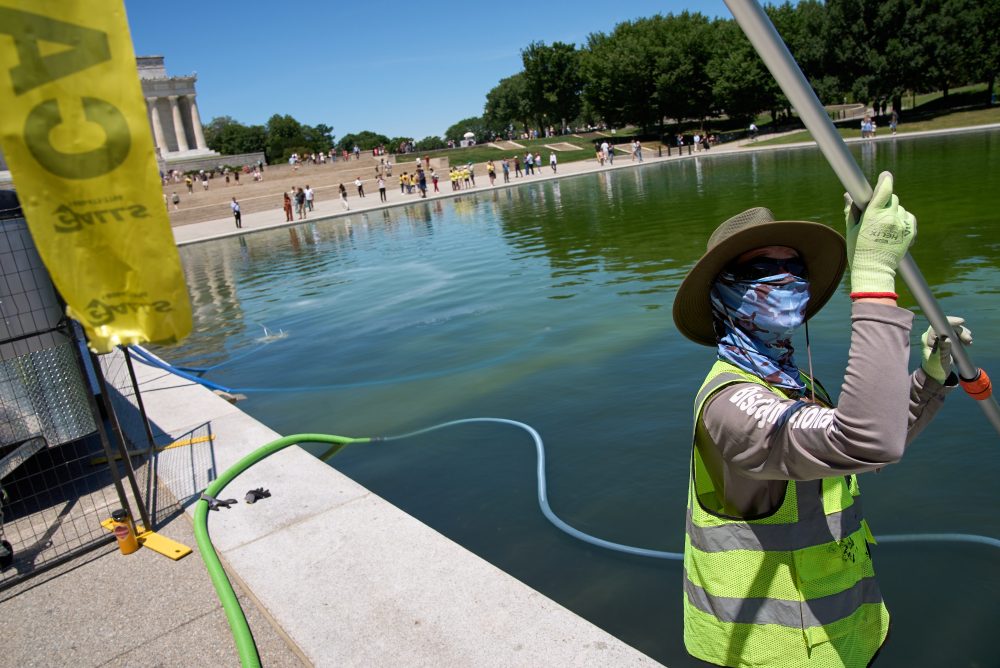

WASHINGTON — The freshly renovated Lincoln Memorial Reflecting Pool, which features a newly painted “American flag blue” bottom, has already turned a murky green color due to an algae bloom — and that’s just days after its more than $14 million makeover was completed.
While the Washington Monument can once again be seen reflected in the refilled pool, President Donald Trump’s dream of a brilliant blue stretch of water between two of Washington’s most famous landmarks has run headlong into the stubborn realities of chemistry and biology — the same ones any homeowner with a backyard pool knows all too well. Making matters more complicated is the sheer size of the structure, which is larger than ten Olympic swimming pools combined and which Trump has referred to as a lake, as well as its water source: the frequently murky Tidal Basin.
Algae has been a persistent problem at the site since it first opened more than a century ago. But Trump made tackling the issue a priority as part of his broader effort to spruce up the nation’s capital ahead of the country’s 250th anniversary. Contracts totaling at least $14.8 million have been awarded for the project, which Trump announced in April after a friend visiting from Germany told him the pool looked dark and disgusting.
On Tuesday, teams of National Park Service employees and outside contractors deployed chemicals along with ozone nanobubbles — a water purification method that reduces the need for harsh chemical treatments — in an effort to get the algae under control. Similar methods had been used to treat the pool before the renovation even began.
Cochise Wanzer II, president of the Pool Service Company in Arlington, Virginia, didn’t mince words about the situation. “What do you expect?” he said. “You’re basically taking natural, untreated river water, pumping it in and expecting it to do something different from what it would do out in the open.”
Wanzer also pointed out that the new dark paint on the pool’s floor is actually making the algae problem worse. “Now that the bottom is nice and dark, it elevates the temperature and the algae grows better,” he explained.
In addition to the nanobubble treatment, workers used a swimming pool-style vacuum to physically remove algae from the bottom of the pool. The result was a patchwork of clean blue patches surrounded by large green-covered areas — a sight anyone who has vacuumed a carpet in sections would recognize. The National Park Service also confirmed it is applying hydrogen peroxide to the water, a gentler alternative to chlorine that is commonly used in spas and natural swimming pools. In a statement, the agency noted, “There are no harmful side effects to marine life or to the environment.”
At one point during the cleanup effort, a contractor removed his shoes and socks, rolled his pants up to his knees, and waded directly into the pool to position an ozone nanobubble tube — all while tourists and local visitors looked on during a sunny morning.
Among those at the pool was a Las Vegas couple, Rick and Ariana Pettit, who are traveling the country in their RV. The two stopped to take photos at the historic site, which has served as the backdrop for countless protests and marches over the decades. Ariana, wearing American flag-themed leggings and a Make America Great Again leotard, turned to her husband — dressed in a Veteran for Trump American flag button-up shirt — and said: “Look, it’s already looking more blue.”
Wanzer offered a straightforward prescription for getting ahead of the algae problem long-term: “They may want to drain it, hose it all down, and start from the beginning with fresh water and treat it as the water comes in.”