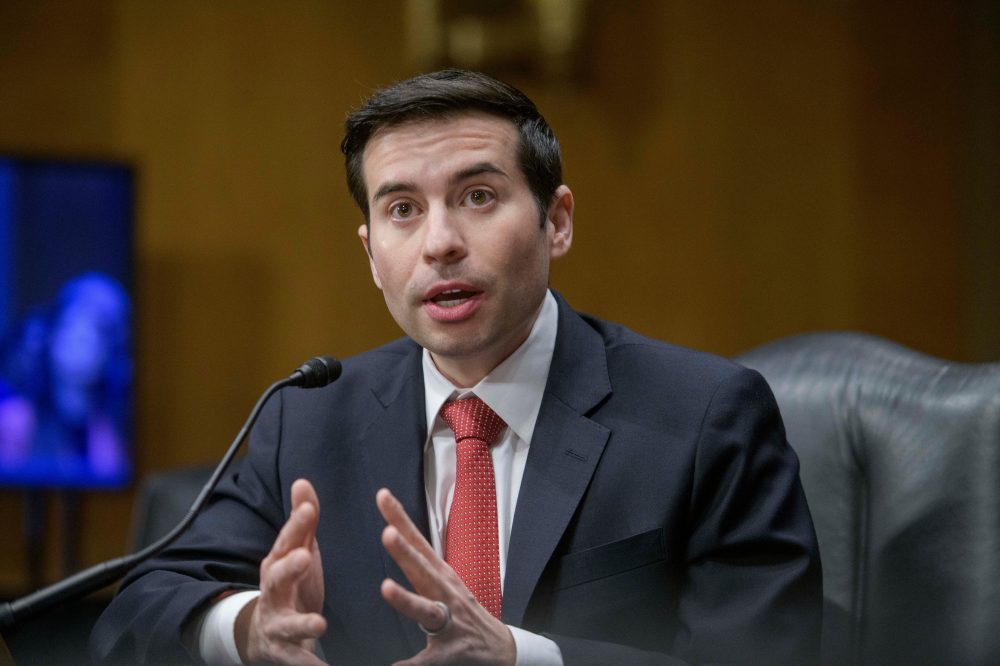
The Federal Trade Commission has taken legal action against the World Professional Association for Transgender Health, filing a lawsuit Wednesday alongside four states as part of the Trump administration’s ongoing effort to restrict gender-affirming care for transgender minors.
The lawsuit, which includes Alaska, Iowa, Nebraska, and Texas as co-plaintiffs, claims that WPATH made misleading statements about gender-affirming care provided to minors and that its members financially benefited from those claims.
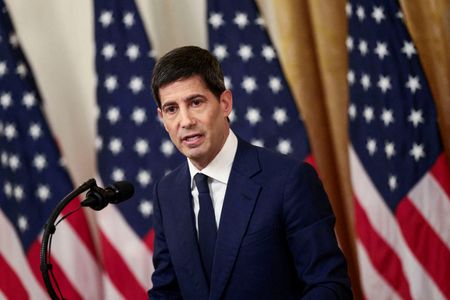
FTC Chairman Andrew Ferguson addressed the lawsuit on X, stating: “Parents have a right to make informed decisions about their children’s health. The FTC will not allow parents and children to be deceived by medical organizations and providers who are prioritizing profit over children’s health and safety.”
In response, WPATH released a statement defending its approach, saying its guidelines are designed to provide care tailored to each individual patient rather than applying a single standard to everyone.
This lawsuit follows a prior FTC investigation into WPATH, which the organization challenged in court, arguing the probe violated its First Amendment rights. A federal judge ruled in WPATH’s favor in May, temporarily halting the investigation.
The FTC has also opened investigations into the American Academy of Pediatrics and the Endocrine Society regarding their own guidelines on gender-affirming care. Both organizations have responded by filing lawsuits against the agency.
According to its website, WPATH has been developing widely accepted medical standards for gender-affirming care for more than 50 years, grounding its guidelines in “established scientific standards, expert consensus and patient-centered values.”
WPATH pointed to the earlier court ruling as evidence of its strong legal footing, and vowed to fight the new lawsuit. “WPATH is in a strong position to prove that the FTC is acting out of pure retaliation as part of the federal government’s relentless and targeted campaign to undermine gender-affirming care by attacking the First Amendment rights and the independence of professional medical organizations,” the organization said. “We expect the same result when we oppose this latest attack on WPATH and its mission to promote evidence-informed care and guidance for doctors and their patients.”
BRUSSELS — The European Parliament voted Wednesday to approve a sweeping overhaul of the European Union’s migration policy, a move that would allow member nations to establish detention facilities in other countries and accelerate the removal of migrants who have no legal right to remain.
The legislation, which still requires a final formal vote of approval from all 27 EU member governments, reflects a dramatic tightening of migration rules that has been building since more than one million refugees and migrants arrived in Europe between 2015 and 2016.
European Commission President Ursula von der Leyen voiced support for the changes ahead of a gathering of EU leaders in Brussels, writing in a letter to member states on Tuesday: “The Return Regulation will provide the necessary tools to make returns more efficient, with faster and more effective procedures.”
EU nations have long complained that they cannot effectively enforce the departure of people whose asylum applications have been denied or who have overstayed their visas.
The shift in policy reflects the growing influence of anti-immigration sentiment across the EU over the past decade, a trend that has fueled support for far-right political parties throughout the bloc.
Opponents of the new rules contend that EU migration policy has swung too far toward punishment and removal, while ignoring the underlying reasons people flee their home countries — including war, poverty, and political persecution.
Volker Turk, the United Nations’ top human rights official, addressed the UN Human Rights Council on Monday with pointed criticism: “The dehumanization of migrants and refugees, including in the UK, US, and many EU countries, is appalling, often leading also to the denial of their rights.”
He added: “The European Union’s new rules on returning migrants risk expanding the use of detention, establishing offshore return hubs, and weakening safeguards against refoulement.”
In a separate and controversial development, the European Commission last month extended an invitation to Taliban officials to visit Brussels to discuss the deportation of Afghan migrants. Human rights organizations warned that such a meeting could put Afghan nationals at risk and undermine core EU principles.
Both the Commission and the Swedish government, which is co-hosting the visit, maintained that the meeting is purely technical in nature and does not amount to formal recognition of Taliban authority.
According to a letter reviewed by Reuters and addressed to Abdul Qaher Balkhi, a Taliban foreign ministry spokesman, the visit was scheduled for June 22 to 23 and would center on “the return and readmission of Afghan nationals without a right to stay in the European Union.”
A spokesperson for the Belgian foreign minister confirmed Wednesday that Belgium had received visa applications from five members of the Taliban delegation, though the spokesperson said it was not yet clear when the visas would be granted or when the meeting would take place. The delegation is also subject to security screening.
The spokesperson made clear that Belgian Foreign Minister Maxime Prevot opposes the invitation entirely. “He does not approve of the choice to invite representatives of the Taliban regime to Brussels. He would never accept that the Belgian government, in its own name, invite these individuals for discussions in Belgium,” the spokesperson said.
The Commission stated last month that any deportations resulting from such talks would be limited to individuals “who pose a security risk.” Neither the Commission nor the Swedish migration minister confirmed the specific date of the meeting.
Western governments have refused to grant the Taliban official recognition since the hardline Islamist movement seized control of Afghanistan in 2021, ousting a government that had been backed by the United States and NATO.
Cybersecurity firm Fortinet announced Wednesday that it has become aware of an active campaign in which hackers are attempting to steal login credentials from its firewall and virtual private network (VPN) devices.
According to a company statement, the attackers are pulling information from “previous incidents” and using a technique known as “bruteforcing” — a method where hackers repeatedly try different password combinations in an attempt to break into a targeted network or device.
Fortinet was clear that the malicious activity is “not related to any recent incident or advisory,” suggesting it is not tied to any newly discovered vulnerability or recently disclosed security event.
A court-ordered inventory has revealed that the National Park Service quietly pulled at least 51 exhibits from 38 locations across the country as part of President Donald Trump’s executive order aimed at eliminating displays that “inappropriately disparage Americans past or living.”
The list was submitted by the Trump administration in a court filing on Wednesday, shedding light on the scope of the removals. Among the affected sites is Philadelphia’s Independence National Historical Park, where an exhibit detailing George Washington’s ownership of enslaved people was taken down.
The filing came at the direction of Boston-based U.S. District Judge Angel Kelley, who ruled Friday that the federal government was engaged in an illegal effort to “rewrite the nation’s history with a white-out pen.” Her ruling followed a legal challenge brought by groups representing national park conservationists, historians, and scientists, who argued the administration had broken laws governing how the National Park Service operates.
In a separate filing, the administration described the judge’s order to have the exhibits reinstalled by July 3 — the day before the country marks the 250th anniversary of its founding — as a “herculean and unmanageable task.” Officials asked that the order be put on hold while they appeal the decision, which blocked Interior Secretary Doug Burgum from carrying out Trump’s March 2025 directive.
Trump’s order took aim at what he described as a “revisionist movement” that portrayed the United States as “inherently racist, sexist, oppressive or otherwise irredeemably flawed,” and instructed the Interior Department to make changes at national parks across the nation. Critics have charged that Trump is attempting to erase parts of American history to support false narratives about the country.
The inventory filed with the court also listed Fort Sumter in South Carolina, the Jamaica Bay Wildlife Refuge at the Gateway National Recreation Area in New York, and Acadia National Park in Maine as sites where materials were removed. At each of those three parks, exhibits related to climate change were taken down. According to the court ruling, those items were discarded because officials deemed them unrelated to the “beauty, abundance, and grandeur of the natural landscape.”
A National Park Service official acknowledged in an accompanying court filing that the submitted list was likely incomplete and that not every item flagged for removal had actually been taken down yet.
Judge Kelley, who was appointed by Trump’s Democratic predecessor Joe Biden, noted in her ruling that an internal National Park Service database — leaked by anonymous civil servants in March — had identified more than 500 items under review for potential removal.
The agency also noted that, in the interest of transparency, the filed list included six additional items removed from a 39th national park under a separate Trump executive order. Attorneys representing the plaintiffs had not responded to requests for comment as of the time of reporting.
Boston bars are bracing for another massive surge in beer consumption as Scotland’s passionate Tartan Army of soccer supporters prepares for its second weekend in the city — after fans came dangerously close to emptying several pubs dry during their first round of World Cup celebrations.
When Scotland defeated Haiti 1-0 on Saturday in the country’s first World Cup appearance since 1998, bar workers were forced to rush emergency supplies to venues packed with tens of thousands of notoriously enthusiastic Scottish fans.
Billy DeCain, general manager of the Sam Adams Tap Room in downtown Boston, said the experience was unlike anything he had seen in three decades in the industry. “I’ve been in this business for over 30 years, and I’ve never seen anything like this,” he said.
At one point during that first weekend, the bar had to arrange a special delivery truck directly from a Sam Adams brewery just to keep up with the relentless demand. Even with that emergency shipment, DeCain said he was worried they might be forced to sell only canned beer.
“We just about made it through. If we didn’t have those emergency deliveries it would have been a tall task,” DeCain said on Wednesday, as fans nursed pints while waiting for Friday’s upcoming match against Morocco.
Both the Haiti game and the Morocco match are being held at the large stadium in the suburban town of Foxborough — the home of the New England Patriots American football team.
DeCain offered an American frame of reference for understanding the level of excitement the Scottish fans brought with them, comparing it to what it would feel like if a beloved American football team made it to the Super Bowl for the very first time.
“You’re on adrenaline all weekend, and you could definitely see that,” he said of the Scots and their first World Cup adventure in nearly 30 years. “Do they ever sleep? Do they ever get tired? They were back at it the next day at 11 a.m.”
The Tartan Army’s enthusiasm extended well beyond the bars. On Sunday, fans marched through the streets to the sound of massed bagpipes, making their way to Fenway Park, the home stadium of the Boston Red Sox baseball team.
Boston Mayor Michelle Wu said local residents immediately connected with the visiting fans’ deep passion for their sport. Wearing a blue Scotland shirt on the steps of Boston City Hall, Wu told reporters: “We count ourselves as among the most passionate and crazy sports fans anywhere. So, to see that same level of commitment and dedication, that brings true respect.”
Wu went on to heap further praise on the visiting supporters. “The Scottish fans are the absolute best. They have been incredibly warm, they’ve been supporting our businesses, they have been getting to know our community and treating Boston as if it were another home away from home for them. So, I hope that the Tartan Army will keep coming back to Boston.”
After Friday’s Morocco match, Scotland’s World Cup journey moves to Miami for a game against Brazil. Meanwhile, Boston will shift its focus to welcoming Scotland’s historic rival England, along with England’s own large contingent of traveling fans, ahead of England’s match against Ghana at Foxborough the following Tuesday.
Speaking to reporters in Paris on Wednesday, U.S. President Donald Trump made a surprising statement regarding Iran’s military capabilities, arguing that denying the country ballistic missiles while other nations possess them is inequitable.
“I’m saying that if other countries have them, it’s a little bit unfair for them not to have some,” Trump said during the Paris press appearance.
Trump went further, suggesting that Iran having missiles on par with neighboring countries would be acceptable. “If Saudi Arabia and Qatar, and they all have some, I would say in relative proportion, I think it’s okay,” he added.
The president also addressed the ongoing U.S. military presence in the Gulf region, saying American forces would remain there “for a while” following an agreement between Washington and Tehran that brought an end to nearly four months of conflict in the region.
A lane shift is currently in effect on Savannah Road between Parker Run Road and Wescoats Road as crews carry out work in the area.
The lane shift is expected to remain active until 6:00 PM. Drivers are encouraged to slow down and proceed with caution through the work zone.
No additional details about the nature of the work were provided. Motorists should plan ahead and allow extra travel time if their route takes them through this stretch of road.
Fishing conditions across Maryland are looking good this week, with striped bass action reported throughout the Chesapeake Bay, solid freshwater opportunities, and exciting catches along the Ocean City coast.
With the first day of summer arriving Sunday, June 21 — the longest day of the year — anglers have more daylight to enjoy the water. However, the Maryland Department of Natural Resources is urging fishermen to be mindful of rising water temperatures and their impact on fish survival during catch-and-release fishing.
The Department of Natural Resources is running its Striped Bass Summer Fishing Advisory Forecast, a campaign designed to reduce striped bass deaths from catch-and-release fishing during hot weather. The agency monitors temperature forecasts and issues daily recommendations for the week ahead.
Forecast Summary: June 17 – June 23
Main Bay surface and river mouth water temperatures have climbed into the mid to upper 70s and are expected to keep rising throughout the week. Bottom waters are currently cooler and offer better conditions for striped bass. Smaller rivers and streams have also warmed to the upper 70s. As waters heat up, oxygen levels at the bottom are beginning to drop. Adequate oxygen is present in most Bay bottom waters, with the exception of the area near Quantico to Colonial Beach in the Potomac River, and from Swan Point down to the Bay Bridge area.
Most Maryland rivers and streams are running below average flow levels. Water clarity throughout the Bay and its rivers is expected to be near average. Strong tidal currents are anticipated from Saturday through Tuesday due to the new moon on Monday, June 15.
Upper Chesapeake Bay
At the Conowingo Dam pool, anglers are making long casts toward the turbine wash where striped bass are holding. Topwater lures and paddletails have been effective during morning and evening hours, while cut bait is drawing striped bass, blue catfish, and flathead catfish throughout the day. In the lower Susquehanna, striped bass are being found along grass flat edges during low-light hours, with poppers and paddletails among the top lure choices.
Blue catfish fishing has been solid near the mouths of the Susquehanna and Elk rivers, even as many of the larger females are in spawning mode. The upper Bay and its tidal rivers also hold blue catfish populations.
Striped bass fishing has been strong this month in the upper Bay. Live-lining spot has become the go-to technique now that spot are widely available. The 30-foot outside edge of Swan Point, the area near Pooles Island, and the Love Point rocks are all producing well. Spot are also being located on the shallow west side of the Bay Bridge, at Podickory Point, near the mouth of the Magothy River, and in the Chester River near Hail Point. White perch and small croaker occasionally show up in the same areas, though white perch fishing in the tidal rivers and creeks of the upper Bay is currently rated fair to poor.
Middle Bay
The Bay Bridge remains a popular destination this week. Anglers are drifting live spot and other baits along the east side of the bridge near the 30-foot drop-off, targeting striped bass around the pier bases. Soft plastic jigs cast close to the piers are also producing results. On the shallower west side, spot, croaker, and white perch are being caught.
Live-lining spot along channel edges has been very popular. Good reports are coming in from the channel edge off Kent Island between the Brick House Bar area and Bloody Point. A few boats are trolling umbrella rigs, but live-lining remains the most popular approach, with jigging a close second. Action is also picking up along the edge from Buoy 84A south to Stone Rock, the Clay Banks, and the False Channel. The Kent Narrows area is also worth fishing for striped bass. Bluefish are in the mix this week, and Thomas Point on the western shore is worth checking. Anglers are reminded to use proper release techniques as warming water temperatures make fish more vulnerable.
Shallow-water striped bass fishing along Bay shores and in the lower sections of tidal rivers continues to be productive, though a higher percentage of smaller fish is expected. The best action is happening during the early morning and late evening hours. Poppers, skipping bugs, paddletails, and jerkbaits are all working well. Speckled trout are occasionally showing up, and cownose rays are stirring up the shallows at times.
White perch fishing in the tidal rivers and creeks of the middle Bay is rated fair to good. Anglers are targeting deep-water docks, piers, submerged rocks, and oyster reefs using bottom rigs baited with grass shrimp, peeler crab, or bloodworm pieces. Casting spin-jigs, small spinnerbaits, and spinners along promising shorelines during morning and evening hours is a fun way to target larger white perch.
Lower Bay
Higher salinity and clearer water — a result of the current drought in Maryland — may bring Spanish mackerel and cobia to the lower Bay earlier than usual and keep them around longer. The 2026 Maryland cobia season opened June 15. The minimum size is 43 inches total length, with a limit of one cobia per angler per day and two per vessel when two or more anglers are aboard. The minimum length for Spanish mackerel is 14 inches with a daily creel limit of 15 fish. The bluefish daily limit is five fish.
Striped bass fishing is good this week across a variety of locations and depths in the lower Bay. As water temperatures push past the mid-70s, larger slot-size striped bass are moving to deeper, cooler water during the day, while shallower areas produce action during the early morning and late evening hours.
The lower Potomac and Patuxent rivers are productive spots for live-lining spot or jigging along channel edges, with the 30-foot depth range being especially productive. Artificial reef sites are also worth checking with depth finders. Early morning and late evening hours offer good shallow-water striped bass fishing at the St. Marys River, Cedar Point, Tangier Sound, and the cuts through Hoopers Island. Paddletails, soft plastic jigs, and poppers are all effective. Speckled trout may also be in the mix.
For trolling, umbrella rigs, tandem-rigged bucktails, and swim shads remain popular. Drone spoons are now being added to trolling spreads as bluefish move into the lower Bay and Spanish mackerel become a possibility. The outside channel edges from Buoy 68 north past the Southwest and Northwest Middle Grounds to Buoy 72 have been productive for both trolling and jigging.
Spot and croaker can be found in several lower Bay locations, including the Cobb Island area, the mouths of the Wicomico and St. Marys rivers, Cornfield Harbor in the lower Potomac, the mouth of the Patuxent, Tangier Sound, and the mouth of the Honga River. Most croaker are running slightly under the required 9-inch minimum. White perch occasionally mix in.
Large red drum are providing exciting catch-and-release action near the Target Ship and Point Lookout areas, where anglers are jigging, trolling, and dropping soft crab baits. Cobia are also expected to be roaming these same areas this week.
Blue Crabs
Recreational crabbers are seeing fair to good catches in the middle and lower Bay this week. The best hauls are coming from the southern region on the eastern side of the Bay. Larger crabs are being found in 10 to 12 feet of water, while smaller crabs are showing up in shallower areas under 8 feet.
Freshwater Fishing
At Deep Creek Lake, smallmouth and largemouth bass are settling into their summer routines. Early morning finds them on main lake points and grass edges, while later in the day they seek shade under floating docks, fallen treetops, and submerged stumps. Bluegills are near docks, and trout are holding deep along the dam face.
Trout fishing in the Group II Delayed Harvest areas has been good since those sections opened June 15. Sections of the North Branch of the Potomac, the Casselman, and the Youghiogheny are now open to trout harvest. Anglers should confirm which specific sections are open before fishing — details are available on the DNR website or on page 25 of the Maryland Fishing and Crabbing Guide.
The upper Potomac is running low and clear. Long casts and light lines are essential. Smallmouth bass fishing is good with crawfish crankbaits and topwater lures in the early morning. Deeper-holding smallmouth and walleye can be targeted with ring worms, paddletails, and tubes.
Water levels are low in central region reservoirs, but fishing for largemouth and smallmouth bass remains good. The best action is during early morning and late evening near grass beds and shoreline structure. Spinnerbaits, paddletails, poppers, and soft plastics are all productive choices. Largemouth bass are transitioning to a summer pattern, feeding mostly at night and in low-light conditions. Targeting floating grass mats with wacky-rigged stick worms, flipping under docks and fallen treetops, or working deep structure are all solid tactics. Chesapeake Channa (snakeheads) are holding in grass beds of the tidal rivers and can be targeted with frogs, buzzbaits, or chatterbaits.
Atlantic Ocean and Coastal Bays
Surf anglers near Ocean City are pulling in kingfish along with a mix of flounder, blowfish, and bluefish. Bloodworms and artificial bloodworm baits are the top choice for kingfish; squid works well for flounder and blowfish; and cut mullet or finger mullet is the go-to for bluefish.
At the inlet and Route 50 Bridge area, striped bass are being caught during morning and evening hours near jetty rocks and bridge and dock piers. Soft plastic jigs and paddletails are popular lures. After dark, anglers are catching striped bass and bluefish by drifting cut bait. Sheepshead are being caught near the jetty rocks and bulkheads using sand fleas.
Flounder fishing has been good in the channels leading from the inlet and in some back bay channel areas. Drifting in front of the airport is reported to be a productive spot for flounder. Striped bass are still being caught during early morning and late evening hours at the Verrazzano and Route 90 bridge piers, with soft plastic jigs and paddletails as the top lure choices.
Black sea bass fishing remains solid at offshore wreck and reef sites. Flounder are also being found at those same locations and on shoals and lumps outside the inlet. At the canyon areas, the first white marlin release of the season has been reported, and some yellowfin tuna and golden tilefish have been brought to the docks.
The Maryland Fishing Report is written and compiled by Keith Lockwood, a fisheries biologist with the Maryland Department of Natural Resources. The Forecast Summary is written by Tidewater Ecosystem Assessment Director Tom Parham. Maryland anglers are encouraged to participate in DNR’s Volunteer Angler Surveys to help scientists monitor and manage important fish species.
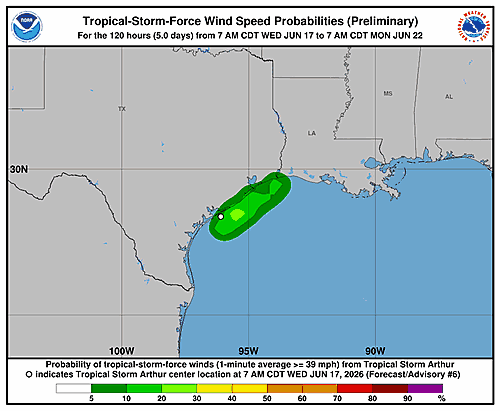
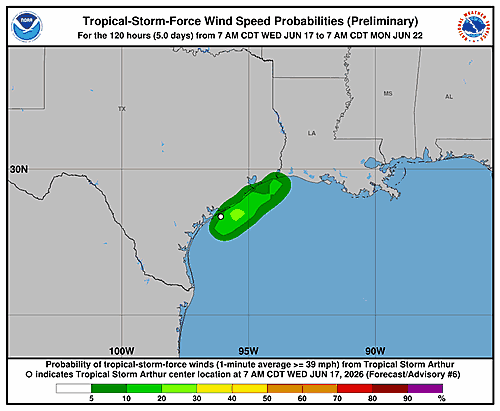
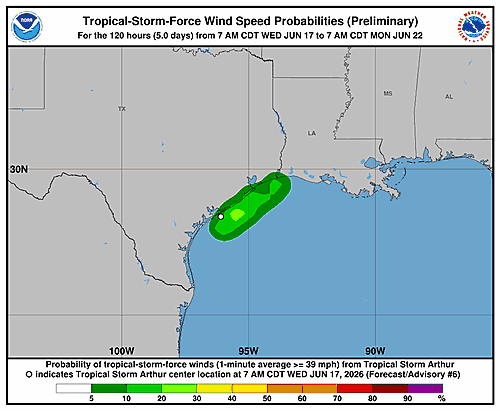
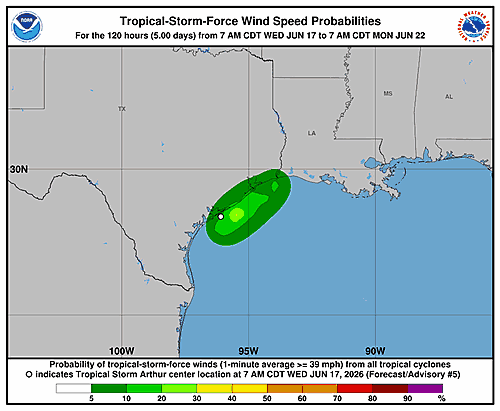
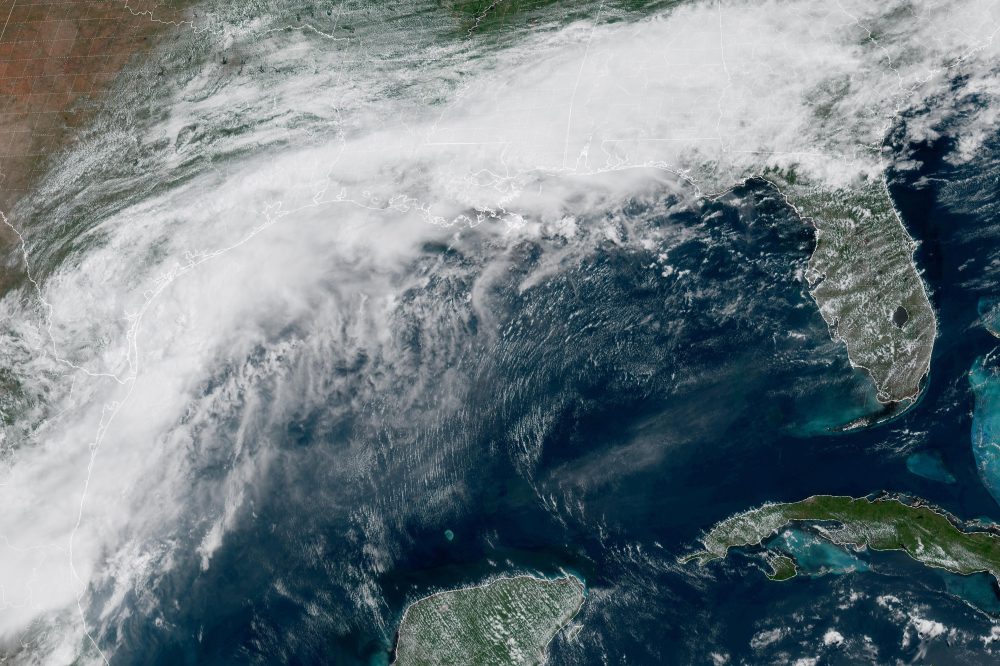
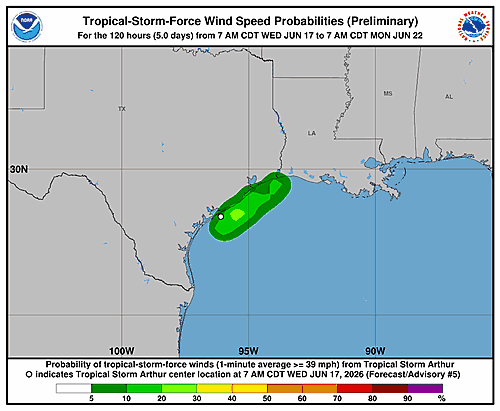
The National Hurricane Center has issued updated wind speed probability graphics for Tropical Storm Arthur, providing forecasters and the public with the latest outlook on the storm’s potential impact.
The graphics display the probability of 34-knot wind speeds affecting different regions over a 120-hour forecast window. These probability maps are a standard tool used by meteorologists to communicate the range of possible storm impacts.
According to the National Hurricane Center, the wind speed probability data was last updated on Wednesday, June 17, 2026, at 4:33 PM GMT.
Residents in potentially affected coastal areas are encouraged to monitor the latest updates from the National Hurricane Center as the storm continues to develop.
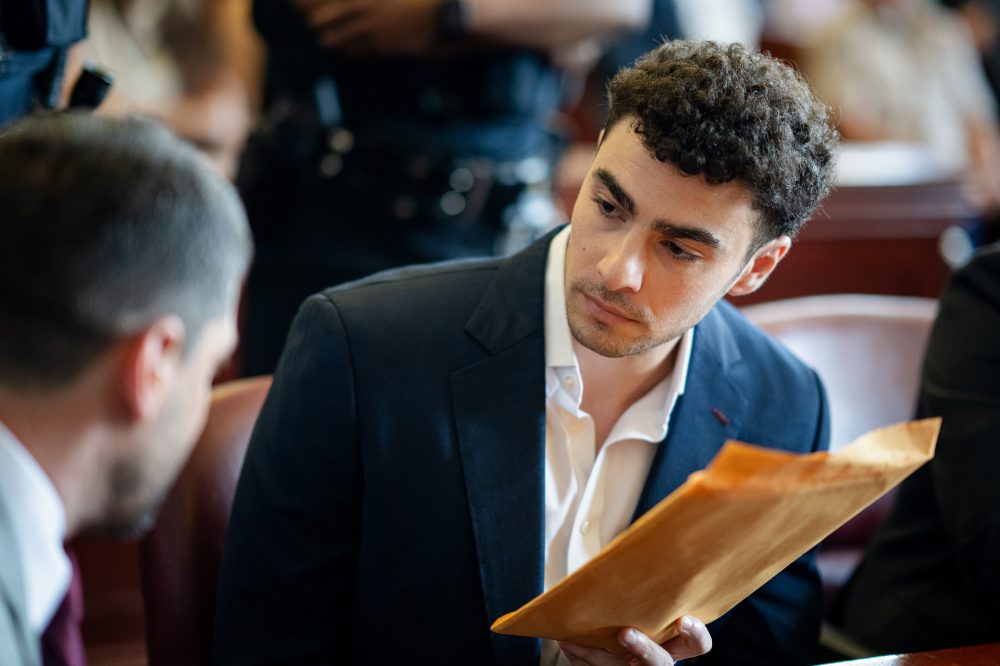
Luigi Mangione is set to return to court Wednesday for a critical pretrial hearing as his state case moves forward.
Mangione is facing charges at both the state and federal levels stemming from the 2024 murder of an insurance company executive. Wednesday’s hearing is considered a key milestone in the state court proceedings ahead of what is expected to be a full trial.
Drivers traveling along Papermill Road should be aware of lane shifts affecting both eastbound and westbound traffic this afternoon.
The lane adjustments are in place between Limestone Road and Willow Creek Lane as a result of construction activity in the area.
The lane shifts are expected to remain in effect until 5 p.m. Motorists are encouraged to allow extra travel time or consider alternate routes if possible.
Quarterback Brendan Sorsby is making moves toward a professional football career, with plans to hold a workout for NFL scouts on July 10 at a Dallas-area high school ahead of the league’s supplemental draft.
A person with knowledge of the situation shared the information with The Associated Press on Wednesday, though they requested anonymity because the supplemental draft process had not yet been finalized.
The deadline to apply for the supplemental draft falls on Monday, but lingering procedural questions remain tied to a temporary injunction issued by a Texas district court. That court order had previously cleared the way for Sorsby to play for Texas Tech this coming fall season.
In order to be eligible for the NFL’s supplemental draft — a rarely used process that would wrap up at least a week before the first training camp opens in late July — Sorsby must first be considered ineligible for NCAA competition. That means the temporary injunction, handed down June 8 by a Lubbock County court, would need to be lifted.
The NCAA originally declared Sorsby permanently ineligible after he acknowledged placing thousands of bets totaling at least $90,000 during his time at three college programs. He began his college career at Indiana, then spent two seasons at Cincinnati before transferring in January to Texas Tech, the reigning Big 12 Conference champion.
Among the bets he admitted to were at least 40 wagers placed on Indiana games during his freshman year in 2022, though none of those bets involved a game in which he personally took the field for the Hoosiers.
Sorsby, who is originally from the Dallas area, had been engaged in what was described as an unprecedented legal effort to restore his college eligibility before ultimately deciding to pursue a path to the NFL instead.
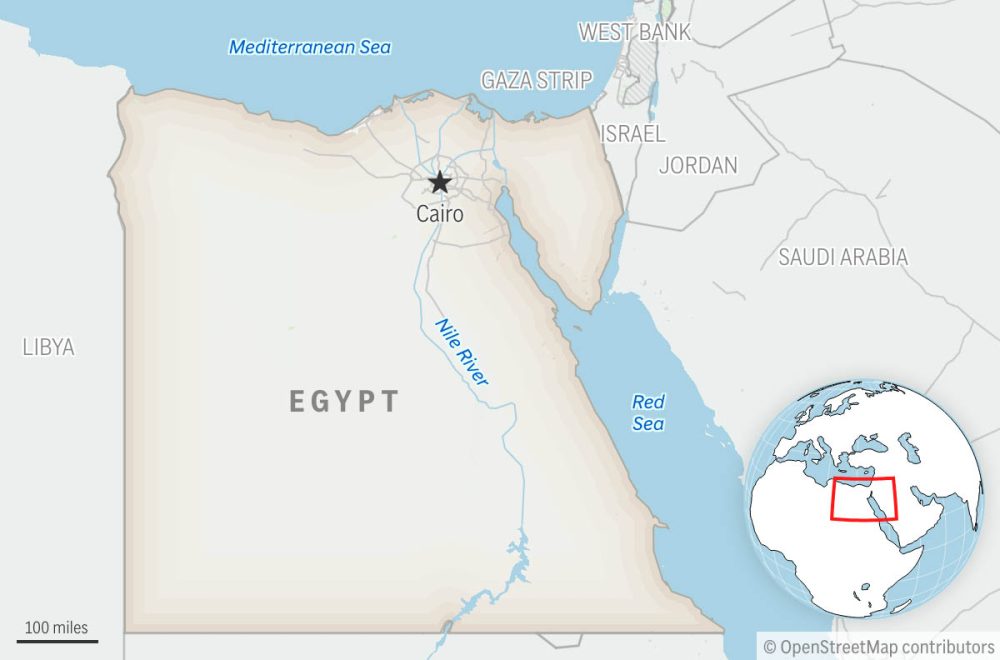
CAIRO (AP) — A former Egyptian doctor who went public on social media with accounts of obstetric violence and mistreatment of women at an Alexandria university hospital has been arrested and released on bail.
Authorities descended on the home of Omnia Swaydan in Damanhour, Beheira province, at approximately 6 p.m. local time Tuesday evening. According to lawyer Asmaa Naeim, who is following the case, Swaydan was home alone when officers arrived, ordered her to power down her phone, and then took her into custody.
Swaydan was brought to the prosecutor’s office in Alexandria on Wednesday afternoon for questioning, Naeim confirmed to The Associated Press.
Lawyer Mohamed Ramadan, who was present during her interrogation, said she faced charges of spreading false information and improperly using social media platforms. Later Wednesday afternoon, Ramadan announced on Facebook that Swaydan had been freed after posting bail of 20,000 Egyptian pounds, equivalent to approximately $401.
Ramadan did not immediately respond when contacted for additional comment. Naeim cautioned that the legal proceedings are not over — Swaydan could be summoned for further questioning at any time and may yet face formal charges that could result in a trial and possible imprisonment.
The arrest followed a post Swaydan published on Monday describing disturbing incidents she witnessed while training as a medical resident in the Obstetrics and Gynecology Department at al-Shatabi Hospital, a university-affiliated facility in Alexandria. Her account detailed cases involving sexual assault, physical violence, verbal abuse, and deliberate medical negligence by hospital staff.
On Tuesday, prior to her arrest, Swaydan updated her post to clarify that she had shared her experiences in hopes of prompting a serious examination of working conditions and medical practices in the ward, while also calling for stronger protections for women, patients, and junior medical staff.
The Doctors’ Syndicate responded to Swaydan’s post on Tuesday, stating it had received no formal complaints about the incidents she described and encouraging anyone with grievances to file official reports with the syndicate, relevant oversight bodies, the hospital administration, Alexandria University, or the public prosecutor. The following day, the syndicate’s Alexandria branch announced it was closely watching how the situation at al-Shatabi Hospital unfolds.
Alexandria University also issued a statement indicating it has launched a review and investigation into the misconduct allegations at the affiliated hospital.
Egyptian human rights organizations, including the Egyptian Initiative for Personal Rights, spoke out against Swaydan’s detention. Lobna Darwish, who leads the group’s women’s rights and gender program, told The Associated Press that the problems Swaydan described are not limited to al-Shatabi Hospital. She said obstetric violence has long been widespread at facilities offering free or reduced-cost care, and even at some private hospitals.
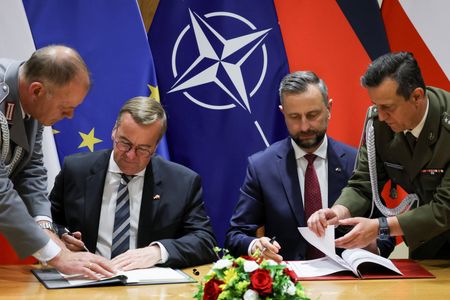
WARSAW, Poland — Poland’s deputy defense minister announced Wednesday that the United States has signaled interest in potentially setting up a permanent American military base on Polish soil.
Cezary Tomczyk spoke with The Associated Press one day after the Polish government passed a resolution clearing the way for such a permanent U.S. base in Poland, located on NATO’s eastern flank. He described Tuesday’s government resolution as a formal invitation extended to the Americans.
“The Americans are interested in the Polish offer to place a permanent base here,” Tomczyk said during an interview at the Defense Ministry in Warsaw, noting that the base would be jointly funded by both nations.
When reporters asked U.S. Defense Department officials in Washington about those comments, they said they had nothing new to announce.
Polish Defense Minister Władysław Kosiniak-Kamysz said Poland is doing everything it can to make a permanent base a reality, but acknowledged that “the decision will always be on the side of the Americans.”
Currently, roughly 10,000 U.S. troops are stationed in Poland, with most serving on a rotational rather than permanent basis. The Polish government is pushing for thousands of those troops to be stationed there on a permanent footing, especially as the United States reconsiders its overall military presence across Europe — both in terms of personnel and equipment.
The issue gained urgency in May, when the U.S. abruptly stopped the deployment of 4,000 soldiers to Poland, even though the Trump administration had previously called Poland a “model ally” for meeting its NATO defense spending targets.
U.S. President Donald Trump had also previously threatened to withdraw troops from Germany — a move linked to German Chancellor Friedrich Merz’s criticism of U.S. policy on Iran. The pullback in Poland, however, created widespread confusion on both sides of the Atlantic.
Tomczyk was part of a Polish delegation quickly sent to Washington for emergency talks. While he was still in the U.S. capital, Trump posted on social media that the U.S. would send an additional 5,000 troops to Poland.
Since then, the U.S. has confirmed it is reorganizing its troop presence in Europe but has offered no specific details about troop movements. Still, multiple statements from Polish defense officials suggest they believe their country has a real opportunity to see an increase in permanently stationed American forces.
“Sometimes a rotating model can change into a permanent model and this is always much better,” Defense Minister Kosiniak-Kamysz said in mid-May.
When asked whether the Polish resolution was prompted by clear signals from the U.S. side, Tomczyk said the two countries are “in a working dialogue” and that “the next step, after the two sides confirmed they are interested in this, is the official offer from the Polish state.”
“We can’t tell fortune from tea leaves,” Tomczyk added. “But we are a serious state which is presenting a serious offer to the Americans, in connection with the dialogue we are having with the Americans.”
A London jury delivered not-guilty verdicts Wednesday against former Nigerian oil minister Diezani Alison-Madueke, clearing her of five counts of accepting bribes and one count of conspiracy to commit bribery — a major defeat for British law enforcement after more than ten years of investigation.
Alison-Madueke, 65, made history as the first woman to serve as Nigeria’s minister for petroleum resources, holding that position from 2010 to 2015 under then-President Goodluck Jonathan. She also briefly served as president of the Organization of the Petroleum Exporting Countries.
Prosecutors had argued that Alison-Madueke was provided with “a life of luxury” in London by oil and gas industry figures who were looking to secure profitable contracts in Nigeria. The former minister denied ever accepting bribes and maintained she had no real power over how contracts were awarded.
Her legal team contended that the expenditures highlighted by prosecutors were either reimbursed by the Nigerian government for official duties or paid out of her own pocket for personal matters. She testified that she was known as “Madame Due Process.”
After more than 46 hours of jury deliberations following a trial that started in January at Southwark Crown Court, Alison-Madueke was acquitted. She described the outcome as the end of her “nightmare.”
“For 11 long, gruelling years this case has hung over my head and has tormented me and my family,” Alison-Madueke said in a statement released through her spokesperson. “But today, the past decade of relentless and unjust vilification, condemnation and scrutiny has finally come to an end.”
Britain’s National Crime Agency responded briefly, with a spokesperson stating: “We respect the decision of the jury.”
Zainab Saleem of the campaign group Spotlight on Corruption noted the broader implications of the outcome. “This case has exposed just how tough it is to investigate and prosecute alleged corruption involving political elites,” she said.
Alison-Madueke had weathered numerous scandals and investigations involving Nigeria’s state-owned petroleum corporation before leaving government when Jonathan lost the presidency in 2015. She was also a target of U.S. authorities, who alleged that proceeds from improperly awarded contracts were laundered through the United States.
While British prosecutors focused only on whether it was “improper” for her to accept benefits — not whether she had awarded contracts to undeserving parties — the U.S. Department of Justice stated in 2017 that Alison-Madueke “used her influence to steer lucrative oil contracts” to senior executives who had paid her bribes.
Two other defendants were also cleared in the case. Oil industry executive Olatimbo Ayinde, 54, was acquitted of one bribery count related to Alison-Madueke and a separate count of bribing a foreign public official. Alison-Madueke’s brother, Doye Agama, 69, was acquitted of conspiracy to commit bribery charges tied to payments made to his church.
The trial came close to collapsing on more than one occasion. Ayinde’s claim that she had acted as a whistleblower — reporting corruption to Bola Tinubu, who became Nigeria’s president in 2023 — caused a lengthy delay that nearly ended proceedings. In March, Nigeria’s attorney general sent a letter confirming that Ayinde had indeed made a report to Nigerian authorities. Despite Ayinde’s effort to have one of the charges against her dismissed, the judge ruled against her, though the jury ultimately acquitted her on both counts.
Alison-Madueke had previously attempted to have the entire case thrown out, arguing that Nigerian investigators were corrupt and that British prosecutors had failed to pursue all relevant leads. Those arguments were rejected before the trial began.
NORTHBOROUGH, Mass. — For the second year in a row, head coach Jim Nestor and his women’s lacrosse coaching staff have been named the Chesapeake Region Coaching Staff of the Year by the Intercollegiate Women’s Lacrosse Coaches Association (IWLCA).
The association made the announcement Wednesday afternoon, recognizing Nestor along with assistant coaches Allie Hynson, Liz Marr, Kellan McAleer, Mary Hanzsche, and Katelin Talbert for their outstanding work in the region.
The back-to-back honor highlights the continued excellence of the coaching staff, which has now earned the prestigious regional recognition in consecutive seasons.
The latest figures from a national broiler hatchery report show a slight uptick in poultry production activity across the United States.
According to the report, the number of broiler-type eggs set in the country increased by 1 percent during the most recent reporting period. At the same time, broiler-type chicks placed nationwide rose by 2 percent.
These numbers reflect ongoing trends in the U.S. broiler chicken industry, which plays a significant role in the nation’s overall poultry and meat supply chain.
NEW YORK — The Federal Reserve left its key interest rate unchanged Wednesday, but policymakers signaled that borrowing costs could rise later this year as concerns mount over inflation running above the central bank’s 2% target.
Updated quarterly projections revealed that nine Fed officials now anticipate a rate increase before the end of 2026. The Fed also stripped language from its policy statement that had previously hinted at the possibility of additional rate cuts in 2026.
With U.S. job growth remaining strong, unemployment holding at a relatively low 4.3%, and inflation continuing to exceed the Fed’s 2% goal, most analysts had already expected the central bank to leave rates where they are.
Kevin Warsh, who is now leading the Fed as its new chair, addressed reporters Wednesday afternoon and quickly pivoted to explaining why the central bank is changing how it talks to the public — including modifications to the so-called dot plot, which tracks economic projections from individual Fed officials. Warsh noted that those submissions are made in pencil “that have big erasers,” and that policymakers “don’t feel bound by their dots.”
MARKET REACTION:
STOCKS: Major indexes turned mixed after spending most of the day in negative territory. The S&P 500 slipped 0.1% after Warsh began speaking, while the Dow industrials were essentially flat and the Nasdaq Composite edged up 0.1%.
BONDS: The yield on the benchmark 10-year U.S. Treasury note climbed 1 basis point to 4.453%, while the 2-year note yield jumped 9 basis points to 4.14%.
FOREX: The U.S. dollar index gained 0.4%, reaching 99.91.
ANALYST REACTIONS:
Michael Pearce, chief U.S. economist at Oxford Economics in New York, said the Fed’s message was clear despite a leaner-than-usual communication: “In a dramatically slimmed-down communication from the Federal Reserve, the key message was that roughly half the committee are now projecting a rate hike this year, reflecting persistent inflation concerns. Our inflation projections for this year and next are far lower than the median projection, which is why we expect the next move will still be a cut. In his first meeting as chair, Kevin Warsh took an axe to the policy statement, which now offers next to no guidance beyond a factual summary of the economic situation. He also appears to have declined to offer economic projections, with 17 of 18 participants submitting rate forecasts for this year and next. The committee is divided roughly in half, with nine participants seeing a hike or a few hikes this year, while a similar number expect cuts by end-2027. Some participants also raised their estimates of long-run neutral rates.”
Michele Raneri, vice president and head of U.S. research and consulting at TransUnion in Chicago, said the hold should bring near-term stability to consumer credit markets: “The Federal Reserve’s decision today to keep interest rates unchanged should support near-term stability across most consumer credit markets. Recent inflation data adds complexity to the outlook, however, as headline inflation rose above 4% for the first time in three years, driven largely by increasing energy costs, while core CPI advanced a more modest and better-than-expected 0.2% in April. This divergence reinforces expectations that the Fed will likely remain on hold rather than pursue additional rate hikes or cuts in the near term.”
Brian Storey, head of multi-asset strategies at Orion in Omaha, Nebraska, noted the unanimous vote and the shift in the economic outlook: “As the market was expecting, the FOMC left the fed funds rate unchanged at a target range of 3.5% to 3.75%. As opposed to multiple dissenters in the past several meetings, this vote to keep the policy rate unchanged was unanimous. Overall, the Fed struck a slightly less upbeat tone on the economy; the updated Statement of Economic Projections showed a slightly lower forecast for GDP growth in 2026 and a notably higher forecast for inflation, with core PCE projected to be 3.3% in 2026 vs. the March forecast of 2.7%. The updated ‘dot plot’ removed the prior outlook for one rate cut in 2026 with a shift to a median outlook of one rate hike by year-end. As it relates to financial markets, the fairly close alignment between the Fed’s ‘dot plot’ and the message from the markets via fed funds futures reduces the likelihood of monetary policy upending equity markets as we move into the back half of the year.”
Kay Haigh, global head of fixed income and liquidity solutions at Goldman Sachs Asset Management in New York, said the meeting confirmed the Fed’s hawkish lean goes beyond just energy prices: “Today’s meeting confirms that the Fed’s recent hawkish shift was not just about higher energy prices. Despite the recent pullback in oil, half of the members of the FOMC expect rate hikes as soon as this year, reflecting strong labor market and inflation data. Our base case remains that the Fed can just about avoid hikes, but the path is narrow and there will be a high premium on the incoming inflation data.”
Stephen Coltman, head of macro at 21Shares in London, pointed to growing hawkish influence within the committee: “The committee remains divided, but the hawks have clearly gained ground since the previous meeting, and the committee is perhaps feeling some pressure in the wake of hikes by the Bank of Japan and the ECB. Warsh’s priority will be to achieve as smooth a handover from Powell as possible, and the recent collapse in oil prices will have been most welcome in this regard. Despite the hawkish tilt in the statement, the Iran deal does ease the pressure on the Fed and provides breathing space for Warsh to establish himself with the media in a calmer environment.”
Phil Blancato, chief market strategist at Osaic in New York, described the moment as a challenging debut for the new Fed leader: “Kevin Warsh is making his debut as chairman of the Fed in a tough moment for the Fed, when inflation is once again on the rise. Inflation is above the Fed’s 2% target, with it being 4.2% at the end of May, its highest level in three years. The labor market remains strong, meaning there is no need for a cut. I’d anticipate the Fed to hold rates here for the foreseeable future. Christopher Waller stated they should remove ‘easing bias’ language from Fed Policy. This is a bearish interest rate move, suggesting that the next move for rates does not have to be down. There is a 98% chance of a hold right now and markets will be more tuned into the Fed’s comments.”
Tom Graff, chief investment officer at Facet in Phoenix, Maryland, highlighted the significance of the dot plot shift: “While the Fed officially made no changes to their rate target today, there has clearly been a big shift. The most notable was the dot plot, where half of FOMC members penciled in at least one hike for the remainder of 2026, while only one member favored a cut. That’s a marked change from the last dot plot where the median forecast was for cuts. We also got our first taste of how Kevin Warsh will handle communication. The post-meeting statement was much more concise, and included only a cursory discussion of the economy. In terms of future rate decisions, the statement only said that ‘The Committee will deliver price stability.’ Overall, this is clearly a bit more hawkish than the market was expecting.”
Brian Jacobsen, chief economic strategist at Annex Wealth Management in Brookfield, Wisconsin, warned that Warsh’s communication overhaul could have unintended consequences: “Warsh turned the table over in the Eccles Building with a radical simplification of the Fed’s policy announcement. By doing this, he’s actually inviting more Fed-speak, not less. Now every Fed President will fill the gap left by the punchy policy announcement. This may backfire on Warsh.”
Ryan Detrick, chief market strategist at Carson Group in Omaha, Nebraska, said Warsh avoided rocking the boat too much in his opening act: “It doesn’t look like Warsh rocked the boat too much with his first meeting in charge. The realization is inflation has clearly been heating up, but the other side is the economy has been fairly firm as well. The chances are, as was widely expected, that there’s probably not going to be a rate cut this year. This further confirms that. Now the question becomes, will we really see a hike or is the Fed on pause the rest of this year?”
Matthias Scheiber, head of the multi-asset team at Allspring Global Investments in London, said consumers have held up better than expected but inflation remains a concern: “The consumer has surprised to the upside, maintaining robust growth of around 2% quarter over quarter but with a falling savings rate. Growth expectations have begun to reprice higher, with investment and consumption both balanced nicely. Inflation, on the other hand, has proved stubborn and is likely to continue to pick up from here. Tariff uncertainty remains, including a small left tail risk that a ‘resolution’ in the geopolitical backdrop could open a flood of demand. The Fed’s balance sheet remains a central question and will increasingly be in focus over the next few Fed meetings. Markets will continue to watch the chair as he implements his vision for the FOMC, which may see subtle shifts in the communications process and provisioning of data. The market will be keenly looking for these signals.”
Karl Schamotta, chief market strategist at Corpay in Toronto, described the statement overhaul as swift and striking: “This Fed decision was short, but not sweet. Kevin Warsh moved swiftly to put his stamp on the central bank’s communication strategy by executing a dramatic revision to the official statement, wiping out anything resembling forward guidance and editing out the bulk of the contextual information typically parsed most closely in financial markets. The committee turned sharply hawkish, with the median participant yanking inflation projections much higher — suggesting that officials don’t expect this weekend’s US-Iran deal to result in a serious easing in price pressures — and penciling in at least one hike this year, marking a stark contrast with the cut previously expected.”
Mark Hackett, chief market strategist at Nationwide Investment Management in Philadelphia, said the outcome largely matched expectations: “So far, as expected — incrementally hawkish with a less detailed statement. Initial market reaction has not meant much in the past several years. We will need to wait for the press conference. They telegraphed the significant changes to the statement, and dropping the easing bias was expected. It’s interesting that gold is having the most significant reaction to what should not have been a surprise.”
SAO PAULO — Brazilian President Luiz Inacio Lula da Silva fired back at U.S. President Donald Trump on Wednesday, acknowledging that Trump has every right to hold a personal preference when it comes to Brazilian politics, but drawing a firm line by telling the American president to “stay out” of Brazil’s upcoming elections.
Lula, who is planning to seek reelection in October’s vote, made his remarks shortly after Trump spoke to reporters, describing Brazil as having become “a little rough” and “dangerous politically.”
“They play pretty tough, but nobody plays tougher than the United States,” Trump told reporters.
The exchange represents the latest chapter in the complicated and often contentious relationship between the two world leaders, who were both present in Switzerland on Wednesday for the final day of the G7 summit.
Lula’s top rival heading into the October election is Senator Flavio Bolsonaro, the son of Trump ally and former Brazilian President Jair Bolsonaro. The elder Bolsonaro is currently serving house arrest following a conviction last year for allegedly plotting a coup in the wake of the 2022 election.
Trump met with Senator Bolsonaro last month, along with his brother Eduardo Bolsonaro, a former lawmaker who currently resides in the United States. That meeting came just weeks after Trump had also sat down with Lula.
Eduardo Bolsonaro, who has been actively seeking international backing for his family, was found guilty on Tuesday by Brazil’s Supreme Court of attempting to solicit interference from the Trump administration in his father’s trial last year — a charge he denies.
A spokesperson for the U.S. State Department responded to the conviction, calling it part of a “pattern of persecution and lawfare by the Brazilian courts against their political opposition.”
The spokesperson went on to say that “political debates should be settled by democratic elections, not by convictions.”
Federal officials have announced the release of $123.6 million in disaster relief funding aimed at helping fishing communities devastated by a series of fishery collapses across Alaska, Oregon, California, and the Squaxin Island Tribe.
NOAA made the announcement, saying the money was appropriated by Congress through the American Relief Act, 2025. The funding is intended to address fishery resource disasters that were declared between 2019 and 2023.
“Fishery resource disasters have devastating effects on local communities and our economy,” said NOAA administrator Neil Jacobs, Ph.D. “This disaster funding provides much needed assistance to our fishing industry, and we will work with the affected communities to help them recover. This action demonstrates our continued commitment to hardworking American fishermen and to the president’s vision to uphold the United States as the world’s dominant seafood leader.”
The funding covers several previously declared disasters, including the 2023/2024 Bering Sea snow crab fishery in Alaska, the 2023 Oregon ocean commercial salmon fishery, the 2022 Chignik salmon fishery in Alaska, the 2023 Upper Cook Inlet East Side Setnet salmon fishery in Alaska, the 2024 Sacramento River Fall Chinook and Klamath River Fall Chinook ocean and inland salmon fisheries in California, and the 2023 Squaxin Island Tribe Puget Sound Fall Chum salmon fishery in Washington.
NOAA Fisheries calculated how to divide the money among the affected disasters based on commercial revenue loss data.
“These fishery resource disasters are of great concern for the fishing industry and the people and communities that depend on these fisheries to support their local economies,” said Eugenio Piñeiro Soler, assistant administrator for NOAA Fisheries. “NOAA will continue to provide guidance and resources to boost recovery and support more resilient fishing communities in the future.”
The relief money is designed to strengthen the long-term economic and environmental health of the affected fisheries. Eligible uses for the funds include infrastructure improvements, habitat restoration, vessel and fishing permit buyback programs run by states, and job retraining programs. Commercial fishermen, recreational fishermen, charter boat businesses, shore-side operations, and subsistence users may all qualify for assistance. Some fishing-related businesses may also be able to seek additional help through the Small Business Administration.
NOAA Fisheries, acting under authority delegated by the secretary of commerce, will oversee the distribution of the funds. The agency will coordinate with the states of Alaska, California, and Oregon, as well as the Squaxin Island Tribe. Fishing community members and individuals affected by these disasters are encouraged to reach out to their state or tribal representatives for guidance on how to access the assistance.
WASHINGTON (AP) — After days of keeping the details under wraps, senior U.S. officials sat down with reporters Wednesday — including those from Townhall — and read aloud the draft memorandum of understanding reached with Iran. Speaking on the condition that their names not be used, the officials walked journalists through the document, which Iran has not publicly released.
Iran has floated the idea that the agreement could ultimately be signed by both presidents — Donald Trump and Masoud Pezeshkian. Such a ceremony would carry enormous historical weight, given that the two nations severed diplomatic ties in 1980 following the U.S. Embassy hostage crisis in Tehran. The memorandum itself is scheduled to be formally signed this Friday in Switzerland.
Below is a detailed breakdown of the 14-point draft agreement, as described by a senior official and quoted as closely as possible:
Point 1 — Ceasefire: Both the United States and the Islamic Republic of Iran, along with their respective allies in the current conflict, agree upon signing this memorandum to an immediate and permanent halt to military operations on all fronts, including in Lebanon. Both sides commit to not initiating any future war or military action against one another, and to refraining from threats or use of force. The agreement also affirms Lebanon’s territorial integrity and sovereignty. A final deal will confirm these terms.
Point 2 — Mutual Respect: Both nations pledge to honor each other’s sovereignty and territorial integrity and to stay out of each other’s internal affairs.
Point 3 — Timeline for Final Deal: The U.S. and Iran commit to negotiating and completing a final agreement within a maximum of 60 days, with the option to extend that window by mutual agreement.
Point 4 — Naval Blockade: Immediately upon signing, the United States will begin lifting its naval blockade and removing any other impediments affecting Iran. The blockade is to be fully lifted within 30 days. During that period, vessel traffic will be gradually restored to pre-war levels. The U.S. also agrees to withdraw its forces from the vicinity of Iran within 30 days after the final deal is reached.
Point 5 — Strait of Hormuz and Persian Gulf Passage: Iran will use its best efforts to ensure safe passage for commercial vessels through the Persian Gulf to the Sea of Oman — and back — at no charge, for 60 days. Commercial traffic is to resume promptly, while Iran works to remove technical and military obstacles, including de-mining efforts beginning within 30 days. Iran will also enter into discussions with the Sultanate of Oman and other Persian Gulf states regarding the future administration and maritime services in the Strait of Hormuz, consistent with international law and the sovereign rights of coastal nations.
Point 6 — Reconstruction Fund: The United States, working with regional partners, commits to developing a mutually agreed-upon reconstruction and economic development plan for Iran worth at least $300 billion. The details of how the plan will be carried out are to be finalized within 60 days as part of the final deal. All necessary financial licenses, waivers, and permissions will be granted by the U.S.
Point 7 — Sanctions Relief: The U.S. agrees to lift all categories of sanctions against Iran, including United Nations Security Council resolutions, IAEA Board of Governors resolutions, and all unilateral U.S. sanctions — both primary and secondary — according to a schedule to be set in the final deal.
Point 8 — Nuclear Commitments: Iran reaffirms that it will not pursue or develop nuclear weapons. Both countries have agreed to work out what happens to Iran’s existing stockpile of enriched material through a mutually agreed mechanism. At a minimum, the material would be down-blended on-site under IAEA supervision. The two sides also agreed to discuss enrichment levels and other nuclear-related matters within the framework of the final deal. Both governments acknowledge the urgency of resolving nuclear issues and express their intent to address them immediately in negotiations.
Point 9 — Status Quo in the Interim: Until a final deal is reached, both sides agree to maintain the current status quo. Iran will keep its nuclear program at its present state, and the U.S. will not impose new sanctions or deploy additional forces to the region.
Point 10 — Oil Export Waivers: Immediately upon signing, the U.S. Treasury Department will issue waivers allowing the export of Iranian crude oil, petroleum products, and related services — including banking, insurance, and transportation — until sanctions are fully lifted.
Point 11 — Frozen Assets: The U.S. commits to making Iran’s frozen or restricted funds and assets fully available for use upon implementation of the memorandum. Procedures for releasing those funds will be agreed upon during negotiations. The funds — wherever they are held — may be used for payments to any recipient designated by Iran’s Central Bank, and the U.S. will issue all necessary licenses and authorizations to make that happen.
Point 12 — Oversight Mechanism: Both countries agree to establish an executive body to monitor compliance with the memorandum and the eventual final deal.
Point 13 — Sequencing of Negotiations: Once the memorandum is signed and specific provisions — including those covering the ceasefire, naval blockade, Strait of Hormuz passage, oil waivers, and frozen assets — begin to be implemented, the two sides will then open negotiations exclusively focused on the remaining points of the final deal.
Point 14 — UN Endorsement: The final deal will be backed by a binding United Nations Security Council resolution.
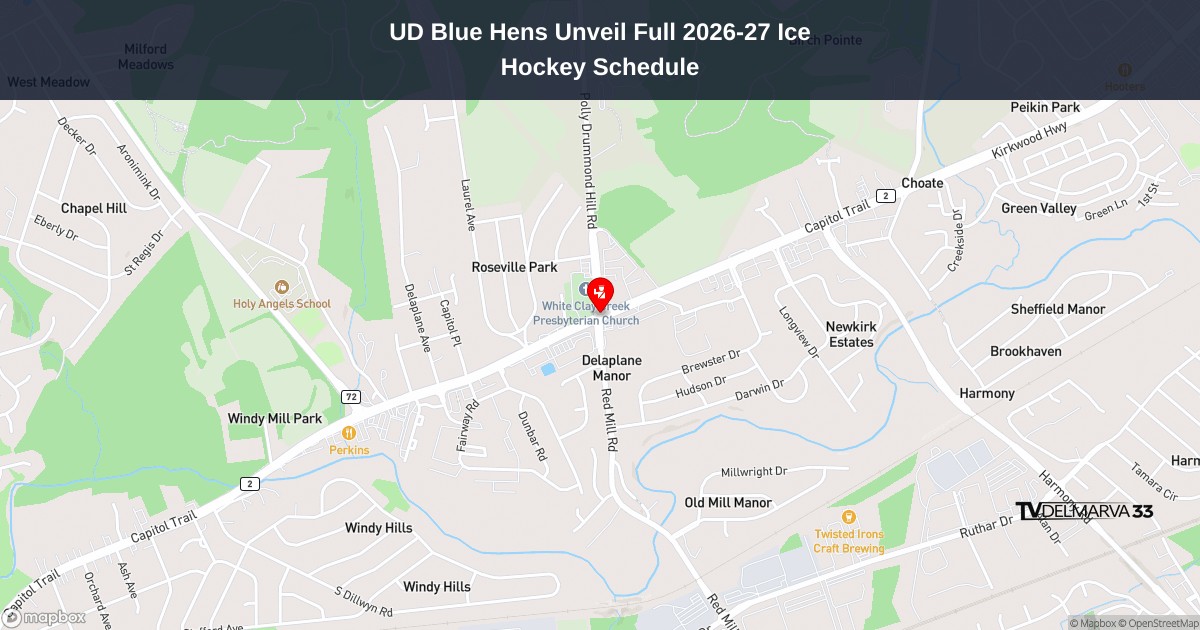
NEWARK, Del. — The University of Delaware’s ice hockey program is gearing up for its second season, with head coach Allison Coomey announcing the full 2026-27 schedule on Wednesday.
The Fightin’ Blue Hens are set to take the ice for 34 games during the upcoming campaign. Fans in Newark will have plenty of opportunities to cheer on the team in person, as 15 of those matchups are scheduled to be played at Fred Rust Ice Arena.
Delaware families who meet eligibility requirements now have access to a summer food assistance program called SUN Bucks, officially known as the Summer Electronic Benefits Transfer program, or Summer EBT.
The program launched this month and is designed to help parents and guardians afford nutritious groceries for their school-age children during the summer, when kids no longer have access to school meals.
Each eligible child receives $120 in grocery benefits through the program, giving families a meaningful boost in purchasing power for healthy food options during the summer months.
The U.S. Department of Labor issued a stern warning to all 50 states Wednesday, demanding they take swift steps to address fraud, waste, and abuse within their unemployment insurance programs — and threatening to cut off administrative funding for those that refuse to act.
Letters were sent directly to the governor of every state, marking the latest move by President Donald Trump’s administration to target fraud and misuse in state-managed programs that receive federal dollars. As has been the pattern with similar announcements, the administration drew attention to states where Democrats hold power.
Acting Labor Secretary Keith Sonderling made the administration’s position clear in a statement Wednesday. “We are officially putting governors on notice,” he said. “The American people will no longer tolerate the blatant waste, fraud, and abuse of their hard-earned tax dollars — no state should allow it either. If states allow it, they will suffer the consequences.”
The Labor Department pointed to a combination of poor oversight, aging technology, weak identity verification, and loose controls as factors that have “allowed unprecedented fraud to flourish.”
The department specifically highlighted California, Illinois, and New York — all states with Democratic-controlled governments — as examples of where problems have occurred.
California’s governor’s office pushed back hard against the announcement, pointing the finger at “lax regulations and rushed distribution” of unemployment benefits during the COVID-19 pandemic under the first Trump administration. A spokesperson for the California governor said in a statement, “Meanwhile California outperforms other states in addressing fraud.”
The Associated Press reached out to the federal Labor Department for more details about the specific fraud allegations, but did not receive an immediate response.
According to an estimate from the nonpartisan Government Accountability Office, fraud made up between 11% and 15% of all unemployment insurance payments distributed from April 2020 through May 2023, the period when the country was operating under a public health emergency due to the pandemic.
That window covered the final months of Trump’s first term in office as well as more than half of former President Joe Biden’s presidency. During that time, eligibility rules were loosened to get money out quickly, and the government identified problems as the funds were being distributed.
The new letter to states noted that the fallout from pandemic-era fraud “are still playing out.”
The Labor Department added that states should expect additional directives in the weeks ahead.
Vice President JD Vance is heading up an anti-fraud task force examining potential misuse of social programs across the country.
This effort is part of a broader pattern of federal pressure on states. The Department of Health and Human Services attempted to withhold funding for child care subsidies and other social services from five Democratic-led states, though a court has blocked that move. That department has also announced it is deploying artificial intelligence to monitor how states and other federal funding recipients are conducting program audits.
Separately, the Department of Agriculture has threatened to pull administrative funds from states that do not share data on participants in the Supplemental Nutrition Assistance Program, including information about their immigration status.
Police in South Africa turned to rubber bullets and stun grenades Wednesday to disperse migrants who clashed with officers near a community hall in Durban, where thousands of people are being processed for deportation.
The violence unfolded against a backdrop of rising anti-immigration tensions in Africa’s wealthiest nation, which has seen a wave of anti-migrant demonstrations and reported attacks on foreign nationals in recent weeks.
Authorities say the majority of those gathered near the hall are Malawian citizens who first arrived at the location more than a week ago, hoping to board government-provided buses back to their homeland voluntarily. The premier of KwaZulu-Natal Province, where Durban is located, said nearly 10,000 Malawians have been waiting in a park beside the hall for a chance to go home.
However, delays in getting people out of the country prompted South African officials to set up an immigration court at the hall and begin what the Ministry of Home Affairs described as “formal deportation processes.”
Footage aired by South African television stations captured groups of protesters hurling rocks, sticks, and logs at officers in the surrounding streets, while police responded with stun grenades and rubber bullets. Local media reported that the confrontations broke out among small groups of migrants who were frustrated by how long the process was taking.
The Home Affairs Ministry confirmed that at least 1,876 individuals among those at the site have been found to be in South Africa without valid documentation and will be deported. Verification of others’ immigration status is still underway, and the mayor of Durban indicated that more than 6,000 Malawians could ultimately face deportation.
Malawi is among at least five African nations that have moved to bring their citizens home from South Africa, pointing to threats and violent attacks against them as the reason. Hundreds of Malawian nationals have already been transported home by bus. Nigeria, Ghana, Mozambique, and Zimbabwe have also arranged flights or buses to help their citizens leave the country.
South Africa’s government has spoken out against a series of attacks on foreign nationals, which have been fueled by a recent surge in anti-migrant sentiment among certain groups.
As the continent’s most developed economy, South Africa has been ramping up immigration enforcement. Over the past two years, the Home Affairs Ministry says more than 100,000 people living in the country illegally have been deported. During that same period, more than 500,000 additional individuals were turned away at the border after being caught attempting to enter South Africa without authorization.
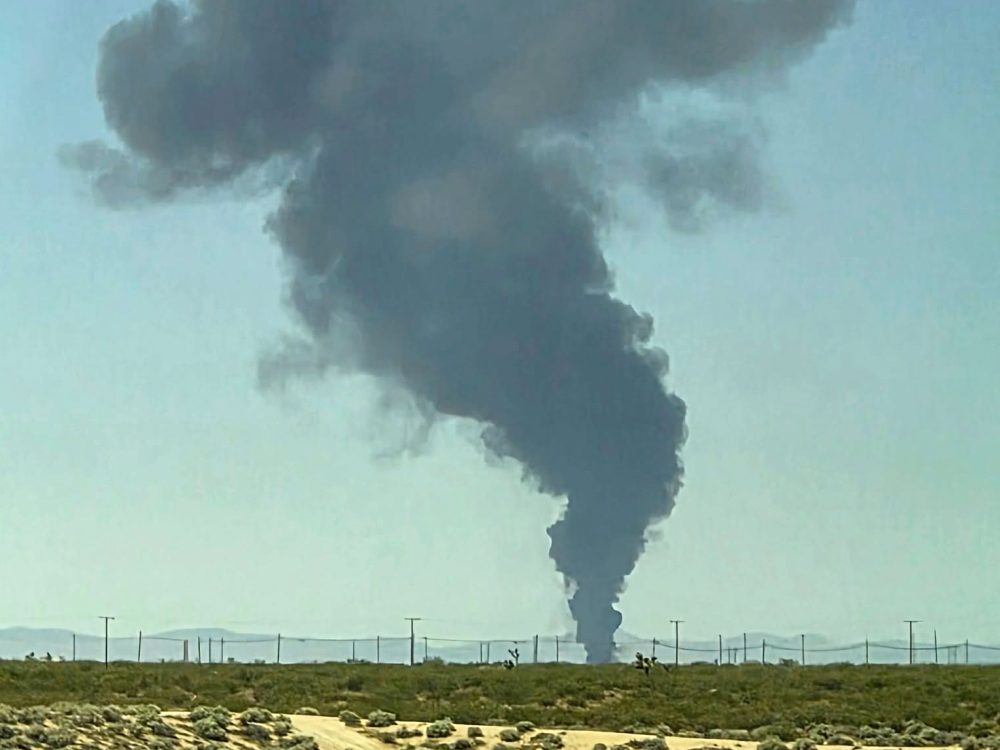
SPOKANE, Wash. — Strong winds pushed a rapidly spreading wildfire into a residential neighborhood in eastern Washington on Tuesday, forcing approximately 1,500 people to flee their homes and leaving some houses engulfed in flames, fire officials announced Wednesday.
The exact number of homes destroyed in the Spokane area had not yet been confirmed. Fire officials were still working Wednesday to assess the full scope of the damage, according to Matthew Vinci, fire chief for Spokane County Fire District 9, who confirmed Tuesday that some structures had been consumed by the flames.
As of Wednesday, the evacuation order covering those 1,500 residents remained active, said Chandra Fox, deputy director for Spokane County Emergency Management.
“Our concern is for increased winds Wednesday afternoon,” Fox said.
The fire broke out shortly after noon on Tuesday and rapidly climbed a hillside before shifting winds redirected the flames toward a nearby neighborhood, according to fire district spokesman Robert Gray.
Firefighting crews from both Washington state and Idaho worked to battle the blaze on the ground and from the air, but the fire quickly expanded to 225 acres — roughly a third of a square mile. By Wednesday morning, it was reported at just 10% containment, according to the National Interagency Fire Center.
Nationally, more than 32,000 wildfires have scorched over 3,900 square miles across the United States so far this year, according to the fire center, which coordinates large-scale firefighting resources. That figure is considerably higher than the 10-year average of nearly 24,000 fires burning around 2,200 square miles by early June — even as fire activity has been relatively subdued in recent weeks.
Looking ahead, weather and fuel models tracked by the National Interagency Fire Center indicate elevated wildfire danger in several parts of the country in the coming weeks. Areas flagged as having critical conditions include parts of California, the Southwest, the Great Basin, and the Rocky Mountain region.
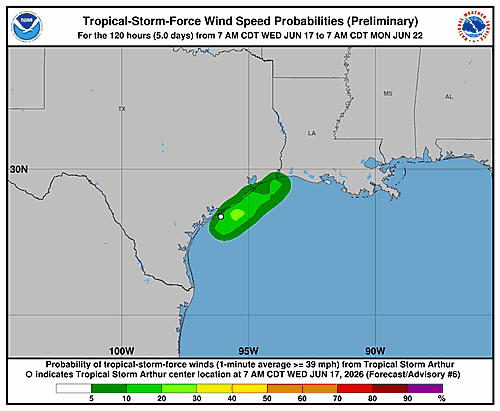
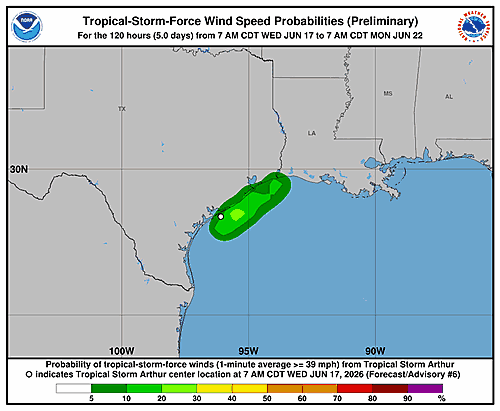
The National Hurricane Center has released updated wind speed probability graphics for Tropical Storm Arthur, providing forecasters and residents with the latest outlook on the storm’s potential impact.
The graphics illustrate the probability of 34-knot wind speeds affecting different areas over a 120-hour forecast period. These probability maps help communities assess their level of risk as the storm develops.
The wind speed probability data was last updated on Wednesday, June 17, 2026, at 4:33 PM GMT. Residents in potentially affected areas are encouraged to monitor the latest updates from the National Hurricane Center as the storm continues to be tracked.
Speaking to reporters in Evian-les-Bains, France on Wednesday, U.S. President Donald Trump indicated that economic sanctions placed on Iran would eventually be lifted — but only after the country changes its behavior.
“As far as sanctions are concerned, at some point, you know, we have sanctions which will never let them rebuild. They would have no money, they would be in poverty, the 91 million people would starve, so something will happen as soon as they behave. When they behave, we’re going to let that go. We’re going to have to. I put sanctions on a lot of people, and then I let them go,” Trump told reporters.
Beyond the sanctions themselves, Trump also floated the possibility that frozen Iranian assets could eventually be returned to the country.
“We have taken their money, it’s not our money, it’s their money, and we froze it. At a certain point in time I guess we’re going to have to give it back,” Trump said. “If we didn’t give it back, nobody would ever invest in the dollar again.”
A pair of former Philadelphia Phillies who each have World Series rings will be in the dugout for the next generation of baseball talent when the MLB Futures Game takes place in Philadelphia on July 12, ahead of the All-Star Game.
Shane Victorino, affectionately nicknamed “The Flyin’ Hawaiian,” has been tapped to manage the National League Futures squad, while longtime Phillies figure Larry Bowa will take the helm of the American League side.
Victorino, now 45, spent key years as a center fielder in Philadelphia, earning four Gold Glove awards and a place on the 2008 World Series championship roster. He later added another title to his resume when he won with the Boston Red Sox in 2013.
Bowa, 80 years old, has deep roots in the Phillies organization spanning nearly four decades. Currently serving as senior adviser to baseball operations for Philadelphia, he was the team’s shortstop when the Phillies claimed the World Series title back in 1980. Over his career, he earned five National League All-Star selections and took home two Gold Gloves.
As a manager, Bowa led the San Diego Padres during the 1987 and 1988 seasons before returning to Philadelphia, where he guided the Phillies to a 337-308 record between 2001 and 2004.
Several current major league players are already on the 2025 Futures Game rosters, including Carter Jensen of the Kansas City Royals, Kevin McGonigle of the Detroit Tigers, Braden Montgomery of the Chicago White Sox, and JJ Wetherholt of the St. Louis Cardinals.
The remainder of the coaching staffs for both squads will be revealed at a later time. First pitch is scheduled for noon ET.
Nearly half of the Federal Reserve’s policymakers have grown doubtful that simply keeping borrowing costs where they are will be sufficient to drive inflation back down to their 2% goal, particularly as oil prices have spiked following the war with Iran.
According to projections released Wednesday, nine of the central bank’s 19 policymakers now expect the Fed’s policy rate will need to increase before the year is out. That marks a striking reversal from just three months ago, when the Fed last released such projections and not a single policymaker anticipated a rate hike. The Fed announced it would leave its policy rate in its current 3.50%-3.75% range.
Of those nine policymakers expecting a rate increase, six — representing close to one-third of the full committee — believe more than one quarter-point hike will be necessary this year. Eight policymakers believe rates should remain at their current level, while just one favored a single rate cut. One policymaker did not submit a rate-path projection.
These individual forecasts, displayed in what is known as the Fed’s dot plot, reveal how swiftly the internal conversation at the central bank has changed — shifting from a debate about how long to hold rates before cutting them, to a growing concern that rate increases may be needed to prevent rising fuel costs from pushing broader inflation even higher.
The shift also creates a difficult situation for new Fed Chairman Kevin Warsh, who was selected for the position by President Donald Trump with the expectation that he would lower interest rates — a path that appears increasingly difficult as support for cuts continues to erode.
Global oil prices have fallen sharply since last week, when Iran and the United States announced a deal to end the conflict and restore oil shipments through the Strait of Hormuz. However, it remains uncertain how quickly shipping and exports can bounce back after the agreement is finalized, especially given the damage that energy infrastructure suffered over the course of the three-month war.
Fed policymakers generally have the ability to revise their dot-plot submissions until shortly before they are published, meaning the projections should reflect the most recent developments in the Middle East.
Inflation has remained above the Fed’s 2% target for more than five years.
The Wednesday projections indicate that central bankers have grown more pessimistic about inflation compared to their March outlook, a reflection of how sharply prices have climbed since the war began.
Based on the median policymaker estimate, inflation as measured by the personal consumption expenditures price index is now expected to reach 3.6% by year’s end. Back in March, policymakers had forecast year-end PCE inflation of 2.7%.
Core PCE inflation — which excludes the more volatile categories of oil and food — is now projected at 3.3%, up from the prior forecast of 2.7%.
The unemployment rate is projected to reach 4.3% by the end of the year, which matches the actual reading recorded in May and comes in below the 4.4% that policymakers had anticipated in March. That forecast reflects growing confidence that the job market is holding steady and does not require the support of rate cuts, a concern some policymakers had raised earlier in the year.
GDP growth is now forecast at 2.2% for the year, a slight downgrade from the 2.4% projection made in March.
Federal Reserve Chairman Kevin Warsh appears to have declined to submit an interest rate projection as part of the central bank’s latest quarterly forecasting exercise — a departure from established practice that could hint at the early stages of the sweeping changes he has pledged to make at the institution.
The Fed released its latest “dot plot” on Wednesday, a chart that displays the anonymous rate-path forecasts of individual policymakers. That chart contained just 18 submissions, even though the Fed’s full policymaking body consists of 19 members. The central bank did not identify which member chose not to participate.
Analysts are likely to point the finger at Warsh. He has been a vocal critic of the kind of forward guidance the dot plot represents, and he is the only new addition to the policymaking table since the previous round of forecasts was submitted.
The dot plot has been a fixture of Fed communications since 2012, published four times annually to give the public and financial markets a window into where policymakers think interest rates may be heading — whether that means a cut, a hike, or holding steady for an extended period.
Fed officials themselves acknowledge the tool has its limitations. It does not, for example, show how each policymaker’s outlook on employment or inflation connects to their rate-path view. Still, it has been part of an ongoing effort toward greater transparency that officials believe has helped make monetary policy more effective by giving investors and the public a clearer picture of the Fed’s thinking.
Warsh has long taken issue with that approach, contending that forward guidance can trap policymakers into a predetermined rate path even when fresh economic data would call for a different course. Whether his apparent decision to skip the dot plot signals something meaningful or simply reflects the fact that he is still getting settled in his new role remains to be seen. Either way, it is certain to fuel speculation about the future of the dot plot and the Fed’s overall communication strategy.
The only other Fed policymaker known to have withheld a dot in the past was former St. Louis Fed President James Bullard, who routinely submitted near-term rate projections but stopped short of providing an estimate for the longer-run neutral rate.
The Fed also noted that only 17 of the 19 policymakers submitted projections for the year 2028.
Tropical Storm Arthur is posing a serious threat to coastal communities along the Gulf of Mexico, with a Tropical Storm Warning still in place for sections of the Texas and Louisiana coastline.
Forecasters are also warning of life-threatening flooding expected to impact portions of the southeastern United States as the storm pushes inland.
According to the latest update issued at 1:00 PM Central Daylight Time on Wednesday, June 17, the center of Arthur was positioned near coordinates 28.9 degrees north, 95.7 degrees west. The storm was tracking to the northeast at approximately 9 miles per hour.
Arthur’s minimum central pressure was recorded at 1,000 millibars, with maximum sustained winds clocking in at around 45 miles per hour.
Residents in the affected areas are urged to monitor local emergency management guidance and be prepared for rapidly changing conditions as the storm continues to move through the region.
DOVER, Del. — A prominent piece of Wilmington’s skyline has earned a prestigious historical designation. The Delaware Division of Historical and Cultural Affairs announced that the Bank of Delaware Building, situated on Delaware Avenue in downtown Wilmington, was officially added to the National Register of Historic Places on April 27, 2026.
The seventeen-story office building received the honor based on two key factors: its architectural significance and its historical connection to commerce in the city of Wilmington.
The listing was announced by the Delaware Division of Historical and Cultural Affairs, the state agency responsible for preserving and promoting Delaware’s historical and cultural heritage.
The National Hurricane Center has issued updated wind speed probability graphics for Tropical Storm Arthur, providing forecasters and the public with the latest outlook on the storm’s potential impact.
The graphics display the probability of 34-knot wind speeds affecting different areas over a 120-hour forecast window. This type of information helps emergency managers and residents assess the likelihood of tropical storm-force winds reaching their locations.
According to the National Hurricane Center, the wind speed probability data was last updated on Wednesday, June 17, 2026, at 16:33 GMT. Residents in potentially affected areas are encouraged to monitor the latest updates from the National Hurricane Center as the storm continues to develop.
Rehoboth Beach is gearing up to honor America’s 250th birthday with a fireworks display on Sunday, July 5. Assuming favorable weather, the show will begin around 9:30 pm, launching from the beach at Brooklyn Avenue. Spectators can catch the display from the beach and boardwalk. The Funsters are scheduled to perform at the Bandstand at 8 pm and again after the fireworks conclude.
To keep crowds safe during the celebration, the city will put several road closures into effect throughout the evening on July 5:
The bandstand area will be off-limits to vehicles from 6 pm until midnight.
Starting at 7 pm, only buses and local residents will be allowed on Henlopen and Surf avenues.
Residents on Henlopen Avenue and those in Henlopen Acres and North Shores must reach their homes by way of 2nd Street beginning at 7 pm.
At 7:30 pm, vehicles will no longer be able to cross Rehoboth Avenue at the circle.
Rehoboth Avenue eastbound and Church Street from State Route 1 will close to traffic at 8 pm. From that point, anyone driving into Rehoboth Beach must enter via State Road to Bayard Avenue.
After the fireworks, vehicles north of Rehoboth Avenue will be directed out via Rehoboth and Columbia avenues. Those on the south side of Rehoboth Avenue should use Bayard Avenue to State Route 1 southbound, or Hickman or Munson streets to State Road, which connects to Route 1 in both directions.
In addition to road closures, parking will be prohibited in several areas, including Surf Avenue, the Convention Center parking lot, around the bandstand, Grenoble Place and Surfside Place, and marked spots along part of the ocean block of Laurel Street.
The city is encouraging visitors to walk or ride bikes into town, or take advantage of DART’s Park and Ride service. After the fireworks, all DART route pickups will be located at the Henlopen Hotel.
The Vegas Golden Knights announced Wednesday that Ryan Craig has been named the team’s new head coach, taking over from John Tortorella.
Craig had been serving as the head coach of the organization’s American Hockey League affiliate based in Henderson, Nevada, before receiving the promotion to the NHL level.
Craig is expected to meet with the media on Thursday to discuss his new role with the club.
SEAFORD, Del. — Motorists traveling through the Seaford area will need to find an alternate route this summer as a portion of Concord Road is set to close for an extended period.
The Delaware Department of Transportation (DelDOT) is scheduled to begin work on Bridge 3-243, which carries Concord Road over Tubbs Branch, on Tuesday, July 7, 2026. The project is part of a Pavement and Rehabilitation and Bridge Rehabilitation contract.
The bridge rehabilitation work will require a full road closure between Honeysuckle Drive and Church Road on Concord Road. The closure is expected to remain in place from July 7, 2026 through September 21, 2026.
DelDOT has established a detour for drivers heading westbound on SR 20 (Concord Road). Those drivers should turn left onto US 9 (County Seat Highway), then turn right onto US 13 (Sussex Highway), which will reconnect them to SR 20 (Concord Road).
Drivers are encouraged to plan ahead and allow extra travel time during the closure period.
The University of Delaware’s Athletics and Campus Recreation departments joined forces for their very first Day of Service, launching what organizers hope will become a cherished annual tradition.
Student-athletes, coaches, and staff members participated in the inaugural event, dedicating their time and energy to giving back to the community around them.
The Day of Service represents a commitment by Delaware Athletics and Campus Recreation to community engagement beyond the playing field, reinforcing the values of teamwork and service that extend well past athletic competition.
Officials indicated the event is intended to be held annually going forward, building on the momentum of this first gathering and expanding the program’s positive impact in the years to come.
ANKARA, Turkey — Turkey on Wednesday sharply condemned a European Parliament report that called on the European Union to consider imposing sanctions on the country’s justice minister and other officials accused of undermining human rights and civil liberties.
The report, approved during a full parliamentary session earlier that day, recommends that the EU look into freezing the assets of certain Turkish officials. Among those named is Akin Gurlek, who previously served as Istanbul’s chief public prosecutor before being elevated to justice minister earlier this year.
In its findings, the European Parliament described Gurlek as a central figure in what it characterized as “the state’s repressive machinery.” The report argued that his promotion suggested “that throughout his career he has always been a political actor following a political agenda.”
Turkey’s Foreign Ministry fired back with a forceful statement, accusing the report of unfairly singling out the justice minister. “We categorically reject the report’s distortion of legal processes conducted by the independent Turkish judiciary and its targeting of our Minister of Justice with baseless accusations,” the ministry said.
During his time as Istanbul’s top prosecutor, Gurlek oversaw several high-profile legal cases against members of the main opposition party, the Republican People’s Party, known as the CHP. Opposition figures have long argued those proceedings were driven by politics rather than law.
Hundreds of officials tied to CHP-governed municipalities have faced arrest in corruption investigations. One of the most prominent cases involved Istanbul’s Mayor Ekrem Imamoglu — widely regarded as President Recep Tayyip Erdogan’s top political rival — who was taken into custody last year.
In a more recent development, a court order removed CHP party leader Ozgur Ozel from his position, reinstating his largely unpopular predecessor, Kemal Kilicdaroglu, in his place. Critics have called the move a deliberate effort by the government to weaken opposition leadership.
Erdogan’s administration, however, continues to maintain that Turkey’s courts operate free from political influence.
Whether EU leaders would risk straining relations with Ankara by sanctioning a senior Turkish government official remains an open question. Turkey plays a significant role as an EU partner in managing migration flows and serves as a key member of NATO.
The European Parliament issues annual reports as part of the process of evaluating Turkey’s progress toward EU membership — a process that has largely stalled due to ongoing concerns about the country’s democratic direction.
Messi ties World Cup scoring record with hat trick in Argentina’s 3-0 win over Algeria
KANSAS CITY, Mo. (AP) — Lionel Messi delivered the first hat trick of his World Cup career Tuesday night, tying Miroslav Klose’s all-time tournament scoring record in front of a packed house of Argentina supporters at Arrowhead Stadium. The defending champions cruised to a 3-0 victory over Algeria. Messi put his team on the board in the opening minutes, added a second goal early in the second half, and completed the hat trick shortly before being substituted out. The milestone came exactly 20 years after Messi’s World Cup debut — in which he also found the back of the net. He now has 16 World Cup goals across six tournament appearances. His dominant showing overshadowed big nights from Kylian Mbappé and Erling Haaland, both of whom also scored twice in their respective matches earlier in the evening.
Argentina fans sparing no expense to follow their beloved team
KANSAS CITY, Mo. (AP) — Die-hard Argentina supporters are going to extraordinary lengths to follow the defending World Cup champions across the United States. One group made a 20-hour road trip to Tuesday’s opener in Kansas City against Algeria, surviving on sandwiches to cut costs. But with Lionel Messi potentially playing in his final World Cup, fans say no journey is too far and no ticket too expensive. Among them is Juan Martin, who is spending $20,000 to trail the team throughout the tournament. He compares the squad and its captain to the Chicago Bulls dynasty led by Michael Jordan. Their devotion paid off as Messi scored all three of Argentina’s goals.
Mbappé surpasses Pelé’s record with two goals as France defeats Senegal 3-1
EAST RUTHERFORD, N.J. (AP) — Kylian Mbappé scored a pair of goals Tuesday to push his career World Cup total to 14, moving him past Pelé on the all-time list. Bradley Barcola also scored as France overcame a sluggish opening half to defeat Senegal 3-1. Mbappé had just 14 touches in a scoreless first half — the fewest of any player on the field — before turning on the jets in the second. He gave France the lead in the 66th minute and added another in stoppage time. Barcola came on as a substitute in the 80th minute and scored just two minutes after entering. Ibrahim Mbaye pulled one back for Senegal with an angled shot late in stoppage time.
Haaland scores twice in World Cup debut as Norway rolls past Iraq 4-1
FOXBOROUGH, Mass. (AP) — Erling Haaland announced himself on the World Cup stage Tuesday, scoring his first two goals in the tournament to lead Norway to a 4-1 victory over Iraq in Group I. The goals were the 56th and 57th international strikes for the Manchester City forward, and they came in Norway’s first World Cup appearance since 1998. Leo Ostigard extended the lead to 3-1 in the 76th minute off a corner kick from Martin Odegaard, and an own goal by Iraq’s Aymen Hussein sealed the result just before the final whistle. Iraq had briefly leveled the score nine minutes after Haaland’s opening goal, with Hussein netting that equalizer as well.
U.S. pushes back on Iran’s complaints about post-match departure
WASHINGTON (AP) — The Trump administration is defending its handling of Iran’s national soccer team after Iranian officials complained the squad was forced to immediately leave the United States following its first World Cup match rather than being allowed a day to rest. Andrew Giuliani, executive director of the White House FIFA Task Force, told the Associated Press on Tuesday that the U.S. had been upfront about the arrangement, stating the country “was clear this was the process.” Separately, Iran winger Mehdi Torabi’s entry visa expired after the team’s first game. Both U.S. State Department officials and team representatives confirmed Tuesday afternoon that Torabi had obtained a new multiple-entry visa.
U.S. team says Pochettino has built a tough mentality ahead of World Cup group play
IRVINE, Calif. (AP) — The U.S. World Cup squad says it is mentally and physically ready for a rugged matchup against Australia in group play this week, and players credit head coach Mauricio Pochettino for that edge. Midfielder Sebastian Berhalter says Pochettino has drilled a key message into the team: “We’re American. We don’t take (crap).” That attitude was shaped in part during an October friendly against Australia, which the U.S. won 2-1 in a scrappy contest in Colorado. Pochettino reportedly tore into his players at halftime, demanding they push back after the Australians played an aggressive, physical style.
Scheffler chasing career Grand Slam at U.S. Open, but says it’s not his driving force
SOUTHAMPTON, N.Y. (AP) — Scottie Scheffler stands on the verge of completing a career Grand Slam at the U.S. Open, a feat that would draw yet another comparison to Tiger Woods. This marks Scheffler’s first opportunity to join golf’s most exclusive club. Woods is the only player in the modern era to accomplish the Grand Slam on his first attempt. Between Scheffler and that goal is Shinnecock Hills, one of the most demanding courses in the country — and that’s before the USGA adds its own challenges. Rory McIlroy noted the course is playing relatively gently at the moment, but with wind in the forecast, conditions could shift in a hurry.
Authorities say they foiled planned drone and gun attack on White House UFC event
WASHINGTON (AP) — Federal authorities say they disrupted a plot to carry out a violent attack on the UFC cage-fighting event held at the White House last weekend. Court documents unsealed Tuesday reveal that those involved discussed using explosives-laden drones and opening fire on crowd members as they fled in panic. Encrypted text messages obtained by the FBI showed roughly 20 individuals sharing detailed maps of the area and talking about securing a safe house and planning escape routes. It remains unclear from court records how close the plotters came to executing the scheme, which was stopped last week. Among those arrested was a 19-year-old man from Ohio, according to the FBI.
What does a winning score look like at the U.S. Open? Experts say under par is the new standard
SOUTHAMPTON, N.Y. (AP) — Arnold Palmer famously declared that a score of 280 always wins the U.S. Open — a statement he made in 1960 during his celebrated charge at Cherry Hills, when even par was considered the benchmark. But the game has evolved dramatically over the past six decades, and so has the standard for winning. With Shinnecock Hills hosting this week’s tournament, the course’s reputation as one of America’s toughest tracks — combined with wind in the forecast — is generating plenty of conversation. Still, some former major champions believe that finishing anywhere from 5 to 10 under par would be a sign that the course has truly lived up to its difficult billing.
Military officials on Wednesday released the identities of all eight people who lost their lives when a B-52 bomber went down in a fiery crash earlier this week at Edwards Air Force Base in Southern California.
According to an official statement, the victims were men ranging in age from 32 to 53. Among the eight were four active duty airmen, one reservist, and three civilians.
Col. Thomas Tauer, commander of the 412th Test Wing at Edwards, paid tribute to those lost, saying, “They were dedicated professionals, beloved family members and irreplaceable teammates.”
The runway where Monday’s crash took place remains closed, though other operations at the base have since resumed. Investigators have not yet pinpointed a cause, and officials warned the full inquiry could take as long as six months to wrap up.
The Boeing B-52 Stratofortress involved in the crash had been flying as part of a test mission connected to a program designed to extend the life of one of the oldest aircraft still serving in the U.S. military fleet. The bomber had been delivered to Edwards in December following upgrades to its radar system, which were carried out at a Boeing facility in San Antonio, Texas.
Two major United Nations food agencies issued a stark warning Wednesday that acute hunger is expected to get worse across 13 global crisis zones over the coming months, driven by ongoing conflict, deep cuts to humanitarian funding, and climate-related disasters.
The Food and Agriculture Organization and the World Food Program released a joint report projecting that conditions will deteriorate between June and November 2026. Approximately 266 million people are already experiencing high levels of acute food insecurity, and the agencies are urging immediate action from the international community.
The report identified Sudan, South Sudan, Yemen, and Palestine as the countries of greatest concern. Nigeria and Somalia have now been added to that top-concern category as conditions in those nations continue to deteriorate and the risk of famine grows.
According to the agencies, conflict and violence are the primary forces driving hunger in nearly every one of the identified hot spots. Those pressures are being made worse by economic instability, steep reductions in humanitarian aid funding, and the anticipated effects of an El Niño weather pattern that could bring droughts and floods to already vulnerable regions.
Funding for food assistance programs has fallen dramatically — dropping roughly 59% since 2022 — even as the number of people in need has climbed, the report noted.
WFP Acting Executive Director Carl Skau stressed the urgency of the situation. “The warnings in this report cannot be ignored,” he said. “Without action now, millions more are expected to face worsening levels of hunger in the months ahead, pushing some closer to famine.”
In the Gaza Strip, a ceasefire reached in October 2025 has led to some improvement, but the situation remains unstable. Earlier this year, approximately 1.6 million people — about 77% of the population studied — were found to be acutely food insecure and in need of immediate help. That figure includes more than half a million people at emergency levels and a smaller number facing catastrophic conditions.
Officials also flagged additional threats worsening the overall outlook, including ripple effects from the broader Middle East conflict and an Ebola outbreak in eastern Congo, both of which are disrupting local markets, livelihoods, and the ability of aid organizations to reach people in need.
The Food and Agriculture Organization and the World Food Program jointly called for fast, coordinated global action to expand aid delivery, protect people’s livelihoods, and stop conditions from deteriorating further. Without swift intervention, the agencies warned, millions more could face catastrophic levels of hunger in the months to come.
The Trump administration announced Wednesday that it has reached an agreement to purchase back four offshore wind leases from an energy company, pushing the total amount spent on these types of deals to nearly $2.6 billion.
Chicago-based Invenergy has agreed to surrender its four offshore wind leases — all of which were in very early stages of development — in exchange for $765 million in lease fee reimbursements. The company had already pulled the plug on the largest of the four projects, Leading Light Wind off the New Jersey coast, back in November. The remaining three projects were located off the coasts of Maine and California. Invenergy plans to put that money toward natural gas and geothermal projects that can be completed more quickly.
The Republican administration’s lease buyback strategy is designed to halt offshore wind development that President Donald Trump opposes, while steering money toward fossil fuel projects he supports. The approach came after federal courts blocked Trump’s attempts to halt offshore wind development through executive orders. Trump has repeatedly expressed his opposition to wind power, often calling turbines unsightly.
Interior Secretary Doug Burgum praised the deal in a statement, saying, “Under President Trump, companies are shifting investment back toward dependable, secure energy infrastructure that can power our economy and lower utility costs. We applaud Invenergy for recognizing the importance of baseload power and investing in energy solutions that deliver real benefits to American consumers.”
However, not everyone is on board. Hillary Bright, executive director of the offshore wind advocacy group Turn Forward, pushed back on the idea that these deals represent an equal trade. She pointed out that the fossil fuel projects being funded won’t deliver electricity to the same regions that would have benefited from the offshore wind farms.
“Replacing coastal offshore wind with geothermal or natural gas infrastructure in another region does nothing to address rising ratepayer affordability concerns, reliability challenges or potential gaps in power supply in the Northeast and mid-Atlantic,” Bright said in a statement.
This is not the first such deal. Back in March, French energy company TotalEnergies reached the first agreement of this kind, receiving close to $1 billion — essentially a full refund on two offshore wind leases off the coasts of North Carolina and New York — on the condition that the money be reinvested in fossil fuels. New York is currently leading a lawsuit challenging that agreement, and Democratic members of Congress have launched an investigation into it.
In April, two additional companies — Golden State Wind and Bluepoint Wind — agreed to give up their leases in exchange for reimbursements totaling nearly $900 million, with the same requirement to reinvest equally in fossil fuels. California is investigating the Golden State Wind deal, which involved a floating offshore wind project proposed off the state’s central coast. Bluepoint Wind was an early-stage project planned for waters off New Jersey and New York.
Invenergy holds four offshore leases in total: the Leading Light Wind lease area, which would have used traditional turbines anchored to the seafloor; two leases for floating turbine projects in the Gulf of Maine; and one lease for a floating project off California’s central coast. The company is North America’s largest privately held independent power producer.
For Invenergy, the agreement provides a path to move forward with energy projects that can get power to customers faster than the stalled offshore wind leases could. The Trump administration has created significant obstacles for wind energy permitting while simultaneously working to fast-track fossil fuel development.
The company left open the possibility of returning to offshore wind down the road. Daniel Runyan, senior vice president for development at Invenergy, said in a statement that given unprecedented energy demand, they “will deploy additional capital into projects that can be delivered on a commercially reasonable timeline and meet customer demand while continuing to evaluate opportunities as market conditions evolve.”
Leading Light Wind had been designed to generate as much as 2.4 gigawatts of electricity — enough to power more than one million homes. When Invenergy canceled it in November, the company cited supply chain difficulties, equipment and vendor challenges, and shifting regulatory requirements as reasons.
The floating offshore wind projects were so early in the planning stages that Invenergy had not yet determined how much power those locations could ultimately produce.
Invenergy is already a significant player in the natural gas industry, with 14 natural gas facilities currently in operation. The company is also expanding into geothermal energy, holding 45 leases covering 144,000 acres across Nevada, Idaho, California, Utah, and New Mexico. The $765 million from this latest deal is earmarked for natural gas facilities in Indiana, Wisconsin, Iowa, Kansas, and Missouri, as well as geothermal development in the West. The company will not be reimbursed for interest paid on lease payments or additional development costs already incurred.
It’s worth noting that Invenergy’s portfolio extends well beyond offshore wind. The company operates roughly 125 land-based wind farms, more than 60 solar projects, and nearly 30 battery storage facilities, with many more in active development.
The Maryland Department of Agriculture has announced that its 2026 Cover Crop Grant Program will be accepting applications beginning June 22, with the sign-up window closing on July 17, 2026.
Farmers interested in participating can register at their local soil conservation districts throughout the state.
The grant program, which has proven popular among the agricultural community, offers financial support to help farmers cover the expenses associated with planting fall cover crops. The conservation-focused initiative is designed to make it more affordable for growers to implement this environmentally beneficial farming practice.
The National Hurricane Center in Miami issued a brief update Wednesday morning indicating that a special advisory for Tropical Storm Arthur was set to be released shortly after 11:27 AM CDT.
According to the update, the purpose of the upcoming special advisory is to extend the Tropical Storm Warning southward to Sargent, Texas, expanding the area under the warning along the Texas Gulf Coast.
The update was authored by Forecaster Kelly at the National Hurricane Center. Additional details on the storm’s track, intensity, and full warning zones were expected to be included in the special advisory to follow.
Tropical Storm Arthur is posing a serious threat to parts of the southeastern United States, with forecasters warning that life-threatening flooding is expected as the storm pushes inland.
According to the latest update issued at 11:30 AM CDT on Wednesday, June 17, the center of Arthur was positioned near coordinates 28.8 degrees north, 95.5 degrees west. The storm was tracking to the northeast at approximately 9 miles per hour.
Meteorologists recorded a minimum central pressure of 999 millibars, with maximum sustained winds clocking in at around 45 miles per hour. A tropical storm warning has been extended further southward as the system continues to develop.
Authorities are urging residents in the storm’s path to take the flooding threat seriously, as conditions could become dangerous and potentially deadly across portions of the Southeast.
It was a big night for the Boston Fleet at the 2026 PWHL Awards, held Tuesday in Detroit, as the team walked away with five of the seven individual honors handed out at the event.
Goaltender Aerin Frankel was the star of the evening, earning two major distinctions — the Billie Jean King MVP Award and the Goaltender of the Year Award. The 26-year-old becomes the first goaltender in league history to receive MVP recognition. During the season, Frankel set new league records with 19 wins and eight shutouts, helping the Fleet tie for the PWHL lead with 62 points across 30 games.
Boston’s success extended beyond Frankel. Defender Megan Keller was recognized as the Defender of the Year, while Haley Winn earned Rookie of the Year honors. Head coach Kris Sparre was also celebrated, taking home the Coach of the Year award.
Two other awards went to players from different teams. Kelly Pannek of the Minnesota Frost was named the Forward of the Year. Rebecca Leslie of the Ottawa Charge received the PWHL “Hockey For All” Award, given to the player who has made the greatest positive impact in her community.
The PWHL also announced its All-Star teams for the season.
The First All-Star Team featured forwards Taylor Heise of Minnesota, Brianne Jenner of Ottawa, and Kelly Pannek of Minnesota. The defensive spots went to Sophie Jaques of Vancouver and Megan Keller of Boston, with Aerin Frankel of Boston named as goaltender.
On the Second All-Star Team, the forwards selected were Britta Curl-Salemme of Minnesota, Rebecca Leslie of Ottawa, and Laura Stacey of Montreal. Defenders Nicole Gosling of Montreal and Haley Winn of Boston rounded out the back end, with Ann-Renee Desbiens of Montreal named as goaltender.
The All-Rookie Team included forwards Kristyna Kaltounkova of New York, Abby Newhook of Boston, and Casey O’Brien of New York. Defenders Nicole Gosling of Montreal and Haley Winn of Boston were also named, with Hannah Murphy of Seattle earning the goaltender spot.
Nippon Steel, ranked third among the world’s largest steelmakers, is bullish on the American steel market and believes favorable conditions could push U.S. Steel’s earnings well above current projections, according to the company’s Vice Chairman Takahiro Mori.
“We are confident that U.S. Steel will be able to post profits in excess of 100 billion yen ($624 million) this year,” Mori said. He added that the positive market outlook stretching through 2027 points to even greater potential gains, and that U.S. Steel could generate between 300 billion yen and 400 billion yen in annual profit over the long term.
Mori described conditions in the U.S. as exceptionally favorable, noting that hot-rolled steel sheet prices have climbed above $1,200 per metric ton — more than twice what the same product fetches in Asian markets. To take advantage of those pricing conditions, U.S. Steel brought back online a previously idled blast furnace in Illinois in March and is now running it at full capacity.
These remarks come roughly a year after Nippon Steel wrapped up its $14.9 billion acquisition of U.S. Steel, a deal that took 18 months to complete and encountered significant political and regulatory resistance in Washington.
Mori said approximately 100 Nippon Steel employees seconded from Japan are currently working on 260 separate operational improvement initiatives aimed at increasing efficiency and generating synergies between the two companies. He also noted that U.S. Steel’s board has already signed off on about one-third of the $11 billion investment package Nippon Steel pledged to deliver through 2028, with projected returns expected to grow to $3 billion annually by 2035.
While Mori acknowledged potential headwinds — including cost pressures tied to inflation and competition for workers among major projects — he said the U.S. government has not stepped in to influence day-to-day management decisions since the acquisition closed, despite holding what is known as a “golden share” in the company.
Looking beyond the U.S., Mori said Nippon Steel plans to keep expanding internationally, with a focus on markets in India, Thailand, Europe, and the United States, even as geopolitical tensions and rising protectionism create uncertainty worldwide.
“We aim to lift overseas profit to more than 500 billion yen by 2030, nearly five times fiscal 2025 levels,” Mori said.
Mori, who personally led the negotiations to acquire U.S. Steel, said shifts in the global landscape have made it increasingly important for multinational companies to cultivate relationships with key government officials and align their business strategies with national industrial priorities.
U.S. Ambassador to Israel Mike Huckabee made a sweeping declaration on Tuesday, asserting that the United States owes its very existence to the Jewish heritage tied to the land of Israel.
Huckabee delivered his remarks at the International Conference on Israeli Heritage in Judea and Samaria, where he described communicating Israel’s significance to Americans as a core part of his role as ambassador.
“It is your heritage, without a doubt, but it is also the heritage of the United States. Without Israel, without the Jewish foundation, there would not be America. We owe our very existence to what happened in this land,” Huckabee said.
His comments followed statements made by President Donald Trump at the G7 summit on the same day, where Trump addressed U.S.-Israel relations and weighed in on Israel’s military campaign against Hezbollah in Lebanon.
“Without the US, there would be no Israel. Without me, there would be no Israel because no other president was willing to do what I did. I have had a great relationship with Bibi. Now Bibi has to be more responsible with respect to Lebanon,” Trump said.
Trump also indicated that Israel had been engaged in fighting in Lebanon for too long, and said he had proposed that Syria take on the responsibility of dealing with the Hezbollah threat.
Reports indicate that Israeli strikes on Hezbollah have been the subject of reportedly heated private exchanges between Trump and Israeli Prime Minister Netanyahu over the past two weeks.
Netanyahu and Israeli Defense Minister Israel Katz have both maintained that Israel reserves the right to keep forces in Lebanon and carry out operations against Hezbollah whenever needed to safeguard communities in northern Israel.
NEWARK, Del. — The University of Delaware women’s lacrosse team has bolstered its roster with the addition of transfer goalkeeper Allie Hanlon, head coach Amy Altig announced Wednesday.
Hanlon becomes the program’s second transfer pickup of the offseason, arriving via the transfer portal from Syracuse University. The Camillus, New York native spent two seasons with the Orange, during which she was part of a team that earned back-to-back trips to the second round of the NCAA Tournament.
Hanlon will join the Fightin’ Blue Hens as they look to strengthen their presence between the posts heading into the upcoming season.
The National Hurricane Center in Miami issued Special Forecast Advisory Number 6 for Tropical Storm Arthur at 4:30 p.m. UTC on Wednesday, June 17, 2026.
As of the advisory, the storm’s center was located near latitude 28.8 North, longitude 95.5 West, with that position accurate to within 30 nautical miles. The storm was moving toward the northeast at approximately 8 knots, or about 9 miles per hour.
Arthur had maximum sustained winds of 40 knots — roughly 46 miles per hour — with gusts reaching up to 50 knots. The storm’s estimated minimum central pressure stood at 999 millibars. Tropical storm-force winds of 34 knots extended outward 150 nautical miles to the northeast and southeast of the center.
According to the forecast, Arthur was expected to move inland by midnight Wednesday night, at which point maximum winds were projected to drop to 30 knots with gusts to 40 knots. By Thursday morning, the system was forecast to weaken further into a post-tropical remnant low near latitude 31.9 North, longitude 91.6 West, with winds down to 20 knots.
The National Hurricane Center forecasts the storm will fully dissipate by Thursday evening, June 19.
The advisory was issued by Forecaster Reinhart. The next full advisory was scheduled for 9:00 p.m. UTC Wednesday, with an intermediate public advisory expected at 6:00 p.m. UTC.
Ships within 300 miles of the storm’s center were asked to submit reports every three hours to assist in tracking the system.
The 2026 Atlantic hurricane season has officially gotten underway with the formation of Tropical Storm Arthur, the first named storm of the year.
Weather forecasters are warning that Arthur poses a serious risk of life-threatening flash flooding along the northern coast of the Gulf of Mexico. Satellite imagery captured the storm system as it continued to develop.
Despite the flooding concerns, forecasters say Arthur is not expected to gain much additional strength before it moves onshore. The National Hurricane Center has indicated the system will likely remain at roughly its current intensity heading into landfall.
Residents along the northern Gulf Coast are urged to stay alert to local warnings and be prepared for the possibility of rapidly rising water as the storm approaches.
The National Hurricane Center has issued updated wind speed probability graphics for Tropical Storm Arthur, providing forecasters and the public with the latest outlook on where dangerous winds may be felt.
The graphics depict the probability of 34-knot wind speeds occurring across a 120-hour forecast window, helping residents in potentially affected areas prepare for the storm’s impact.
According to the National Hurricane Center, the wind speed probability data was last updated on Wednesday, June 17, 2026, at 4:33 PM GMT. Residents in coastal areas are encouraged to monitor the latest updates from the National Hurricane Center as Tropical Storm Arthur continues to develop.
Somaliland’s President, H.E. Abdirahman Mohamed Abdillahi, was honored with the Friends of Zion Award at a ceremony held Tuesday at the Friends of Zion Heritage Center in Jerusalem. The event celebrated Somaliland’s friendship with Israel, its cooperative relationship with the Jewish state, and its decision to establish an embassy in Jerusalem.
Dr. Mike Evans, who founded the Friends of Zion Heritage Center, presented the award to Abdillahi. The ceremony drew diplomats, business leaders, Christian leaders, and international guests.
Addressing those gathered, Abdillahi described the honor as deeply meaningful. “It is a great honor for me to receive the Friends of Zion Award. I am deeply moved and grateful for this recognition. This award symbolizes the growing friendship and strengthening ties between Somaliland and Israel. We are committed to further deepening the relationship between our peoples and building a future based on cooperation, mutual respect, and friendship. I thank Dr. Mike Evans and Friends of Zion for this distinguished honor.”
Evans praised Abdillahi’s leadership in building stronger ties with Israel, pointing specifically to the embassy decision. “At a time when Israel faces complex security and diplomatic challenges, true friendship carries special significance. President Abdirahman Mohamed Abdillahi has demonstrated leadership, courage, and vision in advancing relations with Israel and strengthening the bonds between our peoples.”
He went on to say, “The decision to open an embassy in Jerusalem sends a clear message of friendship, mutual respect, and cooperation.”
Evans also revealed his intention to bring Somaliland’s case directly to the White House. Recalling a personal connection to the region, he stated, “I was in Mogadishu in October 1993 when the Black Hawk was shot down. It’s time to bless all states that bless Israel.”
He continued, “Somaliland has shown genuine friendship toward the Jewish state, and I intend to speak with US President Donald Trump about the importance of formal American recognition of Somaliland.”
The Friends of Zion Award was created by the late Shimon Peres, who served as Israel’s ninth president and was the former international chairman of Friends of Zion. Organizers noted that roughly 26 world leaders have received the award over the years, among them President Donald Trump, former President George W. Bush, and former Vice President Mike Pence.
The Friends of Zion Heritage Center was established in Jerusalem in 2015 by Evans. The organization states that its mission includes fighting antisemitism, opposing the BDS movement, and building global support for Israel.
The National Hurricane Center issued a special advisory Wednesday morning, announcing the extension of a Tropical Storm Warning along the Upper Texas coast southward to Sargent, Texas. The advisory, issued at 11:30 a.m. CDT on June 17, 2026, noted that recent surface observations and readings from NOAA buoy 42035 show maximum sustained winds near 40 knots, with the storm’s minimum pressure dropping to 999 millibars.
The system, now officially designated as Tropical Storm Arthur, was identified after a combination of data sources confirmed it had reached tropical storm strength. A 12:00 UTC Dvorak classification from the Tropical Analysis and Forecast Branch showed enough organized convective activity to classify it as a sheared tropical cyclone. Buoy readings and a ship report confirmed tropical-storm-force winds within the storm’s convective area, and Air Force Reserve Hurricane Hunters flying through the system recorded peak flight-level winds up to 52 knots at 850 millibars — further confirming tropical storm intensity. Arthur was officially designated with an initial intensity of 35 knots.
Arthur is accelerating toward the northeast at roughly 8 knots, carried along by strengthening southwesterly flow tied to a low- to mid-level trough. Forecasters expect the storm’s center to track along or over the Texas coast before pushing inland across southeastern Texas and into southwestern Louisiana by Wednesday night. The National Hurricane Center’s updated track forecast closely mirrors its previous projection.
Due to persistent westerly wind shear and Arthur’s nearness to land, forecasters say significant strengthening is unlikely. Tropical-storm-force winds are currently limited to the storm’s eastern half and are primarily affecting offshore waters. Arthur is expected to hold its current intensity while over water, then begin weakening once it moves inland tonight. Global weather models suggest the storm will eventually break apart into a trough, and forecasters note that Arthur should dissipate before the 24-hour forecast point, which was included mainly for continuity.
Forecasters are also watching for the possibility of new low pressure development over the western Atlantic later this week or over the weekend, as leftover energy from Arthur moves off the southeastern U.S. coast. The nature of that potential system remains uncertain, and the National Hurricane Center says it will continue tracking model trends to assess any risk of tropical cyclone formation.
The primary danger from Arthur is heavy rainfall and the potential for life-threatening flash flooding. The Tropical Storm Warning has been extended westward along the Upper Texas coast to High Island based on the latest observations.
Key threats identified by the National Hurricane Center include:
Flash and urban flooding: Potentially life-threatening flooding is expected through Friday across southern Louisiana, southern Mississippi, southern Alabama, southwestern Georgia, and the Florida Panhandle. Flooding is also possible near the Upper Texas coast, and ongoing heavy rain could extend the threat into the weekend.
Tropical-storm-force winds: Wind impacts are expected along the Upper Texas and Louisiana coasts Wednesday, from High Island to Morgan City, where a Tropical Storm Warning remains in effect.
Coastal flooding: Minor to moderate coastal flooding is anticipated along portions of the Upper Texas and Louisiana shorelines throughout the day.
The forecast calls for Arthur to weaken to a remnant low by 24 hours and fully dissipate within 36 hours. The advisory was prepared by Forecaster Reinhart.
Nearly three years have passed since Hamas carried out its shocking assault on Israel on October 7, dragging the country into a war on multiple fronts simultaneously. Today, Israel finds itself at a critical turning point, particularly as a newly announced US-Iran memorandum of understanding reshapes the dynamics of the broader region.
On the international stage, Israel remains largely on its own. Its military is still deployed in Gaza, Lebanon, and Syria, and long-sought normalization with Saudi Arabia continues to be out of reach. None of the conflicts Israel has been engaged in has reached a definitive conclusion, and its relationship with Washington has grown increasingly complicated.
The preliminary framework between the US and Iran, reached earlier this week, marks a significant shift in the regional equation.
Israel has demonstrated its military reach across the Middle East, causing widespread destruction in Gaza and southern Lebanon while also launching airstrikes in Syria, Iran, Yemen, and Qatar. A strike carried out in September 2025 targeted Hamas leaders in Doha, Qatar, and sparked international condemnation for violating that country’s sovereignty.
Chuck Freilich, a former Israeli national security adviser who now teaches at Tel Aviv University and Columbia University, offered a stark assessment. “There is a great gap between the military picture and the strategic picture, which is one of overall defeat and collapse of Israel’s strategy,” he told The Media Line.
Despite Israel’s battlefield accomplishments, its core objectives remain elusive. “It did not succeed in destroying Hamas or unseating it from power, Hezbollah is coming back despite downgrading its capabilities greatly, and Iran believes with good reason that it won the war by surviving an attack by the world’s superpower and greatly out-negotiated the US, coming ahead on the diplomatic level as well,” Freilich added.
Israeli Prime Minister Benjamin Netanyahu had pledged to dismantle Hamas in Gaza, completely destroy Hezbollah’s military capacity, and eliminate the nuclear threat posed by Iran.
On a more positive note, the Abraham Accords — the normalization agreements Israel struck with several Arab nations — have held up throughout the conflict, even when they appeared vulnerable. However, a deal with Saudi Arabia, something Netanyahu has long pursued and multiple US administrations have tried to broker, remains out of reach.
Prof. Jonathan Rynhold, a senior researcher at the BESA Center for Strategic Studies at Bar-Ilan University, offered a mixed assessment: “All of Israel’s enemies are significantly weaker; there is wider interest in the Abraham Accords because of the threat from Iran, but Israel’s diplomatic and political situation internationally is much worse, particularly in the United States. Israel has been far more isolated than this during its history.”
The situation on each of Israel’s major fronts remains complicated. For decades, Israel has considered Iran its most serious strategic adversary and the main backer of the armed groups that encircle it. Joint American-Israeli strikes caused significant damage to Iranian military infrastructure and reportedly disrupted parts of Tehran’s nuclear program. However, the conflict ended without toppling the Islamic Republic, and Iran may have emerged with even stronger nuclear ambitions.
Iranian officials and state media declared victory, claiming Tehran had survived direct military action from both Israel and the United States while keeping its government and strategic position largely intact.
“Iran believes that it won the war, doing so by withstanding a major American and Israeli operation,” said Freilich. “They come out feeling stronger and invigorated. Israel and the US helped them achieve progress towards their goal of being a regional hegemon.”
The US-Iran memorandum highlighted Israel’s reliance on American diplomatic support while also exposing a rift between Netanyahu and President Donald Trump over what the ultimate outcome should look like. Israel sees Iran as a threat requiring ongoing pressure, while Washington has focused on preventing a wider war, reopening the Strait of Hormuz to maritime traffic, and stabilizing the region.
At this point, neither side has achieved a clear-cut victory. Iran came out militarily weakened but politically intact, while Israel demonstrated an impressive military reach without fully neutralizing the threat it set out to eliminate.
“Israel faces a real problem,” said Rynhold. “If Iran is not limited in its conventional missile stockpile, Israel will want to attack, and it will be constrained by the US.”
The future of sanctions on Iran also remains uncertain, with both sides agreeing to a 60-day window to negotiate the final terms of a deal. “From Israel’s perspective, the worse the Iranian dilemma between survival and building military power is, the better,” Rynhold said. “Sanctions relief would be a strategic failure if it becomes part of any future agreement between the US and Iran.”
When Hamas launched its surprise attack on October 7, 2023, thousands of militants crossed into Israel from the south. Netanyahu vowed to retaliate, promising to free all 251 hostages taken and remove Hamas from power. The military campaign that followed drew widespread international criticism, with some close allies accusing Israel of excessive force and war crimes — allegations Israel strongly rejects.
More than two and a half years later, a fragile ceasefire is holding, and all hostages — including the remains of those who died — have been returned. Israel currently controls more than half of the Gaza Strip, with Hamas still holding sway over the remainder. The next phase of the ceasefire, which would require Israel to withdraw, is tied to Hamas disarming — something the group has refused to do. Netanyahu has indicated Israel will maintain its presence in Gaza and has suggested the military could push even further into Palestinian territory.
“Hamas’ military capabilities are a fraction of what they were,” said Freilich. “They no longer constitute a military threat, but they constitute a threat to the forces in Gaza, and they are still in power politically. Israel will be forced to withdraw from Gaza sooner or later, whether it likes it or not.”
Freilich also noted that further military action in Gaza could happen now that no hostages remain there, and suggested Trump might give Netanyahu some leeway in Gaza, particularly ahead of an election.
Netanyahu leads a far-right coalition whose members support intensifying military pressure on Hamas. Meanwhile, international criticism of Israel has grown, ranging from genocide allegations brought by South Africa to cultural, academic, and weapons embargoes.
“Any Israeli government will not move in a hurry,” said Rynhold. “There are a number of reasons for this — psychologically for the Israeli public, it keeps Hamas further away from the border and also because withdrawal is a hard thing to do.”
Some senior members of Netanyahu’s government have pushed for resettling Gaza with a Jewish population, a position Netanyahu has resisted but one that continues to generate significant international attention and backlash. “As long as Israel won’t allow settlers in, Israel has the ability to shape what goes on there — possibly keeping military control but giving other Palestinian factions civilian control,” Rynhold said.
Israel is set to hold national elections by late October, and the results are expected to significantly shape the future direction of the Gaza situation.
Hezbollah, the Iran-backed militant group in Lebanon, was once considered Israel’s most immediate danger. It joined the fight alongside Hamas just days after the October 7 attack. Israel believed it had nearly defeated Hezbollah by late 2024, but the strategic balance between the two has since shifted again. Iran is now using Hezbollah as a deterrent, threatening to strike Israel if Israel targets its key proxy.
“Israel cannot allow itself to live with that equation,” said Freilich. “This is another failure of its strategy.”
Still, Hezbollah has taken a serious beating. “Hezbollah is infinitely militarily, financially, and politically weaker than it was before October 7,” said Rynhold.
Hezbollah began firing at Israel two days after the joint American-Israeli attack on Iran got underway in March of this year, triggering an Israeli campaign in Lebanon that continued into June. Fighting has slowed since the US-Iran memorandum was announced, but Israeli forces remain in southern Lebanon. Israel has continued striking Hezbollah targets there, deepening its foothold in a zone Hezbollah says should fall under earlier ceasefire terms.
Iran’s threats have made it harder for Israel to strike Hezbollah’s stronghold in the Dahieh neighborhood of Beirut. President Trump reportedly made clear to Netanyahu that any Israeli action there would jeopardize broader efforts to reach an arrangement with Iran. Analysts suggest Hezbollah and Iran may actually emerge from the current situation with more leverage, despite the heavy losses both have suffered.
As Israel approaches nearly three years since October 7, it finds itself in a paradoxical position — militarily powerful yet strategically adrift. Hamas still operates in Gaza, Hezbollah continues to challenge Israel from Lebanon, and Iran has survived and may feel emboldened. With elections approaching, Israel faces a fundamental question: how to turn battlefield success into a lasting and stable regional order.
The National Hurricane Center in Miami released its sixth special wind speed probability update for Tropical Storm Arthur on Wednesday, June 17, 2026, at 12:30 p.m. Eastern Daylight Time.
At the time of the report, the center of Tropical Storm Arthur was located near latitude 28.8 North and longitude 95.5 West. The storm was producing maximum sustained winds of approximately 40 knots — equivalent to 45 miles per hour or 75 kilometers per hour.
The bulletin provided the probability that sustained winds of at least 39 mph, 58 mph, or 74 mph could affect specific coastal locations over the following five days. These probabilities are broken into individual time periods as well as cumulative totals from Wednesday through Monday.
According to the data, Galveston, Texas carried the highest cumulative probability of experiencing tropical-storm-force winds of at least 39 mph, at 16 percent. Cameron, Louisiana followed with a 7 percent cumulative probability. Matagorda, Texas also showed a 7 percent cumulative chance, while Port O’Connor had a 3 percent cumulative probability of reaching those wind thresholds.
No locations in the forecast showed meaningful probabilities for winds reaching 58 mph or higher based on the five-day outlook.
The update was issued by forecaster Reinhart at the National Hurricane Center.
The National Hurricane Center has released updated wind speed probability graphics for Tropical Storm Arthur, providing the latest outlook on where dangerous winds may impact coastal areas.
The graphics, which track the probability of 34-knot wind speeds over a 120-hour period, were last updated on Wednesday, June 17, 2026, at 4:33 PM GMT.
Residents and boaters in potentially affected areas are encouraged to stay informed and monitor the latest updates from the National Hurricane Center as the storm continues to develop.
A resolution aimed at reining in President Donald Trump’s power to order military strikes against Iran without congressional approval was defeated in the U.S. Senate on Tuesday — and it wasn’t even close to close. The measure failed by just a single vote, with the final tally standing at 47 in favor and 48 against.
Sen. Raphael Warnock introduced the resolution as lawmakers pushed to reassert Congress’s role in authorizing military action, particularly with a preliminary peace deal between the United States and Iran expected to be signed in the coming days.
While most Democrats backed the measure, the resolution drew support from an unlikely group of four Republican senators: Lisa Murkowski, Susan Collins, Rand Paul, and Bill Cassidy. On the other side of the aisle, Sen. John Fetterman broke with his party and voted alongside Republicans in opposition.
Five senators were absent from the vote entirely. Republicans Mitch McConnell of Kentucky and Josh Hawley of Missouri did not participate, nor did Democrats Michael Bennet of Colorado and Cory Booker of New Jersey. Independent Sen. Bernie Sanders of Vermont also missed the vote.
Tuesday’s failed resolution marked the ninth time since February that Democrats have attempted to limit the president’s authority to order strikes, following the launch of air attacks against Iran by both the United States and Israel earlier this year.
The resolution was designed to strengthen the War Powers Resolution, a law intended to restore Congress’s constitutional role in decisions about military conflict. That law gives Congress the ability to direct the withdrawal of U.S. forces from unauthorized military engagements.
The vote unfolded as senators were awaiting further information about a memorandum of understanding set to be signed this Friday in Geneva. The agreement is designed to bring the U.S.-Iran conflict to an end and open the door to negotiations over Iran’s nuclear program.
TORONTO (AP) — The Toronto Maple Leafs made a major coaching hire Wednesday, naming Jim Hiller as the 41st head coach in the franchise’s history. Hiller is no stranger to the organization, having previously served as an assistant coach with the club from 2015 to 2019.
At 57 years old, Hiller steps in to replace Craig Berube as new general manager John Chayka continues to reshape the team during the offseason.
Hiller comes to Toronto after serving as head coach of the Los Angeles Kings, where he put together a 93-58-24 record across parts of three seasons. His tenure with Los Angeles ended on March 1 when the Kings dismissed him following an 8-1 defeat to Edmonton. Prior to taking over as head coach, Hiller had spent two seasons with the Kings as an assistant.
Born in Port Alberni, British Columbia, Hiller built his coaching foundation over 11 seasons in junior hockey. His resume includes time with the WHL’s Tri-City Americans and multiple teams in the British Columbia Hockey League before he made the jump to the NHL level.
Berube was let go on May 13 after two seasons behind the bench, a departure that followed a dramatic fall from grace for the Leafs. Toronto had finished first in the Atlantic Division in 2024-25 and advanced to the second round of the playoffs, only to crash to last place in the division and 28th overall in the NHL the following season.
Berube’s dismissal came just 10 days after Chayka was brought in to replace Brad Treliving. Chayka described the decision to move on from Berube as “an opportunity to start fresh” and indicated the team would conduct a broad coaching search.
In addition to the front-office changes, Chayka made a notable trade Tuesday, sending goaltender Joseph Woll and depth defenseman Simon Benoit to the Philadelphia Flyers in exchange for defenseman Emil Andrae, goalie Samuel Ersson, and a third-round selection at next week’s NHL draft.
Toronto also holds the No. 1 overall pick in the upcoming draft — the franchise’s first top pick since selecting Auston Matthews with the first pick in the 2016 draft.
When Kansas freshman Darryn Peterson was healthy and on the floor, he looked like a legitimate candidate to go first overall in the NBA draft. The trouble was staying on the court.
The 6-foot-5, 199-pound combo guard put up 20.2 points per game but sat out 11 contests due to various injuries and health issues. He stands as the marquee name at a position loaded with freshman talent, joining top-10 prospects such as Arkansas’ Darius Acuff Jr., Illinois’ Keaton Wagler, Louisville’s Mikel Brown Jr., and Houston’s Kingston Flemings ahead of Tuesday’s first round.
Here’s a closer look at the top guards entering the draft:
DARRYN PETERSON, Kansas
What he brings: Peterson is a dynamic scoring playmaker capable of creating off the dribble, operating in the halfcourt, and running in transition. He connected on 38.2% of his three-point attempts, including a six-three performance in a victory at Oklahoma State. He was also a reliable free throw shooter, converting 82.6% of his attempts and drawing contact frequently — logging six games with at least eight foul shot attempts, including one game with 16 against TCU in the Big 12 Tournament and another with 15 while pouring in a season-best 32 points in an overtime comeback against TCU. He also chipped in 4.2 rebounds and 1.6 assists per game.
Questions to answer: His availability was a constant concern throughout the season. He was hospitalized before the year even started due to full-body cramping. Beyond the games he missed entirely, he sometimes played limited minutes and was abruptly pulled from games — a pattern that will give NBA front offices pause. On a positive note, he played 37 minutes against Cal Baptist and 36 minutes against St. John’s in his two NCAA Tournament appearances.
DARIUS ACUFF JR., Arkansas
What he brings: The 6-2, 186-pound freshman earned first-team Associated Press All-American honors and his offensive game is the centerpiece of his draft profile. He ranked third in the country in scoring at 23.5 points per game and 14th in assists at 6.4. He helped lead Arkansas to its first Southeastern Conference Tournament championship in 26 years and a Sweet 16 appearance. Acuff thrived as a pick-and-roll ball handler, rated “Excellent” in the 89th percentile by Synergy, and also graded “Very Good” in isolation situations at the 74th percentile. His standout moment came when he set a program freshman record with 49 points in a double-overtime loss at Alabama. He also put up 91 points and 12 three-pointers across three SEC Tournament victories.
Questions to answer: Defense is a notable concern, particularly his ability to guard bigger guards at the next level.
KEATON WAGLER, Illinois
What he brings: Wagler arrived as a four-star recruit and left as a second-team AP All-American after helping Illinois reach the Final Four for the first time in 21 years. The 6-5, 188-pound freshman demonstrated a well-rounded game with the size to play on or off the ball. He averaged 17.9 points, 5.1 rebounds, and 4.2 assists while shooting 39.7% from three-point range, including a nine-three explosion for 46 points against Purdue. Synergy graded him “Excellent” as a pick-and-roll ball handler and with his shot off the dribble, on catch-and-shoot opportunities, and in contested situations.
Questions to answer: His slender build could be a liability against stronger defenders, and he doesn’t possess elite athleticism.
MIKEL BROWN JR., Louisville
What he brings: The Louisville freshman is a high-upside scorer measuring in at 6-5 and 180 pounds. He averaged 18.2 points and 4.7 assists per game. His signature performance was a 45-point, 10-three-pointer effort in a blowout win over N.C. State, which broke the Atlantic Coast Conference freshman scoring record previously held by 2025 No. 1 overall pick Cooper Flagg.
Questions to answer: He’ll need to add physical strength and fill out his frame over time. He also dealt with back problems that kept him out of eight games at midseason, and those issues returned to sideline him for the final six games of the year, including two NCAA Tournament contests.
KINGSTON FLEMINGS, Houston
What he brings: The 6-3, 183-pound freshman earned third-team AP All-American recognition as a lead guard with defensive upside. He averaged 16.1 points, 4.1 rebounds, and 5.2 assists while shooting 47.6% from the field, 38.7% from three, and 84.5% from the foul line. He set a Houston freshman scoring record with 42 points in a loss to Texas Tech and finished the season with a nearly 3-to-1 assist-to-turnover ratio. At the NBA combine, Flemings ranked in the top six among tested players in lane-agility time, shuttle run, and three-quarter-court sprint.
Questions to answer: He’ll need to bulk up to handle physical play at the next level, and his shooting mechanics have been identified as an area that needs work.
Others worth watching:
— BRAYDEN BURRIES: The 6-4, 215-pound Arizona freshman is a sturdy two-way combo guard and top-10 prospect who shot 39.1% from three and finished fourth at the combine in standing vertical leap at 35 inches.
— LABARON PHILON JR.: The 6-3, 176-pound Alabama sophomore was a third-team AP All-American after averaging 22.0 points and 5.0 assists. The potential late-lottery pick improved his shooting efficiency to 50.1% overall and 39.9% from three while excelling as a pick-and-roll ball handler, ranking in the 94th percentile by Synergy.
— CAMERON CARR: The 6-5, 184-pound sophomore transferred from Tennessee to Baylor, putting up 18.9 points, 5.8 rebounds, and 2.6 assists per game. The first-round prospect ranked second at the combine in standing vertical leap at 38 inches and third in max vertical at 42.5 inches.
— BENNETT STIRTZ: The 6-3, 186-pound point guard made the jump from Division II to Drake to Iowa, where he led the Hawkeyes to their first Elite Eight appearance since 1987. He averaged 19.8 points, 4.4 assists, and 1.4 steals. Synergy rated him “Excellent” as a pick-and-roll ball handler in the 91st percentile and as a finisher at the rim in the 90th.
— DAILYN SWAIN: The 6-7, 211-pound wing transferred from Xavier to Texas, averaging 17.3 points, 7.5 rebounds, and 3.6 assists. The first-round prospect averaged 1.6 steals but connected on just 29.3% of his three-point attempts across three seasons.
— CHRISTIAN ANDERSON: The 6-1, 180-pound Texas Tech sophomore was a third-team AP All-American who averaged 18.5 points while ranking fifth nationally in assists at 7.4 per game. He projects as a scoring playmaker and shot 40% from three over two seasons, though his size is a concern.
— EBUKA OKORIE: The four-star prospect emerged as a surprise freshman standout at Stanford, ranking seventh nationally in scoring at 23.2 points per game with a high of 40 against Georgia Tech. The first-round prospect is undersized at 6-1 and 186 pounds but showed the burst to score in both transition and the halfcourt.
— ISAIAH EVANS: The Duke sophomore is a late first-round candidate who can get hot from outside, shooting 38% on threes over two seasons, including a clutch game-winner to defeat reigning national champion Florida. He needs to add strength to his 6-6, 186-pound frame.
— MELEEK THOMAS: The 6-3, 190-pound Arkansas freshman is a late first-round prospect who averaged 15.6 points. He shot 47.9% from three-point range over a 25-game stretch after Christmas that included the SEC Tournament title run and a trip to the NCAA Sweet 16.
When the United States and Israel launched military operations against Iran on February 28, President Donald Trump stated that one of the primary goals was stopping Iran from developing a nuclear weapon. That objective has drawn fresh attention to Iran’s uranium stockpile and the technical process used to transform this naturally occurring element into material capable of sustaining a nuclear reaction — a procedure known as enrichment.
Several of Iran’s key nuclear facilities were struck by U.S. and Israeli forces last summer and again during the most recent conflict. Iran’s leadership continues to maintain that its nuclear program exists solely for peaceful purposes. However, prior to the start of the war, the International Atomic Energy Agency reported that Iran held a supply of enriched uranium that was only a short technical step away from weapons-grade material. The IAEA and Western nations say Iran operated an organized nuclear weapons program until 2003.
So what exactly is uranium enrichment, and why does it matter?
Uranium occurs naturally in slightly different forms. One version, called U-235, is the most effective at powering nuclear reactions. It is less stable than the more common form, making it easier to split apart and release the energy required for generating electricity or building a weapon. The catch is that U-235 makes up less than one percent of all uranium found in nature.
To increase the concentration of U-235, scientists must remove its more stable counterpart, U-238, through the enrichment process.
The most widely used method involves spinning uranium in gas form inside a centrifuge. Because U-235 is lighter than U-238, the two separate during spinning. This is carried out in multiple stages using many centrifuges working together to gradually increase the concentration of U-235.
Nuclear security specialist Sébastien Philippe at the University of Wisconsin-Madison explained that the early stages of enrichment are the most labor-intensive because there is so much more U-238 present. As the process continues, it becomes progressively easier. Depending on the size of the facility, the technology in use, and the desired enrichment level, the entire process can take anywhere from a few days to several months or even years.
Uranium enriched to around 5% is sufficient to power a standard electricity-generating nuclear reactor. Reactors used for scientific research operate on uranium enriched up to 20%. According to the Center for Arms Control and Non-Proliferation, anything enriched to 20% or higher is classified as “highly enriched” uranium, while material enriched above 90% is considered weapons-grade — though some highly enriched uranium is used for research and medical applications.
The IAEA estimates that Iran currently holds approximately 972 pounds, or 441 kilograms, of uranium enriched to 60% purity. Philippe noted that a basic nuclear weapon could potentially be constructed using uranium at that enrichment level, and that further enriching it to the 90% threshold needed for a missile-ready bomb is a relatively straightforward step.
IAEA Director General Rafael Grossi told the Associated Press last year that Iran’s existing stockpile could theoretically be used to build as many as 10 nuclear bombs if the country chose to weaponize its program — though he emphasized that this does not mean Iran currently possesses such weapons.
Once uranium has been enriched, it undergoes additional processing before being converted back into solid form, pressed into pellets, and loaded into sealed metal fuel rods for use in a nuclear reactor. Alternatively, enriched uranium can be shaped into the core of a nuclear weapon — a highly complex process that involves significant engineering challenges, including making the warhead small and light enough to be mounted on a missile.
More than 100 countries, including both the United States and Iran, are signatories to the Treaty on the Non-Proliferation of Nuclear Weapons, which first took effect in 1970 and has been updated periodically since. Under the agreement, nations without nuclear weapons commit to using nuclear materials only for peaceful purposes, while those that already possess nuclear weapons agree to work toward disarmament. The IAEA conducts regular on-site inspections to verify compliance.
Iran was found to be in violation of the treaty in the early 2000s because of a covert nuclear weapons program. It was again found out of compliance in June 2025, this time for failing to provide what the IAEA called “technically credible” explanations for uranium particles discovered by inspectors at several locations in Iran that had not been officially declared.
According to a confidential IAEA report circulated to member states and reviewed by the Associated Press in February, Iran has not permitted inspectors access to the nuclear facilities that were bombed by Israel and the United States during a 12-day conflict in June 2025. The report noted that the agency “cannot verify whether Iran has suspended all enrichment-related activities,” or determine the size of Iran’s uranium stockpile at the affected sites.
HAVANA (AP) — Cuba’s ruling Communist Party, known as the PCC, convened an emergency plenary session Wednesday, just days after President Miguel Díaz-Canel unveiled a package of economic reforms intended to loosen restrictions on the island’s struggling economy.
In an unexpected development the same day, Cuba’s National Assembly was also called to meet Thursday, immediately following the party’s gathering.
Both meetings are taking place at a particularly difficult moment for Cuba, as the country continues to feel the strain of a U.S. energy blockade designed to pressure the island into changing its economic system.
Cuba has been locked in a deepening financial crisis for several years — a situation made worse by an energy embargo put in place under U.S. President Donald Trump. The consequences have fallen hardest on the island’s most vulnerable citizens. Ongoing power blackouts, cuts to government-provided food rations, and critical shortages of both water and medicine have made everyday life increasingly difficult for the island’s nearly 10 million people.
Speaking to reporters last week, Díaz-Canel said the forthcoming reforms would broaden permissions for private businesses, which were first allowed under Cuban law five years ago. While he did not offer specific details or a timeline, the president said the plan would permit Cubans living on the island as well as those living abroad to invest in the tourism sector. He also said state-owned companies would gain more flexibility to work alongside private businesses.
Díaz-Canel also indicated that changes to the currency exchange system are on the horizon and suggested that private enterprises might eventually be allowed to handle imports and exports on their own, without going through the state middlemen currently required by law.
Before the sessions got underway, Díaz-Canel noted that Cuba’s parliament is already reviewing legislation that would reduce the size of the government bureaucracy, cutting the number of ministries from 27 down to 20.
The PCC is the only political party permitted to operate legally in Cuba. It does not participate in elections and is led by Díaz-Canel in his role as first secretary. Under Cuba’s constitution, the party is charged with setting the direction for all branches of government, including the legislature.
The Delaware Department of Transportation (DelDOT) is alerting drivers to date changes for scheduled tree work along Route 141 and Interstate 95 ramps in the Wilmington area.
Southbound Route 141, between Alapocas Drive and the Tyler McConnell Bridge, will now see tree work on Saturday, June 27th, between 6:00 a.m. and 8:00 a.m.
Additionally, the off ramp from Southbound I-95 to Marsh Road, as well as the ramp from Marsh Road back onto Southbound I-95, are now scheduled for work on Saturday, June 27th, running from 6:00 a.m. through 3:00 p.m.
Motorists traveling through these areas on that Saturday morning should allow extra time and watch for crews on the roadway.
LONDON — Top seed Alex de Minaur had little trouble dispatching Canadian Denis Shapovalov on Wednesday, cruising into the Queen’s Club quarterfinals with a 6-4, 6-1 victory that lasted barely more than 60 minutes.
Ranked sixth in the world, de Minaur put on a polished performance on a sun-soaked Andy Murray Arena, extending his personal winning record against Shapovalov to an impressive 6-0.
The display was a noticeable step up from his previous match, in which he defeated fellow Canadian Gabriel Diallo. De Minaur looked every bit the skilled grass-court competitor throughout the contest.
Standing in his way in the quarterfinals will be American Brandon Nakashima, who advanced with a commanding 6-2, 6-2 victory over Peru’s Ignacio Buse.
British wildcard Arthur Fery also punched his ticket to the quarterfinals, getting past crafty French veteran Adrian Mannarino in a 7-6(7), 6-4 effort.
A U.S. Senate committee has announced it will hold a vote next week on the nomination of Brett Matsumoto, President Donald Trump’s chosen candidate to lead the Bureau of Labor Statistics — the federal agency responsible for producing critical economic data, including monthly jobs reports and inflation figures.
The Senate Health, Education, Labor and Pensions Committee has scheduled that vote for June 24, according to a posting on the committee’s website.
Matsumoto faced the panel at a confirmation hearing last week, where he pushed back against claims that BLS data had been falsified or manipulated. His remarks stood in contrast to Trump’s past accusations that the former BLS commissioner had released fraudulent employment numbers.
An economist by training, Matsumoto has been employed at the BLS since 2015, though he is currently on leave to serve at the White House’s Council of Economic Advisers. During his hearing, he expressed confidence in the career staff members who gather and process the agency’s data, and pledged that their work would be what ultimately gets published.
Matsumoto also acknowledged that the BLS has faced technical problems in recent years that have affected data quality, and said he would work to resolve those issues. However, he stopped short of repeating Trump’s unsupported claims that the agency’s output had been politically manipulated.
Trump dismissed the agency’s previous commissioner, Erika McEntarfer — who had been appointed by former President Joe Biden — last August. Her firing came after the release of a monthly jobs report that contained unusually large revisions to earlier job creation figures.
Trump had initially tapped conservative economist E.J. Antoni to run the agency, but that nomination was later pulled.
The Senate committee, which is controlled by Republicans — as is the full Senate — would need to approve Matsumoto’s nomination before it could advance to a chamber-wide vote.
Italian tennis star Lorenzo Musetti announced Wednesday that he will not compete at Wimbledon this year, as he continues his recovery from a thigh injury that has kept him off the court since mid-May.
The 24-year-old, who reached the Wimbledon semi-finals in 2024 and was once ranked as high as fifth in the world, last played when he lost to Casper Ruud in the fourth round of the Italian Open in Rome. That same injury caused him to miss the French Open as well.
Musetti shared the news with fans through Instagram, offering an update on how his rehabilitation is progressing. “I want to update you on my recovery from the injury I sustained in Rome: rehabilitation is going very well and the medical results are encouraging,” he wrote.
Despite the positive signs in his recovery, Musetti said he has not yet been cleared to begin a full athletic training program, making a return to competition at Wimbledon impossible. “Unfortunately, as I have not yet been able to begin a full athletic training program, and after careful evaluation, we have come to the difficult conclusion that I will not be able to participate in Wimbledon this year,” he said.
He acknowledged the weight of the decision but stood by it, adding: “It is not an easy decision, but it is the right one.”
BRUSSELS — The office of European Council President Antonio Costa has quietly reached out to the Kremlin in recent weeks, making what an EU official described as “brief contacts at diplomatic level” aimed at opening lines of communication with Russia.
The official, who spoke on the condition of anonymity, emphasized that no policy matters were on the table. “Nothing was discussed on substance,” the official said. “In any future scenario, the EU has specific interests that will need to be defended, therefore it is important to have established diplomatic channels with Russia.”
The official was also clear about the EU’s role in the ongoing conflict: “The EU is not a mediator. It supports Ukraine in its efforts to achieve a just and lasting peace.”
European leaders have been increasingly discussing the idea of engaging directly with Russia over the Ukraine war and broader security concerns — a significant shift after years of cutting Moscow off diplomatically. However, no unified approach has been agreed upon, and several European nations have expressed hesitation about entering into dialogue with Moscow. The United States has been the primary driver of diplomatic efforts to broker a peace agreement between Ukraine and Russia.
There has also been pushback from some European leaders against Britain, France, and Germany — collectively known as the E3 — taking the diplomatic lead on behalf of Europe in any future talks with Russia.
Italian Prime Minister Giorgia Meloni, speaking Wednesday at the conclusion of a G7 summit held in France, renewed her call for the European Union to designate a single envoy to manage contact with Russia on the Ukraine issue. She suggested that individual should not come from one of Europe’s larger nations.
Meloni warned reporters that having multiple competing diplomatic groups within Europe risked sending a muddled message, making it critical for the bloc to speak with one unified voice when dealing with Moscow.
“It would be very difficult to put forward someone from one of the largest European countries,” she said, adding: “In my view, proposing one of those candidates would make an agreement harder to reach, so I would look instead to the EU’s medium-sized powers.”
Dover Police have arrested a 17-year-old male on multiple firearms-related charges following a foot chase in the Capital Green neighborhood Tuesday evening.
The incident unfolded around 5:26 p.m. on June 16th, when officers assigned to the Enhanced Visibility Patrol initiative tried to make contact with a group of individuals who were standing in the roadway at the intersection of River Road and New Castle Avenue. As officers moved in, the teenager broke away and ran. He was caught a short distance away in an alley situated between New Castle and Kent Avenues.
Once the suspect was in custody, officers discovered he was carrying a loaded 9mm polymer handgun. The weapon was fitted with an extended magazine capable of holding 40 rounds of ammunition. It also had a device known as a “switch” attached to it — a modification that allows a semi-automatic firearm to fire continuously like an automatic weapon.
The 17-year-old was committed to Stevenson House and is being held on a $40,501 secured bond. He faces the following charges:
– Carry Concealed Deadly Weapon – Possession of Handgun/Ammo by Person Under 21 (two counts) – Possession of an Extended Magazine – Resisting Arrest – Possession of a Destructive Weapon
Anyone with questions regarding this case can contact Dover Police Department Public Information Officer Lieutenant Mark Hoffman at [email protected].
The National Hurricane Center has released updated wind speed probability graphics for Tropical Storm Arthur, providing forecasters and the public with the latest outlook on where potentially dangerous winds could reach.
The graphics, which track the probability of 34-knot wind speeds, were last updated on Wednesday, June 17, 2026, at 15:21 GMT. The 120-hour forecast window gives residents and emergency managers an extended look at where the storm’s winds may have an impact.
Residents in potentially affected areas are encouraged to monitor the latest updates from the National Hurricane Center as the storm continues to develop.
NEW YORK (AP) — A new scientific discovery has pushed back the known history of the plague by roughly 200 years, with researchers now tracing the disease’s earliest outbreaks to approximately 5,500 years ago.
The plague has afflicted human populations for millennia, most famously devastating Europe’s population during the 14th century in what became known as the Black Death. While the disease is rare today, it still exists and can be treated with antibiotics.
“To understand our own history, we believe that understanding the history of plague is extremely important,” said study co-author Eske Willerslev, an evolutionary geneticist with the University of Copenhagen in Denmark.
Willerslev and a team of researchers examined remains from four burial sites near Lake Baikal in Siberia, searching for traces of the bacteria responsible for the plague. Their efforts turned up plague DNA in the teeth of 18 ancient hunter-gatherers.
Carbon dating of the bones revealed that the plague caused two separate outbreaks, with the earliest cases appearing around 5,500 years ago.
Researchers determined that the prehistoric version of the plague developed gradually and struck several small family groups. It is believed to have originated in marmots — large rodents native to the region — and spread to humans who consumed raw organs or handled infected animal hides while butchering them. The disease also passed between people through respiratory droplets from coughing and sneezing, according to the study’s authors.
A significant portion of those who perished were young children between the ages of 8 and 11. The study, published Wednesday in the journal Nature, noted that three young girls were buried together, two of whom were likely cousins. An aunt and nephew were also found in the same grave, while her niece was buried separately in another shared plot.
“People were around to bury the dead who knew who these people were when they were alive. And that’s a really human element to all of the scientific work,” said study co-author Ruairidh Macleod, who studies ancient DNA at the University of Oxford.
Researchers suggested that children may have faced greater danger because their immune systems were not fully developed.
The fact that multiple victims were found together indicates the prehistoric plague could cause both isolated cases and larger outbreaks, according to geneticist Aida Andrades Valtueña with the Max Planck Institute for Evolutionary Anthropology, who was not involved in the study.
The research also showed that this early form of the plague existed long before the bubonic plague strain that caused the Black Death in medieval Europe. Yet evidence suggests these earlier outbreaks were equally lethal, wiping out not just densely populated urban centers but also small, mobile hunter-gatherer communities.
Understanding this history can help scientists “understand the steps that the bacterium took to become the deadly pathogen we know today, and that can provide clues on how pathogens may emerge in the future,” Andrades Valtueña said in an email.
A piece of Delaware’s LGBTQ heritage is about to be officially recognized with a new state historical marker. The Delaware Public Archives has announced plans to unveil a State of Delaware Historical Marker dedicated to Poodle Beach on Saturday, June 27, 2026.
The ceremony is scheduled to begin at 9:00 a.m. at the corner of Prospect Street and the South Boardwalk in Rehoboth Beach. The marker will honor Poodle Beach as a landmark in Delaware’s LGBTQ history.
Rehoboth Beach has long been regarded as a welcoming destination for LGBTQ visitors and residents, with Poodle Beach playing a notable role in that tradition for generations.
LONDON (AP) — British TV personality Jeremy Clarkson has opened up about a prostate cancer diagnosis, sharing the news with viewers through the closing episodes of his popular farming reality show.
The 66-year-old described the cancer as “aggressive,” but said doctors caught it at an early stage.
Before the episodes aired, Clarkson took to social media on Tuesday to prepare fans for difficult news tied to the fifth season finale of “Clarkson’s Farm,” a show that follows the trials of operating Diddly Squat Farm in Oxfordshire. The episodes became available to stream on Wednesday.
“Ordinarily we try to keep the show bucolic and charming, and cheerful, but two episodes which drop in the middle of the night tonight are, they’re none of those things,” he posted on Instagram. “They’re a difficult watch, they’re really, really difficult.”
Within one of the episodes, Clarkson broke the news to farm manager Kaleb Cooper and consultant Charlie Ireland while the group was in the middle of harvest planning discussions. “I’ve got cancer,” he told them plainly.
Clarkson built his fame as the outspoken host of the BBC automotive program “Top Gear.” He underwent a heart procedure two years ago, and at that time wrote in his column for The Sun tabloid that his doctor had advised him to swap work for golf.
In 2023, Clarkson faced backlash from media regulators after writing in his column about fantasizing that Prince Harry’s wife, Meghan, be paraded naked through the streets and pelted with feces. He later apologized after a press watchdog ruled the piece was sexist.
Since entering the world of farming in 2019, Clarkson has become a vocal supporter of the agricultural community, publicly opposing the government’s move to impose an inheritance tax on farmland, a policy introduced in November 2024.
During the season five finale, Clarkson appeared speaking from a hospital bed, explaining that a surgeon had removed part of his prostate and that he expected to learn his prognosis in November.
“If this is all successful, I’ll see you for season six, and if it isn’t, I won’t,” he said. “Take care, everyone.”
Gaza’s Health Ministry announced Wednesday that Israeli military operations have claimed the lives of 1,005 Palestinians in the eight months that have passed since a ceasefire was established between Israel and the militant group Hamas.
Despite the ceasefire agreement, the Gaza Strip has experienced near-constant violence, including airstrikes, artillery shelling, and gunfire along the boundary separating Israeli-controlled and Palestinian-controlled portions of the territory. Among the most recent fatalities were victims of a series of Israeli drone strikes carried out over several days, killing multiple people in central Gaza and Gaza City.
Earlier this week, the Health Ministry reported that the total number of deaths from the broader Israel-Hamas war has now exceeded 73,000 in Gaza. The ministry, which is staffed by medical professionals and keeps detailed records, does not distinguish between civilian and combatant casualties. International observers generally consider its data to be reliable.
KAMPALA, Uganda — A Ugandan magistrate’s court on Wednesday formally charged a well-known opposition attorney with concealing treason, deepening a confrontation between the lawyer and the nation’s military commander, whom he had been attempting to hold legally responsible for alleged human rights abuses.
Erias Lukwago appeared before a magistrate’s court in Kampala, Uganda’s capital, just days after soldiers forcibly removed him from his home on the orders of army chief Gen. Muhoozi Kainerugaba.
The charge against Lukwago — known legally as “misprision of treason” — was described by the presiding magistrate as stemming from his alleged failure to report acts of treason committed by others. Lukwago has denied all charges against him.
Lukwago serves as president of the People’s Front for Freedom opposition group and is also the legal representative for Kizza Besigye, a four-time presidential candidate currently imprisoned on treason charges — a case that Besigye’s supporters widely consider to be politically driven. Lukwago, who previously served as mayor of Kampala, has long been a vocal critic of President Yoweri Museveni and Museveni’s son, Kainerugaba.
The way soldiers carried out Lukwago’s arrest — climbing over the perimeter wall of his home — alarmed many observers and intensified concerns about Kainerugaba’s expanding reach. The army chief posted on the social platform X that Lukwago would experience “hurt and pain” and could face up to ten years behind bars. Kainerugaba frequently uses X to publicly target those he views as adversaries.
Though Museveni was sworn in for a seventh straight term last month, Kainerugaba has increasingly operated as Uganda’s de facto leader. He has openly stated his intention to one day assume the presidency — a scenario that appears more plausible as his 81-year-old father leans more heavily on his son’s military authority.
The charges against Lukwago appear to be a direct response to his stated intention, shared with reporters before his arrest, to take legal action against Kainerugaba over his alleged involvement in violations of Besigye’s rights. Those alleged violations include Besigye’s abduction in Nairobi, the Kenyan capital, in November 2024, and his subsequent imprisonment in Uganda without bail. Kainerugaba has publicly threatened Besigye, accusing him of plotting against Museveni.
On Monday, Kainerugaba expressed fury on X after Lukwago attempted to serve him with court documents. “This fool will learn the lesson he has been begging for,” he wrote. He later shared photographs showing a blindfolded Lukwago appearing to plead for mercy.
The Uganda Law Society responded by calling for Lukwago’s immediate release, arguing that his arrest showed contempt for court procedures.
Museveni, who has governed Uganda since 1986, has given no indication of when he plans to step down. With no challengers within the ruling party, many observers believe the military will ultimately play a decisive role in determining who leads the country next.
Kainerugaba’s associates describe him as a committed military officer who tends to avoid flashy displays of wealth. He received military training at institutions in the United States and Britain before taking command of a presidential guard unit that has since grown into an elite special forces division. His father appointed him as the country’s top military commander in 2024.
Beyond his military role, Kainerugaba founded a political activist organization called the Patriotic League of Uganda, whose members and supporters include government ministers and business figures alike.
This week, Kainerugaba claimed that even the speaker of parliament and the deputy speaker serve as his group’s representatives to the legislature.
MOMBASA, Kenya — Representatives from fifteen nations spanning Africa, Asia, Europe, the Caribbean, and the Pacific came together Wednesday to sign a landmark agreement aimed at cracking down on illegal fishing, a global problem that experts estimate drains up to $50 billion from the world economy every year.
The agreement, known as the Mombasa Declaration, takes its name from the Kenyan city where the 11th Our Ocean Conference is being held. The declaration calls on participating governments to open up access to information about fishing vessels, their ownership, and their licensing, while also strengthening the sharing of data to better monitor fishing activity and enforce the rules.
Of the more than 30 countries represented at the summit, 15 ultimately signed onto the agreement: Belgium, Cameroon, Chile, the Dominican Republic, France, Gambia, Ghana, Guinea, Liberia, Panama, Papua New Guinea, Peru, the Republic of the Congo, Somalia, and South Korea.
In a joint statement, the signing nations said the measures are designed to address illegal, unreported, and unregulated fishing — commonly referred to as IUU fishing — which poses a serious threat to ocean ecosystems and the millions of people worldwide whose livelihoods depend on fisheries.
Ghana’s fisheries minister, Emelia Arthur, spoke to the deep importance of the issue for her country. “In my country, our very existence depends on fish,” she said. “Over 60% of our animal protein comes from fish, and 10% of our population depends on the fisheries value chain for livelihood.”
Arthur went on to describe fisheries as both a cultural issue and a matter of national security for Ghana, saying the declaration gives countries a platform to “fight together for transparency in the fisheries sector.”
Illegal fishing hits coastal communities and small-scale fishers especially hard, particularly in developing nations, by wiping out fish populations, threatening food supplies, and distorting markets. Experts have also connected illegal fishing operations to serious human rights violations, including forced labor and dangerous conditions for workers aboard fishing vessels.
The Mombasa Declaration is designed to advance support for the Global Charter for Fisheries Transparency, which outlines ten policy principles focused on improving ocean governance through practical, low-cost reforms — such as updating vessel registries and making fishing authorizations publicly available.
French Minister Delegate for the Sea and Fisheries Catherine Chabaud emphasized that no single country can tackle the problem alone, with France taking a leading role among European nations in backing the agreement. “We will not be able to effectively combat illegal fishing without greater transparency and international cooperation,” she said. “Limited transparency in vessel ownership, tracking, and fishing activity and supply chains allow these illegal practices to thrive, making stronger access to reliable fisheries data and accountability mechanisms essential to protecting marine ecosystems and the communities that depend on them.”
Environmental and conservation organizations praised the declaration as a sign of growing international commitment to holding bad actors accountable on the water. “For too long, illegal fishing has thrived in the dark,” said Tony Long, CEO of the nonprofit Global Fishing Watch. “When governments commit to transparency, they create an interconnected network where bad actors have nowhere left to hide.”
Beth Lowell, vice president of the environmental advocacy group Oceana, said the agreement shows that governments are “ready to act against illegal fishing and work together for a more transparent, equitable and sustainable ocean.”
Countries that have signed the declaration are expected to begin acting on their commitments right away. Additional nations are anticipated to join the initiative ahead of the next Our Ocean Conference, scheduled for 2027, which serves as a major annual gathering focused on pressing ocean-related challenges.
MIAMI (AP) — The Atlantic hurricane season got off to an active start Wednesday as the first tropical storm of the year took shape near the Gulf Coast, threatening Texas, Louisiana, and surrounding states with heavy downpours and dangerous flash flooding, according to meteorologists.
Tropical Storm Arthur developed from a loosely organized group of storm systems that had already been producing rainfall for several days across parts of eastern Mexico and the Gulf of Mexico. The National Hurricane Center, based in Miami, indicated that atmospheric conditions were favorable for a brief tropical storm to develop.
Forecasters expect Arthur to track toward the northwestern Gulf Coast, with Texas, Louisiana, and Mississippi all in its path. Residents in those areas could experience gusty winds and coastal flooding as the storm moves onshore.
National Hurricane Center director Michael Brennan warned Tuesday that the storm’s impact may not end quickly. “Prolonged rainfall may extend the flood threat into the weekend,” Brennan said.
EVIAN-LES-BAINS, France — On the final day of the Group of Seven summit held June 15-17 at the French resort of Evian-les-Bains, world leaders committed to strengthening cooperation on both the dangers and the potential of advanced artificial intelligence technology.
In a joint statement issued Wednesday, the G7 leaders said they would direct finance officials, regulators, and cybersecurity specialists to examine how the most advanced AI models might affect financial stability, worker productivity, and job markets.
A significant point of discussion was a proposed “trusted partners” program that could allow non-U.S. countries to gain access to advanced American AI systems from companies such as Anthropic — potentially offering a way around recent U.S. access restrictions.
The proposal came in response to a directive from U.S. President Donald Trump last week, ordering Anthropic to cut off foreign nationals from its most advanced AI models due to national security concerns. As Reuters reported Tuesday, the “trusted partners” designation could apply to both nations and companies, enabling them to use those models to build stronger cybersecurity defenses against rivals such as China.
Meanwhile, cybersecurity experts have raised alarms about Anthropic’s Mythos — a tool designed to identify coding weaknesses and strengthen cyber defenses — warning that it could potentially be turned around to supercharge attacks on the very systems it was built to protect.
On Wednesday, executives from Anthropic, OpenAI, and Google joined G7 leaders for a working lunch focused on AI regulation and infrastructure development. All three companies are actively building highly advanced AI models.
Europe’s struggle to strike the right balance between technological independence and keeping pace with U.S.-led innovation was also a central theme at the summit. European policymakers have increasingly framed AI as both an economic and a national security priority. The European Commission recently unveiled plans for AI “gigafactories” and large-scale computing infrastructure aimed at giving the region its own access to computing power, and has proposed legislation to grow domestic cloud, AI, and semiconductor industries while reducing reliance on major U.S. technology firms — though critics argue Europe remains years behind its American counterparts.
European Commission President Ursula von der Leyen, speaking at the tech executives’ lunch, argued that it serves both the U.S. and the European Union for Europe to have access to the best AI tools available. She also praised American efforts to ensure AI companies act responsibly when rolling out powerful new systems.
“We use each other’s trusted technology, and our financial systems are interconnected,” von der Leyen said.
WARSAW — Poland and Germany have formalized a new bilateral defense agreement, with the defense ministers of both nations announcing the deal on Wednesday as Poland works to strengthen its alliances amid what it considers a growing threat from Russia.
The new pact is part of a broader effort by Poland to build a network of defense partnerships across Europe. Warsaw has already completed similar defense treaties with France and Britain, and negotiations are currently underway with Italy.
Speaking at a joint press conference alongside Germany’s Defense Minister Boris Pistorius, Poland’s Defense Minister Wladyslaw Kosiniak-Kamysz outlined the scope of the agreement. “The defence agreement… opens up new areas for cooperation. In the field of cybersecurity, joint responsibility, joint command in the Baltic, new technologies,” he said.
Kosiniak-Kamysz added that the deal also addresses military logistics and infrastructure. “It opens up new opportunities regarding military mobility as well as the development of infrastructure for this mobility between our states,” he said.
The signing carried symbolic weight as well — the document was finalized on the 35th anniversary of the signing of the Polish-German Treaty of Good Neighbourly Relations and Friendly Cooperation.
On the sidelines of the G7 summit in the French lakeside resort of Evian-les-Bains, President Donald Trump told reporters Wednesday that his conversations with both Russian President Vladimir Putin and Ukrainian President Volodymyr Zelenskiy had gone well.
Zelenskiy traveled to the summit alongside European allies with a specific goal in mind — to convince Trump that Ukraine’s military situation had improved, pointing to the country’s drone strikes that have reached deep into Russian territory.
When reporters pressed Trump on whether he believed Putin bore more responsibility for the ongoing conflict in Ukraine, the president declined to assign blame. “Well, I don’t want to comment on that, because I’m trying to get it settled, and that doesn’t make it easy,” Trump said.
Trump also addressed Ukraine’s interest in manufacturing U.S. missiles on European soil, saying the request would receive consideration. “They would like to be able to do that. We’ll take a look at it,” he said.
Meanwhile, a waiver that had allowed Russian seaborne oil to avoid U.S. sanctions expired at midnight Wednesday, and the U.S. Treasury did not issue a renewal. However, Trump administration officials did not immediately clarify whether that meant sanctions on Russian oil had been formally reinstated.
When asked directly whether Russian oil sanctions would be brought back, Trump told reporters: “We are looking at that, we’re seeing how far the price of oil comes down, it’s, it’s really tumbling.”
Luigi Mangione, the man charged with killing a major health insurance executive on a Manhattan street, intends to claim at trial that he was experiencing an “extreme emotional disturbance” when the shooting allegedly took place, according to a judge who revealed the defense strategy during a court hearing Wednesday.
Mangione stands accused of fatally shooting UnitedHealthcare CEO Brian Thompson outside a Midtown hotel in December 2024. The high-profile killing drew condemnation from public officials across the country, yet at the same time became a symbol of widespread American anger over soaring healthcare costs and health insurance industry practices.
In December 2024, Mangione entered a not guilty plea to state charges of murder, weapons violations, and forgery filed by Manhattan District Attorney Alvin Bragg. His state trial is scheduled to begin in September before Justice Gregory Carro in Manhattan.
Under New York law, a murder defendant may argue that extreme emotional disturbance prevented them from being fully responsible for their actions at the time of the killing. If that argument succeeds, a murder conviction can be reduced to manslaughter, which carries a substantially lighter sentence.
Thompson was the head of UnitedHealth Group’s insurance division. He was shot and killed in the early morning hours outside a hotel where he had been staying for an investor conference.
Graphic video of the shooting and a five-day manhunt for the suspected gunman turned the case into a major media story and social media phenomenon. Mangione was ultimately taken into custody in Pennsylvania.
In a separate legal matter, Mangione pleaded not guilty in April 2025 to federal charges of murder, weapons violations, and stalking brought by Manhattan federal prosecutors. U.S. District Judge Margaret Garnett, who is presiding over that case, dismissed the murder and weapons charges in January due to legal technicalities in a ruling that surprised many legal observers. That dismissal removed the possibility of the death penalty, though Mangione could still face life in prison without the possibility of parole if convicted on the stalking charge.
Jury selection in the federal case is expected to begin in September, with opening statements in the trial set for November.
MILAN — The son of the late founder of EssilorLuxottica is pursuing a major financial move that could make him the single largest shareholder in the family’s holding company, Delfin — the top investor in the $100 billion eyewear giant.
Leonardo Maria Del Vecchio, 31, who serves as EssilorLuxottica’s chief strategy officer and president of the Ray-Ban brand, is exploring private debt financing options to fund a roughly €10 billion ($11.6 billion) transaction, according to a source close to him. Delfin also holds the largest stake in Italian bank Monte dei Paschi, which is currently the target of a €30 billion takeover bid from Italy’s biggest bank, Intesa Sanpaolo.
Until just a few years ago, Leonardo Maria Del Vecchio was largely unknown in financial circles. That has changed dramatically. In 2022 — the same year his father passed away — he launched his own personal investment vehicle, LMDV Capital, and began making a series of smaller acquisitions.
LMDV Capital has since assembled a diverse portfolio that spans hospitality, food and beverage, real estate, healthcare, and technology. Among its holdings are mineral water brand Acqua Fiuggi, hospitality company Twiga — which operates a beach club in the Tuscan resort of Forte dei Marmi — along with restaurants and digital businesses. The company reached breakeven in 2024 while carrying €360 million in debt, according to company filings.
Del Vecchio drew broader public attention last year when he attempted to purchase la Repubblica, one of Italy’s most prominent newspapers. That deal ultimately fell through, with the publication being sold to Greece’s Antenna instead. Undeterred, he moved forward with other media investments, acquiring a 30% stake in the conservative daily Il Giornale and a controlling interest in Quotidiano Nazionale, which publishes regional papers including Il Giorno, La Nazione, and Il Resto del Carlino.
In an interview with Corriere della Sera, he said his goal was to build an Italian media group “untied from political colours.”
Recognizable by his long dark hair, beard, and glasses, Del Vecchio has become a more prominent figure through his efforts to restructure the ownership of Delfin. The Luxembourg-based holding company controls 32.4% of EssilorLuxottica, holds a 17.5% stake in Monte dei Paschi making it that bank’s largest shareholder, and also owns 10.1% of insurer Assicurazioni Generali along with roughly 2.8% of bank UniCredit.
When the elder Del Vecchio died, he divided Delfin equally among eight heirs, each receiving a 12.5% share. He also granted significant authority to a board chaired by EssilorLuxottica CEO Francesco Milleri and required large supermajorities for major decisions. Those requirements have since led to friction among shareholders, with one notable consequence being that the holding company has never distributed more than 10% of the dividends outlined as a baseline in its own bylaws.
In an effort to break through that gridlock, Leonardo Maria Del Vecchio has offered to purchase the stakes held by two of his siblings in the €10 billion deal, which would raise his total share to 37.5% and position him as Delfin’s largest individual shareholder. However, major decisions would still require the support of other heirs under supermajority rules requiring two-thirds or 88% approval. The deal would also leave him carrying a substantial debt load.
A graduate of Milan’s Bocconi University, Del Vecchio joined the family eyewear business in 2017 and has steadily taken on more responsibility over the years. He is now the only direct Del Vecchio heir still working within the company, following the departure of his stepbrother Rocco Basilico last year.
Tropical Storm Arthur has formed near the middle Texas coast, according to the National Hurricane Center, marking an early-season storm that forecasters say could bring dangerous flooding to portions of the southeastern United States.
As of 10:00 AM Central Daylight Time on Wednesday, June 17, the storm’s center was positioned near coordinates 28.6 degrees north latitude and 95.8 degrees west longitude. Arthur was tracking toward the northeast at approximately 9 miles per hour.
The storm’s minimum central pressure was recorded at 1001 millibars, with maximum sustained winds clocking in at around 40 mph — just above the threshold needed for tropical storm classification.
Forecasters are warning that life-threatening flooding is expected across parts of the southeastern United States as the system continues to move inland. Residents in affected areas are encouraged to follow guidance from local emergency management officials and stay updated on the latest forecasts.
The National Hurricane Center in Miami issued Forecast Advisory Number 5 for Tropical Storm Arthur at 3:00 p.m. UTC on Wednesday, June 17, 2026.
As of the advisory, the storm’s center was located near latitude 28.6 North, longitude 95.8 West. The position is considered accurate within 40 nautical miles. Arthur was moving toward the northeast at approximately 8 knots, or about 45 degrees on the compass.
The storm had a minimum central pressure of 1001 millibars, with maximum sustained winds of 35 knots and gusts reaching up to 45 knots. Tropical storm-force winds of 34 knots or greater extended 150 nautical miles to the northeast and 150 nautical miles to the southeast of the center.
Looking ahead, forecasters expect Arthur to move inland by midnight UTC on June 18, at which point winds are expected to drop to 30 knots with gusts up to 40 knots. By noon UTC on June 18, the system is forecast to downgrade to a post-tropical remnant low near latitude 31.9 North, longitude 91.6 West, with winds of 20 knots and gusts to 30 knots.
The storm is expected to fully dissipate by midnight UTC on June 19, 2026.
The National Hurricane Center is requesting ship reports every three hours from vessels within 300 miles of the storm’s current position. The next full advisory was scheduled for 9:00 p.m. UTC on June 17, with an intermediate public advisory expected at 6:00 p.m. UTC. Forecaster Reinhart issued this advisory.
The National Hurricane Center in Miami officially upgraded a low-pressure system near the middle Texas coast to Tropical Storm Arthur on Wednesday morning, June 17, 2026, citing growing evidence of tropical storm conditions developing around the storm’s center.
Forecasters say the system has been producing sustained thunderstorm activity well to the east of its center. A morning analysis using a standard storm classification method found enough organization to designate it as a sheared tropical cyclone. Buoy readings and a report from a nearby ship confirmed tropical-storm-force winds within that storm activity. Air Force Reserve Hurricane Hunter aircraft flying into the storm recorded peak upper-level winds of up to 52 knots, further supporting the tropical storm designation. Based on all of that data, Arthur was assigned an initial intensity of 35 knots.
The storm is beginning to pick up speed, moving to the northeast at about 8 knots as stronger winds in the atmosphere push it along. Forecasters say Arthur’s center is expected to move along or over the Texas coast Wednesday and then push inland across southeastern Texas and into southwestern Louisiana by Wednesday night. The forecast track has not changed significantly from earlier projections.
Forecasters do not expect much additional strengthening before the storm moves ashore. Strong winds from the west are tearing at the storm’s structure, and its close proximity to land limits any further development. Tropical-storm-force winds are currently confined to the eastern side of the storm and are mainly affecting offshore waters. Arthur is expected to hold its current intensity while over water, then begin weakening once it moves inland Wednesday night. Computer weather models suggest the storm will break apart into a trough of low pressure shortly after landfall, and forecasters expect Arthur to fully dissipate before the 24-hour forecast point — though that point was included in the forecast for consistency.
Weather models are also showing a signal for possible low-pressure development over the western Atlantic later this week or into the weekend, as energy from Arthur emerges off the southeastern U.S. coastline. Forecasters say the exact nature of that potential system is still unclear and will continue to be monitored for any signs of tropical cyclone formation.
The primary danger from Arthur is heavy rainfall and life-threatening flash flooding. The Tropical Storm Warning has been extended westward along the upper Texas coast to High Island based on the latest observations.
Key Hazards:
Potentially life-threatening flash flooding and urban flooding are expected through Friday across southern Louisiana, southern Mississippi, southern Alabama, southwestern Georgia, and the Florida Panhandle, with possible flooding near the upper Texas coast. Heavy ongoing rainfall could extend the flood threat into the weekend.
Tropical-storm-force winds are expected along the upper Texas and Louisiana coasts Wednesday, from High Island to Morgan City, where a Tropical Storm Warning is currently in effect.
Minor to moderate coastal flooding is also expected along portions of the upper Texas and Louisiana coastlines Wednesday.
The forecast calls for Arthur to be at 30 knots and inland by Wednesday night, weakening to 20 knots by Thursday morning, and fully dissipated by Thursday evening. This forecast was prepared by Forecaster Reinhart.
The National Hurricane Center in Miami issued its fifth wind speed probability update for Tropical Storm Arthur on Wednesday, June 17, 2026, at 3:00 p.m. Coordinated Universal Time.
At the time of the advisory, the center of Tropical Storm Arthur was positioned near latitude 28.6 North and longitude 95.8 West, with maximum sustained winds of approximately 35 knots — equivalent to 40 miles per hour or 65 kilometers per hour.
The advisory outlines the probability of locations experiencing sustained wind speeds reaching at least 39 mph (tropical storm force), 58 mph, or 74 mph over the next five days. These probabilities are broken down into individual time periods as well as cumulative chances from Wednesday through the following Monday.
Among the locations listed in the probability table, Galveston, Texas, carries the highest cumulative chance of seeing tropical-storm-force winds at 16 percent. Cameron, Louisiana, follows with a 7 percent cumulative probability, while Matagorda, Texas, also shows a 7 percent cumulative chance. Port O’Connor, Texas, has the lowest listed probability at 3 percent cumulative.
None of the listed locations showed meaningful probabilities for winds reaching 58 mph or higher, suggesting Arthur is not expected to significantly intensify as it affects these coastal communities.
The advisory was prepared by Forecaster Reinhart at the National Hurricane Center.
The National Hurricane Center has released updated wind speed probability graphics for Tropical Storm Arthur, providing forecasters and the public with the latest information on where tropical-storm-force winds may occur.
The graphics depict the probability of 34-knot winds — the threshold for tropical storm conditions — reaching various locations over a five-day, or 120-hour, forecast window.
According to the National Hurricane Center, the wind speed probability data was last updated on Wednesday, June 17, 2026, at approximately 2:56 p.m. GMT.
Residents in potentially affected areas are encouraged to monitor the latest updates from the National Hurricane Center as Tropical Storm Arthur continues to develop.
DELMARVA — Residents across the Delmarva Peninsula should prepare for a potentially active weather day Thursday as hot, humid conditions combine with a powerful storm system capable of producing severe thunderstorms during the afternoon and evening hours.
A strong upper-level disturbance will move across southern Canada and New England on Thursday. While the center of the storm system will remain well north of the region, its influence will extend southward into the Mid-Atlantic, creating an environment favorable for severe weather development.
A warm front is expected to lift north through the region during the early morning hours, placing Delmarva firmly within a warm and increasingly humid air mass. Temperatures are forecast to surge into the upper 80s and lower 90s by afternoon, while dew points climb into the upper 60s and lower 70s. The combination will push heat index values into the low and middle 90s, creating uncomfortable conditions before storms develop.
The primary concern arrives later in the day as a cold front approaches from the west. Strong atmospheric winds associated with the system will overspread the region, creating an environment capable of supporting organized thunderstorms. Forecast data indicates winds exceeding 60 mph just a few miles above the ground, resulting in deep-layer wind shear values of 50 to 55 knots which is more than sufficient to organize storms into fast-moving clusters or line segments.
Despite only moderate instability expected across the region, enough daytime heating and moisture should be present to support scattered thunderstorm development during the afternoon and evening hours.
That is what we are looking at right now. An atmosphere that will not need many storms to become severe. The combination of strong wind fields and increasing instability could allow any thunderstorm that develops to quickly intensify.
The primary threat appears to be damaging straight-line winds capable of downing trees and power lines. Some storms may also produce hail due to the strength of the winds aloft. Tornado potential currently appears limited, though it cannot be ruled out entirely if storms become more organized.
There remains some uncertainty regarding the overall coverage of storms. Computer models continue to differ on the timing of the strongest upper-level disturbance. If it moves through earlier in the day, sinking air behind the system could somewhat limit thunderstorm development. However, even in that scenario, the approaching cold front should still be capable of triggering isolated to scattered severe storms.
The highest concern for severe weather currently appears to be from Thursday afternoon through the early evening hours, especially across southeastern Pennsylvania, southern New Jersey, and much of Delmarva where stronger heating and richer moisture are expected.
Another factor to watch will be the heat and humidity ahead of the storms. Temperatures approaching 90 degrees combined with tropical moisture will make it feel several degrees hotter, with heat index values reaching the low to mid 90s during the afternoon.
In addition to the thunderstorm threat, residents should prepare for a notably windy day. Southwesterly winds will increase throughout the afternoon, with frequent gusts between 25 and 35 mph expected across the peninsula. While widespread wind advisory criteria are not anticipated, the gusty conditions may make outdoor activities challenging and could contribute to scattered tree damage if severe storms develop.
As of now, that is what we are looking at for Thursday: a hot, humid, and breezy day with the potential for scattered severe thunderstorms capable of producing damaging winds and isolated hail during the afternoon and evening hours. While questions remain regarding exactly how widespread storm coverage becomes, residents across Delmarva should stay weather aware and monitor the latest forecasts as Thursday approaches.
A right shoulder closure is currently affecting Willow Grove Road between Cataldi Way and West Lebanon Road, also known as Route 10, according to transportation officials.
The closure is expected to remain in effect until 4 p.m. Drivers traveling through the area should allow extra time and remain alert for changed traffic conditions.
Motorists are encouraged to check for the latest traffic updates before heading out and to use caution when passing through the affected stretch of roadway.
Meeting in Evian-les-Bains, France on Wednesday, leaders of the G7 nations announced an agreement to boost coordination on the supply of critical minerals, outlining a framework for joint stockpiling and the creation of a new international cooperation platform with an expanded role for the International Energy Agency.
The decision reflects growing urgency among Western nations to diversify where they source metals that are essential to the defense, technology, and renewable energy sectors. Concerns intensified last year when China imposed export restrictions on permanent magnets, bringing some industries to a near standstill and exposing just how dependent the world had become on a single supplier.
In a joint statement, the G7 leaders declared: “We are committed to working towards establishing harmonized, interoperable mechanisms… This would start with two pilot critical minerals – lithium and nickel – and aim to avoid undermining competitiveness or imposing excessive cost burdens.”
The group also announced plans for a dedicated platform designed to coordinate policy decisions, share data, and manage crisis situations. The International Energy Agency will play a central role in monitoring global markets and identifying emerging risks — a development first reported by Reuters ahead of the official announcement.
According to the joint statement, the new platform will rely on the agency to deliver analysis and provide “early warnings of market distortions” before they escalate into broader economic disruptions.
The University of Delaware softball team is bringing in new pitching talent for the upcoming 2027 season, announcing the addition of transfer Madison Steppe.
Steppe comes to Newark from Hofstra, where she previously played as a pitcher. She will join the Blue Hens roster as the program continues to build its squad for the 2027 campaign.
Polish Prime Minister Donald Tusk declared Wednesday that the fatal shooting of a Russian artist who openly criticized President Vladimir Putin appears to carry all the signs of a politically motivated killing.
The victim, Robert Kuzovkov — who worked under the artist name Semyon Skrepetsky — was shot at close range near his residence in Biala Podlaska, a city in eastern Poland, on Monday, according to statements from prosecutors released Tuesday.
“Everything points to this being a political murder,” Tusk told reporters at a news briefing in Warsaw. “But we must wait for evidence or more concrete indications. Because if that was the case — if it was ordered by Russia — then it is an extremely serious matter internationally. It would constitute state terrorism.”
Polish authorities initially took two Belarusian nationals into custody, but Tusk confirmed Tuesday that both had been released after investigators found no direct evidence linking them to the killing.
Tusk noted that law enforcement is continuing to build its case and acknowledged the complexity of the investigation.
“The case is difficult. If there’s a hired killer involved, it’s unfortunately not easy to identify such a person,” Tusk said. He also revealed that Polish authorities had previously offered the artist protective security, which Skrepetsky declined.
Polish prosecutors stated that through his work, Skrepetsky “expressed criticism of the current policies of the Russian authorities.” His paintings included unflattering depictions of Putin, Chechen leader Ramzan Kadyrov, and other senior Russian officials. Among his works was a painting showing Putin cradled in the arms of Soviet dictator Josef Stalin.
Just the day before his death, on Sunday, Skrepetsky posted a video to his YouTube channel showing him in Berlin placing a Russian flag into a trash can — a symbolic act timed to June 12, the holiday commemorating Russian sovereignty.
According to prosecutors, an unidentified man approached the artist near his home at approximately 9:45 a.m. Monday, fired two shots, then shot him three additional times at close range before fleeing the scene. The artist died from gunshot wounds to the head, chest, and back.
Since launching its invasion of Ukraine in 2022, Russia has faced repeated accusations of attempting to eliminate critics and dissidents living abroad, including alleged targeting of exiled activists in France and Lithuania.
German officials have also disrupted plots aimed at the leader of a German arms company supplying Ukraine and a Ukrainian military figure. In 2024, Polish authorities arrested a man in connection with an alleged plot to kill Ukrainian President Volodymyr Zelenskyy. That same year, a Russian helicopter pilot who had defected to the West was killed in Spain, with Russian intelligence operatives considered the primary suspects.
ROME (AP) — Carlo Ginzburg, an Italian historian whose groundbreaking approach to the past gave a platform to people long excluded from mainstream historical narratives, passed away Wednesday at the age of 87.
The Scuola Normale Superiore in Pisa — an institution where Ginzburg studied and later served as professor emeritus — confirmed that he died in the northern Italian city of Bologna.
Ginzburg was widely recognized as a trailblazer in the field of microhistory, a discipline that examines small, specific subjects — an individual person, a single community, or one particular event — in order to shed light on much larger historical patterns and social questions.
As one of the most influential figures in modern historical scholarship, Ginzburg developed what became known as the “evidential paradigm” — an approach that relies on reading clues, traces, and seemingly insignificant details to reconstruct the lives and experiences of those left out of dominant historical accounts.
His early scholarship centered on the “benandanti,” a pagan fertility cult that existed in the Friuli region of Italy during the 16th and 17th centuries. Members of the group, who were regarded as shamanic healers, faced accusations of heresy from the Inquisition.
That research formed the foundation of his first book, released in 1966, in which he connected the cult’s origins to older belief systems rooted in Central Europe.
His most celebrated work, “The Cheese and the Worms,” published in 1976, is widely considered one of the most significant contributions to Italian historical writing. The book reconstructed the trial of a Friulian miller from the 16th century who was accused of holding unconventional views about the creation of the world and the nature of Jesus Christ.
By drawing on records from inquisitorial proceedings, Ginzburg demonstrated how the same documents can simultaneously reflect both power and resistance, using individual cases to illuminate broader conflicts between elite and popular culture, and between authority and those who challenged it.
Born in Turin in 1939, Ginzburg was the son of writer Natalia Ginzburg and anti-fascist activist Leone Ginzburg. Over the course of his career, he held teaching positions at Harvard, Yale, Princeton, and the University of California, Los Angeles. His body of work was translated into more than 30 languages.
He was the recipient of numerous prestigious international awards, among them the Prix Aby Warburg, the Balzan Prize, the Antonio Feltrinelli Prize, and the Humboldt Research Award.
In a 2023 interview with the Italian cultural publication Lucy, Ginzburg reflected that his scholarly method had uses beyond the academic world, saying it should be applied “in everyday life” as a way to better understand other people.
In a formal statement, the Scuola Normale Superiore said Ginzburg “changed the way of practicing the historian’s craft,” noting that he “restores voice to those who lack it, shows that the rigor of proof is a form of justice, and upholds a demanding idea of truth.”
He is survived by two daughters — Silvia, an art historian, and Lisa, a writer and essayist — from his marriage to the late historian Anna Rossi-Doria.
NEW YORK — A New York judge confirmed Wednesday that Luigi Mangione’s defense attorneys plan to argue he was suffering from a psychiatric condition at the time of the killing of UnitedHealthcare CEO Brian Thompson.
Judge Gregory Carro announced that Mangione’s legal team intends to demonstrate he was experiencing “extreme emotional disturbance at the time of the occurrence.” A successful psychiatric defense could result in Mangione being sent to a mental health treatment facility rather than serving time in prison.
Judge Carro’s announcement came approximately two weeks after he held a closed-door hearing on the matter, which was requested by the defense. He stated he will now unseal records connected to that private hearing and to the psychiatric defense strategy.
“The reasons for the sealing was to give the defense an opportunity to determine whether they were going forth with that defense and the nature of that defense,” Carro explained in court.
Mangione’s attorney, Karen Friedman Agnifilo, raised concerns about making those records public, arguing it could damage her client’s position in his separate federal case.
“The reason why we asked for the sealing is that this defense is not available federally and Mr. Mangione is being prosecuted federally and this is prejudicial to his defense to the exact same facts,” Friedman Agnifilo said.
The ruling had originally been scheduled for Tuesday but was pushed back one day after prosecutors failed to notify Mangione’s jail that he was required in court. Mangione appeared Wednesday wearing a blue suit and a light-colored button-down shirt, seated between his attorneys. His state trial is scheduled to begin September 8.
Mangione, 28, has entered not guilty pleas to both state and federal charges in connection with the December 4, 2024 killing. A separate federal trial involving stalking charges is set to get underway October 13. A conviction in either case could result in a life sentence.
Thompson, 50, was shot and killed outside a Manhattan hotel where UnitedHealth Group was holding its annual investor conference. Surveillance footage captured a masked gunman firing at him from behind. Investigators say the words “delay,” “deny,” and “depose” were found on the ammunition — a phrase commonly associated with tactics insurers use to avoid paying out claims.
Mangione, an Ivy League graduate from a wealthy Maryland family, was taken into custody five days after the shooting at a McDonald’s restaurant in Altoona, Pennsylvania, roughly 230 miles west of Manhattan. At a May 18 hearing, Judge Carro ruled that a firearm and a notebook recovered from Mangione could be used as evidence in the state trial.
Prosecutors say the weapon — a 3D-printed pistol — is consistent with the gun used to kill Thompson. The notebook reportedly contains references to wanting to “wack” a health insurance executive and expresses opposition to what it describes as “the deadly, greed fueled health insurance cartel.”
Also on Wednesday, Judge Carro dismissed a charge related to a gun magazine that he had previously ruled inadmissible, after determining it was discovered during an initial search of Mangione’s backpack at the McDonald’s location.
Twenty-one people lost their lives in three separate aircraft crashes across the United States in a matter of days, with accidents occurring in Missouri, California, and Texas. Federal investigators are now working to determine what caused each of the deadly incidents.
A business jet carrying six people went down on a Texas highway late Tuesday night, killing one person. Eight people aboard a B-52 military bomber died Monday when the aircraft crashed during takeoff at a California air force base. And on Sunday, a small plane carrying skydivers crashed in Missouri, killing all 12 people on board.
The National Transportation Safety Board is investigating all three crashes, and officials say it is too early to draw conclusions about what went wrong in any of them.
Texas: Business Jet Crashes on Laredo Highway
A Cessna Citation Latitude twin jet was flying from Los Cabos International Airport in Mexico to Austin, Texas, when it came down on a highway near Laredo International Airport at approximately 10 p.m. local time Tuesday.
Dashcam video shared on social media captured the jet skidding down the roadway, striking a light pole before coming to a stop. Witnesses described the scene as surreal, comparing it to something out of a movie, as bystanders rushed from their vehicles in a desperate effort to free the six occupants while the plane burned.
Two people approached the burning aircraft armed with a sledgehammer and a shovel, using them to break through the cockpit glass and attempt to pry open the door. With the jet tipped on its side and nearly split in two, several passengers managed to climb out on their own. A firefighter used a small ladder to reach and rescue the final passenger, who appeared to be unconscious at the time. One person on the plane did not survive, and five police officers were taken to a hospital for smoke inhalation.
Laredo International Airport Director Gilberto Sanchez told a local television station that the plane appeared to have suffered a mechanical failure, though he offered no further details. NTSB investigators arrived at the scene on Wednesday.
California: B-52 Bomber Crashes at Edwards Air Force Base
A Boeing B-52 Stratofortress crashed Monday while taking off at Edwards Air Force Base, bursting into flames on the runway and killing all eight people on board. The aircraft had barely left the ground before it slammed back down approximately halfway along the runway.
Base officials said the bomber was participating in a test mission connected to a program designed to keep the aging aircraft — which first entered service in 1955 — operational for decades into the future. Both military personnel and government contractors were on board. Aircraft manufacturer Boeing confirmed that two of its employees were among those killed.
Aviation safety experts said early impressions pointed to a possible failure in either the flight controls or the engines, though investigators have not yet identified an official cause.
Col. James Hayes, the deputy commander for the 412 Test Wing, said the aircraft was supporting a radar modernization program. In 2025, Boeing had sent a B-52 to Edwards equipped with an upgraded radar system intended to keep the bomber flying through at least 2050. The B-52 has seen service in U.S. military conflicts ranging from Vietnam to Iran.
Authorities have not publicly released the names of those who died. However, Lauren Smith spoke to local television reporters and identified her husband, Jeromy Smith, a flight test engineer with the U.S. Department of Defense, as one of the victims.
Missouri: Skydiving Plane Crashes Near Butler
A pilot and 11 skydivers died Sunday when a single-engine Pacific Aerospace 750XL crashed shortly after departing a small airport in Butler, Missouri, located roughly 65 miles south of Kansas City.
The plane had reached only about 100 feet in altitude and appeared to be losing power when it made a sharp left turn and went down on what witnesses described as a clear, sunny day. Acting airport manager and Bates County Emergency Management Agency director Dennis Jacobs said it appeared the pilot was trying to clear a nearby highway and bring the plane down for a landing, but the aircraft stalled, nosedived, and caught fire in a field.
The passengers were described by family and friends as passionate and experienced skydivers. Among those killed was a skydiving instructor with more than 6,800 jumps to his name, a drummer from Kansas City-area bands who credited the sport with helping him achieve sobriety, and a grandfather who was jumping in honor of his sister who had died from cancer.
The turboprop, built in 2010, was operated by Skydive Kansas City out of Butler Memorial Airport, where flight tracking data from FlightRadar24.com shows it had arrived for the first time on June 5. Prior to that, the plane had been operating in Tennessee and Wisconsin for weeks at a time.
The NTSB said its investigation will examine all contributing factors, including the pilot’s experience with this specific aircraft model and any mechanical or structural issues with the plane itself.
BRUSSELS (AP) — NATO Secretary-General Mark Rutte sought Wednesday to minimize concerns over the Trump administration’s move to scale back the number of American troops and military resources it would make available to allies in the event of an attack.
NATO’s top military commander — an American — has been developing alternative defense plans for Europe after the U.S. signaled on June 3 that it would no longer commit an aircraft carrier, support vessels, aerial refueling aircraft, and dozens of fighter jets, among other assets, to alliance emergencies.
Rutte was quick to clarify, however, that American forces are not being pulled out of Europe. “This is not about where forces and assets are currently located,” he said on the day before a NATO defense ministers meeting he will lead in Brussels.
“It’s about who would do what if our defense plans were activated. So, let’s say in case of an Article 5 situation,” Rutte told reporters.
Article 5 of NATO’s founding treaty — the alliance’s collective defense guarantee — holds that an attack against one of the 32 member nations is considered an attack against all of them. It does not require military assistance, though many allies would likely respond with force.
In practical terms, the United States is reducing the role it would play if an ally invoked Article 5. The U.S. commands by far the largest military force within NATO. The country has not signaled any intention to remove its nuclear weapons from Europe, which remain a cornerstone of the alliance’s deterrence strategy.
The NATO Force Model serves as the alliance’s primary framework for organizing military contributions from all 32 member nations during peacetime, crises, or armed conflict. It defines what military resources commanders can draw upon across the first six months of any potential conflict.
Earlier this month, the Pentagon notified NATO allies that it would be reducing its commitments to the alliance as it shifts focus toward other potential threats, particularly from China in the Indo-Pacific region.
Rutte said NATO’s supreme commander, U.S. Gen. Alex Grynkewich, believes “there are largely capabilities available that other allies already have, or will have in the near future,” that can offset the reduction in American contributions.
“The overall picture is looking good,” Rutte added.
Still, some of the withheld equipment has caught U.S. allies off guard. Many of those assets are scarce in Europe. The U.S. is pressing allies to outline how they plan to replace or compensate for the missing resources before President Donald Trump and fellow heads of state gather for a NATO summit on July 7-8.
Ahead of that summit, European allies and Canada are seeking a clearer picture from U.S. Defense Secretary Pete Hegseth about the administration’s agenda for the gathering in Ankara, Turkey’s capital. Hegseth was absent from the alliance’s previous ministerial meeting in February.
Trump added to the confusion last month when he announced plans to send 5,000 additional U.S. troops to Poland — a move that conflicted with his administration’s stated goal of reducing America’s military presence in Europe.
Reductions are already underway. NATO’s military headquarters announced Friday that it will shrink the size of its peacekeeping force in Kosovo, with American troops expected to be among those withdrawn.
The U.S. currently has 590 soldiers serving with KFOR in Kosovo, placing it second among the 31 contributing nations behind Italy, which has 907 personnel deployed. U.S. Black Hawk helicopters are also based at Camp Bondsteel, the large American installation in the country.
KFOR was established in 1999 to maintain stability between Kosovo and Serbia. Once numbering 50,000 troops, the force has been gradually reduced as tensions declined over the years, though 1,000 additional soldiers were deployed in 2023 following an outbreak of renewed violence.
Rutte confirmed Wednesday that more than 1,000 KFOR personnel would be withdrawn. Gen. Grynkewich has stated that the situation in Kosovo is now stable enough to “optimize” the mission’s troop levels.
WASHINGTON — Contracts signed to purchase previously owned homes across the country surged beyond expectations in May, though the housing market continues to face headwinds from high mortgage rates and a limited number of available homes.
The National Association of Realtors reported Wednesday that its pending home sales index climbed 3.8% last month, reaching 76.8 — the strongest reading since November of last year. Economists surveyed by Reuters had only anticipated a 0.8% increase. These contracts typically turn into completed sales within one to two months.
Every region of the country posted gains. The Northeast led with an 8.7% jump, followed by the Midwest at 8.1%. Compared to the same time last year, contracts were up 4.8% nationally.
Mortgage rates have been pushed higher as the U.S.-backed war with Iran sent oil prices upward, fueling inflation and driving up Treasury yields. According to data from Freddie Mac, the rate on the widely used 30-year fixed mortgage has climbed more than 50 basis points since the conflict began in late February.
On Sunday, Washington and Tehran announced they had reached an agreement to end the war and reopen the Strait of Hormuz.
Lawrence Yun, the NAR’s chief economist, pointed to a notable shift in the Northeast. “The inventory-constrained Northeast region, which has seen faster home price growth but slower home sales for several months, is now showing more buyer contract signings,” he said. “More supply is needed to help moderate home price growth.”
LONDON — Britain’s publicly funded broadcaster, the BBC, announced Wednesday that it will eliminate 550 jobs across its news and content divisions as part of a sweeping cost-cutting initiative aimed at saving £500 million over the next three years.
The move comes as the iconic broadcaster struggles to remain relevant in an era when viewers — especially younger ones — are increasingly turning to streaming services and digital platforms rather than traditional television.
The BBC’s new director-general, former Google executive Matt Brittin, was appointed to lead the organization back in March. At the time, BBC Chair Samir Shah described the need for dramatic change at the publicly funded institution, while Brittin himself warned the broadcaster was facing a moment of “real risk.”
Within the news division specifically, the restructuring will involve shutting down some long-standing programs, combining production teams across different shows, and conducting a review of senior on-air positions.
The BBC employed roughly 21,500 people as of March of last year. The organization said the changes announced Wednesday would account for approximately £160 million of the overall £500 million savings goal. Additional cuts — including the elimination of around 700 jobs in corporate divisions — are expected to be announced in the months ahead.
When all is said and done, the BBC projects total job losses of somewhere between 1,800 and 2,000 positions over the coming three years.
Brittin also faces the challenge of negotiating a new funding arrangement before the broadcaster’s Royal Charter comes to an end in late 2027. Among the options being considered are keeping the existing licence fee paid by households that watch television, switching to a subscription model, or pursuing advertising-based funding.
Russia is pointing the finger at Ukraine over a drone strike it says struck a bus carrying Belarusian children, but Ukraine is calling the accusation completely false.
The acting governor of Russia’s Bryansk region, which shares a border with Ukraine, identified as Yegor Kovalchuk, said the bus had been transporting a youth soccer team on a holiday trip from Belarus to southern Russia. According to Russia’s Foreign Ministry, one woman traveling with the children lost her life, and eight others were hurt — among them six children. The ministry described the incident as “another monstrous crime.”
Ukraine’s military General Staff pushed back firmly, stating on Telegram that “during the specified period, the Defence Forces of Ukraine did not employ unmanned aerial vehicles against targets in Bryansk Oblast.”
Reuters was not able to verify the claims independently. It should be noted that both countries deny deliberately targeting civilians.
Kovalchuk shared photos online depicting a silver bus with shattered windows, a damaged front tire on the right side, and what appeared to be bloodstains on some of the interior seats.
Russian investigators launched a terrorism probe into the incident. Authorities said the bus had been traveling from Gomel in Belarus to Gelendzhik in Russia and had 44 people on board, including 28 children.
This is not the first such accusation this month. Russia also blamed Ukraine earlier in June for a separate drone attack on a bus in a Russian-controlled area of the Donetsk region in eastern Ukraine, claiming that strike killed eight civilians and injured 11 more.
Russia has carried out repeated strikes on Ukrainian cities, including the capital Kyiv, since launching its full-scale invasion in February 2022. In recent months, Ukraine has ramped up its own drone campaign targeting Russian territory, aiming to strain Moscow’s economy and push for an end to a war that has claimed thousands of Ukrainian civilian lives.
U.S. stock markets kicked off Wednesday’s trading session on an upbeat note, with semiconductor stocks bouncing back ahead of a closely watched interest rate announcement from the Federal Reserve.
When trading began at 9:30 a.m. Eastern Time, the Dow Jones Industrial Average edged up 11.12 points, a gain of 0.02%, reaching 52,010.79. The S&P 500 climbed 8.44 points, or 0.11%, to land at 7,519.79, while the Nasdaq Composite posted a stronger advance of 113.22 points — up 0.43% — to hit 26,489.56.
The day’s market activity comes as Wall Street waits for the first interest rate decision under Federal Reserve Chair Kevin Warsh, who now leads the nation’s central bank.