
GAZA (AP) — Tens of thousands of Palestinian children have been left without one or both parents as a result of Israel’s military campaign in Gaza, adding to what UNICEF describes as the “unconscionable” impact the conflict has had on the region’s youth.
The loss of a parent is among the most enduring consequences of the war, stripping children — many of whom are already dealing with trauma, injuries, or desperate living conditions — of the guidance and love that mothers and fathers provide as they grow up.
UNICEF reported that as of earlier this year, close to 59,000 children had lost at least one parent, while approximately 2,700 had lost both their mother and father.
More than 73,000 people have died in Gaza since the war began on Oct. 7, 2023, when Hamas-led militants launched an attack on southern Israel, killing roughly 1,200 people and taking 251 others hostage. Those casualty figures come from Gaza’s health ministry, which operates under the Hamas-run government but is staffed by medical professionals who keep detailed records that the international community generally considers reliable.
“The tragedy is not limited to physical harm alone,” said Dr. Ola Awad, president of the Palestinian Central Bureau of Statistics. “But extends to the very fabric of the family and social structure.”
Gazan society is deeply rooted in extended family networks, with relatives often sharing homes or living nearby. In the wake of widespread destruction, family members and other caregivers have worked to give orphaned children some sense of normalcy.
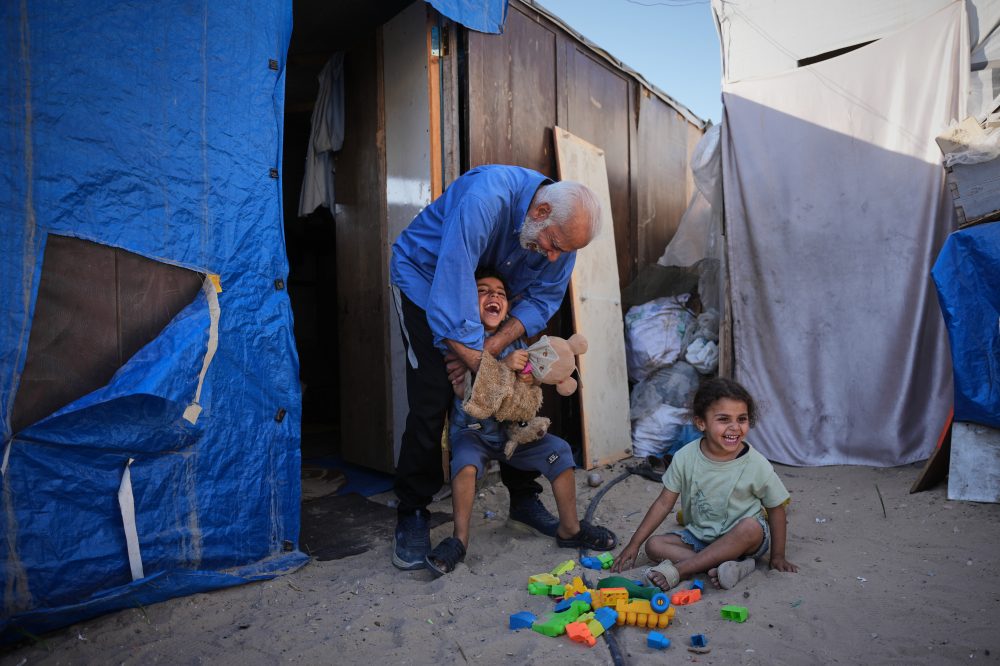
Mahmoud Nofal, 64, is now the guardian of his two young grandchildren, ages 3 and 5. “It’s difficult to replace the love and affection of a father and mother. It’s difficult to compensate them for so many things,” he said. Speaking from the tent where the three of them now live in the southern area of Khan Younis, he added, “I am their provider. I bathe them and I supply them with everything they need.”
Separated from their families, homes, and daily routines, many children hold tightly to whatever remnants of their former lives they can find. Some have returned to school, help out with household tasks, or ride bikes along dirt paths with friends.
For 10-year-old Razan Shanan, letting go has proven nearly impossible. An airstrike took the lives of five members of her immediate family, leaving her as the sole survivor. The attack has left her deeply anxious, and she holds on to family photographs she was able to recover from the wreckage of the six-story building that had been her home.
Salah Al-Kafarana, who is now raising five nieces and nephews in Gaza City, put it plainly: “No matter how much affection, clothing, trips, food, and drink I provide them, it can never replace even one percent of their family.”
This report is based on a documentary photo essay curated by AP photo editors.