
Crude oil prices tumbled sharply Wednesday after a senior U.S. official announced that the United States plans to waive sanctions on Iranian oil as part of a deal to end the conflict between the two nations — raising the possibility of millions of new barrels entering the global supply.
Brent crude futures dropped below $80 per barrel, hitting their lowest point since the early days of the U.S.-Iran conflict back in March.
The potential surge in oil supply offered some hope for inflation relief and pushed bond yields downward. Ten-year Japanese bond yields fell 1.5 basis points to 2.63%, while Australian rates dropped nearly 5 basis points to 4.787%.
Kim Fustier, a senior oil and gas analyst at HSBC, noted that financial markets seem to be betting heavily on a full return to normal oil flows through the Strait of Hormuz. However, the bank believes that normalization won’t fully happen until the end of September.
The U.S.-Iran agreement is expected to be formally signed on Friday, though few specifics have been made public. A three-month blockade of the Strait of Hormuz has already drained oil stockpiles significantly, with U.S. reserves sitting at their lowest level since 1983.
On Wall Street Tuesday night, investors pulled back from heavily concentrated positions in technology and semiconductor stocks, sending the Nasdaq down 1.15%. At the same time, gains in financial and industrial stocks pushed the Dow Jones Industrial Average to a new record high.
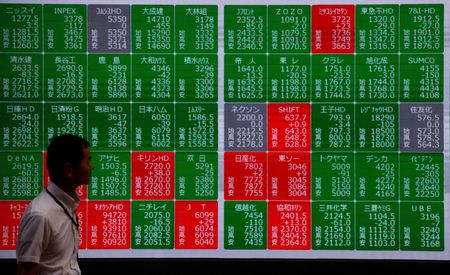
Asian markets were mixed on Wednesday. Japan’s Nikkei climbed 0.4%, while stock markets in Hong Kong and Shanghai held relatively steady. Chipmaker-heavy markets in Taiwan and South Korea edged lower, and the broader MSCI Asia-Pacific index outside Japan fell roughly 0.3%.
Beyond oil, investors were also watching closely for signals from the Federal Reserve’s first meeting under new chair Kevin Warsh. A change in the Fed funds rate is considered unlikely, so attention is focused on Warsh’s press conference and the projections from committee members — who, as of March, mostly expected rate cuts this year.
The euro gained only slightly this week, hovering near $1.16. A widely anticipated rate hike in Japan on Tuesday did little to strengthen the yen, which remained around 160.3 to the dollar.
Xiao Cui, senior economist at Pictet Wealth Management, offered this outlook: “We expect Warsh to downplay forward guidance, instead advocating patience on policy rates and inflation — leaning dovish relative to market pricing.”
Cui added a word of caution: “If Warsh embraces the possibility of rate hikes and does not push back on market pricing, this could be interpreted as hawkish.”