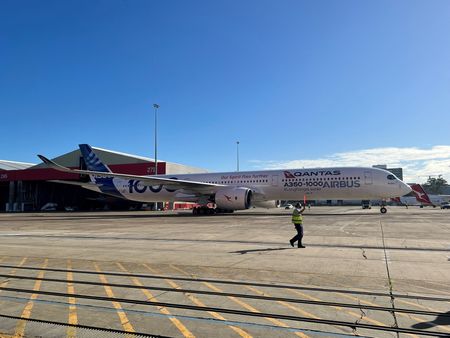

Australian airline Qantas is preparing to reveal which city — London or New York — will be the first destination served by what would become the world’s longest nonstop commercial flights, marking a major milestone in aviation history after years of planning and delays.
Known internally as “Project Sunrise,” the initiative has been in development since 2017 and aims to offer direct service from eastern Australia using specially modified Airbus long-haul aircraft. The flights are expected to begin by the end of next year.
The goal is to shrink what was once a five-day journey along the historic “Kangaroo Route” to London down to a maximum of 22 hours, depending on the specific path and wind conditions. Currently, that same trip takes between 24 and 25 hours with a stop in Singapore.
New York, which Qantas currently reaches from Sydney by way of Auckland, is also among the early planned destinations. However, the airline has not yet publicly stated which city will launch first — until Wednesday’s announcement.
The undertaking represents a significant financial risk for the carrier, which has invested billions of dollars into new aircraft, redesigned cabin interiors, and research into how extremely long flights affect passengers’ health.
For the project to pay off, Qantas must convince travelers to spend more money in exchange for skipping connecting flights, while also making those long hours in the air as comfortable as possible.
Aviation analyst John Strickland put it plainly: “What they are selling is time, and they absolutely need to get a premium on all the cabins, particularly business and premium economy.”
The project takes its name from a series of endurance flights Qantas operated during World War Two, when planes stayed in the air long enough to witness two sunrises — earning the nickname “double sunrise” flights.
Qantas has projected that Project Sunrise could contribute more than A$400 million (approximately $282.68 million U.S.) annually to the company’s earnings. In February, Qantas CEO Vanessa Hudson said the financial model assumes nonstop tickets could command prices roughly 20% higher than comparable one-stop fares in premium cabin classes.
However, analysts have cautioned that elevated fuel costs tied to the conflict in the Gulf region have made it harder for the airline to break even on the flights.
A note from Jefferies analysts published in April — written after an initial U.S.-Iran ceasefire but before this week’s interim peace agreement — suggested that travelers would continue to favor flying directly to Europe through Perth or switching from Middle Eastern hubs to Asian ones through 2027. “Consequently, we expect a positive market for Project Sunrise flights to London,” the analysts wrote.
Gulf-based carriers such as Emirates, which have built their business models around connecting passengers through their hub airports, have signaled they intend to compete aggressively. Adding to that competitive landscape, the Australian government on Wednesday lifted a months-long “do not travel” warning for Gulf hub airports — a warning that had effectively invalidated most travel insurance policies, even for passengers simply passing through.
Qantas plans to present the financial details of the new nonstop service to investors and showcase its custom-designed cabin configurations at an event held Wednesday in Toulouse, France.
Airbus secured the Project Sunrise contract in 2019 following a fierce competition against Boeing’s 777X aircraft. Earlier this month, Airbus completed the first test flight of one of the 12 specially modified A350-1000ULR jets ordered by Qantas.
Each of the 238-seat planes includes an additional rear-center fuel tank that extends the aircraft’s range by 1,000 nautical miles — bringing the total to 10,000 nautical miles (about 11,508 miles). The flights are so lengthy that a substantial portion of the fuel load is consumed simply carrying the weight of the remaining fuel onboard.
The first of these planes is scheduled to be delivered in April 2027 — roughly five years behind the original timeline, due to disruptions caused by the COVID-19 pandemic and ongoing aerospace supply chain problems.
Reuters has also reported that Qantas is currently in discussions to purchase 20 additional wide-body aircraft from either Airbus or Boeing, with the smaller A350-900 model or more Boeing 787s being considered as options.