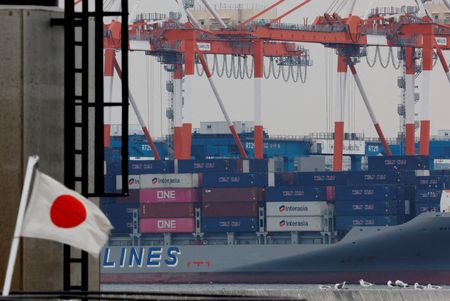

Japan’s export figures continued their upward trend in May, marking nine straight months of growth, according to government data released Wednesday. A weaker yen, rising commodity prices, and robust demand for semiconductors helped push total export values up 17% compared to the same month last year — surpassing the median market forecast of a 16.2% increase and building on April’s 14.8% gain.
Despite the strong headline number, the picture is more complicated when looking beneath the surface. Export volumes rose just 0.5% in May, a figure that tells a very different story than the value data.
Koki Akimoto, an economist at Daiwa Institute of Research, pointed to the yen’s weakness and surging energy costs as key factors inflating both export and import figures in price terms. “With the overall volume hardly increasing, exports lacked underlying strength,” he said.
The global boom in artificial intelligence has provided some cushion for the broader world economy against war-related risks, helping import-dependent countries like Japan absorb the immediate shock to growth and trade. Electronic component exports were a standout driver of overall growth, as AI and data center demand pushed up prices for memory chips and non-ferrous metals.
Exports to the United States climbed 12.5% in May from a year ago, while shipments to China rose 17.9%, according to the data.
On the import side, overall purchases from abroad grew 12.5% year-on-year in May, slightly below market forecasts calling for a 12.8% increase. The gains came even as crude oil import volumes collapsed, largely because the closure of the Strait of Hormuz sent prices for crude and related products sharply higher. Crude oil imports fell 28.5% in value terms and plummeted 57.3% in volume terms, with the per-unit cost in yen reaching an all-time high.
The combination of those factors left Japan with a trade deficit of 378.7 billion yen — equivalent to approximately $2.36 billion — for the month of May. That result was notably smaller than the forecast deficit of 564.6 billion yen.
Japan relies heavily on imported energy, and disruptions to Middle Eastern supply routes have significantly driven up costs. The government has been working to diversify where it sources crude oil, securing alternative supplies from outside the region, including from the United States. Still, those efforts have not fully made up for the shortfall. Crude oil imports from the Middle East dropped 61.9% in volume terms last month, while imports from the United States rose 24%.
U.S. and Iranian officials announced Sunday that they had agreed on a framework for a deal that would end the war, lift the U.S. blockade of Iran, and reopen the Strait of Hormuz. However, analysts cautioned that a full return to normal shipping operations will take time, citing damage to oil processing infrastructure, ongoing security concerns, and the need to restore maritime insurance coverage.
“Higher oil prices driven by supply disruptions tend to erode Japan’s net exports over time, as worsening terms of trade and softer global demand combine to weigh on the export outlook,” Daiwa’s Akimoto warned.
Separately, data also released Wednesday showed Japan’s core machinery orders jumped 8.7% in April from the prior month — well above the median market forecast of just a 0.9% increase — suggesting businesses may be starting to ramp up investment spending.