CHARLOTTE, N.C. — The Charlotte Hornets are sending point guard LaMelo Ball and Josh Green to the Minnesota Timberwolves in exchange for Naz Reid, a 2033 unprotected first-round draft pick, three first-round pick swaps, and three future second-round picks, according to a person with knowledge of the deal who spoke to the Associated Press on Thursday.
The source requested anonymity because the trade, which was first reported by ESPN, has not yet received official league approval.
The three first-round pick swaps are set for 2028, 2029, and 2030. Charlotte will also receive second-round picks in 2029, 2032, and 2033.
Ball, who earned an All-Star selection in 2022, has dealt with ankle and foot injuries throughout his time in the league. Despite that injury history, he appeared in 72 games last season, putting up averages of 20.1 points, 7.1 assists, and 4.8 rebounds per game.
He had three years remaining on a five-year, $203.9 million designated rookie extension — the largest contract in Hornets franchise history.
A second source told the AP that this trade is expected to be connected to the earlier deal in which Minnesota agreed to send Julius Randle to Brooklyn, a transaction that also involved the Chicago Bulls earlier this month. The combined moves are anticipated to generate an NBA-record trade exception of nearly $41 million for Charlotte.
None of the deals can be made official until July 6, when the league’s moratorium on transactions is lifted.
This move is the latest in a string of major NBA trades, following the blockbuster deal that sent Giannis Antetokounmpo from Milwaukee to Miami in a package that included Tyler Herro — a move that came before the draft, shortly after the Randle transaction.
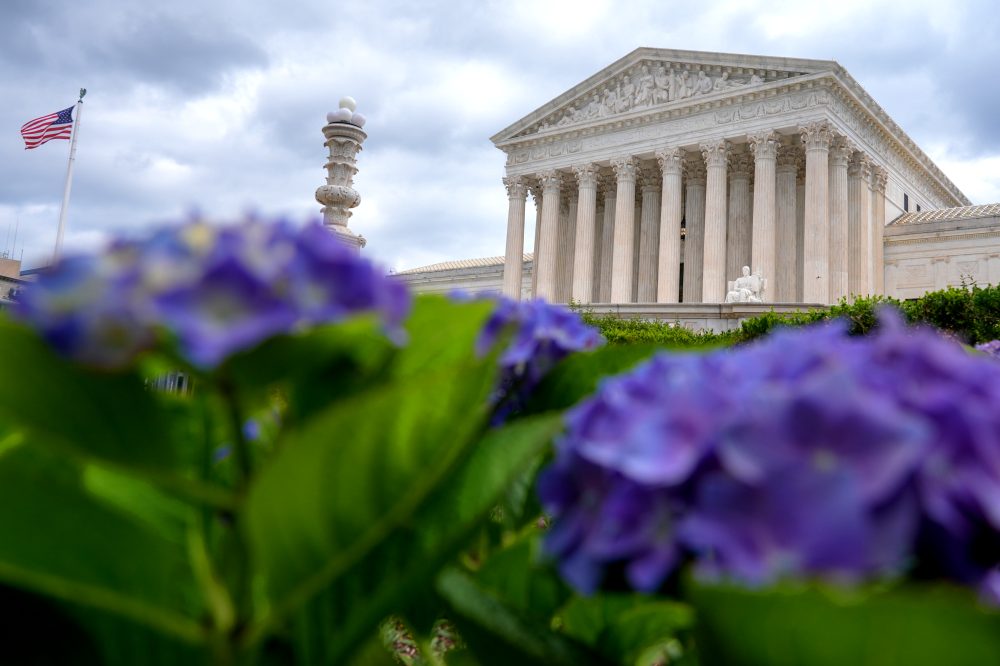
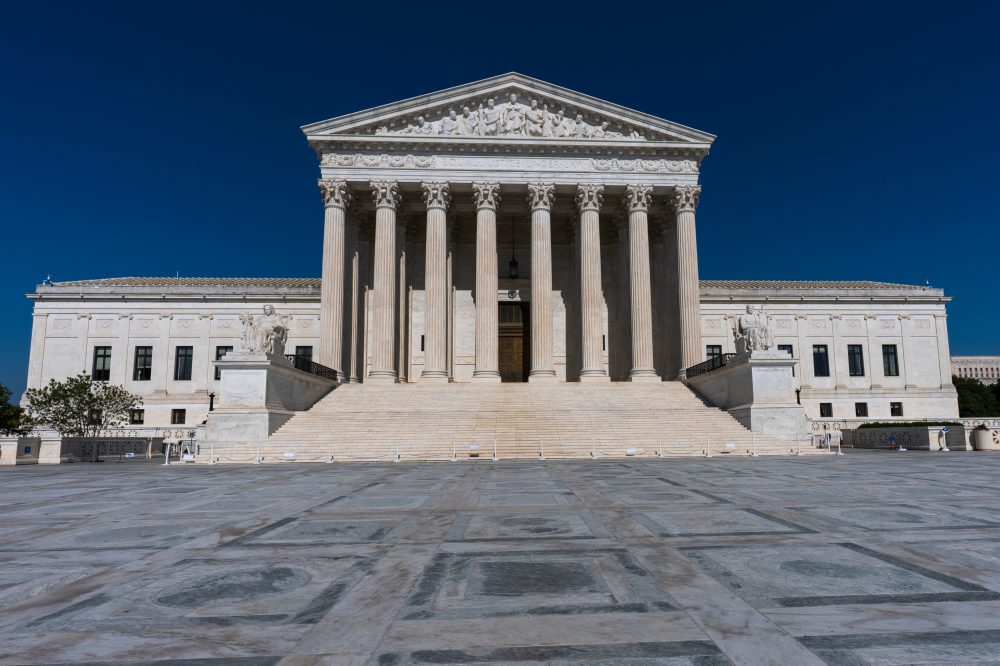
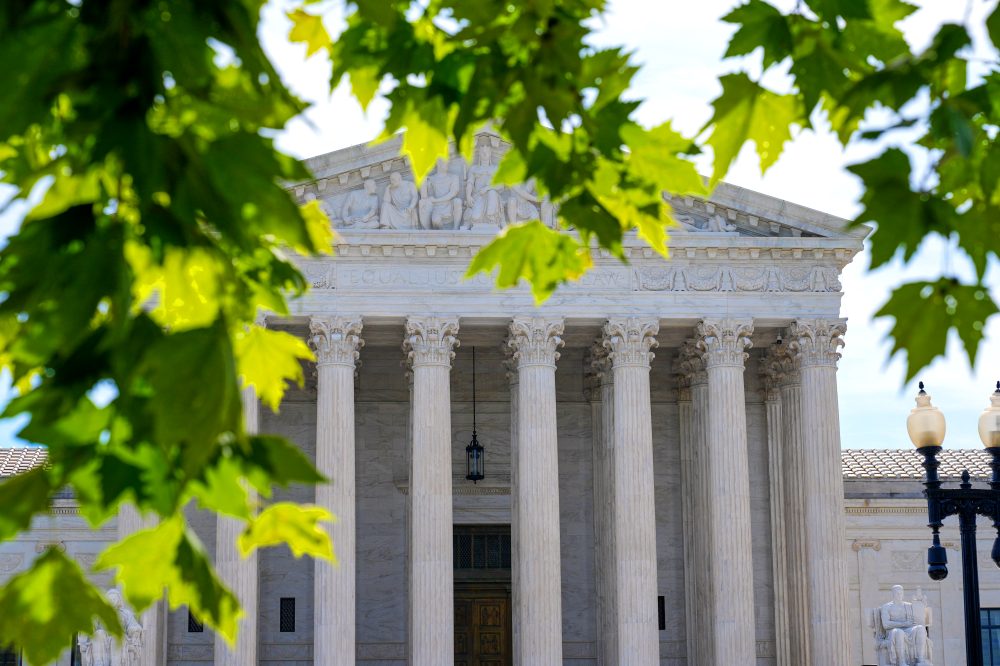
The U.S. Supreme Court has handed Monsanto a major legal victory in a closely watched case involving the company’s widely used Roundup weed killer product.
At the heart of the dispute was a lawsuit brought by Missouri resident James Durnell. The central legal question before the justices was straightforward but consequential: who has the authority to determine what information must appear on a pesticide or insecticide label — and does federal law take precedence over claims made under state law?
The high court’s decision backs Monsanto’s position that federal regulations governing pesticide labeling should shield the company from state-level liability claims.
MILAN (AP) — Shoppers are slowly returning to high-end fashion, accessories, and beauty products despite ongoing global uncertainty, and that cautious comeback is expected to push the luxury goods industry back into growth territory this year, according to a report released Thursday by the Bain & Company consultancy.
Global personal luxury goods sales are projected to climb between 2% and 4% in 2026, reaching somewhere between 365 billion euros and 373 billion euros — or roughly $415 billion to $424 billion — after finishing last year at 358 billion euros. That would mark the end of a two-year stretch of declining sales. The Americas are expected to drive the turnaround, with certain U.S. luxury brands already reporting first-quarter growth of up to 15%, according to Bain’s semi-annual industry study.
“People are still alive and want to live their better lives,” said Claudia D’Arpizio, a partner at Bain and co-author of the report. “So there is this mega trend of looking for good quality of life, of improving their lives and finding the meaning and living the experiences that is stronger than the fear of the future.”
D’Arpizio noted that after a backlash from consumers who grew frustrated with dramatic price increases, luxury brands have stabilized their pricing and introduced more accessible entry-level products. She described the current environment as “a healthier situation vis-a-vis two years ago,” though she cautioned that brands will still need to work hard to win back “customer love that has been a little bit broken in the previous years.”
Bain’s base-case forecast assumes that conflicts in the Middle East will stabilize, that local shoppers will help make up for inconsistent tourist traffic, and that demand in China will gradually recover. If conditions worsen, the consultancy’s downside scenario calls for flat growth. On the other hand, if geopolitical tensions ease and China’s market accelerates, growth could reach as high as 6%.
In the United States, consumers — particularly those under 35 years old — are spending on everyday casual clothing, jewelry, and beauty items. China is expected to return to growth, boosted by online sales of ready-to-wear clothing. Europe, however, is trailing behind largely because geopolitical tensions have reduced tourism. Even in Dubai, local residents have been heading back into stores.
“People want to live a normal life, that’s a stronger feeling,” D’Arpizio said.
WASHINGTON — The U.S. Supreme Court on Thursday opened the door for the Trump administration to potentially bring back a controversial immigration policy that restricted the number of migrants who could seek asylum each day at the southern border.
The justices struck down a lower court ruling that had prevented the practice from being reinstated. The policy, known as metering, was originally used during the Obama administration and was expanded throughout President Donald Trump’s first term in office.
Immigrant rights advocates have argued that the practice triggered a humanitarian emergency, with thousands of people forced to wait in dangerous, overcrowded makeshift camps for their chance to apply. The Trump administration, however, contends the policy is an essential tool for managing the growing number of asylum seekers arriving at the border.
While metering is not currently being enforced, the administration has put other restrictions on asylum seekers in place. Officials argue that metering has been used by presidents from both political parties and should remain available as a border management option. Federal lawyers have pointed out that migrants turned away at the border can return at a later time, though wait lines stretched into the thousands when the policy was previously active.
This case is among several immigration-related lawsuits the high court is examining this term, including challenges to ending birthright citizenship and efforts to remove temporary legal protections for migrants who fled violence and instability in their home countries.
Under U.S. federal law, migrants who reach American soil are entitled to apply for asylum and must be evaluated for fear of persecution in their home countries. The Justice Department argued that individuals stopped before formally entering the country have not legally “arrived,” and therefore immigration officials are not required to process their asylum claims.
Attorneys representing asylum seekers counter that the law has historically been interpreted to mean that anyone reaching a port of entry should be screened, and that blocking people from applying goes against the country’s foundational values.
Metering was first introduced during the Obama administration after a large influx of Haitian migrants appeared at the main crossing between San Diego and Tijuana, Mexico. The policy was later expanded to cover all crossings along the Mexican border during Trump’s initial presidency.
The practice was phased out in 2020 when sweeping pandemic-era restrictions were put in place, and President Joe Biden officially ended it in 2021. That same year, a federal judge based in California ruled that metering violated the legal rights of asylum seekers and the law mandating screening. An appeals court panel upheld that decision, though nearly half of the judges on the full San Francisco-based court voted to reconsider the case — a notable signal that may have drawn the Supreme Court’s attention.
American law permits individuals fleeing danger to apply for asylum once they are on U.S. soil, regardless of how they entered the country. To be granted asylum, applicants must demonstrate a credible fear of persecution in their home country based on factors such as race, religion, nationality, membership in a specific social group, or political beliefs.
Those who are ultimately granted asylum cannot be deported. They are also entitled to work legally in the United States, bring immediate family members to join them, apply for permanent residency, and eventually pursue citizenship.
WASHINGTON — The U.S. Supreme Court handed down a major Second Amendment ruling Thursday, invalidating a Hawaii law that required gun carriers to obtain permission before entering privately owned businesses like stores and hotels.
The court’s 6-3 decision clears the way for people to bring firearms into privately owned public spaces — including shopping malls and gas stations — unless the property owners have explicitly posted a ban on guns at their locations.
The ruling comes shortly after the high court determined that marijuana users cannot be completely prohibited from owning firearms, continuing a string of Second Amendment decisions in recent years.
President Donald Trump’s Republican administration, which had argued the Hawaii measure violated the Second Amendment, claimed a victory with the ruling. The law had earned the nickname the “vampire rule” — a reference to the folklore belief that vampires must be invited into a home before they can enter, similar to how the law required gun carriers to seek permission before entering a business.
Hawaii had defended its 2023 law by arguing it protected the rights of private property owners to decide whether firearms were welcome on their premises. The state enacted the measure after a surge in residents obtaining legal permits to carry guns publicly, which followed a 2022 Supreme Court decision affirming that the Second Amendment extends to carrying firearms in public.
Roughly four other states have passed similar laws, though courts have blocked comparable restrictions in other parts of the country as well.
Hawaii also has laws restricting guns in public spaces like parks, beaches, and alcohol-serving restaurants, but those regulations were not part of this case. They are currently being challenged in lower courts.
The case was originally brought before the courts by a gun rights organization and three Maui residents. A lower court judge had initially blocked the law, but an appeals court later allowed it to take effect. Trump’s administration supported the appeal that reached the Supreme Court.
This is one of two gun-related cases the Supreme Court is hearing this term. The second involves whether people who regularly use marijuana or other drugs can legally possess firearms.
These cases are part of a broader wave of Second Amendment challenges that flooded the legal system following the court’s landmark 2022 ruling. Since then, the justices have struck down a federal ban on bump stocks — devices that allow guns to fire rapidly — while upholding a law designed to shield domestic violence victims and regulations governing so-called ghost guns, which are nearly untraceable firearms.
The U.S. Supreme Court handed a major victory to the maker of Roundup weedkiller on Thursday, issuing a decision expected to shut down thousands of lawsuits claiming the company never warned consumers that the product might cause cancer.
The case reached the nation’s highest court following an enormous wave of legal action — including some multibillion-dollar jury awards — against global agrochemical giant Bayer, which took ownership of Roundup when it purchased the product’s original manufacturer, Monsanto, back in 2018.
While the ruling is seen as a win for the Trump administration, it carries political complications. Allies within the Make America Healthy Again movement have been pushing to reduce pesticide use, creating tension over the outcome.
In a 7-2 decision, the justices determined that Bayer cannot face lawsuits in state courts because federal regulators have concluded that a link between Roundup and cancer is unlikely.
The lawsuit before the court was brought by Missouri resident John Durnell, who developed non-Hodgkin’s lymphoma after spending more than two decades as the go-to person for spraying Roundup on parks in his historic St. Louis neighborhood. A jury sided with Durnell, finding the company failed to adequately warn him of potential cancer risks, and awarded him $1.25 million — one of thousands of similar cases that have been filed across the country.
The debate over Roundup’s main ingredient, glyphosate, and its potential link to cancer remains deeply contested. In 2015, the World Health Organization’s International Agency for Research on Cancer labeled glyphosate as “probably carcinogenic.” However, the Environmental Protection Agency has concluded it is not likely to cause cancer in humans when used as directed.
Because the EPA approved a product label without any cancer warning, Bayer argues it is bound by those federal standards — not the state laws that Durnell and others have relied on in their lawsuits. Durnell’s attorney, Ashley Keller, has noted that the ruling may still leave room for lawsuits based on how the product was designed, rather than how it was labeled.
Bayer has disputed the cancer allegations but previously set aside $16 billion to settle claims. Earlier this year, the company proposed a $7.25 billion class-action settlement to resolve many of the remaining cases. A federal judge recently determined that the proposed settlement will be taken up in a Missouri state court, where a large number of the lawsuits have been filed. Bayer has also been lobbying state legislatures to pass laws protecting it from failure-to-warn liability, with three states having already done so.
Roughly 200,000 Roundup-related claims have been filed against Bayer, the majority from residential users. The company has already stopped including glyphosate in Roundup products sold in the U.S. residential lawn and garden market.
Bayer has warned it may need to consider removing glyphosate from U.S. agricultural markets altogether if the lawsuits continue. Agricultural industry groups have cautioned that such a move could have a severe impact on the nation’s food supply.
The issue has also driven a wedge between the Trump administration and supporters of Health Secretary Robert F. Kennedy’s MAHA movement, who have grown frustrated with an executive order aimed at boosting glyphosate production. Kennedy himself has repeatedly stated his belief that glyphosate causes cancer, even while acknowledging that the executive order was necessary for food supply and national security purposes.
Motorists traveling along Ponds Lane should plan for potential slowdowns this afternoon as a flagging operation is active in the area.
The work zone is located between Montchanin Road, also known as Route 100, and the cul de sac at the end of Ponds Lane. Traffic control personnel are directing vehicles through the area.
The flagging operation is expected to remain in place until 5:30 PM. Drivers are encouraged to use caution and follow the directions of flaggers on site.
WASHINGTON — A national survey examining the state of women in agriculture was unveiled at the International Year of the Woman Farmer ACE Summit held in Washington in early June, with the American Farm Bureau Federation Women’s Leadership Committee sharing the results.
The summit drew a record number of women from Virginia involved in farming, underscoring the growing presence and influence of women across the agricultural sector.
“Having so many Virginia women in agriculture in attendance guaranteed that members of Congress and fellow ACE Summit attendees heard perspectives from nearly every sector or commodity group in agriculture,” said Olivia Gyapong, Virginia Farm Bureau Federation national affairs specialist.
The research, backed by JBS and CoBank, was carried out through a combination of online surveys and focus groups to paint a thorough picture of women’s roles in American agriculture today.
Balancing farm work with outside careers and family responsibilities is a common reality for many farm women. The survey found that 60% of women hold jobs away from the farm. Even so, nine out of ten reported feeling confident discussing agriculture in public and professional settings.
Family farming remains a cornerstone of the industry, with 61% of those surveyed saying they are part of family farm operations. Beef cattle, corn, and row crops ranked among the most common commodities these women work with.
Researchers pinpointed five key areas where women in agriculture need more support: access to resources, time and caregiving demands, skill development, involvement in leadership, financial security, and overall well-being.
The appetite for leadership is strong — nearly 90% of women surveyed said they want to take on leadership roles. One program aimed at supporting that ambition is AgConnectHER, an initiative from the American Farm Bureau Federation designed to help women build leadership skills within the agriculture industry.
“More women are owners, managers, financial professionals and entrepreneurs for their farms now, no longer solely supporting farm operations behind the scenes, so leadership is a natural extension of the responsibilities they are already carrying,” Gyapong said.
Despite that enthusiasm, the survey found that only 17% of women have taken part in formal training programs. Still, interest in skill-building is significant. About 44% of respondents said they want equipment or technical skills training, and nearly 56% expressed interest in business and financial management training.
“At the Virginia level, our women in agriculture have access to our training through avenues like our women’s leadership academy and Virginia Cooperative Extension’s Women in Agriculture program. I hope more women in ag or aspiring women in ag can take advantage of those opportunities,” Gyapong said.
A Texas-based biotechnology company and a federal wildlife agency have joined forces to build what they’re calling a biological safety net for the nation’s most vulnerable species.
Colossal Biosciences and the U.S. Fish and Wildlife Service announced Thursday a sweeping plan to establish a cryogenic archive — dubbed the BioVault — that would store living cells, reproductive tissues, and genetic DNA from every species currently protected under the U.S. Endangered Species Act. That covers approximately 2,300 types of animals and plants classified as either threatened or endangered.
Colossal CEO and co-founder Ben Lamm said the goal is to preserve biological samples before species populations decline beyond the point of no return. “The materials support assisted reproduction, genetic management of wild populations and future restoration if a species is lost entirely. For the first time, we have the technology to make that possible at scale,” Lamm told Reuters.
Colossal describes itself as a company focused on “de-extinction” — the science of bringing back vanished species. The company made headlines last year when it announced it had genetically engineered the dire wolf, an Ice Age predator that disappeared thousands of years ago. Colossal says it will invest tens of millions of dollars to build and run the BioVault, and that the agreement with the federal government does not require any federal funding.
The archive is designed to function as a permanent public resource, with standardized samples and open-access genetic data available to scientists across the globe.
Colossal’s chief animal officer, Matt James, explained that the Fish and Wildlife Service — which operates under the U.S. Interior Department — is leading the partnership. The agency will determine conservation priorities and supply the field networks and legal authority needed to collect samples at this scale. James noted that no completion deadline has been set for the project.
U.S. Fish and Wildlife Service Director Brian Nesvik expressed support for the effort. “This collaboration will help advance our understanding of how biobanking and genomics can complement existing conservation tools and contribute to the recovery and long-term resilience of imperiled species,” Nesvik said in a statement provided by Colossal.
Samples stored in the BioVault will be kept in liquid nitrogen at minus-321 degrees Fahrenheit (minus-196 degrees Celsius) at Colossal’s Dallas headquarters and at additional locations. Lamm said the system is designed with multiple layers of backup protection. “Redundancy is built into the architecture so that no single event, whether a natural disaster, power failure or regional disruption, can compromise the integrity of the collection,” he said.
Lamm drew a comparison between the BioVault and the biblical story of Noah’s Ark. “The Noah’s Ark metaphor is about preserving the blueprint of life before it’s lost, not waiting until a species is on the brink to start paying attention. Noah didn’t build the ark after the flood. The whole point was preparation, preservation and the option to restore what might otherwise disappear forever,” Lamm said.
He continued: “We’re not loading two of every animal onto a boat, we’re preserving the genomic and biological building blocks that define what an entire population is. Every species we bank is a species whose biological information, millions of years of evolutionary innovation encoded in its DNA, is protected against the worst outcomes.”
The stored material could support recovery programs, help restore genetic diversity in struggling populations, and in extreme cases, serve as the foundation for future de-extinction efforts, Lamm said.
Species protected under the Endangered Species Act range widely — from well-known animals like the polar bear to lesser-known creatures such as the Hine’s emerald dragonfly.
Lamm noted that biobanking for wildlife has existed for decades, but in a fragmented way. Zoos, universities, government agencies, and private institutions have each built their own collections independently, with different procedures, different access policies, and no shared catalog. The result is uneven coverage — some species have duplicate samples stored at multiple institutions while others have none at all. The BioVault is intended to address that gap by operating as a national program backed by a government mandate.
One well-known model for this kind of preservation is the Svalbard Global Seed Vault, a so-called “doomsday” facility on a remote Norwegian Arctic island that stores food crop seeds from around the world.
James said that samples contributed to the BioVault will remain the property of the organizations that donate them. He also issued a broader invitation to the conservation community. “This is also a call to the broader conservation community — zoos, universities, government agencies, NGOs and research institutions around the world. The Colossal BioVault is built to be complementary, not competitive. If you’re doing this work, we want to work with you,” James said.
ADEN — A journalist working as a correspondent for Saudi Arabia’s Al Arabiya television was killed late Wednesday after a bomb planted on his car detonated, the network announced Thursday.
The victim, Mohammed Aydah, was a Yemeni national who worked for both Al Arabiya and its sister channel Al Hadath. He was killed in the city of Mukalla, located in Yemen’s eastern Hadramout governorate.
Al Arabiya reported that local security authorities in Mukalla had alerted Aydah roughly a month before his death that he faced a credible threat to his life, though no further details were provided. As of Thursday, no group had claimed responsibility for the bombing.
The assassination occurred amid a backdrop of political instability in the country. Tensions had recently escalated following clashes between Saudi-backed forces loyal to Yemen’s internationally recognized government and UAE-backed separatists, with fighting flaring between November and January. During that period, control of Mukalla shifted between the separatist group — known as the Southern Transitional Council — and the Saudi-backed forces, who currently hold the city.
The Southern Transitional Council issued a statement condemning the killing, describing the attack as evidence of deeper security problems in Hadramout. The group attributed those problems to the dismantling of units under its command that had previously helped drive al Qaeda out of the region in 2016.
Rashad al-Alimi, the head of Yemen’s presidential leadership council, ordered the creation of a high-level joint committee to investigate the killing. He pledged that authorities would pursue those responsible with full force.
Yemen has been engulfed in conflict since 2014, when Iran-backed Houthi forces seized the capital, Sanaa, triggering intervention by a Saudi-led military coalition.
The Committee to Protect Journalists considers Yemen one of the most hazardous countries in the world for members of the press.
Twelve Salisbury University Cross Country and Track & Field athletes have been named to the 2025-26 Academic All-District teams, an honor presented annually by College Sports Communicators to recognize student-athletes who stand out both competitively and academically.
The recognition is awarded to some of the top student-athletes across the country, with selections based on performance in athletic competition as well as achievement in the classroom.
Salisbury University’s program placed an even dozen members on the list, with six honorees coming from the women’s programs and six from the men’s programs.
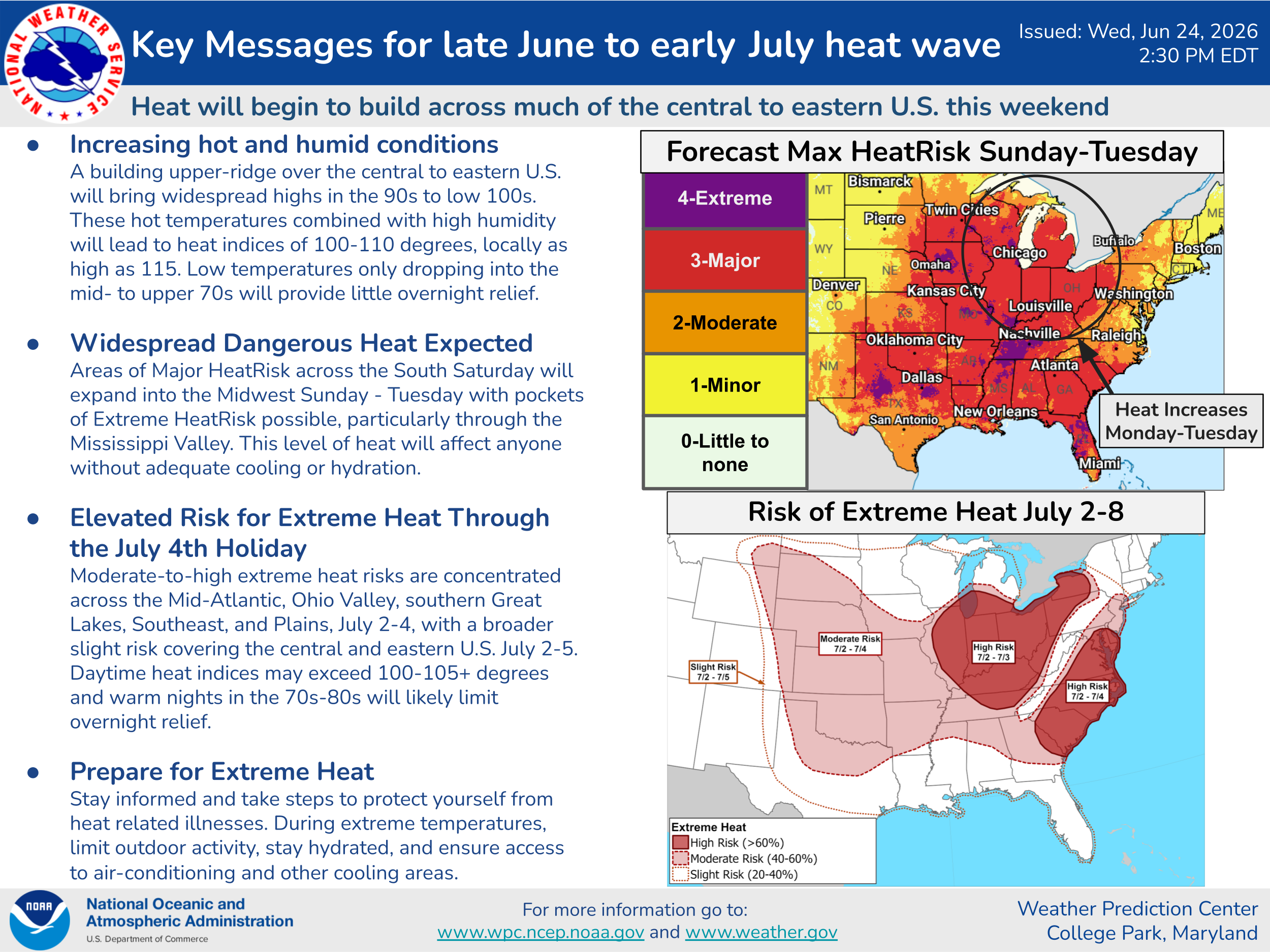
DELMARVA – After a relatively seasonable stretch to end this week and through the weekend, confidence is increasing that a significant surge of heat will arrive across the Mid-Atlantic by the middle of next week, bringing the potential for dangerous heat and humidity to the Delmarva Peninsula.
Forecast guidance continues to show a strong upper-level ridge expanding eastward from the Plains and Great Lakes into the Mid-Atlantic by Wednesday. This pattern will allow temperatures to climb steadily while humidity increases, pushing heat index values into the 100‘s during the second half of next week.
While exact temperatures will become clearer over the coming days, the overall signal for a prolonged period of above-normal warmth continues to strengthen.
The National Weather Service’s latest long-range outlook highlights a broad area of Major HeatRisk expanding across much of the eastern United States from Sunday through Tuesday, with the threat lingering into early July. Additional outlooks indicate an elevated risk for excessive heat extending through the Independence Day holiday period across much of the eastern U.S.
For Delmarva, the hottest stretch currently appears to begin around Wednesday and continue into next weekend, when afternoon temperatures climbing well into the 90s, combined with increasing humidity, could produce heat index values exceeding 100 degrees.
Unlike short-lived hot spells, this pattern may also feature warm overnight lows in the 70s, limiting overnight cooling and increasing the cumulative stress on the body over several consecutive days.
Although this is still several days away and forecast details will continue to be refined, confidence is increasing that the region will experience its most significant stretch of heat so far this summer.
Residents should begin preparing now by:
Staying well hydrated.
Limiting strenuous outdoor activities during the hottest part of the afternoon.
Checking on elderly family members, neighbors, and those without reliable air conditioning.
Never leaving children or pets inside parked vehicles.
Planning outdoor work or recreation for the morning or evening hours whenever possible.
We will continue monitoring the strength and duration of the developing heat dome over the coming days. If current trends continue, heat-related advisories or warnings may become necessary for portions of the Mid-Atlantic next week.
Construction work is causing intermittent lane closures on Vance Neck Road between Peachtree Lane and Marathon Drive, according to Delaware transportation officials.
The lane restrictions are expected to remain in effect until 6 p.m. Drivers traveling through that stretch of road should anticipate possible delays and consider using alternate routes if available.
No further details about the nature of the construction were immediately provided. Motorists are encouraged to stay alert and follow any posted traffic control signs in the area.
WASHINGTON (AP) — President Donald Trump officially launched the United States’ 250th anniversary celebrations Wednesday evening, hosting a large-scale rally on Washington’s National Mall designed to stoke national pride and excitement.
The event featured thunderous flyovers by stealth bombers, performances by military bands, and country singer Lee Greenwood delivering his signature anthem “God Bless the USA.”
Speaking to the crowd, Trump declared, “There has never been anything like the United States of America, and together we are making it bigger and better and stronger and far more exceptional than ever before.”
He told attendees he had restored the nation’s standing on the world stage, saying, “Nobody’s laughing at us anymore.”
True to form, Trump touched on familiar themes from his rally speeches — including his administration’s crackdown at the U.S.-Mexico border and his stance against transgender rights. However, in what appeared to be a nod to the celebratory occasion, he was noticeably less combative toward Democrats than he typically is at such events.
“The American Dream is alive again. It’s something that nobody thought they’d be saying when you went through that last four years of incompetence,” Trump told the crowd.
The president also brought up plans to renovate the Reflecting Pool near the Lincoln Memorial and construct a ballroom at the White House.
Trump wrapped up his remarks in under 30 minutes, but not before letting the crowd know he plans to speak at another Washington rally on July Fourth. “Your favorite president will be speaking so please show up,” he urged.
The crowd was positioned within a designated section of the National Mall, and from the stage Trump could likely see a massive neon-lit Ferris wheel that had been set up in front of the Capitol building.
The rally comes at a politically significant moment, as midterm elections begin to draw closer. Trump is working to reassure Americans that the unpopular Iran war is winding down, with oil prices declining as the Strait of Hormuz has begun to reopen following an interim agreement to end hostilities with Tehran.
Wednesday’s event kicked off several weeks of America-themed festivities called “The Great American State Fair,” taking place along the national park that runs from the U.S. Capitol to the Lincoln Memorial — marking the country’s founding in 1776.
“This is the beginning of the golden age of America,” Trump told those gathered.
Organizers handed out rectangular cardboard American flags, which many attendees used to shield themselves from the sun before Trump took the stage after dark. The atmosphere resembled a summer concert, with vendors offering burgers, sausages, and turkey legs, while the crowd sported an array of American flag-themed clothing — from overalls and skirts to hats — alongside plenty of “Make America Great Again” caps.
Among those in attendance were Karen and Brian Ontrap, who made the journey of more than 500 miles from northwest Ohio with their children. The family had planned the trip back in January to mark the nation’s 250th birthday and, for some members of the group, to see Washington for the very first time. Karen Ontrap said the couple support the president “100%.”
SALISBURY, Md. — Crews with the City of Salisbury’s Department of Waterworks Utilities Division are scheduled to swap out a fire hydrant in the 800 block of Eastern Shore Drive this Thursday, June 25, as part of the city’s continuing push to upgrade and maintain its water distribution infrastructure.
During the project, drivers heading westbound on Eastern Shore Drive between West Lincoln Avenue and Fulton Street should expect a temporary single-lane traffic pattern. Work is set to kick off at 9 a.m. and wrap up by around 3:30 p.m., assuming favorable weather and site conditions.
Both utility locators and Central Alarm have been informed about the upcoming work. Drivers passing through the area are asked to slow down and plan for possible minor delays while the project is underway.
The city is asking for the public’s patience as workers carry out this needed infrastructure improvement. Anyone looking for additional information can reach the Utilities Division by phone at 410-548-3103.
A wasting disease that exploded during a severe Pacific marine heatwave between 2013 and 2016 — known as “the Blob” — wiped out vast numbers of sea star species and caused the collapse of enormous stretches of coastal kelp forests stretching from the Aleutian Islands all the way down to the Baja Peninsula. Among the hardest-hit species was the sunflower sea star, a top-of-the-food-chain predator that keeps kelp forest ecosystems in check by feeding on sea urchins and other kelp grazers.
Now, as captive breeding efforts and the discovery of new sea star refuges — including one found in Greater Farallones National Marine Sanctuary in August 2025 — offer renewed hope for the species, researchers at NOAA’s Pacific Marine Environmental Laboratory (PMEL) have created a fast environmental DNA, or eDNA, detection method that gives scientists a powerful new way to track the sunflower sea star’s health and potential comeback.
“By analyzing tiny amounts of genetic material they shed into the water, we can now identify these large but elusively rare sea stars without ever seeing them,” said Zachary Gold, a scientist who leads PMEL’s Ocean Molecular Ecology program. “This opens the door to efficiently monitoring the recovery of this species, especially at deeper depths and sites that are difficult for divers to survey.”
The eDNA technique is capable of detecting just a small handful of DNA copies in a single liter of seawater. Compared to traditional dive surveys, it is cheaper, more sensitive, and better suited for quick assessments. Results can come back within one to two days and can then be followed up with visual confirmation in the water. In one recent example, after an eDNA signal was detected in Northern California’s Noyo Bay, divers were able to locate a juvenile sunflower sea star roughly the size of a teacup.
Why the Sunflower Sea Star Matters to Kelp Forests
The sunflower sea star — once plentiful along the Pacific Coast and now proposed for listing under the Endangered Species Act — plays a role similar to that of the sea otter. Both are aggressive hunters of bottom-dwelling sea urchins. When sunflower stars, sea otters, and other healthy predator communities are present and thriving, they help keep sea urchin populations in check, which in turn protects vital kelp forest ecosystems.
Kelp forests rank among the most biologically productive and economically valuable ecosystems on the planet. They serve as nurseries and high-quality habitat for hundreds of marine species, filter nutrient pollution, and support fish populations and commercial fishing industries worldwide.
Under normal conditions in healthy kelp forests off California, sea urchins play a natural role — grazing on algae and helping cycle nutrients along the ocean floor. But when that balance breaks down, urchin populations can explode, turning once-vibrant kelp forests into barren underwater wastelands. Even after the Blob’s warmth faded, starving sea urchins continued to prevent kelp from bouncing back by constantly eating off new growth across hundreds of miles of coastline.
Captive Breeding Programs Offer a Lifeline
When the sea star wasting disease outbreak struck, scientists moved quickly to bring surviving sunflower stars into captivity to protect the species and study the illness. That intervention led to two major breakthroughs: researchers learned how to successfully breed sunflower stars in a captive setting, and they identified a previously unknown bacterium called Vibrio pectenicida as the main cause of the disease.
The captive breeding program also gave scientists a way to test and validate their new eDNA detection tool. The research team put the method through its paces in labs, in aquarium settings, and out in the ocean, comparing results alongside traditional dive surveys. The findings were clear — the test accurately identified whether the species was present or absent, and the more sunflower stars divers spotted, the higher the concentration of DNA the method picked up.
Signs of Recovery Being Tracked Along the Pacific Coast
In recent years, scattered sightings in Olympic Coast National Marine Sanctuary and in Northern California tidepools have sparked cautious optimism that sunflower stars may be slowly returning to parts of their historic range. In 2026, a team that included NOAA scientists surveyed 39 sites across California — covering former population hotspots, locations with recent informal sightings, and areas within and near marine protected areas.
Using the eDNA method, the researchers confirmed the presence of sunflower stars at six separate sites across Mendocino, Sonoma, and San Mateo counties. Notably, one of those detections marked the first confirmed presence of the species south of San Francisco in ten years.
PMEL’s Ocean Molecular Ecology program has since been deploying the tool to assist conservation partners. In Olympic Coast National Marine Sanctuary, researchers are now pairing eDNA detections with visual surveys to modernize how they track the species.
“The development of a targeted, validated detection method for the sunflower sea star adds to NOAA’s growing inventory of tools to monitor and evaluate species of concern or importance,” said Krista Nichols, a genetics program manager with NOAA’s National Marine Fisheries Service. “For sea stars in particular, the use of eDNA could be a game changer for this struggling apex predator.”
A federal judge based in Boston has issued a ruling blocking parts of an executive order signed by President Trump that sought to place limits on voting by mail.
The court’s decision puts a hold on certain elements of the order, at least for now. The Trump administration is expected to challenge the ruling through an appeal.
Drivers traveling through the Townsend area of New Castle County will need to find an alternate route starting this summer. The Delaware Department of Transportation (DelDOT) is warning motorists that Walker School Road will be closed for an extended period beginning Wednesday, July 1st.
The closure will remain in place until Saturday, October 24th, affecting the stretch of Walker School Road between Gum Bush Road and Saw Mill Branch Road. During that time, crews will be working to replace Bridge 1-453 in the area.
Drivers are encouraged to plan accordingly and allow extra travel time when heading through that part of New Castle County.
Vermont has made history by becoming the first state in the nation to prohibit the use of paraquat, a widely used weed killer that researchers have linked to Parkinson’s disease.
The governor of New Mexico is calling for a criminal investigation into reports that the DEA allowed fentanyl shipments to reach the public, raising serious concerns about drug enforcement oversight.
France’s health ministry has confirmed that a doctor who previously worked in Congo has tested positive for the Ebola virus, prompting public health concerns in the country.
A story out of India sheds light on the daily struggles of a textile factory worker dealing with extreme heat both on the job and in cramped living conditions at home.
As France endures a historic heat wave, the charming rooftop spaces of Paris are turning into dangerous heat traps, creating serious risks for residents.
A heartwarming story explores how a cancer patient’s bond with their cats sparked a broader movement to allow pets into hospice care wards, offering comfort to patients in their final days.
The U.S. government has announced that chemical manufacturer Chemours will pay $450 million to settle a case involving so-called ‘forever chemicals,’ which have been tied to a range of health and environmental concerns.
With summer beach season in full swing, officials are reminding swimmers what to do if caught in a rip current — the key advice being to stay calm and avoid panicking.
Civil society groups in South Africa are sounding the alarm over what they describe as devastating consequences as the United States moves to reduce funding for HIV programs in the region.
A COVID-19 vaccine study that was previously blocked from being published in a CDC journal has now found a home in another publication, reigniting debate over scientific transparency.
New Nonprofit Launches $500M Effort to Help Workers Displaced by AI
A newly formed bipartisan nonprofit organization called RAISE US is stepping up to address one of the biggest economic concerns of our time: workers losing their jobs to artificial intelligence. The group is launching with more than $500 million earmarked for education and job training programs at the state level. According to an analysis by the Boston Consulting Group, more than half of all jobs in the United States could be transformed by AI within the next few years. Former Commerce Secretary Gina Raimondo and former Indiana Gov. Eric Holcomb are leading the effort as co-founders. Initial programs are planned for Arkansas, Maryland, Utah, and Connecticut. Raimondo has said the goal is for those states to serve as testing grounds for ideas that Congress could eventually turn into national policy.
Scam Attempts Are Overwhelming Americans — But Few Report Them
A new AP-NORC poll reveals that the vast majority of Americans are bombarded with scam attempts on a daily basis, with roughly 3 in 10 people saying they have personally lost money or had their personal information stolen by scammers. A separate survey conducted by Gallup and the Stop Scams Alliance between January and February found that in the past year alone, about 1 in 10 U.S. adults — or someone in their household — was tricked by a scammer into losing money or handing over access to a financial account. Nearly half of those victims reported losing more than $500. Despite the widespread impact, both surveys found that very few victims actually reported the scam to federal authorities or local law enforcement.
AI’s Hidden Environmental Cost — And What You Can Do About It
Every time you type a question into an AI tool, you’re adding to your environmental footprint. Artificial intelligence systems consume enormous amounts of energy and water, and experts warn that the problem is getting worse as AI use expands. While it may feel like individuals have little power to change things, sustainability experts say there are steps people can take. The advice is straightforward: keep your AI queries brief and think twice before using AI for simple tasks like finding a cookie recipe, getting directions, or looking up business hours. Experts note that the tech industry is actively pushing people to rely on AI for these everyday tasks, while remaining secretive about just how much energy and water their systems actually consume.
Humanoid Robot Company Eyes Wall Street in $2.5 Billion Deal
Agility Robotics, an Oregon-based company that builds human-shaped robots, is preparing to enter the public markets. The company announced a planned merger with an investment firm that would value it at $2.5 billion — a move that would make it the first publicly traded company focused specifically on humanoid robots. Its flagship product, called Digit, is built to handle heavy bins and containers in warehouse environments. Unlike other humanoid robots, Digit’s legs are designed more like a bird’s than a human’s. The company’s CEO has said the robots are intended to take over repetitive, injury-prone tasks. Agility has financial backing from Amazon, Nvidia, and others, with Toyota and Mercado Libre among its early customers. A fifth generation of Digit is expected to arrive later this year.
AI Scientists Shift Focus from Chatbots to the Physical World
Some of the brightest minds in artificial intelligence are moving beyond the chatbot era. A growing number of researchers and entrepreneurs are now focused on what are called AI “world models” — systems designed to understand the physical structure of space and time, not just process written language. Among those leading the charge are prominent scientists including “Godmother of AI” Fei-Fei Li and Yann LeCun. While enormous sums of money — potentially trillions of dollars — continue to flow into chatbot developers like Anthropic and OpenAI, a rising faction of AI innovators is devoted to building systems that can respond intelligently to real-world, physical environments.
China Reclaims Title of World’s Fastest Supercomputer
For the first time since 2017, a computer in China has claimed the top spot on the list of the world’s most powerful supercomputers. A machine called LineShine, located in Shenzhen, China, knocked the previous leader — a U.S. computer known as El Capitan, based in California — out of first place. The latest rankings from the TOP500 project, announced Tuesday, show that the LineShine computer at China’s National Supercomputing Center is capable of performing 2.198 exaflops, meaning it can carry out more than 2 quintillion calculations every second. The Top500 list is widely seen as a measure of a country’s technological strength.
AI Chatbots Are Now Playing Matchmaker in the Dating World
Artificial intelligence is finding its way into the world of romance. People are turning to AI in several ways when it comes to dating — some use AI-powered matchmaking services, others rely on it to build out their dating profiles, and many are using chatbots to help write messages to potential partners or decode messages they receive. Major dating apps and AI companies are embracing the trend. ChatGPT and Gemini have both shared content on TikTok highlighting their tools’ ability to offer personalized relationship guidance. Dating coach Carey Gaynes captured the moment with a cultural reference: “Claude is the new Cyrano,” she said, pointing to the 19th century French play ‘Cyrano de Bergerac,’ in which one character secretly writes the romantic words spoken by another.
Alibaba Takes Pentagon to Court Over Military Company Label
Chinese tech giant Alibaba has filed a lawsuit against the U.S. Department of Defense, seeking to have its name removed from a government list that designates it as a Chinese military company. The suit was filed Tuesday in California and argues that the designation has no factual or legal foundation. The label, which was announced on June 8, effectively brands Alibaba as a national security threat and has caused significant damage to the company’s reputation. The Pentagon has claimed that Alibaba has indirect ties to China’s defense sector, a claim the company strongly denies. Alibaba says it operates under an independent board of directors and has no connections to the military. The lawsuit follows similar legal challenges brought by other Chinese companies facing the same designation.
Supreme Court Shuts Down Lawsuit Linking Cisco Technology to Persecution of Falun Gong
The U.S. Supreme Court has sided with technology company Cisco, agreeing to end a lawsuit that alleged the company’s products were used to help the Chinese government persecute members of the Falun Gong spiritual movement. The justices ruled Tuesday that American courts are not the appropriate venue for such cases, rejecting the plaintiffs’ arguments that the lawsuit could proceed under the 18th-century Alien Tort Statute and the Torture Victim Protection Act, which was first passed in 1991. The ruling continues a legal trend in which courts have turned away plaintiffs attempting to use the U.S. justice system to seek accountability for actions taken by foreign governments, particularly when those actions occurred on foreign soil.
AI Spending Frenzy Rattles Investors as Stock Values Slide
Major technology companies are pouring staggering amounts of money into artificial intelligence, but investors are starting to show signs of concern. Alphabet, Amazon, Meta, and Microsoft together plan to spend as much as $720 billion this year building out AI data centers. This week, markets reflected growing doubt about whether AI can generate enough profit to justify that level of investment. On Monday, shares of Amazon and Alphabet each dropped by roughly 5%. On Tuesday, chipmakers including Nvidia and Micron dragged the broader market downward. As tech companies increasingly turn to financial markets to fund their AI expansion, questions are mounting about whether the current pace of spending is sustainable over the long term.
U.S. Economy Posts Stronger First-Quarter Growth Than Previously Thought
The American economy grew at a solid 2.1% annual rate between January and March, according to a final first-quarter estimate released Thursday by the Commerce Department. The figure represents a significant turnaround from the sluggish 0.5% growth recorded in the final three months of 2025, a period weighed down by a 43-day federal government shutdown. The latest report also marks an improvement over Commerce’s earlier estimate of 1.6% growth for the same period. A surge in business investment — likely tied to an artificial intelligence spending boom — helped drive the gains, though consumer spending dropped noticeably compared to the fourth quarter of 2025 and fell short of the department’s previous projections.
Inflation Gauge Hits Three-Year High Amid Rising Gas and Tech Costs
The Federal Reserve’s go-to inflation measure climbed to its highest point in three years in May, driven largely by rising gas prices and more expensive semiconductors and computer equipment fueled by demand for AI technology. The increase signals that affordability pressures could create political headaches for President Trump as midterm elections approach. The Fed has kept its benchmark interest rate on hold throughout the year — a shift from earlier plans to cut rates twice — and some economists now believe the central bank could actually raise rates before the year is out.
Paris Court to Rule on Landmark Climate Case Against Energy Giant TotalEnergies
A court in Paris is preparing to issue a ruling in a major climate change lawsuit targeting energy company TotalEnergies, coming just one day after France experienced record-breaking heat. The case was brought by a coalition of non-governmental organizations and the city of Paris, which argue that the French corporation is violating a 2017 law requiring companies to prevent human rights abuses — the first time that law has been applied to a climate-related claim. Plaintiffs are asking the court to order TotalEnergies to cut oil production by 37% and gas production by 25% by 2030, and to halt all new fossil fuel development.
New Nonprofit Launches $500 Million Push to Retrain Workers Displaced by AI
A newly formed bipartisan nonprofit organization is stepping in to help American workers who lose their jobs due to artificial intelligence. The group, called RAISE US, is kicking off its efforts with more than $500 million earmarked for education and job training programs at the state level. A study by the Boston Consulting Group found that more than half of all U.S. jobs could be significantly changed by AI in the coming years. Former Commerce Secretary Gina Raimondo and former Indiana Governor Eric Holcomb co-founded the organization. Initial programs are planned for Arkansas, Maryland, Utah, and Connecticut. Raimondo said the goal is for these states to test approaches that Congress could eventually turn into national policy.
Detroit Lions cornerback Terrion Arnold arrested on Florida kidnapping and robbery charges
Tampa police announced Wednesday that Detroit Lions starting cornerback Terrion Arnold has been arrested in connection with a kidnapping and robbery that took place in Florida. Authorities allege Arnold was the “primary conspirator” in a February incident in which three young men, all in their late teens, were held at gunpoint, beaten, and pistol-whipped while some of their belongings were taken. Arnold now faces felony charges. A representative for the player stated that Arnold denies any involvement in the incident.
NBA Draft second round wraps up in New York
The NBA Draft concluded Wednesday night in New York City, where second-round picks have a storied legacy with the Knicks. Stars like Jalen Brunson — who was seen parading through Manhattan last week holding the Larry O’Brien Trophy — and the late Willis Reed, who famously limped onto the court in Game 7 of the NBA Finals to help New York win its first championship, were both second-round selections. The Knicks used their pick on Ohio State guard Bruce Thornton, though the team had already arranged to send those rights to Houston before NBA deputy commissioner Mark Tatum even made the announcement.
Caitlin Clark exits Fever loss early after back injury scare
Indiana Fever All-Star guard Caitlin Clark was forced to leave Wednesday’s loss to Phoenix after aggravating a back injury that has bothered her throughout the season. Clark departed with 5:15 left in the third quarter and did not return. The trouble appeared to begin in the second quarter when she was fouled on a three-point attempt, fell to the floor, and was seen rubbing her back. She had previously gone to the tunnel in the first quarter and came back wearing a wrap around her midsection. Before leaving the game, Clark had recorded 19 points and eight assists in 20 minutes of play.
Indiana man charged with stalking WNBA player Sophie Cunningham
An Indiana man has been charged after allegedly stalking WNBA player Sophie Cunningham and sending her threatening and explicit messages through social media. Kevin Singh was charged Wednesday with felony counts of stalking and intimidation, along with a misdemeanor harassment charge. The Marion County Prosecutor’s Office confirmed he was taken into custody on Tuesday. Cunningham told investigators that Singh’s relentless messages had caused her to stay home more often and suffer from nightmares. The case draws attention to an ongoing issue for the team — Cunningham’s teammate, WNBA star Caitlin Clark, was also the victim of a stalker, a man from Texas who was sentenced last year to two and a half years in prison.
Dansby Swanson sets Cubs doubleheader RBI record
Chicago Cubs shortstop Dansby Swanson turned in a historic performance Wednesday, putting together what is now the best four-game series in Cubs franchise history — and there is still one game remaining. Swanson drove in 11 runs across a doubleheader sweep of the struggling New York Mets, finishing the nightcap with a go-ahead RBI triple and four RBIs in a 10-5 victory. In the opener, he launched a three-run home run and a grand slam in a 10-3 win. The 11 RBIs in a single doubleheader broke the previous Cubs record of 10, set by Hall of Famer Ron Santo on July 6, 1970. The only other Cub with a nine-RBI doubleheader is Hall of Famer Billy Williams, who accomplished the feat on August 21, 1968. “A dream come true, just being able to have your name next to those guys,” Swanson said. “It’s amazing and special.”
Austin Reaves re-signs with Lakers on massive $185 million deal
Guard Austin Reaves is staying with the Los Angeles Lakers, agreeing to a four-year contract worth $185 million, according to a person familiar with the deal who spoke to the Associated Press on the condition of anonymity because the agreement has not yet been made official. Reaves is turning down his $14.9 million player option for the coming season in favor of the long-term extension. He originally joined the Lakers as an undrafted free agent out of Oklahoma in 2021 and has since developed into one of the league’s most effective scorers and playmakers, cementing his place among the most successful undrafted players in NBA history.
Christian Pulisic eyes return for U.S. World Cup match against Turkey
U.S. men’s national team midfielder Christian Pulisic says he is feeling “great” and is hopeful he will be available for the Americans’ final World Cup group stage match against Turkey. Pulisic, who plays for AC Milan, was a standout in the first half of the United States’ historic 4-1 opening win over Paraguay but came off at halftime after a calf injury he had been dealing with in training tightened up. He said he came close to playing in the team’s 2-0 victory over Australia but was kept out to allow more recovery time heading into the remaining matches.
Vinícius Júnior scores twice more as Brazil rolls past Scotland 3-0
Brazilian forward Vinícius Júnior continued to silence doubters at the World Cup on Wednesday, netting two goals in Brazil’s 3-0 victory over Scotland to bring his tournament total to four. That puts him just one behind Lionel Messi’s five goals and ties him with Kylian Mbappé and Erling Haaland in the race for the Golden Boot. Vinícius also became the fifth Brazilian player ever to score in all three group stage matches, the first to do so since 2002. Under coach Carlo Ancelotti, Vinícius has scored seven goals across 13 matches and credits his manager for helping him reach this level of play.
Mexico wins all three group stage matches for first time in World Cup history
Mexico made history Wednesday, defeating the Czech Republic 3-0 to become the first time the country has won all three of its World Cup group stage games. Mateo Chávez, 22 years old and playing in his first World Cup, opened the scoring in the 55th minute. Julián Quiñones followed just six minutes later with his second goal of the tournament, and Alvaro Fidalgo added a third in stoppage time. Mexico’s previous best group stage showing was two wins and one draw, achieved in both 1986 and 2002. Already crowned winners of Group A, Mexico will return to Azteca Stadium on Tuesday for a round-of-32 match.
WASHINGTON — The number of Americans filing for unemployment assistance dropped last week, a sign that layoffs remain relatively low even as businesses navigate a challenging economic environment.
For the week ending June 20, new applications for unemployment benefits fell by 12,000 to 215,000, according to a Thursday report from the Labor Department. Analysts surveyed by the data firm FactSet had predicted around 225,000 new filings, making the actual number a pleasant surprise.
Weekly unemployment filings are closely watched because they provide a near-real-time snapshot of layoff activity across the country.
Despite fears that the war in Iran could further strain an already fragile job market, hiring has actually picked up in recent months after a difficult 2025 that saw fewer than 200,000 total job gains — a stark contrast to the roughly 1.5 million jobs added throughout 2024.
American employers added a better-than-expected 172,000 jobs in May alone. Over the three months since the Iran war began in late February, the economy has been averaging 188,000 new jobs per month — the strongest three-month hiring stretch since early 2024. The national unemployment rate currently stands at a historically low 4.3%.
The government is set to release its full June jobs report next week.
Meanwhile, job openings are also trending upward. Employers posted 7.6 million vacancies in April, a jump from 6.9 million in March and the highest level since May 2024.
Thursday’s report also revealed that the Federal Reserve’s preferred measure of inflation climbed to a three-year high in May. That spike was largely driven by surging gas prices tied to the closure of the Strait of Hormuz along Iran’s southern border — a critical waterway through which roughly one-fifth of the world’s daily oil supply passes.
Consumer prices in May were 4.1% higher than a year earlier, the biggest annual jump since April 2023. While energy prices have since come down considerably from their peak during the Middle East conflict, the prolonged period of elevated costs strained household budgets and may have made some employers more cautious about adding workers.
Last week, Iran and the United States reached an agreement to end the war, with Iran agreeing to reopen the Strait of Hormuz and resume selling its oil without restrictions.
With inflation still running well above the Federal Reserve’s 2% target, central bank officials chose to hold interest rates steady at their most recent meeting last week. Some Fed policymakers have indicated they would even consider raising rates at least once this year in an effort to bring inflation under control — though higher borrowing costs can make businesses more hesitant to hire.
The Federal Reserve has signaled a possible rate increase before year’s end. According to data from CME Group, Wall Street currently puts the odds of at least one rate hike this year at 85%.
The rapid growth of artificial intelligence is adding another layer of uncertainty to the job market, both because of the massive investment required to develop the technology and because it has the potential to change or eliminate certain types of jobs.
Among the major companies that have recently announced job cuts are Verizon, UPS, Amazon, Disney, Starbucks, and Walmart.
Weekly unemployment filings have generally stayed within a range of 200,000 to 250,000 since the economy recovered from the pandemic recession. However, hiring began cooling about two years ago and slowed further in 2025, influenced by President Donald Trump’s tariffs, reductions to the federal workforce, and the lingering effects of high interest rates.
Thursday’s report also showed that the four-week moving average of jobless claims — a measure that smooths out week-to-week swings — edged up by 750 to 224,250.
The total number of people collecting unemployment benefits for the week ending June 13 rose by 21,000 to 1.82 million.
LONDON (AP) — A suffocating heat dome has settled over much of western Europe this week, sending temperatures climbing above 40 degrees Celsius — that’s 104 degrees Fahrenheit — across numerous locations.
What makes this event particularly notable is that it’s happening in June, well ahead of the traditional peak of summer. Both daytime highs and overnight lows are shattering previous records. High humidity levels are adding a tropical feel to a region normally known for its mild, temperate climate.
The scorching air is originating in north Africa, pushing northward through Spain and France before reaching countries like the United Kingdom, Belgium, and the Netherlands — nations that simply aren’t built or prepared for this level of heat.
Forecasters say conditions should ease slightly in the days ahead, but not before more records potentially fall. And with July and August — historically Europe’s hottest months — still on the calendar, this could be just the beginning.
Here’s a look at the key numbers telling the story of this extraordinary heat event:
23.5 — High humidity is making the heat especially miserable by preventing the body from cooling itself through sweating. This is a serious overnight problem in countries like the U.K., where air conditioning is uncommon. The Met Office, the U.K.’s national weather agency, confirmed that the country’s highest June overnight low temperature of 23.5 C (73.4 F) was recorded at Bute Park in Cardiff. In England, temperatures in Plymouth only dipped to 23.0 C (73.4 F), provisionally setting a new English record for the warmest June night.
26.2 — Germany experienced even more stifling overnight heat, tying its record for the warmest night on record. The German Weather Service reported that temperatures in Bad Bergzabern, located in the Rhineland-Palatinate region in western Germany, never dropped below 26.2 C. That matches a record set back in July 2019.
30 — France has arguably suffered the most, with three-quarters of the country under a red alert through at least Friday. On Wednesday, France logged its hottest day in recorded history. The Meteo France weather agency reported that the national thermal indicator — an average drawn from 30 weather stations across the country — reached 30 C (86 F) for the very first time. That mark could fall again on Thursday, with forecasters predicting highs of 40 to 42 C (104 to 108 F) in several areas.
31 — Formula 1 officials have designated the upcoming Austrian Grand Prix a “heat hazard,” with temperatures expected to exceed 31 C (87.8 F) on race day Sunday. That threshold triggers a requirement for drivers to carry additional cooling equipment. It will mark the first time these regulations — introduced just one year ago — have been applied to a European F1 race.
36.1 — The United Kingdom set a new record for its hottest June day, with 36.1 C (96.9 F) measured at Gosport in southern England. That record is widely expected to be surpassed in the coming days, as the Met Office has expanded its red heat alert to cover much of central and southern England, as well as Wales.
43.7 — Spain, along with perhaps Greece, is one of Europe’s most heat-hardened nations. Yet even Spain is feeling the strain. An all-time national record of 43.7 C (110 F) was recorded earlier this week in the village of Tama, located in the Cantabrian region — an area typically known for its cooler temperatures and lush, green scenery along the Atlantic coast.
1887 — Ireland’s all-time temperature record could come under threat on Thursday, according to Met Éireann meteorologist Gerry Murphy. The Republic of Ireland’s hottest temperature ever recorded was 33.3 C (91.9 F), set at Kilkenny Castle on June 26, 1887.
WASHINGTON — The inflation measure most closely watched by the Federal Reserve has hit a three-year peak, with May data showing a significant jump driven largely by surging gas prices — a development that could spell political trouble for President Donald Trump and his party as midterm elections approach.
The Commerce Department reported Thursday that consumer prices climbed 4.1% in May compared to the same month last year, marking the steepest annual rise since April 2023. On a month-to-month basis, prices increased 0.4% in May, matching April’s pace but slower than the 0.7% rise seen in March.
Much of the increase came from higher gas prices, along with more expensive semiconductors and computer equipment fueled by heavy demand tied to the artificial intelligence buildout. The persistent inflation has led the Federal Reserve to hold its key interest rate steady this year — a shift from earlier this year when policymakers had anticipated two rate cuts. Some economists now believe the central bank may actually raise rates before the year is out.
New Fed Chair Kevin Warsh reinforced last week that the central bank remains committed to bringing inflation back down to its 2% target, though he offered no specifics on what actions might be taken. Those expectations of a potential rate hike rattled U.S. markets this week, hitting fast-growing sectors like technology especially hard.
Gas prices had climbed to nearly $4.50 per gallon on average across the country last month, partly due to conflict with Iran before a peace deal was reached. Since then, prices have eased to $3.92 per gallon as of Thursday, according to AAA — but that still represents a more than 20% increase compared to prices at this point last year, right as the summer driving season begins.
Stripping out the more unpredictable energy and food categories, so-called core prices rose 3.4% in May from a year ago, edging up from 3.3% in April and reaching the highest level since October 2023. On a monthly basis, core prices increased 0.3% from April to May, the same rate as the prior month.
Thursday’s report also brought some encouraging economic news: consumer spending rose at a healthy clip. After adjusting for inflation, spending increased 0.3% from April to May. Inflation-adjusted incomes also rose 0.3%, the first such gain in four months — a development that could help sustain consumer spending in the months ahead.
Inflation has now remained above the Fed’s 2% target for more than five years. Mark Vitner, chief economist at Piedmont Crescent Capital, notes that inflation hadn’t exceeded 2.5% for nearly a decade before the pandemic, which likely makes the price spikes of recent years even more difficult for American households to absorb.
Thursday’s figures come from the personal consumption expenditures price index, a measure that gets less public attention than the consumer price index but is preferred by the Fed because it gives less weight to housing costs and accounts for shifts in consumer behavior — like when shoppers switch to cheaper store-brand products as prices rise. The CPI, released earlier this month, showed a similarly notable increase.
The new inflation report arrives just one day after President Trump declined to sign housing legislation passed by Congress that was designed to encourage more home construction and eventually bring down housing costs — a response to widespread public concern about rising prices.
When the CPI report came out earlier this month, Trump said he “loved the inflation.” He has also previously dismissed Democratic emphasis on “affordability” as a “hoax.”
Inflation surged to 9.1% during former President Joe Biden’s tenure. Even after it retreated toward 2% in 2024, voters remained frustrated over the cumulative increases in the cost of groceries, rent, and everyday necessities.
The PCE price index was last below 2.5% in April 2025, the same month Trump introduced his “Liberation Day” tariffs. Since then, inflation climbed steadily to 2.9% just before the conflict with Iran broke out.
While falling gas prices should help bring inflation down in the coming months, other factors continue to push costs higher — including computer equipment and services such as restaurant meals, child care, and video streaming.
WASHINGTON — The U.S. economy posted stronger-than-expected growth in the first quarter of the year, expanding at a 2.1% annual rate between January and March, according to the Commerce Department’s final estimate released Thursday.
That figure represents a significant turnaround from the sluggish 0.5% growth recorded in the final three months of 2025, a period dragged down by a 43-day federal government shutdown. Thursday’s final tally also topped the Commerce Department’s earlier first-quarter estimate of 1.6%.
Business investment was a bright spot, surging sharply — a trend analysts say is likely tied to a boom in artificial intelligence spending. However, consumer spending, which drives roughly 70% of all U.S. economic activity, fell sharply compared to the fourth quarter of 2025 and also came in lower than the department’s previous estimate. Analysts say consumers may be pulling back due to rising gasoline prices stemming from the ongoing conflict with Iran.
Heather Long, chief economist at Navy Federal Credit Union, expressed concern about the revised consumer numbers. “It was unsettling to see consumer spending revised even lower,” she wrote in a commentary. “Spending is likely to tick up in (the second quarter), but it’s worth watching carefully… It’s been a tough few months for American consumers, but most have been able to make it through. The question is how much relief is coming” as the U.S. and Iran continue talks toward a resolution of the conflict.
Private investment, excluding housing, jumped 10.6%, a marked improvement from 2.4% in the fourth quarter of 2025. Investment in information-processing equipment — a reflection of the AI buildout — soared at a 39.9% pace as businesses rushed to expand their data centers. Still, Michael Reid, head of U.S. economics at RBC Capital Markets, cautioned ahead of Thursday’s release that “unfortunately, it’s not a sustainable path,” predicting that data center investment will slow in the months ahead.
The housing sector continued to struggle under the weight of elevated interest rates. Residential investment fell 7.8% in the first quarter — the steepest drop since late 2022 and the fifth consecutive quarterly decline.
Federal government spending and investment climbed at a 9.4% pace in the first quarter, bouncing back after a 16.6% drop in the previous quarter that was largely attributed to the government shutdown.
Imports, which are counted as a subtraction in GDP calculations, grew more slowly than previously estimated during the first quarter — one of the key reasons the overall growth figure was revised upward.
Despite the energy shock caused by the conflict with Iran, the broader U.S. economy — the largest in the world — has continued to hold steady. The job market in particular has shown resilience, with employers adding an average of 188,000 jobs per month from March through May, a sharp improvement from fewer than 10,000 monthly additions in 2025 when uncertainty surrounding President Donald Trump’s trade and immigration policies weighed on hiring.
Thursday’s report marked the third and final government estimate of first-quarter GDP growth. The first look at how the economy performed in the second quarter is expected on July 30.
Senate Republicans found themselves at the center of a dramatic political showdown this week, ultimately voting late Wednesday night to defeat a war powers resolution — just 24 hours after a nearly identical measure had passed with bipartisan support.
The reversal came after President Donald Trump traveled to Capitol Hill earlier in the day and delivered a sharp, face-to-face rebuke to GOP senators who had sided with Democrats on Tuesday’s vote to limit his military actions against Iran. The confrontation intensified an already-heated feud that has pulled Republican attention away from the party’s focus on affordability ahead of the midterm elections.
Among those who felt the brunt of Trump’s anger was Louisiana Sen. Bill Cassidy, one of four Republicans who had crossed party lines to support Tuesday’s measure. The two exchanged particularly harsh words during the meeting.
However, just hours after that tense exchange, Cassidy received a personal briefing at the White House from Vice President JD Vance and envoy Steve Witkoff on the situation in Iran. He then returned to the Senate chamber and cast his vote against the second, nearly identical war powers resolution.
The political drama played out against troubling economic news. The Federal Reserve’s preferred measure of inflation climbed to its highest point in three years during May, driven largely by a surge in gas prices. The Commerce Department reported Thursday that consumer prices rose 4.1% compared to the same time last year — the steepest annual increase since April 2023. On a monthly basis, prices climbed 0.4% in May, matching April’s pace but down from 0.7% in March.
Beyond gas, higher costs for semiconductors and other computer equipment tied to the artificial intelligence boom also contributed to the inflation spike. The persistent price pressures have led the Federal Reserve to hold its key interest rate steady this year, a significant shift from earlier plans that had called for two rate cuts. Some economists now warn the central bank could actually raise rates before the year is out. Some analysts, however, predict gas prices may ease if tensions with Iran are resolved.
On a brighter economic note, the Commerce Department also reported Thursday that the U.S. economy grew at a solid 2.1% annual rate during the first three months of the year — an upgrade from a previous estimate of 1.6% growth. The figure marked a strong rebound from a sluggish 0.5% pace in the final quarter of 2025, a period weighed down by a 43-day federal government shutdown. Business investment surged during the first quarter, likely fueled by heavy spending on artificial intelligence infrastructure, though consumer spending declined sharply compared to both the prior quarter and earlier government estimates.
Electric vehicle manufacturer Polestar announced Thursday that the United States has refused to grant it permission to sell vehicles in the country beginning with model year 2027, essentially locking the automaker out of the American market going forward.
The company, headquartered in Sweden and majority-owned by China’s Geely Holding, said it plans to continue selling its remaining Polestar 3 and Polestar 4 inventory already in the U.S. and will keep its service network available to existing customers.
This decision represents the latest step in a broader effort by the Trump administration to restrict vehicles manufactured in China from entering the American market, as part of a push to boost domestic auto production.
Polestar CEO Michael Lohscheller addressed the company’s direction in light of the development. “The automotive industry is entering a new phase, based on regional dynamics. Our strategy reflects that, with Europe being our largest growth engine and our plan to manufacture Polestar 7 in Europe,” he said.
The company has been shifting its focus toward European markets, where demand has been growing, while U.S. sales have struggled amid increased competition and softer consumer spending.
Polestar reported that roughly 94% of its total sales volume in the first quarter of this year came from markets outside the United States.
The authorization denial also raises uncertainty about the future of the Polestar 3, which is the only Polestar model currently built in the U.S.
Facing pressure from tariffs, Polestar has chosen to update existing models rather than introduce entirely new vehicles. The company expects to begin delivering a refreshed version of the Polestar 4 later this year, with an updated Polestar 2 sedan planned for 2027. Its next completely new model will be the compact Polestar 7 SUV, set to follow those updates.
BERLIN — Every bid submitted for Volkswagen’s engine-manufacturing unit Everllence exceeded €9 billion euros — roughly $10.21 billion — according to a source with direct knowledge of the negotiations who spoke to Reuters on Thursday.
Despite receiving three competitive offers, Volkswagen ultimately chose American private equity firm Bain Capital to purchase a 51% stake in the subsidiary. The transaction is anticipated to be among the largest corporate carve-outs in European industry this year, as Volkswagen works to simplify its business structure during a period of significant cost-cutting.
Notably, Bain’s offer was the lowest of the three bids, according to the source. However, Bain may have offered the strongest risk guarantees tied to an internal review within Everllence called “Balthazar” — an audit of individual business partners.
The internal review was prompted after Japanese authorities launched an investigation in 2024 into engine manufacturers over fuel consumption data. Everllence has stated that it did not produce the engines or perform the tests under scrutiny, and that it is not aware of facing “any claims for damages or regulatory proceedings.” Still, the Balthazar audit was a factor in the sales process, the source said.
A second independent source also confirmed that Bain submitted the lowest bid. Both sources requested anonymity because the details of the offers had not been made public.
The other two competing firms were CVC and EQT, with CVC having submitted the highest bid, according to both sources familiar with the matter.
EQT had put together a consortium that included Porsche SE, Volkswagen’s largest shareholder. That arrangement led Volkswagen’s management to run the bidding through a sealed-envelope process, with many supervisory board members stepping aside to prevent conflicts of interest, according to multiple sources within the company.
A spokesperson for Porsche SE — the investment holding company of Germany’s Porsche-Piech automotive family — described the bidding process as having been handled in a transparent and professional way.
Volkswagen declined to comment on the specific values of the bids. Bain Capital could not be reached for immediate comment, and neither EQT nor CVC responded to requests for comment right away.
Volkswagen’s stock rose by as much as 3% on Thursday, the day after the deal was announced Wednesday evening. The transaction is expected to generate €7.4 billion for the automaker as it continues its restructuring push.
Everllence is a prominent manufacturer of marine engines and has also been positioning itself for growth in the artificial intelligence sector, particularly through demand for generators powering data centers.
“With this envisaged transaction, Volkswagen would significantly strengthen its own financial position as its transformation moves forward,” a JP Morgan analyst noted.
Volkswagen CEO Oliver Blume has committed to narrowing the sprawling automaker’s business portfolio to concentrate on its core automotive operations, which have been under pressure from tariffs, competition from Chinese manufacturers, and the expensive transition to electric vehicles.
The company said in a statement that it will determine at a future point how to use the proceeds from the leveraged buyout, which it expects to finalize before the end of the year.
JPMorgan Chase announced Thursday that it is promoting two veteran insiders, Doug Petno and Troy Rohrbaugh, to the role of co-presidents — a move that brings the company’s leadership succession planning into sharper focus as CEO Jamie Dimon reaches his 20th year running Wall Street’s biggest bank.
Dimon has been at the top of JPMorgan since January 2006, guiding the institution through the global financial crisis and stretches of intense market turbulence. For years, investors have watched closely for any signs of when he might eventually step aside and who might take his place.
As part of the reshuffle, Rohrbaugh will take over as CEO of consumer and community banking. That transition comes as Marianne Lake, who previously ran that division, prepares to retire after spending more than 25 years at the bank.
Petno, meanwhile, will step into the role of CEO of the commercial and investment bank as the company reorganizes its top leadership structure.
In an official statement, JPMorgan described the moves this way: “The promotions of Petno and Rohrbaugh to co-presidents and sole CEOs of the company’s two largest businesses are part of the board’s ongoing succession planning process.”
Dimon has repeatedly said over the years that the bank’s board is actively engaged in succession planning and that JPMorgan has a group of “extremely” qualified leaders ready to eventually take the reins.
During Dimon’s tenure, JPMorgan has risen to the very top of the financial industry, both by total assets and overall market value. The bank currently carries a market capitalization exceeding $890 billion — a figure that surpasses the combined market value of its two largest competitors, Bank of America and Citigroup.
Dimon called the leadership changes “an important step” in the board’s broader succession strategy.
In other leadership news from the announcement, Mary Erdoes will stay on as CEO of asset and wealth management, and Jennifer Piepszak will continue serving as the company’s chief operating officer.
SAN FRANCISCO — Apple announced Thursday that it is raising the prices of its iPad and MacBook product lines, stating that skyrocketing memory and storage chip costs have become impossible to absorb any longer. The company attributed the surge in component prices to the massive buildout of artificial intelligence data centers across the tech industry.
The price hikes do not affect the iPhone, Apple’s top-selling product. However, the MacBook Neo — the company’s most affordable laptop, launched just months ago and designed to compete with budget Windows and Chromebook machines — will jump in price from $599 to $699.
Apple released a statement explaining its decision: “We have never seen a component price increase this much, this quickly. We have shielded our customers from these increases so far, but we have now reached a point where we need to begin raising prices on a number of products, including today’s increases for iPad and Mac.”
According to updated pricing on Apple’s website, the MacBook Air with 512 gigabytes of storage climbed from $1,099 to $1,299. The MacBook Pro with 1 terabyte of storage went from $1,699 to $1,999. The iPad Air with 128 gigabytes of storage increased from $599 to $749. Apple also bumped up prices on its HomePod smart speaker and Apple TV streaming device. Company shares slipped 0.7% in premarket trading following the announcement.
Apple had warned investors back in April that its existing inventory had helped keep profit margins above Wall Street’s expectations, but that climbing memory costs were expected to catch up by the end of June, with a slight dip in profitability anticipated.
CEO Tim Cook addressed the issue on a conference call with analysts in late April, saying, “We expect significantly higher memory costs.” He added, “Where we don’t give color beyond June, I can tell you that beyond the June quarter, we believe memory costs will drive an increasing impact on our business.”
Apple has not revealed what other measures it may be taking beyond raising prices. On Thursday, the company said, “We know this is not welcome news, and we are working tirelessly to find solutions.”
The root of the problem lies in the chip market. Prices for dynamic random access memory — the type of memory found in nearly every modern electronic device — shot up by as much as 98% in the first quarter of 2026, according to industry research firm TrendForce. Another increase of 58% to 63% is projected for the current quarter. Some industry experts have dubbed this phenomenon “RAMageddon.”
Memory manufacturers such as Micron have been prioritizing orders from AI chipmakers like Nvidia, which has helped those companies post record profits while leaving consumer electronics makers scrambling for supply. Micron announced Wednesday that it has secured $22 billion in long-term commitments from customers seeking to lock in memory supplies.
The ripple effects are expected to be severe for the broader device market. Research firm IDC projects the global smartphone market will suffer its largest-ever annual decline of nearly 14% this year, while the PC market is forecast to fall 11.3%.
Ben Bajarin, CEO of technology consulting firm Creative Strategies, offered a sobering assessment: “The memory environment is tough and remains structurally tough for the foreseeable future. We had already had signals Apple would need to raise prices, and with their supply chain as good as anyone, there is concern the rest of the industry may have to raise prices even more than Apple.”
The MacBook Neo, launched in March, had been a standout success — helping fuel Apple’s strong sales outlook for the June quarter and prompting some analysts to revise their PC sales forecasts upward. But with its price now matching the $699 Dell XPS 13 laptop — a machine Dell unveiled last month specifically to compete with the Neo — Apple’s budget laptop has lost its $100 pricing edge. It is now also more expensive than certain Chromebook models from Lenovo and Asus.
Harrington Raceway served as the stage Wednesday for the first leg of Delaware Standardbred Breeders’ Fund, or DSBF, competition featuring 3-year-old trotters.
Four divisions, each carrying a $20,000 purse, were contested to complete the opening round of the series. The first pair of divisions on the card were set aside exclusively for fillies.
Among the standout performances of the evening, Top Flight Champion turned in a commanding effort under driver Eddie Dennis, crossing the wire ahead of the field by a remarkable 19 lengths. The victory marked the seventh win of the horse’s career.
Country music fans and beachgoers are getting a shot at attending one of the East Coast’s most popular beachfront music festivals — completely free of charge.
Ocean City, Maryland announced a sweepstakes tied to its Beach & Boots Country Calling Festival, scheduled for October 2026. The contest will award four winners, each of whom may bring along one guest, giving eight people total the chance to attend the festival without spending a dime.
Organizers describe the event as one of the premier beachfront country music festivals on the entire East Coast. The announcement was made on June 24, 2026.
Whether you’re a die-hard country music fan or simply love spending time at the beach, this sweepstakes offers a rare opportunity to take in a major live music event in a stunning oceanfront setting.
To learn more about Ocean City and enter the sweepstakes, visit www.ococean.com
ALDIE, Va. — As Virginia faces growing pressure to both protect farmland and expand clean energy, the state’s farmers took an active role in shaping how a key term would be officially defined — before someone else did it for them.
On June 17, Gov. Abigail Spanberger signed a bill into law that gives the term “agrivoltaics” a formal, legally recognized definition in the Virginia code. The signing took place at the Piedmont Environmental Council’s Community Farm at Roundabout Meadows in Loudoun County — the location of Virginia’s first crop-based agrivoltaics project — and was attended by agriculture leaders and environmental advocates.
Agrivoltaics refers to the intentional combination of solar energy generation and agricultural production on the same piece of land. Prior to this legislation, Virginia had no official definition for the practice.
“By establishing clear, enforceable definitions of agrivoltaics in the code of Virginia, we are protecting farmers,” Gov. Spanberger said. “We are making clear that the use of agrivoltaics prioritizes agricultural productivity, keeps land in production for the life of the solar array, and is part of an existing farm business.”
The Virginia Farm Bureau Federation worked alongside the Piedmont Environmental Council to craft the definition, ensuring that dual-use solar projects follow best management practices and that farmer input was central to the process.
“Defining agrivoltaics represents a practical path forward for farm sustainability — keeping land in production while creating new opportunities for income and energy independence,” said VFBF President Scott Sink. “When we prioritize agriculture first and integrate solar thoughtfully, we can protect our farms today and strengthen them for the next generation.”
Under the new law, agrivoltaics is defined as “the intentional co-location of agricultural production and solar energy generation on the same land” that meets the following criteria:
It is designed to prioritize and sustain agricultural productivity while incorporating renewable energy;
It allows for the continued production and sale of farm products throughout the life of the solar array;
It is part of an existing farm operation; and
It gives farmers flexibility to adapt to changing market conditions and operational needs.
Agrivoltaics projects can involve either crops or livestock. For instance, beef cattle can graze beneath solar panels elevated 7 to 10 feet off the ground, with panels spaced to provide shade and reduce heat stress on the animals. Some projects use sheep to manage vegetation beneath the panels.
The Community Farm at Roundabout Meadows serves as a demonstration site for farmers, solar installers, developers, and policymakers. On a quarter-acre plot, vegetables including beets, broccoli, garlic, kale, and lettuce are being grown beneath 42 solar panels mounted 6 to 8 feet high. The panels supply electricity to the farm, eliminating its power bill, while battery backup systems generate additional income by selling surplus power back to the grid.
The legislation was considered a top priority by the governor and a critical issue for the Farm Bureau, drawing broad support from both political parties.
Sunscreen might feel like just another item on your summer checklist, but health experts say it could be one of the most important tools in preventing cancer.
Skin cancer holds the distinction of being the most common cancer in the United States. The most frequently occurring types are basal cell carcinoma, squamous cell carcinoma, and melanoma. According to the Centers for Disease Control and Prevention, roughly 6.1 million adults receive treatment for basal cell and squamous cell carcinomas every year. Melanoma occurs less frequently but carries greater danger because of its tendency to spread throughout the body. In 2021, more than 90,000 people — specifically 90,365 — were diagnosed with melanoma across the country.
Prolonged exposure to ultraviolet radiation from the sun raises the risk of developing all forms of skin cancer. UV rays are at their most intense between 10 a.m. and 4 p.m. Health officials recommend limiting time outside during those peak hours, though that advice is difficult to follow for farmers and agricultural workers who spend long hours outdoors.
Consistent sunscreen use is considered one of the most reliable ways to lower skin cancer risk. Experts recommend choosing a broad-spectrum sunscreen, which shields the skin from both UVA and UVB rays, with an SPF rating of 15 or higher. Sunscreen should be applied before heading outside and reapplied regularly throughout the day. Often-overlooked areas like the lips and eyes also need protection — lip balm containing SPF and polarized sunglasses can help cover those vulnerable spots.
Beyond sunscreen, wearing long-sleeved shirts, long pants, and wide-brimmed hats can further cut down on harmful sun exposure.
Amy Johnson, a family nurse practitioner in Bedford County and a member of the Virginia Farm Bureau Farm Safety Advisory Committee, stressed that no level of sun exposure is truly without risk.
Drivers heading southbound on Route 1 between Smyrna and Dover should slow down and stay alert — a trash removal crew is currently working in the median of the highway.
The operation is scheduled to remain active until 4 p.m. Motorists passing through the area are advised to exercise caution and watch for workers and equipment near the roadway.
Senate Republicans faced a dramatic Wednesday as President Donald Trump personally confronted them over their opposition to his war in Iran, leading to a late-night vote that rejected a war powers resolution — just one day after a nearly identical measure had passed.
Earlier in the day, Trump met face-to-face with Republican senators and berated them for allowing Tuesday’s vote, which sought to block his military actions in Iran. The confrontation deepened an internal party conflict that has pulled GOP focus away from election-year economic issues and brought much of the Senate’s work to a standstill.
Among those who had a particularly tense exchange with the president was Louisiana Sen. Bill Cassidy, one of four Republicans who had sided with Democrats on the original measure. However, hours after the heated meeting, Cassidy was invited to the White House for a private briefing on the Iran conflict, conducted by Vice President JD Vance and envoy Steve Witkoff. Following that meeting, Cassidy returned to the Capitol and voted against the second, nearly identical war powers resolution.
On a separate front, congressional Democrats in both the House and Senate are demanding answers about the ongoing troubles surrounding the $16 million renovation of the Lincoln Memorial Reflecting Pool. The White House has repeatedly blamed unidentified vandals — without providing evidence — for issues including peeling paint. President Trump stated that six people have been arrested, though he offered no additional details. A local wildlife nonprofit also performed necropsies on dead ducks discovered near the Reflecting Pool, and Trump has suggested the pool may need to be drained again for further repairs.
Connecticut Sen. Richard Blumenthal, the top Democrat on the Senate Permanent Subcommittee on Investigations, raised concerns about no-bid contracts tied to the Reflecting Pool project, alleging they were awarded to vendors with prior connections to Trump.
This World Cup has sparked plenty of questions — some we can answer, and some we simply cannot. Can anyone stop Messi? Does Merlin the duck actually enjoy wearing that jersey? What happens if Congo’s statue-holding superfan needs to sneeze? Those remain mysteries.
But if you’re watching soccer for the first time and feeling a little lost, we’ve got you covered. Free kicks, stoppage time, hydration breaks — there’s a lot going on. We gathered the most common questions from viewers and fans, and we’re breaking them all down below.
What exactly is offside?
First, note the correct spelling: it’s “offside,” according to the AP Stylebook. It’s also one of the most-asked questions in soccer — and knowing the answer will make you sound like a seasoned fan. In simple terms, a player is offside when they are closer to the opponent’s goal line than both the ball and the second-to-last opposing player (usually the goalkeeper is the last defender) at the moment a teammate passes the ball. There are exceptions — you can’t be offside in your own half of the field, for instance — but that’s the core rule. It’s a frequent source of confusion and heated debate.
Why does the clock keep running even after the ball goes out of play?
Unlike American football, basketball, or hockey, the clock in soccer never stops. When time is lost due to injuries, deliberate time-wasting, or goal celebrations, those lost minutes are tacked on at the end of each half in what’s called “stoppage time.” This World Cup has added another wrinkle: hydration breaks. These three-minute pauses in the middle of each half were introduced to help players cope with the summer heat across the United States, Canada, and Mexico — and they also happen to provide a handy window for additional TV commercials. Those three-minute breaks must be factored into stoppage time as well, meaning most halves in this tournament feature at least five extra minutes of play.
What’s the difference between a penalty kick and a free kick?
Both are awarded after fouls and involve a stopped ball, but the location of the foul is what sets them apart. A penalty kick is given when a foul occurs inside the penalty area — the large rectangle near the opposing team’s goal. The kick is taken from a designated spot 12 yards (11 meters) out, and only the goalkeeper can attempt to stop it. A free kick, on the other hand, is awarded for fouls that happen outside the penalty area, and the entire opposing team can set up a defensive wall to block the attempt. The kick is taken from the spot where the foul occurred.
How are tiebreakers decided when teams finish level on points?
This is worth paying close attention to, especially in tight group standings. Starting with this World Cup, the first tiebreaker between teams level on points is now head-to-head results — a change from the previous format, which used overall goal difference first. After that, the second tiebreaker is goal difference in the matches played between the tied teams, followed by the most goals scored in those same matches. Overall goal difference only becomes a factor as the fourth tiebreaker.
What’s the five-second countdown referees are using for throw-ins?
This is another new rule introduced at this World Cup aimed at keeping the game moving and cutting down on time-wasting. If a referee decides a player is dragging their feet on a throw-in, they can begin a visible five-second countdown. If the player hasn’t thrown the ball in by the time the count reaches five, possession is handed to the other team. It’s already happened in the tournament — Bosnia-Herzegovina defender Sead Kolašinac lost a throw-in to Canada for taking too long.
Why are the logos on condiment bottles taped over inside stadiums?
Sharp-eyed reporters and fans have spotted tape covering brand logos on items like Heinz ketchup bottles inside World Cup venues. This comes down to FIFA, soccer’s global governing body, which goes to great lengths to protect the exclusive visibility of its official sponsors. Any brand that isn’t an official FIFA partner gets covered up. The same principle applies to stadium names — venues named after non-partner sponsors, like Gillette Stadium near Boston, have been given generic names by FIFA for the duration of the tournament.
How do European fans afford to take so many weeks off for the World Cup?
It’s a fair question. European workers generally receive far more guaranteed paid vacation time than their American counterparts. In the United Kingdom, most employees are entitled to at least 28 days of paid annual leave each year. French workers receive a minimum of 30 working days off. In Spain, the minimum is 22 days. With this expanded tournament on the calendar for years, many fans had plenty of time to plan and save up their vacation days.
Eastbound travelers on Walt Messick/Vernon Road are facing a right lane closure between Farmington Road and Whiteleysburg Avenue due to ongoing construction work.
The lane restriction is expected to remain in place until 5 PM. Drivers in the area should anticipate potential delays and consider allowing additional time when traveling through this stretch of road.
Two-time MotoGP world champion Francesco Bagnaia is heading to Aprilia after signing a four-year contract with the Italian-based team, which made the announcement on Thursday — just one day after Ducati confirmed his departure. KTM’s Pedro Acosta is set to replace Bagnaia at Ducati beginning next year.
Bagnaia is slated to join Aprilia at the start of the 2027 MotoGP season, where he will partner with Marco Bezzecchi, creating an all-Italian lineup at the Noale-based manufacturer.
Aprilia Racing CEO Massimo Rivola spoke enthusiastically about the signing, connecting it to a broader moment of Italian sporting success. “Bagnaia’s arrival is a confirmation of the value of Italian sport, which in recent months has distinguished itself on the world stage thanks to the achievements of Kimi Antonelli in Formula 1, Jannik Sinner in tennis, and Federica Brignone at the Olympic Winter Games Milano Cortina 2026,” Rivola said. “Having a multiple world champion is a responsibility we can’t wait to take on.”
Bagnaia’s time with Ducati will officially come to a close at the Valencia Grand Prix at the end of November, wrapping up an eight-year run with the Italian manufacturer. He joined Ducati as a rookie in 2019 and went on to become the team’s most decorated rider in history, capturing Ducati’s first riders’ championship in 15 years back in 2022. Over his career with the squad, the 29-year-old racked up 31 race wins, 62 podium finishes, and 28 pole positions.
Despite that impressive resume, Bagnaia has faced mounting challenges over the past year and a half, struggling to keep up with teammate Marc Marquez after Marquez joined the factory Ducati team in 2025. Marquez went on to dominate the most recent season, claiming his seventh world title, while Bagnaia finished fifth — a full 257 points behind the Spanish rider.
Motorists traveling on Christiana Road, also known as Route 273, over Interstate 95 should plan for intermittent lane closures due to an ongoing painting operation in the area.
The lane restrictions are expected to remain in place until 5 p.m. Drivers are advised to allow extra travel time or consider alternate routes if possible.
A pro-life organization called Created Equal is planning a series of public demonstrations in Washington D.C. running from June 30th through the Fourth of July, with the goal of drawing attention to what the group describes as the unprotected status of unborn children in America.
Created Equal spokesman Mark Harrington spoke to the purpose behind the timing of the events. “Our Founder’s vision is not complete. And it will remain incomplete until preborn children are protected and abortion is outlawed in America,” Harrington said.
The demonstrations are set to be held at several high-profile locations in the capital, including Capitol Hill, the Supreme Court, and the National Mall.
Drivers traveling along Cherry Road should be aware of intermittent lane closures currently in effect between Ivy Lane and Ridge Drive.
According to traffic officials, the lane restrictions are expected to remain in place until 5:30 PM. Motorists in the area are encouraged to use caution, allow for additional travel time, or seek an alternate route if possible.
No further details regarding the cause of the closure were immediately available. Drivers should remain alert to traffic control personnel and signage in the affected area.
Travelers on the road between Navaho Court and East Seneca Court should be aware of intermittent lane closures currently in effect.
The lane restrictions are scheduled to remain in place until 5:00 PM. Drivers are encouraged to allow extra travel time or consider using alternate routes to avoid potential delays.
No additional details regarding the cause of the closures were provided. Motorists should stay alert and follow any posted signage in the affected area.
Travelers heading through the Elderon Drive area should be aware of intermittent lane closures currently in effect at the Elderon Drive loop, also known as The Loop.
The closures are the result of active construction work in the area and are expected to continue until 6 p.m.
Drivers are encouraged to use caution when passing through the construction zone and to consider alternate routes if possible to avoid potential delays.
Artificial intelligence-powered chatbots — programs designed to mimic real human conversation — are becoming a fixture in everyday American life, according to a newly released poll from the Pew Research Center.
The survey found that the majority of people who use chatbots rely on them to assist with tasks related to work or school, or to look up information online. Those findings aren’t entirely surprising given how rapidly the technology has grown.
What may raise eyebrows, however, is the emotional role these tools are beginning to play for some users. The poll found that 10% of Americans are turning to chatbots for emotional support, while 4% say they use them specifically for companionship — a finding that some may find unsettling.
The data also shows a clear generational divide, with younger Americans adopting chatbot technology at a much faster rate than their older counterparts.
SRN News brings listeners a compelling two-minute audio feature called “Global Landscape,” designed to keep audiences informed about the most important religion-focused news stories happening around the world.
The daily segment packs a wide range of faith-related developments into a brief but informative format, touching on cultural changes, significant events, and the growing role of religion in shaping global affairs.
For those looking to stay current on how faith intersects with world events, “Global Landscape” offers a quick and accessible way to catch up on the day’s most noteworthy religious news stories.
Americans opened their wallets wider last year, with total charitable giving climbing three percent to reach $617 billion — the first time the figure has ever topped $600 billion. While that total ranks as the second-highest ever when adjusted for inflation, it still fell short of the all-time record set in 2021. The growth rate slightly outpaced the long-term annual average of 2.7 percent, a trend analysts credit to a relatively strong national economy. One notable trend within the data: charitable bequests — donations made through a person’s estate after death — accounted for roughly 10 percent of all giving in 2025.
The U.S. Supreme Court has ruled that a former Louisiana prison inmate cannot pursue a lawsuit against corrections officials who cut off his dreadlocks, a practice he argued violated his religious beliefs. The justices sided against Damon Landor, a Rastafarian, determining that a federal law meant to safeguard the religious rights of incarcerated individuals does not allow inmates to seek monetary damages. The high court upheld earlier lower court rulings finding that the Religious Land Use and Institutionalized Persons Act cannot be used to hold violators financially liable. The justices also declined to extend the reasoning from a 2020 ruling that had allowed Muslim men to file suit under a related federal statute.
An Egyptian court has handed down a five-year hard labor sentence to a Christian man for posting videos on YouTube that drew comparisons between Christianity and Islam. Augustinos Saman was convicted on charges of contempt of religion and misuse of social media. The case highlights the difficult circumstances faced by Christians in Egypt, where they represent only about 10 percent of the population. Although Egypt rarely appears at the top of international lists tracking religious persecution, the government still imposes limits on religious freedom and free speech for non-Muslims, and dozens of members of minority faith communities have been imprisoned.
The Trump administration has opened a federal anti-Semitism investigation targeting the National Education Association, the country’s largest teachers union. Some Jewish members of the NEA allege they were harassed and physically intimidated by fellow union members during the organization’s annual convention last year. Among the specific accusations: other NEA members allegedly cheered when a 2025 attack on Jews in Colorado was mentioned. Additional concerns involve a union handbook for Indigenous People’s Day that featured a map of the Middle East labeling Israel as “Palestine,” as well as a separate handbook that referenced the Holocaust without identifying Jews as its primary victims.
Four years have passed since the Supreme Court overturned Roe v. Wade, but rather than seeing a decline in abortions, the numbers are heading in the opposite direction — and abortion pills are at the center of it all.
The driving force behind the increase appears to be President Biden’s move to make abortion medications readily available through mail delivery. That decision is now being tied to an increase of approximately 100,000 abortions since the high court’s landmark ruling.
Pro-life activists argue that organizations like Planned Parenthood and other abortion advocacy groups are using the widespread availability of these pills to effectively sidestep abortion restrictions that are on the books in roughly half of U.S. states.
In response, some of those states have taken legal action, filing lawsuits in an effort to block the drugs from being distributed within their borders.
The Episcopal Church is putting its New York headquarters building up for sale, marking the latest sign of downsizing among Mainline Protestant denominations as their membership numbers continue to fall.
The losses across several major denominations have been dramatic. The Episcopal Church has shed more than 55% of its membership in recent decades. The United Methodist Church has seen an even steeper drop, losing 65% of its members, while the Presbyterian Church USA has experienced the most severe decline — down 75%.
In each of these cases, the membership slide followed decisions by church leadership to move in a more progressive direction, including embracing same-sex marriage and broader LGBT-related positions.
Four years ago, a landmark report shook the Southern Baptist Convention — the largest Protestant denomination in the United States — by revealing that top leaders had long brushed aside reports of sexual abuse by clergy, intimidated survivors who came forward, and blocked efforts at reform.
At the denomination’s 2022 annual meeting, delegates passed a resolution offering an apology to abuse survivors, naming several of them directly. The gathering also authorized a series of reforms, including the establishment of a database tracking church workers who had been credibly accused of abuse.
The moment seemed to signal a genuine turning point within the SBC, coinciding with the broader #MeToo and #ChurchToo movements, and an acknowledgment that clergy sexual abuse was not limited to the well-known scandal within the Catholic Church.
However, many prominent survivors and advocates say they have essentially given up on pushing for change within the SBC, citing what they describe as a steady retreat from the reform commitments made just a few years ago.
A competing narrative has now taken hold at the highest levels of SBC leadership. Influential voices within the denomination are advancing the position that while some sexual abuse has occurred, it never constituted a true “crisis.”
The SBC’s newly elected president, Florida pastor Willy Rice, has dismissed the 2022 report produced by consultant Guidepost Solutions as a “snipe hunt.” Rice contended that individuals with political motivations “weaponized” the issue against the large, conservative denomination.
Texas megachurch pastor Jack Graham, a former SBC president, also rejected the notion that the denomination ever faced a “systemic sexual abuse crisis.”
“The whole thing was a reckless hoax which has cost us not only millions of dollars but immeasurable damage to our witness,” Graham wrote in a recent post on the social media platform X, referencing costly lawsuits and reputational harm to the SBC.
For those who survived abuse, such statements are both painful and unsurprising.
“For all those who watched us lead the reform, they also watched us get verbally attacked, maligned, bullied & in the end dropped,” survivor Tiffany Thigpen wrote on X. Thigpen attended the 2022 annual meeting to push for reform but has stayed away from more recent gatherings.
Rice said he believes churches should offer abuse prevention training, report “any hint of illegal activity to the appropriate authorities,” and provide care for victims.
He also argued that the sexual abuse reform effort “absolutely was weaponized, just like the #MeToo movement in the secular culture was weaponized.” Rice drew a parallel to sexual assault allegations made against Supreme Court Justice Brett Kavanaugh, who denied those allegations and called them politically driven.
Rice maintained that churches, like other organizations that serve young people, have learned a great deal about handling these issues over time.
“To the degree that there have ever been times that Baptist churches or Baptist institutions did not handle abuse correctly, that has damaged our witness,” Rice said at a news conference at the close of the SBC’s annual meeting earlier this month in Orlando, Florida. “We have tried very hard over the last several years to correct that.”
The view that sexual abuse within the SBC never amounted to a crisis — once a fringe position — is becoming increasingly common. Rice’s only challenger for the SBC presidency, Josh Powell, expressed a similar stance. Delegates at the same annual meeting also moved forward with a constitutional ban on SBC churches having women pastors, a measure that will require ratification next year.
Christa Brown, a survivor of sexual abuse by an SBC pastor who has spent years advocating for reforms, said that if anyone was politicizing the abuse issue, it was those caught up in SBC internal power struggles — not the victims.
“For clergy sex abuse survivors, there has never been anything to gain in speaking out. To the contrary, it almost always comes with a heavy personal cost,” she said in an email. “There’s no political agenda.”
Brown also noted: “There is no place within the SBC where someone who was sexually abused by a pastor or church worker can safely report it and get a proper response. I’ve been working within this arena for over two decades, and this reality has not changed.”
The 2022 annual meeting had authorized both a database of credibly accused church workers and a task force to oversee reform efforts. That task force was later shut down before the database was ever created, partly because of concerns about legal liability. Responsibility was handed to the denomination’s Executive Committee, which has instead directed churches to existing sex offender registries while concentrating on prevention and education.
Brown emphasized that abuse carried out by clergy is uniquely harmful, noting that abusive faith leaders often exploit religious language around spiritual authority and forgiveness to manipulate the trust of minors.
“Sexual abuse committed by clergy carries unique dynamics (and this is something that most SBC leaders just don’t seem to understand… or don’t want to understand),” she wrote.
Survivor Jules Woodson, who had previously advocated for SBC abuse reforms at past annual meetings, wrote on X that she has had to “step far away as it became apparent the #SBC has never been, & will never be, a safe place for me…A woman.”
Those within the SBC who doubt the existence of a systemic crisis frequently point to the numbers. A 2019 investigative report titled “Abuse of Faith,” published by the Houston Chronicle and San Antonio Express-News, identified roughly 380 Southern Baptist church leaders and volunteers who had faced sexual abuse allegations over the previous two decades, with more than 700 victims identified. That investigation drew from publicly available records, including arrests, lawsuits, and confessions.
Skeptics have argued that for a denomination with more than 40,000 churches and millions of members, those figures — while troubling — do not indicate a widespread crisis.
Advocates counter that abuse is frequently never reported, especially when the person responsible holds a position of authority and is often shielded by other church leaders.
For context, a landmark study on the Catholic Church conducted by the John Jay College of Criminal Justice — which had access to internal church records on cases that had never become public — found that more than 4,000 priests were accused of abuse between 1950 and 2002, representing approximately 4% of those serving during that period.
“Given that publicly reported cases (which are based largely on criminal convictions) are the tip of the iceberg, people should be horrified at what the size of that tip reveals about how huge the whole of the SBC’s clergy sex abuse iceberg almost certainly is,” Brown wrote.
The Guidepost report concluded that survivors had repeatedly encountered “resistance, stonewalling and even outright hostility from some” within the denomination’s Executive Committee. It also found that leaders of major churches had failed to report abusers to law enforcement or their own congregations. Two individuals named in the report have filed defamation lawsuits against the SBC; those cases remain pending.
Critics have also challenged how the report characterized certain cases involving women, arguing some involved consensual affairs that were sinful but not abusive. The women involved described the incidents as assaults or abuse in their own court depositions.
Advocates for survivors point to other high-profile failures beyond the Guidepost report’s findings, including the 2018 dismissal of an influential seminary president over his handling of rape allegations, and multiple abuse accusations against a once-powerful figure in SBC politics who has since died.
North Carolina pastor Bruce Frank, who led the Sexual Abuse Task Force created following the “Abuse of Faith” report, acknowledged that survivors have understandable reasons for walking away from the push for denominational reform.
“We made some difference. It fell short of what a lot of people who suffered through that could reasonably expect,” said Frank, pastor of Biltmore Church in Arden, North Carolina.
Frank said he supported creating a database of credibly accused pastors as a way to stop predators from moving on to unsuspecting congregations.
“The bottom line is, how do you protect the most people in a loosely bonded, decentralized body, in a place that heavily relies on volunteers?” he said.
A massive portion of coastline near the famous lighthouse in Biarritz — a resort town along France’s southwestern Atlantic coast — gave way Wednesday evening, claiming the life of one diver and leaving a second unaccounted for, according to local authorities.
The cliff gave way at approximately 8:20 p.m. local time, with three divers positioned at the base when it happened, Biarritz City Hall confirmed in an official statement. One of the three managed to escape without injury and was treated by emergency responders on scene.
Search and rescue teams, including specially trained divers, were immediately deployed to look for the remaining two individuals. The body of one female diver was recovered during the operation. Efforts to locate the second missing diver picked back up on Thursday.
In response to the danger of additional collapses, officials have closed off a 300-meter (985-foot) zone around the cliff to the public, prohibiting access to the area on foot, in the water, or by boat.
Biarritz is a well-known European tourist hotspot, celebrated for its dramatic cliff scenery, sandy beaches, and reputation as one of the top surfing destinations on the continent.
WARSAW, Poland — Ukraine received its first major financial boost Thursday as the European Union disbursed an initial 3 billion-euro ($3.4 billion) installment from a larger 90 billion-euro ($101 billion) loan commitment. The announcement came at the opening of a conference focused on Ukraine’s post-war reconstruction, held in Poland.
Ukrainian Prime Minister Yulia Svyrydenko made the announcement as prominent European figures — including German Chancellor Friedrich Merz and European Commission President Ursula von der Leyen — gathered in Gdansk. The event serves as both a fundraising platform and a show of solidarity, sending a clear signal to Russia that Western nations remain committed to supporting Ukraine over the long term.
“We are forced to innovate to survive and this has become our superpower,” Svyrydenko said, expressing gratitude on behalf of Ukraine for the support pledged to the country.
Von der Leyen reaffirmed the EU’s financial backing for Ukraine, just days after the country formally began EU membership negotiations on June 15. She noted that since Russia launched its full-scale invasion in February 2022, EU nations have collectively provided 200 billion euros ($225 billion) in economic, financial, and military assistance. The newly approved 90 billion-euro loan is set to be delivered over the next two years.
Von der Leyen also announced that an additional 6 billion euros ($6.7 billion) — a second installment from the loan, earmarked specifically for drone production — would begin flowing to Ukraine “in the coming days.”
In a separate development, European leaders announced the launch of a new European equity fund aimed at channeling investment into key sectors of the Ukrainian economy. Merz described the fund’s purpose: “With an initial public package of up to 220 million euros, we are creating the confidence and the risk-sharing mechanism that private investors need to engage now.” The fund, which grew out of last year’s recovery conference in Rome, has backing from the EU along with Germany, Poland, Italy, and France.
Merz acknowledged that government funding alone cannot fully rebuild Ukraine, but stressed that “by investing now and committing long-term capital, Europe is sending a clear message: we believe in Ukraine’s future within the European family.”
Svyrydenko said the Ukrainian delegation plans to sign 160 agreements worth more than 10 billion euros ($11.2 billion) before the Gdansk conference concludes.
Svyrydenko stepped in to lead the Ukrainian delegation after President Volodymyr Zelenskyy withdrew from the conference just days beforehand. His absence stems from a diplomatic rift with Polish President Karol Nawrocki over historical World War II events that have strained ties between the two countries.
Earlier this month, Nawrocki revoked Poland’s highest state honor from Zelenskyy after the Ukrainian president named a military unit after a Ukrainian paramilitary organization accused of killing Poles during the war. The Ukrainian Insurgent Army, known as the UPA, fought for Ukrainian independence against both Nazi German and Soviet forces, but Poland accuses the group of massacring tens of thousands of Poles — primarily in the Nazi-occupied regions of Volhynia and Eastern Galicia — an act Poland classifies as genocide.
Zelenskyy has since returned the Polish honor, and other Ukrainian officials have done the same.
Polish Prime Minister Donald Tusk suggested that Zelenskyy’s absence from the conference may actually help ease tensions between the two nations. Svyrydenko did not address the dispute during her remarks. Tusk, in his own speech, offered this reflection: “We can only build the future on the basis of truth, mutual respect and understanding the past.”
WASHINGTON — Maryland Sen. Chris Van Hollen has thrown his support behind progressive candidate Abdul El-Sayed in Michigan’s Democratic Senate primary, putting him at direct odds with party leadership and deepening a growing divide over the future direction of the Democratic Party heading into one of 2026’s most consequential Senate contests.
Van Hollen announced the endorsement to the Associated Press on the same day early voting opened in Michigan. It makes him the first senator to back El-Sayed since Sen. Bernie Sanders endorsed the candidate shortly after he announced his run last year. The announcement follows a series of victories by progressive challengers in New York U.S. House races earlier this week.
The Michigan primary has become a flashpoint for ideological tensions within the Democratic Party. Senate Democratic Leader Chuck Schumer has thrown his weight behind U.S. Rep. Haley Stevens, while state Sen. Mallory McMorrow has attracted backing from other notable senators.
The seat carries enormous stakes for Democrats. It became available after Democratic Sen. Gary Peters announced his retirement, and former Rep. Mike Rogers is running unopposed for the Republican nomination.
In his conversation with the AP, Van Hollen described El-Sayed as the “strongest” candidate capable of winning in November and “the candidate who’s willing to take on the status quo.”
“When I say the status quo, I mean not just the lawless Trump administration, but take on the Democratic establishment that has not fought hard enough for working people,” Van Hollen said.
Schumer publicly endorsed Stevens last week. She is a fourth-term congresswoman from the suburbs of Detroit who is widely viewed as the more moderate option in the race. Stevens has also received substantial financial backing from outside groups, including close to $8 million this month from the United Democracy Project, a super PAC connected to the American Israel Public Affairs Committee.
McMorrow has attempted to position herself between Stevens and El-Sayed as a reform-minded, anti-establishment option. She has secured endorsements from senators including Connecticut Sen. Chris Murphy and Massachusetts Sen. Elizabeth Warren, along with millions in outside spending on her behalf.
El-Sayed, who previously served as Wayne County’s health director, has staked out the most left-leaning positions in the race, including support for Medicare for All and a complete halt to U.S. weapons transfers to Israel. He has become a favorite among the party’s progressive base and has campaigned alongside popular online streamer Hasan Piker, who boasts millions of followers but has drawn controversy for past statements including saying “America deserved 9/11.”
Earlier this month, the United Auto Workers gave El-Sayed their endorsement, stating that members “want a fighter in Washington, D.C. who isn’t afraid to push forward a strong working-class agenda with moral clarity.”
Van Hollen argued that El-Sayed is well-suited to compete in a swing state because his campaign focuses on affordability and challenges what the senator characterized as a political system overly beholden to wealthy interests.
“This is not about left versus right. This is about very concentrated economic and political power at the top, and everybody else,” Van Hollen said. “And he’s fighting for everybody else.”
El-Sayed welcomed the endorsement, calling it the “culmination of an ongoing conversation” and referring to Van Hollen as a “mentor.”
With progressives riding momentum from their New York victories, El-Sayed said those results reflect the same frustrations he has encountered while campaigning across Michigan.
“It’s not surprising to me that candidates who buck that system win,” El-Sayed said. “I really hope that folks in D.C., like Chuck Schumer, decide to pay attention, finally.”
When asked whether his endorsement represented a broader challenge to Democratic leadership, Van Hollen said it was “not about personalities” but rather about supporting a candidate willing to confront both President Donald Trump and what he called “the establishment Democratic Party” for being “too cozy with big money special interests.”
Van Hollen stopped short of calling on Schumer to step down and told the AP he has “not thought about” taking on a Senate leadership role himself.
Still, his endorsement arrives at a moment of escalating friction between Democratic leadership and the party’s progressive wing over how forcefully to challenge Trump and which type of candidates can succeed in competitive states.
Those tensions were already running high following events in Maine earlier this month, where Schumer had endorsed Gov. Janet Mills in the Democratic Senate primary before she dropped out and progressive Graham Platner went on to win the nomination.
Van Hollen, who has been among the Democratic senators pushing the party to reassess its strategy following the 2024 election, framed his break with leadership as a “difference of opinion with respect to which candidates will best connect with voters.”
“I think it’s pretty clear that Abdul is the candidate who can build a grassroots movement and others are not,” Van Hollen said.
The United States has been racing toward an artificial intelligence-driven future without a clear plan to prevent what some experts warn could be devastating job losses on a massive scale.
While critics paint alarming pictures of widespread unemployment, supporters of AI argue the technology will generate enough new wealth that job losses shouldn’t be a major concern. Now, a new bipartisan nonprofit is stepping in with a different approach — trying to make sure the economic benefits of AI don’t come at the expense of American workers.
The organization, called RAISE US, is launching with more than $500 million and plans to invest in new forms of education and job training. Rather than working primarily through the federal government, the group is focusing its efforts on partnerships with individual states and major employers.
The nonprofit was co-founded by former Commerce Secretary Gina Raimondo, a Democrat, and former Indiana Gov. Eric Holcomb, a Republican. Their goal is to create pilot programs and incentives that help workers transition to new careers as automation powered by artificial intelligence becomes more widespread across the economy.
“We’re talking about a certain level of unemployment that could destabilize our country and our democracy,” Raimondo said. “If you want to lead the world in AI, you have to take action to make sure our democracy doesn’t crumble.”
RAISE US is initially working with officials in Arkansas, Connecticut, Maryland and Utah, along with some of the country’s largest corporations and charitable organizations. The group plans to develop policies that forge stronger connections between schools and employers, with the aim of replacing layoffs with pathways to new, better-paying jobs. The organization is also looking at potential changes to corporate taxes and other financial incentives designed to keep people employed.
“Good things tend to happen when you convert have-nots into haves,” Holcomb said.
Several major companies have signed on as anchor partners with RAISE US, including Amazon, Microsoft, Anthropic, the OpenAI Foundation and Bank of America. Additional employers participating in the effort include UPS, General Motors, Eli Lilly, Mastercard, chipmaker AMD, Cisco and IBM.
Raimondo, who previously served as the Democratic governor of Rhode Island before playing a key role in shaping AI policy as commerce secretary during the Biden administration, will serve as the nonprofit’s CEO.
The organization’s advisory board includes former Republican House Speaker Paul Ryan, billionaire investment manager Stephen Schwarzman, AFL-CIO President Liz Shuler and economists David Autor, Erik Brynjolfsson and Raj Chetty.
The stakes are significant. An April analysis by the Boston Consulting Group estimated that roughly half of all U.S. jobs will be reshaped by AI within the next few years, with as many as 25 million positions potentially eliminated over the next five years. A separate estimate released by Goldman Sachs in March suggested that a quarter of all U.S. work hours could eventually be handled by AI.
The reach of AI extends well beyond chatbots and image generators. The technology could fill highways with driverless trucks, operate factories run by robots, and take over roles currently held by office workers, lawyers and doctors.
President Donald Trump has shown little concern about AI’s potential impact on employment. When asked Tuesday, before visiting a Mack Trucks factory in Pennsylvania, whether AI could cost truckers their jobs, Trump told a reporter, “Right now, they’re not.”
The president has been counting on the construction of AI data centers and power plants to drive job creation and economic growth. While AI-related investments have provided some economic boost, federal labor statistics show that manufacturing has shed 68,000 jobs and the trucking sector has cut 28,300 positions since the beginning of Trump’s second term.
“We have, right now, so many jobs that are going to be available and the biggest problem we have is getting the people,” Trump said. “So we’re really doing spectacular.”
Experts in artificial intelligence have raised concerns about the gap between the rapid changes AI is bringing and a social safety net — built around unemployment insurance and four-year college degrees — that may not be equipped to handle disruption at this speed and scale.
“AI is now disrupting multiple sectors simultaneously, faster than any institution can respond,” said Vivienne Ming, a neuroscientist and author of the book “Robot-Proof: When Machines Have all the Answers, Build Better People.”
Ming said she agrees with economists who argue that AI-generated wealth could create enough new demand for workers to offset job losses. However, she stressed that succeeding in an AI-driven economy requires more than learning a trade — it demands curiosity and the ability to think flexibly.
“Neither our education system nor our labor policies are building the foundational human capital that AI-era work actually requires,” she said.
Raimondo said RAISE US intends to use states as testing grounds for ideas that Congress might eventually adopt as national policy, potentially leading to significant changes in both the tax code and the education system.
“I don’t have a lot of hope for bold action by Congress in the next few years on this issue, and I don’t think we can wait a few years,” she said. “I also think there are many examples in history that when the federal government does take action, they will look around at what has been working in states. I feel pretty confident that they will look at the work that we’ve done.”
FRANKFURT — A new research paper is pushing back against the growing movement to strip down banking regulations in the United States and Britain, warning that doing so could actually leave the financial system more exposed to risk.
The study is scheduled to be presented to leading central bank officials at the European Central Bank’s Sintra conference next week. Its central finding: complexity in financial regulation isn’t just bureaucratic red tape — it can serve as a meaningful barrier that makes it harder for banks to find workarounds.
Among the researchers is Stockholm School of Economics professor Mariassunta Giannetti. The team found that even when simplified rules appear equally strict on paper, banks are more likely to shift risks to other parts of the financial system to get around them.
“Our evidence suggests the U.S. rollback risks going too far,” the authors wrote, noting that Britain appears to be heading in a similar direction.
The research runs counter to current policy trends. In the United States, regulators have been loosening oversight and reducing capital requirements with the goal of encouraging lending and financial innovation. Britain, meanwhile, is revisiting post-financial crisis measures — including so-called ring-fencing rules — to give banks greater operational flexibility.
The study suggests these moves could have unintended consequences, since rules that are easier to follow are also easier to sidestep.
In the European Union, policymakers are attempting to streamline regulations without lowering overall capital requirements. The researchers say that approach is generally in line with their findings — provided that simplification doesn’t strip away what they describe as “load-bearing” elements that keep the rules effective in the first place.
Switzerland’s more aggressive regulatory stance following the 2023 collapse of Credit Suisse is also cited as consistent with the study’s conclusions, pairing strict requirements with enough specificity to close potential loopholes.
The authors do acknowledge a limitation: their findings are drawn from market data tied to publicly listed financial institutions, which means risks lurking in less-regulated corners of the market — such as private credit or private equity-backed lending — may not be fully captured.
A proposed Israeli law that would transfer civil oversight of historic archaeological sites in the West Bank to Israeli government control is facing fierce opposition from Palestinians and Israeli human rights organizations, who argue it is effectively an annexation move that would accelerate settlement expansion.
The legislation, known as the “Heritage Authority in Judea and Samaria” bill, cleared one of three required votes in Israel’s parliament back in May. However, it remains uncertain whether the remaining votes will happen before parliament breaks ahead of an election expected by October 27.
If passed, the bill would place Roman, Byzantine, and Crusader-era archaeological sites under the Israeli Ministry of Heritage and allow for the “expropriation and purchase of real estate” in the West Bank — a territory Israel refers to by its Hebrew biblical name.
The move would effectively strip the Western-backed Palestinian Authority of its oversight role at several ancient sites. Under the Oslo peace accords reached in the 1990s, the Palestinian Authority has exercised limited self-governance over portions of the West Bank, which Israel seized during the 1967 war.
The Palestinian Authority’s tourism minister, Hani Al-Hayek, was blunt in his criticism, saying “control over these antiquities is intended to expand control and expand settlements in these areas, deep inside Palestinian territories.”
Israel, for its part, maintains that the bill’s goal is simply to protect and preserve ancient historical sites.
Israeli settlements watchdog Peace Now characterized the legislation as something that “constitutes an annexationist measure in every respect” and warned it would trigger widespread confiscation of Palestinian land. The organization noted that while using archaeology as a tool to expand settlements is not new, the current government’s approach is unprecedented in its scale.
One community directly in the crosshairs is the Palestinian village of Sebastia, located in the northern West Bank. Many residents there can trace their family ties to the land back hundreds of years, and the local economy depends heavily on visitors to a nearby archaeological site.
That site contains ruins from the 9th-century B.C. Israelite kingdom, along with remnants from the Roman, Byzantine, Crusader, and Ottoman periods. Archaeologists note it is currently on a tentative list for UNESCO World Heritage Site designation.
In late 2025, Israel announced plans to seize approximately 1,800 dunams — roughly 445 acres — at the site, citing development goals. Village officials say the seizure would affect around 5,000 olive trees growing in the village’s groves.
Sebastia’s Deputy Mayor Nizar Kayed described the impact on the community: “They are incorporating areas containing water resources, roads and antiquities, leaving us as residents without any resources. It is part of settlement expansion.”
Local business owner Nahed Sakha, whose restaurant sits on land targeted for confiscation, said tourism had already been declining since late 2023 due to regional conflict. “It seems that the Israeli plan (is) to isolate the archaeological site from the people,” Sakha said.
Israeli parliament member Zvi Sukkot, who has been a driving force behind the bill, argues that bringing these sites under Israeli control is about protecting ancient remnants with deep biblical significance. “There’s nothing here that changes the legal status of Judea and Samaria,” he told Reuters.
Sukkot added: “There are many people who are bothered by our desire to prove the ties between the people of Israel and this land. All the stories of the Bible, all our history, the people (of Israel) were born in Judea and Samaria.”
Sukkot belongs to the pro-settler Religious Zionism party and, like many members of Prime Minister Benjamin Netanyahu’s coalition, opposes the establishment of a Palestinian state and supports annexing the West Bank.
United Nations bodies and the majority of the world’s countries consider Israeli settlements in the West Bank to be illegal under international law, specifically citing the Fourth Geneva Convention, which prohibits transferring a civilian population into occupied territory. Israel rejects that interpretation, describing the West Bank as disputed rather than occupied territory and pointing to security considerations as well as historical and biblical connections to the land.
The bill has also raised alarms within Israel itself. Legal officials in Israel’s defense establishment have expressed concern, and the Israel Academy of Sciences and Humanities sent an open letter to Prime Minister Netanyahu and parliament member Sukkot urging them to scrap the measure entirely.
“This will undoubtedly lead to an immediate deterioration in Israel’s international relations in the field of archaeology, and it will also have an impact on other areas of science and research,” the academy warned.
Morgan Stanley was one of the first major Wall Street institutions to financially support Market Financial Solutions Ltd., a British private credit company that eventually collapsed owing $2.4 billion to creditors, according to documents reviewed by Reuters.
The U.S. investment bank provided early financial support to MFS founder Paresh Raja, a former drinks store owner who had been building out his UK mortgage lending business. In November 2021, Morgan Stanley purchased £50 million — approximately $66 million — in what were described as “Class A loan notes” from a company called Earthave Bridging, a business controlled by Raja that channeled funds into MFS. That transaction was documented in a loan filing with UK Companies House. According to Earthave’s 2021 and 2024 financial accounts, the company used the proceeds to purchase MFS mortgages and later repaid its investors.
This connection between Morgan Stanley and Raja’s extensive business network is being reported publicly for the first time. It preceded a series of larger deals with major financial institutions including HSBC, Barclays, and Wells Fargo. The eventual collapse of MFS has alarmed financial regulators, drawing attention to how much exposure mainstream banks may have to the private credit sector — a loosely regulated market now valued at more than $3 trillion.
Morgan Stanley declined to provide a comment for this story. Filings show that its loan to Earthave was ultimately repaid with interest, while other banks that later backed the Raja-linked group suffered significant losses.
The 2021 Morgan Stanley transaction represented the earliest publicly documented connection between Raja, MFS, and Wall Street. It occurred at the beginning of a worldwide surge of institutional investment into private credit, involving entities ranging from insurance companies to smaller public pension funds.
MFS went under in February, leaving £1.8 billion — roughly $2.4 billion — in unpaid debts to creditors, according to the firm’s administrators, AlixPartners. Court filings reviewed by Reuters indicate that some creditors have accused Raja of misappropriating company funds. A judge’s ruling issued in March noted that Raja had apparently since relocated to Dubai.
AlixPartners declined to comment. A representative for Raja, Salamander Davoudi of Tancredi Intelligent Communication, also declined to comment.
MFS had specialized in bridging loans and buy-to-let mortgages for wealthy homebuyers in the United Kingdom. The company was considered a prime example of the type of private credit firm that thrived after post-financial crisis regulations restricted risk-taking by large traditional lenders.
Major banks gradually increased their exposure to the lightly regulated private credit sector, which expanded to roughly $3.1 trillion before a wave of defaults and insolvencies led some investors to withdraw their money.
Britain’s chief insolvency judge stated in a late February ruling that there were “serious and unresolved questions regarding the management and governance” of MFS, noting that multiple large financial institutions had become creditors of the failed firm.
A Reuters review of filings from 78 companies controlled by Raja showed that he had been arranging deals with domestic and regional banks to funnel money into MFS since at least 2015. In 2025, companies under Raja’s control raised hundreds of millions of pounds for MFS from global banks. Among them, Wells Fargo invested £142 million in October of last year, according to insolvency filings. Wells Fargo declined to comment.
Britain’s Financial Conduct Authority launched a formal investigation into MFS in March. The country’s Financial Reporting Council separately announced on June 11 that it had opened an inquiry into a group of auditors connected to MFS and related companies. The Financial Reporting Council declined to comment, and the Financial Conduct Authority did not immediately respond to a request for comment.
LONDON — The British government announced plans Thursday to make harmful practices aimed at changing a person’s sexual orientation or gender identity a criminal offense.
Officials released a draft Conversion Practices Bill covering England and Wales that would ban these so-called conversion therapies outright. Anyone convicted of carrying out such practices could face an unlimited financial penalty, a prison sentence of up to five years, or both.
The proposed legislation would go even further by making it a crime to encourage or assist conversion therapies that take place outside England and Wales.
Britain first committed to banning conversion practices in 2021, reaffirming that pledge in January 2023. The newly released draft bill represents the government’s most concrete step yet toward fulfilling that promise.
Beyond criminal penalties, the bill would establish civil protections for individuals considered at risk of abuse — modeled after existing legal safeguards already in place for victims of forced marriage and female genital mutilation.
The draft legislation does include exemptions for what officials described as legitimate healthcare. Under those provisions, therapists and counselors would still be permitted to hold open discussions with clients about issues of sexuality and personal identity.
Before the bill can be introduced to parliament for a full debate, it will first go through a pre-legislative review process.
KYIV — Russian forces launched a series of attacks across Ukraine on Thursday, striking three rail locomotives and two fuel stations, according to Ukrainian officials. One person was killed in the assault, the latest in a mounting wave of strikes on the country’s infrastructure.
The CEO of Ukraine’s state-owned railway company, Ukrzaliznytsia, Oleksandr Pertsovskyi, confirmed the strikes in a Facebook post, saying two of the locomotive attacks occurred in the southern Zaporizhzhia region and one in the northeastern Sumy region.
Pertsovskyi described how two train crews were able to escape without injury, but the third strike had a tragic outcome. “Two crews were evacuated in time and none of them was hurt, but the third strike in Zaporizhzhia ended in tragedy: the driver managed to get to safety, but the assistant driver, who was in the rear cab, could not be saved,” he said.
Local officials confirmed that fuel stations in both Zaporizhzhia and Sumy were also hit during the attacks.
Earlier this month, Pertsovskyi told Reuters that Russia had struck more than 100 locomotives since the start of the year — a rate he described as “simply insane.” He accused Moscow of deliberately trying to shut down Ukrzaliznytsia’s operations entirely.
Both Russia and Ukraine have been targeting each other’s fuel supplies and transportation networks in an effort to cut off resources reaching front-line troops. The conflict, now in its fifth year, has seen repeated strikes on logistics infrastructure on both sides.
Earlier in June, Ukrainian attacks on Russian fuel supply lines caused widespread shortages in numerous Russian regions and in Russian-occupied Crimea.
The word “camp” brings to mind roasting marshmallows, canoe trips, and summer adventures in the woods — but its roots are far more military than recreational.
In this week’s installment of NPR’s Word of the Week series, language historians trace the journey of the word “camp” from its origins as a term for Roman military lodgings in the 1500s to the outdoor youth programs that emerged in the 1880s.
Those early wilderness retreats were not simply about fun in the great outdoors. They were intentionally designed to shape young boys into what organizers described as “manly men,” reflecting the cultural values and anxieties of the era.
It is a fascinating linguistic evolution — a word born on the battlefield that eventually found its way into the cherished childhood memories of generations of Americans.
A recently signed executive order from President Trump is calling for the involuntary institutionalization of people experiencing homelessness — and there are growing questions about whether that policy could extend to homeless military veterans.
The order pushes for homeless individuals to be placed into treatment facilities without their consent, a move that has drawn significant attention from advocates and policy experts across the country.
The Department of Veterans Affairs has responded to concerns, saying that homeless veterans would not fall under the scope of the executive order. However, the denial has done little to quiet fears among those who work with veteran populations on the streets.
The policy represents a significant shift in how the federal government approaches homelessness, moving away from voluntary outreach programs toward a more forceful intervention model.
Critics of the order argue that involuntary institutionalization raises serious civil liberties concerns, while supporters say that allowing people to remain on the streets without treatment is itself a failure of care.
The debate comes as homelessness continues to be a pressing issue in cities and communities across the United States, with veterans making up a notable share of the homeless population nationwide.
SANTA CLARA, California — The 2026 World Cup is already rewriting the record books for sports gambling, and the knockout stage hasn’t even started yet. With more teams, more matches, and a growing legal betting market in the United States, industry insiders believe this tournament could go down as the largest betting event ever recorded.
The expanded tournament — featuring 48 nations and 104 matches — is expected to blow past the wagering totals seen during the 2022 World Cup in Qatar. Industry leaders point to a more regulated U.S. gambling market, richer product offerings, and the sheer scale of the American sports betting industry as key factors driving that growth.
Flutter Entertainment, whose portfolio of brands includes FanDuel, Paddy Power, Betfair, Sisal, Sportsbet, and Sky Bet, said the larger tournament format is boosting engagement not just in the U.S., but also in markets like Britain, Spain, Brazil, Australia, and Canada.
“We’re expecting the World Cup to be the biggest betting event of all time given the extended format as well as the benefit of it being partly hosted in our key market, the U.S.,” a Flutter spokesperson said.
The company — the world’s largest online betting operation — anticipates roughly 10 million customers across its various platforms, with up to 100,000 bets processed per minute at peak moments during the tournament. “Overall, we expect staking to be at least double what we experienced in Qatar,” the spokesperson added.
Financial firm Macquarie projects total World Cup wagering to surpass $50 billion worldwide, compared to $35 billion during the 2022 edition. A major factor behind that jump is the shifting legal landscape in the U.S., where access to legal sports betting has climbed to 65% of the population, up from roughly 40% in 2022.
The opening matches for both the United States and Brazil ranked as FanDuel’s top two soccer matches ever in terms of active customers. Those same two games were also the biggest events in DraftKings Sportsbook history, both for total money wagered and number of active customers.
Greg Karamitis, executive vice president and general manager for sports at DraftKings, described the early response as showing “tremendous engagement” and a massive surge in volume compared to the opening rounds of the Qatar tournament.
“We’ve seen a 3x increase in first-time predictions customers and an increase of 87% in predictions trading volume since the start of the tournament,” Karamitis said. “On the Sportsbook side, we’ve seen a 5x increase in handle compared to the 2022 World Cup.”
Deutsche Bank has set a base projection of $3.3 billion for World Cup handle in the U.S. alone — led by FanDuel and DraftKings — which would be nearly double the projected figures for this year’s Super Bowl.
Entain Group, whose brands include Ladbrokes, Coral, BetMGM, Sportingbet, bwin, and Sports Interaction, said game times and host locations are critical factors for betting companies. The group is benefiting from its presence in the U.S. and Brazil, though its CEO Stella David had earlier this year warned of a “rollercoaster ride” early on, due to the increased number of teams and high-scoring, lopsided matches.
Entain said it’s still too early to assess overall performance, noting that some surprising results — such as Spain’s scoreless draw with Cape Verde — were offset by dominant wins from top teams and goals from stars like Lionel Messi, Kylian Mbappe, and Erling Haaland.
Some betting firms have rolled out more generous promotions to attract customers, including enhanced odds and policies that allow bets on specific players to carry over to their replacement if they are substituted during a match.
Britain’s bet365 reported paying out £30 million (approximately $39.5 million) in just the first 11 days of the tournament. Those payouts were driven in part by substitute players making an impact, including Crysencio Summerville scoring and recording an assist for the Netherlands against Sweden, and Marcus Rashford coming off the bench to score for England against Croatia.
William Hill, also based in the UK, said it made a six-figure payout tied to Messi’s first goal of the tournament, and a seven-figure payout within an eight-minute stretch to customers who had backed co-host Mexico to score first in the opening match against South Africa. The firm’s in-play player card betting also drew heavy interest during that game, which saw three red cards issued.
England’s 4-2 victory over Croatia was William Hill’s single largest betting event to date, with opening matches for Mexico, Brazil, and France also ranking among the most popular wagering contests.
“We’ve been encouraged by the level of engagement. We are over 20% ahead of where we predicted to be after the first round of fixtures,” said William Hill spokesperson Lee Phelps, though he noted that not all kickoff times were convenient for bettors in the UK.
Despite the record engagement, Macquarie cautioned that the 39-day tournament is primarily a customer acquisition opportunity for betting companies rather than an immediate revenue windfall. “The ultimate financial impact will depend on converting these players into repeat, multi-sport bettors,” the firm said.
WASHINGTON — Armed with surveillance cameras, floodlights, and National Guard patrols, federal authorities have locked down the Lincoln Memorial Reflecting Pool following a costly renovation that has been plagued by green algae and peeling paint.
Soldiers move through the area around the roughly 2,000-foot-long pool on Washington’s National Mall in small groups of three and four. Solar-powered light towers keep the site lit after dark, and about a half-dozen mobile security stations equipped with cameras are positioned around the perimeter.
The heightened security follows a $14.7 million overhaul of the Reflecting Pool. President Trump has pointed the finger at nighttime saboteurs for the project’s problems, though he has offered no evidence to back up those claims. Algae growth has historically been a recurring issue at the pool.
The heavy presence made an impression on Mary Jane Willard, a tourist visiting from Seattle, Washington. “It’s very sad to come here and see all the fences, to see all the National Guard here, to see all the cameras,” Willard said Wednesday. “It just shouldn’t be here.”
Three weeks ago, the Trump administration announced the completion of a project to repaint the iconic pool, which runs from the Lincoln Memorial nearly to the Washington Monument. The new color was described as “American flag blue” in honor of the 250th anniversary of U.S. independence on July 4.
Since then, the pool has been hit with a wave of problems — most visibly, blooms of green algae that have turned the water a bright green, along with chunks of blue paint flaking off the bottom.
With the National Mall set to host major 250th anniversary events in just days, the Reflecting Pool has drawn national attention as a flashpoint between the administration’s claims and the physical reality visitors are seeing firsthand.
Trump has alleged — without providing supporting evidence — that vandals carved a gash either 250 or 350 feet long into the pool, causing the paint damage, and poured chemicals into the water to trigger the algae bloom. When reporters pressed him Monday on the absence of proof, Trump responded, “at the right time, you’ll see it. You’ll see it in court.”
The Department of the Interior announced via social media Tuesday that six individuals have been arrested on alleged vandalism charges at the Reflecting Pool, with seven others issued federal citations. The department also said it is looking into the “gash” Trump described, though no evidence has been made public to support that claim.
Neither the Department of the Interior nor the U.S. Park Police has released the names of those arrested or the specific charges they face. Both agencies declined to respond to a request for comment Wednesday.
A review of local and federal court records shows no recent cases tied to vandalism at the Reflecting Pool. Those arrested may not appear in Washington, D.C. court records unless the U.S. Attorney’s Office decides to pursue charges locally.
U.S. Attorney Jeanine Pirro, a Trump ally, said in a Fox News interview that aired Sunday that those charged “will face the criminal justice system.”
Among those arrested was former U.S. Olympic cyclist David Hearn. Video shared on social media by conservative journalist Emily Miller showed Hearn, who had been riding his bicycle near the pool, being stopped by National Guard troops and later placed in handcuffs by police.
In an interview with The Washington Post, Hearn denied damaging or taking any property, but acknowledged he reached into the pool and picked up a piece of the pool liner that was already coming loose.
His attorney, Norm Eisen, who has been involved in multiple lawsuits against the Trump administration, issued a statement saying: “Treating ordinary conduct as criminal diverts attention from the real questions of how this project was managed. Using the criminal justice system to target innocent people as a form of distraction is textbook authoritarian behavior.”
Hearn is scheduled to appear in Washington, D.C. court on July 9.
Despite the visible security presence, the mood around the Reflecting Pool was largely calm Wednesday as visitors took in a sunny summer morning on the Mall. “I came down to check it out for myself, but I actually think I was expecting something a little different. It looks pretty good to me,” said Joanna Walling, visiting from Merritt Island, Florida. “It doesn’t look like anyone’s out here vandalizing today.”
A growing number of employers are planning to stop paying for weight-loss medications, and that shift could turn out to be a significant financial opportunity for telehealth provider Hims and Hers Health, according to investors and analysts.
The rising cost of obesity drugs like Novo Nordisk’s Wegovy and Eli Lilly’s Zepbound and Foundayo has pushed many companies to reconsider their benefits packages. Industry experts say some employers intend to notify workers that those medications will no longer be covered starting in 2027.
When employer coverage disappears, workers are expected to turn to direct-to-consumer options — including subscription-based telehealth services like Hims, which bundle provider appointments with access to the medications.
Analysts currently project Hims will bring in $2.89 billion in revenue this year, rising to $3.45 billion in 2027. Seven analysts have raised their 2026 revenue estimates for the company since May, partly because of a new partnership Hims struck with Novo Nordisk to sell its branded drugs.
Raul Shah, CEO of DocShah Financial — which holds less than 1% of Hims shares — noted that about a third of the company’s revenue now comes from its weight-loss segment, and it continues to expand. “I project that ratio to continue increasing as more Americans partake in the GLP-1 mania,” Shah said, adding that he believes the U.S. weight-loss market is moving away from dependence on insurance coverage.
A spokesperson for Hims and Hers declined to provide comment.
Employer-sponsored health plans remain the most common form of health insurance in the country, with more than 150 million Americans enrolled, according to data from KFF. In 2025, about 43% of employers covered weight-loss drugs, and projections for 2026 are roughly the same. However, 10% of employers currently offering GLP-1 coverage for weight loss said they plan to eliminate it in 2027, according to the Business Group on Health, a policy research organization serving large employers.
Truist analyst Jailendra Singh said employers are actively steering workers toward cash-pay options through benefits guides and platforms like TrumpRx and manufacturer pharmacies. Health insurer Cigna, for example, has already dropped coverage of the medications for its own employees.
Both Novo Nordisk and Eli Lilly offer cash-pay pricing through their own pharmacy programs — NovoCare and LillyDirect, respectively. Cash-pay pricing for Novo’s Wegovy and Lilly’s Foundayo weight-loss pills starts at $149 per month.
Hims had grown into one of the largest telehealth providers of weight-loss drugs in the United States, even after moving away from mass compounding of alternative versions of the Novo and Lilly medications. The company fell short of earnings and revenue targets last quarter as it adjusted to updated compounding regulations following the end of the branded drug shortage.
In March, Hims announced a partnership with Novo Nordisk to carry its branded products, while continuing to offer compounded versions in specialized doses or formulations as permitted by regulations. Jamey Millar, executive vice president of U.S. operations at Novo Nordisk, said Hims and Hers has since delivered the highest volume among the company’s telehealth partners.
Analysts said it remains too early to estimate exactly how many new subscribers Hims has gained through the Novo deal. In the first quarter, Hims reported 2.6 million subscribers — a 9% increase compared to the same period last year.
“Second-quarter results should give us a little bit more perspective on how many new subscribers are joining the platform and how well the weight-loss portfolio is performing,” said Morningstar analyst Keonhee Kim.
Most of Hims’ revenue is generated through auto-renewing subscriptions. For GLP-1 users, that means $39 for the first month and $149 for each month after, which includes unlimited access to clinical consultations but does not cover the cost of the medication itself.
Shares of Hims and Hers closed at $32.70 on Wednesday, down more than 50% from a high of $72 reached in July 2025.
Competitor telehealth companies — including Noom, Ivim Health, and Ro — also expect demand to keep climbing as medication prices decline. A spokesperson for Columbus, Ohio-based Ivim said the company has experienced a 345% surge in demand for the Wegovy pill since January. Ro reported that the Wegovy pill has attracted new customers, including men, to its platform.
Because Hims already maintains a large and recurring subscriber base, analysts say drugmakers find the company a more attractive distribution partner than smaller rivals. Truist estimates that between 70% and 80% of new Hims weight-loss subscribers renew month to month, suggesting the company has stayed competitive in the market.
As employer coverage shrinks, pharmaceutical companies like Novo may find it more efficient to reach patients already enrolled in subscription telehealth services rather than seeking out new ones on their own. “Pharma knows how to sell business to business,” said Rajiv Leventhal, a healthcare analyst at commerce data firm eMarketer.
Motorists traveling along West Newport Pike should plan for delays as construction crews have closed the right lane between Harbeson Place and Polliver Drive.
The lane restriction is expected to remain in place until 5 p.m. Drivers are encouraged to allow extra travel time or consider alternate routes to avoid the work zone.
China’s top automakers are making a bold push into Canada — not necessarily because of the money to be made there, but because experts say it sets the stage for a future entry into the United States.
Just two weeks after Canadian Prime Minister Mark Carney announced in January that he would permit a limited number of Chinese electric vehicles into Canada, China’s largest auto exporter, Chery, held its opening meetings with Canadian car dealers.
China’s national champion BYD — now recognized as the world’s largest EV manufacturer — is already moving to open six dealerships in Canada, according to advisory firm DSMA, which is scouting locations on BYD’s behalf. Regulatory records also show BYD has begun the compliance process to bring two passenger vehicles into Canada.
Luxury sports brand Lotus, which is owned by Chinese auto giant Geely, also intends to open about six Canadian dealerships this year, even though it expects to sell only a few hundred cars. Lotus CEO Qingfeng confirmed those plans in an interview. Meanwhile, state-owned automaker Changan has a team actively working on a Canadian launch, according to design chief Klaus Zyciora.
The aggressive expansion into Canada may seem puzzling at first glance. Canada only approved the import of 49,000 Chinese cars annually at a reduced tariff rate of 6.1%, with that ceiling growing to just 70,000 vehicles over five years. With so many automakers competing for a slice of that limited market, the financial returns are slim.
But Canada offers something more strategically valuable: a gateway to the United States. Industry analysts widely view an eventual Chinese automotive presence in the US as unavoidable, even as current American policies effectively keep Chinese cars out.
KYIV, Ukraine — Ukrainian President Volodymyr Zelenskyy says Russia is pulling a substantial portion of its air defense systems away from other parts of the country to guard Moscow and several other critical locations, as Ukraine’s long-range drone strikes continue to reach deep into Russian territory.
In his nightly video address on Wednesday, Zelenskyy said Russia has been funneling air defense resources to its capital, to Valdai — a town roughly 500 kilometers (about 300 miles) northwest of Moscow where Russian President Vladimir Putin maintains a residence — and to the Kerch Bridge, a key supply link between the Crimean Peninsula and the Russian mainland.
“In the Moscow region alone, they have amassed hundreds of launchers” for air defense missiles, Zelenskyy said. “Nearly 90 launchers have been redeployed to Valdai from other regions of Russia.”
Ukraine has been ramping up its aerial offensive over recent months, striking Russian military installations and energy infrastructure. Those attacks have contributed to fuel shortages and disrupted supply lines supporting Russia’s military, hampering Moscow’s invasion after more than four years of conflict.
Ukrainian drones have recently struck both Moscow and St. Petersburg, Russia’s second-largest city and Putin’s hometown. Ukraine is also working to sever Russia’s access to Crimea, the Black Sea peninsula Moscow seized and illegally annexed in 2014.
Zelenskyy suggested the redeployment of Russian air defenses would leave other areas of Russia open to attack from Ukraine’s increasingly advanced drones, which are now capable of traveling more than 1,500 kilometers (roughly 900 miles).
“There are many difficulties (for Russia), all because Putin refuses to end his war and to hear our proposals for a meeting, genuine negotiations, and a dignified peace,” Zelenskyy said.
Zelenskyy has agreed to an unconditional ceasefire called for by U.S. President Donald Trump, but Putin has declined, and a year of U.S.-led diplomatic efforts has produced no meaningful progress toward peace.
Trump, who has at times been critical of Zelenskyy, said at the White House on Wednesday that the Ukrainian leader is “courageous” and “doing pretty well” in the war.
Ukraine’s outlook has improved over the course of the grinding conflict, as domestic production of sophisticated drones has helped tie down the larger Russian military force.
Zelenskyy said he secured commitments of continued international support during a recent G7 leaders’ summit, which included Trump, and that the promised assistance would help sustain Ukraine’s intensified campaign.
“Our operation, including the one concerning Crimea, has been carefully planned, and the way it is unfolding clearly demonstrates that if Ukraine receives exactly what we discussed with our partners at the G7 — and that depends on our partners’ decisions — we will quickly create conditions in which Russia will be forced to choose peace,” he said.
“We very much hope for a positive response from our partners,” Zelenskyy added. “They know exactly what we are talking about.”
In a separate development, Belarus — whose factories have played an important role in supporting Russia’s war effort — appears to have turned off signal relay equipment on its territory that Ukraine said was being used to help direct Russian drone attacks. Zelenskyy had demanded last week that Belarus remove the relay stations, threatening to take action against them if not removed, a move that could have led to direct conflict between the two countries.
Ukrainian intelligence has confirmed the repeaters are now inactive, Zelenskyy said in an audio message sent to journalists. However, he noted that “there are many questions regarding Belarus,” whose territory Russia used as a launching point for its initial invasion of Ukraine.
The Institute for the Study of War, a Washington-based think tank, said Belarusian President Alexander Lukashenko is carefully navigating his position in the conflict. “Lukashenko continues to stall and deflect the Kremlin’s intensified attempts to drag Belarus into the war in Ukraine while maintaining relatively neutral rhetoric towards Ukraine,” the institute said.
Ukrainian military officials on Wednesday ordered a mandatory evacuation of communities in the Chernihiv region, which borders Belarus, beginning July 1. Ukrainian Gen. Oleksandr Syrskyi, the armed forces commander, said last week that Ukraine is bolstering its northern border defenses and establishing new army drone units there.
Overnight, Russia launched one ballistic missile and 90 long-range strike drones at Ukraine, according to the Ukrainian air force. A Russian drone hit a gas station Thursday morning in Ukraine’s northeastern Sumy region, wounding four people including two workers, according to the regional administration head. Russian forces have targeted gas stations in that region 13 times in June alone. A separate overnight Russian strike in the southern city of Zaporizhzhia injured one woman and damaged another gas station, the regional head said.
Russia’s Defense Ministry reported that its air defenses intercepted 269 Ukrainian drones between late Wednesday and early Thursday. Several Russian airports also temporarily halted flights overnight amid the drone attacks.
BEIJING (AP) — China pushed back Thursday against international criticism of its recent naval patrols in waters east of Taiwan, one day after three major European nations voiced serious concerns about what they called “novel Chinese activity.”
Britain, France, and Germany stopped short of specifically identifying the activity but warned it was putting regional stability at risk. In response, a Chinese Foreign Ministry spokesperson argued that China’s law-enforcement and patrol operations were actually intended to preserve stability and order at sea.
The patrols came after Japan and the Philippines announced plans to discuss their shared maritime boundaries in waters that Beijing considers its own. China responded by sending coast guard vessels to the area.
“These are necessary actions in response to Japan’s and the Philippines’ manipulation of maritime delimitation issues and infringement upon China’s maritime rights and interests,” Foreign Ministry spokesperson Guo Jiakun said during a daily press briefing.
A joint statement issued by the de facto embassies of the three European nations in Taiwan said China’s moves were a threat to regional stability, freedom of navigation, and the safety of international shipping routes. Taiwan’s Central News Agency also reported that the United States expressed concern about the activity.
Earlier this month, Taiwan reported that Chinese coast guard vessels were stopping commercial ships near the island and asking them to disclose their planned routes — a move Taiwan characterized as harassment.
The waters in question serve as a critical shipping corridor for oil, natural gas, and goods moving from the Middle East and Europe to ports in China, Japan, and South Korea. While Taiwan operates as a self-governing island, China claims it as part of its territory and asserts rights over the surrounding waters.
Guo defended the operations, calling them “legitimate exercises of jurisdiction in accordance with the law.”
Relations between Beijing and Tokyo have been strained since Japan’s Prime Minister Sanae Takaichi suggested last year that Japan’s military could become involved if China took military action against Taiwan.
The situation surrounding Taiwan remains one of the most volatile potential flashpoints between China and the United States, which is Taiwan’s primary arms supplier.
Adding to the tension, China sent its newest and most powerful aircraft carrier through the Taiwan Strait earlier this week — just hours after Taiwan launched a five-day military exercise designed to rehearse its response to a potential Chinese attack.
Vermont has become the first state in the country to prohibit the use of paraquat, one of the most widely used weed killers in American agriculture, after lawmakers pointed to a possible connection between the herbicide and Parkinson’s disease.
Advocates who have pushed for the ban are celebrating Vermont’s decision, hoping it will spark similar action across the country to combat the neurological condition that strips people of their ability to control their own movements and currently affects roughly 1 million Americans.
Dan Feehan of The Michael J. Fox Foundation — the world’s largest nonprofit dedicated to funding Parkinson’s research — said the move carries real weight. “Vermont took the step to be the leader in this, and that’s significant because it shifts the conversation,” he said. “Now, ‘will your state be the last to ban it?’ becomes the question.”
Not everyone is on board, however. For farmers already operating on tight margins, the ban could create financial strain. Efforts to restrict paraquat in other states where it sees heavier use have repeatedly failed to gain traction.
The U.S. Environmental Protection Agency is currently conducting its own review of paraquat’s safety, having previously stated that a clear link between the chemical and Parkinson’s has not been established.
Syngenta, a Swiss chemical company that has produced paraquat for many years, announced earlier this year that it would halt global production and sales of the substance — while still defending its safety record. Other manufacturers continue to sell the product.
“Despite decades of investigation and more than 1,200 epidemiological and laboratory studies of paraquat, no scientist or doctor has ever concluded in a peer-reviewed scientific analysis that paraquat causes Parkinson’s disease,” the company stated.
Paraquat first arrived in the United States in 1964 and quickly became a go-to solution for farmers battling weeds. It is considered an extremely dangerous chemical — lethal if swallowed and capable of causing long-term health damage through skin contact. Farmworkers face the greatest exposure risk, which is why the EPA requires special certification and training for anyone applying it. That training, which takes roughly an hour and includes a 15-question test, must be renewed every three years.
According to the United States Geological Survey, paraquat is commonly applied to protect soybean, cotton, and corn crops, as well as apple and grape production. As of 2018, the USGS found that more than 10 million pounds — about 4.5 million kilograms — of paraquat were being used annually in the U.S., with the heaviest concentration in the South, Midwest, and California.
Despite its widespread use domestically, dozens of other nations have already outlawed it. The European Union and the United Kingdom banned paraquat in 2007. China and several Southeast Asian nations including Vietnam and Malaysia ended domestic use in 2017, with Thailand following in 2019.
Supporters of paraquat argue that the chemical is absorbed rapidly by weeds and won’t wash away into soil even if rain falls within 30 minutes of application. Companies like Syngenta claim it becomes inert once it contacts the ground. But the Parkinson’s community pushes back, warning that people living near areas where paraquat is sprayed face a higher likelihood of developing the disease.
Dr. Philip Landrigan, an epidemiologist who leads a global health program at Boston College and has long campaigned against human exposure to toxic chemicals, said numerous studies point to environmental factors — including exposure to pesticides such as paraquat — as contributors to Parkinson’s disease risk.
For the Parkinson’s community, Vermont’s ban represents a meaningful milestone. Ron McConnell, a Vermont resident who was diagnosed with Parkinson’s after being exposed to a different toxic substance at his job in 2017, put it plainly: “No matter how you slice and dice it, there’s no safe way to use paraquat. This law that Vermont just passed really is protecting the farmers that use it and the farmworkers that use it.”
The ban officially kicks in on November 1, though farmers growing fruit in orchards, berry operations, and small fruit crops have until 2030 to phase out their use of the herbicide.
Greg Burtt, who owns a family apple orchard and also serves as a Republican Vermont lawmaker, calls paraquat a “critical tool” in his farming operation. He believes the ban will put farmers like him at a disadvantage compared to growers in other states who can keep using the more affordable chemical. While alternative herbicides exist, some farmers caution that those options can damage crops if not applied with precision. Other methods like mechanical tilling, crop rotation, and hand weeding are available but bring their own challenges, particularly higher labor costs.
“There’s a reason why it’s an industry standard,” said Burtt, who has relied on paraquat for 20 years. He said he views the research on the herbicide as inconclusive and isn’t personally concerned about his Parkinson’s risk.
“I wanna be the first person to make sure that it’s safe because I don’t wanna die young over farming,” Burtt said. “And so if anybody’s had to wrestle with these questions, it’s me.”
A Florida man who was convicted of fatally stabbing his wife more than 30 years ago is scheduled to be put to death Thursday evening at Florida State Prison near Starke.
Dusty Ray Spencer, 74, is set to receive a lethal three-drug injection beginning at 6 p.m. for the January 1992 killing of his wife, Karen Spencer.
If the execution proceeds as planned, it will mark Florida’s ninth execution so far this year. That comes on the heels of a record-setting 2025, during which Republican Gov. Ron DeSantis oversaw 19 executions — more than any Florida governor since the state reinstated the death penalty in 1976. The previous single-year record stood at eight executions, set back in 2014.
According to court records, Spencer’s violent history with his wife began before the killing. He was arrested in December 1991 after choking Karen Spencer and threatening to take her life. While he was behind bars, Spencer reportedly called his wife and warned her that he would finish what he had started once he was released.
The violence escalated in early 1992. On January 18 of that year, Spencer beat Karen’s teenage son with a clothes iron when the boy attempted to intervene and protect his mother, officials said. Roughly a week later, the same teenager heard a disturbance outside the family’s home and discovered Spencer striking his mother in the head with a brick.
Court records indicate the teen attempted to shoot Spencer with a rifle, but the weapon misfired. Spencer then turned a knife on the boy, who fled to find help. When law enforcement arrived on the scene, they found Karen Spencer dead from multiple stab wounds to the chest.
Spencer was first convicted of first-degree murder, attempted first-degree murder, aggravated assault, and aggravated battery, receiving a death sentence in 1992. Two years later, the Florida Supreme Court ordered a new sentencing hearing after determining the trial court had improperly weighed aggravating and mitigating factors in the case. Spencer was again sentenced to death in 1995, and his subsequent appeals have been unsuccessful.
Just last week, the state Supreme Court turned down Spencer’s latest round of appeals. His legal team had argued that his health conditions — including liver disease — put him at greater risk of experiencing pain and suffering during execution, and that putting a man of his age to death would amount to cruel and unusual punishment.
A final appeal was still pending before the U.S. Supreme Court at the time of the scheduled execution.
Florida led the nation in executions in 2025, with a total of 47 people put to death across the entire country that year. Alabama, South Carolina, and Texas each carried out five executions, tying for second place behind Florida.
Another execution is already on the calendar in Florida for July 14. Dennis Sochor, also 74, was convicted of killing a woman in the early hours of 1982 after the two met at a New Year’s Eve party.
All executions in Florida are performed using a three-drug lethal injection protocol consisting of a sedative, a paralytic agent, and a drug that stops the heart, according to the state Department of Corrections.
SAO PAULO/BRASILIA — Conservative candidates in Brazil are pledging to bring El Salvador’s aggressive crime-fighting playbook to South America’s largest nation, making public safety a defining issue in the country’s upcoming October general election.
The push reflects the growing regional influence of Salvadoran President Nayib Bukele, whose administration has suspended civil liberties while dramatically reducing crime rates, inspiring a wave of imitators across Latin America. In recent weeks, right-wing candidates in Colombia and Peru both won presidential contests by running heavily on anti-crime platforms.
In Brazil, Senator Flavio Bolsonaro, Congressman Nikolas Ferreira, and former Governor Romeu Zema have each made trips to El Salvador — with some touring its 40,000-capacity “mega prison” known as CECOT — in an effort to build voter enthusiasm for stricter crime measures.
Bolsonaro, who leads among conservative candidates in Brazil’s presidential polling, rolled out a public safety proposal last week that includes “five new maximum-security prisons along the lines of El Salvador’s model.”
At a public event, the senator declared, “More prisons, fewer criminals on the loose,” echoing the tough rhetoric of his father, former President Jair Bolsonaro. Along with his brother Eduardo, a former congressman, he met with Bukele’s security minister during a visit to El Salvador last year. Ferreira, who received the most votes of any lower house lawmaker in Brazil’s 2022 elections, made a similar visit.
Support for Bukele’s methods is quickly becoming a shared position among Brazil’s conservative leaders. Presidential contender Romeu Zema praised El Salvador’s “pragmatic” approach during a March 31 interview with Reuters.
“In El Salvador … criminals stay locked up. Here in Brazil, criminals walk free,” Zema said.
São Paulo Governor Tarcisio de Freitas has also pointed to El Salvador as a model worth studying. Speaking at a public event late last year, he said: “Not to draw too close a comparison, but look at what Bukele did in El Salvador, what it was and what it is now.” He added, “We need to start truly confronting crime with the harshness it deserves.”
Bukele’s strategy has combined a prolonged state of emergency, sweeping mass arrests, military-assisted policing, and the construction of the massive CECOT facility. His government credits the approach with a historic drop in homicides and the dismantling of gangs that had long terrorized the country.
However, the crackdown has come at a cost to constitutional rights, press freedom, and judicial independence. Human rights organizations have accused Salvadoran authorities of carrying out widespread arbitrary arrests and torture. Bukele’s government has denied those allegations, arguing that extreme measures were necessary to break the gangs’ hold on the country.
The model is spreading across the region. Costa Rica welcomed Bukele in January for the opening of its own CECOT-style prison, built with Salvadoran assistance. Costa Rica’s President Laura Fernandez took office last month vowing a “heavy-handed war against organized crime.”
In Colombia, President-elect Abelardo de la Espriella ran on a platform calling for 10 new mega-prisons, drawing comparisons to the Salvadoran leader — comparisons he rejected. In Peru, where security dominated this year’s presidential race, presumptive President-elect Keiko Fujimori campaigned on a “frontal war” against crime, stricter anti-terrorism laws, and an expanded military role in public safety.
Robert Muggah, co-founder of the Igarape Institute, a Brazilian public policy think tank, wrote in a leading defense policy journal this month that “throughout the region, voters facing chronic insecurity and rising mistrust are rewarding leaders who promise decisive control.” He cautioned, however, that “heavy-handed strategies carry well-known risks when they are poorly designed and politically rewarded.”
Those risks may be particularly serious in Brazil, where decades of mass incarceration have failed to rein in organized crime. The country’s two largest criminal organizations — the First Capital Command and Red Command — both originated as prison gangs before expanding into national and international drug-trafficking networks.
Brazil already has one of the world’s largest prison populations, which nearly quadrupled between 2000 and 2024 to roughly 909,000 inmates, according to the University of London’s World Prison Brief — a system already operating far beyond its intended capacity.
“Brazil is far more complex than El Salvador, and it would be very difficult to implement something like that here,” said Rafael Alcadipani, a public security expert and professor at Brazil’s Getulio Vargas Foundation.
Launch prices for newly approved prescription drugs in the United States dropped in 2025 compared to the year before — but don’t let that fool you. The median annual cost still came in at $216,000, driven largely by treatments for rare diseases, according to a new analysis.
That figure marks a notable decline from 2024, when the median annual list price for a new drug topped $370,000 — itself a jump from $300,000 in 2023 and $222,000 in 2022.
Drug pricing specialists say the drop has less to do with any meaningful shift in how companies set prices or new government policies, and more to do with the types of drugs that received approval. The Food and Drug Administration greenlit five cell and gene therapies in 2025, compared to seven in each of the two prior years. Gene therapies, which are typically administered just once, can carry price tags in the millions of dollars.
The pharmaceutical industry trade group Pharmaceutical Research and Manufacturers of America said via email that many new medications target serious, complex conditions with few or no existing treatment options, and that comparing those prices to other drug types is “misleading.”
More than 67% of FDA approvals in 2025 involved small-molecule drugs — things like pills made from chemical compounds — rather than the more expensive biologics, which are derived from living cells. That share was up from 62% in 2024 and 57% in 2023.
Richard Frank, director at the Brookings Institution’s Center on Health Policy, noted that new biologics are often the first of their kind and face no competition, which gives drugmakers the freedom to set high prices.
The average launch price across all drugs approved in 2025 was $416,000. That figure reflects a wide range — from lower-cost options like LENZ Therapeutics’ Vizz eye drops for blurry vision at $1,050 and LIB Therapeutics’ cholesterol drug Lerochol at $5,400, all the way up to Mighty Therapeutics’ Forzinity, a treatment for the rare genetic condition Barth syndrome, priced at nearly $800,000 per year.
Politics Enters the Picture
Dr. Benjamin Rome, an assistant professor at Harvard Medical School who studies drug pricing, urged caution when drawing conclusions. “It is hard to make a lot of assessments about trends based on a single year,” he said, adding that “2025 was an odd year.”
Rome pointed to disruptions at the FDA stemming from the Trump administration’s reorganization efforts, including staff reductions and leadership changes. The agency rejected several gene therapies, which sparked pushback from patient advocates and political controversy. The FDA later indicated it would take a more flexible stance.
Drug companies also faced pressure from President Donald Trump, who has sought to highlight his administration’s efforts on prescription drug costs through the TrumpRx platform — a direct-to-consumer sales initiative — and through agreements with major pharmaceutical companies aimed at aligning U.S. prices with those in other developed countries.
Frank of the Brookings Institution said those deals are unlikely to outlast the current administration. Rome added that without legislation backing them up, the agreements won’t meaningfully change how companies price their products.
Geoffrey Joyce, director at the University of Southern California’s Schaeffer Center for Health Policy and Economics, was blunt in his assessment. “There’s been this broad trend to say look what I’m doing to lower drug prices,” he said, but a lot of it is “performative.”
Cancer and Rare Diseases Dominate Approvals
The FDA approved 51 new drugs in 2025 — 46 through its main division and five cell and gene therapies. That compares to 57 approvals in 2024 and 55 in 2023. Those counts don’t include imaging agents, blood testing reagents, or vaccines.
The analysis, which examined 42 drug prices compiled by 3 Axis Advisors, left out drugs used on an as-needed basis like antibiotics, as well as products not yet commercially available.
Cancer treatments made up the largest share of approvals, accounting for roughly one-third of all drugs the FDA cleared in 2025.
As has been the case in recent years, more than half of the approvals were for so-called “orphan” drugs — treatments for conditions affecting fewer than 200,000 Americans. Drugmakers receive incentives to develop therapies for rare diseases, including extended market exclusivity, and frequently charge premium prices for those niche products.
Joyce called the orphan drug incentive program “wise public policy” but acknowledged that companies have “gamed” the system. He explained that a drug effective across a broad range of conditions might seek approval specifically for a low-prevalence disease in order to access those benefits and tax advantages. “The logic is to launch (at a price) as high as you think you can get away with,” he said.
The pharmaceutical industry has argued that new medications can ultimately save money by reducing emergency room visits and hospitalizations.
The analysis focused solely on list prices and did not factor in the confidential discounts and rebates that insurers may negotiate with manufacturers.
Rome summed it up plainly: “You’re still paying hundreds of thousands of dollars for most new drugs… irrespective of whether they offer a huge benefit over existing drugs or are sort of novel products that don’t offer much benefit.”
Residents across large portions of Western Europe were urged Thursday to take the ongoing deadly heatwave seriously, as the extreme temperatures continued to claim lives, disrupt transportation, and force the closure of schools and cultural sites.
Paris endured another brutally hot day following a record-breaking Wednesday, when the French capital recorded a June high of 40.9 degrees Celsius — equivalent to 105.6 degrees Fahrenheit. Across the English Channel, southern England also set a new June temperature record on Wednesday, reaching 36.1 degrees Celsius.
The mayor of Paris warned that the people most at risk may not be who residents expect. Speaking on broadcaster TF1, Emmanuel Gregoire said the most vulnerable populations are actually being watched closely and are well-informed about the dangers. Instead, he expressed concern about a different group.
“The profile of people currently facing health risks is not necessarily what one might expect — that is, the most vulnerable, because they are closely monitored and well informed,” Gregoire said. “Rather, it’s people aged between 50 and 70 who are generally in good health, but who think this is just a normal period and continue going about their usual activities as if nothing has changed. Really, protect yourselves.”
French authorities reported that at least 48 people have drowned since the heatwave began, many of them trying to find relief from the heat in bodies of water. Two young children also died after being left in a hot vehicle.
France has had protective measures in place since a devastating 2003 heatwave that caused nearly 15,000 excess deaths, with elderly citizens bearing the greatest burden. Those measures include regular check-ins on older residents and providing air-conditioned spaces for people in retirement homes.
Air conditioning is still relatively uncommon across Europe, but manufacturers from Asia — including South Korea’s Samsung Electronics, China’s Midea, and Japan’s Mitsubishi Electric — are seeing a surge in sales, particularly in France, Spain, and Italy.
Meteorologists say the heat is being driven by a weather phenomenon called an Omega block, named for its resemblance to the Greek letter Omega. The pattern features a bulging center that traps heat over a region for extended stretches, while cooler air remains at its edges. According to the Reuters Climate Monitor, the Omega block has pushed temperatures as much as 18 degrees Celsius above normal. Scientists note that climate change is intensifying both heatwaves and storms.
In Italy, the health minister called an emergency meeting after Italian media reported five heat-related deaths on Wednesday alone. The victims included two farmers in the northern provinces of Lodi and Piacenza, a man at a cemetery in the northern town of Pavia, a worker in the northeastern city of Padua, and a homeless man in the southern city of Naples.
France’s national weather agency offered some relief, saying temperatures there are expected to gradually drop beginning Friday. However, Germany, Austria, and Italy are bracing for a rough weekend ahead.
Germany’s National Meteorological Service issued extreme heat warnings for a broad swath of western Germany, where temperatures are forecast to climb to 38 degrees Celsius on Thursday, then reach 41 degrees Celsius on Friday and Saturday. The country’s national rail operator, Deutsche Bahn, announced that customers may cancel their travel plans without penalty due to the heat.
In neighboring Austria, weather officials issued a red heat warning for the northeastern part of the country, including the capital Vienna, where temperatures this weekend could potentially hit a record 40 degrees Celsius.
Italy faces its most intense heat between Saturday and Monday, with forecasts calling for temperatures up to 40 degrees Celsius — well above what is typical for this time of year — especially across northern plains and interior central regions.
TAIPEI — Taiwanese officials ran a tabletop simulation Thursday, practicing how the island would respond if China attempted to impose a maritime blockade by requiring all ships entering or leaving Taiwanese ports to first obtain Beijing’s approval.
China has long refused to rule out military force as a means of bringing Taiwan under its authority and routinely sends military assets around the island. However, Taiwan’s government has grown increasingly concerned about non-military forms of pressure that Beijing could use, such as deploying its Coast Guard to assert legal control over shipping lanes around the island.
Earlier this month, China’s Coast Guard conducted what Beijing described as a “law enforcement” patrol off Taiwan’s eastern coastline, claiming it had inspected vessels in the area. Taiwan strongly condemned the move, and the United States, France, Britain, and Germany all voiced concern over the action.
National Security Council Deputy Secretary-General Lii Wen addressed a regular gathering of Taiwan President Lai Ching-te’s Whole-of-Society Defence Resilience Committee, confirming the drill had taken place earlier that day.
Lii described the exercise scenario: China’s Coast Guard announces that all vessels entering and departing Taiwanese ports must file declarations through the China International Trade Single Window, a government-run portal for trade processing. From there, Beijing would gradually escalate its actions — moving from inspections to boardings, searches, and ultimately the seizure of ships — steadily increasing what Lii called “interference with Taiwan’s maritime resupply.”
In Taiwan’s simulated response, the island’s own Coast Guard would carry out what Lii described as “strong front-line law enforcement and response actions,” while the military would launch immediate combat readiness exercises. Taiwan’s defense and foreign ministries would also mount a public communications effort, arguing that China’s actions — including unauthorized boardings and inspections — violate international law and undermine freedom of navigation.
China’s Taiwan Affairs Office had not responded to a request for comment. Beijing does not recognize any claim of sovereignty by Taiwan.
Earlier Thursday in Beijing, Chinese defense ministry spokesperson Zhang Xiaogang defended China’s recent patrols. “Our law-enforcement patrols in the relevant waters are legitimate and necessary and are a just action to safeguard national territorial sovereignty and maritime rights and interests,” Zhang said.
Speaking at the opening of the resilience committee meeting, President Lai pushed back, saying China’s “acts of expansion carried out under the guise of law enforcement” are destabilizing the security, peace, and stability of the broader region.
“Taiwan’s efforts to strengthen its self-defence capabilities, maintain the peaceful and stable status quo, and safeguard its democratic and free way of life are absolutely not provocations,” Lai added.
French President Emmanuel Macron announced Thursday that his country’s navy has seized another oil tanker believed to be part of Russia’s so-called shadow fleet — a network of aging vessels Moscow uses to transport oil and gas while evading Western sanctions.
The interception occurred Tuesday as the tanker, named the Deliver, was traveling near the coastline of Sicily. Macron shared the news on Instagram, along with video footage showing French Marines rappelling down from helicopters onto the vessel’s deck.
“This new action against the shadow fleet, conducted days after a similar operation by Britain, shows Europeans’ determination,” Macron wrote in his post.
The French president made clear his country intends to keep up the pressure, stating: “We will not let the shadow fleet evade sanctions and finance the Russian war effort.”
Thursday’s announcement marks at least the fifth tanker France has intercepted that it identifies as part of Russia’s shadow fleet — vessels described as older ships that Russia has come to rely on for moving energy exports in defiance of Western penalties tied to the war in Ukraine.
Russia has condemned such interceptions, characterizing them as illegal actions.
Good morning, Delmarva! We’re in for a beautiful Thursday with mostly sunny skies and a high near 85 degrees. A light south wind at 5 to 10 mph will keep things feeling comfortable throughout the afternoon — a great day to get outside and enjoy some summer sunshine.
Tonight, expect partly cloudy skies as temperatures ease down to around 70 degrees. It stays dry, so no worries there.
Looking ahead to Friday, we’ll see partly sunny skies with temperatures climbing a few degrees warmer to near 89. Enjoy the first half of the day, because Friday night brings a change. Showers and thunderstorms are expected to move in overnight, with lows around 71 degrees. If you have outdoor evening plans for Friday, keep an eye on the latest updates and have a backup plan ready.
Overall, enjoy this gorgeous Thursday, Delmarva — it’s a true summer gem before the storms roll in this weekend. Stay tuned to TV Delmarva for the latest updates. Have a wonderful day!
World Cup soccer is now being played in Philadelphia, but the city’s connection to the sport runs far deeper than this summer’s tournament. Decades before most Americans embraced soccer, Ukrainian immigrants were quietly turning Philadelphia into a genuine soccer town.
Those early migrants didn’t just play the game — they built an entire culture around it. Soccer became a way for the Ukrainian community to stay connected to their roots while putting down new ones in American soil.
Today, that tradition lives on. The sport continues to serve as a vital thread holding the community’s cultural identity together, even as generations have passed since those first Ukrainian settlers arrived and laced up their cleats.
With World Cup matches now drawing global attention to Philadelphia, the Ukrainian community’s long and largely untold contribution to the city’s soccer heritage is finally stepping into the spotlight.
Meta has chosen Indian fintech entrepreneur Kunal Shah to lead WhatsApp, signaling the company’s serious ambitions to transform the world’s largest messaging platform into a major player in digital payments.
Shah, 47, has spent roughly two decades building payment-focused businesses in India without a traditional engineering background or ties to Silicon Valley. His appointment was announced internally on Monday by Meta’s Chief Product Officer Chris Cox.
In the internal memo, which was reviewed by Reuters, Cox described the search for a leader with an instinctive understanding of WhatsApp’s enormous global potential. “Over the course of the (now many) conversations I’ve had with Kunal through this courting process, he has shown an immense entrepreneurial energy combined with a natural humanism,” Cox wrote.
The appointment is paired with Meta’s $900 million investment in Shah’s Bengaluru-based financial technology company CRED, a credit card management platform backed by Peak XV and Tiger Global. Shah will retain his roughly 20% ownership stake in CRED but will step away from his day-to-day leadership role there.
Meta founder, chair and CEO Mark Zuckerberg praised the selection, saying: “Kunal built CRED into one of India’s most important technology companies, and he brings the kind of builder mentality and global perspective that will serve him well in running the world’s biggest messaging app.” Shah himself declined to comment.
People within the industry say the hire reflects Meta’s desire to deepen its presence in commerce and financial services across fast-growing markets including India, Brazil and Indonesia. India alone accounts for more than 500 million WhatsApp users, making it the platform’s single largest market.
“If you look at where WhatsApp is right now, they are in a league of their own as far as messaging is concerned, and it remains an excellent tool for small businesses to discover commerce, but the leg which is broken is payments,” said Siddarth Pai, founding partner at venture capital firm 3one4 Capital. Pai added that Shah’s hands-on experience building consumer payment products in India from the ground up makes him a natural fit for the role.
Shah’s path to leading one of the world’s most widely used apps is unconventional. Born in Ahmedabad and raised in Mumbai, he began working as a teenager after his family faced financial hardship. Rather than pursuing an engineering degree like many of his peers in the Indian tech world, Shah studied philosophy at Mumbai’s Wilson College and later left a management program at Narsee Monjee Institute of Management Studies without completing it.
In 2010, he co-founded Freecharge, a mobile phone recharge platform that was sold to Indian e-commerce company Snapdeal in 2015 for approximately $400 million — one of the biggest startup exits India had seen at that point.
Three years after that sale, Shah launched CRED using his own money. The platform initially targeted high-credit-score Indian consumers, rewarding them for paying their credit card bills on time. CRED later grew to include payments, lending, insurance and wealth management products. For the 2024-2025 fiscal year, the company reported revenue of 27 billion rupees ($313 million) alongside a loss of 2.9 billion rupees. CRED says it now has 17 million users and handles more than 40% of all credit card bill payments made in India.
“Kunal has a very rare trait: incredible non-obvious insights into consumer psychology,” said Gokul Rajaram, an early investor in both Freecharge and CRED, suggesting that Shah’s philosophy background may be at the root of that ability.
Despite WhatsApp’s enormous user base in India, the platform has so far remained a minor player in the country’s payments landscape, lagging well behind market leaders PhonePe and Google Pay. Shah had actually predicted this dynamic back in 2018, two years before WhatsApp Pay launched in India, writing in a social media post that WhatsApp might be “the last to launch payments … but the beauty of products with large distribution and network effects is that you can turn any product into your feature at will and win.”
WhatsApp has also faced ongoing regulatory hurdles in India and abroad, including concerns over privacy, data sharing, government access to encrypted messages and questions about market competition.
Industry observers say Shah’s combined experience with payments, product development and regulatory navigation could be a major asset in his new role. “What sets Kunal apart is a rare ability to bring a product lens to regulatory complexity, and a regulatory lens to product design,” said Shweta Rajpal Kohli, chief executive of India’s Startup Policy Forum and a former policy head at Peak XV, one of CRED’s earliest backers.
While the reopening of the Strait of Hormuz and the possibility of a peace deal between the United States and Iran have brought fertilizer prices down somewhat, American farmers who have been under financial pressure are not expected to benefit from that drop anytime soon.
Farmers were already contending with elevated fertilizer and diesel prices before the closure of the Strait of Hormuz pushed those costs even higher. The recent diplomatic developments have offered some hope, but experts say it will likely be months before struggling agricultural producers see any meaningful savings at the farm level.
Thousands of people are feared dead in Venezuela after two powerful earthquakes struck in and around the capital city of Caracas on Wednesday, burying victims under collapsed buildings and triggering a series of strong aftershocks.
According to the U.S. Geological Survey, the disaster began with a magnitude 7.2 earthquake centered about 160 kilometers — roughly 100 miles — west of Caracas. Less than a minute later, an even stronger magnitude 7.5 tremor followed. At least 32 deaths have been confirmed and 700 people were reported injured.
Using predictive modeling, the USGS estimated the final death toll would most likely climb into the thousands, with a notable probability that it could surpass 10,000.
Rescue workers picked through the wreckage of a collapsed building in Caracas as darkness fell Wednesday night. Desperate family members gathered nearby, searching for word about loved ones believed to be trapped in the debris. Several survivors were pulled from the rubble, some carried away on stretchers.
“When we went downstairs, the scene was like a horror movie,” said Maria Alejandra, a resident from a neighboring building who declined to give her last name. “We had to climb over the rubble and everything. The building superintendent with the baby and all the neighbors coming down. But from that building, I only saw that one family got out.”
Interim President Delcy Rodriguez acknowledged that the confirmed casualty numbers do not yet include victims from La Guaira state — the hardest-hit area near Caracas and home to the city’s main airport, which was shut down following the disaster.
“Dozens of buildings have collapsed, and we are currently carrying out very intense rescue efforts to save as many lives as God allows us to save,” Rodriguez said during an appearance on state television just before 1 a.m. local time Thursday.
A website created to track missing persons, shared on X by members of Venezuela’s opposition — many of whom are currently outside the country — showed more than 6,600 people listed as unaccounted for shortly after 2 a.m. local time.
The earthquakes struck during the afternoon on a public holiday, meaning many Venezuelans were at home when the ground began shaking.
“There was a very loud crash. Things fell in the house, jugs inside the refrigerator. I’ve never experienced anything like it,” said Coro Martinez, 56, a resident of eastern Caracas.
Aftershocks continued to shake the capital well into the early morning hours of Thursday. Rodriguez said rescue teams from other countries were expected to arrive in the coming hours, and she thanked several world leaders, including U.S. President Donald Trump.
Trump posted on social media that the United States stood ready to help. “The two major earthquakes that just hit the great people of Venezuela are both massive in scale and have left a devastating number of deaths,” Trump wrote. He had previously ordered the capture of Venezuelan President Nicolas Maduro in a violent raid in January.
The United Nations’ Venezuela human rights mission called on the government to lift local restrictions on social media access, calling it a “matter of life and death.” Access had already been restored in some areas.
Former Venezuelan lawmaker Wilmer Azuaje filmed the moment the quake struck Maiquetia Airport, capturing masonry and dust crashing down around him. “Everyone, the situation we’re experiencing here is serious. A high-magnitude earthquake. Look at how everything ended up,” he said in the video.
A tsunami warning was briefly issued following the earthquakes but was quickly canceled once the threat had passed.
Residents throughout Caracas fled into the streets as buildings shook. The city was previously struck by a deadly magnitude 6.3 earthquake in 1967.
“As soon as it started, we began hearing people screaming,” said Astrid Ramirez, a 41-year-old publicist in western Caracas. “Everyone was running down the stairs.”
Maria Romero, an 80-year-old pensioner living in southern Caracas, said police helped her evacuate her home. “This earthquake was horrible, even worse than the one in 1967,” she said.
Another resident, a 41-year-old office worker who asked not to be identified, said she received an alert on her phone moments before the shaking intensified. “As I picked it up and started listening to what it was saying, I first felt light shaking. Then, in less than two seconds, everything started moving,” she said.
Leaders from El Salvador, the Dominican Republic, Brazil, and Spain all expressed support and condolences. The U.S. State Department confirmed it was in contact with Venezuelan authorities and working to mobilize assistance.
Venezuela sits in a seismically active region where the Caribbean Plate and the South American Plate meet. Historical records show that an estimated 30,000 people perished when a major earthquake devastated the cities of Merida and Caracas back in 1812, according to the USGS.
At Caracas’ Hospital de Clinicas, staff were asked to work double shifts to handle the influx of injured patients. School classes were canceled for the remainder of the week as officials began assessing the full extent of the damage.
The Venezuelan Red Cross reported that its own headquarters had been critically damaged, but said rescue teams had been deployed to the most affected areas. France reported that its embassy in Venezuela had also sustained serious damage.
Venezuela’s oil infrastructure did not appear to be immediately impacted. Civil protection officials in Maracaibo, near the major oil hub at Lake Maracaibo, reported no injuries. A worker at the El Palito refinery near Morón — close to the earthquake’s epicenter — said the facility had not been damaged.
UK oil firm Shell, which is considering developing gas fields in Venezuela, said all of its employees were safe and uninjured. One source warned that a prolonged power outage could affect crude oil production levels. Venezuela’s oil ministry, state-run oil company PDVSA, and its primary foreign partner Chevron had not responded to requests for comment at the time of this report.
London’s eighth annual climate week delivered an unintended but powerful message this week when an event specifically designed to address the dangers of extreme heat was shut down — because the building hosting it was simply too hot.
The gathering had been scheduled to take place at the London School of Economics, in a building nearly a century old that relies on natural airflow and fans rather than air conditioning. Organizers pulled the plug, citing concerns about public health risks.
Chris Anderson, a climate expert with the non-profit organization Practical Action, said the cancellation drove home just how far-reaching the effects of a warming planet can be. “There’s a real irony that an event designed to help vulnerable people adapt to extreme heat in a temperate, wealthy country had to be cancelled,” Anderson said.
The disruption unfolded as British temperatures climbed to a provisional record high for the month of June. Helen Clarkson, CEO of Climate Group, said the heatwave demonstrated that “science has come to life, and reality is clearly showing there is more of this to come.” The government issued an extreme heat warning, and some schools were forced to close their doors.
Despite the heat, the broader climate week drew more than 75,000 participants from governments, corporations, financial institutions, and civil society groups. They took part in more than 1,300 events focused on speeding up climate action, ahead of the COP31 climate talks scheduled in Turkey in November.
A major theme throughout the week was building resilience against extreme weather — including heat, drought, flooding, and storms — particularly in developing nations that are least equipped to handle such events.
United Nations Secretary-General Antonio Guterres called on capital markets to treat climate resilience as a valuable asset and urged governments to increase funding for adaptation projects. He also pushed for taxes on the windfall profits earned by fossil fuel producers.
The urgency behind these calls is backed by sobering data. A report published in October by The Lancet found that global deaths linked to heat have climbed 23% since the 1990s, now averaging around 546,000 fatalities each year, with developing countries bearing the heaviest burden.
The UK’s Climate Change Committee, an independent advisory body, has labeled the country’s current preparations “inadequate” and estimates that roughly £11 billion in annual investment would be needed to adequately address the problem. The committee has also warned that heat-related deaths in the UK could exceed 10,000 per year by 2050.
The sweltering conditions were referenced by multiple speakers throughout the week, including Guterres, British minister Ed Miliband, and the leader of the Pacific nation of Palau, all of whom pressed attendees to accelerate efforts to curb global warming.
Executives from food company Danone and consumer goods firm Unilever told an LSEG event that their companies are investing in reducing carbon emissions and water consumption in agriculture, among other initiatives.
Bertrand Millot, head of sustainability at Canadian pension fund La Caisse, noted that Asian countries are among those facing the greatest risks and must adapt quickly. “It’s a question of survival … and companies need to prepare,” he said.
IndiaMART, among the biggest online marketplaces in India, intends to double what it spends on artificial intelligence every six months as part of a push to eliminate fraudulent listings and strengthen content oversight, according to a senior company official.
The platform serves as a connector between buyers and sellers across an enormous variety of product categories — ranging from phone chargers and lawn mowers to pharmaceutical items, industrial machinery, and even anatomical skeleton models — though the company does not typically manage or oversee the actual transactions that take place.
Chief Product Officer Amarinder S Dhaliwal told Reuters in a recent interview that the company is deploying AI to spot fake or proxy accounts by identifying patterns across seller profiles. Additionally, real-time voice-to-text technology is being introduced to handle buyer requests more quickly — work that had previously been done by call center staff.
The marketplace has long faced questions about counterfeit products appearing on its platform. In 2022, the U.S. Trade Representative placed IndiaMART on its “Notorious Markets” list, citing counterfeit goods as a “serious concern.”
IndiaMART is building some of its AI tools internally while also collaborating with outside AI companies, though the company declined to identify those external partners.
While the company has taken a measured approach to AI investment overall, it has not publicly revealed its AI budget. Its combined technology and content expenses for fiscal year 2026 came to approximately 2.26 billion rupees, equivalent to roughly $23.94 million.
Dhaliwal explained that content problems fall into two main categories: sellers who join the platform with harmful intentions — referred to as supplier contamination — and listings that promote illegal or dangerous items such as drugs or firearms. He noted that AI tools have made filtering out such content more effective.
The company said it currently connects around 600 buyers with sellers every minute and attracts approximately 90 million visitors each month. With roughly 220,000 sellers currently active and a buyer conversion rate of about 45%, IndiaMART has set a long-term goal of eventually bringing 1 million sellers onto the platform, Dhaliwal said.
WASHINGTON — Four sketches created by celebrated American illustrator Norman Rockwell, which hung on the walls of the White House West Wing for over four decades, are finally being made available for the public to see.
The drawings, created in the 1940s, spent more than 40 years displayed inside the West Wing, where every president from Jimmy Carter through Donald Trump would have passed them. Now, after a nonprofit shelled out more than $7 million to purchase them at auction, everyday Americans will get their first chance to view them in person.
The series of four sketches is titled “So You Want to See the President!” and captures a vivid cross-section of people gathered in the West Wing reception area during World War II, all waiting for an audience with President Franklin D. Roosevelt. The scenes include U.S. senators, military personnel, members of the press corps, and even a Miss America contestant, all biding their time before being escorted to the Oval Office.
The White House Historical Association made the purchase to ensure the works wouldn’t disappear into a private collection and be “lost forever,” according to its president, Stuart McLaurin. He told The Associated Press the sketches will be on view through June 2027 at the association’s “The People’s House” education center located near the White House.
“And since they had been seen by the eyes of so many presidents and first ladies and senior White House staff and important visitors from around the world, we wanted the American people to see them. So we acquired them,” McLaurin said.
Rockwell, best known for his depictions of everyday American life that regularly appeared on covers of the Saturday Evening Post, originally spent hours sitting in the West Wing lobby observing the people around him, McLaurin explained. After a fire destroyed his Vermont art studio — taking his original sketches with it — Rockwell returned to the White House a second time to gather additional material.
“So it’s really a combination of his memories from that first visit, the memories of the second visit,” McLaurin said. “And it is an array of these people representing the military and White House staff and members of Congress and the press corps and all kinds of people that literally, to this day, go through that space in the West Wing.”
The first sketch opens at the entrance gate, showing photographers waiting outside on West Executive Avenue and Stephen Early — a former AP journalist who became the third White House press secretary under Roosevelt — meeting with a group of reporters. Rockwell himself appears in the scene, seated in a red leather chair with a pipe in his mouth and his legs stretched out.
The second sketch features Miss America, identified as 1941 titleholder Rosemary LaPlanche, dressed in a yellow gown and her sash, seated on a red sofa next to her publicist. A Scottish officer in a kilt sits nearby while a Secret Service agent stands watch.
In the third sketch, U.S. Sens. Tom Connally, D-Texas, and Warren Austin, R-Vt., are shown in conversation on a red couch while a U.S. Navy “WAVES” officer looks on. Generals Joseph W. “Vinegar Joe” Stillwell and Edwin M. “Pa” Watson are shown shaking hands for a photographer, and Roosevelt’s dog Fala is seen chasing an aide pushing the president’s lunch cart.
The fourth and final sketch shows more uniformed military figures in discussion, and ends with an aide opening the door to the Oval Office, offering a brief glimpse of the president inside.
“It’s such a little aquarium of these people and we’re like a fly on the wall as to what it was like at that particular period of time,” McLaurin said.
Rockwell originally created the sketches for Early, and after they were published in the Saturday Evening Post in November 1943, he gave them to the press secretary as a gift. Early, who passed away in 1951, had displayed them in his West Wing office. In 1978, a family member transferred the sketches to the White House, where they remained on display for more than four decades.
The legal battle over ownership began in 2017, when Thomas Early, one of the press secretary’s sons, spotted the sketches hanging on a White House wall during a televised interview with President Donald Trump, court records show. William Elam III, a grandson of Stephen Early, countered that his mother had received the drawings as a gift from her father before his death, and that ownership had since passed to him.
The sketches had been loaned to the White House in 1978 under an agreement requiring their return to Elam upon request. The White House returned the drawings in 2022. A federal appeals court resolved the dispute in May 2025, upholding a lower-court decision in favor of Elam, after which he put the sketches up for auction.
Association historians have researched the individuals depicted in the drawings, and the exhibit will feature a digital component using modern technology to animate the characters in the sketches.
McLaurin said the $7.25 million paid for the works is the highest amount the association has ever spent on a single piece of art. The privately funded organization, founded in 1961 by first lady Jacqueline Kennedy, receives no taxpayer funding.
“In our view, these are priceless works,” McLaurin said.
The association has not yet determined what will happen to the sketches after the exhibit closes in June 2027. They may travel to other venues and could eventually return to the White House, McLaurin said.
NAIROBI — Dozens of Kenyans gathered in the streets Thursday under a heavy security presence to honor those who lost their lives two years ago when sweeping anti-government protests swept through Nairobi amid outrage over proposed tax increases and a rising cost of living.
Organizers had called for remembrance marches in both the coastal city of Mombasa and the capital Nairobi, marking the second anniversary of the June 25, 2024 unrest — a day when demonstrations intensified sharply, protesters broke through the gates of parliament, and a subsequent security crackdown resulted in dozens of deaths.
The night before the marches, Interior Minister Kipchumba Murkomen issued a stern warning, stating that anyone attempting to engage in “chaos, looting, destroy property, disrupt businesses, or commit any other criminal acts” would face “the full force of the law.” He also said investigators were already looking into reports of people organizing gangs and acquiring weapons ahead of the anniversary.
In Mombasa, dozens of marchers participated while accompanied by security personnel. Meanwhile, Nairobi’s streets were largely empty, with police deploying roadblocks, water cannons, and razor wire barriers outside parliament. Businesses and restaurants in the central district — the heart of previous demonstrations — remained closed throughout the day.
“Today we remember our comrades who died in the demonstrations,” said John Maina, 26, speaking to Reuters in Nairobi. “They were not fighting for any profit, that is why we remember them, it’s not a protest, it’s a remembrance.”
In Nairobi, opposition leaders joined families of slain protesters and victims of alleged police violence in a march toward parliament, where they placed flowers and candles outside the building.
Brian Musyoka, a 37-year-old motorbike taxi driver, told Reuters the business shutdown was compounding the financial strain already felt by everyday Kenyans. “There is not much work, I may not make anything to cover the loan that paid for this electric bike,” he said.
Protest organizers stated their goals include securing justice for victims, obtaining credible investigations into past police conduct, and winning guarantees that excessive force will not be used against demonstrators in the future.
Last week, the U.S. Embassy in Nairobi issued an advisory urging American citizens in Kenya to stay away from protest areas and crowds, and to anticipate traffic disruptions and roadblocks on Thursday.
President William Ruto announced last week that 2 billion Kenyan shillings — roughly $15.5 million — had been set aside for victims of protest-related rights abuses through a national reparations program. However, rights groups and civil society organizations argue that financial compensation alone does not constitute true accountability for the alleged actions of security forces, and have called on Ruto to issue a public apology.
ZURICH — Swiss President Guy Parmelin is heading to the United States next week to meet with U.S. Trade Representative Jamieson Greer, Switzerland’s government announced Thursday. The visit is part of an ongoing effort by Bern to turn a preliminary tariff agreement with the Trump administration into a formal deal.
Parmelin, who also serves as Switzerland’s economy minister, will make the U.S. stop as part of a wider North American journey scheduled from June 29 through July 9. The trip will also include visits to Canada and Mexico.
Switzerland had found itself facing the steepest American tariffs in all of Europe after President Donald Trump imposed a 39% duty on Swiss imports last summer. That changed in November when the two sides reached an initial agreement, bringing the tariff rate down to 15% — matching the rate applied to European Union goods. Formal negotiations to codify that arrangement have since been underway.
During the North American trip, Parmelin is also expected to attend Switzerland’s soccer World Cup match in Vancouver on July 2. The final portion of his journey will take him to Mexico, where he is scheduled to meet with President Claudia Sheinbaum and several ministers, according to Switzerland’s economy ministry.
Among Switzerland’s longer-term trade priorities is updating the free trade agreement between the European Free Trade Association and Mexico — a pact that has been in place for roughly 25 years, the ministry noted. Switzerland stands as the largest economy within EFTA, which also includes Norway, Iceland, and Liechtenstein.
LUXEMBOURG — The European Union took a major step Thursday to honor its commitments under a transatlantic trade agreement, as EU member governments formally adopted legislation that eliminates import duties on a broad range of American goods.
The move fulfills the EU’s end of a trade deal reached with U.S. President Donald Trump and helps head off the possibility of renewed trade tensions between the two economic powers.
The European Parliament had already signed off on the legislation the previous week, approving it by a vote of 440 in favor, 151 against, and 50 abstentions — nearly 11 months after the original framework agreement was first reached.
Thursday’s formal adoption by the Council, which represents EU member governments, puts the EU on pace to meet a July 4 deadline set by Trump, who had warned of “much higher” tariffs if the bloc did not act in time. The legislation will officially go into force once it is published in the EU’s official journal.
As part of the agreement, the EU committed to dropping import duties on U.S. industrial products and opening the door to preferential access for American agricultural goods. The deal also continues duty-free treatment for U.S. lobster imports — an arrangement that was originally negotiated with Trump during his first term in office.
The legislation is set to expire at the close of 2029 and contains several built-in safeguards that would allow the EU to suspend its concessions should the United States fail to uphold its side of the agreement.
Amazon announced Thursday that it plans to invest an additional $13 billion in India by 2030, with the funds earmarked for expanding the company’s artificial intelligence and cloud computing infrastructure.
The newly announced funding builds on top of a previously planned $35 billion investment that the e-commerce giant revealed last year. Combined, Amazon’s total financial commitment to India now stands at $48 billion through the end of the decade.
The announcement was made following a face-to-face meeting between Amazon CEO Andy Jassy and Indian Prime Minister Narendra Modi in New Delhi on Thursday.
Jassy took to the social media platform X to share details of the commitment, writing: “Shared that we’re investing $48 billion over the coming five years, including $21+ billion in AI and cloud infrastructure.”
According to a company statement, the $13 billion in new investment will be directed toward building out AI and cloud infrastructure in the Mumbai and Hyderabad regions of India.
Amazon is not alone in making major financial bets on India. Several large American technology companies have committed billions to the country, reflecting its growing importance as a center for cloud computing, artificial intelligence, and advanced technology development.
Microsoft has pledged $17.5 billion toward AI and cloud infrastructure in India, while Google has committed $15 billion over the next five years to construct AI data centers there.
LONDON — The International Tennis Federation made its name change official on Thursday, announcing it will now be known simply as World Tennis. Along with the rebrand, the sport’s global governing body unveiled an ambitious plan to increase worldwide participation by more than 30 percent.
The organization, which was founded in 1913, is responsible for setting and enforcing the rules of tennis, regulating international competition, and overseeing major events including the Davis Cup, the Billie Jean King Cup, and tennis at the Olympic Games. It also manages tournament levels below the main professional tours.
As part of the announcement, World Tennis pledged to reinvest 85 percent of all revenue it generates each year for the next ten years into growing the sport.
In an open letter, World Tennis president David Haggerty and CEO Ross Hutchins outlined five strategic priorities for the organization going forward:
• Growing participation • Powering future stars • Elevating official national competitions • Ensuring a sport fit for the future • Investing to grow the game
“Tennis is already one of the world’s largest sports. But we want to shout from the rooftops to anyone who hasn’t discovered us yet, ‘Tennis for all!’ and most importantly, tennis for you,” the letter stated. “If more people play, watch or follow, everyone in the game benefits. That’s the future we’ll be striving for.”
The letter also laid out a specific numerical goal: “We believe it’s possible to increase global participation from 106 million people playing tennis to 140 million by 2035. That’s an increase of more than 30%. We want to be ambitious, but we do think it’s realistic too.”
Hutchins, a former professional player, explained why the name change was necessary. He said the new name is about being more recognizable and distinguishing the organization from bodies like the men’s ATP Tour and the women’s WTA Tour.
“The ITF isn’t well known enough or isn’t understood enough by audiences that can have a difference and a positive impact to our game,” Hutchins said. “World Tennis shows the global nature of us, shows the focal point of us as an organisation.”
The rebrand arrives at a pivotal moment for the sport. Top players have been pushing for a larger share of Grand Slam revenues, and some made their frustration known by limiting media appearances at the French Open. Twenty-four-time Grand Slam champion Novak Djokovic recently called on the sport’s various organizations to work more closely together, warning that a failure to do so could lead to fragmentation.
Hutchins, who previously served as the ATP’s Chief Sporting Officer, said World Tennis would make collaboration a priority. “I’m very open and transparent in what I believe and now in this position, I feel it even stronger than before, that collaboration is the way forward,” he said.
Fertilizer costs have begun to fall following the reopening of the Strait of Hormuz and growing optimism around a potential peace agreement between the United States and Iran. For many American farmers who have been struggling financially, though, that good news comes with a significant catch — meaningful relief is still months away.
While the easing of tensions in the region has created movement in global fertilizer markets, the benefits of those lower prices are not expected to reach farmers in any practical way for some time. The gap between market shifts and what growers actually pay means that even as conditions improve on a global scale, the financial pressure on American farms is likely to continue in the near term.
Farmers who have been eagerly watching for any sign of relief following a difficult stretch may have to remain patient a while longer, even as the broader economic picture begins to show some improvement tied to the diplomatic developments.
A high-ranking military general is expected to announce his retirement in the near future, becoming the latest in a string of notable departures from the Pentagon.
The anticipated exit is part of a broader pattern of leadership shake-ups and sudden departures that have been occurring at the nation’s military headquarters.
Listen to the Morning Delmarva Farm Report Update — June 25, 2026
DELMARVA — The Trump administration is pushing Congress to fold 2 major agricultural measures into a sweeping spending bill tied to the Iran war. The package includes $11.1 billion in additional farm aid, plus a provision allowing year-round sales of E-15 fuel — the 15% ethanol blend. Both items are part of a nearly $90 billion spending measure currently moving through Congress.
Policy
Corn producers may want to temper expectations heading into summer. A grain market economist with the University of Minnesota Extension says a review of corn futures dating back to 1990 reveals a consistent pattern of 12-14% price declines during late spring and early summer, suggesting history is not on the side of bullish traders.
A University of Maryland senior faculty specialist is warning that a strengthening El Niño could become one of the most powerful in recent memory, potentially disrupting crop production worldwide through drought and flooding. Delmarva farmers are advised to monitor how that pattern develops over the coming months.
Markets
At Wednesday’s close, July corn settled at $4.07/bu, down 2¾ cents. July soybeans closed at $11.08¾/bu, off 6¼ cents. July Chicago wheat finished at $5.85¾/bu. At Laurel Grain Company in Laurel, Delaware, December corn is trading at $4.50/bu.
Forecast
Thursday brings mostly sunny skies with a high of 85°F. Friday climbs to 89°F under partly sunny conditions, with showers and thunderstorms expected Friday night. Farmers are encouraged to plan field work accordingly.
This article is based on the Delmarva Farm Report Update Morning Edition, June 25, 2026. Hosted by Tom Bradley.
The New Castle County Division of Police has issued a Gold Alert for a missing Newark woman identified as 39-year-old Pamela Barlow.
Pamela was last seen in the 600 block of Postfield Road at approximately 11:48 p.m. on Wednesday, June 24, 2026. The zip code associated with the area is 19713.
Despite extensive search efforts, officers have been unable to locate Pamela or make contact with her. Authorities have expressed concern for her well-being.
Anyone who has information about Pamela Barlow’s whereabouts is encouraged to contact the New Castle County Division of Police immediately.
BAGHDAD — A senior official at Iraq’s oil ministry warned Thursday that the country will be forced to consider every option available if its production quota within OPEC is not substantially raised, according to Reuters.
Additional sources told Reuters that Iraqi officials have discussed the possibility of withdrawing from OPEC entirely, though the current strategy is to stay in the organization and push for a larger share of production.
The possibility of Iraq walking away from OPEC would deal another serious blow to the organization, which already lost the United Arab Emirates as a member this year. Iraq holds the distinction of being one of the group’s five original founding members, and OPEC itself was established in the Iraqi capital of Baghdad.
OPEC had not responded to a request for comment at the time of the report.
The Iraqi official described the situation as urgent, telling Reuters that Iraq is in the grip of a severe financial crisis stemming from the Iran war, and that a meaningful increase in its OPEC production quota is not just important — it must be treated with the highest level of seriousness.
OPEC+ is made up of the Organization of the Petroleum Exporting Countries along with allied oil-producing nations, including Russia.
U.S. adhesives manufacturer H.B. Fuller has reached an agreement to purchase Advanced Medical Solutions Group, a British medical supply company, in an all-cash transaction valuing AMS at roughly £715 million — or about $942.1 million including debt — the two companies announced Thursday.
News of the deal sent AMS shares climbing 15.8% to 278 pence, their highest point since February 2023.
Here are the key details of the agreement:
H.B. Fuller will pay shareholders of the Winsford-based company 285 pence per share. That price represents a 35% premium over AMS’s closing share price on May 20, the day before the offer period officially kicked off.
The transaction is anticipated to wrap up before the close of 2026, and H.B. Fuller projects the combined business will generate roughly $55 million in annual run-rate synergies by 2031.
The acquisition is the latest in a string of overseas companies snapping up London-listed businesses, a trend driven in part by relatively low valuations in the UK market.
The deal also brings to a close a prolonged period of private equity interest in AMS. Investment firm TA Associates had been eyeing the company but walked away in May without placing a bid, while Bridgepoint was also reported to have shown interest.
Grahame Cook, Chair of AMS, expressed confidence in the combined company’s future, stating: “As part of the combined larger medical adhesives platform, AMS and H.B. Fuller will benefit from enhanced commercial, manufacturing and distribution capabilities, which should accelerate the delivery of our strategy and broaden our offering to patients in the US, Europe and beyond.”
The AMS board has voted unanimously to recommend that its shareholders approve the deal. Since H.B. Fuller launched its unsolicited bid on May 20, AMS shares have gained 16% through the most recent market close.
Not everyone has been supportive of the transaction. In May, activist investor Ancora called on Minnesota-based H.B. Fuller to drop what it described as an “irresponsible” pursuit of AMS and instead conduct a broader strategic review of its business. Ancora had not provided a response to requests for comment on the finalized deal as of the time of reporting.
Nasdaq futures surged 2% on Thursday following encouraging outlooks from chipmakers Micron and Qualcomm, which signaled strong demand for artificial intelligence infrastructure and boosted confidence in technology stocks broadly.
Both companies painted a bullish picture for AI-related spending. Customers committed $22 billion to lock in Micron’s memory chips, while Qualcomm projected it would generate $15 billion in data-center revenue by the year 2029.
European-listed shares of Micron climbed 18.7% on the news, and the positive forecasts drove technology shares sharply higher across markets in both Asia and Europe.
Investors had been watching earnings reports from both companies closely to determine whether the sky-high valuations of chip stocks, cloud computing companies, and other businesses riding the AI wave were actually supported by real demand.
U.S.-listed shares of Micron and Qualcomm have surged more than 200% and 50%, respectively, just this quarter. Meanwhile, the Philadelphia SE Semiconductor Index is on pace for its strongest quarter ever recorded, according to data from LSEG.
Technology stocks had been under pressure in recent weeks as investors worried about heavy debt-funded spending and rising borrowing costs. Micron’s strong forecast helped ease those concerns, even as the company announced plans to increase its capital spending.
Despite Thursday’s gains, the Nasdaq remained on track for its largest monthly drop since March 2025. The Philadelphia semiconductor index was also heading toward its worst week since the outbreak of the Middle East conflict earlier this year.
As of 3:00 a.m. Eastern Time, Dow E-minis were up 66 points, or 0.13%. S&P 500 E-minis gained 52.75 points, or 0.71%, while Nasdaq 100 E-minis were up 606.75 points, representing a 2.06% increase.
Attention will now shift to the Federal Reserve’s preferred measure of inflation — the Personal Consumption Expenditures Price Index — scheduled for release later Thursday. Economists surveyed by Reuters expect it to show an annual rate of 4.1%, which is more than double the Fed’s stated target.
In response to persistent inflation pressures, traders are betting that the Fed will raise interest rates by at least a quarter of a percentage point as soon as September, according to the CME Group’s FedWatch Tool.
Tata Motors-owned Jaguar Land Rover is pulling more than 250,857 SUVs off the road in the United States after federal safety officials identified a defect that could prevent air bags from working correctly during a collision.
The U.S. National Highway Traffic Safety Administration announced the recall on Thursday, noting that it affects select models of the Land Rover Defender, Discovery, and Range Rover SUVs.
According to the agency, the problem lies with a connector in the driver’s air bag clockspring. That connector can corrode over time, which may stop the air bag from deploying the way it should — potentially increasing the risk of injury in an accident.
To fix the issue, authorized dealerships will apply a protective lubricant gel to the affected connector terminals. The repair will be performed at no charge to vehicle owners.
Cambodia’s highest court has confirmed the 14-year prison sentences handed down to two journalists who were convicted of leaking military secrets during the nation’s border conflict with Thailand, according to their legal team.
The two reporters — Phorn Sopheap, age 39, and Pheap Pheara, age 41 — were both employed by a local news organization called TSP 68 TV Online.
A provincial court in Siem Reap sentenced the pair last December after finding them guilty of “supplying a foreign state with information prejudicial to national defence” under Article 445 of Cambodia’s Criminal Code.
Both journalists were arrested separately on July 31, 2025, after returning from a reporting assignment in Oddar Meanchey province, a region that borders Thailand and saw some of the fighting during the conflict. Authorities alleged that their coverage revealed the locations and tactical strategies of Cambodian military forces.
Before reaching the Supreme Court, their case was reviewed by the Battambang Appeal Court in March, which also upheld the original sentences. Thursday’s Supreme Court decision is now considered final — the only remaining avenue for the journalists is a pardon from the king.
The case is part of a broader pattern of concern about press freedom in Cambodia. The country has faced significant international criticism over its treatment of journalists, activists, and environmental advocates. Among those detained was an award-winning reporter who had been investigating corruption and illegal scam operations within the country.
The U.S.-based watchdog organization Freedom House recently downgraded Cambodia’s press freedom rating, citing the fact that “virtually all independent media outlets in the country have closed.”