
Four years ago, a landmark report shook the Southern Baptist Convention — the largest Protestant denomination in the United States — by revealing that top leaders had long brushed aside reports of sexual abuse by clergy, intimidated survivors who came forward, and blocked efforts at reform.
At the denomination’s 2022 annual meeting, delegates passed a resolution offering an apology to abuse survivors, naming several of them directly. The gathering also authorized a series of reforms, including the establishment of a database tracking church workers who had been credibly accused of abuse.
The moment seemed to signal a genuine turning point within the SBC, coinciding with the broader #MeToo and #ChurchToo movements, and an acknowledgment that clergy sexual abuse was not limited to the well-known scandal within the Catholic Church.
However, many prominent survivors and advocates say they have essentially given up on pushing for change within the SBC, citing what they describe as a steady retreat from the reform commitments made just a few years ago.
A competing narrative has now taken hold at the highest levels of SBC leadership. Influential voices within the denomination are advancing the position that while some sexual abuse has occurred, it never constituted a true “crisis.”
The SBC’s newly elected president, Florida pastor Willy Rice, has dismissed the 2022 report produced by consultant Guidepost Solutions as a “snipe hunt.” Rice contended that individuals with political motivations “weaponized” the issue against the large, conservative denomination.
Texas megachurch pastor Jack Graham, a former SBC president, also rejected the notion that the denomination ever faced a “systemic sexual abuse crisis.”
“The whole thing was a reckless hoax which has cost us not only millions of dollars but immeasurable damage to our witness,” Graham wrote in a recent post on the social media platform X, referencing costly lawsuits and reputational harm to the SBC.
For those who survived abuse, such statements are both painful and unsurprising.
“For all those who watched us lead the reform, they also watched us get verbally attacked, maligned, bullied & in the end dropped,” survivor Tiffany Thigpen wrote on X. Thigpen attended the 2022 annual meeting to push for reform but has stayed away from more recent gatherings.
Rice said he believes churches should offer abuse prevention training, report “any hint of illegal activity to the appropriate authorities,” and provide care for victims.
He also argued that the sexual abuse reform effort “absolutely was weaponized, just like the #MeToo movement in the secular culture was weaponized.” Rice drew a parallel to sexual assault allegations made against Supreme Court Justice Brett Kavanaugh, who denied those allegations and called them politically driven.
Rice maintained that churches, like other organizations that serve young people, have learned a great deal about handling these issues over time.
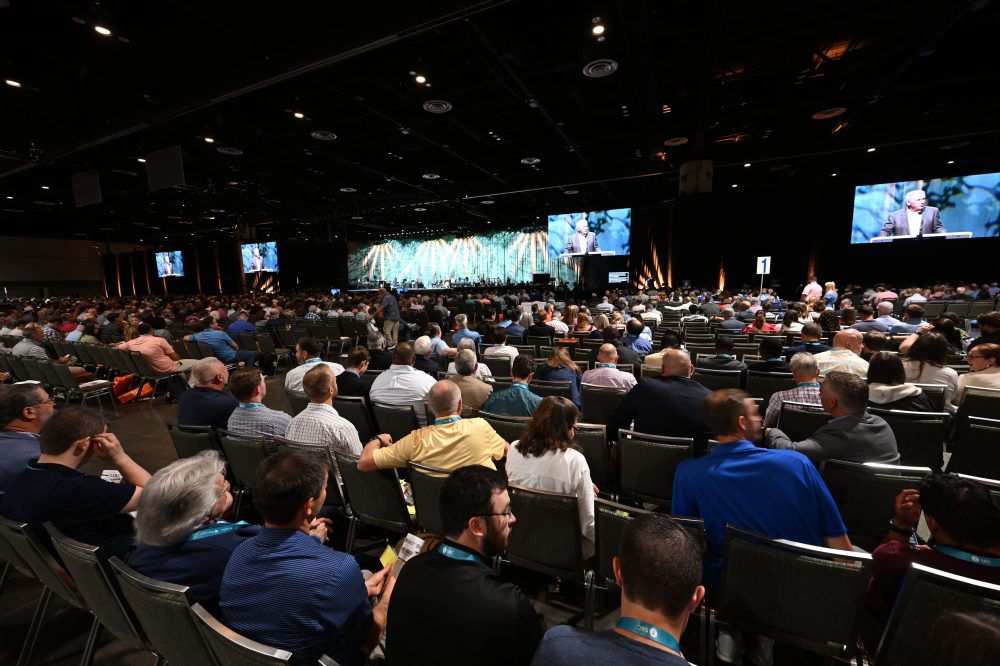
“To the degree that there have ever been times that Baptist churches or Baptist institutions did not handle abuse correctly, that has damaged our witness,” Rice said at a news conference at the close of the SBC’s annual meeting earlier this month in Orlando, Florida. “We have tried very hard over the last several years to correct that.”
The view that sexual abuse within the SBC never amounted to a crisis — once a fringe position — is becoming increasingly common. Rice’s only challenger for the SBC presidency, Josh Powell, expressed a similar stance. Delegates at the same annual meeting also moved forward with a constitutional ban on SBC churches having women pastors, a measure that will require ratification next year.
Christa Brown, a survivor of sexual abuse by an SBC pastor who has spent years advocating for reforms, said that if anyone was politicizing the abuse issue, it was those caught up in SBC internal power struggles — not the victims.
“For clergy sex abuse survivors, there has never been anything to gain in speaking out. To the contrary, it almost always comes with a heavy personal cost,” she said in an email. “There’s no political agenda.”
Brown also noted: “There is no place within the SBC where someone who was sexually abused by a pastor or church worker can safely report it and get a proper response. I’ve been working within this arena for over two decades, and this reality has not changed.”
The 2022 annual meeting had authorized both a database of credibly accused church workers and a task force to oversee reform efforts. That task force was later shut down before the database was ever created, partly because of concerns about legal liability. Responsibility was handed to the denomination’s Executive Committee, which has instead directed churches to existing sex offender registries while concentrating on prevention and education.
Brown emphasized that abuse carried out by clergy is uniquely harmful, noting that abusive faith leaders often exploit religious language around spiritual authority and forgiveness to manipulate the trust of minors.
“Sexual abuse committed by clergy carries unique dynamics (and this is something that most SBC leaders just don’t seem to understand… or don’t want to understand),” she wrote.
Survivor Jules Woodson, who had previously advocated for SBC abuse reforms at past annual meetings, wrote on X that she has had to “step far away as it became apparent the #SBC has never been, & will never be, a safe place for me…A woman.”
Those within the SBC who doubt the existence of a systemic crisis frequently point to the numbers. A 2019 investigative report titled “Abuse of Faith,” published by the Houston Chronicle and San Antonio Express-News, identified roughly 380 Southern Baptist church leaders and volunteers who had faced sexual abuse allegations over the previous two decades, with more than 700 victims identified. That investigation drew from publicly available records, including arrests, lawsuits, and confessions.
Skeptics have argued that for a denomination with more than 40,000 churches and millions of members, those figures — while troubling — do not indicate a widespread crisis.
Advocates counter that abuse is frequently never reported, especially when the person responsible holds a position of authority and is often shielded by other church leaders.
For context, a landmark study on the Catholic Church conducted by the John Jay College of Criminal Justice — which had access to internal church records on cases that had never become public — found that more than 4,000 priests were accused of abuse between 1950 and 2002, representing approximately 4% of those serving during that period.
“Given that publicly reported cases (which are based largely on criminal convictions) are the tip of the iceberg, people should be horrified at what the size of that tip reveals about how huge the whole of the SBC’s clergy sex abuse iceberg almost certainly is,” Brown wrote.
The Guidepost report concluded that survivors had repeatedly encountered “resistance, stonewalling and even outright hostility from some” within the denomination’s Executive Committee. It also found that leaders of major churches had failed to report abusers to law enforcement or their own congregations. Two individuals named in the report have filed defamation lawsuits against the SBC; those cases remain pending.
Critics have also challenged how the report characterized certain cases involving women, arguing some involved consensual affairs that were sinful but not abusive. The women involved described the incidents as assaults or abuse in their own court depositions.
Advocates for survivors point to other high-profile failures beyond the Guidepost report’s findings, including the 2018 dismissal of an influential seminary president over his handling of rape allegations, and multiple abuse accusations against a once-powerful figure in SBC politics who has since died.
North Carolina pastor Bruce Frank, who led the Sexual Abuse Task Force created following the “Abuse of Faith” report, acknowledged that survivors have understandable reasons for walking away from the push for denominational reform.
“We made some difference. It fell short of what a lot of people who suffered through that could reasonably expect,” said Frank, pastor of Biltmore Church in Arden, North Carolina.
Frank said he supported creating a database of credibly accused pastors as a way to stop predators from moving on to unsuspecting congregations.
“The bottom line is, how do you protect the most people in a loosely bonded, decentralized body, in a place that heavily relies on volunteers?” he said.