
A proposed Israeli law that would transfer civil oversight of historic archaeological sites in the West Bank to Israeli government control is facing fierce opposition from Palestinians and Israeli human rights organizations, who argue it is effectively an annexation move that would accelerate settlement expansion.
The legislation, known as the “Heritage Authority in Judea and Samaria” bill, cleared one of three required votes in Israel’s parliament back in May. However, it remains uncertain whether the remaining votes will happen before parliament breaks ahead of an election expected by October 27.
If passed, the bill would place Roman, Byzantine, and Crusader-era archaeological sites under the Israeli Ministry of Heritage and allow for the “expropriation and purchase of real estate” in the West Bank — a territory Israel refers to by its Hebrew biblical name.
The move would effectively strip the Western-backed Palestinian Authority of its oversight role at several ancient sites. Under the Oslo peace accords reached in the 1990s, the Palestinian Authority has exercised limited self-governance over portions of the West Bank, which Israel seized during the 1967 war.
The Palestinian Authority’s tourism minister, Hani Al-Hayek, was blunt in his criticism, saying “control over these antiquities is intended to expand control and expand settlements in these areas, deep inside Palestinian territories.”
Israel, for its part, maintains that the bill’s goal is simply to protect and preserve ancient historical sites.
Israeli settlements watchdog Peace Now characterized the legislation as something that “constitutes an annexationist measure in every respect” and warned it would trigger widespread confiscation of Palestinian land. The organization noted that while using archaeology as a tool to expand settlements is not new, the current government’s approach is unprecedented in its scale.
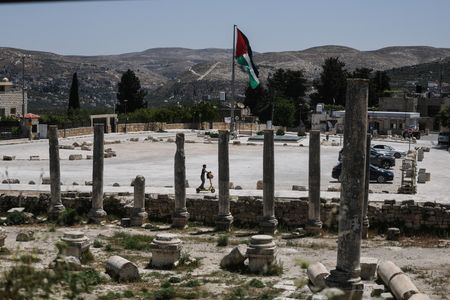
One community directly in the crosshairs is the Palestinian village of Sebastia, located in the northern West Bank. Many residents there can trace their family ties to the land back hundreds of years, and the local economy depends heavily on visitors to a nearby archaeological site.
That site contains ruins from the 9th-century B.C. Israelite kingdom, along with remnants from the Roman, Byzantine, Crusader, and Ottoman periods. Archaeologists note it is currently on a tentative list for UNESCO World Heritage Site designation.
In late 2025, Israel announced plans to seize approximately 1,800 dunams — roughly 445 acres — at the site, citing development goals. Village officials say the seizure would affect around 5,000 olive trees growing in the village’s groves.
Sebastia’s Deputy Mayor Nizar Kayed described the impact on the community: “They are incorporating areas containing water resources, roads and antiquities, leaving us as residents without any resources. It is part of settlement expansion.”
Local business owner Nahed Sakha, whose restaurant sits on land targeted for confiscation, said tourism had already been declining since late 2023 due to regional conflict. “It seems that the Israeli plan (is) to isolate the archaeological site from the people,” Sakha said.
Israeli parliament member Zvi Sukkot, who has been a driving force behind the bill, argues that bringing these sites under Israeli control is about protecting ancient remnants with deep biblical significance. “There’s nothing here that changes the legal status of Judea and Samaria,” he told Reuters.
Sukkot added: “There are many people who are bothered by our desire to prove the ties between the people of Israel and this land. All the stories of the Bible, all our history, the people (of Israel) were born in Judea and Samaria.”
Sukkot belongs to the pro-settler Religious Zionism party and, like many members of Prime Minister Benjamin Netanyahu’s coalition, opposes the establishment of a Palestinian state and supports annexing the West Bank.
United Nations bodies and the majority of the world’s countries consider Israeli settlements in the West Bank to be illegal under international law, specifically citing the Fourth Geneva Convention, which prohibits transferring a civilian population into occupied territory. Israel rejects that interpretation, describing the West Bank as disputed rather than occupied territory and pointing to security considerations as well as historical and biblical connections to the land.
The bill has also raised alarms within Israel itself. Legal officials in Israel’s defense establishment have expressed concern, and the Israel Academy of Sciences and Humanities sent an open letter to Prime Minister Netanyahu and parliament member Sukkot urging them to scrap the measure entirely.
“This will undoubtedly lead to an immediate deterioration in Israel’s international relations in the field of archaeology, and it will also have an impact on other areas of science and research,” the academy warned.