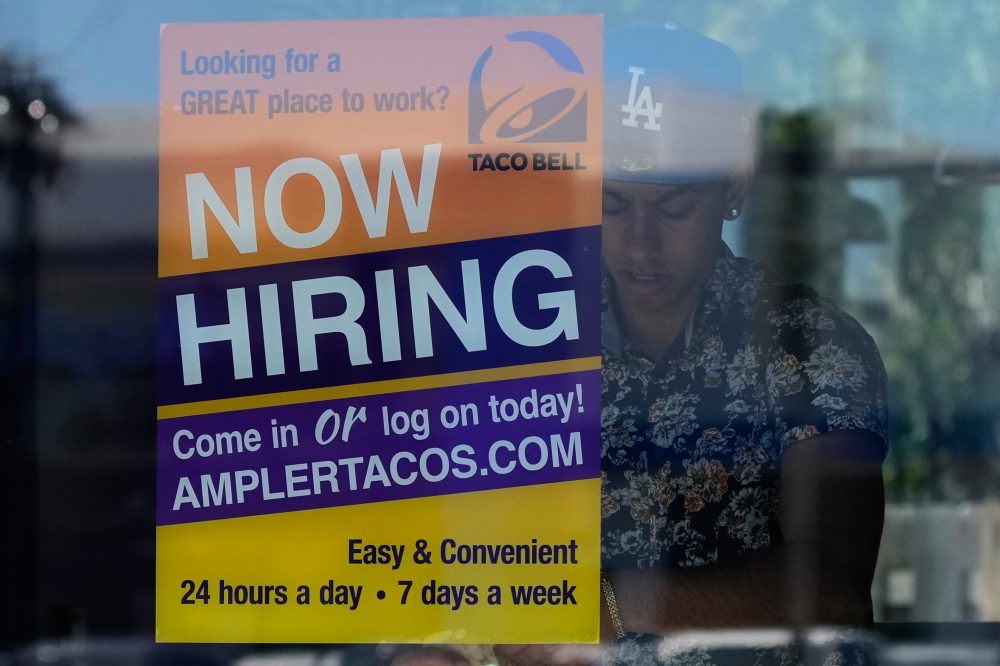

WASHINGTON — The number of Americans filing for unemployment assistance dropped last week, a sign that layoffs remain relatively low even as businesses navigate a challenging economic environment.
For the week ending June 20, new applications for unemployment benefits fell by 12,000 to 215,000, according to a Thursday report from the Labor Department. Analysts surveyed by the data firm FactSet had predicted around 225,000 new filings, making the actual number a pleasant surprise.
Weekly unemployment filings are closely watched because they provide a near-real-time snapshot of layoff activity across the country.
Despite fears that the war in Iran could further strain an already fragile job market, hiring has actually picked up in recent months after a difficult 2025 that saw fewer than 200,000 total job gains — a stark contrast to the roughly 1.5 million jobs added throughout 2024.
American employers added a better-than-expected 172,000 jobs in May alone. Over the three months since the Iran war began in late February, the economy has been averaging 188,000 new jobs per month — the strongest three-month hiring stretch since early 2024. The national unemployment rate currently stands at a historically low 4.3%.
The government is set to release its full June jobs report next week.
Meanwhile, job openings are also trending upward. Employers posted 7.6 million vacancies in April, a jump from 6.9 million in March and the highest level since May 2024.
Thursday’s report also revealed that the Federal Reserve’s preferred measure of inflation climbed to a three-year high in May. That spike was largely driven by surging gas prices tied to the closure of the Strait of Hormuz along Iran’s southern border — a critical waterway through which roughly one-fifth of the world’s daily oil supply passes.
Consumer prices in May were 4.1% higher than a year earlier, the biggest annual jump since April 2023. While energy prices have since come down considerably from their peak during the Middle East conflict, the prolonged period of elevated costs strained household budgets and may have made some employers more cautious about adding workers.
Last week, Iran and the United States reached an agreement to end the war, with Iran agreeing to reopen the Strait of Hormuz and resume selling its oil without restrictions.
With inflation still running well above the Federal Reserve’s 2% target, central bank officials chose to hold interest rates steady at their most recent meeting last week. Some Fed policymakers have indicated they would even consider raising rates at least once this year in an effort to bring inflation under control — though higher borrowing costs can make businesses more hesitant to hire.
The Federal Reserve has signaled a possible rate increase before year’s end. According to data from CME Group, Wall Street currently puts the odds of at least one rate hike this year at 85%.
The rapid growth of artificial intelligence is adding another layer of uncertainty to the job market, both because of the massive investment required to develop the technology and because it has the potential to change or eliminate certain types of jobs.
Among the major companies that have recently announced job cuts are Verizon, UPS, Amazon, Disney, Starbucks, and Walmart.
Weekly unemployment filings have generally stayed within a range of 200,000 to 250,000 since the economy recovered from the pandemic recession. However, hiring began cooling about two years ago and slowed further in 2025, influenced by President Donald Trump’s tariffs, reductions to the federal workforce, and the lingering effects of high interest rates.
Thursday’s report also showed that the four-week moving average of jobless claims — a measure that smooths out week-to-week swings — edged up by 750 to 224,250.
The total number of people collecting unemployment benefits for the week ending June 13 rose by 21,000 to 1.82 million.