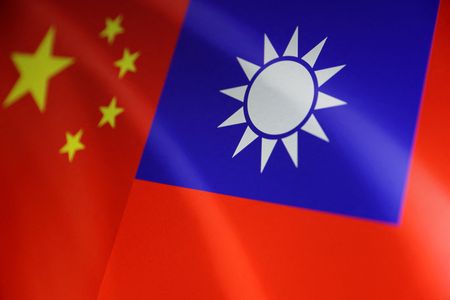

TAIPEI — Taiwanese officials ran a tabletop simulation Thursday, practicing how the island would respond if China attempted to impose a maritime blockade by requiring all ships entering or leaving Taiwanese ports to first obtain Beijing’s approval.
China has long refused to rule out military force as a means of bringing Taiwan under its authority and routinely sends military assets around the island. However, Taiwan’s government has grown increasingly concerned about non-military forms of pressure that Beijing could use, such as deploying its Coast Guard to assert legal control over shipping lanes around the island.
Earlier this month, China’s Coast Guard conducted what Beijing described as a “law enforcement” patrol off Taiwan’s eastern coastline, claiming it had inspected vessels in the area. Taiwan strongly condemned the move, and the United States, France, Britain, and Germany all voiced concern over the action.
National Security Council Deputy Secretary-General Lii Wen addressed a regular gathering of Taiwan President Lai Ching-te’s Whole-of-Society Defence Resilience Committee, confirming the drill had taken place earlier that day.
Lii described the exercise scenario: China’s Coast Guard announces that all vessels entering and departing Taiwanese ports must file declarations through the China International Trade Single Window, a government-run portal for trade processing. From there, Beijing would gradually escalate its actions — moving from inspections to boardings, searches, and ultimately the seizure of ships — steadily increasing what Lii called “interference with Taiwan’s maritime resupply.”
In Taiwan’s simulated response, the island’s own Coast Guard would carry out what Lii described as “strong front-line law enforcement and response actions,” while the military would launch immediate combat readiness exercises. Taiwan’s defense and foreign ministries would also mount a public communications effort, arguing that China’s actions — including unauthorized boardings and inspections — violate international law and undermine freedom of navigation.
China’s Taiwan Affairs Office had not responded to a request for comment. Beijing does not recognize any claim of sovereignty by Taiwan.
Earlier Thursday in Beijing, Chinese defense ministry spokesperson Zhang Xiaogang defended China’s recent patrols. “Our law-enforcement patrols in the relevant waters are legitimate and necessary and are a just action to safeguard national territorial sovereignty and maritime rights and interests,” Zhang said.
Speaking at the opening of the resilience committee meeting, President Lai pushed back, saying China’s “acts of expansion carried out under the guise of law enforcement” are destabilizing the security, peace, and stability of the broader region.
“Taiwan’s efforts to strengthen its self-defence capabilities, maintain the peaceful and stable status quo, and safeguard its democratic and free way of life are absolutely not provocations,” Lai added.