
Vermont has become the first state in the country to prohibit the use of paraquat, one of the most widely used weed killers in American agriculture, after lawmakers pointed to a possible connection between the herbicide and Parkinson’s disease.
Advocates who have pushed for the ban are celebrating Vermont’s decision, hoping it will spark similar action across the country to combat the neurological condition that strips people of their ability to control their own movements and currently affects roughly 1 million Americans.
Dan Feehan of The Michael J. Fox Foundation — the world’s largest nonprofit dedicated to funding Parkinson’s research — said the move carries real weight. “Vermont took the step to be the leader in this, and that’s significant because it shifts the conversation,” he said. “Now, ‘will your state be the last to ban it?’ becomes the question.”
Not everyone is on board, however. For farmers already operating on tight margins, the ban could create financial strain. Efforts to restrict paraquat in other states where it sees heavier use have repeatedly failed to gain traction.
The U.S. Environmental Protection Agency is currently conducting its own review of paraquat’s safety, having previously stated that a clear link between the chemical and Parkinson’s has not been established.
Syngenta, a Swiss chemical company that has produced paraquat for many years, announced earlier this year that it would halt global production and sales of the substance — while still defending its safety record. Other manufacturers continue to sell the product.
“Despite decades of investigation and more than 1,200 epidemiological and laboratory studies of paraquat, no scientist or doctor has ever concluded in a peer-reviewed scientific analysis that paraquat causes Parkinson’s disease,” the company stated.
Paraquat first arrived in the United States in 1964 and quickly became a go-to solution for farmers battling weeds. It is considered an extremely dangerous chemical — lethal if swallowed and capable of causing long-term health damage through skin contact. Farmworkers face the greatest exposure risk, which is why the EPA requires special certification and training for anyone applying it. That training, which takes roughly an hour and includes a 15-question test, must be renewed every three years.
According to the United States Geological Survey, paraquat is commonly applied to protect soybean, cotton, and corn crops, as well as apple and grape production. As of 2018, the USGS found that more than 10 million pounds — about 4.5 million kilograms — of paraquat were being used annually in the U.S., with the heaviest concentration in the South, Midwest, and California.
Despite its widespread use domestically, dozens of other nations have already outlawed it. The European Union and the United Kingdom banned paraquat in 2007. China and several Southeast Asian nations including Vietnam and Malaysia ended domestic use in 2017, with Thailand following in 2019.
Supporters of paraquat argue that the chemical is absorbed rapidly by weeds and won’t wash away into soil even if rain falls within 30 minutes of application. Companies like Syngenta claim it becomes inert once it contacts the ground. But the Parkinson’s community pushes back, warning that people living near areas where paraquat is sprayed face a higher likelihood of developing the disease.
Dr. Philip Landrigan, an epidemiologist who leads a global health program at Boston College and has long campaigned against human exposure to toxic chemicals, said numerous studies point to environmental factors — including exposure to pesticides such as paraquat — as contributors to Parkinson’s disease risk.
For the Parkinson’s community, Vermont’s ban represents a meaningful milestone. Ron McConnell, a Vermont resident who was diagnosed with Parkinson’s after being exposed to a different toxic substance at his job in 2017, put it plainly: “No matter how you slice and dice it, there’s no safe way to use paraquat. This law that Vermont just passed really is protecting the farmers that use it and the farmworkers that use it.”
The ban officially kicks in on November 1, though farmers growing fruit in orchards, berry operations, and small fruit crops have until 2030 to phase out their use of the herbicide.
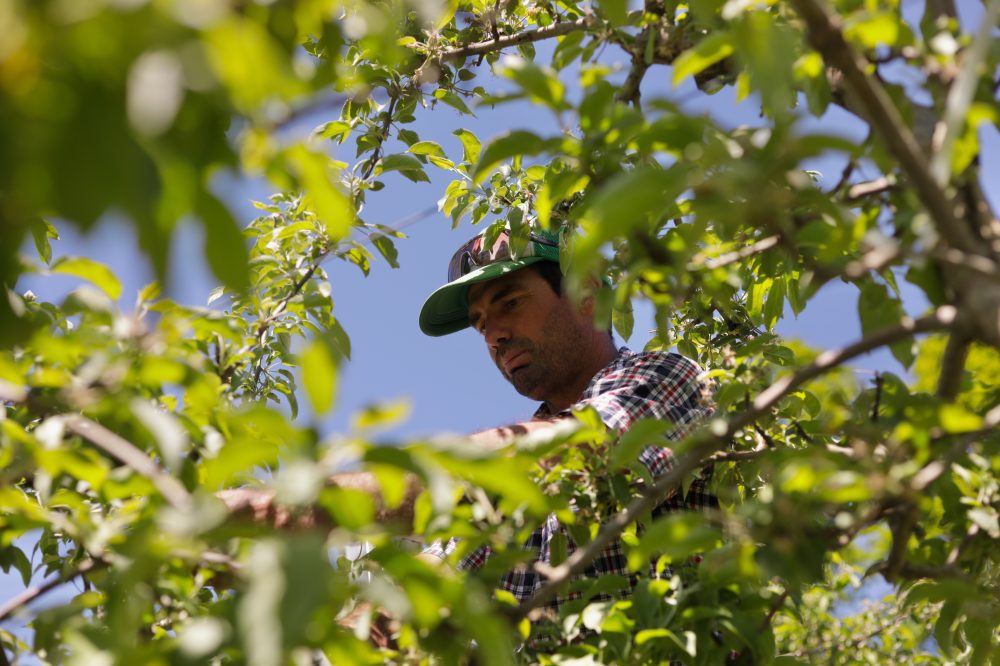
Greg Burtt, who owns a family apple orchard and also serves as a Republican Vermont lawmaker, calls paraquat a “critical tool” in his farming operation. He believes the ban will put farmers like him at a disadvantage compared to growers in other states who can keep using the more affordable chemical. While alternative herbicides exist, some farmers caution that those options can damage crops if not applied with precision. Other methods like mechanical tilling, crop rotation, and hand weeding are available but bring their own challenges, particularly higher labor costs.
“There’s a reason why it’s an industry standard,” said Burtt, who has relied on paraquat for 20 years. He said he views the research on the herbicide as inconclusive and isn’t personally concerned about his Parkinson’s risk.
“I wanna be the first person to make sure that it’s safe because I don’t wanna die young over farming,” Burtt said. “And so if anybody’s had to wrestle with these questions, it’s me.”