
Thousands of people are feared dead in Venezuela after two powerful earthquakes struck in and around the capital city of Caracas on Wednesday, burying victims under collapsed buildings and triggering a series of strong aftershocks.
According to the U.S. Geological Survey, the disaster began with a magnitude 7.2 earthquake centered about 160 kilometers — roughly 100 miles — west of Caracas. Less than a minute later, an even stronger magnitude 7.5 tremor followed. At least 32 deaths have been confirmed and 700 people were reported injured.
Using predictive modeling, the USGS estimated the final death toll would most likely climb into the thousands, with a notable probability that it could surpass 10,000.
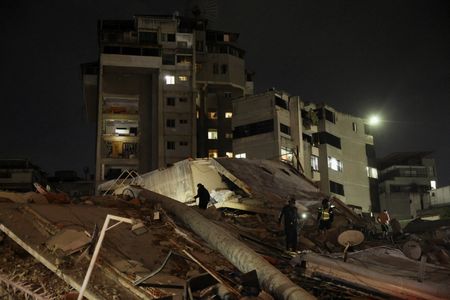
Rescue workers picked through the wreckage of a collapsed building in Caracas as darkness fell Wednesday night. Desperate family members gathered nearby, searching for word about loved ones believed to be trapped in the debris. Several survivors were pulled from the rubble, some carried away on stretchers.
“When we went downstairs, the scene was like a horror movie,” said Maria Alejandra, a resident from a neighboring building who declined to give her last name. “We had to climb over the rubble and everything. The building superintendent with the baby and all the neighbors coming down. But from that building, I only saw that one family got out.”
Interim President Delcy Rodriguez acknowledged that the confirmed casualty numbers do not yet include victims from La Guaira state — the hardest-hit area near Caracas and home to the city’s main airport, which was shut down following the disaster.
“Dozens of buildings have collapsed, and we are currently carrying out very intense rescue efforts to save as many lives as God allows us to save,” Rodriguez said during an appearance on state television just before 1 a.m. local time Thursday.
A website created to track missing persons, shared on X by members of Venezuela’s opposition — many of whom are currently outside the country — showed more than 6,600 people listed as unaccounted for shortly after 2 a.m. local time.
The earthquakes struck during the afternoon on a public holiday, meaning many Venezuelans were at home when the ground began shaking.
“There was a very loud crash. Things fell in the house, jugs inside the refrigerator. I’ve never experienced anything like it,” said Coro Martinez, 56, a resident of eastern Caracas.
Aftershocks continued to shake the capital well into the early morning hours of Thursday. Rodriguez said rescue teams from other countries were expected to arrive in the coming hours, and she thanked several world leaders, including U.S. President Donald Trump.
Trump posted on social media that the United States stood ready to help. “The two major earthquakes that just hit the great people of Venezuela are both massive in scale and have left a devastating number of deaths,” Trump wrote. He had previously ordered the capture of Venezuelan President Nicolas Maduro in a violent raid in January.
The United Nations’ Venezuela human rights mission called on the government to lift local restrictions on social media access, calling it a “matter of life and death.” Access had already been restored in some areas.
Former Venezuelan lawmaker Wilmer Azuaje filmed the moment the quake struck Maiquetia Airport, capturing masonry and dust crashing down around him. “Everyone, the situation we’re experiencing here is serious. A high-magnitude earthquake. Look at how everything ended up,” he said in the video.
A tsunami warning was briefly issued following the earthquakes but was quickly canceled once the threat had passed.
Residents throughout Caracas fled into the streets as buildings shook. The city was previously struck by a deadly magnitude 6.3 earthquake in 1967.
“As soon as it started, we began hearing people screaming,” said Astrid Ramirez, a 41-year-old publicist in western Caracas. “Everyone was running down the stairs.”
Maria Romero, an 80-year-old pensioner living in southern Caracas, said police helped her evacuate her home. “This earthquake was horrible, even worse than the one in 1967,” she said.
Another resident, a 41-year-old office worker who asked not to be identified, said she received an alert on her phone moments before the shaking intensified. “As I picked it up and started listening to what it was saying, I first felt light shaking. Then, in less than two seconds, everything started moving,” she said.
Leaders from El Salvador, the Dominican Republic, Brazil, and Spain all expressed support and condolences. The U.S. State Department confirmed it was in contact with Venezuelan authorities and working to mobilize assistance.
Venezuela sits in a seismically active region where the Caribbean Plate and the South American Plate meet. Historical records show that an estimated 30,000 people perished when a major earthquake devastated the cities of Merida and Caracas back in 1812, according to the USGS.
At Caracas’ Hospital de Clinicas, staff were asked to work double shifts to handle the influx of injured patients. School classes were canceled for the remainder of the week as officials began assessing the full extent of the damage.
The Venezuelan Red Cross reported that its own headquarters had been critically damaged, but said rescue teams had been deployed to the most affected areas. France reported that its embassy in Venezuela had also sustained serious damage.
Venezuela’s oil infrastructure did not appear to be immediately impacted. Civil protection officials in Maracaibo, near the major oil hub at Lake Maracaibo, reported no injuries. A worker at the El Palito refinery near Morón — close to the earthquake’s epicenter — said the facility had not been damaged.
UK oil firm Shell, which is considering developing gas fields in Venezuela, said all of its employees were safe and uninjured. One source warned that a prolonged power outage could affect crude oil production levels. Venezuela’s oil ministry, state-run oil company PDVSA, and its primary foreign partner Chevron had not responded to requests for comment at the time of this report.