Tesla announced Friday that its robotaxi service has arrived in Miami, as the electric vehicle company continues pushing to expand its autonomous ride-hailing network across the country.
The Miami launch underscores Tesla’s broader strategy to grow the use of its self-driving software — a technology central to CEO Elon Musk’s vision of shifting the company’s focus from electric vehicles toward artificial intelligence and robotics.
“Robotaxi now available in Miami,” Tesla’s official robotaxi account posted on X.
The announcement comes at a time when the robotaxi industry is picking up speed. Rivals including Alphabet’s Waymo and Amazon’s Zoox have also been ramping up their own expansion efforts in the autonomous vehicle space.
Tesla first rolled out its unsupervised robotaxi service — meaning no human safety driver is present — in Austin, Texas, in June. Earlier this spring, in April, the company said it planned to bring the service to Dallas and Houston as well.
Musk said in May that he expects fully self-driving vehicles, operating without human safety monitors, to become a more common sight on U.S. roads before the end of this year.
In other Tesla news, the company reported record-breaking vehicle deliveries for the second quarter on Thursday, surpassing Wall Street expectations. The strong numbers were driven in large part by a rebound in sales across Europe.
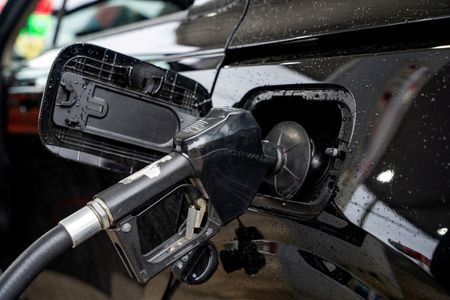
Americans are heading out in force this Independence Day weekend, brushing aside gasoline prices that are still running well above historical norms.
Some relief has come from the easing of tensions between the United States and Iran, which calmed fears that oil shipments through the Strait of Hormuz could be disrupted and send fuel costs skyrocketing.
Even so, drivers are expected to pay the second-highest Fourth of July gas prices ever recorded. Price-tracking service GasBuddy projected last week that the national average would sit around $3.75 per gallon on July 4 — trailing only the all-time holiday record of $4.80 per gallon set on July 4, 2022. As of Thursday, the national average stood at $3.79 per gallon, which is 63 cents higher than the same time last year, according to GasBuddy.
Patrick De Haan, head of petroleum analysis at GasBuddy, addressed the recent price movements in his Monday weekly update. “The declines came despite a turbulent week, as fresh attacks were traded between the U.S. and Iran before both sides agreed to halt hostilities just in time for Sunday. … For now, GasBuddy anticipates the national average will continue drifting lower this week, though the situation remains anything but predictable,” he wrote.
President Donald Trump has pushed gas station operators to drop prices more aggressively, saying pump prices have not come down enough since tanker traffic through the Strait of Hormuz resumed last month. U.S. Treasury Secretary Scott Bessent echoed that call on Tuesday, urging retailers to lower prices as the nation marks its 250th birthday.
Despite the cost, motorist organization AAA is forecasting a record 72.2 million Americans will travel at least 50 miles from home over the holiday period — edging past last year’s record of 71.8 million travelers. However, the number of people driving and flying is expected to stay relatively flat compared to last year, with more travelers opting for other modes of transportation such as cruises.
AAA estimates that about 61.4 million people will drive to their destinations, while nearly 5.85 million are expected to fly. Another 4.93 million are projected to travel by bus, train, or cruise ship.
Denton Cinquegrana, chief oil analyst at Dow Jones Energy, said Americans simply don’t let holiday plans fall apart over gas prices. “I think when it comes to summer holidays Americans will go through with their plans. … It’s the ‘I have had something planned’ mindset and ‘I am not changing it, I’ll figure it out next week,’” he said.
Demand data backs that up. The U.S. Energy Information Administration reported Wednesday that gasoline supplied — a measure used to track fuel demand — climbed by 356,000 barrels per day ahead of the holiday weekend, reaching 9.13 million barrels per day. That compares to 8.64 million barrels per day during the same period last year.
Looking ahead, analysts warn that prices could stay high if fuel supplies continue to tighten. Gasoline stockpiles along the U.S. Gulf Coast have dropped to their lowest point since October 2024, falling to 76.48 million barrels. Overall gasoline inventories declined by 2.3 million barrels to 214 million barrels last week.
Cinquegrana flagged the Gulf Coast situation as particularly worrying. “That (Gulf Coast inventory level) is probably more concerning from a supply standpoint than the U.S. being at the current deficit,” he said. Refineries in that region account for more than 55% of total U.S. refining capacity and are a key supplier to other parts of the country.
Nationwide, gasoline stockpiles for the week ending June 26 were roughly 8% below where they stood at the same point last year, EIA figures show. Unplanned refinery outages in Russia and Mexico, along with the approaching Atlantic hurricane season, could also push prices back up in the weeks ahead.
Travelers heading southbound on Delaware Route 1 are facing lane restrictions after a crash forced the closure of the right lane near Exit 136.
The incident is currently affecting traffic flow in that stretch of the highway. Drivers approaching the area are urged to slow down, stay alert, and be prepared for potential delays.
No additional details about the crash have been released at this time. Motorists are encouraged to allow extra travel time or consider alternate routes until the lane is reopened.
With the United States marking its 250th Independence Day, the New Castle County Division of Police is calling on residents to keep safety top of mind as the holiday celebrations get underway.
Whether your plans include a backyard barbecue, quality time with family, or heading out to watch a professional fireworks show, law enforcement wants Delawareans to remember one important fact: fireworks are regulated in the state of Delaware.
Police say that taking a moment to understand the law before the festivities begin could go a long way toward making sure the holiday stays fun — and safe — for everyone involved.
A collision on Delaware Route 1 southbound has resulted in the closure of the right lane in the vicinity of Exit 136, according to state transportation officials.
Drivers heading southbound on DE-1 should be prepared for potential delays as crews work in the area. Motorists are urged to slow down, stay alert, and allow extra travel time when passing through the affected zone.
No additional details regarding the nature of the crash or any injuries have been released at this time. TV Delmarva will continue to monitor the situation as more information becomes available.
In honor of America’s 250th birthday, SRN News has launched a special new series titled Faith and Freedom.
The series, now in its 17th installment, is presented in audio format and focuses on the relationship between faith and freedom throughout the nation’s history.
The Faith and Freedom series continues to mark this milestone anniversary of the United States.
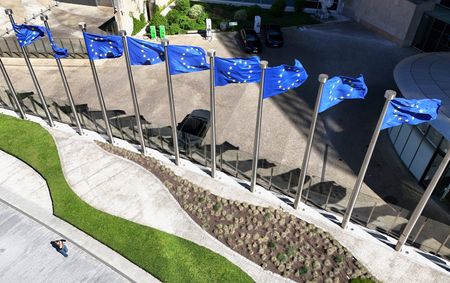
BRUSSELS — The European Commission announced on Friday a proposal for five significant cross-border defence initiatives, paving the way for those projects to tap into European Union funding.
The initiatives, designated as European Defence Projects of Common Interest, span a wide range of security domains. Among them is a drone and counter-drone program that brings together 26 EU member nations along with Norway and Ukraine, as well as an Eastern Flank Watch initiative involving 13 EU members, Norway, and Ukraine.
The remaining three proposals cover integrated maritime and seabed defence, air and missile defence combined with early warning systems, and a space-based defence program.
To qualify for the European Defence Projects of Common Interest designation, a project must be structured to strengthen innovation and boost the competitiveness of Europe’s defence industrial base, while also working to reduce fragmentation across the market.
Through the EU’s European Defence Industry Programme, a total of 325 million euros — roughly $372 million — has been allocated for these designated projects, with the possibility of additional funding down the road.
The five proposals still require formal approval from the Council of the EU before moving forward.
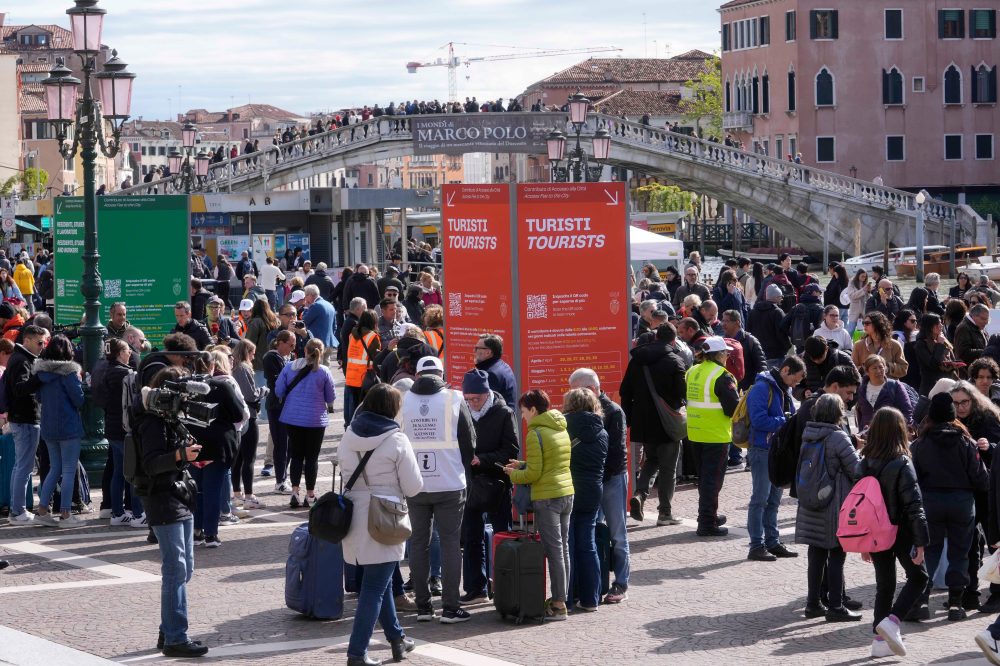
MILAN (AP) — Venice’s new mayor is calling for an overhaul of the city’s three-year-old tourist access fee, proposing a surge-pricing model that could charge day visitors up to 50 euros — roughly $59 — on the city’s most crowded days.
Mayor Simone Venturini spoke with The Associated Press in an interview Friday, explaining that the existing 10-euro charge for last-minute reservations has fallen short of discouraging visitors during peak periods. Rather than simply raising the fee to a fixed higher amount, the city wants to implement a flexible pricing structure that rises along with demand.
Venturini said the approach would serve two purposes: reducing overcrowding and helping to fund the ongoing cost of keeping the city functioning.
“We spend 100 million euros a year just to maintain Venice physically, and nobody gives us that money. Not Europe. Not the Italian state. International critics don’t pay it either. It’s paid by the people of Venice, and in part through tourism taxes,” said Venturini, who was elected mayor last month. He had previously served as the city’s top tourism official when the day-tripper fee was first introduced in 2024.
The access fee has drawn steady criticism from activists, housing advocates, and opposition politicians who argue it hasn’t meaningfully reduced crowding and effectively turns Venice into a ticketed attraction. Critics also contend the city is too focused on managing tourist numbers rather than finding ways to bring more permanent residents back to the historic city center.
Venturini pushed back, saying the revenue is essential for basic upkeep. Implementing a surge-pricing structure would require an amendment to the special Italian law that governs Venice, and Venturini said he has already raised the idea with the country’s tourism minister.
“Day-trippers obviously generate waste — they eat, they drink, they throw things away. That comes at a huge cost,” he said, adding that expenses are driven up “because everything has to be done by hand, with brooms, boats and handcarts.”
Although the proposed 50-euro ceiling has drawn headlines and criticism — particularly over its potential impact on families and budget travelers — Venturini clarified that the figure represents an upper boundary, not a standard charge. The city is still working with researchers to identify the right pricing levels.
“If, for example, more than 40,000 people had already booked for a given day, those above that threshold might be asked to pay a little more — 20, 25 or 30 euros,” Venturini said. “We asked for a broad range, up to 50 euros, and then it would be up to the city to manage the system through further testing. It doesn’t mean everyone who comes to Venice would pay 50 euros.”
Opposition politicians have suggested capping the total number of visitors allowed into the city each day, but Venturini said existing Italian law does not permit that kind of hard limit.
According to the most recent figures tracked by the Ocio housing advocacy group from January, the number of residents living in Venice’s historic canal district has fallen below 48,000, while the number of available tourist beds has climbed above 51,500. Venturini argued that the residential population is likely undercounted, since many students and seasonal workers live in Venice for much of the year without officially registering as residents.
“That doesn’t mean we are satisfied. We need to do more,” he said.
During the program’s 2024 test phase, Venice collected 2.4 million euros from more than 485,000 day-trippers across 29 peak days. Last year, the city expanded the program to 54 days and doubled the last-minute fee to 10 euros, bringing in 5.4 million euros. This year, six additional days have been added to the schedule, though no data on visitor numbers or revenue has been released yet.
Venturini acknowledged that the funds collected so far cover “only a small part of the costs of managing tourism.”
“The goal is not to raise money or to turn Venice into a ticketed city,” he said. “The goal is to give both residents and visitors a better experience on days when the city would otherwise be too crowded.”
CARABALLEDA, Venezuela — In the middle of unimaginable loss, an unexpected source of comfort emerged inside a fast-food restaurant now being called “Hospital McDonald’s.”
Gabriela Alves spent more than a week desperately searching for her 6-year-old dog, Buddy, after two catastrophic earthquakes rocked Venezuela on June 24. On Thursday, she finally found the white pup — alive — at that very restaurant, where she wrapped her arms around him as he lay on a table with an IV in one of his legs, just feet away from workers selling soft-serve ice cream.
“This is a miracle,” Alves said. “We’ve lost everything material, but at least we’re both alive.”
The McDonald’s location, situated beside the collapsed ruins of government housing complexes in the seaside city of Caraballeda, has transformed into an informal medical center for earthquake survivors and a reunification point for families searching for lost pets.
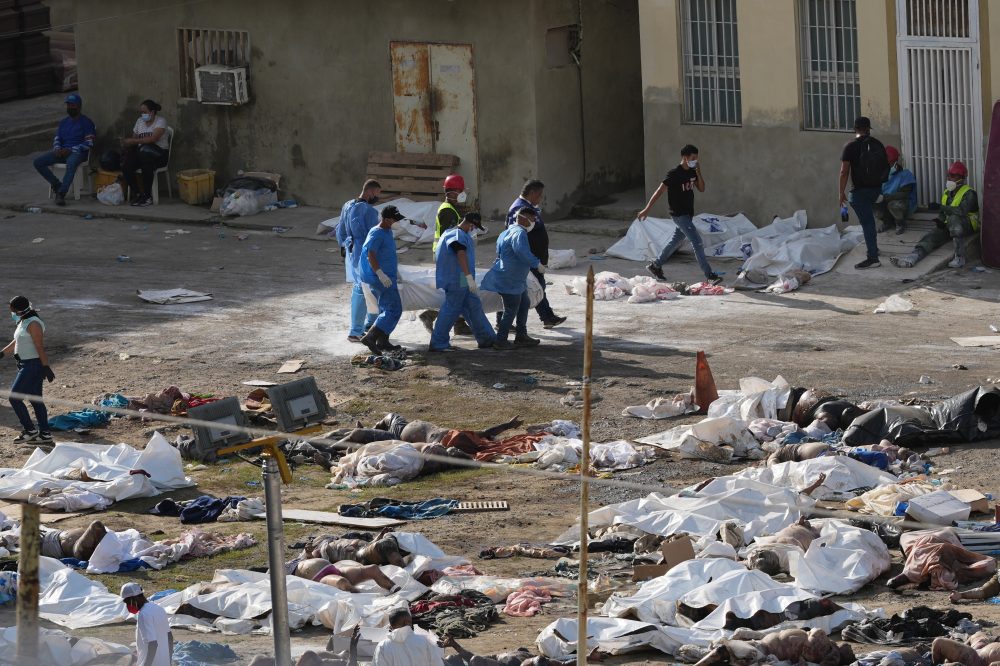
The makeshift operation got started just one day after the back-to-back quakes, which Venezuelan officials say killed at least 2,295 people and left 11,000 others injured. Countless families were left sifting through rubble in search of missing loved ones — including their cats and dogs.
Angel Matute, along with 70 other volunteers — including veterinarians, medical students, doctors, and civilians — made the journey from the western city of Barquisimeto. When the group arrived, they needed a place to sleep, store their supplies, and take cover from the heavy tropical rainfall. One of the few functioning facilities they could find was the local McDonald’s, complete with working air conditioning.
The team moved in and began caring for both human patients and injured animals, while also helping desperate owners track down missing pets.
“For us, a pet is one more human life,” said Matute, who now coordinates the rescue effort out of the restaurant, where volunteers also sleep at night. “There are animals that are more human than humans themselves.”
By Thursday, Matute and his fellow volunteers were busy treating dogs and cats in the same space where search teams were ordering hamburgers and french fries. The group has already rescued 140 animals and treated 60 more, and they say they plan to keep working until their help is no longer needed.
Alves had been visiting the makeshift animal center daily, checking whether any white dogs had been brought in before heading back to the ruins of her home to call out Buddy’s name, hoping for a bark in return. For over a week, there was only silence.
She had been away at a relative’s house when the earthquakes struck northern Venezuela. She immediately jumped on her motorcycle and raced home, only to find her house reduced to rubble with no sign of Buddy.
“We’re all living one day at a time,” she said Thursday. “Today, I returned and I truly can tell you I had lost all hope.”
But she kept searching. While picking through the debris and pulling her mother’s belongings from the only part of the home still reachable, she heard a faint bark. Looking down, she spotted Buddy’s white ear poking through a crack in the concrete.
She screamed for help, and nearby rescue workers rushed over. They broke through the wall and pulled the dust-covered dog from the wreckage. Alves broke down in tears as she held Buddy, who was wrapped in a pink blanket and licking her arm. Hours later, veterinarians at Hospital McDonald’s examined the dog for injuries after he had spent eight days buried in the rubble.
“Right now, with all the tragedy of the earthquake, it’s one positive thing in all the bad,” Alves said, still holding her dog close. “He’s like my doggie Band-Aid.”
BRUSSELS (AP) — NATO’s top military commander told The Associated Press on Friday that European member nations have managed to fill the majority of the defense holes left behind after the United States announced it would scale back its military contributions to the alliance.
U.S. Gen. Alex Grynkewich had called on European countries to step up and offer more military assets after Washington signaled on June 3 that it would no longer provide an aircraft carrier and its support vessels, aerial refueling aircraft, and dozens of fighter jets, among other military resources, to the continent.
Grynkewich also began reviewing backup plans in the event that Europe faces an attack.
The NATO Force Model serves as the alliance’s primary plan for mobilizing forces from its 32 member nations during periods of peace, crisis, or armed conflict. It outlines what military resources commanders can draw upon during the first six months of any potential conflict.
“In a matter of weeks, European Allies have largely filled the gaps left by U.S. reductions to the NATO Force Model,” Grynkewich said. His comments came just days before President Donald Trump and fellow world leaders are set to gather for a July 7-8 summit in Turkey, where military force planning is expected to be a top priority.
“And in those few areas where they haven’t, where they do not currently have a like capability to replace, we are looking at alternate capabilities with matching effect,” Grynkewich added, though he offered no further specifics.
The Pentagon’s announcement caught many NATO allies off guard. The U.S. decision reflects a strategic shift in attention toward potential threats in other parts of the world, particularly from China in the Indo-Pacific region.
European nations and Canada reviewed their own military inventories to determine what resources they could contribute if one of their allies came under attack. Britain, for instance, has placed a second aircraft carrier along with F-35 fighter jets on higher alert, ready for emergency deployment.
NATO Secretary-General Mark Rutte has sought to minimize concerns over the impact of the Trump administration’s move. Rutte believes the United States would redirect more resources toward Europe if an actual conflict were to break out, pointing to how it responded during the war on Iran as an example.
“This is not about where forces and assets are currently located,” Rutte said last month. “It’s about who would do what if our defense plans were activated. So, let’s say in case of an Article 5 situation.”
Article 5 of NATO’s founding treaty — the alliance’s collective defense guarantee — holds that an attack on any one of the 32 member nations is considered an attack on all of them. While it does not legally require members to provide military assistance, most are widely expected to do so.
ROME — The Italian government is speaking out after 80 vials of the powerful synthetic opioid fentanyl were stolen from a hospital in Rome, with officials blasting what they called the “irresponsible conduct” of those who were supposed to keep the drug secure.
The vials were taken from Rome’s Israelite Hospital, and according to a government statement, the amount stolen was sufficient to produce as many as 20,000 doses for illegal use. The statement did not specify when the theft occurred.
Government Undersecretary Alfredo Mantovano presided over an emergency meeting Friday at the government’s headquarters to address the situation.
Law enforcement units that specialize in crimes involving the healthcare sector have been assigned to investigate the theft. Additionally, Italy’s Health Ministry has ordered a formal inspection of the hospital to identify who may bear responsibility for the security lapse.
Italy has been taking steps to address fentanyl misuse in recent years. In 2024, the government rolled out a plan aimed at combating the drug’s abuse. Fentanyl is linked to tens of thousands of overdose deaths worldwide each year, though officials note there is currently no widespread crisis involving the drug within Italy itself.
France’s highest court handed down a significant ruling Friday, declaring that children born through surrogacy in foreign countries must be legally recognized in France as the children of their intended parents — despite the fact that surrogacy itself is prohibited under French law.
The ban on surrogacy — an arrangement in which a woman carries and delivers a child on behalf of parents who cannot do so themselves — has left many families in a legal gray area, with children and their parents lacking official recognition under French law.
The case that triggered the ruling involved a married male couple who had three children through surrogacy in Canada. The couple sought French recognition of a Canadian court decision that had already established them as the children’s legal parents.
In its decision, the court stated: “Given the superior interest of the child, the French ban on surrogacy does not, in itself, allow for the rejection of a foreign judgment which declares the intended parents as the legal parents of the child born through surrogacy practiced in that country.”
The ruling establishes a new legal precedent in France. The court also pointed to a prior decision by the European Court of Human Rights, which found that a national ban on surrogacy cannot be used to block the legal relationship between a child and their intended parents.
Without such recognition, the court warned, “the child would be kept in legal uncertainty … which would be contrary to his best interests.”
The court also noted that Canadian authorities had confirmed the surrogate mothers involved had given their consent to the surrogacy agreements and had agreed to give up their parental rights.
The ruling comes as the surrogacy debate has grown more heated in France. Former prime minister and potential presidential candidate Gabriel Attal has reportedly expressed support for legalizing the practice on what he described as an “altruistic” basis — meaning without any payment to the surrogate mother. However, many of his political allies are opposed to the idea.
France’s current minister for gender equality, Aurore Berge, made her position clear, saying: “I believe that women’s bodies and women’s dignity are completely incompatible with surrogacy.”
The issue remains deeply divisive in French politics, placing supporters of gay rights in opposition to conservatives who uphold traditional family values, while also splitting advocates for women’s rights and those who argue individuals should have freedom over their own bodies.
The debate is not limited to France. In Spain, where surrogacy is also banned, dozens of children born through the practice in other countries are seeking legal recognition. Meanwhile, the Italian government has recently moved to make it a criminal offense for prospective parents to travel abroad to have a child through surrogacy.
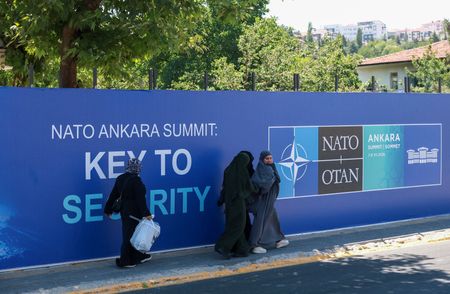
NATO leaders, including U.S. President Donald Trump, are prepared to declare an “ironclad commitment” to collective defense under the alliance’s Article 5 agreement when they gather in Ankara next week, according to a summit declaration reviewed by Reuters that was approved by NATO ambassadors on Friday.
The declaration, which still requires final sign-off from the leaders themselves at the summit, also calls for NATO members to commit €70 billion — roughly $80 billion — in military support for Ukraine in 2026, with “at least equivalent levels” of assistance continuing into 2027.
The summit document states: “We … have gathered in Ankara to reaffirm our ironclad commitment to our collective defence under Article 5 of the Washington Treaty and to the transatlantic bond. An attack on one is an attack on all.”
Trump has repeatedly criticized NATO and its member nations, claiming they have not contributed enough to their own defense and have leaned too heavily on the United States to safeguard Europe. Following disputes with European leaders over the U.S.-Israeli conflict with Iran, Trump raised questions about American dedication to NATO’s mutual defense clause and even floated the idea of withdrawing from the alliance altogether.
However, the fact that the declaration was approved by ambassadors representing all 32 NATO member nations — including the United States — indicates the U.S. president may be willing to put those concerns aside, at least temporarily.
The declaration characterizes Russia as “a long-term threat” to “Euro-Atlantic security and stability” and notes that NATO’s European members and Canada are following through on defense spending commitments made at last year’s summit in The Hague.
“We are building the future: a stronger Europe in a stronger NATO,” the text reads. “European Allies and Canada, working with the United States, are assuming greater responsibility for the Alliance’s defence.”
The declaration also addresses Iran, stating that “Allies reiterate that Iran must never have a nuclear weapon and call on Iran to fully respect freedom of navigation in the Strait of Hormuz.”
Armenia’s parliament approved a new law on Friday that sets stricter requirements for citizens who live outside the country and want to return home to vote in elections.
The move follows reports that Moscow had been working behind the scenes to use Armenians living in Russia to tip the scales in last month’s national election.
Armenia is a landlocked nation and former Soviet republic with a population of around 3 million people. It also has a large number of citizens living abroad, including in Russia, which claims more than 2 million Armenians reside and work there.
The Civil Contract party, led by Prime Minister Nikol Pashinyan, won the June 7 election with 49.8% of the vote. Shortly after that victory, lawmakers from the party introduced the new legislation, arguing that only Armenians who actually live in the country and understand its day-to-day realities should be eligible to vote.
Reuters had reported in May that Russia was stepping up covert operations aimed at undermining Pashinyan’s chances of winning re-election. Officials in Moscow were said to be concerned that he was steering the South Caucasus nation closer to Western nations and away from Russia, which has long served as Armenia’s traditional ally and patron.
According to interviews with five Western intelligence officials and documents reviewed by Reuters, the Russian scheme included plans to transport tens of thousands of Armenians from Russia back to Armenia to influence the outcome of the vote. Pashinyan ultimately defeated a largely pro-Russian opposition.
Russia dismissed the interference allegations as “spymania” and claimed there were irregularities in how the election was conducted.
Under the terms of the newly passed law, Armenian citizens living abroad may only participate in a regular election if they have resided in Armenia for at least half of the two years leading up to the vote — with that residency requirement measured starting 48 days before election day. For snap elections, the window is calculated from 28 days before the vote.
A coalition of Armenian civil society organizations condemned the new law, calling it unconstitutional. In an open letter, the groups wrote that the legislation “endangers democratic principles and violates the political rights of citizens.”
Gulf oil exports climbed sharply in June, rising by more than 3 million barrels per day compared to May to surpass 10 million barrels per day, according to new shipping data. The increase came as U.S. military involvement helped keep the Strait of Hormuz open for tanker traffic, though overall export volumes are still about 40% lower than they were before the conflict began.
The United Arab Emirates was the driving force behind the rebound, with millions of barrels of crude that had been stuck in the Gulf finally reaching global markets. The surge allowed producers to increase output and push oil prices back down to levels seen before the conflict erupted.
Data from cargo analytics firm Kpler showed combined crude and condensate exports from Saudi Arabia, the UAE, Kuwait, Iraq, and Iran climbed by more than 3.5 million barrels per day from May, reaching 10.07 million barrels per day in June. A separate estimate from analytics company Vortexa put June flows at 10.2 million barrels per day, up from 7 million in May but still well below the 16.5 million barrels per day recorded a year ago.
A June 17 agreement between the U.S. and Iran to end hostilities and reopen the Strait of Hormuz accelerated the clearing of backed-up crude shipments. Kpler analyst Johannes Rauball noted that roughly 23 million barrels were still waiting to pass through the waterway. He added that floating storage in the strait had peaked at 96 million barrels in late April.
UAE exports hit a record 3.7 million to 3.8 million barrels per day in June, according to data from Kpler, Vortexa, and LSEG — more than 1 million barrels per day above May figures.
Ship broker BRS reported that 98 tankers crossed the strait between June 22 and June 28, averaging about 14 per day — the highest rate since the conflict started. That total included 47 loaded outbound tankers and 41 empty vessels heading into the Gulf, a sign that ship owners are growing more comfortable sending their fleets back into the region.
Saudi crude exports increased by 768,000 barrels per day to reach 4.52 million barrels per day in June, per Kpler. By last week, exports were averaging around 6.3 million barrels per day — close to January levels — as Riyadh ramped up shipments from Ras Tanura.
During the conflict, Saudi Arabia and the UAE had rerouted some of their exports through pipelines that bypass the Strait of Hormuz, an alternative that Iraq and Kuwait largely did not have access to. ADNOC also employed a tanker shuttle system to keep its exports moving.
Iraq and Kuwait each saw their exports recover to around 800,000 barrels per day, according to Vortexa. Kuwait boosted production sharply in June to 1.65 million barrels per day, a source told Reuters. Iran, meanwhile, saw its exports rise by more than 70% in June to 640,000 barrels per day as the U.S. blockade was eased, Vortexa said.
A vehicle fire has prompted the closure of the Boxwood off-ramp on Route 141 northbound, according to traffic officials.
Drivers traveling in the area are advised to use alternate routes until the situation is resolved. No further details regarding the fire or a timeline for reopening have been provided.
Motorists should remain alert and allow for extra travel time as crews work to address the incident.
As the United States prepared to mark its 250th birthday, House Minority Leader Hakeem Jeffries of New York took time to speak with NPR’s Michel Martin about the state of the Democratic Party and what lies ahead for the midterm elections.
Jeffries acknowledged that divisions exist within the Democratic Party but pushed back on the idea that internal disagreements are the defining story. In his view, the actions and policies of former President Trump represent a far more significant concern for the American public.
The interview covered the Democrats’ strategy as they look toward the midterms, with Jeffries outlining how he believes the party can move forward despite the tensions that have drawn attention in recent months.
The conversation took place against the backdrop of the nation’s semiquincentennial celebration, adding weight to the discussion about the direction of American politics and the role of the opposition party in shaping the country’s future.
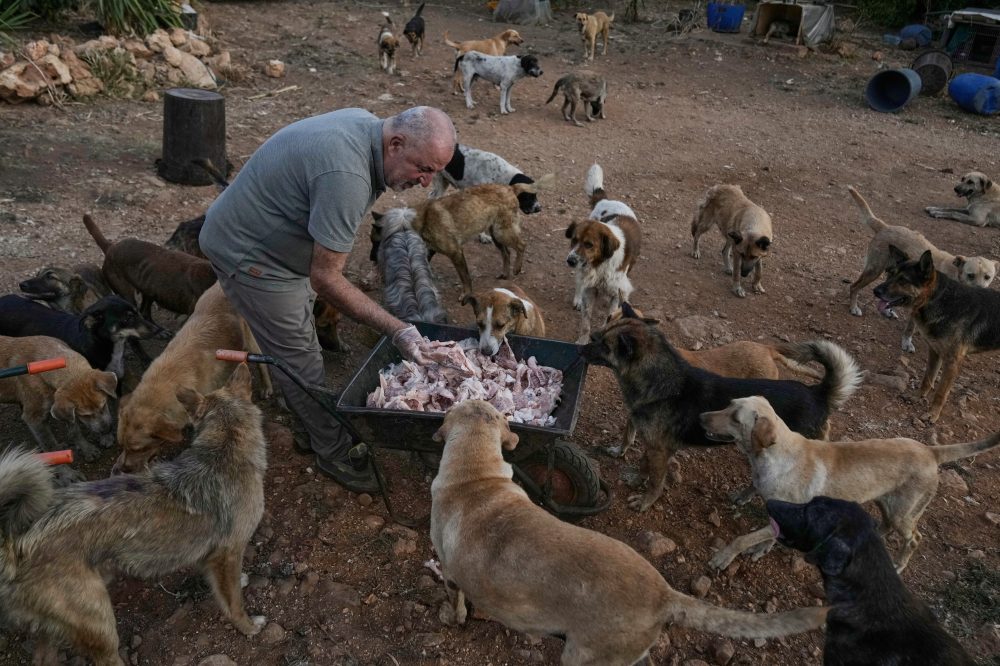
KFAROUE, Lebanon — As the war between Israel and Hezbollah continues to devastate southern Lebanon, one local man is doing what he can to help the most vulnerable victims left behind — the animals.
Hussein Hamza has taken it upon himself to care for abandoned pets and farm animals in the village of Kfaroue. With much of the local population having fled the region to escape the fighting, countless animals have been left without anyone to feed or care for them.
The situation is made even more heartbreaking by the fact that some of those animals’ owners did not simply leave — they were killed in airstrikes, leaving their animals with no one to turn to.
A photo gallery compiled by Associated Press photo editors captures the animals Hamza has been working to rescue and care for amid the ongoing conflict.
Mourners took to the streets of Damascus on Friday, one day after a bomb hidden inside a cafe in the Syrian capital claimed the lives of nine people.
A funeral procession wound through the typically lively Midan neighborhood, with pallbearers carrying the coffins of three of the victims. The explosion at the popular cafe — located close to the city’s main judicial complex and commonly visited by lawyers — also left 20 people injured.
Syrian authorities have pledged to track down and arrest those responsible for the attack, though no updates on the investigation have been made public. As of Friday, no group had stepped forward to claim responsibility.
Bahaa Qabbani told reporters that his brother, Fathi Qabbani — a married father with one son — worked at a shop close to the blast site and happened to be walking past the cafe when the explosion occurred. He did not survive.
Bahaa Qabbani described those behind the attack as “a group of terrorists who are against the homeland” and urged the nation’s security forces to “take hold of the country with an iron fist.”
Separately on Friday, Syria’s state-run news outlet SANA reported that three security force members were injured in a grenade attack at a checkpoint leading into the Damascus suburb of Jaramana. According to SANA, a man riding a motorcycle hurled two hand grenades at checkpoint guards and attempted to throw a third, but it detonated in his hand, killing him. A second individual was taken into custody in connection with the incident.
Syria’s new leadership, which came to power following the rapid fall of the Assad dynasty in December 2024, has faced ongoing difficulties maintaining control throughout the country and containing extremist activity. Recent deadly attacks attributed to the Islamic State group have struck religious minority communities, including a suicide bombing at a church in a Damascus suburb and an explosion at a mosque in a predominantly Alawite section of the city of Homs.
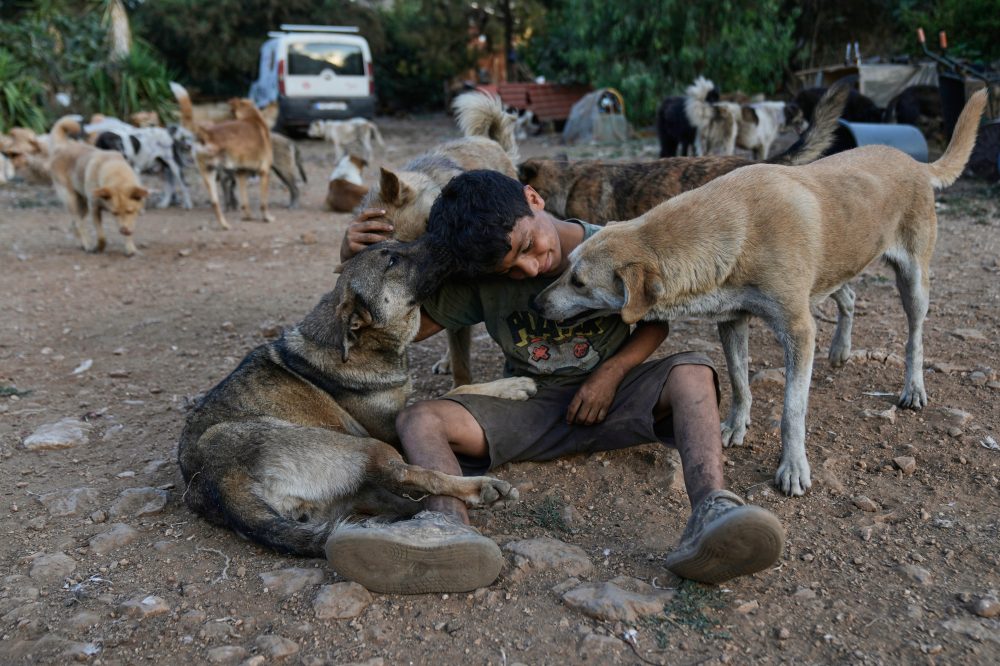
KFAROUE, Lebanon — Every day, Hussein Hamza walks his rounds through a village in southern Lebanon, tending to a growing collection of animals that the war left behind.
Since the latest conflict between Israel and Hezbollah erupted, the number of animals under Hamza’s care has surged dramatically. As hundreds of thousands of southern Lebanese residents fled their homes, many had no choice but to leave their pets and livestock behind. In other cases, the animals’ owners were killed in Israeli airstrikes. Some of the animals arrived at his shelter already injured.
The war in Lebanon started on March 2, after the Iran-backed Lebanese militant group Hezbollah launched missiles into Israel following attacks on Iran by the U.S. and Israel.
When Hamza makes his rounds, dozens of dogs swarm around him, tails wagging as he wheels a barrow full of chicken pieces to distribute. Several of the dogs are missing limbs. One has an infected foot wound that Hamza tends to personally. He then moves on to carry water buckets into an enclosure where chickens and two camels are kept.
“During the war, people contacted us and told us they had left their chickens behind because everyone had to evacuate suddenly,” Hamza said.
While Kfaroue itself experienced some airstrikes, it remained relatively peaceful compared to communities closer to the Israeli border, where entire villages were destroyed and Israeli forces have occupied large stretches of land.
“They asked us to bring the chickens here, because if they were left roaming free, foxes might eat them, and otherwise they would die from hunger and thirst,” he said. “We managed to rescue only the chickens we could reach — not all of them. There were areas where the fighting was too intense and we couldn’t get there.”
With a fragile ceasefire now in place, Hamza is holding the animals and waiting for their owners to return and collect them.
Hamza’s history with animal rescue dates back to 2006. His shelter, called Mashala — an Arabic phrase meaning “what God has willed” — has operated at its current location for seven years.
While the war has expanded the shelter’s responsibilities, it has also strained its already tight finances.
“When I first started, I paid for everything myself,” Hamza said. “I had an agricultural business, and I kept spending from my own money until I went bankrupt.”
He eventually launched a Facebook page to seek donations from the public.
According to Hamza, the shelter burns through roughly $400 to $500 each day covering food, veterinary care, spaying and neutering procedures, staff wages, fuel, and maintenance costs.
Fundraising has become increasingly difficult as Lebanon faces an overwhelming number of humanitarian crises. Many donors are directing their money toward efforts that support displaced or injured people, Hamza noted.
He understands that priority, but believes people still have a duty to the animals that rely on them.
“We shouldn’t neglect these responsibilities because of wars or because of the poverty we face,” he said.
Ongoing instability and fears of renewed fighting have made many potential adopters hesitant, though some of Hamza’s dogs have managed to find new homes. Abbas Shoeib brought home a black pit bull mix whose previous owners died in an airstrike.
“A dog needs someone to take care of him, and when you take care of him, he will take care of you,” Shoeib said.
At Ashawaug Farm in southwest Rhode Island, Dawn and Cassius Spears are doing more than growing food — they’re keeping centuries of Indigenous agricultural knowledge alive. The couple cultivates three Narragansett heritage crops: white corn, succotash beans and crookneck squash.
While they want to grow their farm’s reach beyond their roadside stand, doing so has proven difficult. Like countless small-scale food producers, the Spears have turned to federal assistance programs for support — only to watch some of those programs get slashed or dramatically reduced under the Trump administration, including U.S. Department of Agriculture initiatives that specifically helped tribal farmers.
Native tribes had been counting on those programs to grow and share culturally meaningful foods within their communities.
“When we go into these federal programs, we’re hoping that they’ll last long enough,” Cassius Spears said. “They usually start out with a good song and dance. And they’re going to last a long time. And then something happens where they get cut.”
During the pandemic, the Biden administration launched two programs designed to help states and tribes buy locally grown food for food banks and schools: the Local Food Purchase Assistance Cooperative Agreement Program (LFPA) and the Local Food for Schools Cooperative Agreement Program (LFS). These initiatives gave farmers — including those from tribal communities — dependable buyers for their goods. Tribal governments also received funding to purchase food from nearby producers and distribute it to their members.
The arrangement allowed tribes to direct federal money straight to small producers, said Carly Griffith Hotvedt, executive director of the Indigenous Food and Agriculture Initiative and a member of Cherokee Nation. The Spears’ farm supplied food to a tribal farm in neighboring Connecticut that was drawing on LFPA funds, following an agreement reached in August 2022.
In some cases, tribes used that funding to source culturally important items like bison meat, specific varieties of berries and wild rice, which were distributed in food boxes to tribal members. For lower-income individuals within those communities, it was often the only realistic way to access those foods, Hotvedt said.
“It wasn’t just commodity foods in that box. It was highly local, traditionally relevant, culturally relevant foods that were included,” Hotvedt said.
In March 2025, the Trump administration’s Agriculture Department shut down both programs, which had together provided more than $1 billion for schools and food banks. Officials said the programs no longer fit the agency’s priorities.
U.S. Sen. Jack Reed, a Rhode Island Democrat, and Sen. Jim Justice, a West Virginia Republican, have since introduced legislation they say takes the strongest elements of those two programs and builds a lasting grant structure. The bill would let state and tribal governments purchase locally sourced food from nearby producers and channel it to hunger relief organizations and schools in their areas.
Reed expressed concern that the USDA cuts would leave families across the country struggling to put food on the table — and that what food they could access would be less fresh and nutritious.
Reed is pushing to attach the legislation to the Farm Bill, the sweeping multi-year federal law that shapes agricultural and food policy across the country. The House passed its version of the Farm Bill in April, and a Senate committee released a draft in late June. The House version also contains a bipartisan proposal for a permanent program modeled after the Local Food Purchase Assistance program, which would allow states to work through the USDA to build cooperative agreements linking local farmers with food distribution organizations.
Both proposals would reserve 10% of program funding specifically for tribes.
For any new program to truly work, Congress must include mandatory funding so that farmers can plan ahead, buy supplies and hire workers with confidence, said Hannah Quigley, a policy specialist with the National Sustainable Agriculture Coalition. The House version, she noted, would require Congress to approve funding on a yearly basis.
Reed said he’s pushing hard for mandatory funding in the Senate version, arguing that without it, very little actually gets funded — and that farms are already under enormous financial strain. A program that’s only optional, he said, won’t provide the stability farmers need.
“We really want to punch through the existing obstacles for small farmers and Native American farmers,” he said.
Dawn and Cassius Spears want to see Indigenous producers given priority when tribal entities are purchasing food. They also believe that creating dedicated programs accessible directly to Indigenous producers — outside of tribal government channels — would open doors for more Native farmers.
On an early morning at the start of this year’s planting season, Dawn Spears worked beneath the canopy of one of her farm’s high tunnels, carefully separating tiny tomato plants before moving them to an outdoor field. The farm’s name honors the Narragansett word for the river running through town. What began as a small community garden and food sovereignty effort has grown into a 6-acre operation.
Her 9-year-old grandson, Giizhig, wandered in to offer a hand.
“Only if you want to,” Spears told him. “It’s always good to know how to do it, right?”
Passing that knowledge to the next generation is central to her mission. But her culture extends beyond farming — it includes gathering wild foods and protecting the land where those foods naturally grow. She’s working to preserve land near the farm as surrounding development expands, with plans to introduce native plants that can be foraged for food. Federal programs, she said, can also play a role in helping communities secure access to that land.
“If you take a person away from the land that they come from, then it’s like they’re not whole,” she said. “We have to eat the food that’s naturally from that space that we come from.”
U.S. equity funds welcomed fresh investment dollars during the week ending July 1, as a combination of reduced U.S.-Iran tensions and renewed appetite for technology stocks boosted investor confidence — though caution ahead of an important jobs report kept overall buying in check.
According to LSEG Lipper data, investors directed a net $1.03 billion into U.S. equity funds for the week, partially making up for the $3.47 billion in net withdrawals recorded the week before.
A June employment report that came in below expectations — showing the economy created just 57,000 jobs last month — eased pressure on the Federal Reserve to raise interest rates before year’s end.
Technology sector funds were a standout, pulling in $3.42 billion as investor sentiment improved after the previous week saw a massive $19.97 billion in net sales from that sector. Financial and healthcare funds also attracted fresh capital, drawing $1.96 billion and $1.47 billion, respectively.
Not all fund categories fared well, however. U.S. small-cap funds saw $694 million in outflows, mid-cap funds lost $2.1 billion, and equity income funds shed $1.33 billion. Large-cap funds bucked that trend, pulling in $7.2 billion for the week.
U.S. bond funds continued their strong run, attracting a net $9.88 billion and extending their consecutive weekly inflow streak to eleven weeks. Short-to-intermediate investment-grade funds brought in $4.22 billion, while general domestic taxable fixed income funds added $3.53 billion. Short-to-intermediate government and Treasury funds moved in the opposite direction, recording $2.1 billion in outflows.
Investors also moved $47.82 billion into money market funds — the largest single-week allocation in the past four weeks.
Northbound travelers on Coastal Highway, also known as Delaware Route 1, should expect a slow commute between Rehoboth Avenue Extension and Camelot Drive.
According to traffic officials, congestion in that corridor is currently causing delays ranging from five to ten minutes for drivers moving in the northbound direction.
No additional details about the cause of the backup were provided. Drivers are encouraged to allow extra travel time or consider an alternate route until conditions improve.
German Chancellor Friedrich Merz stood his ground Friday against criticism from U.S. President Donald Trump, saying Germany has every right to be proud of its efforts to boost military spending.
When reporters asked about Trump’s recent comments calling Germany’s past defense spending record “ridiculous,” Merz was direct in his response.
“Germany is doubling its defence budget within four years. This is the greatest effort we have ever made to strengthen our defence capabilities. In this respect, we have no reason to shy away from anyone,” Merz told reporters.
He added: “We will state this, with all due modesty, and we are doing so as the European Union’s largest member state, bearing a responsibility within Europe.”
Trump had taken to his Truth Social platform earlier this week to blast NATO allies over their defense spending. In one post, he wrote: “Ridiculous for the U.S.A. to continue along this one sided path when the relationship is not reciprocal.” In a separate post, he claimed Germany’s spending between 2014 and 2025 was “MUCH LOWER” than that of the United States or other NATO allies, ending with the word “Ridiculous!”
The dispute comes as NATO leaders prepare to meet next week in Ankara. European nations are hoping to show Trump they are serious about shouldering more of the continent’s defense burden, even as tensions simmer over disagreements involving Iran and Greenland.
Last year in The Hague, NATO members agreed to raise defense spending to 3.5% of their gross domestic product on core military items — including weapons and troops — by 2035. That goal replaced a previous target of 2%.
Merz made his comments while hosting leaders from the Baltic states in Berlin. “We, too, take the Russian threat very seriously, and we are arming ourselves against it,” he said. “We will reach the 3.5% benchmark set in The Hague as early as 2029, well ahead of the agreed deadline.”
The past year has been a turbulent one for the NATO alliance. Trump threatened to seize Greenland from fellow NATO member Denmark and launched military action against Iran without consulting European partners — a move that shook global markets and strained relationships with European leaders, including Merz, who publicly said the U.S. was being humiliated by Iran.
LONDON — Just in time for America’s 250th birthday, a remarkably rare copy of the Declaration of Independence has surfaced in a London archive — hidden for nearly 250 years among paperwork from a captured American ship.
The document had been sitting in Britain’s National Archives, buried in files related to the British seizure of an American privateer vessel in 1776. For centuries, 18th century records had described it simply as “another document” — until a volunteer took a second look this past May.
“Unearthing and handling such a significant historical document has been thrilling, particularly in this important anniversary year,” said Michael Scurr, the volunteer who made the discovery while working on a cataloguing project.
The announcement came on Friday, the day before the United States marked its semiquincentennial — 250 years since the Continental Congress adopted the Declaration of Independence from Britain on July 4, 1776.
In those early revolutionary days, printers sympathetic to the cause rushed to reproduce the founding document and spread it as widely as possible throughout the American colonies. The copy found in London was printed in Exeter, New Hampshire, in mid-July 1776, making it the 11th known surviving copy of what are called the “Exeter Declarations” — and the first ever discovered outside the United States.
The document’s journey to England is a story of war and misfortune. Eleazer Johnson, captain of a ship called the Dalton, picked up the copy later that same year before setting sail across the Atlantic. His mission was to intercept and capture British vessels, and historians believe he may have brought the declaration along to inspire his crew to fight for their new nation.
That mission came to an abrupt end on December 24, 1776, when the Royal Navy captured the Dalton off the coast of Portugal. The ship and everything aboard it were brought back to Plymouth, in southwest England.
The National Archives noted that this makes the document the only known copy of the declaration to have been taken through military force.
Under the rules of the time, British naval captains were required to hand over all documents from any ship they captured in order to claim their share of the prize — a bureaucratic requirement that, centuries later, proved to be a historical goldmine.
“Thanks to the bureaucratic processes of war … we can present an unusually rich backstory that most surviving declarations do not have,” said Graham Moore, a curator at the National Archives.
Given that Britain seized roughly 3,600 ships during the American Revolutionary War, the National Archives holds an enormous collection of records that historians are still working to fully explore.
JOHANNESBURG — South Africa has called in more than 3,000 military personnel to back up police forces this month as anti-migrant demonstrations continue to sweep the country, according to a letter signed by the president and released Friday.
Demonstrators took to the streets in cities across the nation on Tuesday, with some marches turning violent. An anti-migrant movement has announced plans to hold similar protests every Thursday, pushing for the government to adopt a stricter approach toward undocumented foreign nationals.
In a letter addressed to the parliamentary speaker, President Cyril Ramaphosa confirmed that 3,405 members of the South African National Defence Force began their deployment on June 28. The operation is projected to cost approximately 54.6 million rand, or about $3.37 million.
The letter, which was published by parliament, stated that “Members of the SANDF … will be on standby for any eventualities.”
Thousands of protesters wrapped in national flags — some carrying wooden weapons — flooded city streets on Tuesday. While most demonstrations remained peaceful, a number of them spiraled into violence and the looting of local shops.
Law enforcement arrested more than 900 individuals on charges ranging from immigration violations and public violence to robbery and sheltering undocumented migrants. Military forces were also sent into an inner-city neighborhood in Johannesburg where large numbers of migrants reside.
Tuesday’s protests are the latest escalation in months of unrest that has drawn condemnation from the international community, as foreign nationals have been forced from their homes and had their businesses and belongings destroyed.
Migrants are frequently accused of taking jobs from citizens, fueling crime, and straining public services — accusations that social scientists say are not supported by evidence.
According to StatsSA, immigrants make up roughly 3 million people, or about 4% of South Africa’s total population — a relatively modest share compared to global averages.
Southbound travelers on Coastal Highway (Delaware Route 1) should expect a slowdown between John J. Williams Highway (Delaware Route 24) and Rehoboth Avenue Extension.
According to Delaware Department of Transportation, heavy congestion in the area is causing delays of approximately 5 to 10 minutes for drivers moving through that corridor.
Motorists are encouraged to allow extra travel time or seek an alternate route to avoid the backup.
France’s public health authority announced Friday that deaths rose by nearly a third during the most intense week of last month’s record-breaking heat wave, with at least 2,000 more fatalities recorded compared to the week before — a period when temperatures were already rising and emergency rooms were already being overwhelmed with heat-related cases.
Public Health France released updated figures that are double what the agency initially estimated. Just last Sunday, the agency had reported at least 1,000 additional deaths, a figure that only accounted for three of the most extreme days of heat. The newer numbers now cover the full week.
In the French capital, funeral service directors have reported serious difficulty finding storage space for bodies ahead of burial or cremation, with some mortuaries reporting they were at capacity and turning bodies away.
The updated figures cover the week of June 22 through June 28 — the period during which France experienced its hottest days ever recorded, with peak daytime and nighttime temperature records broken in cities and towns across the country. The extreme heat also set records in numerous other parts of Europe.
Public Health France reported a preliminary death count of 8,973 for that week, while cautioning that the data remains incomplete. That figure represents a 29% increase over the 6,948 deaths recorded during the previous week of June 15 through June 21, when the heat wave was just beginning. The difference between those two numbers — 2,025 deaths — is considered the excess mortality from one week to the next, across all causes and all age groups.
At Paris-Saclay Hospital, a wave of patients suffering from heat-related illness began arriving on June 20, according to Dr. Nicolas Gonzales, head of the emergency department, who spoke with The Associated Press. He described treating patients — ranging from children to elderly people living alone — for heart attacks, dehydration, kidney failure, and other heat-related conditions.
Public Health France noted that deaths in private homes saw the most dramatic increase, surging 91% compared to the prior week. Deaths in care facilities for older residents climbed 37%, while hospital deaths rose by nearly 20%.
The Paris region was among the hardest hit areas, with deaths increasing by nearly 63% from one week to the next.
The agency acknowledged that its numbers likely undercount the actual death toll due to the incomplete nature of the data collected. “The mortality will as a consequence be higher than these first figures,” the agency stated.
America’s 250th birthday celebration is heating up — literally — as communities from coast to coast gear up for Independence Day festivities, all while dangerous temperatures force both organizers and revelers to take extra precautions.
President Donald Trump is heading to South Dakota to speak and watch fireworks at Mount Rushmore. Meanwhile, New York City’s Times Square will host a midnight ball drop, bringing a New Year’s Eve-style countdown to the July Fourth holiday for the first time.
The biggest events are set for Saturday, when fireworks displays will light up skies in towns across the country alongside backyard cookouts and neighborhood block parties. Trump is also scheduled to speak at the National Mall in Washington before what’s being described as a historically large fireworks show.
Despite the festive atmosphere, dangerously high temperatures are gripping much of the Midwest and East Coast, raising serious safety concerns. Health officials are urging people celebrating outdoors to drink plenty of water and seek air-conditioned spaces when needed.
The extreme heat has already disrupted some holiday programming. In Washington, organizers of the Capitol Fourth concert closed a Thursday rehearsal to the public because of the conditions. The Friday concert itself — a long-standing Independence Day tradition in the nation’s capital — may be canceled entirely. Saturday’s Washington celebrations will include additional water stations, cooling areas, and expanded medical support.
Cities and venues elsewhere are also adjusting. From Boston to Norristown, Pennsylvania, and Gettysburg National Military Park, event plans are being modified to account for the scorching temperatures. Amtrak has canceled select trains in the Northeast, citing heat that could compromise the integrity of the tracks.
The holiday arrives at a particularly charged moment in the country’s history. The 250th anniversary has prompted reflection on America’s past while also highlighting its current political divisions — and even the celebrations themselves reflect that divide.
Freedom 250, an organization with ties to the White House, has emerged as a rival to America250, a bipartisan group that Congress established a decade ago. Freedom 250 has organized much of the Washington activity, including the Great American State Fair, which has drawn attention for its notably sparse attendance. America250, on the other hand, is behind the ball drops in multiple cities including New York, and is planning a concert in Los Angeles on Saturday.
A survey conducted in April by The Associated Press-NORC Center for Public Affairs Research found that roughly 4 in 10 American adults feel “proud” about the country reaching its 250th anniversary, while about 3 in 10 described feeling “excited.”
Joe Fuqua-Bejarano, an auto technician in Topeka, Kansas who is selling fireworks on the side, offered his take on what makes America special — and it isn’t politics. “We’ve just all got to find unity somewhere, whether that’s in laughter or perseverance, and keep everybody cool,” he said.
Christina Zhou, a 25-year-old research assistant from Cambridge, Massachusetts, said she plans to focus on what’s happening close to home. “It feels a little bit more like within our own personal control,” she said.
SRN News produces a regular audio feature called Global Landscape, a compact two-minute segment designed to keep listeners informed about the most significant religion-focused news stories happening around the world.
The feature covers a wide range of topics, from cultural shifts to major events that reflect how faith continues to influence global affairs. Each edition offers a timely overview of developments at the intersection of religion and world news.
Listeners can find Global Landscape and other news features at srnnews.com.
A newly released report from the California government shows that Jewish residents were the victims of nearly 300 hate crimes in the state last year. That figure represents roughly 75 percent of the approximately 400 total hate crimes recorded in California — a striking statistic given that Jewish people make up only about three percent of the state’s population.
Daniel Mariaschin of B’nai B’rith International spoke to the Jewish News Service about the troubling trend. “Whether in California or elsewhere, elected officials, law enforcement, the media, educators and community leaders all have an obligation to address this spiral — now,” he said. Anti-Semitism has been climbing across the globe in recent years, and the United States has not escaped that trend.
On a separate note, a new survey from the Barna Group, a Christian research organization, finds that prayer remains a widespread practice even as traditional church membership and attendance continue to fall. According to the poll, 73 percent of American adults say they pray at least once a week, with Christians reporting even higher rates of prayer.
The Barna report summarizes the finding this way: “Spiritual longing remains active even when institutional participation wavers.” The survey also found that older Americans across all backgrounds are more likely to pray regularly than younger people, and that women tend to pray more frequently than men.
Tropical Storm Maysak made landfall along the southwestern coast of China’s Hainan island province on Friday evening, unleashing winds of up to 23 metres per second — roughly 51 miles per hour — and triggering widespread transportation shutdowns across the region.
China’s National Meteorological Center reported the storm came ashore at approximately 6:20 p.m. local time, which is 10:20 a.m. GMT.
In addition to Hainan, the storm is forecast to dump heavy rain on Guangdong, Guizhou, and Hunan provinces, as well as the Guangxi region. Some parts of Hainan could receive as much as 350 millimetres of rainfall within a single 24-hour period, according to the national weather forecasting agency.
State broadcaster CCTV reported that Hainan’s Sanya Phoenix International Airport halted all takeoffs and landings beginning at 5 p.m., following the earlier cancellation of 92 flights by 11:30 a.m. All round-island high-speed rail services were also shut down for the day.
Ferry crossings across the Qiongzhou Strait were suspended starting at 2 a.m. and are expected to remain out of service for one to two days.
Officials called on authorities to intensify monitoring efforts and carry out evacuations from vulnerable areas, describing the flood prevention situation as “severe and complex.”
Brazilian federal police have launched a major operation targeting individuals who were recently placed on a U.S. sanctions list due to alleged ties to the Primeiro Comando da Capital, known as the PCC, one of Brazil’s largest criminal organizations. Two sources with knowledge of the situation confirmed the operation to Reuters on Friday.
While federal police declined to name the specific suspects involved, officials released a statement saying the operation was aimed at breaking up a criminal network accused of washing money generated through international drug trafficking.
Earlier this week, the U.S. Office of Foreign Assets Control added two Brazilian citizens to its Specially Designated Nationals and Blocked Persons List, citing their alleged connections to the PCC. In addition to the two individuals, three Brazilian entities — two of them operating in the financial sector — were also sanctioned due to their alleged ties to one of those individuals.
The designations come after the United States officially classified both the PCC and its rival gang, Comando Vermelho, as Foreign Terrorist Organizations last month.
Brazilian President Luiz Inacio Lula da Silva’s administration had previously pushed back against such classifications, expressing concern that terrorist designations could eventually pave the way for U.S. military involvement or financial penalties against banks that unknowingly conduct business with gang members.
The entertainment industry appears to have found a new source of inspiration — the Bible. The BBC is the latest network to jump on board, announcing it is developing a documentary series centered on the life of Jesus Christ.
The British broadcaster’s announcement comes at a time when faith-based programming is thriving across the entertainment landscape. The long-running series “The Chosen” has drawn loyal viewers for years, helping pave the way for a wave of similar projects.
Streaming giant Amazon Prime has renewed its series “House of David,” while Netflix made a splash last year with “Ruth and Boaz” alongside several other projects rooted in Biblical stories. Fox also entered the space with its production “The Faithful: Women of the Bible.”
Together, these projects signal a growing appetite among audiences for content drawn from scripture, and major players in the entertainment world are clearly taking notice.
With America on the verge of celebrating its 250th birthday, the Pew Research Center has published a comprehensive look at how life in the United States has transformed since the country marked its 200th anniversary back in 1976.
One of the most striking findings involves marriage. Around the time of the Bicentennial, roughly 70% of American adults were married. That number has fallen dramatically — today, only about half of adults are married.
The study also highlights a significant decline in birth rates, with a growing number of women choosing not to have children at all. Together, these trends paint a picture of a nation whose family structure looks very different than it did just five decades ago.
American oil companies are preparing to announce their most profitable quarter in years — and that news may put them on a collision course with President Donald Trump, who has been pushing the industry to bring down prices at the gas pump before November’s midterm elections.
Exxon Mobil and Chevron are both expected to release second-quarter earnings in the coming weeks that are more than three times higher than what they posted in the first quarter. The surge follows a spike in oil prices triggered by the U.S.-Israeli war on Iran, which began in late February and tightened global fuel supplies.
Analyst forecasts suggest Big Oil’s profits could reach their highest point since 2022, when Russia’s invasion of Ukraine sent energy markets into turmoil. According to estimates compiled by LSEG, Exxon Mobil is projected to report roughly $15.9 billion in adjusted net income for the second quarter. Chevron is forecast to bring in approximately $9.9 billion. Both figures represent more than triple what each company earned in the previous quarter.
The expected windfall threatens to strain the typically close relationship between Trump and the oil industry, which has been a significant financial backer of both Trump and the Republican Party.
Elevated gas prices have given Democrats fresh ammunition in their push to retake control of Congress, while also dragging down Trump’s approval numbers. Many Americans have expressed skepticism that the war with Iran was worth its economic costs.
In response, the Trump administration has asked the U.S. Justice Department to look into potential price gouging at the pump. Treasury Secretary Scott Bessent has warned oil producers and refiners that the White House could pursue administrative action if pump prices don’t drop significantly.
One oil industry executive, who spoke on the condition of anonymity, acknowledged the pressure building within the sector. “The industry is definitely talking to each other and thinking of ways to deal with it, but we know what’s coming. We understand the politics,” the executive said.
Since shipping through the Strait of Hormuz resumed last month, Trump has publicly called for the national average gas price to drop to around $2.50 per gallon. That target is well below the current national average of about $3.85 and roughly 11% lower than the lowest price seen during his current presidency — about $2.81 per gallon, recorded in late December.
Oil industry lobbyists have ramped up their outreach to government officials and lawmakers in an effort to soften criticism, according to interviews with eight lobbyists and industry representatives.
Oil company executives maintain they have little direct control over what consumers pay at the pump. Crude oil costs make up nearly half of the retail price of gasoline, with the remainder shaped by refining, distribution, marketing, and taxes.
Even so, benchmark crude prices have returned to pre-war levels, while U.S. gasoline prices remain about 22% above where they stood before the conflict. Analysts and industry groups attribute the gap to tight physical fuel supplies and low gasoline inventories, rather than crude prices alone.
Bob McNally, president of Rapidan Energy Group, said the disconnect points to deeper structural pressures in the supply-and-demand balance.
Bethany Williams, a spokesperson for the American Petroleum Institute, offered a similar explanation. “Gasoline prices don’t move in lockstep with crude oil, especially during a major global disruption affecting supply, refining and inventories,” she said.
The American Fuel & Petrochemical Manufacturers also weighed in, pointing to the role of government policy. “Refineries do not set the price of finished gasoline, and crude oil is just one of many inputs,” the group said, noting that the Renewable Fuel Standard requires retailers to blend a set percentage of ethanol or other biofuels into their fuel.
The White House, for its part, said lowering gas prices remains Trump’s top priority, pointing to declining oil prices since the Iran agreement and improved coordination with the industry on permitting and regulation.
Exxon declined to comment on the situation. Chevron pointed to a June 25 interview on CNBC in which Chief Financial Officer Eimear Bonner said it would take time for gasoline prices to return to normal levels.
Part of the second-quarter earnings jump is expected to stem from a reversal of accounting losses in the first quarter related to financial instruments used to hedge against price swings in crude oil and refined products. But analysts say the larger gains reflect stronger underlying market conditions.
Energy advisory firm TPH estimates that U.S. gasoline crack spreads — the margin between the cost of crude oil and the fuel refined from it — averaged around $25 per barrel in the second quarter, up about $16 from the prior quarter. Diesel crack spreads climbed roughly $15 to about $45 per barrel, the strongest margins seen since mid-2022. Strong demand for U.S. fuel exports added to the gains, as the war left overseas refiners scrambling for supplies.
Despite the financial burden on American drivers, analysts at BMO Capital Markets expect oil companies to speed up stock buybacks in the second half of 2026, continuing a trend since the pandemic of prioritizing shareholder returns over expanding production.
A second industry executive captured the frustration within the sector. “Being the boogeyman is not particularly fun,” the executive said. “But we need to educate officials that this is a cyclical industry and that no one cares when the market turns and we are taking all the risk.”
A specially designed three-armed spacecraft lifted off Friday on an ambitious mission to save a NASA telescope that is gradually losing altitude and risks crashing back into Earth’s atmosphere.
Northrop Grumman launched Katalyst Space Technologies’ Link spacecraft from the Marshall Islands in the Pacific Ocean. The Pegasus rocket carrying Link was released from beneath a modified aircraft before igniting and sending the spacecraft into orbit. Link is expected to intercept and capture NASA’s Swift Observatory within approximately one month.
The Swift telescope, which has been in operation since 2004, has been losing altitude more rapidly than usual due to a series of recent solar storms. NASA is spending $30 million for Katalyst to grab hold of the telescope and push it into a higher orbit, allowing it to continue its work studying some of the most powerful events in the universe — including gamma ray bursts and exploding stars.
If the mission succeeds, Swift could resume scanning the cosmos as early as September. For now, all observations have been paused in order to conserve the telescope’s remaining orbital altitude.
NASA’s Hubble Space Telescope may face a similar situation in the coming years. It too is slowly dropping in altitude due to increased atmospheric drag caused by heightened solar activity.
Swift currently weighs about 1.6 tons and is orbiting approximately 224 miles above Earth. Katalyst’s plan is to raise the telescope’s altitude by 150 miles, returning it to roughly where it started. The Link spacecraft will use its thrusters to gradually push Swift higher, avoiding any sudden jolts that could damage the observatory.
Katalyst assembled the entire mission in just nine months — a remarkably short timeframe. NASA pushed for the accelerated timeline because the telescope will drop too low to be saved if a rescue attempt is not made before autumn. Without a boost, Swift was projected to re-enter the atmosphere and be destroyed in October.
A string of bad weather and last-minute technical problems caused several delays before the launch finally took place.
Katalyst Space CEO Ghonhee Lee spoke about the stakes before liftoff: “This is a high-risk, high-reward mission. The biggest danger was always we don’t launch anything and we let Swift burn up in the atmosphere. So we were always trying to avoid that risk, and our team has done that.”
GENEVA — The United Nations’ top human rights official issued a dire warning Friday, declaring a “red alert” over the threat of mass atrocity crimes in and around a key city in central Sudan, and calling on global leaders to step up efforts to end the country’s devastating ongoing conflict.
Volker Türk, the UN High Commissioner for Human Rights, addressed the Human Rights Council at the UN’s Geneva office, warning that signals coming out of the city of el-Obeid were “clear and unmistakable: Another human rights catastrophe is unfolding in Sudan.”
The council — the UN’s highest human rights authority — convened an urgent debate on the el-Obeid situation amid mounting alarm from diplomats, advocacy organizations, and others who fear a fresh wave of violence against civilians. The war in Sudan is now in its fourth year.
“This is not a drill. It is a red alert that needs to land on the desks of heads of state and government around the world,” Türk declared. “Their phones should be running hot in the coming days and weeks, with ideas on how to prevent atrocity crimes in el-Obeid and in other places in Kordofan.”
Türk described how civilians in the region have endured siege-like conditions for 18 months, subjected to what he called “relentless drone strikes” as Sudan’s national armed forces and the paramilitary Rapid Support Forces — known as the RSF — fight for dominance in areas surrounding the city.
The council’s 47 member nations were reviewing a draft resolution introduced by Britain, Germany, Ireland, the Netherlands, and Norway. The resolution condemns the RSF and its allies for escalating violence in and around el-Obeid, calls for increased financial and logistical support for countries sheltering Sudanese refugees, and denounces “all forms of external interference” in the conflict, among other provisions.
The war broke out in April 2023, fueled by long-standing tensions between Sudan’s army and the RSF. Since then, the conflict has claimed the lives of at least 59,000 people, forced approximately 13 million from their homes, and pushed large portions of the country into famine. More than 30 million people are currently in need of humanitarian aid.
In February 2025, Sudan’s military managed to lift a siege on el-Obeid that had been in place for over a year. However, the RSF has since launched several offensives in an effort to reimpose the blockade from multiple directions.
The UN and several nations have raised alarms over reports of RSF forces massing around el-Obeid, a city of half a million residents located in North Kordofan. Recent strikes on critical infrastructure have left civilians with severely limited access to food, fuel, water, medical care, and transportation, according to Türk’s office.
A group of climate scientists known as the World Weather Attribution group is pointing to climate change fueled by fossil fuel use as the driving force behind dangerous heat and humidity conditions affecting the ongoing World Cup tournament.
Saturday’s match between Paraguay and France is scheduled to begin at 5:00 p.m. ET in Philadelphia, with temperatures expected to exceed the safety thresholds set by FIFPRO, the world players’ union. The extreme conditions are the result of a heat dome that has settled over large portions of the United States and parts of Canada.
The U.S. National Weather Service issued a warning this week that the heat dome — a high-pressure system that traps hot air close to the ground — could push heat index readings between 105 and 115 degrees Fahrenheit across parts of the Midwest and East Coast. Several World Cup host cities fall within the affected zone.
Beyond the soccer tournament, the dangerous heat is also threatening to overload power grids and put a damper on outdoor Fourth of July celebrations as the United States marks its 250th anniversary this holiday weekend.
Friederike Otto, Professor of Climate Science at the Centre for Environmental Policy at Imperial College London, issued a pointed statement about the situation: “When a historic Fourth of July celebration is disrupted, and World Cup matches are played in conditions that are unsafe for players and fans, it shouldn’t take another scientific study to wake people up.”
Otto continued: “Climate change is here, it’s already impacting the things we enjoy in our everyday lives, and it will continue to get worse the longer we drag out the inevitable transition to net zero emissions.”
The issue of heat at major soccer events is not new. FIFPRO raised serious concerns about dangerous temperatures at the Club World Cup, which was also held in the United States, just a year ago. In December, FIFPRO acknowledged that FIFA had made efforts to “align the competition schedule planning and venue selection with the concerns around player health” for the World Cup, but noted that certain matches still carried health risks.
“The lesson for everyone in the industry is that with a warming planet, heat conditions will play a bigger part in tournament and league scheduling decisions in the future,” FIFPRO stated.
Despite the growing concern, soccer’s global governing body FIFA currently has no rule in place that would automatically force the postponement of a match due to extreme heat. FIFA did not immediately respond to requests for comment.
Goldman Sachs has strengthened its position as the top advisor for mergers and acquisitions in Europe, the Middle East, and Africa, claiming its largest share of that market for the January-through-June period in nearly ten years, according to data from LSEG.
The total value of deals struck in the EMEA region during the first six months of 2026 reached $676 billion — more than twice the level seen in 2025 and the highest figure recorded in 19 years. Analysts point to a more relaxed regulatory environment as a key driver behind the surge.
Goldman, which also leads the global rankings, advised on 111 deals during the period, accounting for 44% of all EMEA merger and acquisition activity by value. That figure is up from 42% during the same stretch in 2025, and marks the bank’s strongest showing for the first half of a year since 2018, when it held a 46% share.
The second-ranked bank in the EMEA market, JPMorgan, managed to close the gap slightly compared to last year. Goldman’s lead over JPMorgan stood at 9 percentage points, down from an 11-point advantage in the first half of 2025. JPMorgan advised on 99 announced deals, representing a 35% share of the market. On a global scale, Goldman holds a 38% market share.
While Goldman led in total deal value, independent advisory firm Rothschild outpaced it in sheer volume, advising on 163 transactions. Goldman’s edge came from its involvement in the biggest deals — it advised on 15 of the top 20 transactions in the region during the period.
Among those major deals, Goldman advised Unilever — alongside Morgan Stanley — on the roughly $45 billion sale of its food division to McCormick, which was the largest single transaction in EMEA during the period. Goldman also advised TK Elevators on its $34 billion combination with Kone. JPMorgan, by comparison, was involved in 13 of the top 20 deals and was not part of the McCormick-Unilever transaction.
Goldman also advised Commerzbank, which has been working to resist a $28 billion takeover bid from UniCredit.
Deal activity had slowed last year amid uncertainty following U.S. President Donald Trump’s return to the White House. Bankers caution that league table standings could shift significantly if pending deals fall through before completion.
Still, many executives say businesses are choosing to press ahead despite the unsettled market conditions. Carsten Woehrn, co-head of M&A in EMEA at Goldman Sachs, put it this way: “Companies are taking a long-term strategic view and investing for where they want to be in the coming decades, not just the next few quarters.”
As the second half of 2026 gets underway, investors on Wall Street are watching closely for any indication of where interest rates are headed and what the upcoming earnings season might look like — all while heavyweight technology stocks continue to drag on major market indexes.
The opening days of the new half-year mirrored the final stretch of the first half, with volatile swings in big tech shares pulling the broader market along for the ride. Upcoming minutes from last month’s Federal Reserve meeting, along with early earnings reports from Delta Air Lines and PepsiCo, are expected to offer fresh direction for a market whose tech-powered surge has lost some momentum in recent weeks.
Technology stocks — semiconductors in particular — were the driving force behind the market’s strong run in recent months. The S&P 500 climbed 14.9% during the second quarter that wrapped up Tuesday, marking its best quarterly performance since 2020.
More recently, however, those same tech stocks have swung wildly, including sharp drops at the end of this past week. Meanwhile, other parts of the market — including healthcare, industrial, and financial stocks — have held up well over the past month, giving some investors hope that market gains could spread more broadly across sectors.
“That’s something I’ll be keeping my eye on over the next couple of weeks is to see whether or not that broadening continues,” said Joe Mazzola, head trading and derivatives strategist at Charles Schwab. “Or if you do start to see a protracted pullback in some of the technology winners, does that portend the market pulling back overall?”
At the start of this year, many investors expected the Federal Reserve to cut interest rates — a move generally welcomed by stock markets. Those expectations have since shifted toward the possibility of rate hikes in the months ahead. That outlook softened slightly on Thursday after a jobs report came in cooler than anticipated.
Bets on more aggressive Fed action had been building following last month’s central bank meeting — the first chaired by new Fed leader Kevin Warsh, who made clear the institution’s priority is bringing inflation under control. Inflation currently sits above the Fed’s 2% annual target. The minutes from that meeting are set to be released on Wednesday.
Warsh also signaled that the Fed would no longer offer the kind of forward guidance markets have grown accustomed to, meaning future meeting minutes could carry even more weight for investors trying to read the central bank’s intentions.
“I think it’s going to be interesting to see how the discussion went around the table, how incrementally hawkish are they leaning,” said Matthew Miskin, co-chief investment strategist at Manulife John Hancock Investments. “That’s what investors and markets are going to be wondering: What is this new Fed chairman and updated (Fed policymaking body) looking for to decide the path of rates from here?”
Investors said they’ll also be paying attention to how Fed officials discussed the inflationary effects of energy prices, which had been pulling back from spikes tied to the Iran conflict heading into the meeting. The level of disagreement among Fed policymakers is another point of interest.
Rising interest rates can weigh on stocks by making borrowing more expensive for households and businesses, and by pushing bond yields higher — potentially making bonds a more appealing option compared to equities.
According to LSEG data, Fed fund futures late Thursday pointed to roughly even odds that the central bank would raise rates by its September meeting. A Labor Department report released Thursday showed U.S. job growth slowed considerably in June, easing some concerns about an imminent rate increase.
“If the Fed does become more restrictive and starts into a tightening cycle, that is a risk to the market and the valuations,” said James Ragan, co-CIO and director of investment management research at D.A. Davidson. “The more information we can get about how the Fed is thinking about things, I think that’s very important.”
On the earnings front, the week ahead is relatively quiet for economic data, though reports on services and manufacturing activity could shed light on inflation trends.
Stocks bounced back in recent months after pulling back due to the U.S.-Israeli conflict with Iran. The S&P 500 is up more than 9% so far in 2026, while the tech-focused Nasdaq Composite has gained 11%.
Stronger-than-expected corporate profits in the first quarter helped fuel the market’s climb and raised expectations for the second quarter, with full earnings season ramping up later this month. Delta and PepsiCo will be among the first to report next week, offering a window into how consumers are spending.
Across the S&P 500, companies are projected to grow second-quarter earnings by more than 24%, according to LSEG IBES data.
“If the north star of this bull market is earnings, I think the main thing for the earnings season is just to validate the earnings trajectory for this year and that the upward momentum continues into next year,” said Keith Lerner, chief investment officer at Truist Advisory Services.
Some of the world’s biggest investment names are reportedly vying for a piece of a prominent Vietnamese financial technology company, according to two sources with direct knowledge of the situation.
Blackstone, CVC Capital Partners, and Japan’s MUFG are among the firms that have submitted bids for a stake in MoMo, a digital finance platform based in Vietnam. The sources, who asked not to be identified because the matter is confidential, said final binding bids are expected to be submitted in September.
The exact size of the stake being offered has not yet been determined, though one source indicated the sale could involve a substantial portion of the company. A third source familiar with the process said the stake could be as large as 50%.
MoMo, CVC, and MUFG did not respond to requests for comment, and Blackstone declined to comment.
MoMo was established in 2010 and has evolved well beyond its origins as a mobile payments tool. Today, the platform offers a wide range of financial services to Vietnamese consumers, including consumer lending, insurance, savings, investment options, and tools for merchants — all within one of Southeast Asia’s fastest-growing economies.
Reuters first reported in April that MoMo was weighing strategic options, potentially including new investors, at a valuation exceeding $2 billion. The company has been profitable since 2024 and brought in outside advisors to manage the process after drawing interest from both strategic and financial investors.
The sources cautioned that the process is still ongoing and may not ultimately result in a transaction.
MoMo currently counts more than 30 million users and operates an extensive nationwide network for digital payments across Vietnam.
The interest from major investors reflects the broader expansion of Vietnam’s digital financial services sector, driven by increasing adoption of cashless transactions and growing demand for online financial products.
The company’s most recent significant fundraising occurred in 2021, when it secured $200 million in a round led by Mizuho Bank. MoMo announced last year that it was broadening its offerings for individual consumers and small businesses as part of an expanded digital finance strategy.
Just a short walk from Philadelphia’s Independence Hall — where the ideals of the American founding were once argued and proclaimed — a separate piece of the nation’s story has become a point of serious contention.
The President’s House, an early home occupied by presidents George Washington and John Adams, hosts an outdoor exhibit that the National Park Service has described as exploring “the paradox between slavery and freedom.” The exhibit highlights the lives of enslaved individuals, including Oney Judge, a woman held in bondage by George and Martha Washington who escaped in 1796 and successfully evaded all attempts to bring her back.
In January, the National Park Service pulled panels related to slavery from the site, following an executive order issued by President Donald Trump directing federal agencies and cultural institutions to review and revise programs that the administration says promote “divisive ideology.”
Administration officials argue the changes bring balance back to institutions they believe placed too much emphasis on America’s historical wrongs. Critics counter that the moves restrict meaningful conversations about slavery and race.
The removal sparked a legal fight, and a federal judge ordered the panels put back in February. However, a federal appeals court ruled last month that the Trump administration has the authority to remove and replace the exhibit.
Alan Spears, senior director of cultural resources at the National Parks Conservation Association nonprofit, said the controversy carries consequences well beyond Philadelphia, raising fundamental questions about whether historic sites can offer unfiltered interpretations of the past.
“When you take down those panels, you are sanitizing, softening, whitewashing and erasing American history,” Spears said.
As the country marks 250 years since its founding, the argument over what history deserves to be included has grown into a broader national debate: Should America’s story be told primarily as a tribute to founding ideals and national accomplishment, or should it offer a more complete picture that includes slavery, the displacement of Indigenous peoples, immigration, exclusion, and the long struggle of marginalized communities to claim the rights the founding documents promised?
Museums, historic sites, national parks, and cultural organizations across the country spent years developing events designed to bring millions of visitors to semiquincentennial celebrations. Those plans have now become tangled in a wider conflict over historical memory, national identity, and political influence.
In Florida, the Stonewall National Museum Archives and Library — one of the country’s foremost LGBTQIA+ archives — is confronting its own set of pressures.
Stonewall president Robert Kesten said the loss of funding could hamper the museum’s ability to preserve and share historical records, as corporate and private donors grow increasingly hesitant to support organizations they consider politically controversial. The museum anticipates losing between $70,000 and $90,000 in county grant funding before year’s end. Kesten attributed those cuts to Florida Republican officials he said have been opposed to LGBTQ+ inclusion.
“That’s a hell of a lot of money for an organization like ours to make up,” he said.
The museum’s current exhibit features Baron Friedrich von Steuben, the Prussian military officer who played a key role in shaping George Washington’s Continental Army during the Revolutionary War. Historians have long debated his sexuality, and some scholars and LGBTQ+ advocates point to him as a possible prominent gay figure from the founding era.
Kesten said that American history has long been skewed disproportionately toward the experiences of white, Christian, and heterosexual men. “And if you are anything else, you are expendable.”
Historians, museum leaders, and cultural advocates told Reuters that the federal push risks shrinking the range of stories that museums and historic sites are able to share with the public.
The dispute is playing out even as museums that offer broader accounts of American history continue to attract large audiences. Last year, the Smithsonian’s National Museum of African American History and Culture in Washington, D.C., recorded 1.4 million visits, while the National Museum of the American Indian drew more than 620,000.
The Smithsonian Institution did not respond to a request for comment on whether its museums had altered exhibits or curatorial work in response to Trump’s “Restoring Truth and Sanity to American History” executive order.
The National Museum of African American History and Culture said its programming for the 250th anniversary will “explore the nation’s pursuit of a more perfect union.”
“History is remembering the full scope of the past, whether it supports or undermines a political goal,” said Howard University history professor Ibram X. Kendi.
Separately, updated application language for federal grants tied to African American history and culture museums caused many institutions to opt out of applying, according to John Dichtl, president and CEO of the American Association for State and Local History. He said the change could leave some long-established museums facing financial uncertainty.
The Institute of Museum and Library Services, a small federal agency that administers the grants, now states it welcomes projects that “foster in all generations a greater appreciation…through uplifting and positive narratives of our shared American experience.”
“It makes one wonder what was pushed out of the way to make room for that,” Dichtl said. The Institute of Museum and Library Services did not offer a comment.
Administration officials have pushed back against accusations of erasing history, saying the goal is not to eliminate difficult chapters but to restore greater focus on the nation’s founding principles, including freedom of religion and freedom of speech.
The White House-backed Freedom 250 initiative has promoted patriotic education and public programming connected to the nation’s founding through a public-private partnership. Its “Freedom Trucks” — mobile museum exhibits housed inside tractor-trailers — have traveled the country featuring displays on the Declaration of Independence, George Washington, and the Revolutionary War, with limited representation of slavery and minority experiences from the founding period.
“Our role is to integrate different initiatives so Americans can celebrate through one connected experience,” said Keith Krach, CEO of Freedom 250, in a May interview with Reuters.
Clifford Murphy, director of the Smithsonian Center for Folklife and Cultural Heritage, said the institution’s work surrounding the 250th anniversary is grounded in presenting American history as both a celebration and a reflection, even amid wider debates over historical erasure.
For many historians and academics, the concern is not the act of celebrating the founding era but what they believe is being left out of the conversation.
Kimberlé Crenshaw, a law professor and scholar who helped develop critical race theory, said public institutions risk promoting celebration while downplaying the harm caused by policies and systems that shaped the nation.
“If our mainstream institutions are not going to critically engage with our past, then we have to ask: What is your role in this democracy?” Crenshaw said.
Ann Burroughs, president of the Japanese American National Museum, said preserving difficult history is essential. She noted that more than 120,000 people of Japanese ancestry — the majority of them U.S. citizens — were incarcerated during World War II. She described the internment camps as “a very dark part of American history” and said the museum has not changed its programming in response to Trump’s order and has since declined to apply for federal grants.
“It tells the story of confronting the truth about race and why it’s important for us to stand up against authoritarianism,” she said.
For Indigenous communities, advocates say their history has long been pushed to the margins of American education and public memory, often reduced to a brief mention around Thanksgiving.
“This has been a continuum of failure, but even more so now,” said Joshua Arce, president of the Partnership With Native Americans nonprofit.
President Donald Trump is making his way to Mount Rushmore in South Dakota on Friday, where the faces of four former American presidents are etched into the granite mountainside, as the nation marks 250 years since its founding.
The South Dakota stop serves as a warm-up to the main celebration scheduled for Saturday evening in Washington, where Trump will speak to a large crowd gathered on the National Mall before a spectacular fireworks display lights up the sky.
Earlier in the week, on Wednesday, Trump was in Medora, North Dakota, where he dedicated the presidential museum honoring Theodore Roosevelt — an occasion that included comparisons between Trump and one of the country’s most energetic historical leaders.
At Mount Rushmore — a site Trump also visited back in 2020 — he will deliver a keynote address and take in another fireworks show. Officials have noted some concern about fire risks in the region due to dry drought conditions currently affecting the area.
Trump has long floated the idea of having his own likeness added to the mountain alongside the carved portraits of George Washington, Thomas Jefferson, Theodore Roosevelt, and Abraham Lincoln. Back in 2020, during his first term, he posted on social media that the idea sounded appealing, writing: “Sounds like a good idea to me.”
No concrete steps have been taken toward making that happen during his second term, however. Instead, Trump has focused on leaving his mark on the nation’s capital through several high-profile projects, including constructing a new ballroom adjacent to the White House, designing a large ceremonial arch, and overseeing renovations to some of Washington’s most recognized landmarks and public areas.
Interior Secretary Doug Burgum, who previously served as governor of North Dakota, is expected to accompany Trump on the trip. The president will make the journey aboard the Qatari jumbo jet that was donated to him for use as Air Force One for the remainder of his time in office — his second flight on the aircraft.
The anniversary festivities are unfolding at a politically complicated moment for Trump, who is navigating rising gas prices tied to the U.S.-Israeli military conflict with Iran, along with growing anxiety among Republican lawmakers worried the conflict could cost the party control of one or more chambers of Congress in November’s midterm elections.
BUENOS AIRES — Argentine President Javier Milei stirred up a mix of excitement and alarm last month when he announced legislation to establish so-called “non-human corporations” powered by artificial intelligence — but a closer look reveals these companies would still need people involved in their operations.
In an op-ed published in the Financial Times, Milei outlined a new kind of business entity that could function without human employees, where AI systems and robots would make independent decisions in unpredictable situations. Multiple legal experts noted that if passed, Argentina would become the first nation to formally recognize a corporate category for AI-operated businesses.
“We are open for business,” Milei declared — a statement that drew sharp criticism from Israeli historian Yuval Noah Harari, who cautioned that granting AI too much authority could erode corporate accountability.
However, corporate attorneys say the reality is far less groundbreaking. The so-called “automated company” outlined in the proposed legislation — part of a broader effort to modernize and streamline Argentina’s corporate laws — would still be required to have a human administrator overseeing day-to-day operations. The bill also permits company leadership to use AI in decision-making, but does not relieve those administrators of responsibility for monitoring results.
Lawrence Cunningham, director of the Weinberg Center for Corporate Governance at the University of Delaware, said it would be “too wild a first step to dispense with human agency entirely,” though he acknowledged the proposal is bold.
“We’re not changing the world here so much as we’re recognizing that you might run a business without any HR,” Cunningham said. “It’s the beginning of something.”
Diego Duprat, a law professor and one of the bill’s co-authors, pointed out that automated companies already exist in certain forms today, citing AI-assisted cashier-less grocery stores as an example.
Under the bill, companies would be held legally responsible for any damages caused by AI or algorithmic systems.
A representative from the presidential spokesperson’s office confirmed that no companies or investment commitments are currently tied to the bill. “What is happening is that we are proposing something innovative, aimed at making Argentina an attractive jurisdiction for the establishment of automated companies,” the representative said. “This project is key to creating better conditions for attracting investment.”
Milei, who has worked to bring down inflation and court foreign investors, has repeatedly promoted Argentina as a future hub for artificial intelligence, pointing to the cold climate and energy resources of Patagonia as ideal conditions for data centers. OpenAI and Sur Energy announced plans in October for a data center representing an investment of up to $25 billion.
Maria Gisele Cano, a corporate attorney in the province of Buenos Aires, said simply having a law that acknowledges a company’s core use of AI could attract investors. She said she has already fielded more than a dozen inquiries from entrepreneurs both inside Argentina and internationally. “These companies will have a clearer and more predictable framework for conducting their operations in this environment,” she said.
Yonathan Arbel, a professor who studies AI at the University of Alabama’s law school, said Argentina could gain a “huge competitive advantage” by creating a welcoming environment for AI-based businesses. He suggested the bill could be strengthened by requiring AI agents to have a digital ID for interactions with individuals and other companies.
The proposal also opens the door for companies structured as decentralized autonomous organizations, known as DAOs, which are built on blockchain technology and allow members to vote on decisions using digital tokens.
Argentina ranks among the top cryptocurrency markets in Latin America. Ricardo Mihura Estrada, former president of Bitcoin Argentina, said the bill’s requirement that token users be identified and registered poses a significant challenge for an industry that has long prized anonymity. “I think it’s well intentioned, but I see difficulty in it being adopted in the blockchain world,” he said.
The presidential spokesperson’s office responded that identifying token users is a basic security requirement, noting: “DAOs that prefer to maintain a completely anonymous structure may continue to operate outside this regime, but they will not gain access to the legal benefits it offers.”
Milei’s vision for automated companies echoes ideas expressed by OpenAI’s CEO, who said in 2024 that AI could enable a single-employee company to reach a $1 billion valuation.
Several U.S. states, including Texas and Utah, have already established legal frameworks for businesses to test AI systems, according to Emerald Greywoode, a researcher at the Weinberg Center. Those frameworks can include requirements for greater human oversight during the early stages of AI testing.
Experts say current AI technology is not yet sophisticated enough to make fully autonomous business decisions. Still, entrepreneurs in Silicon Valley are increasingly redirecting budgets away from hiring staff and toward AI computing power, according to Lan Xuezhao, managing partner at Basis Set Ventures, which invests in AI startups. She noted that AI entrepreneurs are most focused on access to computing power, chips, and energy costs, and that lighter regulatory requirements could become appealing as the U.S. and Europe tighten their rules around AI.
Even so, Lan said the bill alone is unlikely to transform Argentina into a global AI hub. “The most important thing is if the talent goes to Argentina,” she said. “People will follow.”
Investors took advantage of a recent dip in global markets to load up on technology stocks, pushing inflows into global equity funds sharply higher during the week ending July 1.
According to LSEG Lipper data, a net $10.44 billion moved into these funds — about 25% more than the $8.4 billion recorded the week before.
The MSCI World Index dropped 2.07% last week, weighed down by concerns about concentration risks and questions surrounding spending plans from major tech companies. Despite those worries, analysts held an optimistic view of the broader technology sector’s earnings potential.
William Bratton, head of cash equity research for APAC at BNP Paribas, addressed the outlook in a note last week: “Our tech analysts see no reason for the sector’s earnings momentum to slow or reverse over the near-term with the upcoming 2Q earnings season expected to be supportive.”
He added: “All three core components of the tech sector – semis, hardware, and components – are still seeing robust uplifts to F12M earnings.”
Asian equity funds led regional performance with a seven-week-high inflow of $7 billion. U.S. funds brought in $1.03 billion, while European funds attracted $337 million.
Technology sector funds alone pulled in $8.9 billion, a significant rebound from the prior week when investors actually pulled out a net $17.83 billion. Financials funds drew $2.27 billion and healthcare funds attracted $1.52 billion.
Global bond funds continued their strong run, drawing $14.47 billion for a 13th consecutive week of inflows. High-yield bond funds saw their largest single-week intake since June 2025, pulling in $3.61 billion. Euro-denominated and short-term bond funds gathered $2.72 billion and $2.31 billion, respectively.
Money market funds reversed course dramatically, recording $32.55 billion in inflows after the previous week saw $39.36 billion in net outflows.
On the commodities side, gold and other precious metals funds posted a seventh straight week of outflows, totaling $1.85 billion. Energy funds saw net sales of $116 million.
Emerging market equity funds continued to face selling pressure for a 10th consecutive week, with net outflows reaching $5.14 billion. Bond funds in those markets also saw $622 million in withdrawals, according to data covering 28,900 funds.
The Karlovy Vary International Film Festival in the Czech Republic has launched its 60th edition, with celebrated actors Dustin Hoffman and Juliette Binoche set to receive special recognition during the event.
Hoffman, a two-time Academy Award winner for best actor — earning the honor for his performances in “Kramer vs. Kramer” in 1979 and “Rain Man” in 1988 — will be presented with an award recognizing his extraordinary artistic contributions to global cinema on opening night Friday.
The following day, Saturday, Hoffman is scheduled to introduce a screening of “The Graduate,” his landmark 1967 film that earned him his very first Oscar nomination.
French actress Juliette Binoche, who took home the Academy Award for best supporting actress for her role in “The English Patient” in 1996 along with numerous other accolades, will receive the same recognition as Hoffman during the festival’s closing ceremony on July 11.
Three of Binoche’s films will be shown at the festival: “Certified Copy” from 2010, “Three Colors: Blue” from 1993, and “In-I in Motion,” released in 2025.
American cinematographer Robert Richardson, widely recognized for his collaborations with directors Oliver Stone, Martin Scorsese, and Quentin Tarantino, will also be honored at the festival. Richardson, a three-time Oscar winner for best cinematography, will introduce a feature documentary about his life and career titled “Robert Richardson: The White Devil” on Saturday.
A grand jury will evaluate 12 competing films for the festival’s top honor, the Crystal Globe. The festival is held in the western Czech spa town of Karlovy Vary.
MONACO (AP) — International law enforcement agency Interpol has publicly named a suspect wanted in connection with a bombing in Monaco that reportedly targeted a Ukrainian tycoon linked to Russia.
The organization identified the suspect as Anastasiia Berezovska, a 39-year-old woman from Ukraine, through a Red Notice published on its official website calling for her arrest.
According to the notice, Berezovska was born in Ukraine, has dark hair, speaks German, and has a tattoo — possibly depicting a snake — running along her right arm from the shoulder to the elbow.
Authorities in Monaco are seeking her arrest on charges that include attempted murder, along with additional criminal counts, according to the Interpol notice.
NEW DELHI — The Indian government has launched an investigation into a data breach at Tata Electronics after confidential documents tied to Apple’s yet-to-be-released iPhone 18 Pro surfaced on the dark web, the country’s IT secretary confirmed Thursday.
Among the leaked materials are sensitive files identifying which companies manufacture specific components for the iPhone 18 Pro, supplier lists, and photographs of the unreleased handset — details that Apple typically keeps out of its public supplier database.
“We are investigating,” said S. Krishnan, secretary at the Ministry of Electronics and Information Technology, speaking to reporters in what marked the government’s first official public statement on the matter.
Krishnan confirmed the breach has been referred to India’s Computer Emergency Response Team, the agency responsible for handling computer security incidents in the country.
The leak poses a significant threat to the carefully guarded and complex supply chain Apple relies on to build its flagship devices. The company uses a network of suppliers around the world to assemble the iPhone, and such disclosures could expose sensitive business arrangements. Apple is expected to officially unveil the iPhone 18 Pro and Pro Max this coming September.
The ransomware group responsible for the theft also posted documents belonging to Tesla, Qualcomm, and TSMC on the dark web, according to previous reporting. In response, Tata Electronics has brought in a global consultant to perform a forensic audit of the breach.
NATO leaders are heading to Ankara for a summit on July 7-8, where they will confront a series of significant challenges that could shape the future of the alliance for years to come. While some officials are concerned that the Iran war could steal attention from the gathering, they are hoping leaders stay focused on the core mission of defense and deterrence.
Keeping the U.S. on Board
One of the top priorities for NATO officials is preserving unity and ensuring the United States remains committed to Article 5 — the provision stating that an attack against one member nation is considered an attack against all. Two major flashpoints this year have strained the transatlantic relationship: U.S. President Donald Trump’s push for control over Greenland, an autonomous territory belonging to NATO-member Denmark, and his anger toward allies over their handling of the Iran war.
Trump went so far as to call the alliance a “paper tiger” and raised the possibility of pulling the U.S. out of NATO altogether. The alliance’s Secretary-General, Mark Rutte, has worked to ease the friction, combining diplomatic flattery with hard data to convince Trump that European members are living up to their commitments.
Shifting the Defense Burden
The Trump administration has been pushing European governments to assume primary responsibility for defending the continent, as Washington redirects its focus toward the Indo-Pacific region. Steps are already being taken: the U.S. has reduced the military capabilities it makes available to NATO during a crisis, and European members have stepped in to cover nearly all of those gaps.
U.S. Defense Secretary Pete Hegseth has launched a new review of American troop deployments across Europe and threatened to hold back some U.S. financial contributions to NATO if allies he considers “free-riders” fail to meet their defense spending obligations. European officials say they are working to do more, but some have pushed back, arguing that any meaningful transition takes time and expressing unease over the unpredictability of policy decisions coming from Washington.
The Push to Spend More
European NATO members and Canada are under heavy pressure to increase defense investment — both to strengthen deterrence against Russia and to show Trump they are serious about shouldering more of the burden. At last year’s summit in the Hague, NATO leaders agreed to Trump’s demand for higher spending, committing to direct 5% of GDP toward defense and defense-related measures within a decade. Of that total, 3.5% would go toward core defense items like troops and weapons, with the remaining 1.5% allocated to broader related measures.
Alliance data shows that European NATO members and Canada boosted defense spending by 20% in 2025 compared to the previous year in real terms. However, not all countries are on pace to hit the new targets, and several governments are beginning to face domestic political resistance to increased defense budgets.
Turning Money Into Military Capability
As defense investment climbs, a major hurdle for the alliance is converting that funding into actual military capabilities within a reasonable timeframe. In Ankara, NATO members are expected to announce tens of billions of dollars in new contracts. Still, some officials have expressed frustration that production has not ramped up as quickly as hoped, and that securing some orders still takes years. NATO’s leadership has urged defense industries to collaborate more, open new production lines, and speed up delivery timelines.
The Russia Threat
NATO leaders meeting in Ankara are expected to reaffirm that Russia represents a long-term danger to security across Europe and the Atlantic region. While alliance officials acknowledge that Russia is dealing with serious economic difficulties and that Ukraine has strengthened its military position, Secretary-General Rutte has warned that nearly half of Russia’s national budget is now devoted to defense spending — and that the alliance must not be complacent about Moscow’s intentions.
Continued Support for Ukraine
European NATO members have continued to fund assistance for Ukraine, more than four years after Russia launched its full-scale invasion. Aid flows through multiple channels, including direct bilateral support, a European Union loan program, and an initiative that allows European nations to pay for U.S. weapons to be supplied to Ukraine. While most European leaders say they remain committed to backing Kyiv, keeping that support at a high level is increasingly difficult given competing demands on national budgets and growing concern in some capitals that the financial contributions are not being shared equally among member nations.
Chinese technology firm Kuaishou Technology announced Thursday that a coalition of investors — including major players Alibaba and Tencent — will pump more than 19 billion yuan, equivalent to approximately $2.80 billion, into its AI-powered video platform, Kling AI. The deal places a pre-money valuation of $15 billion on the service.
The massive capital raise reflects the enormous appetite investors have for China’s booming artificial intelligence industry, which has continued drawing billions in fresh funding. Technology companies in China raised a combined $3.1 billion through stock market listings in the first half of this year through mid-June — more than five times what was raised during the same stretch last year.
As part of the deal’s structure, Kling AI has a window of two months to bring on one additional investor, and the total fundraise is capped at 20.45 billion yuan.
Once the investment is complete, Kuaishou’s ownership share in Kling AI will drop from 100% to roughly 68%.
Along with Alibaba and Tencent, Baidu has also agreed to take a stake in Kling AI. The platform brought in 650 million yuan in revenue during the first quarter of this year — more than four times the amount it generated in the same period a year ago.
Analysts at Citi said the pre-money valuation was not unexpected, but called the lineup of investors “impressive,” noting that attention will now shift to an upcoming upgrade for the Kling AI platform.
Shares of Kuaishou surged as much as 6.9% on Friday following the announcement, though the stock gave back all of those gains and finished the trading day essentially flat.
Kuaishou had acknowledged in May that it was exploring a potential restructuring of Kling AI after media reports surfaced about a possible spin-off, though the company said at the time that those conversations were still in very early stages.
ABUJA — The United States has pulled back the majority of military forces it deployed to Nigeria for a recent operation against Islamic State militants, with American support now shifting to intelligence sharing at Nigeria’s request, the commander of U.S. Africa Command (AFRICOM) announced.
Back in May, U.S. and Nigerian forces carried out joint military operations in northeastern Nigeria, resulting in the killing of Abu-Bilal al-Minuki, who held the second-highest position in ISIS’s global leadership structure. That mission came after a Christmas Day strike against the militants ordered by President Donald Trump, who stated that the group had been targeting Christians in Nigeria.
Speaking at a conference of African defense chiefs held in Angola on Thursday, AFRICOM Commander General Dagvin Anderson called the May joint operation a blueprint for how the U.S. should approach security partnerships across Africa going forward.
“We have withdrawn much of our forces that were just there for that operation, but are continuing the partnership that Nigeria has asked for to help continue with the intelligence sharing,” Anderson told reporters during a briefing hosted by the U.S. State Department following the conference.
Anderson explained that the operation, which took place in Nigeria’s Lake Chad Basin region, reflected Washington’s broader strategy of offering specialized military capabilities while letting African partner nations take the lead in their own security operations.
He noted that the collaboration with Nigeria had dealt a significant blow to Islamic State’s leadership structure, and said the effects were felt beyond West Africa due to the group’s far-reaching international network. The operation also disrupted broader ISIS communications and activities, not just local commanders, he added.
“Nigeria has been very active since that operation in May,” Anderson said. “They continue to prosecute targets themselves.”
Anderson also pointed out that sustained military pressure from Nigeria, combined with publicizing the operation’s success, had prompted more ISIS fighters in northeastern Nigeria to defect or surrender.
The three-day gathering in Luanda, Angola’s capital, brought together military leaders from 35 African nations, as well as representatives from the United States and Brazil.
The remains of Iran’s Supreme Leader Ayatollah Ali Khamenei were placed on public display Friday in a large ceremonial hall in Tehran, drawing clerics, government officials, foreign dignitaries, and thousands of grieving supporters following his 37-year reign.
Iran has organized a full week of large-scale funeral processions for Khamenei, who was killed in February during U.S. and Israeli airstrikes at the outset of a four-month war. The elaborate ceremonies are being presented as a demonstration of public loyalty to Iran’s Islamic Republic and its revolutionary principles.
Khamenei’s body is expected to travel to Qom, Najaf, and Kerbala — major Shi’ite holy centers in Iran and Iraq — before his final burial next Thursday in Mashhad, the site of Iran’s most sacred pilgrimage shrine.
His coffin was first unveiled late Thursday to a crowd of weeping supporters who swayed and beat their heads in rhythm with a sung lament while flowers were tossed from the funeral bier into the gathering. By Friday, the coffin — along with those of family members who perished alongside him — had been moved into the grand prayer hall constructed in honor of his predecessor, Ayatollah Ruhollah Khomeini.
The funeral is unfolding at a pivotal time for Iran. The country’s clerical leadership, backed by the Islamic Revolutionary Guard Corps, has emerged emboldened after what it viewed as a battle for survival against its most powerful enemies. Yet nearly five decades after the 1979 revolution, the Islamic Republic finds itself deeply divided internally, even as officials publicly proclaim national unity.
Analysts say support for the clerical leadership is extremely thin. The new Supreme Leader, Khamenei’s son Mojtaba Khamenei, has not appeared publicly since being wounded in the same strike that killed his father.
Years of heavy economic sanctions have crippled the country’s economy, and waves of nationwide protests have been suppressed by security forces with growing brutality — reaching a peak with the killing of thousands of demonstrators in January.
Those underlying tensions have been set aside this week as authorities mount a display of state power, hoping to mobilize millions of mourners for the funeral events. Tehran’s streets were heavily secured, with military and police vehicles positioned along major roads and members of the black-shirted Basij paramilitary force patrolling on motorcycles. Iran also issued a warning to the United States and Israel against conducting any attacks during the funeral period.
When the coffins arrived Friday, carried above the outstretched hands of a waiting crowd, they were placed on a white, tiered platform inside the prayer hall, framed by intricately tiled arched walls and flanked by national and black mourning flags. A black turban — worn by clerics who claim descent from Islam’s Prophet Mohammed — rested on the coffin alongside a folded checkered scarf, a symbol in Iran of revolutionary ideals and solidarity with Palestinians.
Delegations from Lebanon, Iraq, and Yemen — home to some of the strongest groups within Iran’s regional network — filed through the hall to pay their respects. Representatives from Russia and China were also expected to attend. Iraqi President Abdul Latif Rashid, Armenian Prime Minister Nikol Pashinyan, and Pakistani Interior Minister Syed Mohsin Naqvi all traveled to Tehran for the occasion.
Family members of Hezbollah leader Hassan Nasrallah and senior commander Imad Mughniyeh, both Lebanese allies of Iran who were killed in Israeli strikes, also attended the ceremony.
Within Iran’s theocratic system, Khamenei held a unique position — not only as head of state and leader of a revolutionary movement, but as the earthly representative of Shi’ite Islam’s 12th imam, who vanished in the ninth century. His death at the hands of an enemy feeds into a deep Shi’ite tradition of martyrdom and mourning, in which processions of the faithful beat their chests or backs in grief.
That powerful symbolism has been on display throughout Tehran and beyond, with black funeral flags referencing the seventh-century martyrdom of Shi’ism’s third imam, Hossein, hanging over city streets since Khamenei’s death.
Overnight in central Tehran, crowds gathered sobbing and chanting, led by a Basij member, while others distributed posters of the late leader.
Good morning, Delmarva! If you’re heading outside today, make sure you’re prepared for some serious heat. We’re looking at a scorching high near 103°F this afternoon, with heat index values potentially reaching 110°F — that’s dangerously hot. A light northwest wind at 5 to 10 mph won’t offer much relief under mostly sunny skies. Please stay hydrated, limit outdoor activity during peak afternoon hours, and check on elderly neighbors and pets.
Tonight, we’ll see a slight break with isolated showers and thunderstorms possible before skies clear out. Temperatures will only drop to around 81°F overnight — still quite warm.
Looking ahead to Independence Day tomorrow, expect another hot one with highs near 100°F. Scattered showers and thunderstorms will develop during the afternoon and evening, so keep that in mind for any Fourth of July celebrations — have a backup plan ready! Saturday night stays unsettled with showers and storms lingering.
Stay cool, stay safe, and enjoy the holiday weekend, Delmarva! I’ll see you back here for your next update.
The ongoing war in Iran has sent ripple effects through global supply chains, and American farmers are among those feeling the impact. The closure of the Strait of Hormuz has interrupted shipments of both fertilizer and natural gas — a key raw material used in fertilizer manufacturing.
Agricultural operations across the country were already navigating a difficult environment before the disruption, contending with extreme weather events, ongoing tariffs, and elevated costs for fuel and labor. The added strain of reduced fertilizer availability has compounded those challenges.
One farm highlighted in reporting on the issue is Bluff View Farms in West Jefferson, North Carolina, where workers were recently photographed spreading fertilizer following a potato planting in late April.
Despite the supply chain disruption and higher fertilizer prices, analysts do not expect the situation to trigger significant increases in food costs for everyday shoppers at U.S. grocery stores.
A group of emergency room doctors in Eugene, Oregon pulled off what many are calling a classic underdog victory — standing their ground against a powerful national physician staffing firm that wanted to push them out.
The local doctors, who held existing contracts to staff emergency departments at area hospitals, found themselves in the crosshairs of a large national company seeking to take over those contracts. Rather than accept the outcome, the physicians turned to a newly passed state law to fight back — and won.
The case is being described as a “David and Goliath” showdown between community-based physicians and the growing corporate influence in American medicine. The outcome has sent ripples well beyond Oregon’s borders, drawing attention from medical professionals and lawmakers across the country.
As more states grapple with the increasing consolidation of healthcare by large corporations, Oregon’s new law is being held up as a potential model. Legislators in other states are now examining whether similar protections could be put in place to shield local doctors from being displaced by national staffing firms.
For the Eugene physicians, the fight represented more than just their jobs — it was a stand for locally driven patient care against the tide of corporate medicine.
DUBAI, United Arab Emirates — For more than three decades, Ayatollah Ali Khamenei steered Iran with an iron grip, reshaping the nation into a formidable regional force while putting it on a collision course with Israel and the United States. Now, months after he was killed at the outset of the U.S.-Israeli war in Iran, his funeral is underway — a multi-day ceremony beginning Saturday.
Khamenei rose to power in 1989 following the death of Ayatollah Ruhollah Khomeini, the revolutionary cleric who had toppled the shah and established clerical rule in Iran. Where Khomeini was a firebrand ideologue, Khamenei was seen as a more rigid figure with less religious authority — yet it was his task to transform that revolutionary spirit into a functioning government.
Throughout his time in power, Khamenei threw his support behind numerous armed groups across the Middle East, pressed forward with Iran’s nuclear ambitions, and responded to multiple waves of domestic unrest with brutal crackdowns. His confrontations with the U.S. and Israel earned him support within Iran, but those same conflicts ultimately contributed to his death.
Following the Iran-Iraq war of the 1980s, Khamenei elevated the paramilitary Revolutionary Guard into the central pillar of his regime. The Guard evolved into both a military powerhouse and a massive business enterprise, becoming Iran’s most elite fighting force with deep roots in the country’s economy.
During his rule, Iran moved away from conventional military strategy, instead cultivating a network of proxy forces known as the “Axis of Resistance.” This included support for the Lebanese militant group Hezbollah, which forced Israel out of southern Lebanon in 2000 and has continued clashing with Israeli forces ever since.
Iran also backed Yemen’s Houthi rebels, who seized the country’s capital in 2014 and held it for over a decade in a grinding, unresolved conflict. The Palestinian militant group Hamas also received Iranian support in its fight against Israel in the Gaza Strip. Meanwhile, Iranian-backed militias carried out an insurgency against American forces in Iraq.
However, the chain of Middle East conflicts sparked by Hamas’ October 7, 2023, attack on Israel began to unravel the “Axis of Resistance,” leaving both Hamas and Hezbollah significantly weakened.
For years, Khamenei brushed aside United Nations sanctions and continued pushing Iran’s nuclear program forward. The U.S. and its allies have long maintained that Iran secretly pursued nuclear weapons development until 2003. Khamenei issued a verbal religious ruling — known as a fatwa — declaring nuclear weapons to be against Islamic principles, while insisting Iran would never abandon what he described as a peaceful nuclear energy program.
Under a 2015 nuclear agreement, Iran committed to sharply scaling back its uranium stockpile and enrichment activities in return for relief from sanctions. But after U.S. President Donald Trump pulled the United States out of that deal in 2018 — a move welcomed by Israel — Iran began amassing uranium enriched to levels close to weapons-grade. Both Israeli and some American officials have warned that Tehran could use that stockpile to pursue nuclear weapons if it decided to do so. The U.S.-Israeli military campaign in 2025 and the ongoing war have both included strikes on Iran’s nuclear facilities.
Political repression and a struggling economy repeatedly ignited waves of public protest throughout Khamenei’s rule. In 2009, demonstrators took to the streets after the reformist opposition alleged that hard-line President Mahmoud Ahmadinejad’s reelection was fraudulent. The government’s response left dozens dead and hundreds imprisoned.
Economic frustrations drove more protests in 2017, and in 2019, demonstrations escalated after the government raised gasoline prices. Activists say the crackdown that followed killed more than 300 people.
In 2022, the death of Mahsa Amini — a young woman who had been detained for allegedly wearing her headscarf incorrectly — ignited another round of nationwide protests. Security forces crushed the movement, killing more than 500 people and arresting tens of thousands.
Then in late 2025, economic grievances once again brought Iranians into the streets in what appeared to be the largest protest movement in the country’s history. Hundreds of thousands of people across Iran demanded an end to the Islamic Republic. Activists report that at least 7,000 people were killed in the crackdown that followed — a level of violence that shocked many Iranians.
Khamenei’s death has raised serious questions about Iran’s future. His son, Ayatollah Mojtaba Khamenei, has been selected as the next supreme leader, but reports suggest he was wounded in the strikes that killed his father and he has not appeared in public since.
As he launched the current war, President Trump urged Iranians to “take over your government.” So far, no such uprising has materialized — hard-liners have instead been gathering nightly in the streets of Tehran.
What comes next for Iran after the burial of its longtime supreme leader may hinge largely on institutions like the Revolutionary Guard, which has demonstrated time and again its willingness to use overwhelming force to hold onto power.
CHISINAU, Moldova — In a surprise announcement Friday, Moldovan Prime Minister Alexandru Munteanu declared he is leaving office, a move that under Moldovan law immediately triggers the resignation of the entire government.
Munteanu offered no specific explanation for his decision, which comes less than a year after he was sworn in to lead the pro-Western government of the EU candidate nation — a country whose recent elections have been seen as a pivotal choice between aligning with Europe or Russia.
In a statement shared on social media, Munteanu wrote: “Today I end my term as prime minister. The moment I understand that I can no longer exercise my mandate in accordance with my principles and beliefs, I choose to walk away.”
He also noted: “I accepted the proposal to be prime minister with a lot of responsibility and strong conviction that I can contribute to changing things for the better.”
Under Moldovan law, a prime minister’s resignation takes effect immediately upon announcement. However, the government remains in place in a caretaker role until a new cabinet is assembled.
Moldovan President Maia Sandu responded to the news with a statement that both acknowledged Munteanu’s service and offered some criticism. She thanked him for guiding the country through what she called a “complex period,” but said she had hoped for “more involvement in complicated decisions, more openness to listening to people.”
Sandu outlined her next steps, saying: “Next week, I will listen to the parliamentary groups to appoint a new prime minister. We must have a united, strong team in the Government that will fulfill our country’s objective. We are obliged to succeed in taking Moldova into the EU and helping the country.”
She acknowledged the challenge ahead, adding: “From my experience, at least in recent years, it is never easy to identify candidates for the position of prime minister. I cannot know how long it will take, but we must still manage to have a government fairly quickly.”
Moldova is a landlocked nation bordered by Ukraine to the east and EU and NATO member Romania to the west. The country declared independence from the Soviet Union in 1991 and in recent years has charted a clear course toward Western integration, making it a focal point in the ongoing geopolitical competition between Russia and Europe.
As the United States celebrates its 250th anniversary, young Americans are weighing in on what it truly means to be American in today’s world.
Student podcasters from across the country took on the challenge of exploring one of the nation’s most enduring questions: what do the founding ideals of “life, liberty and the pursuit of happiness” look like for young people living in America today?
The project brought together some of the best student-produced podcasts tackling American identity, offering a window into how the next generation views their country as it reaches this major milestone.
From personal stories to broader social reflections, these young voices are adding their perspectives to the national conversation at a moment when the country is pausing to consider where it has been — and where it is headed.
The United Nations’ top human rights official is calling on the world to take action as a new crisis deepens in Sudan, this time centered on the city of al-Obeid in the state of North Kordofan.
Speaking to delegates in Geneva during an emergency session of the U.N. Human Rights Council on Friday, U.N. High Commissioner for Human Rights Volker Turk delivered a stark warning. “The signs from al-Obeid are clear and unmistakable: Another human rights catastrophe is unfolding in Sudan, this time in the capital of the strategic state of North Kordofan,” he said.
The emergency session was requested by Britain, whose representative had already raised concerns about the possibility of large-scale atrocities. Those fears stem from reports that Sudan’s paramilitary Rapid Support Forces and their allies have been gathering troops around al-Obeid, raising the risk that the conflict could intensify further.
Turk informed delegates that residents of al-Obeid have been living under siege-like conditions for the past 18 months. Access to clean water has reached a critical shortage, and the city has endured relentless drone strikes as Sudan’s Armed Forces and the Rapid Support Forces fight for control of the surrounding territory.
Between June 6 and June 28, the U.N. human rights office documented 15 drone strikes in and around al-Obeid. Those strikes killed at least 45 civilians and left 41 others injured.
JALUD, West Bank — Mohammad Salameh had a straightforward dream: finish building a home in the Israeli-occupied West Bank where his recently engaged son could begin married life. That dream was shattered when a group of Israeli settlers moved in and took over the property before construction could be completed.
Video captured earlier this week and confirmed as authentic by Reuters showed a minimum of six settlers moving about on the roof of the two-story structure, which sits beneath a nearby hill.
Salameh said he reached out to both the Israeli military and police for help, but received none. He now fears the home — surrounded, like many properties in the Palestinian territory, by Israeli settlements and smaller outposts — may be gone for good. He warned that neighboring homes could face the same outcome.
“Only God knows, if there is law and order then they will leave,” Salameh said. “If they succeeded with taking one, then the rest will follow.”
Reuters was not able to reach the settlers for comment. One settler was observed walking on the roof of the house on Thursday. The Israeli military said it was looking into Reuters’ request for comment but had not replied by Friday. Israeli police also did not respond to a request for comment.
The takeover of Palestinian land by settlers is nothing new in the West Bank, where approximately 500,000 Israelis live alongside roughly 3 million Palestinians. Palestinians have long reported destruction of farmland, acts of vandalism, and violent incidents tied to settlement growth. A United Nations inquiry released last month found that settler attacks on Palestinian villages and agricultural land had surged by 130% since 2023.
For residents of Jalud, this week’s events represent a disturbing new chapter because the settlers targeted a house that had not yet been finished.
“They have now moved down to within no more than 100 meters from the last house in Jalud, which is also a house under construction belonging to a resident,” said Raed al-Haj Mohammad, who leads the village council.
He noted that Jalud has endured five major settler attacks, including homes being burned, vehicles damaged, and trees uprooted.
The vast majority of countries and the United Nations consider Israeli settlements in the West Bank to be illegal under international law, based on the Fourth Geneva Convention’s ban on moving a civilian population into occupied territory. Israel disputes this view, arguing the West Bank is contested land with a Jewish historical presence spanning thousands of years. Palestinians regard the West Bank, along with Gaza and East Jerusalem, as part of a future Palestinian state.
Settlement construction and settler violence have long stood as major barriers to peace between Israelis and Palestinians. Even Israel’s closest allies, including the United States, have spoken out against settler conduct. Still, settlement expansion has picked up pace under Prime Minister Benjamin Netanyahu’s government, which depends on hardline pro-settlement parties to hold its parliamentary majority.
For Salameh, the situation cuts deeply on a personal level. Work on the house had already slowed after the Gaza war broke out in 2023, when his son struggled to find employment and the family faced financial hardship.
“The neighbour close by has built a two-story house, which they will probably take too, if we lose this house (his) they will lose theirs,” he said.
PARIS — A deadly heatwave that gripped parts of Europe in late June has resulted in at least 3,700 excess deaths across France, Belgium, and the Netherlands, according to health officials in each country. Authorities stress these figures are early estimates and the final toll is likely to be higher.
Experts have described the heatwave, which ran from roughly June 20 through June 28, as the most severe on record for Europe. The extreme temperatures caused widespread disruption, straining power systems, damaging infrastructure, and pushing healthcare systems to their limits. Scientists say climate change almost certainly played a role in fueling the dangerous heat.
In France, health officials recorded 2,025 excess deaths during the heatwave period. French Health Minister Stephanie Rist told local television on Friday that people over the age of 45 saw a particularly sharp rise in fatalities. The country’s public health authority reported that deaths at home surged 91% between June 22 and June 28 compared to the week prior, with nursing homes and medical facilities also seeing increased mortality. The authority cautioned that “mortality will … be higher than these initial figures suggest.”
Belgium’s Health Ministry announced Thursday that it had logged approximately 1,200 excess deaths between June 18 and June 29. Of those, 530 were among individuals aged 85 or older, while 180 of the excess deaths involved people under the age of 65. The ministry called the situation alarming, stating in an official release: “Such excess mortality during a heatwave is unprecedented in our country.”
In the Netherlands, authorities reported around 480 excess deaths tied to the heatwave, with the majority occurring among those over 80 years old.
Listen to the Morning Delmarva Farm Report Update — July 3, 2026
DELMARVA — An Extreme Heat Warning issued by the National Weather Service in Mount Holly is in effect through Saturday evening at 8 p.m., with today’s high forecast to reach 103°F under sunny skies and light northwest winds.
The dangerous heat poses serious risks for field workers and livestock. Producers are advised to limit outdoor exposure during peak afternoon hours, keep animals watered, and monitor herds for signs of heat stress.
Drought conditions are compounding the danger. As prolonged heat and dry stress cause pastures to stop producing new growth earlier than normal, forage supplies shrink faster than expected and water sources dwindle. Livestock producers face the challenge of balancing immediate animal needs against long-term land health.
Markets
At Thursday’s close, September corn settled at $4.23/bu, up $0.0025. August soybeans closed at $11.3625/bu, up $0.03. September Chicago wheat slipped $0.0025 to $5.9975/bu. August live cattle fell $2.60 to $239.22, while August lean hogs bucked the trend, rising $1.70 to $98.75.
Locally, Laurel Grain Company in Laurel is bidding $4.68/bu on September corn and $10.98/bu on November soybeans.
Policy
The European Union has lifted tariffs on American nuts, fruits, vegetables, and lobsters — a development that benefits Delmarva producers with export exposure.
Forecast
Saturday brings another scorcher with a high of 100°F and scattered afternoon and evening thunderstorms possible.
This article is based on the Delmarva Farm Report Update Morning Edition, July 3, 2026. Hosted by Tom Bradley.
In the aftermath of the devastating flooding at Camp Mystic in Texas, a grieving father who lost his 18-year-old daughter in the disaster has made it his mission to push for stronger safety protections at youth camps nationwide.
The father is now an advocate for change, calling on camp operators and officials to implement greater safeguards that could protect young campers from similar tragedies in the future.
The United States is set to mark a historic milestone tomorrow — its 250th birthday. But the celebrations surrounding this once-in-a-generation anniversary have been thrown into uncertainty.
A dangerous heat wave is threatening to upend the festivities, and organizers have already been forced to cancel a number of events that had been on the books for quite some time.
To mark the United States’ 250th birthday, NPR’s Student Podcast Challenge invited young people from across the country to think deeply about what it means to be American.
Students in the younger grade levels were asked to reflect on the nation’s milestone anniversary and share their perspectives on American identity through podcasting.
The competition has now announced its winners from the younger grades, highlighting the voices of the next generation as the country celebrates this historic occasion.
The man behind the design of the American flag that flies today is reflecting on the moment he first created it — not as a professional designer, but as a high school student working on a class project.
The 50-star flag, which has become one of the most recognized symbols in the world, got its start as a student assignment. The designer is now looking back on that creative moment and sharing what it was like to craft what would eventually become the official flag of the United States.
Oil prices barely moved on Friday as U.S. markets prepared to close ahead of the Independence Day holiday on Saturday, with investors cautiously watching diplomatic efforts aimed at ending hostilities between the United States and Iran.
Brent crude futures edged up 7 cents, a gain of 0.1%, reaching $71.87 per barrel as of 0737 GMT. West Texas Intermediate, another key benchmark, slipped 6 cents, or 0.09%, to $68.63 per barrel.
U.S. financial markets are closed Friday in observance of the Independence Day holiday falling on Saturday.
In the previous trading session, both benchmarks dropped to their lowest points since before the U.S.-Israeli military campaign against Iran began in late February. For the week, Brent was down just 0.16% and WTI fell only 0.87% — the smallest weekly price moves for both in several months.
Tim Waterer, chief market analyst at KCM Trade, described the mood in the market as cautiously hopeful. “It’s a case of guarded optimism, with the market wanting to believe the peace efforts will hold, but it’s still hedging its bets until it sees real evidence on the water,” he said.
Some vessel traffic has resumed through the Strait of Hormuz, as outlined in the initial agreement between Iran and the United States. However, uncertainty remains elevated after the two nations exchanged military strikes last weekend, following an Iranian attack on a cargo ship.
With the prospect of increased oil flow through the strait, Gulf-region producers have been working to boost their output. Kuwait’s oil production surged to 1.65 million barrels per day in June, up sharply from 580,000 barrels per day in May, according to a source familiar with the situation who spoke to Reuters on Thursday.
At least five large supertankers carrying a combined 10 million barrels of Saudi oil have already cleared the Strait of Hormuz. Additionally, Saudi Aramco has shifted from long-term contracts to spot pricing in order to accelerate sales in Asian markets, according to trade sources and shipping data.
As the supply picture improves, the structure of the oil market has shifted from backwardation — where near-term prices are higher than future prices — to contango, which signals reduced concern about future shortages. The spread between front-month Brent and one-month forward contracts turned negative on June 24, and the six-month spread followed suit on Thursday.
Analysts at ING noted in a Friday report that the reintroduction of this supply is happening alongside continued releases from the U.S. Strategic Petroleum Reserve. They added that the lower near-term prices could attract more buyers, which in turn may provide some support for prices going forward.
A Bangkok-based flight attendant received an unusual message through TikTok early on the morning of June 18 — a series of questions from an account she didn’t recognize: “Are you flying to Australia? Do you do carry-for-hire? What is your rate?”
The 30-year-old attendant, who works for a regional budget airline, dismissed the message and moved on — until news broke that a Thai Airways flight attendant had been charged with smuggling more than one kilogram (2.2 pounds) of heroin into Australia, hidden inside several tote bags.
“I don’t reply to strangers like this,” the attendant told Reuters, referring to the unknown account that had contacted her. She requested anonymity given the sensitive nature of the situation. “We’ve been constantly warned about this, no carry-for-hire. It’s a well-known rule.”
The account that sent the message — named “Powder is Powder” in Thai — was connected to drug trafficking operations that set up fake social media profiles to find individuals willing to move illegal substances across international borders, according to Areepak Ngernbamroong, a spokesperson for Thailand’s Office of the Narcotics Control Board (ONCB).
“The account has now been shut down,” Areepak said. “The ONCB is investigating, and preliminary findings indicate that the account used many different names.”
Following the flight attendant’s detention, Thai Airways issued a statement saying the airline maintains strict rules of conduct for all staff and would work fully with relevant authorities.
Thai authorities say trafficking networks bring drugs in from neighboring countries that have large production operations, then conceal them in everyday items like clothing, coffee packets, and vases before moving them through Thailand.
According to a December report from the U.N. Office on Drugs and Crime, the cultivation of opium poppies for heroin production in neighboring Myanmar reached its highest point in a decade in 2025. Myanmar, which is experiencing ongoing conflict and economic hardship, has become the world’s leading known source of illicit opium as production has declined in Afghanistan.
Police Major Suriya Singhakamol, Secretary-General of the ONCB, said trafficking rings in Thailand specifically target certain groups of travelers — including flight attendants — to carry drugs out of the country.
In the case of the arrested Thai Airways attendant, Suriya said she had initially posted in a social media group where people advertise their willingness to transport items overseas for payment. She then began communicating with a Facebook user going by the name “Rose Rose.”
“They later agreed on a fee of 8,800 baht ($265.46),” Suriya told reporters.
The heroin that was sewn into the lining of the bags she carried had an estimated street value of A$500,000 (approximately $347,150), according to the Australian Federal Police.
Suriya also revealed that similar trafficking operations had planned to ship five additional drug packages from Bangkok to Australia and Taiwan between June 30 and July 1. Those efforts were intercepted.
“But authorities seized 24.38 kilograms of heroin, concealed in traditional goods, silk clothing, coffee sachets, and winter jackets,” he said, noting that Thai agencies are working in coordination with their counterparts in Australia and Taiwan.
To date, Thai authorities have arrested two individuals — a Thai man and his Laotian wife — suspected of dispatching drug shipments from a border province to Bangkok.
Rescue crews worked through the rubble in Ukraine’s capital city of Kyiv on Friday, hoping to find survivors from a Russian missile and drone assault that claimed at least 30 lives the day before. Flags across the city were lowered to half-staff as officials declared an official day of mourning.
Kyiv Mayor Vitali Klitschko confirmed Friday that the attack — the most lethal Russian strike on the capital in 2025 — left 92 people injured. He also noted that the parents of a 10-year-old boy who was hospitalized following the attack, along with a 15-year-old girl, remained unaccounted for.
In a separate incident, a Russian drone strike on a home in Ukraine’s northern Sumy region killed four people overnight, among them a woman and her young toddler daughter, according to the Prosecutor General’s Office.
Forensic specialists continued working alongside rescue teams as they attempted to identify human remains from the wreckage. Ukrainian President Volodymyr Zelenskiy described the scale of destruction as extraordinary, saying more than 100 residential buildings had been damaged — an extent of devastation rarely seen even in a conflict now entering its fifth year.
In his Thursday evening address to the nation, Zelenskiy placed blame squarely on Russian President Vladimir Putin. “Russia has no argument left for its war other than its ballistic missiles,” he said. “Putin still intends to ‘vanquish’ residential buildings rather than end this war.”
Moscow characterized the strikes as retaliation for Ukrainian drone attacks launched against Russian territory.
Ukraine has in recent months managed to slow Russian advances along the roughly 1,200-kilometer front line, even recapturing ground in certain areas. At the same time, Ukraine has stepped up its own long-range strikes deep inside Russia, targeting energy infrastructure in particular. Those attacks have contributed to a fuel shortage in Russia, forcing the country — one of the world’s top oil producers — to import gasoline.
Russia has responded by escalating its air campaign against Ukrainian cities. Last month, a Russian strike damaged a Kyiv cathedral with roots stretching back 1,000 years, a site considered sacred to the Orthodox faith in both countries.
GoDaddy, the world’s largest seller of internet domain names, is sounding the alarm over a series of directives handed down by an Indian court, arguing that rules meant to combat fraudulent websites could actually make the internet more dangerous for law-abiding businesses and have consequences that stretch well beyond India’s borders.
Online fraud has become a mounting crisis in India, the world’s most populous country, as smartphone and internet usage has surged. Prime Minister Narendra Modi’s government received 2.4 million complaints of alleged cyber fraud last year alone, with losses totaling $2.4 billion.
The legal battle traces back to 2019, when more than 20 major Indian and international companies — including Amazon, McDonald’s, Microsoft, Xiaomi, and Colgate-Palmolive — filed lawsuits seeking court action against websites fraudulently using their names. Amazon targeted fake shopping sites, while McDonald’s went after bogus pages selling phony franchise opportunities. In December, a New Delhi judge ordered more than 1,100 such sites to be shut down.
But that same judge went further, issuing a set of sweeping additional measures that tech experts say have fundamentally altered how internet governance works. Among the directives: domain registrars must stop offering privacy protection to buyers at no cost by default, the personal details of website registrants must be handed over to anyone with a “legitimate interest” within 72 hours, and domain names that resemble protected brand names must be blocked from registration.
GoDaddy, which is based in the United States, has filed a challenge against those directives before a larger panel of judges at the Delhi High Court, according to a Reuters review of non-public court documents. The company argues that removing default privacy protections would expose the names, addresses, phone numbers, and email addresses of legitimate website owners to the public, creating what it described as “foreseeable privacy and security risks” including stalking and harassment.
Because domain names function on a global scale rather than within any single country, GoDaddy also warned that the court’s order could effectively require the company to regulate website addresses around the world. On the 72-hour disclosure requirement, GoDaddy contends it has no reliable way to determine who qualifies as having a “legitimate interest” in obtaining someone’s registration information.
One of GoDaddy’s appeal documents — spanning 5,121 pages — cautioned that the “commercially destabilising” nature of the directives could push domain name companies to “exit India” altogether. Neither the Indian government nor GoDaddy responded to requests for comment from Reuters.
GoDaddy is a major player in the industry, generating $5 billion in annual revenue, managing 80 million domain names, and serving more than 20 million users. Company executives stated in 2024 that India represented its largest market in the emerging market category. Two of GoDaddy’s competitors — Arizona-based Namecheap and Netherlands-based Hosting Concepts — have also challenged the New Delhi ruling, though the specifics of their appeals could not be confirmed. Neither company responded to Reuters’ questions.
The December ruling characterized the fraudulent websites as “engines for large scale deception.” Among the 14 measures outlined by the court, one specified that hiding a domain buyer’s registration details should only be available as a paid service, since the feature acts “as a cloak” that shields the identities of bad actors.
Despite the court order still being in effect, GoDaddy’s website continues to advertise “free privacy protection forever,” stating that it conceals users’ names, addresses, phone numbers, and email addresses from public directories. GoDaddy argues that stripping away default privacy protections would conflict with India’s own data protection law as well as the European Union’s GDPR regulation, both of which require a “privacy by default” approach.
Farzaneh Badii, a New York-based researcher who studies internet governance, was critical of the New Delhi ruling. She pointed out that European regulators moved to hide such personal details precisely because making them public had been exploited for harassment and targeted phishing attacks. “The people exposed will be journalists, activists, small business owners, and private individuals. The brand impersonators will not,” she said.
India’s Home Minister, Amit Shah, stated this year that a person falls victim to cybercrime every 37 seconds in the country, warning that inaction could allow the problem to become a “national crisis.” Although the sweeping December directives came from a court, documents show they were shaped by submissions from the government. An unreported 59-page document from India’s IT ministry, dated 2023 and included in GoDaddy’s appeal filings, revealed that the government told the judge it was troubled by “domain name abuse” and “lack of stringent verification.” The home ministry separately urged the court to make registration details “readily available” for use in criminal investigations.
That position is consistent with Modi’s government’s track record of confrontations with global technology companies. New Delhi has repeatedly criticized firms such as Meta, X, Google, and Telegram for allegedly failing to adequately police content it views as contrary to national interests, and has taken some of those companies to court.
In the McDonald’s case, the company sought action against 110 websites — such as mcdonaldsfranchiseindia.com — some of which displayed the chain’s Golden Arches logo and sold counterfeit franchise opportunities for “huge sums of money.” After those sites were blocked, GoDaddy raised objections to the court’s additional requirement that alphanumeric variations of a protected trademark be prohibited from registration. GoDaddy called such bans “blanket injunctions” that would be nearly impossible to enforce.
The company noted that the name “McDonald” has Scottish origins, derived from a phrase meaning “son of the world ruler,” and argued that blocking all variations of it would effectively “confer a monopoly” over a common name with deep linguistic and historical roots. Reuters found that domains such as mcdonalds-india-franchise.com were still available for purchase on GoDaddy’s India platform for approximately $10.
GoDaddy also submitted research drawn from the Merriam-Webster website to illustrate how protecting variations of a trademark like “HUL” — the Indian subsidiary of Unilever — could interfere with 118 English words that contain those letters, including “hulk” and “moghul.” The company concluded that it is “virtually impossible to register a domain name containing an English word that does not overlap with a registered trademark.”
The appeals are scheduled to be heard by the judges on July 16.
A vehicle crash has forced the closure of multiple lanes on DuPont Boulevard at the intersection of Lazy Lagoon Road, according to transportation officials.
Motorists traveling through the area are advised to use caution and allow for extra travel time. Alternate routes are encouraged as crews work at the scene.
No additional details regarding injuries or the number of vehicles involved have been released at this time. Drivers should stay alert for emergency vehicles and traffic control personnel in the area.
NATO leaders are preparing to convene next week in Ankara, Turkey, as European members of the alliance look to put recent conflicts with U.S. President Donald Trump behind them and demonstrate their commitment to defending the continent amid reduced American involvement.
NATO Secretary General Mark Rutte says the Tuesday and Wednesday gathering will serve as proof that European nations are following through on pledges to boost defense spending as a deterrent against any Russian aggression. Tens of billions of dollars in arms agreements are expected to be signed at the summit.
Leaders are also anticipated to reaffirm their commitment to financing weapons for Ukraine as it continues to fight off Russia’s invasion. Ukrainian President Volodymyr Zelenskiy is scheduled to attend a dinner hosted by Turkish President Tayyip Erdogan, who will also hold one-on-one talks with Trump.
European officials say they are counting on Trump’s close relationships with both Erdogan and Rutte to help the summit go smoothly — though they acknowledge there are no guarantees, given ongoing transatlantic friction over the Iran conflict and Trump’s repeated criticism of the alliance.
Just this past Thursday, Trump took to Truth Social to complain that the United States was spending money to protect NATO members “without getting any benefit from so doing.”
Rutte and other NATO leaders have pushed back on that claim, arguing the alliance serves American security interests as well, and that European nations have been answering Trump’s longstanding calls to invest more in their own defense.
Speaking in Berlin on Wednesday, Rutte outlined the summit’s priorities: “The summit next week will focus on turning extra spending into combat-ready capabilities, and significantly scaling up our defence industries.”
He went on to say, “NATO is, and will always be, a transatlantic alliance but we need to rebalance it for the better. Working closely with the United States, European allies and Canada are taking greater responsibility for conventional defence in Europe.”
Rutte revealed last month that NATO’s European members and Canada collectively spent $90 billion more on defense in 2025 compared to the previous year, bringing the total to more than $570 billion.
At last year’s summit in The Hague, NATO leaders agreed to raise defense spending to 3.5% of GDP on core military items — such as weapons and troops — by 2035, up from a previous target of 2%. They also committed to investing an additional 1.5% of GDP on broader defense-related areas, including cybersecurity.
European officials are hoping this year’s Ankara summit mirrors the success of The Hague gathering, where Trump reaffirmed the U.S. commitment to the 32-member alliance and its Article 5 mutual defense clause, while also offering praise for fellow leaders.
However, the past year has put significant strain on the alliance. Trump threatened to seize Greenland from fellow NATO member Denmark, launched a war against Iran without consulting European allies — a conflict that rattled global markets — and the U.S. has since announced troop withdrawals from Europe and reduced the forces it contributes to NATO’s defense plans, including an aircraft carrier, refueling planes, fighter jets, and drones. Washington has also begun a six-month review of its overall military presence on the continent.
“The alliance is alive and kicking but a bit bruised,” one European diplomat said, speaking anonymously.
European officials are also concerned the Iran conflict could cast a shadow over the summit — particularly if fighting flares up again during what is currently a fragile ceasefire, or if Trump publicly criticizes European nations for not doing more to support U.S. military efforts.
Trump has suggested that European reluctance to assist in the Iran war could affect the U.S. obligation to come to the aid of a NATO ally under attack. NATO officials, however, note that the vast majority of member nations did allow the U.S. to use their airspace and military bases, even though the war was broadly unpopular across Europe and many European leaders opposed it.
The conflict also damaged personal relationships between Trump and European leaders including Italian Prime Minister Giorgia Meloni and outgoing British Prime Minister Keir Starmer — raising the possibility that those tensions could re-emerge at the summit.
One senior NATO diplomat expressed cautious optimism: “I’m optimistic (that won’t happen) because I think the leaders know what is at stake. And if something like that does occur, then we always have the ultimate marriage counsellor, Mark Rutte, to smooth things over.”
Moldova’s Prime Minister Alexandru Munteanu publicly announced his resignation on Friday, ending his time leading the country’s government.
In a post shared on the social media platform X, Munteanu explained that he felt he could no longer fulfill his responsibilities while staying true to his own values. “The moment I realized that I could no longer carry out my mandate in accordance with my principles and convictions, I chose to step down,” he wrote.
The prime minister did not elaborate on the specific circumstances that led him to make this decision.
Ratledge Road is closed between Coale Lane and Summit Bridge Road following a tree that has come down across the roadway.
Motorists traveling in that area are advised to seek an alternate route and allow extra time for their commute. Crews are expected to work to clear the obstruction, though no estimated time of reopening has been provided at this time.
Drivers should use caution near the affected area and watch for any traffic control measures that may be in place.
An Extreme Heat Warning has been issued by the National Weather Service out of Mount Holly, New Jersey, beginning at 3:19 AM on July 3rd and lasting through 8:00 PM on the evening of July 4th.
This type of warning is reserved for the most dangerous heat conditions, when high temperatures and humidity combine to create life-threatening situations. Residents should take steps to stay cool, stay hydrated, and check on vulnerable neighbors, family members, and pets during the duration of this warning.
Officials recommend limiting time outdoors during peak afternoon hours, seeking air-conditioned spaces when possible, and never leaving children or animals in parked vehicles.
A scorching heat wave sweeping across the eastern and central United States is setting the stage for what could be the most dangerous conditions yet at this year’s World Cup tournament, with Saturday’s afternoon match between France and Paraguay in Philadelphia drawing particular concern.
The National Weather Service says the heat wave is expected to linger through the end of the week, with heat indexes — a measurement that factors in both air temperature and humidity — projected to peak between 100 and 115 degrees Fahrenheit. Overnight temperatures will remain high, offering little relief, and records could fall.
Earlier this week, French players used field sprinklers to cool down during their match against Sweden in New Jersey, where temperatures reached 90 degrees Fahrenheit.
Worries about extreme heat at World Cup venues across the United States, Canada, and Mexico have been mounting for months. Some scientists have gone as far as calling FIFA’s heat safety guidelines “inadequate” and “impossible to justify” — even for players who have trained in hot conditions. For fans watching in the stands, the heat could mean a slower, less intense game.
According to the climate monitoring organization Berkeley Earth, the world has warmed roughly 1.26 degrees Fahrenheit over the past three decades since the United States last hosted the World Cup. Scientists with the World Weather Attribution group said Friday that the humid heat currently smothering much of the country and parts of Canada would have been “virtually impossible” without climate change.
The 2022 World Cup in Qatar was shifted from summer to winter specifically because of extreme heat concerns, and temperatures soared again at last year’s Club World Cup. The global union representing soccer players has cautioned that extreme heat will likely be an even greater problem at this and future World Cup tournaments.
For historical context, one of the hottest World Cup matches on record took place in 1994 in Orlando, Florida, when temperatures reached 110 degrees Fahrenheit.
Bharat Venkat, director of the Heat Lab at the University of California, Los Angeles, explained that the human body faces heat stress from both the surrounding environment and from the internal warmth generated during physical activity. Together, those factors make it much harder for the body to cool itself in hot, humid conditions.
“So when you’re exerting yourself on a particularly hot day, the likelihood of experiencing heat related illness or even death is much higher,” Venkat said.
Pushing the body hard in extreme heat can trigger a range of symptoms — fatigue, poor performance, headaches, irritability, nausea, dizziness, cramping, and dehydration — all signs of exertional heat illness. Exertional heat stroke requires immediate medical attention and ranks as the third leading cause of death among athletes.
Ryan Calsbeek, a professor of biological sciences at Dartmouth College, noted that when the wet bulb globe temperature — a measure that accounts for temperature, humidity, cloud cover, and wind — climbs above roughly 95 degrees Fahrenheit, the body’s ability to cool itself rapidly breaks down. “The physiological mechanisms just break down,” he said. He added that heat-induced confusion could affect a player’s decision-making and potentially change the outcome of a match.
Mandatory three-minute hydration breaks in the middle of each half are intended to guard against heat illness for both players and referees. However, the breaks have drawn criticism from multiple sides: some argue they disrupt the natural flow of the game and hand coaches an opportunity to shift momentum, while some scientists contend the breaks are too short to allow players to adequately cool down and rehydrate in extreme conditions.
FIFA has also said it has limited outdoor matches during the hottest parts of the day and prioritized covered stadiums for games scheduled during warmer time windows.
Under FIFA’s guidelines, a match could be postponed if the wet bulb globe temperature reaches 89.60 degrees Fahrenheit. But Douglas Casa, CEO of the University of Connecticut’s Korey Stringer Institute, pointed out that threshold is already dangerously high. “So extreme that in the military, at our basic training facilities in America, if it reaches 32, it’s black flag and all training has to be canceled and stopped,” he said.
Temperatures in Philadelphia during Saturday’s game are forecast to exceed 100 degrees Fahrenheit. The players’ union FIFPRO and the American College of Sports Medicine have both called for matches to be delayed once the wet bulb globe temperature hits 82.40 degrees Fahrenheit.
Guilherme Passos, a sport scientist with the Brazilian Football Federation who monitors and prepares Brazil’s national team for heat, said his team has been acclimating to the U.S. conditions using saunas and hot baths during the competition. “If you expose them straight to the hottest time of the day you can lose a bit of training quality,” he said. He noted that when Brazil hosted the World Cup in 2014, players covered less ground and cut back on high-speed running, instead leaning more on technical and tactical precision.
“Soccer players are a really unique mix of athletic attributes,” said Calsbeek. “They have to have extreme endurance and explosive speed. And then on top of that, they have to make really critical decisions. All of those different facets of the sport will be affected by the temperature.”
But the danger doesn’t stop with the players. Fans — many of whom will be drinking alcohol while watching in the heat — also face serious risks. Cities and stadiums have expanded access to shade, cooling areas, and water, and medical staff are positioned at FIFA Fan Festivals and around stadium grounds.
“People are going to be dehydrated, super excited, and not wanting to leave the match,” Calsbeek warned. “We’re likely to see, in those extreme temperatures, spectators pay the price as well.”
An Extreme Heat Warning has been issued by the National Weather Service office in Mount Holly, New Jersey, covering the area through the Fourth of July holiday.
The warning took effect in the early morning hours of July 3rd at 3:19 AM EDT and is set to expire on July 4th at 8:00 PM EDT, meaning dangerous heat conditions are expected throughout the holiday period.
Extreme Heat Warnings are issued when dangerously hot conditions pose a significant risk to public health. Officials typically advise residents to stay indoors in air-conditioned spaces, drink plenty of water, check on elderly neighbors and relatives, and avoid prolonged exposure to the sun during the hottest parts of the day.
Anyone experiencing symptoms of heat-related illness, such as heavy sweating, weakness, dizziness, nausea, or confusion, should seek medical attention immediately.
In the southern Indian state of Kerala, mechanical elephants are beginning to take the place of their living counterparts at traditional temple celebrations in the city of Chalakudy and beyond.
The move toward robotic alternatives follows mounting concerns about the welfare of elephants used in these festivals, as well as a number of alarming incidents that raised serious safety questions.
A photo gallery assembled by AP photo editors captures this unusual and evolving tradition, documenting the transition from live animals to lifelike robotic replicas at these culturally significant events.
QUETTA, Pakistan — Forty people lost their lives and eight others were hurt early Friday when a speeding, overcrowded bus veered off a highway and plummeted into a rocky ravine in southwestern Pakistan, officials reported, describing it as one of the most deadly road accidents the country has seen in recent memory.
The crash took place in Dana Sar, a remote area situated near the boundary between Balochistan and Khyber Pakhtunkhwa provinces. Shahid Rind, a spokesperson for the Balochistan government, said the bus lost control before falling into the ravine below.
Rind explained that the vehicle was not only carrying its own passengers but had also taken on riders from a second bus that had broken down along the route, leaving it dangerously overcrowded. He added that rescue teams were working to identify the victims of the crash.
Pakistan’s President Asif Ali Zardari expressed deep sorrow over the tragedy, offering his condolences to the families of those who died and wishing a full and swift recovery to those who were injured. He also instructed the appropriate authorities to make sure the injured receive the highest quality of medical care available.
Balochistan Chief Minister Sarfraz Bugti also released a statement conveying his grief over the lives lost and ordered officials to ensure survivors are given the best possible medical treatment.
Deadly road accidents are a recurring problem across Pakistan, driven by deteriorating road conditions, weak enforcement of traffic regulations, and reckless driving habits — issues that are especially pronounced in mountainous regions.
This latest disaster follows a similar tragedy in May, when a minibus collided with a parked bus along a motorway in northwestern Pakistan, leaving 17 people dead and five others injured.
MELBOURNE, Australia — Australian Prime Minister Anthony Albanese is sharply criticizing senators who voted to stall updates to a groundbreaking law that bans children from using social media, warning that tech companies will take advantage of the holdup to wipe out records that could be used as evidence against them.
Earlier this week, the government brought forward proposed changes to Parliament that were designed to strengthen the authority of eSafety Commissioner Julie Inman Grant — the country’s top online safety official — to enforce the existing ban. That ban, which has been in effect since December, prohibits Australian children under the age of 16 from holding accounts on platforms such as Facebook, Instagram, and YouTube.
Under the proposed updates, Inman Grant would gain the ability to require platforms to hand over actual documents — not just general information — about how they are working to keep young children off their sites. Currently, she can only request information.
However, the conservative Liberal Party opposition and the minor Australian Greens party joined forces Thursday to send the proposed legislation to an eight-week Senate inquiry. The center-left Labor Party, which leads the government, does not control a Senate majority.
Speaking to the Australian Broadcasting Corp., Albanese made clear his frustration with the delay. “It is outrageous the delay because what the eSafety Commissioner has said very clearly is that that will allow the platforms to go and just delete a whole lot of material,” he said.
He continued: “Whereas if it was passed yesterday, that would have been the date from which these demands could be made by the commissioner. So then fines can be issued.”
The proposed amendments would also extend the commissioner’s reach to third parties, such as companies that provide age verification technology, so she could test whether platforms are being truthful about how children are still managing to get around the ban.
Additionally, the bill would double the maximum penalty for platforms that fail to take reasonable steps to keep children out — raising the ceiling to 99 million Australian dollars, or roughly $68 million.
Greens Senator David Shoebridge, who has consistently opposed the social media ban, questioned the value of raising fines that have never actually been handed out. “Doubling penalties that they’ve never used doesn’t seem to me to be a meaningful measure,” he told Sky News Australia. “Is that really going to be the thing that keeps kids safe online?”
From the opposition side, communications spokesperson Senator Sarah Henderson argued the amendments don’t go far enough. “This is a social media ban which is failing; a half-baked law which is poorly designed, which was rushed, which is badly implemented and which is not working,” she said. “We will interrogate this bill properly and, frankly, I think the amendments before the Parliament need to be tougher,” she added.
The original legislation passed Parliament in 2024 with broad, bipartisan support. The 10 platforms targeted by the law were given more than a year to put the ban into practice.
Several other countries that have enacted or are considering similar restrictions have been closely monitoring how Australia’s approach plays out.
Initially, the government reported that more than 5 million children had their accounts removed, deactivated, or restricted after the law took effect. However, eSafety reported in March that seven out of 10 children who had accounts on the restricted platforms when the ban went into effect on December 10 were still active on Facebook, Instagram, Snapchat, and TikTok.
In April, Inman Grant announced she was weighing legal action against those platforms — along with YouTube — over allegations they were not doing enough to keep children off their services. She said she was more satisfied with the steps taken by the other restricted platforms: X, Kick, Reddit, Threads, and Twitch.
Communications Minister Anika Wells said this week that she has been receiving monthly reports from eSafety since March and that “we are not seeing improvements.”
A bus carrying 48 passengers plunged into a deep roadside ditch in Pakistan’s southwestern province of Balochistan on Friday, killing 40 people and leaving eight others injured, according to a rescue agency and a government official.
The bus was traveling from the provincial capital of Quetta to the national capital of Islamabad when the deadly accident occurred, the rescue agency reported.
Alibaba is moving to block its workers from accessing Claude Code within company work environments, effective July 10, due to concerns that the tool may contain hidden security vulnerabilities known as backdoors, according to a source familiar with the decision.
The Chinese technology company had not responded to requests for comment as of the time of this report.
The planned restriction was first reported by Yicai, a Chinese financial news publication.
Seattle Mariners starter Bryce Miller was nearly untouchable Thursday, taking a no-hit bid into the seventh inning before the Mariners completed a three-game sweep of the visiting Los Angeles Angels with a 1-0 victory over their American League West rivals.
The game’s lone run came in the bottom of the sixth inning when Cal Raleigh worked a bases-loaded walk against Angels starter Walbert Urena, who dropped to 5-7 on the season. Prior to that, neither club had managed a hit — until Seattle’s J.P. Crawford opened the sixth with a double to right-center field. Dominic Canzone and Randy Arozarena followed with one-out walks, and after Urena struck out Josh Naylor on three pitches, he got ahead of Raleigh 0-2 before last season’s home run champion battled back to draw the decisive walk.
Miller finished the outing allowing just two hits, walking no one, and striking out eight — a strong bounce-back after dropping his previous two starts. He improved to 4-2 on the year. Closer Andres Munoz ran into trouble in the ninth, surrendering a walk and two singles to load the bases, but he induced Wade Meckler into a game-ending double play to seal the win.
Guardians 6, White Sox 5
Cleveland’s Brayan Rocchio launched a two-run walk-off home run with one out in the ninth inning to lift the host Guardians over Chicago. The dramatic finish pulled Cleveland into a virtual tie with the White Sox for first place in the American League Central — though the Guardians have played two more games, with one additional win and one additional loss. Rocchio finished with three RBIs. Tim Herrin earned the win at 1-3, retiring all three batters he faced in the ninth, while Chicago’s Grant Taylor fell to 4-2 after giving up two runs in 1 1/3 innings while attempting a six-out save.
Reds 7, Brewers 2
Cincinnati’s Sal Stewart, Jose Trevino and T.J. Friedl all went deep as the Reds knocked off host Milwaukee, ending a four-game losing streak and avoiding a series sweep. Chase Burns outdueled hard-throwing Jacob Misiorowski, improving to 10-1 with his ninth consecutive winning decision. Burns allowed two runs and four hits over six innings. For Milwaukee, Garrett Mitchell homered, but Misiorowski dropped to 9-4 after surrendering five runs — just one earned — on five hits in five innings. He struck out 10 without issuing a walk, pushing his major-league-leading strikeout total to 156.
Pirates 6, Phillies 1
Pittsburgh rookie Esmerlyn Valdez drove in three runs and Nick Gonzales and Endy Rodriguez each hit home runs as the Pirates split a four-game series with Philadelphia. Valdez tied the game at 1-1 with an RBI single in the fifth, then recorded his first career triple two innings later when the ball slipped under the glove of Phillies center fielder Justin Crawford, allowing Brandon Lowe to score and give Pittsburgh a 2-1 edge. Valdez later scored on a Gonzales bloop single and added a sacrifice fly. Philadelphia’s Bryce Harper contributed an RBI double, but the Phillies managed only four hits compared to Pittsburgh’s 14.
Rockies 14, Marlins 4
Mickey Moniak went single, double, and home run while scoring three times as Colorado earned a series split with Miami, winning the finale of a four-game set in Denver. Jake McCarthy also homered and finished with four RBIs and three runs scored for the Rockies. Willi Castro, Troy Johnston and Cole Carrigg each drove in two runs. A McCarthy two-run single sparked a seven-run sixth inning that put the game away. Miami’s Otto Lopez went 3-for-the-day with a triple, a double and two runs scored.
Cardinals 11, Braves 5
Nathan Church belted a two-run homer to ignite a seven-run seventh-inning uprising as visiting St. Louis rallied from behind to beat Atlanta in the series finale. The Cardinals sent 11 batters to the plate in that decisive frame, erasing a 5-3 deficit and handing the Braves their 14th defeat in 19 games. St. Louis has now won three of its last four. Cardinals pitcher Gordon Graceffo improved to 6-1 with a clean sixth inning. Atlanta’s Hurston Waldrep made his first start of the season after elbow surgery during spring training to remove loose bodies, working 5 1/3 innings and allowing three runs on five hits.
Rangers 10, Tigers 4
Texas slugged a season-high 17 hits in a victory over Detroit in Arlington, with Elias Diaz, Josh Smith and Evan Carter all going deep. Nathan Eovaldi earned his ninth win of the year, allowing three runs on six hits in five-plus innings. He has now gone 6-0 in nine career outings against the Tigers. Alejandro Osuna and Nicky Lopez each collected three hits and an RBI for Texas, which has won seven of its last eight games. Detroit’s Hao-Yu Lee hit a two-run homer and Colt Keith added a solo shot, but Tigers starter Framber Valdez fell to 4-6 after giving up five runs on nine hits in five innings.
Rays 5, Royals 2
Ian Seymour fanned eight batters across six solid innings and Cedric Mullins delivered a two-run homer as visiting Tampa Bay swept Kansas City in three games, extending the Rays’ winning streak to a season-best eight straight. Chandler Simpson and Hunter Feduccia each recorded three hits for the American League East-leading Rays. Seymour improved to 5-1 despite allowing a leadoff home run to Carter Jensen. Isaac Collins also went deep for Kansas City.
Dodgers 12, Padres 7
Dalton Rushing collected four hits — including a home run — and drove in four runs as Los Angeles overcame a six-run deficit to defeat San Diego. The Dodgers tied their season high with 17 hits and have now won eight of their last 10 games. Kyle Tucker matched a career best with four hits and drew a walk, while Andy Pages delivered a game-tying two-run double in the fourth inning. Starter Roki Sasaki struggled, yielding six runs on seven hits in just three innings — his shortest outing of the season. San Diego has now dropped six straight. The Padres had jumped out to a 6-0 lead on first-inning homer by Manny Machado and back-to-back home runs from Jackson Merrill and Jake Cronenworth in the second. Randy Vasquez surrendered four runs over three innings, and Wandy Peralta fell to 1-1 after being tagged for four runs on six hits in the fourth.
Trade in goods flowing between the European Union and the United States climbed to a record €875 billion — roughly $1 trillion — last year, even as tariff pressures continued to mount. But according to a new study from the German Economic Institute (IW) released Friday, those headline numbers tell only part of the story.
EU exports heading to the U.S. jumped 7.7% to reach €580 billion, while American goods flowing into the EU rose 2.2% to €295 billion. That pushed the EU’s trade surplus to nearly €285 billion.
At first glance, the record-setting figures might lead some to conclude that tariffs introduced under President Donald Trump and the broader political tensions between the two sides have done little to disrupt trade — or may have even accidentally boosted it.
But IW economist Samina Sultan cautioned against drawing that conclusion. “This first impression is misleading,” she said, noting that certain industries are already taking a significant hit.
The automotive sector stands out as one of the hardest-hit areas. EU exports of cars and auto parts to the United States fell 20.4% in 2025. Germany, which is responsible for nearly two-thirds of all EU auto exports to the U.S., saw its own exports in that category decline by 18.9%.
Ireland was a notable exception, posting a 52.7% surge in exports — a jump driven largely by pharmaceutical and chemical products, which remain exempt from the tariffs.
On the services side of the ledger, transatlantic trade also set a new record at €865 billion, though the EU found itself on the losing end of that equation, running a €178 billion deficit in services. A large portion of that gap was driven by intellectual property fees — including software licenses, patents, and trademarks — which rose 13.7% and accounted for more than 40% of all U.S. service exports to the EU.
At least two people lost their lives in Russian border regions overnight as Ukrainian drones struck multiple targets, damaging several industrial facilities, according to local officials and media reports released Friday.
Ukraine has been relentlessly targeting Russia’s energy infrastructure for months in a sustained effort to weaken Moscow’s military capabilities. Those strikes have contributed to fuel shortages across Russia, the world’s largest nation.
Russian President Vladimir Putin has publicly claimed the attacks are designed to stir up unrest among the Russian population.
On the other side of the conflict, Ukrainian officials announced via Telegram that Russian overnight strikes on Ukraine resulted in four deaths and left ten others wounded.
Valentin Demidov, the mayor of the western Russian city of Belgorod, confirmed that a woman died inside a vehicle after sustaining shrapnel wounds. He also reported that both water and electricity services in the city — located roughly 40 kilometers, or about 25 miles, north of the Ukrainian border — had been knocked out.
Earlier Friday, the Vesti news channel, citing regional officials, reported that an industrial facility had caught fire after Belgorod and the surrounding area were hit by Ukrainian missiles.
In the neighboring border region of Bryansk, acting governor Egor Kovalchuk reported that a man was killed in a village following a kamikaze drone strike.
A fire also ignited at an industrial site in the western Smolensk region after a drone attack there, though local governor Vasily Anokhin noted on Telegram that no injuries were reported in that incident.
MADRID (AP) — Every year during Pride week, the streets of Spain’s capital transform into a runway of a different kind. On Thursday, July 2, competitors strapped on their tallest footwear and dashed through the city in the iconic annual high heel race.
To qualify for the event, participants must wear shoes with heels no shorter than 10 centimeters — that’s roughly 3.9 inches — making the race as much a test of balance as it is of speed.
Images from the lively competition were curated into a photo gallery by AP photo editors, showcasing the energy and excitement of one of Madrid’s most beloved Pride week traditions.
BERLIN — Germany’s far-right Alternative for Germany party is gathering this weekend in an upbeat mood, capitalizing on widespread frustration with the national government’s efforts to revive a sluggish economy while setting its sights on a historic breakthrough in regional elections this fall.
The anti-immigration nationalist party, known as AfD, is holding a convention in the eastern city of Erfurt to re-elect its leadership — something German parties do every two years. The gathering is expected to draw tens of thousands of demonstrators to the streets outside.
The convention will focus on extending the terms of co-leaders Alice Weidel and Tino Chrupalla, who have jointly led the party for four years, with the goal of presenting a united front.
In last year’s national election, the AfD posted the strongest showing by a far-right party in Germany since World War II. Its second-place finish made it the largest opposition party in the country and the dominant political force in Germany’s formerly communist eastern regions. Its support has continued to grow beyond the 20.8% it earned in that election, with recent polling placing it in first place nationally.
Weidel recently declared that “2026 is a year of destiny for AfD.” Mainstream political parties have maintained a so-called “firewall” policy, pledging they will not partner with the AfD in government.
Despite that stance, the AfD is aiming to capture 40% or more of the vote in a state election scheduled for September 6 in the eastern region of Saxony-Anhalt. Such a result could put the party on a path toward an outright majority or place it in a position to attract defectors from other parties — potentially paving the way for the AfD to install its first-ever state governor.
A second eastern state election follows two weeks later in Mecklenburg-Western Pomerania, where the AfD also sees favorable prospects.
“AfD is standing before the gates of power, to some extent,” said Albrecht von Lucke, a political analyst and editor of the magazine Blätter für deutsche und internationale Politik.
The party did achieve a milestone in 2023 when it elected its first county administrator in Thuringia — the state where Erfurt is located — but no additional wins of that kind have followed, as enough voters coalesced around mainstream candidates to block further gains.
Taking control of a state government, however, would represent a far more significant achievement. Germany’s 16 states wield considerable authority, including oversight of education systems and security agencies.
Critics have raised alarms about what an AfD-led state government could mean in practice, including concerns about the replacement of career civil servants and the potential for sensitive government information to reach far-right networks or even Russia. “An AfD interior minister would be a security risk,” said Gregor Maier, Thuringia’s center-left interior minister, in comments to ARD television.
The AfD has pushed back on those concerns. “We will prove that we can do it better, and that is exactly what the old parties are afraid of,” Chrupalla said at a rally in Berlin this week.
Von Lucke, however, cautioned that governing Saxony-Anhalt would be “a huge challenge” for the party, predicting internal tensions. “A lot speaks for this not succeeding,” he said.
The AfD has been boosted by deep public dissatisfaction with Chancellor Friedrich Merz’s national coalition government, which came to power 14 months ago promising to reform and reinvigorate Germany’s economy — the largest in Europe. The government is now undertaking what could be painful economic changes after a prolonged period of stagnation, but has yet to convince voters it can deliver results.
Merz has urged the public to be patient. “It is unrealistic always just to lament decline, mope and wait for a big bang,” he said at a recent industry event. “There isn’t going to be one. We are in a reform process … and we are moving forward in this process.”
He added: “We want to show that solutions are possible from the political center of this country, that we also recognize the problems correctly.”
The AfD has long since expanded its appeal beyond its original focus on limiting immigration, which fueled its initial rise in the mid-2010s. The party has expressed support for the Trump administration’s general direction while criticizing the war in Iran. It has also consistently called for lifting sanctions against Russia and opposes sending weapons to Ukraine. Chrupalla accused Merz of wanting to “escalate against Russia, like in the Cold War,” saying instead, “He should be building bridges.”
The party is also locked in an ongoing legal dispute with Germany’s domestic intelligence agency. The Federal Office for the Protection of the Constitution announced last year that it was formally classifying the AfD as a proven right-wing extremist organization, but suspended that designation after the party filed a legal challenge. In February, a court in Cologne ruled the agency cannot apply the label while it reviews the party’s lawsuit in greater detail.
Some voices in Germany have called for the party to be banned outright, a sentiment that protesters gathering this weekend are expected to amplify. However, Germany’s supreme court has historically set a very high legal bar for banning political parties.
Some opponents of a ban worry that a failed attempt could actually benefit the AfD politically. Merz and his conservative allies have argued the better approach is for the government to demonstrate it can improve everyday life for German citizens.
In a report released Tuesday, the intelligence agency said it found no evidence the AfD had moved away from its controversial positions. “Many statements by the AfD and its representatives reflect an understanding of the nation that is based on ethnicity and ancestry and contradicts the understanding of the nation enshrined in Germany’s constitution,” the agency stated. The report also cited the party’s calls for the “remigration” of millions of people and repeated references to an alleged “great replacement” of the population.
The AfD has strongly rejected accusations of extremism, arguing that the intelligence agency is being used as a political tool by mainstream parties.
Months after the killing of Iran’s supreme leader at the outset of its war with the United States and Israel, the country is preparing to hold a dayslong funeral and burial for the late Ayatollah Ali Khamenei.
Khamenei’s body will be carried through cities across Iran and neighboring Iraq during the mourning period. Iran’s theocratic government is expected to encourage ordinary citizens, government workers, and paramilitary forces to line the streets in tribute.
Khamenei, who held power in Iran for nearly four decades, was killed on Feb. 28 when the U.S. and Israel launched a joint military campaign. The funeral was postponed while the war continued.
The ceremonies will serve as a significant test for Iran’s weakened theocracy and its capacity to draw a massive show of public support — especially since the funeral comes just six months after security forces violently cracked down on nationwide protests against Khamenei’s government.
A massive crowd could also increase the danger of deadly stampedes. A similar tragedy occurred at the funeral of Iran’s first supreme leader, Ayatollah Ruhollah Khomeini.
An uneasy ceasefire, followed by an interim agreement with the United States, likely gave Iranian authorities enough confidence to proceed with the public ceremony and allow top officials to appear. Throughout the war, Israel had targeted and killed senior Iranian leaders, in at least one instance using public appearances to locate them.
It remains uncertain whether Khamenei’s son — Iran’s new Supreme Leader Ayatollah Mojtaba Khamenei — will make his first public appearance during the funeral proceedings. The younger Khamenei is believed to have been injured in the same attack that killed his father and has remained out of public view.
Here is a breakdown of what to expect from the ceremonies, which are set to begin Saturday in Iran’s capital, Tehran.
Khamenei’s body will lie in state at Tehran’s Grand Mosalla on Saturday and Sunday. On Monday, a procession will carry it through the streets of Tehran before it heads to Qom, a Shiite seminary city located roughly 120 kilometers — about 75 miles — to the south. Tuesday’s events will honor Khamenei in Qom.
On Wednesday, the body will be transported to Karbala, Iraq, the location of the shrine of Imam Hussein, a grandson of the Prophet Muhammad who has long represented resistance and sacrifice in Shiite tradition. Wednesday also marks the anniversary of the crackdown on protests against Khamenei’s rule, during which thousands of demonstrators were killed by security forces.
From Iraq, Khamenei’s remains will be brought to Mashhad, Iran’s second-largest city, where he will be laid to rest at the Imam Reza shrine.
Imam Reza was the eighth imam in Shiite Islam. The shrine draws millions of pilgrims annually. A hadith — a traditional Islamic saying — holds that those burdened by sorrow or sin will find relief by visiting the site. Many prominent Shiite clerics have been interred there, including Iran’s late President Ebrahim Raisi, who died in a helicopter crash in 2024.
The risk of crowd-related tragedy looms large over the proceedings. On June 6, 1989, millions of Iranians flooded the streets to mourn Ayatollah Khomeini, who had led the 1979 Islamic Revolution. The scene quickly spiraled out of control as mourners beat their chests in the summer heat and wailing filled the air. The crowd surged toward the casket, causing the 86-year-old cleric’s white-wrapped body to fall into the mass of people. At least eight people were reported killed and roughly 11,000 were injured in the chaos.
Authorities are concerned that a comparable disaster could occur at Khamenei’s funeral if turnout reaches into the millions. A stampede at the 2020 burial of Revolutionary Guard General Qassem Soleimani left at least 56 people dead and more than 2,000 injured.
Meanwhile, diplomatic efforts continue in the background. An interim deal reached in June opened a 60-day window to negotiate the terms of a final agreement to end the Iran war, covering issues such as Iran’s nuclear program and control of the Strait of Hormuz. Technical talks launched this week in Qatar, but deep disagreements — along with several days of military exchanges between the U.S. and Iran over the strait’s future — have complicated the negotiations.
A former European Parliament member who helped investigate abusive surveillance practices was himself a target of Israeli-made spyware, according to a Canadian technology watchdog group.
Citizen Lab released a report Friday stating that the phone of Stelios Kouloglou — a Greek television journalist who went on to serve as a lawmaker — was compromised at least three times between October 2022 and March 2023. The tool used was Pegasus spyware, a product distributed by the Israeli company NSO Group.
During the period when he was being targeted, Kouloglou was an active member of the European Parliament’s PEGA Committee, a body created in 2022 specifically to examine unlawful phone hacking across the European Union. The committee’s work centered largely on Pegasus and similar surveillance tools, ultimately concluding that EU governments had likely used spyware “in one way or another, some legitimate, some illegitimate.”
Kouloglou said he was stunned by the brazenness of whoever carried out the attacks.
“I was not expecting that a PEGA member would be spied on by Pegasus,” he told Reuters. “I was not expecting that they would be as reckless as that.”
NSO Group did not respond to requests for comment.
The European Parliament issued a statement that did not directly address Kouloglou’s situation, but noted that its IT security teams “constantly monitor cybersecurity threats as well as potential cyberattacks against its working environment.” The Parliament also said spyware screening tools have been offered to all lawmakers since 2022, and that a report adopted last month called for expanding those tools to cover all devices used for parliamentary work.
The European Commission, which serves as the EU’s executive arm, did not respond to requests for comment.
NSO has long maintained that its surveillance tools are deployed to combat serious crime and safeguard national security. However, the company has faced repeated accusations of enabling intrusive monitoring of journalists, political figures, civil rights advocates, and religious individuals around the globe. The U.S. government placed NSO on a blacklist in 2021 over concerns about human rights and national security. Last year, Meta Platforms — the parent company of WhatsApp — won a $168 million damages award against NSO for illegally hacking its platform, though that award was later significantly reduced. More recently, Meta accused NSO of violating the court’s injunction against targeting its services and sought a contempt order.
Citizen Lab said it believes the hacking was carried out through a previously unknown vulnerability in Apple software. The group noted that Kouloglou received multiple warnings from Apple in 2023 and 2024 about suspected state-sponsored hacking attempts targeting his device.
While Citizen Lab did not identify the specific party responsible for deploying Pegasus against the former lawmaker, it connected some of the hacking activity to earlier findings that Pegasus had been used to monitor Russian- and Belarusian-speaking journalists and activists living in exile.
Apple did not directly respond to questions about Kouloglou’s case, but confirmed that the vulnerability cited in the Citizen Lab report has since been patched and that the company routinely notifies individuals it believes may have been targeted.
Sophie in ‘t Veld, a former EU lawmaker who was instrumental in establishing the PEGA Committee, said the hacking of Kouloglou’s phone illustrated how the proliferation of for-hire spyware has created a surveillance environment with virtually no boundaries.
“We’re in a situation where anybody could spy on anyone and they’re spying on citizens, they’re spying on journalists, they’re spying on NGOs, on lawyers, on politicians, and nobody knows who’s behind it,” she said.
BioNTech, the German company behind the COVID-19 vaccine, has been quietly holding discussions with potential buyers for its German facilities that are scheduled to shut down, according to a report published Friday by the Handelsblatt newspaper. The number of German locations facing closure has now grown to four.
Back in May, BioNTech announced it would be shutting down three locations in Germany — in Idar-Oberstein, Marburg, and Tuebingen — before the close of 2027. The company also said it would wind down its Singapore operations by the first quarter of next year. Combined, those closures are expected to affect as many as 1,860 workers.
Now, Handelsblatt is reporting that a fourth German operation is also on the chopping block. JPT Peptides, a BioNTech subsidiary based in Berlin that manufactures peptides used in immunology and drug discovery research, is being offered for sale. According to sources cited by the newspaper who are familiar with the matter, the subsidiary is no longer turning a profit, and BioNTech intends to close it by the end of this year if a buyer cannot be found.
Requests for comment sent to both BioNTech and JPT Peptides were not answered prior to publication.
REALP, Switzerland — Train lovers are gathering this weekend to mark the 100th anniversary of a legendary Swiss mountain railway, with vintage steam-powered locomotives carrying passengers through breathtaking Alpine landscapes as part of the centennial festivities.
The Furka Pass, sitting at an elevation of 2,431 meters — roughly 7,976 feet above sea level — ranks among the highest mountain passes in Switzerland. The route is also well-known to movie fans as the location of a thrilling car chase scene in the 1964 James Bond film “Goldfinger,” featuring actor Sean Connery. Long before Hollywood came calling, however, a steam locomotive completed its first full journey along the steep, winding route on July 3, 1926, establishing an essential rail connection between the Swiss regions of Uri and Valais that would serve the area for decades.
The line’s story took a difficult turn in the early 1980s when a newly constructed tunnel at the foot of the Alps redirected rail traffic, leading to the closure of the beloved mountain route. The railway’s survival came down to volunteers — hundreds of them, affectionately known as the railway’s “pioneers” — who poured countless hours into restoring, maintaining, and operating the historic tracks and equipment to keep the experience as authentic as it was a century ago.
The first portion of the revived heritage line reopened in 1992, and by 2010, the full 18-kilometer, or 11-mile, stretch was once again ready for passengers. Today, the steam trains operate as a warm-weather tourist attraction, running between the stations of Realp and Oberwald during summer months. Riders board old-fashioned carriages and take in sweeping views of rivers, Alpine meadows, and green pastures still dusted with patches of snow.
Last month, passengers traveling through the German-speaking region enjoyed rides aboard what locals call the “dampflokomotive.” Traveler Stephan Willareth described his experience as “wonderful,” while Kurt Guldemann, who previously worked for the Swiss national railway system, praised the historical significance of the locomotives.
Bernhard Lang, one of many volunteers who operate the steam engines, noted that learning to drive one is no quick task.
“It’s something like a living machine, so you have to get kind of the feeling for it,” he said. “To feel how it behaves, how it moves, how it smells, how it sounds.”
Jacob Kallert, a 21-year-old German student studying transport engineering and the youngest train manager on the line, emphasized the importance of truly listening to the locomotives.
“You hear every sound, you hear if everything is right,” he said. “You can pretty much feel how it was then and how it is now.”
Fellow volunteer Sergio Rovelli said that everyone who gives their time to the project ends up completely devoted to it.
“We say, in German, that everyone who works here has the ‘Furka Virus, the Furka disease,’” he joked. “Once you come here, you like it, and you stay.”
A single one-way ticket begins at 46 Swiss francs — approximately $56.82 — for a ride that lasts just under two and a half hours. The centennial celebration kicked off Friday and runs through the weekend.
LA GUAIRA, Venezuela — Rosa López kept her voice low as she described walking past rows of bodies baking under the hot sun while helping her daughter search for her missing son-in-law. Despite her years of experience as a nurse, nothing could have readied her for the sight of dozens of victims wrapped in sheets and blankets.
“We saw a lot of bodies that had not yet been identified,” López said.
Across La Guaira — the Venezuelan coastal state that bore the brunt of the two powerful earthquakes on June 24 — families are in a desperate race to locate and identify their loved ones before time runs out. With a death toll of at least 2,295, Venezuelan authorities are struggling to collect, identify, and preserve the growing number of victims. Thousands of people remain missing.
López’s 25-year-old son-in-law, José Antonio Toledo, was found beneath the building where he had been working as a security guard when the quakes hit. Emergency crews brought his body to a nearby hospital, but staff turned them away due to a lack of space. His remains were then transported to another facility and eventually moved to an open parking lot.
A forensic doctor helped the family locate him several days later, on Saturday. After identifying his body, the family faced another obstacle — they could not afford the $450 fee a funeral home was charging.
Late Saturday night, López received word that the mayor’s office was offering a free burial plot at a local cemetery, but the family had to act fast to secure the spot. Within an hour, López and her daughter made their way up a hillside to the cemetery and laid Toledo to rest.
“He was an exemplary person, a boy who liked helping people,” López said.
Their swift action spared him from a mass grave — a fate that many grieving families fear as the search for victims continues.
Forensic technician Joel Mirabal has been working without a day off since the 7.2 and 7.5 magnitude earthquakes struck seven days ago.
The 45-year-old estimates that in roughly 60% to 70% of cases, a family member or neighbor is present to help identify a body when he arrives. Even then, the process is difficult, with many identifications relying on tattoos, scars, or recognizable clothing.
“They don’t look even 10% like what they were in real life,” he said of the victims.
Bodies that cannot be identified are taken to forensic specialists working out of La Guaira’s seaport. Private companies have donated large refrigerated containers to help preserve the remains, but the number of dead continues to climb.
“Obviously, mass graves will have to be created,” Mirabal said. “The collapse is massive, and the bodies are buried under many layers of debris.”
Mirabal and his fellow forensic technicians expect the body recovery effort to stretch as long as three months. Each day, they travel through the affected areas guided by rescue workers and civilians who have found or spotted remains.
“Many of the rescues are carried out by the people,” he said, referring to the thousands of everyday Venezuelans who have joined the recovery effort.
A professional dog trainer who once worked with the government to locate drugs and missing persons, Mirabal finds comfort in the 12 dogs waiting for him at home — not counting the puppies. One of his favorites is Mila, a young black Dutch Shepherd who rested beside him on Thursday.
“It’s not easy at all to witness the suffering and tragedy of your fellow human beings,” he said.
Over the weekend, crews transported dozens of bodies recovered from collapsed buildings to a government-operated health facility in the city of La Guaira. The remains were held in a scorching parking lot until families could claim them, with funeral home workers estimating that more than 200 bodies were stored there at one point.
By Thursday, grieving families were lined up outside the La Guaira seaport, waiting to identify bodies that authorities were continuing to recover throughout the coastal state. A long line of vehicles — including trucks and vans from funeral homes — formed outside a makeshift morgue at the facility.
Among those waiting was Robert Rodríguez, who sat slumped on a concrete block, his legs hanging, as his daughter went inside to identify the body of her husband. Rafael Alvarado had been killed while trapped inside a grocery store where he worked at the deli counter.
“He was her best friend,” Rodríguez said, tears soaking his blue face mask.
Rodríguez said the family found Alvarado in the rubble on Wednesday, and his body was transported to the seaport on Thursday.
“I saw his shoes and knew it was him,” Rodríguez said, adding that he had tried to prepare his daughter for what she would see. “I told her, ‘Prepare yourself.’”
The family plans to cremate Alvarado and scatter his ashes on Isla de Margarita, the Venezuelan island where he had called home.
Inside a backyard workshop in Chalakudy, India, mechanical engineer Prasanth Prakashan has built life-size robotic elephants capable of flapping their ears, swishing their tails and spraying water from their trunks.
Beyond those features, however, the fiberglass, iron and rubber animatrons have little in common with the living animals that hold deep spiritual significance across India. These machines are designed to serve as stand-ins for real elephants at Hindu temples — a development that has sparked both enthusiasm and fierce opposition.
Animal welfare advocates are applauding the shift, while many devoted temple-goers insist that living elephants are an essential, irreplaceable part of religious tradition and festival culture.
The animal welfare organization PETA and several other nonprofits have donated roughly 40 robotic elephants to Indian temples, each one costing approximately $6,000, with the goal of replacing live animals used in religious ceremonies.
The robotic versions are considerably lighter than real elephants and lack the natural, flowing movements of the real thing. Electric motors control the head and eye movements, and the body parts are made to flex in an effort to appear more lifelike.
Prakashan is candid about the limitations of his creations.
“You can’t create an original elephant just as you cannot duplicate a human,” he said. “But we try to capture the majestic animal’s essence as much as we can.”
One capability still missing from his robots is the ability to walk — though Prakashan says that won’t last long.
“But they will,” he said with a smile. “I’m working on it.”
The reverence for elephants extends beyond Hinduism. Buddhists view elephants as symbols of patience, wisdom and enlightenment, drawing comparisons to the Buddha himself. In Kandy, Sri Lanka, 100 decorated elephants march through the streets each year, with the largest carrying the Buddha’s tooth relic inside a golden casket.
In the Kerala region of India, festivals featuring live elephants draw enormous crowds. The annual Pooram parade at the Thrissur Vadakkunnathan temple showcases around 100 elephants dressed in golden headgear and vibrant silk coverings, accompanied by handlers waving peacock feathers and yak-hair whisks.
About 40 miles away, the Guruvayur Sree Krishna Temple is home to nearly 50 elephants and hosts an annual elephant race along with a ceremonial feeding ritual in which the animals receive rice, ghee, jaggery, fruits and vegetables after prayers.
Elephant parades also appear at other religious institutions in Kerala, including St. George Orthodox Syrian Church in Kunnamkulam and the Pattambi Mosque in Palakkad district.
Some temple elephants have achieved celebrity status. One elephant, Thechikkottukavu Ramachandran, has nearly 150,000 followers on Facebook. Another, Guruvayur Keshavan — widely considered the most famous temple elephant before his death in 1976 — has been honored with a life-size statue near the temple he served, and his life story inspired both a film and a television series.
Andrea Gutierrez, a professor at the University of Texas who has studied captive elephants in South Asia, noted that Kerala’s temple elephants are exclusively male, which creates a significant safety concern. Adult male elephants periodically experience musth, a condition that dramatically increases aggression due to a testosterone surge that can reach up to 60 times normal levels.
“But people want these huge impressive tusks, which almost feels like a military presence,” Gutierrez said.
Despite stricter regulations around elephant ownership, nearly 400 elephants remain in captivity in Kerala, out of roughly 2,500 throughout India — a figure that has dropped by about half since 2010.
Khushboo Gupta, vice president of policy at PETA India, said the visual appeal of live elephants does not excuse the mistreatment they endure, including being shackled, beaten and separated from their families. The danger is real: nine people were killed in 2024 during elephant rampages at Kerala temple festivals.
“These elephants are forced to stand there for hours in the heat, with large crowds, drums and fireworks,” Gupta said. “Any trigger could cause them to go on a rampage.”
Prakashan, who normally builds animatronics for malls, amusement parks and carnivals, first caught PETA’s attention in 2023 when a video of his robotic elephants at a Dubai festival went viral. Gupta then reached out to him and Sooraj Nambiat, a Kochi-based artist who creates elephant sculptures, about developing a robotic elephant suitable for temple use. Demand for Prakashan’s creations quickly took off.
His earliest model used a rubber exterior, but he has since transitioned to more long-lasting fiberglass molds. Artists carefully craft the flexible rubber sections, replicating fine details like the animal’s wrinkled skin and the veins visible in its ears. From start to finish, Prakashan and his team can now complete a robotic elephant in about 15 days.
“It was something we had to figure out on our own,” Prakashan said of the pioneering process.
His first robotic elephant, named Irinjadapilly Raman, was installed at the Irinjadapilly Sree Krishna Temple in 2023. On a recent visit, two children were seen laughing and wrapping their arms around the robot’s trunk — something that would never be safe with a real elephant, according to the temple’s head priest, Rajkumar Namboothiri.
Namboothiri added that the ancient tantric texts governing Kerala temple rituals do not actually mandate the use of live elephants. He believes the tradition began centuries ago when elephants were part of royal cavalries and palace life.
“They had trees and forests before,” Namboothiri said. “Now, we have concrete jungles, heat and noise. … Elephants are tortured and abused. It’s not right.”
He also noted that while elephants were historically chosen for religious processions because of their impressive height, the same effect could be achieved using portable palanquins or chariots.
Temple devotee P.C. Subhash said he supports keeping live elephants at larger temples as a matter of tradition, but sees robotic alternatives as a practical solution for smaller temples that struggle with the high costs and liability insurance requirements.
“I really hope more people come to accept them,” Subhash said.
K.I. Purushottaman, president of the Cheekamundi Sri Mahavishnu Temple in Thrissur, said switching to a robotic elephant has brought him significant relief, as temple administrators had long worried about the risk of a deadly attack.
“With a robotic elephant, we don’t have that fear,” he said. “That’s a big relief.”
Not everyone shares that sentiment. K. Mahesh, who rents out his real elephant for festival appearances about 45 days each year, firmly believes elephants are holy beings that cannot be replaced by machines.
“If you don’t believe elephants are sacred, what’s the point of a robotic elephant in a temple?” he asked.
Mahesh said he has owned his elephant for 25 years and describes the animal as being “like a family member or a pet” that brings happiness to those around it, as long as it is handled with appropriate care.
A number of temple administrators have formally rejected the use of robotic elephants in rituals and festivals. Artist Nambiat said the backlash has become so intense that he no longer feels comfortable attending temple events.
“This is my trade. … I’m not out to ruin their tradition,” he said. “But, if we don’t stop treating elephants like commodities, future generations won’t have them.”
P.S. Easa, a wildlife biologist and elephant expert based in Kerala who helped write the state’s captive elephant regulations, acknowledged that while enforcement remains difficult, the rules have offered some protection for the animals.
“Sadly, there’s a lot of money to be made with elephants,” he said. “It’s not about spirituality or even tradition. It’s religious tourism.”
Easa expressed doubt that robotic elephants will gain widespread acceptance within his lifetime.
“You cannot change centuries-old tradition anytime soon,” he said. “But who knows? Maybe if these robotic elephants can start walking.”
JAKARTA, Indonesia — A group of Indonesians is working to halt a massive German cement company’s plans to build a mine and factory, using a first-of-its-kind legal approach that experts say could have far-reaching consequences for European companies doing business across Asia.
Heidelberg Materials, among the largest cement producers on the planet, is accused by critics of failing to thoroughly evaluate and address the potential damage its proposed limestone mine and cement factory could cause in Central Java’s Kendeng Mountains. Opponents of the project warn it could devastate a rare karst ecosystem and strip away the livelihoods of Indigenous communities living in the area.
“If the project is implemented, we face an ecological catastrophe, impoverishment, and violations of our human rights,” said Bambang Sutikyo, one of the people who filed the complaint.
A senior sustainability communication manager for Heidelberg Materials, Katharina Plonsker, said local residents had opportunities to raise concerns with the company’s Indonesian subsidiary, PT Indocement Tunggal Prakarsa, during the permitting process, and that their input shaped the project’s planning. She added that so far, “no decision on the implementation of the project has been taken.”
The complaint, lodged with Germany’s Federal Office for Economic Affairs and Export Control against both Heidelberg Materials and Indocement, is the first time Indonesia has invoked Germany’s supply chain law — a regulation designed to hold large corporations accountable for human rights conditions throughout their supply chains.
Annabell Brüggemann of the Berlin-based European Center for Constitutional and Human Rights noted that other European Union countries are preparing to introduce similar rules, drawing on Germany’s experience as a model. She said that makes the current complaints especially meaningful, adding, “complaints filed at this moment are quite significant.”
This case is part of a broader global trend. Plaintiffs in Cambodia, Pakistan, the Philippines, and other parts of Indonesia are pursuing legal action against major European firms — including apparel company Adidas and energy giant Shell — in comparable disputes.
According to Jameela Joy Reyes of the London-based Grantham Research Institute on Climate Change and the Environment, these cases create mounting financial risk for European companies that may have set up operations in Asia to benefit from less strict regulations. “The transboundary harm element of these cases is quite interesting, and we might be seeing that more in the future,” she said.
The current complaint was brought by 10 individuals, backed by local and international nonprofits including Inclusive Development and Watch Indonesia. They allege that Heidelberg Materials did not fully examine the potential harm to the Kendeng Mountains — a significant natural carbon sink and underground water reservoir.
Opposition to mining projects in the Kendeng region is nothing new. Plaintiff Gunretno, a member of the Indigenous farming community known as the Samin, or Sedulur Sikep, said the stakes go beyond the environment. Like many Indonesians, he uses only one name. “It’s not just the environmental impact, the loss of land taken by the cement industry will result in our brothers and sisters having no land left,” he said.
Gunretno also framed the issue in broader terms: “When it comes to environmental destruction of any kind, we, as global citizens, have a responsibility to figure out how we can work together to protect our one and only Earth.”
A lawyer with the Semarang Legal Aid Institute, Syamsuddin Arief, which supports the Samin community, expressed hope that the complaint would “achieve the shared goal of upholding citizens’ rights to a sustainable life, a healthy and good environment, and ensuring the sustainability of the Kendeng Mountains.”
The Grantham Research Institute, which monitors nearly 3,000 climate-related lawsuits across 60 countries, counted at least 226 such cases filed in 2024 alone.
In a separate but related matter, four fishing community members from Indonesia’s Pari Island filed a legal complaint in 2023 against Swiss construction company Holcim, claiming the firm’s climate-altering emissions threaten their homes and way of life. Holcim disputes those claims and says it intends to appeal a Swiss court’s decision to hear the case — a move that could make it one of the first climate lawsuits ever brought against a Swiss corporation.
In the Philippines, nearly 70 survivors of a devastating 2021 super typhoon filed a complaint last year against Shell, arguing that the company’s historical emissions worsened the storm and seeking compensation for deaths and losses. Shell maintains it bears no legal responsibility.
Around 40 farmers in Pakistan filed a similar complaint against Heidelberg Materials and German energy company RWE last year, arguing that those corporations’ emissions intensified the catastrophic 2022 floods — the worst in Pakistan’s history at the time. That effort was inspired by a parallel case from Peru targeting RWE.
Reyes of the Grantham Institute said these cases are part of a larger conversation about accountability. “All of these factors are coming into play in this bigger conversation about reparations and what this might mean for those in the Global South, whose land and whose resources many of these corporations have been profiting off of,” she said.
Laurie Parsons of Royal Holloway, University of London and author of “Carbon Colonialism,” said Germany’s supply chain law has fundamentally shifted what communities affected by corporate activity around the world can do to push back. “It also changed the mindsets of companies and governments about what’s possible,” he said.
With regulations similar to Germany’s expected to roll out across all 27 EU member nations by 2028, Brüggemann of the ECCHR said more cases are unavoidable. The Indonesian cement case, she said, “shows how strong the movement is for corporate accountability and how big the need is for regulation of the globalized economy.”
ST. PAUL, Minn. — While incense filled the air and 13 altar boys stood in attendance, a priest at the Church of Saint Agnes delivered a message this week about blending centuries-old Catholic traditions with loyalty to the Vatican — just as Pope Leo XIV was confronting a serious challenge from a breakaway traditionalist faction.
“Our Catholic faith is a living tradition, and there is a difference between being rooted and being stuck,” said the Rev. John Ubel, who delivered that message during both English-language and Latin Masses on Sunday.
Ever since the Second Vatican Council overhauled Catholic worship more than six decades ago, celebrating Mass in the traditional Latin Rite — the form that existed before those changes — has become a flashpoint for deep theological, cultural, and increasingly political tensions within the Catholic Church.
The conflict grabbed international attention when Pope Leo XIV announced Thursday that the Society of St. Pius X — a traditionalist organization founded specifically to reject the Council’s reforms and celebrate only the old Latin Mass — had formally separated from the Catholic Church. The Vatican excommunicated the society’s bishops and priests and issued a warning to its many followers after the group consecrated four men as bishops in direct defiance of Leo.
Although the Latin Rite itself was not the root cause of the split, the bitterness surrounding it — and the lingering assumption that anyone who prefers it must be an ultraconservative dissident — remains a sore point at Saint Agnes. The parish has no connection to the Society of St. Pius X and holds official church permission to celebrate Mass in Latin.
“For all who are attached to Tradition, I pray that they seek to maintain full ecclesial communion with our Holy Father, Pope Leo XIV,” Ubel said in a statement Thursday.
Saint Agnes is a historic parish originally established for German-speaking immigrants, now located in a diverse, centrally situated neighborhood in Minnesota’s capital. The church offers one traditional Latin Mass per weekend with the archbishop’s approval, along with a modern Latin Mass and four English-language services.
“I believe that Saint Agnes is an example where the different forms of Latin Mass, and English, peacefully coexist, and, in many ways, I think it’s a model for how the church can respect various liturgical traditions and do so in full charity,” Ubel said during Sunday’s homilies.
Peter Draganowski, a 15-year-old who will be a sophomore at Saint Agnes’ school this fall, has served as an altar boy at both English and Latin services for years. He prefers the Latin Mass, even with its additional steps and rituals.
“It’s really not hard, it just has a lot more moving parts,” he said in the parish hall while hot dogs and doughnuts were being served after Sunday’s first English Mass. “The sacred mysteries deserve that beauty.”
The archbishop of St. Paul and Minneapolis, Bernard Hebda, expressed hope that local Catholics who had been attending Society of St. Pius X chapels would now seek out approved services instead.
“We are blessed that the same traditional Eucharistic liturgy beloved by those who have worshiped with the SSPX in the past continues to be celebrated in six locations throughout the Archdiocese,” Hebda said in a statement. “I am confident that those who prefer the Traditional Latin Mass could find a home here.”
Beyond being conducted in Latin, the old rite Mass differs from standard Catholic services in several other ways: its prayers are longer and different, the priest faces the altar with his back to the congregation, Communion is placed only on the recipient’s tongue while kneeling at the altar rail rather than placed in the hand, and priests wear shorter Roman-style vestments along with a black biretta hat.
Very few American Catholics regularly attend Sunday Mass in this pre-Vatican II format, known as the “extraordinary form,” according to Stephen Cranney, a lecturer at Catholic University of America in Washington and co-author of a forthcoming book on the Latin Mass in the United States. He estimates approximately 510 such Masses are held on Sundays across the country, out of more than 16,000 active parishes. The U.S. Conference of Catholic Bishops and Georgetown University’s Center for Applied Research in the Apostolate both indicated they do not track this data.
In surveys Cranney conducted, most American Catholics who prefer this form of Mass cite its elaborate aesthetic quality, a stronger sense of reverence, and its connection to centuries of tradition. Only a small fraction said they oppose the Vatican II reforms, and even fewer expressed support for defying the pope.
Still, popes have long grappled with the concern that a preference for a more solemn liturgy could mask a deeper desire to break from the church.
“How do you … try to be accommodating to the people who might prefer the traditional Latin Mass while not giving fuel to the fire of people that want to split off?” Cranney said.
Leo’s two predecessors took notably different approaches. In 2007, Pope Benedict XVI affirmed the validity of the Latin Rite and encouraged priests to offer it when parishioners asked. Pope Francis, however, tightened restrictions between 2021 and 2023, requiring individual bishops to approve the celebration of the traditional Mass and to verify that those requesting it had accepted the Vatican II reforms. He also limited the use of parish churches for these services. Francis said his concern was that the old Mass had become a source of division — though Vatican documents that surfaced after his death suggested most bishops had actually expressed general satisfaction with how the practice was being handled.
Last fall, Leo permitted a U.S. cardinal to celebrate the old Latin Mass at St. Peter’s Basilica in Vatican City, a move many traditionalists viewed as a positive signal. In the year since taking office, Leo has repeatedly emphasized the importance of unity within the Church. Just this past Tuesday, before the Society of St. Pius X went ahead with the consecrations, he again urged the group not to proceed. Once they did, the Vatican warned the faithful to stop attending the society’s Masses, stating that those who formally align with the group are considered schismatic and excommunicated.
Members of Saint Agnes said they were grieved by the schism and pledged to keep praying for a unified church.
Nell O’Leary Alt, who was raised in the parish, said her family attends both Latin Masses as well as English services. As a mother of five children ranging in age from 5 to 16, she admitted with a laugh that she once found the quiet stretches of the traditional Latin Mass nerve-wracking, with nothing to mask the fidgeting and giggling of her kids in the pews. But her family has come to love Latin worship: “It’s the same the saints knew all through the ages.”
Tom Graff, another lifelong Catholic at the church who sings in the choir, said he is drawn to the solemnity of the rite. But this week’s events have reinforced what he tries to teach his four children — not to fall into the trap of thinking one form of worship is better than another.
“I can appreciate both the ordinary and the extraordinary forms of Latin Mass, and Schubert’s Tantum Ergo as well as On Eagle’s Wings,” Graff said, referencing a centuries-old and a contemporary Christian hymn. “It’s about the holy sacrifice of Mass, regardless of the parish or the type of liturgy.”
For Ubel, offering multiple Mass options is fundamentally about welcoming people in, not pushing them apart.
“It’s not a competition to see who’s more Catholic,” he said.
A farmer based in Reedley, California has been handing out free nectarines this week as he finds himself at the center of a legal battle with a food market and distributing company.
The company involved in the dispute is claiming it holds exclusive rights to the specific variety of white nectarine that the farmer has been growing on his land.
The situation has drawn attention, with Associated Press photo editors curating a gallery of images documenting the farmer’s unusual act of giving away his fruit amid the ongoing legal controversy.
Thousands of people have made their way to a farm in central California this week to pick up free nectarines — and the farmer giving them away says he would rather share his harvest than watch it spoil while he fights a legal battle over the right to sell it.
Cesar Mora, a third-generation farmer in the agricultural community of Reedley in California’s Central Valley, has been distributing his crop at no charge since Monday. By mid-week, he had already given away more than 100,000 pounds — roughly 45,359 kilograms — of the fruit.
“It was really just a thought of not wasting a perfectly good product,” Mora said. “It does make a grower feel good, being able to share my fruit with people and see their immediate reaction that they love it. It’s a little bit of good in this tough situation that I’ve been dealing with.”
At the center of the dispute is a legal fight Mora has been waging since 2023 against Giumarra Brothers Fruit Co. The company filed a lawsuit against him, claiming he violated a contract by selling a specific variety of white nectarine to other fruit packers — a variety the company says it holds exclusive rights to sublicense. A trial is scheduled for later this month.
Giumarra released a statement through one of its attorneys, saying: “At its heart, this is a disagreement involving two written agreements, and it is being resolved the right way — in court and on the facts.” Mora, for his part, has accused the company of unfair and fraudulent business practices.
The nectarine at the heart of the dispute is a variety called “Monalise,” known for its sweeter, less tart flavor. According to Giumarra’s court filings, all rights to the Monalise variety are owned by Star Fruits Diffusion, a French company involved in plant breeding programs, while Giumarra holds the right to sublicense the variety for testing, growing, and selling. Star Fruits Diffusion did not respond to a request for comment.
The case reflects a broader tension in American agriculture between farmers and the plant breeders or large food marketing companies that develop new crop varieties and secure exclusive rights over them. Bradley Rickard, a professor of food and agricultural economics at Cornell University, noted that fruit patents are becoming increasingly common, allowing breeders to collect royalties on the trees they sell, the fruit those trees produce, or both.
Plant breeding has a long history in the U.S. Washington State University developed the Rainier cherry in the 1950s, and the University of Minnesota introduced the Honeycrisp apple in the 1990s. Both varieties are now in the public domain and can be grown and sold freely. In 2010, more than a dozen apple growers sued the University of Minnesota after it awarded exclusive rights to its SweeTango apple to a single cooperative of orchards. That case was eventually settled, allowing additional Minnesota orchards to lease the trees.
California’s Central Valley, which spans roughly 20,000 square miles, is one of the most productive farming regions in the country, estimated to produce about 40% of the nation’s fruits, nuts, and other table foods — including the vast majority of its nectarines.
Court documents show Mora signed a sublicensing agreement with Giumarra in 2017 to grow and sell the Monalise nectarine, and then entered a separate marketing agreement in 2019 requiring the fruit to be packed and sold exclusively through Giumarra. He says the company recruited him to grow the variety in the first place.
Under the terms of those agreements, Mora was required to pay Giumarra a royalty of $2.50 per tree, a 4% production royalty based on gross sales of the fruit, and a sales commission.
“They sold me hope and a big dream that I thought I could participate in with them,” he said.
Mora claims that in 2020, up to half of the nectarines he delivered to Giumarra were discarded, cutting into his profits. The company disputes that claim, and the judge overseeing the case ruled that the deadline to pursue those allegations had already passed. Mora also alleges that in 2022, Giumarra sold his nectarines to buyers in Taiwan, which he says violated the contract’s requirement that the fruit be marketed and sold only in the U.S. and Canada. Giumarra denies that allegation as well.
After seeking to end his relationship with the company, Mora sold his nectarines to a different fruit packer in 2023. That decision prompted Giumarra to sue him for breach of contract, leaving him unable to sell his nectarine crop at all while the legal proceedings continue.
Mora’s legal team has argued that Giumarra failed to provide documentation proving it actually holds a license to the nectarine variety. The company stated in court filings that the Monalise is not covered by a U.S. plant patent. Mora’s attorneys counter that Giumarra represented the nectarine as an exclusive variety with patent protection and promised that exclusivity would allow the fruit to command premium prices.
Fresno County Superior Court Judge Jon Skiles ruled in May that Giumarra’s breach of contract claim can proceed, finding that the agreement between the two parties is valid regardless of whether a patent exists for the fruit. “The sublicense agreement does not expressly state that its validity is dependent on the existence or issuance of a patent for the fruit,” the judge wrote. He further noted that Giumarra “does not have to prove the existence of the underlying license agreement in order to prove that it has a valid contract with defendant regarding growing and selling the fruit.”
Mora said the years of legal fighting have left him feeling worn down and without recourse. While he also grows peaches and plums that are not tied to any agreement with Giumarra, he estimates he has lost a quarter of his income by being unable to sell his nectarine harvest. He says he hopes his case ultimately leads to stronger legal protections for farmers in similar situations.
“It’s been discouraging to even want to go out and farm,” he said.
On Wednesday, community members showed up wearing T-shirts that read “No Nectarines Wasted” as they bagged up the free fruit. Some stayed to help Mora manage the large crowds. He has also raised more than $17,000 through a GoFundMe campaign.
“The only saving grace through all this is being able to share it with the public,” Mora said, “and having everybody enjoy it.”
Stock markets across Asia moved higher on Friday, riding momentum from a record-breaking performance by the Dow Jones Industrial Average, even as artificial intelligence stocks sent mixed signals to investors.
South Korea’s Kospi index, which had tumbled nearly 8% the day before, clawed back some of those losses with a 2.8% gain, finishing at 7,863.22. Samsung Electronics, the nation’s largest company and a significant producer of computer chips, surged 7%. Smaller competitor SK Hynix also climbed, rising 4.9%.
Japan’s Nikkei 225 moved up 0.9% to close at 69,368.30. Chipmaker Tokyo Electron slid 2.5%, while memory manufacturer Kioxia jumped 6.6%.
Hong Kong’s Hang Seng index advanced 1.7% to 23,444.45, and China’s Shanghai Composite rose 0.7% to 4,056.81. Taiwan’s Taiex bucked the regional trend, slipping 0.6%. Australia’s S&P/ASX 200 gained 1.3%, settling at 8,834.90.
U.S. futures pointed modestly higher, and oil prices also ticked up. American markets were shut Friday for the Independence Day holiday.
Back on Thursday, the Dow led U.S. markets with a 1.1% gain, reaching a new record of 52,900.07. However, the broader market told a more complicated story. The S&P 500 ended the day barely changed, edging up less than 0.1% to close at 7,483.24 — even though roughly seven out of every ten stocks within the index finished higher. The Nasdaq composite fell 0.8% to 25,382.67, dragged down by continued weakness in chip stocks.
One piece of economic data gave markets a lift: a report showing U.S. employers added 57,000 jobs last month. While that figure fell short of the 100,000 jobs economists had anticipated and represented a slowdown from May’s hiring pace, it carried a silver lining. A softer job market could ease pressure on inflation, which has been rising globally due to oil price spikes tied to the war with Iran. With oil prices now retreating below pre-war levels, slower inflation in the coming months could reduce the need for the Federal Reserve to raise interest rates multiple times this year.
Lower interest rates are generally welcomed by investors because they make borrowing cheaper for households and businesses, which can fuel economic activity. They also tend to push stock and investment prices higher.
Cryptocurrency-related stocks also had a strong session after bitcoin’s price climbed roughly 2%, rebounding from near its lowest point since 2024. Robinhood Markets gained 3.8%, and Coinbase Global rose 3.9%.
Meanwhile, computer chip companies continued to struggle. Concerns have mounted that chip stocks were bid up too aggressively during the AI frenzy, and that the massive investments in chips and data centers may not generate the profits and productivity gains investors originally hoped for.
Memory chip maker Micron Technology reversed an early gain to finish down 5.5%, one day after plunging 10.6%. Nvidia declined 1.4%, and Lam Research dropped 10.2%. These companies carry extra weight on the S&P 500 because of how large they’ve grown during the AI boom. Nvidia alone carries a total market value of nearly $4.7 trillion, giving its stock movements an outsized influence on the broader index.
In currency and commodity markets, Brent crude, the international oil benchmark, rose 0.6% to $72.26 per barrel. U.S. benchmark crude gained 0.5% to $69.05 per barrel. The dollar weakened against the Japanese yen, falling to 161.17 yen from 161.97. The euro strengthened slightly against the dollar, rising to $1.1439 from $1.1431.
Four people lost their lives and ten more were wounded as Russian forces launched overnight attacks on Ukraine, officials announced via Telegram in the early morning hours of Friday.
In the Sumy region, which borders Russia, a drone strike hit a residential home, claiming the lives of two women, an elderly man, and a girl not yet two years old. Three additional people were hurt in that attack, according to Oleh Hryhorov, who leads the regional military administration.
Meanwhile, in Kryvyi Rih — a city in central Ukraine and the hometown of President Volodymyr Zelenskiy — a Russian missile slammed into a densely populated urban neighborhood, leaving seven people injured. Oleksandr Vilkul, head of the city’s defence council, confirmed the details of that strike.
Friday has been designated a day of mourning in Kyiv, following a devastating Russian assault on the capital on Thursday that killed at least three dozen people — making it the deadliest attack on Kyiv so far this year.