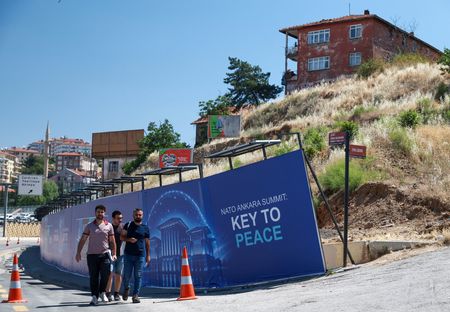

NATO leaders, including U.S. President Donald Trump, are prepared to declare an “ironclad commitment” to collective defense under the alliance’s Article 5 agreement when they gather in Ankara next week, according to a summit declaration reviewed by Reuters that was approved by NATO ambassadors on Friday.
The declaration, which still requires final sign-off from the leaders themselves at the summit, also calls for NATO members to commit €70 billion — roughly $80 billion — in military support for Ukraine in 2026, with “at least equivalent levels” of assistance continuing into 2027.
The summit document states: “We … have gathered in Ankara to reaffirm our ironclad commitment to our collective defence under Article 5 of the Washington Treaty and to the transatlantic bond. An attack on one is an attack on all.”
Trump has repeatedly criticized NATO and its member nations, claiming they have not contributed enough to their own defense and have leaned too heavily on the United States to safeguard Europe. Following disputes with European leaders over the U.S.-Israeli conflict with Iran, Trump raised questions about American dedication to NATO’s mutual defense clause and even floated the idea of withdrawing from the alliance altogether.
However, the fact that the declaration was approved by ambassadors representing all 32 NATO member nations — including the United States — indicates the U.S. president may be willing to put those concerns aside, at least temporarily.
The declaration characterizes Russia as “a long-term threat” to “Euro-Atlantic security and stability” and notes that NATO’s European members and Canada are following through on defense spending commitments made at last year’s summit in The Hague.
“We are building the future: a stronger Europe in a stronger NATO,” the text reads. “European Allies and Canada, working with the United States, are assuming greater responsibility for the Alliance’s defence.”
The declaration also addresses Iran, stating that “Allies reiterate that Iran must never have a nuclear weapon and call on Iran to fully respect freedom of navigation in the Strait of Hormuz.”