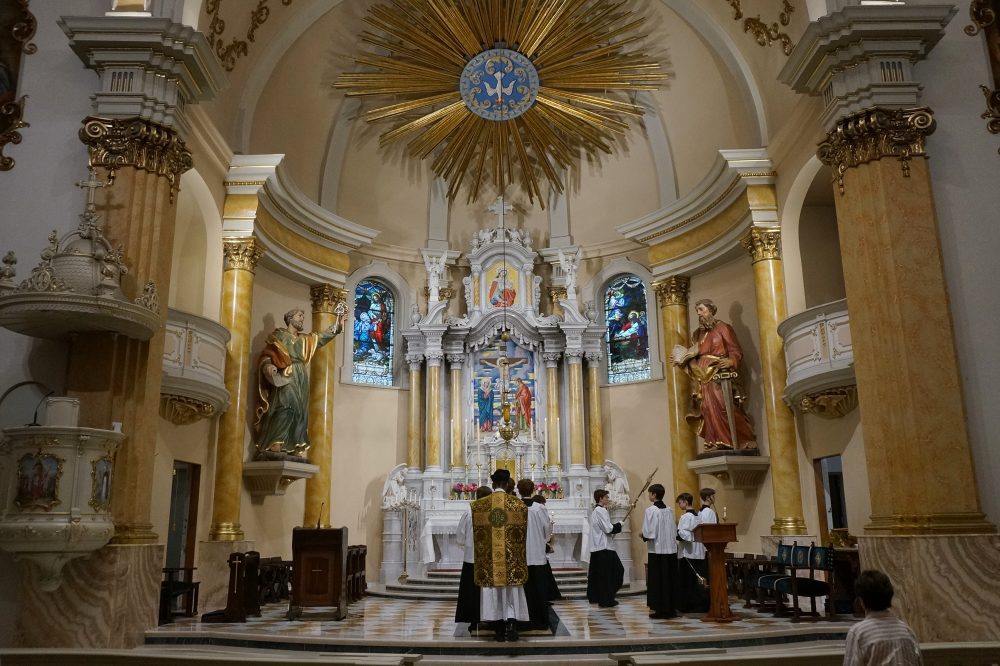

ST. PAUL, Minn. — While incense filled the air and 13 altar boys stood in attendance, a priest at the Church of Saint Agnes delivered a message this week about blending centuries-old Catholic traditions with loyalty to the Vatican — just as Pope Leo XIV was confronting a serious challenge from a breakaway traditionalist faction.
“Our Catholic faith is a living tradition, and there is a difference between being rooted and being stuck,” said the Rev. John Ubel, who delivered that message during both English-language and Latin Masses on Sunday.
Ever since the Second Vatican Council overhauled Catholic worship more than six decades ago, celebrating Mass in the traditional Latin Rite — the form that existed before those changes — has become a flashpoint for deep theological, cultural, and increasingly political tensions within the Catholic Church.
The conflict grabbed international attention when Pope Leo XIV announced Thursday that the Society of St. Pius X — a traditionalist organization founded specifically to reject the Council’s reforms and celebrate only the old Latin Mass — had formally separated from the Catholic Church. The Vatican excommunicated the society’s bishops and priests and issued a warning to its many followers after the group consecrated four men as bishops in direct defiance of Leo.
Although the Latin Rite itself was not the root cause of the split, the bitterness surrounding it — and the lingering assumption that anyone who prefers it must be an ultraconservative dissident — remains a sore point at Saint Agnes. The parish has no connection to the Society of St. Pius X and holds official church permission to celebrate Mass in Latin.
“For all who are attached to Tradition, I pray that they seek to maintain full ecclesial communion with our Holy Father, Pope Leo XIV,” Ubel said in a statement Thursday.
Saint Agnes is a historic parish originally established for German-speaking immigrants, now located in a diverse, centrally situated neighborhood in Minnesota’s capital. The church offers one traditional Latin Mass per weekend with the archbishop’s approval, along with a modern Latin Mass and four English-language services.
“I believe that Saint Agnes is an example where the different forms of Latin Mass, and English, peacefully coexist, and, in many ways, I think it’s a model for how the church can respect various liturgical traditions and do so in full charity,” Ubel said during Sunday’s homilies.
Peter Draganowski, a 15-year-old who will be a sophomore at Saint Agnes’ school this fall, has served as an altar boy at both English and Latin services for years. He prefers the Latin Mass, even with its additional steps and rituals.
“It’s really not hard, it just has a lot more moving parts,” he said in the parish hall while hot dogs and doughnuts were being served after Sunday’s first English Mass. “The sacred mysteries deserve that beauty.”
The archbishop of St. Paul and Minneapolis, Bernard Hebda, expressed hope that local Catholics who had been attending Society of St. Pius X chapels would now seek out approved services instead.
“We are blessed that the same traditional Eucharistic liturgy beloved by those who have worshiped with the SSPX in the past continues to be celebrated in six locations throughout the Archdiocese,” Hebda said in a statement. “I am confident that those who prefer the Traditional Latin Mass could find a home here.”
Beyond being conducted in Latin, the old rite Mass differs from standard Catholic services in several other ways: its prayers are longer and different, the priest faces the altar with his back to the congregation, Communion is placed only on the recipient’s tongue while kneeling at the altar rail rather than placed in the hand, and priests wear shorter Roman-style vestments along with a black biretta hat.
Very few American Catholics regularly attend Sunday Mass in this pre-Vatican II format, known as the “extraordinary form,” according to Stephen Cranney, a lecturer at Catholic University of America in Washington and co-author of a forthcoming book on the Latin Mass in the United States. He estimates approximately 510 such Masses are held on Sundays across the country, out of more than 16,000 active parishes. The U.S. Conference of Catholic Bishops and Georgetown University’s Center for Applied Research in the Apostolate both indicated they do not track this data.
In surveys Cranney conducted, most American Catholics who prefer this form of Mass cite its elaborate aesthetic quality, a stronger sense of reverence, and its connection to centuries of tradition. Only a small fraction said they oppose the Vatican II reforms, and even fewer expressed support for defying the pope.
Still, popes have long grappled with the concern that a preference for a more solemn liturgy could mask a deeper desire to break from the church.
“How do you … try to be accommodating to the people who might prefer the traditional Latin Mass while not giving fuel to the fire of people that want to split off?” Cranney said.
Leo’s two predecessors took notably different approaches. In 2007, Pope Benedict XVI affirmed the validity of the Latin Rite and encouraged priests to offer it when parishioners asked. Pope Francis, however, tightened restrictions between 2021 and 2023, requiring individual bishops to approve the celebration of the traditional Mass and to verify that those requesting it had accepted the Vatican II reforms. He also limited the use of parish churches for these services. Francis said his concern was that the old Mass had become a source of division — though Vatican documents that surfaced after his death suggested most bishops had actually expressed general satisfaction with how the practice was being handled.
Last fall, Leo permitted a U.S. cardinal to celebrate the old Latin Mass at St. Peter’s Basilica in Vatican City, a move many traditionalists viewed as a positive signal. In the year since taking office, Leo has repeatedly emphasized the importance of unity within the Church. Just this past Tuesday, before the Society of St. Pius X went ahead with the consecrations, he again urged the group not to proceed. Once they did, the Vatican warned the faithful to stop attending the society’s Masses, stating that those who formally align with the group are considered schismatic and excommunicated.
Members of Saint Agnes said they were grieved by the schism and pledged to keep praying for a unified church.
Nell O’Leary Alt, who was raised in the parish, said her family attends both Latin Masses as well as English services. As a mother of five children ranging in age from 5 to 16, she admitted with a laugh that she once found the quiet stretches of the traditional Latin Mass nerve-wracking, with nothing to mask the fidgeting and giggling of her kids in the pews. But her family has come to love Latin worship: “It’s the same the saints knew all through the ages.”
Tom Graff, another lifelong Catholic at the church who sings in the choir, said he is drawn to the solemnity of the rite. But this week’s events have reinforced what he tries to teach his four children — not to fall into the trap of thinking one form of worship is better than another.
“I can appreciate both the ordinary and the extraordinary forms of Latin Mass, and Schubert’s Tantum Ergo as well as On Eagle’s Wings,” Graff said, referencing a centuries-old and a contemporary Christian hymn. “It’s about the holy sacrifice of Mass, regardless of the parish or the type of liturgy.”
For Ubel, offering multiple Mass options is fundamentally about welcoming people in, not pushing them apart.
“It’s not a competition to see who’s more Catholic,” he said.