
A scorching heat wave sweeping across the eastern and central United States is setting the stage for what could be the most dangerous conditions yet at this year’s World Cup tournament, with Saturday’s afternoon match between France and Paraguay in Philadelphia drawing particular concern.
The National Weather Service says the heat wave is expected to linger through the end of the week, with heat indexes — a measurement that factors in both air temperature and humidity — projected to peak between 100 and 115 degrees Fahrenheit. Overnight temperatures will remain high, offering little relief, and records could fall.
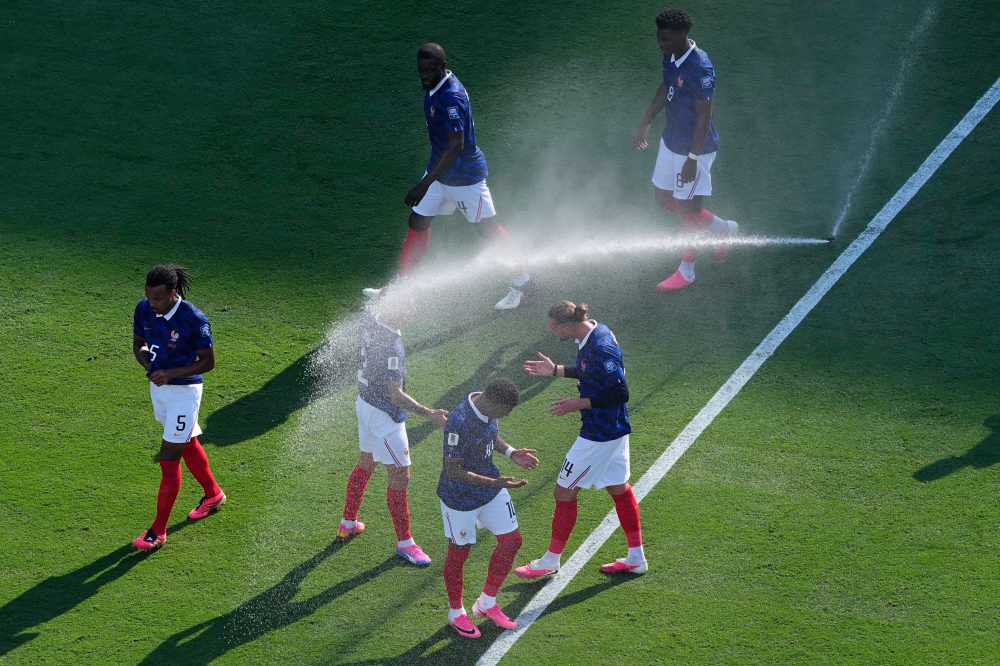
Earlier this week, French players used field sprinklers to cool down during their match against Sweden in New Jersey, where temperatures reached 90 degrees Fahrenheit.
Worries about extreme heat at World Cup venues across the United States, Canada, and Mexico have been mounting for months. Some scientists have gone as far as calling FIFA’s heat safety guidelines “inadequate” and “impossible to justify” — even for players who have trained in hot conditions. For fans watching in the stands, the heat could mean a slower, less intense game.
According to the climate monitoring organization Berkeley Earth, the world has warmed roughly 1.26 degrees Fahrenheit over the past three decades since the United States last hosted the World Cup. Scientists with the World Weather Attribution group said Friday that the humid heat currently smothering much of the country and parts of Canada would have been “virtually impossible” without climate change.
The 2022 World Cup in Qatar was shifted from summer to winter specifically because of extreme heat concerns, and temperatures soared again at last year’s Club World Cup. The global union representing soccer players has cautioned that extreme heat will likely be an even greater problem at this and future World Cup tournaments.
For historical context, one of the hottest World Cup matches on record took place in 1994 in Orlando, Florida, when temperatures reached 110 degrees Fahrenheit.
Bharat Venkat, director of the Heat Lab at the University of California, Los Angeles, explained that the human body faces heat stress from both the surrounding environment and from the internal warmth generated during physical activity. Together, those factors make it much harder for the body to cool itself in hot, humid conditions.
“So when you’re exerting yourself on a particularly hot day, the likelihood of experiencing heat related illness or even death is much higher,” Venkat said.
Pushing the body hard in extreme heat can trigger a range of symptoms — fatigue, poor performance, headaches, irritability, nausea, dizziness, cramping, and dehydration — all signs of exertional heat illness. Exertional heat stroke requires immediate medical attention and ranks as the third leading cause of death among athletes.
Ryan Calsbeek, a professor of biological sciences at Dartmouth College, noted that when the wet bulb globe temperature — a measure that accounts for temperature, humidity, cloud cover, and wind — climbs above roughly 95 degrees Fahrenheit, the body’s ability to cool itself rapidly breaks down. “The physiological mechanisms just break down,” he said. He added that heat-induced confusion could affect a player’s decision-making and potentially change the outcome of a match.
Mandatory three-minute hydration breaks in the middle of each half are intended to guard against heat illness for both players and referees. However, the breaks have drawn criticism from multiple sides: some argue they disrupt the natural flow of the game and hand coaches an opportunity to shift momentum, while some scientists contend the breaks are too short to allow players to adequately cool down and rehydrate in extreme conditions.
FIFA has also said it has limited outdoor matches during the hottest parts of the day and prioritized covered stadiums for games scheduled during warmer time windows.
Under FIFA’s guidelines, a match could be postponed if the wet bulb globe temperature reaches 89.60 degrees Fahrenheit. But Douglas Casa, CEO of the University of Connecticut’s Korey Stringer Institute, pointed out that threshold is already dangerously high. “So extreme that in the military, at our basic training facilities in America, if it reaches 32, it’s black flag and all training has to be canceled and stopped,” he said.
Temperatures in Philadelphia during Saturday’s game are forecast to exceed 100 degrees Fahrenheit. The players’ union FIFPRO and the American College of Sports Medicine have both called for matches to be delayed once the wet bulb globe temperature hits 82.40 degrees Fahrenheit.
Guilherme Passos, a sport scientist with the Brazilian Football Federation who monitors and prepares Brazil’s national team for heat, said his team has been acclimating to the U.S. conditions using saunas and hot baths during the competition. “If you expose them straight to the hottest time of the day you can lose a bit of training quality,” he said. He noted that when Brazil hosted the World Cup in 2014, players covered less ground and cut back on high-speed running, instead leaning more on technical and tactical precision.
“Soccer players are a really unique mix of athletic attributes,” said Calsbeek. “They have to have extreme endurance and explosive speed. And then on top of that, they have to make really critical decisions. All of those different facets of the sport will be affected by the temperature.”
But the danger doesn’t stop with the players. Fans — many of whom will be drinking alcohol while watching in the heat — also face serious risks. Cities and stadiums have expanded access to shade, cooling areas, and water, and medical staff are positioned at FIFA Fan Festivals and around stadium grounds.
“People are going to be dehydrated, super excited, and not wanting to leave the match,” Calsbeek warned. “We’re likely to see, in those extreme temperatures, spectators pay the price as well.”