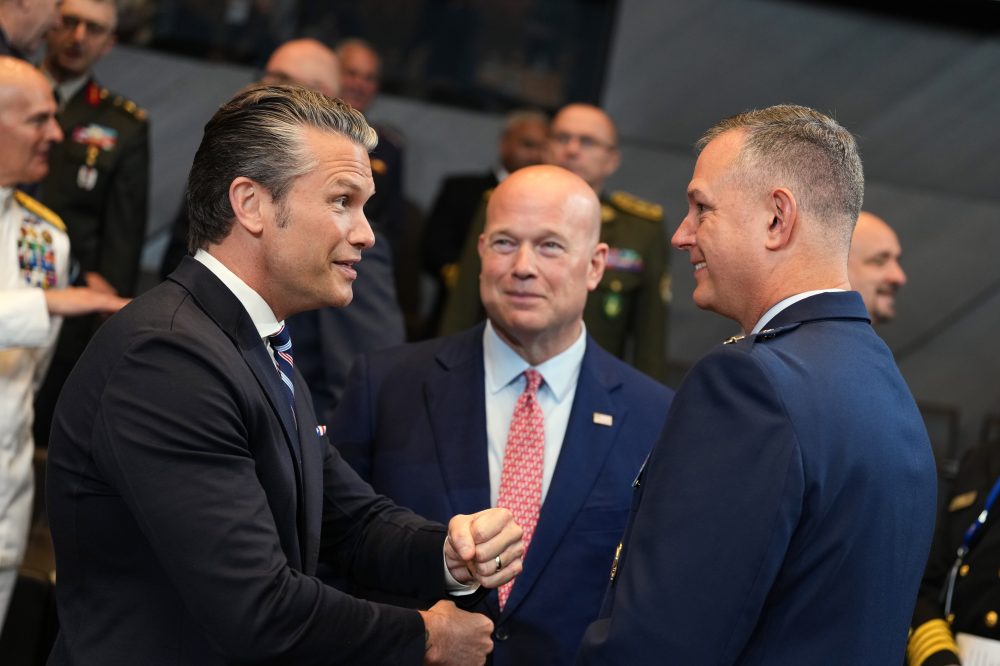

BRUSSELS (AP) — NATO’s top military commander told The Associated Press on Friday that European member nations have managed to fill the majority of the defense holes left behind after the United States announced it would scale back its military contributions to the alliance.
U.S. Gen. Alex Grynkewich had called on European countries to step up and offer more military assets after Washington signaled on June 3 that it would no longer provide an aircraft carrier and its support vessels, aerial refueling aircraft, and dozens of fighter jets, among other military resources, to the continent.
Grynkewich also began reviewing backup plans in the event that Europe faces an attack.
The NATO Force Model serves as the alliance’s primary plan for mobilizing forces from its 32 member nations during periods of peace, crisis, or armed conflict. It outlines what military resources commanders can draw upon during the first six months of any potential conflict.
“In a matter of weeks, European Allies have largely filled the gaps left by U.S. reductions to the NATO Force Model,” Grynkewich said. His comments came just days before President Donald Trump and fellow world leaders are set to gather for a July 7-8 summit in Turkey, where military force planning is expected to be a top priority.
“And in those few areas where they haven’t, where they do not currently have a like capability to replace, we are looking at alternate capabilities with matching effect,” Grynkewich added, though he offered no further specifics.
The Pentagon’s announcement caught many NATO allies off guard. The U.S. decision reflects a strategic shift in attention toward potential threats in other parts of the world, particularly from China in the Indo-Pacific region.
European nations and Canada reviewed their own military inventories to determine what resources they could contribute if one of their allies came under attack. Britain, for instance, has placed a second aircraft carrier along with F-35 fighter jets on higher alert, ready for emergency deployment.
NATO Secretary-General Mark Rutte has sought to minimize concerns over the impact of the Trump administration’s move. Rutte believes the United States would redirect more resources toward Europe if an actual conflict were to break out, pointing to how it responded during the war on Iran as an example.
“This is not about where forces and assets are currently located,” Rutte said last month. “It’s about who would do what if our defense plans were activated. So, let’s say in case of an Article 5 situation.”
Article 5 of NATO’s founding treaty — the alliance’s collective defense guarantee — holds that an attack on any one of the 32 member nations is considered an attack on all of them. While it does not legally require members to provide military assistance, most are widely expected to do so.