

Paul Pelosi, the husband of former U.S. House Speaker Nancy Pelosi, is facing a hit-and-run charge after his vehicle struck a parked car in Napa County, California on Friday, according to media reports.

Paul Pelosi, the husband of former U.S. House Speaker Nancy Pelosi, is facing a hit-and-run charge after his vehicle struck a parked car in Napa County, California on Friday, according to media reports.



DELMARVA — Agronomic research is reinforcing a critical message for Delmarva growers this holiday weekend: planting date has a dramatically larger effect on double crop soybeans than on full-season varieties. Because double crop beans go in after wheat harvest, the growing window is already compressed, and every day of delay translates directly into measurable yield losses at harvest. Agronomists say prioritizing speed after wheat comes off is essential, particularly in years when harvest runs late.
The USDA’s acreage report released earlier this week showed increases in planted acres for corn, soybeans, and cotton nationally, while rice and wheat acres came in below the agency’s March projections. University of Arkansas Extension economist Hunter Biram identified soybean profitability as a key driver behind planting decisions this season, a trend that aligns closely with what many Delmarva producers are seeing in their own operations.
On local cash markets, corn at Laurel Grain Company in Laurel, Delaware is trading at $4.57/bu on the December contract. Soybeans at Laurel are at $10.98/bu on the November contract.
The National Weather Service has issued a Severe Thunderstorm Watch for the Delmarva region through 11 PM tonight. Damaging winds, large hail, and heavy rain are all possible. Producers with equipment or livestock exposed are urged to take protective action immediately. Sunday’s forecast calls for a high of 92°F with afternoon storm chances continuing.
This article is based on the Delmarva Farm Report Update Evening Edition, July 4, 2026. Hosted by Tom Bradley.


President Trump wrapped up the country’s 250th birthday celebration on July Fourth with a lengthy speech followed by a fireworks display.
The milestone anniversary of American independence was not without its challenges — extreme heat gripped the day and forced the cancellation of a number of planned events before the evening’s festivities got underway.
Despite the difficult conditions earlier in the day, the celebration concluded with the president’s address and a fireworks show to mark the historic occasion.
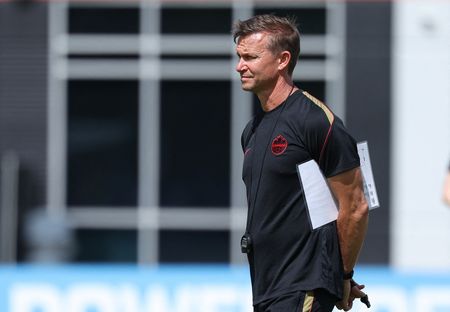

HOUSTON — Canada’s remarkable World Cup journey came to a painful close Saturday, as they fell 3-0 to Morocco in the round of 16. But head coach Jesse Marsch refused to let the scoreline define what his team accomplished, saying he could not be more proud of the way his players competed.
The Canadian squad had already made history during the tournament, earning their first-ever World Cup point, their first victory, and their first knockout-stage win. Against the seventh-ranked Moroccan side, Canada controlled long stretches of play but ultimately could not convert their opportunities, and the absence of their biggest star loomed large over the result.
“I’m very proud to be the Canadian national team coach, and as proud as I am, I’m even more proud of the way our boys played today,” Marsch told reporters after the match.
Wing-back Alphonso Davies, who plays for Bayern Munich, sat out the contest after suffering a hamstring injury, having appeared for only a few minutes throughout the entire tournament.
“We want players on the pitch that are 100% to play the game, I wasn’t there yet,” Davies said. “It was tough sitting there, watching the game, knowing that I’m not 100%.”
Marsch said that heading into the match, he felt his team was capable of winning based on how they were playing.
“Before today, if you would have said your team’s going to play like that, I would have said, ‘okay, there’s a good chance we’re going to win the match,’” he said.
“Thought we totally controlled the number seven team in the world in the first half, total control. There was one team on the pitch. And then we weren’t able to make the play. Even at the start of the second half, we were the aggressor, we were the ones that looked more likely to score.”
Marsch noted that Morocco’s opening goal shifted the dynamic of the game, allowing the North African side to drop back and defend while Canada chased an equalizer.
On the Davies injury, Marsch explained the decision to keep him out was made with the player’s long-term health in mind.
“He didn’t feel right yesterday in training, and we got an MRI, and it was clear, but his hamstring didn’t feel right,” Marsch said. “It killed him more than anyone, but I think it was the right decision to preserve him and his career and get him fully healthy.”
The American coach encouraged his players and Canadian soccer broadly to treat the tournament as a launching pad going forward. After gathering his team on the field for a post-game huddle — waving off television cameras in the process — Marsch challenged them to maintain the level they had shown throughout the competition.
“I challenged them to understand that we can play like this all the time,” he said. “Against the best teams in the world, we can be better on the day. The challenge is, can we hold that standard for 90 minutes? Can we continue to build the depth of what we’re doing with the team? Can we build a real Canadian DNA into the kind of football we want to play?”
Marsch said the tournament marked the beginning of a new chapter for Canadian soccer.
“It is a privilege to have now a Canadian national team competing at levels that had never been dreamed of 10 years ago,” he said. “With that excitement comes higher expectations. Nobody is more disappointed than us, but we have to continue to think about how to get better and commit ourselves to it every time we’re together.”
Canada’s Prime Minister Mark Carney also weighed in on social media platform X, writing: “Nothing but pride … An incredible run and a sign of what’s to come.”


As the United States marked its 250th birthday on Independence Day, heads of state and government leaders from across the Middle East and beyond extended their congratulations to President Donald Trump and the American people.
Israeli President Isaac Herzog made a personal gesture by traveling to the US Embassy in Jerusalem, where he hand-delivered a letter addressed to President Trump and the American people to US Ambassador to Israel Mike Huckabee. Speaking to the ambassador, Herzog called American independence “one of the greatest moments in history,” saying it “changed the fate of humanity.” He also noted that the embassy in Jerusalem came to be following President Trump’s decision to recognize Jerusalem as Israel’s capital.
In his written message, Herzog referred to the 250th anniversary as “a moment to honor the incredible triumph of the American spirit.” He called the United States “a beacon of liberty, and as the leader of the free world,” and thanked President Trump for his “steadfast commitment to Israel’s security.” Herzog also wrote that Israelis “will never forget your tireless efforts to bring our beloved hostages home.”
Receiving the Israeli president, Ambassador Huckabee remarked that Americans were “not the only ones celebrating America’s 250th birthday,” and told Herzog, “We’re honored to have you here and honored to call you a friend.”
Israeli Prime Minister Benjamin Netanyahu also released a congratulatory statement, calling the United States “the greatest force for freedom that the modern world has known.” Netanyahu said, “We may live on different continents, but there is a strong bond between us because we have one destiny.” He went on to say the alliance between the two countries is built on “shared values” as well as mutual interests, and argued those values are being threatened by “the tyrants we face” who chant, “Death to America, Death to Israel.”
In the Gulf region, UAE President Mohamed bin Zayed Al Nahyan sent his congratulations to President Trump and the American people, writing that “The journey of the United States’ founding is one of determination and resolve.” He said those same principles continue to shape the relationship between the two nations and pledged ongoing cooperation toward “lasting progress and prosperity.”
UAE Vice President, Prime Minister and Ruler of Dubai Mohammed bin Rashid Al Maktoum said his country remains dedicated to a relationship that advances “peace, stability and prosperity,” while Al Nahyan characterized US-UAE ties as a “robust strategic partnership.”
Saudi Arabia’s King Salman bin Abdulaziz and Crown Prince Mohammed bin Salman both sent messages to President Trump, according to the Saudi Foreign Ministry. King Salman highlighted “the bilateral relations between the two countries and the development they are witnessing in various fields” and extended wishes for the United States’ “continued progress and prosperity.”
Egyptian President Abdel Fattah el-Sisi offered his “warmest congratulations” to President Trump, his administration, and the American people, saying he looked forward to deepening cooperation between the two countries “in pursuit of our shared interests.”
Qatar also took part in the anniversary observances, with the Qatari Amiri Diwan announcing that HH Tamim bin Hamad Al Thani sent a cable to President Trump marking US Independence Day.
Pakistani Prime Minister Shehbaz Sharif described the occasion as a celebration of “the enduring values of freedom, resilience, and democracy.” He noted that Pakistan and the United States have maintained a partnership for more than seven decades and praised President Trump’s “vital contribution to peace in South Asia,” saying it helped save “hundreds of millions of lives.” Sharif also commended the president’s efforts on major international conflicts and reaffirmed his country’s commitment to stronger bilateral ties.
Moroccan King Mohammed VI marked the anniversary by calling it a celebration of “250 years of strong and stable relations between our two nations.” He pointed out that Morocco was “the first State to recognize the independence of the United States of America” and said the relationship between the two countries “have never been as rich and fruitful” as during President Trump’s two terms. The king also said that President Trump’s recognition of Morocco’s sovereignty over its Sahara “will remain etched in the memory of Moroccans from generation to generation.”
Jordan’s Royal Court announced that King Abdullah II sent President Trump a congratulatory message on behalf of the Jordanian government and people, highlighting the countries’ longstanding strategic partnership and expressing a desire to continue building on bilateral relations.
In Bahrain, the capital city of Manama lit up its skyline in the colors of the American flag to honor the anniversary. US Ambassador to Bahrain Stephanie Hallett hosted a reception celebrating the friendship and growing defense partnership between the two nations.
Kurdistan Region President Nechirvan Barzani congratulated President Trump and the American people, praising the United States’ commitment to democratic governance. “America’s enduring lesson is that liberty requires more than power. It requires a Constitution, institutions, federal balance, and the consent of free people,” Barzani said. He added that both the Kurdistan Region and Iraq are seeking closer ties with the United States and expressed appreciation for America’s “friendship and leadership.”
Kuwait’s Amir, Mishal Al-Ahmad Al-Jaber Al-Sabah, also sent a congratulatory cable to President Trump marking the 250th anniversary of the Declaration of Independence, praising the longstanding historical and strategic relationship between the two countries.
Oman’s Haitham Bin Tarik extended his congratulations to President Trump, wishing the American people prosperity, stability and progress while pledging to expand cooperation between the two nations. Separately, the US Embassy in Muscat held a reception at the Diplomatic Club attended by Omani ministers, senior officials and diplomats. The event featured a short film on US-Oman relations dating back to the countries’ first treaty in 1833, along with an exhibition tracing the history of their bilateral ties.
Azerbaijani President Ilham Aliyev called the Declaration of Independence “a symbol of the struggle for freedom, indomitable resolve, and democracy” in his message to President Trump. Aliyev welcomed the recent strengthening of US-Azerbaijan relations following the signing of a Charter on Strategic Partnership in February, and praised President Trump’s role in promoting peace in the South Caucasus while expressing appreciation for US support of regional infrastructure and economic development efforts.


It may be hard to imagine a time when a person using a wheelchair simply could not board a city bus — but that was the reality before a group of determined activists changed everything in 1978.
A protest organized by wheelchair users that year resulted in a landmark victory for disability rights, securing the ability to ride public transit alongside everyone else. That access, which millions of Americans now take completely for granted, did not come without a fight.
NPR’s Joe Shapiro and Colorado Public Radio’s Stephanie Wolf examined the story behind that historic demonstration and what it ultimately meant for the future of public transportation in the United States.


This Fourth of July, a veteran journalist took a trip back to his roots to explore how one American city tells the story of the nation as a whole.
NPR correspondent Don Gonyea returned to Detroit — the city where he first began his career in journalism — to reflect on what makes the city such a powerful symbol of American identity.
His reporting digs into some of the most defining chapters of Detroit’s history, including the rise and transformation of the American auto industry, and the Great Migration — the massive movement of Black Americans from the South to northern cities like Detroit in search of better opportunities and lives.
At the heart of the story are the people themselves — the workers, families, and communities whose labor and perseverance helped build Detroit into the city it is today.
The piece draws a line between Detroit’s unique history and the larger American story, suggesting that what happened in that city — the triumphs, the struggles, and the resilience — reflects something true about the country as a whole.
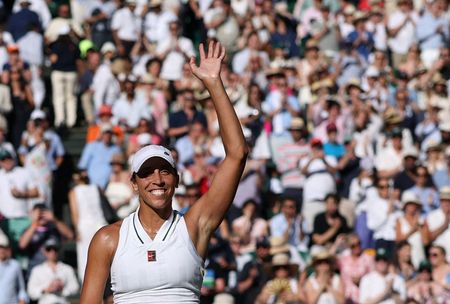

American tennis star Madison Keys had double the reason to celebrate this Fourth of July — she not only won her Wimbledon match but finally set foot on the tournament’s legendary Centre Court for the very first time.
Keys, seeded 26th in the tournament, defeated fellow American Amanda Anisimova, the sixth seed, by a score of 3-6, 6-2, 6-3 on Saturday to move into the fourth round. What made the victory even more special was that it marked Keys’ first-ever appearance on Centre Court despite having competed at Wimbledon 11 times before.
“I’m glad that I finally got to check that off of the list,” said the 31-year-old former Australian Open champion, confirming that playing Centre Court had indeed been on her bucket list.
The fact that Keys had never previously appeared on the world’s most celebrated tennis court surprised even those close to her. She recalled a recent conversation with her agent, Max Eisenbud, about the topic.
“Everyone was shocked. I was saying that to (agent) Max (Eisenbud) the other day, and he’s like, ‘you’ve been on Centre Court.’ I was like, ‘no, I actually physically have not,’” Keys said.
When the order of play was released Friday, Keys learned she would be competing on Centre Court for the first time. Her excitement was immediate.
“I was so excited. I was texting our podcast group chat. I was like, ‘Guys, I’m going to be on the Centre Court of Wimbledon. This is crazy,’” she recalled.
Keys came into Wimbledon riding some momentum, having captured the Eastbourne title just last week. She took some time to find her footing in the match but ultimately looked right at home on the historic surface.
Describing the moments leading up to her walk onto the court, Keys said the experience was one she truly savored.
“It’s funny, just like all these years later when you do the whole walk and down the stairs, I was like, I’ve never seen this. I kind of kept looking around,” she said. “I don’t know if I would say it was intimidating. It was just really fun for me to … experience it for the first time. I really kind of took it all in. I was quite literally looking at every single picture on the wall.”
Keys will return to action Monday when she faces Czech ninth seed Linda Noskova, with a chance to match her best-ever run at the grasscourt Grand Slam.


When summer arrives, two neighboring cities on opposite sides of an international border put aside what divides them and come together for a celebration that has endured for generations.
Detroit, Michigan and Windsor, Ontario, Canada have maintained a beloved fireworks tradition that draws thousands of spectators to both shores. Year after year, residents from both countries line up along the waterfront to share in the festivities as the skies light up overhead.
The cross-border gathering is a testament to the unique bond between these two communities, which face each other across the water and have built a tradition that transcends national boundaries.


ARLINGTON, Texas — The Texas Rangers and Budweiser raised a glass — a very, very big glass — to celebrate America’s 250th birthday in record-breaking fashion.
The two teamed up on Saturday to claim a Guinness World Record for the biggest glass of beer ever created. A massive beer stein standing 12 feet tall and holding 600 gallons was filled in a plaza just outside Globe Life Field ahead of the Rangers’ July 4th matchup against the Detroit Tigers.
The filling process alone took close to two hours to complete. Once finished, an official Guinness adjudicator who was on-site reviewed and certified the new world record.
The achievement topped the previous record of 550 gallons, which had been set back in 2014 by Stod Fold Brewing Company, a brewery based in Halifax, United Kingdom. That record had been tied to the Tour de France bicycle race held that same year.
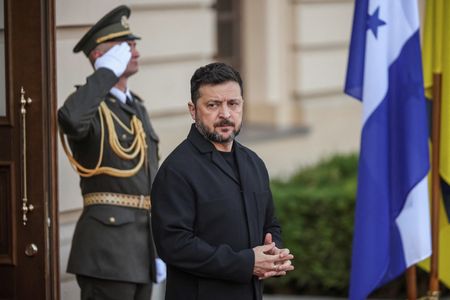

Ukrainian President Volodymyr Zelenskiy announced Saturday that he connected with U.S. President Donald Trump by phone on the Fourth of July, urging the United States to show firm resolve in helping bring an end to the war with Russia — a conflict that has now stretched beyond four years.
Zelenskiy described the exchange in positive terms, saying the two leaders had a “very good” discussion focused on the current situation along the front lines of the war.
“There is a real prospect to end this war and American resolve will have a crucial meaning,” Zelenskiy stated following the call.
The Ukrainian president added that he and Trump reached an agreement to “continue our conversation” when they meet at next week’s NATO summit, which is scheduled to take place in Turkey.


CHISINAU — A Russian cultural center operating in Moldova for over 15 years has officially closed, following an order from the country’s pro-European government that determined the facility posed a potential threat to national security.
Moldova’s government, which has been a vocal opponent of Russia’s invasion of Ukraine, declared last year that the Russian Centre for Science and Culture could be used as a tool to spread harmful narratives within the country of 2.5 million people. The nation’s parliament backed that decision.
The Russian embassy released a statement acknowledging the closure, saying: “It is with deep regret that we are obliged to advise that, in connection with a Moldovan government decision, the Russian Centre of Science and Culture (‘Russia House’) is ending its activity.”
In its own farewell statement, the center said it had spent many years serving “as a meeting place, for dialogue and friendship,” adding: “We hope that interest in Russian language, literature, culture and education, will not cease.”
The Russian embassy noted that some responsibilities previously handled by the center would be absorbed by its cultural department going forward.
Tensions between Moldova and Russia have escalated significantly since Moscow launched its invasion of neighboring Ukraine. The government’s closure order also pointed to incidents in which Russian drones violated Moldovan airspace and landed on the country’s soil.
President Maia Sandu, who is leading Moldova’s push to become a member of the European Union before the decade is out, has charged that Russia is actively working to undermine her government. Russia, for its part, has accused Sandu of fueling anti-Russian sentiment in the country.
Moldova has a complex historical relationship with Russia, having been part of the Russian empire, the Soviet Union, and “Greater Romania” at various points in its past. While Russian remains widely spoken, younger generations have largely shifted to Romanian, which is the country’s official language.
Last month, officials in Transdniestria — a pro-Russian separatist region located in eastern Moldova — proposed establishing an alternative Russian cultural center “to act against destructive attempts to limit Russian presence.”
However, Deputy Prime Minister Valeriu Chiveri, a senior figure in the Moldovan government, stated that establishing any such center would not be possible without first reaching a new agreement with Russia.


The combined death toll from two powerful earthquakes that struck Venezuela has reached 2,954, the country’s information ministry announced on Saturday, July 4.
Jorge Rodriguez, who leads Venezuela’s National Assembly legislature, released updated figures showing that 16,592 people have been injured and 16,309 have been left homeless as a result of the twin disasters.
Rodriguez also reported that medical teams have provided care to 22,445 individuals since the quakes struck. To assist those affected, nearly 30,000 officials have been mobilized, joined by 3,281 rescue workers from other countries.
Search and rescue operations remain active as crews continue looking for any survivors still trapped, Rodriguez confirmed.
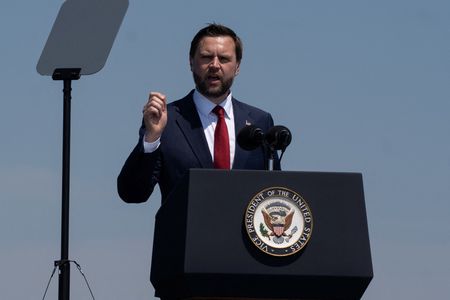

LONDON — U.S. Vice President JD Vance is weighing in on British politics, saying the United Kingdom has been “failed by its leadership for a long time” and expressing hope that the country’s next prime minister can bring about the kind of sweeping change citizens have been demanding.
Speaking to the Sunday Times newspaper, Vance said the rapid succession of British governments points to something fundamentally broken in the country’s political system. Prime Minister Keir Starmer announced last month that he would be stepping down after two years in office, setting the stage for Britain to welcome its seventh prime minister in just ten years.
Lawmaker Andy Burnham has emerged as the leading candidate to take over from Starmer and is widely expected to succeed him.
“What I see is six prime ministers in the last few years,” Vance told the paper. “What that says to me is that something is very broken about British politics and that people are really crying out for significant structural change.”
The vice president went on to say, “I hope that Andy Burnham — and if not Andy Burnham, somebody else — is able to deliver it,” adding that he hopes “whoever the prime minister is figures out how to get Britain back on track.”
Vance, whose wife Usha attended the University of Cambridge and who has often expressed fondness for the country, called Britain an “amazing place” with the “most amazing people in the world” outside the United States.
His remarks follow a relationship between Starmer and U.S. President Donald Trump that was at times tense but largely workable. The two leaders frequently emphasized the importance of the U.S.-UK “special relationship” even as they clashed on issues such as Iran, Gaza, and Ukraine, while also managing to reach trade and investment agreements.
When Starmer stepped down last month, Trump called him a “lovely man” and “a sort of friend of mine,” but criticized his handling of immigration and energy policy. Trump added, “I wish him well.”
Trump has since described Burnham as “extremely liberal” and suggested Britain’s likely next leader would probably not support expanded North Sea oil and gas drilling — something Trump had been pushing Starmer to pursue.
In the same Sunday Times interview, Vance acknowledged he doesn’t know much about Burnham personally, but stressed that Britain remains one of America’s closest partners. “Whoever is the prime minister, we’re going to work with them and work with them as successfully as we can,” he said.
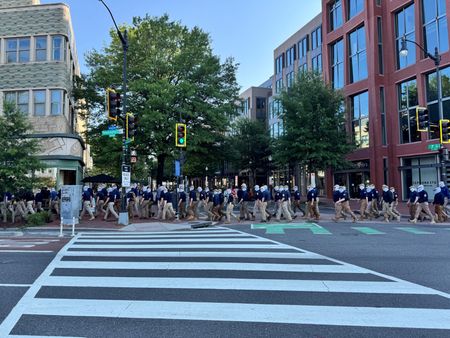

WASHINGTON — On the Fourth of July, hundreds of masked white nationalists belonging to the group Patriot Front made their way through the streets of Washington, D.C., hours before the city’s planned Independence Day evening events.
The organization announced on social media that approximately 400 of its members had descended on the nation’s capital. Reuters photographers captured footage of large numbers of people dressed in Patriot Front attire riding Washington’s Metro rail system.
Footage circulated across multiple social media platforms and on the group’s own Telegram channel showed members marching near the U.S. Capitol building to the beat of drummers. The marchers were dressed in a recognizable uniform of khaki pants and caps, blue shirts, white face coverings, and sunglasses. Many in the crowd carried the group’s flag, Confederate flags, and various versions of the American flag, with participants at times shouting the phrase “Reclaim America.”
By midday, the group boarded Metro trains and departed at the New Carrollton, Maryland station, located in the northeastern suburbs of Washington.
According to the Southern Poverty Law Center, Patriot Front was established in 2017 in the aftermath of the deadly “Unite the Right” rally held in Charlottesville, Virginia. The group broke away from Vanguard America, a white supremacist organization that played a central role in that violent gathering. Patriot Front has become known for its coordinated uniforms, face masks, and flash mob-style public appearances.
A statement on the Patriot Front’s website reads, “Democracy has failed this once great nation,” and calls for a “hard reset” to “return to the traditions and virtues of our forefathers” — whom the group identifies as European settlers.


President Trump kicked off the nation’s 250th birthday celebration with a speech at Mount Rushmore that broke sharply from the tradition of nonpartisan, unifying remarks that past presidents have delivered on Independence Day.
Rather than sticking to the kind of broadly patriotic themes typically associated with such milestone occasions, Trump’s address mixed messages of American exceptionalism with stark warnings about the threat of communism.
The speech drew attention for how dramatically it differed in tone and content from the apolitical Independence Day addresses that have been a hallmark of previous administrations.


SALISBURY, Md. — An air conditioning malfunction and sweltering temperatures have forced organizers to push back a popular community celebration in Salisbury.
The America250 Picnic at Poplar Hill Mansion, which had been scheduled for Sunday, July 5, will instead be held on Sunday, July 12, from 1 to 4 p.m.
A problem with the air conditioning unit on the mansion’s first floor, combined with the recent heat, led officials to make the call to reschedule in order to keep visitors safe and comfortable.
The City is actively working to get the air conditioning system repaired ahead of the new date.
Organizers expressed gratitude for the community’s patience during the delay, saying they look forward to welcoming everyone to Poplar Hill Mansion on July 12 for an afternoon filled with history, community spirit, and celebration.
For more details about Poplar Hill Mansion and its upcoming events, visit the mansion’s official website at poplarhillmansion.org or check out their social media pages.


Motorists traveling through the intersection of DE-896 at Four Seasons Parkway should be aware that the traffic signal at that location is currently not functioning.
When a traffic signal is dark or completely out, drivers are required by law to treat the intersection as a four-way stop, yielding appropriately and proceeding with caution.
Authorities have not yet released a timeline for when the signal will be restored to normal operation. Drivers are encouraged to allow extra travel time and remain alert when passing through the area.


Southbound travelers on US Route 113 near Warner Road are facing a lane restriction after a pavement problem prompted officials to close the left lane.
The closure is in effect due to a road pavement issue at that location. Drivers in the area should expect potential slowdowns and are encouraged to allow extra travel time.
Authorities have not yet announced when the lane is expected to reopen. Motorists should remain alert and follow any posted signage while passing through the work zone.


SEATTLE — Defender Sergino Dest says the U.S. men’s national soccer team is ready to channel the energy of a nation that is fully behind them as they prepare to battle Belgium for a spot in the World Cup quarterfinals following the July 4 holiday weekend.
The squad enjoyed a laid-back Saturday morning training session before heading off to celebrate the country’s 250th birthday with fireworks, family, and friends. Coach Mauricio Pochettino greeted reporters with holiday well-wishes before the players got down to business, while Weston McKennie and Folarin Balogun — who faces a suspension after receiving a straight red card in the victory over Bosnia and Herzegovina — loosened up by tossing a baseball around.
On Friday evening, the team took in a Seattle Mariners baseball game, where midfielder Cristian Roldan fired up the crowd with a rallying cry of “let’s go win a World Cup” — a moment that captured the growing sense of belief surrounding the co-host nation.
Dest said the team intends to bring that momentum into a packed stadium in Seattle on Monday for what he acknowledged could be the most significant match in the history of American soccer — at least so far.
“At the moment, maybe yes,” Dest told reporters. “Hopefully we will win this game and then we can even play more games in this tournament. Because we have an amazing group at the moment.”
“We play really well and we’re all just so motivated and the country believes — everybody believes at the moment … the support is huge,” he added.
Belgium arrives with momentum of their own after staging a stunning comeback against Senegal, and Dest acknowledged that despite an uneven tournament, they remain a dangerous opponent.
“They are inconsistent this tournament, but we still know that they have qualities,” he said.
Fellow defender Tim Ream echoed the team’s confidence while also reflecting on the broader impact a deep tournament run could have on the sport’s popularity across the United States.
“We’re not fully thinking about that at the minute. We’re thinking about playing games and putting in performances,” Ream said. “But we are … very aware of the impact that we’re having around the country and the impact we’re having on generations of people and fans.”
With Balogun sidelined, the team will need to find a different way to generate offense. But Ream pointed to how the squad managed to hold on against Bosnia while playing a man down as proof they can adapt under pressure.
“When teams can win in different ways, when teams have to win in different ways, it gives you that mental boost,” Ream said. “Sometimes the game’s not going to be nice, it’s not going to be pretty, you’re not going to have everything go your way, but you find ways to finish games out.”


HOUSTON — Morocco made short work of a spirited Canada side on Saturday, winning 3-0 in the World Cup’s round of 16 and booking their place in the quarter-finals for the second straight tournament.
Despite the comfortable final score, Morocco were far from dominant in the early going. Canada came out with intensity from the opening whistle, pressing high and creating several quality chances while Morocco struggled to find any rhythm. In fact, Morocco did not manage a single shot on goal until the 28th minute.
Things got more complicated for Morocco when midfielder Ismael Saibari, who had tallied three goals in the tournament, went down with a hamstring injury in the 22nd minute and had to be replaced by Soufiane Rahimi.
Canada — co-hosts of the tournament — had kept their fairytale run alive heading into the match, but their inability to finish those early opportunities proved costly. Just five minutes into the second half, Morocco broke the deadlock through a clever free-kick routine. Achraf Hakimi slid a low ball in from the right side, finding a completely open Ounahi, who calmly side-footed it into the bottom corner from about 25 yards out.
That goal deflated the Canadian side, who were already without key player Alphonso Davies, sidelined by fitness troubles throughout a tournament in which Canada recorded their first-ever point and victory at a World Cup.
Ounahi struck again in the 82nd minute, finishing into the top corner after a swift four-on-two counterattack in which Brahim Diaz set him up perfectly — Canada caught out pushing forward in search of a goal to get back in the match.
Morocco capped off the victory with a third goal late in the match, courtesy of substitute Rahimi, who finished off another fast break to seal a convincing win.
Morocco will now await the outcome of Saturday’s other round of 16 match between Paraguay and France, with the quarter-final scheduled for July 9.


The Texas Rangers made two roster moves in their bullpen on Saturday, reinstating veteran right-handed reliever Chris Martin from the injured list while placing fellow right-hander Jakob Junis on the IL, backdated to Wednesday.
Martin, who is 40 years old, had spent just over a month on the shelf recovering from a right shoulder impingement. Through 12 relief outings this season, he posted a 1-1 record with a 7.84 ERA. Over the course of his 11-year career, Martin has appeared in 430 relief games for seven different organizations, compiling a 19-25 record and a 3.45 ERA.
Junis, 33, is being sidelined by a right hip impingement. He has been solid for Texas this season, going 1-1 with a 2.80 ERA across 31 appearances, including one start. In 10 seasons at the major league level, Junis owns a 47-47 record and a 4.29 ERA over 280 appearances — 117 of which were starts — spread across six different clubs.


Britain’s Arthur Fery delivered one of the most dramatic moments of this year’s Wimbledon championship on Saturday, staging a remarkable comeback against Belgium’s Zizou Bergs to advance to the round of 16.
The 23-year-old wildcard won a grueling five-set battle by a score of 2-6, 7-5, 2-6, 7-6(3), 7-6(5) in what became the longest match of the entire tournament, lasting four hours and 38 minutes.
Spectators packed every available spot around Court 18, cheering loudly as Fery clawed his way back from what looked like certain defeat. At one point, he was down two sets to one and trailing by a double break of serve against the world’s 37th-ranked Bergs.
Bergs appeared to have the match in hand, but his serve began to falter as Fery mounted his comeback and forced a decisive fifth set.
The drama reached new heights in the final set when Bergs surged ahead 4-1, yet once again he was unable to put Fery away. A nosebleed struck Fery while he was serving at 4-5, adding yet another layer of tension to an already electric atmosphere.
Despite the physical setback, Fery looked composed as the deciding tiebreaker got underway. With Bergs making a string of unforced errors, Fery closed out the victory and immediately collapsed onto his back on the court in a mixture of relief and exhaustion.
The win makes Fery the first British wildcard to reach the fourth round at Wimbledon since Andrew Foster accomplished the feat in 1993. Born in France, Fery is expected to crack the world’s top 100 rankings as a result of this run, setting him up for a consistent presence on the ATP Tour going forward.
Britain had a tough week overall at Wimbledon, losing 15 of its 19 singles players in the opening round. Fery stood alone as the only British player to make it as far as the third round.


Northbound travelers on Route 1 between Hall Avenue and the Rehoboth Avenue Extension should expect some extra time behind the wheel.
According to Delaware Department of Transportation, congestion in that stretch is causing delays of approximately five to ten minutes.
Drivers are encouraged to allow for additional travel time or look for alternate routes to avoid the slowdown.


Travelers making their way southbound on Route 1 between Delaware Route 24 and Rehoboth Avenue Extension should expect a slowdown, according to Delaware’s transportation officials.
DelDOT is reporting a 5 to 10 minute delay along that stretch of roadway as a result of congestion. No additional details regarding the cause of the backup have been provided at this time.
Drivers in the area are encouraged to allow extra travel time or consider using an alternate route until conditions improve.


The National Weather Service out of Mount Holly, New Jersey has issued an Extreme Heat Warning for the area, running from 3:10 PM EDT through 8:00 PM EDT on July 4th.
The warning covers the holiday afternoon and evening hours — a time when many people are expected to be outdoors for Independence Day celebrations. Authorities are urging residents to limit time in the sun, drink plenty of water, and seek air-conditioned spaces whenever possible.
Those most at risk during extreme heat events include the elderly, young children, and individuals with certain medical conditions. Officials recommend checking on neighbors and loved ones who may not have access to air conditioning.
If you or someone you know is experiencing symptoms of heat exhaustion or heat stroke — such as heavy sweating, dizziness, confusion, or a rapid pulse — seek medical attention immediately.


A different kind of Monday Night Football is coming to Seattle, as the United States men’s soccer team squares off against Belgium in a World Cup round-of-16 clash with a quarterfinal berth on the line.
The venue is the home stadium of the Seattle Seahawks — one of the noisiest arenas in the NFL — and it is expected to deliver an electric atmosphere for a U.S. squad whose ambitions have grown considerably as the tournament has progressed.
Heading into the World Cup, many American fans considered simply reaching the round of 16 a success. But victories over Paraguay and Australia in the group stage, capped by a gritty 2-0 win over Bosnia while playing the final 36 minutes a man down, have fueled belief that Mauricio Pochettino’s side can go even further on home soil.
Belgium, on the other hand, has yet to inspire much confidence. The European nation trailed Senegal for most of their match before scoring twice to level things up, then advancing on a VAR-assisted penalty in extra time — a decision that left Senegal deeply frustrated.
For Belgium’s so-called “Golden Generation” — headlined by Kevin De Bruyne, Romelu Lukaku, and Thibaut Courtois — this tournament could represent their final World Cup chapter together.
The U.S. defense, which raised eyebrows as a potential weak spot before the tournament, turned in a strong performance against Bosnia. That unit will now need to keep tabs on Jeremy Doku, who is considered overdue for a standout showing after a quiet tournament so far.
Monday’s match also carries a sense of unfinished business. Back in 2014, Belgium eliminated the U.S. in the round of 16 during extra time in Brazil. That game is still remembered for goalkeeper Tim Howard’s remarkable 16-save performance and a late American push that ultimately came up short.
This time around, the U.S. will be without striker Folarin Balogun, who scored in the first half against Bosnia before being shown a red card in the second half. His absence due to suspension leaves Pochettino with a significant lineup decision as the Americans look to keep their run alive.
U.S. midfielder Tyler Adams spoke to the team’s motivation heading into the match. “As a team we want to leave our mark on the game and a legacy behind,” Adams said. “We know that the further we go, the more the game is going to grow.”


The National Weather Service out of Mount Holly, New Jersey has issued a Severe Thunderstorm Watch for the area, beginning at 3:29 PM Eastern Time on July 4th and running through 11:00 PM Eastern Time the same evening.
A Severe Thunderstorm Watch means conditions are favorable for severe thunderstorms to develop across the affected area. Residents should remain alert and monitor updated forecasts as the evening progresses.
With Fourth of July celebrations and outdoor gatherings planned throughout the region, officials urge the public to keep a close eye on the sky and be ready to seek shelter quickly if threatening weather approaches. Severe thunderstorms can bring damaging winds, large hail, and heavy rainfall.
Stay tuned to TV Delmarva for the latest weather updates throughout the evening as conditions develop.


Northbound travelers on Delaware Route 1 are facing delays between Rehoboth Avenue Extension and Route 24, according to DelDOT.
Congestion in the area is causing travel times to increase by approximately 5 to 10 minutes for drivers moving through that corridor.
Motorists are encouraged to allow extra time or seek alternate routes to avoid the slowdown.


An Extreme Heat Warning is in effect for the area this Fourth of July, according to the National Weather Service office in Mount Holly, New Jersey.
The warning went into effect at 3:10 PM Eastern Time on July 4th and is set to expire at 8:00 PM Eastern Time the same evening, covering the peak heat hours of the holiday afternoon.
Residents planning to be outdoors for Independence Day festivities — including parades, cookouts, and fireworks gatherings — should be aware of the dangerous heat conditions during this time window.
Health officials generally advise staying hydrated, seeking shade or air-conditioned spaces, and checking on elderly neighbors and young children during extreme heat events. Pets should also be kept out of direct sunlight and given plenty of water.
Residents should monitor local forecasts and heed any additional guidance from emergency management officials as the holiday progresses.


Competitive eating icon Joey Chestnut held onto his throne at the Nathan’s Famous Hot Dog Eating Contest on Saturday, July 4th, though sweltering temperatures prevented him from putting up bigger numbers.
Chestnut secured his 18th Mustard Belt championship by consuming 66 hot dogs at the annual event held at Coney Island in New York City. That total fell short of the 70.5 dogs he ate at the 2025 competition, and well below his all-time personal record of 76 hot dogs, which he set back in 2021.
Chestnut pointed to the brutal heat gripping much of the East Coast as a major factor. Temperatures at the midday event climbed close to 100 degrees Fahrenheit — about 38 degrees Celsius — with heavy humidity that affected both the competitors’ physical condition and even the texture of the buns.
At one point during the contest, sweat was visibly pouring down Chestnut’s forehead, dripping off his nose and onto a half-eaten hot dog in his mouth.
Speaking with ESPN after his win, Chestnut acknowledged the conditions worked against him. “I knew early that I was going to win, but I also knew early I wasn’t going to break the record,” he said.
He added: “I’m not going to get into it looking for an excuse, but yeah, it slowed me down.”
Last year’s champion, Patrick Bertoletti, finished in second place this time around, eating 51 hot dogs.
In the women’s competition, undefeated champion Miki Sudo captured her 12th title, finishing with 38.75 hot dogs eaten.
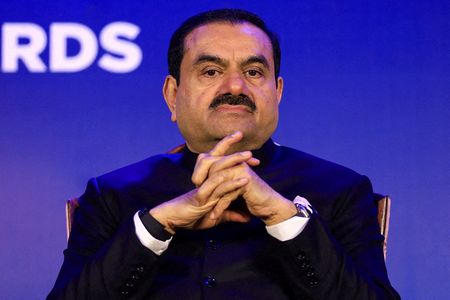

WASHINGTON — The U.S. Justice Department filed a formal request Saturday to have all charges against Indian billionaire Gautam Adani thrown out, arguing the case involves foreign conduct, carries little likelihood of winning at trial, and does not align with the agency’s current priorities.
U.S. District Judge Nicholas Garaufis had directed prosecutors last month to explain why they wanted to walk away from the case. In response, the Justice Department submitted a 10-page court filing Saturday laying out its reasoning for seeking to dismiss all charges with prejudice against Adani and the other defendants named in the case.
The new filing characterizes the case — brought during the Biden administration — as having been built on shaky legal ground from the start. “The indictment was unsealed in the final days of the prior Administration, apparently as a ‘name and shame’ designed to levy accusations without any realistic prospect of a trial ever occurring,” the filing states.
The Justice Department further argued that U.S. attorneys should not be pursuing a “foreign case” involving conduct with no ties to criminal organizations, no U.S. companies, and no national security concerns. “The alleged ‘payments’ in this case were made by Indian nationals, working for Indian companies, to the Indian government, with no U.S. interests implicated in any way,” the filing reads.
Adani was originally charged in 2024 with allegedly agreeing to pay bribes to Indian government officials in order for a subsidiary of his Adani Group to receive approval to develop a solar energy facility. He was also accused of misleading American investors by providing false assurances about his company’s anti-corruption standards.
Adani Group has repeatedly denied any wrongdoing, and Adani himself has never appeared before a U.S. court to answer the charges.
This effort to end the Adani prosecution is part of a broader pattern seen during President Donald Trump’s second term, in which the Justice Department has moved to close out several notable white-collar criminal cases.
Legal experts note that judges have very limited authority to force prosecutors to continue pursuing cases they no longer want to bring. However, the charges against Adani will remain officially active until Judge Garaufis formally orders their dismissal.
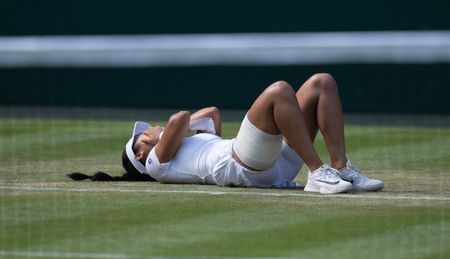

LONDON — Iga Swiatek says it was the fearlessness of young Filipina Alexandra Eala that brought her Wimbledon title defense to an abrupt end in the third round on Saturday, with the former champion now pledging to “trust the process” as she navigates a difficult stretch of form.
The defending champion fought hard through an opening set that lasted 84 minutes, only to lose it in a tiebreak. From there, Eala grew increasingly confident and ultimately pulled off the biggest upset of this year’s tournament.
Swiatek’s run at the French Open had already unraveled in May — a fourth-round loss to Marta Kostyuk that came on her 25th birthday. But she was quick to draw a distinction between that defeat and Saturday’s loss on grass.
“I don’t think it’s the same as in Paris. In Paris it was completely about me not handling the pressure well. I was firing shots,” Swiatek told reporters.
“Today… I was mis-hitting half of these returns. I lost many points. Maybe if I watch, I’m going to see something else.”
“I’m also happy how I came back in the tiebreaker, and also after being a break down in the first set because in Paris I’d just lose it straight.”
“I was there to fight. It wasn’t enough… in the tiebreak, when it was tight, I slowed down a bit, but she was brave enough to play a bit faster. You need to be brave in Wimbledon to win these points.”
The six-time major champion’s 2025 season has been defined by inconsistency. She exited in the quarterfinals at the Australian Open, Qatar, and Indian Wells, then suffered a second-round loss in Miami before enduring a rocky clay court season that ended in disappointment at Roland Garros. Her grass court warm-up was equally underwhelming, with an early exit in Bad Homburg ahead of Wimbledon.
Despite the string of setbacks, Swiatek says she has shifted her mindset away from chasing results.
“Well, you need to trust the process. I don’t care anymore about the results. I’ve been so focused on them that it’s hard to continue like that. So I’m trying to let it go,” she said.
“I don’t have good results, so I’m not going to expect for myself good results because they’re just not happening. I’m not on that level yet.”
“I need to work from the beginning and try to just get my tennis better.”


The U.S. Supreme Court’s refusal to allow a Rastafarian prisoner to pursue a lawsuit against prison officials who cut his hair is being viewed by many as an uncommon loss for religious freedom at the nation’s highest court. Legal experts say the case highlights just how complicated and wide-ranging religious liberty laws in America have become, especially as the country’s faith landscape continues to shift. Christians now make up 62 percent of the U.S. population — a notable drop from 78 percent two decades ago. Roughly 30 percent of American adults identify with no religion at all, while the remainder belong to various other faith traditions. Despite those divides, the Rastafarian inmate’s case drew backing from a broad coalition of religious groups.
The Trump administration is taking steps to restore a specialized option for LGBT youth who call the 988 mental health crisis hotline. The hotline currently offers dedicated options for specific groups, including veterans and Spanish-speaking callers. About a year ago, the administration eliminated the so-called “press 3” option for LGBT youth, citing a lack of funding. Now, officials say they plan to bring it back before the end of the year, after Congress directed that $33 million be set aside specifically for LGBT-focused interventions for young people. Democratic lawmakers were the driving force behind that funding mandate.
A newly released survey from Talker Research finds that Americans are sharply divided on the subject of Gay Pride Month. Seventeen percent of those polled said they don’t believe it should be observed at all, while another eight percent said it has become “too much” and should be scaled back. On the other side, 28 percent said Pride Month is meaningful and deserves support, and 21 percent said they support the concept but admit it doesn’t hold much personal significance for them. Researchers noted that these divisions closely mirror political party lines — support for the importance of Pride Month is more than twice as high among Democrats, while roughly one in three Republicans say the observance should be eliminated.
A gay rights activist has filed a federal lawsuit in New York City against the Department of Defense, demanding to know whether Scouting America secretly agreed to prohibit transgender boys from participating as part of a deal with the Pentagon. The plaintiff, James Dale, says both parties have given contradictory answers on the matter. The Defense Department announced an agreement with Scouting America back in February, which Secretary Pete Hegseth described as a move to steer the organization away from diversity programs and what he called “woke” policies. Hegseth also warned that the military would cut off its long-standing support for the organization if it did not comply within six months — a deadline that falls in late August.


From sea to shining sea, Americans are coming together to celebrate a major milestone — the 250th anniversary of the nation’s independence. Parades, fireworks displays, and patriotic gatherings are taking place across the country to mark the occasion.
This year’s Fourth of July carries extra significance as the country reaches the quarter-millennium mark, though the celebrations are unfolding amid a sweltering heat wave gripping much of the nation and deep political divisions that continue to define the current moment in American history.
The Associated Press has put together a photo gallery, curated by its photo editors, capturing the sights and spirit of this historic day across the United States.


Three children died after a boat capsized on Geneva Lake in Wisconsin’s Walworth County during a fierce Fourth of July storm — and authorities confirmed that all four children aboard the vessel had been wearing life jackets at the time.
The lake, located in a region of Southern Wisconsin long popular with vacationers from the Chicago area, became the site of a devastating holiday tragedy after a sudden and powerful storm swept through. The storm also toppled trees, snapped power lines, and made roads dangerous across several states.
According to a statement from Lake Geneva’s police department, a privately owned recreational motorboat with 10 people on board — including four children — attempted to reach shore quickly as conditions deteriorated. The boat was overwhelmed by powerful winds and waves, took on water, and eventually sank.
Rescuers pulled six adults and one child from the water alive. However, three children recovered during an extensive search were unresponsive, and lifesaving efforts administered immediately upon finding them were unsuccessful, police said.
In the wake of the storm, Lake Geneva Mayor Todd Krause declared a local emergency. He noted that one person sustained minor injuries after a falling tree struck them, and that downed trees and power lines blocked several streets throughout the area.
The Wisconsin Department of Natural Resources and the Geneva Lake Law Enforcement Agency launched investigations into the incident.
The deadly storm was part of a broader pattern of severe weather that swept across the Midwest and Northeast on Friday, forcing numerous cities to call off Independence Day festivals and push back fireworks shows. In Belleville, New Jersey, Mayor Frank Velez announced the celebration would be rescheduled to next year, telling residents: “While we’re disappointed we couldn’t celebrate together tonight, your safety will always come first.”
A violent storm that struck the New York area late Friday left hundreds of thousands of utility customers in the dark, halted train service to New Jersey, and damaged or uprooted thousands of trees. When combined with storm damage across the Midwest, nearly one million people were without electricity. By midday on July Fourth, roughly 750,000 utility customers remained powerless across Wisconsin, Michigan, Illinois, Pennsylvania, Ohio, New York, and New Jersey.
Despite the storms, dangerous heat returned quickly. By noon on July Fourth, temperatures in parts of the Northeast were climbing back toward triple digits. Forecasters predicted additional storms later in the day would bring relief, with significantly cooler temperatures expected heading into the new week.
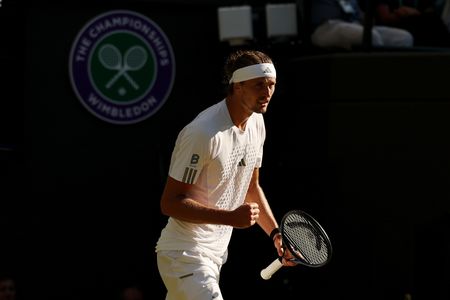

LONDON — Men’s second seed Alexander Zverev has punched his ticket to the Wimbledon round of 16 for the fourth time in his career, and there’s growing confidence that the German star may be ready to make a real statement on grass courts this year.
Zverev, still riding high after capturing his first-ever Grand Slam title at the French Open, made quick work of Marcos Giron on Saturday, winning 6-2, 7-6(4), 6-4 on Court One.
The 29-year-old has never advanced beyond the fourth round at the All England Club and has openly acknowledged that grass is the weakest surface in his game — though he has spoken with growing confidence throughout this week’s competition.
After dropping a set in his opening-round match against Alexander Blockx, Zverev has cruised through his subsequent matches, clearly benefiting from the dry, firm court conditions that suit his powerful serve.
His path gets considerably more difficult in the next round, however, as he is set to face hard-hitting Czech 13th seed Jiri Lehecka.


LONDON — Saturday at Wimbledon turned into a day of stunning upsets as the women’s draw lost two of its biggest stars in back-to-back shockers.
Defending champion Iga Swiatek, the Polish third seed, was dominated by 29th-seeded Alexandra Eala of the Philippines, falling 7-6(9) 6-2 in a match that began with a grueling first set stretching nearly 90 minutes. Shortly after, second seed Elena Rybakina — the 2022 Wimbledon champion who added the Australian Open title to her resume earlier this year — was knocked out by Belgium’s Elise Mertens, 7-6(4) 6-1.
Eala made history in the process, becoming the first player from the Philippines ever to reach the fourth round of a Grand Slam. A message written in Tagalog on her Nike cap sums up her attitude: “once it grows, it cannot be stopped.”
Speaking to an emotional Centre Court crowd, Eala reflected on her journey. “For someone who grew up in the Philippines … I went to training with my brother and my grandfather every day after school with my ruffled socks and my light-up shoes and chubby cheeks, so … to her, this is everything,” she said. She quickly added: “But because I’m emotional does not mean I’m satisfied, so yeah, okay, next round. Let’s go.”
The first set was a tense affair, with Eala saving a set point in the tiebreak after Swiatek netted a forehand — a moment that visibly frustrated the defending champion, who laughed sarcastically and shouted toward her team in the stands. Eala stayed composed and pulled away decisively in the second set.
A clearly dejected Swiatek later told reporters she is trying to shift her mindset. “Honestly, I don’t care anymore about the results. I’ve been so focused on them that it’s hard to continue like that,” she said. “So I’m really trying to let it go.”
Rybakina, who had a chance to reach world number one with a deep run in the tournament, also crumbled after a competitive opening set. “Definitely I need to analyse and change something, because it’s not working,” she said following the loss. Mertens, meanwhile, advanced to the last 16 for the fourth time in her career.
Eala’s next challenge will be 13th seed Jasmine Paolini, the 2024 Wimbledon runner-up, who rolled past Greece’s Maria Sakkari 6-1 6-2.
The day carried added emotion for American tennis fans, as Saturday marked the 250th anniversary of the Declaration of Independence. Serena Williams, one of the greatest athletes in U.S. history, announced via Instagram that she was withdrawing from her long-awaited doubles partnership with sister Venus due to injury. Williams had already exited the singles draw after a loss to Maya Joint following a four-year absence from the tournament. She described herself as “heartbroken to have to withdraw.”
There was some American success on the day, as qualifier Ashlyn Krueger cruised past Ukraine’s Daria Snigur 6-3 6-2. However, 23rd seed Emma Navarro was eliminated by Ukraine’s Marta Kostyuk in three sets.
On the men’s side, there were no major surprises. Second seed Alexander Zverev, the newly crowned French Open champion, kept his strong run going with a 6-2 7-6(4) 6-4 win over American Marcos Giron. Italy’s Flavio Cobolli, the French Open runner-up, dropped the opening set 6-0 to Russia’s Karen Khachanov but battled back to win in five sets, 0-6 7-6(4) 6-7(5) 6-2 6-2.
Italy could make history in the men’s draw, with the possibility of placing four players in the round of 16 for the first time since the 1947 French Open. Defending men’s champion Jannik Sinner has already advanced, while Matteo Berrettini and Lorenzo Sonego were set to play later. Cobolli, the ninth seed, will next face Australian Alex de Minaur, who defeated American Zachary Svajda 6-2 5-7 6-2 6-4.


Jonas Vingegaard is off to a strong start in his pursuit of a third Tour de France championship, claiming the coveted yellow jersey after his Visma-Lease a Bike squad turned in the best performance during Saturday’s opening stage — a 19.6-kilometer team time trial held in Barcelona.
The Danish cyclist’s team crossed the finish line in 21 minutes and 47 seconds, edging out the competition from the start of this year’s race.
Italian rider Filippo Ganna, competing for Netcompany-Ineos, came in eight seconds behind Vingegaard’s squad to take second place. Defending champion Tadej Pogacar of UAE Team Emirates-XRG rounded out the top three, finishing 12 seconds back.
For Vingegaard, it marks the first time he has worn the yellow jersey since 2023, as he looks to add a third Tour title to his resume.
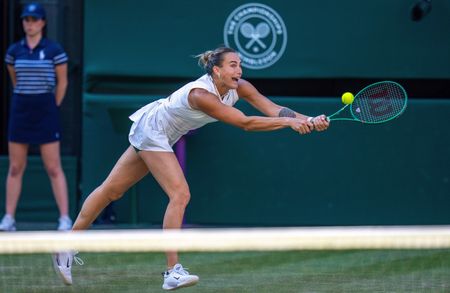

LONDON — Wimbledon’s fourth round is set for Sunday, featuring a highly anticipated women’s showdown between world number one Aryna Sabalenka and Naomi Osaka, along with a men’s clash between top seed Jannik Sinner and Japanese qualifier Shintaro Mochizuki.
WOMEN’S FEATURED MATCH: NAOMI OSAKA vs. ARYNA SABALENKA
Osaka, ranked 14th in the world, is hoping the fourth time will be the charm against Sabalenka. The Japanese star has fallen to the Belarusian in all three of their encounters so far in 2026 — at Indian Wells, Madrid, and the French Open.
Before this year, the two hadn’t faced each other in more than seven years. Their only prior meeting came back in 2018, when Osaka defeated Sabalenka on her way to winning her first Grand Slam title at the U.S. Open.
Osaka addressed the losing streak directly, telling reporters: “She’s the number one player in the world. If there is someone I had to lose to, I would pick that ranking position.”
She added: “If anything, I would say I learned from all of those matches, so hopefully I can apply (that).”
Osaka also pointed to the grass surface as a potential advantage for her heading into Sunday’s contest.
“My confidence is pretty high. For me, I know what my grass court tennis looks like. It gives me a pretty stable mindset going into the match no matter who I play,” she said following her victory over Daria Kasatkina.
“I also don’t really have as many doubts as I did on clay. Maybe it would be a little bit better for me on grass,” Osaka added.
Despite her recent dominance over Osaka, Sabalenka isn’t taking the match lightly.
“Always been a tricky match. She’s very aggressive player… every time she plays me, she’s more focused,” Sabalenka said. “Every time it’s a battle. Every time it’s high-level matches. Super excited to play her.”
MEN’S FEATURED MATCH: JANNIK SINNER vs. SHINTARO MOCHIZUKI
Mochizuki entered Wimbledon ranked 151st in the world and had been struggling with losses on the professional tour. But something clicked once he arrived at the All England Club, where he previously won the junior Wimbledon title back in 2019.
The 23-year-old has turned in the best Grand Slam performance of his career, reaching the round of 16. In the third round, he rallied from a set down to defeat 23rd seed Rafael Jodar, using aggressive net rushes and flat groundstrokes to unsettle the Spaniard.
World number one Sinner has taken notice of his upcoming opponent’s impressive run.
“He’s a very good player, especially on grass. His ball is very low, so it helps a lot. Seems like a very, very aggressive player,” Sinner said. “Very dangerous player. I try to be as prepared as I can.”
Mochizuki himself seems almost puzzled by his own success at this year’s tournament.
“It’s a strange feeling to play Jannik at Wimbledon, especially now this year. I was not winning much before coming here, and I don’t know how I have been winning matches here,” he said.
GAUFF CHANGES HER APPROACH ON SERVE
Coco Gauff has been well known for her struggles with her serve, but heading into her fourth-round match against Belinda Bencic, the American says she’s shifting her mindset — going for power rather than simply trying to land the ball in play.
“I feel like most of the time when my first serve does go in, I’m getting a weaker reply,” said Gauff, who has won her last three meetings with the Swiss player and is chasing her first-ever Wimbledon quarter-final appearance.
“I think it’s much easier to start the points off when you’re on the offensive than if you just get it in and you’re hoping the girl misses. At this level, it’s not going to happen, especially now in the second week,” she added.
SUNDAY ORDER OF PLAY
Centre Court (Play begins at 12:30 p.m. GMT): Roman Safiullin (Russia) vs. 7-Novak Djokovic (Serbia); 1-Aryna Sabalenka (Belarus) vs. 14-Naomi Osaka (Japan); 1-Jannik Sinner (Italy) vs. Shintaro Mochizuki (Japan).
Court Number One (Play begins at 12:00 p.m. GMT): 4-Jessica Pegula (U.S.) vs. 16-Iva Jovic (U.S.); 3-Felix Auger-Aliassime (Canada) vs. 22-Alejandro Davidovich Fokina (Spain); 11-Belinda Bencic (Switzerland) vs. 7-Coco Gauff (U.S.).
Court Number Two (Play begins at 10:00 a.m. GMT): Doubles matches to be announced; 10-Karolina Muchova (Czech Republic) vs. Barbora Krejcikova (Czech Republic); Hubert Hurkacz (Poland) vs. Jan-Lennard Struff (Germany).
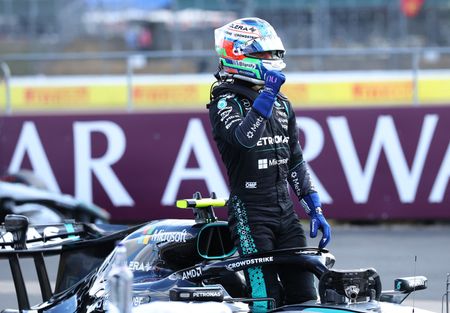

SILVERSTONE, England — Formula One championship leader Kimi Antonelli had a day to remember at a blustery Silverstone circuit, first taking victory in the sprint race and then claiming pole position for Sunday’s British Grand Prix.
The 19-year-old Italian set a best lap time of one minute 28.111 seconds on his opening run in the final qualifying segment, proving too quick for the rest of the field. Ferrari’s Charles Leclerc slotted into second on the grid, 0.175 seconds back, while seven-time world champion Lewis Hamilton secured third.
Antonelli’s closest rival in the title race, Mercedes teammate George Russell, could only manage fourth place — a significant blow at his home circuit. The pole was Antonelli’s fifth of the season and continued Mercedes’ remarkable run of starting from the top spot at all nine grands prix held so far this year.
“It was a very tidy lap, a lap where I put everything together,” Antonelli said. “It was very tricky with the wind because it was very gusty and unpredictable.”
Earlier in the day, Antonelli won the sprint race ahead of Hamilton, pushing his championship advantage over Russell out to 43 points. The young Italian had reeled off five consecutive race wins before Hamilton snapped that streak in Spain last month.
Looking ahead to Sunday’s race, Antonelli acknowledged the challenge posed by the two Ferraris directly behind him on the grid. “It’s not going to be easy because I have two Ferraris behind me and, for sure, they will work together,” he said. “Their pace is good but ours was strong in the Sprint. Hopefully we can keep that for tomorrow and do a good race.”
Isack Hadjar qualified fifth for Red Bull, with McLaren’s reigning world champion and defending British GP winner Lando Norris in sixth. Four-time world champion Max Verstappen of Red Bull will start seventh, McLaren’s Oscar Piastri eighth, and the Racing Bulls duo of rookie Arvid Lindblad and Liam Lawson rounded out the top ten.


The Pittsburgh Pirates have landed reliever Evan Sisk on the 15-day injured list after he developed inflammation in his left elbow, the team announced Saturday.
The 29-year-old southpaw had been a steady presence in Pittsburgh’s bullpen, posting a 1-0 record with a 2.23 ERA across 32 appearances this season. His most recent outing came on Monday, and the injured list placement was backdated to Wednesday.
Sisk came to Pittsburgh via a trade with Kansas City at the 2025 trade deadline. Over his career spanning 51 games — all relief appearances — with both the Royals and the Pirates, he carries a combined 2-1 record and a 2.67 ERA.
To fill the vacancy on the roster, Pittsburgh recalled right-hander Hunter Stratton from Triple-A Indianapolis. Stratton had not yet taken the mound for the Pirates since rejoining the club in the June 18 trade that sent catcher Joey Bart to the Atlanta Braves.
The 29-year-old Stratton has put together a career line of 3-2 with a 3.75 ERA and two saves over 60 relief appearances with the Pirates (2023-25) and Braves (2025-26). His lone outing for Atlanta this season came on May 2, when he tossed a scoreless inning, surrendering just one hit in a 9-1 victory over Colorado.


Colorado Rockies right-hander Tomoyuki Sugano will not take the mound Saturday against the visiting San Francisco Giants after being scratched from his scheduled start because of back spasms.
Stepping in to fill the role will be rookie left-hander Sean Sullivan, who carries a 0-2 record and an 8.64 ERA into the Denver contest.
Sugano, who is 36 years old and holds an 8-4 record with a 4.80 ERA this season, had been pitching well throughout June. He went 4-0 across five starts that month, though his ERA during that stretch was 6.58. His teammates provided him with a combined 40 runs of offensive support across those four victories.
Sullivan, 23, most recently pitched Monday against the Miami Marlins, where he gave up five runs on six hits over 4 2/3 innings and walked away with a no-decision. Saturday’s matchup will mark his first career appearance against San Francisco.


KANSAS CITY, Missouri — Argentina’s reign as World Cup champions continues, but not without a significant scare. The South American side needed extra time to defeat first-time World Cup participants Cape Verde 3-2 on Friday, escaping what could have been a stunning upset in Kansas City.
Cape Verde refused to be intimidated, coming from behind twice to level the score and expose defensive weaknesses in the Argentine lineup. The match was ultimately settled when defender Cristian Romero’s header was redirected into the net off Cape Verde’s Diney Borges, finally putting the contest to rest.
Coach Lionel Scaloni had cautioned before the match that Cape Verde posed a real threat, pointing to their group stage draws against Spain and Uruguay. Still, few expected the tournament newcomers to push Argentina this close to elimination.
The result throws a spotlight on Argentina heading into their round-of-16 showdown with Egypt in Atlanta on Tuesday. The team had cruised through the group stage with wins over Algeria (3-0), Austria (2-0), and Jordan (3-1), but questions had already been swirling about the quality of opposition they had faced. Their defense had not been seriously tested until Friday night.
Former River Plate coach Marcelo Gallardo, who represented Argentina at the 1998 and 2002 World Cups, suggested the close call might be exactly what the team needed. “It was good that this happened. There will be a reaction, there has to be a reaction,” he said on ESPN Argentina.
Lionel Messi scored in the first half, extending his own World Cup record to 20 career goals, but the 39-year-old captain acknowledged the physical demands of the match took a toll. “They had the ball and made us run because we couldn’t press,” he said. “We couldn’t press them properly, the lines were too far apart.”
Scaloni acknowledged room for improvement while crediting his team’s ability to respond under pressure. “There is always room for improvement, but it is important that the team stepped up during difficult moments,” the manager said. “We can debate whether we played well or poorly, but this team doesn’t shy away from taking charge of the match.”
Two defenders who battled back from serious injuries provided key contributions and gave the victory an added emotional dimension. Lisandro Martinez, who tore his anterior cruciate ligament in early 2025, scored Argentina’s second goal. Romero, who had missed earlier tournament games due to knee problems, helped set up the winning goal.
“Everything I went through was very hard, but thanks to my club and the national team today I’m very happy,” Martinez said. “I’m grateful to the doctors and coaching staff for allowing me to be here. I’m on cloud nine.”
Argentina will head to Miami on Saturday to resume training as they prepare to face Egypt in the knockout round.


Travelers making their way southbound on Coastal Highway between South Bethany and Fenwick Island should expect some extra time behind the wheel.
Congestion along that corridor is currently causing delays ranging from five to ten minutes, according to traffic reports.
Drivers in the area are encouraged to allow for additional travel time or consider alternate routes if possible.
If you were planning to watch the Independence Day Parade in Washington this year, you’ll need to make other plans. Organizers announced late Friday that the parade has been called off due to an extreme heat warning, with temperatures forecast to climb as high as 115 degrees.
While the parade won’t be taking place, those hoping to still mark the holiday with a show in the sky are in luck — the evening fireworks display is still scheduled to go ahead as planned.


PARIS (AP) — Swimming in the Seine River has become a new summertime tradition in Paris, as the city opened three supervised bathing locations for the second year running this past Saturday.
The three free swimming zones — situated near City Hall, the Eiffel Tower, and in the eastern part of the city — will stay open throughout the summer, weather and water quality permitting. Lifeguards are stationed at each site, and officials test the water every day to ensure it meets safety standards.
Those who took the plunge described the experience as something they won’t soon forget.
“It’s amazing to be swimming in the Seine while looking at the Eiffel Tower,” said Stewart Talbot, a tourist from Melbourne, Australia, who was spending a week in Paris. “Maybe it’s not as good as the sea in Australia, but it’s better than our rivers.”
Locals are also eager to check the activity off their bucket lists.
“It’s great because it’s such a mix of people,” said Hermine Jegou, 19. “I love that everyone can get into the water — grandmothers, children — it’s just really nice.”
Her sister, Joanne Jegou, 21, said she would gladly return. “It’s such a cool experience, especially being out in the sun and cooling off.”
The Seine served as a competition venue for swimming and triathlon events during the Paris 2024 Olympics. Those games helped speed up a massive, multibillion-euro river cleanup effort that included major sewer upgrades, new rainwater storage systems, and other pollution-reduction projects.
Despite the progress, last summer saw multiple swimming days scrapped after heavy rainfall pushed pollution levels higher upstream.
At the Grenelle site near the Eiffel Tower, staff were already preparing for large crowds expected to seek relief from upcoming hot temperatures.
“The maximum capacity here is 200 people,” said Clémence Donazzan, deputy manager of the Grenelle site. A queuing system will be in place at the entrance, and staff will track swimmer numbers in real time, she added, “so everyone will eventually have access, even if there’s a short wait.”
Swimming in the Seine had been off-limits for roughly a century before 2024 due to longstanding water quality concerns. A canal in northeastern Paris has offered public swimming during the summer months for several years.


A photograph circulating online shows a blindfolded Palestinian man from Gaza stripped down to his underwear, lying face down on a cot while in Israeli military custody. His hands are tied behind his back, his right foot is bound to the corner of the cot, and a wooden rod is fastened along the back of his body from his foot up to his neck. His face is largely hidden from view.
Israel has confirmed the image is authentic and stated that what it shows does not reflect the values of its military. However, authorities have not disclosed the identity of the man or where he is being held. An inquiry has been launched, and the military said those found responsible “will be dealt with in accordance with the findings.”
The photo — originally posted to Instagram by an account that has since been deleted — had the words “good morning” written in Hebrew across the image.
The uncertainty surrounding the man’s identity has intensified the suffering of two Palestinian mothers, Rana Abu Nassar and Joudeh Al-Ghoul, each of whom is certain the man in the photo is her own son.
Abu Nassar said she recognized the man immediately when she first saw the image two days ago. “I know the details of his body. He has swelling in his foot and scars on his leg — the same swelling on his left leg I saw in the picture,” she said. She believes the man is her son Osama, whom she has not seen or heard from since his arrest in March near Israel’s armistice line with Hamas militants.
Osama’s detention on March 19 drew international attention because his 1-year-old child was taken into custody alongside him. The baby was released the same day, and his family reported the child had cigarette burn marks on his legs. Israel’s military denied those allegations, saying the marks came from warning shots troops fired to stop Osama from approaching what is known as the “Yellow Line” — an area where Israeli forces regularly open fire on Palestinians approaching. Reuters was unable to independently confirm the details of his arrest.
Abu Nassar also noted that her son has mental health issues and said a “normal person would not take his son to that area.”
Al-Ghoul, the second mother, said her son Amin was detained in November 2023 while attempting to travel from southern Gaza to the northern part of the territory. She, too, said she knew the moment she saw the image that it was her child.
“It’s him — his hair and chin. He is my son. A mother’s heart can recognise her son. I hugged the mobile phone and started crying,” she said from a displaced persons camp in Gaza City. “He is my son, my soul, my life.”
Approximately 1,200 Palestinians from Gaza are currently held in Israel under the Internment of Unlawful Combatants Law, a measure that permits indefinite detention of individuals believed to have taken part directly or indirectly in hostile acts.
Amani Sarahneh of the Palestinian Prisoners Society said her organization has submitted both men’s names to the Israeli military since the photo emerged, in an effort to arrange legal visits. “Visits do take place, but with great difficulty. The coordination process takes a very long time,” Sarahneh said.


The Toronto Maple Leafs made a move Sunday morning, inking restricted free agent defenseman Emil Andrae to a two-year contract extension.
While the team did not release the financial details of the agreement, TSN reported the total value of the deal at $3.1 million.
Andrae came to Toronto as part of a trade with the Philadelphia Flyers on June 16. In that deal, the Maple Leafs also received goaltender Samuel Ersson and a third-round selection in the 2026 NHL Draft. In return, Philadelphia received defenseman Simon Benoit and goaltender Joseph Woll.
The 24-year-old Andrae wrapped up his three-year entry-level contract after putting up 13 points — two goals and 11 assists — across 61 games during the most recent season.
Originally selected by Philadelphia in the second round of the 2020 NHL Draft, Andrae has accumulated 20 points in 107 career games since making his NHL debut with the Flyers in October 2023, tallying three goals and 17 assists over that stretch.
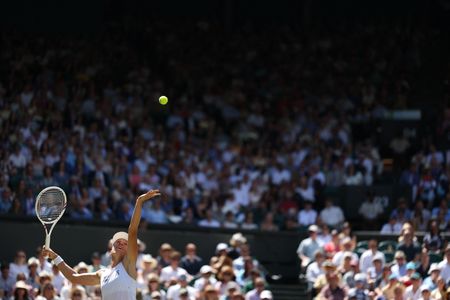

Iga Swiatek’s bid to defend her Wimbledon crown came to a stunning end Saturday when the Polish third seed was defeated by Filipino sensation Alexandra Eala in a gripping third-round contest at the All England Club in London. Eala claimed the victory 7-6(9) 6-2, sending shockwaves through the tournament.
Swiatek captured last year’s Wimbledon title, finally silencing doubters who had long questioned whether she could conquer the sport’s fastest playing surface. However, the 25-year-old arrived at this year’s tournament carrying some uncertainty, having suffered an early exit at the Bad Homburg warm-up event and still working to find her best form.
She had shown encouraging signs in her previous two matches, getting past Taylor Townsend and then handling Karolina Pliskova with confidence. But on a sun-drenched Centre Court afternoon, she ran into a red-hot Eala and could not find a way through.
The two players had crossed paths before. Eala stunned Swiatek in Miami last year, only for the Pole to return the favor on the clay courts of Madrid. Saturday’s rematch, however, belonged to the left-handed Eala, whose aggressive baseline hitting put Swiatek on the back foot from the very start.
The opening set was a fiercely competitive affair, with neither player willing to give an inch. When Eala eventually claimed it in a tiebreak, Swiatek’s frustration boiled over — she was seen shouting toward her team in the stands before slamming her racket against a chair. Meanwhile, Eala soaked in the crowd’s enthusiastic applause.
Eala kept the momentum rolling into the second set, breaking Swiatek’s serve twice in quick succession to race out to a 3-0 lead. Swiatek managed to claw back one of those breaks, but Eala held firm, ultimately sealing the match with a forehand winner that sent the crowd into a frenzy.
With the victory, Eala advances to the fourth round where she will face 2024 Wimbledon runner-up Jasmine Paolini in what promises to be another exciting matchup.
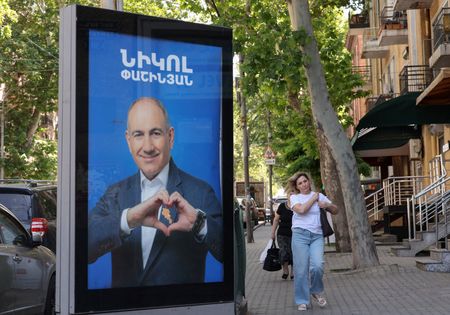

Armenia’s constitutional court has turned down a bid by the country’s pro-Russian opposition to nullify the results of a June parliamentary election, according to the state news agency Armenpress.
The court’s ruling on Saturday upheld the election outcome, dismissing a challenge brought by the Strong Armenia opposition bloc. That bloc captured 23.3% of the vote and had alleged that the election was marred by irregularities.
The governing Civil Contract party, led by pro-Western Prime Minister Nikol Pashinyan, claimed nearly 50% of the vote, securing its continued hold on power.
Prior to the election, opposition groups raised concerns about a wave of arrests that they said targeted their parliamentary candidates and supporters.
A team of international election observers acknowledged the allegations of vote-buying and other potential violations, but noted that voting proceeded without major incident at the vast majority of polling locations.
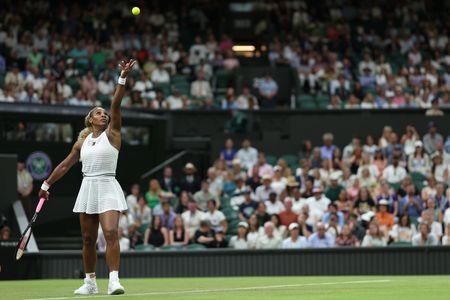

Serena Williams will not be taking the court at Wimbledon for doubles play after a knee injury forced her to step away from the tournament, ending what was meant to be a memorable reunion with sister Venus on the grass courts of the All England Club.
In a heartfelt post shared on Instagram, the 44-year-old expressed her disappointment. “I’m heartbroken to have to withdraw from doubles. Coming back to compete again has been a gift, and the opportunity to play alongside @venuswilliams once more meant the world to me,” she wrote. “I did everything I could but unfortunately my knee just isn’t ready to compete.”
The withdrawal comes just days after Serena’s highly anticipated return to Grand Slam tennis — her first in four years — came to a disappointing end. She fell to Australian up-and-comer Maya Joint on Tuesday by a score of 6-3, 6-7(6), 6-3 in the first round of singles play.
Following that loss, Serena revealed she had “tweaked” her right knee toward the end of the opening set but had hoped to push through and compete in doubles.
The Williams sisters had received a wildcard entry into the doubles draw and were scheduled to face Solana Sierra and Camila Osorio in their opening match. The pair have a storied history at Wimbledon, having claimed six doubles titles together at the prestigious tournament.
Serena also took a moment to thank tournament director Jamie Baker and the rest of the staff. “I’m especially grateful to tournament director, Jamie Baker, and the entire tournament team for giving me every opportunity to recover,” she said.
She closed her message with a tease for her supporters: “Thank you to the fans for your incredible support and for making this comeback so meaningful…All I can say is stay tuned to a city near you…”
This is not the first time injury has disrupted Serena’s recent comeback efforts. Last month, she teamed up with Canadian teenager Victoria Mboko at a WTA event at Queen’s Club, but that partnership was cut short when Mboko suffered a knee injury of her own during singles play. Serena then joined forces with Czech player Karolina Muchova at the Berlin Open, though the two were eliminated in their very first match.


Shohei Ohtani, the two-way sensation for the Los Angeles Dodgers, will not take the field Saturday night when his team faces the San Diego Padres. The reason: tightness in his right biceps.
The Dodgers, who hold the best record in Major League Baseball and a commanding 14-game lead in the National League West, are in a position to allow their designated hitter and pitcher some time to rest and heal.
Ohtani exited Friday’s 4-3 Los Angeles victory in the seventh inning after noticing the biceps tighten up following a swing he took in the previous inning.
Speaking with reporters after the game, Ohtani noted that he had dealt with a similar problem earlier this season and recovered from it “relatively quickly.”
Manager Dave Roberts echoed that optimism, saying, “He’s dealt with it before. He’s a quick healer and finds a way to get back. But I do think that for us to read and react and hear what his body is telling him is really important, given the toll it takes on his body to be a two-way player.”
Friday’s appearance against the Padres had Ohtani on the mound as the starting pitcher, working on nine days of rest. He threw a season-high 110 pitches, surrendering three runs on seven hits and two walks across six innings while striking out nine batters. At the plate, he went 0-for-3.
On the season, Ohtani is hitting .288 with 18 home runs and 50 RBIs. On the pitching side, he carries an 8-2 record with a 1.79 ERA, having tossed 85 and two-thirds innings over 14 starts.
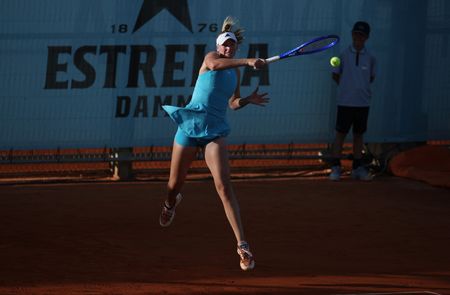

LONDON — Ashlyn Krueger found the perfect way to ring in the Fourth of July, rolling through Ukraine’s Daria Snigur 6-3, 6-2 on Saturday to advance to the third round at Wimbledon — all on America’s 250th birthday.
Krueger, who entered the tournament as a qualifier and sits at No. 102 in the world rankings, was among eight American singles players competing in southwest London while their fellow Americans back home enjoyed holiday festivities and fireworks.
Not every American had reason to celebrate, though. The 23rd-seeded Emma Navarro struggled against her Ukrainian opponent, falling 6-2, 4-6, 6-1 to 12th seed Marta Kostyuk.
On the men’s side, 23-year-old Zachary Svajda made his Wimbledon debut and gave fifth-seeded Australian Alex de Minaur a scare, capturing a set before ultimately bowing out 6-2, 5-7, 6-2, 6-4.
Fans at the All England Club were also eagerly awaiting a much-anticipated doubles appearance by Venus and Serena Williams, who were scheduled to take the court Saturday against Colombia’s Camila Osorio and Argentina’s Solana Sierra.
The iconic sisters, now 46 and 44 years old, last played doubles together at the 2022 U.S. Open. Between them, they captured six Wimbledon doubles titles from 2000 to 2016, part of a combined haul of 22 doubles titles and three Olympic gold medals.
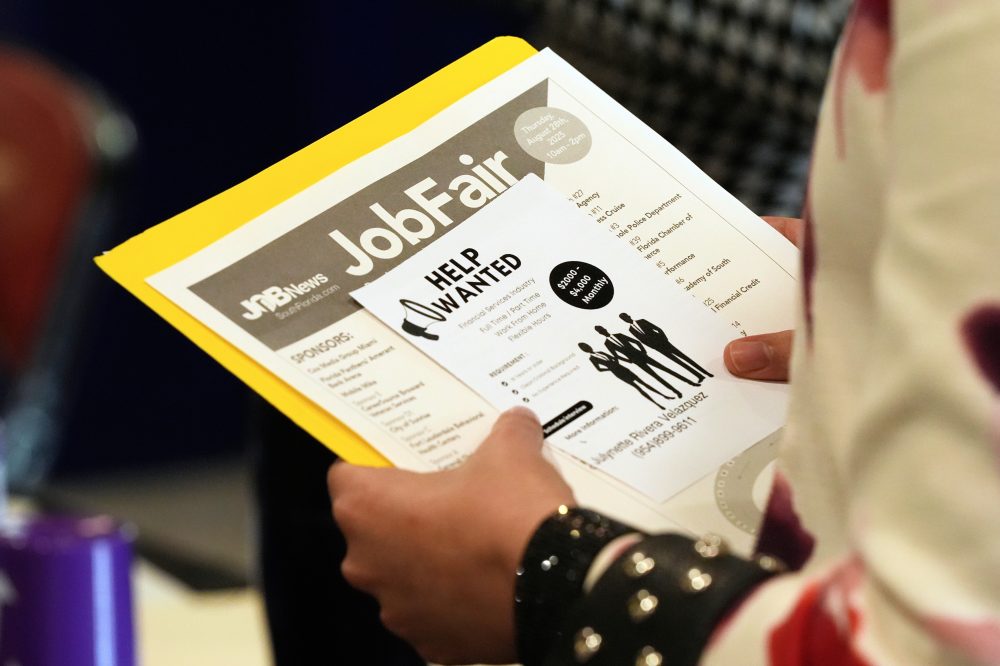

The economy and inflation have dominated the conversation over the past week, touching nearly every corner of American life. From trips to the grocery store to filling up at the gas pump, rising costs continue to weigh on families and shape decisions being made by both households and businesses alike.
Here is a look at the most significant economic data released over the past week and what it could mean for your wallet.
Americans are feeling marginally more optimistic about the economy this month, largely driven by a dip in gas prices — but the overall mood is still quite downbeat compared to historical norms.
The Conference Board announced Tuesday that its consumer confidence index ticked up 0.6 point to 91.2 in June. That number still trails the year-ago reading of 95.2. Consumer attitudes took a hit after the Iran war triggered a spike in oil and gas prices, accelerating inflation and shrinking Americans’ inflation-adjusted incomes. Before the pandemic, the same index routinely climbed above 120.
The data indicates that consumer confidence is bouncing back only gradually from the blow dealt by the Iran war.
American employers significantly slowed their hiring pace last month, adding just 57,000 jobs — fewer than half the number added the month before — signaling that many companies remain cautious about the economic road ahead.
The Labor Department reported Thursday that the unemployment rate edged down to 4.2% from 4.3% in May. However, much of that decline happened because a large number of out-of-work Americans stopped searching for jobs and were therefore no longer counted as unemployed.
The numbers paint a picture of businesses still wary of the economy’s direction, with inflation sitting at a three-year high and consumer confidence hovering near post-pandemic lows. Job gains that had initially been reported for April and May were also revised downward.
On a brighter note, the number of Americans filing new unemployment claims declined slightly last week, with layoffs still at historically manageable levels.
For the week ending June 27, new unemployment benefit applications dropped by 1,000 to 215,000, according to the Labor Department’s Thursday report. That came in below the 225,000 new filings that analysts surveyed by the data firm FactSet had predicted.
Weekly unemployment filings are closely watched as a near real-time measure of layoff activity and overall job market health.
The four-week moving average of jobless claims, which smooths out week-to-week swings, fell by 2,500 to 222,000.
Prospective homebuyers got a bit of relief this week as the average long-term mortgage rate dropped to its lowest point since mid-May.
Mortgage buyer Freddie Mac reported Thursday that the benchmark 30-year fixed mortgage rate slipped to 6.43% from 6.49% the previous week. That same rate stood at 6.67% one year ago.
Since the conflict between the U.S. and Iran erupted in late February, mortgage rates have largely hovered around 6.5%. The war disrupted the flow of crude oil out of the Persian Gulf, pushing oil prices sharply higher and helping fuel inflation, bond yields, and borrowing costs for homebuyers.
Despite the economic headwinds, U.S. job openings held at a surprisingly resilient 7.6 million in May, topping forecasts that had called for just 7 million openings.
Still, the job market’s strength has its limits. Layoffs increased in May, and the number of workers voluntarily leaving their jobs — often seen as a sign of confidence in finding something better — rose only slightly, according to data released Tuesday by the Bureau of Labor Statistics.
Employers are posting openings but not doing much actual hiring. Total gross hiring fell to 5.17 million in May from 5.26 million in April. During the post-pandemic hiring boom that ran from mid-2021 to mid-2023, gross monthly hiring routinely exceeded 6 million.


CAIRO (AP) — Egypt has announced two major archaeological discoveries, including the uncovering of a remarkably well-preserved residential city from the Byzantine era buried in the country’s western desert.
The Egyptian government revealed the findings at two separate sites — the Dakhla Oasis and the Marina el-Alamein archaeological site near Alexandria — hoping the discoveries will give a boost to the nation’s critical tourism industry, which depends significantly on visitors drawn to ancient sites.
Tourism, along with the Suez Canal, is one of Egypt’s primary sources of foreign currency, making such discoveries economically significant for the financially strained country.
According to the Tourism and Antiquities Ministry, the Dakhla Oasis discovery sheds light on everyday life, city planning, and commerce during the fourth century, when Egypt was under Byzantine rule.
Hisham el-Leithy, secretary general of the supreme council of antiquities, described the excavated city layout as featuring north-south main roads crossed by east-west streets, creating open plazas and communal spaces throughout the settlement.
Mahmoud Massoud, who leads the archaeological mission, said a basilica church dating to the middle of the fourth century sits at the top of the settlement, looking out over the main roads below. The remains of two watchtowers, built to protect the edges of the city, were also found.
The Dakhla Oasis is located in Egypt’s western province of New Valley and is currently on UNESCO’s Tentative List, placing it one step away from being designated a World Heritage Site.
Massoud also noted the discovery of a heavily fortified structure with thick walls, as well as numerous homes featuring reception areas and arched ceilings.
Among the most notable residential finds was the house of Tisous, identified as a church deacon. The structure dates to the second half of the fourth century and is believed by archaeologists to have functioned as a house of worship before the city’s main basilica was built.
Excavators also uncovered bread ovens, cooking areas, and stone tools used for grinding food. Well-preserved bronze coins were found bearing images of Byzantine emperors, Latin text, and Christian symbols. A collection of gold coins from the reign of Roman Emperor Constantius II — who ruled from 337 to 361 — was also recovered, according to the ministry.
Diaa Zahran, head of the Islamic, Coptic and Jewish Antiquities department, said archaeologists discovered roughly 200 pottery fragments that were once used as writing surfaces. These fragments, known as ostraca, contain inscriptions recording business dealings, personal correspondence, and glimpses of daily life.
In a separate announcement, archaeologists reported uncovering 18 ancient tombs at the Marina el-Alamein site, located approximately 100 kilometers — or about 62 miles — west of the Mediterranean city of Alexandria.
The newly found tombs include 11 carved directly into rock at an average depth of 8 meters, and seven others constructed above ground using limestone. With these additions, the total number of tombs discovered at the site now stands at 48, the ministry said.
Items found within the tombs included pottery vessels, amphorae, oil lamps, plates, altars, and limestone basins.
Mission chief Eman Abdel-Khaliq reported finding a granite sarcophagus measuring 2.5 meters in length containing skeletal remains that are currently being analyzed. Near the sarcophagus, researchers also found the remnants of a plaster sphinx statue.
Abdel-Khaliq added that four gold pieces were discovered placed inside the mouths of some of the deceased — a practice known as “the golden tongue,” which was tied to the funerary traditions of that period.
Marina el-Alamein, situated near the city of Alamein along Egypt’s Northern Coast, was first uncovered in 1986. Researchers believe it was once the ancient Greco-Roman port city of Leukaspis, a Mediterranean settlement built in the second century that flourished through the fourth century.
Egypt’s tourism sector has been on a steady path to recovery following years of political instability and unrest after the 2011 uprising, as well as the disruption caused by the coronavirus pandemic.
Official figures show that a record 19 million tourists visited Egypt last year, marking a 21% jump compared to 2024. The first four months of 2026 welcomed 6.1 million visitors, up from 5.7 million during the same stretch in 2025.


Dover police are investigating a shooting that left a 33-year-old man seriously wounded on Friday night at a local hair salon.
Officers were called to J Stylz Unisex Salon, located at 1101 S. DuPont Highway, around 8:17 p.m. on July 3rd, 2026 after reports of a shooting. When they arrived, they found the victim had been struck by gunfire multiple times in his lower legs and once in the abdomen.
Emergency medical crews transported the man to a nearby hospital, where he remains in serious but stable condition.
The investigation is ongoing. Anyone who has information about this incident is encouraged to reach out to the Dover Police Department at (302) 736-7145. Those who wish to remain anonymous can submit tips through Delaware Crime Stoppers by calling 800-TIP-3333 or by visiting www.delaware.crimestoppersweb.com online. A cash reward may be offered for any information that leads to an arrest.
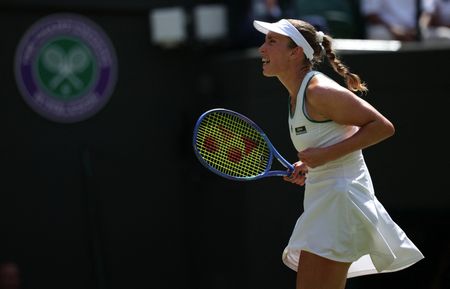

LONDON — A stunning upset unfolded at Wimbledon on Saturday when 25th-seeded Belgian Elise Mertens knocked out second seed Elena Rybakina, handing the Kazakh star a 7-6(4) 6-1 defeat in the third round of the prestigious grass-court tournament.
The loss crushed Rybakina’s dual ambitions of capturing a second Grand Slam title this year and climbing to the top spot in the WTA world rankings. To have any shot at overtaking Aryna Sabalenka at number one, Rybakina needed to advance at least to the quarterfinals.
Rybakina, who had won this year’s Australian Open to go along with her 2022 Wimbledon championship, never found her footing after dropping the opening set in a tiebreak. Mertens, the savvy 30-year-old, used a wide range of shot-making to keep her opponent off balance throughout the match — a contrast to what was described as a flat showing from Rybakina on Court One.
Mertens, who currently holds a Wimbledon doubles title, was dominant during one stretch of the second set, reeling off nine consecutive points. Though she showed some nerves while serving out the match, she closed things out emphatically with an ace. It marked just her second victory over Rybakina in nine career meetings between the two.
With Czech player Marie Bouzkova standing between her and the quarterfinals, Mertens has a real opportunity to post the deepest Wimbledon singles run of her career.


Southbound travelers on Coastal Highway should expect some extra time behind the wheel as congestion is causing delays between the DE 1A Rehoboth Beach interchange and Collins Avenue.
According to traffic reports, the backup is resulting in approximately 5 to 10 minutes of additional travel time through that corridor.
Drivers in the area are encouraged to allow extra time or look for alternate routes to avoid the slowdown.


Motorists traveling eastbound on Route 54 should expect some added time behind the wheel as congestion is causing delays between Mallard Lakes and Coastal Highway.
According to traffic officials, the backup is resulting in wait times of roughly 5 to 10 minutes along that corridor.
Drivers are encouraged to plan accordingly and allow extra travel time until the congestion clears.


Travelers on Route 26 westbound should expect some added time behind the wheel as congestion is causing noticeable slowdowns in the area.
According to traffic reports, the delay is affecting the stretch of roadway running from Coastal Highway to Central Avenue, with backups adding roughly five to ten minutes to travel times.
Drivers in the area may want to allow extra time or look for alternate routes to avoid the congestion.


Motorists traveling eastbound on Route 26 should expect a delay between Central Avenue and Route 1.
Congestion along that stretch is causing travel times to run approximately five to ten minutes longer than usual.
Drivers are encouraged to plan ahead and allow extra time if their route takes them through that corridor.


Travelers on Coastal Highway southbound are experiencing slowdowns between U.S. Route 9 and DE 1A near Rehoboth Beach.
According to Delaware Department of Transportation, congestion in that stretch is causing delays of approximately 5 to 10 minutes.
Drivers in the area are encouraged to allow extra time or seek an alternate route to avoid the backup.


Southbound Limestone Road, also known as Delaware Route 7, is closed at Village Drive as crews respond to a fire in the area.
Motorists traveling southbound on DE 7 should avoid the area and plan for alternate routes until the road is reopened. No estimated time for reopening has been provided.
Drivers are urged to use caution near the scene and follow any detour signs posted by traffic authorities. Updates will be provided as more information becomes available.


Medical experts are raising serious concerns about a troubling rise in child drowning deaths across the United States, warning that every second counts when a child ends up in the water.
“When drowning occurs, seconds matter,” said Dr. Rohit Shenoi, the lead author of a recent American Academy of Pediatrics alert. “Quick rescue and resuscitation can mean the difference between life, death and lifelong disability.”
Each year, between 4,000 and 5,000 Americans drown. The majority are adults who lose their lives in natural bodies of water like lakes, ponds, or the ocean. But for children, the risk is disproportionately severe — drowning is the number one cause of death among kids ages 1 to 4, and ranks among the top killers of children ages 5 to 14. The drowning rate is higher for white children in the younger age group, while Black, American Indian, and Alaska Native children face significantly higher rates in the older group.
Very young children sometimes drown in bathtubs, but swimming pools are the most common setting for these tragedies.
One grocery chain has made drowning prevention part of its identity. Inside several locations of the Stew Leonard’s grocery stores — known for a lively, theme-park-like atmosphere complete with animatronic characters like a dancing banana and singing avocados — shoppers will find an unexpected figure: a life-jacketed duck named Stewie who sings about water safety.
The duck honors the memory of the son of the chain’s chief executive. The boy was just 21 months old when he drowned during a family vacation on the island of St. Martin in 1989.
More than a dozen family members and friends had gathered for a birthday party celebrating Stewie’s older sister, who was turning 3. His father was outside hanging balloons while his mother was inside baking a cake.
“I saw Stewie outside and I assumed that he was watching him,” said his mother, Kim, explaining that other relatives were also nearby at the pool.
“We never communicated with each other; ‘You’ve got him?’” said Kim Leonard, now 65. “When everyone’s watching, nobody’s watching.”
“There were a couple of balloons floating in the water,” recalled Stew Leonard, now 71. “And you know after a few minutes, sort of everybody was like, ‘Where’s Stewie?’ Unfortunately I was the one who found him. He was face down in the pool.”
The couple responded to their son’s death by creating a foundation dedicated to funding children’s swimming lessons and raising awareness about drowning prevention.
For decades, the numbers were moving in the right direction. Unintentional child drowning deaths dropped from roughly 2,000 per year in the 1980s to fewer than 1,000 annually by the early 2000s, driven by public awareness efforts, greater access to swimming lessons, and new pool fencing laws. Between 2000 and 2019, health officials recorded a 38% decline.
Then the trend reversed. Child drowning deaths rose from 756 in 2019 to 865 in 2024 — the most recent year with complete data available. The majority of those deaths involved children under the age of 5. The child drowning death rate also ticked upward, from 1.1 to 1.2 per 100,000 children.
Experts point to several causes for the reversal. The COVID-19 pandemic disrupted swimming lessons and lifeguard training programs, contributing to a national shortage of lifeguards. At the same time, some data indicates an increase in swimming pool construction and a rise in unsupervised swimming, according to Tessa Clemens, the CDC Foundation’s senior director for drowning prevention initiatives.
Kym Roberts, who studies drowning trends in Australia — where child drowning deaths have remained level or declined in recent years — noted that “drowning in young children is often associated with falls into water and lapses in direct supervision.”
There may be some encouraging news on the horizon: early data suggests child drowning deaths dropped last year. However, Clemens cautioned that it remains unclear whether this signals a lasting trend, and the numbers are still higher than they were before the pandemic.
New technology has also entered the picture, with immersion alarms now available that sound an alert when a child’s wristband goes underwater. Manufacturers stress, however, that these devices are meant to serve as a backup warning system — not a primary safety measure.
The federal Centers for Disease Control and Prevention laid off Clemens and the rest of its drowning prevention team last year. Despite that setback, organizations including the CDC Foundation and the American Academy of Pediatrics continue to issue guidance and support prevention efforts.
A CDC Foundation program has provided basic swimming and water safety training to more than 35,000 students since 2024. The initiative operates in 11 states with elevated drowning rates: Alaska, Arizona, California, Florida, Georgia, Hawaii, Louisiana, Michigan, New York, Oklahoma, and Texas.
The American Academy of Pediatrics points to research showing that policies save lives — including lifeguard standards, life jacket regulations, and requirements that pools be fully enclosed by fences with self-closing, self-latching gates.
Stew Leonard stresses two priorities above all: swimming lessons for young children, and complete, undivided attention from caregivers whenever kids are near water.
“I mean, I love ballet. I love karate. I love tennis lessons. You know, all the activities that kids can do,” he said. “But the only thing you can do to save their life is put them in swimming lessons.”
His foundation has funded more than 250,000 swimming lessons for children and opened two swimming schools, including one directly across the street from the company’s headquarters in Norwalk, Connecticut.
He also had a pointed message for caregivers: “Shut your cellphones off when you’re around the pool, watching the kids. Don’t sit there reading a book. Don’t sit there talking to your friends, neglecting your child that’s near the water.”
“This happens in the blink of an eye,” he added.


A powerful and historic heat wave sweeping across the United States is putting a damper on Fourth of July celebrations, pushing event organizers in communities nationwide to cancel parades and postpone other Independence Day activities.
The dangerous temperatures are making it difficult — and in some cases impossible — to safely hold outdoor events that millions of Americans look forward to each year. As a result, organizers have been left with little choice but to alter or completely call off their planned festivities.


Kimi Antonelli delivered a dominant performance at Silverstone on Saturday, taking the British Grand Prix sprint race victory for Mercedes while denying Ferrari’s Lewis Hamilton a win in front of his home crowd.
Hamilton had secured pole position heading into the 17-lap sprint but found himself overtaken on lap eight, ultimately crossing the finish line 2.7 seconds behind Antonelli in second place. McLaren’s Lando Norris came in third.
Antonelli’s Mercedes teammate George Russell, who sits as his closest rival in the championship race, finished fourth on a windy day at Silverstone.
The sprint victory earns a maximum of eight points, pushing the 19-year-old Italian to 179 total points in the Formula One standings. Russell sits 43 points back with 136, while seven-time world champion Hamilton holds 132 points.


KYIV — Russia has been deliberately targeting Ukraine’s railway system, destroying or damaging more than 200 locomotives since the start of 2026, according to Ukraine’s Deputy Prime Minister for Restoration Oleksiy Kuleba.
Kuleba reported that Russian forces have struck Ukrainian railway infrastructure more than 1,000 times so far this year. Among the most recent incidents, two locomotives were damaged during a Friday evening attack in the eastern Dnipropetrovsk region.
The deputy prime minister noted that the scale of repair work needed is growing steadily and is demanding substantial financial resources to keep up with the ongoing destruction.
The attacks are particularly significant given the critical role Ukraine’s rail network plays in its economy. The state-owned railways operator Ukrzaliznytsia is responsible for handling more than 90% of all Ukrainian export shipments, making it a vital lifeline for the country’s trade and supply chains.


Atlanta is home to one of the largest Venezuelan communities in the entire United States, and those residents are now stepping up to help earthquake victims in need.
Members of that community have been gathering aid and supplies in response to the destruction caused by recent devastating earthquakes, organizing efforts to get relief to those who have been impacted.


The United States rang in its 250th birthday on Friday, and President Trump was on hand at Mount Rushmore to mark the milestone with a speech before making his way back to Washington, D.C.
After his appearance at the iconic South Dakota landmark, the President returned to the nation’s capital to take part in additional Independence Day celebrations there.


One year has passed since devastating floods tore through parts of the Texas Hill Country, and two neighboring communities are now telling very different stories about what recovery looks like.
Though the disaster struck the same general region, the two communities have each chosen a separate course in their efforts to rebuild and move forward from the destruction left behind.
The contrast between the two towns offers a striking look at how communities can respond in fundamentally different ways when faced with the same catastrophic event.


Summer is here, and that means millions of families are making their way to the beach. But if you’ve ever watched your carefully built sandcastle crumble before you could finish it, you’re not alone — and a professional sand sculptor has some advice that might help.
Dean Arscott, a professional sand sculptor, recently spoke with NPR’s Scott Simon to offer guidance on how everyday beachgoers can construct a truly impressive sandcastle. From technique to materials, Arscott brings years of hands-on experience to the conversation.
Whether you’re packing up the buckets and shovels for a family outing this holiday weekend or just looking to up your beach-building skills, Arscott’s tips are aimed at helping anyone create something worth showing off before the tide rolls in.


Tucked within the city of New Orleans lies a place that historians consider one of the true birthplaces of American music — Congo Square.
It was at this landmark location that enslaved people were able to come together and express themselves through song, dance, and drumming, holding onto the cultural traditions that connected them to their roots.
The gatherings that took place at Congo Square were far more than simple recreation. They represented an act of cultural preservation under extraordinarily difficult circumstances, and the sounds that emerged from that space would go on to influence not just American music, but musical traditions heard across the globe.
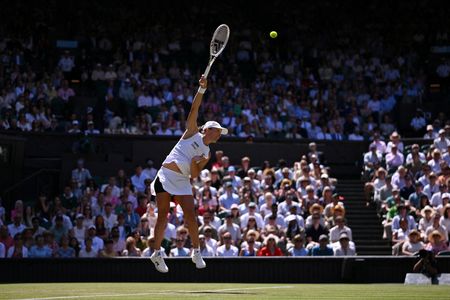

LONDON — Saturday brought another full day of action at Wimbledon, with play beginning under clear skies and temperatures hovering around 23 degrees Celsius at the All England Club.
Matches got underway at 10:07 a.m. GMT, with players competing across multiple courts throughout the day.
On Centre Court, where play began at 12:30 p.m. GMT, 29th-seeded Alexandra Eala of the Philippines faced third-seeded Iga Swiatek of Poland in a highly anticipated matchup. Also on Centre Court, sixth-seeded Amanda Anisimova of the United States squared off against 26th-seeded Madison Keys, also of the U.S. Grigor Dimitrov of Bulgaria rounded out the Centre Court schedule against Italy’s Matteo Berrettini.
Court Number One opened at noon GMT with 25th-seeded Elise Mertens of Belgium taking on second-seeded Elena Rybakina of Kazakhstan. American Marcos Giron then faced second-seeded Alexander Zverev of Germany, followed by a matchup between 17th-seeded Frances Tiafoe of the U.S. and 10th-seeded Alexander Bublik of Kazakhstan.
Court Number Two kicked off the day’s schedule at 10:00 a.m. GMT, featuring 23rd-seeded Emma Navarro of the U.S. against 12th-seeded Marta Kostyuk of Ukraine. That was followed by 19th-seeded Karen Khachanov of Russia taking on ninth-seeded Flavio Cobolli of Italy, and sixth-seeded Taylor Fritz of the U.S. meeting Italy’s Lorenzo Sonego.


A grain market report for June 2026 has been published, providing agricultural producers with an overview of market conditions and price trends during the month.
The report, which covers key grain commodities, is intended to help farmers and others in the agricultural industry better understand the current marketing environment and make informed decisions about their crops.
No additional details from the report were available in the source material provided.


Farmers and growers are being advised to keep a close watch on their fields for signs of fall armyworm, a damaging insect pest that can devastate crops if left unchecked.
Agricultural experts are raising the alarm about the potential for fall armyworm activity, urging producers to regularly inspect their crops for early signs of infestation. Catching the pest early is considered critical to limiting crop losses.
Fall armyworm is known for its ability to spread rapidly and cause significant damage to a wide range of crops. Growers who spot signs of the pest are encouraged to take action promptly and consult with their local agricultural extension office for guidance on management options.


When it comes to growing soybeans, timing matters — but not equally for every type of crop. New agronomic research indicates that the date a farmer puts seeds in the ground has a much more noticeable effect on double crop soybeans than it does on full season soybeans.
Double crop soybeans are typically planted after a winter grain, such as wheat, is harvested. Because the growing season is already shortened by the time those seeds go in, any delay in planting can have a significant impact on how much the crop ultimately produces.
Full season soybeans, by contrast, appear to be less dramatically affected by shifts in planting date, according to the research. While timing still plays a role, the yield differences seen in full season varieties are not as pronounced as those observed in double crop production.
The findings serve as a practical reminder for growers to prioritize getting double crop soybeans in the ground as quickly as possible after the preceding crop is harvested. Every day of delay during that critical window can translate into measurable losses at harvest time.
Agronomists say understanding these differences can help farmers make better decisions about how they manage their fields and plan their growing seasons, particularly in years when wheat harvest runs later than expected.


As the United States kicks off celebrations marking the 250th anniversary of its founding, the Trump administration is officially launching one of its signature financial initiatives — Trump Accounts — on Saturday, July 4th.
The program, which has been months in the making, is designed to encourage investing and financial education starting at birth. U.S. citizens born between 2025 and 2028 will automatically receive a government-funded investment account seeded with $1,000, giving families a starting point to build long-term savings.
Andy Blocker, head of policy, regulatory and government relations at financial services firm Edward Jones, called the initial contribution a meaningful step. “The $1,000 federal contribution at birth helps remove the barrier of having nothing to start with, which has historically been one of the biggest obstacles to saving,” he said. “If by year-end more families have a clear onramp to begin saving and investing for their children’s financial futures, that’s success.”
A number of major U.S. corporations have thrown their support behind the program, pledging employer matches or additional seed funding. Among the participating companies are payment giant Visa, technology firm Dell, and media and telecom company Comcast. Earlier this week, chipmaker Micron announced a $250 million commitment to support the accounts.
The program’s debut comes as the rising cost of living continues to weigh heavily on American families ahead of the November midterm elections. Across the political spectrum, policymakers have been pushing proposals aimed at helping households build wealth and strengthen their financial futures.
According to provisional data from the U.S. CDC, approximately 3.6 million children were born in the United States in 2025. While the $1,000 government contribution is reserved for U.S. citizens born during the current administration, parents can open a Trump Account for any child under 18 who has a valid Social Security number.
The Treasury Department is overseeing the program. Brokerage firm Robinhood and custodian bank BNY are serving as administrators. Treasury officials have urged families to stay alert to potential scams and fraudsters, and have published guidance on warning signs to watch for.
The accounts cost nothing to open. Parents, relatives, employers, and charitable organizations can contribute up to $5,000 per year on a pre-tax basis. All contributions are automatically placed into a low-cost index fund built for long-term growth. When account holders turn 18, they gain full control and can either withdraw the money or keep investing — though gains will be taxed at the time of withdrawal.
According to estimates on the Trump Accounts website, a child who receives the maximum $5,000 in annual contributions could accumulate roughly $271,000 by age 18, based on the historical average returns of the S&P 500. If those contributions continue, the account could potentially grow to around $13 million by age 55 — though actual results will vary based on market conditions.
At launch, all contributions will be directed into the State Street SPDR Portfolio S&P 500 ETF, a low-cost fund that tracks the U.S. stock market benchmark. The program’s broader investment lineup also includes ETFs from BlackRock and Vanguard, both of which offer wide exposure to U.S. equities.
Steve Quirk, chief brokerage officer at Robinhood, described the program’s underlying goal this way: “The thesis behind Trump Accounts is to have more people participate in the greatest wealth creation vehicle on the planet, which is the U.S. market.”
Not everyone is convinced the program will deliver on its promises. While supporters view Trump Accounts as a powerful tool for early investing, some policy experts are skeptical about whether it will meaningfully close wealth gaps. They argue that real-world results will depend heavily on families’ ability to make consistent contributions over many years, as well as sustained market performance over decades.
Adam Michel, director of tax policy studies at the Washington-based Cato Institute, was blunt in his assessment. “Government handouts have a long track record of failing to lift people out of poverty, and there’s little reason to think this one will be different,” he said. Michel also noted that employer matching contributions are likely to be concentrated among larger companies, adding, “The real benefit lands on families who already have steady jobs and the capacity to save.”


BAMAKO, Mali — Mali’s military announced Saturday that a number of towns in the country’s north had come under attack from rebel forces, with Gao and Sévaré among the locations targeted.
The announcement coincided with a declaration from a separatist organization of a fresh offensive aimed at seizing a northern town. Mohamed Elmaouloud Ramadane, a spokesperson for the Azawad Liberation Front (FLA), posted on Facebook that separatist fighters were moving against the town of Anefis.
As of Saturday, no reports of casualties had emerged from the attacks.
Mali has long struggled with armed insurgencies, including from groups tied to al-Qaida and the Islamic State, as well as a long-running separatist movement in the north. The separatists have spent years fighting to carve out an independent state in that region.
The conflict extends beyond Mali’s borders — neighboring Niger and Burkina Faso are also engaged in ongoing battles against al-Qaida and Islamic State-linked factions.
After military coups toppled governments in all three countries, the new ruling juntas abandoned their Western partnerships and turned to Russia for assistance in fighting Islamic militants. Despite that shift, the security situation has continued to deteriorate, with militant attacks reaching record levels. Government forces in the region have also faced accusations of killing civilians believed to be working with militant groups.
The violence has been escalating in recent months. In late April, the FLA joined forces with JNIM, the regional al-Qaida affiliate, in a coordinated assault that killed the defense minister in his home and allowed the attackers to seize control of several key towns in northern Mali.


Ukrainian drones struck an oil terminal in Russia’s city of St. Petersburg on Saturday, according to Russian officials, as Ukraine continues its sustained campaign against Russia’s energy infrastructure.
Near-daily long-range strikes on Russian oil facilities have triggered a fuel crisis and increased political pressure on the Kremlin, as the full-scale invasion of Ukraine now enters its fifth year.
Gov. Alexander Beglov confirmed that the city’s Kirovsky district, located along the Baltic Sea, was struck. He also reported that air defense systems managed to intercept 72 Ukrainian drones over Russia’s second-largest city and the surrounding area.
Ukrainian President Volodymyr Zelenskyy characterized the assault as part of what he called Ukraine’s “long-range sanctions” against Russia, adding that Ukrainian forces also targeted a military site on Kronstadt island, just off the St. Petersburg coastline.
“The Ukrainian defense forces hit the port oil infrastructure, which earns money for the Russian war, and there were also hits on Kronstadt — an important military target,” Zelenskyy wrote in a Telegram post.
This is not the first time the Kirovsky district has been targeted — it was previously struck in June, just before Russia’s prominent St. Petersburg International Economic Forum.
The Crimean peninsula, annexed by Russia in 2014, has also been hit hard by Ukrainian strikes, prompting local officials to halt gasoline sales to civilians. A separate Ukrainian attack on Saturday in Crimea left one person dead and two others injured, including a 10-year-old child, according to the Moscow-appointed Gov. Sergei Aksyonov.
Russian President Vladimir Putin has downplayed the strikes on Russia’s energy facilities, calling them “not critical,” and has insisted the war will press forward until his objectives are achieved.
Putin has framed Ukraine’s attacks on Russian energy as an attempt to divert attention from battlefield setbacks, though analysts note that Russian forces have seen their advances slow considerably in recent months.
On Friday, Putin visited the Russian military command center overseeing the war in Ukraine, where he received a briefing on the fall of the city of Kostyantynivka following weeks of intense urban combat. He called the capture a critical step toward seizing the nearby cities of Sloviansk and Kramatorsk — the last major strongholds in the heavily fortified “forest belt” of cities in the Donetsk region still held by Ukraine.
Dressed in military fatigues, Putin stated in televised remarks that taking Kostyantynivka, a significant transportation and industrial hub, carries “major strategic importance.”
Ukrainian officials are pushing back on that claim. General Staff spokesperson Maj. Andriy Kovalev, speaking to the Ukrainian outlet Ukrainska Pravda, called Moscow’s assertions “outright disinformation” and said Russian forces had not succeeded in seizing the city.
Despite the fuel crisis, Putin appears confident his government can prevent it from undermining public support for the war he launched more than four years ago. At minimum, the ongoing strikes have made the conflict increasingly real for millions of Russians, chipping away at Putin’s portrayal of the war as something that doesn’t touch everyday life inside Russia.
The border city of Belgorod, which has also been a repeated target of Ukrainian drone strikes, was left nearly without electricity on Saturday following overnight attacks, according to local media reports.
Separately, eight people were wounded — including two children — when a Russian strike hit residential buildings in Ukraine’s southeastern Zaporizhzhia region, local officials confirmed Saturday.


BEIJING (AP) — China’s military has elevated two officers to the rank of general, a move that analysts believe may signal an upcoming reshuffling at the highest levels of military command following a sweeping anti-corruption campaign.
The ongoing crackdown is widely viewed as part of an effort to strengthen the military’s allegiance to China’s ruling Communist Party and its leader, Xi Jinping, who also serves as the head of the military.
At a ceremony held Friday, Xi personally presented promotion orders to Zhang Shuguang and air force commander Wang Gang, both of whom were elevated to the rank of general. In addition to his promotion, Zhang was appointed to lead the corruption investigation unit within the Central Military Commission — the military’s highest governing body.
The two newly promoted generals are now considered potential candidates to fill open seats on the seven-member Central Military Commission, which has been whittled down to just two active members as a result of the corruption investigations.
Xi chairs the commission, and Vice Chair Zhang Shengmin is currently its only other functioning member. Two former vice chairs — including the military’s highest-ranking general — have been removed or effectively pushed out amid the probe.
The commission’s current five-year term is set to conclude in the fall of next year, at which point a new commission is expected to be formally announced.


WASHINGTON — The just-completed U.S. Supreme Court term made one thing abundantly clear: when President Donald Trump and Chief Justice John Roberts want the same outcome, they tend to get it. But when their priorities diverge, Trump loses — and Roberts is often the one writing the ruling against him.
Despite their starkly different personalities — Roberts is known as a reserved Midwestern institutionalist while Trump is an outspoken billionaire real estate developer from New York — the two found common ground in several landmark cases during the court’s nine-month term, which wrapped up Tuesday.
One of the most significant victories for Trump came in a ruling written by Roberts that granted the president sweeping authority to dismiss the heads of federal regulatory agencies. The decision fulfilled a long-standing conservative goal of giving the executive branch greater control over key government functions.
Throughout his second term, Trump has repeatedly pushed the boundaries of presidential authority in both domestic policy and foreign affairs, generating a wave of legal challenges. On the whole, the court has ruled in his favor more often than not.
However, three major cases exposed the fault lines between Roberts and Trump. In each instance, Roberts authored the majority opinion ruling against the president — on the legality of sweeping global tariffs, on birthright citizenship, and on Trump’s attempt to remove a member of the Federal Reserve Board of Governors. Those rulings drew support from a varying lineup of justices but were backed in every case by the court’s three liberal members.
John Yoo, a law professor at the University of California, Berkeley School of Law, said the defeats should silence critics who claim the high court functions as a rubber stamp for the Trump administration. “This term shows that Trump wins at the court only when his agenda coincides with Roberts’ agenda,” said Yoo, who previously served as a Justice Department attorney under Republican President George W. Bush.
SHIFTING TO THE RIGHT
Roberts has led the Supreme Court for two decades, serving under four presidents — two from each party. For much of that period, the court held a narrow 5-4 conservative majority, with former Justice Anthony Kennedy frequently serving as the deciding vote.
That balance shifted significantly when Trump, during his first term, appointed three justices: Neil Gorsuch in 2017, Brett Kavanaugh in 2018, and Amy Coney Barrett in 2020. The resulting 6-3 conservative supermajority has moved American law sharply rightward, producing decisions that rolled back abortion rights and affirmative action, expanded gun and religious freedoms, and curtailed the power of federal regulatory agencies.
That trajectory continued in the most recent term. In April, the court struck down a key provision of the Voting Rights Act, and on Tuesday it invalidated a campaign finance restriction — both outcomes consistent with the court’s conservative direction.
Syracuse University College of Law professor Jenny Breen described the continued weakening of the Voting Rights Act as “a decades-long project for Chief Justice Roberts.”
The 6-3 Voting Rights Act ruling, written by Justice Samuel Alito, made it more difficult for minority voters to challenge electoral district maps as racially discriminatory under the landmark 1965 civil rights law. The decision could allow Republican-led Southern states to redraw majority-Black and majority-Latino congressional districts ahead of November’s midterm elections. Black and Latino voters have historically leaned toward Democratic candidates, and Trump’s Republican Party is working to hold onto its congressional majority in November.
On the same final day of the term, the court also struck down federal limits on coordinated campaign spending between political parties and their candidates, citing free speech protections — a ruling that benefits Republicans heading into the midterms with a significant financial edge over Democrats.
PRESIDENTIAL POWER
Among the rulings drawing the most praise from conservative legal scholars and Trump supporters was a 6-3 decision in a case called Trump v. Slaughter. Written by Roberts, the Monday ruling overturned a 1935 precedent that had allowed Congress to shield leaders of independent regulatory agencies from being fired by the president without cause.
The case arose from Trump’s removal of Federal Trade Commission member Rebecca Slaughter. By siding with the president, the court dramatically expanded executive authority over the federal bureaucracy.
“His best work has come when the limits of the executive branch have been tested by Trump’s adversaries,” said Robert Luther III, a George Mason University law professor who worked in the White House Counsel’s Office during Trump’s first term, referring to Roberts.
The Slaughter ruling is widely viewed as the strongest affirmation yet of the “unitary executive” theory — a conservative legal doctrine that gained prominence during Republican President Ronald Reagan’s administration in the 1980s. The theory holds that the president has complete authority over the executive branch, including the unrestricted power to hire and fire agency heads.
American University Washington College of Law professor Elizabeth Beske called the ruling’s outcome “part of a decades-long John Roberts project.” She noted that “Roberts has always been a unitary executive guy, since his days in the White House Counsel’s office” during the Reagan years. “There have been a lot of scholarly headwinds in the past few years against the moves taken in Slaughter,” Beske added, “but I think he set out to do it long ago and could not be stopped.”
ECONOMIC SETBACKS
Two of Trump’s most painful defeats this term struck directly at his economic agenda.
In February, Roberts authored a 6-3 ruling throwing out Trump’s sweeping global tariffs, which the president had imposed under a law designed for national emergencies. Then on Monday, Roberts wrote another opinion blocking Trump’s effort to remove Federal Reserve Board member Lisa Cook — a decision aimed at preserving the independence of the central bank.
“Both of those decisions reflect the Supreme Court’s discomfort with changes that they fear might disrupt the market or economy more broadly,” said Breen. “Those decisions, in other words, are entirely consistent with the conservative economic orientation of the court.”
On the final day of the term, Roberts also wrote the majority opinion finding that Trump’s executive order seeking to deny birthright citizenship to children of certain immigrants violated the 14th Amendment to the U.S. Constitution, which grants citizenship to anyone born on American soil who is “subject to the jurisdiction thereof.”
Yoo pointed out that Trump’s push to end birthright citizenship conflicted with “an uninterrupted history of following that rule,” as well as a Supreme Court precedent set in an 1898 case known as United States v. Wong Kim Ark.
“Where Trump seeks outcomes because of their political salience, but he comes into conflict with these long-held Roberts Court principles, he has lost,” Yoo said.


As Americans across the country celebrate the nation’s 250th birthday with fireworks and parades, President Donald Trump is placing himself front and center at the festivities in Washington with a campaign-style rally on the National Mall.
Trump has described his evening appearance among the capital’s famous monuments as “the most spectacular TRUMP RALLY of them all,” promising military aircraft flyovers and an extra-large fireworks display to mark the occasion.
Cities around the country are hosting their own celebrations. Philadelphia — where the Declaration of Independence was signed 250 years ago on July 4, 1776 — is offering free cupcakes and a six-hour pop music concert. New York is welcoming tall ships from nations around the globe.
In Washington, the National Mall’s annual July 4 gathering typically attracts hundreds of thousands of visitors. This year, attendees must navigate heightened security measures, the potential for thunderstorms, and temperatures that could climb above 100 degrees Fahrenheit (38 degrees Celsius).
While past presidents have traditionally stayed out of the July 4 spotlight, Trump has blended official national commemoration with the feel of a political campaign event. A nonpartisan organization created in 2016 specifically to oversee the 250th anniversary has largely been pushed aside by the Trump administration’s Freedom 250 group.
That group has fenced off much of the 1.5-mile National Mall for what it calls a “Great American State Fair,” which includes attractions like a Ferris wheel alongside exhibits from conservative organizations and defense contractors. Several states led by Democratic governors declined to send delegations, and a number of performers who had been booked for the events withdrew, citing worries about the partisan direction of the celebration.
The events have sometimes struggled to draw large crowds, though thousands did attend Trump’s kickoff rally on June 24.
Other Freedom 250-branded activities include a faith rally featuring predominantly conservative Christian speakers, a mixed martial arts fight card held on the White House grounds tied to Trump’s 80th birthday, and an IndyCar race scheduled for Washington in August.
The Freedom 250 organization also sponsored what it called “Freedom Trucks,” which critics argue present an overly religious portrayal of American history while glossing over topics such as slavery and racial injustice.
A Reuters/Ipsos poll found that a majority of Americans think the 250th anniversary events have become too political — a view shared by three-quarters of Democrats and half of Republicans.
Trump also pushed for a broad makeover of Washington ahead of the anniversary, with uneven outcomes. While many fountains and statues have been restored, a heavily promoted $15 million renovation of the Lincoln Memorial’s Reflecting Pool has run into trouble, with security cameras and soldiers now standing guard over peeling paint and algae-covered water.


Here Now Health is not an artificial intelligence company — but without AI, it might never have gotten off the ground.
Michelle Turner, a first-time founder working out of her Virginia Beach home, used AI tools to teach herself about startup culture, draft a business plan, and sharpen her pitch for potential investors. The company officially launched in January 2025, and today it has 16 employees and is certified in three states to offer Medicaid-funded mental health counseling to children entering the foster care system — a gap Turner recognized through her own experience as a foster parent.
“A mom of six kids who’s a first-time founder, who’s a sole female founder, should not be able to raise (venture capital). I don’t have an MBA. I don’t have these things to back me up,” Turner said. She described using AI to develop her investor pitch as “like going to a master’s level class every day from the robot. It was my startup advisor.”
Turner’s rapid rise from nonprofit manager to company chief executive is drawing attention as AI continues to reshape the broader U.S. economy. Federal Reserve officials are closely watching the technology’s potential effects on productivity, economic growth, inflation, and employment. As part of a wide-ranging review launched by new Fed Chairman Kevin Warsh, one working group is focused specifically on AI and what it could mean for productivity — a force that can allow the economy to expand more quickly with less inflation, but that can also mean fewer workers are needed to produce the same results.
Some Fed officials have already raised the prospect of an AI-driven economy with persistently higher unemployment. Other analysts have pointed to a declining share of national income going to workers and questioned whether rising returns to capital could become a defining feature of the AI era — a question with serious social and political consequences.
The competition among AI models today draws comparisons to the early days of the internet, when brands like Yahoo! and America Online raced to connect users to the web. But today’s AI tools go far beyond browsing and shopping — they can perform complex tasks, write computer code, and solve problems that once required significant human effort.
Heavy investment in data centers is fueling economic growth while also pushing up energy and labor costs in some areas. Projections for where AI leads range from widespread prosperity to mass unemployment, with banks, government agencies, and the military all working to harness — and guard against — the new technology.
“Markets are confronted with dramatically different competing narratives,” said Jean Boivin, head of the BlackRock Investment Institute, speaking at a journalist seminar on Tuesday. “We are framing this as scarcity versus abundance… Scarcity is the story of the moment” — with the AI investment surge driving up certain costs and demand for capital — but, he added, “we are also talking about abundance… We are talking about AI that can lead to significant breakthroughs… Growth that might be breaking out of a 2% world.”
John Bailey, a nonresident senior fellow at the American Enterprise Institute and an adviser to one of the firms that invested in Here Now Health, says Turner’s story is becoming more common. He helped Turner from the beginning develop the AI tools she depended on.
For small business owners, Bailey said, “things that used to take too much time or cost too much — the price to access has fallen close to zero.” He added, “It is empowering entrepreneurs to scale faster and hire people. These are not AI companies. They are traditional companies trying to deliver services but do it faster, cheaper.”
Public discussion has largely centered on AI’s capacity to eliminate jobs, with waves of tech industry layoffs linked to the technology and evidence that companies are using it to shrink back-office and clerical workforces. But Bailey said he has grown more confident that AI will change and redistribute jobs rather than simply destroy them — much as earlier waves of technological change did.
Torsten Slok, chief economist at investment firm Apollo Global Management, credits AI with a recent uptick in new business formations, saying the technology is “dramatically reducing the cost and complexity of launching a company. As these firms scale, they will create jobs.”
How it all nets out may not be clear for years.
A recent surge in job creation has eased some concern that the U.S. was already entering a period when technology would replace workers fast enough to push unemployment higher — which would mark the first time a major new general-purpose technology proved, on balance, to be a net destroyer of jobs.
Richmond Fed President Thomas Barkin said in an earlier interview this year that he is grappling with the employment risks AI may bring, but he is also struck by reports from businesses that the technology is helping ease labor shortages in certain skilled fields.
“We are all quick to see the disasters, which is about jobs getting replaced,” Barkin said. But he noted that businesses in sectors like auto repair and manufacturing “are still in a world of saying they cannot get enough workers” and are turning to AI to make their existing staff more productive.
“It is still going to be a challenge. It is a ‘rust-belt risk’” for some white-collar occupations in particular, Barkin said. But “we are not an economy that has no shortages.”
The transition, though, could be painful for many workers. The spread of global trade in the 1990s wiped out long-established U.S. manufacturing communities, and programs designed to help displaced workers find new jobs largely failed. Over time, shrinking opportunity in parts of the Midwest and South is widely seen as having contributed to a rightward political shift and a rise in so-called “deaths of despair” tied to substance abuse.
Researchers warn a similar disruption may now be building for workers in clerical, administrative, and related roles — particularly those without college degrees who depend on work experience to advance. A study by the Brookings Institution and Opportunity@Work found roughly 23 million people whose most logical career step would take them into jobs highly exposed to AI replacement, effectively putting them at risk of being stuck in lower-paying positions.
“Disruptions in these roles can have outsized effects on workers’ ability to move into higher-wage work,” the researchers wrote, with the heaviest regional impacts expected in Florida, the Northeast, Texas, and California — a different geographic footprint than the manufacturing disruption of earlier decades.
For the Federal Reserve, both the ultimate outcome and the speed of the AI transition will matter, as near-term effects could look very different from long-run results — especially if a major productivity boom eventually materializes.
At his first press conference, Fed Chairman Warsh called AI the most significant economic shift “that we’ve had in my adult lifetime” and said the U.S. “is ultimately going to be better off” as a result.
But, he cautioned, “that certainly doesn’t mean it’s not going to be disruptive.”


Continental, the German automotive parts manufacturer, announced Saturday that it has reached an agreement to sell its ContiTech division — which produces rubber and plastic products — to private equity firm Lone Star Funds for €4 billion, or approximately $4.57 billion. The deal also includes the possibility of additional performance-based payments of up to €250 million in future years.
After standard financial adjustments, Continental anticipates receiving roughly €3.1 billion in cash from the transaction. Of that amount, the company plans to distribute approximately €2.5 billion back to its shareholders once the deal is finalized.
Company officials said the divestiture will allow Continental to sharpen its focus on its core tires business, which the company confirmed will not be affected by the sale.
Continental is still evaluating what impact the transaction may have on its financial outlook for the current fiscal year.
The ContiTech division has faced significant headwinds in recent months. In May, the unit eliminated 3,000 positions — including 1,600 jobs in Germany — as part of broader cost-cutting efforts. Continental had previously set a goal of saving €150 million per year by 2028 through reductions at ContiTech.
Reuters had reported on Friday, citing sources familiar with the matter, that the two companies were close to finalizing a deal for ContiTech, which manufactures rubber and plastic components primarily for industrial customers. The sale is expected to be completed by the end of 2026.

British clothing retailer Next is reportedly gearing up to make a takeover offer for the upscale department store chain Harvey Nichols, according to a report from Sky News published Saturday.
Reuters was unable to independently confirm the report, and neither Next nor Harvey Nichols responded to requests for comment.
According to Sky News, the potential acquisition is still in its early stages.
Harvey Nichols, which was established in 1831, carries a wide range of high-end products including cosmetics, fashion, food, and wine, as listed on its website.
The news comes on the heels of Next’s recent acquisition of footwear brand Russell & Bromley through an insolvency process, a deal that cost the retailer 2.5 million pounds, equivalent to approximately $3.34 million.




LONDON — Departing British Prime Minister Keir Starmer is making clear that whoever takes his place will need to invest just as much energy in global diplomacy as he did — dismissing the notion that Britain’s next leader could shift focus primarily to issues at home.
Starmer, who announced last month that he will leave office after two years as prime minister, told the BBC on Friday that foreign and domestic policy are too intertwined to treat separately, especially as the world grows more unstable.
“There’s often this discussion — what’s the right balance between dealing with international affairs and dealing with domestic affairs? They’re one and the same thing,” he said.
When asked directly whether a future prime minister could scale back time spent on diplomacy, Starmer was blunt: “No, I don’t think it is possible.”
The outgoing prime minister has drawn criticism from some corners over how heavily his tenure leaned into foreign policy matters. Lawmaker Andy Burnham, who is widely expected to be his successor, has signaled a different set of priorities — promising to concentrate on living standards, housing, infrastructure, and shifting more governing authority to Britain’s regions.
On Saturday, Starmer posted a video on X titled “With Keir,” in which he defended his administration’s international emphasis, arguing that Britain had reclaimed its standing on the world stage. He highlighted his government’s backing of Ukraine and its involvement in international coalitions as standout accomplishments.
“The fact that now other countries look to us for that leadership is something I’m really proud of having delivered in the two years we’ve had in government,” he said.
Beyond foreign policy, Starmer also pointed to stabilizing the economy, cutting child poverty, and making improvements to the National Health Service as achievements he is proud of from his time in office.


KYIV — Ukraine’s general staff issued a firm denial on Saturday, dismissing Russian claims that Moscow’s military had taken control of the key eastern city of Kostiantynivka.
“We deny this. These are more fake claims,” a general staff official stated.
According to the General Staff, Kostiantynivka has not fallen and remains firmly in Ukrainian hands.
“Military units and subunits of the 19th Army Corps of the Eastern Grouping continue to conduct defensive operations on designated lines within the town and on its approaches,” the statement read.
The dispute arose after Russia’s military informed President Vladimir Putin on Friday that its forces had successfully captured Kostiantynivka — a strategic objective Moscow has been pursuing as part of its broader push through the Donetsk region.
Kostiantynivka holds significant military importance as the southernmost of four key towns that together form a defensive line central to Ukraine’s effort to hold onto the heavily industrialized Donetsk region.
Military analysts note that if Russian forces were to take Kostiantynivka, it would provide them a launching point to drive northward along the defensive corridor, which has become the primary focus of their current campaign.
Russian forces have previously claimed to control portions of Kostiantynivka, one of several heavily fortified urban centers that make up what is known as Ukraine’s “fortress belt” in Donetsk.


BAMAKO — A Tuareg-led insurgent group claimed responsibility Saturday for attacking a northern Mali town where both government soldiers and Russian paramilitary forces are stationed, while residents in two additional locations across northern and central Mali reported hearing gunfire and explosions.
The violence represents the most recent challenge to Mali’s military-led government in the landlocked West African nation. Rebels had already carried out high-profile strikes in April, targeting the airport in the capital city of Bamako, killing the country’s defense minister, and seizing a series of army outposts in the north.
Mohamed Elmaouloud Ramadane, a spokesperson for the Azawad Liberation Front, known as the FLA, told Reuters that fighters from the organization attacked the town of Anefis in the northeastern Kidal region during the early morning hours Saturday. Government forces and Russian troops had moved into Anefis following the April offensive, during which the FLA and a regional al Qaeda-linked group took control of Kidal town.
Meanwhile, in the central city of Gao, a local official reported that gunfire and rockets had been directed at a military camp starting before sunrise Saturday. Authorities had not yet determined which armed group was behind that attack.
A government spokesperson had not responded to a request for comment as of the time of reporting.

DELMARVA — An Extreme Heat Warning issued by the National Weather Service in Mount Holly is in effect Saturday, covering the region through 8 p.m. Temperatures are reaching 100°F across Delmarva under mostly sunny skies, with a chance of showers and thunderstorms developing by evening. Producers are urged to keep workers and livestock out of direct sun during peak hours, monitor water intake closely, and check on vulnerable neighbors.
Saturday night will drop to 74°F with continued storm chances. Sunday brings a high of 90°F with additional afternoon storm potential, limiting the outlook for any clear fieldwork window.
Thursday’s closing futures marked the last full trading session before the Independence Day holiday. September corn settled at $4.23/bu, up $0.0025. August soybeans closed at $11.3625/bu, gaining $0.03. September Chicago wheat slipped $0.0025 to close at $5.9975/bu.
At Laurel Grain Company in Laurel, Delaware, September corn bids are at $4.68/bu. November soybeans at Laurel are bringing $10.98/bu.
Cattle futures finished Thursday’s holiday-shortened session lower. August live cattle dropped $2.60 to settle at $239.22. August feeder cattle fell $3.52 to $360.62. Lean hogs bucked the slide, gaining $1.70 to close at $98.75.
This article is based on the Delmarva Farm Report Update Morning Edition, July 4, 2026. Hosted by Tom Bradley.
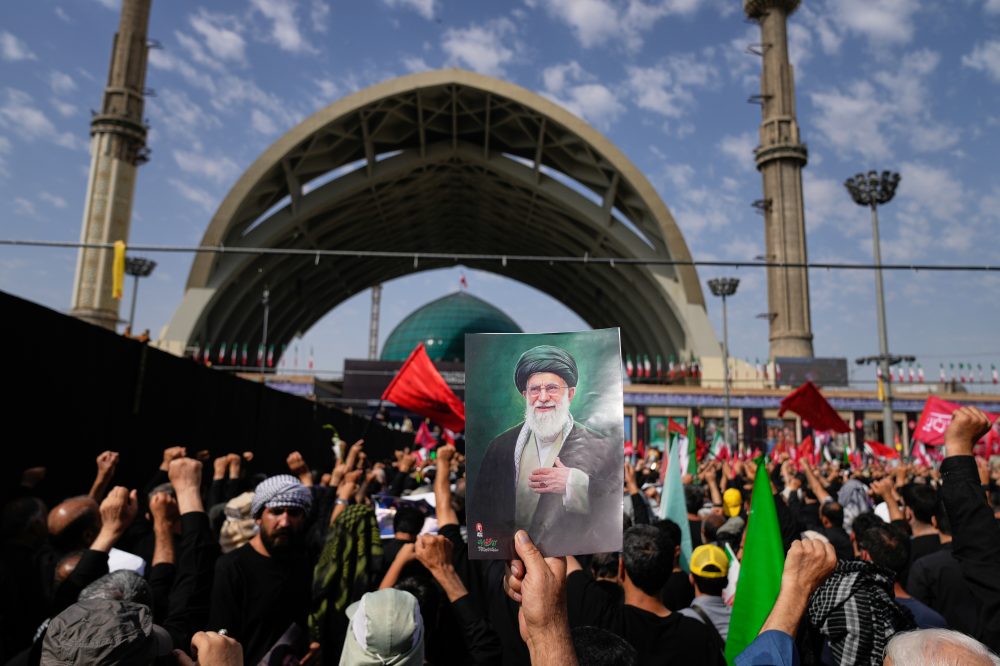

TEHRAN, Iran — A multi-day funeral for Iran’s late Supreme Leader, Ayatollah Ali Khamenei, kicked off Saturday as the country paused to honor the man who ruled with an iron fist for decades while consistently standing in opposition to Western nations.
In the capital city of Tehran, authorities closed off streets, halted air travel, and brought everyday life to a standstill as mourners gathered to pay their respects.
Following ceremonies in Tehran, Khamenei’s body is scheduled to be transported to additional cities throughout Iran, as well as to neighboring Iraq.
This report is accompanied by a photo gallery assembled by Associated Press photo editors.
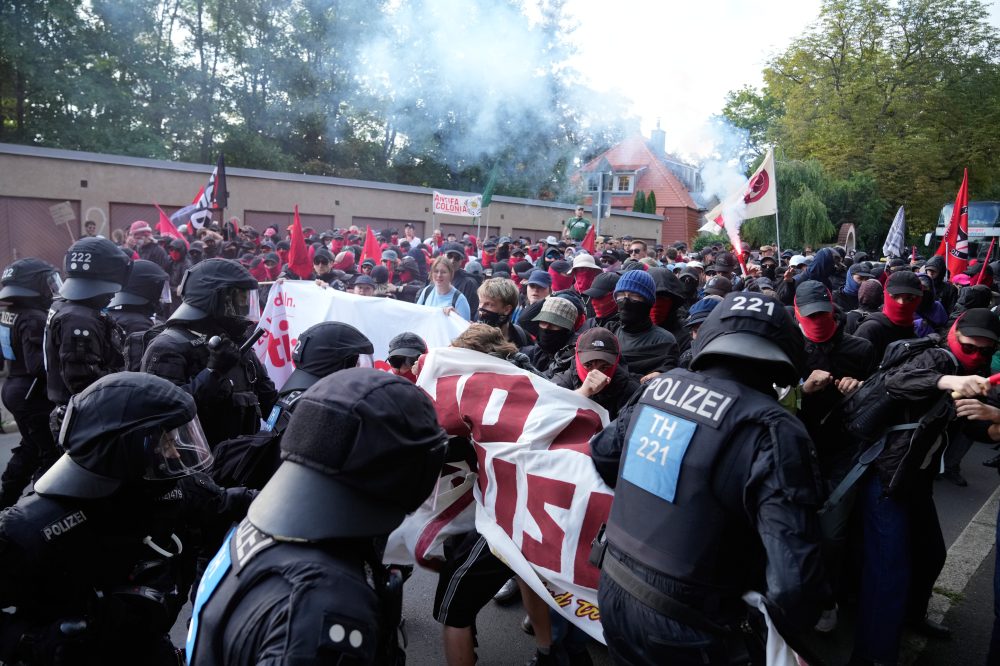

Thousands of demonstrators flooded the streets of Erfurt, Germany on Saturday in an effort to disrupt the national gathering of the far-right Alternative for Germany party, known as AfD. Tensions escalated outside the venue as some protesters came into direct conflict with police officers in riot gear.
The AfD convened in the eastern German city to hold its leadership elections, a process German political parties carry out every two years. The party is working to project a unified image as it moves to extend the leadership terms of Alice Weidel and Tino Chrupalla, who have jointly led the organization for the past four years.
The protests surrounding the convention highlight how deeply the AfD has polarized German society, even as the party holds the distinction of being the country’s largest opposition force at the national level.
The weekend event has stirred additional controversy because it falls near the 100th anniversary of a Nazi Party meeting held in the same area — a gathering that helped solidify Adolf Hitler’s control over the fascist movement. Historians and political rivals argue the timing carries significant symbolic weight, a charge the AfD flatly denies.
Weidel recently declared that “2026 is a year of destiny for AfD.” Established mainstream parties have maintained they will not partner with the AfD in governing coalitions, a position commonly referred to as a “firewall.”
Despite that opposition, the AfD has been capitalizing on widespread frustration with the current government’s efforts to revive a sluggish economy. The party has broadened its appeal well beyond its original focus on restricting immigration, which fueled its initial surge in the mid-2010s.
Looking ahead, the AfD is targeting 40% or more of the vote in a September 6 state election in the eastern region of Saxony-Anhalt. A result at that level could position the party for an outright majority or give it leverage to lure defectors from rival parties — potentially opening the door to its first-ever state governor.


BRATISLAVA, Slovakia — Citizens across Slovakia cast their ballots Saturday in a national referendum addressing two major questions: whether to eliminate lifelong monthly payments granted to Prime Minister Robert Fico and other senior officials after they leave their posts, and whether to bring back a special anti-corruption prosecutor’s office and related police unit that were shut down.
Under current law, Slovak prime ministers and parliament speakers who have served at least two terms are entitled to receive a monthly payment for life — equivalent to a lawmaker’s salary — once they leave office. The benefit was created as a security measure following a 2024 assassination attempt on Fico, in which he was shot and seriously wounded after a government meeting. The attack sent shockwaves through the small nation and drew widespread attention across Europe. Prior to 2024, only former presidents received such a benefit.
The referendum was triggered by a petition organized by the Democrats, a pro-Western opposition party that does not hold seats in parliament. More than 350,000 Slovaks signed the petition — the number required by law to force a national vote — in a country of 5.4 million people.
Despite the large number of signatures, polls ahead of Saturday’s vote indicated that turnout was unlikely to reach the 50% participation rate required for the referendum results to be binding. Slovakia has a difficult history with referendums — only one has ever succeeded, the 2003 vote on joining the European Union. All others failed because not enough voters showed up.
Earlier in 2024, Fico’s coalition government pushed through legislation dissolving the special prosecutor’s office, which had been responsible for investigating serious offenses including corruption, organized crime, and extremism. The government also disbanded the police unit that handled similar cases. The move drew fierce backlash both within Slovakia and internationally, with thousands of citizens taking to the streets in repeated protests. Several individuals connected to Fico’s political party had faced prosecution in corruption-related cases.
Fico has been a polarizing political figure since returning to power in 2023, with his pro-Russian stance and other policy positions sparking ongoing demonstrations. On the day of the referendum, Fico announced he would not be casting a vote.
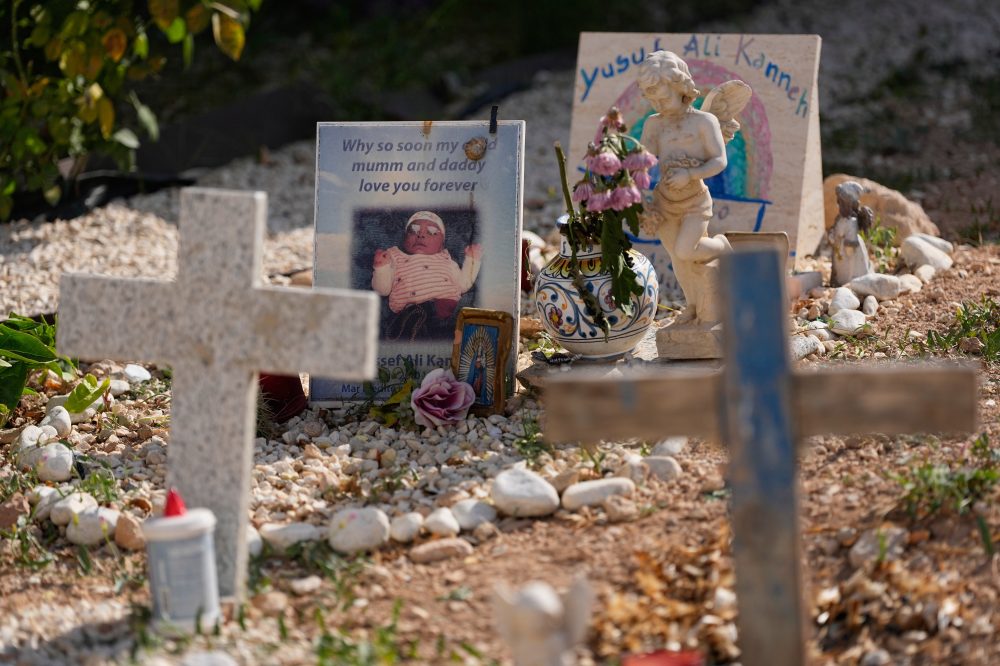

LAMPEDUSA, Sicily — While Americans celebrated the 250th anniversary of the Declaration of Independence with parties and fireworks back home, Pope Leo XIV chose the Fourth of July to make a deeply symbolic journey to one of Europe’s most contested migration flashpoints.
The first pope born in the United States — who has clashed with the Trump administration over its immigration enforcement policies — flew to the Sicilian island of Lampedusa on Saturday to honor the tens of thousands of migrants who have lost their lives trying to reach Europe in search of freedom and a better life.
On the occasion of the July 4th anniversary, Leo sent a letter to Americans arguing that protecting human life — including the unborn — also means “welcoming protecting and assisting immigrants, whose hopes, sacrifices and contribution have formed part of the history of this country from its very beginning.”
“To receive them with compassion and generosity is not only an act of charity, but also a recognition of the dignity that belongs to every human person,” Leo wrote.
Lampedusa is a small, treeless strip of rock measuring about 9 kilometers — roughly 5.6 miles — long. Sitting closer to the African coast than to the Italian mainland, it serves as the primary entry point into Europe for hundreds of thousands of migrants smuggled by boat from Libya and Tunisia.
The island has become the symbolic center of Europe’s heated migration debate, as the continent wrestles with enforcing its borders while meeting its legal obligations to shelter refugees escaping conflict, poverty, and climate change.
The International Organization of Migration has documented more than 35,000 migrants who have gone missing in the Mediterranean Sea since 2014. Experts believe the true death toll is considerably higher, as countless shipwrecks go unrecorded.
After landing on the island, Leo visited the local migrant cemetery to pay tribute to those who died and unveiled a plaque dedicated to Pope Francis at the main dock. He then celebrated Mass in the main town square.
Tareke Brhane, a migrant from Eritrea who serves as president of the October 3rd Committee — a nonprofit created by relatives of victims of a deadly 2013 shipwreck off Lampedusa that killed 368 people — called the pope’s gestures a “strong message” of solidarity.
“It is a strong sign for our battle with Italy and with Europe in order to register the deaths, because as of today we still do not have a registry (of those deceased),” Brhane told The Associated Press.
He added that Leo’s visit honors the dead and “gives a message to the relatives, so many of them still waiting and suffering.”
Leo’s trip echoes the legacy of Pope Francis, who made the welfare of migrants and refugees a central theme of his papacy. Francis himself visited Lampedusa in July 2013 — his first trip outside Rome after becoming pope — where he threw a wreath into the sea in memory of those who had drowned and condemned what he called the “globalization of indifference” toward migrants.
Leo has also recently visited another European migration hotspot in Spain’s Canary Islands, where he criticized leaders who turn migrants away without compassion and warned people smugglers of divine consequences for exploiting desperate individuals.
Salvatore Sortino, the head of mission for Italy and Malta with the International Organization of Migration, noted that while the number of migrants crossing the central Mediterranean has dropped this year, the proportion of deaths has actually risen.
“That speaks about the vulnerability that remains,” Sortino said. “So the visit of the pope here, where all this happens, I think is a very important reminder of that element.”
The International Rescue Committee estimates that 118 million people worldwide have been forcibly displaced in 2025 alone.
The papal visit comes roughly two weeks after the European Union began enforcing a new framework determining how each of its 27 member states handles irregular migration and asylum requests. Under the updated rules, migrants will be screened at EU borders for up to seven days before being admitted. Those considered a security risk or from designated “safe” countries will face an expedited review process, and rejected asylum seekers will automatically receive return orders.
Human rights organizations have pushed back against the new regulations, arguing they compromise the fundamental right to seek asylum by rushing the evaluation process. Critics say the accelerated procedures risk racial profiling and could deny protection to people with legitimate claims, while also warning of a likely surge in extended border detentions.
Italy’s Interior Ministry reported 14,464 migrant arrivals as of Friday this year — a sharp decline compared to 30,598 during the same period last year and 26,202 in 2024. Meanwhile, the number of both voluntary and forced deportations has increased under the current Italian government’s push to crack down on migration and the criminal networks behind it.


Tens of thousands of mourners packed a sprawling prayer complex in Tehran on Saturday as Iran launched a week of funeral ceremonies for Supreme Leader Ayatollah Ali Khamenei. The proceedings opened with the national anthem, religious eulogies, and readings from the Koran.
The Iranian government is organizing large-scale funeral processions for Khamenei, whose 37-year leadership came to an end in February when he was killed in the first airstrike of the war initiated by the United States and Israel. The elaborate ceremonies are seen as a demonstration of loyalty to the Islamic Republic’s theocratic government and its revolutionary principles.
Video broadcast on television showed Khamenei’s flag-draped coffin, topped with his signature black turban, placed on a large black platform designed to resemble the Kaaba — the cube-shaped structure at the heart of Islam’s most sacred site in Mecca. Alongside his coffin were four additional coffins belonging to family members who also died in the strike.
The enormous courtyard of the Imam Khomeini Grand Mosalla was filled with mourners waving Iranian flags and holding up photographs of the slain leader. Iran’s state broadcaster, Seda va Sima, reported that chants of “Death to America” rang through the complex, describing the occasion as a farewell to what it called “Mr. Martyr.”
Other state media outlets shared video in which mourners could be heard chanting: “Our slogan is one word: Revenge, revenge,” and “We will kill, we will kill he who killed our Imam.”
With summer temperatures running high, water was sprayed from rooftops to help keep the crowds cool. Khamenei’s coffin is set to remain at the Mosalla through Sunday evening.
Following that, his remains are expected to be transported to Qom, then to Najaf and Kerbala — major centers of Shi’ite Islam in Iran and Iraq — before the final burial on Thursday in Mashhad, the location of Iran’s most revered pilgrimage shrine.
The coffin had been publicly unveiled late Thursday to a crowd of grieving supporters who swayed and struck their heads in mourning as flowers were tossed from the bier into the crowd. On Friday, the coffin was placed on display in the grand prayer hall built to honor Khamenei’s predecessor, Ayatollah Ruhollah Khomeini.
Iranian authorities are working to mobilize millions of participants for the processions in the days ahead, offering transportation, meals, and accommodations to encourage attendance.
Khamenei’s son Mojtaba Khamenei, who has been named as the new supreme leader, has not appeared in any newly released images since he was wounded in the same strike that killed his father.


ERFURT, Germany — Tens of thousands of people marched through the eastern German city of Erfurt on Saturday, working to block access to the venue hosting the far-right Alternative for Germany party’s annual conference, as the group prepares for regional elections that could hand it control of a state government for the very first time.
Demonstrators representing labor unions, civil society organizations, and left-leaning political parties joined the protest, while police — including officers brought in from other parts of the country — were deployed in large numbers to manage the crowds. Authorities estimated approximately 15,000 people participated in demonstrations in and around Erfurt.
Protesters sat down in rows across roads and highways leading to the convention center, with officers in riot gear watching on. Georg Becker, a spokesperson for the anti-AfD coalition group Widersetzen — which translates to “Resist” — explained the motivation behind the demonstrations. “We want to make it clear that we simply won’t tolerate this, that fascism is on the rise here in Germany,” he said.
The conference is expected to see the party’s co-leaders, Alice Weidel and Tino Chrupalla, re-elected to their positions. It comes just before elections in the eastern German states of Saxony-Anhalt and Mecklenburg-Vorpommern, contests the AfD hopes will help build momentum toward success at the national level.
The AfD, which was established more than ten years ago, has surged ahead of Chancellor Friedrich Merz’s conservative bloc in national opinion polls. The party has built its following through nationalist messaging, calls for stricter immigration controls, and by appealing to voters who feel let down by years of economic stagnation and a string of governments that failed to address their concerns.
Critics of the AfD charge that the party promotes racist policies and holds views that are at odds with Germany’s democratic principles, arguing it poses a danger to the country’s constitutional framework. Established political parties have agreed not to work with the AfD under what is known as a “firewall” policy — a coordinated effort to keep the party isolated and out of governing coalitions.
AfD officials reject the claim that they stand against Germany’s democratic foundations. Earlier this year, the party won a court ruling requiring the country’s domestic intelligence agency to pause its classification of the AfD as an “extremist” organization.
The latest polling shows AfD support at roughly 29%, compared to around 22% for Merz’s CDU/CSU conservative alliance. The party also posted strong results in two regional elections held in western Germany earlier this year.
The AfD’s most significant base of support lies in the former communist eastern regions of Germany, where voter frustration with the established party system runs highest. In Saxony-Anhalt, recent polling places the AfD at 41%, far ahead of the Christian Democrats at 23%, as the party pursues an outright victory. It is also hoping to emerge as the top party in Mecklenburg-Vorpommern.


The National Weather Service office in Mount Holly, New Jersey has issued an Extreme Heat Warning covering the July 4th holiday, beginning at 3:57 AM EDT and lasting until 8:00 PM EDT on July 4th.
An Extreme Heat Warning is the highest level of heat alert issued by the National Weather Service, indicating that dangerously hot conditions are expected that could pose a serious risk to public health.
Residents are strongly encouraged to stay indoors in air-conditioned spaces as much as possible during the warning period. If you must be outside, drink plenty of water, wear lightweight and light-colored clothing, and take frequent breaks in the shade or cool environments.
Health officials typically remind the public during extreme heat events to check on elderly neighbors, young children, and pets, as these groups are especially vulnerable to heat-related illness. Never leave children or animals in parked vehicles.
Cooling centers may be available in your area. Contact your local government or emergency management office for more information on nearby resources.


The National Weather Service office in Mount Holly, New Jersey has issued an Extreme Heat Warning effective July 4th, beginning at 3:57 AM EDT and lasting through 8:00 PM EDT that same evening.
Residents are advised to take the warning seriously, as extreme heat can pose significant health risks, particularly for vulnerable populations including the elderly, young children, and those with underlying health conditions.
Officials recommend staying indoors in air-conditioned spaces during peak heat hours, drinking plenty of water, and checking on neighbors and family members who may be at risk.
The warning remains in effect through the evening hours of the Fourth of July holiday.