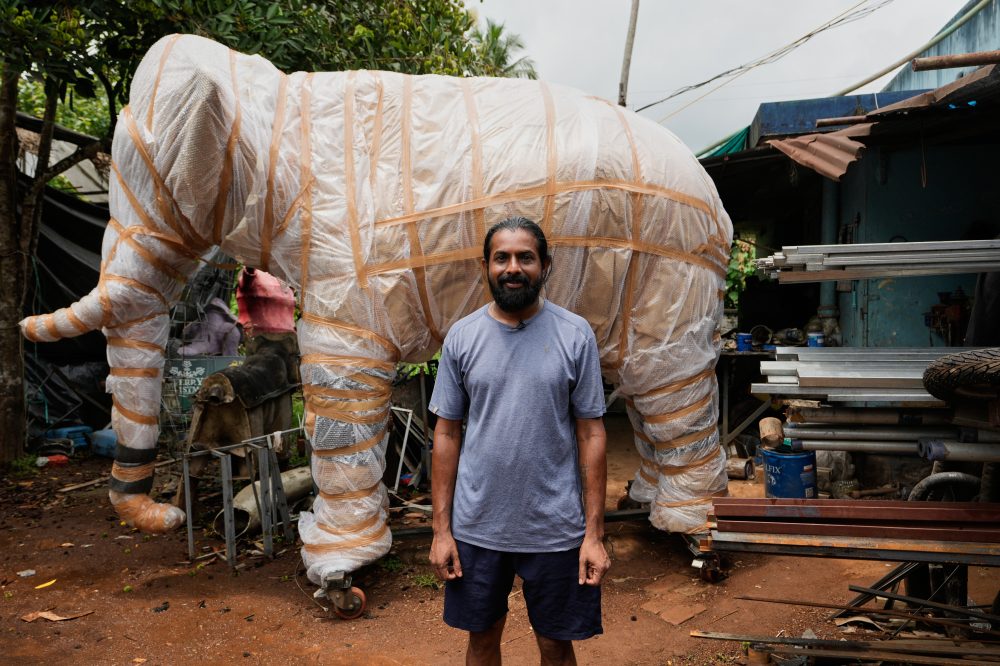

Inside a backyard workshop in Chalakudy, India, mechanical engineer Prasanth Prakashan has built life-size robotic elephants capable of flapping their ears, swishing their tails and spraying water from their trunks.
Beyond those features, however, the fiberglass, iron and rubber animatrons have little in common with the living animals that hold deep spiritual significance across India. These machines are designed to serve as stand-ins for real elephants at Hindu temples — a development that has sparked both enthusiasm and fierce opposition.
Animal welfare advocates are applauding the shift, while many devoted temple-goers insist that living elephants are an essential, irreplaceable part of religious tradition and festival culture.
The animal welfare organization PETA and several other nonprofits have donated roughly 40 robotic elephants to Indian temples, each one costing approximately $6,000, with the goal of replacing live animals used in religious ceremonies.
The robotic versions are considerably lighter than real elephants and lack the natural, flowing movements of the real thing. Electric motors control the head and eye movements, and the body parts are made to flex in an effort to appear more lifelike.
Prakashan is candid about the limitations of his creations.
“You can’t create an original elephant just as you cannot duplicate a human,” he said. “But we try to capture the majestic animal’s essence as much as we can.”
One capability still missing from his robots is the ability to walk — though Prakashan says that won’t last long.
“But they will,” he said with a smile. “I’m working on it.”
The reverence for elephants extends beyond Hinduism. Buddhists view elephants as symbols of patience, wisdom and enlightenment, drawing comparisons to the Buddha himself. In Kandy, Sri Lanka, 100 decorated elephants march through the streets each year, with the largest carrying the Buddha’s tooth relic inside a golden casket.
In the Kerala region of India, festivals featuring live elephants draw enormous crowds. The annual Pooram parade at the Thrissur Vadakkunnathan temple showcases around 100 elephants dressed in golden headgear and vibrant silk coverings, accompanied by handlers waving peacock feathers and yak-hair whisks.
About 40 miles away, the Guruvayur Sree Krishna Temple is home to nearly 50 elephants and hosts an annual elephant race along with a ceremonial feeding ritual in which the animals receive rice, ghee, jaggery, fruits and vegetables after prayers.
Elephant parades also appear at other religious institutions in Kerala, including St. George Orthodox Syrian Church in Kunnamkulam and the Pattambi Mosque in Palakkad district.
Some temple elephants have achieved celebrity status. One elephant, Thechikkottukavu Ramachandran, has nearly 150,000 followers on Facebook. Another, Guruvayur Keshavan — widely considered the most famous temple elephant before his death in 1976 — has been honored with a life-size statue near the temple he served, and his life story inspired both a film and a television series.
Andrea Gutierrez, a professor at the University of Texas who has studied captive elephants in South Asia, noted that Kerala’s temple elephants are exclusively male, which creates a significant safety concern. Adult male elephants periodically experience musth, a condition that dramatically increases aggression due to a testosterone surge that can reach up to 60 times normal levels.
“But people want these huge impressive tusks, which almost feels like a military presence,” Gutierrez said.
Despite stricter regulations around elephant ownership, nearly 400 elephants remain in captivity in Kerala, out of roughly 2,500 throughout India — a figure that has dropped by about half since 2010.
Khushboo Gupta, vice president of policy at PETA India, said the visual appeal of live elephants does not excuse the mistreatment they endure, including being shackled, beaten and separated from their families. The danger is real: nine people were killed in 2024 during elephant rampages at Kerala temple festivals.
“These elephants are forced to stand there for hours in the heat, with large crowds, drums and fireworks,” Gupta said. “Any trigger could cause them to go on a rampage.”
Prakashan, who normally builds animatronics for malls, amusement parks and carnivals, first caught PETA’s attention in 2023 when a video of his robotic elephants at a Dubai festival went viral. Gupta then reached out to him and Sooraj Nambiat, a Kochi-based artist who creates elephant sculptures, about developing a robotic elephant suitable for temple use. Demand for Prakashan’s creations quickly took off.
His earliest model used a rubber exterior, but he has since transitioned to more long-lasting fiberglass molds. Artists carefully craft the flexible rubber sections, replicating fine details like the animal’s wrinkled skin and the veins visible in its ears. From start to finish, Prakashan and his team can now complete a robotic elephant in about 15 days.
“It was something we had to figure out on our own,” Prakashan said of the pioneering process.
His first robotic elephant, named Irinjadapilly Raman, was installed at the Irinjadapilly Sree Krishna Temple in 2023. On a recent visit, two children were seen laughing and wrapping their arms around the robot’s trunk — something that would never be safe with a real elephant, according to the temple’s head priest, Rajkumar Namboothiri.
Namboothiri added that the ancient tantric texts governing Kerala temple rituals do not actually mandate the use of live elephants. He believes the tradition began centuries ago when elephants were part of royal cavalries and palace life.
“They had trees and forests before,” Namboothiri said. “Now, we have concrete jungles, heat and noise. … Elephants are tortured and abused. It’s not right.”
He also noted that while elephants were historically chosen for religious processions because of their impressive height, the same effect could be achieved using portable palanquins or chariots.
Temple devotee P.C. Subhash said he supports keeping live elephants at larger temples as a matter of tradition, but sees robotic alternatives as a practical solution for smaller temples that struggle with the high costs and liability insurance requirements.
“I really hope more people come to accept them,” Subhash said.
K.I. Purushottaman, president of the Cheekamundi Sri Mahavishnu Temple in Thrissur, said switching to a robotic elephant has brought him significant relief, as temple administrators had long worried about the risk of a deadly attack.
“With a robotic elephant, we don’t have that fear,” he said. “That’s a big relief.”
Not everyone shares that sentiment. K. Mahesh, who rents out his real elephant for festival appearances about 45 days each year, firmly believes elephants are holy beings that cannot be replaced by machines.
“If you don’t believe elephants are sacred, what’s the point of a robotic elephant in a temple?” he asked.
Mahesh said he has owned his elephant for 25 years and describes the animal as being “like a family member or a pet” that brings happiness to those around it, as long as it is handled with appropriate care.
A number of temple administrators have formally rejected the use of robotic elephants in rituals and festivals. Artist Nambiat said the backlash has become so intense that he no longer feels comfortable attending temple events.
“This is my trade. … I’m not out to ruin their tradition,” he said. “But, if we don’t stop treating elephants like commodities, future generations won’t have them.”
P.S. Easa, a wildlife biologist and elephant expert based in Kerala who helped write the state’s captive elephant regulations, acknowledged that while enforcement remains difficult, the rules have offered some protection for the animals.
“Sadly, there’s a lot of money to be made with elephants,” he said. “It’s not about spirituality or even tradition. It’s religious tourism.”
Easa expressed doubt that robotic elephants will gain widespread acceptance within his lifetime.
“You cannot change centuries-old tradition anytime soon,” he said. “But who knows? Maybe if these robotic elephants can start walking.”