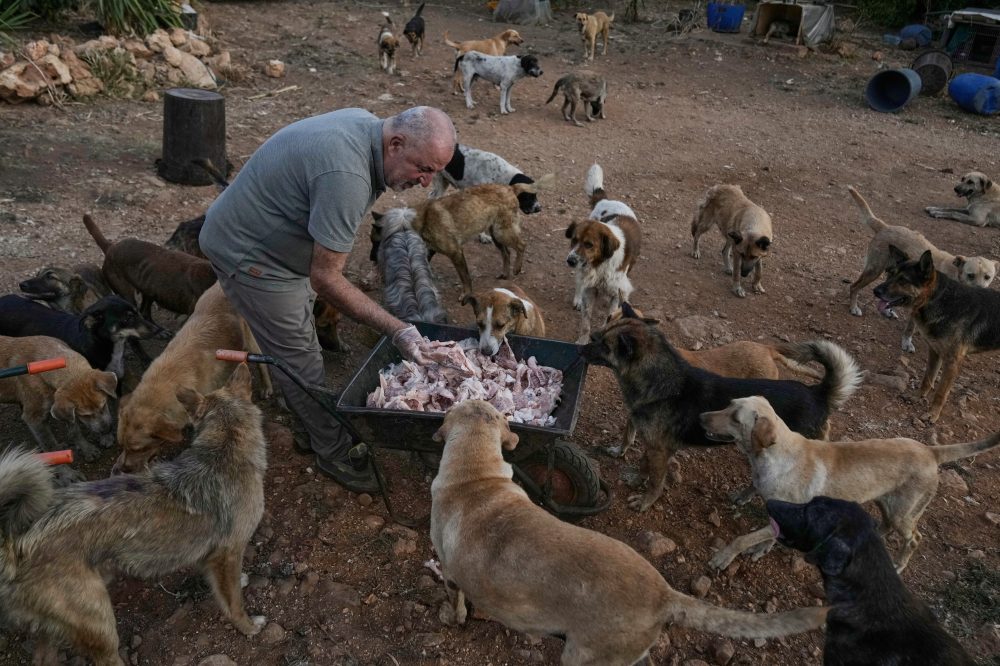

KFAROUE, Lebanon — Every day, Hussein Hamza walks his rounds through a village in southern Lebanon, tending to a growing collection of animals that the war left behind.
Since the latest conflict between Israel and Hezbollah erupted, the number of animals under Hamza’s care has surged dramatically. As hundreds of thousands of southern Lebanese residents fled their homes, many had no choice but to leave their pets and livestock behind. In other cases, the animals’ owners were killed in Israeli airstrikes. Some of the animals arrived at his shelter already injured.
The war in Lebanon started on March 2, after the Iran-backed Lebanese militant group Hezbollah launched missiles into Israel following attacks on Iran by the U.S. and Israel.
When Hamza makes his rounds, dozens of dogs swarm around him, tails wagging as he wheels a barrow full of chicken pieces to distribute. Several of the dogs are missing limbs. One has an infected foot wound that Hamza tends to personally. He then moves on to carry water buckets into an enclosure where chickens and two camels are kept.
“During the war, people contacted us and told us they had left their chickens behind because everyone had to evacuate suddenly,” Hamza said.
While Kfaroue itself experienced some airstrikes, it remained relatively peaceful compared to communities closer to the Israeli border, where entire villages were destroyed and Israeli forces have occupied large stretches of land.
“They asked us to bring the chickens here, because if they were left roaming free, foxes might eat them, and otherwise they would die from hunger and thirst,” he said. “We managed to rescue only the chickens we could reach — not all of them. There were areas where the fighting was too intense and we couldn’t get there.”
With a fragile ceasefire now in place, Hamza is holding the animals and waiting for their owners to return and collect them.
Hamza’s history with animal rescue dates back to 2006. His shelter, called Mashala — an Arabic phrase meaning “what God has willed” — has operated at its current location for seven years.
While the war has expanded the shelter’s responsibilities, it has also strained its already tight finances.
“When I first started, I paid for everything myself,” Hamza said. “I had an agricultural business, and I kept spending from my own money until I went bankrupt.”
He eventually launched a Facebook page to seek donations from the public.
According to Hamza, the shelter burns through roughly $400 to $500 each day covering food, veterinary care, spaying and neutering procedures, staff wages, fuel, and maintenance costs.
Fundraising has become increasingly difficult as Lebanon faces an overwhelming number of humanitarian crises. Many donors are directing their money toward efforts that support displaced or injured people, Hamza noted.
He understands that priority, but believes people still have a duty to the animals that rely on them.
“We shouldn’t neglect these responsibilities because of wars or because of the poverty we face,” he said.
Ongoing instability and fears of renewed fighting have made many potential adopters hesitant, though some of Hamza’s dogs have managed to find new homes. Abbas Shoeib brought home a black pit bull mix whose previous owners died in an airstrike.
“A dog needs someone to take care of him, and when you take care of him, he will take care of you,” Shoeib said.