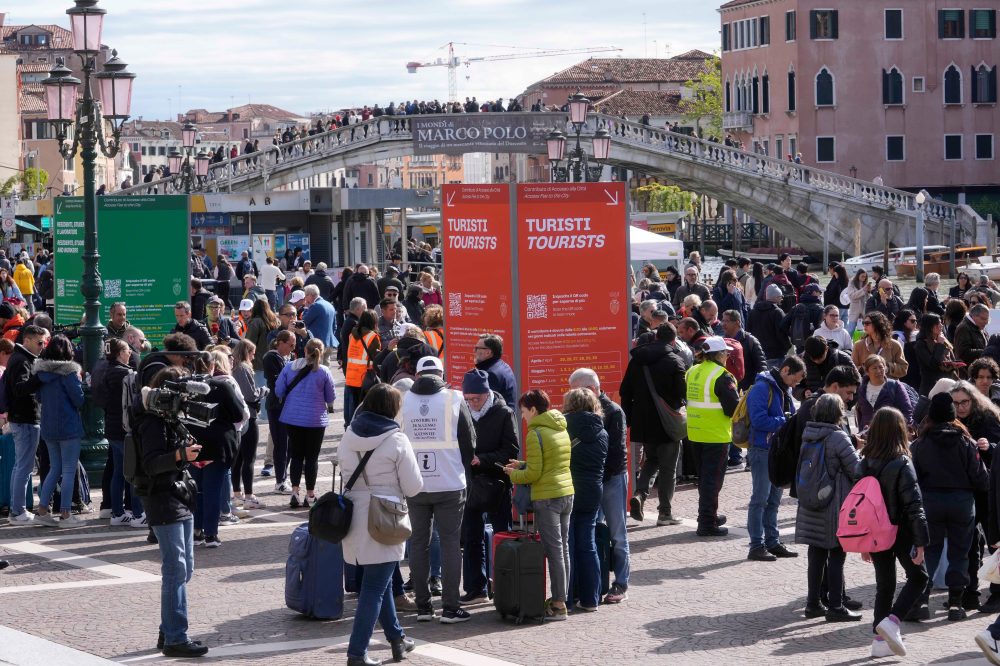

MILAN (AP) — Venice’s new mayor is calling for an overhaul of the city’s three-year-old tourist access fee, proposing a surge-pricing model that could charge day visitors up to 50 euros — roughly $59 — on the city’s most crowded days.
Mayor Simone Venturini spoke with The Associated Press in an interview Friday, explaining that the existing 10-euro charge for last-minute reservations has fallen short of discouraging visitors during peak periods. Rather than simply raising the fee to a fixed higher amount, the city wants to implement a flexible pricing structure that rises along with demand.
Venturini said the approach would serve two purposes: reducing overcrowding and helping to fund the ongoing cost of keeping the city functioning.
“We spend 100 million euros a year just to maintain Venice physically, and nobody gives us that money. Not Europe. Not the Italian state. International critics don’t pay it either. It’s paid by the people of Venice, and in part through tourism taxes,” said Venturini, who was elected mayor last month. He had previously served as the city’s top tourism official when the day-tripper fee was first introduced in 2024.
The access fee has drawn steady criticism from activists, housing advocates, and opposition politicians who argue it hasn’t meaningfully reduced crowding and effectively turns Venice into a ticketed attraction. Critics also contend the city is too focused on managing tourist numbers rather than finding ways to bring more permanent residents back to the historic city center.
Venturini pushed back, saying the revenue is essential for basic upkeep. Implementing a surge-pricing structure would require an amendment to the special Italian law that governs Venice, and Venturini said he has already raised the idea with the country’s tourism minister.
“Day-trippers obviously generate waste — they eat, they drink, they throw things away. That comes at a huge cost,” he said, adding that expenses are driven up “because everything has to be done by hand, with brooms, boats and handcarts.”
Although the proposed 50-euro ceiling has drawn headlines and criticism — particularly over its potential impact on families and budget travelers — Venturini clarified that the figure represents an upper boundary, not a standard charge. The city is still working with researchers to identify the right pricing levels.
“If, for example, more than 40,000 people had already booked for a given day, those above that threshold might be asked to pay a little more — 20, 25 or 30 euros,” Venturini said. “We asked for a broad range, up to 50 euros, and then it would be up to the city to manage the system through further testing. It doesn’t mean everyone who comes to Venice would pay 50 euros.”
Opposition politicians have suggested capping the total number of visitors allowed into the city each day, but Venturini said existing Italian law does not permit that kind of hard limit.
According to the most recent figures tracked by the Ocio housing advocacy group from January, the number of residents living in Venice’s historic canal district has fallen below 48,000, while the number of available tourist beds has climbed above 51,500. Venturini argued that the residential population is likely undercounted, since many students and seasonal workers live in Venice for much of the year without officially registering as residents.
“That doesn’t mean we are satisfied. We need to do more,” he said.
During the program’s 2024 test phase, Venice collected 2.4 million euros from more than 485,000 day-trippers across 29 peak days. Last year, the city expanded the program to 54 days and doubled the last-minute fee to 10 euros, bringing in 5.4 million euros. This year, six additional days have been added to the schedule, though no data on visitor numbers or revenue has been released yet.
Venturini acknowledged that the funds collected so far cover “only a small part of the costs of managing tourism.”
“The goal is not to raise money or to turn Venice into a ticketed city,” he said. “The goal is to give both residents and visitors a better experience on days when the city would otherwise be too crowded.”